Microorganisms help in the fertility and endurance of soil. Additionally supporting the growth of several biological systems, soil and soil microorganisms fill in as the best mode for plant growth. Soil microbes are essential for recycling old plant material and decaying organic matter. In the upkeep of the Environment microbial diversity plays a dominant role. The current paper is focused on the seasonal variations in the microbial count, which are increased or decreased (Impact on counts) in the Gautala reserve forest. In the present study, soil samples from Gautala Reserve Forest were collected from 15 different sites during the rainy, winter, and summer seasons. The present study was attempted to cover the microbial diversity of the whole Gautala forest through covering maximum sampling spots. The average total microbial count (TMC) in the rainy season for plate 1 and plate 2 was 36.73 and 35.46 respectively and the final count was 36.4 × 10⁶. The average TMC in the winter season for plate 1 and plate 2 was 32.4 and 31.93 respectively and the final count was 32.46 × 10⁵. The average TMC in the summer season for plate 1 and plate 2 was 37.13 and 36.4 and the final count was 37.6 × 10⁴. The bacterial colony at sampling points 1, 4, and 7 exhibits presence of Gram-Negative Bacteria; whereas the rest of the sampling spots showed presence of Gram - Positive Bacteria. There were three types of Gram-negative and 12 were found to be Gram-positive bacteria with three genera i.e. Pseudomonas spp., Bacillus spp., and micrococcus spp. This paper discusses seasonal fluctuations in microbial counts and associated laboratory culture techniques and statistical analysis methods.
Soil is one of the most significant biological factors, developed naturally by the rock weathering process 1. Soil is an essential component of the terrestrial ecosystem, as it supports immense biodiversity in terms of species diversity and functionality 2, 3. It’s a vivacious habitat for the enormous diversity of life forms. It covers various animals from invertebrates such as worms and insects to mammals like rabbits, badgers, and rodents. It is also a habitation of microorganisms 4. Microbial populaces in soil are determined by various factors such as soil depth, organic matter, bulk density, soil pH, etc. The microbial populace in soil counts for a large mass of organic matter on this planet. The soil microorganisms consist of bacteria, archaebacteria, yeast, fungi, algae, and protozoa 5. Microorganisms can remain in the surroundings with humans, hot springs, internal rocks and very cold temperatures, and severe conditions that include very cold temperatures 6. Soil microorganisms are the most diverse organisms that play an important role in biological cycles. However, environmental conditions that affect the number and composition of soil microbial communities prevent the role of soil biodiversity in ecosystem services 7.
The present study was attempted to study the gram negative and gram positive bacteria from the study area with the prime intention to observe the present status of biota with respect to existence of biodiversity. Mapping of microbial diversity of soil has numerous effects on the number and composition of soil communities. Present study was also aimed to study the colony characteristics and microscopic observation of isolates where priority was given to colony counts from the study area. Soil generally contains 109 to 1010 microorganisms per gram (dry weight), which can represent more than one million species of bacteria 8. The characterization of microorganisms allows a glimpse of their potential physiological capacities and their impact on soil ecosystems 9. Tree cover of forest can be increased by allowing space for the overall vegetation cover, planting, and natural regeneration 10. The present study is focused on the seasonal variations in microbial counts and the identification of the microbial populace of Gautala Autramghat Wildlife Sanctuary.
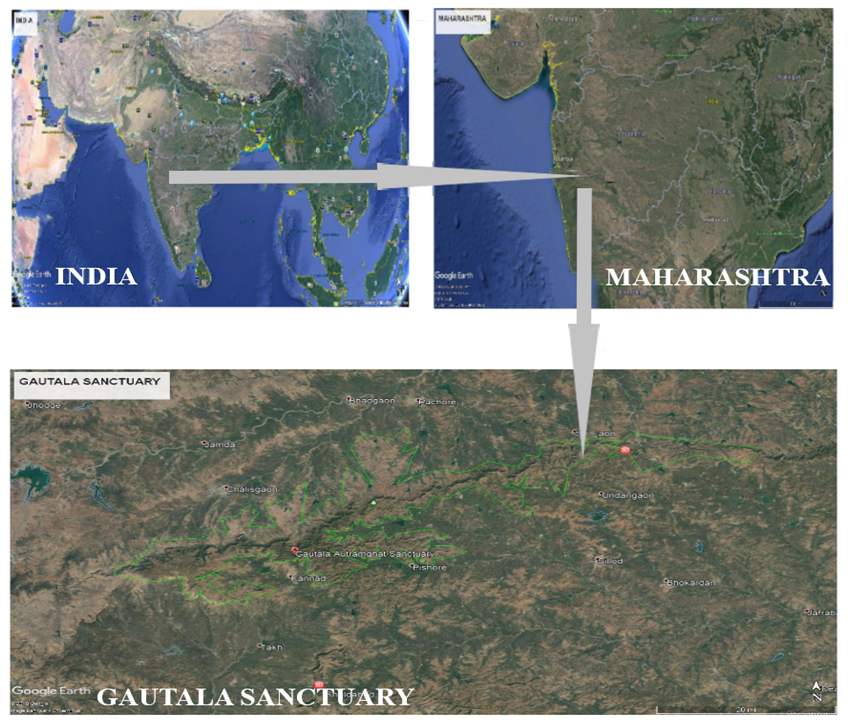
Gautala Reserve Forest, also known as ‘Gautala Autramghat wildlife sanctuary’, is situated in the west-north direction of the Aurangabad District, Marathwada region. It is expanded in about 261 sq. km, at longitude E 740, 55’, latitude N 190, 54’, and at altitude 1904 ft. 11, 12, 13. Gautala is a Tropical Dry Deciduous Forest receiving an average annual rainfall of 600 mm. The average maximum temperature is about 42°C and the average minimum temperature is about 8°C.
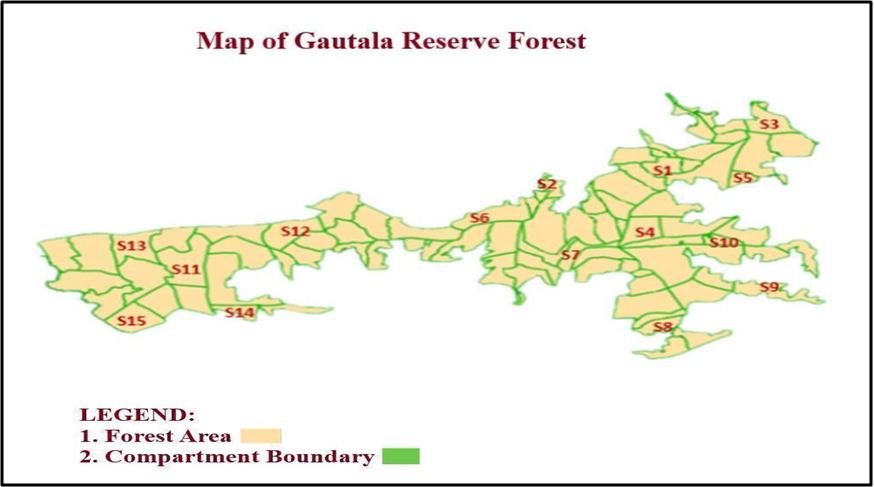
2.2. Sample CollectionThe Soil samples were collected from 15 different sites maintaining an average km distance among each other (Figure 1 and Figure 2). A sterile spatula was used for soil sample collection and the samples were stored in a sterile zip-lock pouch with proper labeling. All the samples were then without delay transferred to the laboratory.


Microbial growth was determined in terms of Colony-forming Units (CFU) in each soil sample, using the pour plate method. 10-4, 10-5, and 10-6 series of soil sample suspensions in distilled water were prepared 14, 15. 1ml of these stock solutions was transferred to the labeled sterile Petri dishes. A molten agar medium (40-45°C) was then transferred to the plate containing soil suspension and blended well by slightly rotating the plate. After the cooling and hardening of the agar, the plates were incubated at room temperature for 3-5 days. Pour plates for all the samples were made in triplicates 16, 17, 18.
CFU visible with the naked eye were counted as per the following formula 19:
 | (1) |
Microbial growth was determined in terms of SPC in each soil sample, using the pour plate method. 10-4, 10-5, and 10-6 series of soil sample suspensions in distilled water were prepared 14, 15. 1ml of these stock solutions was transferred to the labeled sterile Petri dishes. A molten agar medium (40-45°C) was then transferred to the plate containing soil suspension and blended well by slightly rotating the plate. Later the agar has cooled and hardened, the plates were incubated overnight in an incubator at 37°C. Pour plates for all samples are made in triplicate 16, 17, 18.
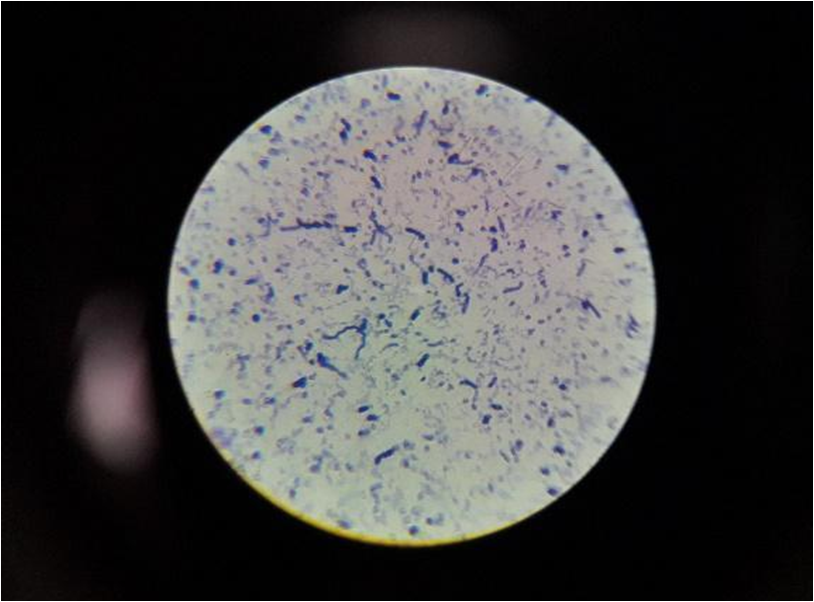
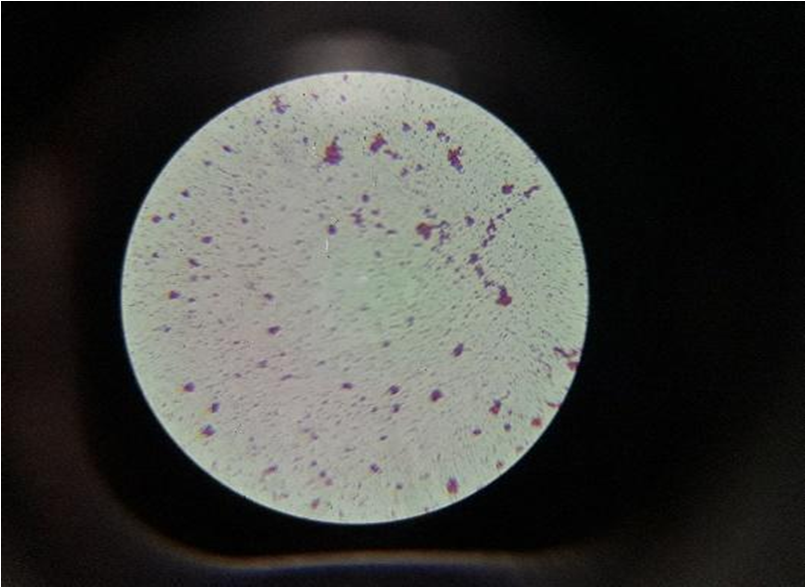
Bacterial growth was determined using Gram staining method. Smear of cells was taken on an inoculated glass slide with the help of an inoculating loop. Then it was air dried and heat fixed with the help of flame. Crystal Violet stain was applied on the slide for 1 min then washed off by distilled water. The same procedure was followed by Gram iodine staining. After this, slide was rinsed with decolorizer - 95% ethanol followed by distilled water wash. Finally, safranin stain was applied on the slide for 1 min and washed off with distilled water. After drying the slide was ready to observe under a microscope 20. LABOPHOT-2 (Nikon, Japan) was used for bacterial identification.


Pearson Correlation test, two-way ANOVA test, and Tukey’s test were utilized to analyze the results of Microbial counts seasonally. The correlation test was conducted between three seasons (Rainy, winter, and summer). R Studio software was used for qualitative and statistical data analysis.
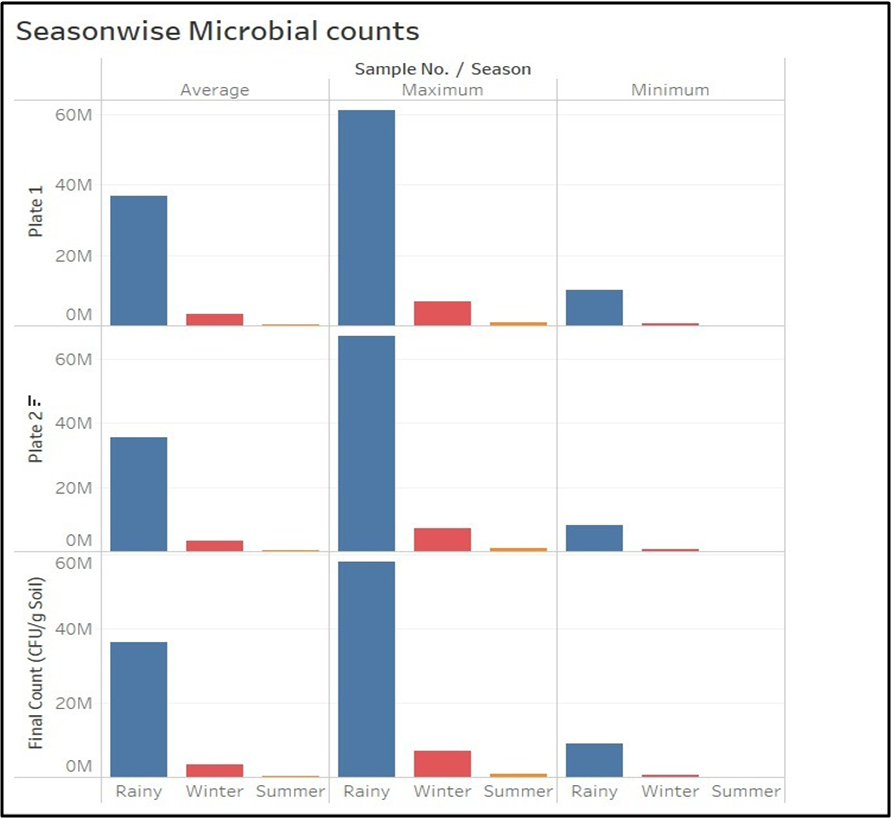
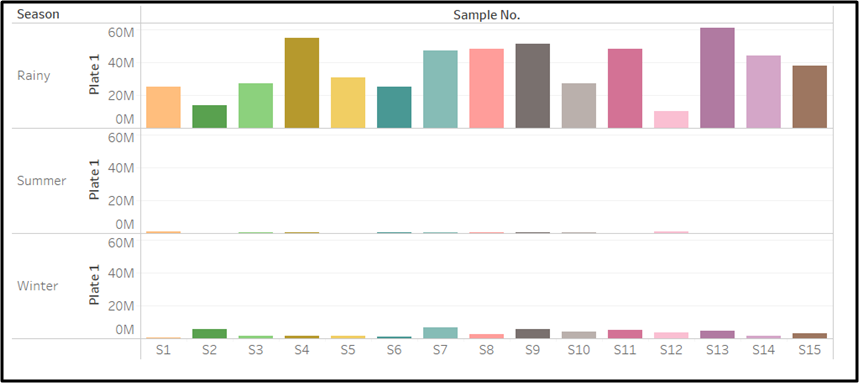
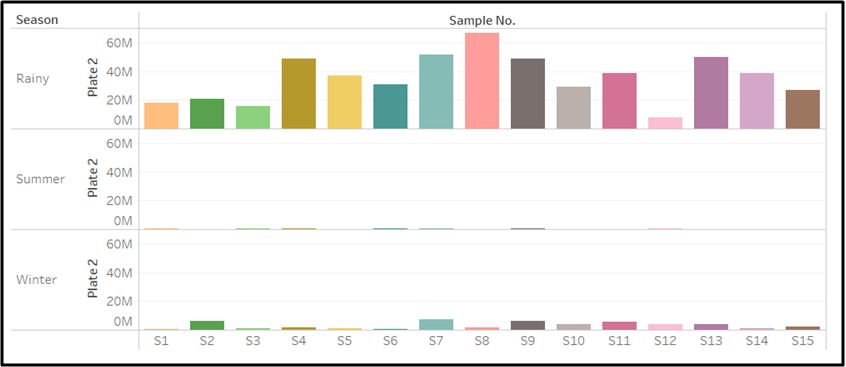
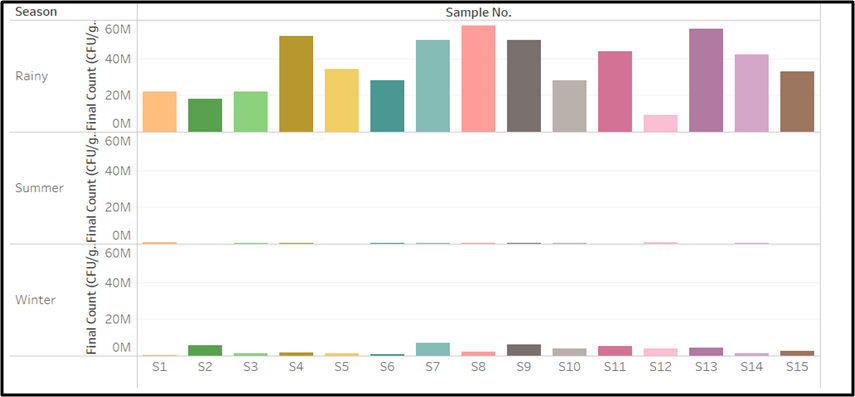
The study attempted to cover the microbial diversity of the whole Gautala forest through covering maximum sampling spots. The average TMC in the rainy season for plate 1 and plate 2 was 36.73 and 35.46 respectively, and the final count was 36.4 X 10⁶. The average TMC in the winter season for plate 1 and plate 2 was 32.4 and 31.93 respectively, and the final count was 32.46 X 10⁵. The average TMC in the summer season for plate 1 and plate 2 was 37.13 and 36.4 respectively, and the final count was 37.6 X 10⁴ (Table 1). (Figure 5 - Figure 8)


The bacterial colony at sampling points 1, 4, and 7 showed presence of Gram-Negative Bacteria; whereas the rest of the sampling points showed presence of Gram - Positive Bacteria. Further details about the bacterial colony characters, microscopic observation of isolates, and shape are depicted in Table 2. There were three types of Gram-negative and 12 were found to be Gram-positive bacteria with three genera i.e. Pseudomonas spp., Bacillus spp., and micrococcus spp. (Table 2).
Microbial growth rates were thoroughly interconnected to temperature and carbon content. The high growth rates mostly occur at 20°C. In general, under deciduous forest higher carbon value occurs during summer months temperature always more than above 20°C. This may be responsible for the highest count in the summer season. It depends strongly on temperature 21, therefore, in particular spots i.e. S1, S3, S4, S6, and S8 highest specific growth rate in summer is observed as compared to rainy and winter seasons (Table 1). The work which is carried out by Kavitha et al., 22 population of microbes was found to be affected in contaminated soil which could be observed by increase in the bacterial count in the forest ecosystem especially in Kallar region (78.5 × 10⁸ CFU g-1) and Ooty (74.75 × 10⁸ CFU g-1) soil on compared to the Agro-ecosystem eastern block (51.0 × 10⁸ CFU g-1) and contaminated soil (37.0 × 10⁸ CFU g-1) in nearby town area. Significantly higher bacterial count was noticed in soil near forested areas.
The most important nutrient supply to the forest is derived from litter decomposition by the action of organisms under conditions of high air temperature and soil moisture. The chemical factors present inside the litter are mobilized and reabsorbed through plant roots, restarting a new plant nutrient cycling and ensuring perennial situations to the system even in instances of low fertile soils. The greater accumulation of litter in the rainy season can be attributed to the greater precipitation, which leads to an increase in plant biomass. The existence of a resilient culturable bacterial population that is not affected by season 23. Decreased microbial diversity in winter seasons agrees to the propositions that microbial populaces were lower in winter and maximum in the summer 24. Soil bacterial communities within the soil large macro and micro aggregates are shaped in part by various resources and Physico-chemical ambient conditions 25, 26, 27, 28.
The Finding of present research work similar to the work carried out by Martinez 24. Seasonal variation in diversity and richness of microbes in a dry deciduous forest may be due to seasonal fluctuations in ecological factors 29. Consideration of soil combination microbial communities additionally led us to detect potential soil microbial diversity than the entire soil sampling approaches. Previous work shows that approaches of easily available substrates in an ecosystem supports biodiversity across various levels of biological organization 30, 31, including the potential within soil aggregates 32. As a beneficial microbe, Bacillus, a part of the Firmicutes family, can enhance plant growth and reduce soil-borne disorders 33. Bacillus, for instance, prevents Ralstonia solanacearum-induced bacterial loss 34, 35, 36, 37. Furthermore, Bacillus-inoculated fertilizer was shown to enhance bacterial diversity in the soil 38, 39.
Table 2 describes the detailed analysis of primary soil characteristics i.e. Colony Characteristics and Microscopic Observation of Isolates. The microbial groups existing (e.g., Gram + and Gram -) 40. With reference to the colony characteristics, all the isolates except at S1, S4, and S7 were Gram-positive in nature.
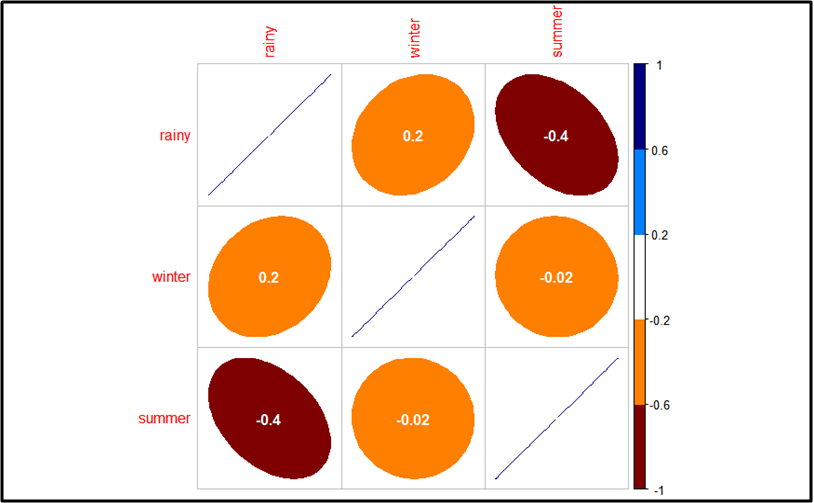
3.1. Statistical RelationshipsMicrobial count in the rainy season and summer season are significantly negatively (-0.4) associated, according to Pearson correlation test results. The microbial counts of the rainy, winter, and summer seasons have no significant correlation. (Figure 9), shows the comparison of microbial counts during the rainy, winter, and summer seasons. Spots has a P-value of 0.426, which is greater than 0.05. (Level of significance). As a result, we accept the null hypothesis at a significance level of 5%. In other words, the average microbial count of different places does not differ significantly. Season has a P-value of 3.21*10 (-12), which is less than 0.05. (Level of significance). As a result, at a 5% level of significance, we reject the null hypothesis. In other words, there is a considerable variance in one of the seasons' average microbial counts (Table 3). Tukey's test is used to determine which pair of seasons has the most significant difference. We can conclude from Tukey's test that there is a substantial variation in average microbial counts across all seasons (Table 4).

The study was carried out for mapping the microbial diversity and seasonal changes of microbial counts in the soil of selected sites of Gautala Reserve Forest. The population of soil bacteria varies rapidly depending on geographical, ecological and climatic conditions etc. Soil microorganisms are a potential indicator of soil superiority, because plants rely on soil microorganisms to mineralize organic nutrients and promote their growth. Prolonged rains may create anaerobic conditions in the soil thus reducing microbial activities. As per the present results Bacterial process rates were commonly lower in winter than in summer. In statistical analysis, the Pearson correlation tests used for microbial populations are correlated. The microbial counts of rainy and summer seasons are slightly negative (-0.4). There is no significant correlation between microbial counts of rainy, winter, and summer seasons, but the two-way ANOVA test, and Tukey’s test showed a significant difference between the average microbial counts at all sites seasonally. The seasonal variations in microbial counts in different seasons are increased or decreased (Impact on counts).
I am grateful to Dr. S. S. Patil Sir for his encouragement and guidance. Thanks to all the staff members and colleagues in the Department of Environmental Science. I would also like to express my gratitude to the Forest Department for providing me the permission to carry research in the Gautala reserve forest. Special thanks to the wildlife staff at the Gautala sanctuary for assisting me during fieldwork. A special thankfulness to the Indian Council of Social Science Research (ICSSR) for funding this research through a Centrally-Administered Short-Term Doctoral Fellowship.
| [1] | Yardi D., Eco-sustainability Assessment of Jaikwadi Dam with reference to Bird Sanctuary, A thesis submitted to Dr. Babasaheb Ambedkar Marathwada University, Aurangabad. 2011. | ||
| In article | |||
| [2] | Ghorade I. B., Eco sustainability assessment of Godavari river water for sustainable utilization. A thesis submitted to Dr. Babasaheb Ambedkar Marathwada University, Aurangabad. 2013. | ||
| In article | |||
| [3] | Mirza Amrin Naimoddin and Patil Satish S., Seasonal Plant Diversity of Gautala Reserve Forest, District Aurangabad, Applied Ecology and Environmental Sciences, 9 (1), 92-10, January 2021. | ||
| In article | View Article | ||
| [4] | Stine M. A. and Weil R. R., The relationship between soil quality and crop productivity across three tillage systems in south-central Honduras. American Journal of Alternative Agriculture, 17(1): 2-8. March 2002. | ||
| In article | View Article | ||
| [5] | Braga R. M., Dourado M. N. and Araujo W. L., Microbial interactions: ecology in a molecular perspective, Braz J. Microbiol., 47, 86-98. October 2016. | ||
| In article | View Article PubMed | ||
| [6] | Hongmei J., Aitchison J., Lacap D., Peerapornpisal, Y., Sompong, U. and Pointing, S., Community phylogenetic analysis of moderately thermophilic cyanobacterial mats from China, the Philippines and Thailand, Extremophiles, 9, 325-332. September 2005. | ||
| In article | View Article PubMed | ||
| [7] | Gardi C., Montanarella L., Arrouays D., Bispo A., Lemanceau P., Jolivet C., Mulder C., Ranjard L., Rombke J., Rutgers M., and Menta C., Soil biodiversity monitoring in Europe: ongoing activities and challenges. European Journal Of Soil Sciences, Volume 60, Issue 5, 807-819. September 2009. | ||
| In article | View Article | ||
| [8] | Gans J., Wolinsky M., and Dunbar J., Computational improvements reveal great bacterial diversity and high metal toxicity in soil. Science 309:1387-1390. August 2005. | ||
| In article | View Article PubMed | ||
| [9] | Eichorst Stephanie A., Breznak John A., and Schmidt Thomas M., Isolation and Characterization of Soil Bacteria That Define Terriglobus gen. Nov., in the Phylum Acidobacteria, Applied and Environmental Microbiology, 73(8), 2708-2717. April 2007. | ||
| In article | View Article PubMed | ||
| [10] | Potadar Vishnu R, and Satish S Patil., Sequestration and storage of carbon by trees in and around University campus of Aurangabad city in Maharashtra, India. International Research Journal of Engineering and Technology (IRJET). 04 (01), ISSN: 2395-0056, January 2017. | ||
| In article | |||
| [11] | Kshirsagar Anil A., Pawar Sanjay M., Patil Nirmala P., and Mali Vasant P.: Diversity of medicinal plants in Gautala Sanctuary of Kannad, District Aurangabad (Ms) India. Bioscience Discovery, 3(3):355-361. November 2012. | ||
| In article | |||
| [12] | Naik V. N., Flora of Marathwada. Vol. I and II, Amrut Prakashan, Aurangabad. 1998. | ||
| In article | |||
| [13] | Mirza Amrin Naimoddin and Patil Satish S., Assessment of Seasonal Variation in Physicochemical Characteristics of the Soil at Gautala Reserve Forest (M.S), India. Curr World Environ, 15 (2), Pg. 289-303. June 2020. | ||
| In article | View Article | ||
| [14] | Soman Reshma, Thomas Achamma, Sarma N. Minu, Varada Jagadeesh and Sankarshanan Mohan., Bacterial Diversity in Soil from Peripheral Areas of Thattekad Bird Sanctuary. Indian J. Sci. Res. 18 (2), 80-87. February 2018. | ||
| In article | |||
| [15] | Waksman Selman A., A Method for Counting the Number of Fungi in the Soil. J Bacteriol. 7(3): 339-341. May 1922. | ||
| In article | View Article PubMed | ||
| [16] | APHA, Standard Methods for the Examination of Water and Wastewater. Washington, D.C. 15th ed. 1980. | ||
| In article | |||
| [17] | Tankeshwar Acharya, Pour Plate Method: Procedure, Uses, (Dis) Advantages, Microbe Online, (2021). https://microbeonline.com/pour-plate-method-principle-procedure-uses-dis-advantages/. | ||
| In article | |||
| [18] | Taylor Raymond H., Allen Martin J. and Geldreich Edwin E., Standard plate count: A comparison of pour plate and spread plate methods, Journal (American Water Works Association), 75 (1), 35-37. January 1983. | ||
| In article | View Article | ||
| [19] | Bertrand Jean Claude, Caumette Pierre, Lebaron Philippe, Matheron Robert, Normand Philippe and Telesphore Sime-Ngando., Environmental Microbiology: Fundamentals and Applications: Microbial Ecology. Presses Universitaires de Pau et des Pays de l’Adour, Springer, ISBN 978-94-017-9117-5. 2015. | ||
| In article | View Article | ||
| [20] | Sharma Sonam, Kumar Vijay and Tripathi Ram Babu., Isolation of Phosphate Solubilizing Microorganism (PSMs) From Soil, J. Microbiol. Biotech. Res., 1 (2), 90-95. January 2011. | ||
| In article | |||
| [21] | Biasi C., Rusalimova O., Meyer H., Kaiser C., Wanek, W., Barsukov P., Junger H. and Richter A., Temperature-dependent shift from labile to recalcitrant carbon sources of arctic heterotrophs, Mass Spectrom. 19, 1401-1408. May 2005. | ||
| In article | View Article PubMed | ||
| [22] | Kavitha, A. Sudha, P. Ahila Devi and K. Kumaran., A Comparative Study on Forest Soil Microbial Diversity and Biomass in Nilgiri Biosphere of Southern India P.G. International Journal of Current Microbiology and Applied Sciences, 9 (9), ISSN: 2319-7706., August 2020. | ||
| In article | View Article | ||
| [23] | Franca Luis, Ciro Sannino, Benedetta Turchetti, Pietro Buzzini, and Rosa Margesin., Seasonal and altitudinal changes of culturable bacterial and yeast diversity in Alpine forest soils. Extremophiles, 20, 855-873. November 2016. | ||
| In article | View Article PubMed | ||
| [24] | Martinez J., Smith D., Steward G. F. and Azam. F., Variability in Ecto-hydrolytic enzyme activities of pelagic marine bacteria and its significance for substrate processing in the sea. Aqua. Microbial. Ecol., 10, 223-230. January 1996. | ||
| In article | View Article | ||
| [25] | Davinic Marko, Fultz Lisa M., Acosta-Martinez Veronica, Calderon Francisco J., Cox Stephen B., Dowd Scot E., Allen Vivien G., Zak John C., and Moore-Kucera Jennifer., Pyrosequencing and mid-infrared spectroscopy reveal distinct aggregate stratification of soil bacterial communities and organic matter composition. Soil Biology & Biochemistry, Elsevier, 46, 63-72. December 2011. | ||
| In article | View Article | ||
| [26] | Hattori T., Soil Aggregates in Microhabitats or Microorganisms, The Reports of the Institute for Agricultural Research, Tohoku University, 37, 23-36. January 1988. | ||
| In article | |||
| [27] | Mummey, D., Holben, W., Six, J. and Stahl, P., Spatial stratification of soil bacterial populations in aggregates of diverse soils, Microbial Ecology, 51, 404-411. May 2006. | ||
| In article | View Article PubMed | ||
| [28] | Mummey, D. L. and Stahl, P.D., Analysis of soil whole and inner-micro aggregate bacterial communities, Microbial Ecology, 48, 41-50. July 2004. | ||
| In article | View Article PubMed | ||
| [29] | Banakar Shivakumar P., Thippeswamy B., Thirumalesh B. V., and Naveen Kumar K. J., Diversity of soil fungi in dry deciduous forest of Bhadra Wildlife Sanctuary, Western Ghats of southern India, Journal of Forestry Research, 23 (4), 631-64. November 2012. | ||
| In article | View Article | ||
| [30] | Eisenhauer, N., Schulz, W., Scheu, S., and Jousset, A., Niche dimensionality links biodiversity and invasibility of microbial communities, Functional Ecology, 27, 282-288. February 2013. | ||
| In article | View Article | ||
| [31] | Harpole W. S., and Tilman D., Grassland species loss resulting from reduced niche dimension, Nature 446, 791-793. April 2007. | ||
| In article | View Article PubMed | ||
| [32] | Gupta V. V. S. R., and Germida J. J., Distribution of microbial biomass and its activity in different soil aggregate size classes as affected by cultivation, Soil Biology and Biochemistry 20, 777-786. January 1988. | ||
| In article | View Article | ||
| [33] | Raaijmakers J., Paulitz T., Steinberg C., Alabouvette C., and Moenne-loccoz Y., The rhizosphere: a playground and battlefield for soilborne pathogens and beneficial microorganisms, Plant and Soil, 321, 341-361. January 2009. | ||
| In article | View Article | ||
| [34] | Chen, D. et al., Isolation of Bacillus amyloliquefaciens S20 and its application in control of eggplant bacterial wilt, Journal of Environmental Management, 137, 120-127. May 2014. | ||
| In article | View Article PubMed | ||
| [35] | Guo, J. H., et al., Biocontrol of tomato wilt by plant growth-promoting rhizobacteria, Biological Control, 29 (1), 66-72. January 2004. | ||
| In article | View Article | ||
| [36] | Hu H. Q., Li X. S. and He H., Characterization of an antimicrobial material from a newly isolated Bacillus amyloliquefaciens from mangrove for biocontrol of Capsicum bacterial wilt, Biological Control, 54 (3), 359-365. January 2010. | ||
| In article | View Article | ||
| [37] | Tan S. et al., Two Bacillus amyloliquefaciens strains isolated using the competitive tomato root enrichment method and their effects on suppressing Ralstonia solanacearum and promoting tomato plant growth, Crop Protection, 43, 134-140. January 2013. | ||
| In article | View Article | ||
| [38] | Huang X., Zhang N., Yong X., Yang X. and Shen Q., Biocontrol of Rhizoctonia solani damping-off disease in cucumber with Bacillus pumilus SQR-N43, Microbiological Research 167(3), 135-143. March 2012. | ||
| In article | View Article PubMed | ||
| [39] | Wang W., Li S., Li Z., Zhang J., Fan K., Tan G., Ai G., Lam S.M., Shui G., Yang Z., and et al., Harnessing the intracellular triacylglycerols for titer improvement of polyketides in Streptomyces. Nat. Biotechnol. 38: 76-83. January 2020. | ||
| In article | View Article PubMed | ||
| [40] | Kramer C., and Gleixner G., Variable use of plant- and soil-derived carbon by microorganisms in agricultural soils, Soil Biol. Biochem., 38, 3267-3278. November 2006. | ||
| In article | View Article | ||
Published with license by Science and Education Publishing, Copyright © 2022 Amrin Naimoddin Mirza and Satish Sudhakarrao Patil
 This work is licensed under a Creative Commons Attribution 4.0 International License. To view a copy of this license, visit
http://creativecommons.org/licenses/by/4.0/
This work is licensed under a Creative Commons Attribution 4.0 International License. To view a copy of this license, visit
http://creativecommons.org/licenses/by/4.0/
| [1] | Yardi D., Eco-sustainability Assessment of Jaikwadi Dam with reference to Bird Sanctuary, A thesis submitted to Dr. Babasaheb Ambedkar Marathwada University, Aurangabad. 2011. | ||
| In article | |||
| [2] | Ghorade I. B., Eco sustainability assessment of Godavari river water for sustainable utilization. A thesis submitted to Dr. Babasaheb Ambedkar Marathwada University, Aurangabad. 2013. | ||
| In article | |||
| [3] | Mirza Amrin Naimoddin and Patil Satish S., Seasonal Plant Diversity of Gautala Reserve Forest, District Aurangabad, Applied Ecology and Environmental Sciences, 9 (1), 92-10, January 2021. | ||
| In article | View Article | ||
| [4] | Stine M. A. and Weil R. R., The relationship between soil quality and crop productivity across three tillage systems in south-central Honduras. American Journal of Alternative Agriculture, 17(1): 2-8. March 2002. | ||
| In article | View Article | ||
| [5] | Braga R. M., Dourado M. N. and Araujo W. L., Microbial interactions: ecology in a molecular perspective, Braz J. Microbiol., 47, 86-98. October 2016. | ||
| In article | View Article PubMed | ||
| [6] | Hongmei J., Aitchison J., Lacap D., Peerapornpisal, Y., Sompong, U. and Pointing, S., Community phylogenetic analysis of moderately thermophilic cyanobacterial mats from China, the Philippines and Thailand, Extremophiles, 9, 325-332. September 2005. | ||
| In article | View Article PubMed | ||
| [7] | Gardi C., Montanarella L., Arrouays D., Bispo A., Lemanceau P., Jolivet C., Mulder C., Ranjard L., Rombke J., Rutgers M., and Menta C., Soil biodiversity monitoring in Europe: ongoing activities and challenges. European Journal Of Soil Sciences, Volume 60, Issue 5, 807-819. September 2009. | ||
| In article | View Article | ||
| [8] | Gans J., Wolinsky M., and Dunbar J., Computational improvements reveal great bacterial diversity and high metal toxicity in soil. Science 309:1387-1390. August 2005. | ||
| In article | View Article PubMed | ||
| [9] | Eichorst Stephanie A., Breznak John A., and Schmidt Thomas M., Isolation and Characterization of Soil Bacteria That Define Terriglobus gen. Nov., in the Phylum Acidobacteria, Applied and Environmental Microbiology, 73(8), 2708-2717. April 2007. | ||
| In article | View Article PubMed | ||
| [10] | Potadar Vishnu R, and Satish S Patil., Sequestration and storage of carbon by trees in and around University campus of Aurangabad city in Maharashtra, India. International Research Journal of Engineering and Technology (IRJET). 04 (01), ISSN: 2395-0056, January 2017. | ||
| In article | |||
| [11] | Kshirsagar Anil A., Pawar Sanjay M., Patil Nirmala P., and Mali Vasant P.: Diversity of medicinal plants in Gautala Sanctuary of Kannad, District Aurangabad (Ms) India. Bioscience Discovery, 3(3):355-361. November 2012. | ||
| In article | |||
| [12] | Naik V. N., Flora of Marathwada. Vol. I and II, Amrut Prakashan, Aurangabad. 1998. | ||
| In article | |||
| [13] | Mirza Amrin Naimoddin and Patil Satish S., Assessment of Seasonal Variation in Physicochemical Characteristics of the Soil at Gautala Reserve Forest (M.S), India. Curr World Environ, 15 (2), Pg. 289-303. June 2020. | ||
| In article | View Article | ||
| [14] | Soman Reshma, Thomas Achamma, Sarma N. Minu, Varada Jagadeesh and Sankarshanan Mohan., Bacterial Diversity in Soil from Peripheral Areas of Thattekad Bird Sanctuary. Indian J. Sci. Res. 18 (2), 80-87. February 2018. | ||
| In article | |||
| [15] | Waksman Selman A., A Method for Counting the Number of Fungi in the Soil. J Bacteriol. 7(3): 339-341. May 1922. | ||
| In article | View Article PubMed | ||
| [16] | APHA, Standard Methods for the Examination of Water and Wastewater. Washington, D.C. 15th ed. 1980. | ||
| In article | |||
| [17] | Tankeshwar Acharya, Pour Plate Method: Procedure, Uses, (Dis) Advantages, Microbe Online, (2021). https://microbeonline.com/pour-plate-method-principle-procedure-uses-dis-advantages/. | ||
| In article | |||
| [18] | Taylor Raymond H., Allen Martin J. and Geldreich Edwin E., Standard plate count: A comparison of pour plate and spread plate methods, Journal (American Water Works Association), 75 (1), 35-37. January 1983. | ||
| In article | View Article | ||
| [19] | Bertrand Jean Claude, Caumette Pierre, Lebaron Philippe, Matheron Robert, Normand Philippe and Telesphore Sime-Ngando., Environmental Microbiology: Fundamentals and Applications: Microbial Ecology. Presses Universitaires de Pau et des Pays de l’Adour, Springer, ISBN 978-94-017-9117-5. 2015. | ||
| In article | View Article | ||
| [20] | Sharma Sonam, Kumar Vijay and Tripathi Ram Babu., Isolation of Phosphate Solubilizing Microorganism (PSMs) From Soil, J. Microbiol. Biotech. Res., 1 (2), 90-95. January 2011. | ||
| In article | |||
| [21] | Biasi C., Rusalimova O., Meyer H., Kaiser C., Wanek, W., Barsukov P., Junger H. and Richter A., Temperature-dependent shift from labile to recalcitrant carbon sources of arctic heterotrophs, Mass Spectrom. 19, 1401-1408. May 2005. | ||
| In article | View Article PubMed | ||
| [22] | Kavitha, A. Sudha, P. Ahila Devi and K. Kumaran., A Comparative Study on Forest Soil Microbial Diversity and Biomass in Nilgiri Biosphere of Southern India P.G. International Journal of Current Microbiology and Applied Sciences, 9 (9), ISSN: 2319-7706., August 2020. | ||
| In article | View Article | ||
| [23] | Franca Luis, Ciro Sannino, Benedetta Turchetti, Pietro Buzzini, and Rosa Margesin., Seasonal and altitudinal changes of culturable bacterial and yeast diversity in Alpine forest soils. Extremophiles, 20, 855-873. November 2016. | ||
| In article | View Article PubMed | ||
| [24] | Martinez J., Smith D., Steward G. F. and Azam. F., Variability in Ecto-hydrolytic enzyme activities of pelagic marine bacteria and its significance for substrate processing in the sea. Aqua. Microbial. Ecol., 10, 223-230. January 1996. | ||
| In article | View Article | ||
| [25] | Davinic Marko, Fultz Lisa M., Acosta-Martinez Veronica, Calderon Francisco J., Cox Stephen B., Dowd Scot E., Allen Vivien G., Zak John C., and Moore-Kucera Jennifer., Pyrosequencing and mid-infrared spectroscopy reveal distinct aggregate stratification of soil bacterial communities and organic matter composition. Soil Biology & Biochemistry, Elsevier, 46, 63-72. December 2011. | ||
| In article | View Article | ||
| [26] | Hattori T., Soil Aggregates in Microhabitats or Microorganisms, The Reports of the Institute for Agricultural Research, Tohoku University, 37, 23-36. January 1988. | ||
| In article | |||
| [27] | Mummey, D., Holben, W., Six, J. and Stahl, P., Spatial stratification of soil bacterial populations in aggregates of diverse soils, Microbial Ecology, 51, 404-411. May 2006. | ||
| In article | View Article PubMed | ||
| [28] | Mummey, D. L. and Stahl, P.D., Analysis of soil whole and inner-micro aggregate bacterial communities, Microbial Ecology, 48, 41-50. July 2004. | ||
| In article | View Article PubMed | ||
| [29] | Banakar Shivakumar P., Thippeswamy B., Thirumalesh B. V., and Naveen Kumar K. J., Diversity of soil fungi in dry deciduous forest of Bhadra Wildlife Sanctuary, Western Ghats of southern India, Journal of Forestry Research, 23 (4), 631-64. November 2012. | ||
| In article | View Article | ||
| [30] | Eisenhauer, N., Schulz, W., Scheu, S., and Jousset, A., Niche dimensionality links biodiversity and invasibility of microbial communities, Functional Ecology, 27, 282-288. February 2013. | ||
| In article | View Article | ||
| [31] | Harpole W. S., and Tilman D., Grassland species loss resulting from reduced niche dimension, Nature 446, 791-793. April 2007. | ||
| In article | View Article PubMed | ||
| [32] | Gupta V. V. S. R., and Germida J. J., Distribution of microbial biomass and its activity in different soil aggregate size classes as affected by cultivation, Soil Biology and Biochemistry 20, 777-786. January 1988. | ||
| In article | View Article | ||
| [33] | Raaijmakers J., Paulitz T., Steinberg C., Alabouvette C., and Moenne-loccoz Y., The rhizosphere: a playground and battlefield for soilborne pathogens and beneficial microorganisms, Plant and Soil, 321, 341-361. January 2009. | ||
| In article | View Article | ||
| [34] | Chen, D. et al., Isolation of Bacillus amyloliquefaciens S20 and its application in control of eggplant bacterial wilt, Journal of Environmental Management, 137, 120-127. May 2014. | ||
| In article | View Article PubMed | ||
| [35] | Guo, J. H., et al., Biocontrol of tomato wilt by plant growth-promoting rhizobacteria, Biological Control, 29 (1), 66-72. January 2004. | ||
| In article | View Article | ||
| [36] | Hu H. Q., Li X. S. and He H., Characterization of an antimicrobial material from a newly isolated Bacillus amyloliquefaciens from mangrove for biocontrol of Capsicum bacterial wilt, Biological Control, 54 (3), 359-365. January 2010. | ||
| In article | View Article | ||
| [37] | Tan S. et al., Two Bacillus amyloliquefaciens strains isolated using the competitive tomato root enrichment method and their effects on suppressing Ralstonia solanacearum and promoting tomato plant growth, Crop Protection, 43, 134-140. January 2013. | ||
| In article | View Article | ||
| [38] | Huang X., Zhang N., Yong X., Yang X. and Shen Q., Biocontrol of Rhizoctonia solani damping-off disease in cucumber with Bacillus pumilus SQR-N43, Microbiological Research 167(3), 135-143. March 2012. | ||
| In article | View Article PubMed | ||
| [39] | Wang W., Li S., Li Z., Zhang J., Fan K., Tan G., Ai G., Lam S.M., Shui G., Yang Z., and et al., Harnessing the intracellular triacylglycerols for titer improvement of polyketides in Streptomyces. Nat. Biotechnol. 38: 76-83. January 2020. | ||
| In article | View Article PubMed | ||
| [40] | Kramer C., and Gleixner G., Variable use of plant- and soil-derived carbon by microorganisms in agricultural soils, Soil Biol. Biochem., 38, 3267-3278. November 2006. | ||
| In article | View Article | ||