Surface coal mining practices pose health risks by triggering respiratory inflammation. This study investigated the impact of coal handling on respiratory health in coal (Wani) and non-coal handling (Arni) areas in central India for the first time. Air particulate matter (PM) and associated heavy metal concentrations (As, Cd, Co, Cr, Cu, Mn, Ni, Pb, and Zn) were estimated at each location. Wani showed higher level of PM-associated heavy metals compared to Arni. Particularly, Arsenic was present in Wani but not in Arni PM samples. Serum lung epithelial injury biomarker (CC16) was also measured in Wani (n = 148) and Arni (n = 95) populations. Unadjusted serum CC16 was significantly lower in Wani than in Arni (6.99 ± 5.14 µg/L vs 10.89 ± 4.95 µg/L; p < 0.001). Results revealed that the population at Wani is more vulnerable to lung epithelial injury.
Opencast mining and associated operations can directly or indirectly contribute to air pollution by generating particulate matter (PM2.5, PM10) 1. The IARC has designated ambient particulate matter as a group 1 human carcinogen 2. Historically, studies have investigated the link between PM10 and PM2.5 and human mortality and morbidity 3, 4. Pande et al. 5 calculated that a 10 µg/m3 rise in PM10 concentration increases death risk by 0.03 percent in 7 Indian areas. PM2.5 is the 5th greatest cause of death globally 6. India has the second-highest absolute death toll from air pollution after China 7.
Air pollution from coal mining and related operations harms nearby areas 8. Studies have found acute and chronic consequences near coal mines, including illness and mortality 9, 10. Chronic obstructive pulmonary disease (COPD) and respiratory disorders are among the major undesirable health consequences of coal dust exposure 11. Heavy metals in coal dust are toxic even at a low concentration and are responsible for obstructive lung diseases, airway irritation and inflammation 12. In addition, heavy metal exposure has been linked to airway epithelial damage 10. CC16 (Uteroglobin) is a 16 kD protein generated by Clara cells in the non-ciliated respiratory epithelium that plays a role in respiratory tract protection with antioxidant, anti-inflammatory and immunomodulatory effects. As a result, this biomarker can be utilized to measure lung epithelial damage in the absence of renal diseases 13, 14.
The current study aimed to assess the health impact of emissions arising from coal handling activities in Wani town located in central India. Another town Arni, also located in central India and without any coal-related activities, was chosen as the reference site to compare the extent of adverse effects in Wani. Residents in Wani have been raising concerns about health ailments due to coal handling activities. So, the current study was undertaken for the first time in central India to estimate the respiratory health effects of coal handling operations. Air quality was measured by PM10 and PM2.5 levels and the PM-bound heavy metal concentration. The air quality was correlated to human health by health risk assessment and serum CC16 level as the respiratory health biomarker. This study will help both local authorities and policymakers to take action to mitigate the human health impact of coal handling practices.
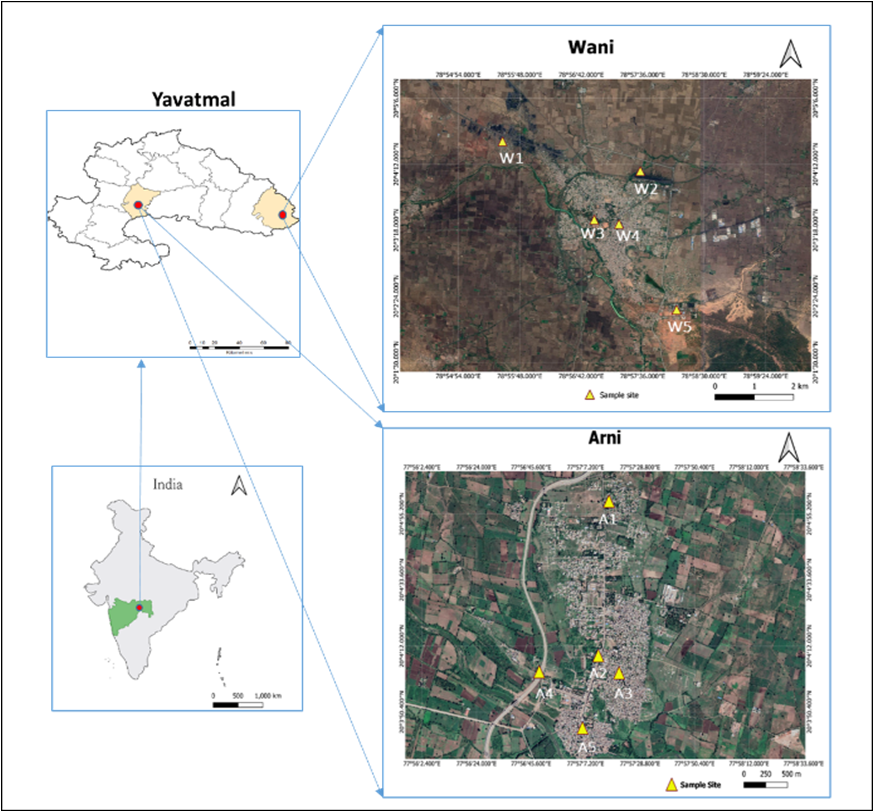
The current study covers two towns, Wani and Arni, in the Yavatmal district of Maharashtra state in India. The study focuses on exposure to coal dust from coal handling activities and its health effects in the Wani town (20° 4' 0" North, 78° 57' 0" East) with a population of 58,820 and an area of 16.0 km2. Western Coal-fields Limited, a subsidiary of Coal India Limited, has a Wani North coal mining area scattered around Wani. There are also several privately owned coal depots in Wani. As a result, Wani town is prone to air dust emissions from coal handling, transportation and storage activities and their impacts on human health, agriculture and well-being. On the other hand, Arni town (20° 4' 0" North, 77° 57' 0" East) has a population of 27809 and a 6.1 km2 area. Arni does not have any known sources of coal handling emissions and hence, is taken as the control area (Figure 1).
2.2. Collection of Particulate Matter (PM) and AnalysisPM monitoring was carried out at five different sampling locations, each in Wani (W1, W2, W3, W4, and W5) and Arni (A1, A2, A3, A4, and A5) to determine PM10 and PM2.5 levels by gravimetric method (Figure 1). W1 was an industrial site; W2, W4 and W5 were commercial sites, whereas W3 was residential-cum-commercial area in Wani. A1, A5 were residential sites; A2, A3 were commercial sites, and A4 was an industrial site in Arni.
A high volume sampler (Envirotech APM 550 EL, India) was used to collect PM samples on polytetrafluoroethylene (PTFE) filter paper (Whatman, 46.2 mm ring supported) at the flow rate of 16.7 L/min for the 8-hour duration. The Inlet height of the sampler was maintained as per the CPCB guidelines 15. Filters were desiccated for 24 hours before and after use and transported in a sealed polypropylene Cassette (Envirotech, India). A total of 3 filters were collected at each sampling location for 24 hours. Collectively, there were 30 filters for each PM2.5 and PM10 analysis. After proper conditioning and desiccation, the filter papers were weighed on a microbalance (model CPA26P, Sartorius, Sensitivity 0.0001 g) and stored at 4°C for further metal analysis.

The PTFE filter samples were used to analyse metals using ICP-OES (Inductively Coupled Plasma Optical Emission Spectroscopy, Thermo fisher iCAP 6300 DUO). Digestion vessels were washed with 10% HNO3 and rinsed with distilled water before each digestion. Samples were added to the vessels with 3 mL HNO3 (ULTREX® II, JT Baker, USA), 1 mL H2O2 (ULTREX® II, JT Baker, USA), 3 mL HCL (ULTREX® II, JT Baker, USA) and 5 mL deionised water. The vessels were capped and digested using the microwave digestion system (MOD milestone, Italy) by ramping temperature (ramped to 180°C for 10 min, held at 180°C for 15 min, and the outer temperature of the reaction chamber was maintained at 100°C. Power and Pressure were set at 1000 W, 45 bar, respectively). The vessels were allowed to cool down to room temperature, and the clear digested solution was transferred to a polypropylene container. The digested solution volume was adjusted to 50 mL with deionized water and stored at 4°C until analysis. Blank filters were also treated in the same manner to check for heavy metal impurities. A multi-element standard mix (Certipur, Merck) was used for instrument calibration.
2.3. Health Risk AssessmentHealth risk assessment was carried out using the mean concentration of heavy metals in PM2.5. Exposure dose was calculated and expressed in terms of intake doses via ingestion, inhalation, and dermal contact pathways according to equations 1-3. The United States Environmental Protection Agency (USEPA) model was used for the health risk assessment in this study 16.
 | (1) |
 | (2) |
 | (3) |
Where (IDinh), (IDing), and (IDder) are the intake doses (µg.kg−1.day), via inhalation, ingestion and dermal contact pathways, respectively. Other parameters used for exposure assessment of heavy metals in air are: Pollutant concentration (Ca) = Respective concentrations of metals; Inhalation rate (IRinh) = 20 m3.day−1; Ingestion rate (IRing) = 100 mg.day−1; Adherence factor (AF) = 0.07 mg•cm2; Absorption factor (ABS) = 0.01; Conversion factor (CF) = 10-6 kg.mg−1; Particle emission factor (PEF) = 1.36 x 10⁹ m3.kg−1; Body weight (BW) = 70 kg; Exposed skin surface area (SA) = 4350 cm2•day−1; Exposure frequency = 1 [EF = (frequency × ED)/ AT), where ED is exposure duration; AT is Averaging time. The length of time used for the exposure duration in the numerator is same as in the denominator. Thus, EF was taken as one in this study] 16, 17, 18.
The Hazard quotient (HQ) was calculated to evaluate the non-carcinogenic health risk due to heavy metal exposure based on the reference dose for different heavy metals reported by Zheng et al 19. HQ is the ratio between the intake dose of metals and the corresponding reference doses (RfD) 16. For example, HQ for inhalation is given in the below-mentioned equation.
 | (4) |
The hazard index (HI), a summation of HQs, was calculated to estimate the overall potential non-carcinogenic effect posed by different heavy metals (EPA 1989). The HI for inhalation is given in the below-mentioned equation.
 | (5) |
Where k is the number of metals. The HQ and HI for ingestion and dermal contact were also calculated as above.
2.4. Serum CC16 AnalysisSubjects were selected randomly from the general population to estimate the serum CC16 level. Subjects having any renal disease were excluded from this study. Total 148 and 95 blood samples were collected from Wani and Arni, respectively, in vacutainer tubes (BD Vacutainer serum tube, USA). Blood was left at room temperature and allowed to clot for 2 hours. The clotted blood was centrifuged at 2000 X g for 10 minutes, and the supernatant was collected as serum and stored at -20°C until further examination. The serum CC16 level was quantified using a Human CC16 ELISA kit (Immunotag, Cell Biolabs Inc., USA) as per the manufacturer’s procedure. The data on the investigated subjects from the Wani and Arni areas were obtained through a questionnaire featuring demographic variables such as age, sex, BMI etc. Air quality parameters, i.e. PM10 and PM2.5, obtained at the monitoring locations from Wani and Arni areas, were considered to assess the impact of particulate matter on CC16 concentration. Using the mean and standard deviation of the parametric concentration, the Monte-Carlo simulation was performed following log-normal distribution, in which PM10 and PM2.5 values were generated and assigned to the subjects. The simulation was performed independently for both the areas referring to the respective mean and standard deviation of parameters. CC16 values were adjusted with age, gender, BMI, and PM (PM10 or PM2.5) concentration values in the first run. Accordingly, the adjusted mean values of CC16 were obtained and tested for statistical significance of difference using a t-test for independent samples. The above steps were repeated 100 times, and thus, an array of adjusted CC16 values for both groups was obtained at each run and compared statistically for the significance of difference.
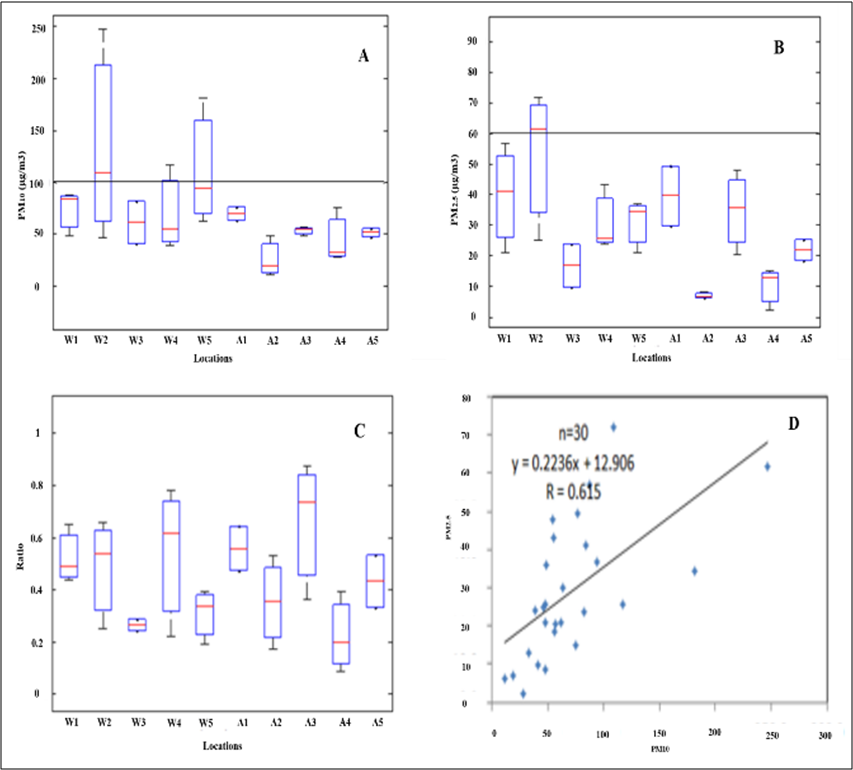
Average PM10 levels in Wani and Arni were 85.4 ± 29.04 and 44.6 ± 10.17 µg/m3, respectively, while the PM2.5 levels were 35 ± 11.01 µg/m3 and 23.2 ± 12.49 µg/m3 respectively (Figure 2). Thus, Wani had significantly higher PM10 and PM2.5 levels compared with Arni. Average PM10 and PM2.5 values at Wani were 1.89 and 2.33 times higher in comparison to the international air quality standards (PM10 - 45 µg/m3; PM2.5 - 15 µg/m3) laid down by the World Health Organization 20. On the other hand, average PM10 values met the WHO air quality standards, while PM2.5 values were 1.55 times higher at Arni. With reference to the national guidelines, PM10 and PM2.5 values in the majority of the locations at Wani were close to National Ambient Air Quality Standards (NAAQS), India (annual mean PM10 - 100 µg/m3; PM2.5 - 60 µg/m3) 21. For example, the PM10 level at the W5 site was 100 ± 50.34 µg/m3, approaching the NAAQS limit, while at the W2 location, it was higher than NAAQS. PM10 and PM2.5 levels were within the NAAQS limit at other sites in Wani (W1, W3, and W4) and all Arni locations.
Figure 2 shows PM2.5/PM10 ratios for all the locations in the study area. Based on the ratios, the monitoring locations were classified into three groups. In group 1 (W3 and A4), the ratio was <0.30, suggesting a non-combustible source of coarse particulate matter. In group 2 (W1, W5, A2, and A5), the ratio was 0.34-0.49 suggesting the influence of moderate pollution sources, including combustion activities. In group 3 (W2, W4, A1, and A3), the ratio was 0.54-0.74, suggesting highly polluting activities and combustion sources. PM2.5/PM10 ratio was highest in the A1 site and lowest in the A4 site. The correlation coefficient between PM10 and PM2.5 at all the locations was 0.61, which was moderately significant (Figure 2).
3.2. Heavy Metal Concentration in PMTable 1 shows PM2.5 and PM10 bound heavy metal concentrations at each location in Wani and Arni area. Metal concentrations were compared with the limits given by WHO, NAAQS (India) and OSHA (Occupational Safety and Health Administration, USA) 20, 21, 22, 23. Among PM2.5 samples, Arsenic (As) was detected only at the W5 location of Wani (0.18 μg/m3), which was 30 times the limit set by NAAQS, India (6 ng/m3) 21. As concentration at all the other sampling locations was found to be below the detection limit (BDL). Chromium (Cr) level was greater than the acceptable limits at many of the sites in both Arni and Wani. Other metals like Cadmium (Cd), Cobalt (Co), Copper (Cu), lead (Pb), Manganese (Mn), Nickel (Ni), and Zinc (Zn) were below acceptable limits at most of the sites in both Arni and Wani (Table 1).

Among PM10 samples, As level at the W5 site (0.43 ug/m3) of Wani was 72 times higher than the NAAQS limit, corroborating the results from the PM2.5 analysis. As was not present in Arni locations. In Wani, the average Ni concentration was 30 ng/m3 at W1 (industrial area) and 40 ng/m3at W3 (commercial area), which were 1.5 times and 2 times higher than the NAAQS (20.0 ng/m3), respectively (Table 1). Compared to the WHO limit of 25 ng/m3, the Ni level was 1.2 and 1.6 times higher at W1 and W3, respectively. On the other hand, Ni was not detected in Arni samples (Table 1). Mn level at the A2 location in Arni was 1.2 times the WHO limit (150 ng/m3), while it was within the limit at Wani locations (Table 1). The rest of the metals viz., Cd, Co, Cr, Cu, Mn, Pb, and Zn were under the limits set by various regulatory authorities at most of Wani and Arni’s locations. The high levels of PM and associated heavy metals, especially As and Ni indicated air quality deterioration and possible human health risks in Wani compared to Arni.
3.3. Health Risk AssessmentMean inhalation, ingestion, and dermal exposure of different heavy metals are shown in Table 2. In terms of mean total exposure dose, Zn has the highest exposure dose, while Cd has the lowest exposure dose for both Wani and Arni. Based on the HQ, the highest non-carcinogenic effect was posed by Cr in both Wani and Arni population for all three routes, i.e., inhalation, ingestion, and dermal exposures. The lowest non-carcinogenic risk was observed for Ni in Wani and Cu in Arni. The order of hazard index values for three pathways decreased in the order inhalation > ingestion > dermal at Wani and Inhalation > Dermal > Ingestion at Arni, indicating that inhalation was the primary route of exposure. The HI for Wani and Arni were 4.68171×10⁻⁷ and 4.37×10-07, which were below 1, indicating that there was no significant risk due to metal exposure in Wani, Arni area in the present condition.
3.4. Demographic Characteristics of Wani and ArniThe demographic characteristics of the Wani and Arni groups are described in Table 3. The study population in the Arni and Wani groups varied significantly in terms of age. The mean age of subjects in Arni (41.01 ± 14.61 years) was significantly higher than in Wani (32.13 ± 14.28 years), with P-value < 0.001. Out of 95 subjects in the Arni group, there were 39 (41.05%) males and 56 (58.95%) females, while in the Wani group, 58 (39.19%) were males, and 90 (60.81%) were females out of 148 subjects. The distribution of subjects in two groups regarding gender was insignificantly different (p = 0.877). Similarly, the mean BMI of subjects from the Arni group (21.122 ± 4.215 kg/m2) and the Wani group (20.72 ± 3.99 kg/m2) differed insignificantly (p =0.464).
Mean PM2.5 and PM10 exposures were significantly higher in the Wani group compared to the Arni group (p<0.001). Table 3 displays the mean and adjusted mean CC16 values for Wani and Arni groups. The unadjusted mean CC16 levels in the Wani group were significantly lower as compared to the Arni population (p<0.001). Similarly, the difference in the mean levels of CC-16, adjusted using PM10 or PM2.5 exposure, was statistically significant between the 2 groups (p < 0.001). The mean unadjusted CC16 level of Arni (10.89 µg/L) was taken as a reference to estimate the percentage of the population having a CC16 value below this reference value in both Wani and Arni. The percentage was higher in the Wani population (Table 3).
PM values in Wani were close to Indian standards and above the WHO standards for ambient PM concentration, while those in Arni were significantly lower. This indicates the potential impact on human health because of the coal handling related activities in Wani. Particulate matter is the main air contaminant in coal handling, and it has been linked to human ailments 24, 25. The highest PM10 value was found at the Wani W2 site, whereas that at the W5 site approached the NAAQS (Figure 2). This is supported by other studies in which the concentrations of RSPM and PM10 were higher around opencast mining areas 26, 27, 28. In addition to the mining activities, diesel exhaust also results in PM10 and PM2.5 emissions 29. The increased level of PM10 can be attributed to mining-related vehicular and commercial activities, including transportation and storage in these areas 30.
The PM2.5/PM10 ratios are reported as an indicator of the emission sources that can highlight the origin, formation, and processes that govern the particle size distribution during transportation from the emission source to the ambient environment in the local settings 31, 32. A high PM2.5/PM10 ratio indicates the influence of vehicular emission, while a low ratio depicts fugitive emission and suspended dust 33, 34. In this study, the PM2.5/PM10 ratio revealed the non-combustible source of PM10 for the W5 location and moderate pollution source, including a combustion activity for the W2 location.
Many studies in India have focused on heavy metals in the PM as a marker for source apportionment studies 35, 36, 37. Particularly, the studies have reported high levels of As in coal mining areas 24, 38. In our analysis, a high concentration of As was found in both the PM10 and PM2.5 samples at Wani, which was absent in the Arni samples (Table 1). As is released during mining activities and is also associated with coal-burning 39. Similarly, we observed a high concentration of Ni in Wani, which was not found in Arni (Table 1). The Ni source in Wani may be anthropogenic, such as traffic and industrial activities related to coal handling 40. In India, the mean concentration of Ni in mining areas like the Dhanbad Region (0.002 to 0.02 μg/m3) 26 and Jharia Coalfield in Jharkhand (0.01 to 0.04 μg/m3) 41, 42 exceeded the CPCB standard for Nickel, i.e. 20 ng/m3 21. In our study, the mean Ni concentration in PM10 (24 ng/m3) at Wani was higher than the Indian standard. In summary, the PM and heavy metals revealed a deterioration in Wani air quality compared to Arni.
Recent studies showed that trace elements bound to PM2.5 are responsible for the impairment of lung function 43. Serum CC16 is a sensitive biomarker for early detection of acute and chronic changes in the Clara cell integrity, alveolar membrane structures, and pulmonary damage associated with air pollution 34. Table 3 displays the low concentration of CC16 in the Wani population than in the Arni population. Helleday et al. 44 reported 10-15 µg/L baseline level of CC16 in a healthy population. In our study, subjects at Wani showed significantly (< 0.001) lower levels of unadjusted and adjusted CC16 protein compared to the Arni population (Table 3). Several studies have demonstrated that the expression of CC16 decreased following long-term exposure to PM, which may impair Clara cells, reducing CC16 protein production 10, 45. This has been associated with rapid progression and severity of COPD or higher mortality from respiratory disorders, including lung cancer 46, 47. CC16 plays a significant role in the airway protection and repairing process 48. As a result, the current study suggests an increased risk of lung epithelial injury to human subjects residing near the coal handling area at Wani due to significantly lower levels of CC16.
The study revealed significantly elevated levels of particular matter (PM10 and PM2.5) in Wani compared to Arni. This may be attributed to coal mining, transportation, storage, and other activities in the Wani area. Although HI values for PM-bound metals in Wani and Arni were below 1, the adverse health impacts due to exposure to other toxic pollutants present in the PM cannot be ruled out. Additionally, chronic exposure to low concentrations of heavy metals can lead to lung epithelial injury. The CC16 level was significantly lower in the Wani population as compared to the Arni population. Lower levels of CC16 indicate imperilment in lung epithelial cells. Thus, the present findings suggest a higher risk of lung epithelial injury in the Wani population than in Arni. A more extensive air quality assessment and cohort study are needed to strengthen these findings and understand the association between PM exposure and lung epithelial injury in the general population at Wani.
Authors are thankful to CSIR-NEERI, Nagpur for providing the research facility and infrastructure. The manuscript represents CSIR-NEERI communication number CSIR-NEERI/KRC/2020/JAN/HTC-DRC-EISD/1.
| [1] | Liu, Y., Wang, R., Zhang, Y., Zhao, T., Wang, J., Wu, H. and Hu, P., “Temporal and spatial distributions of particulate matters around minings areas under two coal mining methods in arid desert region of northwest China,” Environ Technol Innov. 19, 101029. 2020. | ||
| In article | View Article | ||
| [2] | International Agency for Research on Cancer (IARC). World Health Organization (WHO), Outdoor air pollution a leading environment cause of cancer deaths, Lyon/Geneva. 2013. | ||
| In article | |||
| [3] | Orellano, P., Reynoso, J., Quaranta, N., Bardach, A. and Ciapponi, A., “Short-term exposure to particulate matter (PM10 and PM2.5), nitrogen dioxide (NO2), and ozone (O3) and all-cause and cause-specific mortality: Systematic review and meta-analysis,” Environ Int. 142, 105876. 2020. | ||
| In article | View Article PubMed | ||
| [4] | Polichetti, G., Cocco, S., Spinali, A., Trimarco, V. and Nunziata, A., “Effects of particulate matter (PM10, PM2. 5 and PM1) on the cardiovascular system,” Toxicology. 261 (1-2), 1-8. 2009. | ||
| In article | View Article PubMed | ||
| [5] | Pande, P., Dey, S., Chowdhury, S., Choudhary, P., Ghosh, S., Srivastava, P. and Sengupta, B., “Seasonal transition in PM10 exposure and associated all-cause mortality risks in India,” Environ Sci Technol. 52 (15), 8756-63. 2018. | ||
| In article | View Article PubMed | ||
| [6] | Cohen A.J., Brauer M., Burnett R., Anderson H.R., Frostad J., Estep K., Balakrishnan K., Brunekreef B., Dandona L., Dandona R. and Feigin V., “Estimates and 25-year trends of the global burden of disease attributable to ambient air pollution: an analysis of data from the Global Burden of Diseases Study 2015,” Lancet. 389, 1907-18. 2017. | ||
| In article | View Article | ||
| [7] | Health Effects Institute (HEI), State of Global Air 2017, Special report on global exposure to air pollution and its disease burden. Boston, MA, 2017. | ||
| In article | |||
| [8] | Mishra, N. and Das, N., “Coal mining and local environment: A study in Talcher coalfield of India,” Air, Soil Water Res. 10. 2017. | ||
| In article | View Article | ||
| [9] | Hosgood III, H.D., Chapman, R.S., Wei, H., He, X., Tian, L., Liu, L.Z., Lai, H., Engel, L.S., Chen, W., Rothman, N., Lan, Q. Rothman N. and Lan, Q., “Coal mining is associated with lung cancer risk in Xuanwei, China,” Am J Ind Med. 55(1), 5-10. 2012. | ||
| In article | View Article PubMed | ||
| [10] | Wang, Y., Duan, H., Meng, T., Shen, M., Ji, Q., Xing, J., Wang, Q., Wang, T., Niu, Y., Yu, T. and Liu, Z., “Reduced serum club cell protein as a pulmonary damage marker for chronic fine particulate matter exposure in Chinese population,” Environ Int. 112, 207-17. 2018. | ||
| In article | View Article PubMed | ||
| [11] | Cortes-Ramirez, J., Naish, S., Sly, P.D. and Jagals, P., “Mortality and morbidity in populations in the vicinity of coal mining: a systematic review,” BMC public health. 18(1), 1-7. 2018. | ||
| In article | View Article PubMed | ||
| [12] | Rokadia, H.K. and Agarwal, S., “Serum heavy metals and obstructive lung disease: results from the National Health and Nutrition Examination Survey,” Chest. 143(2), 388-97. 2013. | ||
| In article | View Article PubMed | ||
| [13] | Andersson, L., Lundberg, P.A. and Barregard, L., “Methodological aspects on measurement of Clara cell protein in urine as a biomarker for airway toxicity, compared with serum levels,” J Appl Toxicol. 27(1), 60-6. 2007. | ||
| In article | View Article PubMed | ||
| [14] | Lopez, E., Fujiwara, O., Nelson, C., Winn, M.E., Clayton, R.S., Cox, R.A., Hawkins, H.K., Andersen, C.R., Wade, C.E., Hariprakasha, H. and Prough, D.S., “Club cell protein, CC10, attenuates acute respiratory distress syndrome induced by smoke inhalation,” Shock. 53(3), 317-326. 2020. | ||
| In article | View Article PubMed | ||
| [15] | Central Pollution Control Board (CPCB), Ministry of Environment & Forests, India, Guidelines for ambient air quality monitoring, National Ambient Air Quality Monitoring Series (NAAQMS)/2003–04, 2003. | ||
| In article | |||
| [16] | EPA, Risk assessment guidance for superfund, Volume I: human health evaluation manual (part a), EPA/540/1-89/002, United States Environmental Protection Agency: DC, USA. 1989. | ||
| In article | |||
| [17] | EPA, Risk Assessment Guidance for Superfund, Volume III: Process for Conducting Probabilistic Risk Assessment (part a), 540-R-02-002. United States Environmental Protection Agency: Washington, DC, USA. 2001. | ||
| In article | |||
| [18] | EPA, Risk Assessment Guidance for Superfund, Volume 1: Human Health Evaluation Manual (Part E, Supplemental Guidance for Dermal Risk Assessment). Washington, DC, USA. 2004. | ||
| In article | |||
| [19] | Zheng, X., Zhao, W., Yan, X., Shu, T., Xiong, Q. and Chen, F., “Pollution characteristics and health risk assessment of airborne heavy metals collected from Beijing bus stations,” Int J Environ Res Public Health. 12, 9658-9671. 2015. | ||
| In article | View Article PubMed | ||
| [20] | WHO global air quality guidelines, Particulate matter (PM2.5 and PM10), ozone, nitrogen dioxide, sulfur dioxide and carbon monoxide Geneva: World Health Organization, 2021. | ||
| In article | |||
| [21] | Central Pollution Control Board (CPCB), National Ambient Air Quality Standards (NAAQS), India, Gazette notification, New Delhi, 2009. | ||
| In article | |||
| [22] | OSHA (Occupational Safety and Health Administration), OSHA Annotated Table Z-1, 2020. | ||
| In article | |||
| [23] | WHO (World Health Organization). Air quality guidelines, 2nd ed. Geneva, Switzerland, 2000. | ||
| In article | |||
| [24] | Finkelman, R.B., Orem, W., Castranova, V., Tatu, C.A., Belkin, H.E., Zheng, B., Lerch, H.E., Maharaj, S.V., Bates, A.L. “Health impacts of coal and coal use: possible solutions,” Int J Coal Geol. 50(1-4), 425-43. 2002. | ||
| In article | View Article | ||
| [25] | Hendryx, M., “Mortality from heart, respiratory, and kidney disease in coal mining areas of Appalachia,” Int Arch Occup Environ Health. 82(2), 243-9. 2009. | ||
| In article | View Article PubMed | ||
| [26] | Dubey, B., Pal, A.K. and Singh, G., “Trace metal composition of airborne particulate matter in the coal mining and non–mining areas of Dhanbad Region, Jharkhand, India,” Atmos Pollut Res. 3(2), 238-46. 2012. | ||
| In article | View Article | ||
| [27] | Huertas, J.I., Huertas, M.E., Izquierdo, S. and González, E.D., “Air quality impact assessment of multiple open pit coal mines in northern Colombia,” J Environ Manage. 93(1), 121-9. 2012. | ||
| In article | View Article PubMed | ||
| [28] | Reddy, G.S. and Ruj, B., “Ambient air quality status in Raniganj-Asansol area, India,” Environ Monit Assess. 89(2), 153-63. 2003. | ||
| In article | |||
| [29] | Gargava, P., Chow, J.C., Watson, J.G. and Lowenthal, D.H., “Speciated PM10 emission inventory for Delhi, India,” Aerosol Air Qual Res. 14(5), 1515-26. 2014. | ||
| In article | View Article | ||
| [30] | Kurth, L.M., McCawley, M., Hendryx, M. and Lusk, S., “Atmospheric particulate matter size distribution and concentration in West Virginia coal mining and non-mining areas,” J Expo Sci Environ Epidemiol. 24(4), 405-11. 2014. | ||
| In article | View Article PubMed | ||
| [31] | EEA (European Environment Agency) Copenhagen, Air pollution in Europe 1990–2004, EEA report no. 2/2007, 2007. | ||
| In article | |||
| [32] | Zhao, D., Chen, H., Yu, E. and Luo, T., “PM2. 5/PM10 ratios in eight economic regions and their relationship with meteorology in China,” Adv Meteorol. 2019. | ||
| In article | View Article | ||
| [33] | Tripathy, D.P. and Dash, T.R., “Assessment of Particulate and Trace Element Pollution in Airborne Dust around a Highly Mechanized Opencast Coal Mine in Talcher, Odisha,” J Min Sci. 54(4), 697-708. 2018. | ||
| In article | View Article | ||
| [34] | Wang, C., Cai, J., Chen, R., Shi, J., Yang, C., Li, H., Lin, Z., Meng, X., Liu, C., Niu, Y. and Xia, Y., “Personal exposure to fine particulate matter, lung function and serum club cell secretory protein (Clara),” Environ Pollut. 225, 450-455. 2017. | ||
| In article | View Article PubMed | ||
| [35] | Basha, A.M., Yasovardhan, N., Satyanarayana, S.V., Reddy, G.V.S. and Kumar, A.V., “Baseline survey of trace metals in ambient PM10 at Tummalapalle uranium mining site,” Atmos Pollut Res. 5(4), 591-600. 2014. | ||
| In article | View Article | ||
| [36] | Meena, M., Meena, B.S., Chandrawat, U. and Rani, A., “Seasonal variation of selected metals in particulate matter at an industrial city Kota, India,” Aerosol Air Qual Res. 16(4), 990-999. 2016. | ||
| In article | View Article | ||
| [37] | Pathak, A.K., Yadav, S., Kumar, P. and Kumar R., “Source apportionment and spatial–temporal variations in the metal content of surface dust collected from an industrial area adjoining Delhi, India,” Sci Total Environ, 443, 662-72. 2013. | ||
| In article | View Article PubMed | ||
| [38] | Yudovich, Y.E. and Ketris, M.P., “Arsenic in coal: a review,” Int J Coal Geol. 61(3-4), 141-196. 2005. | ||
| In article | View Article | ||
| [39] | Tian, H.Z., Wang, Y., Xue, Z.G., Cheng, K., Qu, Y.P., Chai, F.H. and Hao, J.M., “Trend and characteristics of atmospheric emissions of Hg, As, and Se from coal combustion in China 1980–2007,” Atmos Chem Phys. 10, 11905-11919. 2010. | ||
| In article | View Article | ||
| [40] | Jena, S. and Singh, G., “Human health risk assessment of airborne trace elements in Dhanbad, India,” Atmos Pollut Res. 8(3), 490-502. 2017. | ||
| In article | View Article | ||
| [41] | Pandey, B., Agrawal, M. and Singh, S., “Assessment of air pollution around coal mining area: emphasizing on spatial distributions, seasonal variations and heavy metals, using cluster and principal component analysis,” Atmos Pollut Res. 5(1), 79-86. 2014. | ||
| In article | View Article | ||
| [42] | Mondal, S., Singh, G. and Jain, M.K., “Spatio-temporal variation of air pollutants around the coal mining areas of Jharia Coalfield, India,” Environ Monit Assess. 192, 1-7. 2020. | ||
| In article | View Article PubMed | ||
| [43] | Paulin, L. and Hansel, N., “Particulate air pollution and impaired lung function,” F1000Res. 5. 2013. | ||
| In article | View Article PubMed | ||
| [44] | Helleday, R., Segerstedt, B., Forsberg, B., Mudway, I., Nordberg, G., Bernard, A. and Blomberg, A., “Exploring the time dependence of serum clara cell protein as a biomarker of pulmonary injury in humans,” Chest. 130(3), 672-5. 2006. | ||
| In article | View Article PubMed | ||
| [45] | Berthoin, K., Broeckaert, F., Robin, M., Haufroid, V., Burbure, C.D. and Bernard, A., “Serum pneumoproteins and biomarkers of exposure to urban air pollution: a cross-sectional comparison of police¬men and foresters,” Biomarkers. 9(4-5), 341-52. 2004. | ||
| In article | View Article PubMed | ||
| [46] | Guerra, S., Halonen, M., Vasquez, M.M., Spangenberg, A., Stern, D.A., Morgan, W.J., Wright, A.L., Lavi, I., Tarès, L., Carsin, A.E. and Dobaño, C., “Relation between circulating CC16 concentrations, lung function, and development of chronic obstructive pulmonary disease across the lifespan: a prospective study,” Lancet Respir Med. 3(8), 613-20. 2004. | ||
| In article | View Article | ||
| [47] | Zhu, L., Di, P.Y., Wu, R., Pinkerton, K.E. and Chen, Y., “Repression of CC16 by cigarette smoke (CS) exposure,” PloS one. 10(1), e0116159. 2015. | ||
| In article | View Article PubMed | ||
| [48] | Laucho-Contreras, M.E., Polverino, F., Gupta, K., Taylor, K.L., Kelly, E., Pinto-Plata, V., Divo, M., Ashfaq, N., Petersen, H., Stripp, B. and Pilon, A.L., “Protective role for club cell secretory protein-16 (CC16) in the development of COPD,” Eur Respir J. 45(6), 1544-56. 2015. | ||
| In article | View Article PubMed | ||
| [49] | ATSDR, MINIMAL RISK LEVELS (MRLs), Agency for Toxic Substances and Disease Registry: Division of Toxicology, Atlanta, GA, USA, 2020. | ||
| In article | |||
| [50] | WHO (World Health Organization Air quality guidelines). 2nd ed. Geneva, Switzerland, 2000. | ||
| In article | |||
Published with license by Science and Education Publishing, Copyright © 2022 Dinesh Wadikar, Atul Daiwile, Md. Ozair Farooqui, Amit Bafana, Umamaheswari Arthanari, Vidyanand Motghare, Elumalai Sanniyasi, Saravanadevi Sivanesan and Krishnamurthi Kannan
 This work is licensed under a Creative Commons Attribution 4.0 International License. To view a copy of this license, visit
http://creativecommons.org/licenses/by/4.0/
This work is licensed under a Creative Commons Attribution 4.0 International License. To view a copy of this license, visit
http://creativecommons.org/licenses/by/4.0/
| [1] | Liu, Y., Wang, R., Zhang, Y., Zhao, T., Wang, J., Wu, H. and Hu, P., “Temporal and spatial distributions of particulate matters around minings areas under two coal mining methods in arid desert region of northwest China,” Environ Technol Innov. 19, 101029. 2020. | ||
| In article | View Article | ||
| [2] | International Agency for Research on Cancer (IARC). World Health Organization (WHO), Outdoor air pollution a leading environment cause of cancer deaths, Lyon/Geneva. 2013. | ||
| In article | |||
| [3] | Orellano, P., Reynoso, J., Quaranta, N., Bardach, A. and Ciapponi, A., “Short-term exposure to particulate matter (PM10 and PM2.5), nitrogen dioxide (NO2), and ozone (O3) and all-cause and cause-specific mortality: Systematic review and meta-analysis,” Environ Int. 142, 105876. 2020. | ||
| In article | View Article PubMed | ||
| [4] | Polichetti, G., Cocco, S., Spinali, A., Trimarco, V. and Nunziata, A., “Effects of particulate matter (PM10, PM2. 5 and PM1) on the cardiovascular system,” Toxicology. 261 (1-2), 1-8. 2009. | ||
| In article | View Article PubMed | ||
| [5] | Pande, P., Dey, S., Chowdhury, S., Choudhary, P., Ghosh, S., Srivastava, P. and Sengupta, B., “Seasonal transition in PM10 exposure and associated all-cause mortality risks in India,” Environ Sci Technol. 52 (15), 8756-63. 2018. | ||
| In article | View Article PubMed | ||
| [6] | Cohen A.J., Brauer M., Burnett R., Anderson H.R., Frostad J., Estep K., Balakrishnan K., Brunekreef B., Dandona L., Dandona R. and Feigin V., “Estimates and 25-year trends of the global burden of disease attributable to ambient air pollution: an analysis of data from the Global Burden of Diseases Study 2015,” Lancet. 389, 1907-18. 2017. | ||
| In article | View Article | ||
| [7] | Health Effects Institute (HEI), State of Global Air 2017, Special report on global exposure to air pollution and its disease burden. Boston, MA, 2017. | ||
| In article | |||
| [8] | Mishra, N. and Das, N., “Coal mining and local environment: A study in Talcher coalfield of India,” Air, Soil Water Res. 10. 2017. | ||
| In article | View Article | ||
| [9] | Hosgood III, H.D., Chapman, R.S., Wei, H., He, X., Tian, L., Liu, L.Z., Lai, H., Engel, L.S., Chen, W., Rothman, N., Lan, Q. Rothman N. and Lan, Q., “Coal mining is associated with lung cancer risk in Xuanwei, China,” Am J Ind Med. 55(1), 5-10. 2012. | ||
| In article | View Article PubMed | ||
| [10] | Wang, Y., Duan, H., Meng, T., Shen, M., Ji, Q., Xing, J., Wang, Q., Wang, T., Niu, Y., Yu, T. and Liu, Z., “Reduced serum club cell protein as a pulmonary damage marker for chronic fine particulate matter exposure in Chinese population,” Environ Int. 112, 207-17. 2018. | ||
| In article | View Article PubMed | ||
| [11] | Cortes-Ramirez, J., Naish, S., Sly, P.D. and Jagals, P., “Mortality and morbidity in populations in the vicinity of coal mining: a systematic review,” BMC public health. 18(1), 1-7. 2018. | ||
| In article | View Article PubMed | ||
| [12] | Rokadia, H.K. and Agarwal, S., “Serum heavy metals and obstructive lung disease: results from the National Health and Nutrition Examination Survey,” Chest. 143(2), 388-97. 2013. | ||
| In article | View Article PubMed | ||
| [13] | Andersson, L., Lundberg, P.A. and Barregard, L., “Methodological aspects on measurement of Clara cell protein in urine as a biomarker for airway toxicity, compared with serum levels,” J Appl Toxicol. 27(1), 60-6. 2007. | ||
| In article | View Article PubMed | ||
| [14] | Lopez, E., Fujiwara, O., Nelson, C., Winn, M.E., Clayton, R.S., Cox, R.A., Hawkins, H.K., Andersen, C.R., Wade, C.E., Hariprakasha, H. and Prough, D.S., “Club cell protein, CC10, attenuates acute respiratory distress syndrome induced by smoke inhalation,” Shock. 53(3), 317-326. 2020. | ||
| In article | View Article PubMed | ||
| [15] | Central Pollution Control Board (CPCB), Ministry of Environment & Forests, India, Guidelines for ambient air quality monitoring, National Ambient Air Quality Monitoring Series (NAAQMS)/2003–04, 2003. | ||
| In article | |||
| [16] | EPA, Risk assessment guidance for superfund, Volume I: human health evaluation manual (part a), EPA/540/1-89/002, United States Environmental Protection Agency: DC, USA. 1989. | ||
| In article | |||
| [17] | EPA, Risk Assessment Guidance for Superfund, Volume III: Process for Conducting Probabilistic Risk Assessment (part a), 540-R-02-002. United States Environmental Protection Agency: Washington, DC, USA. 2001. | ||
| In article | |||
| [18] | EPA, Risk Assessment Guidance for Superfund, Volume 1: Human Health Evaluation Manual (Part E, Supplemental Guidance for Dermal Risk Assessment). Washington, DC, USA. 2004. | ||
| In article | |||
| [19] | Zheng, X., Zhao, W., Yan, X., Shu, T., Xiong, Q. and Chen, F., “Pollution characteristics and health risk assessment of airborne heavy metals collected from Beijing bus stations,” Int J Environ Res Public Health. 12, 9658-9671. 2015. | ||
| In article | View Article PubMed | ||
| [20] | WHO global air quality guidelines, Particulate matter (PM2.5 and PM10), ozone, nitrogen dioxide, sulfur dioxide and carbon monoxide Geneva: World Health Organization, 2021. | ||
| In article | |||
| [21] | Central Pollution Control Board (CPCB), National Ambient Air Quality Standards (NAAQS), India, Gazette notification, New Delhi, 2009. | ||
| In article | |||
| [22] | OSHA (Occupational Safety and Health Administration), OSHA Annotated Table Z-1, 2020. | ||
| In article | |||
| [23] | WHO (World Health Organization). Air quality guidelines, 2nd ed. Geneva, Switzerland, 2000. | ||
| In article | |||
| [24] | Finkelman, R.B., Orem, W., Castranova, V., Tatu, C.A., Belkin, H.E., Zheng, B., Lerch, H.E., Maharaj, S.V., Bates, A.L. “Health impacts of coal and coal use: possible solutions,” Int J Coal Geol. 50(1-4), 425-43. 2002. | ||
| In article | View Article | ||
| [25] | Hendryx, M., “Mortality from heart, respiratory, and kidney disease in coal mining areas of Appalachia,” Int Arch Occup Environ Health. 82(2), 243-9. 2009. | ||
| In article | View Article PubMed | ||
| [26] | Dubey, B., Pal, A.K. and Singh, G., “Trace metal composition of airborne particulate matter in the coal mining and non–mining areas of Dhanbad Region, Jharkhand, India,” Atmos Pollut Res. 3(2), 238-46. 2012. | ||
| In article | View Article | ||
| [27] | Huertas, J.I., Huertas, M.E., Izquierdo, S. and González, E.D., “Air quality impact assessment of multiple open pit coal mines in northern Colombia,” J Environ Manage. 93(1), 121-9. 2012. | ||
| In article | View Article PubMed | ||
| [28] | Reddy, G.S. and Ruj, B., “Ambient air quality status in Raniganj-Asansol area, India,” Environ Monit Assess. 89(2), 153-63. 2003. | ||
| In article | |||
| [29] | Gargava, P., Chow, J.C., Watson, J.G. and Lowenthal, D.H., “Speciated PM10 emission inventory for Delhi, India,” Aerosol Air Qual Res. 14(5), 1515-26. 2014. | ||
| In article | View Article | ||
| [30] | Kurth, L.M., McCawley, M., Hendryx, M. and Lusk, S., “Atmospheric particulate matter size distribution and concentration in West Virginia coal mining and non-mining areas,” J Expo Sci Environ Epidemiol. 24(4), 405-11. 2014. | ||
| In article | View Article PubMed | ||
| [31] | EEA (European Environment Agency) Copenhagen, Air pollution in Europe 1990–2004, EEA report no. 2/2007, 2007. | ||
| In article | |||
| [32] | Zhao, D., Chen, H., Yu, E. and Luo, T., “PM2. 5/PM10 ratios in eight economic regions and their relationship with meteorology in China,” Adv Meteorol. 2019. | ||
| In article | View Article | ||
| [33] | Tripathy, D.P. and Dash, T.R., “Assessment of Particulate and Trace Element Pollution in Airborne Dust around a Highly Mechanized Opencast Coal Mine in Talcher, Odisha,” J Min Sci. 54(4), 697-708. 2018. | ||
| In article | View Article | ||
| [34] | Wang, C., Cai, J., Chen, R., Shi, J., Yang, C., Li, H., Lin, Z., Meng, X., Liu, C., Niu, Y. and Xia, Y., “Personal exposure to fine particulate matter, lung function and serum club cell secretory protein (Clara),” Environ Pollut. 225, 450-455. 2017. | ||
| In article | View Article PubMed | ||
| [35] | Basha, A.M., Yasovardhan, N., Satyanarayana, S.V., Reddy, G.V.S. and Kumar, A.V., “Baseline survey of trace metals in ambient PM10 at Tummalapalle uranium mining site,” Atmos Pollut Res. 5(4), 591-600. 2014. | ||
| In article | View Article | ||
| [36] | Meena, M., Meena, B.S., Chandrawat, U. and Rani, A., “Seasonal variation of selected metals in particulate matter at an industrial city Kota, India,” Aerosol Air Qual Res. 16(4), 990-999. 2016. | ||
| In article | View Article | ||
| [37] | Pathak, A.K., Yadav, S., Kumar, P. and Kumar R., “Source apportionment and spatial–temporal variations in the metal content of surface dust collected from an industrial area adjoining Delhi, India,” Sci Total Environ, 443, 662-72. 2013. | ||
| In article | View Article PubMed | ||
| [38] | Yudovich, Y.E. and Ketris, M.P., “Arsenic in coal: a review,” Int J Coal Geol. 61(3-4), 141-196. 2005. | ||
| In article | View Article | ||
| [39] | Tian, H.Z., Wang, Y., Xue, Z.G., Cheng, K., Qu, Y.P., Chai, F.H. and Hao, J.M., “Trend and characteristics of atmospheric emissions of Hg, As, and Se from coal combustion in China 1980–2007,” Atmos Chem Phys. 10, 11905-11919. 2010. | ||
| In article | View Article | ||
| [40] | Jena, S. and Singh, G., “Human health risk assessment of airborne trace elements in Dhanbad, India,” Atmos Pollut Res. 8(3), 490-502. 2017. | ||
| In article | View Article | ||
| [41] | Pandey, B., Agrawal, M. and Singh, S., “Assessment of air pollution around coal mining area: emphasizing on spatial distributions, seasonal variations and heavy metals, using cluster and principal component analysis,” Atmos Pollut Res. 5(1), 79-86. 2014. | ||
| In article | View Article | ||
| [42] | Mondal, S., Singh, G. and Jain, M.K., “Spatio-temporal variation of air pollutants around the coal mining areas of Jharia Coalfield, India,” Environ Monit Assess. 192, 1-7. 2020. | ||
| In article | View Article PubMed | ||
| [43] | Paulin, L. and Hansel, N., “Particulate air pollution and impaired lung function,” F1000Res. 5. 2013. | ||
| In article | View Article PubMed | ||
| [44] | Helleday, R., Segerstedt, B., Forsberg, B., Mudway, I., Nordberg, G., Bernard, A. and Blomberg, A., “Exploring the time dependence of serum clara cell protein as a biomarker of pulmonary injury in humans,” Chest. 130(3), 672-5. 2006. | ||
| In article | View Article PubMed | ||
| [45] | Berthoin, K., Broeckaert, F., Robin, M., Haufroid, V., Burbure, C.D. and Bernard, A., “Serum pneumoproteins and biomarkers of exposure to urban air pollution: a cross-sectional comparison of police¬men and foresters,” Biomarkers. 9(4-5), 341-52. 2004. | ||
| In article | View Article PubMed | ||
| [46] | Guerra, S., Halonen, M., Vasquez, M.M., Spangenberg, A., Stern, D.A., Morgan, W.J., Wright, A.L., Lavi, I., Tarès, L., Carsin, A.E. and Dobaño, C., “Relation between circulating CC16 concentrations, lung function, and development of chronic obstructive pulmonary disease across the lifespan: a prospective study,” Lancet Respir Med. 3(8), 613-20. 2004. | ||
| In article | View Article | ||
| [47] | Zhu, L., Di, P.Y., Wu, R., Pinkerton, K.E. and Chen, Y., “Repression of CC16 by cigarette smoke (CS) exposure,” PloS one. 10(1), e0116159. 2015. | ||
| In article | View Article PubMed | ||
| [48] | Laucho-Contreras, M.E., Polverino, F., Gupta, K., Taylor, K.L., Kelly, E., Pinto-Plata, V., Divo, M., Ashfaq, N., Petersen, H., Stripp, B. and Pilon, A.L., “Protective role for club cell secretory protein-16 (CC16) in the development of COPD,” Eur Respir J. 45(6), 1544-56. 2015. | ||
| In article | View Article PubMed | ||
| [49] | ATSDR, MINIMAL RISK LEVELS (MRLs), Agency for Toxic Substances and Disease Registry: Division of Toxicology, Atlanta, GA, USA, 2020. | ||
| In article | |||
| [50] | WHO (World Health Organization Air quality guidelines). 2nd ed. Geneva, Switzerland, 2000. | ||
| In article | |||