Tuipui river is the main source of supply water in Champhai town, in the state of Mizoram, India. An increase in population and developmental activities may cause a rapid increase in pollutant intensity of the river water. The present study aims to assess the water quality of the Tuipui river for pre-treated and treated water. Various chemical parameters were studied on a seasonal basis (pre-monsoon, monsoon, and post-monsoon seasons) for a period of two years (i.e. from February 2018 to January 2019 and February 2019 to January 2020). The findings reveal that pH ranged from 6.9 – 7.2 for pre-treated water, and 7.1 – 7.3 for treated water, Total Hardness ranged from 30.12 mg/L CaCO3 to 47.83 mg/L CaCO3 for pre-treated water, and 27.16 mg/L CaCO3 to 42 mg/L CaCO3 for treated water, Total Alkalinity ranged from 45.66 mg/L CaCO3 to 78.83 mg/L CaCO3 for pre-treated water, and 42.08 mg/L CaCO3 to 74.08 mg/L CaCO3 for treated water, Acidity ranged from 16.67 mg/L CaCO3 to 50.33 mg/L CaCO3 for pre-treated water, and 10.33 mg/L CaCO3 to 22.33 mg/L CaCO3 for treated water, Chloride content ranged from 0.32 mg/L to 0.57 mg/L for pre-treated water, and 4 mg/L to 4.9 mg/L for treated water, Phosphate-P ranged from 0.01 mg/L to 0.02 mg/L for pre-treated water, and 0.01 mg/L to 0.02 mg/L for treated water, Nitrate-N ranged from 0.1 mg/L to 0.12 mg/L for pre-treated water, and 0.1 mg/L to 0.12 mg/L for treated water, Dissolved Oxygen (DO) ranged from 6.22 mg/L to 6.5 mg/L for pre-treated water, and 7.5 mg/L to 8.3 mg/L for treated water and Biochemical Oxygen Demand (BOD) ranged from 1.2 mg/L – 1.8 mg/L for pre-treated water, and 0.2 mg/L – 0.8 mg/L for treated water. The values are within the permissible limits prescribed by various scientific agencies, but long-term use of pre-treated water may cause adverse effects on human beings as water is having traces of impurities like organic substances, nitrates, and phosphates even after treatment. The data were subjected to a correlation coefficient among the different parameters to check the validity and significance of the results.
Water is one of the most important and most abundant chemical components within our biosphere. Life on earth depends on water as the basic medium of metabolic functioning. Its abundance made it ideal as a universal solvent for cleaning, removal, and dilution of all manners of wastes from natural and human-made. Water gets recycled constantly in the biosphere through a process called the hydrological cycle 1.
Having a sufficient amount of clean water for consumption plays a major role in the development of human civilization. The need for safe and wholesome water in our modern society, with the growing population, is more than ever before. Since the quality of water is directly linked to the welfare of humans, it is of great concern for mankind to produce better and safer water for consumption 2.
Surface water such as rivers and lakes are the main sources of supply water for public usage. The chemistry of water is dynamic and it can be highly influenced and manipulated when it comes in contact with different mediums along its path. A certain amount of impurities and harmful microorganisms can be present in the water bodies. An increase in population, industrialization, the use of fertilizers to increase crop yield in agriculture, and many other anthropogenic activities led to the pollution of water and its aquatic ecosystem. The use of such polluted and contaminated water can cause serious water-borne diseases 3, 4, 5.
The presence of organic pollutants in river water can increase the biochemical oxygen demand (BOD), phosphate, nitrate, and total dissolved solids (TDS), on the other hand, they decrease the dissolved oxygen (DO) content in the water. They can render the water unfit for drinking or any other purposes 6.
The supply of safe and clean water for the public is an important task for the planners and designers of the public water supply scheme. The raw water must be thoroughly checked, analyzed, and treat to a safe and permissible limit before supplying to the public. The pre-treated and treated water can be checked and analyzed by testing and comparing its physical, chemical, and bacteriological characteristics using guidelines provided by various scientific agencies to maintain the desired quality 7, 8.
Mizoram is a state located in the northeast part of India, bordering Myanmar, and characterized by north to south trending parallel hill ranges, valleys, and numerous rivers. Water supply for domestic, agricultural, and irrigation purposes depends heavily on the perennial and ephemeral rivers 9.
Champhai District is situated in the NE part of the state of Mizoram, India and it lays between 24° 05’ 03.99” and 23° 00’ 03.25” N latitudes and 93° 00’ 31.29” and 93° 26’ 17.66” E longitudes. It has a climate ranging from moist tropical to moist sub-tropical with an annual rainfall of 2908.40mm 10, 11.
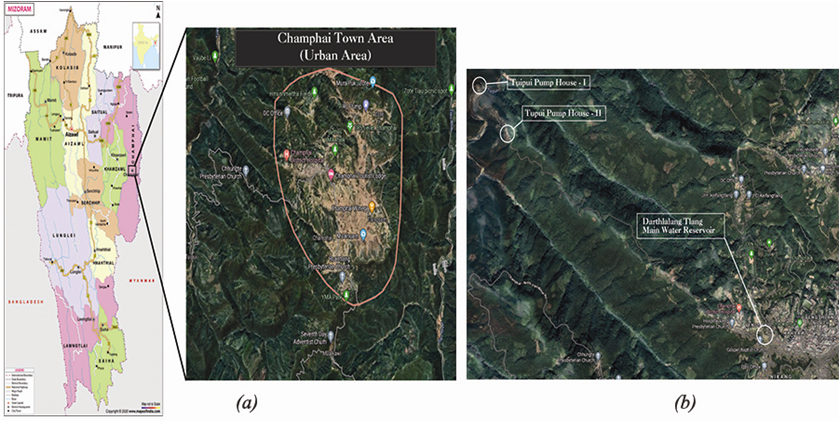
The supply of water in Champhai town is undertaken by the Public Health Engineering Department, Champhai under the Greater Champhai Water Supply Scheme. Water from the Tuipui river is collected at Tuipui Pump House-I, which is located beside the river and the water goes through treatment at Tuipui Pump House-II, located 200m above sea level. Treated water is then stored in the main water reservoir at Darthlalang tlang, located 830m above sea level. From the main reservoir, water is supplied to different areas within Champhai town (Figure 1).
2.2. Sampling and AnalysisPre-treated and treated water samples were collected at monthly intervals in triplicates for two successive years i.e. from February 2018 to January 2019 and from February 2019 to January 2020. The samples were analyzed for various chemical characteristics (pH, total hardness, total alkalinity, acidity, chloride, phosphate-P, nitrate-N, D.O., and B.O.D.), and the monthly observations have been computed on a seasonal basis i.e. pre-monsoon season (February-May), monsoon season (June-September), and post-monsoon season (October-January). Analysis of water samples was carried out using the methods outlined in the “Standard Methods for the Examination of Water and Wastewater” as prescribed by APHA 12.

The water samples were analyzed for various chemical characteristics for pre-treated and treated water for two successive years as mentioned in the methodology. The findings are compared with the standards given by various scientific agencies for drinking water viz. USPH (1962) 13, BIS (2012) 14, ICMR (1975) 15, and WHO (2008) 16 (Table 1). The interpretation of findings was done in light of available literature for conformity of the work.
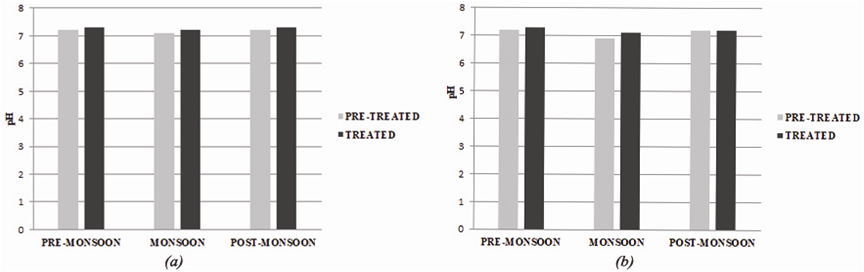
1) pH: pH value indicates the negative logarithm of hydrogen ion concentration in the water sample. It is a representation of the acidity or alkalinity of water 17. The pH value during the study period ranged from 6.9 – 7.2 for pre-treated water and 7.1 – 7.3 for treated water. The pH of the water was found to be higher during the pre-monsoon season and slightly lower during the monsoon season (Figure 2).
The high decomposition rate of organic matters which results in the release of humic acid in the river water during the rainy season may cause slight acidity which resulted in low pH during the monsoon season 18. The pH value has a negative correlation with temperature and acidity.
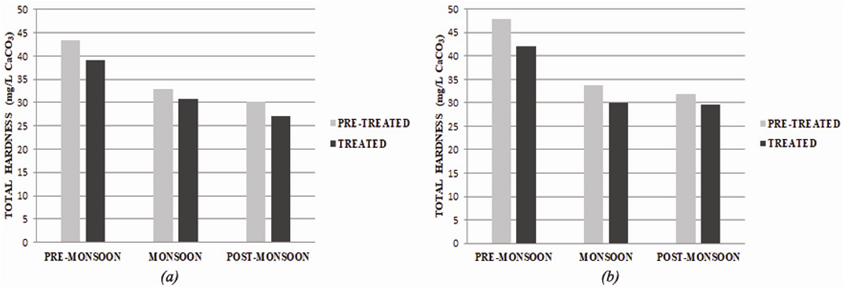
2) Total Hardness: The total hardness values ranged from 30.12 mg/L CaCO3 to 47.83 mg/L CaCO3 for pre-treated water, and 27.16 mg/L CaCO3 to 42 mg/L CaCO3 for treated water. Total hardness was found to be higher during the pre-monsoon season and lower during the post-monsoon season (Figure 3).
Evaporation of water, the inflow of sewage containing calcium and magnesium salts as well as soaps and detergents into the river water may be the cause for the higher value of hardness during the pre-monsoon season 19. Based on the classification provided by WHO 20, water samples from the Tuipui river fall under the soft water category. There is a significant (p<0.05) and positive correlation between total hardness and total alkalinity (r = 0.742 for pre-treated and r = 0.558 for treated).
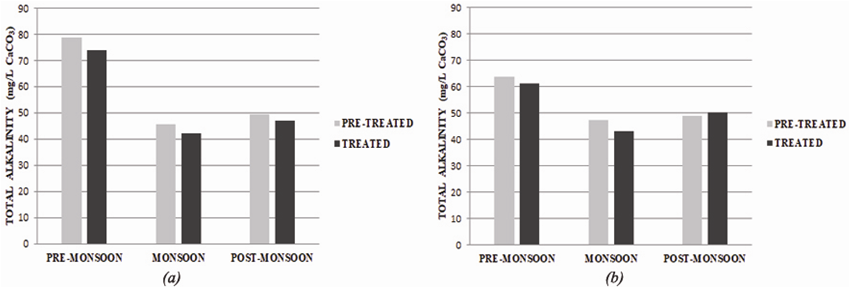
3) Total Alkalinity: The total alkalinity during the study period ranged from 45.66 mg/L CaCO3 to 78.83 mg/L CaCO3 for pre-treated water, and 42.08 mg/L CaCO3 to 74.08 mg/L CaCO3 for treated water. Total alkalinity in treated and pre-treated water of Tuipui river showed higher values for pre-monsoon and lower for the monsoon season (Figure 4).
A higher value of total alkalinity during the pre-monsoon season may be caused by the presence of carbonates, bicarbonates, and hydroxide in the water which are obtained from mineral decompositions in the atmosphere or the soil 21. According to the classification given in 22, the water quality of the Tuipui river falls under the medium productive category. The correlation coefficient reveals a significant (p<0.05) and negative correlation of total alkalinity with acidity (r = -0.665 for pre-treated and r = -0.709 for treated), phosphate-P (r = -0.718 for pre-treated and r = -0.628 for treated) and BOD (r = -0.622 for pre-treated and r = -0.664 for treated).
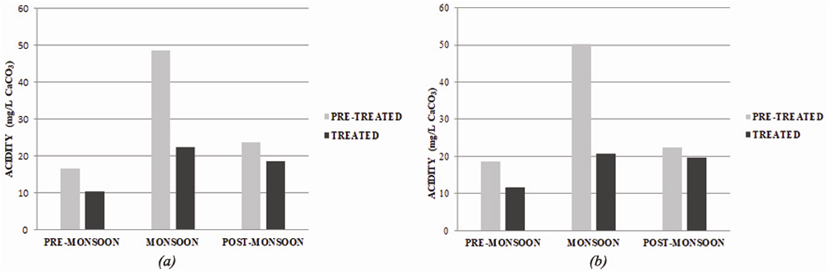
4) Acidity: Acidity in a water sample is the capacity to neutralize a strong base to a designated pH. It can influence the chemical and biological activities in the water bodies 23. The acidity values ranged from 16.67 mg/L CaCO3 to 50.33 mg/L CaCO3 for pre-treated water, and 10.33 mg/L CaCO3 to 22.33 mg/L CaCO3 for treated water. The acidity content of water is higher during the monsoon season and lower during the pre-monsoon season (Figure 5).
The practice of jhum cultivation (slash and burn) during the pre-monsoon months every year has resulted in more carbon dioxide and other particulate substances in the air. This carbon dioxide in the atmosphere reaches the river water in the form of precipitation which may be the cause of higher acidity during the monsoon season 24. There is a significant (p<0.05) and positive correlation of acidity with temperature (r = 0.664 for pre-treated and r = 0.654 for treated water), turbidity (r = 0.865 for pre-treated and r = 0.917 for treated water) and BOD (r = 0.930 for pre-treated and r = 0.980 for treated water).
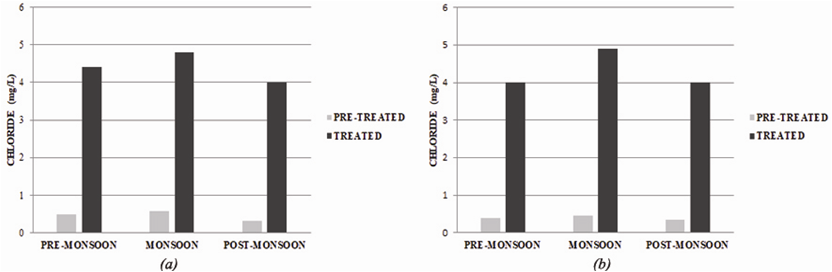
5) Chloride: Chloride in aquatic ecosystems is present in nature in the form of chloride salts such as NaCl, KCl, and CaCl2 25. The chloride content ranged from 0.32 mg/L to 0.57 mg/L for pre-treated water, and 4 mg/L to 4.9 mg/L for treated water. Chloride content was found to be higher during the monsoon season and lower during the post-monsoon season (Figure 6).
The presence of organic matters and surface run-off may cause a slight increase in chloride content during the monsoon season 26. The treated water goes through chlorination for disinfection, which increased the chloride content of treated water. The chloride content has a positive correlation with temperature and a negative correlation with the DO content of water.
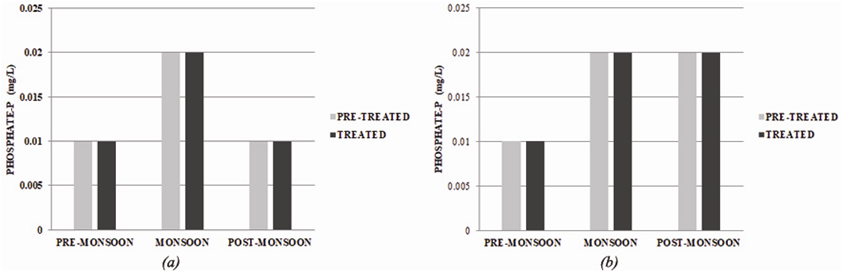
6) Phosphate –P: Phosphate-P content ranged from 0.01 mg/L to 0.02 mg/L for pre-treated water, and 0.01 mg/L to 0.02 mg/L for treated water. The phosphate-P content was found to be higher during the monsoon season and lower during the pre-monsoon season (Figure 7).
With the use of fertilizers and other phosphate-containing compounds for harvesting crops in the field, some amount of phosphate-P is released into river water with surface run-off. Leaching from rocks and soil, and the anthropogenic source may cause an increase in phosphate-P content during the monsoon season 27, 28. However, the concentrations present in the water samples are within the permissible limit. There is a significant (p<0.05) and negative correlation of phosphate-P with total alkalinity (r = -0.718 for pre-treated and r = -0.628 for treated water).
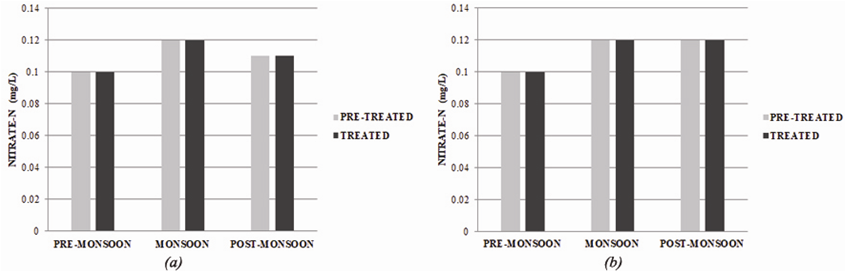
7) Nitrate – N: The nitrate-N value ranged from 0.1 mg/L to 0.12 mg/L for pre-treated water, and 0.1 mg/L to 0.12 mg/L for treated water. The nitrate-N value was found to be highest during the monsoon season compared to the pre-monsoon and post-monsoon seasons (Figure 8).
The increase in nitrate-N concentration may be due to the runoff from agricultural land that contains inorganic fertilizers and manures, leachate from wastes, and the transformation of organic matters to nitrate by mineralization and hydrolysis 29, 30. The nitrate-N values are within the permissible limit given by various scientific agencies. Nitrate-N has a significant (p<0.05) and positive correlation with temperature (r = 0.748 for pre-treated and r = 0.780 for treated water), turbidity (r = 0.625 for pre-treated and r = 0.647 for treated water), acidity (r = 0.723 for pre-treated and r = 0.702 for treated water) and BOD (r = 0.624 for pre-treated and r = 0.603 for treated water). Nitrate-N also has a significant (p<0.05) and negative correlation with DO (r = -0.765 for pre-treated and r = -0.862 for treated water).
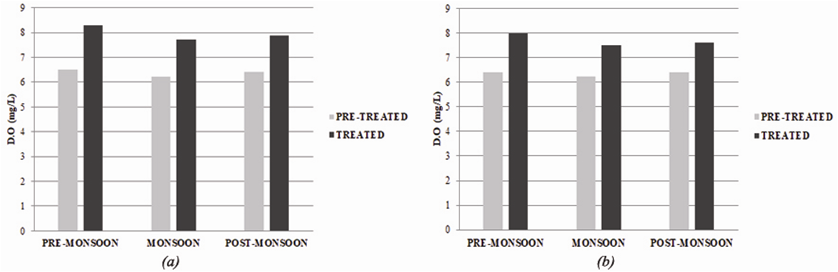
8) Dissolved Oxygen (DO): The dissolved oxygen (DO) value ranged from 6.22 mg/L to 6.5 mg/L for pre-treated water, and 7.5 mg/L to 8.3 mg/L for treated water. The DO content of water was found to be higher during the pre-monsoon season and lower during the monsoon season (Figure 9).
The reduced microbial activities and low organism respiratory demand during the winter season may also lead to higher DO content during the pre-monsoon season as the temperature of the water is relatively low. The lower DO content during the monsoon season may be due to increased microbial activities due to the presence of high organic material load through surface run-off resulting in high temperature 31. There is a significant (p<0.05) and negative correlation of DO with nitrate-N (r = -0.765 for pre-treated and r = -0.862 for treated water), temperature (r = -0.753 for pre-treated and r = -0.504 for treated water).
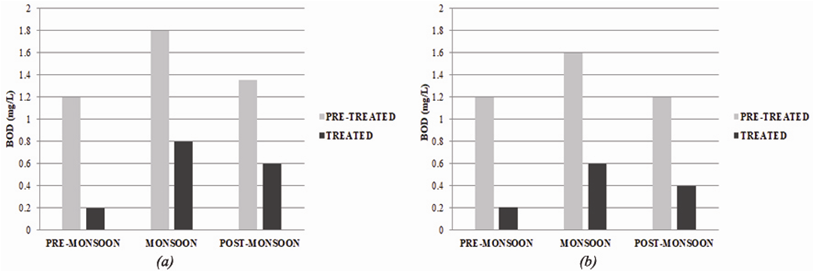
9) Biochemical Oxygen Demand (BOD): BOD represents the level of organic matter contamination in the surface water. The BOD content ranged from 1.2 mg/L – 1.8 mg/L for pre-treated water and 0.2 mg/L – 0.8 mg/L for treated water. BOD content of water during the two years was higher during the monsoon season and lower during the pre-monsoon season (Figure 10).
The presence of organic matters and enhanced microbial activities may lead to higher BOD content during the monsoon season. The low temperature during winter did not favor any microbial activity which may lead to low BOD during the pre-monsoon season 32. The BOD content of the river is within the permissible limit as given by various scientific agencies. There is a significant (p<0.05) and positive correlation of BOD with turbidity (r = 0.939 for pre-treated and r = 0.937 for treated water), acidity (r = 0.930 for pre-treated and r = 0.980 for treated water) and nitrate-N (r = 0.624 for pre-treated and r = 0.603 for treated water). Moreover, there is a negative and significant (p<0.05) correlation of BOD with total alkalinity (r = -0.622 for pre-treated and r = -0.664 for treated water).


The value of all the chemical parameters of the water samples collected from the Tuipui river during the study period is compared with the standards for drinking water given by various scientific agencies. It was found that all the chemical parameters tested during the study period lie within the permissible limit of drinking water standards.
Direct use of water from the Tuipui river for drinking purposes is not recommended. The long-term use of pre-treated water may lead to adverse effects on human health. Regular monitoring of the Tuipui River for water quality should be done. Disposal of wastes and other anthropogenic activities that can compromise the quality of the river water should be avoided and kept in check.
The authors are thankful to the Department of Environmental Science, Mizoram University, and the Public Health Engineering Department, Champhai District for their commendable help and support in carrying out this piece of research works successfully and effectively.
The authors have no competing interests.
| [1] | Henry, J. G., and Heinke, G. W. Environmental Science and Engineering, Second Edition, Pearson Education Inc., Upper Saddle River, New Jersey, USA, 1996. | ||
| In article | |||
| [2] | De, A.K. Environmental Chemistry, Seventh Edition, New Age International Publishers, Ansari Road, Daryaganj, New Delhi, India, 2012. | ||
| In article | |||
| [3] | Simpi, B., Hiremath, S.M. Murthy, K.N.S., Chandrashekarappa, K.N., Patel, A.N. and Puttiah, E.T. Analysis of Water Quality Using Physico-Chemical Parameters Hosahalli Tank in Shimoga District, Karnataka, India. Global Journal of Science Frontier Research, 11(3): 31-34. May 2011. | ||
| In article | |||
| [4] | Sheikh, A., Pal, A. and Pandit, A.K. Water Quality of Vishav Stream in Kashmir Valley, J& K, India. Recent Research in Science and Technology, 2(2): 54-59. Jan 2010. | ||
| In article | |||
| [5] | Shukla, D.P., Vaghela, K.B. and Jain, N.K. Assessment of Physico-Chemical and Bacteriological Water Quality Parameters: A Review. International Journal of Pharmacy and Integrated Life Sciences, 5(2): 1-17, Jan 2017. | ||
| In article | |||
| [6] | Vinutha, G.P., Hemant Kumar, N.K., Hosmani, S.P. and Jagannath, S. Assessment of Physico-Chemical Analysis and Its Correlation with Water Quality of Chikkarasinakere Lake, Karnataka, India. Int. J. Adv. Biotechnol. Res. 6(3): 296-309, Aug 2015. | ||
| In article | |||
| [7] | Garg. S.K. Water Supply Engineering, Thirty-Fourth Edition, Khanna Publishers, Delhi, India, 2021. | ||
| In article | |||
| [8] | Amin, A., Ahmad, T., Ehsnullah, M., Irfanullah, Khatak, M.M. and Khan, M.A. Evaluation of Industrial and city effluent quality using Physicochemical and Biological Parameters. Electronic Journal of Environmental, Agricultural and Food Chemistry, 9(5): 931-939, Jan 2010. | ||
| In article | |||
| [9] | Imchen, W., Panja, P., Yanthan, C. and Elow, A. Physiochemical characterization and evaluation of river water quality for its potability, Champhai District, Mizoram, NE India. Journal of Environmental Science, Computer Science and Engineering & Technology, 9(2): 327-341, March 2020. | ||
| In article | View Article | ||
| [10] | Lalzarliana, C. Rainfall records of Mizoram. Directorate of Agriculture, Government of Mizoram, 2014, p. 1. | ||
| In article | |||
| [11] | Lalbiaknungi, R. and Lalbiakmawia, F. Application of Geo-Spatial Technology for Ground Water Quality Mapping of Champhai District, Mizoram, India. Journal of Emerging Technologies and Innovative Research, 4(11): 752-756, Nov 2017. | ||
| In article | |||
| [12] | APHA. Standard methods for the examination of water and wastewater; 21stedition as prescribed by American Public Health Association, American Water Works Association, and Water Environment Federation, Washington, D.C., 2005. | ||
| In article | |||
| [13] | USPH. Drinking Water Standards, PHS Pub. 956. U.S. Department of Health Education and Welfare, Washington D.C., 1962. | ||
| In article | |||
| [14] | BIS. Indian Standard Drinking Water Specification (2nd Revision), IS 10500:2012, Bureau of Indian Standards, New Delhi, 2012. | ||
| In article | |||
| [15] | ICMR. Manual of standards of quality for drinking water supplies. Indian Council of Medical Research, New Delhi, 1975. | ||
| In article | |||
| [16] | WHO. Guidelines for Drinking Water Quality. World Health Organization. 3rd Edition, Volume 1 Recommendations, 2008. Geneva, Switzerland. | ||
| In article | |||
| [17] | Chenkual, L. and Mishra, B.P. Physico-chemical characteristics of Tamdil in Mizoram, Northeast India. Science Vision, 14(4): 200-206, Oct-Dec 2014. | ||
| In article | |||
| [18] | Sunar, S. and Mishra, B.P. Assessing the impact of Hydroelectric Power Project on the water quality of Serlui River in Kolasib district, Mizoram, North-East India. International Research Journal of Environmental Sciences, 5(9): 40-44. Sept.2016. | ||
| In article | |||
| [19] | Singh, M.R. and Gupta, A. Seasonal variation in certain physicochemical parameters of Imphal, Iril and Toubal rivers from Manipur river system, India. Ecology, Environment and Conservation, 16(2): 197-207. 2010. | ||
| In article | |||
| [20] | WHO. Guidelines for Drinking Water Quality. World Health Organization. 3rd Edition, Volume 1, Recommendations. Geneva. Switzerland, 2004, p. 515. | ||
| In article | |||
| [21] | Bozorg-Haddad, O., Delpasand, M. and Loáiciga, H.A. Economical, Political, and Social Issues in Water Resources, Elsevier, July 2021, pp 217-257. | ||
| In article | View Article | ||
| [22] | Schaeperclaus, W., Kulow, H. and Schreckenbach, K. Fischkrankheiten, Fifth Edition, Akademie-Verlag, Berlin, 1990. | ||
| In article | |||
| [23] | Bendicho, C. and Lavilla, I. Water Analysis|Sewage, Encyclopedia of Analytical Science, (Ed.) Worsfold, P., Townshend, A. and Poole, C., Second Edition, Elsevier, 2005, pp300–307. | ||
| In article | View Article | ||
| [24] | Laldintluanga, H., Lalbiakmawia, F. and Lalbiaknungi, R. Assessment of Rural Water Quality in Aizawl, Mamit, and Serchhip District of Mizoram, India. International Journal of Science Technology & Engineering, 3(6): 111-118. Dec 2016. | ||
| In article | |||
| [25] | Verma, P. and Ratan, K.K. Assessment of the negative effects of various inorganic water pollutants on the biosphere—an overview, Inorganic Pollutants in Water, (Ed.) Devi, P., Singh P. and Kansal, S.K., Elsevier, 2020, pp73-96. | ||
| In article | View Article | ||
| [26] | Jain, P. K. Assessment of Water Quality of Khnop Reservoir in Chhatarpur, M.P., India, Ecol. Env. & Cons. 5(4): 401-403, 1999. | ||
| In article | |||
| [27] | Lalchhingpuii, Lalramnghinglova, H. and Mishra, B.P. Sulphate, Phosphate-P and nitrate-N contents in Tlawng river in vicinity of Aizawl city, Mizoram. Science Vision. 11(4), 19-202. Oct 2011. | ||
| In article | |||
| [28] | Chenkual, L. and Mishra, B.P. Assessment of seasonal variation in chemical characteristics of Tamdil lake, Mizoram, Northeast India. International Journal of Scientific Engineering and Applied Science (IJSEAS). 2(7): 157-164. July 2016. | ||
| In article | |||
| [29] | Parvizishad, M., Dalvand, A., Mahvi, A.H. and Goodarzi F. A Review of Adverse Effects and Benefits of Nitrate and Nitrite in Drinking Water and Food on Human Health. Health Scope, 6(3): e14164, June 2017. | ||
| In article | View Article | ||
| [30] | Ward, M. H., deKok, T. M., Levallois, P., Brender, J., Gulis, G., Nolan, B. T., VanDerslice, J., and International Society for Environmental Epidemiology. Workgroup report: Drinking-water nitrate and health--recent findings and research needs. Environmental health perspectives, 113(11), 1607-1614, Nov 2005. | ||
| In article | View Article PubMed | ||
| [31] | Srivastava, R.K., Harit, G. and Srivastava, R. A study of physic-chemical characteristics of lakes around Jaipur, India. Journal of Environmental Biology, 30(5): 889-894. 2009. | ||
| In article | |||
| [32] | Mishra, B.P. and Tripathi, B.D. Sewage Quality Analysis: Pollutants Removal Efficiency of a Sewage Treatment Plant. Jr. of Industrial Pollution Control, 16(2): 239-251, Jan 2000. | ||
| In article | |||
Published with license by Science and Education Publishing, Copyright © 2022 Vanlalhruaitluanga Bochung and B.P. Mishra
 This work is licensed under a Creative Commons Attribution 4.0 International License. To view a copy of this license, visit
http://creativecommons.org/licenses/by/4.0/
This work is licensed under a Creative Commons Attribution 4.0 International License. To view a copy of this license, visit
http://creativecommons.org/licenses/by/4.0/
| [1] | Henry, J. G., and Heinke, G. W. Environmental Science and Engineering, Second Edition, Pearson Education Inc., Upper Saddle River, New Jersey, USA, 1996. | ||
| In article | |||
| [2] | De, A.K. Environmental Chemistry, Seventh Edition, New Age International Publishers, Ansari Road, Daryaganj, New Delhi, India, 2012. | ||
| In article | |||
| [3] | Simpi, B., Hiremath, S.M. Murthy, K.N.S., Chandrashekarappa, K.N., Patel, A.N. and Puttiah, E.T. Analysis of Water Quality Using Physico-Chemical Parameters Hosahalli Tank in Shimoga District, Karnataka, India. Global Journal of Science Frontier Research, 11(3): 31-34. May 2011. | ||
| In article | |||
| [4] | Sheikh, A., Pal, A. and Pandit, A.K. Water Quality of Vishav Stream in Kashmir Valley, J& K, India. Recent Research in Science and Technology, 2(2): 54-59. Jan 2010. | ||
| In article | |||
| [5] | Shukla, D.P., Vaghela, K.B. and Jain, N.K. Assessment of Physico-Chemical and Bacteriological Water Quality Parameters: A Review. International Journal of Pharmacy and Integrated Life Sciences, 5(2): 1-17, Jan 2017. | ||
| In article | |||
| [6] | Vinutha, G.P., Hemant Kumar, N.K., Hosmani, S.P. and Jagannath, S. Assessment of Physico-Chemical Analysis and Its Correlation with Water Quality of Chikkarasinakere Lake, Karnataka, India. Int. J. Adv. Biotechnol. Res. 6(3): 296-309, Aug 2015. | ||
| In article | |||
| [7] | Garg. S.K. Water Supply Engineering, Thirty-Fourth Edition, Khanna Publishers, Delhi, India, 2021. | ||
| In article | |||
| [8] | Amin, A., Ahmad, T., Ehsnullah, M., Irfanullah, Khatak, M.M. and Khan, M.A. Evaluation of Industrial and city effluent quality using Physicochemical and Biological Parameters. Electronic Journal of Environmental, Agricultural and Food Chemistry, 9(5): 931-939, Jan 2010. | ||
| In article | |||
| [9] | Imchen, W., Panja, P., Yanthan, C. and Elow, A. Physiochemical characterization and evaluation of river water quality for its potability, Champhai District, Mizoram, NE India. Journal of Environmental Science, Computer Science and Engineering & Technology, 9(2): 327-341, March 2020. | ||
| In article | View Article | ||
| [10] | Lalzarliana, C. Rainfall records of Mizoram. Directorate of Agriculture, Government of Mizoram, 2014, p. 1. | ||
| In article | |||
| [11] | Lalbiaknungi, R. and Lalbiakmawia, F. Application of Geo-Spatial Technology for Ground Water Quality Mapping of Champhai District, Mizoram, India. Journal of Emerging Technologies and Innovative Research, 4(11): 752-756, Nov 2017. | ||
| In article | |||
| [12] | APHA. Standard methods for the examination of water and wastewater; 21stedition as prescribed by American Public Health Association, American Water Works Association, and Water Environment Federation, Washington, D.C., 2005. | ||
| In article | |||
| [13] | USPH. Drinking Water Standards, PHS Pub. 956. U.S. Department of Health Education and Welfare, Washington D.C., 1962. | ||
| In article | |||
| [14] | BIS. Indian Standard Drinking Water Specification (2nd Revision), IS 10500:2012, Bureau of Indian Standards, New Delhi, 2012. | ||
| In article | |||
| [15] | ICMR. Manual of standards of quality for drinking water supplies. Indian Council of Medical Research, New Delhi, 1975. | ||
| In article | |||
| [16] | WHO. Guidelines for Drinking Water Quality. World Health Organization. 3rd Edition, Volume 1 Recommendations, 2008. Geneva, Switzerland. | ||
| In article | |||
| [17] | Chenkual, L. and Mishra, B.P. Physico-chemical characteristics of Tamdil in Mizoram, Northeast India. Science Vision, 14(4): 200-206, Oct-Dec 2014. | ||
| In article | |||
| [18] | Sunar, S. and Mishra, B.P. Assessing the impact of Hydroelectric Power Project on the water quality of Serlui River in Kolasib district, Mizoram, North-East India. International Research Journal of Environmental Sciences, 5(9): 40-44. Sept.2016. | ||
| In article | |||
| [19] | Singh, M.R. and Gupta, A. Seasonal variation in certain physicochemical parameters of Imphal, Iril and Toubal rivers from Manipur river system, India. Ecology, Environment and Conservation, 16(2): 197-207. 2010. | ||
| In article | |||
| [20] | WHO. Guidelines for Drinking Water Quality. World Health Organization. 3rd Edition, Volume 1, Recommendations. Geneva. Switzerland, 2004, p. 515. | ||
| In article | |||
| [21] | Bozorg-Haddad, O., Delpasand, M. and Loáiciga, H.A. Economical, Political, and Social Issues in Water Resources, Elsevier, July 2021, pp 217-257. | ||
| In article | View Article | ||
| [22] | Schaeperclaus, W., Kulow, H. and Schreckenbach, K. Fischkrankheiten, Fifth Edition, Akademie-Verlag, Berlin, 1990. | ||
| In article | |||
| [23] | Bendicho, C. and Lavilla, I. Water Analysis|Sewage, Encyclopedia of Analytical Science, (Ed.) Worsfold, P., Townshend, A. and Poole, C., Second Edition, Elsevier, 2005, pp300–307. | ||
| In article | View Article | ||
| [24] | Laldintluanga, H., Lalbiakmawia, F. and Lalbiaknungi, R. Assessment of Rural Water Quality in Aizawl, Mamit, and Serchhip District of Mizoram, India. International Journal of Science Technology & Engineering, 3(6): 111-118. Dec 2016. | ||
| In article | |||
| [25] | Verma, P. and Ratan, K.K. Assessment of the negative effects of various inorganic water pollutants on the biosphere—an overview, Inorganic Pollutants in Water, (Ed.) Devi, P., Singh P. and Kansal, S.K., Elsevier, 2020, pp73-96. | ||
| In article | View Article | ||
| [26] | Jain, P. K. Assessment of Water Quality of Khnop Reservoir in Chhatarpur, M.P., India, Ecol. Env. & Cons. 5(4): 401-403, 1999. | ||
| In article | |||
| [27] | Lalchhingpuii, Lalramnghinglova, H. and Mishra, B.P. Sulphate, Phosphate-P and nitrate-N contents in Tlawng river in vicinity of Aizawl city, Mizoram. Science Vision. 11(4), 19-202. Oct 2011. | ||
| In article | |||
| [28] | Chenkual, L. and Mishra, B.P. Assessment of seasonal variation in chemical characteristics of Tamdil lake, Mizoram, Northeast India. International Journal of Scientific Engineering and Applied Science (IJSEAS). 2(7): 157-164. July 2016. | ||
| In article | |||
| [29] | Parvizishad, M., Dalvand, A., Mahvi, A.H. and Goodarzi F. A Review of Adverse Effects and Benefits of Nitrate and Nitrite in Drinking Water and Food on Human Health. Health Scope, 6(3): e14164, June 2017. | ||
| In article | View Article | ||
| [30] | Ward, M. H., deKok, T. M., Levallois, P., Brender, J., Gulis, G., Nolan, B. T., VanDerslice, J., and International Society for Environmental Epidemiology. Workgroup report: Drinking-water nitrate and health--recent findings and research needs. Environmental health perspectives, 113(11), 1607-1614, Nov 2005. | ||
| In article | View Article PubMed | ||
| [31] | Srivastava, R.K., Harit, G. and Srivastava, R. A study of physic-chemical characteristics of lakes around Jaipur, India. Journal of Environmental Biology, 30(5): 889-894. 2009. | ||
| In article | |||
| [32] | Mishra, B.P. and Tripathi, B.D. Sewage Quality Analysis: Pollutants Removal Efficiency of a Sewage Treatment Plant. Jr. of Industrial Pollution Control, 16(2): 239-251, Jan 2000. | ||
| In article | |||