This study is on seasonal algal composition in River Rupnarayan between June and December 2021 (monsoon and winter seasons). It is also studied the availability of algae present in the river Rupnarayan as a source of food for fishes specially Tenualosa ilisha. To study the water quality in relation with algal growth in the River Rupnarayan, some physicochemical parameters like pH, Conductance (µS/cm), Hardness (ppm), TDS (ppm), Dissolve Oxygen (ppm), Salinity(ppm), Turbidity (NTU), total Alkalinity (ppm), Biological Oxygen Demand (mg/l) were evaluated. Result showed a clear relation between physicochemical parameters and algal growth during monsoon and winter periods. Major group of algae recorded during observation were Chlorophyceae, Cyanophyceae and Bacilariophyceae. Species of Anabaena, Nostoc, Spirogyra, Chlorella,Chlorococcum, Oscillatoria were dominant in the rainy season and Diatoms in the winter season. The river water is slightly alkaline, have low salinity and low TDS. The river water contained adequate sodium, potassium and nitrate in monsoon and winter periods.
River Rupnarayan begins as the Dhaleswari (Dhalkisor) in the Choto Nagpur plateau foothills northeast of the town of Purulia. It then follows a tortuous southeasterly course past the town of Bankura, where it is known as the Dwarakeswar River. Near the town of Ghatal it is joined by the Shilabati river, where it took the name Rupnarayan. And discharge into Hooghly River. It is famous for the Tenualosa ilisha fishery used in Bengali Cuisine. Algae are found in wide range of lentic and lotic environment 1. Algae are one of the important source of food for aquatic fauna such as fishes, snails, crabs etc. In India there are about 2,500 species of fishes out of which 930 live in freshwater and 1,570 are marine 2. The distribution and composition of the fish species in each habitat were closely associated with various factors such as the availability of food, breeding sites, water current, depth, topography and physico-chemical properties of water 3. Algae are frequently found in polluted and unpolluted water and generally are considered useful in the determination of quality of water. Algae have long been identified as valuable indicators in the bio-monitoring of river ecosystems 4, 5. They play a very pivotal role as primary producers as well as oxygen producer in the food web of various aquatic bodies Biological assessment is a useful alternative for assessing the ecological quality of aquatic ecosystems since biological communities integrate the environmental effects of water chemistry in addition to the physical and geomorphologic characteristics of Rivers 6.
The aim of this study is to assess the seasonal algae in River Rupnarayan during monsoon and winter seasons in relation to some physico-chemical parameters. It will also study the availability of algae present in the river Rupnarayan which are used as a source of food for fishes specially Tenualosa ilisha.
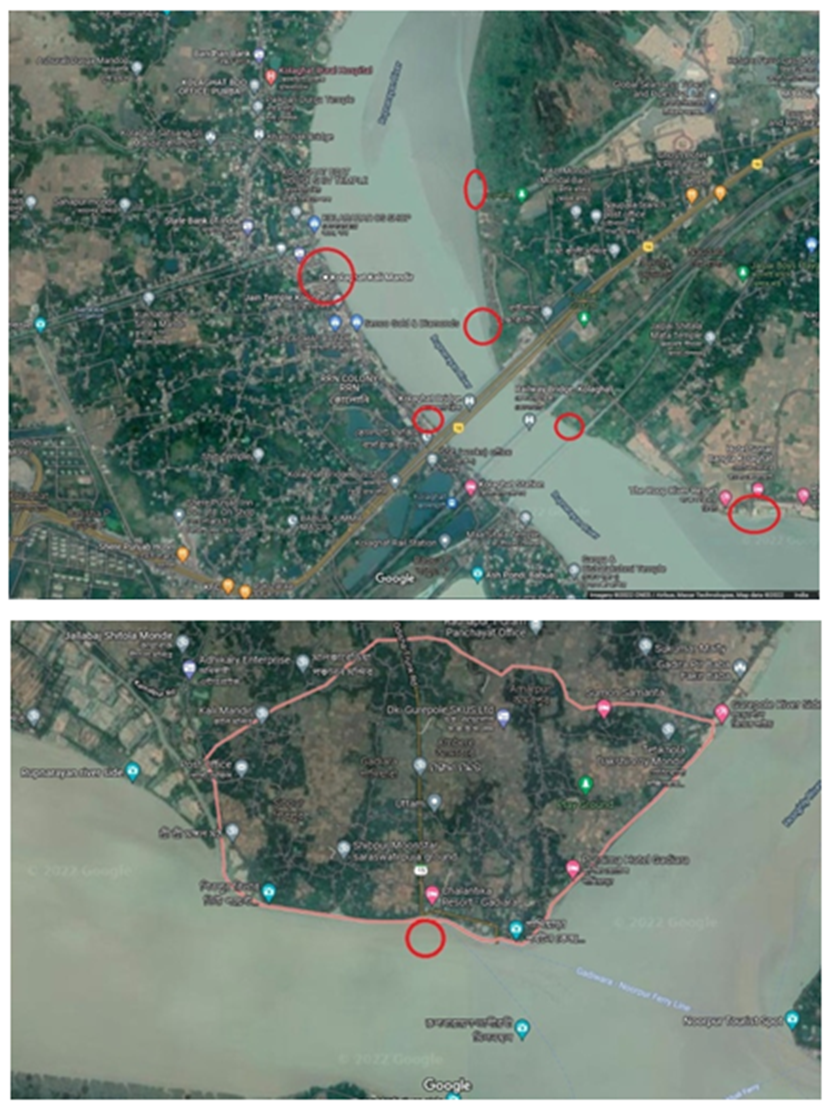
Water and algal samples from Rupnarayan River were collected from 6 spots in Kolaghat namely Kali Maa temple (22°26ʹ7.188ʺN, 87°53ʹ1.8456ʺE) Kolaghat, Hotel Sonar Bangla Ghat (22°26̍ʹ7.1736ʺN, 87°53ʹ1.7988ʺE) of Purba Medinipur district, Sarat setu NH6, Naupala I (22°26ʹ25.6128ʺN, 87°53ʹ13.6716ʺE), Naupala II(22°44ʹ90.9122ʺN, 87°88ʹ25.4228ʺ E, Kolaghat Bridge(22˚ 44ʹ00.3102ʺ N, ̍ 87˚ 88ʹ00.4202ʺ E), Kolaghat Railway Bridge (22˚ 43ʹ87.4038ʺ N, ̍ 87˚ 88ʹ48.2032ʺE), Howrah district and Gadiara (22°21ʹ98.0024ʺN, 88°04ʹ72.7028ʺ E), of Howrah district, West Bengal, India. All the study stations circled in red in the map. The river water mainly used for fishery, agriculture and in Kolaghat Thermal power plant.

The water samples were collected on a monthly basis between June and December 2021 randomly from River Rupnarayan. All the water samples were analyzed using Titrimetry, Flamephotometry methods. Is-Situ measurements of some physicochemical parameter like pH, Conductance (µS,/cm), TDS (ppm), Salinity(ppm) were made using EUTECH made Multi-parameter PCSTester 35 and Dissolve Oxygen (ppm) was determined by Dissolved Oxygen Meter, Lutron DO-5509. Temperature was measured using EUTECH made Multi-parameter PCS Tester 35.
The water samples were collected in sterile Plastic bottles of 1l capacity. Sodium and potassium ions determined using SYSTRONICS flame photometer 128 µC, Calcium and Nitrate ions were analyzed using pH/ORP/mv Meter Sys 460, and Turbidity was measured using µC Turbidity meter 135 of the Environmental Chemistry Research Laboratory, Barrackpore Rastraguru Surendranath College.
2.3. Algal SamplingBenthic algal samples were collected from hard surface such as rock with the help of pocket knife; scalpels and spatulas made with stainless steel by scraping algae from hard surface and collected them in a sterile bottle. Algal samples from soft surface such as muddy area collected with the help of a pipette. Floating algae collected with the help of fine meshed dip nets and by hand and preserved into sterile plastic bottles. Phytoplankton samples were collected with the help of Plankton nets. Algal sample were preserved with 3% Formaldehyde solution. Microscopic observation was done by using standard methods 7. The identification was done by using standard literature 8, 9, 10, 11.
Water samples were collected from all the 7 locations in every month during monsoon to winter period from Rupnarayan River and Physico-chemical parameters and inorganic ions were analyzed. All the data were calculated by using IBM SPSS 20 Software and results presented in Table 1 and Table 2.
The mean pH value of Rupnarayan River was slightly alkaline, ranging from 7.75 to 8.13 and within permissible limit. The mean value of conductance ranged between 186.66 - 320 µS/cm. Rupnarayan River remained slightly hard and ranged between 70.47 – 145.64ppm. Total Dissolved Solids or TDS mean value remained between 132.33 - 289 ppm during monsoon and winter seasons. Dissolve Oxygen (DO) plays important role in Biological process of water ecosystem and important parameter to assets water quality. During monsoon and winter season mean DO value of Rupnarayan River ranged between 5.8 to 7.8 ppm which indicates the river ecosystem is good for growth of Cyanophyceae, Chlorophyceae, Bacillariophyceae. The present study also justified the same. The mean value of salinity lied between 95.91.83 to 206.66ppm during monsoon and winter seasons which suggest the river water is fresh. Turbidity of the river water ranged between 81.86 and 130.40 NTU. Biological Oxygen Demand or BOD is an important parameter often use as an index of the degree of organic pollution in water. 12 Mean value of BOD ranged between 2.4 – 3.4 ppm which indicates River water is suitable for aquatic life.
Blue green algae like Anabaena cylindrica requires adequate amount of sodium ion as nutrients 13. From Table 2 it is clear that River contained adequate sodium ions for the growth of blue green algae as one of the nutrients. Under low concentrations of potassium ions algal growth and rate of photosynthesis become low and rate of respiration become high 14. Potassium ion concentration ranged between 5.60 ppm to 8.87 ppm (Table 2) which was found suitable for algal growth. Algae require bicarbonate ions as one of the key factors for photosynthesis 15. The river contained bicarbonate ion between 103.29 and 144.03 ppm suggested that River is a good source of bicarbonate ion for algal photosynthesis. and mean value of carbonate ion ranged between 2.36 ppm to 3.86 ppm (Table 2). It was reported that adequate concentration of nitrate as nutrient promote algal growth 16. The nitrate content is high in July and August month, 2021 and this may be due to mixing of chemical manure used in agricultural land situated beside river bank through rain water and in this study it was observed that during this time only blue-green algae are dominant. Calcium ion concentrations range between 59 to 66 ppm. It was reported that decreasing number of species of diatoms indicated the presence of decreasing pollution of water 17. The river water remained unpolluted during study time and good source for diatoms.
The present study showed rich variety of algal species in the river water during monsoon season. The present study identified 5 Blue-green algae, 12 Green algae, 1 yellow green algae and 10 diatoms (Table 3) belonging to the group Cyanophyta, Chlorophyta, Charophyta and Bacillariophyta. During monsoon season some algal species such as Stigeoclonium, Chaetophora, Nostoc, Oedogonium are rare to dominant. Some other algal species such as Spirogyra, Chlorococcum, Amphora, Microspora are abundant. Diatoms are dominant during winter season. The reason may be temperature change in winter.
Diatoms are generally rich in protein and fat, so they are important for fish growth. Where diatoms are dominant in aquatic ecosystem they improve the growth of fish and shrimp and meets their growing nutritional demands 18. River Rupnarayan is rich in different fishes. It was reported that the river is a rich sources of Ompok bimaculatus, Ompok pabda, Mystus tengara, Mystus seenghala, Puntius ticto, Puntius vittatus, Chela cachius, Puntius sarana, Ambly pharyngodonmola, Amphipnous sp, Colisa fasciata, Colisa chuna, Setipinna phasa, Gudusia chapr, Polynemus paradiseus 19. 4 major groups of phytoplankton such as Bacillariophyceae, Chlorophyceae, Cyanophyceae and Euglenophyceae were reported as main food source of Tenualosa ilisha fish 20. It was also reported that Coscinodiscus, Pleurosigma, Bacillaria, Nitzschia, Biddulphia, Diatoma and Asterionella were the most common genera consumed by Tenualosa ilisha 21. Blue green algae prefer neutral or alkaline pH where as green algae prefer acidic pH 11. The present study observed vast growth of blue green algae than green algae during monsoon season when river water is very slightly to slightly alkaline though it was found that number of genera of green algae is more than blue green algae.
In the present study we found 5 blue-green which have biological nitrogen fixing capability 22 and causes soil fertility of river bank and suppress the growth of submerged weeds. Chlorella vulgaris is a member of green algae is a rich protein source 23 and dietary source for fish growth, immune response and disease resistance 24.
From the recorded data during study time in the sense of presence of algal group it can be concluded that approximately 43% algal species are Chlorophyceae, 18% are cyanophyceae and 39% are Bacilariophyceae which are good source of food for Tenualosa ilisha and this is one reason that during monsoon season the river contains good quality and quantity of Tenualosa ilisha. In this study presence of Coscinodiscus, Pleurosigma,, Nitzschia and Pinnularia were recorded during rainy season provide good source of food for Tenualosa ilisha. The order of abundance of various phytoplankton groups was Chlorophyceae > Cyanophycea > Bacillariophyceae in the rainy season but in winter season the order is Chlorophyceae > Bacillariophyceae > Cyanophycea. It is also concluded that river ecosystem is suitable for fishery and growth of algae. The Dissolved Oxygen (DO) concentration of the river water always remained between 5.8 ppm to 7.8 ppm. This is an ideal aquatic condition for growth of Algae.
The authors are extremely grateful to Governing Body and Research monitoring committee of Barrackpore Rastraguru Surendranath College for financial assistance and funding research project.
| [1] | Patil S.V., Karande V.C. and Karande C.T.. Limnological study of Venna Lake, Mahabaleshwar, Maharashtra, India.International Research Journal of Environment Sciences., 4(8), 45-49. 2015. | ||
| In article | |||
| [2] | Kar, DA., Bohra, C Kumar., Sigh, LK., (Eds).. Fishes of Barak drainage, mizoram and Tripura; In: Environment, pollution and management, APH publishing corporation, New Delhi., 604: 203-211, 2003. | ||
| In article | |||
| [3] | Harris, J. H.. The use of fish in ecological assessments. Australian Journal of Ecology, 20: 65-80, 1995. | ||
| In article | View Article | ||
| [4] | Kolkwitz, R., Marsson, M.. Ecology of plant saprobia. – Calc. German. Bot. Ges. 22: 505-519, 1908. | ||
| In article | |||
| [5] | Hill, B.H., Herlihy, A.T., Stevenson, R.J., Kaufmann, P.R., McCormick, F.J., Johnson, C.B.. The use of periphyton assemblage data in an index of biotic integrity. – J. N. Am. Benthol. Soc. 19: 50-67, 2000. | ||
| In article | View Article | ||
| [6] | Stevenson, R J; Pan, Y. Assessing environmental conditions in Rivers and streams using diatoms. In: Stoermer, E F; Smol, J P (eds.) The diatoms. Applications for the environmental and earth sciences. Cambridge University Press, Cambridge. 11-40, 1999. | ||
| In article | View Article PubMed | ||
| [7] | Steven N. Francoeur, Steven. T. Rier, S. Whorley. Methods for Sampling and Analyzing Wetland Algae. Wetland Technique. Springer, 2013. 1-58. | ||
| In article | View Article | ||
| [8] | Desikachary, T.V. Cyanophyta. – Indian Council of Agricultural Research, New Delhi, 1959. | ||
| In article | |||
| [9] | Cox, E. R., Hightower, J.. Some corticolous algae of McMinn County, Tennessee, U.S.A. Journal of Phycology 8: 203-205, 1972. | ||
| In article | View Article | ||
| [10] | Sarode P. T. And Kamat N.D.. Fresh water diatoms of Maharashtra, Pub. Saikrupa Prakashan Aurangabad, 1-338, 1984. | ||
| In article | |||
| [11] | Sharma O.P. Algae. McGraw Hill Education (India), 2011. | ||
| In article | |||
| [12] | Neelam Verma, Ashis Kumar Singh. Development of Biological Oxygen Demand Biosensor for Monitoring the Fermentation Industry Effluent. Hindawi Publishing Corporation. ISRN Biotechnology. 1-6, 2013. | ||
| In article | View Article PubMed | ||
| [13] | Amelia. K. Ward, Robert. G.Wetzel. Sodium: Some effects on blue-green algal growth. Journal of Phycology. 11(4), 357-363. 2008. | ||
| In article | View Article | ||
| [14] | William A. Jackson and Richard. J.Volk. Role of Potassium ion in Photosynthesis and Reaspiration. American Society of Agronomy inc.1968. | ||
| In article | |||
| [15] | D. Shevela, Julain J. Eaton- Rye. Photosystem II and the unique role of bicarbonate: Ahistorical perspective. Biochemica et Biophysica Acta(BBA)- Bioenergetics. 1817(8), 1134-1151, 2018. | ||
| In article | View Article PubMed | ||
| [16] | P.J. Harrison and C.L. Hurd. Nutrient physiology of seaweeds: application of concepts to aquaculture. Cahiers de Biologie Marine, 41; 71-82, 2001. | ||
| In article | |||
| [17] | Patrick. R. The Biology of diatoms. Blackwell publications London. 284-332, 1977. | ||
| In article | |||
| [18] | Nesara KM, Bedi CS. Diatomix : a diatom enhancer. Journal of fisheries sciences.com. 13(2), 12-15, 2018. | ||
| In article | View Article | ||
| [19] | M.Ghorai. Diversity and Present Conservation Status of Fish Fauna in the Rupnarayan River at Kolaghat of Purba Medinipur District of West Bengal, India. International Journal of Scientific Development And Research Vol. 3:115-123, 2018. | ||
| In article | |||
| [20] | Hoque. M, Haque. A. Food and feeding of Tenualosa ilisha shad Tenualosa Ilisha (Hamilton, 1822) of the river tentulia in Bangladesh. International Journal of Advance Multidiscplinary Research. Vol. 3: 17-22, 2016. | ||
| In article | View Article | ||
| [21] | Debashis D., Anand Shyne P. S, Sinha Subhasmita and Suresh V.R. Study on Preferred Food Items of Tenualosa ilisha (Tenualosa Ilisha), International Journal of Agriculture Food Science, Vol 4: 447-458, 2013. | ||
| In article | |||
| [22] | Ahmed. A. Issa, Mohamed Hemida Abd-Alla and Takuji Ohyama. Advances in Biology and Ecology of Nitrogen Fixation. Intech Open. Tokyo. 2014. | ||
| In article | |||
| [23] | Uchechukwu D. Enyidi. Chlorella vulgaris as Protein Source in the Diets of African Catfish Clarias gariepinus. Fishes. 2(4), 17, 2017. | ||
| In article | View Article | ||
| [24] | Azza A.A. Galal, Rasha M. Reda, Amany Abdel-Rahman Mohamed. Influences of Chlorella vulgaris dietary supplementation on growth performance, hematology, immune response and disease resistance in Oreochromis niloticus exposed to sub-lethal concentrations of penoxsulam herbicide. Fish & Shellfish Immunology. 77, 445-456, 2018. | ||
| In article | View Article PubMed | ||
Published with license by Science and Education Publishing, Copyright © 2022 Suraj Sk and Monojit Ray
 This work is licensed under a Creative Commons Attribution 4.0 International License. To view a copy of this license, visit
http://creativecommons.org/licenses/by/4.0/
This work is licensed under a Creative Commons Attribution 4.0 International License. To view a copy of this license, visit
http://creativecommons.org/licenses/by/4.0/
| [1] | Patil S.V., Karande V.C. and Karande C.T.. Limnological study of Venna Lake, Mahabaleshwar, Maharashtra, India.International Research Journal of Environment Sciences., 4(8), 45-49. 2015. | ||
| In article | |||
| [2] | Kar, DA., Bohra, C Kumar., Sigh, LK., (Eds).. Fishes of Barak drainage, mizoram and Tripura; In: Environment, pollution and management, APH publishing corporation, New Delhi., 604: 203-211, 2003. | ||
| In article | |||
| [3] | Harris, J. H.. The use of fish in ecological assessments. Australian Journal of Ecology, 20: 65-80, 1995. | ||
| In article | View Article | ||
| [4] | Kolkwitz, R., Marsson, M.. Ecology of plant saprobia. – Calc. German. Bot. Ges. 22: 505-519, 1908. | ||
| In article | |||
| [5] | Hill, B.H., Herlihy, A.T., Stevenson, R.J., Kaufmann, P.R., McCormick, F.J., Johnson, C.B.. The use of periphyton assemblage data in an index of biotic integrity. – J. N. Am. Benthol. Soc. 19: 50-67, 2000. | ||
| In article | View Article | ||
| [6] | Stevenson, R J; Pan, Y. Assessing environmental conditions in Rivers and streams using diatoms. In: Stoermer, E F; Smol, J P (eds.) The diatoms. Applications for the environmental and earth sciences. Cambridge University Press, Cambridge. 11-40, 1999. | ||
| In article | View Article PubMed | ||
| [7] | Steven N. Francoeur, Steven. T. Rier, S. Whorley. Methods for Sampling and Analyzing Wetland Algae. Wetland Technique. Springer, 2013. 1-58. | ||
| In article | View Article | ||
| [8] | Desikachary, T.V. Cyanophyta. – Indian Council of Agricultural Research, New Delhi, 1959. | ||
| In article | |||
| [9] | Cox, E. R., Hightower, J.. Some corticolous algae of McMinn County, Tennessee, U.S.A. Journal of Phycology 8: 203-205, 1972. | ||
| In article | View Article | ||
| [10] | Sarode P. T. And Kamat N.D.. Fresh water diatoms of Maharashtra, Pub. Saikrupa Prakashan Aurangabad, 1-338, 1984. | ||
| In article | |||
| [11] | Sharma O.P. Algae. McGraw Hill Education (India), 2011. | ||
| In article | |||
| [12] | Neelam Verma, Ashis Kumar Singh. Development of Biological Oxygen Demand Biosensor for Monitoring the Fermentation Industry Effluent. Hindawi Publishing Corporation. ISRN Biotechnology. 1-6, 2013. | ||
| In article | View Article PubMed | ||
| [13] | Amelia. K. Ward, Robert. G.Wetzel. Sodium: Some effects on blue-green algal growth. Journal of Phycology. 11(4), 357-363. 2008. | ||
| In article | View Article | ||
| [14] | William A. Jackson and Richard. J.Volk. Role of Potassium ion in Photosynthesis and Reaspiration. American Society of Agronomy inc.1968. | ||
| In article | |||
| [15] | D. Shevela, Julain J. Eaton- Rye. Photosystem II and the unique role of bicarbonate: Ahistorical perspective. Biochemica et Biophysica Acta(BBA)- Bioenergetics. 1817(8), 1134-1151, 2018. | ||
| In article | View Article PubMed | ||
| [16] | P.J. Harrison and C.L. Hurd. Nutrient physiology of seaweeds: application of concepts to aquaculture. Cahiers de Biologie Marine, 41; 71-82, 2001. | ||
| In article | |||
| [17] | Patrick. R. The Biology of diatoms. Blackwell publications London. 284-332, 1977. | ||
| In article | |||
| [18] | Nesara KM, Bedi CS. Diatomix : a diatom enhancer. Journal of fisheries sciences.com. 13(2), 12-15, 2018. | ||
| In article | View Article | ||
| [19] | M.Ghorai. Diversity and Present Conservation Status of Fish Fauna in the Rupnarayan River at Kolaghat of Purba Medinipur District of West Bengal, India. International Journal of Scientific Development And Research Vol. 3:115-123, 2018. | ||
| In article | |||
| [20] | Hoque. M, Haque. A. Food and feeding of Tenualosa ilisha shad Tenualosa Ilisha (Hamilton, 1822) of the river tentulia in Bangladesh. International Journal of Advance Multidiscplinary Research. Vol. 3: 17-22, 2016. | ||
| In article | View Article | ||
| [21] | Debashis D., Anand Shyne P. S, Sinha Subhasmita and Suresh V.R. Study on Preferred Food Items of Tenualosa ilisha (Tenualosa Ilisha), International Journal of Agriculture Food Science, Vol 4: 447-458, 2013. | ||
| In article | |||
| [22] | Ahmed. A. Issa, Mohamed Hemida Abd-Alla and Takuji Ohyama. Advances in Biology and Ecology of Nitrogen Fixation. Intech Open. Tokyo. 2014. | ||
| In article | |||
| [23] | Uchechukwu D. Enyidi. Chlorella vulgaris as Protein Source in the Diets of African Catfish Clarias gariepinus. Fishes. 2(4), 17, 2017. | ||
| In article | View Article | ||
| [24] | Azza A.A. Galal, Rasha M. Reda, Amany Abdel-Rahman Mohamed. Influences of Chlorella vulgaris dietary supplementation on growth performance, hematology, immune response and disease resistance in Oreochromis niloticus exposed to sub-lethal concentrations of penoxsulam herbicide. Fish & Shellfish Immunology. 77, 445-456, 2018. | ||
| In article | View Article PubMed | ||