Today, the provision of good solid waste management is a tremendous challenge. This challenge is going to aggravate in the developing countries because of future population growth and increasing urbanisation. About 90 per cent of the future growth in world population will occur in Africa, and 83 per cent of the world population will be concentrated in the developing countries in Asia and Africa. The developing countries have also been witnessing rapid urbanisation, which adds to their waste management challenges because urban populations generate more waste than rural populations. Research on the current waste management practices shows the crucial dependence of the municipal authorities on the informal sector waste-pickers, who earn their livelihood by extracting recyclables from the waste stream. Waste-pickers help the municipal authorities effect savings on the collection/transportation of waste, landfill space, and landfill management costs. By making available recyclable materials made from natural resources, waste-pickers also help local and national economies draw benefits by the substitution of primary raw materials. However, the attitude of municipal authorities towards waste-pickers varies from hostility or indifference, to treating them as a useful segment of the waste management system. The results show that informal sector waste-pickers in Delhi find it hard to work in tandem with the formal system, they report various problems such as downside of new work mode, complain of unfair price for collected waste, extortion from goons and contractors, experience of health hazard, and joblessness in COVID-19. While there have been attempts to include informal sector workers alongside formal sector, the informal waste pickers continue to show distrust towards civic authorities and private companies and NGOs and prefer to work alone. Finally, the paper discusses the successful solid waste management systems that exist in various states of India and how Delhi can take inspiration from these systems.
India’s urban population is 377 million, that is, 31 percent of the country’s total population 1. The number of Indians residing in cities is projected to reach 600 million by 2031. People are coming to cities for better opportunities. The rising urban population is beneficial in terms of the country’s development. However, the unbridled growth of the urban population creates wealth discrepancies, ghettos and high-class areas 2. Solid waste, generated by households, has increased over the years, owing to rapid urbanisation, rising consumerism, and popularisation of the use-and-throw culture. It has been observed that urban local bodies (ULBs) are unable to handle huge quantities of solid waste due to financial and institutional debilities. The average daily collection efficiency of ULBs is around 50-60 percent. In some exceptional cases, it goes up to 90 percent. However, only 10 percent of the collected waste receives treatment and virtually nothing is scientifically disposed of in engineered landfills 3, 4. This leads to overburdening of landfills and creating mountains of poison.
In view of the prevailing adverse scenario, waste management is going to be a daunting task for India. On October 2, 2014, the Government of India launched the country-wide cleanliness drive – Swachh Bharat Abhiyan (SBA). The aim of the SBA was to have a clean India by October 2, 2019, as a tribute to Mahatma Gandhi on his 150th birth anniversary, by eliminating the unhealthy practice of open defecation and providing sanitation and solid waste management facilities to all. The nation-wide SBA is considered a paradigm shift in India’s strategy for solid waste management and cleanliness. It covers 4041 statutory towns, with the objective of cleaning their streets, roads and infrastructure. Some SBA objectives, which directly address waste management, are: 100 percent collection and scientific disposal/processing/recycling/reuse of municipal solid waste (MSW) by bringing a behavioural change in people’s sanitation practices; spreading awareness about sanitation and its linkage with public health; upskilling urban local bodies to design, execute and operate waste management systems; and involving the private sector in waste management.
1.2. Waste Management and Air PollutionWaste management and air pollution are becoming the leading concerns for Delhi. The ill-managed waste disposal is one of the causes responsible for deterioration in Delhi’s air quality. A study revealed that of 150 patients of lung cancer, 50% had lung cancer even if they do not smoke 5. The Supreme Court of India expressed its anger over the rising mountain of garbage in the Delhi. It underlined the dire need of the government finding a solution instead of just shifting the garbage from one place to another. The residents of a Sonia Vihar, a Delhi colony, object to a landfill site that came up in their vicinity. An apex court bench, affirming the Sonia Vihar resident’s right to question the landfill, said that the civic body should dump the “waste on the Raj Niwas Marg (the road to the Delhi Governor’s residence)”. The bench said, “Lives of people are going to be affected if you will put garbage in front of their house. They have a right to say that do not put garbage in front on my house. It is a criminal offence. You will have to find a solution. You cannot just shift the garbage like this” 6.
The Lancet Commission on pollution and health ranked India number one on pollution with 2.51 million deaths in 2015 7. The major causes of deterioration in Delhi air quality include diesel, petrol and coal combustion (50%), biomass burning (20%), industries (20%) and the rest being dust deposits. The role of the inefficient waste management system in Delhi’s air pollution is often overlooked 7. The ill-managed waste adds some of the most harmful particulate matter to the already unbreathable Delhi air.
Delhi generates 9,500 tonnes of waste daily, which is either dumped at the three commissioned landfill sites or incinerated at three ‘Waste to Energy’ plants built in and around Delhi. Organic decomposition of food waste mixed with municipal solid waste at landfill sites leads to high emissions of two greenhouse gases (GHGs)– methane and carbon dioxide. Methane share in the landfill gases is about 50%, carbon dioxide accounts for about 45%, and the remainder is composed of nitrogen, oxygen, hydrogen, and other gases. If incineration of waste is chosen as an alternative to waste dumping, then emissions from the waste-to-energy’ plants leave a deleterious effect on environment and living organisms.
Table 1 shows the amount of pollutants (µg/m3) present in the air of a few cities of some states of India, as stated in the 2019-2020 report of the Central Pollution Control Board of India 8.
1.3. Informal Sector Waste-pickersFor the purpose of our study, we define the informal sector waste-pickers as individuals working independently or for waste management companies. Generally, these workers are not formally registered or mandated to provide waste management services.
India figures among the countries where the informal sector collects the maximum waste. India’s waste-pickers, as they come from the poor sections of society, are unable to find decent respectable jobs. Therefore, they end up in waste-picking, an occupation which is full of health hazards.
Shockingly, waste-pickers are not legally permitted by municipalities to collect, segregate and sell waste from garbage dumps. Their act of waste collection is considered theft under the Indian Penal Code, 1860 10.
The informal sector waste-pickers have made a valuable contribution in managing urban waste, though their contribution remains unrecognised by both the authorities and the people. These waste-pickers earn their living by segregating and selling the recyclables found in non-segregated waste, disposed of carelessly by people here and there in residential areas or brought to the local dumping sites by municipal authorities. Some waste-pickers also provide service to collect waste from individual households for a fee.
The local civic bodies benefit immensely from the work of waste-pickers, as segregation of recyclables by them reduces the cost of waste transportation to the landfill and also saves the landfill space. The German Society for International Corporation 9 conducted a study on solid waste management to assess the importance and contribution of the informal sector in major cities around the world. The study found that the cost savings brought to the municipality by the informal sector range between 1 and 16 million euros per year. The credit for these savings goes to the informal sector waste-pickers, who collect recyclables before they are sent to the landfills.
However, despite their indispensable role in municipal waste management, waste-pickers are socially stigmatised, and there is no concern among the people and authorities for the high occupational risk waste-pickers face. Apart from occupational hazards, waste-pickers also endure exploitation by government officials and private waste buyers. Often, they are targeted and harassed by the police and anti-social elements. Sometimes they are wrongly branded as thieves.
The informal waste recycling trade is structured hierarchically. At the bottom of the waste recycling trade hierarchy are waste-pickers. Above them in the hierarchy are scrap buyers or kabadi-walas who purchase or collect recyclables in small quantities from households. Next to scrap buyers are different levels of traders, including retailers, stockists and wholesalers. Many of these traders operate informally because they do not get registered as businesses.
1.4. Government Policies and Informal Sector Waste-pickersOn 2 October 2, 2014, the Government of India launched a country-wide cleanliness drive— Swachh Bharat Abhiyan (SBA). The laudable vision of the SBA was to make India clean and healthy as a tribute to Mahatma Gandhi on his 150th birth anniversary five years later – October 2, 2019. The two main goals of the SBA were: (a) Eliminate the unhealthy practice of open defecation. (b) Provide sanitation and solid waste management facilities to all. However, its SBA implementation policy has neglected the informal sector waste-pickers whose work is crucial for realizing the SBA vision.
The informal waste sector in Delhi provides a crucial source of income to some of the city’s poorest sections 11. It recycles over 2,000 tons waste daily in Delhi. Across India, 15 lakh waste-pickers save municipalities over INR (Indian Rupees) 54.75 crores annually. In Delhi alone, waste-pickers save the municipal corporation at least INR 1.7 crore per day in terms of labour cost only, because of their free civic services and no minimum wage from the civic body 12.
1.5. Pollutants Emitted by Municipal WasteLandfills have negative effects on soil, air, water, and natural life. The major pollutants, emitted by landfills, have definitely aggravated the air pollution problem Delhi and other big cities of India, which are generating municipal waste in huge quantities. The World Air Quality Report 2020 of IQ Air reported India as the third most polluted country in the world. Also, among 50 most polluted cities in the world, 35 are in India. Most Indian cities far exceed WHO-recommended safe limits of (particulate matter) PM2.5 and PM10 concentrations. PM2.5 and PM10 are hazardous air pollutants whose excessive inhaling for long periods can cause deadly diseases such as lung cancer, stroke, and heart disease.
In 2020, the average annual concentration of PM2.5 in Delhi was 84.1 micrograms per cubic metre of air. This was 17 times the WHO-recommended annual safe average of PM2.5 – 5 micrograms per cubic metre of air.
Landfills release the following harmful pollutants:
Landfill gas (LFG) is a natural byproduct of the decomposition of organic material in landfills. LFG consists of about 50 percent methane (the primary component of natural gas), 50 percent carbon dioxide (CO2) and a small amount of non-methane organic compounds.
Like carbon dioxide, methane is a potent greenhouse gas and a key contributor to global climate change. It is 28 to 36 times more effective than CO2 in trapping heat in the atmosphere over a 100-year period. Methane also contributes to background tropospheric ozone levels as an ozone precursor. Reducing methane emissions from landfills is an effective way to mitigate global climate change on a short-term basis. Many of the technologies and practices, applied to reduce methane emissions, also lower associated emissions of volatile organic compounds, odors and other local air pollutants.
Leachate is another major pollutant generated by landfills. According to the U.S. Geological Survey (USGS), "Landfills are the final repository for a heterogeneous mixture of liquid and solid waste from residential, industrial, and commercial sources, and thus, have the potential to produce leachate – a liquid waste product that consists of a diverse mixture of chemicals as precipitation or applied water moves through the waste... ."
The harmful components of leachate are much more complex than domestic sewage. These components include various toxic organic pollutants, heavy metals, ammonia nitrogen compounds, etc. Leachate is dangerous for aquatic, animal and human life because it can penetrate into the soil and water resources, contaminate them. The negative impacts of leachate remain years after the closure of the landfill.
The quantity of leachate may considerably increase when the lining system of the landfill is destroyed and the underground water enters into the waste mass.
The most common treatment methods for leachate are biological and physic-chemical techniques, which possess the differential removal capacities for various pollutants.
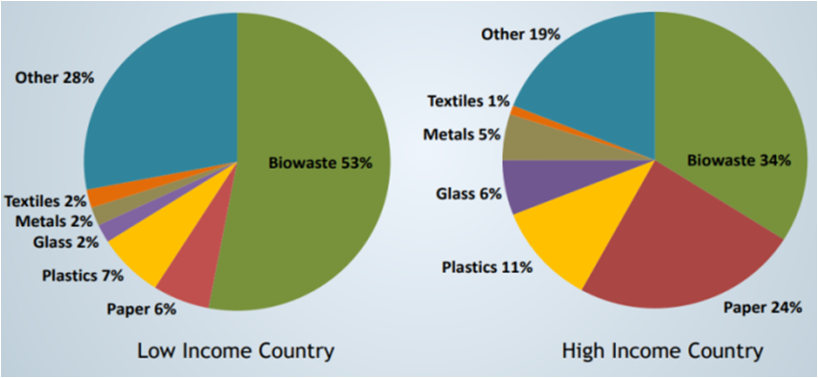
1.6. Techniques for Treating Biowaste [13]Often, biowaste is the predominant fraction of municipal solid waste in low- and middle-income countries (Figure 1). It represents about 50 percent of the municipal solid waste in these countries. But it can be as high as 80 percent.

Biowaste treatment is essential for reducing public health threats and environmental burden. Another advantage of biowaste treatment is that the resource value of waste is returned to the economy, creating new business opportunities and giving push to economic growth.
Some of the commonly used technologies for treating biowaste are:
• Composting
• Vermicomposting
• Black Soldier Fly treatment
• Anaerobic digestion
• Thermochemical treatments
Composting refers to controlled aerobic decomposition of raw organic material into biologically stable humic substances, also called compost. The aerobic decomposition of raw organic material is carried out by microorganisms in the presence of air or oxygen. The final product, compost, is stable can act as an excellent soil amendment. The following composting technologies are commonly used in low- and middle-income countries –
• Windrow composting
• Composting in passively aerated windrows
• Composting in forced aerated windrows
• In-vessel composting
• Bin composting.
Windrow composting: Windrow refers to an elongated pile of stacked raw materials. Windrow composting is suited to treat large volumes of bio-waste and produce large volumes of compost. In windrow composting, aeration of the raw organic material is crucial. Oxygen in the material pile needs to be replenished continuously. Otherwise, the pile would go anaerobic in the center, resulting in a different decomposition process and producing foul odors.
Composting in passively aerated windrows: In this technology, perforated pipes are positioned within the biowaste pile. This promotes convected airflow throughout the material. The pipes bring oxygen within the pile. This oxygen is required by the microorganisms in the pile. Since the pile is normally not turned during the process, therefore the pile material should be premixed thoroughly before placing it on the perforated pipes. The pile should be insulated with finished compost to ensure that thermophilic temperatures also reach the outer layer of the pile.
Composting in forced aerated windrows: Windrows used in this technology might look similar to the ones used in the previous technologies. However, blowers are installed at the end of the perforated pipes or air ducts. During the active phase, when compost reaches high temperature, blowers inject air into the pile. Insulation with finished compost ensures that thermophilic temperatures are reached in the outer layers. The pile does not need to be turned.
In-vessel composting and bin composting: The in-vessel composting technology consists of a group of methods that are used to do composting within a container or vessel. This technology can be used in both high-tech and low-tech configurations. The high-tech configuration resembles a bio-reactor. The in-vessel composting technology allows easy control of airflow and temperature in comparison to other composting technologies. Turning or stirring of biowaste takes place manually or mechanically.
The other technology, bin composting, is primarily practiced at the household level for treating little amounts of waste to produce compost for self-consumption. Biowaste is kept in a container which generally has some sort of perforated wall for air passage. Some containers include a stirring mechanism. Bin composters can also be used on a big scale.
Anaerobic digestion is becoming a popular method for waste management. Anaerobic digestion is a collection of processes in which micro-organisms break down biodegradable matter in the absence of oxygen. In this process, micro-organisms produce biogas that's a mixture of methane and carbon dioxide. Since methane is flammable, it can be used as an energy source. Anaerobic digestion of biowaste also yields a nutritious digestate.
• Renewable energy is produced thus reducing our dependence on fossil fuels and pollution from fossil fuels.
• Emission of greenhouse gases is reduced thus reducing pollution from waste.
• Not much space is required as reactors for anaerobic digestion can be built underground.
• Solid waste volumes are reduced, leading to reduction in waste disposal costs.
• Waste gives value in the form of gas and nutrients.
In terms of drawbacks, anaerobic digestion is slower and less energy intensive. Technically, it is more complex and therefore needs higher levels of skills and investment.
Technologies used for Anaerobic digestion: Different types of anaerobic digestion technologies can be classified as dry and wet systems, batch and continuous systems, thermophilic and mesophilic operating systems and one-stage and multi-stage systems
Wet, continuous, mesophilic fixed-dome reactor: The wet, continuous, mesophilic fixed-dome reactor is a brick-built and gas-tight plastered structure, which is often established underground. Waste material is fed into the digestor through an inlet pipe. The digestor has a volume of slurry and also space for gas storage. The reactor has an outlet, also called the compensation chamber, and the overflow. Fixed-dome digestors come in different designs, and their sizes can vary.
It is important to inoculate the reactor with methanogenic bacteria when starting it for the first time. The easiest way to inoculate is to add cow manure and water, with the ratio of 1:1. Also, the digestate from another reactor can be used for inoculation. The waste material mixed with water is transferred to the reactor. The waste material mixes with the material which is already undergoing degradation in the reactor. Anaerobic digestion takes place and bio-gas is generated in the slurry. The gas bubbles move to the top of the reactor, and if the valve is closed, gas starts to build up pressure. The rising gas pressure pushes down the slurry in the reactor, and up into the overflow chamber. After the gas has been used, its pressure drops, and the slurry level balances out to a new equilibrium.
Floating-drum digestor: A floating-drum digestor has features similar to those of mesophilic fixed-dome reactor, like the inlet, the digestor for the slurry, the outlet, and the overflow. However, in the floating-drum digestor, the gas holder is not a fixed unit but is a moving unit. It's floating on a water jacket or directly on the slurry. With increasing gas pressure, this floating gas holder moves upwards. After the gas has been used, the weight of the drum pushes it back down. The digestor is often placed below the ground while the gas holder drum is above ground.
Vermicomposting of biowaste: In vermicomposting worms and microorganisms are used to process biowaste in a controlled manner, and to produce valuable soil amendment called vermicompost or worm compost. If the objective of the process is to grow and market worms, then the process is called vermiculture.
To produce vermicompost, biowaste is fed to earthworms. The worms eat the biowaste, they grow and they reproduce. As the biowaste passes through the gut of the worms it becomes vermicompost. Vermicompost is actually worm poop.
Biowaste Processing with Black Soldier Fly Larvae: This is an innovative biological treatment process in biowaste in which biowaste is fed to insect larvae which is then harvested as a protein source. In this process, we make use of the black soldier fly larvae's voracious appetite. They process large amounts of organic material very fast. Once the larvae have processed the material and gained a lot of weight, they can be harvested. Thereafter, they can be fed to animals. Piglets love to eat the larvae.
The black soldier fly, Hermetiaillucens, has its origin in the Americas. Nowadays, it can be found in the temperate and tropical areas. An adult black soldier fly lives for about a week. During its short life, the female fly lays about a 1,000 eggs close to a suitable feed source. The feed source can be a wide variety of organic material, such as food, market waste, animal manure, slaughterhouse waste, or even human excreta. The eggs take about 3 days to hatch and small larvae emerge. At this moment, they're only about one millimeter in size.
We need about 8,000 larvae to treat 1 kilogram of food waste per day. After they have fed for about 2 weeks, the larvae are ready to be harvested. By the time we harvest, the wet waste has been reduced by 80% to 90%.
Today, municipal vans have replaced the erstwhile door-to-door waste collection system that was run by waste-pickers on behalf of the local jamadarins (traditional sweeper and waste collector). It has been observed that growing privatization of waste management has led to waste-pickers losing their jobs. Chintan, a non-profit organisation advocating for the rights of waste-pickers in Delhi, in their study 15 found that after waste collection privatisation by the MCD, 50 per cent of waste-pickers lost their jobs or experienced a drastic fall in their earnings. A 2016 study 16 in Punjab found similar results—privatisation had a negative impact on waste-pickers’ access to waste as well as their capacity to earn a livelihood. In this background, we take up the present study to understand the condition of the informal sector waste-pickers in Delhi.
The most vulnerable and exploited component of the waste management system are the informal sector waste-pickers. They render a crucial but often unrecognized service in the waste management system. This study focuses on the contribution of waste-pickers in enhancing the efficiency of municipal waste management and the challenges faced by them. To get a holistic perspective about the condition of the informal sector waste-pickers, we interviewed them as well as municipal corporation officers, waste entrepreneurs, NGO staffers and residents in Delhi.
The major research questions that guide the present study are:
• How does a typical informal sector waste picker conduct their day-to-day work?
• In what way does the formal waste management system benefit from the work of waste-pickers?
• What problem/hassles are faced by the informal sector waste-pickers?
2.1. DesignFor the purpose of the study, we have used the qualitative method of data collection, as waste management studies should have a qualitative component. Though the quantitative method is useful in research, its over-emphasis to move from statements of correlation to causal statements tells us nothing about the social context of the phenomenon 17. A topic such as waste management cannot be studied by ignoring the larger social and cultural context. Sometimes, it might also be difficult to measure some aspects of human behaviour in numerical terms 18. However, researchers like Bertrand and Fransoo 19 term qualitative research as small-scale and non-representative, which can’t be generalised to a broader context. Some researchers are also of the view that research must flexibly mix the qualitative and quantitative traditions to overcome the limitation of both the methods 20. Bryman 21 finds that quantitative research is concerned with the researcher’s view and qualitative research is conducted through the eyes of stakeholders involved. The following paper largely follows a qualitative tradition of research. This paper is a part of the larger mix method research project.
2.2. SampleThe study uses the interview method, with all stakeholders related to waste management. A total of 10 interviews were conducted and a focus group discussion with waste-pickers was held. The interviewees were: four waste-pickers, two municipal corporation officers, a waste entrepreneur, an NGO founder, a private waste management company employee, and one resident.

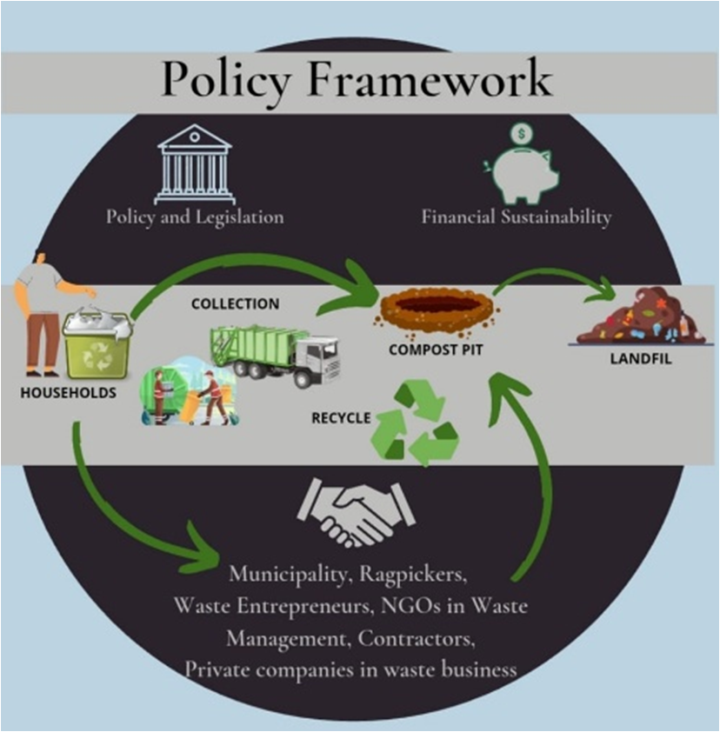
It was ensured that our research followed a standard social science ethical procedure. Figure 2 shows the stakeholders involved in waste management and the ways in which waste is managed. Before starting the interview, informed consent and confidentiality were discussed. The study uses a semi-structured interview format for eliciting responses from the participants. The participants were seen as the co-creators of knowledge and were not restricted in any way from talking about their experiences and stories related to waste management. The interview schedule was formulated after reading the latest policies regarding solid waste management. Purposive non-random sampling was used for the current study.
2.3. ResultsAll the 10 interviews were transcribed and read twice for insights, following which the study themes were selected and the portions highlighting these themes were drawn out from the interview texts. Then, a thematic table was formulated based on the research questions, and the researcher analysed all the interview transcriptions to find common themes. represents the themes.
The informal sector waste-pickers have been embedded in our waste management system for a very long time. The attitude of the municipal authorities as well as common people towards these waste-pickers differs from place to place. Some view them with hostility, others with indifference, and some see them as a useful part of the waste management system and provide them with an opportunity to enhance their livelihoods. From the interviews, it is clear that most participants acknowledge the hazardous nature of the waste-picker’s work. However, no efforts are made at the national or the local level to lessen the occupational hazards faced by the waste-pickers. The Government of India launched the Swachh Bharat Abhiyan, which gathered a lot of attention nationally and internationally. The current waste management policy of India is effectively drafted, however, there is a lack of application of the current policy. India is going to experience an unbridled urban growth 2 which will lead to an increase in waste generation.
In our interviews, we found that experts in the field of waste management recognise the role of the informal sector waste-pickers in effective waste management. The majority view is that urban local bodies will find it tough to manage waste in the absence of the service rendered by the informal sector waste-pickers, who segregate waste at the source, thereby reducing the cost of waste transportation and saving the landfill space. The reason is that most Delhi households still do not segregate their waste before disposing it off. However, despite the dependence of urban local bodies on waste-pickers, the government’s current door-to-door waste collection plan via municipal vans largely ignores the informal sector waste-pickers. They find no place in the government’s policy framework on waste management. They are on their own without any social security.
The waste-pickers we interviewed said that waste collection by the municipal van has hit the earnings of most of the waste-pickers (who earlier used to collect household waste on behalf of the jamadarin), except those who are able to sit in the van and segregate waste. Earlier if waste collection provided jobs to 100 people, now only 20 people are able to collect and sell waste. Those, unable to sit in the municipal van, collect the waste lying on the colony roads. Sometimes, waste-pickers have to run from the waste disposal sites if a senior municipal officer arrives for inspection.
Waste-pickers tell us that there are no fixed hours for their waste collection work. Generally, they start work early morning at 5 a.m. and finish by 3 or 4 p.m. in the afternoon. Some days they work till 8 or 10 p.m. in the night. The incentive for working long hours is the satisfaction that whatever recyclables they gather from waste is their own earning.
Mr. Dharmendra, who runs the NGO Lok Adhikar for protecting the rights of waste-pickers, informs, “The informal sector waste-pickers earn their living by segregating about 30-40 per cent of the recyclables from the dhalao waste. If there are no informal sector waste-pickers, then waste collection and segregation in Delhi is going to suffer severely. The reason is today we can’t expect that the MCD would hire waste workers on its own because it is unable to fill its various vacancies due to the financial crunch. But despite their indispensable work, these waste-pickers neither receive any formal payment for their work nor do they get a fair price from waste dealers.”
Mr. Santosh, who is associated with a waste management firm, also credits the informal sector waste-pickers for keeping the dhalaos and landfills from overflowing.
Private Players - A Mixed Response: Today, a lot has changed in the way waste is collected as compared to the practices that were followed a decade back. There is a considerable presence of private players and contractors in the waste management system. Mr. Santosh tells us that their company takes good care of the informal sector people who work with them. “We teach them about hygiene and provide appropriate amenities and safety arrangements to safeguard their health and life. We enable individual waste collectors get waste collector identity cards, train them along with the MCD staff in waste collection methods. We educate them about the waste management policies of the government and how they have to adhere to the policy guidelines,” explains Mr. Santosh. This is surely a good example of an effective partnership between the informal sector waste-pickers and a private company.
Fair Price not Paid Waste: The informal sector waste-pickers we interviewed were suspicious of some private contractors’ intentions to deal with them fairly. They said, “Some contractors want to hire us and provide us waste collector identity cards. But they offer us only INR 2-3 per kg for our segregated waste. Some contractors say that as a social service they will bear the expenses related to our health. But after entering into contract with us, they demand monthly charges up to INR 10,000 for allowing us to segregate waste.”
According to waste-pickers, prices of recyclable items keep varying. During the rainy season, the prices of some recyclables drop to almost half of their normal prices. For example, buyers write off about 70 per cent weight of the recyclable cardboard in the rainy season, and pay waste-pickers only for 30 per cent of the weight of the waste.
Why do waste-pickers receive unfair prices for their waste? Waste entrepreneur Mr. Rohit explains the reason, “The value chain of an old newspaper, from a household to a recycler has varying rates going up to INR 14 per kg. The householder, who generates newspaper waste, gets INR 12. The newspaper reaches the recycler at a slightly higher rate of INR 14. The funny part is the householder has cornered the lion’s share in the value chain while the rest of the players are left to share only INR 2 among themselves. Ideally, the householder as the waste generator should not be getting anything.”
Echoing Mr. Rohit’s views, Mr. Santosh says, “People think they have the right to earn from their waste. Due to this thinking, waste-pickers usually get less money. Ideally, the waste picker should earn more from the waste generator.”
According to Mr. Santosh, their company pays waste-pickers the right price without delay. “That’s why they opt to deal with us,” he says.
Lack of Social Security Net: Mr. Dharmendra (Lok Adhikar) expresses concern that there is no social security net available for waste-pickers. He says, “The main task of our NGO is to protect the jobs of waste-pickers and get social security for them. We demand that the waste-pickers should also be brought under the social security net like the other workers of the unorganised sector, such as construction workers, rickshaw-pullers and domestic workers.”
Waste entrepreneur, Mr. Rohit, too is concerned about the neglect of waste-pickers by the government. He rues, “Waste-pickers just don’t seem to exist for the government. They work for a living at a great risk to their life. They get no social security, insurance, education for kids. They remain unknown.”
Extortion from waste-pickers: Waste-pickers often face harassment and threats from goons and contractors. Sharing their concerns in this regard, waste-pickers tell us, “Our earning is limited to making both ends meet. We just can’t share our hard-earned money with anyone. But sometimes the area goons, waste contractors or politically connected persons try to extort money from us.” In one instance, a garbage contractor gave a waste picker, who was picking waste from a dump site for 15 years, two options – either sell the segregated waste to him at INR 3-4 per kg or give him INR 30,000 per month doe collecting recyclables from the site. In another instance, a waste picker in an East Delhi colony was thrashed by a local goon who was demanding money for allowing him to continue his work. Though the area residents condemned the attack, the waste-picker stopped waste collection, fearing for his life.
Bias against Muslims: Waste-pickers mostly come from the marginal sections of society and most of them are Muslims. Waste-pickers complain that they are discriminated on the basis of their religion. They recount, “Where we live, there are about 80 per cent people engaged in waste collection work. Since we are Muslims, nobody gives job even to the educated among us. Even we do not get the job of a sweeper.”
Regarding the bias against Muslim waste-pickers, Mr. Dharmendra tells, “Most of the waste-pickers are from West Bengal and belong to the minority community. The police and the MCD believe that they are Bangladeshis. Due to their minority community tag, waste-pickers often become the target of people’s adverse behaviour. We strive to protect their rights as Indian citizens. We tell the authorities that if any waste picker does not have documents to prove their Indian citizenship, then you can detain them. We do not provide protection to any Bangladeshi person.”
Echoing Mr. Dharmendra’s views, Mr. Santosh says, “Waste-pickers are mostly Muslims. Since they are from a backward community, they face discrimination.”
Waste management is hazardous: Since waste-picking and management is a hazardous activity, waste-pickers have been adversely affected by it. The government should make policies to take care of the health of the informal sector waste-pickers. Mr. Santosh explains the hazards faced by these pickers, “Sometimes it happens that I meet a waste- picker and then two days later I get the sad news of his sudden death. Waste-pickers face immense hazards even from domestic waste which also contains sanitary pads, diapers, condoms and expired medicines. Animals too fall ill by eating the leftover food mixed with this hazardous waste.”
Integrating the informal sector in waste management: There is an urgent need for integrating the informal sector waste-pickers into the city's formal waste management master plan. They should be involved in waste collection at the source, with the right over the recyclables that they collect and a guarantee of regular access to waste. To make this happen, the municipal authorities have to play a leading role. Giving waste-pickers a formal role is also financially viable for the government. Waste management experts feel that the waste management system in India is highly centralised, which is one of the causes making waste management inefficient. The government should take initiative to decentralise waste management by encouraging NGOs, cooperatives and private players to help the informal sector waste-pickers.
Belo Horizonte, a Brazilian city, is a good example of the successful integration of the informal sector into formal waste management. In 1993, the city authorities started promoting waste segregation at the source. The urban local bodies helped in setting up cooperatives for waste management and guided them towards material recovery close to households, instead of waste scavenging at the landfill. There are an estimated 2700 informal waste workers in Belo Horizonte and eight cooperatives have been managing waste. The municipality has provided warehouses to these cooperatives. The materials are processed at the warehouses, before moving up the recycling chain. The cooperatives are assisted with scales, personal protection equipment, and big bags for storage.
In 2001, to encourage waste management, Brazil announced “catador de material reciclado”, which stands for collector of recyclables, as a formal profession in the Brazilian occupation classification. The Brazilian initiative can be replicated in India. In fact, such an occupation classification in our country can help waste workers overcome marginalisation and take pride in their work.
Like the Brazilian example, some initiatives have also been taken in India which have led to successful integration of the informal sector waste-pickers into formal waste management. One notable initiative is of the SWACH cooperative in Pune. SWACH is a wholly-owned cooperative of waste-pickers. In 2008, SWACH entered into a Memorandum of Understanding with the Pune Municipal Corporation to collect waste, door-to-door. This was an important milestone for the waste-pickers in the city.
Today, the SWACH cooperative is overseen by a governing board that is composed of 14 waste-picker members, two representatives of the Pune Municipal Corporation, and two members of the trade union of waste-pickers. SWACH has ensured regular employment for waste-pickers. It collects waste, recovers recyclables from the collected, and handle recyclable trading and waste processing. It is in close contact with the clients and residents since it provides them the services they need. It also operates a helpline for feedback and complaints.
Currently, through its 1867 members, SWACH provides service to 1.5 million residents of Pune. Among its members, 80 per cent are women. Data shows that thanks to the work of SWACH, waste reaching the landfills has been reduced by more than 55 per cent, or 320 tonnes per day, which is a big achievement. The entire waste management system has become accountable and efficient.
Some other successful waste management include Hasiru Dala in Bengaluru and SEWA in Gujarat.
The Government’s policy for waste management should not neglect the informal sector waste-pickers. Though privatisation of the waste management system has its advantages, we must acknowledge the fact that the informal sector waste-pickers are the backbone of waste management. Private players, cooperatives, and NGOs should respect the rights of waste-pickers. Representatives of waste-pickers must be included in such committees whose decisions can affect their future.
• All waste-pickers should get a free identification card that acknowledges their right to access, collect and sell waste, so that they don’t get harassed by goons or contractors.
• Availability of subsidised waste picking gear such as gloves, masks, protective and sorting tools and shoes with metal-plated soles should be provided to waste-pickers through a public distribution system.
• An independent body to take care of the rights and welfare of waste-pickers should be created.
• On the lines Hasiru Dala (Bengaluru), SWACH (Pune) and SEWA (Gujarat), trade unions and cooperatives should be formed for the waste-pickers so that they can remain independent and can work fair terms.
• Waste-pickers should be included in all social welfare schemes, and a cooperative bank for marginalised workers on the lines of the Brazilian Bank for Economic and Social Development should be established to provide subsidised credit facilities to waste-pickers.
The informal sector waste-pickers have contributed to the formal waste management in numerous ways such as saving waste transportation cost and keeping landfills from being overburdened. Despite their valuable contribution, the government, the municipal authorities, and the public remain indifferent to the problems and challenges faced by waste-pickers. Their challenges include occupational hazards, health problems, job-loss in the new waste management system, lack of social security net, danger of extortion by contractors, not getting fair prices for recyclables, and facing bias and discrimination.
The informal sector waste-pickers have been an important but unrecognised component of the Swachh Bharat Abhiyan. To give them their due and make our waste management system more efficient, it is time that they be integrated into the formal waste management system. There is a dire need to recognize the immense contribution of waste-pickers in effective waste management and formulate policies at the national level to protect the rights of waste-pickers, help them lead a quality life and consider.
| [1] | Ministry of Urban Development, The High Powered Expert Committee (HPEC) for Estimating the Investment Requirements for Urban Infrastructure Services: Report on Indian Urban Infrastructure and Services, Ministry of Urban Development, Government of India, March. (2011). | ||
| In article | |||
| [2] | Ministry of Urban Development, (n.a.), Guidance Note: Municipal Solid Waste Management on a Regional Basis, Foreword: Secretary, Ministry of Urban Development, Government of India, New Delhi. | ||
| In article | |||
| [3] | National Institute of Urban Affairs, National Workshop on Sustainable Solid Waste Management in India: Workshop (2013). | ||
| In article | |||
| [4] | Proceedings, organized by Ministry of Urban Development, Government of India, Ministry of Environment & Forest, Government of India and National Institute of Urban Affairs, New Delhi, 18 January 2015. | ||
| In article | |||
| [5] | Number of non-smokers with lung cancer in north India is same as smokers: Study (theprint.in) (2018). | ||
| In article | |||
| [6] | https://economictimes.indiatimes.com/news/politics-and-nation/angry-over-garbage-mountains-in-delhi-sc-asks-civic-body-to-dump-waste-near-l-gs-house/articleshow/65302154.cms?utm_source=contentofinterest&utm_medium=text&utm_campaign=cppst. | ||
| In article | |||
| [7] | ORF, Article Managing Delhi’s toxic wastes to improve air quality (2018). | ||
| In article | |||
| [8] | CPCB | Central Pollution Control Board Report of 2019 and 2020. | ||
| In article | |||
| [9] | Gesellschaftfur Internationale Zusammenarbeit (GIZ), ‘Salient Features of the MSWM Manual: An Overview’, Part I, Training on Municipal Solid Waste Management, organized by GIZ and German Cooperation, Ministry of Urban Development, at New Delhi on May 5-8, 2015. | ||
| In article | |||
| [10] | Mani, S., (2015), Technologies for Centralized Solid Waste Management, CITIES: The 21st Century India, edited by Satpal Singh, Bookwell, New Delhi. | ||
| In article | |||
| [11] | Who Recycles Your Waste, Chintan Envionmental Research and Action Group. Available at: http://www.chintan-india.org/documents/fact_sheets/chintan_who_recycles_your_ waste_fact_sheet.pdf (2011). | ||
| In article | |||
| [12] | Scheinberg, Anne, Michael H. Simpson, et al (2010). Economic Aspects of the Informal Sector in Solid Waste. GTZ (German Technical Cooperation), Eschborn, Germany. | ||
| In article | |||
| [13] | Christian R. Lohri. Stefan D. Imanol Z. Adeline M. Christian, Treatment technologies for urban solid biowaste to create value products: a review with focus on low- and middleincome settings, Published online: 10 February 2017 The Author(s) 2017. This article is published with open access at Springerlink.com. | ||
| In article | |||
| [14] | David C WilsonGlobal Waste Management Outlook, United Nations Environment Programme (UNEP) and International Solid Waste Association (ISWA), United Nations Environment Programme (UNEP). ISBN: 978-92-807-3479-9. | ||
| In article | |||
| [15] | Down to earth, A law for waste-pickers (downtoearth.org.in). | ||
| In article | |||
| [16] | Earth Engineering Centre, (2012), 'Sustainable Solid Waste Management in India', Ranjith KharvelAnnepu, Columbia University, New York, January. | ||
| In article | |||
| [17] | Apuke, O.D., (2017). Quantitative Research Methods: A Synopsis Approach. Kuwait Chapter Arab. J. Bus. Manag. Rev. | ||
| In article | View Article | ||
| [18] | Marvasti, A., Research Methods The Cambridge Handbook of Social Problemsdoi:10.1017/9781108656184.00, (2018). | ||
| In article | |||
| [19] | Bertrand, J.W.M., Fransoo, J.C., Operations Management Research Methodologies Using Quantitative Modeling. Int. J. Oper. Prod. Manag. (2002). | ||
| In article | |||
| [20] | Amaratunga, D., Baldry, D., Sarshar, M., Newton, R., Quantitative and Qualitative Research in the Built Environment: Application of “Mixed” Research Approach. Work Study. (2002). | ||
| In article | View Article | ||
| [21] | Bryman, A., Integrating Quantitative and Qualitative Research: How Is It Done? Qual. Res. (2006). | ||
| In article | View Article | ||
| [22] | Gupta, P. T., Whither Indian Urban Growth: Dreams and Reality of Healthy, 2015. | ||
| In article | |||
| [23] | Urban City in India, CITIES: The 21st Century India, edited by Satpal Singh, Bookwell, New Delhi. | ||
| In article | |||
| [24] | Ministry of Urban Development, 'Draft of Municipal Solid Waste Management Manual', Central Public Health and Environmental Engineering Organization (CPHEEO), Ministry of Urban Development, Government of India, New Delhi, May. (2014). | ||
| In article | |||
| [25] | Ministry of Urban Development, 'Toolkit for Solid Waste Management' - Jawaharlal Nehru National Urban Renewal Mission (JNNURM), Ministry of Urban Development, Government of India, New Delhi November (2012). | ||
| In article | |||
| [26] | Planning Commission, 'Report of the Task Force on Waste to Energy', Vol. I, Planning Commission, New Delhi, May. (2014). | ||
| In article | |||
| [27] | The Hindu. Waste to Energy Plant Unveiled in Ghazipur. www.The.Hindu.com (28 October 2020). | ||
| In article | |||
Published with license by Science and Education Publishing, Copyright © 2022 Raunaq Chawla and Avinash Kumar
 This work is licensed under a Creative Commons Attribution 4.0 International License. To view a copy of this license, visit
http://creativecommons.org/licenses/by/4.0/
This work is licensed under a Creative Commons Attribution 4.0 International License. To view a copy of this license, visit
http://creativecommons.org/licenses/by/4.0/
| [1] | Ministry of Urban Development, The High Powered Expert Committee (HPEC) for Estimating the Investment Requirements for Urban Infrastructure Services: Report on Indian Urban Infrastructure and Services, Ministry of Urban Development, Government of India, March. (2011). | ||
| In article | |||
| [2] | Ministry of Urban Development, (n.a.), Guidance Note: Municipal Solid Waste Management on a Regional Basis, Foreword: Secretary, Ministry of Urban Development, Government of India, New Delhi. | ||
| In article | |||
| [3] | National Institute of Urban Affairs, National Workshop on Sustainable Solid Waste Management in India: Workshop (2013). | ||
| In article | |||
| [4] | Proceedings, organized by Ministry of Urban Development, Government of India, Ministry of Environment & Forest, Government of India and National Institute of Urban Affairs, New Delhi, 18 January 2015. | ||
| In article | |||
| [5] | Number of non-smokers with lung cancer in north India is same as smokers: Study (theprint.in) (2018). | ||
| In article | |||
| [6] | https://economictimes.indiatimes.com/news/politics-and-nation/angry-over-garbage-mountains-in-delhi-sc-asks-civic-body-to-dump-waste-near-l-gs-house/articleshow/65302154.cms?utm_source=contentofinterest&utm_medium=text&utm_campaign=cppst. | ||
| In article | |||
| [7] | ORF, Article Managing Delhi’s toxic wastes to improve air quality (2018). | ||
| In article | |||
| [8] | CPCB | Central Pollution Control Board Report of 2019 and 2020. | ||
| In article | |||
| [9] | Gesellschaftfur Internationale Zusammenarbeit (GIZ), ‘Salient Features of the MSWM Manual: An Overview’, Part I, Training on Municipal Solid Waste Management, organized by GIZ and German Cooperation, Ministry of Urban Development, at New Delhi on May 5-8, 2015. | ||
| In article | |||
| [10] | Mani, S., (2015), Technologies for Centralized Solid Waste Management, CITIES: The 21st Century India, edited by Satpal Singh, Bookwell, New Delhi. | ||
| In article | |||
| [11] | Who Recycles Your Waste, Chintan Envionmental Research and Action Group. Available at: http://www.chintan-india.org/documents/fact_sheets/chintan_who_recycles_your_ waste_fact_sheet.pdf (2011). | ||
| In article | |||
| [12] | Scheinberg, Anne, Michael H. Simpson, et al (2010). Economic Aspects of the Informal Sector in Solid Waste. GTZ (German Technical Cooperation), Eschborn, Germany. | ||
| In article | |||
| [13] | Christian R. Lohri. Stefan D. Imanol Z. Adeline M. Christian, Treatment technologies for urban solid biowaste to create value products: a review with focus on low- and middleincome settings, Published online: 10 February 2017 The Author(s) 2017. This article is published with open access at Springerlink.com. | ||
| In article | |||
| [14] | David C WilsonGlobal Waste Management Outlook, United Nations Environment Programme (UNEP) and International Solid Waste Association (ISWA), United Nations Environment Programme (UNEP). ISBN: 978-92-807-3479-9. | ||
| In article | |||
| [15] | Down to earth, A law for waste-pickers (downtoearth.org.in). | ||
| In article | |||
| [16] | Earth Engineering Centre, (2012), 'Sustainable Solid Waste Management in India', Ranjith KharvelAnnepu, Columbia University, New York, January. | ||
| In article | |||
| [17] | Apuke, O.D., (2017). Quantitative Research Methods: A Synopsis Approach. Kuwait Chapter Arab. J. Bus. Manag. Rev. | ||
| In article | View Article | ||
| [18] | Marvasti, A., Research Methods The Cambridge Handbook of Social Problemsdoi:10.1017/9781108656184.00, (2018). | ||
| In article | |||
| [19] | Bertrand, J.W.M., Fransoo, J.C., Operations Management Research Methodologies Using Quantitative Modeling. Int. J. Oper. Prod. Manag. (2002). | ||
| In article | |||
| [20] | Amaratunga, D., Baldry, D., Sarshar, M., Newton, R., Quantitative and Qualitative Research in the Built Environment: Application of “Mixed” Research Approach. Work Study. (2002). | ||
| In article | View Article | ||
| [21] | Bryman, A., Integrating Quantitative and Qualitative Research: How Is It Done? Qual. Res. (2006). | ||
| In article | View Article | ||
| [22] | Gupta, P. T., Whither Indian Urban Growth: Dreams and Reality of Healthy, 2015. | ||
| In article | |||
| [23] | Urban City in India, CITIES: The 21st Century India, edited by Satpal Singh, Bookwell, New Delhi. | ||
| In article | |||
| [24] | Ministry of Urban Development, 'Draft of Municipal Solid Waste Management Manual', Central Public Health and Environmental Engineering Organization (CPHEEO), Ministry of Urban Development, Government of India, New Delhi, May. (2014). | ||
| In article | |||
| [25] | Ministry of Urban Development, 'Toolkit for Solid Waste Management' - Jawaharlal Nehru National Urban Renewal Mission (JNNURM), Ministry of Urban Development, Government of India, New Delhi November (2012). | ||
| In article | |||
| [26] | Planning Commission, 'Report of the Task Force on Waste to Energy', Vol. I, Planning Commission, New Delhi, May. (2014). | ||
| In article | |||
| [27] | The Hindu. Waste to Energy Plant Unveiled in Ghazipur. www.The.Hindu.com (28 October 2020). | ||
| In article | |||