Termites are one of the most destructive insect pests of buildings across the world. Though chemical termiticides are widely used for controlling termites, it has many limitations for indoor use. Thus, an attempt was made to collect the traditional knowledge on termite control in Northern Kerala, and to test out the promising methods in the laboratory. Thirty houses each were surveyed in three geographical areas- Highland, Midland and Coastal area. Questionnaire survey was done for collecting information on the control methods adopted or known by the homeowners. The study showed that all the 90 homeowners are aware of at least one traditional method of termite control and 54 among them attempted controlling the termites using any of such methods. Ten traditional control methods were selected for preliminary screening in the laboratory of which seven were disproved. The three materials that gave positive results included Kerosene (undiluted), salt solution (1:1 in water) and Acrostichum aureum (The Golden Leather Fern). But these results only have indicative value and requires further detailed studies to understand better. The scope of present study was limited to collection of traditional knowledge and their preliminary screening mainly to falsify the ineffective methods.
Termites are a group of social insects belonging to the order Blattodea (Infra order: Isoptera). They play a very significant role in the ecosystem as an efficient decomposer. They are also one of the most destructive insect pests of buildings, crops and forests across the world. Several methods are being employed for controlling the termite attack by farmers and home owners worldwide. Mostly chemical insecticides with many known ill effects are used to overcome the issue. Use of locally available materials and methods for termite control is also a common practice in many areas of the Indian subcontinent since ages 1, 2, 3. Such traditional knowledge has to be documented and tested scientifically for conservation of the knowledge and wider acceptance and use. Proving the efficacy of a traditional method would be a laborious task, but disproving the claim would be much easier. The present study is an attempt for collecting the traditional knowledge on termite control and their preliminary screening in the laboratory.
The survey on traditional knowledge was done in the two Northern Districts of the Kerala State viz. Kannur and Kasaragod. Kannur District is located within the geographical limits 11˚52ʹ08ʺ N latitude and 75˚21ʹ20ʺ E longitude and Kasaragod District is located within 11° 18' to 12° 48' N latitude and 74° 52' to 75° 26' E longitude. The whole area is geographically divided in to three zones – the Coastal area on the west, the Western Ghats on the east (Highland / hill area) and the Laterite plain (Midland / plane area) in between the two. The three areas differ in terms of altitude from sea level, soil type and wood materials used for building. The three areas were selected for survey, expecting a difference in the traditional knowledge mainly due to difference in the availability of plant materials.
2.2. SurveyThirty houses each were selected at random from each area viz., Hill, Plain and Coastal area. Older houses with more wooden structures were given preference in selection. Termite attack incidence and control methods adopted by the homeowners were recorded in detail with direct observation and questionnaire survey. Questions were specifically asked to check their awareness about the common traditional practices and materials on termite control along with the recording of other methods they know or practice.
2.3. Laboratory Screening of Promising Materials/MethodsThe lab experiment was aimed at testing the efficacy of some of the common materials/methods which were suggested by the homeowners to have anti-termite effects. Ten materials were selected for laboratory evaluation based on availability of materials and convenience.
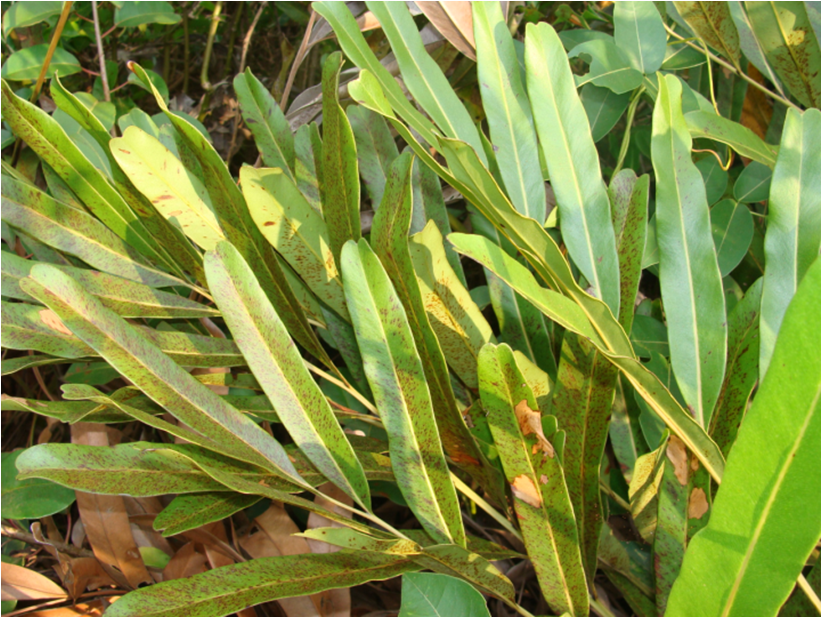
1. Acrostichum aureum (The Golden Leather Fern; Figure 1)
2. Hyptis suaveolens (The Pignut)
3. Ocimum sanctum (Tulsi)
4. Gliricidia sepium (Mexican Lilac)
5. Vitex negundo (Chinese Chaste Tree)
6. Maranta arundinacea (Arrow Root)
7. Trigonella foenum-graecum (Fenugreek)
8. Curcuma longa (Turmeric)
9. Salt
10. Kerosene

Preparation of extracts and feeding material: All the materials were made into 5ml each concentrated liquid forms. Leaves of the first five materials were crushed and the extract was taken without adding water. Arrow Root tubers were also crushed to get the extract. Turmeric powder and salt were dissolved in distilled water (0.1g/ml) and the kerosene was taken undiluted. Extract of fenugreek was taken by keeping 2 grams in 10ml water for 12 hrs and by collecting the supernatant. All the solutions were taken in small beakers and labeled. Distilled water was used as control. Cardboard (brown, corrugated) pieces of size 1cm2 were cut and two pieces each were immersed for half an hour in the solutions prepared. Then the pieces were taken out, dried and used as the feeding material. The prediction to be tested was that, if the material has any antitermite property, termite will not feed and keep away from the cardboard treated with that material.
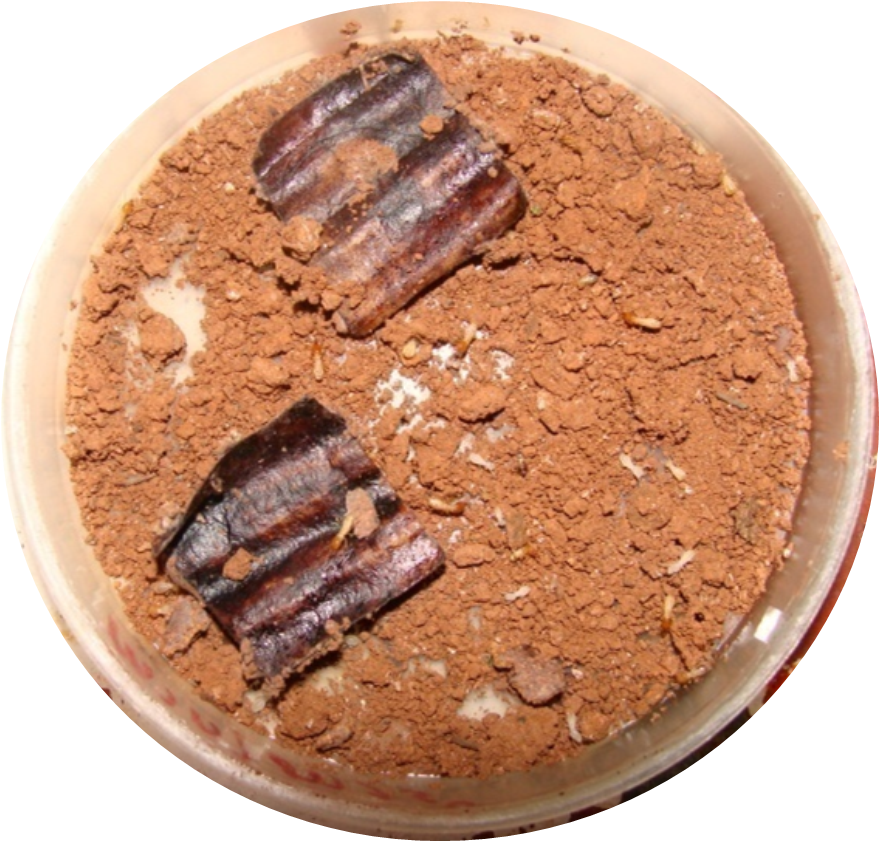
Collection of termites and screening: The termite species used for the screening was Odontotermes obesus, a common pest species of the study area. Termites and soil were collected from a mound of the species located in the campus of Payyanur College. Petri plates (10cm diameter) were labeled with the name of test material. The bottom of the plates were layered with 5gram mound soil and 30 termites (25 workers and 5 soldiers) were introduced to each plate carefully using a hand brush. The two cardboard pieces were kept in each plate without disturbing the termites (Figure 2). All the plates were kept in a large basin and maintained with adequate humidity. The activity of termites were observed at six hour interval and recorded. Percentage of the material fed by termites after 48 hrs was measured and recorded.
The type of material and method of use varied among the respondents in the survey. The methods suggested by homeowners are listed in Table 1.
All the 90 respondents in the survey were aware of one or other traditional method of termite control. Marked difference in the awareness could be recognized between the respondents of the three geographical regions. For example, the use of Acrostichum aureum was completely unknown for the homeowners of the hilly area. Among the total 90 homeowners surveyed, 54 actually attempted controlling termites with any one or more of the traditional methods (Hill area-16; Plain area-26, Coastal area-12). Highest number of attempts was recorded from the plain area and the most commonly employed control method was that with kerosene. Out of the 54 attempts, 45 employed kerosene.
From the laboratory testing, only three materials were found to have some effects on termites (Table 2). They were Kerosene, Salt and Acrostichum aureum. The cardboard pieces dipped in these materials/extracts were not approached by termites even after 48hours. In all the other 8 cases, including the control, the termites started their building activities and mud-plastering around the material as early as the second hour of observation itself. So, the possibility of the use of any of these materials against termites could be outrightly rejected. The effect of kerosene was as expected. But the effect of salt and Acrostichum aureum requires further testing and evaluation. Rather than proving the anti-termite properties of the materials, the aim of the experiment was to disprove the suggested efficacy of some of the materials. Since the data obtained were largely qualitative, no statistical analyses were done.
Many materials including plant products are mentioned in literature to have anti termite property. Apart from documenting the knowledge, attempts to falsify the claim would help to streamline our effort in search of a promising alternative to chemical termiticides. Around 1800 plants are known to contain phytochemicals, which are toxic or repellent to insects. However, only a few containing pyrethroids, rotenoids and alkaloids have been used commercially. Compounds isolated from some tree species such as 2-methyl anthroquinon from teak wood 4 and α-pinene present in the essential oil from the leaves of Eucalyptus grandis and E. globulus 5 are reported to repel termites. Treatment with oil and/or seeds of Pongamia pinnata, Azadirachta indica, Ricinus communis and Swietenia macrophylla are reported to reduce termite attack in bamboo poles 1. An effective control of termites damaging crops and trees by using leaves of Calotropis procera and seed kernels of Azadirachta indica were reported from Rajasthan 6. However, neem kernel when mixed with potting soil was found to be ineffective against subterranean termites attacking eucalyptus 7. Many plant species such as whole plant of Aak (Calotropis spp.), leaves of Arusha (Adhatoda vasica Nees), latex/milk of Cactus (Euphorbia neriifolia L.), Asafoetida (Fernulla narthex), Tulsi (Ocimum sanctum), etc have been used across Indian subcontinent to control termites 8. Other plant materials like twig of Aristolochia bracteata and twig of Solanum surattenseare also used against termites 2.
In general, it may be mentioned that the fast rate of degradability of the plant products in nature could be a drawback in terms of their applied value. Checking the scientific validity of some of the common traditional knowledge available in the locality is of importance as it can save time, effort and expense of practicing an ineffective method. As in the present study, many of the methods may get disproved by simple experiments; though confirming the efficacy is not that simple.
Of the different traditional knowledge available, Kerosene was the most widely used, probably due to ready availability and instant effect. But its use inside the house is not much feasible due to fast evaporation. The other two promising materials – salt and Acrostichum aureum need further evaluation in lab and field.
Though many traditional knowledge are available for termite control, majority of them may get falsified in scientific validation. Out of the ten methods tested in the current study, only three showed promising results. The positive results are not foolproof, and it requires further tests for confirmation and practice. Much traditional knowledge is in practice for various issues faced by humans. Checking their claim through simple tests would help to streamline our research and minimise the wastage of time, effort and resources in practicing an ineffective method. Just like conservation of traditional knowledge, it is also important to test and discard those knowledge, which are baseless.
We declare that there is no conflict of interests regarding this work.
Authors acknowledge the UGC, Govt of India for Financial support for the project.
| [1] | Mokabel, A.N.M., Gavi Gowda and Gowda, G. (2000). Evaluation of some important plant products for anti termite properties, Journal of Ecobiology, 12 (1), 3-8. | ||
| In article | |||
| [2] | Sahay, N.S., Prajapati, C.J., Panara, K.A., Patel, J.D. and Singh, P.K. (2014). Anti-termite potential of plants selected from the SRISTI database of Grassroots Innovations, J. Biopest, 7(Supp.), 164-169. | ||
| In article | |||
| [3] | Nyeko, P. and Olubayo, M.F. (2005). Participatory assessment of farmers’ experiences of termite problems in agroforestry in Tororo district, Uganda. Agricultural Research & Extension Network Paper No. 143, 16pp. | ||
| In article | |||
| [4] | Gupta, B.K. and Sen-Sarma, P.K. (1978).Antitermite properties of some anthraquinone derivatives. Holzforch. Und. Holzverw. Vienna. 30, 57-58. | ||
| In article | |||
| [5] | Lin Tien Shu. (1998). Effects of essential oils from the leaves of seven Eucalyptus on the control of termite. Forest Products and Industries, 17 (4), 751-760. | ||
| In article | |||
| [6] | Parihar, D.R. (1994). Termite management in arid zone of Rajasthan, India, Pest Management and Economic Zoology, 2(1), 81-84. | ||
| In article | |||
| [7] | Varma, R.V. and Nair, K.S.S. (1997). Evaluation of newer termiticides including plant products for forest plantation establishment, KFRI Research Report. No.127, KFRI, Peechi, India, 24p. | ||
| In article | |||
| [8] | Mahapatro, G.K., Debajyoti, C. and Gautam, R.D. (2017). Indian Indigenous Traditional Knowledge (ITK) on termites: Eco-friendly approaches to sustainable management, Indian Journal of Traditional Knowledge, 16(2), 333-340. | ||
| In article | |||
Published with license by Science and Education Publishing, Copyright © 2022 Swaran PR, Sapna Jacob, Manesh Augustine and Anushya AV
 This work is licensed under a Creative Commons Attribution 4.0 International License. To view a copy of this license, visit
http://creativecommons.org/licenses/by/4.0/
This work is licensed under a Creative Commons Attribution 4.0 International License. To view a copy of this license, visit
http://creativecommons.org/licenses/by/4.0/
| [1] | Mokabel, A.N.M., Gavi Gowda and Gowda, G. (2000). Evaluation of some important plant products for anti termite properties, Journal of Ecobiology, 12 (1), 3-8. | ||
| In article | |||
| [2] | Sahay, N.S., Prajapati, C.J., Panara, K.A., Patel, J.D. and Singh, P.K. (2014). Anti-termite potential of plants selected from the SRISTI database of Grassroots Innovations, J. Biopest, 7(Supp.), 164-169. | ||
| In article | |||
| [3] | Nyeko, P. and Olubayo, M.F. (2005). Participatory assessment of farmers’ experiences of termite problems in agroforestry in Tororo district, Uganda. Agricultural Research & Extension Network Paper No. 143, 16pp. | ||
| In article | |||
| [4] | Gupta, B.K. and Sen-Sarma, P.K. (1978).Antitermite properties of some anthraquinone derivatives. Holzforch. Und. Holzverw. Vienna. 30, 57-58. | ||
| In article | |||
| [5] | Lin Tien Shu. (1998). Effects of essential oils from the leaves of seven Eucalyptus on the control of termite. Forest Products and Industries, 17 (4), 751-760. | ||
| In article | |||
| [6] | Parihar, D.R. (1994). Termite management in arid zone of Rajasthan, India, Pest Management and Economic Zoology, 2(1), 81-84. | ||
| In article | |||
| [7] | Varma, R.V. and Nair, K.S.S. (1997). Evaluation of newer termiticides including plant products for forest plantation establishment, KFRI Research Report. No.127, KFRI, Peechi, India, 24p. | ||
| In article | |||
| [8] | Mahapatro, G.K., Debajyoti, C. and Gautam, R.D. (2017). Indian Indigenous Traditional Knowledge (ITK) on termites: Eco-friendly approaches to sustainable management, Indian Journal of Traditional Knowledge, 16(2), 333-340. | ||
| In article | |||