The present study was carried out to assess the water quality changes across the upstream and downstream sites of Jhajjar stream - major tributary of River Tawi in Jammu. Monthly water samples were collected from two sites viz., Site 1 (upstream) and Site 2 (downstream) of Jhajjar stream and analysed for various water quality parameters for a period of one year covering three seasons (summer, monsoon, winter). All the analysed parameters were found to be within the desirable limits prescribed by the World Health Organisation and Bureau of Indian Standards for drinking and domestic purposes except for total alkalinity and total hardness. Thirteen water quality parameters were used for calculating the Arithmetic Water Quality Index which indicated good to very poor water quality status of the stream during different seasons. Based on the water quality criteria as given by Central Pollution Control Board for designated best use of water, both the sites were classified under the Class B which means that the water was fit for outdoor bathing. However, Site 1 was also categorized under Class C for some months of the year wherein the water could be used as drinking water source after conventional treatment and disinfection.The multivariate cluster analysis was also performed which showed less seasonal variations at Site 1 but monthly variations at Site 2 which may be attributed to high anthropogenic pressures at Site 2 as compared to Site 1. Overall, the water quality of the sites under observation ranged from good to very poor for drinking purposes for which prior treatment of water is highly recommended especially for Site 2 to make it fit for drinking and other domestic uses.
For all living things, water is a necessary and life-sustaining resource 1. The amount of freshwater on Earth is only 3%, 2% of which is frozen in ice caps and glaciers, and the remaining 1% provides all the water resources required for the survival of all living things 1, 2. Lakes, rivers, streams, ponds, springs, wetlands, and groundwater are the main sources of readily accessible freshwater 1, 3. One of the world's most important renewable freshwater resources is provided by Himalayan rivers 4 supporting the lives and well-being of more than billion downstream residents 5. Water quality has decreased because these water resources are being used carelessly and endlessly for industrial, agricultural, and commercial growth 1. Rising pollution levels pose a threat to human health as well as the ability to use rivers as a source of potable water 6 however they can also contribute to the deterioration of rivers' and streams' natural conditions 5. Scientists and social activists around the world are concerned about declining water quality. Land use planning, atmospheric deposition, geology and soil conditions, climatic condition, terrain, and catchment hydrogeology are the main catchment constituents responsible for contamination in the streams because the riverine quality of water differs within as well as between watersheds 5. Due to the ease with which wastewater and other pollutants can be disposed off, surface water bodies are particularly vulnerable to pollution 1, 7. Drinking contaminated water and using it for irrigation both have the potential to seriously harm people's health. In recent years, monitoring and assessment of water quality have taken on essential importance due to forecasts that there will be a shortage of potable freshwater in the future, which threatens the quality of life 8. To create plans for enhancing ecological conditions and preserving the status of water bodies, regular water quality monitoring is necessary 9. Regular geographical and temporal monitoring of the water body produces a sizable, complicated dataset that must be translated into a form that is easily foreseeable and usefully analysed. To evaluate the quality of both surface water and groundwater, the Water Quality Index (WQI) has been widely utilised throughout the world 1. It is a technique that combines many physical and chemical criteria into a single, simple number that can be easily understood by policymakers. It gives a way, to sum up, all water quality conditions 10, 11. It may be utilised effectively in the execution of water quality improvement programmes since it is an efficient technique for examining the extent of water. Cluster Analysis (CA), one of the most used multivariate statistical techniques for assessing surface water quality, is an unsupervised multivariate statistical approach used to group items into clusters based on their similarity 12.
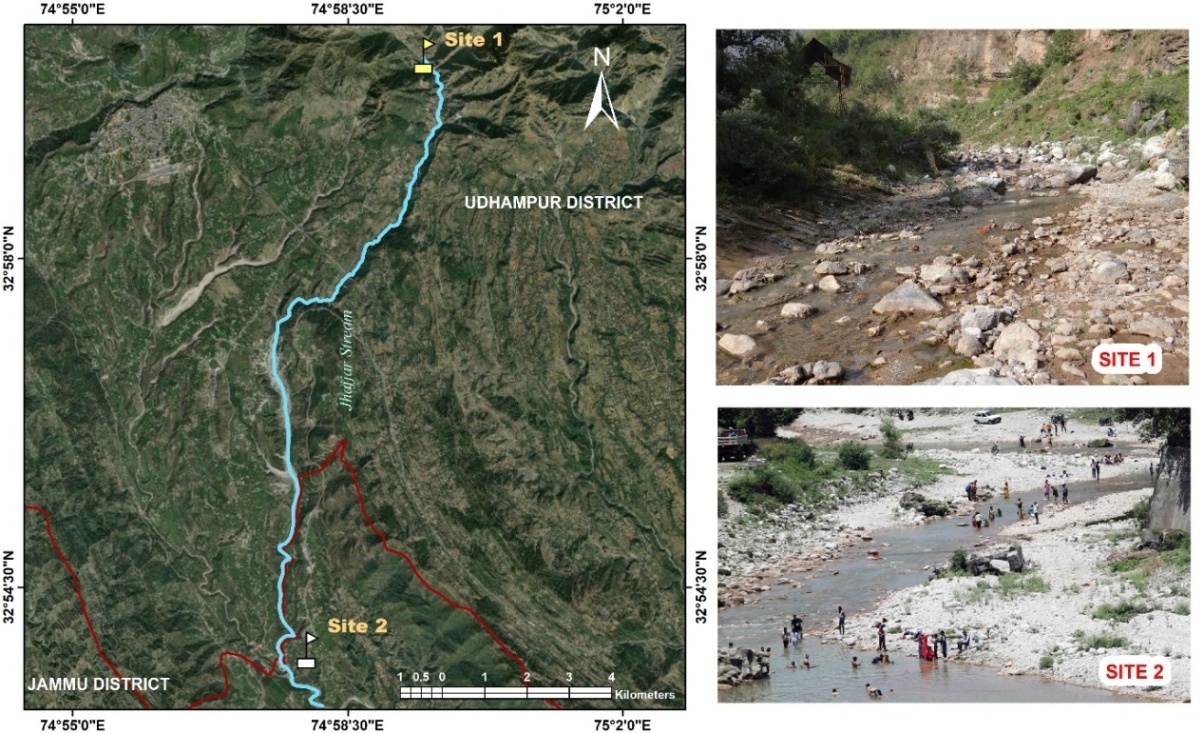
The present work was carried out to evaluate the water quality changes across the Jhajjar stream- an important tributary of River Tawi, which passes through two major districts of the UT of J&K viz., Udhampur and Jammu. The Jhajjar stream flows along National Highway 1A and joins river Tawi at village Kattal-Battal near Nagrota. For the evaluation of water quality two sites were selected on the Jhajjar stream viz., Site 1(upstream site) and Site 2 (downstream site). Site 1 falls in District Udhampur and lies at geographical coordinates of 32° 59' 70" N and 74° 59' 29.26" E whereas, Site 2 of the stream, falls in district Jammu and lies at geographical coordinates of 32° 53' 50" N and 74° 58' 0" E (Figure 1). The sites are located about 13km apart. The surrounding factors and anthropogenic effects on both the sites are completely different as very little or no anthropogenic stress was recorded at the upstream site (Site 1), whereas at the downstream site (Site 2) which is an important tourist destination of Jammu, a very high anthropogenic load was observed throughout the year.
2.2. Analytical ProcedureMonthly water samples for physicochemical analysis were collected in pre-cleaned, polypropylene plastic bottles from selected sampling sites and analysed for different water quality parameters. The parameters (in-situ) like temperaturewere determined using a mercury bulb thermometer (0C); pH, electrical conductivity (EC), total dissolved solids (TDS) by using multiparameter kit (Model WTW Multi 350i), and turbidity using Lutron TU-2016 turbidity meter. The samples were analysed for other major ions in the laboratory within four hours of their collection except for BOD for which five days test was applied using standard techniques 13.
2.3. Water Quality IndexThe arithmetic water quality index(WQI) as suggested by Brown et al. 14 was calculated for the two sites by usingparameters such as pH, TDS, total alkalinity, total alkalinity, calcium, magnesium, sodium, potassium, total hardness, nitrate, sulphate, chloride, dissolved oxygen and biological oxygen demand.
The following equation was used to determine the WQI-
 |
Qn is the quality score rating and Wn is the unit weight of the nth parameter.
The WQI value was compared with the following classification scheme to determine the monthly status of the water quality at the two sites 15
 |

For classifying the water based on the primary water quality criteria for designated best use as given by CPCB, the key metrics used included pH, DO, BOD and EC 16, 17.
2.5. Multivariate AnalysisMultivariate cluster analysis was performed to understand the similarity in the water quality data in different months. For the analysis, Ward’s linkage method was used. The method uses the Euclidean distance of similarity or clustering of the data. The Shapiro-Wilk test was used to assess the entire data set prior to analysis to determine its normal distribution; if the test result was p 0.05, the data was deemed non-normal. When the non-normal distribution of the data was discovered, log transformation (Log10) was performed. The entire set of data was then normalised using the Z-score method to maximise the impact of factors with low variation and minimise the impact of variables with high variance 18. The statistical programme for palaeontology was used to do a clustering analysis (Past 4.03) 19.
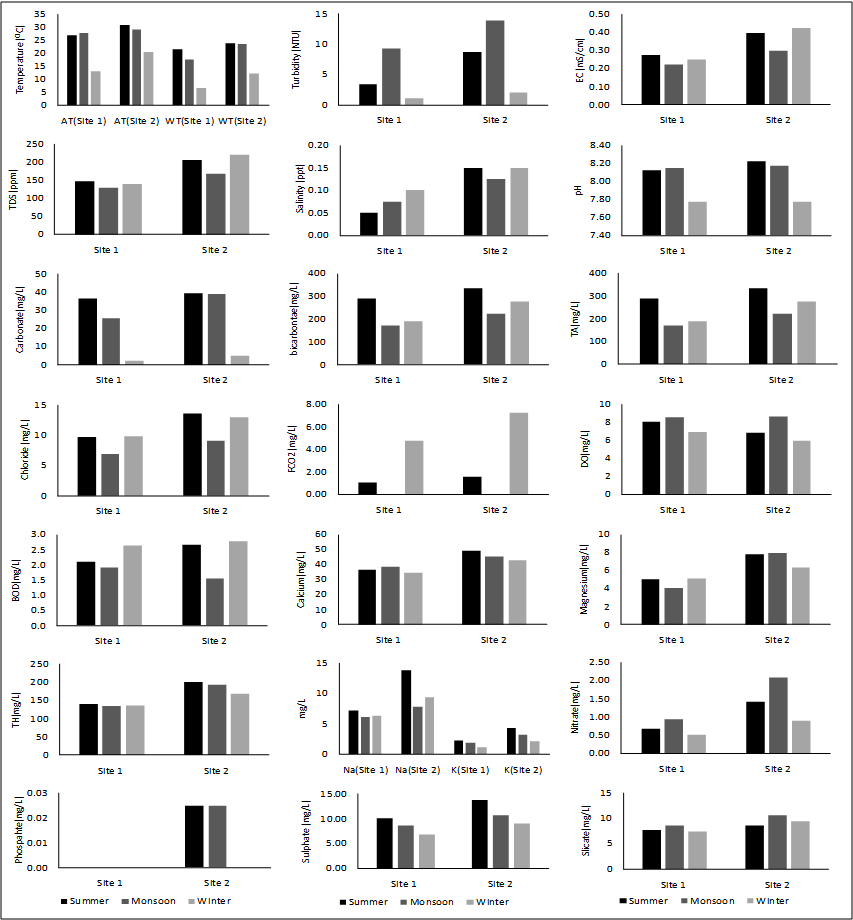
The descriptive analytical data of Site 1 and Site 2 of Jhajjar stream have been tabulated in Table 2 and the seasonal variations for one year study period have been depicted in Figure 2. Comparative analysis of various water quality parameters has shown high values of parameters such as turbidity, TDS, EC, salinity at Site 2 as compared to Site 1 (Figure 2). Also, cations like calcium, magnesium, sodium and potassium, and anions like bicarbonate, chloride, nitrate, phosphate, nitrate and silicate observed high concentration at Site 2 as compared to Site 1. DO and BOD observed inverse relationship with high value of DO at Site 1 and low value at Site 2. BOD remained high at Site 2 and low at Site 1 as there was no pollution source at Site 1. Cationic dominance in the stream followed the following trend: Ca2+>Na+>Mg2+ and> K+ whereas anionic dominance was shown by HCO3- > CO32- > SO42-> Silicate > NO3- and >PO43-. The major cation that characterizes stream water is calcium and major anion as bicarbonate. Seasonally, most of the parameters showed elevated values during summer season which may be due to Site 2 being important tourist destination of Jammu is visited by tourists during summer vacations. However, high phosphate and nitrate concentration during monsoon may be due to entry of these nutrients from catchment along with monsoon runoff. Compared to Site 1 (upstream), Site 2 (downstream) showed much monthly variation which may be due to variation in the anthropogenic pressure during different months.
3.1. Comparison of Water Quality Parameters with WHO and BIS Standard LimitsThe mean of water quality parameter has been compared with BIS 20 and WHO 21 standard limits for drinking water (Table 3). All the water quality parameters were within the desirable limit of WHO and BIS. The mean total alkalinity (238.2 mg/l/363.9 mg/l) at Site 1/ Site 2 were within the desirable limit of BIS (2012). Total hardness at both sites (138.5 mg/l, Site 1 and 188.08 mg/l, Site 2) were above the desirable limit (100 mg/l) of WHO but within the desirable limit of BIS (2012) (500 mg/l).
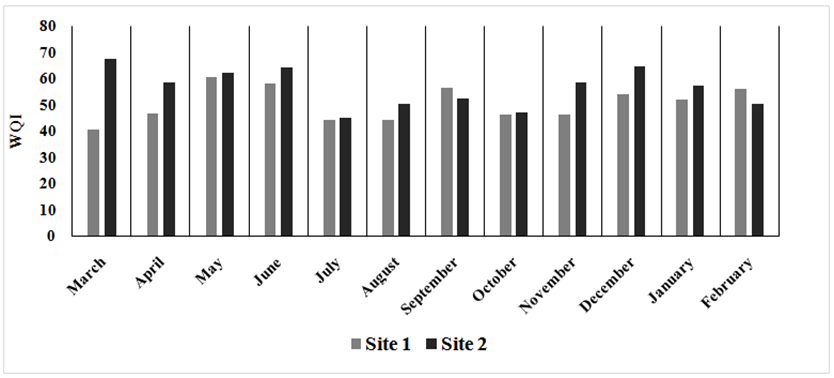
3.2. Water Quality Index (WQI)Table 4 lists the relative weights determined for the water quality parameters and the water quality condition based on WQI. The WQI of Site 1 showed narrow fluctuation from good to slightly poor for drinking purposes (Figure 2). It showed a minimum value in March (40.61) and maximum in May (60.56). The low value in March may be attributed to the high DO, low nitrate and neutral pH. High WQI in May may be due to high pH, high TDS, alkalinity and high nitrate concentration during this month.
At Site 2, the WQI was classified from good for July and October to poor in the remaining months (Figure 3). The low WQI was observed in July (44.93) while the maximum WQI value was attained in March (67.45). The poor water quality status of water in most of the months may be due to high anthropogenic pressures at this Site.
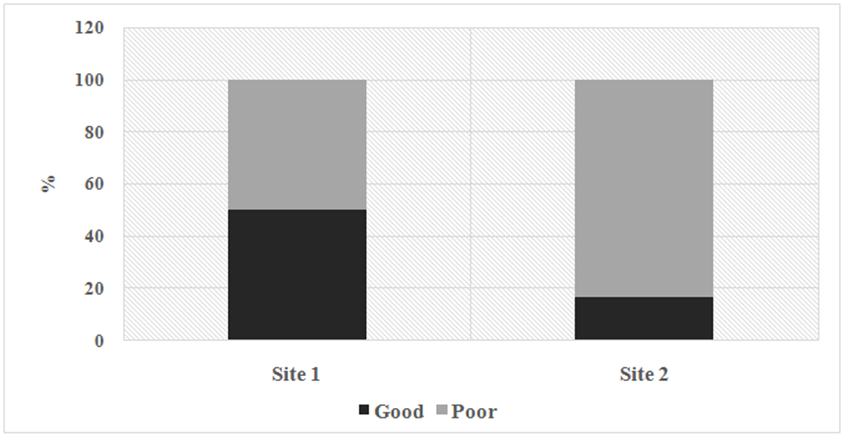
Water quality was observed in the poor category in 50% of the months and was observed good for drinking in the rest of the 50% of months at Site 1, while at Site 2 water quality was observed in the poor category during 83.33 % of the months and remaining two months (16.6%) were observed with good water quality (Figure 4). In comparison to Site 1, water quality at Site 2 had high WQI which may be due to high BOD at this site as other parameters followed almost a similar trend at both the sites 22.


The mean pH (8.02, Site1 and 8.06, Site 2), DO (7.81, Site 1 and 7.12 mg/L, Site 2), BOD (2.21 mg/L, Site 1 and 2.30 mg/L, Site 2) and EC (0.26 mS/cm, Site 1 and 0.39 mS/cm, Site 2) in water quality of both the sites of Jhajjar stream is meeting the Class B of the primary water quality criteria when compared with criteria required for the particular class mentioned in Table 1 16, 17. However, Site 1 was also categorized under Class C for some months of the year wherein the water could be used as drinking water source after conventional treatment and disinfection.
3.4. Multivariate Cluster AnalysisAgglomerative hierarchical cluster analysis has been performed which arranges the clusters progressively in first being the pairs with the most similarity, and higher clusters are generated in step-by-step manner, first considering each object as the single-element cluster 23. The cluster analysis of water quality parameters is a practical tool for identifying homogeneity within the groups 11.
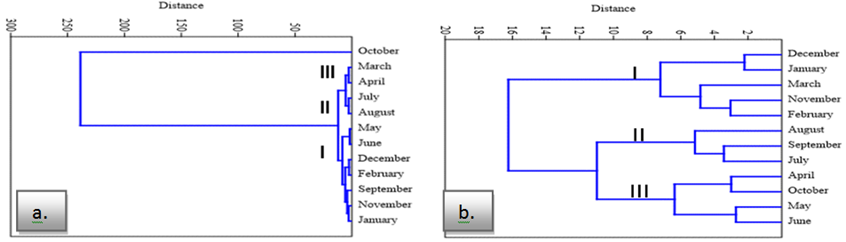
In the dendrogram (Figure 5a), water quality clusters for different months were formed at a very small distance showing not much variation in the water quality parameters. The hierarchical analysis clustered the data of May and June at minimum distance showing maximum similarity in different parameters during these months. After that December and February have clustered. This cluster is with slightly similar WQI value and similar concentration of chloride, calcium, magnesium, potassium, sulphate, nitrate, DO and BOD. Slightly similar cluster of both July and August have been observed with similarity in WQI, chloride, calcium, magnesium, sulphate, DO and BOD. Cluster of March and April have shown similar TDS, magnesium, sodium, potassium, sulphate, nitrate, DO and BOD, at a little distance following the cluster of December and February. January, September and November further clustered at a little more distance. This cluster has shown the minimum variation. Majorly three clusters were observed at Site 1. December, February, January, September, November, May and June months clustered together in cluster I. In cluster II, March, April, July and August clustered. In the cluster III, only October month was observed. It joined the previous two to at a very large distance showing high variation in water quality parameters during this month as compared to other months. Much variation in water quality during October month at Site 1 was attributed to damming of water at this site for construction of bund across the road which was removed in the November month.

At Site 2, clusters formed at a certain distance compared to Site 1 may be due to the significant monthly variations in water quality parameters (Figure 5b). February, November and March clustered together signifying many similarities in the water quality data of salinity, pH, DO, BOD, calcium, magnesium, TH, nitrate, sulphate, silicate etc. July, August and September, the monsoonal seasons clustered together with similarities in water temperature, pH, TA, chloride, DO, BOD, Calcium, magnesium, potassium, nitrate, silicate and WQI. April and October clustered with similar water temperature, turbidity, EC, salinity, pH, chloride, dissolved oxygen, calcium, magnesium, total hardness, nitrate and phosphate. May and June months clustered together having similarities in air and water temperature, pH, DO, BOD, sulphate, silicate and WQI. Three major clusters were observed at Site 2. December, January, March and November months clustered together in group I. In cluster II, August, September and July were observed. In cluster III, only April, October, May and June months were observed.
The water quality changes along two sites of Jhajjar stream were assessed. Detailed monitoring and analysis of water quality parameters in the upstream and downstream sites generated the following major findings:
i. All the water quality parameters at the upstream and downstream sites of Jhajjar stream were within the desirable limits of drinking water as compared to the standard limits of WHO and BIS except total alkalinity and total hardness which were above the desirable limit but within the permissible limit.
ii. The water quality index of the stream at Site 1 was observed better than Site 2 due to less anthropogenic pressure at the upstream site.
iii. At the downstream site most of the parameters showed elevated values with low DO and pH during summer season.
iv. Based on the water quality criteria given by CPCB for designated best use of water, both the sites were classified under the Class B which means that the water was fit for outdoor bathing. However, Site 1 was also categorized under Class C for some months of the year wherein the water could be used as drinking water source after conventional treatment and disinfection.
v. Cluster analysis observed less monthly variation at Site 1 in the water quality parameters due to the clustering of different months at a very small distance. The clustering of different months at Site 2 was at a greater distance showing variation in the water quality parameters which may be due to different inputs of anthropogenic wastes in different months.
vi. The differences in the water quality at the two sites are attributed to more disturbances at Site 2 due to increased tourist pressure particularly during summer months, developmental activities like deforestation for recreation activities like zip lining, park development, road construction and widening near site 2 and entry of waste drains from the restaurants and habitations in the catchment. At Site 1, very less anthropogenic pressures are noticed. The water quality of both sites is being deteriorated because of the anthropogenic pressures in the vicinity.
The study proposes development of an intangible framework as a basis for understanding the upstream-downstream linkages of the Jhajjar stream and based on that an integrated land and water management plan be formulated. Also, increasing forest cover and riparian zone management could reduce erosion and entry of sediments and pollutants into the stream. Diversion of drains and ban on entry of waste into the stream are also suggested.
The authors are thankful to Head, Department of Environmental Sciences, University of Jammu for providing the necessary facilities during the present work and University Grants Commission for providing the funding.
The authors declare no conflict of interest.
| [1] | Singh, Y., Singh, G., Khattar, S., Barinova, S., Kaur, J., Kumar, S and Singh, D.P. “Assessment of water quality condition and spatiotemporal patterns in selected wetlands of Punjab, India”, Environmental Science and Pollution Research, 29, 2493-2509, 2022. | ||
| In article | View Article PubMed | ||
| [2] | Deep, A., Gupta, V., Bisht, L., and Kumar R. “Application of WQI for water quality assessment of high-altitude snow-fed sacred Lake Hemkund, Garhwal Himalaya”, Sustainable Water Resource Management, 6, 89, 2020. | ||
| In article | View Article | ||
| [3] | Kaur, J. Kaur, V. Pakade, Y. and Katnoria, J. “A study on water quality monitoring of Buddha Nullah, Ludhiana, Punjab (India)”, Environmental Geochemistry and Health, 1-24, 2020. | ||
| In article | View Article PubMed | ||
| [4] | Barnett, T. P., Adam, J. C., Lettenmaier, D. P. “Potential impacts of a warming climate on water availability in snow-dominated regions”, Nature, 438, 303-309. | ||
| In article | View Article PubMed | ||
| [5] | Zhang ZM, Zhang F, Du JL, Chen DC. “Surface Water Quality Assessment and Contamination Source Identification Using Multivariate Statistical Techniques: A Case Study of the Nanxi River in the Taihu Watershed, China,” Water, 778, 1-14, 2022. | ||
| In article | View Article | ||
| [6] | Jiang, Y. “China's water scarcity.” Journal of environmental management, 90, 11, 3185-3196, 2009. | ||
| In article | View Article PubMed | ||
| [7] | Sharma, S. and Bhattacharya, A. Drinking water contamination and treatment techniques. Applied Water Science, 7, 1043-1067, 2017. | ||
| In article | View Article | ||
| [8] | Qadir, M., Tubeileh, A., Javaid, A., Larbi, A., Minhas, P., Khan, M. “Productivity enhancement of salt-affected environments through crop diversification,” Land Degradation and Development, 19, 429-453, 2008. | ||
| In article | View Article | ||
| [9] | Dinka, M.O., Loiskandl, W. and Ndambuki, J. M. “Hydrochemical characterization of various surface water and groundwater resources available in Matahara areas, Fantalle Woreda of Oromiya region,” Journal of Hydrology Regional Studies, 3, 444-456. | ||
| In article | View Article | ||
| [10] | Wu, H., Yang, W., Yao, R., Zhao, Y., Zhao, Y., Zhang, Y., Yuan, Q., Lin, A.. “Evaluating surface water quality using water quality index in Beiyun River, China,” Environmental Science and Pollution Research, 27:35449-35458, 2020. | ||
| In article | View Article PubMed | ||
| [11] | Bhat, S. U., Nisa, A.U., Sabha, I and Mondal, N.C. “Spring water quality assessment of Anantnag district of Kashmir Himalaya: towards understanding the looming threats to spring,” Applied Water Science, 12,8, 1-17, 2022 | ||
| In article | View Article | ||
| [12] | Tokatli, C., Kose, E., Cicek, A., Emiroglu, O., Bastatli, Y. “Use of cluster analysis to evaluate surface water quality: an application from downstream of Meric river basin (Edirne, Turkey),” Int. J. Adv. Sci. Eng. Technol.(Spl. Issue-3), 33-35, 2015. | ||
| In article | |||
| [13] | APHA, A.W., Greenberg, W.I., Clesceri, L., Eaton, A. Standard methods for the examination of water and wastewater. Washington DC American Public Health Association, 2012. | ||
| In article | |||
| [14] | Brown, R.M., McClelland, N.I., Deininger, R.A. and O’Connor, M.F.. A water quality index - crashing the psychological barrier. In: Thomas, W.A (ed) Indicators of environmental quality, vol Vol 1. Environmental Science Research, Springer, Boston, MA., 1972. | ||
| In article | View Article | ||
| [15] | Ameen, H.A. “Spring water quality assessment using water quality index in villages of Barwari Bala, Duhok, Kurdistan Region, Iraq,” Applied Water Science, 9,8,1-2, 2019. | ||
| In article | View Article | ||
| [16] | Rani, M., Akolkar, P., and Bhamrah, H. S. “Water quality assessment of River Yamuna from origin to confluence to River Ganga, with respect to biological water quality and primary water quality criteria,” Journal of Entomology and Zoology Studies, 1,6, 1-6, 2013. | ||
| In article | |||
| [17] | CPCB. Water quality criteria. https://cpcb.nic.in/water-quality-criteria/, 2019. | ||
| In article | |||
| [18] | Liu, W. X., Li, X.D., Shen, Z.G., Wang, D.C., Wai, O.W., Li, Y.S. “Multivariate statistical study of heavy metal enrichment in sediments of the Pearl River Estuary,” Environmental pollution, 121, 3, 377-388, 2003. | ||
| In article | View Article PubMed | ||
| [19] | Hammer, O., Harper, D. A. T., Ryan, P. D. PAST. “Paleontological Statistics software package for education and data analysis,” Paleontologia Electronica, 4,1, 9, 2001 | ||
| In article | |||
| [20] | Bureau of Indian Standards (BIS) Indian Standard DRINKING WATER — SPECIFICATION (Second Revision). IS 10500: 2012. Publication Unit, BIS, New Delhi, India. pp 13. http://cgwb.gov.in/Documents/WQ-standards.pdf. Accessed 10 May 2021, 2012. | ||
| In article | |||
| [21] | World Health Organization (WHO). Guidelines for drinking-water quality: second addendum. Vol. 1, Recommendations. World Health Organization, 2008. | ||
| In article | |||
| [22] | Slathia, D. and Jamwal, K. D. “Water quality characterization and pollution source apportionment in the Himalayan river flowing through Jammu City, India, using multivariate statistical approach and geospatial techniques,” Environmental Science and Pollution Research, 1-16, 2022. | ||
| In article | View Article PubMed | ||
| [23] | Wang, Y., Wang, P., Bai, Y., Tian, Z., Li, J., Shao, X., Mustavich, L.F., Li, B.L.. “Assessment of surface water quality via multivariate statistical techniques: A case study of the Songhua River Harbin region, China,” Journal of Hydro-Environment Research, 7, 30-40, 2013. | ||
| In article | View Article | ||
Published with license by Science and Education Publishing, Copyright © 2022 Manisha Wazir, Tsering Dolkar, Shashi Aggarwal and Deepika Slathia
 This work is licensed under a Creative Commons Attribution 4.0 International License. To view a copy of this license, visit
http://creativecommons.org/licenses/by/4.0/
This work is licensed under a Creative Commons Attribution 4.0 International License. To view a copy of this license, visit
http://creativecommons.org/licenses/by/4.0/
| [1] | Singh, Y., Singh, G., Khattar, S., Barinova, S., Kaur, J., Kumar, S and Singh, D.P. “Assessment of water quality condition and spatiotemporal patterns in selected wetlands of Punjab, India”, Environmental Science and Pollution Research, 29, 2493-2509, 2022. | ||
| In article | View Article PubMed | ||
| [2] | Deep, A., Gupta, V., Bisht, L., and Kumar R. “Application of WQI for water quality assessment of high-altitude snow-fed sacred Lake Hemkund, Garhwal Himalaya”, Sustainable Water Resource Management, 6, 89, 2020. | ||
| In article | View Article | ||
| [3] | Kaur, J. Kaur, V. Pakade, Y. and Katnoria, J. “A study on water quality monitoring of Buddha Nullah, Ludhiana, Punjab (India)”, Environmental Geochemistry and Health, 1-24, 2020. | ||
| In article | View Article PubMed | ||
| [4] | Barnett, T. P., Adam, J. C., Lettenmaier, D. P. “Potential impacts of a warming climate on water availability in snow-dominated regions”, Nature, 438, 303-309. | ||
| In article | View Article PubMed | ||
| [5] | Zhang ZM, Zhang F, Du JL, Chen DC. “Surface Water Quality Assessment and Contamination Source Identification Using Multivariate Statistical Techniques: A Case Study of the Nanxi River in the Taihu Watershed, China,” Water, 778, 1-14, 2022. | ||
| In article | View Article | ||
| [6] | Jiang, Y. “China's water scarcity.” Journal of environmental management, 90, 11, 3185-3196, 2009. | ||
| In article | View Article PubMed | ||
| [7] | Sharma, S. and Bhattacharya, A. Drinking water contamination and treatment techniques. Applied Water Science, 7, 1043-1067, 2017. | ||
| In article | View Article | ||
| [8] | Qadir, M., Tubeileh, A., Javaid, A., Larbi, A., Minhas, P., Khan, M. “Productivity enhancement of salt-affected environments through crop diversification,” Land Degradation and Development, 19, 429-453, 2008. | ||
| In article | View Article | ||
| [9] | Dinka, M.O., Loiskandl, W. and Ndambuki, J. M. “Hydrochemical characterization of various surface water and groundwater resources available in Matahara areas, Fantalle Woreda of Oromiya region,” Journal of Hydrology Regional Studies, 3, 444-456. | ||
| In article | View Article | ||
| [10] | Wu, H., Yang, W., Yao, R., Zhao, Y., Zhao, Y., Zhang, Y., Yuan, Q., Lin, A.. “Evaluating surface water quality using water quality index in Beiyun River, China,” Environmental Science and Pollution Research, 27:35449-35458, 2020. | ||
| In article | View Article PubMed | ||
| [11] | Bhat, S. U., Nisa, A.U., Sabha, I and Mondal, N.C. “Spring water quality assessment of Anantnag district of Kashmir Himalaya: towards understanding the looming threats to spring,” Applied Water Science, 12,8, 1-17, 2022 | ||
| In article | View Article | ||
| [12] | Tokatli, C., Kose, E., Cicek, A., Emiroglu, O., Bastatli, Y. “Use of cluster analysis to evaluate surface water quality: an application from downstream of Meric river basin (Edirne, Turkey),” Int. J. Adv. Sci. Eng. Technol.(Spl. Issue-3), 33-35, 2015. | ||
| In article | |||
| [13] | APHA, A.W., Greenberg, W.I., Clesceri, L., Eaton, A. Standard methods for the examination of water and wastewater. Washington DC American Public Health Association, 2012. | ||
| In article | |||
| [14] | Brown, R.M., McClelland, N.I., Deininger, R.A. and O’Connor, M.F.. A water quality index - crashing the psychological barrier. In: Thomas, W.A (ed) Indicators of environmental quality, vol Vol 1. Environmental Science Research, Springer, Boston, MA., 1972. | ||
| In article | View Article | ||
| [15] | Ameen, H.A. “Spring water quality assessment using water quality index in villages of Barwari Bala, Duhok, Kurdistan Region, Iraq,” Applied Water Science, 9,8,1-2, 2019. | ||
| In article | View Article | ||
| [16] | Rani, M., Akolkar, P., and Bhamrah, H. S. “Water quality assessment of River Yamuna from origin to confluence to River Ganga, with respect to biological water quality and primary water quality criteria,” Journal of Entomology and Zoology Studies, 1,6, 1-6, 2013. | ||
| In article | |||
| [17] | CPCB. Water quality criteria. https://cpcb.nic.in/water-quality-criteria/, 2019. | ||
| In article | |||
| [18] | Liu, W. X., Li, X.D., Shen, Z.G., Wang, D.C., Wai, O.W., Li, Y.S. “Multivariate statistical study of heavy metal enrichment in sediments of the Pearl River Estuary,” Environmental pollution, 121, 3, 377-388, 2003. | ||
| In article | View Article PubMed | ||
| [19] | Hammer, O., Harper, D. A. T., Ryan, P. D. PAST. “Paleontological Statistics software package for education and data analysis,” Paleontologia Electronica, 4,1, 9, 2001 | ||
| In article | |||
| [20] | Bureau of Indian Standards (BIS) Indian Standard DRINKING WATER — SPECIFICATION (Second Revision). IS 10500: 2012. Publication Unit, BIS, New Delhi, India. pp 13. http://cgwb.gov.in/Documents/WQ-standards.pdf. Accessed 10 May 2021, 2012. | ||
| In article | |||
| [21] | World Health Organization (WHO). Guidelines for drinking-water quality: second addendum. Vol. 1, Recommendations. World Health Organization, 2008. | ||
| In article | |||
| [22] | Slathia, D. and Jamwal, K. D. “Water quality characterization and pollution source apportionment in the Himalayan river flowing through Jammu City, India, using multivariate statistical approach and geospatial techniques,” Environmental Science and Pollution Research, 1-16, 2022. | ||
| In article | View Article PubMed | ||
| [23] | Wang, Y., Wang, P., Bai, Y., Tian, Z., Li, J., Shao, X., Mustavich, L.F., Li, B.L.. “Assessment of surface water quality via multivariate statistical techniques: A case study of the Songhua River Harbin region, China,” Journal of Hydro-Environment Research, 7, 30-40, 2013. | ||
| In article | View Article | ||