After the industrial revolution, human beings are utilizing natural resources in an accelerated and alarming rate, which has resulted into the release of very harmful substances into the environment. Along with industrialization, there was the growth of urban centers with changed lifestyles having an additional burden on the environment posing a serious threat to the delicate ecological balance. For cleaning this waste, especially domestic wastewater by conventional treatment methods, all governments, and local civic bodies have to incur huge capital expenditures on them. Some alternative green technologies, such as the technique of phytoremediation for the treatment of domestic wastewater are much promising. This review article focuses on a selection of plant species for phytoremediation which are indigenous, have the potential of cleaning domestic wastewater, and can easily adapt to local ecosystems without harming them along with some socio-economic and ecological benefits.
In Rig Veda ‘Apas’ means water, considered Divine, and is one of the Panchmahabhutas which sustains life on the earth. The availability of water is the main driving force for the settlement and development of human civilizations from ancient times. But nowadays this precious resource is being polluted due to human activities. One of the main reasons which deteriorate the quality of surface water in India is the discharge of untreated sewage into surface water bodies 24. In India, urban centers generate 72368 MLD sewage, out of which only 20236 MLD is actually treated accounting for 28% of the total sewage generated 9. In India currently, the total number of Sewage Treatment Plants (STPs) is about 1641 having an installed treatment capacity of 37921.42 MLD of which 1095 STPs are operational giving treatment to 18439.96 MLD of sewage (CPCB, 2020). Thus most Sewage Treatment Plants (STPs) are not utilizing their installed capacity due to operational and maintenance costs of the plant 24. Thus untreated wastewater is finding its way into nearby water bodies and posing a great threat to all living things 12. So there is a need for alternate decentralized domestic wastewater treatment methods such as phytoremediation. This review paper focuses on the status of phytoremediation of domestic wastewater in India with the objectives of studying the status of phytoremediation of domestic wastewater in India along with taking a review of various plants utilized in the process of phytoremediation and the performance of these plants in removing pollutant load from domestic wastewater. Thus we aim to outline the progress of phytoremediation of domestic wastewater in India to date.
‘Status of Phytoremediation of Domestic Wastewater in India’ is the focus of this article, which is referring to the phytoremediation of domestic wastewater in India. Efforts are made to find out various plant species which were utilized for the purpose of phytoremediation of domestic wastewater in India, different types of constructed wetlands, Hydraulic retention time (HRT), different physico – chemical parameters analyzed, the removal efficiency of pollutant load, etc. Further by keeping in mind the conservation of biodiversity of indigenous plants, these plants were also categorized into indigenous plants and exotic plants.
Phytoremediation is the green technology in which plants are utilized to degrade, extract, accumulate, volatilize or immobilize toxic pollutants from soil, water or groundwater.
Phyto is the Greek word that means ‘plant’ and remediation means ‘to correct. Actually the concept of ‘Phytoremediation’ dates back over 300 years but comparatively, it is a new technology that can remove a variety of pollutants such as inorganic, organic, heavy metals, and radionuclides from a polluted site. This process involves different mechanisms such as enhanced rhizosphere degradation, phytodegradation, phytoextraction, rhizofilteration, phytovolatization, phytostabilization, etc. Though this technology is sustainable and cost-effective, still its wide application in the field of pollution control is in its primary stage. Very little work is available on the phytoremediation of domestic wastewater on a field scale, especially in developing countries like India. Therefore in the present review attempt was made to find out research done on phytoremediation of domestic wastewater in the Indian context, where different plants were employed to treat this wastewater.
The efficiency of Lemna minor L. in treating domestic wastewater, especially in removing nutrient load was assessed. Along with increased Net Primary Productivity of Lemna minor L., for the culture time period of seven days each month throughout the year, it was able to decrease the values of different parameters required for quality control of domestic wastewater 4. Similar results were obtained for Lemna minor in which the reduction in various physic-chemical parameters simultaneously both in vivo and in vitro conditions showed that phytoremediation of wastewater is more rapid in tank water as compared to pond 21.
Application of untreated and Phyto -treated domestic wastewater was done to the tree saplings of Azadirachta indica Juss (Neem ) and then their growth was observed. From this experimental set up it was concluded that nutrients in untreated and Phyto-treated wastewater are very useful for tree saplings thus fulfilling the dual purpose of domestic wastewater utilization and supply of nutrients to the plants. Moreover, if there is nutrient stress in growth media such as soil or water it leads to more bioaccumulation of toxic metals per unit biomass weight which is not happening in the case of Fe which is a micronutrient and excess quantity of nutrients and metals after plant uptake are accumulating in soil 27.
Domestic wastewater can be treated very well in shallow pond water hyacinth systems as compared to conventional deep pond water ecosystems. A study revealed that in shallow pond water hyacinth systems there are more aerobic conditions and more plant density which facilitates a higher population of aerobic bacteria enhancing higher decomposition rates to decompose organic matter 28. Furthermore, after improving the design of constructed wetland system and other findings, it was stated that a bio-rack system (system having an assemblage of the number of vertical systems as a rack) is superior to shallow ponds 29. The performance of two phytoremediation systems i.e., reed bed technology and water hyacinth treatment system to treat domestic wastewater were compared after a couple of experiments. It was concluded that reed bed technology was more effective than the water hyacinth system after considering various criteria such as HRT, reduction in organic load from wastewater after treatment, rate of evapotranspiration, morphological and histochemical changes in the plants, footprint area, the capital cost required to run the plant on large scale, etc. 30.
The efficiency of a series of bio-filters planted with Lippia nodiflora, cattail plants, and Typha angustifolia was checked to treat grey water collected from University Hostel. It was found that these series of bio-filters efficiently treated grey water to remove various parameters having a 100% removal rate for SS and total organic carbon, 97.5% for BOD, 96.6% for total solids, 84.37% for chlorides, and 80% for TDS 17.
The impact of domestic wastewater on the growth of Blue Green Alga i.e., Anabaena doliolum, and further biochemical changes occurring in the plant were investigated. It was found that within the study time period of 20 days the maximum Chlorophyll (3.421μg/ml), Carotenoid (1.047μg/ml), and Protein content (253.402μg/ml) were recorded on the 16th day after which there was a decline in the content and it also showed that optimum Basal Nutrient Medium (BNM) should be maintained to treat domestic wastewater 7.
Natural wetlands of East Kolkata which are sewage fed were studied and checking for the carrying capacity of these ecotone areas for pollutant load was done if sewage is mixed in these wetlands for a longer time period was also checked. This study found that some macrophytes like water hyacinth can considerably reduce the higher values of the Pollution Load Index (PLI) and Water Quality Index (WQI). These plants are also more capable of removing toxic metals from aquatic media and sediments 24.
Catharanthus Roseus has better efficiency as compared to Hibiscus rosa in treating domestic wastewater by the process of phytoremediation.This study revealed that Catharanthus Roseus reduced Turbidity, TSS, BOD₃, Sulphates, and Nitrates, by 67.8%, 64%, 68%, 63%, and 47% respectively as compared to Hibiscus rosa – Turbidity (62%), TSS (46%), BOD₃ (61%), Sulfates (56%) and Nitrates (40.7%) 26.
In another attempt to treat grey water by the process of phytoremediation Canna spp. and Cyperus alternifolius (Umbrella palm) was utilized 4.
Another study shows that about 43 phytoplankton species were identified in wastewater contaminated ponds consisting of different floating and marginal macrophytes, moreover it also revealed that according to physic-chemical parameters species dynamics were also changed. It means that a number of aquatic phytoplankton species in water bodies can adapt to the organic load and the same species can be utilized for decentralized phytoremediation of domestic wastewater 6.
Typha latifolia can remove nitrate and phosphate load very efficiently with a removal rate of 48.922% and 47.614% respectively from inlet wastewater of sewage treatment plants within the time duration of 15 days 15.
Floating islands consisting of aquatic macrophytes such as Vetiver zizanioides, Canna indica, and Typha latifolia along with microbial communities drastically reduce the organic load of domestic wastewater at various stages of growth. In this study Vetiver and Canna indica species efficiently reduced phosphates (from 12.5mg/lit. to 1.2 mg/lit. and 2.8mg/lit. respectively) along with turbidity. Vetiver species were more efficient in reducing COD having a removal rate of 60% i.e. from 600 mg/lit.to 240 mg/lit 20.
Another plant Phragmites karka by utilizing well-designed Root Zone Technology can efficiently remove pH from 8.122 to 7.26, Electrical Conductivity from 798.5 to 678.9μmhos/cm, nitrate from 7.727 to 1.231 mg/lit., nitrite from 0.832 to 0.192mg/lit., sulfate from 50.877 to 21.275 mg/lit., phosphate from 0.198 to 0.627 mg/lit. revealing the efficiency of phytoremediation technology using constructed wetland systems for domestic wastewater treatment 12.
Raw sewage wastewater from sewage treatment plant can be treated very well by using an optimum concentration of Chlorella vulgaris for two different Hydraulic Retention Time(HRT) of 8 hours and 24 hours i.e. in a lesser retention time period, for removal of ammonia, COD, phosphate, etc. 14.
The performance of two plant species such as Canna indica and Acorus calamus in Vertical Subsurface Flow Constructed Wetlands (VSSFCW) was very promising in the removal of organic load from primary treated sewage from the residential buildings of the University campus. This study showed that constructed wetlands having Canna indica removed organic load more efficiently as compared to the Acorus calamus. The removal rate for TDS, BOD₅, Total Nitrogen, Phosphate and Alkalinity was 22.31%, 81.79%, 60.37%, 81.53%, 51.28% and 18.96%, 78.74%, 56.33%, 79.57%, 48.37% for Canna indica and Acorus calamus respectively 2.
A comparative study to check the efficiency of different aquatic plant species for the removal of nutrient and organic load from slaughterhouse wastewater was done.In this study Eichhornia Crassipes, Lemna minor, and filamentous algae for phytoremediation for the period of one month at the time interval of five days were utilized. It was found that duckweeds effectively removed TKN by 37.67%, N-NO₃ by 83.33%, and N-NO₂ by 35.33% while filamentous algae were more efficient in removing a load of COD by 49.36%, PO₄³¯ by 57.18% 1.
Laboratory wastewater from educational institutes also finds its way to urban wastewater. Feasibility of use of phytoremediation technique for wastewater arising from Chemistry laboratory by using Ocimum sanctum, Cymbopogon citratus (Lemon grass) and Aloe barbadensis miller by biological absorption method was done. Analysis of about 35 physico-chemical parameters consisting, along with some trace metals was also done. The dried powder of all three plants when kept for one week in wastewater was very efficient in removing the contaminants from laboratory wastewater 22.
A summary of research studies in which phytoremediation of domestic wastewater was done by using various plant species is given in Table 1(A) and plant species and their common names utilized in those studies are given in Table 1 (B).
CSIR– NEERI, Nagpur has developed Phytorid Wastewater Technology for the treatment of different types of wastewater such as municipal, urban, agricultural, and industrial wastewater. Phytorid technology utilises plants such as Pennisetum purpureum, Typha spp., Phragmites, Canna spp., Iris pseudacorus (Yellow Flag iris). Along with this some ornamental plants such as Duranta repens (Golden Duranta), Bamboo, Nerium oleander, Colocasia, etc. The Phytorid Technology is a subsurface flow type consisting of three zones i.e., inlet zone, treatment zone having specific plants, and outlet zone. This technology has efficiency in reducing the organic load from wastewater up to, TSS – 70% to 80%, BOD from 78% to 84%, Nitrogen from 70% to 75%, Phosphorus from 52% to 64%, and fecal coliform from 90% to 97% 31.
For the same purpose Shrishti Eco–Research Institute have developed various eco-technologies for wastewater treatment in which there is the use of plants such as Soil Scape filter, Hydrasch Succession Pond, Stream ecosystem, Phytofilteration and Biox Process, Green Bridge Technology, Green Lake Technology, where normal functioning of bio-geo-chemical cycles in an ecosystem can be maintained 9, 10.
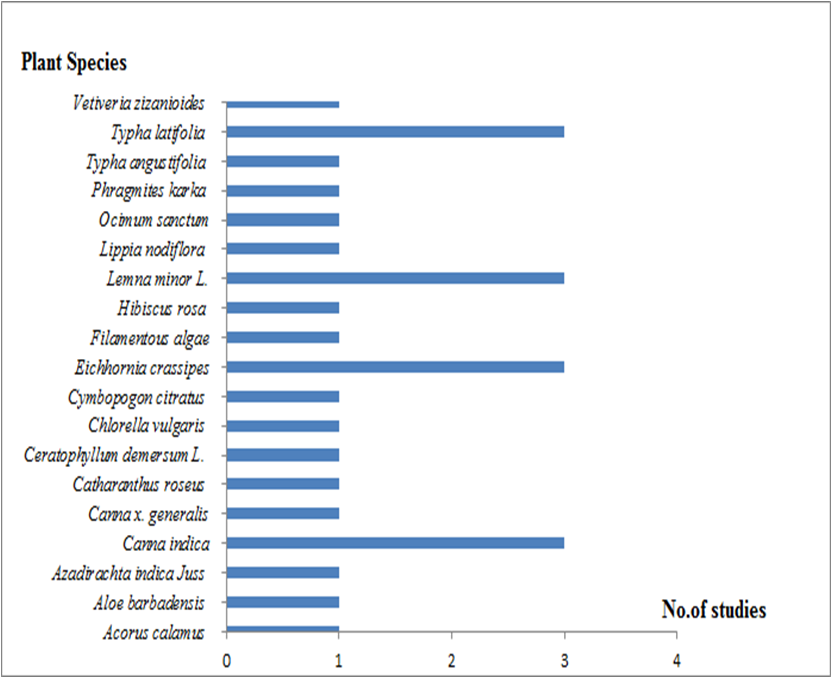
As compared to conventional wastewater treatment, phytoremediation is a very promising technology that is driven by solar energy for filtering and degrading contaminated water media. In India, still it is in the primary stage of development restricted to academia and researchers. In this review, it is found that efforts are made to treat domestic wastewater of various types such as grey water, kitchen wastewater, laboratory wastewater, raw sewage from conventional treatment plants, etc. by using various plants right from microalgae to large macrophytes. Efforts were also made to find out the composition of aquatic plants in sewage-fed aquatic ecosystems, such as pond ecosystems, and also in wetland ecosystems, which are Ramsar sites. Most of the plants utilized while giving phyto treatment were utilized once except Canna indica, Eichhornia crassipes, Lemna minor L. and Typha latifolia, which were used many times. From these plants, Eichhornia crassipes and Typha latifolia are not indigenous to India and moreover, Eichhornia crassipes have been declared an invasive species. Along this efforts were also made by using different types of constructed wetlands, Hydraulic retention time (HRT), analysis of different physico – chemical parameters, analyzing removal efficiency of pollutant load, etc. But still, this work is primitive and on a pilot scale. More accuracy is required when selecting plants, which should be strictly indigenous and do not affect the biodiversity conservation efforts made by experts, otherwise, new problems will be generated while solving the existing problem. So more research is required in this regard. Overall encouragement should be given by the public, government, and local civic bodies to utilize the decentralized process of phytoremediation to treat domestic wastewater at a field scale.
| [1] | Alam, R., Khan, S., Basheer, F., Farooqi, I., 2020. Nutrients and organics removal from slaughterhouse wastewater using phytoremediation: A comparative study on different aquatic plant species. IOP Conference Series: Materials Science and Engineering, 1-12. | ||
| In article | View Article | ||
| [2] | Barya, M., Gupta, D., Thakur, T., Shukla, R., Singh, G., Mishra, V., 2020. Phytoremediation Performance of Acorus calamus and Canna indica for the treatment of primary treated domestic sewage through vertical subsurface flow constructed wetlands: a field- scale study. Water Practice and Technology 15(2), 528-539. | ||
| In article | View Article | ||
| [3] | Bhardwaj, R. M., Scientist ‘C’ Central Pollution Control Board, India, 2002. Status of wastewater generation and treatment in India. IWG-Env, International Work Session on Water Statistics, Vienna, June 20-22, 2005. | ||
| In article | |||
| [4] | Bute, R., Waghmare, E., Sarode, A., Chandekar, A., Sawwalakhe, A., Bondre, K., 2017. Treatment of grey water using technique of phytoremediation. International Research Journal of Engineering and Technology 4(3), 2760-2767. | ||
| In article | |||
| [5] | Chandekar, N. S., Godboley, B. J., 2017. Use of phytoremediation for the treatment of kitchen wastewater. International Journal of Science and Research 6(4), 1170-1173. | ||
| In article | |||
| [6] | Das, D., Pathak, A., Pal, S., 2018. Diversity of phytoplankton in some domestic wastewater-Fed urban fish pond ecosystems of the Chota Nagpur Plateau in Bankura, India. Applied Water Science 8(84), 1-13. | ||
| In article | View Article | ||
| [7] | Dash, A. K., Pradhan, A., 2013. Growth and biochemical changes of the Blue Green Alga, Anabaena doliolum in domestic wastewater. International Journal of Scientific and Engineering Research 4(6), 2753-2758. | ||
| In article | |||
| [8] | ENVIS Centre on Hygiene, Sanitation, Sewage Treatment Systems and Technology. National status of wastewater generation and treatment, December 2020. | ||
| In article | |||
| [9] | Joshi, S., Joshi, S., 2008. Ecotechnological applications for the control of lake pollution.Proceedings of Taal 2007: The 12th World Lake Conference, 864-867. | ||
| In article | |||
| [10] | Joshi, S., 2008. Invasive species – ecological corrections for control of pollution. Proceedings of Taal 2007: The 12th World Lake Conference, 889-893. | ||
| In article | |||
| [11] | Kamyotra, J. S., Bhardwaj, R. M., Municipal Wastewater Management in India. India Infrastructure Report 2011, 299-311. | ||
| In article | |||
| [12] | Khare, P., Jain, N.K., 2019. Phytoremediation of wastewater by constructed wetland system in government new law college, Indore. Journal of Pharmacognosy and Phytochemistry 8(2), 1192-1195. | ||
| In article | |||
| [13] | Magar, R. B., Khan, A.N., Honnutagi, A., 2017. Wastewater treatment using WaterHyacinth.32nd Indian Engineering Congress, The Institution of Engineers (India), Chennai,2017. Theme: Innovation in Engineering: Competitive Strategy Perspective. | ||
| In article | |||
| [14] | Moondra, N., Jariwala, N. D., Christian, R. A., 2020. Sustainable treatment of domestic Wastewater through microalgae. International Journal of Phytoremediation, 1-7. | ||
| In article | View Article PubMed | ||
| [15] | Nafiya, Anitha, K. G., 2019. Phytoremediation of domestic wastewater using Cattail plants. International Research Journal of Engineering and Technology 6(4), 4596-4601. | ||
| In article | |||
| [16] | Ojoawo, S. O., Gaddale, U., Naik, P., 2015. Phytoremediation of Phosphorus and nitrogen with Canna x generalis Reeds in domestic wastewater through NMAMIT constructed wetland. Aquatic Procedia 4, 349-356. | ||
| In article | View Article | ||
| [17] | Pandiyaraja, S., Shrinithivihahshini, N. D., Chithra Devi, R., 2013. Phytoremediation a promising tool for decentralised grey water management at small scale. Indian Journal of Environmental Protection 33(10), 847-850. | ||
| In article | |||
| [18] | Patel, D.K., Kanungo, V. K., 2010. Ecological efficiency of Ceratophyllum demersum L. in phytoremediation of nutrients from domestic wastewater. The Ecoscan 4(4), 257-262. | ||
| In article | |||
| [19] | Patel, D.K., Kanungo, V. K., 2010. Phytoremediation potential of Duckweed ( Lemna minor L). A tiny aquatic plant ) in the removal of pollutants from domestic wastewater with special reference to nutrients. The Bioscan 5 (3), 355 -358. | ||
| In article | |||
| [20] | Pradeep, W. K., Patil, P., Gunale, V. R., Mawal, S., Patil, S., 2019. Domestic wastewater Management: Floating islands come to a rescue. International Journal of Botany Studies 4(4), 14-19. | ||
| In article | |||
| [21] | Raju, A. R., Anitha, C.T., Sidhimol, P. D., Rosna, K. J., 2010. Phytoremediation of domestic wastewater by using a free floating aquatic angiosperm, Lemna minor. Nature Environment and Pollution Technology 9, 83-88. | ||
| In article | |||
| [22] | Sabitha, M. A., Mohamed, A. S., 2021. Phytoremediation of laboratory wastewater using Ocimum sanctum, Cymbopogon citratus, Aloe barbadensis and reusing for domestic purposes. Wutan Huatan Jisuan Jishu XVII(I), 593-604. | ||
| In article | |||
| [23] | Sahasranaman, M., Ganguly, A., 2018. Wastewater treatment for water security in India. Institute for Resource Analysis and Policy, 1-34. | ||
| In article | |||
| [24] | Sanyal, P., Chakraborty, S., Ghosh, P. B., 2015. Phytoremediation of sewage-fed wetlands of East – Kolkata, India – A case study. International Research Journal of Environmental Sciences 4(1), 80-89. | ||
| In article | |||
| [25] | Sharma P.D., “ Ecology and Environment”, Rastogi Publications, Meerut, 13th edition (2017–2018), 400-430. | ||
| In article | |||
| [26] | Suma, Gadag, R. B., 2017. Phytoremediation of domestic sewage by Hibiscus rosa and Catharanthus roseus plants. International Research Journal of Engineering and Technology 4(1), 1181-1185. | ||
| In article | |||
| [27] | Thapliyal, A., Vasudevan, P., Dastagir, M. G., Tandon, M., Sen, P.K., Mishra, S., 2011.Growth of tree saplings of neem (Azadirachta indica Juss) under fertigation with Untreated and treated domestic wastewater. Journal of Scientific and Industrial Research 70, 616-621. | ||
| In article | |||
| [28] | Valipour, A., Raman, V. K., Ghole, V.S., 2011. Phytoremediation of domestic wastewater using Eichhornia crassipes. Journal of Environmental Science and Engineering 53(2), 183-190. | ||
| In article | |||
| [29] | Valipour, A., Raman, V. K., Badaliansgholikandi, G., 2012. Comparative evaluation on the performance of Bio –rack and shallow pond systems for domestic wastewater treatment. Journal of Environmental Science and Engineering 54(4), 453-462. | ||
| In article | |||
| [30] | Valipour, A., Azizi, SH., Raman, V. K., Jamshidi, S., Hamnabard, N., 2014. The comparative evaluation of the performance of two phytoremediation systems for domestic wastewater treatment. Journal of Environmental Science and Engineering 56(3), 319-326. | ||
| In article | |||
| [31] | www.neeri.res.in – Phytorid Technology. | ||
| In article | |||
Published with license by Science and Education Publishing, Copyright © 2022 Jambhali Smita Vinay and Ghayal Nivedita Amrendra
 This work is licensed under a Creative Commons Attribution 4.0 International License. To view a copy of this license, visit
http://creativecommons.org/licenses/by/4.0/
This work is licensed under a Creative Commons Attribution 4.0 International License. To view a copy of this license, visit
http://creativecommons.org/licenses/by/4.0/
| [1] | Alam, R., Khan, S., Basheer, F., Farooqi, I., 2020. Nutrients and organics removal from slaughterhouse wastewater using phytoremediation: A comparative study on different aquatic plant species. IOP Conference Series: Materials Science and Engineering, 1-12. | ||
| In article | View Article | ||
| [2] | Barya, M., Gupta, D., Thakur, T., Shukla, R., Singh, G., Mishra, V., 2020. Phytoremediation Performance of Acorus calamus and Canna indica for the treatment of primary treated domestic sewage through vertical subsurface flow constructed wetlands: a field- scale study. Water Practice and Technology 15(2), 528-539. | ||
| In article | View Article | ||
| [3] | Bhardwaj, R. M., Scientist ‘C’ Central Pollution Control Board, India, 2002. Status of wastewater generation and treatment in India. IWG-Env, International Work Session on Water Statistics, Vienna, June 20-22, 2005. | ||
| In article | |||
| [4] | Bute, R., Waghmare, E., Sarode, A., Chandekar, A., Sawwalakhe, A., Bondre, K., 2017. Treatment of grey water using technique of phytoremediation. International Research Journal of Engineering and Technology 4(3), 2760-2767. | ||
| In article | |||
| [5] | Chandekar, N. S., Godboley, B. J., 2017. Use of phytoremediation for the treatment of kitchen wastewater. International Journal of Science and Research 6(4), 1170-1173. | ||
| In article | |||
| [6] | Das, D., Pathak, A., Pal, S., 2018. Diversity of phytoplankton in some domestic wastewater-Fed urban fish pond ecosystems of the Chota Nagpur Plateau in Bankura, India. Applied Water Science 8(84), 1-13. | ||
| In article | View Article | ||
| [7] | Dash, A. K., Pradhan, A., 2013. Growth and biochemical changes of the Blue Green Alga, Anabaena doliolum in domestic wastewater. International Journal of Scientific and Engineering Research 4(6), 2753-2758. | ||
| In article | |||
| [8] | ENVIS Centre on Hygiene, Sanitation, Sewage Treatment Systems and Technology. National status of wastewater generation and treatment, December 2020. | ||
| In article | |||
| [9] | Joshi, S., Joshi, S., 2008. Ecotechnological applications for the control of lake pollution.Proceedings of Taal 2007: The 12th World Lake Conference, 864-867. | ||
| In article | |||
| [10] | Joshi, S., 2008. Invasive species – ecological corrections for control of pollution. Proceedings of Taal 2007: The 12th World Lake Conference, 889-893. | ||
| In article | |||
| [11] | Kamyotra, J. S., Bhardwaj, R. M., Municipal Wastewater Management in India. India Infrastructure Report 2011, 299-311. | ||
| In article | |||
| [12] | Khare, P., Jain, N.K., 2019. Phytoremediation of wastewater by constructed wetland system in government new law college, Indore. Journal of Pharmacognosy and Phytochemistry 8(2), 1192-1195. | ||
| In article | |||
| [13] | Magar, R. B., Khan, A.N., Honnutagi, A., 2017. Wastewater treatment using WaterHyacinth.32nd Indian Engineering Congress, The Institution of Engineers (India), Chennai,2017. Theme: Innovation in Engineering: Competitive Strategy Perspective. | ||
| In article | |||
| [14] | Moondra, N., Jariwala, N. D., Christian, R. A., 2020. Sustainable treatment of domestic Wastewater through microalgae. International Journal of Phytoremediation, 1-7. | ||
| In article | View Article PubMed | ||
| [15] | Nafiya, Anitha, K. G., 2019. Phytoremediation of domestic wastewater using Cattail plants. International Research Journal of Engineering and Technology 6(4), 4596-4601. | ||
| In article | |||
| [16] | Ojoawo, S. O., Gaddale, U., Naik, P., 2015. Phytoremediation of Phosphorus and nitrogen with Canna x generalis Reeds in domestic wastewater through NMAMIT constructed wetland. Aquatic Procedia 4, 349-356. | ||
| In article | View Article | ||
| [17] | Pandiyaraja, S., Shrinithivihahshini, N. D., Chithra Devi, R., 2013. Phytoremediation a promising tool for decentralised grey water management at small scale. Indian Journal of Environmental Protection 33(10), 847-850. | ||
| In article | |||
| [18] | Patel, D.K., Kanungo, V. K., 2010. Ecological efficiency of Ceratophyllum demersum L. in phytoremediation of nutrients from domestic wastewater. The Ecoscan 4(4), 257-262. | ||
| In article | |||
| [19] | Patel, D.K., Kanungo, V. K., 2010. Phytoremediation potential of Duckweed ( Lemna minor L). A tiny aquatic plant ) in the removal of pollutants from domestic wastewater with special reference to nutrients. The Bioscan 5 (3), 355 -358. | ||
| In article | |||
| [20] | Pradeep, W. K., Patil, P., Gunale, V. R., Mawal, S., Patil, S., 2019. Domestic wastewater Management: Floating islands come to a rescue. International Journal of Botany Studies 4(4), 14-19. | ||
| In article | |||
| [21] | Raju, A. R., Anitha, C.T., Sidhimol, P. D., Rosna, K. J., 2010. Phytoremediation of domestic wastewater by using a free floating aquatic angiosperm, Lemna minor. Nature Environment and Pollution Technology 9, 83-88. | ||
| In article | |||
| [22] | Sabitha, M. A., Mohamed, A. S., 2021. Phytoremediation of laboratory wastewater using Ocimum sanctum, Cymbopogon citratus, Aloe barbadensis and reusing for domestic purposes. Wutan Huatan Jisuan Jishu XVII(I), 593-604. | ||
| In article | |||
| [23] | Sahasranaman, M., Ganguly, A., 2018. Wastewater treatment for water security in India. Institute for Resource Analysis and Policy, 1-34. | ||
| In article | |||
| [24] | Sanyal, P., Chakraborty, S., Ghosh, P. B., 2015. Phytoremediation of sewage-fed wetlands of East – Kolkata, India – A case study. International Research Journal of Environmental Sciences 4(1), 80-89. | ||
| In article | |||
| [25] | Sharma P.D., “ Ecology and Environment”, Rastogi Publications, Meerut, 13th edition (2017–2018), 400-430. | ||
| In article | |||
| [26] | Suma, Gadag, R. B., 2017. Phytoremediation of domestic sewage by Hibiscus rosa and Catharanthus roseus plants. International Research Journal of Engineering and Technology 4(1), 1181-1185. | ||
| In article | |||
| [27] | Thapliyal, A., Vasudevan, P., Dastagir, M. G., Tandon, M., Sen, P.K., Mishra, S., 2011.Growth of tree saplings of neem (Azadirachta indica Juss) under fertigation with Untreated and treated domestic wastewater. Journal of Scientific and Industrial Research 70, 616-621. | ||
| In article | |||
| [28] | Valipour, A., Raman, V. K., Ghole, V.S., 2011. Phytoremediation of domestic wastewater using Eichhornia crassipes. Journal of Environmental Science and Engineering 53(2), 183-190. | ||
| In article | |||
| [29] | Valipour, A., Raman, V. K., Badaliansgholikandi, G., 2012. Comparative evaluation on the performance of Bio –rack and shallow pond systems for domestic wastewater treatment. Journal of Environmental Science and Engineering 54(4), 453-462. | ||
| In article | |||
| [30] | Valipour, A., Azizi, SH., Raman, V. K., Jamshidi, S., Hamnabard, N., 2014. The comparative evaluation of the performance of two phytoremediation systems for domestic wastewater treatment. Journal of Environmental Science and Engineering 56(3), 319-326. | ||
| In article | |||
| [31] | www.neeri.res.in – Phytorid Technology. | ||
| In article | |||