Purpose: This research attempts to test the relationship between organizational DNA and the individual and team dimensions of the learning organization in the Egyptian Banking Sector. Findings: This research reveals that the four building blocks of organizational DNA; decision rights, information, motivators, and organizational structure have a significant direct correlation with the individual level and team level of the learning organization. Design/methodology/approach: The research uses the quantitative method, data were collected by distributing questionnaires to 384 employees in different banks in Egypt during the third quarter of 2022. The questionnaire consists of 3 sections demographics, organizational DNA dimensions based on the 5 Likert scale, and the individual and team dimensions of the Learning organization dimension which is based on the 6 Likert scale. Rigorous translation procedures, including both forward and backward processes, have been used to guarantee the relevance of this instrumentation in different cultural contexts. The analysis uses different statistical techniques using SPSS 25 and AMOS 25. Several tests were carried out, the tests were done at (P<0.01) significance level (α = 0.01). The evaluation focused on the hypotheses derived from the objective of the research. Practical implications: This research suggests that the Egyptian Banking Sector can improve individual and team learning by diagnosing its organizational DNA building blocks; decision rights, information, motivators, and organizational structure. This research provides a set of recommendations including the necessity to pay more attention to the dimensions of organizational DNA as a key source for the Egyptian Banking Sector to enhance individual and team learning in all Egyptian Banks.
Contemporary studies in management have contributed extensively to the development of new concepts like organizational DNA 1 and learning organizations 2, 3. Organizational DNA is one of the terms that have been recently considered in organization and management subjects that describe organizations with a genetic approach. Analysis, discovery, classification, and description of inheritance facts and variations are considered important targets in genetics 4.
Each organization has its unique traits distinguishing it from other organizations, even those operating in the same field. This urged many researchers to study these traits that are considered organizational DNA 1. Researchers found four variables that define organizational genetics: decision rights, information, motivators, and structure 1, 5. Others argued that the organizational DNA has an important role in the identification of organizations and their leadership and management functions such as the organizational structure, decisions, group work, and communications 6.
According to 3, a learning organization is an organization where people continually expand their capacity to create the results they truly desire. In addition, a learning organization is an organization where new and expansive patterns of thinking are nurtured, collective aspiration is set free, and where people are continually learning how to acquire knowledge together. A learning organization has been observed as a positive factor that encourages an organization to change for enhancing its performance 7, 8. Meanwhile, modern organizations can learn and change in particular ways at the same time according to the techniques and processes in adopting continuous learning 3. Hence, learning organization is a substantial factor that enables employees to improve their skills and abilities to become more knowledgeable and educated.
This research aims to study the relationship between the organizational DNA and the individual and team dimensions of the learning organization. In his research, “The DNA of the learning organization” 9 defined the organizational DNA as “the internalized values and beliefs that govern team and individual behavior” 9. While 10 continued the genetic example and linked between learning organization and DNA “To continue the DNA example borrowed from genetics, the business and learning process must become strands in a common chromosome.” 10. As for 11, he believed that “Corporate DNA has enormous power to help our organization learn and adapt.” 11. He believed that team learning and individual learning are the outcomes of the employees' interaction, the employees are “autonomous agents whose interaction creates behavior on the scale of the whole that would be impossible at the individual level” 11.
It is concluded that this research stems its distinguished aspects of being unique as there is lack of studies and research that tackle the impact of Organizational DNA on the learning organization dimensions of individual and team learning. Individual and team learning are not confined to training courses, on the contrary, it is embedded in all the organizational DNA and its four building blocks; decision rights, structure, information, and motivators. If the organizational DNA is diagnosed and the organizations fix the glitches related to it, this will impact the employee and enhance the learning dimensions inside the organization
The research up to the researcher's knowledge is novel and has genuine insights into the Egyptian banking sector. It studies the relation between organizational DNA based on 1 and the individual and team dimensions of the learning organization as per the study of 12. Different empirical studies examined the organizational DNA and others examined the level of learning organization in different countries but no empirical study has tackled both variables in Egypt, especially in the Egyptian banking sector.
The current research will stem its distinguished aspects of being unique as – up to the researcher's knowledge- there is lack of studies and research that have tackled the relationship between the organizational DNA and the individual and team learning organization dimensions in the Egyptian banking sector. The current research's main questions are:
• What is the relationship between organizational DNA and the individual and team dimensions of learning organizations in the Egyptian banking sector?
• What is the level of organizational DNA in the Banking sector?
• What is the level of individual and team learning in the banking sector?
• To what extent can the alignment of organizational DNA building blocks influence individual and team learning in the Egyptian Banking Sector?
- To study the link between organizational DNA and the individual and team dimensions of the learning organizations in the Egyptian banking sector
- To study how far we can implement the individual and team learning organization inside the Egyptian banking sector
- To study the level of organizational DNA in the banking sector
The organizational DNA plays an important role in the identification of the management functions of the organizations and their leadership 6. A new vision of the organization based on the concept of organizational DNA helps explain its performance. Booz Allen Company for administrative consultations, based in the USA, was the first to coin this term upon its foundation in 2002 using an international questionnaire. This questionnaire in its first phase encompassed 100 states in the USA, twenty-three sectors in different fields, and eight departments inside each company 5.
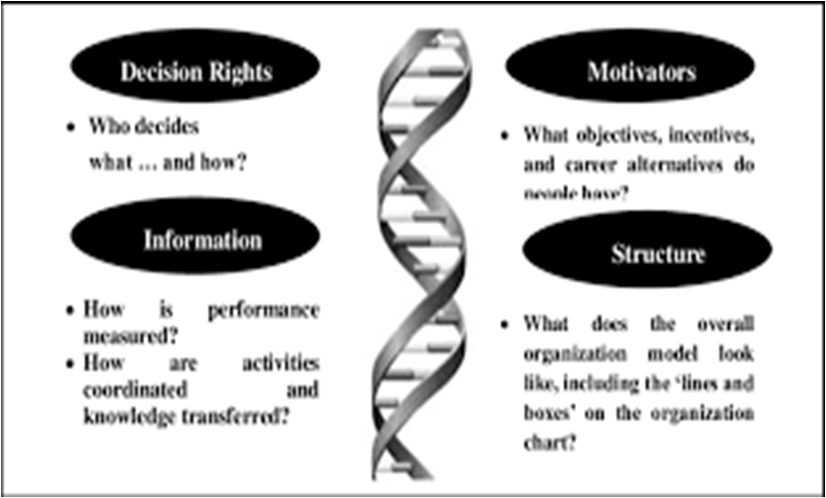
The aim was to understand the unique characteristics of the organization and define its character. As revealed through this questionnaire, each organization enjoyed its unique traits distinguishing it from other organizations, even those operating in the same field. This new concept urged many researchers to attempt to detect such traits, which are regarded as organizational DNA. There were four variables or chromosomes that define the organization gene (gene of performance): 1) decision rights, 2) information, 3) motivators, and 4) structure 5.
To conclude, the four building blocks or the chromosomes of the DNA are crucial for understanding more about the identity of any organization. Diagnosing each pillar and fixing the problem that arises enable the top management to take better decisions and enhance the internal synergy and alignment inside the organization. This results in more unification between the internal departments. The organizational DNA shows how unified the organization is and if the organization performs in alignment or not.

When a company decides, who is authorized to make what types of decisions, this can have a profound effect on its business, both in terms of everyday effectiveness and the bottom line 13. Decision rights are the basic techniques of the actual decision-making process in the organization, besides how efficient it is for the organization's work, speed of supplying products, good services, and time needed to get the outcome 14. Decision rights are the main obstacles that stand behind any organization that suffers functional imbalance, they have to be tackled and solved as they are the cornerstone of efficient development, they are the underlying mechanisms of how decisions are truly made 1. Therefore, the organization has to first appoint the authorities and responsibilities of those who make the decisions, make it as clear as possible, and secondly, define the business unit or functional managers “process owners” who are responsible for leading the revitalization of the business processes and are accountable for its success and empowerment 15.
It is believed that when the decision making process is adjusted, all the organizational processes will work in harmony. Decision-making has to be taken with calculated risks. Roles and responsibilities are defined so organizations decide who is authorized to make what types of decisions because this has a high impact on the business. Distributing authorities is very crucial for any organization and has to be periodically reviewed.
Motivators are essential for any organization, they are exemplified in the objectives, incentives, and career alternatives the employees have 14. Motivators include more than money, they include other non-financials like goals, preferences, and accomplishments 16. Balancing between the carrot and the stick; in other words, the positives (financial and non-financial) and the negatives (punishment) is another motivational consideration that managers must attend to 17. Motivation is a powerful tool for achieving the organization's strategic goals. First, awards have a major impact on employee attitudes. Second because employee compensation is typically a significant organizational cost and thus requires close attention 18.
It is deducted that motivation is the engine of employees' performance in any organization. Some managers underestimate the value of motivation. Both intrinsic and extrinsic motivations are essential for any employee and can lead to a leap in his performance. Appreciation affects employees and can change even poor performers to achievers. Mentoring, coaching, and appreciation have to be used more extensively with employees together with extrinsic tools.
Information is exemplified in what metrics are used to measure performance, how activities are coordinated, and how knowledge is transferred 14. Information can play two critical roles in today’s organizations: organizational response to business pressures 19, and enhancement of key business functions 20. The information explains what metrics are used to measure performance, how activities are coordinated, and how knowledge is transferred 21.
It is believed that the flow of information between the departments has to be controlled and moved in the legal channels inside the organization. It can be done horizontally between the different departments or vertically between the employees and their managers. Communication is crucial in any organization as the flow of information helps management take decisions and the interaction between the employees helps them develop and allows them to work smoothly together in synergy.
Companies make structural choices to support a strategy. 21. It is a high combination of relations between organizational elements forming the existence philosophy of organizational activity 22. The organizational structure shows the overall picture of how the organizational hierarchy looks like, and how the reporting lines and boxes in the organization chart are interconnected. It highlights the number of layers in the hierarchy and the span of control for each layer 14. The structure is the total of how the organization divides its labor into distinct tasks to ensure effective communication, coordination, and integration of efforts across departments 23, 24. The structure should not be the starting point, but the logical outcome related to the other three determinants; decision rights, information, and motivators. It is the climax of reorganization, not the starting point 25. The structure is the total of efforts in which the organization divides its workforce among the different layers to ensure effective communication, coordination, and integration among departments 23, 24.
It is worth mentioning that the organizational structure is the skeleton of any organization. Flexibility, decision making, and communication should be all considered when designing the organizational structure of any organization. There is no right or wrong form of structure for any organization. Mixing the different types of structures according to the need of each department can sometimes solve different issues yet if it is misused inside the organization, the unification of structure would be the best solution.
4.2. Learning Organizations“A learning organization is an organization where people continually expand their capacity to create the results they truly desire, where new and expansive patterns of thinking are nurtured, where collective aspiration is set free, and where people are continually learning how to learn” 3. It is highlighted through giving continuous feedback and encouraging personal learning and development and gaining benefits from the different learning opportunities, they may encounter 26. In his research, “Building a learning organization”, 27 suggests that the learning organization concept needs to satisfy three main objectives to create tangible outcomes. A clear definition, and practical operational advice from managers together with valid tools and assessment instruments to measure achievements, are the main drivers for reaching the level of a learning organization 27.
Therefore, learning is crucial for any organization, and encouraging creativity inside the organization is one of the main tools for changing the culture of the employees to learn. Learning can be embedded in all organizational activities; it should be encouraged by managers and top management. Unfortunately, some managers discourage learning and believe that if their subordinates are well-learned, this may affect their position in the organization.
Continuous learning can be viewed as a subset of lifelong learning 28. It explains “evolution in training” as a movement towards a continuous learning philosophy where employee efforts shift from formal training to everyday training 29. It is the self-initiated, discretionary, planned, and proactive pattern of activities that are sustained over time to apply or transport knowledge for career development 30. Continuous learning can be both formal and informal. It can include daily, daylong, and anytime learning, that is, whenever an individual is consciously thinking, reflecting, or learning. It happens from individual to group to the organizational level and vice versa 28.
It is believed that continuous learning is not limited to training courses but to developing employees' skills and enhancing productivity. Organizations encourage and motivate employees to engage in continuous learning, and promote new ideas. Engagement between employees and the transfer of experiences foster a culture of continuous learning. The key to continuous learning at all levels is by providing top management support, resources, and meaningful rewards for participation.
Dialogue and Inquiry are considered collective thinking it is the process of transforming the quality of conversation and thinking about what lies beneath it 31. Through dialogue and Inquiry, the organization can build a group that can think creatively, and most importantly think together 32. Dialogue and Inquiry is a collective and collaborative communication process where people explore together their individual and collective assumptions and ideas. Dialogue and Inquiry help employees establish shared meaning and understanding and thus learn together 33.
It is believed that dialogue and inquiry are sometimes misused in organizations. Engaging in continuous meetings without any clear outcomes can be time-wasting. Unfortunately, it is sometimes a good environment to raise conflicts and struggles.
Team learning and collaboration exclusively address the group/team learning level of an organization 34. They play a vital role in the framework of the learning organization, since they allow “people to experience things from a myriad of vantage points, enabling them to expand their horizons, deepen their understandings, amplify their perspectives, and develop a better sense of self” 35. Teams are constantly exploring, evolving, building on, and integrating each of the disciplines of learning organizations, they adapt as circumstances change and are truly greater than the sum of their parts 3.
It is believed that team learning is essential because engaging in groups and interactions encourages learning but some employees may not benefit from team learning because they face difficulty learning in groups. Teamwork has to be motivated by encouraging team spirit and eliminating negative vibes inside the teams. Sharing experiences will enhance learning yet monitoring and follow-up from team leaders are essential to promote the exchange of experiences and eliminate negative effects.
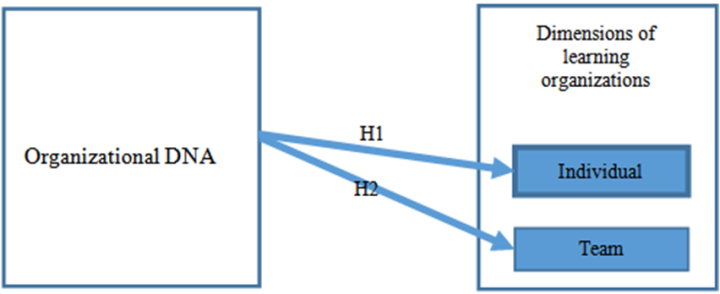
4.3. Research Model
4.4. Hypotheses
H1: Organizational DNA has a relationship with the Individual dimension in the Egyptian banking sector.
H2: Organizational DNA has a relationship with the Team dimension in the Egyptian banking sector
The researcher uses a survey strategy and the tool is the questionnaire to collect the relevant data. It is correlational as the researcher is aiming to test the relationship between the organizational DNA and two of the dimensions of the learning organization in the Egyptian Banking sector in a natural working environment. Data is collected and analyzed from employees from different age groups and different titles in the banking sector. It is a cross-sectional study as data has been gathered just once to test the research hypotheses. The questions in the survey are typically arranged into web-based self-administered questionnaires that a respondent completes on his/her own, via the computer.
5.2. The Survey ProcedureThe questionnaire used in the research consists of three sections: demographics, organizational DNA, and Individual and team levels of learning organizations.
This section includes 5 questions about gender, age group, job nature, total working experience, and experience in the banking sector.
This section consists of 12 questions measured by a 5 Likert scale which ranges between strongly disagree and strongly agree. This section is based on 36. There were 12 items 3 items measuring decision rights, 3 items measuring information, 3 items measuring motivators, and 3 items measuring structure.
This section consists of 9 questions measured by a 6 Likert scale that ranges between strongly disagree and strongly agree. The individual level was measured by continuous learning 3 questions and Dialogue and Inquiry 3 questions and the team level was measured by team learning and collaboration 3 questions based on 37.
For better comprehension of the participants, the original instrument in English was translated into Arabic, following the forward-then-back translation approach 38. After the English version was translated, an independent expert translated the Arabic version back into English. After conducting a meaningful comparison between the original and back-translated English versions, some Arabic items were modified.
The questionnaire is distributed in the following e-channels: Facebook, LinkedIn, and banking groups. This is in addition to LinkedIn network contacts, phone book contacts, and referrals from the banking sector through WhatsApp, emails, and messages.
5.3. Target PopulationSince this research aims to investigate the relationship between the organizational DNA and the individual and team dimensions of the learning organization in the banking sector in Egypt, therefore the whole number of employees working in the banking sector is the target population. As per the Central Bank of Egypt, the number of employees in the banking sector as of the end of Dec 2021 is 130,385 employees. Data has been gathered from a sample of individual employees in different banks by answering a questionnaire to understand their perception of the Organizational DNA and the individual and team dimensions of the learning organizations in their banks.
As per the central bank of Egypt, the banking sector definition is that it includes the CBE and the banks registered therewith. The list of registered banks in Egypt includes 37 banks.
If the target population is finite, the following formula may be used to determine the sample size. 42.
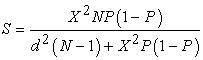 |
Where:
S = Sample size
X= Z value (e.g. 1.96 for 95% confidence level)
N= Population Size
P= Population proportion (expressed as a decimal) (assumed to be 0.5 (50%) – this provides the maximum sample size).
d= Degree of accuracy (5%), expressed as a proportion (.05); It is the margin of error
42 greatly simplified the size decision by this equation. The equation provides the generalized scientific guideline for sample size decisions. Therefore since the population exceeds 100,000 so the researcher adopts the highest sample size which is 384 samples from different banks.
The researcher uses a simple random sample technique as one of the probability sampling techniques. This technique eliminates bias in the population and gives all members a fair chance to be included in the sample.
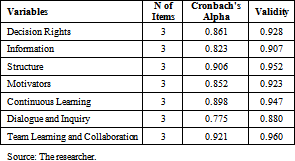
It is clear from the Table 3 that there is stability in the values of Cronbach alpha coefficients, all dimensions are greater than (0.70) which is a high ratio and the validity ratios are all greater than (0.80)
6.2. Demographics AnalysisRespondents from 26 out of 37 banks identified by the Central Bank of Egypt shared in the survey with a total of 384 respondents to the survey.
H1: Organizational DNA has a relationship with the Individual dimension in the Egyptian banking sector
First: - The coefficient of determination - Goodness of fit
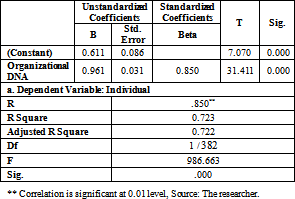
From the above Table 5 it is clear that there is a correlation between Organizational DNA and Individual at a confidence level of 99%, this correlation (R) equals 0.850, so it is very strong. The coefficient of determination (R square) equals (0.723), and this indicates that the independent variable (Organizational DNA) explains 72.3% of any change in the Individual. In addition, the regression model is statistically significant when the F test (986.663) is significant at the level of confidence of 99%.
Hypotheses tests for beta coefficients
Null hypothesis: - beta coefficients for Organizational DNA equal to zero (β = 0)
The alternative hypothesis: - beta coefficient for Organizational DNA not equal to zero (β≠0)
Table 5 shows the values of the coefficient of the independent variable and it is found that the model variables are statistically significant at a confidence level of 99%, thus the null hypothesis is rejected and the alternative hypothesis is accepted. Therefore, the independent variable (Organizational DNA) value coefficient is (0.961) and has a real impact on the Individual.
Second: - Equation model
Individual = 0.611 + 0.961(Organizational DNA)
Results:-
The null hypothesis is rejected and the alternative hypothesis is accepted. There is a positive effect of (Organizational DNA) on the Individual dimension at the significance level (∝≤0.05)
There is a significant relationship between Organizational DNA and Individual dimension.
7.2. Testing the Second HypothesisH2: Organizational DNA has a relationship with the Team dimension in the Egyptian banking sector.
First: - The coefficient of determination - Goodness of fit
From the above Table 6 it is clear that there is a correlation between Organizational DNA and Teams at a confidence level of 99%, this correlation (R) equals 0.784, so it is strong. The coefficient of determination (R square) equals (0.615), and this indicates that the independent variable (Organizational DNA) explains 61.5% of any change in the Teams. In addition, the regression model is statistically significant when the F test (604.435) is significant at the level of confidence of 99%.
Hypotheses tests for beta coefficients
Null hypothesis: - beta coefficients for Organizational DNA equal to zero (β = 0)
The alternative hypothesis: - beta coefficient for Organizational DNA not equal to zero (β≠0)
Table 6 shows the values of the independent variables coefficient and the model variables are statistically significant at a confidence level of 99%. Therefore, the null hypothesis is rejected and the alternative hypothesis is accepted. The independent variable (Organizational DNA) has a value coefficient of 1.024 and has a real impact on the Teams.
Second: - Equation model
Teams = 0.571 + 1.024(Organizational DNA)
Results:-
• There is a significant relationship between Organizational DNA and Team dimension.
The null hypothesis that Organizational DNA has a relationship with Team dimension in the Egyptian banking sector is accepted.
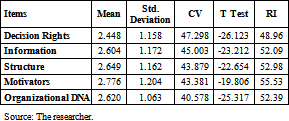
As shown in Table 7, around 59% of the respondents evaluated the level of organizational DNA in the banking sector to be neutral (2.62). These results mismatch the findings of the study of 43 in her study “The Impact of Organizational DNA on Jordanian Water Authority Good Governance”. A Case Study on diagnosing the level of organizational DNA. The organizational DNA level in WAJ is high with a mean value of (3.86) 43. The results of the research also mismatch with the results of 44 in her research “The Impact of the Organizational DNA on the Institutional Excellence of Alexandria Petroleum Companies through Improving Organizational Performance as a Mediating Variable” where the mean was found to be (4.33) which indicates strongly agree 44. The results of this research also mismatch the results of 14 in his research “The Role of Organizational DNA in Improving Organizational Performance: A Study on the Industrial Companies in Egypt”. The mean of the organizational DNA in his study was 3.53 which indicated that the respondents agreed that their organization implements organizational DNA. Finally, the results of this research match the study “The influence of organizational DNA on innovation performance: An empirical study in a sample of Iraqi industrial organizations” which was 3.083 which indicates that the respondents in this research evaluated the organizational DNA to be Neutral 45.
In this research, the Motivation factor has the highest mean 2.776 (Neutral) and this indicates the highest importance. This shows that there are few motivators in the banking sector and the employees are somehow discouraged to show high performance. There is a fair appreciation for the achievers. Balancing between positive (financial and non-financial) and negative (punishment) motivational considerations is one of the main issues that managers must attend to 17. Motivation is a powerful tool for furthering the organization's strategic goals. First, awards have a major impact on employee attitudes. Second, employee compensation is typically a significant organizational cost and thus requires scrutiny 18.
The Structure factor has the second highest mean (2.649) which is neutral and this indicates the authorities are somehow not distributed fairly inside the organization and the information is not transferred from the top management to the lower layers, which leads to the demotivation shown in the previous factor. The employees do not have enough authority to perform their job and the transfer of knowledge between the different layers of management is not done effectively. “Organizational structure is the total of how the organization divides the employees into distinct tasks to ensure effective communication, coordination, and integration of efforts across departments. Whatever the structure, multiple organization layers and narrow span of control often result in excess bureaucracy and bottlenecked decision making” 45.
The third factor in relative importance and has the third rank in the mean is Information (2.604) which is neutral, this indicates that there is slight distrust from the employees toward the validity of the information transferred from the management downward and this agrees with the answers of the previous factor. It also indicates that there is somehow a lack of technological advances which enables a smooth flow of information between the different sectors inside the organization. It also indicates that the different departments and sectors are working in silos, as there is no smooth information between the different departments. “Information is the basic means for the transfer and dissemination of knowledge inside an organization from holders of information to those in need of it. It is the mover of activities at the organization and may be employed to measure employees' performance as bad information affects the remaining components of DNA, especially decision rights and motivators.” 14. The last factor according to relative importance and the least in the mean value (2.448) is the decision rights. The employees perceive the decisions of the top management as not achievable. Not all decisions are taken by the top management communicated to the staff, which leads to a lack of transparency. The employees do not have the full authority to take decisions related to their jobs as there is a long hierarchy and the authorities are not fairly distributed, which agrees with the answers related to the structure factor. This leads to delays in taking decisions, which affects the whole organization. This indicates that the authorities and responsibilities are not clear and the mechanism of decision-making needs to be revisited. “It is the definition of the basic techniques of actual decision taking in the organization, besides efficiency of organization's work, speed of supplying products, good services, and time needed to get the outcome. Decision rights are the basic task that should be tackled by organizations that suffer functional imbalance as they are the cornerstone of efficient development” 14.
According to Table 8, Table 9, the team learning and collaboration dimension (related to the team learning dimension) is the one with the highest mean (3.252) and standard deviation (1.387) within the individual and team dimensions in this research, which indicates slightly disagree. This agrees with the studies 46, 47, 48, which also indicate slightly disagree. This explains that the respondents in this research perceive team learning and collaboration inside the banking sector as ineffective. This indicates that the teams do not act or think collectively. They do not act in alignment and lack a shared vision. Team learning is “...the process of aligning and developing the capacity of a team to create the results its members truly desire.” 3
Concerning continuous learning (related to the Individual learning dimension), the mean equals (3.243) and the standard deviation is 1.385, which indicates slightly disagree. This matches with the studies 46, 47 which also indicates slightly disagree but mismatches with the study 48 which indicates slightly agree. This result shows that the respondents in this research don't perceive continuous learning as a feature of their organization. The employees are not rewarded for learning, they are not given time to support learning. Employees do not transfer knowledge to each other nor help each other learn.
Dialogue and Inquiry factor (related to the Individual learning dimension) the mean equals (3.016) and standard deviation (1.140) which indicates slightly disagree. This result matches with the studies 46, 47, 48 which also indicates slightly disagree. This result implies that the dialogue in the Egyptian banking sector is meager and needs improvement. Respondents of the questionnaire perceive feedback received from the managers and from the employees to each other as dishonest. They do not state their views openly and do not care about others' opinions. They do not exert time or effort to build trust between each other. Thus promoting dialogue and inquiry flourishes the concept of learning organization in the banking sector. Inquiry into others as well as one's assumptions and preconceptions promotes individual and collective learning 34.
The results of the study agree with 49 in his study “Measuring the Impact of Learning Organization on Employee Retention, Competitive Advantage and Financial Performance in the BPO industry”. He stated that Learning organizations focus on embedding learning in the DNA of the organization's culture 49. In another article “Corporate DNA: Organizational Learning, Corporate Co-Evolution”, 11 believes that when we apply DNA to our organization, not as a specific structure (a literal translation) but as a set of operating principles, the resulting corporate DNA has enormous power to help our organizations learn and adapt. Corporate DNA drives the process of organizational learning and provides the flexible documentation of alternative paths of evolution/learning on which anyone can build, so long as their contribution moves the organization in the direction of its identity. The result is ongoing, accelerated organizational learning. It also agrees with the article published by 9 “The DNA of the learning organization” in which he shows how the DNA of the learning organization can be created and how to bring the learning organization and the business systems together in one system. In the banking sector, there are barriers to implementing organizational DNA and the learning organization dimensions, banks should develop strategies and techniques to overcome these problems, and “learning becomes embedded in day-to-day work activity.” 9.
8.2. RecommendationsFrom the above studies and the results of the research, the following recommendations can be concluded:
1. To encourage continuous learning, employees have to learn more about the work procedures and develop new products and services that match the employee requirements and not treat business and learning as if they are separate from each other.
2. The banking sector has to encourage employees' mutual learning between employees and managers, build trust between them and provide coaching from the managers. Workplace activities and job responsibilities require new skills and professional development. Since there is a dynamic environment in the banking sector, this requires the banks to enhance professional development because these skills will be translated to performance.
3. Concerning the formal training courses, although it is a prime contributor yet it is not enough to create a learning environment, there should be room for informal learning to encourage the learning environment. Learning must be integrated with work not only in classroom training. Formal training has to be supported by experiential learning and action learning. Yet classroom training is still very important in transferring knowledge and experience. This can be done through the help of The Egyptian Banking Institute (EBI). The (EBI) was established in 1991 by the Central Bank of Egypt (CBE) to act as its official training arm with a vision to be the preferred partner for developing the human capital of the banking ecosystem in Egypt, and the lighthouse for the banking sector development across strategic African and Arab countries, through mirroring the latest international banking trends.
4. Information is another tool to enhance learning in the banking sector. Increasing the availability of information related to work procedures for the whole organization will enable any teller, customer service, or call center agent to answer the inquiries of the customers and guide them through the process, therefore making it easier to understand customers' emerging needs and fulfill their requirements. A database can be created by documenting the best ways that the organization had found to perform any task either in hard copy or in electronic form or mix. Mapping workflows and examining them enable employees to have full awareness of work procedures and can develop new products and solve customer problems.
5. Encouraging dialogue and inquiry between the different departments and between the managers and the employees effectively encourage communication and the change of ideas. Promoting the initiative and suggestion environment will improve the current policies and procedures under the guidance of their managers and encourage them to work autonomously.
6. Rigid Bureaucratic structure functions as a prison that hinders learning because it does not permit employees to connect with other departments and units, which is reflected in the organization's operation. Leaders have to dilute the impermeable boundaries between the departments to encourage networking and communication, which will facilitate the transfer of knowledge and information. Networking between the different departments so that information can flow easily without rigid structures, ensures a strong sense of interconnection between the different departments in addition to cross-training between departments to understand more about the work of other departments.
7. Job rotation can be another way to promote learning inside the organization. It enables employees to widen their knowledge in different fields in the banking sector, which strengthen their experiences, in addition to this it adds to their motivation.
8. The banking sector needs to encourage Team learning and collaboration between employees. This can lead to cross-peer tutoring and mentoring. It also helps in creating self-directed teams.
9. Motivation is still a very important tool to encourage learning inside the organization. Reward systems have to be changed to increase both individual and team productivity. Employees need to understand their objectives and have clear KPIs to guide them through their achievements. Some managers use the reward system to maintain their power not to increase productivity and teamwork. These drawbacks have to be eliminated and offer new systems to follow and monitor performance without favoritism and fairly and transparently.
The current study has contributed to theory by rooting the study conceptual model and its variables in the literature of organizational theory. In addition, this study has contributed to practice by recommending approaches and mechanisms which would support the human resources and top management in the Egyptian banking sector. This section will present the contributions made by this study from two main angles: theoretical (Contributions to Academia) and practical contributions.
9.1. Theoretical Contributions (Contributions to Academia)In literature, in general, there is a scarcity of studies on the relationship between organizational DNA and the learning organization. In Egypt, this study is the first to address this important issue in Egyptian the banking sector. The current study examines an integrated model that shows the relationship between organizational DNA and the individual level and team level of the learning organization using 12. Dimensions of learning organization questionnaire. In addition, the current study has contributed to theory by rooting the proposed conceptual model and its variables in the literature of organizational theory.
9.2. Practical Contributions (Contributions to the Egyptian Banking Sector)The previous section elaborated on the theoretical contributions to the body of knowledge. This section continues this elaboration by presenting the practical contributions:
This study strongly encourages human resources and top management in the banking sector to pay more attention to employing the advantages of organizational DNA in enhancing the learning organization.
This study may well be the first to explore the study model in the Egyptian banking sector. Therefore, it is hoped that this contribution will offer precious insight to both academia and practitioners.
Finally, this study has added more insight into the body of knowledge in the organizational DNA and learning organizations' literature by providing several results from the banking sector staff perspectives. Thus, the findings of this study can be useful to the top management and the Human Resources of the banking sector when they plan to enhance learning inside their organizations.
There are different limitations that the researcher encountered in this study. The first limitation is that not all the banks in the banking sector are shared in the study. It is recommended in future studies that the researcher would specify specific banks as a field of study or choose a stratified sampling technique to ensure that all banks share in the study with the same percentage. The second limitation is that the sample did not represent all the positions in the bank and it is recommended in the future to specify certain sectors and focus on certain jobs. The third limitation is the geographical area, the banks have branches in different geographical areas. It is recommended in future research to include different geographical areas in the study.
There are several areas for future research. 1) Different moderating variables like culture and organization identity can be added to the model. 2) The same model of the relationship between organizational DNA and the learning organization can be tested in different industries other than the banking sector. 3) As the results of the multiple regression in this study revealed that each of the organizational DNA dimensions has a different impact on the learning organization, future studies can choose one or two of the dimensions of organizational DNA and test their impact on the learning organization. 4) It is also recommended that future research would test the different results in the significance between different demographics and how far the change in demographics can affect the results of the study.
| [1] | Hamilton, B., Organizational DNA. Retrieved from http://www.boozallen.com, 2005. | ||
| In article | |||
| [2] | Marsick, V. J., & Watkins, K. E., Demonstrating the Value of an Organization’s Learning Culture: The Dimensions of the Learning Organization Questionnaire. Advances in Developing Human Resources, 5(2), 2003, 132-151. | ||
| In article | View Article | ||
| [3] | Senge, P., The art and practice of the learning organization. Vol. 1. New York: Doubleday, 1990. | ||
| In article | |||
| [4] | Soroush, S., Esfahani, D., & Poorfarahmand, B., Investigation of organizational DNA in Esfahan Province sport and youth offices according to Honold and Silverman Model. International Research Journal of Applied and Basic Sciences, 2013, 4(6), 1417-1425. | ||
| In article | View Article | ||
| [5] | Neilson, G., Pasternack, B., & Mendes, D., “The Four Bases of Organizational DNA Trait by trait, companies can evolve their own execution cultures”, 2004, Retrieved from http://www.strategy-business.com. | ||
| In article | |||
| [6] | Naderi A., Organization DNA Explanation and How to Find it. Management Thesis for MSc, Islamic Azad university Khorasgan Branch., 2009. | ||
| In article | |||
| [7] | Megheirkouni M., Leadership styles and organizational learning in UK for-profit and non-profit sports organizations. International Journal of Organizational Analysis. 2017 Sep 4. | ||
| In article | View Article | ||
| [8] | Rebelo, T. M. & Duarte Gomes, A., Organizational learning and the learning organization: Reviewing evolution for prospecting the future. The Learning Organization. Vol. 15, (4), 2008 p. 294-308. | ||
| In article | View Article | ||
| [9] | Dilworth, R., “The DNA of the learning organization.” Learning organizations: Developing cultures for tomorrow's workplace: 1995, 243-255. | ||
| In article | |||
| [10] | Mehta, P., et al., COVID-19: Consider Cytokine Storm Syndromes and Immunosuppression. The Lancet, 395, 2020, 1033-1034. | ||
| In article | View Article PubMed | ||
| [11] | Baskin, K., Corporate DNA: Organizational Learning, Corporate Co-Evolution. Emergence. 2. 34-49. | ||
| In article | View Article | ||
| [12] | Watkins, K.E. and Marsick, V.J., “In Action: Creating the Learning Organization, American Society for Training and Development”, Alexandria, VA., 1996. | ||
| In article | |||
| [13] | Jacobs P., Decision rights: Who gives the green light. Retrieved June. 2005; 30. | ||
| In article | |||
| [14] | Nafei W., The role of organizational DNA in improving organizational performance: a study on the industrial companies in Egypt. International Business Research, 2014 Jan 1; 8(1): 117. | ||
| In article | View Article | ||
| [15] | Bordia, R., Kronenberg, E., and Neely, D., Innovations Organizational DNA. Retrieved from http://www.boozallen.com (2005). | ||
| In article | |||
| [16] | Ivancevich, J., & Matteson, M. (2002), Organizational Behavior and Management. McGraw-Hill Company, Inc. | ||
| In article | |||
| [17] | Thompson, A., & Strickland, A. “Strategic Management: Concepts and Cases”, McGraw -Hill / Irwin., 2003. | ||
| In article | |||
| [18] | Noe, R., Hollenbeck, J., Gerhart, B., & Wright, P., “Human Resource Management: Gaining a Competitive Advantage, Richard D. Irwin. Inc. 1994. | ||
| In article | |||
| [19] | Turban, E., Mcleam, E., & Wetherbe, J.,” Information Technology for Management: Making Connections for Strategic Advantage”, (2nd ed.). John Wiley & Sons Inc. 1999. | ||
| In article | |||
| [20] | Wheelen, T. L., & Hunger, J. D. “Strategic Management and Business Policy: Concepts “(9th ed.). Pearson Education, Inc., Upper Saddle River. 200. | ||
| In article | |||
| [21] | Neilson, G., Pasternack, B., & Van Nuys, K., “The Passive-Aggressive Organization”, Harvard Business Review, 2005, 1-12. | ||
| In article | |||
| [22] | Ahmady, G.A., Mehrpour, M. and Nikooravesh, A., Organizational structure. Procedia-Social and Behavioral Sciences, 230, pp.455-462. (2016). | ||
| In article | View Article | ||
| [23] | Hodge, B., & Anthony, W., Organization Theory: A Strategic Approach, Allyn & Bacon, Inc., 1991. | ||
| In article | |||
| [24] | Daft, R.L., Organizational Theory and Design, 7th ed., South-Western College Publishing, Cincinnati, OH., 2001 | ||
| In article | |||
| [25] | Govindarajan, V., and Trimble, C., Organizational DNA for Structure Innovation, Management Span and Layers. Retrieved from http://www.Orgdna.com, 2006. | ||
| In article | |||
| [26] | Moilanen, R., “Diagnosing and measuring learning organization”, The Learning Organization, Vol. 12 No. 1, 2005 pp. 71-89. | ||
| In article | View Article | ||
| [27] | Garvin, D.A., “Building a learning organization”, Harvard Business Review, Vol. 71 No. 4, 1993, pp. 78-91. | ||
| In article | |||
| [28] | Jain, S., & Martindale, E. T., Facilitating continuous learning: A review of research and practice on individual learning capabilities and organizational learning environments. The Proceedings of Association for Educational Communication & Technology (AECT), 2012, 288-297. | ||
| In article | |||
| [29] | Rosow J.M., Zager R., Training—the competitive edge: Introducing new technology into the workplace. Jossey-Bass; 1988. | ||
| In article | |||
| [30] | London, M., & Smither, J. W., Empowered self-development and continuous learning. Human Resource Management. 38(1), 1999, 3-15. | ||
| In article | View Article | ||
| [31] | Isaacs, W. N., Taking flight: Dialogue, collective thinking, and organizational learning. Organizational Dynamics, 22(2), 1993, 24-39. | ||
| In article | View Article | ||
| [32] | Schein, E. H., On dialogue, culture, and organizational learning. Organizational Dynamics, 22(2), 40-51, 1993. | ||
| In article | View Article | ||
| [33] | Ellinor, L., & Gerard, G., Dialogue: Rediscover the transforming power of conversation. New York: John Wiley, 1998 | ||
| In article | |||
| [34] | Watkins, K.E. and Marsick, V.J., “In Action: Creating the Learning Organization, American Society for Training and Development”, Alexandria, VA., 1996 | ||
| In article | |||
| [35] | Gilley, J. W. & Maycunich, A., Beyond the Learning Organization: Creating a Culture of Continuous Growth and Development through State-of-the-Art Human Resource Practices, Cambridge, Massachusetts: Perseus Books, 2000. | ||
| In article | |||
| [36] | Abdel-Raheem, A. and Saad, M., Organizational Personality as a Moderating Variable of the Relationship between Organizational DNA and Innovative Performance, Journal of Business and Management Sciences, 2019, Vol. 7, No. 3, 131-139. | ||
| In article | |||
| [37] | Chai, D.S. & Dirani, K., The dimensions of the learning organization questionnaire (DLOQ): A validation study in the Lebanese context. The Learning Organization. 25. 2018. | ||
| In article | View Article | ||
| [38] | Degroot, A., Dannenberg L., Vanhell, J.G., Forward and Backward Word Translation by Bilinguals, Journal of Memory and Language, Volume 33, Issue 5, 1994, Pages 600-629, ISSN 0749-596X. | ||
| In article | View Article | ||
| [39] | Song, J.H., Joo, B. and Chermack, T., “The dimensions of learning organization questionnaire (DLOQ): a validation study in a Korean context”, Human Resource Development Quarterly, Vol. 20 No. 1, pp. 43-64, 2009. | ||
| In article | View Article | ||
| [40] | Wang, X., Yang, B. and McLean, G.N., “Influence of demographic factors and ownership type upon organizational learning culture in Chinese enterprises”, International Journal of Training and Development, Vol. 11 No. 3, pp. 154-165, 2007. | ||
| In article | View Article | ||
| [41] | Lien, B.Y., Hung, R.Y., Yang, B. and Li, M., “Is the learning organization a valid concept in the Taiwanese context?”, International Journal of Manpower, Vol. 27 No. 2, pp. 189-203, 2006. | ||
| In article | View Article | ||
| [42] | Krejcie, R. V., & Morgan, D. W., Determining sample size for research activities. Educational and psychological measurement, 30(3), 1970, 607-610. | ||
| In article | View Article | ||
| [43] | Qabaja D., The Impact of Organizational DNA on Jordanian Water Authority “Good Governance”. A Case Study (Doctoral dissertation, Zarqa University, 2018. | ||
| In article | |||
| [44] | Elsakaan, R.A.-E.M., Ragab, A.A., El-Gharbawy, A. and Ghanem, A.-N., The Impact of the Organizational DNA on the Institutional Excellence of Alexandria Petroleum Companies through Improving Organizational Performance as a Mediating Variable. Open Access Library Journal, 8, 1-13. doi: 10.4236/oalib.1107691 Employee Counseling Today, Vol. 8 No. 7, 2021, p. 16. | ||
| In article | View Article | ||
| [45] | Rashid, S. and Challab , I., “The influence of organizational DNA on innovation performance: An empirical study in a sample of Iraqi industrial organizations”, 2007, https://www.researchgate.net/publication/323616005. | ||
| In article | |||
| [46] | Leufvén, M., Vitrakoti, R., Bergström, A., Kc, A., & Målqvist, M.. Dimensions of Learning Organizations Questionnaire (DLOQ) in a low-resource health care setting in Nepal. Health research policy and systems, 13(1), 1-8, 2015. | ||
| In article | View Article PubMed | ||
| [47] | Consuela-Mădălina, G., Lorin, P.V, Luliana-Raluca, G. and Ovidu, P.V. (2018), “Investigating the dimensions of learning organizations questionnaire (DLOQ) in a Romanian private ophthalmology organization”, Romanian Journal of Ophthalmology, Volume 62, Issue 4, pp:288-295, 2018. | ||
| In article | View Article PubMed | ||
| [48] | Sharifirad, M., The Dimensions of Learning Organization Questionnaire (DLOQ) A cross-cultural validation in an Iranian context International Journal of Manpower Vol. 32 No. 5/6, 2011. pp. 661-676. | ||
| In article | View Article | ||
| [49] | Pahurkar, Rajesh & Nair, Jaya & Kolte, Ashutosh. Measuring the Impact of Learning Organization on Employee Retention, Competitive Advantage and Financial Performance in the BPO industry. 8. 2019, 546-553. | ||
| In article | View Article | ||
Published with license by Science and Education Publishing, Copyright © 2022 Amany F. Abdel Messih and Tarek H. Abdeen
 This work is licensed under a Creative Commons Attribution 4.0 International License. To view a copy of this license, visit
http://creativecommons.org/licenses/by/4.0/
This work is licensed under a Creative Commons Attribution 4.0 International License. To view a copy of this license, visit
http://creativecommons.org/licenses/by/4.0/
| [1] | Hamilton, B., Organizational DNA. Retrieved from http://www.boozallen.com, 2005. | ||
| In article | |||
| [2] | Marsick, V. J., & Watkins, K. E., Demonstrating the Value of an Organization’s Learning Culture: The Dimensions of the Learning Organization Questionnaire. Advances in Developing Human Resources, 5(2), 2003, 132-151. | ||
| In article | View Article | ||
| [3] | Senge, P., The art and practice of the learning organization. Vol. 1. New York: Doubleday, 1990. | ||
| In article | |||
| [4] | Soroush, S., Esfahani, D., & Poorfarahmand, B., Investigation of organizational DNA in Esfahan Province sport and youth offices according to Honold and Silverman Model. International Research Journal of Applied and Basic Sciences, 2013, 4(6), 1417-1425. | ||
| In article | View Article | ||
| [5] | Neilson, G., Pasternack, B., & Mendes, D., “The Four Bases of Organizational DNA Trait by trait, companies can evolve their own execution cultures”, 2004, Retrieved from http://www.strategy-business.com. | ||
| In article | |||
| [6] | Naderi A., Organization DNA Explanation and How to Find it. Management Thesis for MSc, Islamic Azad university Khorasgan Branch., 2009. | ||
| In article | |||
| [7] | Megheirkouni M., Leadership styles and organizational learning in UK for-profit and non-profit sports organizations. International Journal of Organizational Analysis. 2017 Sep 4. | ||
| In article | View Article | ||
| [8] | Rebelo, T. M. & Duarte Gomes, A., Organizational learning and the learning organization: Reviewing evolution for prospecting the future. The Learning Organization. Vol. 15, (4), 2008 p. 294-308. | ||
| In article | View Article | ||
| [9] | Dilworth, R., “The DNA of the learning organization.” Learning organizations: Developing cultures for tomorrow's workplace: 1995, 243-255. | ||
| In article | |||
| [10] | Mehta, P., et al., COVID-19: Consider Cytokine Storm Syndromes and Immunosuppression. The Lancet, 395, 2020, 1033-1034. | ||
| In article | View Article PubMed | ||
| [11] | Baskin, K., Corporate DNA: Organizational Learning, Corporate Co-Evolution. Emergence. 2. 34-49. | ||
| In article | View Article | ||
| [12] | Watkins, K.E. and Marsick, V.J., “In Action: Creating the Learning Organization, American Society for Training and Development”, Alexandria, VA., 1996. | ||
| In article | |||
| [13] | Jacobs P., Decision rights: Who gives the green light. Retrieved June. 2005; 30. | ||
| In article | |||
| [14] | Nafei W., The role of organizational DNA in improving organizational performance: a study on the industrial companies in Egypt. International Business Research, 2014 Jan 1; 8(1): 117. | ||
| In article | View Article | ||
| [15] | Bordia, R., Kronenberg, E., and Neely, D., Innovations Organizational DNA. Retrieved from http://www.boozallen.com (2005). | ||
| In article | |||
| [16] | Ivancevich, J., & Matteson, M. (2002), Organizational Behavior and Management. McGraw-Hill Company, Inc. | ||
| In article | |||
| [17] | Thompson, A., & Strickland, A. “Strategic Management: Concepts and Cases”, McGraw -Hill / Irwin., 2003. | ||
| In article | |||
| [18] | Noe, R., Hollenbeck, J., Gerhart, B., & Wright, P., “Human Resource Management: Gaining a Competitive Advantage, Richard D. Irwin. Inc. 1994. | ||
| In article | |||
| [19] | Turban, E., Mcleam, E., & Wetherbe, J.,” Information Technology for Management: Making Connections for Strategic Advantage”, (2nd ed.). John Wiley & Sons Inc. 1999. | ||
| In article | |||
| [20] | Wheelen, T. L., & Hunger, J. D. “Strategic Management and Business Policy: Concepts “(9th ed.). Pearson Education, Inc., Upper Saddle River. 200. | ||
| In article | |||
| [21] | Neilson, G., Pasternack, B., & Van Nuys, K., “The Passive-Aggressive Organization”, Harvard Business Review, 2005, 1-12. | ||
| In article | |||
| [22] | Ahmady, G.A., Mehrpour, M. and Nikooravesh, A., Organizational structure. Procedia-Social and Behavioral Sciences, 230, pp.455-462. (2016). | ||
| In article | View Article | ||
| [23] | Hodge, B., & Anthony, W., Organization Theory: A Strategic Approach, Allyn & Bacon, Inc., 1991. | ||
| In article | |||
| [24] | Daft, R.L., Organizational Theory and Design, 7th ed., South-Western College Publishing, Cincinnati, OH., 2001 | ||
| In article | |||
| [25] | Govindarajan, V., and Trimble, C., Organizational DNA for Structure Innovation, Management Span and Layers. Retrieved from http://www.Orgdna.com, 2006. | ||
| In article | |||
| [26] | Moilanen, R., “Diagnosing and measuring learning organization”, The Learning Organization, Vol. 12 No. 1, 2005 pp. 71-89. | ||
| In article | View Article | ||
| [27] | Garvin, D.A., “Building a learning organization”, Harvard Business Review, Vol. 71 No. 4, 1993, pp. 78-91. | ||
| In article | |||
| [28] | Jain, S., & Martindale, E. T., Facilitating continuous learning: A review of research and practice on individual learning capabilities and organizational learning environments. The Proceedings of Association for Educational Communication & Technology (AECT), 2012, 288-297. | ||
| In article | |||
| [29] | Rosow J.M., Zager R., Training—the competitive edge: Introducing new technology into the workplace. Jossey-Bass; 1988. | ||
| In article | |||
| [30] | London, M., & Smither, J. W., Empowered self-development and continuous learning. Human Resource Management. 38(1), 1999, 3-15. | ||
| In article | View Article | ||
| [31] | Isaacs, W. N., Taking flight: Dialogue, collective thinking, and organizational learning. Organizational Dynamics, 22(2), 1993, 24-39. | ||
| In article | View Article | ||
| [32] | Schein, E. H., On dialogue, culture, and organizational learning. Organizational Dynamics, 22(2), 40-51, 1993. | ||
| In article | View Article | ||
| [33] | Ellinor, L., & Gerard, G., Dialogue: Rediscover the transforming power of conversation. New York: John Wiley, 1998 | ||
| In article | |||
| [34] | Watkins, K.E. and Marsick, V.J., “In Action: Creating the Learning Organization, American Society for Training and Development”, Alexandria, VA., 1996 | ||
| In article | |||
| [35] | Gilley, J. W. & Maycunich, A., Beyond the Learning Organization: Creating a Culture of Continuous Growth and Development through State-of-the-Art Human Resource Practices, Cambridge, Massachusetts: Perseus Books, 2000. | ||
| In article | |||
| [36] | Abdel-Raheem, A. and Saad, M., Organizational Personality as a Moderating Variable of the Relationship between Organizational DNA and Innovative Performance, Journal of Business and Management Sciences, 2019, Vol. 7, No. 3, 131-139. | ||
| In article | |||
| [37] | Chai, D.S. & Dirani, K., The dimensions of the learning organization questionnaire (DLOQ): A validation study in the Lebanese context. The Learning Organization. 25. 2018. | ||
| In article | View Article | ||
| [38] | Degroot, A., Dannenberg L., Vanhell, J.G., Forward and Backward Word Translation by Bilinguals, Journal of Memory and Language, Volume 33, Issue 5, 1994, Pages 600-629, ISSN 0749-596X. | ||
| In article | View Article | ||
| [39] | Song, J.H., Joo, B. and Chermack, T., “The dimensions of learning organization questionnaire (DLOQ): a validation study in a Korean context”, Human Resource Development Quarterly, Vol. 20 No. 1, pp. 43-64, 2009. | ||
| In article | View Article | ||
| [40] | Wang, X., Yang, B. and McLean, G.N., “Influence of demographic factors and ownership type upon organizational learning culture in Chinese enterprises”, International Journal of Training and Development, Vol. 11 No. 3, pp. 154-165, 2007. | ||
| In article | View Article | ||
| [41] | Lien, B.Y., Hung, R.Y., Yang, B. and Li, M., “Is the learning organization a valid concept in the Taiwanese context?”, International Journal of Manpower, Vol. 27 No. 2, pp. 189-203, 2006. | ||
| In article | View Article | ||
| [42] | Krejcie, R. V., & Morgan, D. W., Determining sample size for research activities. Educational and psychological measurement, 30(3), 1970, 607-610. | ||
| In article | View Article | ||
| [43] | Qabaja D., The Impact of Organizational DNA on Jordanian Water Authority “Good Governance”. A Case Study (Doctoral dissertation, Zarqa University, 2018. | ||
| In article | |||
| [44] | Elsakaan, R.A.-E.M., Ragab, A.A., El-Gharbawy, A. and Ghanem, A.-N., The Impact of the Organizational DNA on the Institutional Excellence of Alexandria Petroleum Companies through Improving Organizational Performance as a Mediating Variable. Open Access Library Journal, 8, 1-13. doi: 10.4236/oalib.1107691 Employee Counseling Today, Vol. 8 No. 7, 2021, p. 16. | ||
| In article | View Article | ||
| [45] | Rashid, S. and Challab , I., “The influence of organizational DNA on innovation performance: An empirical study in a sample of Iraqi industrial organizations”, 2007, https://www.researchgate.net/publication/323616005. | ||
| In article | |||
| [46] | Leufvén, M., Vitrakoti, R., Bergström, A., Kc, A., & Målqvist, M.. Dimensions of Learning Organizations Questionnaire (DLOQ) in a low-resource health care setting in Nepal. Health research policy and systems, 13(1), 1-8, 2015. | ||
| In article | View Article PubMed | ||
| [47] | Consuela-Mădălina, G., Lorin, P.V, Luliana-Raluca, G. and Ovidu, P.V. (2018), “Investigating the dimensions of learning organizations questionnaire (DLOQ) in a Romanian private ophthalmology organization”, Romanian Journal of Ophthalmology, Volume 62, Issue 4, pp:288-295, 2018. | ||
| In article | View Article PubMed | ||
| [48] | Sharifirad, M., The Dimensions of Learning Organization Questionnaire (DLOQ) A cross-cultural validation in an Iranian context International Journal of Manpower Vol. 32 No. 5/6, 2011. pp. 661-676. | ||
| In article | View Article | ||
| [49] | Pahurkar, Rajesh & Nair, Jaya & Kolte, Ashutosh. Measuring the Impact of Learning Organization on Employee Retention, Competitive Advantage and Financial Performance in the BPO industry. 8. 2019, 546-553. | ||
| In article | View Article | ||