The performance of enterprises is important to the success of an economy. Privatisation has come to be viewed as the means through which development can be achieved. Nevertheless, scholars note that privatisation always has winners and losers. Therefore, there is a need to ensure that the majority come out on the winning side. This study determined the winners and losers from privatisation in Zambia. The study employed the Marxist theory of political economy which posits that privatisation benefits private investors and the state at the expense of workers and the general public. The study employed a qualitative approach using both primary and secondary data. Primary data came from interviews held with relevant officials while secondary data was sourced from published documents on privatisation. Data was analysed through thematic and document analysis, respectively. The study uncovered that until the early 1990s, Zambia had a socialist economy dominated by parastatals across all sectors. Privatisation in the country was pushed for by foreign interests through the World Bank and International Monetary Fund. The two institutions ordered the country to divest its parastatals as a condition for debt relief and further funding. Consequently, the country divested 265 enterprises, leaving only 30 parastatals. The state’s three branches were reconfigured to serve the interests of private firms. As expected by Marxists, private investors and the state emerged as winners while workers and the general public lost. Private investors made huge profits by barely paying any taxes while being shielded from major legal issues. The state in turn earned huge sums of money from the divesture and passed on responsibility for the provision of most goods and services. In contrast, thousands of employees lost jobs. Those who remained employed endured deteriorating working conditions. Citizens were overtaxed, lost access to social amenities, failed to compete with foreign investments and suffered health complications from industrial pollution. The study thus concludes that Zambia’s privatisation had more losers than winners.
Governments constantly grapple with ways of developing their countries so as to improve citizens living conditions. One realisation has been the immense role played by well performing enterprises in the success of an economy 1. Privatisation has come to be viewed as of the means through which this development can be achieved. Nevertheless, the term privatisation has, and will continue to have a myriad of definitions. In general terms, privatisation means any activity which involves the adoption of organisational and management techniques employed by the private sector, cited as the reason for their successes 1, 2. A more narrow definition sees privatisation as the transfer of government functions, such as production of goods and provision of services, from the public to the private sector ( 3, 4, p.38). While privatisation as a term emerged in the 1930s, the practice can be traced to the ancient Greeks who transferred traditional government functions to powerful private individuals who were allowed to rule over their own domicile 5. The Roman Republic took this a step further by contracting out almost all aspects of services to private organisations. Roman history is full of instances were leaders hired private armies to fight their wars. Han China in turn established privatisation as an ideology 5. However, it was Thatcherism and Reaganomics, in the 1980s, which ushered privatisation on the world’s stage ( 6, p. 89). The two economic models, through the World Bank and International Monetary Fund, fostered privatisation in former socialist countries of Eastern and Central Europe, South America, Africa and Asia ( 6, p.90).
More precisely, modern privatisation can be traced to Great Britain’s much publicised privatisation of the steel industry in the 1950s and Socialist West Germany’s in the early 1960s 7. In Great Britain, privatisation entered the main stream in the 1970s beginning with the sale of Lunn Poly to British Petroleum, beginning in 1971 and completed in 1987. The trend gained steam in the 1980s with over 34 large enterprises sold off with a further 38 divested in the 1990s 7. Thousands of enterprises have been privatised worldwide. In 1988, global privatisation revenue totals were US$39.0 billion, increasing to US$319.9 billion in 2015 and over US$400 billion in 2016 ( 4, p.9, 1). Thousands more unites are expected to be privatised in future ( 4, p.23). Abioye 3 cites a number of studies which suggested that African countries adopted privatisation mainly because of changing ideological perspectives and conditions attached to loans from the World Bank. Zambia’s privatisation traces its birth from the above factors. Before privatisation, Zambia’s economy was socialist ( 8, p.60).
Scholars note that regardless of how successful privatisation is, there are always and winners and losers 1, 3, 4. Nevertheless, the main emphasis is to ensure that majority of the population and economy comes out on the winning side. It is therefore pertinent to determine the true winners and losers of Zambia’s privatisation so as to determine whether the wins outweighed the losses. In order to comprehensively achieve this, the study is divided into nine sections. In addition to this introduction, the rest of the study is arranged as follows: section two presents a theoretical framework. Section for three gives the materials and methods. Section four shows how Zambia’s privatisation was imposed by foreign interests. Section five shows the dismantling of the parastatal sector in Zambia. Section six shows the reconfiguration of the non-profit making branches. Section seven and eight examine the winners and losers of privatisation in Zambia, respectively. Finally, section nine offers a conclusion.
According to Marx and Engels 9 two major actors struggle to benefit from the economy. In the modern era, this struggle is between capitalists (private investors) as the owners of the means of production, and workers as the providers of labour. Marx 10 contends that capitalists wish to exploit workers and produce surplus while workers wish to earn a decent wage. Ultimately, the capitalist class wins at the expense of the workers and the masses a large. This is because in addition to the capitalist’s strength as owners of the means of production, capitalism has the state, through democracy, as its best political shell 11. Lenin 11 was skeptical of capitalist democracy. He argued that this type of democracy was only democracy for the minority (bourgeoisie). Workers and the poor masses are denied participation in the real sense in the social and political life of society. The state through democracy comes in to legitimise capitalism’s exploitation of the masses. Marx 10 goes even further to suggest that through the medium of the state, the capitalists become the politically dominant class, and thus acquires new means of holding down and exploiting the oppressed. The capitalists’ obsession with profit maximization ultimately compromises quality and quantity of goods and services produced and provided in society, respectively 9.
While proponents contend that privatisation would benefit all stakeholders, Marxists argue that this is simply not possible. This is because the motive behind privatisation is the reintroduction of capitalism in economies that lean towards socialism 12. This is usually driven by international capitalists, represented by the World Bank and International Monetary Fund. Once capitalism is introduced, the two classes have different expectations about how they would benefit from the proceeds of privatisation. In turn, they all have different beliefs about how to make privatisation succeed and if it occurs, what rights and responsibilities each should have 13.
The capitalists, backed by economic power and shielded by the state, utilise privatisation, and the capitalism it brings to subject the masses to a lot of atrocities and exploitation. Because of the evils against the masses, there is a possibility of an uprising against the capitalists 10. Democracy was conceived as a mechanism of preventing the rebellion by giving the masses false consciousness 11. Rather than the people blaming privatisation for failed improvement in the performance of the economy, the citizens fault either the politicians or other external forces. The state would in turn take the blame for any failure while allowing profit externalisation while at the same time calling for more privatisation.
The study employed a qualitative design consisting of data gathered through interviews with informants 14. The qualitative design was adopted so as to gain detailed insight from participants with regards to privatisation in Zambia. The design was also chosen because it is trustworthy, reliable and robust 15. The study concentrated on investigating the winners and losers from privatisation in Zambia. Privatisation was chosen as it remains a thorny issue in the country. The Zambian president recently announced plans of setting up a commission of inquiry to investigate the privatisation process and determine the culprits behind its detrimental effect on the country’s economy 8.
The study collected both primary and secondary data. To collect primary data, interview guides were used to conduct in-depth interviews with relevant informants. The employment of primary data was based on its ability to offer accurate, up-to-date, unbiased, reliable, valid and authentic information. This is on account of the information being collected directly from the informants 14. Secondary data was sourced from documents on privatisation and as well as economic performance. These documents included annual reports, journal articles, books, working papers, research reports and theses. These documents were obtained from libraries, the internet and government institutions. The collection of secondary data enabled provision of knowledge on what is already known about the topic ( 16, p.214). Secondary data also helped to make primary data collection more specific by enabling identification of gaps and deficiencies and what additional information needs to be collected 14.
Using purposive sampling, three officials with knowledge about the topic of study were selected. One official each were interviewed from the Zambia Chamber of Commerce, Competition and Consumer Protection Commission and the Zambia Congress of Trade Unions. Data from interviews were analysed using Thematic Analysis. According to Braun and Clarke ( 17, p.9) Thematic Analysis is a qualitative ‘method for identifying, analysing and reporting patterns (themes) within data’. Thematic Analysis was used as it is flexible, can generate unanticipated insights and results are easily understood 15. To ensure reliability, consistent responses were taken as reliable data. To ensure validity, interview guides covered elements that accurately corresponded to the matter under examination 18.
Published documents were analysed using Document Analysis. According to Bowen ( 19, p.33) Document Analysis is a process of ‘evaluating documents in such a way that empirical knowledge is produced and understanding is developed’. To analyse documents, a list of high quality documents, to source data from, was created. Weaknesses in the contents of these documents were then noted and addressed. Finally, contents of the documents were explored and written down 20. To guarantee trustworthiness, care was taken to ensure that findings were based on the actual information collected from the documents. In addition, data was triangulated and peer reviewed so as to ensure that findings remain the same over time. Findings were reported factually so as to ensure that other researchers can corroborate them 21. Document analysis was used because it is the most appropriate for analysing data from published documents ( 19, p.33).
The history of privatisation in Zambia can be traced to the end of the Second World War. After the war, two countries dominated sharing the spoils of war, the United States of America and the United Soviet Socialist Republic 22. While the United States of America championed capitalism, the United Soviet Socialist Republic called for socialism. The more countries adopted socialism, the more powerful the United Soviet Socialist Republic became and vice-versa. As a result, the two countries instituted aggressive foreign policies aimed at motivating foreign countries into buying their economic models 22. Beginning in the 1950s, a majority of Latin countries adopted socialist policies as a response to the perceived failures of capitalism as well as the rising influence of the Soviet Union 23.
By the 1960s, newly independent African countries began adopting socialism due in part to the dominance of the United Socialist Soviet Republic as well as a counter reaction to their former colonial powers 3. The countries’ newly gained political freedom was not accompanied with economic freedom as their economies continued to be run by foreign companies. Consequently, the economic booms mostly accrued to foreign owned enterprises that repatriated increasingly large portions of their profits. As a result, African countries, like most developing countries, began adopting socialism by nationalising these companies so as to keep and spread the wealth locally. By the 1980s, most of the third world economies were socialist 23.
The United States of America and its capitalist allies therefore needed a way of reversing the trend. This was achieved through institutions tailor made for international capitalism, the World Bank and International Monetary Fund 22. Beginning in the late 1960s, the two institutions awarded developing countries huge loans with the promise of swift payback. However, between October 1973 and March 1974, the Organisation of Arab Petroleum Exporting Countries imposed an oil embargo following disagreements with the United States of America 24. This caused skyrocketing of oil prices internationally. In addition, prices of raw material, the main export of developing countries, fell at the international market 22, 23. While the United States of America and its capitalist initiated trade policies aimed at cushioning itself from the crisis, developing countries were hard hit 22, 24. Consequently, developing countries failed to developing countries failed to pay back the loans.
The World Bank and International Monetary Fund, responded by awarding further loans to bail out these developing countries. By 1979, a second oil crisis occurred deal to the Iran Revolt and Iran-Iraq War, this again increased oil prices until the mid-1980s 24. Meanwhile, the price of raw materials continued to decline. As a result, developing countries, including Zambia, failed to pay back the second loans. Nevertheless, the countries still needed more loans. As a precondition for further funding, the World Bank and International Monetary Fund commanded the countries to undertake Structural Adjustment Programmes. Like most other countries, Zambia’s Structural Adjustment Programme contained policies calling for the adoption of capitalism. At the heart of these policies was privatisation of all parastatals ( 8, p.71).
Through the Mulungushi and Matero Reforms of 1968 and 1969, respectively, the Zambian government nationalised key enterprises 8. Over the decades that followed, parastatals were created across all sectors of the economy 2. By 1991, parastatals, numbering around 286, had an 80% share of industrial activities with the public sector taking up most of the remaining 20% ( 8, p.61). Following the command to undertake Structural Adjustment Programmes, Zambia began to the privatisation process in in the early 1990s. In January 1990, the Kaunda government created a Steering Committee and Technical Committee on Privatisation to oversee the privatisation process 2. By early 1992, the new government, under the Movement for Multiparty Democracy, put privatisation into overdrive by announcing the intention to privatise all parastatals ( 8, p.63-64, 23). On the 4th of July 1992, the government enacted Privatisation Act No. 21 under chapter 386 of the laws of Zambia, which was amended by Act No. 13 of 1994, itself amended by Act No. 9 of 1996 ( 2 8, p.63). The Act established the Zambia Privatisation Agency with a board tasked with the responsibility of carrying out the privatisation process. The Act also provided the activities to be carried out in preparing companies for privatisation as well as the models to use ( 2 8, p.63). The bulk of the privatisation occurred between 1994 and 1998. After initially holding out, the government finally agreed to privatise mines 1998, as a condition to qualify for debt relief under the Highly Indebted Poor Countries Initiative. Nearly all mines were privatised by 2003 25. By 2010, a total of 265 units were privatised from a working portfolio of 288 26.
While parastatals were still found across various sectors, by 2010, over 90% of enterprises were in private hands 27. There were only 30 remaining parastatals accounting for only 2.3% of formal sector employment ( 27, p.24). Private enterprises accounted for 64.1% of formal sector employment with the rest employed in Central and local government institutions as well as producer’s corporations, Faith Based Organisations and Non-Governmental Organisations ( 27, p.24). The number of parastatals is expected to reduce further with the Zambian government having placed 21 among the remaining parastatals under preparation for possible privatisation 26.
Running side by side with privatisation was the reconfiguration of the three branches of the Zambian government. Through the Public Service Reform Programme, Public Service Capacity Building Programme and Public Service Management Programme, the executive branch of government was rolled back 8, 28. Through these programmes, the executive branch was restructured and streamlined by reducing its size, both in terms of number of workers and structures. By 2005, the size of the public sector was reduced by 37.6% 28. Decentralisation in turn called for, among others, the transfer of certain state functions to the private sector. Consequently, a number of services previously provided by the government were transferred to private or semi-private enterprises. These included provision of services such as water and public transportation. The government concentrated on enforcement of regulations 8.
To enforce these regulations, the judicial system was also reconfigured so that it reflected the needs of the private sector. For instance, in 2006, the Privatisation Act was repealed and replaced with the Zambia Development Agency Act 29. Through this repeal, the Zambia Privatisation Agency was replaced with the Zambia Development Agency which had more functions beyond privatisation. The agency was tasked with, among others, creating an economic environment conducive for a private sector driven economy 8, 29. This was to be done by protecting the interests and reducing regulations imposed on private enterprises. For instance, the Act made it difficult for government officials to revoke licenses, permits or certificates of registration for private enterprises 29.
Aimed at encouraging foreign investors, the government weakened the labour movement by enacting the 1993 Industrial Relations Act No. 27 under Chapter 269 of the Laws of Zambia 30. The Act allowed the fragmentation of unions thus reducing their bargaining power. The Zambian state also acted as a ‘watchman’ for international investors. Successive presidents had continuously assured international investors that the country’s legal system was pro-investor and would thus safeguard their investments 31.
Recognizing the need for quick settlement of labour disputes, the government strengthened the Industrial Relations Court’s ability to resolve and reconcile said disputes. This aided in avoiding disruptions resulting from strikes and other labour actions 30. Various amendments have also been made which makes it easy for other courts to handle matters involving disputes between private enterprises and regulatory agencies. All legal amendments that occurred since the start of privatisation have ensured that owners/shareholders of certain business structures, such as companies, are insulated from prosecution as a result of a legal challenge on the business 30. These include the Investment Act which helped reduce regulations that had stifled activities of enterprises 13, 25. The general outcome was that Zambia’s legal framework had been reconfigured to create an environment in which private enterprises could flourish.
True to the concerns of Marxist theorists, the main winners of privatisation in Zambia were private investors and their state. Governments are not under pressure to make profit because their main objective is public service provision 32. In addition, funds spent on running the enterprises came from taxes. This therefore means that those in charge of public enterprises did not personally feel the effects of losses. Fraser and Lungu 13 note that many Zambian parastatals continued to make loses even during periods of good economic indicators. For instance, all mines under the Zambia Consolidated Copper Mines made losses during periods of high copper prices on the international market. This was due to poor management which allowed overemployment, poor investments and misuse of company resources. By privatising the parastatals, the government relinquished the burden of funding loss making parastatals 33. In addition, the government raised substantial funds, about US$828 million, from the sale of the parastatals 1, 26. Similarly, governments had earned over US$400 billion from privatisation globally from the sale of thousands of firms ( 4, p.9, 1).
The government also earned tax revenue from the privatised companies which had become profitable. For instance, privatisation brought an influx of money leading to mines threatened with closure remaining operational and production and profits significantly increasing 34. Between 2005 and 2006 alone, Zambia exported US$2.78 billion worth of copper, doubling previous earnings 13. These earnings accrued to the government, in form of tax from mining profits. For instance, the government had earned over US$250 million in taxes from Chibuluma Mine since its sale to China’s Jinchuan Group in 1997 34. Similar observations were made in a number of developing countries 32.
The biggest winners of privatisation were its architects, international investors. As a way of protecting parastatals, during the period of nationalisation, many foreign investors were blocked from investing in the country 35. However, once privatisation set in it was accompanied by economic deregulation. This allowed foreign investors access to the local economy 23. The majority of large parastatals were bought by foreign nationals or companies ( 1, p.21). These include Intercontinental Hotel (Livingstone) sold to Sun international of South Africa, Kansanshi Copper Mine sold to Cyprus Amax of the United States of America and Maamba Collieries sold to Nava Bharat Ventures of Singapore 26. The accompanying deregulation led to further influx of major international investors. Before privatisation, Zambia’s level of foreign direct investment was insignificant. However, following privatisation, foreign direct investment quickly increased, reaching over US$831 million in 2011 36. Estrin and Pelletier 32 also note that developing countries which accompanied privatisation with economic liberalisation had seen an influx of foreign direct investment.
In addition, typical of a pro-bourgeoisie state in a capitalist economy, many parastatals were sold below market value. For instance, as with most mining companies, Kansanshi Copper Mine was sold to Cyprus Amax of the United States of America for US$ 3 million even though it was worth more than ten times that amount 26. To further attract investments, concessions were awarded to foreign investors. One such concession was tax free holidays. That is, companies were given a five year period, after initial purchase of parastatals or investment, in which they were to pay little to no tax 25. Even after the initial five year period, companies continued to enjoy tax breaks. For example, since Maamba Collieries was valued at US$26 million but with liabilities of US$92.6 million, a deal was reached with the buyer, Nava Bharat Ventures, to forego paying for the purchase 26. In addition, Nava Bharat Ventures was given a tax holiday until such a period that the total tax it was to pay matched the original liabilities. However, the tax concessions where maintained even after the liabilities had been offset. Similarly, tax concessions enabled Zambia Sugar, sold to Illovo Sugar Group of South Africa, to pay corporate tax at 0.5% rather than the expected 35% 37. As a result, the company made millions in profit which all went to paying dividends to its foreign owners. Nellis 1 notes that these kinds of tax arrangements are common in most countries that carried out privatisation. These concessions enabled firms to make huge profits.
Mining firms faired even better. Repeal of the country’s Mines and Minerals Act provided for incentives to mining investors. The new Act permitted companies to minimise their income tax returns by allowing deductions for any investments made. It also provides relief from paying customs duties on imported machinery and equipment 25. Consequently, many activities of these mines, such as importation of mining equipment, capital investments and interest rates on loan, all qualified as deductible income. The mining companies also managed to negotiate for a reduction in company income tax from 35% in 2005 to 15% from 2019 onwards ( 13, p.11 31). In addition, the government replaced Sales Tax with Value Added Tax in 1996 ( 31, p.21). By its nature, Value Added Tax is only paid by final consumers of goods and services. Consequently, majority of private businesses do not pay this tax and when they pay, are allowed to claim it back from the Zambia Revenue Authority ( 31, p.21). An official from the Zambia Development Agency noted that Zambia’s tax regime made it possible for private investors to amass substantial profits.
One measure of citizens’ quality of life is the access to social amenities. It is for this reason that enterprises are encouraged to practice social responsibility by spending some of their profits into providing social amenities for employees and the public at large 38. Zambian parastatals managed to set up robust social amenities. For instance, parastatals like the Zambia Consolidated Copper Mines provided amenities such as hospitals, schools and housing to employees and members of the public 13, 25. However, these amenities disappeared immediately private owners took over. This was on account of private enterprises over emphasizing profit maximization at the expense of social development. Employees and citizens were forced to rely on government provided amenities which were of very poor quality and in short supply. The situation was similar to that of former Soviet Union countries. As Earle and Gehlbach 38 discovered, the post-privatisation loss of health and social care resulted in a 13% increase in deaths (accounting for over one million deaths) in these countries.
Proponents posit that privatisation is important in creating a free market economy, which in itself is the cornerstone of economic development 1, 3, 4. However, privatisation on its own cannot be the solution to economic growth. A study by Cook and Uchida 39 uncovered a strong negative correlation between privatisation and economic growth in developing countries. Further, the little development that privatisation brought was not equally distributed, to the detriment of citizens. This was applicable to Zambia’s case. In order to achieve equal development, the government located parastatals throughout the country 8, 23, 35. One informant acknowledged that the government had made a deliberate policy to evenly parastatals in far flung areas. This was the reason why enterprises such as Chipata Bicycle Assembly and Mansa Batteries were situated in Chipata and Mansa, respectively, far from the market in Lusaka 35. In addition, the main milling company in Zambia, Indeco Milling, had plants throughout the country 26. While these locations were unprofitable, they helped distribute development equally.
However, once privatised, the enterprises begin making economic decisions at the expense of equal development. For instance, once Railway Systems of Zambia Limited was awarded a concession to operate Zambia Railways Limited, the company closed operations in areas it deemed unprofitable 40. The result was that when they closed operations in Luanshya, for example, passengers and companies could not find rail transportation. Furthermore, the rail line was vandalized due to lack of security 40. Zambia has high levels of unequal development. The little development in the country is concentrated in Lusaka and parts of the Copperbelt Province. The rest of the country has little infrastructure and amenities to write home about. This is the result of the post-privatisation closures of enterprises in areas deemed uneconomical 33. For instance, both the Chipata Bicycle Assembly and Mansa Batteries were closed 35. An informant lamented that private investors were mostly interested in opening enterprises in profitable urban areas of major cities.
The general public can benefit from privatisation, if income generated from tax is used for provision of social amenities. In reality, bad tax policies and increased tax evasion tend to diminish the actual tax paid by enterprises 41. Governments react by lumping taxes on the citizens instead. For instance, the top tax band for Zambian workers’ income tax was progressively hiked from 25% in 2002 to 37.5% from 2017 onwards 31, 42. This resulted in Zambian workers being among the highest taxed in Africa. In addition to goods and services being overly expensive, citizens were made to pay an extra 16% in value added tax for every consumption purchase 31. Adams and Mengistu 43 made similar observations in 82 developing countries. This exacerbated economic hardships and income inequalities faced by citizens.
Zambia’s privatisation favoured well-funded foreign individuals and companies at the expense of locals 44. Zambians failed to compete such that out of the 137 parastatals privatised through competitive bidding by 1996, only 18 were sold to Zambians 2. Serlemitsos and Fusco 44 note that pay in parastatals did not enable many Zambian employees to have sufficient savings to purchase businesses. Most Management-Employee Buy-Outs involved an external partner financing the purchase 26. Most Zambians who were able to purchase parastatals either closed or sold them to foreigners deal to lack of capital. This resulted in large enterprises being owned by foreigners and relegating locals to running small sole traders 1, 27. To make matter worse, foreign owners fired locals and employed foreign nationals on the pretext of expertise ( 1, p.22). Zambians who managed to remain employed were subjected to poor working conditions. Nearly half of employees were on low paid and non-pensionable contracts. They were literary a group of the ‘working poor’ 13, 27.
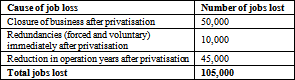
During the reign of parastatals, employees were never at risk of retrenchment as they were guaranteed job security 33. Unfortunately, due to the flawed nature in which enterprises were privatised, many people lost their jobs. Zambia’s privatisation process was so poor and riddled with corruption such that a number of enterprises were sold to politically connected individuals who lacked the necessary capital or managerial knowhow 23. These enterprises subsequently either reduced or ceased operations soon after being privatised. This resulted in thousands of employees being laid off. Notably, the liquidation of Roan Antelope Mining Corporation of Zambia (RAMCOZ) alone, led to the loss of nearly 6,300 jobs ( 33, p.188). Some buyers fired many workers, despite having promised to retain them all ( 1, p.22). A study by the British Broadcasting Corporation 45 found that between 1992 and 2003, over 100,000 jobs were lost as a result of redundancies, closures and reduction in work force due to reduced output or enterprise closures following privatisation in Zambia (Table 1).
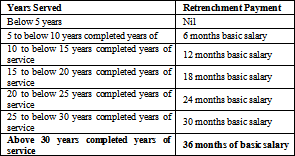
Additionally, a number of those retrenched either got their benefits late or were still waiting to be paid. Nellis ( 1, p.22) cites incidences of mining companies deliberately firing workers and then failing to pay the legally required severance awards. In instances were severance was paid, they were inadequate. Most terminal benefits were calculated based on the low basic salaries that had been obtaining in the parastatals 44.
Good severance packages were only received by employees who served a minimum of 20 years. The situation was worse for thousands of retrenched employees who served for less than five years (Table 2). Not only were they left jobless and with no terminal benefits, they were also faced with an economy were the prospects of a new job were non existant 44. This was confirmed by an offical from the Zambia Congress of Trade Unions. Banda 46 adds that under the law, in cases of liquidation, a former employee was only entitled to about US$0.50, an amount not enough to buy a bottle of Coca-Cola. Mususa 33 concludes that these job losses and poor redundancy packages resulted in rising poverty levels and deaths. Zambia’s experience was similar to other countries. For instance, privatisation of coal production and telecommunications in Britain resulted in the loss of hundreds of thousands of jobs 6, 7. This was the general trend for all privatised enterprises. Similarly, privatisation led to a 56% rise in unemployment in former Soviet Union countries 38.
In Zambia, employees were further exploited through weakening of trade unions. Before privatisation, trade unions were governed by the 1971 Trade Union Act which required each industrial sector to have only one trade union. This reduced the number of trade unions in the country. For instance, the country only had a total of 18 trade unions in 1974 46. This led to increased union density thus strengthening their bargaining strength. However, the advent of privatisation saw the introduction of the 1993 Industrial Relations Act which allowed for proliferation of unions 30. At federation level, the Act made affiliation to the Zambia Congress of Trade Unions optional, leading to the creation of the Federation of Free Trade Unions of Zambia. This in turn led to the creation of multiple trade unions, competing for members in the industrial sector. For instance, the Zambia Congress of Trade Unions alone had over 30 affiliated unions 30, 46. An official from the Zambia Congress of Trade Unions lamented that the proliferation of unions has resulted in fragmentation, infighting and weak alliances. Consequently, unions concentrated on competing for new members rather than representing their interests of their current members. This undermined union unity and ultimately reduced bargaining power.
For the general public, lack of economic development has been by far their biggest loss from privatisation. Parastatals use the resources from the activities of enterprises to develop the country 3, 4. This enabled the Zambian government to build capital intensive structures such as roads, schools, and bridges. A good example was the construction of the University Teaching Hospital in 1974 2. However, once privatised, foreign owners repatriate profits to their countries of origin rather than reinvesting in the local economy. This is especially tragic for mining which is a diminishing resource. For instance, the government and mining companies claimed that the US$2.78 billion earned from copper exports between 2005 and 2006 benefited the entire country 13. The reality was that most of the earnings never made it back to Zambia. Rather, mining companies requested the buyers of the copper to pay to their companies’ home headquarters located in Europe, America, China and Australia. Profit repatriation by mining companies was so high it caused the country’s local currency to significantly depreciate against major international currencies. This was despite the country recording a positive trade balance. Fraser and Lungu 13 suggest that had the Zambia Consolidated Copper Mines not been privatised, the massive increase in world copper prices that began soon after its divesture could have led to real improvements in the lives of Zambians. Australia had a similar experience. Despite the country being the world’s second biggest supplier of gas, it faced acute shortages on account of multinational corporations preferring to ship gas offshore for more profit. This resulted in low manufacturing, power outages and increased energy prices 41.
Privatised enterprises also damaged the environment through pollution thus endangering the lives of citizens 3. Levels of pollution among Zambian mines drastically increased after privatisation. Odiot and Gallet 47 reported health complications among residents in the Copperbelt Province due to high emissions of Sulfur Dioxide, dust as well as water pollution due to mining operations. Local residents complained of frequent breathing problems, chest pains and eye irritations due to exposure to the emissions. Sulfuric acid from the extraction of copper from the ore leaked into drinking water causing numerous hospitalizations of local residents, among them children. Ill health resulting from pollution from private industrial activities has been documented among a host of non-mining enterprises 47. Similarly, negative environmental impacts of privatisation in Latin America led riots in Peru, water wars in Bolivia, anti-privatization protests in Ecuador and Paraguay as well as cancellation of water privatizations in parts of Brazil 48.
The World Bank and International Monetary Fund commanded Zambia to institute privatisation as a condition to qualify for debt relief and further funding from. Consequently, the country divested almost all parastatals with private enterprises eventually dominating the economy. The three branches of government were then reconfigured so that they best served the interests of private firms. Privatisation is envisioned to improve living conditions of majority of a country’s citizens. However, true to the expectations of Marxist theorists, Zambia’s privatisation benefited private investors and the state at the expense of workers and the general public. Private investors made huge profits by operating in a capital friendly legal environment. This allowed them to pay low taxes and cut corners while being shielded by the state. In addition to earning substantial sums of money from the divesture, the state reduced its burden by transferring responsibility for the provision of most goods and services.
On the other hand, thousands of employees lost jobs and where offered inadequate retrenchment packages which were never even paid on time. Those who hang on to their jobs were subjected to poor working conditions deal in part to weakened trade unions. Workers and the public lost out on the much needed social amenities that had been provided by parastatals. They were also overtaxed in order to offset revenue shortages from reduced corporate taxes. Influx of foreign investors squeezed locals from owning meaningful businesses. They also suffered from health complications stemming from pollution resulting from enterprises cutting corners in their operations. Private firms also contributed to unequal distribution of development as enterprises where located in urban areas. The study thus concludes that privatisation in Zambia had more losers than winners. The major contribution of this study is that it has shown how privatisation was undertaken in Zambia as well as the main winners and losers in the process. However, the study does not cover the actual performance of the Zambian economy when it was dominated by parastatals. Future research can focus on this issue.
This research did not receive any specific grant from funding agencies in the public, commercial, or not-for-profit sectors.
The author certifies that there is no conflict of interest associated with this manuscript.
| [1] | Nellis, Privatization in Developing Countries: A Summary Assessment, SAIS Review of International Affairs, 27 (2). 3-29. 2007. | ||
| In article | View Article | ||
| [2] | Fundanga, C.M. and Mwaba, A, Privatisation of Public Enterprises in Zambia: An valuation of the Policies, Procedures and Experiences, Economic Research Papers No. 35, African Development Bank, 1997. | ||
| In article | |||
| [3] | Abioye, O, Privatisation of the Nigerian Railway Corporation: An Evaluation of Critical Choices, PhD Thesis, Cardiff Metropolitan University, Cardiff, 2016. | ||
| In article | |||
| [4] | Megginson, W.L, Privatization Trends and Major Deals in 2015 and 2016, in Privatization Barometer, The PB Report 2015/2016, Privatization Barometer, Milan, 2017, 2-26. | ||
| In article | View Article | ||
| [5] | Buoye, T.M, Manslaughter, Markets, and Moral Economy in China; Violent Disputes over Property Rights in 18th-Century China, Cambridge University Press, Cambridge, 2000. | ||
| In article | View Article | ||
| [6] | Edwards, C, Margaret Thatcher's Privatization Legacy, Cato Journal, 37 (1). 89-101. 2017. | ||
| In article | |||
| [7] | Seymour, R, A Short History of Privatisation in the UK: 1979-2012, The Guardian, 29 March. 2012. | ||
| In article | |||
| [8] | Malisase, R, Public Sector Reforms’ Contribution to Poor Public Service Delivery in Zambia: Poor Implementation or Defective Programmes? ZANGO: Zambian Journal of Contemporary Issues, 32 (2016). 59-76. Nov.2016. | ||
| In article | |||
| [9] | Marx, K. and Engels, F, Selected Works, Vol. 3, Progress Publishers, Moscow, 1973. | ||
| In article | |||
| [10] | Marx, K, Wage Labour and Capital, Marxist.Org, [1891] (1999), [Online]. Available: https://www.marxists.org/archive/marx/works/download/Marx_W age_Labour_and_Capital.pdf (Accessed Jun. 2, 2019). | ||
| In article | |||
| [11] | Lenin, V.I, The State and Revolution, Progress Publishers, Moscow, 1973. | ||
| In article | |||
| [12] | Mandel, E, An Introduction to Marxist Economic Theory, Resistance Books, Chippendale, 2002. | ||
| In article | |||
| [13] | Fraser, A. and Lungu, J, For Whom the Windfalls? Winners and Losers in the Privatisation of Zambia's Copper Mines. Civil Society Trade Network of Zambia, Lusaka, 2007. | ||
| In article | |||
| [14] | Saunders, M., Lewis, P., and Thornhill, A, Research Methods for Business Students, 7th Ed., Pearson Education Limited, London, 2016. | ||
| In article | |||
| [15] | Fowler, F.J, Survey Research Methods, 8th Ed, SAGE Publications, Los Angeles, 2014. | ||
| In article | |||
| [16] | Creswell, J.W, Research Design: Qualitative, Quantitative, and Mixed Methods Approaches, 4th Ed, Sage Publications, Los Angeles, 2014. | ||
| In article | |||
| [17] | Braun, V., and Clarke, V, “Using Thematic Analysis in Psychology,” Qualitative Research in Psychology, 3 (2), 77-101. Jan.2008. | ||
| In article | View Article | ||
| [18] | Alshenqeeti, H, “Interviewing as a Data Collection Method: A Critical Review,” English Linguistics Research, 3 (1). 39-45. Mar.2014. | ||
| In article | View Article | ||
| [19] | Bowen, G.A, Supporting a Grounded Theory with an Audit Trail: An Illustration, International Journal of Social Research Methodology, 12 (4). 305-316. Sep.2009. | ||
| In article | View Article | ||
| [20] | O’Leary, Z, The Essential Guide to Doing Your Research Project, 2nd ed, Sage Publications, Thousand Oaks, CA, 2014. | ||
| In article | |||
| [21] | Anney, V.N, Ensuring the Quality of the Findings of Qualitative Research: Looking at Trustworthiness Criteria, Journal of Emerging Trends in Educational Research and Policy Studies (JETERAPS), 5 (2). 272-281. 2014. | ||
| In article | |||
| [22] | Cooper, J, The Russian Economy Twenty Years after the End of the Socialist Economic System, Journal of Eurasian Studies, 4 (1). 55-64. Jan.2013. | ||
| In article | View Article | ||
| [23] | Rakner, L, Political and Economic Liberalisation in Zambia: 1991-2001, Nordic Africa Institute, Stockholm, 2003. | ||
| In article | |||
| [24] | Smith, C.D, Palestine and the Arab-Israel Conflict, Bedford, New York, 2006. | ||
| In article | |||
| [25] | Mwambwa, S., Griffiths, A. and Kahler, A, A Fool’s Paradise? Zambia’s Mining Tax Regime. CTPD Policy Briefing Paper No.1, Centre for Trade Policy and Development, Lusaka, 2010. | ||
| In article | |||
| [26] | Zambia Development Agency, Zambia Privatisation Status Report, Zambia Development Agency, Lusaka, 2010. | ||
| In article | |||
| [27] | Central Statistical Office, 2019. 2018 Zambia Labour Force Survey Report, Central Statistical Office, Lusaka, 2019. | ||
| In article | |||
| [28] | World Bank, Implementation Completion Report: Zambia Public Service Capacity Building Project, Report No: 34450, World Bank, Washington, D.C, 2005. | ||
| In article | |||
| [29] | Republic of Zambia, The Zambia Development Agency Act, Government Printer, Lusaka, 2006. | ||
| In article | |||
| [30] | Shezongo-Macmillan, J, Zambia: Justice Sector and the Rule of Law, A Review by AfriMAP and the Open Society Initiative for Southern Africa (OSISA), Johannesburg, 2013. | ||
| In article | |||
| [31] | Ng’andu, B.K.E, 2019 National Budget Speech, National Assembly of Zambia, Lusaka, 2019. | ||
| In article | |||
| [32] | Estrin, S. and Pelletier, A, Privatization in Developing Countries: What Are the Lessons of Recent Experience? The World Bank Research Observer, 33(1). 65-102. Feb.2018. | ||
| In article | View Article | ||
| [33] | Mususa, P, Contesting Illegality: Women in the Informal Copper Business, in Fraser, A. and Larmer, M, Zambia, Mining and Neoliberalism: Boom and Bust on the Globalized Copperbelt, Palgrave Macmillan, New York, 2010, 185-204. | ||
| In article | View Article | ||
| [34] | Mining for Zambia, A Case Study in Privatisation: Has Zambia Benefited from a Privatised Chibuluma? 2016, [Online]. Available: https://miningforzambia.com/a-case-study/ (Accessed Jun 2, 2019). | ||
| In article | |||
| [35] | Mwinga, L.M, The Effects of Privatisation in Zambia: The Case of Five Kitwe Based Companies, Masters Disertation, Copperbelt University, Kitwe, 2003. | ||
| In article | |||
| [36] | International Monetary Fund, Balance of Payments Statistics Yearbook and Data Files, International Monetary Fund, Washington, D.C, 2012. | ||
| In article | |||
| [37] | Lewis, M, Sweet Nothings: The Human Cost of a British Sugar Giant Avoiding Taxes in Southern Africa, Research Report, ActionAid, London, 2013. | ||
| In article | |||
| [38] | Earle, J.S. and Gehlbach, S, Did Post-Communist Privatisation Increase Mortality? Comparative Economic Studies, 53 (2011). 239-260. May.2011. | ||
| In article | View Article | ||
| [39] | Cook P. and Uchida, Y, Privatisation and Economic Growth in Developing Countries, The Journal of Development Studies, 39 (6). 121-154. Jun.2003. | ||
| In article | View Article | ||
| [40] | Zambia Railways Limited, Five Year Strategic Plan for the Period 2014-2018, Zambia Railways Limited, Lusaka, 2013. | ||
| In article | |||
| [41] | Quiggin, J, Electricity Privatisation in Australia: A Record of Failure, The Electrical Trades Union, Victoria, 2014. | ||
| In article | |||
| [42] | Kasonde, E.G, 2002 Budget Address to the National Assembly, Government Printer, Lusaka, 2002. | ||
| In article | |||
| [43] | Adams, S. and Mengistu, B, Privatization, Governance and Economic Development in Developing Countries, Journal of Developing Societies, 24 (4). 415-438. Sep.2009. | ||
| In article | View Article | ||
| [44] | Serlemitsos, J. and Fusco, H, Zambia: Post-Privatisation Study, The World Bank, Washington, D.C, 2003. | ||
| In article | |||
| [45] | British Broadcasting Corporation, “Zambia to Re-Think Privatisation,” British Broadcasting Corporation, February 2003. [Online]. Available: http://news.bbc.co.uk/2/hi/business/2749219.stm [Accessed Mar. 25, 2019]. | ||
| In article | |||
| [46] | Banda, D.A, The Trade Union Situation in Zambia: An Overview of the Law, Practice and the Way Forward: A Monogram, Friedrich-Ebert-Stiftung, Bonn, 1997. | ||
| In article | |||
| [47] | Odiot and Gallet (2012) Odiot, A. and Gallet, A, Zambia: Good Copper, Bad Copper, Television Documentary, France Télévisions, Paris, 2012. | ||
| In article | |||
| [48] | McKenzie, D. and Mookherjee, D, Distributive Impact of Privatization in Latin America: Evidence from Four Countries. The Latin American and Caribbean Economic Association - LACEA, 0 (20). 161-234. Jan.2003. | ||
| In article | View Article | ||
Published with license by Science and Education Publishing, Copyright © 2021 Royd Malisase
 This work is licensed under a Creative Commons Attribution 4.0 International License. To view a copy of this license, visit
http://creativecommons.org/licenses/by/4.0/
This work is licensed under a Creative Commons Attribution 4.0 International License. To view a copy of this license, visit
http://creativecommons.org/licenses/by/4.0/
| [1] | Nellis, Privatization in Developing Countries: A Summary Assessment, SAIS Review of International Affairs, 27 (2). 3-29. 2007. | ||
| In article | View Article | ||
| [2] | Fundanga, C.M. and Mwaba, A, Privatisation of Public Enterprises in Zambia: An valuation of the Policies, Procedures and Experiences, Economic Research Papers No. 35, African Development Bank, 1997. | ||
| In article | |||
| [3] | Abioye, O, Privatisation of the Nigerian Railway Corporation: An Evaluation of Critical Choices, PhD Thesis, Cardiff Metropolitan University, Cardiff, 2016. | ||
| In article | |||
| [4] | Megginson, W.L, Privatization Trends and Major Deals in 2015 and 2016, in Privatization Barometer, The PB Report 2015/2016, Privatization Barometer, Milan, 2017, 2-26. | ||
| In article | View Article | ||
| [5] | Buoye, T.M, Manslaughter, Markets, and Moral Economy in China; Violent Disputes over Property Rights in 18th-Century China, Cambridge University Press, Cambridge, 2000. | ||
| In article | View Article | ||
| [6] | Edwards, C, Margaret Thatcher's Privatization Legacy, Cato Journal, 37 (1). 89-101. 2017. | ||
| In article | |||
| [7] | Seymour, R, A Short History of Privatisation in the UK: 1979-2012, The Guardian, 29 March. 2012. | ||
| In article | |||
| [8] | Malisase, R, Public Sector Reforms’ Contribution to Poor Public Service Delivery in Zambia: Poor Implementation or Defective Programmes? ZANGO: Zambian Journal of Contemporary Issues, 32 (2016). 59-76. Nov.2016. | ||
| In article | |||
| [9] | Marx, K. and Engels, F, Selected Works, Vol. 3, Progress Publishers, Moscow, 1973. | ||
| In article | |||
| [10] | Marx, K, Wage Labour and Capital, Marxist.Org, [1891] (1999), [Online]. Available: https://www.marxists.org/archive/marx/works/download/Marx_W age_Labour_and_Capital.pdf (Accessed Jun. 2, 2019). | ||
| In article | |||
| [11] | Lenin, V.I, The State and Revolution, Progress Publishers, Moscow, 1973. | ||
| In article | |||
| [12] | Mandel, E, An Introduction to Marxist Economic Theory, Resistance Books, Chippendale, 2002. | ||
| In article | |||
| [13] | Fraser, A. and Lungu, J, For Whom the Windfalls? Winners and Losers in the Privatisation of Zambia's Copper Mines. Civil Society Trade Network of Zambia, Lusaka, 2007. | ||
| In article | |||
| [14] | Saunders, M., Lewis, P., and Thornhill, A, Research Methods for Business Students, 7th Ed., Pearson Education Limited, London, 2016. | ||
| In article | |||
| [15] | Fowler, F.J, Survey Research Methods, 8th Ed, SAGE Publications, Los Angeles, 2014. | ||
| In article | |||
| [16] | Creswell, J.W, Research Design: Qualitative, Quantitative, and Mixed Methods Approaches, 4th Ed, Sage Publications, Los Angeles, 2014. | ||
| In article | |||
| [17] | Braun, V., and Clarke, V, “Using Thematic Analysis in Psychology,” Qualitative Research in Psychology, 3 (2), 77-101. Jan.2008. | ||
| In article | View Article | ||
| [18] | Alshenqeeti, H, “Interviewing as a Data Collection Method: A Critical Review,” English Linguistics Research, 3 (1). 39-45. Mar.2014. | ||
| In article | View Article | ||
| [19] | Bowen, G.A, Supporting a Grounded Theory with an Audit Trail: An Illustration, International Journal of Social Research Methodology, 12 (4). 305-316. Sep.2009. | ||
| In article | View Article | ||
| [20] | O’Leary, Z, The Essential Guide to Doing Your Research Project, 2nd ed, Sage Publications, Thousand Oaks, CA, 2014. | ||
| In article | |||
| [21] | Anney, V.N, Ensuring the Quality of the Findings of Qualitative Research: Looking at Trustworthiness Criteria, Journal of Emerging Trends in Educational Research and Policy Studies (JETERAPS), 5 (2). 272-281. 2014. | ||
| In article | |||
| [22] | Cooper, J, The Russian Economy Twenty Years after the End of the Socialist Economic System, Journal of Eurasian Studies, 4 (1). 55-64. Jan.2013. | ||
| In article | View Article | ||
| [23] | Rakner, L, Political and Economic Liberalisation in Zambia: 1991-2001, Nordic Africa Institute, Stockholm, 2003. | ||
| In article | |||
| [24] | Smith, C.D, Palestine and the Arab-Israel Conflict, Bedford, New York, 2006. | ||
| In article | |||
| [25] | Mwambwa, S., Griffiths, A. and Kahler, A, A Fool’s Paradise? Zambia’s Mining Tax Regime. CTPD Policy Briefing Paper No.1, Centre for Trade Policy and Development, Lusaka, 2010. | ||
| In article | |||
| [26] | Zambia Development Agency, Zambia Privatisation Status Report, Zambia Development Agency, Lusaka, 2010. | ||
| In article | |||
| [27] | Central Statistical Office, 2019. 2018 Zambia Labour Force Survey Report, Central Statistical Office, Lusaka, 2019. | ||
| In article | |||
| [28] | World Bank, Implementation Completion Report: Zambia Public Service Capacity Building Project, Report No: 34450, World Bank, Washington, D.C, 2005. | ||
| In article | |||
| [29] | Republic of Zambia, The Zambia Development Agency Act, Government Printer, Lusaka, 2006. | ||
| In article | |||
| [30] | Shezongo-Macmillan, J, Zambia: Justice Sector and the Rule of Law, A Review by AfriMAP and the Open Society Initiative for Southern Africa (OSISA), Johannesburg, 2013. | ||
| In article | |||
| [31] | Ng’andu, B.K.E, 2019 National Budget Speech, National Assembly of Zambia, Lusaka, 2019. | ||
| In article | |||
| [32] | Estrin, S. and Pelletier, A, Privatization in Developing Countries: What Are the Lessons of Recent Experience? The World Bank Research Observer, 33(1). 65-102. Feb.2018. | ||
| In article | View Article | ||
| [33] | Mususa, P, Contesting Illegality: Women in the Informal Copper Business, in Fraser, A. and Larmer, M, Zambia, Mining and Neoliberalism: Boom and Bust on the Globalized Copperbelt, Palgrave Macmillan, New York, 2010, 185-204. | ||
| In article | View Article | ||
| [34] | Mining for Zambia, A Case Study in Privatisation: Has Zambia Benefited from a Privatised Chibuluma? 2016, [Online]. Available: https://miningforzambia.com/a-case-study/ (Accessed Jun 2, 2019). | ||
| In article | |||
| [35] | Mwinga, L.M, The Effects of Privatisation in Zambia: The Case of Five Kitwe Based Companies, Masters Disertation, Copperbelt University, Kitwe, 2003. | ||
| In article | |||
| [36] | International Monetary Fund, Balance of Payments Statistics Yearbook and Data Files, International Monetary Fund, Washington, D.C, 2012. | ||
| In article | |||
| [37] | Lewis, M, Sweet Nothings: The Human Cost of a British Sugar Giant Avoiding Taxes in Southern Africa, Research Report, ActionAid, London, 2013. | ||
| In article | |||
| [38] | Earle, J.S. and Gehlbach, S, Did Post-Communist Privatisation Increase Mortality? Comparative Economic Studies, 53 (2011). 239-260. May.2011. | ||
| In article | View Article | ||
| [39] | Cook P. and Uchida, Y, Privatisation and Economic Growth in Developing Countries, The Journal of Development Studies, 39 (6). 121-154. Jun.2003. | ||
| In article | View Article | ||
| [40] | Zambia Railways Limited, Five Year Strategic Plan for the Period 2014-2018, Zambia Railways Limited, Lusaka, 2013. | ||
| In article | |||
| [41] | Quiggin, J, Electricity Privatisation in Australia: A Record of Failure, The Electrical Trades Union, Victoria, 2014. | ||
| In article | |||
| [42] | Kasonde, E.G, 2002 Budget Address to the National Assembly, Government Printer, Lusaka, 2002. | ||
| In article | |||
| [43] | Adams, S. and Mengistu, B, Privatization, Governance and Economic Development in Developing Countries, Journal of Developing Societies, 24 (4). 415-438. Sep.2009. | ||
| In article | View Article | ||
| [44] | Serlemitsos, J. and Fusco, H, Zambia: Post-Privatisation Study, The World Bank, Washington, D.C, 2003. | ||
| In article | |||
| [45] | British Broadcasting Corporation, “Zambia to Re-Think Privatisation,” British Broadcasting Corporation, February 2003. [Online]. Available: http://news.bbc.co.uk/2/hi/business/2749219.stm [Accessed Mar. 25, 2019]. | ||
| In article | |||
| [46] | Banda, D.A, The Trade Union Situation in Zambia: An Overview of the Law, Practice and the Way Forward: A Monogram, Friedrich-Ebert-Stiftung, Bonn, 1997. | ||
| In article | |||
| [47] | Odiot and Gallet (2012) Odiot, A. and Gallet, A, Zambia: Good Copper, Bad Copper, Television Documentary, France Télévisions, Paris, 2012. | ||
| In article | |||
| [48] | McKenzie, D. and Mookherjee, D, Distributive Impact of Privatization in Latin America: Evidence from Four Countries. The Latin American and Caribbean Economic Association - LACEA, 0 (20). 161-234. Jan.2003. | ||
| In article | View Article | ||