The article introduces the concept of position, language function and survey area. Through field survey data, analyzing and explaining the position and function of Ede language in Kao village, Ea Kao commune, Buon Ma Thuot city, Dak Lak province, Vietnam in various aspects: Scope of using Ede language for formal and informal communication in Kao village; the linguistic competence of people in Kao village in terms of education, occupation and gender; the role of the Ede script and the transmission of the Ede language between generations. Since then, making scientific conclusions, helping local authorities at all levels have appropriate solutions to enhance the position and function of Ede language and Vietnamese language among ethnic minorities in Dak Lak, in particular and in the Central Highlands in general, contribute to building the material and spiritual life of the people in the area.
The Ede people (in the Ede language: Anak De or Anak De-Ga) have a population of about 346.946 people, ranking 11th in the population of all ethnic groups in Vietnam. They reside mainly in some provinces of the Central Highlands and South Central Vietnam, such as: Dak Lak, Dac Nong, Gia Lai, Phu Yen, Khanh Hoa,... A small part living in some other countries like Cambodia, USA, Canada and Northern European countries. “The Ede language is a language belonging to the Cham subgroup, Austronesian language family (Austronesia) or Malay - Multi-island (Malayo-Polynesia). This language family extends from Madagasca to Hawai and to Vietnam. The Ede language is closely related to the languages of Cham, Gia-rai, Chu-ru,... in Vietnam and Melayu in Malaysia, Indonesia,... in Southeast Asia island.” [ 1, p.40].
Dak Lak province currently has 48 ethnic groups living together, with a total population of the province with 1.919.200 people, of which: Kinh people 1.305.056 people (68%); the remaining are 47 ethnic minorities, with 614.144 people 2 (32%). Among ethnic minorities, ethnic groups like Ede, Nung, Tay and Mnong have a larger population than other ethnic groups. Particularly the Ede people in Dak Lak, there are 312.599 people, accounting for 50,9% of the population of ethnic minorities in the province; accounting for 16,2% of the provincial population; accounting for 90,1% of Ede people in Vietnam.
The Ede script is a set of letters created in the early twentieth century in Latin letters. This is one of the earliest ethnic tribes in the region, aimed at education, with a sense of national pride. Since the beginning of the twentieth century, some European missionaries have combined Latin letters and relied on the spelling of the Vietnamese script to translate the Bible into Ede for missionary purposes. This script also had the great contribution of some Ede intellectuals at that time. According to the authors Be Viet Dang, Chu Thai Son “In 1923, two Ede intellectuals: Y-Jut H'wing teacher (1888 - 1934) in Kram village, Ea Tieu commune, Krong Ana district (Cu Kuin district now), Dak Lak province and Y-Ut Nie Buon Rit teacher (1891-1962) in Ko Sire village, Buon Ma Thuot town (Buon Ma Thuot city now), Dak Lak province relied on the national language syllable, the Latin alphabet system and inheriting the achievements of some foreign religious leaders to create a set of rhymes for the Ede language” [ 3, p.125]. And “it was not until 1936 that the Governor General of Indochina issued a Decree to recognize the Ede script... to this day, the script still stands without significant improvements” [ 4, p.19]. Over the course of the administrative process, the Ede script has been increasingly improved, becoming an important means of communication between members of the Ede community, in particular, and with members of other ethnic communities in general beside the Vietnamese script. The Ede word was born to mark the level of Ede's thinking, social organization and cultural life that has developed along with other ethnic groups in the ethnic minority community in Vietnam. Ede scripts become a crystalline material, create and store unique cultural values of the Ede people. It has become a unique cultural symbol unique to the language system of ethnic groups in Vietnam.
The essay analyzes, explains and clarifies the position and function of the Ede language in Dak Lak in the following aspects: The situation of using the Ede language in communication in the kao; the linguistic competence of the villagers in terms of education, occupation and gender; The role of the Ede script and the transmission of the Ede language between generations. Thereby making scientific conclusions, helping local governments at all levels have appropriate solutions to enhance their position, the function of Ede language and Vietnamese language in ethnic minority people in Dak Lak in particular and in the Central Highlands in general, contributing to building material and spiritual life of people in the area.
In a multinational nation, when it comes to position, the function of a language refers to the role and influence of that language in terms of social function in relation to other languages. Therefore, understanding the position and function of a language is clarifying the role and function of that language in the community or geopolitical region considered in relation to other languages co-exist on the same level.
Studying the status and function of the Ede language in Dak Lak province and the wider region of the Central Highlands requires an overview of the other languages that co-exist with the Ede language from the region, geo-political areas that we care about. At the same time, it is necessary to select an area in the region with similar characteristics of the position and function of the Ede language in the area to survey.
Ede language in Kao village, Ea Kao commune, Buon Ma Thuot city has correlative characteristics of position and function with Ede language in Dak Lak province, such as: Ratio of Ede speakers - in relation to other languages and population distribution; scope of use in Ede's social interaction in the community and in the region. Therefore, studying the position and function of Ede language in Kao village, Ea Kao commune, Buon Ma Thuot city, will contribute to clarifying the position and function of the Ede language in Dak Lak province.
2.1.2.1. Population situation and population structure in Kao village, Ea Kao commune
Ea Kao commune, Buon Ma Thuot city, Dak Lak province has 15 villages, with a total population of 15.878 people 5, of which: 8.416 Kinh people (51,3%); 5.658 Ede people (35,8%); 1.162 Muong people (7,3%); 380 Tay people (2,4%); 262 people from other ethnic groups. Regarding education level: The number of illiterate people in Ea Kao is 1031 / 15.878 people, accounting for 6,5% of the population.
Buon Kao (surveyed area) in Ea Kao commune has a multi-ethnic and multi-lingual population structure - typical of Dak Lak province, which shows clearly the position and the function of Ede language in highlands region. The whole village has 1.130 people, including 769 Ede people (68,05%); 341 Kinh people (30,18%); 6 Muong people (0,53%); 3 Tay people (0,26%) and 11 other ethnic groups. The intersection of ethnic groups and ethnic groups with the Kinh in the area creates a bilingual phenomenon not only in schools but also in community activities, such as at markets; at the commune committee; in the village,... The number of illiterate people in Kao village with 175/1130 people (5,49%), ranked second in the whole commune.
2.1.2.2. Number of people using Ede language and population distribution in Kao village
Survey results show that, 769/1130 Ede people (68,05%) in Kao village use Ede language in communication. Other residents of Ede language use a lower percentage, such as: 341/1130 Kinh people (30,18%); 20 people of other ethnic groups (1,87%). Thus, in Kao village, Ede language is used by most people. In Kao area in particular, Ea Kao commune in general, residents use 4 language systems: Island south (Ede, Gia rai), South Asia (Vietnamese - Kinh, Muong), Thai-KaDai (Tay), and Sino-Tibetan (Chinese). This proves that the linguistic situation in Kao village and Ea Kao commune is a multi-element linguistic scenario, not co-source and unbalanced. This is also a cross-section of linguistic origin in Dak Lak province and the Central Highlands region of Vietnam.
In Kao village, there are many ethnic groups living together in a small geographical area, in which Ede people are indigenous people living in concentration. Residents of other ethnic groups, such as Kinh, Muong, Tay, Hoa... mainly came to live after 1975, scattered in Kao village, Ea Kao commune and other areas in Dak Lak province. Therefore, residents of these ethnic groups must “integrate” with the Ede people by learning and using the Ede language.
2.2. Scope of Using Ede Language in Communications in Buon KaoIn Kao village, Ede language is used by people in some cases of formal communication (in meetings, with local authorities; in education) and informal communication (in household activities) and social activities of individuals in social life).
In the context of formal communication, Ede language is mainly used in the following communication environments:
2.2.1.1. Use Ede language at local meetings
Statistics show that, in trade meetings, the number of people using Ede language is the majority. Among 128 collaborators, 108 (84,37%) use Ede language; 12 people (9,37%) use Vietnamese; 8 (6,25%) use both Ede and Vietnamese.
Due to the mixed living conditions among ethnic groups, in the trade meetings, people of other ethnic groups who do not speak the Ede language, they use Vietnamese to communicate. At the same time, there are a number of Ede people, most of whom are aged 60 and older who cannot speak Vietnamese. Therefore, there are many meetings, village leaders or some attendees must use both Ede and Vietnamese for everyone to understand. Thus, at village meetings, Ede has a higher position, is more dominant and plays a major role compared to Vietnamese and other languages. This is in accordance with the general rule of using the language in the mixed residence of people of different ethnic groups in a small geographical area.
However, in the higher meetings (commune, district...), the rate has changed. The survey of 171 collaborators who were able to attend the meeting in the commune showed that 89 people (52,05%) used Ede language; 39 people (22,81%) use Vietnamese; 43 people (25,14%) use both Ede and Vietnamese. If comparing the Ede language status by the proportion of users in the meetings at the village is 84,4% and the Ede language position by the rate of the users in the meetings at the commune is 52,05%. This shows that the position of Ede language in village meetings is higher than that in commune meetings.
The survey of 157 collaborators members who were able to attend meetings in the city (district) showed that 37 people (23,56%) used Ede language; 73 people (46,49%) use Vietnamese and 47 people (29,93%) use both Ede and Vietnamese.
The results of the Table 1 show that, in the local meetings, the use of Ede language decreased compared to the authorities from the village to the commune and city levels. In contrast, the number of people using Vietnamese and the number of people using both Vietnamese and Ede is increasing. This shows that, in the narrow geographical space (as in the village area), many Ede people live in a closed, less social way with the people outside the community. Their lives are mostly self-sufficient, not able to study (some people only speak Ede language, do not speak Vietnamese; cannot write the Ede language and the Vietnamese national language). When the living space was expanded in the commune and city, Ede people were able to contact Kinh people. They can improve their education, learn Vietnamese in schools and through social interaction, so they have the need to speak Vietnamese to integrate with the community.
2.2.1.2. Use Ede language when communicating with authorities and in education
Survey results of 128 Ede people, when they contacted the public authorities at their offices, showed that 63 people (49,21%) spoke their mother tongue; 65 people (50,78%) speak Mandarin. This shows that: when communicating at public authorities, Ede people tend to use their mother tongue. Because, their Vietnamese ability is not enough to express the content of opinions; civil servants have many ethnic people, and some Kinh civil servants also know Ede language. Besides, many Ede people know Vietnamese, they use Vietnamese to communicate. Therefore, if civil servants are ethnic people (or people who know their native language), the Ede people can use both Ede and Vietnamese to communicate.
In the administrative documents, or other documents (birth, property, application...) of the Ede people when communicating with public authorities, they used the Vietnamese script in accordance with the requirement of the government.
Regarding education, in the school year 2018-2019, Ea Kao commune has 1352 students from preschool to high school learnt in Vietnamese. In which only 187/1352 (13.83%) of Ede students and some other ethnic minority students in the area are organized to learn Vietnamese-Ede bilingual. The Vietnamese-Ede bilingual program is only for students in grades 3, 4 and 5 6. Thus, the percentage of Ede students attending their mother tongue is too small, compared to the percentage of the population and the number of students in the locality.
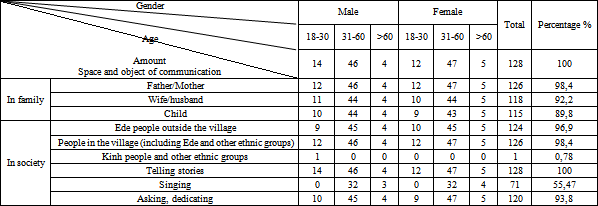
Regarding the method of data collection in the surveyed area: access 128 collaborators, of which: number, sex and age group: 64 men with 14 people aged 18-30, 46 people aged 31-60, 4 people over the age of 60; 64 women have 12 people aged 18-30, 47 people aged 31-60, 5 people aged over 60. Make a table with survey criteria combining polling VTVs to fill in the data items, calculate the total numbers and percentages for the criteria. Specifically:
In the scope of informal communication, Ede language is mainly used in some environments, such as: in the family, in the village, with ethnic people, with other ethnic groups (Kinh, ethnic groups, other minorities), markets, village, bus stations; in the cultural and spiritual activities and beliefs... On the basis of the survey results in Table 2, below will mention some areas of informal communication in Ede language in Kao village, Ea Kao commune, Buon Ma Thuot city, Dak Lak province.
2.2.2.1. Use Ede language within the scope of family activities
Within the scope of family, Ede language is used in communication between people of the same family. It is between people of the same generation or another generation. Due to the characteristics of ethnic culture in communication 7, the use of Ede language depends on age without any distinction between the younger and older of the same generation. This is the choice of communication language and way of addressing in Ede's communication. When communicating with family members (parents, spouses, children, etc.), most people use their native language. Specifically, the ratio of using the native language of collaborators in the following cases of communication: when talking to parents: 126/128 people (98,4%); when speaking with a spouse: 118/128 people (92,2%); when speaking to children: 115/128 people (89,8%).
In our survey, we found that Ede grandparents only spoke to their grandchildren using Ede language (even though they were talking to investigators at home). They do not use Mandarin or other languages.
2.2.2.2. Use Ede language within the scope of social communication
- When communicating in society, depending on the target audience, Ede people use their mother tongue. Survey data through collaborators showed that specific Ede people use their mother tongue to communicate in the following cases: When communicating with ethnic people: 124/128 people (96,9%) use their mother tongue, only 4 people (3,1%) use the common language. When communicating with people in the village (in general, including many people from other ethnic groups): 126/128 people (98,4%) use their mother tongue. When communicating with Kinh people and people of other ethnic groups: 1/128 (0,78%) use their native language.
Due to the characteristic of the village, most Ede people, so Ede people mainly use their mother tongue to communicate. However, there are also 25/128 people (19,5%), mostly men who use Mandarin to communicate with people of different races. According to their explanation, the Ede people had settled in Dak Lak for a long time, and most of the other ethnic groups were newcomers and the number was not much compared to the people in the village. Therefore, people of other ethnic groups (including Mnong people - the oldest indigenous people) can hear and use Ede language to a certain extent. When communicating, the Ede people can mix the communication code, even use “mixed” both Ede and Mandarin so that participants in the communication can understand.
- When telling stories: 128/128 people (100%) use their mother tongue, if the target audience is Ede people or ethnic people who know Ede language. At that time, those ethnic people were considered as “their” Ede people and they calmly used their mother tongue to tell stories. However, in situations where there are people from the same ethnic group listening to it, there are also some 25/128 people (19,5%) who use both their mother tongue and Mandarin languages for the people from different ethnic groups to understand the story they are telling.
- When singing: Surveying 71/128 Ede people use language when participating in singing, cultural and arts activities. The results showed that 64/71 Ede people (90,14%) (mostly young and middle-aged people) use Kinh language; the remaining 7 people (9,86%) aged 60 and older prefer to sing in their mother tongue. This shows that the young and middle-aged people have the opportunity to learn Vietnamese, community cultural exchanges with Vietnamese people. Therefore, they use Vietnamese as a means to integrate into the community. As for people from 60 years of age and older, most of them have no chance to learn Vietnamese, so their mother tongue is the language they use in singing, cultural and arts activities and community activities.
- When praying and worshiping, there are 120/128 Ede people (93,8%) using their mother tongue. Protestants, when they go to church or pastors’ house to attend the ceremony, they all use their native language to pray according to the New Testament published in the Ede language 8. Eao Kao commune has 3994/5658 people (70.6%) who are Protestant, of which Buon Kao has 580/769 (75%) of Ede people following this religion. However, there are still some people using Mandarin when they go to temples of the Kinh people or places of worship of other ethnic groups.
- The use of writing in daily communication or recording for Ede farmers is very limited. The above illiteracy rate shows that very few Ede people in Kao village are able to use written language to communicate. Of the 72 collaborators surveyed on the writing ability (including the Vietnamese script or the Ede language), only 31 people know the Ede language but only at a low level: able to write but not correctly, write misspelled or misspelled. Very few Ede people in Kao village could read and write the Ede language fluently. This proves that the role of the writing in the life of the Ede people has not been properly expressed.
The above statistics have confirmed that, in the context of informal communication, Ede people tend to use their mother tongue to communicate with family members and ethnic people. When communicating with non-ethnic people in public, most Ede people speak Mandarin. However, due to the limited capacity of using Vietnamese, even in public places (markets, markets, bus stations, village activities, etc.), many Ede women still have to use their mother language. To communicate.
Through the use of the mother tongue and Vietnamese language of Ede people in the areas of communication, we realize that the Ede language only plays a major role in family and village communication; In communication in public, the use of Vietnamese still occupies a large position. Especially in the informal and informal scope of communication: contact with people of different ethnic groups, in public places, at meetings at commune, district and provincial levels, and in workplace communications the use of both languages still takes place.
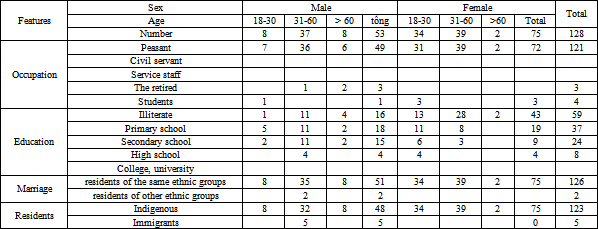
2.3. Language Capacity of People in Born Room through Learning, Professional and Gender LevelsThe results of the survey on linguistic competence through education, occupation and gender of 128 staffs in Kao village are as follows:
2.3.2.1. About education and career
- About education
The above table clearly shows: Most of the staffs have low educational level, the number of illiterate people is quite high (compared to other villages in the commune). Specifically: Illiterate: 59/128 people (46,1%); Primary school: 37/128 people (28,9%); Secondary school: 24/128 people (18,7%); High school: 8/128 people (6,3%); College, University: 0. The percentage of illiterates concentrated at the age of 31 and older: 38/59 people (64,4%), among young people under the age of 31, there are also people who are illiterate 1/59 (1,7 %).
-About job
The main occupation of the collaborators is farming. They are the oldest settlers in the area and live on farming. Specifically: farming: 121 people (94,5%), including 49 men and 72 women, aged 31 - 60 with 76 people; retirement: 3 people (2,3%), only men aged 31 and over; Student: 4 people (3,1%), including 1 male and 3 female under the age of 31. Occupational characteristics directly related to collaborators's bilingual competence. As a farmer, the work is mainly on the fields, so the Ede people have little contact with the residents of other ethnic groups outside the family, especially the Kinh. Among 14/128 people (10,93%) who can read and write fluently in Vietnamese, including 3 students, 2 retired civil servants, and 11 farmers.
2.3.2.2. About gender
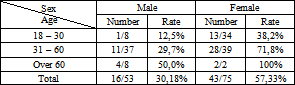
From a gender perspective, the number of illiterate people: female, there are 43/75 people (57,33%); male, 16/53 (30,18%). Thus, the rate of illiterate women is higher than that of men. Through Table 3, this shows that, for women, the number of illiterates decreases with age, that is, the older women are, the higher the rate of illiteracy is compared to the younger ones. However, Ede women aged 18-30 years old still have a high rate of illiteracy of 13/34 people (38.2%). Also in this age group, the rate of illiteracy among Ede men is 1/8 (12,5%). Specifically in the following table:
One of the reasons leading to Ede women aged 18-30 having high illiteracy rate is: Ede women are less interested in improving their education; or due to difficult life, no conditions to study. They only know how to perform the roles of women in the family and produce in the fields. This is an issue that local authorities need to pay attention to, creating conditions for elimination of Ede women in Kao village in particular, in Dak Lak and Central Highlands in general.
The data summarizing the position and function of the Ede language shows that out of 72 officials, only 14 people (19,44%) received the ability to “master Vietnamese” (verbal communication); 35 people (48,61%) are able to “listen, speak”; 20 people (27,78%) have the ability to “listen and speak”; 1 person (1.38%) only “can speak but cannot comprehend the language”. From the above data, it can be affirmed that because of the low education level, the Ede-Vietnamese bilingual ability of the collaborators is very limited. These are just natural bilinguals - passive, negative bilinguals. With 15 people with secondary and high school education, 14 people are “fluent in Vietnamese”, and 1 person can only study at the first grade of junior high school level so not fluent in Vietnamese.
In summary, the language skills of Ede people in Kao village are mainly in their mother tongue, while bilingual capacity is still limited. Illiteracy, the ability to use the Kinh language of most people is weak, and the bilingual capacity of the ethnic groups - Vietnamese is low. This is a passive form of bilingual (native bilingual). Only 3 people know the language of other ethnic groups (besides the Kinh language) at a low level, like “cannot speak well” or “cannot listen well”. The ability to use other ethnic languages (besides Ede and Vietnamese) is also very small, only 1/72 (1,39%) people “listen, speak”. Regarding the use of scripts of other ethnic groups, the situation is similar. Only one in 72 (1,39%) people know the literacy of a nation other than the Quoc ngu and Ede words. One of the causes of this situation is due to the fairly concentrated residence characteristics of the Ede people in the Kao village area (68,05% of the population of the village) in particular and in Dak Lak in general. Residents of other ethnic groups account for a very small percentage in Kao village. Therefore, the languages of these ethnic groups are not used within the village. Since then, it has decided to the regional language position (number one, unique position) of the Ede language in Kao village.
However, in the area of Ea Kao commune, the geographical area - administrative area is wider than Kao village, the percentage of Kinh population is higher than Ede people: 8.416 Kinh people (51,3%); 5.658 Ede people (35,8%). Therefore, the position of the Ede language was no longer unique as in the village, but ceded the number one position to the Mandarin language.
2.4. The Role of the Edeetic Writer and the Transmission between the Generations2.4.1.1. The role of Ede writing in education
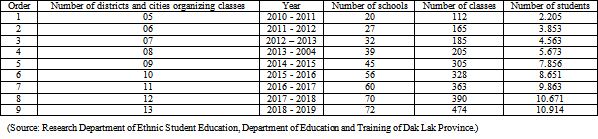
During the French colonial period, Ede was taught in elementary schools in Dak Lak province. From the years after 1954 to 1975, the government of the Republic of Vietnam introduced Ede language to some elementary schools, teaching other ethnic officials to work in Dak Lak and Quang Duc provinces (Dak Nong nowadays). After the liberation, the issue of teaching and learning Ede language was not organized, even though at that time, the Dak Lak Education Department (now the Department of Education and Training) had a Department of Ethnic Education (Mr. Nay Thong is the manager). After the Decision No. 53/ CP of February 22, 1980 of the Government, in 1981, Dak Lak Provincial Party Committee issued a Resolution on teaching and learning ethnic minority languages in schools. At that time, the provincial Education Department organized a compilation of Ede language and teaching books in primary schools. By 1986, Dak Lak province had compiled and published a number of Ede language books for grade 1, such as Klei Ede (Adu sa - Grade 1), Hriăm ting 1 (grade 1). However, in the early nineties, the teaching and learning of the Ede language in Dak Lak province halted. By the beginning of the twenty-first century, the problem of teaching and learning Ede language and words in Dak Lak province was restored and developed. This locality has piloted Ede language at secondary schools (at some boarding ethnic minority high schools). However, the number of students in recent years has not increased significantly, although the number of districts and schools teaching - learning this subject has increased compared to the past. Specifically in the following table:
In recent years, the subject of Ede language arts has been put into experimental teaching at 10 boarding schools for ethnic minorities in most districts, towns and cities in Dak Lak province. In the 2018-2019 school year, the number of classes participating in language learning (and the Ede language) increased by 84, while the number of students increased by only 243 students. This shows that, although organized mass teaching for students, but the number of people enrolled is limited. One of the reasons for this is the lack of Ede teaching staff, the Ede's awareness of the role of ethnic writing is incomplete. However, compared to the organization of teaching and learning ethnic languages in the Central Highlands provinces in high schools, the teaching and learning of Ede language in Dak Lak has achieved remarkable results.
The organization of teaching Ede language for cadres and civil servants in Dak Lak province was also concerned quite early. Since 1987, the People's Committee of Dak Lak has advocated teaching Ede language to cadres and civil servants of other ethnic groups working in the locality. Especially, since the Decision No. 253 / QD-TTg of March 5, 2003, and the Decision No. 03/2004 / QD-TTg of January 7, 2004, to make learning of ethnic minority languages a task regular service for officials and civil servants; or Directive No. 38/2004 / CT-TTg of the President on promoting training and retraining of ethnic minority languages for cadres and civil servants working in ethnic minority and mountainous areas. Up to now, it can be said that this work done in Dak Lak province has achieved certain results.
2.4.1.2. The role of Ede script in art literature and communication
- In artistic literature
The set of Ede scripts was born, many Ede epics such as Khan Dam Hunt, Khan Dam Kteh Mlan, Dam Tiong, King Ju, Xing Nha... and Ede customary law: Klei bhian Ede Translate and print the book in Ede language and Vietnamese language. Especially with the project “Investigating, collecting, preserving, translating and publishing epic treasures of the Central Highlands” by the Vietnam Academy of Social Sciences (now the Vietnam Academy of Social Sciences) in collaboration with the Central Highlands provinces and surrounding areas from October 2001. By 2013, 804 works had been collected, and 88 works were published in book form, including 13 epic works of Ede people. Epics Ede has common characteristics of the genre of epics and epics of the Central Highlands. The Ede epic was created by the Ede people since ancient times, reflecting the cultural and historical features of the Ede community. This is a rich and valuable source of Ede language and culture preserved in Ede scripts.
The set of Ede scripts was born with the value of recording the Ede language with characters, providing and adding more and more rich vocabulary from the Ede language. Creating conditions for artisans and authors to create literary and artistic works that reflect the life and culture of the Ede people. Therefore, the Ede khan is transmitted not only by sound but also by writing in the memory of the Ede people. Many Ede intellectuals compose poems, collect fairy tales and epics, contributing to the creation of the folklore treasure of their people.
- In the media
As a province with the largest Ede population in Vietnam, since 1993, the Ede language program has been broadcast on the Voice of Vietnam and local radio stations. In recent years, the Ede language program has been broadcast on the local television station.
Many books and propaganda materials are published in bilingual Ede - Vietnamese or Vietnamese - Ede for the political, cultural - social, scientific and technical activities of the locality. It can be said that the Ede language plays an important role in the life of the Ede people in Dak Lak province.
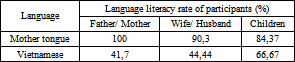
The transmission of Ede language between generations demonstrates the vitality of this language in the area. This is also a criteria to be considered when talking about the position and function of the Ede language. The transmission of Ede language between generations has the meaning of determining the existence and position of this language in the context of multi-element language situation in Dak Lak province. Of the 128 participants surveyed, 108 Ede people (84,37%) whose children all know their mother tongue. Thus, if in the generation of parents with 100% native language, then the generation of ego (I am currently a research center, there are vertical relationships: with the above generations are parents / grandfather, grandfather / grandmother...; the descendants are children, grandchildren... And immediate relationships like spouse, siblings,...). This rate is reduced and only 84,37% can use the mother tongue well. This is a general trend for children of ethnic minorities in Vietnam.
Results of a survey of Ede position and function, with the question: What languages do family members know? As a result, 72/72 (100%) of Ede people in Kao village responded that their parents knew their mother tongue. It is the language value of the Ede people preserved from the previous generation. When asked about the ability of the spouse to know the Ede's language, only 65/72 (90,3%). In this generation, there began to be a change due to the impact of social life. Some people, due to the need to earn a living, work in areas with few ethnic minorities, they come in contact with other ethnic groups (mainly Kinh) with a larger population. The mother tongue is not used frequently in communication, so it is forgotten and lost. In some cases, Ede married to another ethnic group, people of other ethnic groups did not know Ede's language. By the generation of ego, the number of people who knew Ede language continued to decline to only 59/72 (81,94%). Due to the influence of family background and living environment, some families are not Ede parents, so teaching Ede language to their children in the family is not done. On the other hand, many people with older children, away from their families, go to school or live in an environment with little Ede people or no Ede people to communicate for a long time. As a result, this person was no longer able to use the native language.
Knowing other ethnic languages is only 1/72 (1,39%) cases of fathers aged 31-60.
From the above figures, the percentage of Ede people who speak their mother tongue and the proportion of Ede people who speak Vietnamese in Kao village is summarized as follows:
The above figures show that the number of people in the family who know Kinh language is inversely proportional to age. This means that the lower the age, the percentage of people who can speak Kinh language increases, and vice versa, the higher the percentage of people who know Kinh language, especially in women (collaborators's mother, collaborators's wife). The percentage of Ede family members who know their mother tongue is higher than the percentage of Ede people who know Vietnamese. This confirms that Vietnamese language does not have great vitality and great demand in this locality. The Ede people, who live in concentration, have the highest proportion of the population in the area, so they use the language of their community to communicate in life. Therefore, local authorities need to create favorable conditions for Ede people to learn Vietnamese in addition to their mother tongue, so that they can receive information and use Vietnamese in communication to improve the physical and mental life for people in the area.
Most Ede people use at least two languages to communicate, and depending on the individual, situation, content so that they can use any language appropriately. But in reality, the number of Ede people in Kao village knows very little Vietnamese, so the mother tongue is still the main means of communication of Ede people. Specifically in the following table:
The table results show that the Ede people use Vietnamese in a number of activities that account for a low proportion, such as praying for 6/72 (8,33%), writing 16/72 (22,22%), counting 16/72 telling stories (22,22%), singing 22/72 (30,56%), daily notes 18/72 (25%), when speaking at the market 72/72 (100%). When participating in meetings: in the village 30/72 (41,67%), in the commune 51/72 (70,83%), in the district and province 72/72 (100%). As communication increased, the need to interact with more people from other ethnic groups increased, the rate of using Vietnamese increased. For example, when speaking at markets 72/72 (100%) and when meeting in districts and provinces 72/72 (100%).
Thus, if Ede language is widely used within the family and the communication space is narrow, Vietnamese language is used very limited in the family and village environment. The more the context, the greater the scope of social communication, the greater the scope of Vietnamese language use, and the narrower the scope of using Ede language. This shows that the functional position of the Ede language is mainly used for Ede people in the village area when they live in a commune.
The number of people using a language is an important condition affecting the survival, development and position of a language in a multilingual and multi-ethnic community. Compared to the language of ethnic minorities in Dak Lak, the Ede language has a higher position in terms of population, linguistic tradition and an officially recognized writing system from the thirties of twentieth century. And so, most Ede people do not know the language of a minority in this region. Currently, Ede is included in the school curriculum in the area of ethnic Ede students.
From analyzing the position and function of the Ede language in Dak Lak and the Central Highlands (in the case of Kao village), it is shown that: Before 1975, the Ede language was a fairly common language in the provinces of Highland. The Ede people, although not considered to be the oldest indigenous people in this area, but due to many reasons, the language of this ethnic group has been quite popular in the Central Highlands. According to the document [ 9, p.12.], At the beginning of 1955, there was the Front of the Liberation of the Nation (French: Front de Libération des Montagnards, FLM) in Dak Lak, initiated by ethnic Ede to oppose the policy of the Ngo Dinh Diem government. In May 1955, with the response of other ethnic groups, the movement took the name BAJARAKA (named by four great ethnic groups: Bahnar, Jarai, Ede and Kơ-ho) founded by Y Bhăm Êñuôl of the Ê-people. The Central Self-Committee, based in Pleiku, directs the movement, the language of the organization being the Ede language. Since then, the use of Ede language has been commonly used in the Central Highlands. Therefore, compared to the Gia-rai language, the Ede language does not dominate the number of users but it has a higher position than the regional Javanese language. However, after 1975, the position of the Ede language changed. From a “regional universal” language in Dak Lak and the former Central Highlands, this is now only a “regional universal” language in some narrow geographical - administrative areas (such as villages) in Dak Lak. Or it just means “regional universal” to other ethnic minorities (with their weak language skills), when they live intertwined with the Ede people who outnumber them in the region.
The results of the survey on the ability to use the mother tongue and the Mandarin language as well as the education level of the Ede people in Kao village proves that the Ede-Vietnamese bilingual ability of the Ede people is still low. This is just a natural, passive bilingual ability, especially for women. The ability of bilingual Ede residents to communicate is only verbal communication, less able to communicate in writing. Although the mass media in the area is not complete, there are many issues that need to be further improved but have contributed to developing Ede-Vietnamese bilingual capacity of Ede people. Statistical results in the family of Ede collaborators have some mass media, such as: radio 22/72 (30,6%), television 69/72 (95,8%), books and newspapers. Vietnamese 24/72 (33,3%), Ede ethnic books and newspapers 9/72 (12,5%). Of the 72 participants, the percentage and extent of participant watching TV: 25/72 (34,72%) have current news and evening movies, and 47/27 (65,3%) when they have free time. Keep informed and watch film of the day. There is no case that the participant has never seen a television. 100% of participants think that listening to the radio or watching TV is a regular need because they know current news, science, music and movies, photos.
The above data reflects that the media in the family related to the Ede's spoken and written language is limited, especially with publications. This proves that the material and spiritual life of Ede people is low, they do not have good conditions to improve their spiritual life. And they are not interested, nor have conditions to fully contact Vietnamese and Ede through books. This issue not only affects the level of information reception, cultural awareness, science and technology but also the Ede bilingual level. Since then, it is an urgent requirement to improve the educational level, capacity of the mother tongue and Vietnamese language for Ede residents to contribute to improving the spiritual and material life for the Ede people in the area.
Vietnamese, as the universal language of the Vietnamese nation, has important functions and a wide range of communication. Compared to the languages of the remaining 53 ethnic groups, Vietnamese has a higher position in social life. At the present development level, Vietnamese language also helps ethnic groups to have an effective and effective tool to contribute to the development of economy, culture, education, science and technology, etc. Meanwhile, the languages and scripts of ethnic minorities are mainly aimed at preserving and developing the ethnic cultural capital. To a certain extent, the language and writing of ethnic minorities also contribute to creating favorable conditions for other multifaceted activities of ethnic groups such as: in education, information and communication, correspondence and letters, words, in relation to government agencies, and a bridge for ethnic minorities to learn Vietnamese.
In order to improve the education, capacity of the mother tongue and Vietnamese language for Ede residents, it is necessary to actively conduct language education (and writing) for Ede residents in particular, and residents of ethnic minorities in Dak Lak in general. This is the practice of educating their mother tongue and Vietnamese language through bilingual education programs in schools and in society, through public and non-public educational institutions, through various means so that ethnic minority people can fully enjoy the Party and State's bilingual education policy.
| [1] | Summary reports on ethnic minority students' education in the school years from 2005 to 2019 of the Ethnic Student Education Research Committee, Dak Lak Department of Education and Training. | ||
| In article | |||
| [2] | Be Viet Dang, Chu Thai Son (1982), Outline of the Ede and Mnong ethnic groups in Dak Lak, Social Sciences Publishing House, Hanoi. | ||
| In article | |||
| [3] | Census data of Ea Kao commune on April 1, 2019. | ||
| In article | |||
| [4] | Hoang Van Hanh (1994), “Issues of language education and cultural development in the area of ethnic minorities in Vietnam today”, Language (3), p. 1-7. | ||
| In article | |||
| [5] | Hoang Van Hanh (2002), “Issues on linguistic situations and policies in Vietnam - Current situation and prospects”, in Linguistic situations and policies in Vietnam, Social Sciences, Hanoi, p. 11- 53. | ||
| In article | |||
| [6] | Nguyen Minh Hoat (2007), “Pronouns pronounced in Ede language (Compared to Vietnamese)”, Language (6), p. 72-80. | ||
| In article | |||
| [7] | Nguyen Minh Hoat (2007), Tu vocative in Ede language (compared with Vietnamese), Master thesis, Vinh University. | ||
| In article | |||
| [8] | Nguyen Minh Hoat (2008), “vocative by relative nouns in Ede language (compared with Vietnamese)”, Language and life (4), p. 28-32. | ||
| In article | |||
| [9] | Nguyen Minh Hoat (2011), “Nouns refer to people in Ede language”, Social Sciences of the Central Highlands (3), pp.54-66. | ||
| In article | |||
| [10] | Nguyen Minh Hoat (2017), “Picture of ethnic minority languages in Dak Lak”, Proceedings of the International Scientific Conference on Linguistics at Vietnam Academy of Social Sciences, August 24, 2015. “Vietnam linguistics 30 years of innovation and development” Social Sciences Publisher, p. 852-865. | ||
| In article | |||
| [11] | Nguyen Minh Hoat (2018), “Characteristics of language and culture in Ede customary law”, Language (7), p. 27-41. | ||
| In article | |||
| [12] | Nguyen Minh Hoat (2018), Adjective nouns of Ede language, Hanoi National University Publisher. | ||
| In article | |||
| [13] | Nguyen Minh Hoat (2019), “Teaching Vietnamese-Ede bilingualism in primary schools in Dak Lak province: Situation and solutions”, Language (4), pp.58-73. | ||
| In article | |||
| [14] | Nguyen Minh Hoat (2019), “Vietnamese –Ede bilingual teaching in primary school in Dak Lak province” language, vol.4. | ||
| In article | |||
| [15] | Nguyen Minh Hoat (2020), Exploiting the value of epic Ede language and culture, applying it to education and training in the West, Hanoi National University Publisher. | ||
| In article | |||
| [16] | Nguyen Van Khang (2012), Social Linguistics, Vietnam Education Publisher. | ||
| In article | |||
| [17] | Doan Van Phuc (1996), Phonetic of Ede language, Social Sciences Publisher, Hanoi. | ||
| In article | |||
| [18] | Po Dharma (2007), Champaka 7: From the FLM front to the FULRO movement. San Jose, CA: Office International of Champa, p.12. | ||
| In article | |||
| [19] | Ly Toan Thang, Nguyen Van Loi (2002), “On the development of ethnic minority languages in Vietnam in the twentieth century”, in Vietnamese language context and policy, Social Sciences Publisher, Hanoi, p. 104 - 135. | ||
| In article | |||
| [20] | General Statistics Office (1979), List of components of ethnic groups in Vietnam, Hanoi, 1979. | ||
| In article | |||
| [21] | General Statistics Office (2010), Vietnam Population and Housing Census, Statistical Publisher, Hanoi. | ||
| In article | |||
| [22] | General Statistics Office of Vietnam (2019), Population of provinces of Vietnam, Retrieved September 30, 2019. | ||
| In article | |||
| [23] | Institute of Linguistics (1993), Issues of language policies in Vietnam, Social Sciences, Hanoi. | ||
| In article | |||
| [24] | Institute of Linguistics (1997), Scenarios and language policies in multi-ethnic countries, Social Sciences, Hanoi. | ||
| In article | |||
| [25] | Religion Publisher (2006), Klei bi mguôp mrâo (New Testament). | ||
| In article | |||
| [26] | Anne de Hauteclocque - Howe (1987), Les Rhade une socie'te 'de droite maternel, center de la recherche, scientifique, Paris (Rhade people, a matriarchal society), 2004 translation of the Cultural Publishing House clan, Hanoi. | ||
| In article | |||
| [27] | Henri Maitre (1912), Montagnard forest, mountainous area in Central Highlands of Vietnam, (Luu Dinh Tuan translated in 2008), Knowledge Publishing House. | ||
| In article | |||
| [28] | Henri Maitre (1980) Upper Countries in Southern Indochina: Dak Lak Plateau (translation of Central Committee for Ethnic Minorities). | ||
| In article | |||
Published with license by Science and Education Publishing, Copyright © 2020 Nguyen Minh Hoat
 This work is licensed under a Creative Commons Attribution 4.0 International License. To view a copy of this license, visit
http://creativecommons.org/licenses/by/4.0/
This work is licensed under a Creative Commons Attribution 4.0 International License. To view a copy of this license, visit
http://creativecommons.org/licenses/by/4.0/
| [1] | Summary reports on ethnic minority students' education in the school years from 2005 to 2019 of the Ethnic Student Education Research Committee, Dak Lak Department of Education and Training. | ||
| In article | |||
| [2] | Be Viet Dang, Chu Thai Son (1982), Outline of the Ede and Mnong ethnic groups in Dak Lak, Social Sciences Publishing House, Hanoi. | ||
| In article | |||
| [3] | Census data of Ea Kao commune on April 1, 2019. | ||
| In article | |||
| [4] | Hoang Van Hanh (1994), “Issues of language education and cultural development in the area of ethnic minorities in Vietnam today”, Language (3), p. 1-7. | ||
| In article | |||
| [5] | Hoang Van Hanh (2002), “Issues on linguistic situations and policies in Vietnam - Current situation and prospects”, in Linguistic situations and policies in Vietnam, Social Sciences, Hanoi, p. 11- 53. | ||
| In article | |||
| [6] | Nguyen Minh Hoat (2007), “Pronouns pronounced in Ede language (Compared to Vietnamese)”, Language (6), p. 72-80. | ||
| In article | |||
| [7] | Nguyen Minh Hoat (2007), Tu vocative in Ede language (compared with Vietnamese), Master thesis, Vinh University. | ||
| In article | |||
| [8] | Nguyen Minh Hoat (2008), “vocative by relative nouns in Ede language (compared with Vietnamese)”, Language and life (4), p. 28-32. | ||
| In article | |||
| [9] | Nguyen Minh Hoat (2011), “Nouns refer to people in Ede language”, Social Sciences of the Central Highlands (3), pp.54-66. | ||
| In article | |||
| [10] | Nguyen Minh Hoat (2017), “Picture of ethnic minority languages in Dak Lak”, Proceedings of the International Scientific Conference on Linguistics at Vietnam Academy of Social Sciences, August 24, 2015. “Vietnam linguistics 30 years of innovation and development” Social Sciences Publisher, p. 852-865. | ||
| In article | |||
| [11] | Nguyen Minh Hoat (2018), “Characteristics of language and culture in Ede customary law”, Language (7), p. 27-41. | ||
| In article | |||
| [12] | Nguyen Minh Hoat (2018), Adjective nouns of Ede language, Hanoi National University Publisher. | ||
| In article | |||
| [13] | Nguyen Minh Hoat (2019), “Teaching Vietnamese-Ede bilingualism in primary schools in Dak Lak province: Situation and solutions”, Language (4), pp.58-73. | ||
| In article | |||
| [14] | Nguyen Minh Hoat (2019), “Vietnamese –Ede bilingual teaching in primary school in Dak Lak province” language, vol.4. | ||
| In article | |||
| [15] | Nguyen Minh Hoat (2020), Exploiting the value of epic Ede language and culture, applying it to education and training in the West, Hanoi National University Publisher. | ||
| In article | |||
| [16] | Nguyen Van Khang (2012), Social Linguistics, Vietnam Education Publisher. | ||
| In article | |||
| [17] | Doan Van Phuc (1996), Phonetic of Ede language, Social Sciences Publisher, Hanoi. | ||
| In article | |||
| [18] | Po Dharma (2007), Champaka 7: From the FLM front to the FULRO movement. San Jose, CA: Office International of Champa, p.12. | ||
| In article | |||
| [19] | Ly Toan Thang, Nguyen Van Loi (2002), “On the development of ethnic minority languages in Vietnam in the twentieth century”, in Vietnamese language context and policy, Social Sciences Publisher, Hanoi, p. 104 - 135. | ||
| In article | |||
| [20] | General Statistics Office (1979), List of components of ethnic groups in Vietnam, Hanoi, 1979. | ||
| In article | |||
| [21] | General Statistics Office (2010), Vietnam Population and Housing Census, Statistical Publisher, Hanoi. | ||
| In article | |||
| [22] | General Statistics Office of Vietnam (2019), Population of provinces of Vietnam, Retrieved September 30, 2019. | ||
| In article | |||
| [23] | Institute of Linguistics (1993), Issues of language policies in Vietnam, Social Sciences, Hanoi. | ||
| In article | |||
| [24] | Institute of Linguistics (1997), Scenarios and language policies in multi-ethnic countries, Social Sciences, Hanoi. | ||
| In article | |||
| [25] | Religion Publisher (2006), Klei bi mguôp mrâo (New Testament). | ||
| In article | |||
| [26] | Anne de Hauteclocque - Howe (1987), Les Rhade une socie'te 'de droite maternel, center de la recherche, scientifique, Paris (Rhade people, a matriarchal society), 2004 translation of the Cultural Publishing House clan, Hanoi. | ||
| In article | |||
| [27] | Henri Maitre (1912), Montagnard forest, mountainous area in Central Highlands of Vietnam, (Luu Dinh Tuan translated in 2008), Knowledge Publishing House. | ||
| In article | |||
| [28] | Henri Maitre (1980) Upper Countries in Southern Indochina: Dak Lak Plateau (translation of Central Committee for Ethnic Minorities). | ||
| In article | |||