Coumarin derivatives are an important class of heterocyclic compounds with interesting physical and biological properties. 3-(2-phenyl-oxo-ethoxy)-2H-chromen-2-one is prepared by reacting 2-chloro-1-phenylethanone with 3-hydroxycoumarin in tetrahydrofuran using a suitable base. The structure of the newly obtained compound has been confirmed by conventional analytical methods such as infrared (IR), mass spectrometry (MS) and nuclear magnetic resonance spectrometry (NMR). In mass spectrometry, fragmentation was studied in the context of the correlation between the fragmentation process and the value of the electronic charges obtained by the semi-empirical method AM1. This method, recently introduced in the study of mass spectra, allows to improve the explanation of the fragmentation process in ESI-MS and EIMS and even to predict fragment ions. We were able to successfully synthesize the title compound. The proposed structure was elucidated by spectral analysis. Concerning the fragmentation process, a good correlation between the fragmentation pathways and the electronic charges of the atoms was obtained.
Coumarins and their derivatives are heterocycles prevalent in the family of natural and synthetic compounds. Specially, hydroxycoumarins are used in the fields of biology, medicine and polymer sciences. These compounds have been identified as anticoagulants 1, 2, 3, antibacterials 4, anticancer 5, 6, 7 and antivirals 8. Its are also used as fluorescent compounds because of their inherent photochemical characteristics 9, 10, 11. As part of our current research on new coumarin derivatives, we are studying acylated derivatives of hydroxycoumarins. This study relates to the synthesis and characterization of 3-(2-phenyl-oxo-ethoxy)-2H-chromen-2-one, a new 3-hydroxycoumarin derivative. In addition, we describe the behaviour of this compound in mass spectrometry in the context of correlating between the fragmentation pathways and the electronic charges of the atoms obtained by the semi-empirical theoretical method Austin Model 1 (AM1). The analysis of spectra in ESI-MS has recently been improved by the introduction of electronic charges in the study of fragmentation 12, 13, 14, 15. This previous work has shown that the fragmentation of organic compounds, both in electron impact mass spectrometry (EI-MS) and electrospray ionization (ESI-MS, Positive Mode), is guided by highly charged atoms whose nature is identical to that of the projectile used for ionization. Thus, it would be possible to predict and explain most of the behaviour of organic compounds in mass spectrometry using the electronic charges of the atoms. In this paper, we wish to apply this analytical method to the study of the fragmentation process of the title compound in ESI-MS.
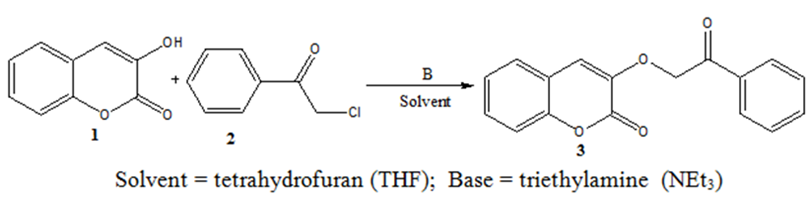
The method used for the synthesis of these compound has been early described in littarature 9. 3-hydroxycoumarin is reacted with an acyl chloride in an appropriate solvent in a basic medium as shown in Figure 1.

In a 100 ml flask fitted with a refrigerant, introduce 30 ml of tetrahydrofuran and 0,0012 mol of 3-hydroxycoumarin 1 or chroman-2,3-dione and three molar equivalents of triethylamine. Leave the mixture to shake for a few minutes and add 0,0012 mol of acyl chloride 2. After stirring the mixture obtained for 1 hour at room temperature, then heat the mixture for 1 hour at the reflux of the solvent. The reaction mixture is then cooled beforehand in order to isolate the final product. Chloroform (40 ml) is added and stirring is continued for 10 minutes. A solution of HCl in water is added to neutralise the base. The resulting organic layer is washed twice with water and dried on MgSO4. The solvent is removed and the crude product is purified by recrystallization.
2.2. Materials and MeasurementThe melting point is determined using a capillary tube with a Stuart SMP 11 and is uncorrected. The IR spectra were recorded on an Agilent Technologies Fourier Transform Infrared (FT-IR) spectrometer. NMR spectra (1H-NMR; 13C-NMR + DEPT 135°) were recorded on a BRUKER AMX spectrometer at 400 MHz and 100 MHz, using TMS as the internal standard, chemical shifts δ in ppm. The EI-MS spectra were obtained with a PERKIN-ELMER.
2.3. Mass SpectrumThe analyzes were performed on a 3200 QTRAP (Applied Biosystems SCIEX) mass spectrometer equipped with a pneumatically assisted atmospheric pressure ionization (API) source. The sample was ionized in positive electrospray mode under the following conditions: electrospray voltage (ISV): 5500 V; orifice voltage (OR): 10 V; Nebulization gas pressure (air): 10 psi. The mass spectrum (MS) was obtained with a linear ion trap. The fragmentation spectrum (MS/MS) was obtained after collision induced dissociations (collision gas: N2, collision energy: 20 eV) in a configuration where the two tandem mass analyzers are quadrupoles. The sample is dissolved in 450 μl of dichloromethane and then diluted 1/100 in a solution of methanol at 3 mM ammonium acetate. The solution of the extract is introduced into the infusion ionization source (Harvard Apparatus pump-syringe pump) at a flow rate of 10 μl /min.
2.4. Electronic ChargesThe electronic charges were obtained by the Austin Model1 semi-empiric method (AM1) 16, using Chem Draw Ultra 8.0 and Chem3D Ultra 8.0 programs from Chem Office 2008 software.
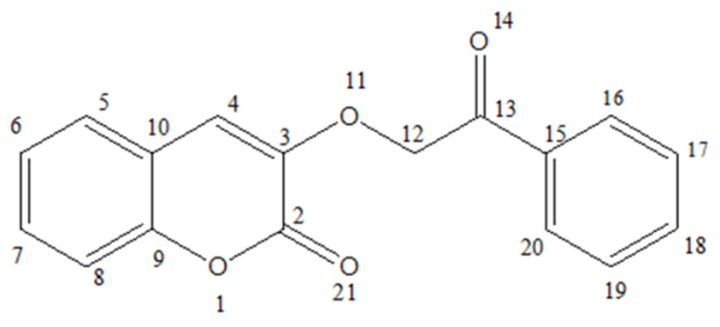
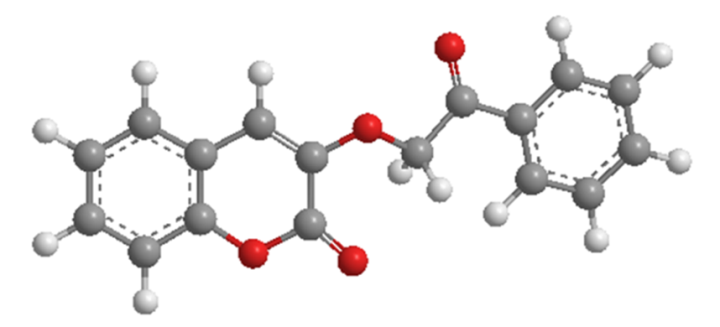
The theoretical load calculations only concern compound 3 (Figure 2). For these calculations, we have used a three-dimensional structure model obtained with optimal heat of formation ΔHf: -64.80542 kcal/mol (Figure 3).
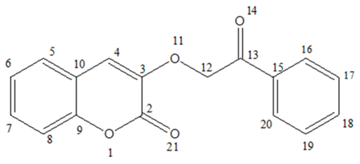

Yield (%): 80; Mp (K): 446-448; IR (cm-1): 1744 (C=O, ester); 1726 (C=O, lactone); 1620 (C=C); 3250 (C-H, aromatic ring); 1H-NMR (CDCl3, 400 MHz, δ: ppm): 5.45 (s, 2H, CH2); 6.80 (s, 1H, H-4); 7.27 (m, 1H, H-5); 7.02 (m, 1H, H-6 and H-8); 7.11 (m, 1H, H-7); 7.86 (m, 1H, H-16 and H-20); 7,37 (m, 1H, H-17 and H-19); 7.45 (m, 1H, H-18). 13C-NMR (CDCl3, 100 MHz, δ: ppm): 71.3 (C-12); 116.3 (C-4); 117.9 (C-3); 157.44 (C-2); 128.1 (C-5); 126.8 (C-6); 119.2 (C-8); 129 (C-7); 150.16 (C-9); 124.7 (C-10); 193.36 (C-13); 142.87 (C-15); 134 (C-16 and C-20); 129.1(C-17 and C-19); 134.1 (C-18). DEPT-135°: 71.3 (C-12); 116.3 (C-4); 128.1 (C-5); 126.8 (C-6); 119.2 (C-8); 129 (C-7); 134 (C-16 and C-20); 129.1(C-17 and C-19); 134.1 (C-18).
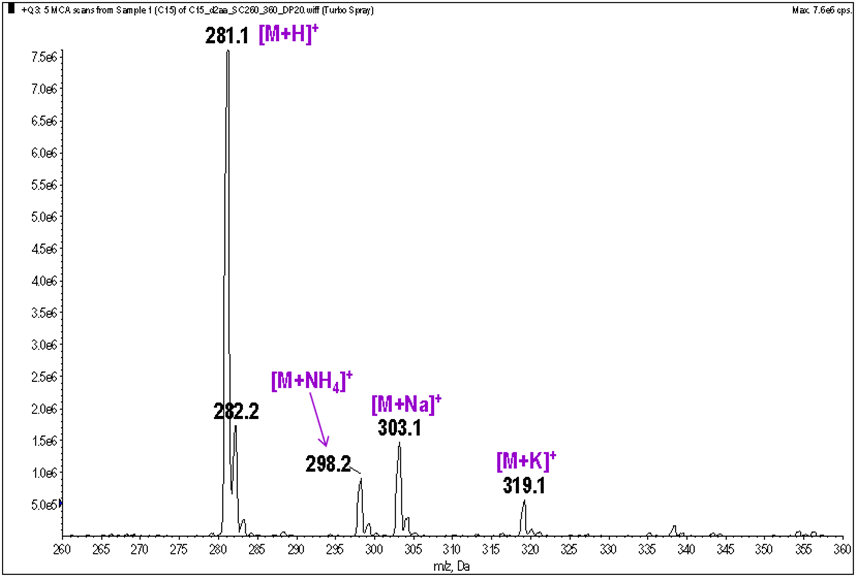
The title compound has been prepared with a good 80% yield, from 3-hydroxycoumarin (tautomer of chroman-2,3-dione) using the corresponding benzoyl chloride. The analysis of the different spectra recorded confirmed the expected structure. The NMR spectra (1H-NMR; 13C-NMR) allowed the attribution of the chemical shifts of the different protons and carbons. The FT-IR spectrum showed the main characteristic absorption bands (C=O, lactone); (C=O, ester); (C=C); (C-H aromatic ring). In mass spectrometry, the objective was to search the spectrum for the presence of diagnostic ions of the expected compound and to study its mode of fragmentation in ESI-MS/MS. The mass spectrum obtained after ionization by electrospray in positive mode (Figure 5) shows the presence of several peaks among which one identifies that of the pseudo-molecular ion. All the peaks present in the spectrum can be attributed to the desired compound: the pseudomolecular ion, [M+H]+, at m/z 281, the ammonium adduct, [M+NH4]+, at m/z 298, the sodium adduct, [M+Na]+, at m/z 303, the potassium adduct, [M+K]+, at m/z 319.
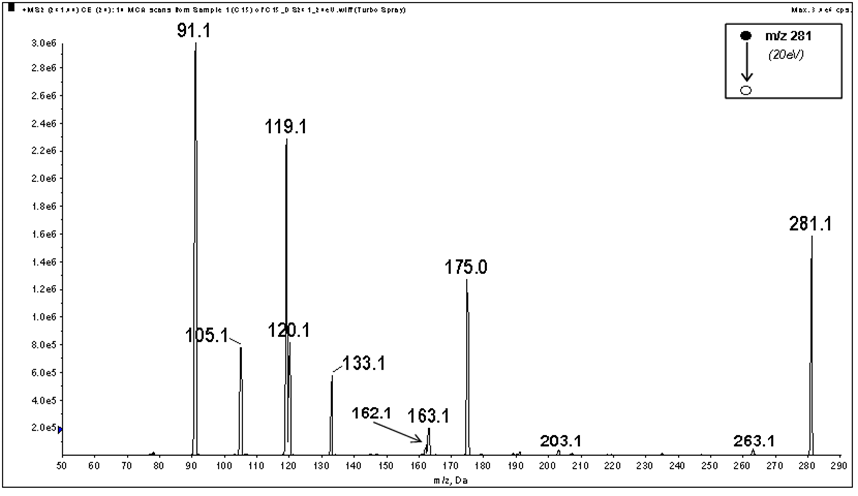
3.2. Fragmentation Study of 3-(2-phenyl-oxo-ethoxy)-2H-chromen-2-oneThe pseudo-molecular ion [M+H]+: m/z 281 of compound 3 was then fragmented by the ESI-MS/MS method. The fragmentation spectrum is shown below (Figure 6). In this section, we propose a plausible description of the fragmentation mechanism of some major fragments such as m/z 91.1 (100%); m/z 105.1 (80%); m/z 281.1 (75 %) m/z 175 (45%) in correlation with the charges obtained by the semi-empirical AM1 method (Table 1).


The atomic charges obtained by the semi-empirical AM1 method prove to be good predictions for the fragmentation pathways. In the case of compound 3, the charges that can guide the fragmentation process will be the positive charges. The important fragments that we found are those representing the peak-pseudo-molecular [M+H]+ m/z 281.1 (75%); the acylium ion fragment R-CO+ (30 %) and others major fragment such m/z 175 (45%); m/z 119 (80%) and m:z 91.1 (100 %). The atoms carrying positively high electronic charges is reduced in number. Only carbon atoms C-2 q= 0.37325); C-9 (q =0.09185); and C-13 (q = 0.28525) mean positive electronic charges.
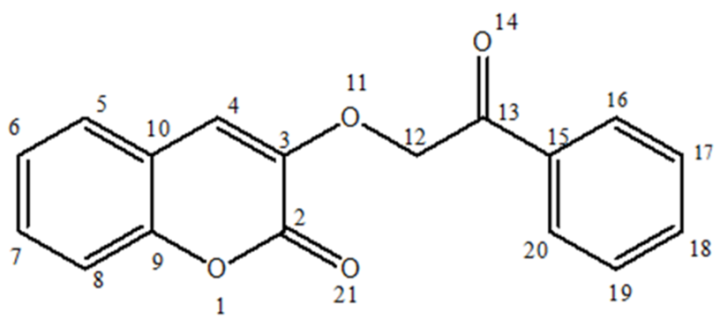
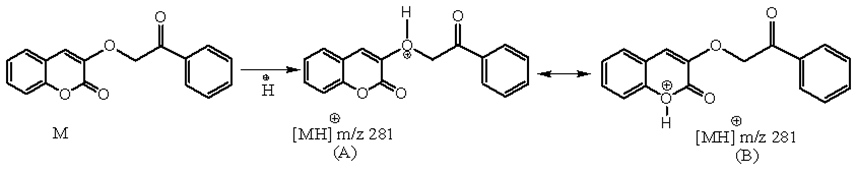
The pseudo-molecular ion [MH]+, as described below, is obtained after ionization of the molecule M, following the effect of the H + projectile. The ionization is certainly done on the oxygen atoms in the state of SP3 hybridization as oxygen O-1; O-11; (Figure 7). Indeed p electrons doublets of heteroatoms are more mobile than electrons and therefore react more easily with acids (H+). This behaviour is generally observed with most of acylated derivatives of coumarin 11, 13.
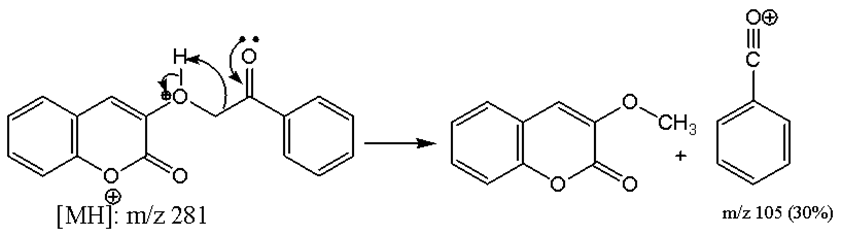
Fragmentation leading to the acylium ion takes place at the level of the C-13 carbon whose electronic charge is positive q = 0.28525. The pseudo-molecular ion (A) [MH]+: m/z 281 (75%) fragments into a neutral fragment, the 3-methoxy-2H-chromen-2-one and the acylium ion RCO+: m/z 105 (30%) as shown in the figure below (Figure 8).


The fragmentation leading to the m/z 175 ion is also oriented by the C-13 carbon. The pseudo-molecular ion (form A) fragments into a neutral moiety, benzaldehyde and the fairly stable m/z 175 ion (30%) as shown in Figure 9.
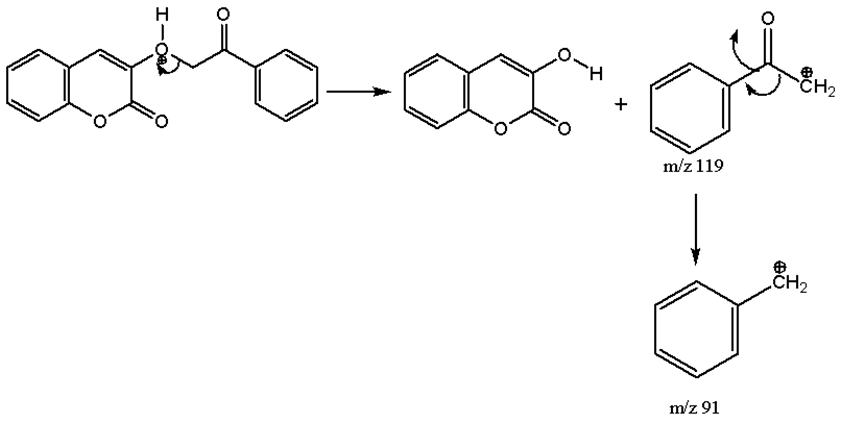
The pseudo-molecular ion (form A), fragments into neutral (uncharged) 3-hydroxycoumarin and stable m/z 119 (80%) ion. This ion by a rearrangement oriented by the C-13 carbon leads to another more stable ion, the base peak m/z 91 (100%) with the loss of a carbon monoxide (CO) as shown in Figure 10.
For the other fragments, it is possible to give a plausible description of the mechanism of their fragmentation in relation to one or all of the positive carbons. In this paper we have just shown that the most stable fragments are oriented by C-13 carbon, which has a relatively high charge.
In this study, we report the synthesis and characterization of 3-(2-phenyl-oxo-ethoxy)-2H-chromen-2-one and its behavior in mass spectrometry (ESI-MS, positive mode). The structure was characterized by means of FT-IR, 1H-NMR, 13C-NMR, ESI-MS spectrometry. The fragmentation pathways are analyzed and we find a good correlation between the orientation effect of some constituent atoms and their atomic electronic charges. This extends our previous work and supports the proposition that the study of fragmentation pathways in mass spectrometry offers a fruitful meeting place for experimentation and theory. This comes as additional evidence to corroborate the results obtained on the title compound.
The authors would like to thank the Spectropole Service of the Federation of Chemical Sciences (University of Aix-Marseille, France) for its assistance in recording the various MNR spectra.
| [1] | Murray R.D. Coumarins. Nat. Prod. Rep. 1989, 6, 551. | ||
| In article | View Article PubMed | ||
| [2] | Goodman L.S. and Gilman A. The pharmacological basis of therapeutics. 5th Ed., MacMillan, New York, 1975. | ||
| In article | |||
| [3] | Au N., Rettie A. E. Pharmacogenomics of 4-hydroxycoumarin anticoagulants. Drug Metab. Rev. 2008, 40 (2): 355-375. | ||
| In article | View Article PubMed | ||
| [4] | Vukovic N., Sukdolak S., Solujic S., Niciforovic N. Substituted imino and amino derivatives of 4-hydroxycoumarins as novel antioxidant, antibacterial and antifungal agents: synthesis and in vitro assessments. Food Chem. 2010, 120 (4): 1011-1018. | ||
| In article | View Article | ||
| [5] | Dong Y., Nakagawa-Goto K., Lai C., Morris-Natschke S., Bastow K., Lee K. Antitumor agents 278. 4-Amino-2H-benzo[h]chromen-2-one (abo) analogs as potent in vitro anticancer agents. Bioorg. Med. Chem. Lett. 2010, 20, 4085-4087. | ||
| In article | View Article | ||
| [6] | Kielbus M., Skalicka-Wozniak K., Grabarska A., Jeleniewicz W., Dmoszynska-Graniczka M., Marston M., Polberg K., Gawda P., Klatka J., Stepulak A. 7-substituted coumarins inhibit proliferation and migration of laryngeal cancer cells in vitro. Anticancer Res. 2013, 33, 4347-4356. | ||
| In article | |||
| [7] | Finn G. J., Creaven B.S., Egan D.A. A study of the role of cell cycle events mediating the action of coumarin derivatives in human malignant melanoma cells. Cancer Lett. 2004. 214, 43-54. | ||
| In article | View Article PubMed | ||
| [8] | Huang L., Yuan X., Yu D., Lee K., Ho Chen C. Mechanism of action and resistant profile of anti-HIV-1 coumarin derivatives. Virology 2005, 332, 623-628. | ||
| In article | View Article PubMed | ||
| [9] | Sosso S., Yoda J., Djandé A., Coulomb B. (Coumarin-3-yl)-benzoates as a Series of New Fluorescent Compounds: Synthesis, Characterization and Fluorescence Properties in the Solid State. American Journal of Organic Chemistry 2018, 8(2): 17-25. | ||
| In article | |||
| [10] | Azim S. A., Al-Hazmy S. M., Ebeid E. M., & El-Daly S. A. A new coumarin laser dye 3-(benzothiazol-2-yl)-7-hydroxycoumarin. Optics & Laser Technology 2005, 37(3): 245-249. | ||
| In article | View Article | ||
| [11] | Yoda J., Djandé A., Cissé L., Abou A., Kaboré L., Saba A. Review on 4-Hydroxycoumarin Chemistry: Synthesis, Acylation and Photochemical Properties. World Journal of Organic Chemistry, 2019, 7 (1): 19-30. | ||
| In article | |||
| [12] | Yoda J., Chiavassa T. and Saba A. Fragementations processes of 3-coumarinyl carboxylates in ESI/ MS and their correlation with the electronic charges of their atoms, Res. J. Chem. Sci. (2014), 4(4): 12-16. | ||
| In article | |||
| [13] | Yoda J., Djandé A., Kaboré L., House P., Traoré H. and Saba A. EIMS and AM1 study of the fragmentations of 3-coumarinyl Carboxylates: Interpretation from electronic charges of atoms. J. Soc. Ouest-Afr. Chim. 2016, 041, 51- 58. | ||
| In article | |||
| [14] | Djandé A., Sessouma B., Cisse L., Kaboré L., Bayo K., Tine A. and Saba A. AM1 and ESI/MS study of 4-acyl Isochroman-1, 3-diones: Correlation between Electronic charges of Atoms and fragmentation processes. Res. J. Chem. Sci. 2011, 1(3): 78-86. | ||
| In article | |||
| [15] | Kavitha P., Rao R. B. and Ravinder V. AM1 and mass spectrometry study of the fragmentation of 4-aminoantipyrine Schiff base ligand. International journal of pharmaceutical and chemical sciences 2014. 3(3):714-720. | ||
| In article | |||
| [16] | Dewar M.J., Zoebish E.G., Healy E.F., Stewart J.P. The development and use of quantum mechanical molecular models. 76. AMI: a new general purpose quantum mechanical molecular model. J. Amer. chem. Soc.1985, 107, 902. | ||
| In article | View Article | ||
Published with license by Science and Education Publishing, Copyright © 2020 Jules Yoda, Siaka Sosso, Abdoulaye Djandé and Adama Saba
 This work is licensed under a Creative Commons Attribution 4.0 International License. To view a copy of this license, visit
http://creativecommons.org/licenses/by/4.0/
This work is licensed under a Creative Commons Attribution 4.0 International License. To view a copy of this license, visit
http://creativecommons.org/licenses/by/4.0/
| [1] | Murray R.D. Coumarins. Nat. Prod. Rep. 1989, 6, 551. | ||
| In article | View Article PubMed | ||
| [2] | Goodman L.S. and Gilman A. The pharmacological basis of therapeutics. 5th Ed., MacMillan, New York, 1975. | ||
| In article | |||
| [3] | Au N., Rettie A. E. Pharmacogenomics of 4-hydroxycoumarin anticoagulants. Drug Metab. Rev. 2008, 40 (2): 355-375. | ||
| In article | View Article PubMed | ||
| [4] | Vukovic N., Sukdolak S., Solujic S., Niciforovic N. Substituted imino and amino derivatives of 4-hydroxycoumarins as novel antioxidant, antibacterial and antifungal agents: synthesis and in vitro assessments. Food Chem. 2010, 120 (4): 1011-1018. | ||
| In article | View Article | ||
| [5] | Dong Y., Nakagawa-Goto K., Lai C., Morris-Natschke S., Bastow K., Lee K. Antitumor agents 278. 4-Amino-2H-benzo[h]chromen-2-one (abo) analogs as potent in vitro anticancer agents. Bioorg. Med. Chem. Lett. 2010, 20, 4085-4087. | ||
| In article | View Article | ||
| [6] | Kielbus M., Skalicka-Wozniak K., Grabarska A., Jeleniewicz W., Dmoszynska-Graniczka M., Marston M., Polberg K., Gawda P., Klatka J., Stepulak A. 7-substituted coumarins inhibit proliferation and migration of laryngeal cancer cells in vitro. Anticancer Res. 2013, 33, 4347-4356. | ||
| In article | |||
| [7] | Finn G. J., Creaven B.S., Egan D.A. A study of the role of cell cycle events mediating the action of coumarin derivatives in human malignant melanoma cells. Cancer Lett. 2004. 214, 43-54. | ||
| In article | View Article PubMed | ||
| [8] | Huang L., Yuan X., Yu D., Lee K., Ho Chen C. Mechanism of action and resistant profile of anti-HIV-1 coumarin derivatives. Virology 2005, 332, 623-628. | ||
| In article | View Article PubMed | ||
| [9] | Sosso S., Yoda J., Djandé A., Coulomb B. (Coumarin-3-yl)-benzoates as a Series of New Fluorescent Compounds: Synthesis, Characterization and Fluorescence Properties in the Solid State. American Journal of Organic Chemistry 2018, 8(2): 17-25. | ||
| In article | |||
| [10] | Azim S. A., Al-Hazmy S. M., Ebeid E. M., & El-Daly S. A. A new coumarin laser dye 3-(benzothiazol-2-yl)-7-hydroxycoumarin. Optics & Laser Technology 2005, 37(3): 245-249. | ||
| In article | View Article | ||
| [11] | Yoda J., Djandé A., Cissé L., Abou A., Kaboré L., Saba A. Review on 4-Hydroxycoumarin Chemistry: Synthesis, Acylation and Photochemical Properties. World Journal of Organic Chemistry, 2019, 7 (1): 19-30. | ||
| In article | |||
| [12] | Yoda J., Chiavassa T. and Saba A. Fragementations processes of 3-coumarinyl carboxylates in ESI/ MS and their correlation with the electronic charges of their atoms, Res. J. Chem. Sci. (2014), 4(4): 12-16. | ||
| In article | |||
| [13] | Yoda J., Djandé A., Kaboré L., House P., Traoré H. and Saba A. EIMS and AM1 study of the fragmentations of 3-coumarinyl Carboxylates: Interpretation from electronic charges of atoms. J. Soc. Ouest-Afr. Chim. 2016, 041, 51- 58. | ||
| In article | |||
| [14] | Djandé A., Sessouma B., Cisse L., Kaboré L., Bayo K., Tine A. and Saba A. AM1 and ESI/MS study of 4-acyl Isochroman-1, 3-diones: Correlation between Electronic charges of Atoms and fragmentation processes. Res. J. Chem. Sci. 2011, 1(3): 78-86. | ||
| In article | |||
| [15] | Kavitha P., Rao R. B. and Ravinder V. AM1 and mass spectrometry study of the fragmentation of 4-aminoantipyrine Schiff base ligand. International journal of pharmaceutical and chemical sciences 2014. 3(3):714-720. | ||
| In article | |||
| [16] | Dewar M.J., Zoebish E.G., Healy E.F., Stewart J.P. The development and use of quantum mechanical molecular models. 76. AMI: a new general purpose quantum mechanical molecular model. J. Amer. chem. Soc.1985, 107, 902. | ||
| In article | View Article | ||