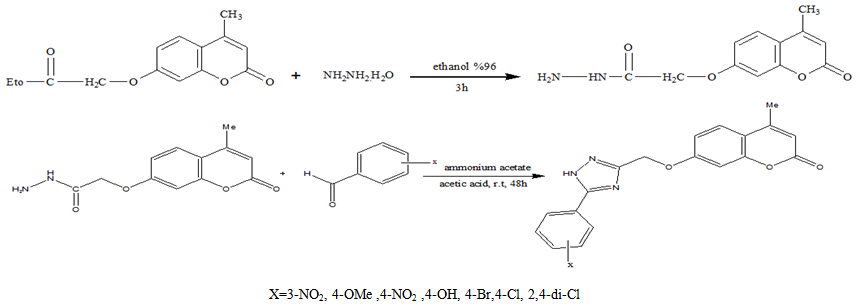
Synthesis of 1,2,4- triazoles fused to another heterocyclic ring such as pyridine, pyridazine, pryimidine, pyrazine and triazine are very well known systems with diverse biological application. In this research the 4-methyl-2-oxo-2H-chromen-7-yl-oxyacetic acid ethyl ester was prepared as the key starting material according to the known procedures. Treatment of 4-methyl-2-oxo-2H-chromen-7-yl-oxyacetic acid ethyl ester with hydrazine hydrate afford 4-methyl-2-oxo-2H-chromen-7-yl-oxyacetic acid hydrazide. At the last stage, the prepared 4-methyl-2-oxo-2H-chromen-7-yl-oxyacetic acid hydrazide was reacted in situ with benzaldehyde and their derivatives in the presense of ammonium acetate using acetic acid as solvent. The final triazole products was obtained with excellent yield. The structures of the target compounds confirmed by IR, 1H-NMR, 13C-NMR, and MASS analysis.
Coumarin is currently undergoing clinical trials for the treatment of lymphoedema following breast cancer treatment and in the treatment of lung and kidney. Carcinoma having been used both in isolation 1. Triazole ring system has attracted a continuously growing interest of synthetic organic chemists and those dealing with the medicinal compounds due to its versatile potential to interact with biological systems. The triazole compounds possess a wide range of biological activities and are especially focused for antifungal behavior.The synthesis of compounds containing 1,2,4-triazole ring in their structure has attracted widespread attention, due to their pharmacological properties. A variety of biological activities such as anti-inflammatory, Analgesic, 2, 3 antibacterial, 4, 5 have been reported. Synthesis of 1,2,4-triazoles fused to another heterocyclic ring such as pyridine, pyridazine, pryimidine, pyrazine and triazine are very well known systems with diverse biological application 6, 7, 8, 9, 10, 11, 12. In this research 4-methyl-2-oxo-2H-chromen-7-yl-xyacetic acid ethyl ester was prepared as the key starting material according to the known procedures. Treatment of 4-methyl-2-oxo-2H-chromen-7-yl-oxyacetic acid ethyl ester with hydrazine hydrate afford 4-methyl-2-oxo-2H-chromen-7-yl-oxyacetic acid hydrazide. At the last stage, the prepared 4-methyl-2-oxo-2H-chromen-7-yl-oxyacetic acid hydrazide was reacted in situ with benzaldehyde and it,s derivatives in the presense of ammonium acetate using acetic acid as solvent. the final triazole products was obtained with excellent yield.
All compounds were obtained from Merck chemical company and were used without further purification.
Melting points (m.p.) were determined on an Electrothermal melting point apparatus (Electrothermalb 4300) and uncorrected. The progress of the reactions was constantlymonitored by the silica-gel G/UV254). IR spectra (wave No./cm-1) were obtained on the Nexus 870 spectromiter using a KBr disk. 1HNMR were measured on a Bruker Advance DRX 500M in CHCl3 or DMSO as solvent using TMS as internal satandard, and chemical shifts are expressed as ppm. MS Model: 5975C VL MSD with Tripe-Axis Detector.
General procedure for synthesis of 4-methyl-7-(5-aryl-1H-[1,2,4]triazol-3-yl-methoxy)-2H-chromen-2-one
In a 100 ml round bottomed flask equipped with magnetic stirrer, 2 ml of 4-methyl-7-yl-oxyacetohydrazide, 9 ml ammonium acetate and 2 ml of 4-substituted-benzaldehyde was dissolved in 15 ml glacial acetic acid. The reaction mixture was stirred for 48 hours at room temperature. Finally the mixture was poured into a beaker containing 150 gr crushed ice. The product was immediately formed in the ice-water mixture as precipitate. Recrystallization of the solid product from 96% ethanol afforded pure product. Yield 72-81%. IR and NMR techniques were used for characterization of the product.
Synthesis of 4-Methyl-7-[5-)3-nitrophenyl)-1H-[1,2,4]triazol-3-yl-methoxy]-2H-chromen -2-one as a typical reaction
In a 100 ml round bottomed flask equipped with magnetic stirrer, 2 ml of 4-methyl-7-yl-oxyacetohydrazide, 9 ml ammonium acetate and 2 ml 4-chlorobenzaldehyde was dissolved in 15 ml glacial acetic acid. The reaction mixture was stirred for 48 hours at room temperature. At the end the mixture was poured into a beaker containing 150 gr crushed ice. The product was immediately formed in the ice-water mixture as precipitate. Recrystallization of the solid product from 96% ethanol afforded pure product. IR and NMR techniques were used for characterization of the product.
White powder, mp 273-275 C°, 0.67 g, yield 88%. 1HNMR (DMSO): δ2.4(s, 3H, Me); 5.37 (s, 2H, CH2); 6.24(s, 1H, H3 of coumarin ring); 7-7.5(m, aromatic and other coumarin protons); 11.95(s-broad, 1H, NH). 13CNMR (ppm): 18.62 (CH3), 65 (CH2), 102-104 (coumarin and aromatic carbons), 169 (C=O). EI-MS (m/z): 378.34 ,203,175,147,104,75.8.
Synthesis of 4-methyl-7-[5-(4-methoxyphenyl)]-1H-[1,2,4]triazol-3-yl-methoxy]-2H chromen-2-one: White powder, mp 274-276 °C, 0.62 g, yield 74%. IR (KBr) (Vmax/cm-1): 3310(NH), 3037(CH- aromatic ring bands), 2850-3000(C-H OCH3, CH3 and CH2), 1631 (C=N), 1691(C=O), 1504-1543(C=C), 1303-1379(C-H), 1018-1253(C-O), 660-959(C-H aromatic ring bands). 1HNMR (DMSO): 2.4(s, 3H, CH3); 3.8(s, 3H, OCH3); 5.2(s, 2H, CH2); 6.2(s, 1H, H3 of coumarin ring); 6.9-7.74(m, aromatic and other coumarin porotons); 11.7(s-broad, 1H, NH). 13CNMR (ppm): 18.6 (CH3), 55.8 (OCH3), 65.7 (CH3), 102-164 (coumarin and aromatic carbons) 168.7 (C=O).
Synthesis of 4-methyl-7-[5-(4-nitrophenyl]-1H-[1,2,4]triazol-3-yl-methoxy]- 2H chromen-2- one: White powder, mp 270-271 °C, 0.67 g, yield 80%. 1HNMR (DMSO):
δ2.41(s, 3H, CH3); 5.36(s, 2H, CH2); 6.23(s, 1H, H3 of coumarin ring); 7(d, H2, H6 of 4-nitrophenyl); 7.68(d, H5 of coumarin ring); 8(d, H3, H5 of 4-nitrophenyl); 8.3(d, H6 of coumarin ring); 8.1(s, H8 of comarin ring). 13CNMR (ppm): 18.6 (CH3), 65.8 (CH2), 102-164 (coumarin and aromatic carbons), 169 (C=O).
Synthesis of 4-methyl-7-[5-(4-hidroxyphenyl]-1H-[1,2,4]triazol-3-yl-metoxy]-2H-chromen-2-one: White powder, mp 274-276 C°, 0.59 g, yield 84%. 1HNMR (DMSO) :
δ 2.4(s, 3H, CH3); 5.72(s, 2H, CH2); 6.23(s, 1H, H3 of coumarin ring); 6.82- 7.75(m, aromatic and other coumarin porotons). 13CNMR: 18.66 (CH3), 65.1 (CH2), 102-163 (coumarin and aromatic carbons), 168 (C=O).
Synthesis of 4-methyl-7-[5-(4-bromophenyl]-1H-[1,2,4]triazol-3-yl-methoxy]-2H chromen-2- one: White powder, mp 265-266 °C, 0.62 g, yield 74%. 1HNMR (DMSO): 2.4(s, 3H, CH3); 5.3(s, 2H, CH2); 6.23(s, 1H, H3 of coumarin ring); 6.9-7.75(m, aromatic and other coumarin porotons); 11.92(s-broad, 1H, NH). 13CNMR (ppm): 18.6 (CH3), 65.8 (CH2), 102-146 (coumarin and aromatic carbons), 169 (C=O).
Synthesis of 4-methyl-7-[5-(2,4-dichloro]-1H-[1,2,4]triazol-3-yl-methoxy-]-2H chromen- 2-one as a typical reaction: White powder, mp 280-281 °C, 0.53 g, yield 65%. 1HNMR (DMSO):2.4(s, 3H, CH3); 5.31(s, 2H, CH2); 6.21(s, 1H, H3 of coumarin ring); 6.9(d, H5, H6 of dichlorophenyl); 7.4(d, H8 of coumarin ring); 7.7(s, H3 of dichlorophenyl and H5 of coumarin ring); 7.95-8.8(dd, H6 of coumarin ring); 11.92(s-broad, 1H, NH). 13CNMR (ppm): 18.62 (CH3), 65.8 (CH2), 102-164 (coumarin and aromatic carbons), 169.2 (C=O).
Synthesis of 4-methyl -7-[5-(4-chloro phenyl] -1H -[1,2,4] triazol-3- yl-methoxy] -2H chromen- 2- one: White powder, mp 280-285 °C, 0.42 g, yield 56%. IR (KBr) (Vmax/cm-1): 3120(NH), 3074(CH- aromatic ring bands), 2850-3000(C-H OCH3, CH3 and CH2), 1687-1695(C=O),1613(C=N), 1399-1498(C=C), 1017-1270(C-O), 646-977(C-H aromatic ring bands). 1HNMR (DMSO):2.4(s, 3H, CH3); 5.31(s, 2H, CH2); 6.22(s, 1H, H3 of coumarin ring); 7(d, H2, H6 of chlorophenyl ring); 7.49-7.53(m, H3, H5 of chrophenyl ring and H5, H6, H8 of coumarin ring); 11.72(s, 1H, NH). 13CNMR (ppm): 18.6 (CH3), 65.7 (CH2), 102-164 (coumarin and aromatic carbons), 169 (C=O). EI-MS (m/z): 367.7, 233, 205, 147, 138, 103,63.
The yield of products and the reaction time depends on the type of aldehyde used as one of the starting materials. For example when the electron withdrawing group is attached to benzaldehyde the yield of product is favored this shows the possible nucleophilic substitusion mechanism between the hydrazide NH2 group and the aldehyde.
The mild reaction condition, the ease of reaction and the good yield of products are the different for developing this method for synthesis of a series of new products with diferent substitution. The following proposed mechanism well the synthesis of final product.
| [1] | D. Cox, R. O'Kennedy and R. D. Thornes, Human and Experimental Toxicology, 1989, 8, 501-506. | ||
| In article | View Article | ||
| [2] | Amir M&Kumar S, Acta Phaem,57, 2007, 31. | ||
| In article | |||
| [3] | Gokce M, Cakir B, Erol K &Sahin M,F, Arch Pharm, 334, 2001, 279. | ||
| In article | |||
| [4] | Ezabadi I R, Camoutsis C, Zoumpoulakis P, Geronikaki A, Sokovic M, Glamoclija J & Ciric A, Bioorg Med Chem, 16, 2008, 355. | ||
| In article | View Article | ||
| [5] | Mazzone G, Bonina F, Arrigo Reina R & Blandino G, IIFarmaco, 36, 1981, 181. | ||
| In article | |||
| [6] | Kucukguzel I, Tatar E, Kucukguzel S G, Rollas S & De Clercq E, Eur J Med Chem, 43, 2008, 381. | ||
| In article | View Article | ||
| [7] | Dogan H N, Duran A & Rollas S, Indian J Chem, 44B, 2005, 2301. | ||
| In article | |||
| [8] | Y. Jiang, C. Kuang, Q. Yang, Synlett, 2009, 3163-3166. | ||
| In article | |||
| [9] | X.-J. Quan, Z.-H. Ren, Y.-Y. Wang, Z.-H. Guan, Org. Lett., 2014, 16, 5728-5731 | ||
| In article | View Article | ||
| [10] | J. Barluenga, C. Valdés, G. Beltrán, M. Escribano, F. Aznar, Angew. Chem. Int. Ed., 2006, 45, 6893-6896. | ||
| In article | View Article | ||
| [11] | A. H. Banday, V. J. Hruby, Synlett, 2014, 25, 1859-1862. | ||
| In article | View Article | ||
| [12] | A. Kolarovič, M. Schnürch, M. D. Mihovilovic, J. Org. Chem., 2011, 76, 2613-2618. | ||
| In article | View Article | ||
Published with license by Science and Education Publishing, Copyright © 2018 Enayatollah Mottaghinejad and Shabnam Alibakhshi
 This work is licensed under a Creative Commons Attribution 4.0 International License. To view a copy of this license, visit
http://creativecommons.org/licenses/by/4.0/
This work is licensed under a Creative Commons Attribution 4.0 International License. To view a copy of this license, visit
http://creativecommons.org/licenses/by/4.0/
| [1] | D. Cox, R. O'Kennedy and R. D. Thornes, Human and Experimental Toxicology, 1989, 8, 501-506. | ||
| In article | View Article | ||
| [2] | Amir M&Kumar S, Acta Phaem,57, 2007, 31. | ||
| In article | |||
| [3] | Gokce M, Cakir B, Erol K &Sahin M,F, Arch Pharm, 334, 2001, 279. | ||
| In article | |||
| [4] | Ezabadi I R, Camoutsis C, Zoumpoulakis P, Geronikaki A, Sokovic M, Glamoclija J & Ciric A, Bioorg Med Chem, 16, 2008, 355. | ||
| In article | View Article | ||
| [5] | Mazzone G, Bonina F, Arrigo Reina R & Blandino G, IIFarmaco, 36, 1981, 181. | ||
| In article | |||
| [6] | Kucukguzel I, Tatar E, Kucukguzel S G, Rollas S & De Clercq E, Eur J Med Chem, 43, 2008, 381. | ||
| In article | View Article | ||
| [7] | Dogan H N, Duran A & Rollas S, Indian J Chem, 44B, 2005, 2301. | ||
| In article | |||
| [8] | Y. Jiang, C. Kuang, Q. Yang, Synlett, 2009, 3163-3166. | ||
| In article | |||
| [9] | X.-J. Quan, Z.-H. Ren, Y.-Y. Wang, Z.-H. Guan, Org. Lett., 2014, 16, 5728-5731 | ||
| In article | View Article | ||
| [10] | J. Barluenga, C. Valdés, G. Beltrán, M. Escribano, F. Aznar, Angew. Chem. Int. Ed., 2006, 45, 6893-6896. | ||
| In article | View Article | ||
| [11] | A. H. Banday, V. J. Hruby, Synlett, 2014, 25, 1859-1862. | ||
| In article | View Article | ||
| [12] | A. Kolarovič, M. Schnürch, M. D. Mihovilovic, J. Org. Chem., 2011, 76, 2613-2618. | ||
| In article | View Article | ||