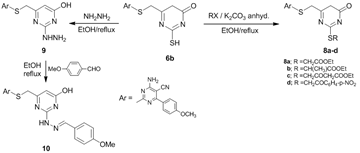
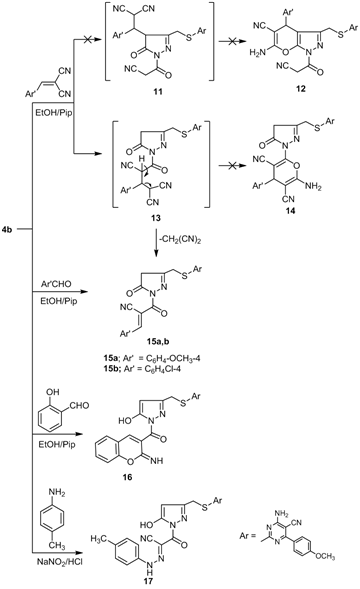
Pyrimidine-2-thiol derivative (1) reacted with ethyl 4-chloroacetoacetate in the presence of potassium carbonate to give thioacetoacetate derivative (3). The later compound upon treatment with hydrazine derivatives gave pyrazolone derivatives (4a-e). The reaction of compound 3 with salicylaldehyde or 2-hydroxaynaphthaldehyde afforded coumarin derivatives (5a,b), respectively. Also, the reaction of thioacetoacetate derivative (3) with either urea or thiourea gave the corresponding pyrimidine derivatives (6a,b). Compound 3 reacted with diazonium salts to give diazo compounds 7a,b. Compounds 8a-d were obtained through the reaction of 6b with different halogenated compounds, while the reaction of 6b with hydrazine hydrate afforded hydrazine derivative (9). Condensation of the later with 4-methoxybenzaldehyde gave 10. Treatment of pyrazolone derivative 4b with different aldehydes afforded compounds 15a,b and 16. While coupling with 4-tolyldiazonium chloride gave compound 17. Finally, the reaction of pyrazole derivative 4c with different halogenated compounds afforded 18, 22, 24 and 26. The structures of the newly synthesized compounds were confirmed by elemental analysis and spectral data. The newly synthesized compounds were also screened for their antimicrobial activity.
In the recent years much attention has been focused on the synthesis of heterocycles containing nitrogen atoms because of their biological 1, 2, 3, 4 and medicinal importance including ontological research. They are widely distributed in nature and are essential for life. Pyrazolone derivatives are an important class of heterocyclic compounds that occur in many drugs and synthetic products 5, 6. These compounds exhibit remarkable analgesic 7, antitubercular 8, antifungal, antiviral 9, antibacterial 10, 11, anti-inflammatory 12, antioxidant 11, 13, 14 and antitumor activities 15, 16.
Pyrazolones are pharmacophores of numerous compounds that display activities such as analgesic and antipyretic (propylphenazone, phenazone, metamizole etc.) 17, 18, anti-cancer (TELIN) 19, anti-ischemic (edaravone) 20, and antianxiolytic 21. Pyrazolones are gaining importance especially in drug discovery programs towards cerebral ischaemia 22 and cardiovascular diseases 23, 24. On the other hand Pyrimidine derivatives exhibit various biological 25, 26, 27 and pharmaceutical activities 28. Pyrimidine derivatives are of great interest due to their presence in a wide variety of drugs 29, 30, 31, 32, 33, 34, 35, 36, 37, 38.
Thus, in continuation of our work on the chemistry of pyrimidine derivatives 39 it was of interest to to synthesize some pyrazole, thiazole and coumarin bearing pyrimidine moiety in a molecular framework to study their potential biological activity. Thus, pyrimidine-2-thiol derivatives was used to synthesize some novel heterocyclic compounds.
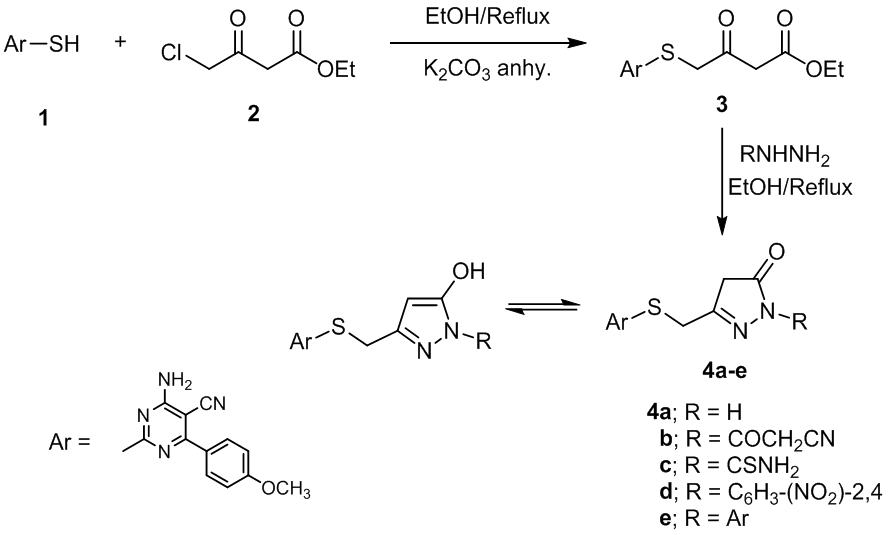
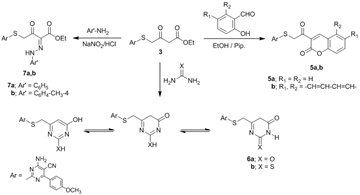
4-Amino-2-mercapto-6-(4-methoxyphenyl)pyrimidine-5-carbonitrile (1) 39 was allowed to react with ethyl 4-chloroacetoacetate (2) in ethanol in the presence of anhydrous potassium carbonate at refluxing temperature, ethyl 4-((4-amino-5-cyano-6-(4-methoxyphenyl)pyrimidin-2-yl)thio)-3-oxo-butanoate (3) was obtained in good yield. Structure of 3 was confirmed by spectral data. Its IR spectra showed two strong absorption bands at the regions 1748 & 1724 attributed to v max of two carbonyl groups which indicated the formation of new carbonyl groups. Also, the 1H-NMR spectrum of compound 3 revealed a triplet at 1.16 ppm characteristic for CH3 protons and a quartet at 4.09 ppm for CH2 protons of CH2CH3, singlet at 4.15 ppm. Assigned for SCH2. In addition, the structure of compound 3 was inferred chemically, in which it reacted with the nucleophile hydrazine hydrate and/or its derivatives in ethanol to give the target molecule pyrazolone derivatives which may be exist in the two tautomeric forms (4a-e). The structures of 4a-e were investigated from its IR, 1H-NMR, mass spectrometry and microanalysis. The spectral data revealed the disappearance of CO group indicating their involvement in the cyclization process. Its 1H-NMR spectrums devoid any signals for CH2CH3 group which indicated its participation in the reaction and showed signals for OH & CH-pyrazole or CH2-pyrazolone (Scheme 1).

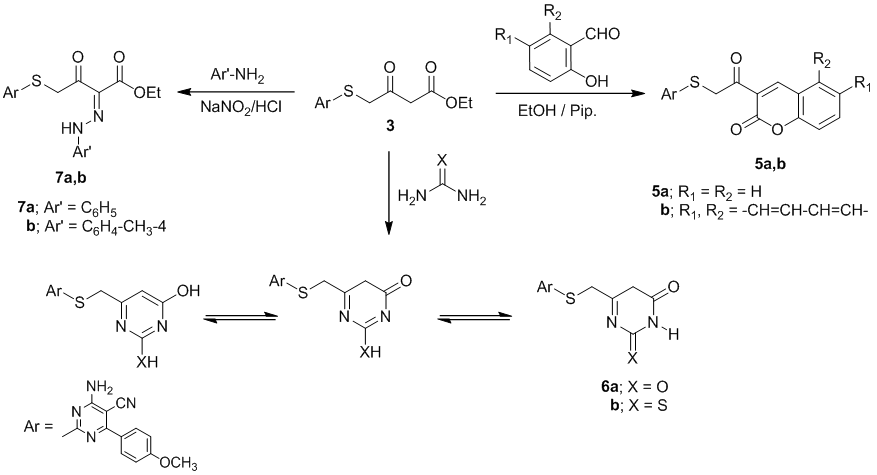
Knoevenagel reaction of compound 3 with phenolic aldehydes namely (salicylaldehyde and 2‐hydroxy‐1‐naphthaldehyde) in ethanolic piperidine medium afforded 4-amino-6-(4-methoxyphenyl)-2-((2-oxo-2-(2-oxo-2H-chromen-3-yl)ethyl)thio)pyrimidine-5-carbonitrile (5a), 4-amino-6-(4-methoxyphenyl)-2-((2-oxo-2-(3-oxo-3H-benzo[f]chromen-2-yl)ethyl)thio)-pyrimidine-5-carbonitrile (5b), respectively (Scheme 2). The spectral data revealed the disappearance of CH2CH3 group indicating their involvement in the cyclization process. Also, the 1H-NMR spectrum showed singlet signals at 8.58 and 9.14 ppm. attributed to chromene-H4.
Also, compound 3 reacted with either urea or thiourea in ethanol catalyzed with piperidine to afford the corresponding 4-amino-2-(((2,6-dioxo-1,2,5,6-tetrahydro-pyrimidin-4-yl)methyl)thio)-6-(4-methoxy-phenyl)pyrimidine-5-carbonitrile (6a) and 4-amino-6-(4-methoxyphenyl)-2-(((6-oxo-2-thioxo-1,2,5,6-tetrahydropyrimidin-4-yl)methyl)thio)pyrimidine-5-carbonitrile (6b), respectively. The structure of compound 6b was supported by its 1H-NMR spectrum which revealed the presence of a singlet signals at 6.02 ppm. assigned to CH pyrimidine and downfield singlet at 12.42 ppm. assigned for hydroxyl group.
On the other hand, compound 3 underwent coupling with equimolar amount of benzenediazonium chloride and/or 4-methylbenzenediazonium chloride in ethanolic sodium acetate at 0°C giving the arylhydrazone derivatives (7a,b), respectively (Scheme 2). The mass spectrum of compound 7a showed a molecular ion peak together with a base peak at m/z 490 (100%). Also, the structure of 7b was supported by its 1H-NMR spectrum which revealed singlet signal at 2.29 ppm. assigned to CH3 and 12.03 ppm. attributed to NH group.
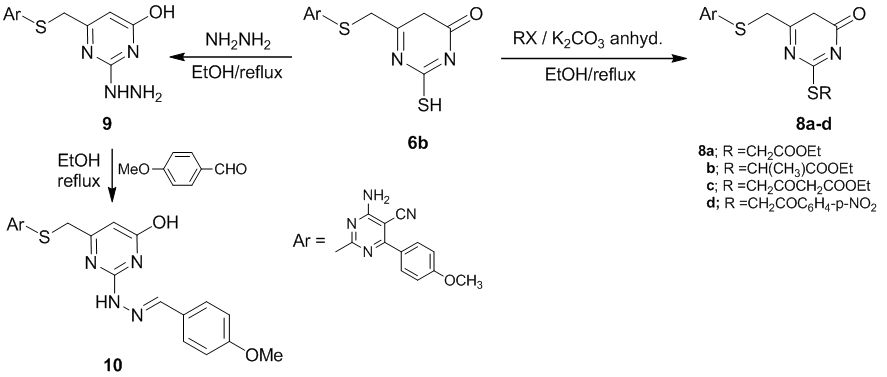
The structure of 6b was verified chemically through its reaction with different halogenated compounds in boiling ethanol containing potassium carbonate to afford the corresponding alkylmercaptopyrimidine derivatives (8a-d). The infrared spectrum of these compounds showed the appearance of strong absorption bands attributed to v max of new carbonyl group. Also, 1H-NMR spectrum of compounds 8a-c showed a presence of triplet and quartet signals for the methyl and methylene protons. The reaction of 6b with hydrazine hydrate in ethanol under reflux temperature (till H2S ceased) gave product that identified as 4-amino-2-(((2-hydrazinyl-6-hydroxypyrimidin-4-yl)methyl)thio)-6-(4-methoxyphen-yl)pyrimidine-5-carbonitrile (9). Condensation of compound 9 with 4-methoxybenzaldehyde in ethanol under reflux gave hydrazone derivative 39 10 (Scheme 3). The 1H-NMR spectrum of compound 10 showed the presence of new singlet signal at 3.91 ppm. for the methoxy group protons in addition to presence of three signals at 8.56, 9.23,12.42 ppm. assigned to N=CH, NH and OH respectively.
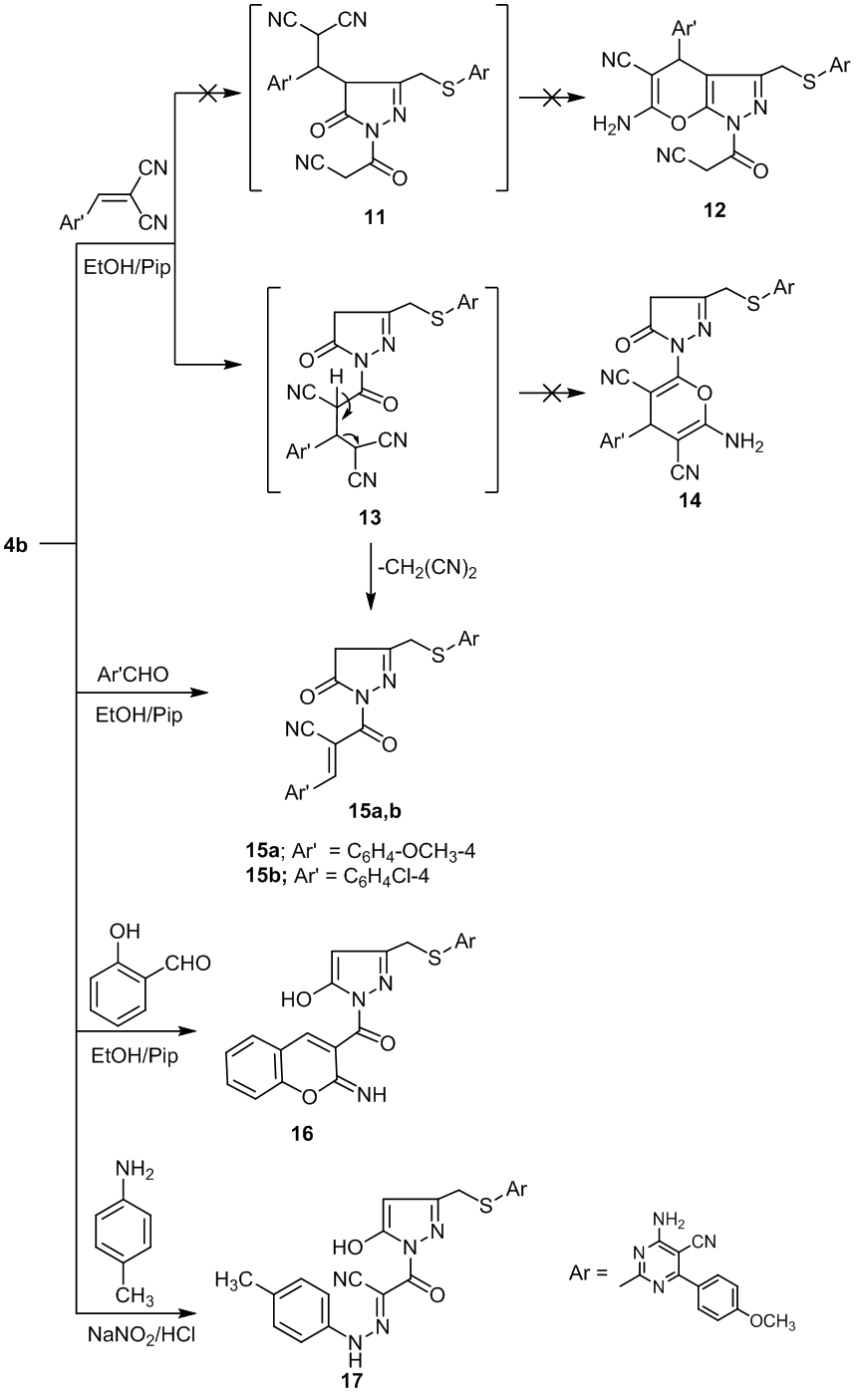
The reactivity of 4b towards some electrophilic reagents was studied. Thus, treatment of 4b with α-cyano-4-(substituted)cinnamonitriles in boiling ethanol containing few drops of piperidine as a catalyst afforded 4-amino-2-(((1-(2-cyano-3-(4-(substituted)phenyl)acryl-oyl)-5-oxo-4,5-dihydro-1H-pyrazol-3-yl)methyl)thio)-6-(4-methoxyphenyl)pyrimidine-5-carbonitriles (15a,b) rather than the other possible structures 12, 14. The formation of compounds 15a,b was assumed to proceed via Michael addition of the CH2CN moiety to cinnamonitrile derivatives to give Michael adduct 13 followed by loss of malononitrile molecule. The structure of compounds 15a,b was also supported by reaction of compound 4b with aromatic aldehydes in ethanolic piperidine under reflux temperature. The spectral data of compounds 15a,b revealed the disappearance of CH2CN signal in 1H-NMR indicating their involvement in the condensation process. In addition to the presence of signal at 3.67 ppm. assigned for CH2-pyrazole and 8.67 ppm. attributed for CH=C, while the other possible structures 12, 14 were excluded depending on 1H-NMR data.
Knoevenagel condensation of compound 4b with salicylaldehyde in ethanolic piperidine solution afforded 4-amino-2-(((1-(2-imino-2H-chromene-3-carbonyl)-5-oxo-4,5-dihydro-1H-pyrazol-3-yl)methyl)thio)-6-(4-methoxyphenyl)pyrimidine-5-carbonitrile (16).
Moreover, coupling of compound 4b with equimolar amount of 4-methylbenzenediazonium chloride in ethanol containing sodium acetate at (0‐5°C) afforded a colored product identified as 2-(3-(((4-amino-5-cyano-6-(4-methoxyphenyl)pyrimidin-2-yl)thio)methyl)-5-oxo-4,5-dihydro-1H-pyrazol-1-yl)-2-oxo-N'-(p-tolyl)acetohydrazonoyl cyanide (17) (Scheme 4). The infrared spectrum of compound 17 showed absorption band at 3479, 3176 cm-1 for hydroxyl and imino groups respectively and its mass spectrum showed a molecular ion peak together with a base peak at m/z 539 (100%).
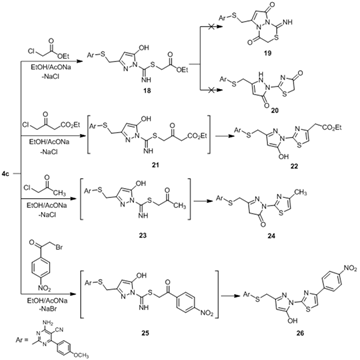
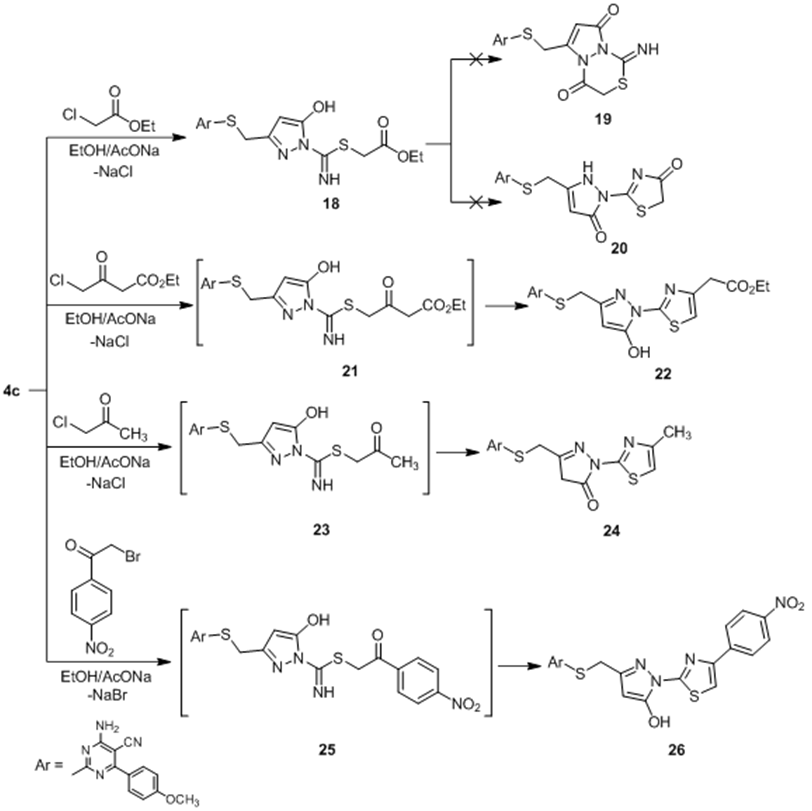
When carbothioamide (4c) was allowed to react with ethyl chloroacetate in ethanolic sodium acetate the corresponding S-alkylated derivative (18) was obtained. The presence of ethyl group in 1H-NMR spectrum elucidate the acyclic structure for compound 18 and ruled out the other possible structures 19 and 20. On the other hand, when carbothioamide (4c) was heated with ethyl 4-chloro-3-oxobutanoate in ethanol containing anhydrous sodium acetate under reflux, the corresponding N-thiazolyl-pyrazolone derivative 22 was formed in moderate yield. The formation of compound 22 is assumed to proceed via the nucleophilic substitution to yield the corresponding acyclic non-isolable intermediate 21 which undergoes interamolecular cyclization by the elimination of water molecule to give 22.
Finally, this investigation was extended to include the reactivity of carbothioamide derivative (4c) with α-halo ketones. Thus, when compound 4c was allowed to react with chloroacetone and 4-nitrophenacyl bromide in ethanol containing fused sodium acetate under reflux, the thiazolyl-pyrazolone derivatives 24 and 26 respectively were obtained. The formation of compounds 24&26 were assumed to proceed via S-alkylation to give intermediates 23,25 followed by interamolecular cyclization through elimination of water molecule (Scheme 5). 1H-NMR spectrum of compounds 22 & 24 gave analytical figures compatible with the proposed structural formula, while the mass spectrum for compound 26 showed a molecular ion peak at m/z 558 (62.87%) together with a base peak at m/z 77 (100%).
The standardized disc – agar diffusion method 40, 41 was followed to determine the activity of the synthesized compounds against the tested microorganisms.
3.1. Test OrganismsCultures of the following microorganism were used in the test:
Gram- positive bacteria: Staphylococcus aureus (ATCC 25923) and Bacillus subtilis (ATCC 6635), Gram – negative bacteria: Escherichia coli (ATCC 25922) and Salmonella typhimurium (ATCC 14028), Yeast: Candida albicans (ATCC 10231) and Fungus: Aspergillus fumigatus.
3.2. Standard ReferencesThe antibiotic chloramphenicol was used as standard reference in the case of Gram – negative bacteria, Cephalothin was used as standard reference in the case of Gram – positive bacteria and cycloheximide was used as standard reference in the case of yeasts and fungi.
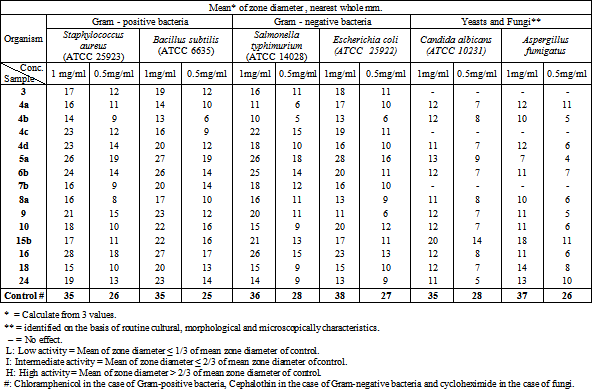
The inhibition zone diameters were recorded and rounded up to the nearest whole number (mm) for analysis. The inhibitory effects of the synthesized compounds against these organisms are given in Table 1.
The screening results from Table 1 indicate that: all compounds under investigation were less active against all the tested bacterial strains than the standard controls. In other words, all synthesized compounds showed moderate activity against the tested Gram-positive bacteria and Gram- negative bacteria except compounds (5a, 6b & 16) which showed high activities against: Staphylococcus aureus (ATCC 25923), Bacillus subtilis (ATCC 6635), Escherichia coli (ATCC 25922) and Salmonella typhimurium (ATCC 14028).
Also, from Table 1 it’s evident that: all the synthesized compounds showed a weak in vitro antifungal and yeast activity against the tested organism except compound (15b) which showed moderate activity against Candida albicans (ATCC 10231) and Aspergillus fumigatus.
3.3. Experimental GeneralMelting points were determined on a Stuart melting point apparatus and are uncorrected. IR spectra were recorded in KBr using a FT-IR 5300 spectrometer and Perkin Elmer spectrum RXIFT-IR system (ν, cm−1). The 1H-NMR at (300 MHz) was recorded in DMSO-d6 on a Varian Mercury VX-300 NMR spectrometer. Chemical shifts (δ) are related to that of the solvent. Mass spectra were measured on a Shimadzu GMMS-QP-1000 EX mass spectrometer at 70 eV. The elemental analyses and biological activity were performed at the Microanalytical Center, Cairo University. Cairo (Egypt).
Ethyl 4-((4-amino-5-cyano-6-(4-methoxyphenyl)pyrimidin-2-yl)thio)-3-oxobutanoate (3)
To a solution of 4-amino-2-mercapto-6-(4-methoxyphenyl)pyrimidine-5-carbonitrile (1) (1 mmol) and ethyl 4-chloro-3-oxobutanoate (1 mmol) in absolute ethanol (30 mL), anhydrous potassium carbonate (0.7g) was added. The mixture was refluxed for 3 h. The reaction mixture was poured onto ice water and neutralized by dil. hydrochloric acid (10%). The solid product so formed was collected by filtration and washed several times by water
Yield 82%, mp 170-172°C, colorless crystals, recrystallized from ethanol. IR (KBr) (νmax cm−1): 3321, 3166 (NH2), 2214 (C≡N), 1748, 1724 (CO), MS, m/z (%) = 387 (M+, 2.9), 386 (11.3), 270 (100), 341 (8.9), 315 (2.4), 225 (23.9), 183 (13.7), 121 (25.3), 92 (11.1), 68 (14.5) and 1H NMR (DMSO-d6): δH 1.16 (t, J = 7.2 Hz, 3H, CH2CH3), 3.80 (s, 2H, CH2C=O), 3.85 (s, 3H, OCH3), 4.15 (s, 2H, SCH2), 4.09 (q, J = 7.2 Hz, CH2CH3), 7.07, 7.85 (2d, J = 8.7 Hz,4H, Ar-H), 7.87 (s, br, 2H, NH2 cancelled by D2O). Anal. calcd. for C18H18N4O4S; M. Wt (386.10): C, 55.95; H, 4.70; N, 14.50,. Found: C, 55.84; H, 4.60; N, 14.41.
General procedure for the synthesis of 4 (a-e)
To a suspension of 3 (1 mmol) and hydrazine derivatives namely (hydrazine hydrate, cyanoacetohydrazide, thiosemicarbazide, 2,4-dinitro-phenylhydrazine or 4-amino-2-hydrazino-6-(4-methoxyphenyl)pyrimidine-5-carbonitrile) (1 mmol) in ethanol (30 mL) in the presence of a few drops of piperidine was refluxed for 3 h. The solvent was evaporated under vacuo; the residues were triturated with dil. ethanol and the solids separated were filtered off and recrystallized from an appropriate solvent.
4-Amino-6-(4-methoxyphenyl)-2-(((5-oxo-4,5-dihydro-1H-pyrazol-3-yl)-methyl)thio)pyrimidine-5-carbonitrile (4a).
Yield 62%, mp 196-198°C, white crystals, recrystallized from ethanol/ benzene. IR (KBr) (νmax cm−1): 3340, 3196, 3122 (NH2,NH), 2208 (C≡N), 1650 (C=O); 1H NMR (DMSO-d6): δH 3.657 (s, 2H, CH2-pyrazole), 3.823 (s, 3H, OCH3), 4.26 (s, 2H, SCH2), 7.03, 7.81 (2d, J = 9 Hz, 4H, Ar-H), 7.81 (s, br, 2H, NH2 cancelled by D2O) 8.58 (s, br, 1H, NH, cancelled by D2O). Anal. calcd. for C16H14N6O2S; M. Wt. (354.09): C, 54.23; H, 3.98; N, 23.71. Found: C, 54.13; H, 3.86; N, 23.59.
4-Amino-2-(((1-(2-cyanoacetyl)-5-hydroxy-1H-pyrazol-3-yl)methyl)-thio)-6-(4-methoxyphenyl)pyrimidine-5-carbonitrile (4b).
Yield 76%, mp 220-222°C, colorless crystals, recrystallized from ethanol/ benzene. IR (KBr) (νmax cm−1): 3384, 3198 (NH2), 2220, 2210 (C≡N), 1690 (C=O); MS, m/z (%) = 421 (M, 2.8), 403 (6.8), 354 (69.3), 321 (25), 257 (69.5), 225 (38.1), 97 (35.1), 67 (100). Anal. calcd. for C19H15N7O3S. M. Wt. (421.10): C, 54.15; H, 3.59; N, 23.27. Found: C, 54.08; H, 3.50; N, 23.16.
3-(((4-Amino-5-cyano-6-(4-methoxyphenyl)pyrimidin-2-yl)thio)methyl)-5-hydroxy-1H-pyrazole-1-carbothioamide (4c).
Yield 76%, mp 206-208°C, white crystals, recrystallized from ethanol/ benzene. IR (KBr) (νmax cm−1): 3422 (OH), 3310, 3124 (NH2), 2220 (C≡N), 1714 (C=O); MS, m/z (%) = 413 (12.8), 354 (25.5), 321 (12.8), 257 (53.2), 225 (44.7), 185 (36.2), 92 (27.7), 64 (100); 1H NMR (DMSO-d6): δH 3.84 (s, 3H, OCH3), 4.26 (s, 2H, SCH2), 7.08, 7.65 (2d, J = 8.7 Hz,4H, Ar-H), 7.41 (s, 1H, CH-pyrazole), 7.50, 8.09 (2br, 4H, 2NH2 cancelled by D2O), 11.55 (s, br, H, OH cancelled by D2O). Anal. calcd. for C17H15N7O2S2; M. Wt. (413.07): C, 49.38; H, 3.66; N, 23.71; Found: C, 49.28; H, 3.58; N, 23.60.
4-Amino-2-(((1-(2,4-dinitrophenyl)-5-hydroxy-1H-pyrazol-3-yl)methyl)-thio)-6-(4-methoxyphenyl)pyrimidine-5-carbonitrile (4d).
Yield 65%, mp 270-272°C, white crystals, recrystallized from dioxane. IR (KBr) (νmax cm−1):3436 (OH), 3340, 3220 (NH2), 2208 (C≡N), 1720 (C=O). MS, m/z (%) = 521 (M+1,1.4), 520 (M+1,1.2), 473 (4.3), 384 (5.3), 297 (6.1), 271 (3.6), 257 (100),199 (23.5), 92 (12.1), 64 (21.5). 1HNMR (DMSO-d6): δH 3.83 (s, 3H, OCH3), 4.23 (s, 2H, SCH2), 7.02, 7.81 (2d, J = 9 Hz, 4H, Ar-H), 7.35 (s, 1H, CH-pyrazole), 7.84 (br, 2H, NH2 cancelled by D2O), 7.88 (d, J = 9 Hz, 1H, Ar-H), 8.32 (d, J = 8.1 Hz, 1H, Ar-H), 8.85 (s,1H, Ar-H), 11.18 (s, br, H, OH cancelled by D2O). Anal. calcd. for C22H16N8O6S; M. Wt. (520.09): C, 50.77; H, 3.10; N, 21.53. Found: C, 50.67; H, 3.01; N, 21.41.
4-Amino-2-(((1-(4-amino-5-cyano-6-(4-methoxyphenyl)pyrimidin-2-yl)-5-oxo-4,5-dihydro-1H-pyrazol-3-yl)methyl)thio)-6-(4-methoxyphenyl)-pyrimidine-5-carbonitrile (4e).
Yield 80%, mp 294-296°C, white crystals, recrystallized from acetic acid. IR (KBr) (νmax cm−1): 3346, 3188 (NH2), 2208 (C≡N), 1724 (C=O); 1H NMR (DMSO-d6): δH 3.48 (s, 2H, CH2- pyrazole), 3.78, 3.81 (2s, 6H, 2OCH3), 4.20 (s, 2H, SCH2), 6.85, 7.05, 7.76, 7.81 (4d, J = 8.7 Hz, 8H, Ar-H), 7.75 (br, 4H, 2NH2 cancelled by D2O). Anal. calcd. for C28H22N10O3S; M. Wt. (578.16): C, 58.12; H, 3.83; N, 24.21;. Found: C, 58.01; H, 3.73; N, 24.10.
Genral procedure for the synthesis of 5a,b.
A mixture of 3 (1 mmol) and either salicylaldehyde or 2-hydroxynaphthaldehyde (1 mmol) in ethanol (30 mL) in the presence of a few drops of piperidine was refluxed for 2 hours. The solvent was evaporated under vacuum. The obtained solids were filtered off and washed with ethanol, and recrystallized from an appropriate solvent.
4-Amino-6-(4-methoxyphenyl)-2-((2-oxo-2-(2-oxo-2H-chromen-3-yl)eth-yl)thio)pyrimidine-5-carbonitrile (5a)
Yield 90%, mp 280-282°C, colourless crystals, recrystallized from dioxane. IR (KBr) (νmax cm−1): 3292, 3132 (NH2), 2210 (C≡N), 1730, 1680 (C=O); 1H NMR (DMSO-d6): δH 3.71 (s, 3H, OCH3), 4.58 (s, 2H, SCH2), 6.84, 7.74 (2d, J = 8.7 Hz,4H, Ar-H), 7.73-7.85 (m,4H, Ar-H), 7.71 (br, 2H, NH2 cancelled byD2O), 8.58 (s, H, CH-chromen). Anal. calcd. for C23H16N4O4S; M. Wt. (444.09): C, 62.15; H, 3.63; N, 12.61. Found: C, 62.04; H, 3.53; N, 12.50.
4-Amino-6-(4-methoxyphenyl)-2-((2-oxo-2-(3-oxo-3H-benzo[f]chromen-2-yl)ethyl)thio)pyrimidine-5-carbonitrile (5b).
Yield 90%, mp 328-330°C, colourless crystals, recrystallized from dioxane. IR (KBr) (νmax cm−1): 3302, 3148 (NH2), 2216 (C≡N), 1738, 1694 (C=O); MS, m/z (%) = 494 (32), 484 (37), 466 (35), 403 (41), 343 (69), 325(56), 203 (84), 105 (100); 1H NMR (DMSO-d6): δH 3.60 (s, 3H, OCH3), 4.71 (s, 2H, SCH2), 6.87, 7.73 (2d, J = 9 Hz, 4H, Ar-H), 7.63-8.47 (m,6H, Ar-H), 7.68 (br, 2H, NH2 cancelled byD2O), 9.14 (s, H, CH-chromen). Anal. calcd. for C27H18N4O4S; M. Wt. (494.10): C, 65.58; H, 3.67; N, 11.33;. Found: C, 65.47; H, 3.66; N, 11.22.
General procedure for the synthesis of 6a,b
A suspension of 3 (1 mmol) and either urea or thiourea (1 mmol) in ethanol (30 mL) in the presence of anhydrous potassium carbonate (0.7g) was refluxed for 3 h. The solvent was evaporated under vacuo; the residues were triturated with dil. ethanol and the solids separated were filtered off and recrystallized from an appropriate solvent.
4-Amino-2-(((2,6-dioxo-1,2,5,6-tetrahydropyrimidin-4-yl)methyl)thio)-6-(4-methoxyphenyl)pyrimidine-5-carbonitrile (6a).
Yield 76%, mp 252-254°C, colourless crystals, recrystallized from dioxane. IR (KBr) (νmax cm−1): 3392, 3314, 3182 (NH2, NH), 2213 (C≡N), 1652 (C=O). MS, m/z (%) = 383 (M+1, 5), 382 (73), 369 (89), 368 (100), 354 (35), 339 (59), 327 (18), 271 (11), 241(19), 183 (25), 168 (28), 155 (17),139 (27.7), 101 (11),90 (31), 87 (25). Anal. calcd. for C17H14N6O3S; M. Wt. (382.08): C, 53.40; H, 3.69; N, 21.98; Found: C, 53.31; H, 3.59; N, 21.78.
4-Amino-6-(4-methoxyphenyl)-2-(((6-oxo-2-thioxo-1,2,5,6-tetrahydro-pyrimidin-4-yl)methyl)thio)pyrimidine-5-carbonitrile (6b).
Yield 82%, mp 244-246°C, colourless crystals, recrystallized from dioxane. IR (KBr) (νmax cm−1): 3457 (OH), 3330, 3149 (NH2, NH), 2215 (C≡N), 1663 (C=O). 1H NMR (DMSO-d6): 3.85 (s, 3H, OCH3), 3.89 (s, 2H,CH2-pyrimdine) 4.07 (s, 2H, SCH2),6.02 (s, 1H,CH-pyrimdine) 7.08, 7.86 (2d, J = 8.7 Hz,4H, Ar-H), 7.88, 8.55, 9.20 (3br, 3H, NH+NH2), 12.42 (s, 1H, SH), 12.42 (s, 1H, OH). Anal. calcd. for C17H14N6O2S2; M. Wt. (398.06): C, 51.24; H, 3.54; N, 21.09. Found: C, 51.14; H, 3.44; N, 21.00.
General procedure for the synthesis of 7a,b.
To a stirred solution of 3 (1 mmol) in ethanol (50 mL) containing, sodium acetate (3 g) and either benzenediazonium chloride or 4-methylbenzene-diazonium chloride (prepared by adding sodium nitrite (1 mmol) to aniline (1 mmol) or 4-methylaniline (1 mmol) in conc. HCl (6 mL) at 0~5 °C under stirring was added dropwise The reaction mixture was then left at room temperature for 2 hours. The solid products formed were collected by filtration and recrystallized from an appropriate solvent.
Ethyl-4-((4-amino-5-cyano-6-(4-methoxyphenyl)pyrimidin-2-yl)thio)-3-oxo-2-(2-phenylhydrazineylidene)butanoate (7a).
Yield 66%, mp 210–212 °C, red crystals, recrystallized from ethanol. IR (KBr) (νmax cm−1): 3362, 3320, 3176 (NH, NH2), 2216 (C≡N), 1748, 1656 (C=O). MS, m/z (%) = 490 (100), 457 (33), 455 (57), 411 (35), 398 (352), 317 (12), 258 (29), 92 (11). Anal. calcd. for C24H22N6O4S; M. Wt. (490.14): C, 58.76; H, 4.52; N, 17.13. Found: C, 58.65; H, 4.42; N, 17.02.
Ethyl 4-((4-amino-5-cyano-6-(4-methoxyphenyl)pyrimidin-2-yl)thio)-3-oxo-2-(p-tolyldiazenyl)butanoate (7b).
Yield 72%, mp 202–204 °C, orange crystals, recrystallized from ethanol. IR (KBr) (νmax cm−1): 3392, 3320, 3166 (NH2), 2214 (C≡N), 1744, 1652 (C=O). 1H NMR (DMSO-d6): δH 1.22 (t, J = 7.2 Hz, 3H, CH2CH3), 2.29 (s, 3H, CH3), 3.85 (s, 3H, OCH3), 4.25 (q, J = 7.2 Hz, CH2CH3), 4.63 (s, 2H, SCH2), 6.89, 7.14, 7.41, 7.82 (4d, J = 8.7 Hz, 8H, Ar-H), 7.78 (br, 2H, NH2), 12.03 (s, 1H, NH). Anal. calcd. for C25H24N6O4S; M. Wt.( 504.16): C, 59.51; H, 4.79; N, 16.66. Found: C, 59.41; H, 4.69; N, 16.54.
General procedure for the synthesis of 8a-d
To a solution of 6b (1 mmol) in dioxane, different halogenated compounds namely (ethyl chloroacetate, ethyl 2-chloropropanoate, ethyl 4-chloro-3-oxobutanoate and 4-nitrophenacyl bromide), (1 mmol), and anhydrous potassium carbonate (0.7g) were added. The mixture was refluxed for 3 h (30 mL). The reaction mixture was poured onto ice water and neutralized with dil. hydrochloric acid (10%); the solid products formed were collected by filtration and washed several times with water and recrystallized from an appropriate solvent.
Ethyl 2-((6-(((4-amino-5-cyano-6-(4-methoxyphenyl)pyrimidin-2-yl)-thio)methyl)-4-oxo-4,5-dihydropyrimidin-2-yl)thio)acetate (8a),
Yield 66%, mp 224-226°C, yellow crystals, recrystallized from ethanol/ benzene. IR (KBr, νmax cm−1): 3328, 3166 (NH2), 2216 (C≡N), 1726, 1648 (C=O); 1H NMR (DMSO-d6): δH 1.17 (t, J = 7.2 Hz, 3H, CH2CH3), 3.64 (s, 2H, CH2-pyrimidine), 3.85 (s, 3H, OCH3), 3.97, 3.97 (2s, 4H, SCH2), 4.114 (q, J = 7.2 Hz, 2H,CH2CH3), 7.08, 7.87 (2d, J = 9 Hz, 4H, Ar-H), 7.85 (s, br, 2H, NH2 cancelled by D2O). Anal. calcd. for C21H20N6O4S2; M. Wt. (484.10): C, 52.05; H, 4.16; N, 17.34. Found: C, 51.94; H, 4.06; N, 17.22.
Ethyl 2-((6-(((4-amino-5-cyano-6-(4-methoxyphenyl)pyrimidin-2-yl)-thio)methyl)-4-oxo-4,5-dihydropyrimidin-2-yl)thio)propanoate (8b),
Yield 60%, mp 214-216°C, yellow crystals, recrystallized from ethanol/ benzene. IR (KBr, νmax cm−1): 3320, 3166 (NH2), 2214 (C≡N), 1744, 1652 (C=O); 1H NMR (DMSO-d6): δH 1.15 (t, J = 7.2 Hz, 3H, CH2CH3), 1.22 (d, J = 7.2 Hz, 3H, CHCH3), 3.60 (s, 2H, CH2-pyrimidine), 3.84 (s, 3H, OCH3), 4.00 (q, J = 7.2 Hz, 2H,CH2CH3), 4.08 (q, J = 7.2 Hz,1H,CHCH3), 4.14 (s, 2H, SCH2), 7.06, 7.84 (2d, J = 8.7 Hz,4H, Ar-H), 7.76 (s, br, 2H, NH2 cancelled byD2O). Anal. calcd. for C22H22N6O4S2; M. Wt. (498.11): C, 53.00; H, 4.45; N, 16.86. Found: C, 52.89; H, 4.34; N, 16.75.
Ethyl 4-((6-(((4-amino-5-cyano-6-(4-methoxyphenyl)pyrimidin-2-yl)-thio)methyl)-4-oxo-4,5-dihydropyrimidin-2-yl)thio)-3-oxobutanoate (8c)
Yield 76%, mp 210-212°C, yellow crystals, recrystallized from ethanol/ benzene. IR (KBr, νmax cm−1): 3324, 3162 (NH2), 2212 (C≡N), 1748,1724, 1656 (C=O); 1H NMR (DMSO-d6): δH 1.24 (t, J = 7.2 Hz, 3H, CH2CH3), 3.44 (s, 2H, CH2-pyrimidine), 3.60 (s, 2H, CH2CO), 3.77 (s, 2H, SCH2CO), 3.81 (s, 3H, OCH3), 4.05 (q, J = 6.9 Hz,CH2CH3), 4.14 (s, 2H, SCH2), 7.06, 7.801 (2d, J = 9 Hz,4H, Ar-H), 7.93 (s, br, 2H, NH2 cancelled by D2O). Anal. calcd. for C23H22N6O5S2; M. Wt. (526.11): C, 52.46; H, 4.21; N, 15.96. Found: C, 52.36; H, 4.10; N, 15.84.
4-Amino-6-(4-methoxyphenyl)-2-(((2-((2-(4-nitrophenyl)-2-oxoethyl)-thio)-6-oxo-5,6-dihydropyrimidin-4-yl)methyl)thio)pyrimidine-5-carbonitrile (8d).
Yield 74%, mp 324-326 °C, colorless crystals, recrystallized from dioxane. IR (KBr, νmax cm−1): 3316, 3160 (NH2), 2210 (C≡N), 1730, 1642 (C=O). MS, m/z (%) = 561 (38), 539 (48), 515 (50), 481 (45), 448 (43), 345 (42), 294 (35), 177 (100), 91 (29). Anal. calcd. for C25H19N7O5S2; M. Wt. (561.09): C, 53.47; H, 3.41; N, 17.46. Found: C, 53.36; H, 3.31; N, 17.35.
4-Amino-2-(((2-hydrazinyl-6-hydroxypyrimidin-4-yl)methyl)thio)-6-(4-methoxyphenyl)pyrimidine-5-carbonitrile (9).
A suspension of 6b (1 mmol) and hydrazine hydrate (1 mmol) in ethanol (30 mL) was refluxed for 3 h. The solvent was evaporated under vacuo; the residue was triturated with ethanol and the solid separated was filtered off and recrystallized from benzene.
Yield 82%, mp 258-260°C, white crystals. IR (KBr) (νmax cm−1): 3.456 (OH), 3305, 3190, 3154 (NH, NH2), 2199 (C≡N). 1H NMR (DMSO-d6): δH 3.83 (s, 3H, OCH3), 4.27 (s, 2H, SCH2),4.29 (br, 2H, NH2 cancelled by D2O), 5.91(s, 1H, CH-pyrimidine), 7.028, 7.850 (2d, J = 8.8 Hz,4H, Ar-H), 7.24, 8.42 (2br, 3H, NH+NH2 cancelled byD2O) 8.67 (br, 1H, OH cancelled by D2O). Anal. calcd. for C17H16N8O2S; M. Wt. (396.11): C, 51.51; H, 4.07; N, 28.27. Found: C, 51.42; H, 3.97; N, 28.17.
4-Amino-2-(((6-hydroxy-2-(2-(4-methoxybenzylidene)hydrazinyl)pyri-midin-4-yl)methyl)thio)-6-(4-methoxyphenyl)pyrimidine-5-carbonitrile (10)
A suspension of 9 (1 mmol), 4-methoxybenzaldehyde (1 mmol) in ethanol (30 mL) in the presence of a few drops of piperidine was refluxed for 3 h. the solid obtained was collected by filtration, washed with ethanol, and recrystallized from dioxane.
Yield 86%, mp 226-228 °C, yellow crystals. IR (KBr, νmax cm−1): 3409 (OH), 3307, 3177 (NH, NH2), 2212(C≡N). 1H NMR (DMSO-d6): δH 3.85, 3.91 (2s, 6H, OCH3), 4.07 (s, 2H, SCH2), 6.01(s, 1H, CH-pyrimidine), 7.04, 7.27, 7.57, 7.92 (4d, J = 8.8 Hz,8H, Ar-H), 7.29(br, 2H, NH2), 8.56 (s.1H, N=CH),9.23 (br, H, NH) 12.42 (br, 1H, OH). Anal. calcd. for C25H22N8O3S; M. Wt. (514.15): C, 58.36; H, 4.31; N, 21.78. Found: C, 58.26; H, 4.20; N, 21.88.
Genral procedure for the synthesis of 15a,b
A mixture of 4b (1 mmol) and either aromatic aldehydes namely (4-methoxybenzaldehyde and 4-chlorobenzaldehyde) or its benzylidenemalono-nitrile derivatives (1 mmol) in ethanol (30 mL) in the presence of a few drops of piperidine was refluxed for 3 h. The solvent was evaporated under vacuum. The obtained solids were filtered off and washed with ethanol, and recrystallized from an appropriate solvent.
4-Amino-2-(((1-(2-cyano-3-(4-methoxyphenyl)acryloyl)-5-oxo-4,5-dihydro-1H-pyrazol-3-yl)methyl)thio)-6-(4-methoxyphenyl)pyrimidine-5-carbonitrile (15a)
Yield 78%, mp 266-268°C, colorless crystals, recrystallized from dioxane. IR (KBr) (νmax cm−1): 3310, 3169 (NH2), 2208, 2210 (C≡N), 1690 (C=O). 1H NMR (DMSO-d6): δH 3.67 (s, 2H, CH2-pyrazolone), 3.84, (s, 3H, OCH3), 3.86 (s, 3H, OCH3), 4.08 (s, 2H, SCH2), 6.76-8.32 (m, 8H, Ar-H),7.83 (s, br, 2H, NH2 cancelled by D2O), 8.67 (s, 1H, CH=C). Anal. calcd. for C27H21N7O4S; M. Wt. (539.14): C, 60.10; H, 3.92; N, 18.17. Found: C, 60.00; H, 3.81; N, 18.06.
4-Amino-2-(((1-(2-cyano-3-(4-methoxyphenyl)acryloyl)-5-oxo-4,5-dihydro-1H-pyrazol-3-yl)methyl)thio)-6-(4-chlorophenyl)pyrimidine-5-carbonitrile (15b)
Yield 78%, mp 270-272°C, colorless crystals, recrystallized from dioxane. IR (KBr) (νmax cm−1): 3310, 3189 (NH2), 2215, 2210 (C≡N), 1648 (C=O). MS, m/z (%) = 543 (5.33), 529 (11.13), 512(10.05), 479 (11.13), 461 (100), 373 (22), 366 (29), 324 (40), 199 (18), 141 (14), 56 (19), 46 (23). Anal. calcd. for C26H18ClN7O3S; M. Wt. (543.09): C, 57.41; H, 3.34; N, 18.02. Found: C, 57.32; H, 3.23; N, 17.91.
4-Amino-2-(((1-(2-imino-2H-chromene-3-carbonyl)-5-oxo-4,5-dihydro-1H-pyrazol-3-yl)methyl)thio)-6-(4-methoxyphenyl)pyrimidine-5-carbonitrile (16).
A mixture of 4b (1 mmol) and salicylaldehyde (1 mmol) in ethanol (30 mL) in the presence of a few drops of piperidine was refluxed for 3h. The solvent was evaporated under vacuum. The obtained solid was filtered off and washed with ethanol, and recrystallized from acetic acid.
Yield 88%, mp 334-336 °C, colourless crystals. IR (KBr, νmax cm−1): 3392, 3298, 3158 (NH, NH2), 2208 (C≡N), 1712, 1660 (C=O). 1H NMR (DMSO-d6): δH 3.85 (s, 3H, OCH3), 4.27 (s, 2H, SCH2), 7.09-7.88 (m, 9H, Ar-H, CH-pyrazole), 7.57, 7.69 (2br, 3H, NH, NH2 cancelled by D2O), 8.90 (s, 1H, 4H-coumarin), 11.59 (br, 1H, OH cancelled by D2O). Anal. calcd. for C26H19N7O4S; M. Wt. (525.12): C, 59.42; H, 3.64; N, 18.66. Found: C, 59.32; H, 3.55; N, 18.54.
2-(3-(((4-Amino-5-cyano-6-(4-methoxyphenyl)pyrimidin-2-yl)thio)-methyl)-5-hydroxy-1H-pyrazol-1-yl)-2-oxo-N'-(p-tolyl)acetohydrazonoyl cyanide (17).
To a stirred solution of 4b (1 mmol) in ethanol (50 mL) containing, sodium acetate (1g) 4‐methylbenzenediazonium chloride (prepared by adding sodium nitrite (1 mmol) to 4‐methylaniline (1 mmol) in conc. HCl (6 mL) at 0~5°C under stirring was added dropwise The reaction mixture was then left at room temperature for 2 hours. and the solid product formed was collected by filtration. and recrystallized from acetic acid.
Yield 74%, mp 208–210 °C, orange crystals. IR (KBr) (νmax cm−1): 3479 (OH), 3362, 3318, 3176 (NH, NH2), 2213 (C≡N), 1746 (C=O). MS, m/z (%) = 539 (100), 512(30) 484 (20), 462(20), 439 (20), 384 (30), 346 (337), 305(40), 228 (40), 155 (38), 77 (53). 1H NMR (DMSO-d6): δH 2.18 (s, 3H, CH3), 3.82 (s, 3H, OCH3), 4.20 (s, 2H, SCH2), 6.93-7.88 (m, 9H, Ar-H, CH-pyrazole), 7.81 (br, 2H, NH2 cancelled by D2O), 8.70 (br, 1H, NH cancelled by D2O), 11.53 (br, 1H, OH cancelled by D2O). Anal. calcd. for C26H21N9O3S; M. Wt. (539.57): C, 57.88; H, 3.92; N, 23.36. Found: C, 57.77; H, 3.82; N, 23.30.
General procedure for the synthesis of 18, 22, 24 and 26.
To a solution of 4c (1 mmol), different halogenated compounds namely (ethyl chloroacetate, ethyl 4-chloro-3-oxobutanoate, chloroacetone and 4-nitrophenacyl bromide) (1 mmol) were added in the presence of a fused sodium acetate. The mixture was refluxed for 3 h in dioxane (30 mL). The reaction mixture was poured onto ice water and neutralized by dil. hydrochloric acid (10%); the solid product formed was collected by filtration and washed several times by water and recrystallized from an appropriate solvent.
Ethyl 2-(((3-(((4-amino-5-cyano-6-(4-methoxyphenyl)pyrimidin-2-yl)-thio)methyl)-5-hydroxy-1H-pyrazol-1-yl)(imino)methyl)thio)acetate (18)
Yield 64%, mp 214-216°C, colorless crystals, recrystallized from ethanol/ benzene IR (KBr, νmax cm−1): 3412 (OH), 3318, 3222, 3124 (NH, NH2), 2224 (C≡N), 1722, 1696 (C=O). 1H NMR (DMSO-d6): δH 1.10 (t, J = 7.2 Hz, 3H, CH2CH3), 3.76 (s, 2H, CH2C=O), 3.83 (s, 3H, OCH3), 4.01 (q, J = 7.2 Hz, CH3CH2O), 4.18 (s, 2H, SCH2), 7.06, 7.93 (m, 5H Ar-H,CH-pyrazole,),7.82,7.90 (2br, 3H, NH,NH2 cancelled by D2O), 11.82 (br, 1H, OH cancelled by D2O). Anal. calcd. for C21H21N7O4S2; M. Wt. (499.11): C, 50.49; H, 4.24; N, 19.63. Found: C, 50.40; H, 4.13; N, 19.53.
Ethyl 2-(2-(3-(((4-amino-5-cyano-6-(4-methoxyphenyl)pyrimidin-2-yl)-thio)methyl)-5-hydroxy-1H-pyrazol-1-yl)thiazol-4-yl)acetate (22)
Yield 60%, mp 256-258°C, colorless crystals, recrystallized from dioxane IR (KBr) (νmax cm−1): 3408 (OH), 3324, 3164, (NH2), 2210 (C≡N), 1728 (C=O), 1H NMR (DMSO-d6): δH 1.18 (t, J = 7.2 Hz, 3H, CH2CH3), 3.68 (s, 2H, CH2C=O), 3.84 (s, 3H, OCH3), 4.06 (q, J = 7.2 Hz, CH2CH3), 4.17 (s, 2H, SCH2), 7.074, 7.81 (m, 6H, Ar-H, CH-pyrazole, CH-thiazole), 7.74 (br, 2H, NH2 cancelled by D2O), 10.60 (br, 1H, OH cancelled by D2O). Anal. calcd. for C23H21N7O4S2; M. Wt. (523.11): C, 52.76; H, 4.04; N, 18.73. Found: C, 52.66; H, 3.95; N, 18.60.
4-Amino-6-(4-methoxyphenyl)-2-(((1-(4-methylthiazol-2-yl)-5-oxo-4,5-dihydro-1H-pyrazol-3-yl)methyl)thio)pyrimidine-5-carbonitrile (24).
Yield 70%, mp 228-230°C, colorless crystals, recrystallized from dioxane IR (KBr, νmax cm−1): 3316, 3220 (NH2), 2210 (C≡N), 1708 (C=O). 1H NMR (DMSO-d6): δH 2.01 (s, 3H, CH3), 3.78 (s, 2H, CH2-pyrazolone), 3.824 (s, 3H, OCH3), 4.283 (s, 2H, SCH2), 6.91 (s, 1H,CH- thiazole), 7.01, 7.89 (2d, J = 9 Hz, 4H, Ar-H),7.88 (br, 2H, NH2 cancelled by D2O), Anal. calcd. for C20H17N7O2S2; M. Wt. (451.09): C, 53.20; H, 3.80; N, 21.72. Found: C, 53.10; H, 3.72; N, 21.61.
4-Amino-2-(((5-hydroxy-1-(4-(4-nitrophenyl)thiazol-2-yl)-1H-pyrazol-3-yl)methyl)thio)-6-(4-methoxyphenyl)pyrimidine-5-carbonitrile (26)
Yield 74%, mp 254-256°C, colorless crystals, recrystallized from dioxane IR (KBr, νmax cm−1):3414 (OH), 3282, 3220 (NH2), 2210 (C≡N). MS, m/z (%) = 559 (M+1, 15.35), 558 (62.87) 534 (43.45), 519 (27.86), 493(31), 435 (10), 409 (58.22), 341 (66.23), 340 (30.58), 313 (18.22), 267 (18.56), 256 (20.17), 118 (37.80), 106 (57.31), 77 (100), 51 (44.61). Anal. calcd. for C25H18N8O4S2; M. Wt. (558.09): C, 53.76; H, 3.25; N, 20.06. Found: C, 53.65; H, 3.15; N, 19.91.
3.3. Screening for the Antimicrobial PotentialThe tested compounds were dissolved in dimethylformamide (DMF) and prepared in two concentrations; 100 and 50 mg/ml and then 10 μl of each preparation was dropped on disk of 6 mm in diameter and the concentrations became 1 and 0.5 mg/disk respectively. In the case of insoluble compounds, the compounds were suspended in DMF and vortexed then processed.
Bacterial cultures were grown in nutrient broth medium at 30°C. After 16 h of growth, each microorganism, at a concentration of 108 cells/mL, was inoculated on the surface of Mueller-Hinton agar plates using sterile cotton swab. Subsequently, uniform size filter paper disks (6mm in diameter) were impregnated by equal volume (10µl) from the specific concentration of dissolved compounds and carefully placed on surface of each inoculated plate. The plates were incubated in the upright position at 36°C for 24 hours. Three replicates were carried out for each extract against each of the test organism. Simultaneously, addition of the respective solvent instead of dissolved compound was carried out as negative controls. After incubation, the diameters of the growth inhibition zones formed around the disc were measured with transparent ruler in millimeter, averaged and the mean values were tabulated.
3.4. Testing for Anti-fungal ActivityActive inoculum for experiments were prepared by transferring many loopfuls of spores from the stock cultures to test tubes of sterile distilled water (SDW) that were agitated and diluted with sterile distilled water to achieve optical density corresponding to 2.0x10⁵ spore/ml. inoculum of 0.1 % suspension was swabbed uniformly and the inoculum was allowed to dry for 5 minutes then the same procedure was followed as described above.
| [1] | E. McDonald, K. Jones, P. A. Brough, M. J. Drysdale, P. Workman, Curr. Top. Med. Chem. 2006, 6, 1193-1203. | ||
| In article | View Article PubMed | ||
| [2] | J. Elguero, P. Goya, N. Jagerovic, A. M. S. Silva, Targets Heterocycl. Syst. 2002, 6, 52-98. | ||
| In article | |||
| [3] | M. Jyothi, R. Merugu, Int. J. PharmTech. Res. 2015, 8, 80-87. | ||
| In article | |||
| [4] | G. Mariappan, B. P. Saha, L. Sutharson, S. Garg, L. Pandey, D. Kumar and Ankit S; J. Pharm. Res. 2010, 3, 2856-2859. | ||
| In article | |||
| [5] | M. Arnost, A. Pierce, E. Haar, D. Lauffer, J. Madden, K. Tanner and J. Green.; Bioorg. Med. Chem. Lett. 2010, 20, 1661-1664. | ||
| In article | View Article PubMed | ||
| [6] | A. M. El-Morsy, M. S. El-Sayed, H. S. Abulkhair; J. Med. Chem., 2017, 7, 1-17. | ||
| In article | |||
| [7] | A. Gursoy, S. Demirayak, G. Capan, K. Erol and K. Vural.; Eur. J. Med. Chem. 2000; 35, 359-364. | ||
| In article | View Article | ||
| [8] | D. Castagnolo, F. Manetti, M. Radi, B. Bechi, M. Pagano, AD. Logu, R. Meleddu, M. Saddi and M. Botta; Bioorg. Med. Chem. 2009; 17, 5716-5721. | ||
| In article | View Article PubMed | ||
| [9] | K. Sujatha, G. Shanthi, N. P. Selvam, S. Manoharan, P. T. Perumal, M. Rajendran; Bioorg. Med. Chem. Lett. 2009, 19, 4501-4508. | ||
| In article | View Article PubMed | ||
| [10] | A. A. Fadda, R. Rabie, S. Bondock and H. A. Etman; J. Heterocycl. Chem., 2017, 54, 1304-1310. | ||
| In article | View Article | ||
| [11] | P. Gurunanjappa, V. H. Kameshwar and A. K. Kariyappa; Asian J. Chem; 2017, 29, 1549-1554. | ||
| In article | View Article | ||
| [12] | G. Mariappan, BP. Saha, L. Sutharson and A. Haldar; Indian J. Chem. 2010, 49(B), 1671-1674. | ||
| In article | View Article | ||
| [13] | N. M. Abunada,; H. M. Hassaneen, N. G. Kandile, O. A.Miqdad; Molecules, 2008, 13, 1501-1508. | ||
| In article | View Article PubMed | ||
| [14] | M. Ezawa,; D. S. Garvey, D. R. Janero, S. P. Khanapure, L. G. Letts, A.Martino, R. R. Ranatunge, D. J. Schwalb, D.V. Young, Letters in Drug Design & Discovery, 2005, 2, 40-43. | ||
| In article | View Article | ||
| [15] | J. J. Liu, M. Y. Zhao, X. Zhang, X. Zhao, H. L. Zhu, Mini. Rev. Med. Chem. 2013, 13, 1957-1966. | ||
| In article | View Article PubMed | ||
| [16] | P. Manojkumar, TK. Ravi, G. Subbuchettiar; Acta Pharmaceutica 2009; 59, 159-170. | ||
| In article | View Article PubMed | ||
| [17] | N. Uramaru, H. Shigematsu, A. Toda, R. Eyanagi, S. Kitamura, S. Ohta; J. Med. Chem. 2010, 53, 8727-8733. | ||
| In article | View Article PubMed | ||
| [18] | M. Himly, B. Jahn-Schmid, K. Pittertschatscher, B. Bohle, K. Grubmayr, F. Ferreira, H. Ebner, C. Ebner; J. Aller. Clin. Imm. 2003; 111, 882-888. | ||
| In article | View Article | ||
| [19] | Y. Kakiuchi, N. Sasaki, M. Satoh-Masuoka, H. Murofushi, K. Murakami-Murofushi; Biochem. Biophys. Res. Commun. 2004; 320, 1351-1358. | ||
| In article | View Article PubMed | ||
| [20] | T. W. Wu, L. H. Zeng, J. Wu, K. P. Fung; Life Science, 2002, 71, 2249-2255. | ||
| In article | View Article | ||
| [21] | Y. R. Prasad, A. L. Rao, L.Prasoona, K. Murali, P.R.Kumar; Bioorg. Med. Chem. Res. 2005; 15, 5030-5034. | ||
| In article | View Article | ||
| [22] | J. R. Walker, K. E. Fairfull-Smith, K. Anzai, S. Lau, P. J. White, P. J. Scammells, S. E. Bottel; Med. Chem. Commun. 2011, 2, 436-441. | ||
| In article | View Article | ||
| [23] | G. Kuçukguze, S. Rollas, H. Erdeniz, M. Kiraz, A. C. Ekinci and A.Vidin; Eur. J. Med. Chem. 2000; 35, 761-771. | ||
| In article | View Article | ||
| [24] | C. S. R. Venkata, V. R. A. Rao Phosphorus, Sulfur and Silicon and Related Elements 2011, 186, 489-495. | ||
| In article | View Article | ||
| [25] | P. D. Jacobus, V. Veldhoven, C. W. Lisa, J. M.Chang Kunzel, T. M. Krieger, R. S. Link, W. Beukers, J.Brussee, I. P.Ijzerman,; Bioorg. Med Chem. 2008, 16, 2741-2752. | ||
| In article | View Article PubMed | ||
| [26] | T. V. Hughes, S. L. Emanuel, A. K. Beck, S. K. Wetter, P. J. Connolly, P. Karnachi, M. Reuman, J. Seraj, A. R. Fuentes‐Pesquera, R. H. Gruninger, S. A. Middleton, R.Lin, J. M. Davis, D. F. C. Moffat; Bioorg. Med. Chem. Lett. 2007, 17, 3266-3270. | ||
| In article | View Article PubMed | ||
| [27] | K. L. Sayle, J. F. Bentley, T. Boyle, A. H. Calvert, Y.Cheng, N. J. Curtin, J. A. Endicott, B. T. Golding, I. R. Hardcastle, P. Jewsbury,V.Mesguiche, D. R. Newell, M. E. M. Noble, R. J. Parsons, D. J. Pratt, L. Z. Wang, R. J. Griffin,; Bioorg. Med. Chem. Lett. 2003, 13, 3079-3082. | ||
| In article | View Article | ||
| [28] | S. Sasaki, N. Cho, Y. Nara, M. Harada, S. Endo, N. Suzuki, S. Furuya, M. Fujino,; J. Med. Chem. 2003, 46 (1), 113-124. | ||
| In article | View Article PubMed | ||
| [29] | R. Dudhe et al, J. Ad. Sci. Res., 2011, 2 (3), 10-17. | ||
| In article | |||
| [30] | H. M. Gaber, I. S. Abdel Hafiz, K. M. Elsawy and Sh. M. Sherif., Acta. Chim. Slov., 2010, 57, 230-243. | ||
| In article | PubMed | ||
| [31] | D. N. Singh, N. Verma and L. P. Pathak, J. Ind. Coun. Chem. 2010, 27(2), 140-144. | ||
| In article | |||
| [32] | M. D. Gavilan, J. A. Gomez-Vidal, F. R. Serrano; Bio. Med. Chem. Lett., 2008 18, 1457-1460. | ||
| In article | |||
| [33] | R. S. Gouhar, U. Fathy., M. F. El-Shehry and S. M. El-Hallouty; Der Pharma Chemica, 2016, 8(15):134-145. | ||
| In article | View Article | ||
| [34] | T. Aniskova, V. Grinev and A. Yegorova; Molecules 2017, 22, 1251-1258. | ||
| In article | View Article PubMed | ||
| [35] | M. Mahfoudh, R. Abderrahim, E. Leclerc and J. M. Campagne; Eur. J. Org. Chem. 2017, 2856–2865. | ||
| In article | View Article | ||
| [36] | T. Ur Rehman, I. U. Khan, M. Ashraf, H. Tarazi, S. Riaz1, and M.Yar; Arch. Pharm. Chem. Life Sci. 2017, 350-361. | ||
| In article | |||
| [37] | J. Rani, M. Saini, S. Kumar and P. K. Verma; Chem. Cent. J. 2017, 11:16, 1-11. | ||
| In article | |||
| [38] | M. Albratty, K. A. EL-sharkawy, S. Alam; Acta Pharm. 2017, 67, 15-33. | ||
| In article | PubMed | ||
| [39] | A. M. El-Agrody, F. M. Ali, F. A. Eid, M. A. A. El-Nassag, G. El-Sherbeny, A. H. Bedair. Phosphorus, Sulfur, and Silicon, 2006, 181, 839-864. | ||
| In article | View Article | ||
| [40] | A. W.Bauer, W. W. M.Kirby, J. C. Sherris, M. Turck. American Journal of Clinical Pathology 1966, 45, 493-96. | ||
| In article | PubMed | ||
| [41] | Clinical and Laboratory Standard Institute. Performance standards for antimicrobial disk susceptibility tests; approved standard, ninth edition, CLSI Document M2-A9. Clinical and Laboratory Standards Institute, USA. 2006. | ||
| In article | |||
 This work is licensed under a Creative Commons Attribution 4.0 International License. To view a copy of this license, visit
http://creativecommons.org/licenses/by/4.0/
This work is licensed under a Creative Commons Attribution 4.0 International License. To view a copy of this license, visit
http://creativecommons.org/licenses/by/4.0/
| [1] | E. McDonald, K. Jones, P. A. Brough, M. J. Drysdale, P. Workman, Curr. Top. Med. Chem. 2006, 6, 1193-1203. | ||
| In article | View Article PubMed | ||
| [2] | J. Elguero, P. Goya, N. Jagerovic, A. M. S. Silva, Targets Heterocycl. Syst. 2002, 6, 52-98. | ||
| In article | |||
| [3] | M. Jyothi, R. Merugu, Int. J. PharmTech. Res. 2015, 8, 80-87. | ||
| In article | |||
| [4] | G. Mariappan, B. P. Saha, L. Sutharson, S. Garg, L. Pandey, D. Kumar and Ankit S; J. Pharm. Res. 2010, 3, 2856-2859. | ||
| In article | |||
| [5] | M. Arnost, A. Pierce, E. Haar, D. Lauffer, J. Madden, K. Tanner and J. Green.; Bioorg. Med. Chem. Lett. 2010, 20, 1661-1664. | ||
| In article | View Article PubMed | ||
| [6] | A. M. El-Morsy, M. S. El-Sayed, H. S. Abulkhair; J. Med. Chem., 2017, 7, 1-17. | ||
| In article | |||
| [7] | A. Gursoy, S. Demirayak, G. Capan, K. Erol and K. Vural.; Eur. J. Med. Chem. 2000; 35, 359-364. | ||
| In article | View Article | ||
| [8] | D. Castagnolo, F. Manetti, M. Radi, B. Bechi, M. Pagano, AD. Logu, R. Meleddu, M. Saddi and M. Botta; Bioorg. Med. Chem. 2009; 17, 5716-5721. | ||
| In article | View Article PubMed | ||
| [9] | K. Sujatha, G. Shanthi, N. P. Selvam, S. Manoharan, P. T. Perumal, M. Rajendran; Bioorg. Med. Chem. Lett. 2009, 19, 4501-4508. | ||
| In article | View Article PubMed | ||
| [10] | A. A. Fadda, R. Rabie, S. Bondock and H. A. Etman; J. Heterocycl. Chem., 2017, 54, 1304-1310. | ||
| In article | View Article | ||
| [11] | P. Gurunanjappa, V. H. Kameshwar and A. K. Kariyappa; Asian J. Chem; 2017, 29, 1549-1554. | ||
| In article | View Article | ||
| [12] | G. Mariappan, BP. Saha, L. Sutharson and A. Haldar; Indian J. Chem. 2010, 49(B), 1671-1674. | ||
| In article | View Article | ||
| [13] | N. M. Abunada,; H. M. Hassaneen, N. G. Kandile, O. A.Miqdad; Molecules, 2008, 13, 1501-1508. | ||
| In article | View Article PubMed | ||
| [14] | M. Ezawa,; D. S. Garvey, D. R. Janero, S. P. Khanapure, L. G. Letts, A.Martino, R. R. Ranatunge, D. J. Schwalb, D.V. Young, Letters in Drug Design & Discovery, 2005, 2, 40-43. | ||
| In article | View Article | ||
| [15] | J. J. Liu, M. Y. Zhao, X. Zhang, X. Zhao, H. L. Zhu, Mini. Rev. Med. Chem. 2013, 13, 1957-1966. | ||
| In article | View Article PubMed | ||
| [16] | P. Manojkumar, TK. Ravi, G. Subbuchettiar; Acta Pharmaceutica 2009; 59, 159-170. | ||
| In article | View Article PubMed | ||
| [17] | N. Uramaru, H. Shigematsu, A. Toda, R. Eyanagi, S. Kitamura, S. Ohta; J. Med. Chem. 2010, 53, 8727-8733. | ||
| In article | View Article PubMed | ||
| [18] | M. Himly, B. Jahn-Schmid, K. Pittertschatscher, B. Bohle, K. Grubmayr, F. Ferreira, H. Ebner, C. Ebner; J. Aller. Clin. Imm. 2003; 111, 882-888. | ||
| In article | View Article | ||
| [19] | Y. Kakiuchi, N. Sasaki, M. Satoh-Masuoka, H. Murofushi, K. Murakami-Murofushi; Biochem. Biophys. Res. Commun. 2004; 320, 1351-1358. | ||
| In article | View Article PubMed | ||
| [20] | T. W. Wu, L. H. Zeng, J. Wu, K. P. Fung; Life Science, 2002, 71, 2249-2255. | ||
| In article | View Article | ||
| [21] | Y. R. Prasad, A. L. Rao, L.Prasoona, K. Murali, P.R.Kumar; Bioorg. Med. Chem. Res. 2005; 15, 5030-5034. | ||
| In article | View Article | ||
| [22] | J. R. Walker, K. E. Fairfull-Smith, K. Anzai, S. Lau, P. J. White, P. J. Scammells, S. E. Bottel; Med. Chem. Commun. 2011, 2, 436-441. | ||
| In article | View Article | ||
| [23] | G. Kuçukguze, S. Rollas, H. Erdeniz, M. Kiraz, A. C. Ekinci and A.Vidin; Eur. J. Med. Chem. 2000; 35, 761-771. | ||
| In article | View Article | ||
| [24] | C. S. R. Venkata, V. R. A. Rao Phosphorus, Sulfur and Silicon and Related Elements 2011, 186, 489-495. | ||
| In article | View Article | ||
| [25] | P. D. Jacobus, V. Veldhoven, C. W. Lisa, J. M.Chang Kunzel, T. M. Krieger, R. S. Link, W. Beukers, J.Brussee, I. P.Ijzerman,; Bioorg. Med Chem. 2008, 16, 2741-2752. | ||
| In article | View Article PubMed | ||
| [26] | T. V. Hughes, S. L. Emanuel, A. K. Beck, S. K. Wetter, P. J. Connolly, P. Karnachi, M. Reuman, J. Seraj, A. R. Fuentes‐Pesquera, R. H. Gruninger, S. A. Middleton, R.Lin, J. M. Davis, D. F. C. Moffat; Bioorg. Med. Chem. Lett. 2007, 17, 3266-3270. | ||
| In article | View Article PubMed | ||
| [27] | K. L. Sayle, J. F. Bentley, T. Boyle, A. H. Calvert, Y.Cheng, N. J. Curtin, J. A. Endicott, B. T. Golding, I. R. Hardcastle, P. Jewsbury,V.Mesguiche, D. R. Newell, M. E. M. Noble, R. J. Parsons, D. J. Pratt, L. Z. Wang, R. J. Griffin,; Bioorg. Med. Chem. Lett. 2003, 13, 3079-3082. | ||
| In article | View Article | ||
| [28] | S. Sasaki, N. Cho, Y. Nara, M. Harada, S. Endo, N. Suzuki, S. Furuya, M. Fujino,; J. Med. Chem. 2003, 46 (1), 113-124. | ||
| In article | View Article PubMed | ||
| [29] | R. Dudhe et al, J. Ad. Sci. Res., 2011, 2 (3), 10-17. | ||
| In article | |||
| [30] | H. M. Gaber, I. S. Abdel Hafiz, K. M. Elsawy and Sh. M. Sherif., Acta. Chim. Slov., 2010, 57, 230-243. | ||
| In article | PubMed | ||
| [31] | D. N. Singh, N. Verma and L. P. Pathak, J. Ind. Coun. Chem. 2010, 27(2), 140-144. | ||
| In article | |||
| [32] | M. D. Gavilan, J. A. Gomez-Vidal, F. R. Serrano; Bio. Med. Chem. Lett., 2008 18, 1457-1460. | ||
| In article | |||
| [33] | R. S. Gouhar, U. Fathy., M. F. El-Shehry and S. M. El-Hallouty; Der Pharma Chemica, 2016, 8(15):134-145. | ||
| In article | View Article | ||
| [34] | T. Aniskova, V. Grinev and A. Yegorova; Molecules 2017, 22, 1251-1258. | ||
| In article | View Article PubMed | ||
| [35] | M. Mahfoudh, R. Abderrahim, E. Leclerc and J. M. Campagne; Eur. J. Org. Chem. 2017, 2856–2865. | ||
| In article | View Article | ||
| [36] | T. Ur Rehman, I. U. Khan, M. Ashraf, H. Tarazi, S. Riaz1, and M.Yar; Arch. Pharm. Chem. Life Sci. 2017, 350-361. | ||
| In article | |||
| [37] | J. Rani, M. Saini, S. Kumar and P. K. Verma; Chem. Cent. J. 2017, 11:16, 1-11. | ||
| In article | |||
| [38] | M. Albratty, K. A. EL-sharkawy, S. Alam; Acta Pharm. 2017, 67, 15-33. | ||
| In article | PubMed | ||
| [39] | A. M. El-Agrody, F. M. Ali, F. A. Eid, M. A. A. El-Nassag, G. El-Sherbeny, A. H. Bedair. Phosphorus, Sulfur, and Silicon, 2006, 181, 839-864. | ||
| In article | View Article | ||
| [40] | A. W.Bauer, W. W. M.Kirby, J. C. Sherris, M. Turck. American Journal of Clinical Pathology 1966, 45, 493-96. | ||
| In article | PubMed | ||
| [41] | Clinical and Laboratory Standard Institute. Performance standards for antimicrobial disk susceptibility tests; approved standard, ninth edition, CLSI Document M2-A9. Clinical and Laboratory Standards Institute, USA. 2006. | ||
| In article | |||