 OPEN ACCESS
  PEER-REVIEWED
Short Review on Synthesis of Thiazolidinone and β-Lactam
N. A. A. Elkanzi
Abstract
The review summarizes literature dealing with the synthesis of thiazolidinoneand β-lactamVarious methods for synthesis of thiazolidinone and β-lactamare discussed. Like boiling benzene thioglycolic acid was added to (1)a-d using a water separator to give thiazolidinone derivatives (2)a-d. Also Reaction of the Schiff bases of 3 and /or5 with one mole of thioglycolic acid was proceeded smoothly to afford the corresponding thiazolidinone derivatives 6,7 respectively. The synthesis of a new type of compound, 2-hydrazolyl-5,5-diphenyl-4-thiazolidinone (24), obtained by treatment of thiosemicarbazone with benzyl in basic media. β-lactams were prepared by N-Tosyl-3-halo-3-butenylamines underwent efficient Ullmann-type coupling to afford 2-alkylideneazetidines, which could be readily converted to the corresponding β-lactams by oxidation with O3 to give β-lactams 119. A chiral N-heterocyclic carbene catalyzed the Staudinger reaction of arylalkylketenes with a variety of N-tert-butoxycarbonylarylimines to give the corresponding cis-β-lactams 124.
At a glance: Figures

Figure 1

Figure 2

Figure 3

Figure 4

Figure 5

Figure 6

Figure 7

Figure 8

Figure 9

Figure 10

Figure 11
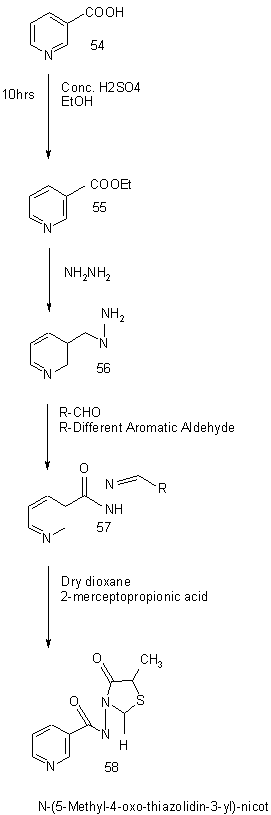
Figure 12

Figure 13

Figure 14

Figure 15

Figure 16

Figure 17

Figure 18

Figure 19

Figure 20

Figure 21

Figure 22

Figure 23
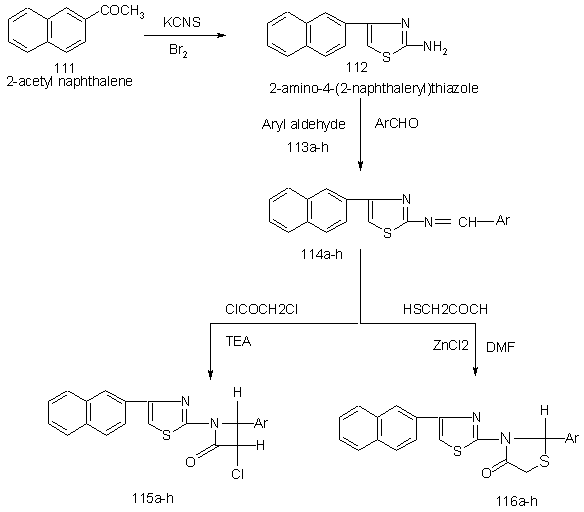
Figure 24

Figure 25

Figure 26

Figure 27

Figure 28

Figure 29

Figure 30

Figure 31

Figure 32

Figure 33

Figure 34

Figure 35

Figure 36

Figure 37

Figure 38

Figure 39

Figure 40
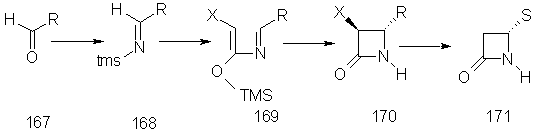
Figure 41

Figure 42

Figure 43
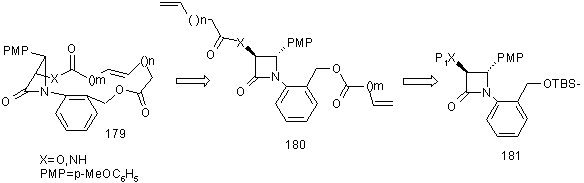
Figure 44

Figure 45

Figure 46

Figure 47

Figure 48

Figure 49

Figure 50

Figure 51

Figure 52

Figure 53

Figure 54
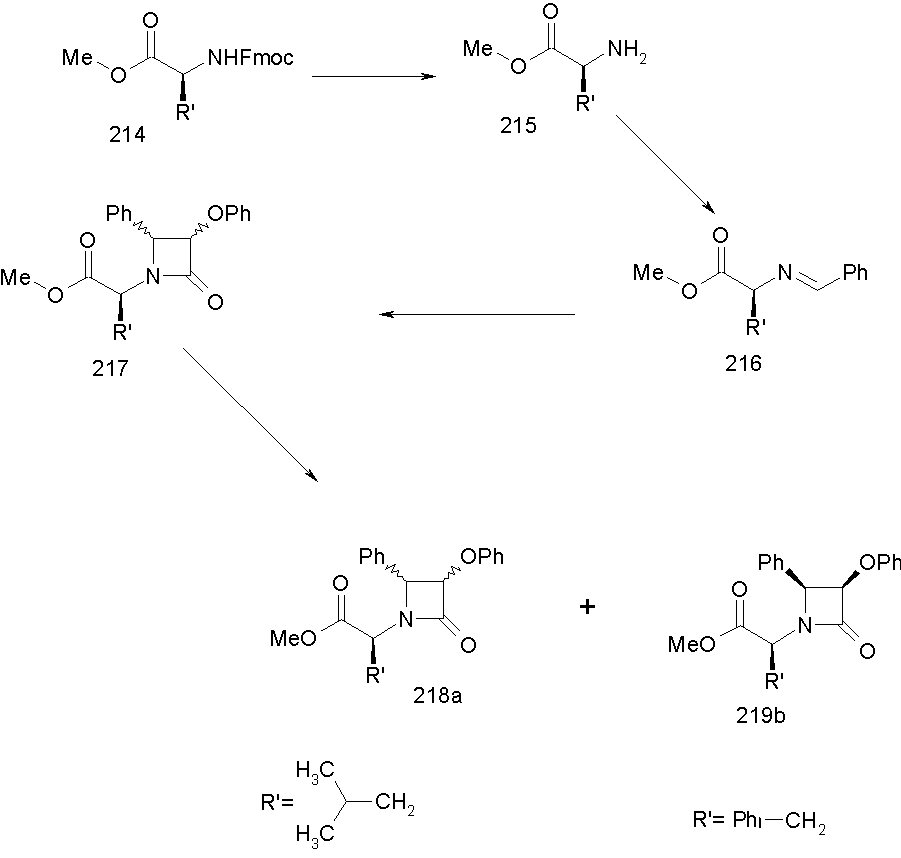
Figure 55

Figure 56

Figure 57

Figure 58

Figure 59

Figure 60

Figure 61

Figure 62

Figure 63
Keywords: thiazolidinone,β-lactam,thioglycolic acid,Schiffs bases, synthesis,condensation
World Journal of Organic Chemistry, 2013 1 (2),
pp 24-51.
DOI: 10.12691/wjoc-1-2-4
Received April 26, 2013; Revised August 20, 2013; Accepted September 25, 2013
Copyright © 2013 Science and Education Publishing. All Rights Reserved.Cite this article:
- Elkanzi, N. A. A.. "Short Review on Synthesis of Thiazolidinone and β-Lactam." World Journal of Organic Chemistry 1.2 (2013): 24-51.
- Elkanzi, N. A. A. (2013). Short Review on Synthesis of Thiazolidinone and β-Lactam. World Journal of Organic Chemistry, 1(2), 24-51.
- Elkanzi, N. A. A.. "Short Review on Synthesis of Thiazolidinone and β-Lactam." World Journal of Organic Chemistry 1, no. 2 (2013): 24-51.
| Import into BibTeX | Import into EndNote | Import into RefMan | Import into RefWorks |
1. Introduction
β-Lactams, being a structural unit found in the most widely used antibiotics [1], have occupied a basic position in medicinal chemistry for almost a century now. With the microbes basic position in medicinal chemistry for almost a century now. With the microbes responding to the traditional antibiotics through β-lactamases, the need for novel antibiotics prevails, making synthesis of newer β-lactams ever more important. In addition to their use as antibiotics, β-lactams are increasingly being used as synthons for other biologically important molecules [2-11][2]. β-Lactams have been found to act as cholesterol acyl transferase inhibitors [12], thrombin inhibitors [13], human cytomegalovirus protease inhibitors [14], matrix metalloprotease inhibitors [15], cysteine protease [16], and apoptosis inductors [17]. Moreover, thiazolidin-4-ones and their derivatives are an important class of compounds in organic and medicinal chemistry. The thiazolidin-4-one ring system is a core structure in various synthetic pharmaceutical agents, displaying a broad spectrum of biological activities such as, antitubercular [18], antibacterial [19], anti-HIV [20], anti-inflammatory [21], anti- histaminic [22], antifungal [23], anticancer [24] and analgesic [25].
2. Thiazolidinone
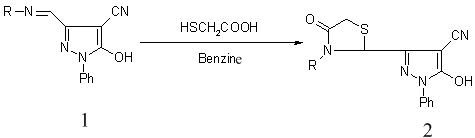
2.1. Synthesis from Cycloaddition Reaction of Thioglycolic Acid to Schiff’s BasesCycloaddition reaction of thioglycolic acid to the Schiff’s bases derivatives (1)a-d proceeded successfully. Thus, in boiling benzene thioglycolic acid was added to (1)a-d using a water separator to give thiazolidinone derivatives (2)a-d. Soleiman et al, 2002 [26].

 PowerPoint Slide
 Larger image(png format)


 PowerPoint Slide
 Larger image(png format)
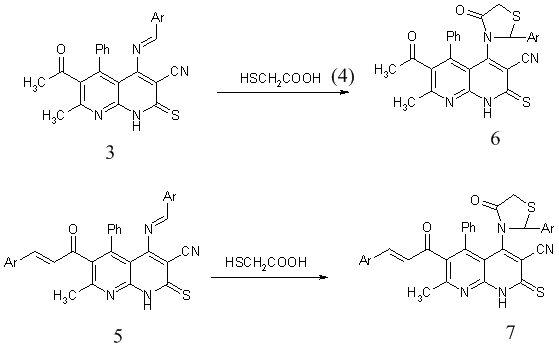
Reaction of the Schiff bases of 3 and /or5 with one mole of thioglycolic acid was proceeded smoothly to afford the corresponding thiazolidinone derivatives 6,7 respectively. Soleiman H.A. et al, 2002 [26].
It is interesting to mention that along with an efficient strategy for synthesis of new heterocyclic by cyclocondensation, reaction of compound (9) with chloroacetyl chloride produced the new compound (10) which is used for the synthesis of thiazolidinone (13). ELKanzi et al. , 2007 [27].
 to give thiazolidinone (13)) PowerPoint Slide
PowerPoint Slide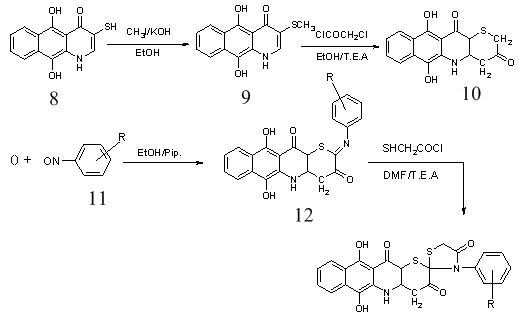 Larger image(png format)
Cycloaddition reaction of thioglycolic acid to the prepared Schiff’s bases (16)a-c in a mixture of ethanol and DMF in the presence of piperidine as catalyst and afforded thiazolidione derivatives (17)a-c. ELKanzi et al, 2007 [28].
a-c afforded thiazolidione derivatives (17)a-c) PowerPoint Slide
PowerPoint Slide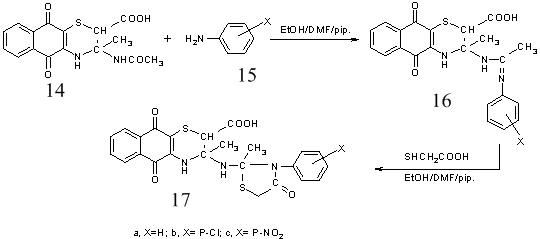 Larger image(png format)
 and treatment of thiosemicarbazone with benzyl give thiazolidinone derivatives (24)) PowerPoint Slide
PowerPoint Slide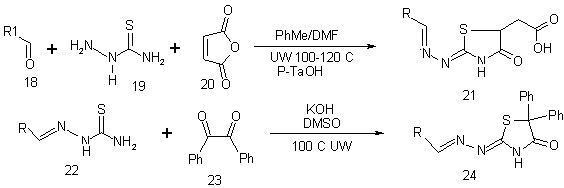 Larger image(png format)
A tandem method for the synthesis of 2-hydrazolyl-4-thiazolidinones (21) from commercially available materials in a 3-component reaction has been developed. The reaction connects aldehydes, thiosemicarbazides, and maleic anhydride, effectively assisted by microwave irradiation. The synthesis of a new type of compound, 2-hydrazolyl-5,5-diphenyl-4-thiazolidinone (24), obtained by treatment of thiosemicarbazone with benzyl in basic media is also reported. HOMO/LUMO energies, orbital coefficients, and charge distribution were used to explain the proposed reaction mechanism.CeciliaSaiz et al, 2008 [29].
2.3. Cyclocondensation of Schiff's bases with 2-mercaptopropionic Acid Afforded 4-Thiazolidinone DerivativesA series of 4-thiazolidinones and 2-azetidinones have been synthesized by condensation of 4,4'-diaminodiphenylsulphone with various aromatic or heterocyclic aldehydes to yield the Schiff's bases. Cyclocondensation of Schiff's bases with 2-mercaptopropionic acid afforded 4-thiazolidinone derivatives, and cyclocondensation of Schiff's bases with chloroacetylchloride in presence of triethylamine afforded 2-azetidinone derivatives.. All these compounds were evaluated for their in vitro growth-inhibitory activity against several microbes. Standard ampicillin against Bacillus subtilis.Mehta et al, 2006 [30].
) PowerPoint Slide
PowerPoint Slide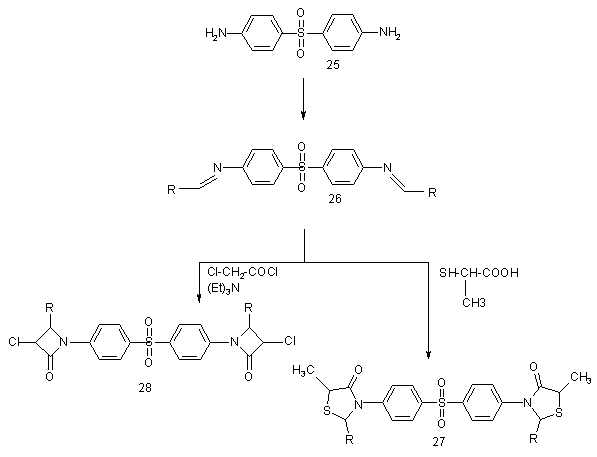 Larger image(png format)
-and aniline via an imine linkage follow by Knoevenagel condensation afford thiazolidinone derivatives 31) PowerPoint Slide
PowerPoint Slide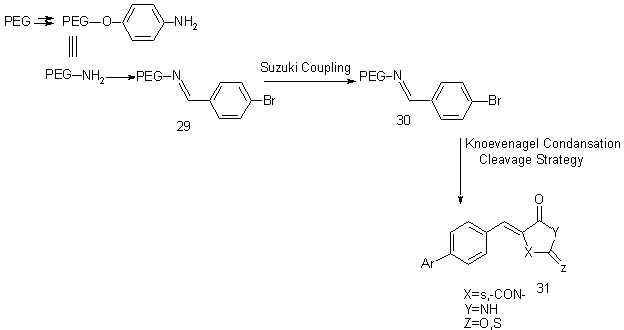 Larger image(png format)
An efficient method for the soluble polymer-supported synthesis of 5-arylidene thiazolidinones and pyrimidinones using aniline as a traceless linker was described. Aldehyde substrates were attached to the polyethylene glycol (PEG)-bound aniline via an imine linkage, and after the subsequent PEG-promoted Suzuki coupling reaction for the diversification, Knoevenagel condensation was readily employed as the cleavage strategy. Zhang Liu et al, 2008 [31].
2.5. Reaction of Schiff’s bases (35a-i) with Thioglycolic Acid2-Acetylnaphtho [2,1- b ] furan (32), obtained from 2-hydroxy-1-naphthaldehyde was converted into 2-bromoacetylnaphtho[2,1- b ]furan 33), which served as an intermediate for the synthesis of title compounds. The compound (33) was treated with thiourea to get 2-(2-aminothiozol-4-yl)naphtho[2,1- b ]furan (34), which produced 2-(2-arylideneaminothiozol-4-yl)naphtho[2,1- b ]furans (35 a-i) on reacting with various aromatic aldehydes. Schiff bases (35a-i) yielded 2-[2-(2-aryl-4-thiazolidinone)thiazol-4-yl] naphtho [2,1- b ]furans (36 a-i) on treating with thioglycolic acid. Compound (33) was reacted with different aromatic amines to obtain 2-(N-aryl-2-amino) acetylnaphtho [2,1- b ]furans (37a-k). Similarly reaction with substituted thiourea furnished 2-(2-N-arylaminothiazol-4-yl)naphtho[2,1- b ]furans (38a-k). All the newly synthesized compounds have been characterized by elemental analysis and spectral data, which have been screened for antimicrobial and anthelmintic activities. The selected compounds have been evaluated for antiinflammatory and diuretic activities.Vagdevi et al,2006 [32].
 with thioglycolic acid) PowerPoint Slide
PowerPoint Slide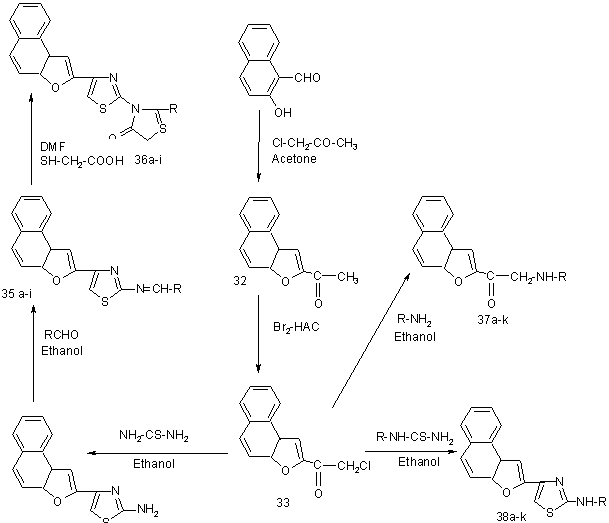 Larger image(png format)
The preparation of thiazolidin-4-ones by condensation of aromatic aldehydes, amines and mercaptoacetic acid in ethanol. The optimized procedure involved microwave irradiation of a mixture of amine hydrochloride, aldehyde and mercaptoacetic acid (molar ratio 1:2:3) in the presence of 1.25 equivalents of N,N-diisopropylethylamine39(DIEA) base in ethanol at 120°C for 30 minutes at atmospheric pressure. Kappe et al, 2004 [33].
) PowerPoint Slide
PowerPoint Slide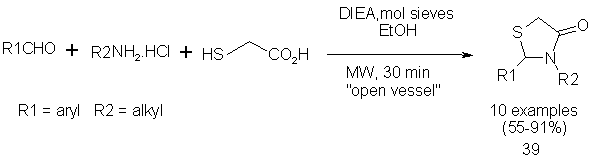 Larger image(png format)
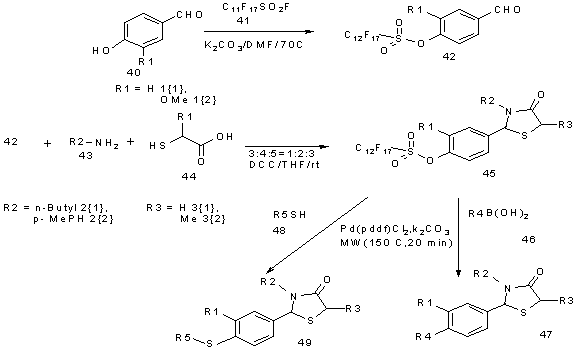
Synthesis of 2-aryl-substituted 4-thiazolidinone and 4-thiazinanone libraries as drug candidates. Fluoroussulfonate tag 42 was introduced and performed 41 functions during the syntheses: as a phase tag for the purification of intermediates 45, and as an activated leaving group for cross-coupling reactions to form the final products of the libraryBin Yan et al, 2008 [34].
 PowerPoint Slide
 Larger image(png format)
2-(4-Chloro-3-methylphenoxy)acetohydrazide (51)derived from ethyl 2-(4-chloro-3-methylphenoxy) acetate (50) was reacted with different aromatic aldehydes to yield N-(substituted benzylidiene)-2-(4-chloro-3-methylphenoxy)acetamide (52a-e). Cyclization of compound (52a-e) with thioglycolic acid yielded 2-(4-chloro- 3-methylphenoxy)-N-(4-oxo-2-arylthiazolidin-3-yl) acetamide (53 a-e). The newly synthesized compounds were characterized on the basis of spectral studies and evaluated for antibacterial and antifungal activities. Neeraj et al, 2009 [35].
 with thioglycolic acid yielded 2-(4-chloro- 3-methylphenoxy)-N-(4-oxo-2-arylthiazolidin-3-yl) acetamide (53 a-e)) PowerPoint Slide
PowerPoint Slide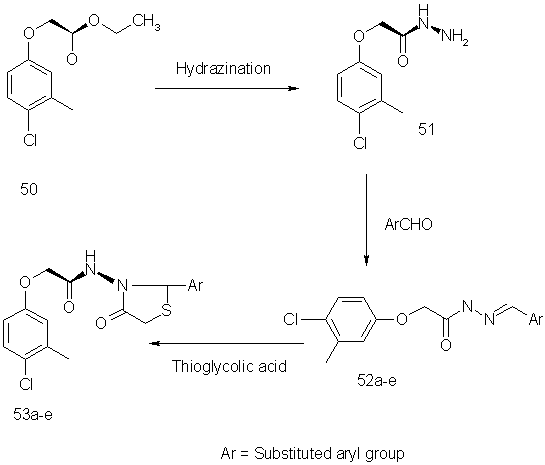 Larger image(png format)
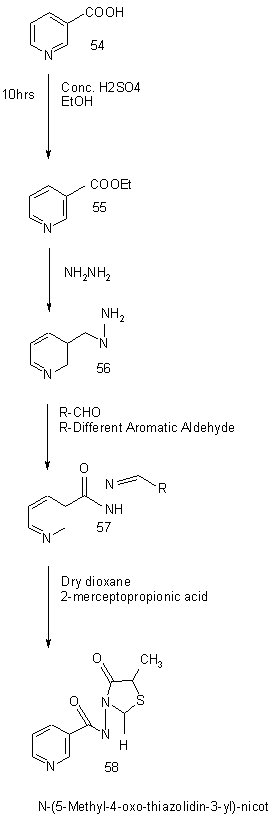
Nicotinic acid was refluxed with sulphruric acid and absolute alcohol for 10 h. and the mixture was cooled to the room temperature and poured on to the crushed ice. The mixture was then made strongly alkaline by the addition of ammonia solution. The resulting mixture was extracted with ether solvent. The ether was then distilled off and the resultant liquid was recovered. (55) Ethyl nicotinate was condensed with hydrazine hydrate by maintaining the reaction temperature of 0o. This resulted in solid nicotinic acid hydrazide. The resultant nicotinic acid hydrazide was recrystillised from warm ethanol. (56)Nicotinic acid hydrazide was refluxed were various aromatic / heterocyclic aldehydes in the presence of sulphuric acid for 6 h. The reaction mixture was then poured into the crushed ice. The resultant solid was washed with distilled water, dried in vacuum and recrystallised from warm ethanol. (57a-j) To a mixture of compound 57 in dry dioxane, a solution of 2-mercaptopropionic acid in dry dioxane was added and the reaction mixture was refluxed for 24 h. The reaction mixture was then poured into crushed ice. The separated solid was neutralized by sodium bicarbonate to remove excess of 2-mercaptopropionic acid. solid compound obtained was crystallized from ethanol to give thiazolidin derivatives (58a-j) Sharma et al, 2009 [36].
 PowerPoint Slide
 Larger image(png format)
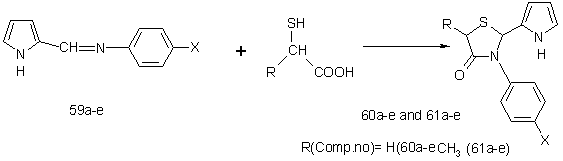
3-aryl-2-(2-pyrrolyl)-4-thiazolidinones, 60a-e and 5-methyl-3-aryl-2-(2-pyrrolyl)-4-thiazolidinones, 61a-e were obtained in good yields by refluxing equimolar amounts of the imines 59a-e and thioglycolic or thiolactic acids in dry benzene. FerayAydogan, et al, 2001 [37].
 PowerPoint Slide
 Larger image(png format)
4-Methylcoumarinyl- 7-oxyacetic acid hydrazide (62) reacted with arylazopropanes or hydrazono-3-oxobutyrate derivatives to form pyrazole (63a-c) and pyrazolone derivatives (65a-c). Heterocyclisation of Schiff’s bases with thioglycolic acid, thiomalic acid or acetic anhydride afforded novel heterocyclic derivatives 4-thiazolidinones (66a-c), 5-carboxymethyl- 4-thiazolidinones (67a-c) and oxadiazoles (68a-c), respectively. Some of the compounds showed promising antioxidant activity in vitro and cytotoxic activity against DLA cells and EAC cells.Manojkumar et al, 2009 [38].
, 5-carboxymethyl- 4-thiazolidinones (67a-c)) PowerPoint Slide
PowerPoint Slide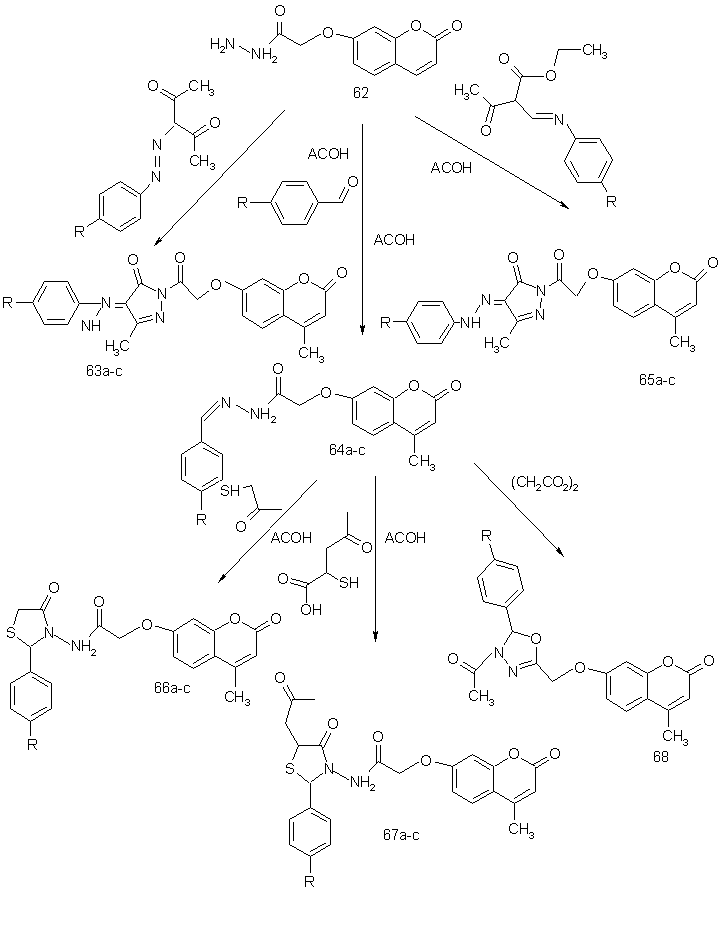 Larger image(png format)
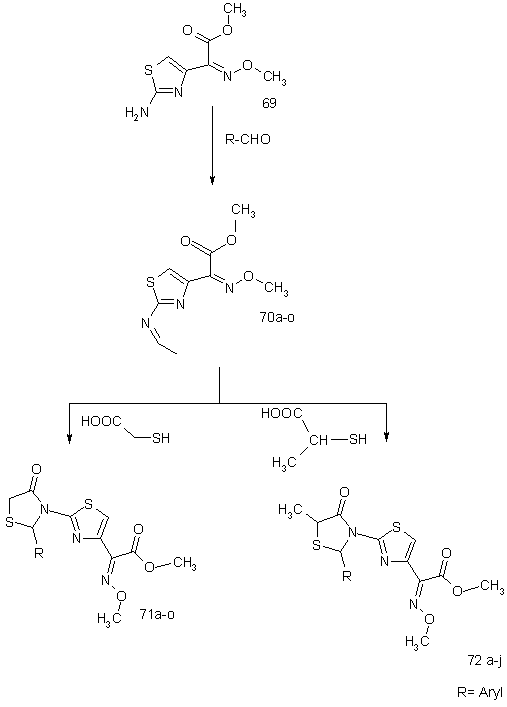
Substituted Schiff's bases 70a-o prepared by the treatment of 2-amino-4-(α-methoxyiminocarbomethoxymethyl)-thiazole 69 with different aromatic aldehydes, on cyclocondensation with mercaptoaceticacid and mercaptopropionicacid in dry benzene furnished desired thiazolidinones of type 71a-o and 72a-j, respectively. The structures of the compounds have been assigned on the basis of elemental analyses and spectral data. The products were evaluated for their in vitro growth inhibiting activity against several microbes. Some of the compounds showed significant antitubercular and antifungal activity Parekh et al.2004 [39].
 PowerPoint Slide
 Larger image(png format)
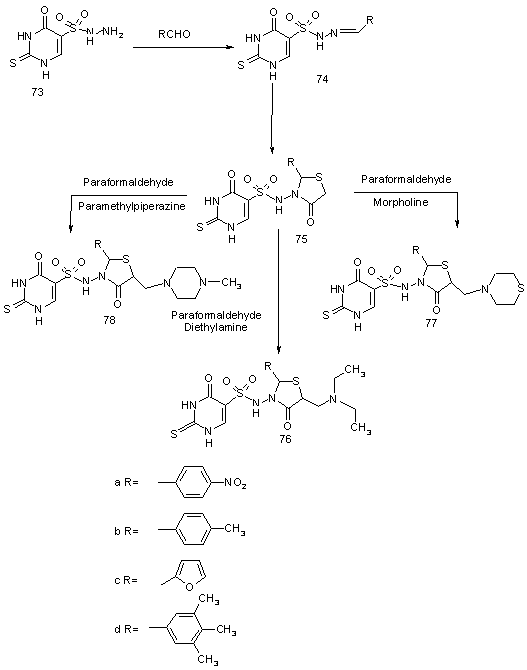
5-Substituted 4-oxo-2-thioxo-1,2,3,4-tetrahydropyrimidine were synthesized by interaction of 4-oxo-2-thioxo-1,2,3,4-tetrahydropyrimidine-5-sulfonylhydrazide with some aldehydes to give the corresponding Schiff’s bases, which after cyclization gave corresponding thiazolidinones. For some of the thiazolidinones, Mannich bases reaction was carried out. Mahmoud et al.2005 [40].
 PowerPoint Slide
 Larger image(png format)
The starting compounds 2-chloro-7-methoxy-3-formylquinoline24,25, was condensed with 3-amino-4-(phenyldiazenyl) phenol under microwave irradiation in one pot to furnish the compound 3-[(1E)-1-aza-2- (2-chloro-7-methoxy-3-quinolyl)-vinyl]-4-(aryldiaze- nyl) phenol 334 in good yield. Compound, 3-[(1E)-1-aza-2-(2-chloro-7-Methoxy- 3-quinolyl-vinyl]-4-(aryldiazenyl) phenol 79 upon cyclization with chloroacetylchloride and 2-mercapto acetic acid by microwave irradiation technique yields the title compound 80a-s and 81a-s, respectively in good yield Patel et al, 2008 [41].
-1-aza-2-(2-chloro-7-Methoxy- 3-quinolyl-vinyl]-4-(aryldiazenyl) phenol 79 with chloroacetylchloride and 2-mercapto acetic acid by microwave irradiation technique yields 80a-sand 81a-s) PowerPoint Slide
PowerPoint Slide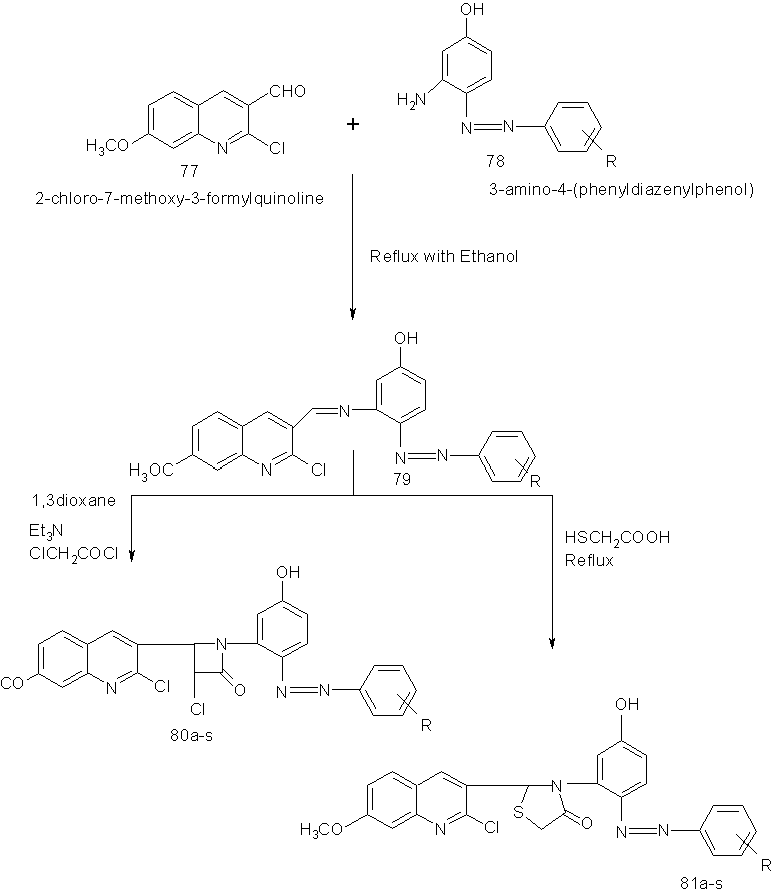 Larger image(png format)
The synthesis of 4-thiazolidinones 86a-j in a good yields from the heterocyclization reaction of 2-(benzothiazol-2-ylthio)-N'-benzylideneacetohydrazide85a-j with SHCH2COOH in DMF in the presence of a catalytic amount of anhydrous ZnCl2 under microwave irradiation is described and compared with conventional synthesis methods. Some of the new compounds were tested against bacteria (Gram- veandGram+ ve) and fungi. Desai et al.2006 [42].
-N'-benzylideneacetohydrazide85a-j with SHCH2COOH) PowerPoint Slide
PowerPoint Slide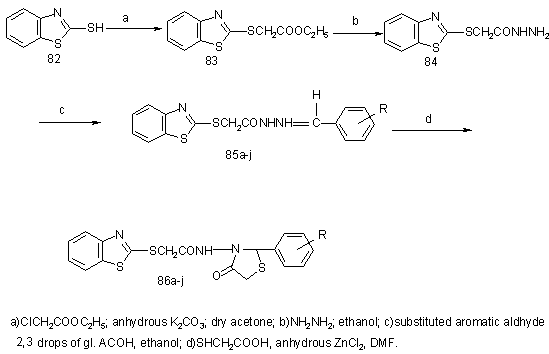 Larger image(png format)
Two regioisomer series, 2-(3-ethyl-4(3H)-quinazolinone-2-ylmercaptoacety-lhydrazono)-3-alkyl/3-aryl- 5-methyl-4-thiazolidinones (88) and 2-arylimino-3-(3-ethyl-4 (3H)-quinazolinone-2-ylmercaptoacetylamino)-5-methyl-4-thiazolidino-nes (89), were synthesized by the cyclization of 1-(3-ethyl-4(3H)-quinazolinone-2-ylmercapto-acetyl)-4-alkyl/aryl thiosemicarbazides (87) with ethyl 2-bromopropionate in the presence of anhydrous sodium acetate in anhydrous ethanolic medium. Aysel G¨URSOY et al, 2005 [43].
-quinazolinone-2-ylmercapto-acetyl)-4-alkyl/aryl thiosemicarbazides (87) with ethyl 2-bromopropionate to give thiazolidinone 88and 89) PowerPoint Slide
PowerPoint Slide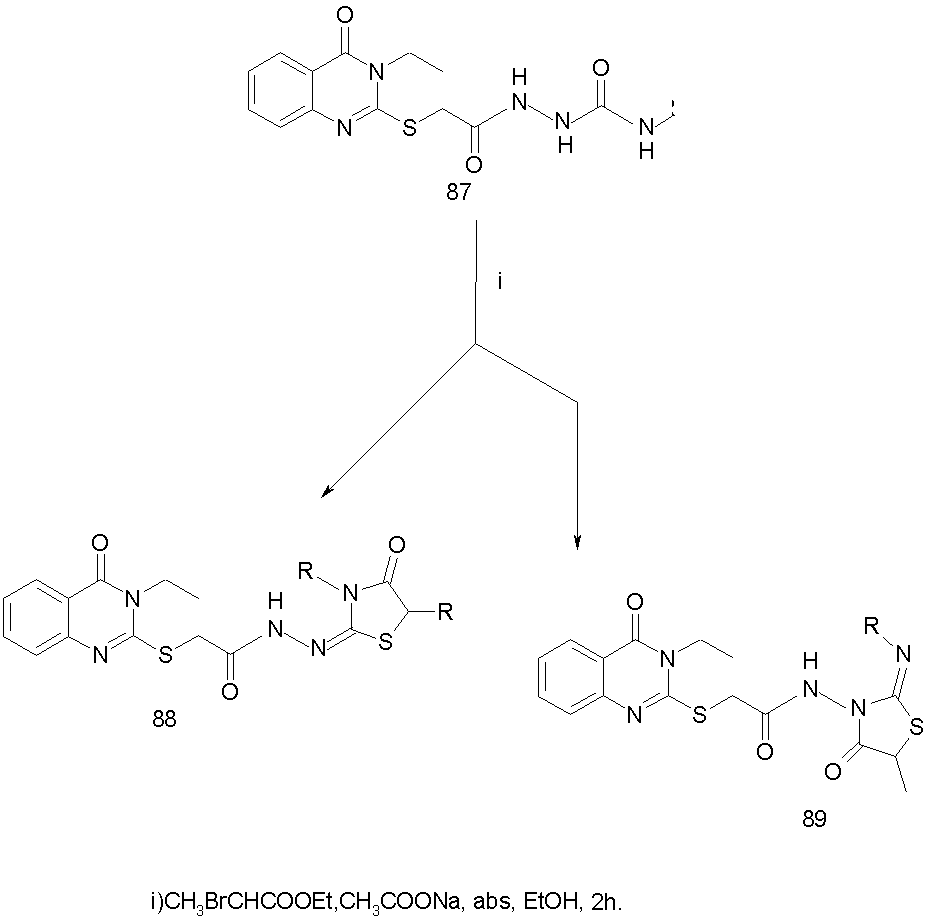 Larger image(png format)
4-Carbethoxymethyl-2-[(_-chloropropionyl-bromobutyryl-chloro-(phenyl) acetyl) aminothiazoles (91a-c) were synthesized by the reaction of 4-carbethoxymethyl-2-aminothiazole (90) with chloropropionyl chloride, bromobutyryl bromide and chlorophenylacetyl chloride, respectively, which were then refluxed with ammonium thiocyanate to obtain 5-substituted 2-[(4-carbethoxymethylthiazol-2-yl)imino]-4-thiazolidinones (92a-c). 92a-c were stirred with formaldehyde and various secondary amines to gain 15 novel compounds with the structure 5-substituted 5-(N,N-disubstituted aminomethyl)-2-[(4-carbeth-oxymethylthiazol-2-yl)imino]-4-thiazolidinones (93a-o)Altintas et al, 2005 [44].
imino]-4-thiazolidinones (92a-c) with formaldehyde and various secondary amines to give 93a-c) PowerPoint Slide
PowerPoint Slide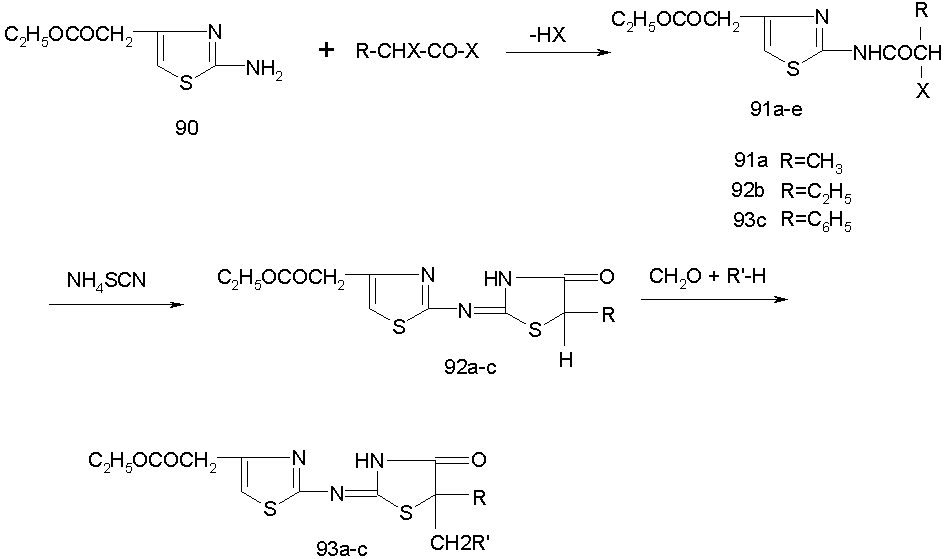 Larger image(png format)
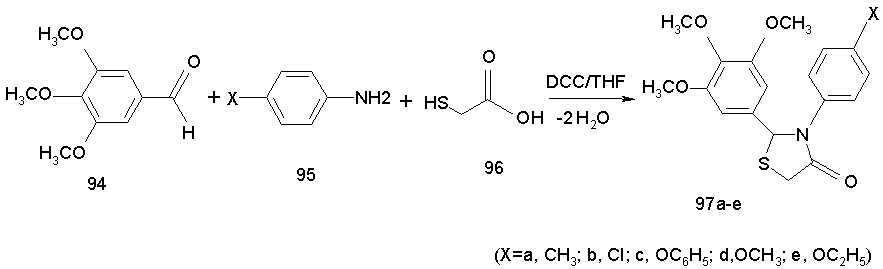
4-thiazolidinones 97a-e were synthesized by the Katticarbodiimide (DCC) mediated one-pot three component condensation reaction of an aromatic amine95, an aldehyde94 and a mercaptoacetic acid96.ZuhalTurgut et al. 2007 [45].
 PowerPoint Slide
 Larger image(png format)
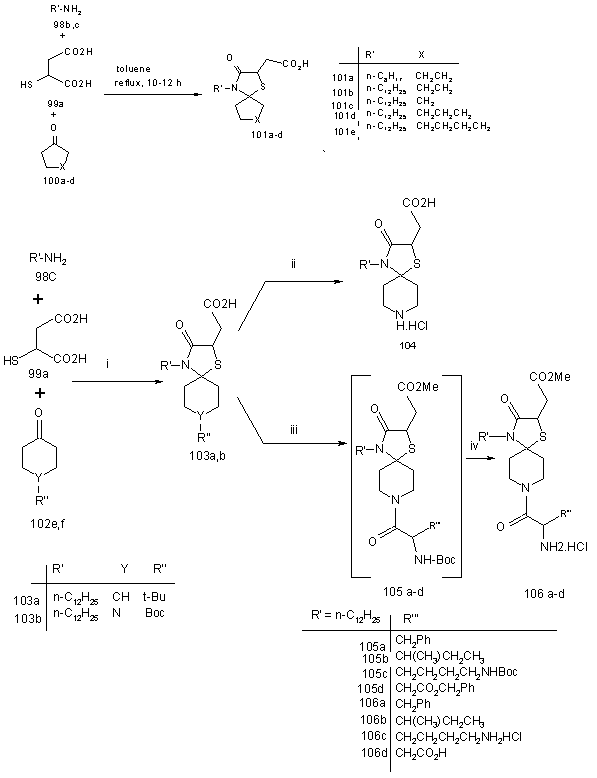
When the monoacids 99a,b were replaced by mercaptosuccinic acid 102c an interference of the additional carboxyl group with DCC was anticipated and therefore, a slightly different strategy was adopted. In this protocol, the synthesis of 1-thia-4-azaspiro[4.5]decan-3-ones 101a-e, 8-tert-butyl-1-thia-4-azaspiro[4.5]decan-3-one and N-Boc-protected 1-thia-4,8- diazaspiro[4.5]decan-3-one 103b was achieved by refluxing a mixture of amines 98b,c, mercaptosuccinic acid 99c and carbonyl compounds 100a-f in toluene for 10-12 hours.
Removal of the Boc group in 1-thia-4,8-diazaspiro[4.5]decan-3-one 103b with 20% hydrogen chloride/dioxane solution afforded the hydrochloride 104. TumulSrivastava et al, 2005 [46].
 PowerPoint Slide
 Larger image(png format)
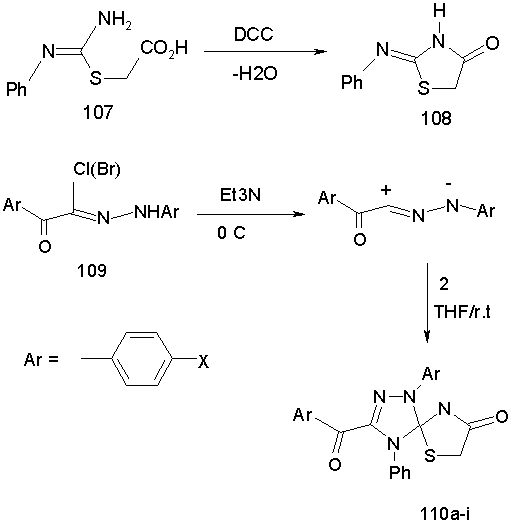
The 2-phenylimino-1,3-thiazolidin-4-one 108 was obtained by thermal cyclization of 4-amino-5- phenyl-3,5-thiaaza-4-pentenoic acid 107 using DCC as dehydration agent. Treatment of 2-phenylimino-1,3- thiazolidin-4-one 108 with various hydrazonoyl halides 109 (nitrilimines 4 precursor) yielded 6-aryl-9- phenyl- 8-substituted-1,4,6,7,9-thiatetrazaspiro-[4.4]non-7-en-3-ones 110a-l.
2.21. Synthesis from Schiff bases (114a-h)The 2-Amino-4-(2-naphthalenyl)thiazole112 was dissolved in ethanol and was reacted with aromatic aldehyde113 in the presence of piperidine to yield Schiff bases (114a-h). These Schiff bases on cyclo-condensation reaction with chloro acetyl chloride afford 2- azetidinone (115a-h) and with thioglycolic acid afford 4-thiazolidinone (116a-h) Mehta et al, 2006 [47].
 PowerPoint Slide
 Larger image(png format)
 with thioglycolic acid) PowerPoint Slide
PowerPoint Slide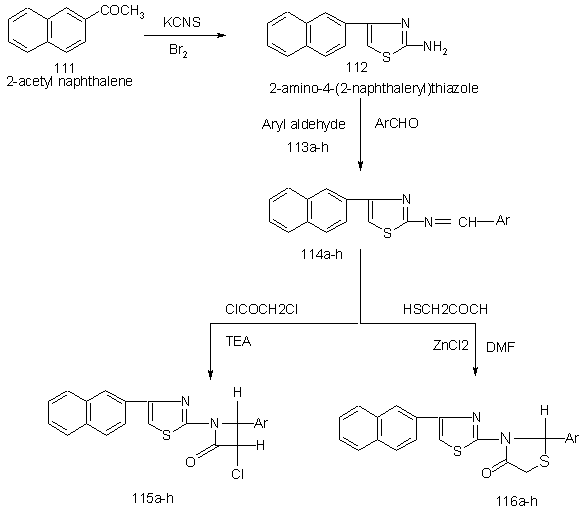 Larger image(png format)
Where Ar: (a) Phenyl, (b) 4-Methoxy Phenyl (c) 4-Hydroxy Phenyl (d) 2-Hydroxy Phenyl (e) 4-Methyl Phenyl (f) 3,4-Methylenedioxy Phenyl (g) 4-Hydroxy- 3-Methoxy Phenyl (h) 3,4-Diethoxy Phenyl.
3. Synthesis of β-lactam
3.1. Synthesis from α-diazo-acetamides:Preferential Rh(II) carbenoidintramolecular C-H versus O-H insertion derived from α-diazo-acetamides can be achieved in water by creating a large hydrophobic environment around the reactive carbenoid center using an appropriate combination of the catalyst and amide groups.Candeias et al, 2006 [48].
 carbenoidintramolecular) PowerPoint Slide
PowerPoint Slide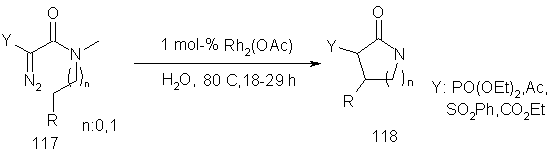 Larger image(png format)
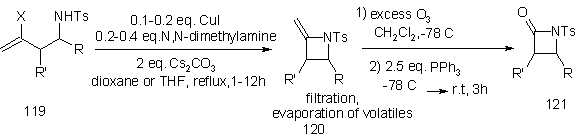
N-Tosyl-3-halo-3-butenylamines underwent efficient Ullmann-type coupling to afford 2-alkylideneazetidines, which could be readily converted to the corresponding β-lactams by oxidation with O3Lu et al, 2006 [49].
3.2. Synthesis from2-alkylideneazetidines
 PowerPoint Slide
 Larger image(png format)
A chiral N-heterocyclic carbene catalyzed the Staudinger reaction of arylalkylketenes with a variety of N-tert-butoxycarbonylarylimines to give the corresponding cis-β-lactams in good yields with good diastereoselectivities and excellent enantioselectivities.Zhang et al, 2008 [50].
 PowerPoint Slide
 Larger image(png format)
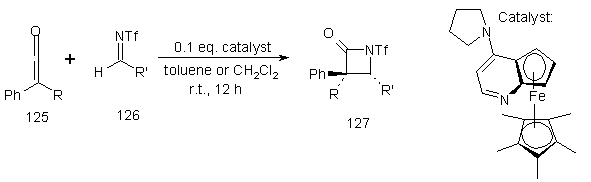
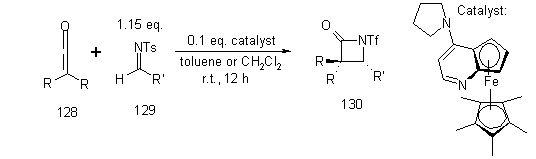
A catalytic enantioselective Staudinger reactions is described that preferentially furnish trans β-lactams. The use of an N-triflyl protecting group for the imine is crucial for the success of the reaction.Lee et al., 2005 [51].
 PowerPoint Slide
 Larger image(png format)
The Staudinger synthesis, an overall [2 + 2] cycloaddition of a ketene with an imine, provides a nicely convergent route to biologically and synthetically interesting β-lactams. A planar-chiral derivative of 4-(pyrrolidino)pyridine serves as a very effective enantioselective catalyst coupling a range of symmetrical and unsymmetrical ketenes with various imines with very good stereoselection and yield.Hodous et al, 2002 [52].
 PowerPoint Slide
 Larger image(png format)
The transformation of diazoketones to ketenes can be realized not only by utilizing photochemical reaction conditions but also under the action of microwave irradiation. In the presence of imines, the generated ketenes react further to afford β-lactams. Various trans-substituted β-lactams derived from amino acids have been prepared.Linder et al, 2001 [53].
 PowerPoint Slide
 Larger image(png format)
A practical methodology for the catalytic, asymmetric synthesis of β-lactams results from the development of a catalyzed reaction of ketenes (or their derived zwitterionicenolates) and imines using benzoylquinine as chiral catalyst and proton sponge as the stoichiometric base.Taggi et al, 2002 [54].
 PowerPoint Slide
 Larger image(png format)
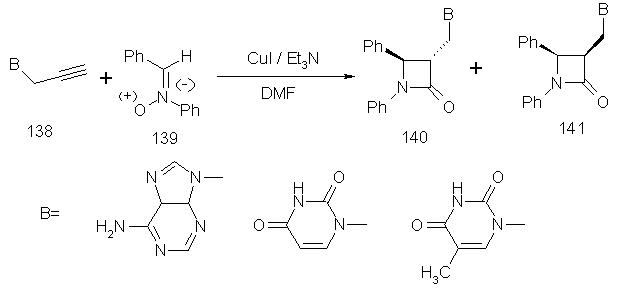
Several β-lactam nucleoside chimeras 140 (cis) and 141 (trans) were synthesized from the corresponding N-propargylnucleobases via Kinugasa reaction in moderate yields. Initial screening for antibacterial activity against ampicillin sensitive E. coli showed weak activity for the uracil-β-lactam chimera.AmitBasak et al, 2005 [55].
 PowerPoint Slide
 Larger image(png format)
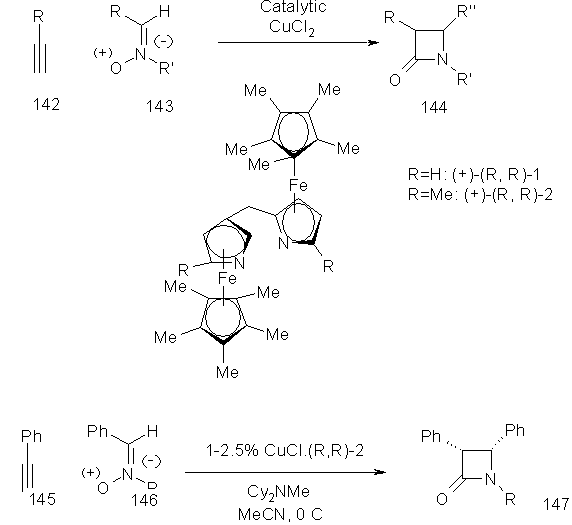
The group of Fu at MIT has improved a reaction known as the Kinugasa reaction, involving the cycloaddition of acetylenes with nitrones.
By using a copper catalyst and a bisazoferrocene ligand, high yields of the β-lactam product are produced. The process is generally cis selective, and is quite versatile, although some yields are only in the 40-60% range Lo et al2002 [56].
 PowerPoint Slide
 Larger image(png format)
2,4-Dimethyl-3-phenylisoxazole anhydrobases were easily prepared from the corresponding 5-chloroisoxazolium trifluoromethanesulfonate and carbon anions of 1,3-dioxo compounds in the presence of triethylamine. Photorearrangementof 2-(2,4-dimethyl-3-phenyl-2H-isoxazol-5-ylidene)malonic acid, diethyl ester gave a 4,5-dihydrofuroazetidinone in good yield. Donato et al, 2003 [57].
malonic acid, diethyl ester) PowerPoint Slide
PowerPoint Slide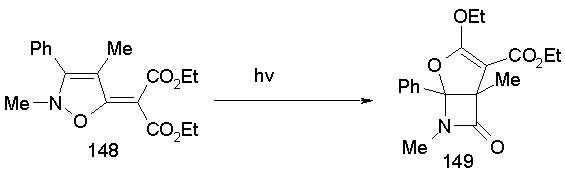 Larger image(png format)
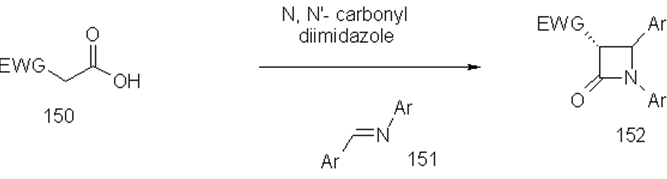
Reaction of N-acylimidazoles possessing an electron-withdrawing group in the α position with diarylimines produces β-lactams in high yields Moshe et al, 2006 [58].
 PowerPoint Slide
 Larger image(png format)
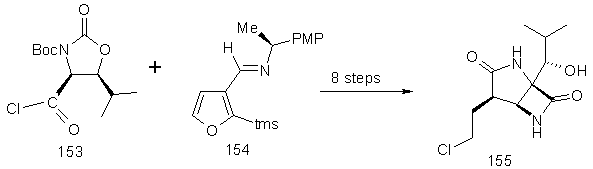
A new and effective proteasome inhibitor, β-lactam, has been accessed enantioselectively by multistep synthesis from the readily prepared intermediates and which were joined by a [2 + 2]-cycloaddition reaction to form the spiro β-lactam stereo selectively. The β-lactam is stable for many days in water at pH 7, in contrast to the natural β-lactones salinosporamide A (153) and omuralide (154). In common with 153 and 154, the β-lactam 155 effectively inhibits the mammalian proteasome Philip et al, 2005 [59].
 PowerPoint Slide
 Larger image(png format)
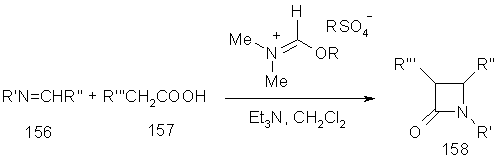
A number of 2-azetidinones were synthesized in good to excellent yields by a novel reaction between Schiff bases, substituted acetic acids and alkoxymethylene-N,N-dimethyliminium salts, the adduct formed from DMF and O-alkylating agents. The advantages of this new method are mild reaction conditions, low cost, avoiding the use of chlorinating agents and easy purification of the products. The best results were obtained when DMF and dimethyl sulfate were used at room temperature.Aliasghar et al, 2009 [60].
 PowerPoint Slide
 Larger image(png format)
A facile and efficient synthesis of substituted α-alkylidene-β-lactams have been developed via a NaOH-promoted intramolecularaza-Michael addition of α-carbamoyl, α-(1-chlorovinyl) ketene-S,S-acetals and subsequent nucleophilicvinylic substitution (SNV) reaction in alcoholic aqueous media. Yang et al, 2008 [61].
 ketene-S,S-acetals and subsequent nucleophilicvinylic substitution (SNV) reaction in alcoholic aqueous media) PowerPoint Slide
PowerPoint Slide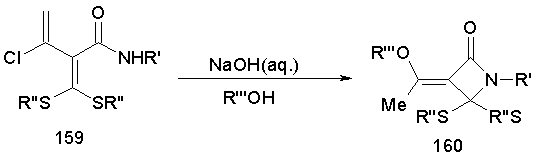 Larger image(png format)
Trans-disubstituted β-lactams show increasing utility and prominence in numerous pharmaceutical applications, making their asymmetric synthesis an attractive goal for chemists. We introduce an anionic, nucleophilic catalyst system that provides an efficient, diastereoselective route to trans-disubstituted β-lactams, a complement to our previously described catalytic methodology for generating the corresponding cis diastereomers. This catalytic, “switch mechanism” process allows for flexibility in the stereo selective synthesis of β-lactams, producing either cis or trans products as desired from the same substrates.Anthony et al, 2005 [62].
 PowerPoint Slide
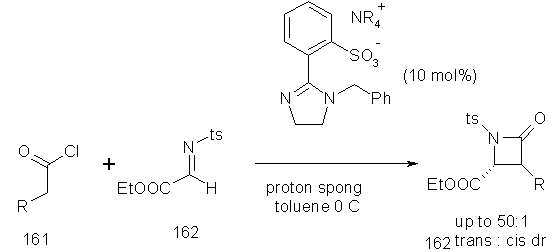 Larger image(png format)
[2+2] Carbonylative cycloaddition of chiral imines to various allyl halides, under CO pressure, in the presence of Et3N, a catalytic amount of Pd(OAc)2 and PPh3 as ligand, are carried out. Separable diastereomeric mixtures of chiral alkenyl-β-lactams are isolated with good yields and high Trans diastereoselections. Absolute configurations are assigned by X-ray measurements and 1H NMR spectroscopy. Luigino et al, 2004 [63].
 PowerPoint Slide
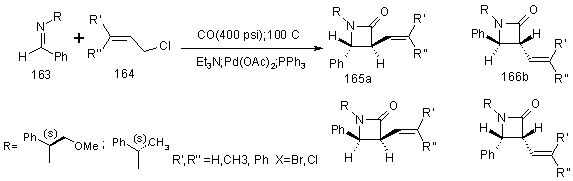 Larger image(png format)
Conrotatory ring closure of 1-halo-3-aza-4-alkyl-1,3-dienes in refluxing toluene gives rise to 3-halo-4-aryl-2-azetidinones in satisfactory yields. Dehalogenation of the resulting β-lactams by tris(trimethylsilyl)silane furnished 3-unsubstituted azetidinones, valuable intermediates in the synthesis of biologically active compounds. Elisa et al, 2000 [64].
 PowerPoint Slide
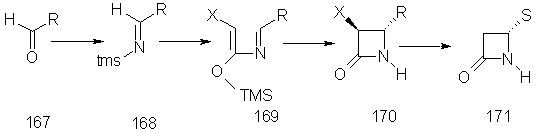 Larger image(png format)
Lawesson's reagent is found to be a unique reagent that provides a convenient route for the synthesis of β-lactams from Schiff's bases and alkoxy/aryloxy acetic acids. The process involves the formation of a titanium enolate of a mixed anhydride followed by condensation with imine to afford β-lactam. Sharma et al, 2004 [65].
 PowerPoint Slide
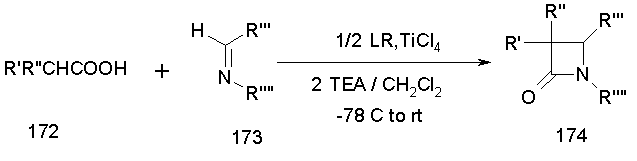 Larger image(png format)
The synthesis of pharmaceutically important α-hydroxy (or t-butyldimethylsilyl protected α-hydroxy)-β-lactams with functionalized chains in position 4 of the azetidinone ring. A convenient and high-yielding route to these compounds was developed and optimized. Preparation and characterization of several new enantiopure title compounds with various functional groups are discussed.Yan Yang et al, 2007 [66].
-β-lactams) PowerPoint Slide
PowerPoint Slide Larger image(png format)
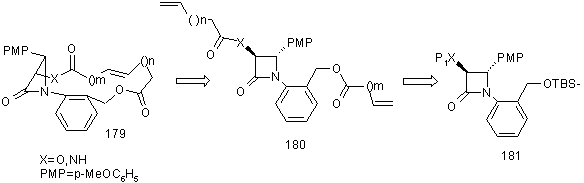
A new approach to N1-C3 bridged macrocyclic β-lactams has been developed. Orthogonal functional groups' protection combined with RCM has allowed the construction of the bicyclic systems bearing a β-lactam motif. These systems could represent a structural alternative to the actual lactamic antibiotics and may be further transformed into a broad variety of compounds.Miguel et al, 2008 [67].
 PowerPoint Slide
 Larger image(png format)
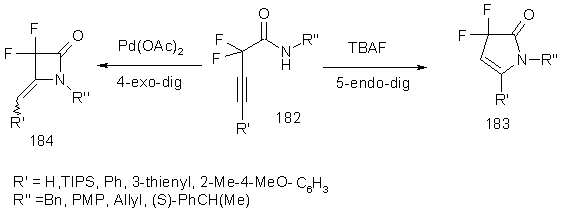
Functionalized gem-difluoro β- and γ-lactams were synthesized through a novel intramolecular hydroamination reaction of difluoropropargyl amides. β-Lactams were obtained via a Baldwin disfavored 4-exo-digonal cyclization using palladium acetate as the catalyst, whereas γ-lactams were produced under basic conditions. Acid hydration of γ-lactams produced ketoamides or hemiaminalsselectivelySantos et al, 2007 [68].
 PowerPoint Slide
 Larger image(png format)
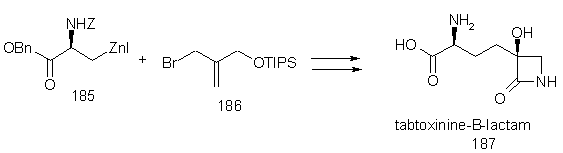
Synthesis of (−)-tabtoxinine-β-lactam 187, the cause of tobacco wildfire disease, was achieved from l-serine using a zinc-mediated coupling reaction, Sharpless asymmetric dihydroxylation and lactamization of N-OBn amide as the key steps HiromasaKiyota et al, 2004 [69].
 PowerPoint Slide
 Larger image(png format)
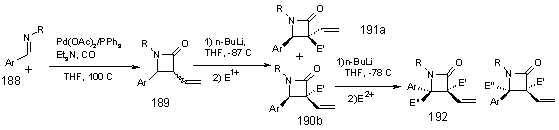
Novel polyfunctionalizedN-alkyl-β-lactams were prepared with high stereoselectivity in an efficient manner by a palladium-catalyzed [2+2] carbonylativecycloaddition of allyl bromide with heteroarylideneN-alkyl-amines The type of alkyl group linked to the nitrogen atom influences the reaction stereoselectivity. Moreover, the C-3 and the C-4 positions of the azetidinone ring can be further stereoselectively functionalized inserting various groups through the generation of a stable azetidinylcarbanion and then captured by various electrophilesLuiginoTroisi et al, 2008 [70].
 PowerPoint Slide
 Larger image(png format)
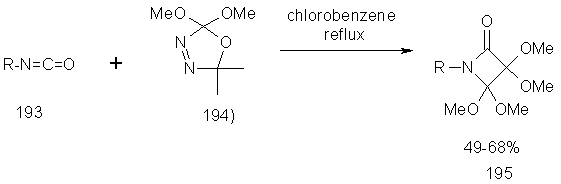
Highly substituted β-lactams have been isolated as the major product of the reaction of dimethoxycarbene with selected isocyanates. This reaction offers the potential for rapid access into a variety of highly functionalized species James et al, 2006 [71].
 PowerPoint Slide
 Larger image(png format)
The base-promoted cyclization of optically pure N-(p-methoxybenzyl)-N-(2-chloro)propionyl amino acid derivatives resulted in a diastereo- and enantioselective approach to valuable 1,3,4,4-tetrasubstituted β-lactams. The stereochemical outcome of the reaction is exclusively governed by the configuration of the N-(2-chloro)propionyl moiety. Paula Pérez-Faginas et al, 2007 [72].
-N-(2-chloro)propionyl amino acid derivatives) PowerPoint Slide
PowerPoint Slide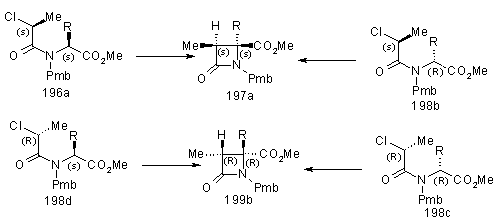 Larger image(png format)
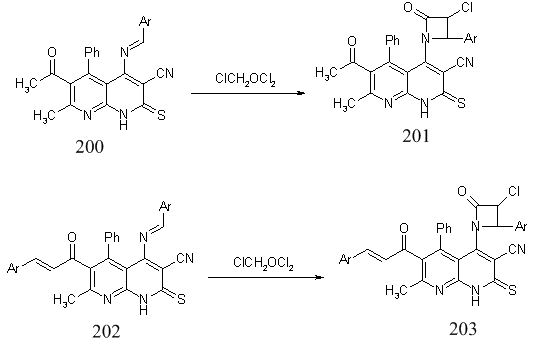
Further, reaction of the Schiff’s bases with one mole of chloroacetyl chloride in ethanol solution in the presence of triethylamine as catalyst leads to the β-Lactam derivatives 201,203.Soleiman et al, 2002 [26].
 PowerPoint Slide
 Larger image(png format)
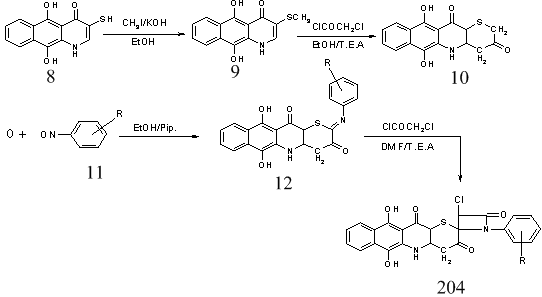
It is interesting to mention that along with efficient strategy for synthesis of new heterocyclic by cyclocondensation, reaction of compound (10) with different nitroso compounds 11 produced the new compound(12) which is used in synthesis of b-lactam (204). ELKanzi et al, 2007 [27].
 PowerPoint Slide
 Larger image(png format)
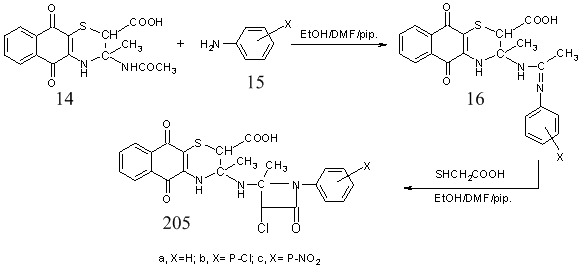
The reaction of 276 a-c with equimolar ratios of chloroacetylchloride in mixture of ethanol and DMF in the presence of piperidine catalyst afforded lactam derivatives (417). ELKanzi et al, 2007 [28].
 PowerPoint Slide
 Larger image(png format)
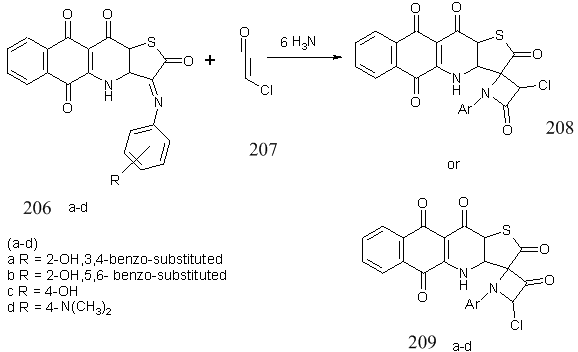
Compound (206a-d)underwent cycloaddition with chloroketone to give spiro lactam. The cycloaddition proceeded smoothly in dimethylformamide in the presence of triethylamine catalyst to afford (209 a-d). Khalafallah et al., 2006 [73].
 PowerPoint Slide
 Larger image(png format)
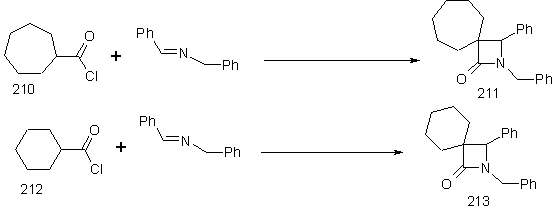
The spiro β-lactams 211 and 213 were prepared by reaction of either cycloheptyl acid chloride 210or cyclohexyl acid chloride 212 with imine, respectively (Scheme 92). In a typical procedure, the acid chloride was added to a stirred, refluxing solution of the imine and triethylamine in toluene. After refluxing the solution overnight and an aqueous work-up, spiro β-lactams 11 and 13 were obtained in moderate yields and trash amount of side products were detected in TLC. The spiro β-lactams 211 and 213 are the expected products of the [2+2] cycloadition reaction of imine with the cyclic ketenes intermediate. Sun Joo Oh et al , 2007 [74].
 PowerPoint Slide
 Larger image(png format)
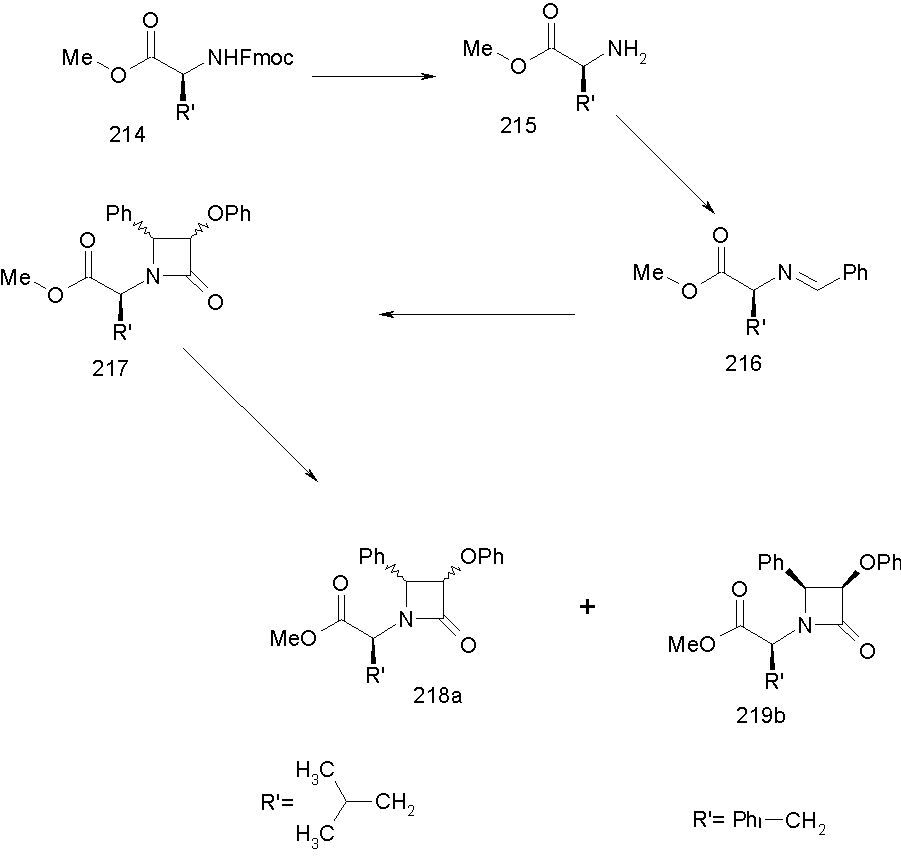
For immobilization of the starting material, Fmoc-aminoacid, both Wang resin as well as JandaJel resin were used. Wang resin consists of a basic structure of polystyrene cross-linked with divinylbenzene, and a 4-hydroxybenzyl group as linker. "JandaJel" resin (Toy and Janda, 1999) is an interesting alternative since polymer matrix is a polyestyrene resin cross-linked with 1,4-cis (vinylphenoxy)butane, which increases twice its swelling capacity with respect to common resins. This increase in swelling capacity implies a better contact between reagents and substrate linked to the resin. Then the amino group is deprotected, usually with 30% piperidine in DMF. The amino group release can be monitored by the Kaiser test (Kaiser et al, 1970). The amine linked to solid.
Support is transformed in an imine by condensation with an aldehyde in a 1% v/v AcOH solution. Afterwards, β-lactamic ring formation is carried out by the Staudinger methodology, which involves the reaction of imine linked to the solid support with a ketene, in situ generated from an acid chloride and triethylamine as base. Infrared spectrum of solid phase product shows a peak at approx. 1770 cm-1, accounting for a β-lactam carbonyl. Finally, resin separation depends on the linker that connects the polymer matrix and the substrate. In the case of using Wang resin, β-lactam is released using a 10% v/v trifluoracetic acid (TFA) solution in dichloromethane. The acid obtained was methylated with diazomethane. Pablo et al, 2007 [75].
 PowerPoint Slide
 Larger image(png format)
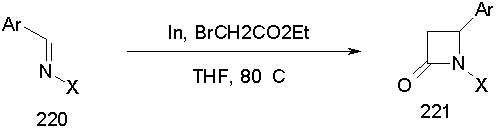
Reaction of various imines with ethyl bromoacetate in the presence of indium metal using anhydrous tetrahydrofuran as the solvent produced the β-lactams 221.Bimal et al, 2000 [76].
 PowerPoint Slide
 Larger image(png format)
BQ (223a) serves as an excellent shuttle base when added to the solution of phenylacetyl chloride 222c and 224 in toluene at low temperature; a yellow solution of phenylketene was formed along with a white precipitate over the course of a few minutes Imino ester 225a was then added to the solution at -78 C, and the characteristic ketene color disappeared over the course of 2 h to give cis-lactam 226c in 96% ee (65% yield,. In this reaction, BQ plays two distinct catalytic roles as a dehydrohalogenation agent and a nucleophilic catalyst. We obtained other â-lactams from a variety of in situ generated Andrew et al,2000 [77].
) PowerPoint Slide
PowerPoint Slide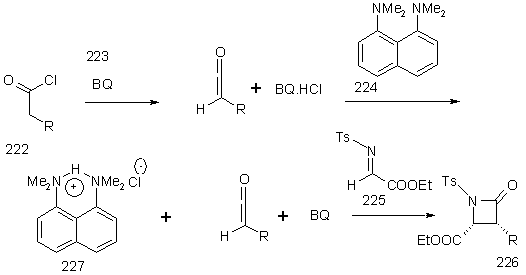 Larger image(png format)
Compound 228 (0.35g, 1mmol) was reacted with (4R)-phenyloxazolidylacetyl chloride 229(0.38g, 1.58mmol) in the presence of Et3N in CH2Cl2 for 24h to produce the 1,5-benzothiazepine-β-lactam. The triethylamine salt was removed by filtration, the CH2Cl2 solution was evaporated and the residue was purified by column chromatography (ethyl acetate/ petroleum ether = 1:2) to give product 230. The single crystal suitable for X-ray analysis was obtained by slowly evaporating an ethyl acetate-petroleum ether solution in the air. Zhang et al,2002 [78].
-phenyloxazolidylacetyl chloride 229(0.38g, 1.58mmol) in the presence of Et3N in CH2Cl2) PowerPoint Slide
PowerPoint Slide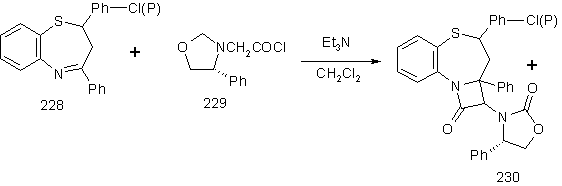 Larger image(png format)
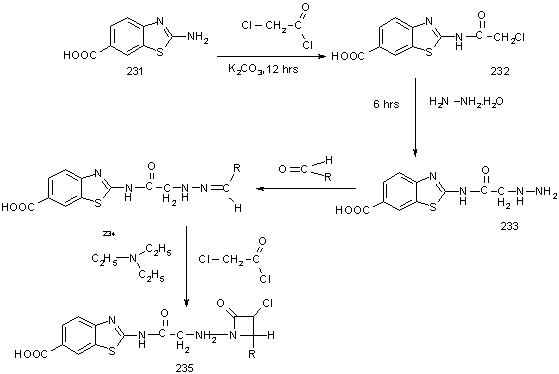
2-Aminobenzothiazole-6-carboxylic acid 231. This compound, on condensed with chloroacetyl chloride yielded 2-(2-chloroacetylamino) benzothiazole-6-carboxylic acid 232. Compound 232 on amination with hydrazine hydrate afforded 2-(2-hydrazinoacetylamino) benzothiazole-6-carboxylic acid 233. The condensation reaction of compound 233 with various aromatic aldehydes yielded 2-{2-[N’-(arylidene)hydrazino] acetylamino}- benzothiazole-6-carboxylic acids 234a-h. Compounds 234a-h, on reaction with chloroacetyl chloride in the presence of triethylamine underwent dehydrativeannulation to afford 2-{2-[3-chloro-2-(aryl)-4-oxoazetidin-1-ylamino]acetylamino} benzothiazole-6-carboxylic acids 235a-h. These reactions are summarized in.Ameya et al, 2007 [79].
 PowerPoint Slide
 Larger image(png format)
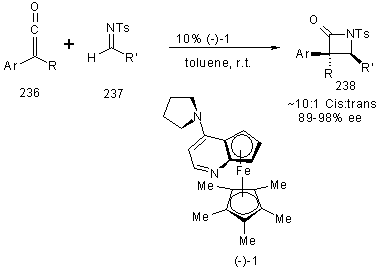
Only one method has been described for the diastereo- and enantioselective synthesis of R,R-disubstitutedâ-lactams through a catalytic asymmetric Staudinger reaction ; as indicated, this process preferentially affords the cis isomer Elaine et al, 2005 [80].
 PowerPoint Slide
 Larger image(png format)
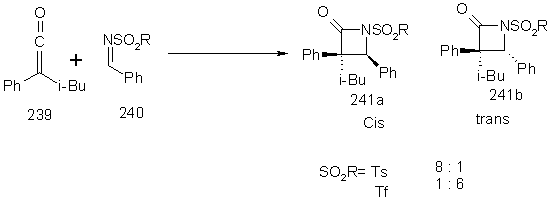
While attempting to improve upon the process illustrated in eq 1, we made the exciting discovery that the cis/trans selectivity of Staudinger reactions catalyzed by PPY derivative 1 (PPY) 4-(pyrrolidinopyridine) can be effectively controlled through the appropriate choice of the N-protecting group of the imine. Thus, ketenes couple with N-tosyl imines to predominantly generate cis â-lactams, whereas reactions with N-triflyl imines preferentially furnish the trans isomers Elaine et al, 2005 [80].
 PowerPoint Slide
 Larger image(png format)
Condensation of 3,3-diethoxy-2,2-dimethylpropionic acid ethyl ester 244 with p-anisidine245 gave 3-(4-methoxyphenylimino)- 2,2-dimethylpropionic acid ethyl ester 246, which was used in the following step without purification. Cycloaddition of 246 with the in-situ-generated acetoxyacetyl chloride253 in the presence of anhydrous triethylamine gave acetyl β-lactam 250(PMP = p-methoxyphenyl) in 53% yield after two steps.Yan et al, 2005 [81].
- 2,2-dimethylpropionic acid ethyl ester 246) PowerPoint Slide
PowerPoint Slide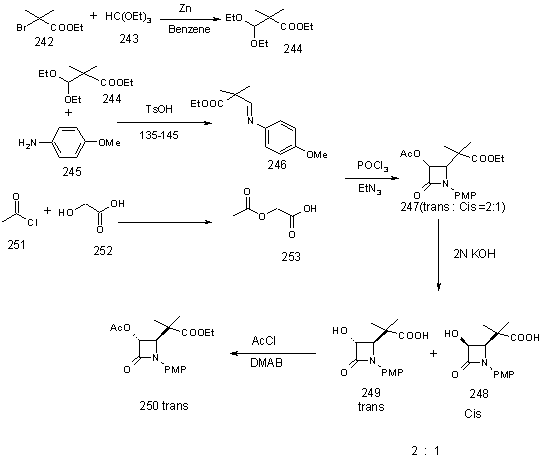 Larger image(png format)
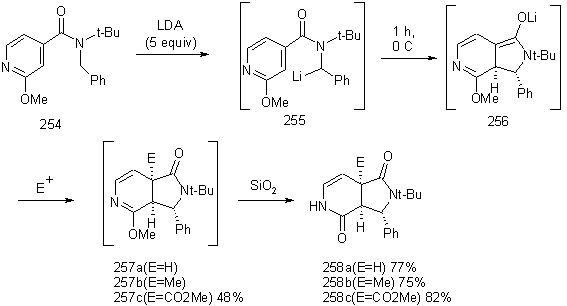
To establish the feasibility of cyclizing a lithiated benzyl group onto a pyridine ring, the isonicotinamide254 was made using standard methods and treated with excess LDA7 at 0°C. A red-brown organolithium was formed, presumably 255. Stirring for 1 h at 0°C and neutral workup yielded a product (258a) resulting from dearomatizing cyclization of 257 into the 3-position8 of the pyridine ring and protonation of the resulting enolate 258. Hydrolysis of the unstable amidate 258a on purification by chromatography on silica yielded the stable lactam 259a as a single diastereoisomer. Alkylating the enolate 258 with methyl iodide or acylating with methyl chloroformate gave, after hydrolysis, lactams 260b and 260c, respectively, as single diastereoisomers Jonathan et al, 2005 [82].
 PowerPoint Slide
 Larger image(png format)
4. Conclusion
In this review different method for synthesis of thiazolidinone and β-lactam were discussed like a series of 4-thiazolidinones and 2-azetidinones have been synthesized by condensation of 4,4'-diaminodiphenylsulphone with various aromatic or heterocyclic aldehydes to yield the Schiff's bases(26). Cyclocondensation of Schiff's bases with 2-mercaptopropionic acid afforded 4-thiazolidinone derivatives(27), and cyclocondensation of Schiff's bases with chloroacetylchloride in presence of triethylamine afforded 2-azetidinone derivatives(28).. All these compounds were evaluated for their in vitro growth-inhibitory activity against several microbes. Standard ampicillin against Bacillus subtilis.
References
| [1] | Southgate,R. Contemp. Org. Synth. 1994, 1, 417-431. | ||
 In article In article | CrossRef | ||
| [2] | Broccolo, F.; Carnally, G.; Caltabiano, G.; Cocuzza, C.E.A.; Fortuna, C.; Galletti, G.; Giacomini, P.D.; Musumarra, G.; Musumeci, R.; Quitavalla, J. Med. Chem. 2006, 49, 2804-2811. | ||
| In article | CrossRef PubMed | ||
| [3] | Alcaide, B.; Almendros, P.; Aragoncillo, C. Chem. Rev. 2007, 107, 4437-4492. | ||
| In article | CrossRef PubMed | ||
| [4] | Alcaide, B.; Almendros, P. Curr. Med. Chem. 2004, 11, 1921-1949. | ||
| In article | CrossRef PubMed | ||
| [5] | Deshmukh, A.R.A.S.; Bhawal, B.M.; Krishnaswamy, D.; Govande, V.V.; Shinkre, B.A.; Jayanthi, A.. Curr. Med. Chem. 2004, 11, 1889-1920. | ||
| In article | CrossRef | ||
| [6] | Alcaide, B.; Almendros, P. Synlett 2002, 381-393. | ||
| In article | CrossRef | ||
| [7] | Palomo, C.; Aizpurua, J.M.; Ganboa, I.; Oiarbide, M Synlett 2001, 1813-1826. | ||
| In article | CrossRef | ||
| [8] | Ojima, I. The Organic Chemistry of β-Lactams; Georg, G.I., Ed.; VCH: New York, NY, USA, 1993; pp. 197-255. | ||
| In article | |||
| [9] | Ojima, I. Acc. Chem. Res. 1995, 28, 383-389. | ||
| In article | CrossRef | ||
| [10] | O’Driscoll, M.; Greenhalgh, K.; Young, A.; Turos, E.; Dickey, S.; Lim, D.V. Bioorg. Med. Chem. 2008, 16, 7832-7837. | ||
| In article | CrossRef PubMed | ||
| [11] | Turos, E.; Reddy, G.S.K.; Greenhalgh, K.; Ramaraju, P.; Abeylath, S.C.; Jang, S.; Dickey, S.; Lim, D.V. Bioorg. Med. Chem. Lett. 2007, 17, 3468-3472. | ||
| In article | CrossRef PubMed | ||
| [12] | Dugar, S.; Yumibe, N.; Clader, J.W.; Vizziano, M.; Huie, K.; van Heek, M.; Compton, D.S.; Davis, H.R., J. Bioorg. Med.Chem. Lett. 1996, 6, 1271-1274. | ||
| In article | CrossRef | ||
| [13] | Han, W.T.; Trehan, A.K.; Wright, J.J.K.; Federici, M.E.; Seiler, S.M.; Meanwell, N.A. Bioorg. Med. Chem. 1995, 3, 1123-1143. | ||
| In article | CrossRef | ||
| [14] | Borthwick, A.D.; Weingarte, G.; Haley, T.M.; Tomaszewski, M.; Wang, W.; Hu, Z.; Bedard, J.; Jin, H.; Yuen, L.; Mansour, T.S. Bioorg. Med. Chem. Lett. 1998, 8, 365-370. | ||
| In article | CrossRef | ||
| [15] | Cainelli, G.; Galletti, P.; Garbisa, S.; Giacomini, D.; Sartor, L.; Quintavalla, A Bioorg. Med. Chem. 2003, 11, 5391-5399. | ||
| In article | CrossRef | ||
| [16] | Zhou, N.E.; Guo, D.; Thomas, G.; Reddy, A.V.N.; Kaleta, J.; Purisima, E.; Menard, R.; Micetich, R.G.; Singh, R. Bioorg. Med. Chem. Lett. 2003, 13, 139-141. | ||
| In article | CrossRef | ||
| [17] | Kazi, A.; Hill, R.; Long, T.E.; Kuhn, D.J.; Turos, E.; Dou, Q.P Biochem. Pharmacol. 2004, 67, 365-374. | ||
| In article | CrossRef | ||
| [18] | Shetgiri N. P. andChitre, A. D. Ind. J. Chem. 2006, 45(B), 1308. | ||
| In article | |||
| [19] | Omark., Geronikaki, A., Zoumpoulakis, P., Camoutsis, C., Soković, M., Ćirić A. and Glamočlija J., Bioorg. Med. Chem.2010, 18, 426. | ||
| In article | PubMed | ||
| [20] | Patel R. B., Desai P. S.; Desai K. R. and Chikhalia K. H., Indian J. Chem.. 2006, 45B, 773. | ||
| In article | |||
| [21] | Turgut Z., Yolacan C., Aydogan F., Bagdatli E., Ocal N., Molecules.2007, 12, 2151. | ||
| In article | CrossRef PubMed | ||
| [22] | Previtera T., Vigorita M. G., Bisila M., Orsini F., Benetolla F., Bombieri G., Eur. J. Med. Chem., 1994, 29, 317. | ||
| In article | CrossRef | ||
| [23] | Srivastava S., Jain A., and Srivastav S.a, J. Indian Chem. Soc. 2006, 83, 1118. | ||
| In article | |||
| [24] | Havrylyuk D., Mosula L. , Zimenkovsky B., Vasylenko O., Gzella A. and. Lesyk R. Eur. J. Med. Chem. 2010, 45(11), 5012. | ||
| In article | CrossRef PubMed | ||
| [25] | Vigorita M. G., Ottana R., Monforte F., Maccari R., Trovato A.; Monforte M. T. and Taviano M. F., Biorg. Med.Chem.Lett2001, 11, 2791. | ||
| In article | CrossRef | ||
| [26] | Soleiman, H.A.; Abdel-Latif, F.M; Khalil, M.A.;Elazab, 1.H., Phosphours, Sulfur and Silicon,2002,177,1001. | ||
| In article | CrossRef | ||
| [27] | ElkanziN.A.A.; SoliemanH.A and KhalafallahA.K., Phosphorus, Sulfur, and Silicon, 2007,182: 1483-1496. | ||
| In article | |||
| [28] | ElkanziN.A.A.; and KhalafallahA.K.; Abu ELhamd, H. M. and Solieman A. S., Phosphorus, Sulfur, and Silicon, 2007,182: 1483-1496. | ||
| In article | |||
| [29] | Cecilia S., Chiara P., Eduardo M., Peter W. and S. Graciela S.M., Tetrahedron lett,2009, Vol.50, Issue 8. Pages 901-904. | ||
| In article | |||
| [30] | MehtaPD, SengarN P.S, SubrahmanyamE V.S, SatyanarayanaD, Indian Journal of Pharmaceutical Sciences, 2006,Vol.68 Issue.1, Page 103-106. | ||
| In article | CrossRef | ||
| [31] | Zhang L., Yue H., Wei Z., Lanping M., Jingya L., Xin W., Jia L. and JingkangS., J. Comb. Chem., 2008,10 (5), pp 632-636. | ||
| In article | CrossRef PubMed | ||
| [32] | VagdeviHM, VaidyaVP, LathaKP, PadmashaliB, Indian Journal ofPharmaceutical Sciences,2006, Vol.68, Issue 6, pages 719-725. | ||
| In article | |||
| [33] | Miller M.J., Biswas A. and Krook M.A; Tetrahedron,2008,39, 2571, 1983. | ||
| In article | |||
| [34] | Kappe, C. O. "Controlled Microwave Heating in Modern Organic Synthesis", Angew. Chem. Int. Ed. 2004, 43, 6650. | ||
| In article | CrossRef PubMed | ||
| [35] | Bin Yan,Hongyu Z.,AifengL.,XifengM.,WeiF.,WeiZ., J. Comb. Chem.,200810 (2), pp 303-312. | ||
| In article | |||
| [36] | Neeraj K. F., a, Vijender S., Mohammad S. Y. and Mohammad A., ActaPoloniaePharmaceuticaDrug Research,2009, Vol. 66 No. 2 pp. 141-146. | ||
| In article | |||
| [37] | SharmaM. C., SahuN. K., KohaliD. V., ChaturvediS. C., Smita. Sharma, Digest Journal of Nanomaterials and Biostructures, 2009, Vol.4, No.1,pp.223-232. | ||
| In article | |||
| [38] | FerayAydogan, NüketÖcal, ZuhalTurgut, and CigdemYolacan, Bull. Korean Chem. Soc. 2001, Vol. 22, No. 5. | ||
| In article | |||
| [39] | ParameswaranM.Thengungal K. RAVI G.S.Acta Pharm.2009,59, 159-170. | ||
| In article | |||
| [40] | Parekh.H.H;ParikhK.A., ParikhA.R. J.ScienceIslamicRepublicof Iran,, 2004 ;15(2), 143-148. | ||
| In article | |||
| [41] | Mahmoud M. B., AmanyS.M., Mogeda.H., Andreas R., Omar A. M. F., Arch Pharm Res,2005,Vol 28, No 9, 1002-1012. | ||
| In article | |||
| [42] | PatelJ., Miatry BD., Desai KP, Indian J. of chemistry2008,vol. 47B,,pp.1695-1700. | ||
| In article | |||
| [43] | Desai KG, Desai KR J Sulfur Chemistry; 2006,27(4): 315-328. | ||
| In article | CrossRef | ||
| [44] | Aysel G., Nalan T., Turk J Chem.,2005, 29, , 247 -254. | ||
| In article | |||
| [45] | Altinas H.,Ozonum A., SeherB., IrieksozMoltem U.D.S., GultenOtUk, TurkJ.Chem.,2005,29,425-235. | ||
| In article | |||
| [46] | Zuhal Turgot, CigdemYolacan, FerayAydogan, EmineBagdatli andNuketOcal, Molec.,2007. | ||
| In article | |||
| [47] | TumulS., Anil K. GaikwadW., SudhirSinha, and Setu B. K., ARKIVOC,2005,(ii) 120-130,2005. | ||
| In article | |||
| [48] | patelK.H.,.MehtaA.GE-Journal of Chemistry,2006,Vol. 3, No.2, pp 103-109. | ||
| In article | |||
| [49] | CandeiasN. R., GoisP. M. P., AfonsoC. A. M., J. Org. Chem.,2006, 71, 5489-5497. | ||
| In article | CrossRef PubMed | ||
| [50] | LuH., LiC., Org. Lett,2006,8, 5365-5367. | ||
| In article | PubMed | ||
| [51] | A.-R. Zhang, L. He, X. Wu, P.-L. Shao, S. Ye, Org. Lett., 2008,10, 277-280. | ||
| In article | PubMed | ||
| [52] | LeeE. C., HodousB. L., BerginE., ShihC., FuG. C., J. Am. Chem. Soc., 2005,127, 11586-11587. | ||
| In article | CrossRef PubMed | ||
| [53] | LinderM. R., PodlechJ., Org. Lett.,2001,3, 1849-1851. | ||
| In article | CrossRef PubMed | ||
| [54] | Taggi, A. E., Hafez, A. M., Wack, H., Young, B., Ferraris, D. &Lectka, T.. J. Am. Chem. Soc. 2002,124, 6626-6635. | ||
| In article | CrossRef | ||
| [55] | AmitB. and Runa P., Bioorganic & Medicinal Chemistry Letters, 15 April 2005, Vol.15, Issue 8, Pages 2015-2018. | ||
| In article | |||
| [56] | Lo MCM,J Am ChemSoc,2002, 124, 4572. | ||
| In article | CrossRef PubMed | ||
| [57] | DonatoD., StefaniaF. and Fabio P., Tetrahedron lett., 22 December 2003, Vol. 44, Issue 52, Pages 9247-9250. | ||
| In article | CrossRef | ||
| [58] | Moshe Nahmany and ArtemMelman, J. Org. Chem., 2006, 71 (15), pp5804-5806. | ||
| In article | |||
| [59] | Philip C. H. and CoreyE. J., J. Am. Chem. Soc., 2005,127 (44), pp15386-15387. | ||
| In article | CrossRef PubMed | ||
| [60] | AliasgharJarrahpour and MaaroofZarei, Tetrahedron lett., 8 April 2009, Vol.50, Issue 14, Pages 1568-1570. | ||
| In article | |||
| [61] | Yang Y., Dexuan X., Xiaoliang Z., Yongjiu L., Jie H. and Dewen D., Tetrahedron, 26 May 2008, Vol.64, Issue 22, Pages 4959-4966. | ||
| In article | CrossRef | ||
| [62] | Anthony W., Ciby J. A., Thomas L., Org. Lett.,2005, 7 (16), pp3461-3463. | ||
| In article | |||
| [63] | LuiginoT., Luisella D. V., CatiaG., TullioP.,EmanuelaP., Tetrahedron, 2 August 2004, Vol.60, Issue 32, Pages 6895-6900. | ||
| In article | |||
| [64] | Elisa B., Gianfranco F., Giorgio M., Mauro P., Giovanni P.,Org. Lett., 2000,2 (8), pp 1077-1079. | ||
| In article | CrossRef | ||
| [65] | Sharma. S. D. and SeemaKanwar, Org. Proc. Res. Dev.,2004, 8 (4), pp658-659. | ||
| In article | |||
| [66] | Yan Y., Jianmei W., Margaret K., Tetrahedron Asymmetry, 4 September 2007,Vol. 18, Issue 17, Pages 2021-2029. | ||
| In article | |||
| [67] | Miguel A. Sierra, M. R.F., María J. M., Luis C., Mar G.G., Tetrahedron, 29 September 2008, Vol.64, Issue 40, Pages 9592-9598. | ||
| In article | |||
| [68] | Fustero S., Fernández B., Org. Lett.,2007, 9, pp. 4251-4253. | ||
| In article | CrossRef PubMed | ||
| [69] | HiromasaKiyota, TakafumiT., Masatoshi S., Osamu N., Takayuki O.,ShigefumiKuwahara, Tetrahedron lett., 25 October 2004, Vol. 45, Issue 44,, Pages 8191-8194. | ||
| In article | |||
| [70] | LuiginoT., CatiaG. and EmanuelaP., Tetrahedron, 15 December 2008, Vol. 64, Issue 51, Pages 11632-11640. | ||
| In article | |||
| [71] | James H. R., JeanC. B., Patrick J. B., Stephanie R., ShyamaS., and Mary J. H., Org. Lett.,2006, 8 (14), pp 3121-3123. | ||
| In article | CrossRef PubMed | ||
| [72] | Paula P.F., Fran O., Aisling O., Carlos G.A., Mercedes M.M, JesúsM.P. V., TeresaM. G.L., Rosario G.M.,Org. Lett.,2007, 9 (8), pp1593-1596. | ||
| In article | CrossRef PubMed | ||
| [73] | KhallafallahA.K., ElkanziN.A.A., SoleimanH.A. and YounisM., phosphorus, sulfur and silicon, 2006,181-2483-2508. | ||
| In article | |||
| [74] | Sun Joo Oh, Ki-Hoon Jung, Byung-Hyun Moon, and ChuljinAhn, Bull. Korean Chem. Soc., 2007,Vol. 28, No. 7. | ||
| In article | |||
| [75] | Pablo C. Duché and Ernesto G. Mata., Molecular MedicinalChemistry, January-April 2007, vol 12, 67-69. | ||
| In article | |||
| [76] | Bimal K. Banik,AnjanGhatak and Frederick F. Becker, J. Chem. Soc., Perkin Trans.2000, 1,, 2179-2181. | ||
| In article | |||
| [77] | Andrew E. Taggi, A. M. Hafez, HaraldW.,Brandon Y., William J. Drury, III, and Thomas Lectka, J. Am. Chem. Soc., 2000,122, 7831-7832. | ||
| In article | |||
| [78] | Zhang P.,Xu L.J. Yuan, Chinese J. Struct. Chem., 2002, Vol. 21, No. 2, 133-135. | ||
| In article | |||
| [79] | Ameya A. Chavan and Nandini R. Pai, Molecules 2007, 12, 2467-2477. | ||
| In article | CrossRef PubMed | ||
| [80] | Elaine C. Lee, Brian L. Hodous, Enda Bergin, Crystal Shih, and Gregory C. Fu, J. AM. CHEM. SOC. 2005, 127, 11586-11587. | ||
| In article | CrossRef PubMed | ||
| [81] | Yan Yang, Fengyun Wang, Fernande D. Rochon, and Margaret M. Kayser, Can. J. Chem.,, 2005, Vol. 83, 28-36. | ||
| In article | CrossRef | ||
| [82] | Jonathan Clayden, Stuart D. Hamilton, and Rukhsana T. Mohammed, Org. Lett, 2005,Vol. 7, No. 17,3673-3676. | ||
| In article | CrossRef PubMed | ||

 CiteULike
 Mendeley
 StumbleUpon
 Delicious
 Facebook
 Twitter
 LinkedIn
 Print
Print