sciepub.com
 Quick Submission

Laboratory Practices and Investigative Cases: Establishing Relationships with Knowledge
Welington Francisco1, , Anna Maria Canavarro Benite2
1Department of Exact Sciences and Biotechnology, Federal University of Tocantins, Gurupi, Brazil
2Institute of Chemistry, Federal University of Goiás, Goiânia, Brazil
Abstract
This study presents a learning experience involving an investigative case experimentation, which is based on Bernard Charlot’s concept of relationship with knowledge to analyze the learning process of students. The activity was planned in the discipline of Instrumental Analytical Chemistry with the participation of sixteen students of the Environmental Chemistry course of the Federal University of Tocantins, Gurupi, Brazil. We applied participatory research to conduct the activity and to gather narratives for data collection. The analysis of the narratives allowed us to uncover the relationship with knowledge that prevails during the resolution and to analyze the appropriation of chemical knowledge present in the case, whichever the description and explanation of the phenomena or chemical processes, since the level of appropriation of knowledge among students differs according to their relationship with themselves after taking part in the activity.
Keywords: relationships with knowledge, chemical learning, investigative case, experimentation
Copyright © 2017 Science and Education Publishing. All Rights Reserved.Cite this article:
- Welington Francisco, Anna Maria Canavarro Benite. Laboratory Practices and Investigative Cases: Establishing Relationships with Knowledge. World Journal of Chemical Education. Vol. 5, No. 2, 2017, pp 71-77. http://pubs.sciepub.com/wjce/5/2/6
- Francisco, Welington, and Anna Maria Canavarro Benite. "Laboratory Practices and Investigative Cases: Establishing Relationships with Knowledge." World Journal of Chemical Education 5.2 (2017): 71-77.
- Francisco, W. , & Benite, A. M. C. (2017). Laboratory Practices and Investigative Cases: Establishing Relationships with Knowledge. World Journal of Chemical Education, 5(2), 71-77.
- Francisco, Welington, and Anna Maria Canavarro Benite. "Laboratory Practices and Investigative Cases: Establishing Relationships with Knowledge." World Journal of Chemical Education 5, no. 2 (2017): 71-77.
| Import into BibTeX | Import into EndNote | Import into RefMan | Import into RefWorks |
At a glance: Figures
1. Introduction
The investigative cases (IC) are examples of assessments of real-stories. The value of the case is in exploring the ability of people to develop actions as observers of the human nature. The teacher is a storyteller, while the students are the audience. Simplifying, the IC are stories with an educational message [1, 2].
Herreid [3] points out that a good case must: tell a story without an end; present dialogues between the characters; have an extension that does not tire the reader; stimulate the interest in the dilemmas; conquer the reader for the characters; be relevant to the reader; provoke conflict and force a decision-making process to solve it; have an educational role and permit generalizations. All these features allow inserting the students in the story, propelling them to solve the case, seeking the maximum possible information.
However, such features are not rules that must be followed faithfully to obtain good results. In general, the IC should encourage problem formulation, research, persuasion and should teach science so that students acquire an applicable and flexible knowledge of scientific content [4].
The IC highlight the process and encourage students to challenge and solve problems. They require scepticism, flexibility and the ability to see alternative approaches. In other words, they require heterogeneity in the acquisition and appropriation of knowledge and, consequently, their relationship with this knowledge.
Charlot [5, 6, 7] and the ESCOL team (Education, Socialization and Local Collectivity) point out that all knowledge acquired has relationship with the world, with other humans and with their own experiences (with oneself). Thus, Charlot [7] clarifies that:
The relationship with knowledge is the set of relations a subject establishes with an object, a "thought content", an activity, an interpersonal relationship, a place, a person, a situation, an opportunity, an obligation, etc., related somehow to learning and knowing – consequently, it is also a relationship with language, a relationship with time, a relationship with an activity in the world and about the world, a relationship with others and a relationship with yourself, as more or less able to learn such a thing in such a situation [7].
All these relationships with knowledge seek, in general, the identification of the story the subject treads during the learning process. It is in this journey of observing obstacles, advances, difficulties, challenges, that are identified the reasons of how learning does or does not occur and the reason for these results. Here is what Bernard Charlot called positive reading to support his notion of relationship with knowledge, to discuss the reasons that some students are in school failure. "This issue of the heterogeneity of the ways of learning is fundamental, allowing to contest the idea that there are deficiencies in students" [8], because what characterizes the subjects in the relationship with knowledge are the ways they relate with the world in which they live, with others to help them, and themselves, from their mobilization.
The concept of mobilization implies in a relationship of the subject to put him; herself in motion, or to use him/herself as a resource to perform an activity. It is by entering an internal dynamic; it is by their own resources in movement [5].
This movement is caused by different mobilizations, and the challenge to... is the main engine to do so. This means that the subjects are the centre of their own learning, because it depends on their own desire to do or do not learn. However, it is possible that something external, as a teaching resource (such as IC), the teacher or a specific activity, is able to trigger the desire to learn.
Why is the teacher essential in the learning process? The teacher must take a role in mobilizing the activities, because "paying attention to the mobilization of students leads to wondering about the internal engine of studying, i.e., it is what causes them to invest in the study" [8].
When the teacher proposes an activity involving investigative cases, the role as mobilizer starts in the development of the case. The origin of the case is from situations that approach the experience of the students or what they will experience later in the world, especially in the professional aspect, after finishing their studies. The idea is introducing the students to universes that allow the construction of other forms of relationship with the world, different from what they are accustomed. The mobilization of activities with IC is the challenge in solving the proposed dilemma.
The knowledge that students will appropriate during the resolution of the case results from the relationship with it, as well as from the relationship with family or friends, with teachers, with life experiences, with the help of books and magazines, of the internet. The students’ ways to acquire knowledge are called by Charlot [5] figures of learning, which are characterized by:
Object-knowledge: knowledge available in objects as books, monuments, works of art, cultural television programs, or embodied in other people;
Mastery of activities: related to activities that require the mastery of their own bodies as walking, swimming, cycling; or mastery of available gadgets, from the simplest to handle as a toothbrushes, to the most sophisticated to handle as a computers or driving a car;
Appropriation of emotional devices: knowledge associated with relational behaviours such as being supportive, being responsible, helping others, which involve the ways of interacting with themselves and with others.
Thus, the goal of this study is to analyse the learning of scientific and procedural contents on the technique of molecular absorption spectroscopy through the relationships with knowledge established using an IC experimentation.
2. Methodology
This research has elements of a participatory research, since it was born from the concern of the teacher with the concrete reality in the classroom, who tries to change it from facts, data and their sense in having the population involved [9].
This concrete reality involved sixteen students from the sixth period of the Environmental Chemistry course of the Federal University of Tocantins - Campus Gurupi, enrolled in the discipline of Analytical Instrumental Chemistry.
The activity was planned and drawn from the use of investigative case [1, 2, 3, 10, 11], grounded in the investigative trial as a guiding element and provider of information for the activity, because the students were required to collect data to solve the case. The activity was conducted in four steps with duration of eight classes of fifty consecutive minutes:
Delivery and reading of the case: a week before the practice class, the case was handed over to the students and read in the classroom for interpretation and clarification (the first two classes). It was required of the students a study of the situation proposed for discussion in the next week.
Discussion and organization for the practice class: this discussion took place one day before the practice class in the classroom (two more classes). Each student presented the acquired information and the main questions, for example, how would an experimental class be like and its procedures. The teacher was the mobilizer of the discussion, answering questions and selecting the information with the students to organize the performance of the practice.
Practical class: two 50-minutes classes were conducted in accordance with the previous discussion and the steps previously defined. The regent teacher guided the students on handling the equipment (spectrophotometer) and the students prepared solutions, performed the measurements and recorded data.
Post-lab discussion and resolution of the case: it was based on the results obtained; a previous lesson (the last two classes) served to discuss the main concepts related to the technique and to guide the interpretation of results. With the information and the concepts learned in the classroom, each student began writing the resolution individually. However, all were free to consult any person, including the regent teacher. The students had two weeks to deliver the resolution.
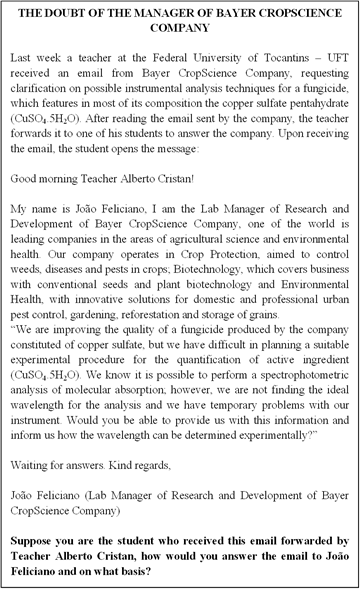
The IC was entitled "The doubt of manager of Bayer CropScience company" (Figure 1). The intention was to use experimentation to start and to end the discussion on the principles of the Molecular Absorption Spectroscopy (MAS) technique in the spectral region of the visible and ultraviolet.
 Download as

Data were obtained through narratives performed by the students. In these narratives, the students described the route used to resolve the case and explained the proposed solutions based on scientific concepts.
Narrative is a speech genre that presents an organizational text, expressed in the form of structured stories the experiences of temporality and personal actions developed by humans [12].
To represent the speeches of the students, they were identified by S1, S2, S3... to S16.
The analysis of the narratives (resolutions of cases) was based on the learning process of the students with the chemical knowledge involved in the IC under the framework of the relationship with the knowledge [5, 6, 7]. For this interpretation, four criteria were elaborated, underlying all learning in chemistry:
Accurate description of chemical concepts: it related to the way students use chemical concepts to address an object or phenomenon, highlighting the characteristics or properties of the constituents, but without presenting the chemical meaning of the terms.
Use of appropriate scientific terms: together with the description, this criterion sought to identify how students use scientific terms to describe the characteristics of the constituents.
Accurate explanation of chemical processes: it assessed how students establish relationships between phenomena and concepts, mentioning and using the theoretical models or causal mechanisms to make sense of these phenomena or chemical processes in the written language [13];
Accurate symbologies and chemical representations: which analysed the way that students use equations and chemical representations to support the explanations of phenomena.
These criteria seek to approach the understanding of the chemical nature, once that chemistry is a science that can be understood or taught at three levels: the macroscopic - which deals with visible and tangible properties; the microscopic - interpretation of phenomena in terms of distribution and rearrangements of atoms, ions and molecules; the symbolic - the description by graphical and mathematical representations, in addition to the chemical equations that bind the other levels [14].
3. Results and discussion
Table 1 shows the network of meanings present in the case, which corresponds to the main content of knowledge concerning the MAS technique, as well as the criteria to analyse the learning process of students. The acronym NA means not applicable to the established criteria and the numbers indicate the amount of students who could learn each network properly.
Table 1. Network of meanings present in the case and the criteria for analysis of the learning process of students (N = 16 students)


)



The first network of meanings is related to the figure of the domain “learning an activity”, in which the subject is enabled to use an object or a machine as a form of knowledge. The results show that all students have learned to handle the spectrophotometer, allowing the performance of chemical analysis during the experimental class.
The extract 1 shows some speeches of students highlighting the domain “equipment handling”, on learning how to perform the calibration and the reading scan:
EXTRACT 1
S3: [...] The cuvette was placed with the blank (distilled water) for calibration, eliminating the difference in background absorbance and then, promoting the real reading of absorbance of the solution.
S5: [...] The study provided the way in which the analysis would be performed, the instruments that would be used, how to operate the instrument, its limitations, the existing errors, the composition, among others.
S9: The scan was carried out by varying the wavelength 5nm at a time, and in every new wavelength, the instrument was calibrated.
The different speeches show that all the students learned how to calibrate the equipment (using a white solution called matrix without analyte) and to perform a scan reading (S9) during the analysis. At the same time, it was reported the importance of carrying out the calibration that consists in eliminating any absorption signal of another substance besides the analyte through the difference between sample and background absorption.
The domain of each step in the experiment represents a “self” who is engaged in a knowledge-object, i.e., a knowledge related to the subject’s mastery of the spectrophotometer. It is a “‘self’ immersed in a given situation, a ‘self’ that is body, perceptions, action system, in a correlated world of actions, as a possibility to act, as the value of certain actions, as an effect of the actions” [5]. Concerning the chemical content, this mastery of the machine is related to the self-realization of the analysis, because without it, it would not be possible to continue our activity.
The second network of meanings represents the overall objective of the activity. Two conceptual relationships are involved in this network: the relationship between the coloring properties of copper sulfate pentahydrate with the strategy to determine the spectral scanning range, exemplified in extract 2, and the importance of measuring the absorbance at the wavelength of maximum absorption, which provides the greatest sensitivity to absorption, present in extract 3:
EXTRACT 2
S1: [...] CuSO4.5H2O presents the color blue, which is the color transmitted, therefore, the absorbed complementary color is red, which is between 620 and 780nm, then we understand that, theoretically, in the range of those wavelengths there will be a greater absorbance of the substance.
S6: The solution CuSO4.5H2O is blue, therefore, it is possible to detect its absorbance by spectrophotometry molecular absorption in the visible region... The color blue is known as the complementary color transmitted, which results in the absorbance varying between yellow and red, hence the beginning of the spectral range at 580nm.
S9: The copper sulfate is blue, which means we can limit our work only to the visible region [...] Since the color that is transmitted is blue, it means the copper sulfate must absorb another color, that is, it must absorb a complementary color of the white radiation so that blue can be transmitted.
EXTRACT 3
S2: In general, to obtain greater sensitivity, Abs measurements are usually performed at λmax, since the change in Abs per wavelength unit is higher at this point.
S3: It was graphically observed the linear relation between absorbance, A, and the wavelength of ± 780nm that determines that the maximum absorption wavelength of CuSO4 is exactly 780nm.
S12: To obtain greater sensitivity, the absorbance measurements are usually performed at a wavelength corresponding to maximum absorption, because the change in absorbance per concentration unit is higher at this point.
The examples of S1 and S6 in the extract 2 are conceptually suitable because students can relate to the coloring property of copper sulphate pentahydrate (phenomenon description) with the theoretical and conceptual model involved in the chemical interpretation of the correct choice of the visible spectral range (beginning at the wavelength of red which is complementary to the transmitted color blue).
In the stretch “Since the color that is transmitted is blue, it means that copper sulphate must absorb another color” (emphasis added) in S9 , the use of the verb "must" does not establish the most appropriate relationship with the knowledge in question. The phenomenon of transmission of the color blue for copper sulphate is not associated with a need for absorption of a complementary color to blue, but with a result of the absorption of a specific wavelength range. If the transmission occurs in the spectral range corresponding to blue, it is because the absorption of radiation occurred in a region that is complementary to that, and not the opposite.
What it observed is a reversal in the attribution of chemical meaning because the student justifies the theoretical-conceptual model from the phenomenon and not the other way around. Thus, the chemical meaning does not establish a relationship between cause and consequence, resulting in a difficulty in the interpretation of scientific language, as pointed by Mortimer [15].
The domain of chemical language is a normativity of chemistry learning. It is the way that subjects represent the chemical knowledge. Therefore, the relationship with knowledge is also a relationship with language, because it is from this domain that the students create the relationship with the chemical world and the content of thought [8].
In extract 3, the passages S2 and S12 are conceptually correct in relation to the meaning and interpretation of the wavelength of maximum absorption. These students used correctly the scientific terms to describe the concept involved and they can assign the chemical meanings according to the theories and models supported, showing the dynamic learning process. Charlot [5] points out this process as "passing from significance to value", that is, when the subject’s relationship with knowledge also becomes a relationship with the desire to learn, combining the reason (study) and goal (learning).
However, in the speech of S3, there are some conceptual errors. The phrase “It was graphically observed the linear relation between absorbance, A, and the wavelength of ± 780nm” is at odds with the absorption spectrum constructed by the student. In fact, there is no linear relationship between absorbance and wavelength, but a sequence of values that vary according to the change of wavelength during scanning.
This example shows that the thought contents (that λmax refers to increased sensitivity to absorption) is not yet understood. The link between a network of meanings is known as the systematization of knowledge, which is necessary to approach to a particular concept as the “set of relationships it has with other concepts and not by a direct link to a referral” [8]. Then, while the student is not able to see the scientific relationships that are induced to this concept, the chemistry learning is not yet complete.
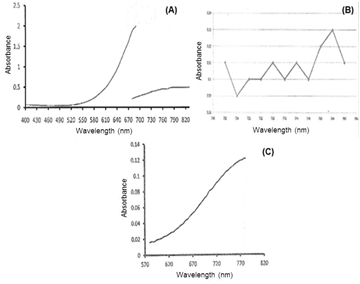
The network of meanings “Construction and interpretation of an absorption spectrum” includes the following chemical knowledge: the spectrum representation (graphic structure/format) and the information it provides (interpretation) about the sample (properties). Figure 2 represents the three different forms of representation of the absorption spectrum of CuSO4.5H2O made by students.
 Download as
Of the three graphical representations of the absorption spectrum, the spectra shown in (A) and (C) are properly outlined, when compared with what is accepted by the scientific community. However, these two graphs are still different.
Only in the graph (A) the students present the scan in all visible spectral region in order to check the behavior of the sample absorption and to find λmax. However, it was observed that there are two different mathematical functions on the same graph, with an open interval of 680nm, which is not suitable for the representation of an absorption spectrum.
This representation was due to the need to make a dilution of the sample solution during spectroscopic analysis, because at λ = 700nm, the value of absorbance exceeded the maximum extent of the spectrophotometer. Extract 4 exemplifies this situation:
EXTRACT 4
S1: [...] At the concentration of 0.4 mol.L-1, the absorbance reached its maximum detection level, as the wavelength of 700nm was not in the limit of the visible region, thus preventing the observation of the maximum Abs. With a dilution, the concentration was 0.04 mol.L-1, enabling the maximum absorbance of Cu2+ ions at 780nm.
A more appropriate representation for this situation would be to redo all absorbance readings at a lower concentration, since in all absorption spectra of any substance, the concentration of the solution should be specified. This idea is expressed in the following statement of one of the students, as well as the reasons for working with diluted solutions in MAS, considering the explanation of the distance between a molecule and the surrounding molecules in solution:
EXTRACT 5
S4: Our sample solution was very concentrated because when the readings reached 700nm, the maximum absorption was exceeded and thus we diluted the sample ten-fold [...] We continued the analysis where we stopped (700nm). However, the ideal it would have been to start again at a wavelength of 400nm.
S2: At high concentrations, the average distance between the molecules or ions responsible for the absorption decreases to the point that each particle affects the charge distribution of its neighbors. These solute-solute interactions may alter the ability of analytes to absorb a particular wavelength of radiation.
Although the representation is not adequate, it is worth highlighting the decision-making capacity to address the adverse situation during the experimental activity. This decision-making emphasizes the knowledge obtained in relation to chemical concepts involved in the technique, because without them it would not be possible to propose such a solution.
Since “the representations of knowledge appear as interpretation systems and are based on a network of meanings”5, these results indicate that students can establish relationship with the knowledge required for learning, because they observe the problem and propose a solution, even though the representation is not the most appropriate.
Graph (B) shows a linear relationship between the different absorbance values and the variation of wavelength. Conceptually, this representation is incorrect because the magnitude of absorbance does not establish a linear relationship with wavelength variations. The linear relationship occurs between the absorbance measured and the concentration of the sample, when working with λmax and with diluted concentrations, being expressed by the Beer-Lambert law.
This detachment between the representation of chemical knowledge (normativity) and the relationship with knowledge reveals gaps in the learning process. Charlot6 points out that it is necessary to the subject to adopt, for an intellectual activity, a position that meets the conditions of knowledge normativity, besides establishing relations with the world, with others and with him/herself to develop the knowledge appropriately.
In general, as there has not been a full mastery of chemical language, with its models of explanations allied to consistent symbology, these students have not yet appropriated the relations with particular knowledge of chemistry in this concept.
Still inserted in the fourth network, extract 6 presents some speeches related to the interpretation of absorption spectrum. An absorption spectrum shows the behavior of absorption of radiation of a substance in the ultraviolet and visible spectral regions [16]. The interpretation of an absorption spectrum allows the identification of the wavelength of maximum absorption, which all students were able to identify:
EXTRACT 6
S5: Therefore, the wavelength of maximum absorbance for the copper sulphate-based fungicide is 786nm.
S8: Through the spectrophotometric analysis, we conclude that the wavelength of maximum absorption was experimentally determined at 780nm in the visible region.
S15: The scan resulted in a graph called absorption spectrum that relates the wavelength for absorbance, where the highest point is considered to be the wavelength of maximum absorption (λmax = 780nm).
For the last network of meanings, the quantitative data in Table 1 show that all students learned the chemical knowledge intrinsic to the network. This knowledge mainly involve the interval that defines the spectral region of the visible (400 to 780nm), which highlights the importance of colors. Extract 7 brings these understandings:
EXTRACT 7
S2: The main characteristic of absorption in the visible region is the color. Based on this information, CuSO4.5H2O analysis can be performed at a wavelength of 400 to 780 nm, which includes the visible region.
S12: The visible region comprises wavelengths between 400nm and 800nm. As the copper sulphate transmits the color blue, it is expected it absorbs a complementary color, which may be yellow, orange or red [...], i.e., between 580nm and 800nm.
According to the discourse above, it is observed that the students understood that a substance is only colored if it is interacting with visible radiation. Furthermore, they were also able to establish the relationship between color and wavelength ranges, which is a microscopic and symbolic way to explain why there are different colors in nature.
The speeches of S2 and S12 reveal the mastery of the chemical concept of complementary colors. When students write for example “As the copper sulphate transmits the color blue, it is expected it absorbs a complementary color, which may be yellow, orange or red [...], i.e., between 580nm and 800nm”, the understanding of complementarity is concrete. In this situation, the subject is part of this set of chemical meanings, not only being part of this world, but appropriating the world, building up, i.e., "the subject is the relationship with knowledge" [5].
4. Conclusion
The use of investigative cases provides active and challenging learning for students. Active because it brings a problem situation in which students should enter the story, interpret the facts and make decisions to solve the problem. Challenging because these cases tease the students, telling stories that have a context closer to them.
Furthermore, the relationship with knowledge made during the resolution of the case have increased the discussion time in the classroom and engaged students in the activity. This allowed a greater diversity of chemical knowledge and narrowed the relationship between problem and object of knowledge for students, culminating in the promotion of learning of the scientific concepts involved.
In terms of learning, the results mark out the boundary between “success” and “failure” in chemical learning, exactly how the notion of relationship with knowledge explains. Those students had more relationships with knowledge during the activity, including relationship with the world, with others, with themselves, with time and with language, in search of constant mobilization, obtaining more fruitful results in the process of learning.
We also observed a diversity of conceptually correct assignments made by the students in the various networks of meanings for the analysis of learning. These results indicate both the understanding ability of chemical knowledge and the reflection chemical meaning in producing the written statements, which stresses once more the efficiency of chemical learning.
Specifically in chemistry teaching, the thinking of chemical knowledge and the representation of chemical knowledge is to seek the explanation of the microscopic phenomena of transformation of matter through chemical language (normativity). Therefore, the learning process only happens when the students move from non-possession to possession (or from the non-mastery to mastery) of the representation of chemical knowledge, independent of the choice of the expression of the knowledge acquired.
References
| [1] | Herreid, C.F., Start with a story: the case study method of teaching college science, NSTA Press, Arlington, USA, 2007. | ||
 In article In article | |||
| [2] | Herreid, C.F., “What is a case? Bringing to science education the established teaching tool of law and medicine,” Journal of College Science Teaching, 27 (2), 92-94, Nov.1997. | ||
| In article | |||
| [3] | Herreid, C.F., “What makes a good case?,” Journal of College Science Teaching, 27 (3), 163-169, Jan. 1998. | ||
| In article | |||
| [4] | Waterman, M.A., “Investigate case study approach for biology learning,” Journal of College Biology Teaching, 24 (1), 1-13, Abr.1998. | ||
| In article | |||
| [5] | Charlot, B., Da relação com o saber: elementos para uma teoria, Artmed, Porto Alegre, Brazil, 2000. | ||
| In article | PubMed | ||
| [6] | Charlot, B., Os jovens e o saber: perspectivas mundiais, Artmed, Porto Alegre, Brazil, 2001. | ||
| In article | PubMed | ||
| [7] | Charlot, B., Relação com o saber, formação dos professores e globalização: questões para a educação hoje, Artmed, Porto Alegre, Brazil, 2005. | ||
| In article | |||
| [8] | Charlot, B., Da relação com o saber às práticas educativas, Cortez, São Paulo, Brazil, 2013. | ||
| In article | |||
| [9] | Freire, P., Criando métodos de pesquisa alternativa: aprendendo a fazê-la melhor através da ação. In: Brandão, C.R. Pesquisa participante, 8 ed., Brasiliense, São Paulo, Brazil, 2006, 34-41. | ||
| In article | PubMed | ||
| [10] | Herreid, C.F., “‘Clicker’ cases: introducing case study teaching into large classrooms,” Journal of College Science Teaching, 36 (2), 43-47, Oct. 2006. | ||
| In article | |||
| [11] | Herreid, C.F., “Case study teaching,” New Directions for Teaching and Learning, 1 (128), 31-40, Dec. 2011. | ||
| In article | View Article | ||
| [12] | Polkinghorne, D.E., Narrative knowing and the human sciences, State University of New York Press, Albany, USA, 1988. | ||
| In article | |||
| [13] | Silva, A.C.T., Mortimer, E.F., “Caracterizando estratégias enunciativas em uma sala de aula de química: aspectos teóricos e metodológicos em direção à configuração de um gênero do discurso,” Investigações em Ensino de Ciências, 15 (1), 121-53, Jun. 2010. | ||
| In article | |||
| [14] | Johnstone, A.H., “Teaching of chemistry-logical or psychological?,” Chemistry Education: Research and Practice in Europe, 1 (1), 9-15, Feb. 2000. | ||
| In article | View Article | ||
| [15] | Mortimer, E.F., Sobre chamas e cristais: a linguagem cotidiana, a linguagem científica e o Ensino de Ciências. In: Chassot, A., Oliveira, R.J., Ciência, ética e cultura na educação, Unisinos, São Leopoldo, Brazil, 1998, 99-118. | ||
| In article | |||
| [16] | Skoog, D.A., West, D.M., Holler, F.J., Crouch, S.R., Fundamentals of Analytical Chemistry, 9 ed., Cengage Learning, Boston, USA, 2013. | ||
| In article | |||
 CiteULike
 Mendeley
 StumbleUpon
 Delicious
 Facebook
 Twitter
 LinkedIn

 three students (S1, S2 and S3); (B) four students (S5, S12, S14 and S16); (C) nine students (S4, S6, S7, S8, S9, S10, S11, S13 and S15))