Hammett ρ values are estimated for the two acid dissociation equilibriums eqn. 1 and 2 of pyridinium and pyridazenium ions from the Hammett plots of log KaH versus Hammett σ values. The Hammett ρ values are found to be 5.94 and 5.29 for the two equilibriums eqns. 1 and 2 respectively. The effect of extra pyridine type nitrogen (=N-) on Hammett ρ is discussed. Similarly, the average lone pair ionization potentials (IP) of pyridines and pyridazines also followed Hammett equation with Hammett ρ of 1.18 for pyridines and 0.38 for pyridazines respectively. This article is useful in an undergraduate and graduate classroom who tries to study the substituent effects and reactivity-selectivity principle. 
Pyridine 1 and pyridazine 2 are basic aromatic heterocyclic compounds with molecular formulas C5H5N and C4H4N2 respectively. They are structurally related to benzene, with one methine group (=CH−) replaced by a nitrogen atom in pyridine and two methine groups replaced by two adjacent nitrogen atoms in pyridazine respectively. The usual way of quantifying the strength of amines is to examine the pKa of its conjugate acid and abbreviated as pKaH. The values of pKaH of pyridinium 3 and pyridazenium ions 4 and average lone pair ionizations potentials (IP) of neutral pyridines 5 and pyridazines 6 are known. In this article the effect of extra sp2 nitrogen on Hammett ρ is discussed.
All the linear correlations were done using the KaleidaGraph software, Reading, PA, USA. The chemical structures are drawn using chemdraw.
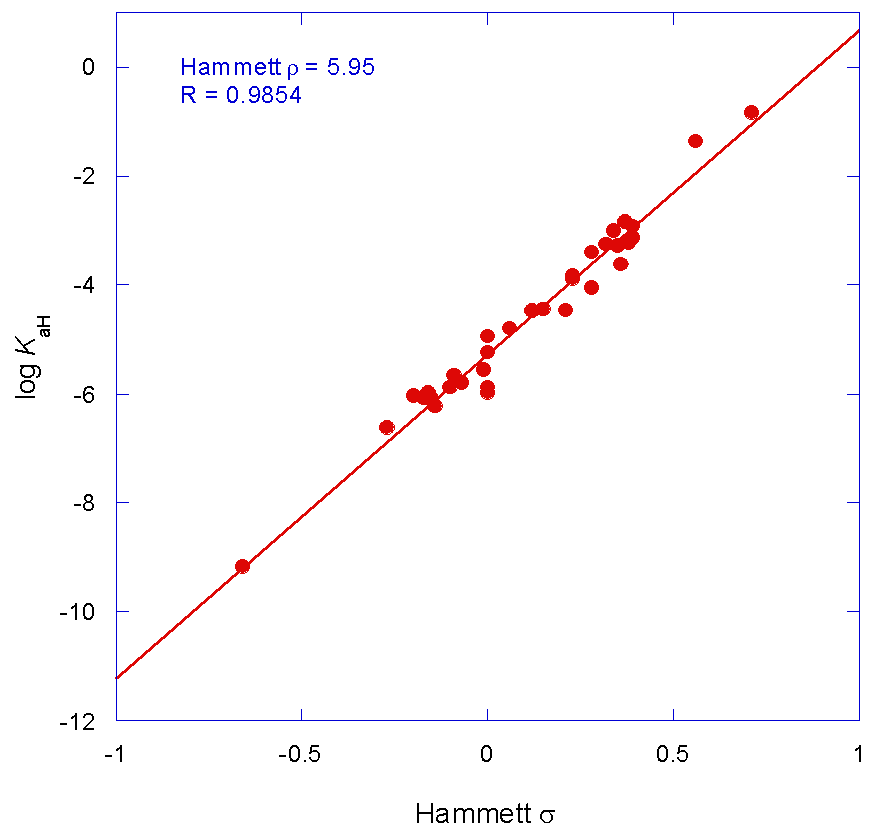
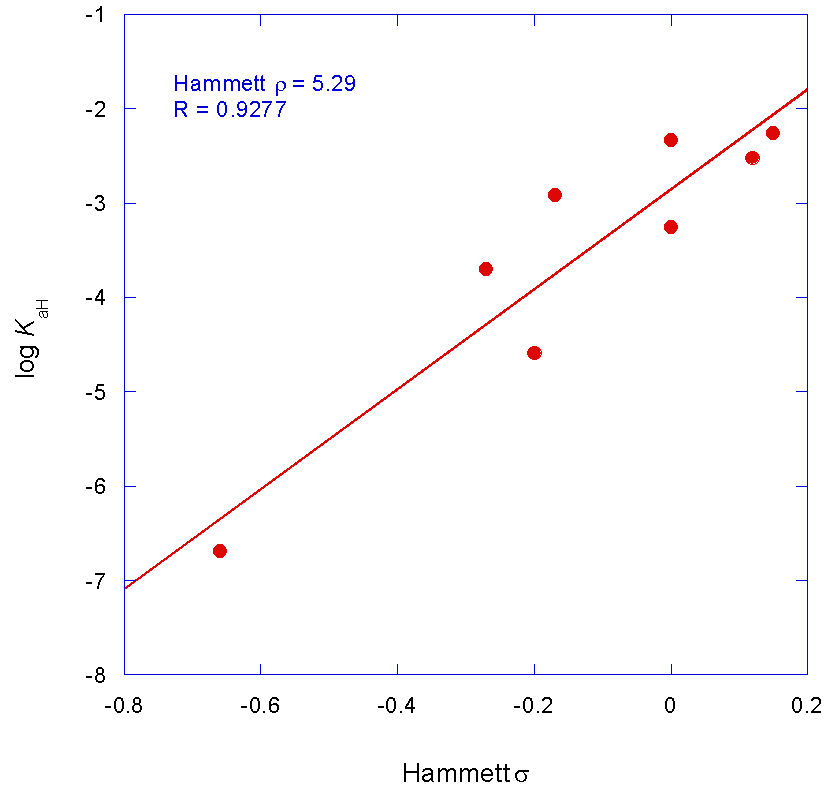
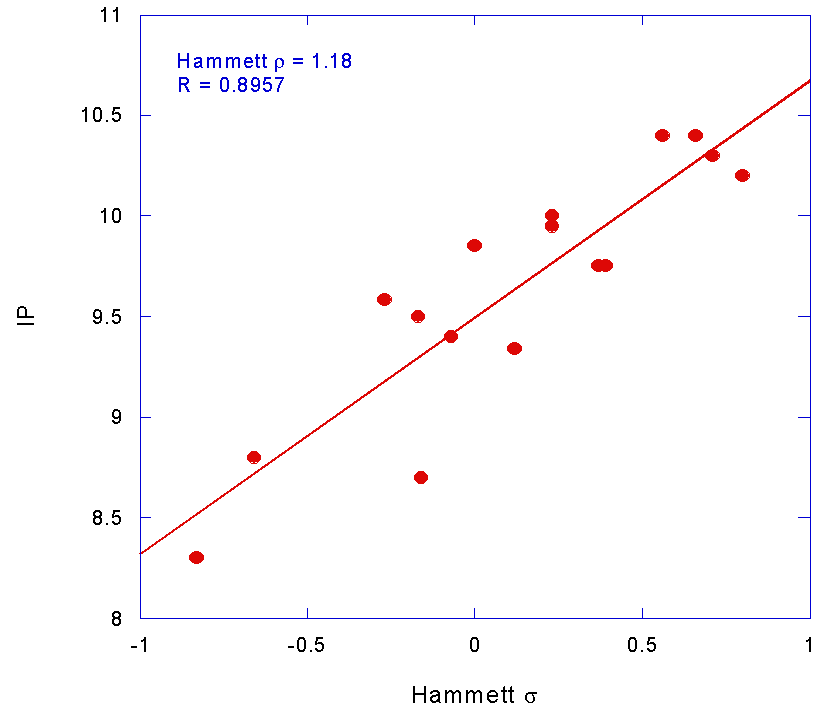
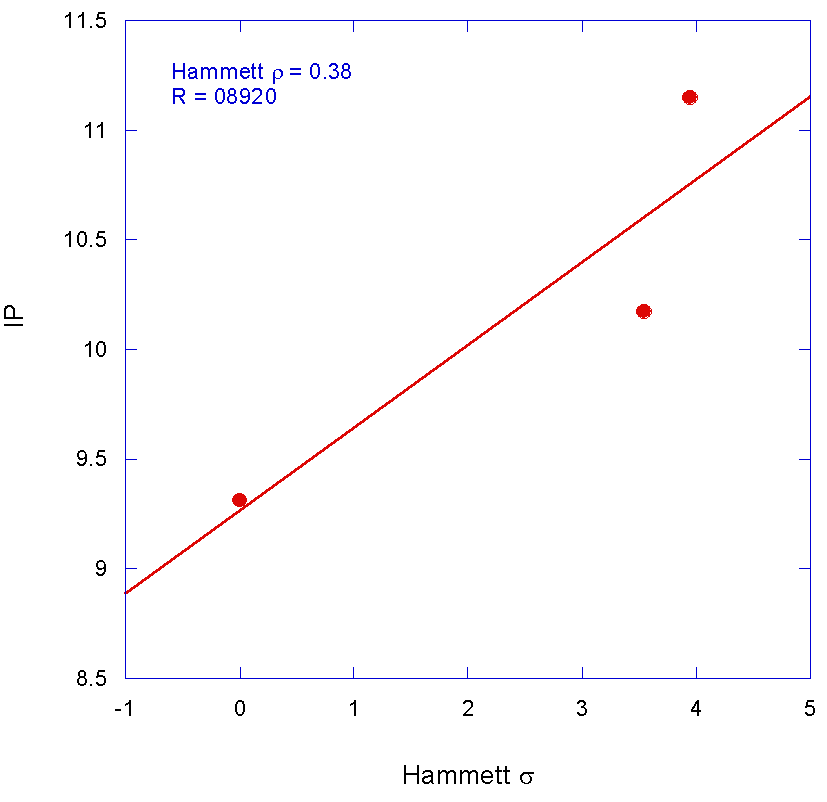
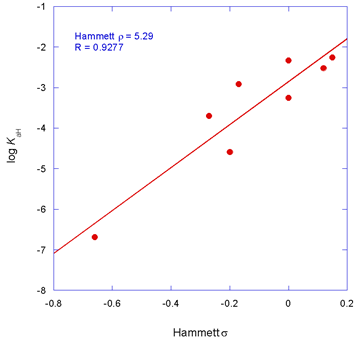
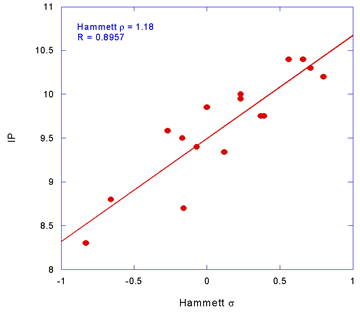
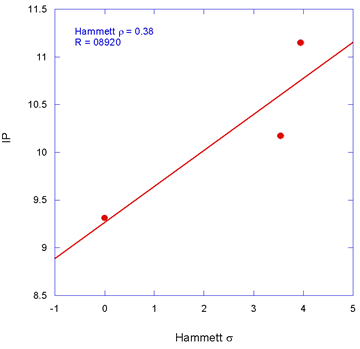
The two Hammett plots of log KaH versus Hammett σ are given in Figure 1 and Figure 2 for the dissociation equilibriums of pyridinium (eqn. 1) and pyridazenium (eqn. 2) ions respectively. The Hammett ρ values are found to be 5.94 and 5.29 for the two equilibriums eqn. 1 and 2 respectively (Figure 1 and Figure 2, Table 1). Similarly, the average lone pair ionization potentials (IP) of pyridines and pyridazines followed Hammett equation. Two Hammett plots of IP versus Hammett σ are given in Figure 3 and Figure 4 for pyridinines and pyridazines respectively. The Hammett ρ values are found to be 1.18 and 0.38 (Figure 3 and Figure 4).

It is noteworthy that for every pyridine type nitrogen (=N-) added to the ring system the mean lone pair ionization potentials (IV/eV) increases systematically by a factor of 0.80 eV 7. And pKaH decreases systematically by 3-4 units in the azines starting from pyridine to tetrazine 7. This is attributed by Katrizky in a note 8 to the high electronegativity of nitrogen which decreases the N(1)-H bond energy and makes the proton to dissociate easily resulting in the increase of stability of the conjugate base (N5-) in the context of the explanation of the effect of aza substitution on the N(1)-H acidity which shows how the pKa values of azoles decrease systematically with number of nitrogen atoms, hence is the decrease in pKa.
The pKaH of pyridazenium ion is 2.24 and that of pyridinium ion is 5.27 7. The large decrease of pKaH of 3 units from pyridine to pyridazine is just due to the high electronegativity of extra nitrogen. This makes the N-H bond weak, and the proton dissociates easily. Consequently, one can expect smaller substituent effect on the pyridazenium (eqn. 2) ion dissociation equilibrium than that of pyridinium (eqn. 1) ion dissociation equilibrium. This is just a simulation of reactivity-selectivity principle 9. The more dissociable pyridazenium ion (pKaH = 2.24) is less susceptible to substituent effect (Hammett ρ = 5.29, eqn. 2) compared to less dissociable pyridinium ion (pKaH 5.27) is more susceptible to substituent effect (Hammett ρ = 5.94, eqn. 1). In other words, stronger the acid less will be the substituent effect (Hammett ρ = 5.29, eqn. 2) and weaker the acid more will be the substituent effect (Hammett ρ = 5.94, eqn. 1).
The IP of pyridazine is 9.31 5 and that of pyridine is 9.85 6. The change in IP from pyridine to pyridazine is not much even due to the presence of extra pyridine type nitrogen (=N-) and its high electronegativity compared to the large change in pKaH of 3 units 7. In fact, an increase in IP from pyridine to pyridazine is expected due to extra pyridine type nitrogen (=N-) and its high electronegativity as the lone pair electrons would be intact. Due to this fact a high substituent effect (Hammett ρ) is also expected compared to that of in pyridines. But larger substituent effect is seen in pyridines (Hammett ρ = 1.18) than in pyridazines (Hammett ρ = 0.38) (Figure 3 and Figure 4). Though the correlation coefficients are little poor but the trends are not distrustable. The possible explanations are as follows: In addition to the aromatic stabilization, pyridine is nucleophilic due to its lone pair of electrons on nitrogen that replaces the CH bond in benzene. A total of 12 azines can be formulated on successive substitution of each sp2 carbon (=CH-) of benzene by nitrogen atoms 10. Unfavorable repulsive interactions among nitrogen lone pairs begin from pyridazine with two adjacent nitrogens 10 and continue till hexazine. These unfavorable repulsive interactions may be favorable to make the lone pair of electrons of nitrogen in pyridazine more labile. This may be reason that the IP of pyridazine is 9.31 5 is less than the IP of pyridine 9.85 8. Therefore, once again invoking the reactivity-selectivity principle, a compound with less labile electron is more susceptible to substituent effect (Hammett ρ = 1.18, Figure 3) and a compound with more labile electron is less susceptible to substituent effect (Hammett ρ = 0.38, Figure 4).
Structure-function relation is a 155-year-old concept to explain the dependence of biological activity of a drug molecule on its structure put forward by Crum-Brown and Fraser 11. And it recalls the Reactivity-Selectivity Principle as Professor Herbert Mayer 12 pointed out is still an “Imperishable myth in Organic Chemistry”. Therefore, the authors believe that the reactivity-selectivity principle is all time popular and important in understanding the behavior of molecules as a function of its structure in various aspects.
The authors don’t have any conflict of interest.
| [1] | https://en.wikipedia.org/wiki/Pyridine, Elschenbroich, C. (2008). Organometall-chemie (6th Ed.). Vieweg & Teubner. pp. 524-525. | ||
| In article | |||
| [2] | https://en.wikipedia.org/wiki/Pyridazine, Gumus, S. (2011). “A computational study on substituted diazabenzenes”. Turk J Chem. 35: 803-808. | ||
| In article | |||
| [3] | Ionization Constants of Acids and Bases, by W. P. Jencks , J. Regenstein, in the Handbook of Biochemistry and Molecular Biology Authored by: Roger L. Lundblad , Fiona M. Macdonald, Taylor and Francis group, 2010. | ||
| In article | |||
| [4] | Advances in Heterocyclic Chemistry, Edited by A R Katritzky, Academic Press, 1988, vol. 43, page 129. | ||
| In article | |||
| [5] | D. Stefanovic and H. F. Grutzmac, Organic Mass Spectrometry, 1974, Vol. 9, pp. 1052 to 1054. | ||
| In article | View Article | ||
| [6] | D. M. W. Van Den Ham, D. Van Der Meer and D. Feil, Journal of Electron Spectroscopy and Related Phenomena, 3 (1974) 479-487. | ||
| In article | View Article | ||
| [7] | F. Brogli, E. Heilbronner and T. Kobayashi, Helvetica Chimica Acta - L701.55, Fasc. 1 (1972)- Nr. 30, page 274. | ||
| In article | View Article | ||
| [8] | Handbook of Heterocyclic Chemistry, Elsevier, 3rd Edition, 2010, page 146 and 147, By Alan R. Katritzky, Christopher A. Ramsden, John A. Joule, Viktor V. Zhdankin. | ||
| In article | |||
| [9] | V. Jagannadham. Resonance, The Journal of Science Education (2009), Vol. 14, No. 11, page 1097, https://www.ias.ac.in/article/fulltext/reso/014/11/1097-1101. | ||
| In article | |||
| [10] | Handbook of Heterocyclic Chemistry, Elsevier, 3rd Edition, 2010, page 38, By Alan R. Katritzky, Christopher A. Ramsden, John A. Joule, Viktor V. Zhdankin. | ||
| In article | |||
| [11] | Crum-Brown, A; Thomas R. Fraser, “The connection of chemical constitution and physiological action”. Trans. R. Soc. Edinb., Vol. 25, page 1968-69 (1865). | ||
| In article | |||
| [12] | Herbert Mayr and Armin R. Ofial, Angew. Chem. Int. Ed. 2006, 45, 1844-1854. | ||
| In article | View Article PubMed | ||
Published with license by Science and Education Publishing, Copyright © 2022 R. Sanjeev and V. Jagannadham
 This work is licensed under a Creative Commons Attribution 4.0 International License. To view a copy of this license, visit
http://creativecommons.org/licenses/by/4.0/
This work is licensed under a Creative Commons Attribution 4.0 International License. To view a copy of this license, visit
http://creativecommons.org/licenses/by/4.0/
| [1] | https://en.wikipedia.org/wiki/Pyridine, Elschenbroich, C. (2008). Organometall-chemie (6th Ed.). Vieweg & Teubner. pp. 524-525. | ||
| In article | |||
| [2] | https://en.wikipedia.org/wiki/Pyridazine, Gumus, S. (2011). “A computational study on substituted diazabenzenes”. Turk J Chem. 35: 803-808. | ||
| In article | |||
| [3] | Ionization Constants of Acids and Bases, by W. P. Jencks , J. Regenstein, in the Handbook of Biochemistry and Molecular Biology Authored by: Roger L. Lundblad , Fiona M. Macdonald, Taylor and Francis group, 2010. | ||
| In article | |||
| [4] | Advances in Heterocyclic Chemistry, Edited by A R Katritzky, Academic Press, 1988, vol. 43, page 129. | ||
| In article | |||
| [5] | D. Stefanovic and H. F. Grutzmac, Organic Mass Spectrometry, 1974, Vol. 9, pp. 1052 to 1054. | ||
| In article | View Article | ||
| [6] | D. M. W. Van Den Ham, D. Van Der Meer and D. Feil, Journal of Electron Spectroscopy and Related Phenomena, 3 (1974) 479-487. | ||
| In article | View Article | ||
| [7] | F. Brogli, E. Heilbronner and T. Kobayashi, Helvetica Chimica Acta - L701.55, Fasc. 1 (1972)- Nr. 30, page 274. | ||
| In article | View Article | ||
| [8] | Handbook of Heterocyclic Chemistry, Elsevier, 3rd Edition, 2010, page 146 and 147, By Alan R. Katritzky, Christopher A. Ramsden, John A. Joule, Viktor V. Zhdankin. | ||
| In article | |||
| [9] | V. Jagannadham. Resonance, The Journal of Science Education (2009), Vol. 14, No. 11, page 1097, https://www.ias.ac.in/article/fulltext/reso/014/11/1097-1101. | ||
| In article | |||
| [10] | Handbook of Heterocyclic Chemistry, Elsevier, 3rd Edition, 2010, page 38, By Alan R. Katritzky, Christopher A. Ramsden, John A. Joule, Viktor V. Zhdankin. | ||
| In article | |||
| [11] | Crum-Brown, A; Thomas R. Fraser, “The connection of chemical constitution and physiological action”. Trans. R. Soc. Edinb., Vol. 25, page 1968-69 (1865). | ||
| In article | |||
| [12] | Herbert Mayr and Armin R. Ofial, Angew. Chem. Int. Ed. 2006, 45, 1844-1854. | ||
| In article | View Article PubMed | ||