Vegetation growth is functionally dependent on climate. Though increased yields have been attained through plant breeding, yet it is well established that genetic factors alone cannot cause a plant character to develop to its maximum potential without a favorable environment. Plants can be made to adapt to conditions which deviate from their natural habitat through breeding and acclimatization. Three local, Oba super-2 hybrid and seventeen maize accessions/varieties newly developed by the Institute for Agricultural Research (IAR) Samaru Zaria, in collaboration with the International Institute of Tropical Agriculture (IITA), for the northern guinea savanna belt, were evaluated for their relative yield performances in the derived savanna belt of Nigeria. The assessments were carried out at the Department of Crop Science teaching and research farm, University of Nigeria, Nsukka. Parameters assessed include field germination percentage, days to first tassel appearance, days to fifty percent tassel appearance, days to fifty percent silking, percentage, double cob per stand, percentage triple cob per stand, plant height, days to maturity, percentage harvest index, cob weight, grain weight per ear e.tc. Correlation and path analysis were used to ascertain the degree of association of traits with yield. Biomass weight was observed to have the highest direct positive influence on yield. Therefore, varieties with high biomass weight (Sammaz-14, 17 and 18) consistently produced high yield. This results could be useful to breeders as they work to produce maize varieties that will perform better in the derived savanna zone of the country. That will make for increased availability and choice of planting materials for farmers and ultimately, increased productivity and sustainability of maize production in the derived Savanna Zones of Nigeria. Further screening of these accessions should also be encouraged in the zone until adaptation is established.
Maize (Zea mais) is a cereal crop that is grown widely throughout the world in a range of agro-ecological environments. There are about 50 species of maize consisting of different colors, textures and grain shapes and sizes. White, yellow and red are however, the most common types. Maize is a staple food crop in Nigeria. It is rich in vitamins E, A, and C, protein, essential minerals and carbohydrates 1. Millions of Africans rely on this crop because it usually costs less than other common grains and cereals 2. Maize kernels are often used as a source of starch. It is largely used in livestock feed and as a raw material for many industrial products. It can be processed into maize flour and can serve as a replacement for wheat flour, to make cornbread and other baked products. It can be boiled or roasted on its cob and served as a snack like popcorn. A lot of health benefits have been attributed to maize including; it aids digestion due to its high fiber content. It has anti-cancer properties and also aid the treatment and prevention of diabetes and hypertension. It is good for the heart and improves vision. It helps in the prevention of Alzheimer's disease, hair loss, and numerous skin problems 1, 3.
The global production of this all important crop is estimated to about 785 million tons. The United States is rated as the largest producer with an estimate of about 42% of the world’s production 4. Maize production in Africa was around 75 million tons in 2018, representing 7.5% of world maize production. Maize occupies approximately 24% of farmland in Africa and the average yield festers at around 2 tons/hectare/year. Africa imports 28% of its required maize grain from countries outside the continent as most of the maize production in Africa is done under rain-fed conditions.
Generally, out of the 7.5% of the world’s maize consumption contributed by Africa, Nigeria was rated as the largest producer seconded by South Africa. Until recently, much of Nigerian maize grain production was from the southwest zone. Ogunbode and Olokojo 5 reported that Western Nigeria generally produces about 50% of Nigeria’s green maize, the remaining 50% being split between the North and the East. However, today, maize is widely grown all over the country with the bulk of production being from Niger, Kaduna, Taraba, Plateau, and Adamawa states which mostly fall within the Northern guinea savannah belt 6. Although maize is highly adaptable to various growth conditions, it is commonly productive in the middle and northern belts of Nigeria where sunshine is adequate and rainfall is moderate 7. It is particularly very sensitive to drought. There have been records that periodic drought cause crop failure and even famine in Nigeria and some other African Countries 4.
The recent achievement by the breeders in the development and release of superior maize varieties with higher yield potentials and better resistance to insect and disease has also played a central role in increase maize production in Nigeria 8. Production figures from FAO 9 show that the area planted with maize in Nigeria has increased from 3.3million hectares in 2009 to 6.2 million hectares in 2019/20, dropping some 100,000 hectares (or over 1.5%) from the 2018/19 estimate of 6.3 million hectares (FAO, 2019). This was reportedly associated with increase in production from 7.3million metric tons in 2009 to about 10.5 million metric tons, decreasing in 2019/20 by less than two percent or about 200,000 Metric Tons lower than 2018/19 estimate of 10.7 million metric tons.
Despite these strides in maize production in Nigeria, maize is still being imported in Nigeria to bridge the gap between production and consumption. FAS Lagos forecasts Nigeria’s corn consumption in 2018/19 at about 11.3 million metric tons 9.
Climate variability is the most important cause of food insecurity in many part of the world 10. Hence, it has recently become a course for concern by many stake holders. Climate plays a major role in vegetation phonological cycles, hence, there is spatio-temporal variation of vegetation cover as a consequence of main climatic elements variability 11. Vegetation growth is functionally dependent on climate 12. Climate is therefore a key environmental factor that determines what crop grows where and their performance. Though increased yields have been achieved through plant breeding, the environmental factors however, determines the extent to which the genetically-dictated character is expressed. It is well established that the genetic factors alone cannot cause a plant character to develop to its maximum potential without a favorable environment. With the right gene combination, favorable environment can ensure full expression of crop yielding potential which ultimately translates into high crop yields. Plants can be made to adapt to conditions which deviate from their natural habitat through acclimatization, but only up to a certain point 13.
To boost national maize production for economic growth and sustainability especially in the derived savanna zones of Nigeria, farmers must be encouraged to increase production by providing them with productive and high yielding planting materials 14. The use of high resilient varieties and hybrids could advance or increase crop yield and so Farmer’s income. This ultimately reduces poverty and increase farmers’ efficiency 15.
As a contribution to the work going on in this area, this work evaluated some varieties/accessions of maize released for the northern guinea savanna belt for their performances in a derived savannah belt of Nigeria.
These experiments were carried out at the Teaching and Research Farm of the Department of Crop Science, University of Nigeria, Nsukka (0652ˈN, 0724ˈE; 447.26m asl). Planting was done in May 2012 and repeated in 2013 planting season
2.2. Land PreparationA piece of land measuring 40 m x 50 m was marked out, mowed, ploughed and harrowed before ridging. A total of 21 maize accessions comprising 17 accessions emanating from the breeding programmes of Institute for Agricultural Research (IAR), three local and Oba Super-2 hybrid were used for the screening. The experiments were laid out in a randomized complete block design (RCBD) with three replications.
2.3. Field Lay-outThe field was divided into three blocks with each block having twenty-one ridges to contain the 21 accessions of maize under investigation in a single row plot 16. Each ridge measured 6 meters. Seeds were planted 2 per hole at a spacing of 75cm x 25 cm. Two weeks after germination, the plants were thinned down to one plant per stand to give a total of 24 stands per plot/ridge. The field was laid out in three blocks with the 21 treatments (maize accessions) allocated to the plots in a randomized complete block design (RCBD).
2.3. Fertilizer Application and WeedingFertilizer (NPK) was applied at the rate of 100 kg / ha in three split doses, at 2 weeks and 4 weeks after planting and at tasseling. Weeding was manual.
2.4. Maize accessionsA total of twenty one varieties including three local varieties, (Nsukka (pink), Enugu-Ezike (yellow) and Kagoro (white), three hybrids (Sammaz-15, 16 and Oba super-2) and fifteen open pollinated varieties (Sammaz-11, 14, 17, 18, 20, 26, 27, 28, 29, 31, 32, 33, 34, 35 and 37) were used. The first three were collected from the places as their names implied (ie Nsukka “Enugu state” Enugu-Ezike “Enugu State” and Kagoro “Kaduna State” all in Nigeria) and the rest from Institute of Agricultural Research (IAR) Samaru Zaria which was developed in collaboration with International Institute for Tropical Agriculture (IITA) Ibadan.
2.5. Assessment of Maize Yield and Maturity ParametersThe assessment was carried out from 60 - 90 days after planting, when the maize plant is at their physiological maturity stage (when the silk just turned brown).
This was determined from ground level to the first branch of the tassel in meters using a long meter rule at physiological maturity.
The height of each cob on the plant was taken at physiological maturity with a meter rule from ground level to the first node from where the ear emanated from the culm.
This is the ratio of the threshed grains at harvest when dry (12-13% moisture level) to the weight of cob in grams multiplied by a hundred.
This is the ratio of the weight of the dry harvested undehusked ear in grams to that of the entire dry biomass weight of the plant in grams multiplied by a hundred.
This is the number of days from planting to physiological maturity. This is the point the grains become hard from the milk stage at 30 - 40% moisture level or the point at which the silk just turned brown (usually 60 - 90 days after planting depending, on the variety) 17.
This is the length in centimeters from the tip of an undehusked cob to its base.
This is the diameter of the dehusked cob taken at the centre of the cob in centimeters.
This was calculated as the ratio of maize stands with double or triple ears to the total of stand/plot multiplied by a hundred.
This is the weight of dehusked /unshelled dry cob in grams at a safe moisture level of 12 - 14%.
This is the weight of cleaned shelled dry grains in grams at a safe moisture level of between 12 - 14%.
2.6. Statistical AnalysisAnalysis of variance (ANOVA) was carried out using Genstat statistical package 14th Edition. Mean separation was done using Fisher’s Least Significant Difference (F-LSD). All test of significance were carried out at 5% level of probabilities. Correlation and path coefficient analysis were also carried out.
3.1. The effects of environment on some agro-botanical characteristics of different accessions / varieties for 2012 and 2013 planting seasons showed that field germination percentage (FGP) (97.90%) was highest in Sammaz-33, which differed significantly (p<0.05) with Sammaz-29 which had the least FGP of 52.86% (Table 1). Days to tasseling (DTT) (63.0 days) and days to 50% tasseling (DTFPT) (70.0 days) were highest in Sammaz-17 and differed significantly (p<0.05) from DTT (44.33 days) in Sammaz-33 and DTFPT in Sammaz-31, which tasseled earliest. Percentage of plants with double cobs (PDCS) was highest in Sammaz-16 (13.67%) in both 2012 and 2013 plantings compared to other varieties/accessions like NSU-P and Sammaz-27. No triple cob / stand (PTCS) was recorded except in Sammaz-32 (0.73%), which was statistically higher (p<0.05) than other accessions/varieties that recorded 0.00% PTCS. The tallest maize ear height was recorded in Sammaz-34 (0.98 m), which was significantly (p<0.05) taller than 0.60 m observed in Sammaz-28. The tallest plant (2.73 m) was observed in KAG-W which was significantly (p<0.05) different from the shortest plant height (0.60 m) recorded in Sammaz-28. Days to 50% silking in Sammaz-17 (64.50 days) differed significantly (p<0.05) compared to the least (47.33 days) in Sammaz-31. Sammaz-16 had the highest number of days to fifty percent silking (DTFPS) (72.33 days), which differed significantly (p<0.05) from the least number of days (52.50 days) in sammaz-31. Days to maturity (DTM) were highest (94.17 days) in KAG-White, which was statistically different (p<0.05) relative to Sammaz-31 with the least maturity.
The biomass weight (BMW) for the two years were highest in KAG-W (333.4 g), which remained statistical similar (p>0.05) to NSU-P (296.0 g), but differed significantly (p<0.05) with Sammaz - 28 (183.4 g). The cob length (CL) (19.24 cm) was longest in Sammaz - 17 and significantly similar (p>0.05) to KAG-W (18.07 cm) but significantly different (p<0.05) and higher than Sammaz - 29 (14.44 cm). Cob width (CW) (5.12 cm), was highest in Sammaz - 17, which remained statistical different (p<0.05) from the least value (4.48 cm) observed in ENU-E for the two years. Cob weight (CWT), grain weight (GW), threshing percentage (TP) and percentage harvest index (PHI) exhibited their highest values (141.70 gm, 114.108, 88.69 % and 47.77 % respectively) in Sammaz - 17, and 28 but differed significantly (p<0.05) from the least values (79.7 g, 64 g, 73.30%, and 31.50%) observed in ENU-E for the two years.
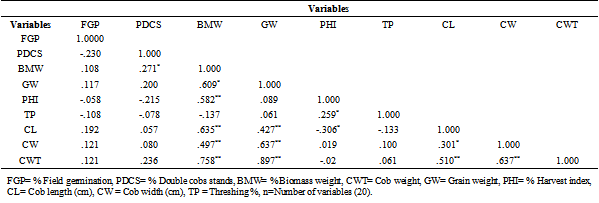
3.2. The Correlations of some agro-botanical components with yield of maize for 2012 and 2013 planting seasons (Table 2) shows that cob weight (CWT) had no significant correlations with field germination percentage (FGP) (0.121), percentage double cobs stands (PDCS) (0.236), threshing percentage (TP) (0.061), and percentage harvest index (PHI) (-0.02). On the other hand, a highly significant positive correlations was established between cob weight and cob length (CL) (0.510**), cob width (CW) (0.637**), biomass weight (BMW) (0.758**) and grain Weight (GW) (0.897**). No significant correlation was established between Cob width (CW) and FGP (0.121), PDCS (0.080), PHI (0.019) and TP (0.100). CW however, showed significant positive correlation with CL (0.301*), and highly significant correlation with BMW (0.497**) and GW (0.637**). Cob length showed significant negative correlations with PHI (-0.306*), highly significant positive correlation with GW (0.427**), and BMW (0.635**). The threshing percentage (TP) recorded significant positive correlation with PHI (0.259*). Percentage Harvest Index (PHI) exhibited non-significant correlations with FGP (-0.058), PDCS (-0.215) and GW (0.089) but showed a highly significant positive correlation with BMW (0.582**). Grain weight (GW) exhibited highly significant positive correlation with BMW (0.609**). Biomass weight (BMW) showed a non-significant correlation with FGP (0.108) and a weak but significant, positive correlation with PDCS (0.271*).
3.3. Direct and indirect effects of maize yield components on cob weight (yield) of maize planted in May 2012 and 2013 planting seasons
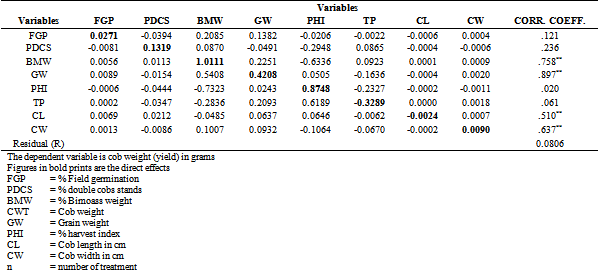
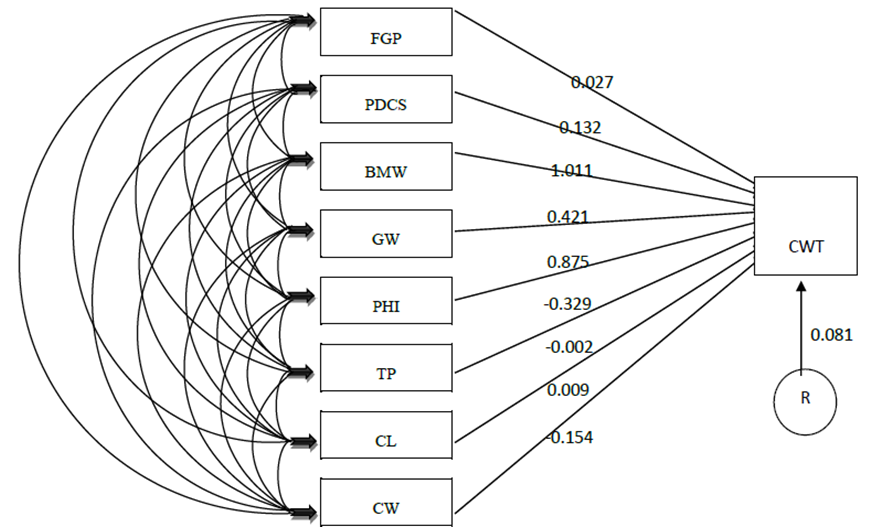
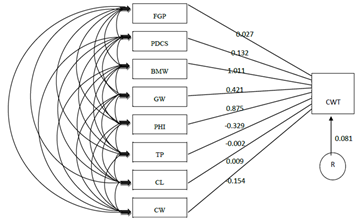
The path analysis of some traits (FGP, PDC, BMW, GW, PHI, TP, CL, CW as independent variables and CWT as a dependent trait) evaluated for 2012 and 2013 planting seasons (Table 3) showed that BMW had the highest direct effect on CWT (1.0111). It also had a strong negative indirect effect through PHI (-0.6336). Percentage harvest index exerted a high direct positive contribution towards cob weight (0.8748). It also registered only one positive indirect effect through grain weight (0.0243), while the highest indirect negative effect was via biomass weight (-0.7323). Grain weight had high positive direct effects (0.4208) and positive indirect influence through BMW (0.5408). GW through TP (-0.1636), PDCS (-0.0154) and CL (-0.0004) exerted negative direct influence on cob weight. PDCS (0.1319) had a positive direct effect on cob weight and also had positive indirect effects through BMW (0.2085), GW (0.1382) and CW (0.004). FGP (0.0271) showed a low positive direct effect on cob weight and a positive indirect effects through BMW (0.2085). Cob width exerted a very low positive direct contribution towards cob weight (0.0090). TP had a high positive indirect effect through PHI (0.6189).
Figure 1 shows the path diagram and coefficients of some maize yield components, their indirect links with each other and how each component relate directly with the independent yield component (cob weight).
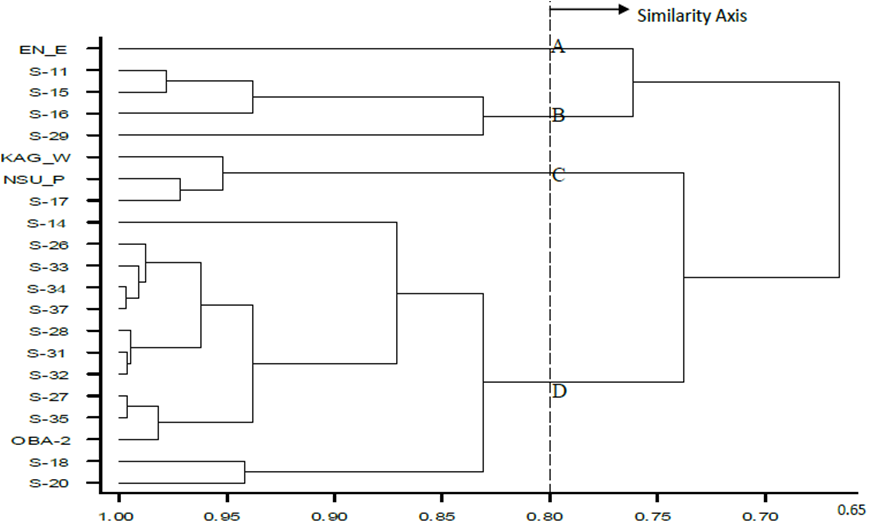
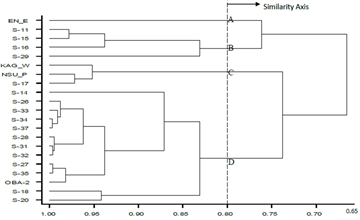
Based on the dendrogram (Figure 2), the 21 genotypes were classified into four clusters (A, B, C and D) for FGP, PDCS, BMW, CWT, GW, PHI, TP, CL and CW at 0.8 coefficient of similarity. It revealed that cluster A consists of only one accession (Enugu-Ezike). Cluster B comprised Sammaz-11, 15, 16 and 29. Cluster C comprised Kagoro-white, Nsukka-pink and sammaz-17. Cluster D is the largest cluster, which consists of Sammaz-14, 26, 33, 34, 37, 28, 31, 32, 27, 35, OBA-super - 2, Sammaz-18 and 20.
Cob weight (CWT) and grain weight (GW), exhibited the highest values (141.70 gm, 114.108gm, respectively) in Sammaz - 17 accession. It also had similar value with KAG-W which had the highest BMW. These accessions therefore, can be said to be better adapted to the derived savanna zone as can be seen from their performances.
Biomass weight (BMW), grain weight (GW), length of cob (CL), cob width (CW) and double cob per plant in the association studies showed significant positive association with cob weight (grain yield). This is in agreement with the findings of Ojo 18, Rafiq et al. 19, Chinnadurai and Pathiraj 20 and Raghu 21 who reported that biomass weight, cob length, cob width and double cob per plant correlated positively with cob weight. There was a low and negative correlation between percentage harvest index and cob weight contrary to a positive correlation that was reported by Halil and Necmi 22 on rice. Cob weight did not correlate significantly with shelling percentage, which disagreed with the findings of Rajesh and Godawat 23, who reported that grain yield per plant showed highly significant positive association with shelling percentage in maize both at genotypic and phenotypic levels. This may be due to the fact that the grain attachment (placenta) of the cob had relatively very low dry weight.
Highly significant positive correlations were found between cob weight and biomass weight (BMW) (r = 0.758**), grain weight (GW) (r = 0.897**), cob length (CL) (r = 0.510**), and cob width (diameter) (CW) (r = 0.637**) in the same trend as reported by Agbaje et al., 24. Biomass weight showed the second highest positive association with cob weight after grain weight contrary to the report of Agbaje et al. 24 that most tropical maize varieties do generate enough above ground biomass which they fail to convert to grain yield. Biomass weight is very important in maize grain yield as stated by Anderson et al. 25 who reported that increased production of dry matter for ear development over a long duration would enhance grain yield in maize, since yield of maize depends on the amount of dry mater produced and translated to grain after anthesis.
The path coefficient study revealed that the highest positive direct effect on cob weight was exhibited by biomass weight (1.0111) followed by percentage harvest index (0.8748), grain weight (0.4208), percentage double cobs per plant (0.1319) and least by ear diameter (0.0090), which agreed with the report of Sofi and Rather 26 who reported grain weight (GW) to have the highest direct positive effect on cob weight (CWT) but differed by showing cob length to have a direct negative effect on grain yield. Out of the traits taken for path analysis, cob length (CL) (-0.0024) had the least negative direct effect on cob weight contrary to the report of Chinnadurai and Ponthiraj 20 who stated that out of fourteen traits they took for path analyses, cob length had a maximum positive direct effect on grain yield / cob weight, which is similar to the report by Halil and Necmi 22. Path coefficient analysis revealed that biomass weight (1.0111) and harvest index (0.8748) had the highest positive direct effects on grain yield/cob weight. This study revealed that biomass weight (-0.6336) and Harvest index (-0.7323) had high negative indirect effects on each other as reported by Halil and Necmi 22 but showed a significantly high positive correlation with each other.
Biomass weight gave the highest direct positive effect on yield. Based on the result of the assessment, Sammaz-14, 17and 18 varieties recorded high biomass weight and invariably higher yield than the other accessions.
Biomass weight (BMW), percentage harvest index (PHI), grain weight (GW) and cob weight (CWT) were observed as the most important parameters responsible for grain yield among the various maize accessions / varieties and could be very important traits to be considered by breeders in the improvement of maize varieties for yield. Selection/breeding tests should therefore be continued on these varieties to establish that the performances observed were as a result of their adaptability to the conditions in the derived savanna belt.
| [1] | Newell-McGloughlin M, Nutritionally Improved Agricultural Crops. Plant Physiology, Vol. 147, 939-953. 2008 | ||
| In article | View Article PubMed | ||
| [2] | Agoda, S., Abrida, S., Usangia, O.E., Ikotun, I. & Isong, I. U. Post-harvest food losses reduction in maize production in Nigeria. African Journal of Agricultural Research, 6, 4833-4839. 2011. | ||
| In article | |||
| [3] | Shah R. T, Prasad K and Kumar P. Maize—A potential source of human nutrition and health: A review. Cogent Food & Agriculture. 2. 1166995. 2016. | ||
| In article | View Article | ||
| [4] | IITA, file:///C:/Users/USER/Desktop/Maize%20production%20in%20Niger.htm. | ||
| In article | |||
| [5] | Ogunbodede, B.A. and Olakojo, S.A. Development of Striga asiatica tolerant hybrid maize (Zea mays L) Varieties: Tropical Agriculture Research and Extension, 4 (1), 2001. | ||
| In article | |||
| [6] | Ado, S. G., & Abdullahi, U. S. Recent development in maize research at Institute for Agricultural Research, Samaru, Nigeria. African Crop Science Conference Proceeding, 8, 1971-1874. 2007. | ||
| In article | |||
| [7] | Iken, J.E., and Amusa, N.A. Maize Research and production in Nigeria. African Journal of Biotechnology, 6, pp. 302-307. 2004. | ||
| In article | View Article | ||
| [8] | FAO. FAOSTAT - http://faostat.fao.org/site/567/DesktopDefault.aspx?PageID=567. 2007. | ||
| In article | |||
| [9] | FAO, Global Information and Early Warning System on Food and Agriculture (GIEWS). ISBN 978-92-5-131625-2. www.fao.org/giews/. 2019. | ||
| In article | |||
| [10] | Kandji ST, Verchot L, Mackensen J. Climate Change, Climate and Variability in Southern Africa: Impacts and Adaptation in the Agricultural Sector. Word Agro forestry Centre (ICRAF), United Nations Environment Programme (UNEP), Nairobi, Kenya, pp. 42. 2006. | ||
| In article | |||
| [11] | Getachew B. T., Berhan G., Tulu B., Getachew W. Evaluating the Association between Climate Variability and Vegetation Dynamics by Using Remote Sensing Techniques: The Case of Upper Awash Basin, Ethiopia. World Journal of Agricultural Research, Vol. 6, No. 4, 153-166. 2018. | ||
| In article | |||
| [12] | Ogunbadewa, E. Climatic Variability Prediction with Satellite Remote Sensing and Meteorological Data in the South Western Nigeria. Geodesy and Cartography, Vol 39(2): 59-63. 2013. | ||
| In article | View Article | ||
| [13] | Belt, D. Parting the waters. National Geography. 217(4): 2010. 154-167. | ||
| In article | |||
| [14] | McCann, J. C., Dalton, T. J., & Mekuria, M. Breeding for Africa's new smallholder maize paradigm. International Journal of Agricultural Sustainability, 4, 99-107. 2007. | ||
| In article | View Article | ||
| [15] | Kijima, Y., Otsuka K. and Sserunkuuma, D., “An inquiry into Constraints on a green revolution in Sub-Saharan Africa”. The case of NERICA rice in Uganda. World Development. Vol. 39: 2011. pp. 77-86. | ||
| In article | View Article | ||
| [16] | Gozubenli, S., Mehmet, K. Okan, S. & Omer, K. Effects of single and twin row planting on yield and yield components in maize. Asian Journal of Sciences, 3, 203-206. 2004. | ||
| In article | View Article | ||
| [17] | Idem, N. U. A., & Showemimo, F. A. Cereal crops of Nigeria: Principles of production and utilization. December 2004. ISBN 978274198-3. | ||
| In article | |||
| [18] | Ojo, D.K., Omikunle, O.A., Oduway, O.A., Ajala, M.O., & Ogunbaya, S.A. Heritability, Character correlation and path coefficient analysis among six-inbred-lines of maize (Zea mays L.) World Journal of Agricultural Science, 2, 352-358. 2006. | ||
| In article | |||
| [19] | Rafiq, C. M., Muhammad, R., Amer, H. & Mohammad, A. studies on Heritability, correlation and path analysis in maize (Zea mays L.) Journal of Agricultural Research, 48, 35-38. 2010. | ||
| In article | |||
| [20] | Chinnadurai, I.S., & Pothiraj, N. Interrelationship and path coefficient studies for quantitative Traits, Grain Yield and other yield Attributes among maize (Zea mays L.). International Journal of Plant Breeding and Genetics, 5, 209-223. 2011. | ||
| In article | View Article | ||
| [21] | Raghu, B., Suresh, J., Kumar, S.S., & Saidaiah, P. Character Association and Path Analysis in Maize (Zea mays L.) Modras Agricultural Journal, 98, 7- 9. 2011. | ||
| In article | |||
| [22] | Halil, S.R. & Necmi, B. Correlation and path coefficient analysis for some yield-Related Traits in Rice (Oryza sativa L. under Thrace conditions. Turkish Journal of Agriculture & Forestory, 27, 77-83. 2003. | ||
| In article | |||
| [23] | Rajesh, D., & Godawat, S.L. Correlation between quality and Ear 1 yield trait in maize (Zea mays L.) and their paths coefficient analysis. Modras Agricultural Journal, 81, 125-127. 1994. | ||
| In article | |||
| [24] | Agbaje, G.O., Abayomi, Y. A., & Awoleye, F. Grain yield potential and associatedtraits in maize (Zea mays L.) varieties in the forest zone of Nigeria. Ghana Journal of Agricultural Science, 33, 191-198. 2000. | ||
| In article | View Article | ||
| [25] | Anderson, F.N., Kamprath, C. J. & Moll, R.H. Nitrogen fertility effects on accumulation, remobilization, and partitioning of Nitrogen and dry matter in corn genotypes differing in prolificacy. Agronomy Journal, 66, 605-608. 1984. | ||
| In article | |||
| [26] | Sofi, P.A., & Rather, A.G. Studies of Genetic variability, correlation and path analysis in maize (Zea mays L.). Maize Genetics cooperation Newsletter vol. 81, 2007. | ||
| In article | |||
Published with license by Science and Education Publishing, Copyright © 2020 Abba Nathan Yatai, Chukwulobe Modesta Ngozi and Echezona Bonaventure Chukwujindu
 This work is licensed under a Creative Commons Attribution 4.0 International License. To view a copy of this license, visit
http://creativecommons.org/licenses/by/4.0/
This work is licensed under a Creative Commons Attribution 4.0 International License. To view a copy of this license, visit
http://creativecommons.org/licenses/by/4.0/
| [1] | Newell-McGloughlin M, Nutritionally Improved Agricultural Crops. Plant Physiology, Vol. 147, 939-953. 2008 | ||
| In article | View Article PubMed | ||
| [2] | Agoda, S., Abrida, S., Usangia, O.E., Ikotun, I. & Isong, I. U. Post-harvest food losses reduction in maize production in Nigeria. African Journal of Agricultural Research, 6, 4833-4839. 2011. | ||
| In article | |||
| [3] | Shah R. T, Prasad K and Kumar P. Maize—A potential source of human nutrition and health: A review. Cogent Food & Agriculture. 2. 1166995. 2016. | ||
| In article | View Article | ||
| [4] | IITA, file:///C:/Users/USER/Desktop/Maize%20production%20in%20Niger.htm. | ||
| In article | |||
| [5] | Ogunbodede, B.A. and Olakojo, S.A. Development of Striga asiatica tolerant hybrid maize (Zea mays L) Varieties: Tropical Agriculture Research and Extension, 4 (1), 2001. | ||
| In article | |||
| [6] | Ado, S. G., & Abdullahi, U. S. Recent development in maize research at Institute for Agricultural Research, Samaru, Nigeria. African Crop Science Conference Proceeding, 8, 1971-1874. 2007. | ||
| In article | |||
| [7] | Iken, J.E., and Amusa, N.A. Maize Research and production in Nigeria. African Journal of Biotechnology, 6, pp. 302-307. 2004. | ||
| In article | View Article | ||
| [8] | FAO. FAOSTAT - http://faostat.fao.org/site/567/DesktopDefault.aspx?PageID=567. 2007. | ||
| In article | |||
| [9] | FAO, Global Information and Early Warning System on Food and Agriculture (GIEWS). ISBN 978-92-5-131625-2. www.fao.org/giews/. 2019. | ||
| In article | |||
| [10] | Kandji ST, Verchot L, Mackensen J. Climate Change, Climate and Variability in Southern Africa: Impacts and Adaptation in the Agricultural Sector. Word Agro forestry Centre (ICRAF), United Nations Environment Programme (UNEP), Nairobi, Kenya, pp. 42. 2006. | ||
| In article | |||
| [11] | Getachew B. T., Berhan G., Tulu B., Getachew W. Evaluating the Association between Climate Variability and Vegetation Dynamics by Using Remote Sensing Techniques: The Case of Upper Awash Basin, Ethiopia. World Journal of Agricultural Research, Vol. 6, No. 4, 153-166. 2018. | ||
| In article | |||
| [12] | Ogunbadewa, E. Climatic Variability Prediction with Satellite Remote Sensing and Meteorological Data in the South Western Nigeria. Geodesy and Cartography, Vol 39(2): 59-63. 2013. | ||
| In article | View Article | ||
| [13] | Belt, D. Parting the waters. National Geography. 217(4): 2010. 154-167. | ||
| In article | |||
| [14] | McCann, J. C., Dalton, T. J., & Mekuria, M. Breeding for Africa's new smallholder maize paradigm. International Journal of Agricultural Sustainability, 4, 99-107. 2007. | ||
| In article | View Article | ||
| [15] | Kijima, Y., Otsuka K. and Sserunkuuma, D., “An inquiry into Constraints on a green revolution in Sub-Saharan Africa”. The case of NERICA rice in Uganda. World Development. Vol. 39: 2011. pp. 77-86. | ||
| In article | View Article | ||
| [16] | Gozubenli, S., Mehmet, K. Okan, S. & Omer, K. Effects of single and twin row planting on yield and yield components in maize. Asian Journal of Sciences, 3, 203-206. 2004. | ||
| In article | View Article | ||
| [17] | Idem, N. U. A., & Showemimo, F. A. Cereal crops of Nigeria: Principles of production and utilization. December 2004. ISBN 978274198-3. | ||
| In article | |||
| [18] | Ojo, D.K., Omikunle, O.A., Oduway, O.A., Ajala, M.O., & Ogunbaya, S.A. Heritability, Character correlation and path coefficient analysis among six-inbred-lines of maize (Zea mays L.) World Journal of Agricultural Science, 2, 352-358. 2006. | ||
| In article | |||
| [19] | Rafiq, C. M., Muhammad, R., Amer, H. & Mohammad, A. studies on Heritability, correlation and path analysis in maize (Zea mays L.) Journal of Agricultural Research, 48, 35-38. 2010. | ||
| In article | |||
| [20] | Chinnadurai, I.S., & Pothiraj, N. Interrelationship and path coefficient studies for quantitative Traits, Grain Yield and other yield Attributes among maize (Zea mays L.). International Journal of Plant Breeding and Genetics, 5, 209-223. 2011. | ||
| In article | View Article | ||
| [21] | Raghu, B., Suresh, J., Kumar, S.S., & Saidaiah, P. Character Association and Path Analysis in Maize (Zea mays L.) Modras Agricultural Journal, 98, 7- 9. 2011. | ||
| In article | |||
| [22] | Halil, S.R. & Necmi, B. Correlation and path coefficient analysis for some yield-Related Traits in Rice (Oryza sativa L. under Thrace conditions. Turkish Journal of Agriculture & Forestory, 27, 77-83. 2003. | ||
| In article | |||
| [23] | Rajesh, D., & Godawat, S.L. Correlation between quality and Ear 1 yield trait in maize (Zea mays L.) and their paths coefficient analysis. Modras Agricultural Journal, 81, 125-127. 1994. | ||
| In article | |||
| [24] | Agbaje, G.O., Abayomi, Y. A., & Awoleye, F. Grain yield potential and associatedtraits in maize (Zea mays L.) varieties in the forest zone of Nigeria. Ghana Journal of Agricultural Science, 33, 191-198. 2000. | ||
| In article | View Article | ||
| [25] | Anderson, F.N., Kamprath, C. J. & Moll, R.H. Nitrogen fertility effects on accumulation, remobilization, and partitioning of Nitrogen and dry matter in corn genotypes differing in prolificacy. Agronomy Journal, 66, 605-608. 1984. | ||
| In article | |||
| [26] | Sofi, P.A., & Rather, A.G. Studies of Genetic variability, correlation and path analysis in maize (Zea mays L.). Maize Genetics cooperation Newsletter vol. 81, 2007. | ||
| In article | |||