The deterioration of soil quality and rising environmental pollution have substantially undermined agricultural output, thereby endangering global food security. This study examined the impacts of plant growth-promoting bacteria (PGPB) and biochar (BC) -based seed coating on the growth, pigment concentration, and protein content of Vigna unguiculata. Among the isolated strains, PGPB Bacillus cereus SE1Z1 was selected based on its potential to enhance V. unguiculata seedling growth in a roll towel assay. Characterization of SE1Z1 confirmed its key plant growth-promoting traits, such as synthesis of indole-3-acetic acid (IAA), siderophores, and solubilization of P. BC was produced from wood chips and pomegranate peel through pyrolysis at varying temperatures of 400°C, 550°C, and 700°C. The wood chip-derived BC pyrolyzed at 550°C (WCB2) was selected for further studies based on its beneficial effects on V. unguiculata growth and SE1Z1 viability. Evaluation of SE1Z1 and WCB2 -based seed coatings revealed that V. unguiculata seeds treated with either SE1Z1 or WCB2 showed enhanced plant growth, photosynthetic pigments, protein and relative water contents. Notably, the combined application resulted in significantly greater improvements, likely due to synergistic interactions. Furthermore, WCB2 and SE1Z1 coating facilitated higher SE1Z1 colonization in the rhizosphere compared to the SE1Z1 only treatment, indicating that WCB2 may enhance SE1Z1 survival and activity. In conclusion, the integrated use of PGPB and BC as a seed coating presents a promising and eco-friendly approach to improving crop performance.
With the continuous growth of the global population and the escalating impact of environmental challenges such as pollution and climate change, ensuring food security has become a matter of pressing global importance 1. To address these concerns, sustainable agricultural practices are increasingly being adopted to meet nutritional demands while conserving essential natural resources and ensuring consistent crop performance 2. One of the core strategies within this framework is the use of organic and inorganic substances as soil amendments to improve soil health, thereby promoting plant growth and productivity. These amendments play a crucial role in improving soil health and fertility by enhancing nutrient availability, increasing water retention capacity, and stimulating beneficial microbial activity etc 3.
Biochar (BC), a carbon-rich product generated from the pyrolysis of organic waste, has been extensively used as soil amendments due its properties to improve soil fertility 4. It improves soil organic matter, nutrient bioavailability and water retention, while also providing a favourable environment for beneficial microbes 5. Additionally, BC contributes to increased soil cation exchange capacity (CEC), microbial diversity, and ultimately higher crop yields. For instance, 6 found that the application of 3% BC derived from black cherry wood significantly improved Osimum basilicum growth, biomass production and other physiological parameters including pigments, sugar and flavonoid contents. The study highlighted that key properties of the BC including water-holding capacity, enhances soil nutrient availability, nutrient supply and seed germination and played a major role in exhibiting beneficial effects on plant development.
Similarly, the utilization of plant growth promoting bacteria (PGPB) has garnered significant interest among agronomists and environmental scientists due to their ability to improve crop productivity, particularly in marginal soils 7. These PGPB contribute to plant development by facilitating water and nutrient uptake and by imparting stress tolerance through the biosynthesis of various beneficial metabolites, such as synthesis of indole-3-acetic acid (IAA), siderophores, and solubilization of P etc 8. For instance, 9 carried out an analysis of the effects of Bacillus subtilis, isolated from marine water sample on the growth and physiological response of chick pea. Their research showed that Bacillus strain has several plant growth promoting (PGP) traits for plants, such as the ability to fix nitrogen, produces ammonia and gibberellins, solubilize phosphate and potassium. Given that the efficacy of inoculated PGPB in enhancing plant growth is critically influenced by their survival and functional activity within rhizosphere soils, various additives such as organic matter and selected inorganic amendments are commonly co-applied with PGPB. These amendments contribute to improved PGPB persistence and proliferation by supplying essential nutrients, optimizing soil physico-chemical properties, and fostering a microenvironment conducive to PGPB growth and metabolic function 10. For instance, vermicompost amendment in soil has been found to promote the proliferation and persistence of inoculated PGPB, leading to improved growth of tomato and spinach 11. Similarly, BC produced from agro-waste biomass have also been tested in combination with PGPB such as coconut husk BC 12, Spent mushroom substrate BC 13 and maize straw BC 14. Recently, 15 evaluated the effectiveness of PGPB, Bacillus sp with and without BC amendment on wheat growth and found that the combined application of Bacillus sp and shisham wood tree BC resulted in the most significant improvements in plant growth and physiological parameters.
Recent studies have advanced our understanding of the distinct and synergistic effects of BC and PGPB, when applied as soil amendments and as seed or seedling inoculants, respectively, in influencing soil physico-chemical and biological properties, plant growth, physiological and biochemical responses 16, 13, 15. However, the impact of BC on plant growth when applied as a seed coating in combination with PGPB remains largely unexplored particularly with respect to the survival of inoculated PGPB and their subsequent influence on plant development. This knowledge gap prompted us to investigate the synergistic potential of BC and PGPB as integrated seed coating agents to enhance plant growth performance. Thus, the objectives of the current study were to: (1) isolate, screen, and characterize the efficient PGPB, (2) prepare and screen suitable BC that is compatible with both selected plants and PGPB strain, and (3) investigate the effects of BC and PGPB-based seed coatings on Vigna unguiculata growth, pigment biosynthesis, protein accumulation and relative water content.
Bacterial strains were initially isolated from the rhizosphere soil of Catharanthus roseus growing in magnesite-contaminated soils located in Vellakalpatti, Salem, India, using the standard serial dilution and plating method as described by 17. To select a potential PGPB, a roll towel assay was performed with V. unguiculata serving as the test plant. In brief, V. unguiculata seeds were surface-sterilized by immersing in 75% ethanol for one minute, followed by exposure with 1% sodium hypochlorite for five min. Subsequently the seeds were then rinsed thoroughly five times with sterile deionized water to eliminate any remaining sterilizing agents. Each bacterial isolate was cultured overnight in Luria-Bertani (LB) broth at 30 °C under continuous shaking. After 18 h of incubation, bacterial cells were separated by centrifuging at 5000 rpm for 10 min and resuspended in sterile distilled water. The cell suspension was then adjusted to an optical density of 1.0 at 600 nm to obtain approximately 10⁸ colony-forming units (CFU)/mL. Sterilized seeds of V. unguiculata were inoculated by soaking in the cell suspension for two hours under aseptic conditions. Control seeds underwent the same procedure but were soaked in sterile distilled water instead of the bacterial inoculum. Both treated and control seeds were placed on moist blotting paper and incubated in a plant growth chamber. After 7 days, the percent seed germination, average shoot and root length were noted, and the vigour index was determined using the equation established by 18.
The bacterial strain (SE1Z1) exhibiting the highest PGP potential in the roll towel assay was selected for further characterization of key PGP traits, including the synthesis of IAA, siderophores, P solubilization, and other growth-enhancing activities. IAA production was quantitatively determined following the methodology described by 19. Siderophore synthesis was assessed using the Chrome Azurol S (CAS) assay 20. P solubilization ability was assessed using the method of 21. Ammonia production was determined following the procedure outlined by 22, while HCN production was evaluated using the method described by 23. Additionally, the strain's tolerance to heavy metals, salinity, and temperature was assessed using previously established protocols 24, 25, 26. Moreover, the identification of the selected bacteria was performed through 16S rRNA gene sequencing, according to the procedure outlined by 16.
2.2. Preparation and Screening of BiocharBiochar in this study was produced from wood chips and pomegranate peel through slow pyrolysis at 400°C, 550°C, and 700°C under limited oxygen conditions, as previously described 27. The resulting BC was then ground and sieved to get particles size smaller than 2 mm for subsequent use. In order to select the most suitable BC for seed coating applications, the prepared BC were further screened for their compatibility with V. unguiculata and PGPB strain SE1Z1 by evaluating their effects on V. unguiculata growth and SE1Z1 viability.
For the pot experiment, the soil was obtained from the agriculture field near Bharathiar University and amended with various BCs at the concentrations of 0%, 5%, and 10% (w/w). V. unguiculata seeds were planted in pots containing 1 kg of soil, either untreated or treated with BC. The pots were kept at 30 °C under a controlled photoperiod of 8 hours dark and 16 hours light. After 20 days of growth, the plants were carefully uprooted and evaluated for key growth parameters, including shoot length (SL), root length (RL), fresh biomass (FB), and dry biomass (DB).
The effect of BC on the viability of PGPB strain SE1Z1 was assessed using tryptone soya broth (TSB). BC was incorporated into 10 mL of TSB at concentrations of 0% (control) and 5% (w/v). SE1Z1 was grown to the logarithmic phase in TSB and adjusted to an optical density of 1.0 at 600 nm. A 0.1 mL aliquot of the bacterial cell suspension was added to each treatment, and the cultures were allowed to grow at 28 ± 2 °C with continuous shaking at 120 rpm. Bacterial growth was monitored at 12-hour intervals over a 72-hour period. At each time point, samples collected were diluted and plated on nutrient agar using the standard spread plate method. After incubation at 38 °C for 24 hours, the CFU was enumerated.
2.3. Analysis of the Effects of Seed Coating on the Growth of V. unguiculataV. unguiculata seeds were surface-sterilized and inoculated with PGPB strain SE1Z1 following the procedure outlined in the previous section. Prior to seed bacterization, mutants of SE1Z1, marked with ampicillin resistance were acquired by plating the parental SE1Z1 strain on LB agar supplemented with ampicillin (300 mg L⁻¹). For the preparation of the BC and PGPB based seed coating, the PGPB inoculated (as detailed in the previous section) or non-inoculated seeds were mixed with wood chips derived BC pyrolyzed at 550 °C (WCB2) and guar gum (GG) in a sterile round-bottom flask at a ratio of 2:1:1 (w/w). A minimal volume of sterile deionised water was added to activate the adhesive properties of GG, facilitating uniform coating of materials on the seed surface. The flask was gently rotated at 25 rpm to ensure homogeneous distribution of the coating mixture. Following the coating process, seeds were air-dried under a fume hood at ambient temperature and subsequently stored in sterile containers for future experimental use.
A greenhouse trial was conducted to evaluate the impact of BC and PGPB based seed coating on the growth and certain biochemical parameters of V. unguiculata. For pot experiment, the soil collected was sterilized by autoclaving at 121 °C for 40 min over five consecutive days. The experimental setup consisted of six seed treatment groups: 1. Untreated (seeds without SE1Z1, GG, and WCB2), 2. GG (un-inoculated seeds coated with GG), 3. GG + WCB2 (un-inoculated seeds coated with GG and WCB2), 4. SE1Z1 (Seeds inoculated with SE1Z1), 5. SE1Z1 + GG (SE1Z1 inoculated seeds coated with GG), 6. SE1Z1 + GG + WCB2 (SE1Z1 inoculated seeds coated with GG and WCB2). The coated or uncoated seeds were planted in pots containing 1 kg of sterilized soil and maintained in greenhouse conditions at 30 °C, with a 16-hour light and 8-hour dark photoperiod to ensure optimal plant growth. After 60 days of growth, above-ground biomass was harvested and plant RL, SL and FB were determined. Plant biomass was oven-dried at 80 °C for 48 hours in the laboratory and subsequently weighed to determine DB.
To assess the colonization and survival of SE1Z1 in the rhizosphere, 1 g of soil adhering to root surface was separated and suspended in sterile distilled water. The resulting suspension was plated onto LB agar supplemented with 300 mg L⁻¹ ampicillin. Following incubation at 37 °C for 4 to 5 days, CFUs were quantified following methodology outlined by 28.
Chlorophyll and carotenoid contents in plant leaves were quantified following the method described by 29. Briefly, 0.1 g of leaf tissue was crushed in 6 mL of 80% ethanol to extract pigments. Following centrifugation, the absorbance of the supernatant was recorded at 663 nm for chlorophyll a, 645 nm for chlorophyll b, 510 nm and 480 nm for carotenoids using a Shimadzu UV-1800 spectrophotometer.
Protein levels in leaf tissues were quantified using the procedure outlined by 30. A 0.1 g portion of leaf material was homogenised in 1 mL of phosphate buffer (pH 7.5) and centrifuged at 3000 rpm for 10 minutes. A 0.1 mL aliquot of the sample was diluted to 1 mL using distilled water. This was then mixed with 1 mL of reagent C, which consists of a 50:1 ratio of solution A and solution B. Solution A contains 2% sodium carbonate, 1% sodium-potassium tartrate, and 0.4% sodium hydroxide, while solution B contains 0.5% copper sulfate pentahydrate. Subsequently, 0.1 mL of Folin–Ciocalteu reagent was added to the reaction mixture, which was then incubated at room temperature for 30 minutes. The absorbance was then recorded at 660 nm using a Shimadzu UV-1800 spectrophotometer. Protein concentration was quantified using a bovine serum albumin calibration curve ranging from 20 to 640 µg.
The relative water content (RWC) of plant leaves was quantified using the methodology described by 31. Initially, the turgid weight of the leaf samples was measured after immersing known weight of fresh leaf samples in distilled water for 12 h in darkness. Subsequently, the leaf dry weight was measured after drying the samples at 72°C for 12 h. The RWC was further calculated using the following equation.
 |
Where, FW = Fresh Leaf weight; TW = Turgid leaf weight; DW = Dry leaf weight.
2.4. Statistical AnalysisExperiments were conducted in triplicate, with results reported as mean ± standard deviation. Statistical differences between groups were assessed using one-way ANOVA and Tukey’s HSD test (p < 0.05), performed in SPSS v25.
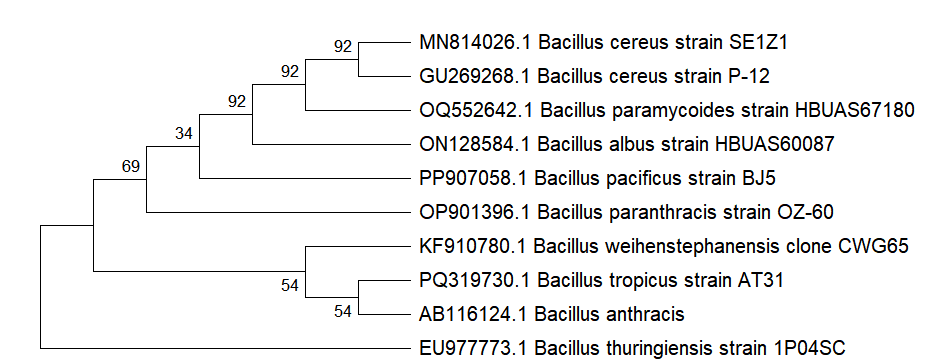
In this investigation, we isolated 25 morphologically distinct bacterial strains from magnesite-contaminated soils and evaluated their efficiency in promoting V. unguiculata growth, with an objective of selecting effective PGPB. Among the 25 strains tested, strain SE1Z1 significantly increased the vigor index by 109.8 % compared with non-inoculated control (Table 1). Several previous studies have documented that inoculation with PGPB significantly enhances seed germination and overall plant development by producing a diverse array of PGP metabolites 32. These include nitrogen fixation, P solubilization, synthesis of phytohormones such as auxins, siderophore production, and ACC deaminase activity 33. For instance, experiments conducted on Z. mays demonstrated that treatment with PGPB, B. subtilis and L. fusiformis led to increased plant growth and biomass accumulation. This improvement was attributed to elevated levels of soluble P in the soil and enhanced P uptake by the plants 34. Moreover, Bacillus strains capable of producing IAA have been shown to promote host plant growth and nutrient acquisition. These effects are mediated through promotion of cell division, enhancement of cell elongation, and initiation of root development 35. Recently, 36 demonstrated that inoculation with the IAA-producing PGPB strains Bacillus and Pseuedomonas led to notable improvements in growth parameters and biomass accumulation in Cicer arietinum plants. Similarly, the PGPB, Pantoea dispersa MPJ9 and Pseudomonas putida MPJ6 producing siderophores which chelate iron have also been reported to improve the plant growth by increasing Fe bio-availability in soils and thereby its uptake by plants 37. In our study, the enhanced plant growth observed due to SE1Z1 treatment prompted us to evaluate whether any of its PGP traits contributed to the growth promotion of V. unguiculata. Characterization of SE1Z1's PGP attributes revealed its intrinsic capacity for IAA biosynthesis, siderophore production, and inorganic P solubilization (Table 2). These PGP traits suggest that SE1Z1 may have contributed to enhanced root proliferation in V. unguiculata, thereby improving the uptake of essential minerals including P and Fe. In addition to its PGP traits, SE1Z1 exhibited remarkable tolerance to heavy metals such as Zn (300 mg L -1), Cd (100 mg L -1), Cu (200 mg L -1), Cr (500 mg L -1), Ni (200 mg L -1) , and Pb (1000 mg L -1), elevated salinity levels (7%), and temperature (55%). This suggests that, once inoculated into soil, SE1Z1 may successfully colonize the rhizosphere and continue to exert PGP effects such as enhancing nutrient availability and promoting plant growth even under suboptimal environmental conditions. Based on a comprehensive evaluation of morphological, and biochemical characteristics (data not shown), along with sequence alignment against established databases and phylogenetic analysis using ClustalW (Figure 1), strain SE1Z1 was taxonomically classified as Bacillus cereus.

In order to select a suitable BC that favours both V. unguiculata growth and SE1Z1 viability for seed coating application, BC prepared from wood chips and pomegranate peel via pyrolysis at a range of temperatures were systematically assessed for their influence on the growth performance of V. unguiculata and SE1Z1. The effect of BC types and pyrolysis temperature on the growth of V. unguiculata is summarized in Table 3. Among the BC tested, wood chips BC produced at 550 °C (WCB2) exhibited the most pronounced positive effects, with increases in SL (241%), RL (160%), FB (242%), and DB (340%) of V. unguiculata compared to the control. These results suggest that pyrolysis at 550 °C may represent an optimal condition for enhancing the physico-chemical properties of WCB, including porosity, surface area, and nutrient retention, thereby promoting plant growth 38. Pomegranate peel BC pyrolyzed at 400 °C (PPB1) also improved plant growth metrics relative to the control, with SL, RL, FB and DB increase by 183%, 100%, 148%, and 180%, respectively. However, its overall performance was inferior to that of WCB2, likely due to differences in feedstock composition and associated nutrient profiles 39. In contrast, PPB produced at 700 °C (PBC3) demonstrated minimal enhancement or even suppression of plant growth. Our observations corroborate the results of 40, who recorded that increasing pyrolysis temperature led to a gradual decrease in plant growth. This was attributed to a corresponding reduction in water-soluble nitrogen and phosphorus content in reed-derived BC, indicating that higher pyrolysis temperatures may adversely affect nutrient bioavailability critical for optimal plant development.
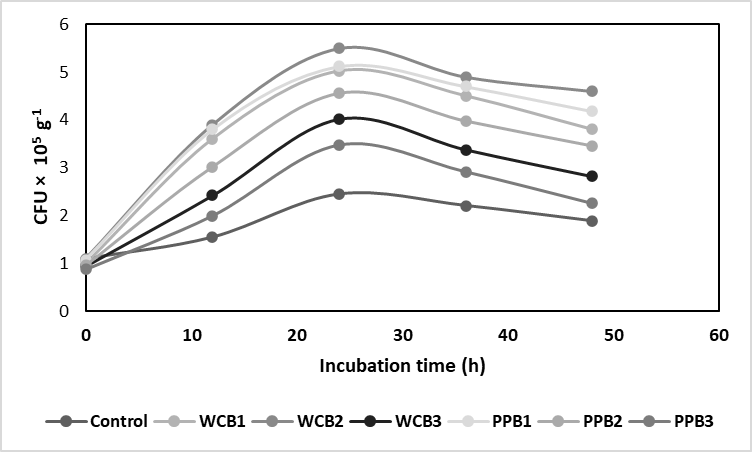
The growth response of PGPB strain SE1Z1 to BC derived from different feedstocks and pyrolysis temperatures is presented in Figure 2. The highest SE1Z1 density was recorded at 24 hours (5.5 × 10⁵ CFU mL⁻¹) in TSB medium supplemented with WCB2 (produced at 550 °C). BC generated at 400 °C also supported SE1Z1 proliferation, though to a lesser extent. In contrast, BC produced at 700 °C resulted in significantly reduced SE1Z1 growth. The superior growth in the presence of WCB2 suggests that the pyrolysis temperature at 550 ºC yields BC with optimal physicochemical properties for bacterial proliferation. This may be attributed to enhanced surface area and porosity, which facilitate microbial adhesion and create a favourable microhabitat 41. Additionally, BC at this temperature likely retains a balanced composition of nutrients and functional groups that support microbial metabolism, while minimizing the formation of toxic polycyclic aromatic hydrocarbons (PAHs), which are more prevalent at higher pyrolysis temperatures 42. The diminished growth observed with BC produced at 700 °C underscores the potential inhibitory effects of excessive thermal treatment, possibly due to reduced labile organic content or the presence of inhibitory compounds 43. Although both previous and current studies suggest that pyrolysis at 550 °C enhances the beneficial properties of (BC) for plants and microbes, further research including the characterization of BC produced at varying pyrolysis temperatures is necessary to confirm the relationship between pyrolysis conditions and the positive attributes of BC on plant growth and microbial activity.
The observed positive effects on the growth of V. unguiculata (Table 3) and SE1Z1 (Figure 2) highlight the advantageous characteristics of WCB2, indicating its potential as a promising carrier material for seed coating applications. Consequently, WCB2 was selected for further investigation to evaluate its effectiveness as a seed coating material, in combination with the PGPB SE1Z1, in enhancing V. unguiculata growth and certain key biochemical responses.

SL, RL, FB and DB were recorded to assess the effects of seed coating treatments involving SE1Z1 and WCB2 on the growth performance of V. unguiculata (Table 4). The SE1Z1+GG+WCB2 treatment demonstrated the most pronounced impact, increasing SL, RL, FB, and DB by 150.2%, 122.7%, 72.8%, and 149.3%, respectively. This enhancement can be attributed to the synergistic interaction among the coating components including WCB2, GG and SE1Z1. Similarly, seeds coated with GG+ WCB2 (uninoculated) also showed notable improvements, with SL, RL, FB and DB increase by 71%, 52%, 20.4%, and 103.5%, respectively. In general, BC improves soil structure, porosity, and water retention, collectively facilitating better root development and nutrient absorption 44, 45. Additionally, GG acts as an effective natural polymer that aids in bacterial immobilization and supports sustained microbial activity near the rhizosphere 46. Comparable positive outcomes have been reported in previous studies, where seed coatings containing maize straw BC and PGPB Serratia nematodiphila significantly enhanced SL, RL, FB and DB of Z. mays 47. This improvement can be attributed to the beneficial effects of BC on soil characteristics, including enhanced porosity, better moisture retention, and greater nutrient availability combined with the PGP capabilities of PGPB, which support better root colonization and nutrient uptake 48, 49.
3.4. Effects of BC and PGPB - based Seed Coating on SE1Z1 Survival in Rhizosphere Soils
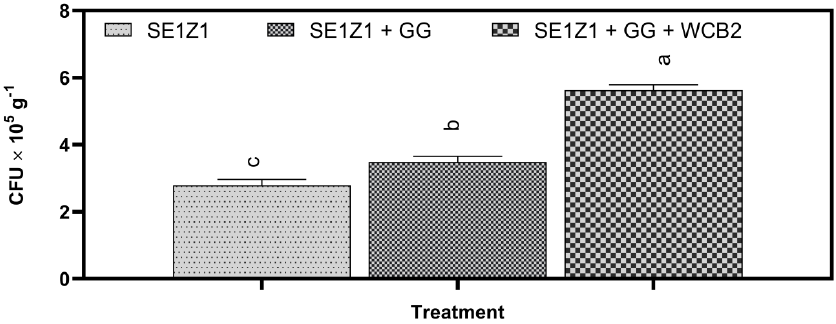
Given that microbial survival and colonization are critical determinants of bioformulation efficacy especially in the context of enhancing plant growth, the colonization efficiency of SE1Z1 in the rhizosphere soils of V. unguiculata was systematically assessed (Figure 3). The SE1Z1 population exhibited significant variation across treatments, highlighting the influence of BC treatment on the colonization efficiency of SE1Z1. The highest number of CFUs was recorded in the SE1Z1+GG+WCB2 treatment (5.62 × 10⁵ CFU mL⁻¹), followed by SE1Z1+GG (3.48 × 10⁵ CFU mL⁻¹). The lowest SE1Z1 count was observed in the SE1Z1-alone treatment (2.7 × 10⁵ CFU mL⁻¹). These results align with previous findings indicating that BC functions as an effective carrier matrix for PGPB, enhancing their delivery, colonization, and long-term persistence in soil ecosystems 50. In general, the porous structure and high adsorption capacity of BC likely create protective microhabitats that shield microorganisms from environmental stress while facilitating nutrient acquisition 51. Furthermore, BC may alter key physico-chemical properties of the rhizosphere such as pH, aeration, and moisture retention thereby fostering conditions conducive to bacterial proliferation 52. In this study. the enhanced colonization observed as a result of SE1Z1+GG+WCB2 treatment supports its positive impact on plant growth (Table 4), reinforcing the role of WCB2 in facilitating the survival and establishment of SE1Z1 within the rhizosphere. This improved microbial colonization likely contributes to better plant development by synthesizing PGP metabolites.
Given the established correlation between chlorophyll content and crop productivity, and its significance as an indicator of treatment effectiveness, this study further analysed the effect of SE1Z1 and WCB2- based seed coating on pigment contents in V. unguiculata (Table 4). WCB2, both alone and in combination with SE1Z1, significantly enhanced pigment concentrations in plants compared to untreated controls. Remarkably, the SE1Z1+GG+WCB2 formulation yielded the highest increases in chlorophyll a (184.5%), chlorophyll b (135.4%), total chlorophyll (86.01%), and carotenoids (208%). This pronounced enhancement is likely attributable to BC’s capacity to improve water retention, soil aeration, and nutrient availability within the rhizosphere 51, thereby creating favourable physiological conditions for pigment biosynthesis in plants 53. Additionally, the elevated pigment concentrations observed in SE1Z1+GG+WCB2 treated plants suggest a synergistic interaction between SE1Z1 and WCB2, which played a pivotal role in stimulating chlorophyll and carotenoid biosynthesis. In general, chlorophyll synthesis is tightly regulated by N availability, primarily via the glutamine synthetase–glutamate synthase pathway 54. Previous studies have demonstrated that BC enhances N retention in the soil matrix 55, while PGPB Bacillus spp. facilitate N uptake by promoting root development and producing phytohormones such as IAA 56. In this study, combined effect of SE1Z1 and WCB2 might have promoted the synthesis of 5-aminolevulinic acid, a key precursor in the chlorophyll biosynthetic pathway, thereby contributing to the substantial accumulation of pigments in leaf tissues V. unguiculata.
3.6. Effects of BC and PGPB - based Seed Coating on Protein Contents in V. unguiculataSince protein quantification serves as a reliable biochemical marker for evaluating the efficacy of bioformulations, we further investigated the effects of SE1Z1 and WCB2 based seed coating on total protein content in V. unguiculata (Table 4). Protein levels were lowest in the untreated control, while seeds treated with SE1Z1+GG+WCB2 showed a marked increase of 116.3%, suggesting that SE1Z1 and WCB2 may boost metabolic processes and contribute to improved plant growth. The elevated protein content is likely attributed to improved soil conditions and enhanced nutrient availability 57. In general, BC enriches soil with organic carbon, helping retain key nutrients like nitrogen, phosphorus, and potassium vital for protein and amino acid synthesis 58. Its porous nature also improves aeration and moisture retention, which can alleviate plant stress and promote better nutrient uptake 59. Furthermore, BC enhances the colonization and survival of PGPB, which secrete PGP metabolites that facilitate nutrient uptake and promote protein synthesis in plants 9. Our results are consistent with these reports, suggesting that the combination of BC and GG may have supported bacterial adhesion and persistence on the seed surface 60. This likely promoted effective root colonization and improved plant nutrient acquisition, ultimately leading to elevated protein levels in the plants 12.
3.7. Effects of BC and PGPB - based Seed Coating on Relative Water Content in V. unguiculataRelative water content (RWC) is a crucial physiological indicator that significantly influences plant growth by regulating key processes such as photosynthesis, protein synthesis, and pigment stability 61. In this study, we evaluated the effects of SE1Z1 and WCB2- based seed coatings on RWC levels in V. unguiculata (Table 4). Untreated plants exhibited the lowest RWC, whereas those treated with the SE1Z1+GG+WCB2 combination showed a substantial increase, highlighting the potential of these formulations to enhance water uptake and improve plant hydration. BC is well known for its ability to improve RWC by enhancing soil structure, increasing water retention, and promoting root development 62. Its porous architecture allows it to retain moisture and nutrients efficiently, making them more accessible to plant roots and thereby supporting better cell hydration, sustained turgor pressure, and improved physiological performance 63. Similarly, PGPB, through the production of IAA, stimulate root elongation and lateral root formation, which enhances water and nutrient absorption and contributes to increased RWC 64. For example, 65 reported that inoculation of Triticum aestivum with Azospirillum sp. significantly elevated RWC, attributing the improvement to enhanced root development driven by bacterial IAA production. In our study, the enhancement of RWC observed with combined SE1Z1 and WCB2 treatments suggests that while WCB2 improves soil moisture retention, SE1Z1 inoculants promote root proliferation and water absorption, collectively leading to higher RWC in plants. Although our findings confirm the positive effects of BC and PGPB-based seed coatings on plant growth, photosynthetic pigment, protein, and relative water contents, additional research is needed to uncover the molecular pathways driving these positive effects.
This study indicates that applying SE1Z1 and WCB2 as seed coatings can significantly promote plant development, boost pigment production, and increase protein levels. Interestingly, the co-application of SE1Z1 and WCB2 markedly enhanced SE1Z1 survival within the rhizosphere. This indicates that, in addition to their direct benefits on V. unguiculata, BC plays a supportive role in promoting plant growth and biochemical traits by improving SE1Z1 stability in the root zone. The increased SE1Z1 survival facilitates the synthesis of IAA, siderophores, and P solubilization, all of which support plant development. Given the multifaceted benefits observed from the SE1Z1 and WCB2 - based seed coating, this combination shows promise as a bioformulation for promoting plant growth. Ongoing research is focused on evaluating the efficacy of SE1Z1 and WCB2-based seed coatings across various plant species under field conditions to further validate their potential in improving crop growth and yield.
The authors have no competing interests.
| [1] | Mirzabaev, A., Kerr, R.B., Hasegawa, T., Pradhan, P., Wreford, A., von der Pahlen, M.C.T., and Gurney-Smith, H., “Severe climate change risks to food security and nutrition,” Climate Risk Management, vol. 39, 100473, 2023. | ||
| In article | View Article | ||
| [2] | Muhie, S.H., “Novel approaches and practices to sustainable agriculture,” J. Agric. Food Res., vol. 10, 100446, 2022. | ||
| In article | View Article | ||
| [3] | Al-Shammary, A.A.G., Al-Shihmani, L.S.S., Fernández-Gálvez, J., and Caballero-Calvo, A., “A comprehensive review of impacts of soil management practices and climate adaptation strategies on soil thermal conductivity in agricultural soils,” Rev. Environ. Sci. Biotechnol., pp. 1–31, 2025. | ||
| In article | View Article | ||
| [4] | Afshar, M., and Mofatteh, S., “Biochar for a sustainable future: Environmentally friendly production and diverse applications,” Results Eng., vol. 23, 102433, 2024. | ||
| In article | View Article | ||
| [5] | Ighalo, J.O., Ohoro, C.R., Ojukwu, V.E., Oniye, M., Shaikh, W.A., Biswas, J.K., et al., “Biochar for ameliorating soil fertility and microbial diversity: From production to action of the black gold,” iScience, vol. 28, no. 1, 2025. | ||
| In article | View Article PubMed | ||
| [6] | Jabborova, D., Ma, H., Bellingrath-Kimura, S.D., and Wirth, S., “Impacts of biochar on basil (Ocimum basilicum) growth, root morphological traits, plant biochemical and physiological properties and soil enzymatic activities,” Sci. Hortic., vol. 290, 110518, 2021. | ||
| In article | View Article | ||
| [7] | Ramakrishna, W., Yadav, R., and Li, K., “Plant growth promoting bacteria in agriculture: two sides of a coin,” Appl. Soil Ecol., vol. 138, pp. 10–18, 2019. | ||
| In article | View Article | ||
| [8] | Fanai, A., Bohia, B., Lalremruati, F., Lalhriatpuii, N., Lalmuanpuii, R., and Singh, P.K., “Plant growth promoting bacteria (PGPB)-induced plant adaptations to stresses: An updated review,” PeerJ, vol. 12, e17882, 2024. | ||
| In article | View Article PubMed | ||
| [9] | Rathod, K., Rana, S., Dhandhukia, P., and Thakker, J.N., “From Sea to Soil: Marine Bacillus subtilis enhancing chickpea production through in vitro and in vivo plant growth promoting traits,” Braz. J. Microbiol., vol. 55, no. 1, 823–836, 2024. | ||
| In article | View Article PubMed | ||
| [10] | Malik, L., Sanaullah, M., Mahmood, F., Hussain, S., Siddique, M.H., Anwar, F., and Shahzad, T., “Unlocking the potential of co-applied biochar and plant growth-promoting rhizobacteria (PGPR) for sustainable agriculture under stress conditions,” Chem. Biol. Technol. Agric., vol. 9, no. 1, 58, 2022. | ||
| In article | View Article PubMed | ||
| [11] | Song, X., Liu, M., Wu, D., Griffiths, B.S., Jiao, J., Li, H., and Hu, F., “Interaction matters: Synergy between vermicompost and PGPR agents improves soil quality, crop quality and crop yield in the field,” Appl. Soil Ecol., vol. 89, pp. 25–34, 2015. | ||
| In article | View Article | ||
| [12] | Anbuganesan, V., Vishnupradeep, R., Varshini, V.S., Archana, A.S., Soundarya, S., Bruno, L.B., and Rajkumar, M., “Effect of plant growth-promoting rhizobacteria and biochar on Ricinus communis growth, physiology, nutrient uptake and soil enzyme activities,” Appl. Ecol. Environ. Sci., vol. 10, pp. 640–651, 2022. | ||
| In article | View Article | ||
| [13] | Guan, T.K., Wang, Q.Y., Li, J.S., Yan, H.W., Chen, Q.J., Sun, J., et al., “Biochar immobilized plant growth-promoting rhizobacteria enhanced the physicochemical properties, agronomic characters and microbial communities during lettuce seedling,” Front. Microbiol., vol. 14, 1218205, 2023. | ||
| In article | View Article PubMed | ||
| [14] | Tu, C., Wei, J., Guan, F., Liu, Y., Sun, Y., and Luo, Y., “Biochar and bacteria inoculated biochar enhanced Cd and Cu immobilization and enzymatic activity in a polluted soil,” Environ. Int., vol. 137, 105576, 2020. | ||
| In article | View Article PubMed | ||
| [15] | Malik, L., Hussain, S., Shahid, M., Mahmood, F., Ali, H.M., Malik, M., et al., “Co-applied biochar and drought tolerant PGPRs induced more improvement in soil quality and wheat production than their individual applications under drought conditions,” PeerJ, vol. 12, e18171, 2024. | ||
| In article | View Article PubMed | ||
| [16] | Anbuganesan, V., Vishnupradeep, R., Mehnaz, N., Kumar, A., Freitas, H., and Rajkumar, M., “Synergistic effect of biochar and plant growth promoting bacteria improve the growth and phytostabilization potential of Sorghum bicolor in Cd and Zn contaminated soils,” Rhizosphere, vol. 29, 100844, 2024. | ||
| In article | View Article | ||
| [17] | Weller, D.M., Landa, B.B., Mavrodi, O.V., Schroeder, K.L., De La Fuente, L., Bankhead, S.B., et al., “Role of 2, 4-diacetylphloroglucinol-producing fluorescent Pseudomonas spp. in the defense of plant roots,” Plant Biol., vol. 9, pp. 4–20, 2007. | ||
| In article | View Article PubMed | ||
| [18] | Abdul‐Baki, A.A., and Anderson, J.D., “Vigor determination in soybean seed by multiple criteria,” Crop Sci., vol. 13, no. 6, pp. 630–633, 1973. | ||
| In article | View Article | ||
| [19] | Bric, J.M., Bostock, R.M., and Silverstone, S.E., “Rapid in situ assay for indoleacetic acid production by bacteria immobilized on a nitrocellulose membrane,” Appl. Environ. Microbiol., vol. 57, no. 2, pp. 535–538, 1991. | ||
| In article | View Article PubMed | ||
| [20] | Schwyn, B., and Neilands, J., “Universal chemical assay for the detection and determination of siderophores,” Anal. Biochem., vol. 160, no. 1, pp. 47–56, 1987. | ||
| In article | View Article PubMed | ||
| [21] | Sundaro Rao, W.V.B., and Sinha, M.K., “Phosphate dissolving micro-organisms in the soil and rhizosphere,” 1963. | ||
| In article | |||
| [22] | Cappuccino, J.G., and Sherman, N., Microbiology: A Laboratory Manual, 9th ed., San Francisco: Pearson/Benjamin Cummings, 2005, p. 507. | ||
| In article | |||
| [23] | Abd El-Rahman, A.F., and Shaheen, H.A., “Biological control of the brown rot of potato, Ralstonia solanacearum and effect of bacterization with antagonists on promotion of potato growth,” Egypt. J. Biol. Pest Control, vol. 26, no. 4, pp. 733–739, 2016. | ||
| In article | |||
| [24] | Sheng, X.F., Xia, J.J., Jiang, C.Y., He, L.Y., and Qian, M., “Characterization of heavy metal-resistant endophytic bacteria from rape (Brassica napus) roots and their potential in promoting the growth and lead accumulation of rape,” Environ. Pollut., vol. 156, no. 3, pp. 1164–1170, 2008. | ||
| In article | View Article PubMed | ||
| [25] | Komaresofla, B.R., Alikhani, H.A., Etesami, H., and Khoshkholgh-Sima, N.A., “Improved growth and salinity tolerance of the halophyte Salicornia sp. by co–inoculation with endophytic and rhizosphere bacteria,” Appl. Soil Ecol., vol. 138, pp. 160–170, 2019. | ||
| In article | View Article | ||
| [26] | Ashry, N.M., Alaidaroos, B.A., Mohamed, S.A., Badr, O.A., El-Saadony, M.T., and Esmael, A., “Utilization of drought-tolerant bacterial strains isolated from harsh soils as a plant growth-promoting rhizobacteria (PGPR),” Saudi J. Biol. Sci., vol. 29, no. 3, pp. 1760–1769, 2022. | ||
| In article | View Article PubMed | ||
| [27] | Sahoo, S.S., Vijay, V.K., Chandra, R., and Kumar, H., “Production and characterization of biochar produced from slow pyrolysis of pigeon pea stalk and bamboo,” Clean. Eng. Technol., vol. 3, 100101, 2021. | ||
| In article | View Article | ||
| [28] | Ma, Y., Prasad, M.N.V., Rajkumar, M., and Freitas, H., “Plant growth promoting rhizobacteria and endophytes accelerate phytoremediation of metalliferous soils,” Biotechnol. Adv., vol. 29, no. 2, pp. 248–258, 2011. | ||
| In article | View Article PubMed | ||
| [29] | El-Esawi, M.A., Elkelish, A., Soliman, M., Elansary, H.O., Zaid, A., and Wani, S.H., “Serratia marcescens BM1 enhances cadmium stress tolerance and phytoremediation potential of soybean through modulation of osmolytes, leaf gas exchange, antioxidant machinery, and stress-responsive genes expression,” Antioxidants, vol. 9, no. 1, 43, 2020. | ||
| In article | View Article PubMed | ||
| [30] | Bates, L.S., Waldren, R.P., and Teare, I.D., “Rapid determination of free proline for water-stress studies,” Plant Soil, vol. 39, pp. 205–207, 1973. | ||
| In article | View Article | ||
| [31] | Ali, A., Ullah, Z., Sher, H., Abbas, Z., and Rasheed, A., “Water stress effects on stay green and chlorophyll fluorescence with focus on yield characteristics of diverse bread wheats,” Planta, vol. 257, no. 6, 104, 2023. | ||
| In article | View Article PubMed | ||
| [32] | Chandran, H., Meena, M., and Swapnil, P., “Plant growth-promoting rhizobacteria as a green alternative for sustainable agriculture,” Sustainability, vol. 13, no. 19, 10986, 2021. | ||
| In article | View Article | ||
| [33] | Khoso, M.A., Wagan, S., Alam, I., Hussain, A., Ali, Q., Saha, S., et al., “Impact of plant growth-promoting rhizobacteria (PGPR) on plant nutrition and root characteristics: Current perspective,” Plant Stress, vol. 11, 100341, 2024. | ||
| In article | View Article | ||
| [34] | Rafique, M., Sultan, T., Ortas, I., and Chaudhary, H.J., “Enhancement of maize plant growth with inoculation of phosphate-solubilizing bacteria and biochar amendment in soil,” Soil Sci. Plant Nutr., vol. 63, no. 5, pp. 460–469, 2017. | ||
| In article | View Article | ||
| [35] | Etesami, H., Jeong, B.R., and Glick, B.R., “Potential use of Bacillus spp. as an effective biostimulant against abiotic stresses in crops—A review,” Curr. Res. Biotechnol., vol. 5, 100128, 2023. | ||
| In article | View Article | ||
| [36] | Lata, D.L., Abdie, O., and Rezene, Y., “IAA-producing bacteria from the rhizosphere of chickpea (Cicer arietinum L.): Isolation, characterization, and their effects on plant growth performance,” Heliyon, vol. 10, no. 21, 2024. | ||
| In article | View Article PubMed | ||
| [37] | Patel, P., Trivedi, G., and Saraf, M., “Iron biofortification in mungbean using siderophore producing plant growth promoting bacteria,” Environ. Sustain., vol. 1, no. 4, pp. 357–365, 2018. | ||
| In article | View Article | ||
| [38] | Zhang, C., Zeng, G., Huang, D., Lai, C., Chen, M., Cheng, M., et al., “Biochar for environmental management: Mitigating greenhouse gas emissions, contaminant treatment, and potential negative impacts,” Chem. Eng. J., vol. 373, pp. 902–922, 2019. | ||
| In article | View Article | ||
| [39] | Mukherjee, A., Patra, B.R., Podder, J., and Dalai, A.K., “Synthesis of biochar from lignocellulosic biomass for diverse industrial applications and energy harvesting: Effects of pyrolysis conditions on the physicochemical properties of biochar,” Front. Mater., vol. 9, 870184, 2022. | ||
| In article | View Article | ||
| [40] | Zheng, H., Wang, Z., Deng, X., and Xing, B., “Impact of pyrolysis temperature on nutrient properties of biochar,” in Functions of Natural Organic Matter in Changing Environment, Dordrecht: Springer, pp. 975–978, 2012. | ||
| In article | View Article | ||
| [41] | Gryta, A., Skic, K., Adamczuk, A., Skic, A., Marciniak, M., Józefaciuk, G., and Boguta, P., “The importance of the targeted design of biochar physicochemical properties in microbial inoculation for improved agricultural productivity—A review,” Agriculture, vol. 14, no. 1, 37, 2023. | ||
| In article | View Article | ||
| [42] | Bolan, S., Sharma, S., Mukherjee, S., Kumar, M., Rao, C.S., Nataraj, K.C., et al., “Biochar modulating soil biological health: A review,” Sci. Total Environ., vol. 914, 169585, 2024. | ||
| In article | View Article PubMed | ||
| [43] | Gale, N.V., Sackett, T.E., and Thomas, S.C., “Thermal treatment and leaching of biochar alleviates plant growth inhibition from mobile organic compounds,” PeerJ, vol. 4, e2385, 2016. | ||
| In article | View Article PubMed | ||
| [44] | Yin, J., Zhao, L., Xu, X., Li, D., Qiu, H., and Cao, X., “Evaluation of long-term carbon sequestration of biochar in soil with biogeochemical field model,” Sci. Total Environ., vol. 822, 153576, 2022. | ||
| In article | View Article PubMed | ||
| [45] | Alghamdi, A.G., Alomran, A., Ibrahim, H.M., Alkhasha, A., and Majrashi, M.A., “Spent coffee waste-derived biochar improves physical properties, water retention, and maize (Zea mays L.) growth in sandy soil,” Sci. Rep., vol. 14, no. 1, 19753, 2024. | ||
| In article | View Article PubMed | ||
| [46] | Jain, R., Anjaiah, V., and Babbar, S.B., “Guar gum: A cheap substitute for agar in microbial culture media,” Lett. Appl. Microbiol., vol. 41, no. 4, pp. 345–349, 2005. | ||
| In article | View Article PubMed | ||
| [47] | Cheng, Y., Cao, M., Shi, X., Chen, X., Li, Z., and Ma, Y., “Mitigating salt stress in Zea mays: Harnessing Serratia nematodiphila-biochar-based seed coating for plant growth promotion and rhizosphere microecology regulation,” Ind. Crops Prod., vol. 223, 120164, 2025. | ||
| In article | View Article | ||
| [48] | Alkharabsheh, H.M., Seleiman, M.F., Battaglia, M.L., Shami, A., Jalal, R.S., Alhammad, B.A., et al., “Biochar and its broad impacts in soil quality and fertility, nutrient leaching and crop productivity: A review,” Agronomy, vol. 11, no. 5, 993, 2021. | ||
| In article | View Article | ||
| [49] | Khawula, S., Daniel, A.I., Nyawo, N., Ndlazi, K., Sibiya, S., Ntshalintshali, S., et al., “Optimizing plant resilience with growth-promoting Rhizobacteria under abiotic and biotic stress conditions,” Plant Stress, 100949, 2025. | ||
| In article | View Article | ||
| [50] | Kamyab, H., Chelliapan, S., Khalili, E., Rezania, S., Balasubramanian, B., Taheri, M.M., et al., “Biochar as a carrier for plant growth-promoting bacteria in phytoremediation of pesticides,” J. Hazard. Mater. Adv., 100673, 2025. | ||
| In article | View Article | ||
| [51] | Lehmann, J., and Joseph, S., Biochar for Environmental Management: An Introduction, Routledge, pp. 1–13, 2015. | ||
| In article | View Article | ||
| [52] | Ndoung, O.C.N., de Figueiredo, C.C., and Ramos, M.L.G., “A scoping review on biochar-based fertilizers: Enrichment techniques and agro-environmental application,” Heliyon, vol. 7, no. 12, 2021. | ||
| In article | View Article PubMed | ||
| [53] | Hashmi, S., Younis, U., Danish, S., and Munir, T., “Pongamia pinnata L. leaves biochar increased growth and pigments syntheses in Pisum sativum L. exposed to nutritional stress,” Agriculture, vol. 9, no. 7, 153, 2019. | ||
| In article | View Article | ||
| [54] | Fortunato, S., Nigro, D., Lasorella, C., Marcotuli, I., Gadaleta, A., and de Pinto, M.C., “The role of glutamine synthetase (GS) and glutamate synthase (GOGAT) in the improvement of nitrogen use efficiency in cereals,” Biomolecules, vol. 13, no. 12, 1771, 2023. | ||
| In article | View Article PubMed | ||
| [55] | Schofield, H.K., Pettitt, T.R., Tappin, A.D., Rollinson, G.K., and Fitzsimons, M.F., “Biochar incorporation increased nitrogen and carbon retention in a waste-derived soil,” Sci. Total Environ., vol. 690, pp. 1228–1236, 2019. | ||
| In article | View Article PubMed | ||
| [56] | Sun, W., and Shahrajabian, M.H., “Biostimulant and beyond: Bacillus spp., the important plant growth-promoting rhizobacteria (PGPR)-based biostimulant for sustainable agriculture,” Earth Syst. Environ., pp. 1–34, 2025. | ||
| In article | View Article | ||
| [57] | Khan, M.A., Basir, A., Fahad, S., Adnan, M., Saleem, M.H., Iqbal, A., et al., “Biochar optimizes wheat quality, yield, and nitrogen acquisition in low fertile calcareous soil treated with organic and mineral nitrogen fertilizers,” Front. Plant Sci., vol. 13, 879788, 2022. | ||
| In article | View Article PubMed | ||
| [58] | Glaser, B., Wiedner, K., Seelig, S., Schmidt, H.P., and Gerber, H., “Effect of biochar fertilizers on amino acid variability of Secale cereale and Lupinus angustifolius,” Agron. Sustain. Dev., vol. 35, pp. 667–678, 2015. | ||
| In article | View Article | ||
| [59] | Laird, D.A., Fleming, P., Davis, D.D., Horton, R., Wang, B., and Karlen, D.L., “Impact of biochar amendments on the quality of a typical Midwestern agricultural soil,” Geoderma, vol. 158, pp. 443–449, 2010. | ||
| In article | View Article | ||
| [60] | Głodowska, M., Schwinghamer, T., Husk, B., and Smith, D., “Biochar based inoculants improve soybean growth and nodulation,” Agric. Sci., vol. 8, no. 9, pp. 1048–1064, 2017. | ||
| In article | View Article | ||
| [61] | Lawlor, D.W., and Tezara, W., “Causes of decreased photosynthetic rate and metabolic capacity in water-deficient leaf cells: a critical evaluation of mechanisms and integration of processes,” Ann. Bot., vol. 103, no. 4, pp. 561–579, 2009. | ||
| In article | View Article PubMed | ||
| [62] | Chang, Y., Rossi, L., Zotarelli, L., Gao, B., Shahid, M.A., and Sarkhosh, A., “Biochar improves soil physical characteristics and strengthens root architecture in Muscadine grape (Vitis rotundifolia L.),” Chem. Biol. Technol. Agric., vol. 8, no. 1, 7, 2021. | ||
| In article | View Article | ||
| [63] | Naeem, M.B., Jahan, S., Rashid, A., Shah, A.A., Raja, V., and El-Sheikh, M.A., “Improving maize yield and drought tolerance in field conditions through activated biochar application,” Sci. Rep., vol. 14, no. 1, 25000, 2024. | ||
| In article | View Article PubMed | ||
| [64] | El-Saadony, M.T., Saad, A.M., Mohammed, D.M., Fahmy, M.A., Elesawi, I.E., Ahmed, A.E., et al., “Drought-tolerant plant growth-promoting rhizobacteria alleviate drought stress and enhance soil health for sustainable agriculture: A comprehensive review,” Plant Stress, vol. 14, 100632, 2024. | ||
| In article | View Article | ||
| [65] | Arzanesh, M.H., Alikhani, H.A., Khavazi, K., Rahimian, H.A., and Miransari, M., “Wheat (Triticum aestivum L.) growth enhancement by Azospirillum sp. under drought stress,” World J. Microbiol. Biotechnol., vol. 27, no. 2, pp. 197–205, 2011. | ||
| In article | View Article | ||
Published with license by Science and Education Publishing, Copyright © 2025 Mani Rajkumar, Sundaramoorthy Soundarya and Ashok Suma Archana
 This work is licensed under a Creative Commons Attribution 4.0 International License. To view a copy of this license, visit
http://creativecommons.org/licenses/by/4.0/
This work is licensed under a Creative Commons Attribution 4.0 International License. To view a copy of this license, visit
http://creativecommons.org/licenses/by/4.0/
| [1] | Mirzabaev, A., Kerr, R.B., Hasegawa, T., Pradhan, P., Wreford, A., von der Pahlen, M.C.T., and Gurney-Smith, H., “Severe climate change risks to food security and nutrition,” Climate Risk Management, vol. 39, 100473, 2023. | ||
| In article | View Article | ||
| [2] | Muhie, S.H., “Novel approaches and practices to sustainable agriculture,” J. Agric. Food Res., vol. 10, 100446, 2022. | ||
| In article | View Article | ||
| [3] | Al-Shammary, A.A.G., Al-Shihmani, L.S.S., Fernández-Gálvez, J., and Caballero-Calvo, A., “A comprehensive review of impacts of soil management practices and climate adaptation strategies on soil thermal conductivity in agricultural soils,” Rev. Environ. Sci. Biotechnol., pp. 1–31, 2025. | ||
| In article | View Article | ||
| [4] | Afshar, M., and Mofatteh, S., “Biochar for a sustainable future: Environmentally friendly production and diverse applications,” Results Eng., vol. 23, 102433, 2024. | ||
| In article | View Article | ||
| [5] | Ighalo, J.O., Ohoro, C.R., Ojukwu, V.E., Oniye, M., Shaikh, W.A., Biswas, J.K., et al., “Biochar for ameliorating soil fertility and microbial diversity: From production to action of the black gold,” iScience, vol. 28, no. 1, 2025. | ||
| In article | View Article PubMed | ||
| [6] | Jabborova, D., Ma, H., Bellingrath-Kimura, S.D., and Wirth, S., “Impacts of biochar on basil (Ocimum basilicum) growth, root morphological traits, plant biochemical and physiological properties and soil enzymatic activities,” Sci. Hortic., vol. 290, 110518, 2021. | ||
| In article | View Article | ||
| [7] | Ramakrishna, W., Yadav, R., and Li, K., “Plant growth promoting bacteria in agriculture: two sides of a coin,” Appl. Soil Ecol., vol. 138, pp. 10–18, 2019. | ||
| In article | View Article | ||
| [8] | Fanai, A., Bohia, B., Lalremruati, F., Lalhriatpuii, N., Lalmuanpuii, R., and Singh, P.K., “Plant growth promoting bacteria (PGPB)-induced plant adaptations to stresses: An updated review,” PeerJ, vol. 12, e17882, 2024. | ||
| In article | View Article PubMed | ||
| [9] | Rathod, K., Rana, S., Dhandhukia, P., and Thakker, J.N., “From Sea to Soil: Marine Bacillus subtilis enhancing chickpea production through in vitro and in vivo plant growth promoting traits,” Braz. J. Microbiol., vol. 55, no. 1, 823–836, 2024. | ||
| In article | View Article PubMed | ||
| [10] | Malik, L., Sanaullah, M., Mahmood, F., Hussain, S., Siddique, M.H., Anwar, F., and Shahzad, T., “Unlocking the potential of co-applied biochar and plant growth-promoting rhizobacteria (PGPR) for sustainable agriculture under stress conditions,” Chem. Biol. Technol. Agric., vol. 9, no. 1, 58, 2022. | ||
| In article | View Article PubMed | ||
| [11] | Song, X., Liu, M., Wu, D., Griffiths, B.S., Jiao, J., Li, H., and Hu, F., “Interaction matters: Synergy between vermicompost and PGPR agents improves soil quality, crop quality and crop yield in the field,” Appl. Soil Ecol., vol. 89, pp. 25–34, 2015. | ||
| In article | View Article | ||
| [12] | Anbuganesan, V., Vishnupradeep, R., Varshini, V.S., Archana, A.S., Soundarya, S., Bruno, L.B., and Rajkumar, M., “Effect of plant growth-promoting rhizobacteria and biochar on Ricinus communis growth, physiology, nutrient uptake and soil enzyme activities,” Appl. Ecol. Environ. Sci., vol. 10, pp. 640–651, 2022. | ||
| In article | View Article | ||
| [13] | Guan, T.K., Wang, Q.Y., Li, J.S., Yan, H.W., Chen, Q.J., Sun, J., et al., “Biochar immobilized plant growth-promoting rhizobacteria enhanced the physicochemical properties, agronomic characters and microbial communities during lettuce seedling,” Front. Microbiol., vol. 14, 1218205, 2023. | ||
| In article | View Article PubMed | ||
| [14] | Tu, C., Wei, J., Guan, F., Liu, Y., Sun, Y., and Luo, Y., “Biochar and bacteria inoculated biochar enhanced Cd and Cu immobilization and enzymatic activity in a polluted soil,” Environ. Int., vol. 137, 105576, 2020. | ||
| In article | View Article PubMed | ||
| [15] | Malik, L., Hussain, S., Shahid, M., Mahmood, F., Ali, H.M., Malik, M., et al., “Co-applied biochar and drought tolerant PGPRs induced more improvement in soil quality and wheat production than their individual applications under drought conditions,” PeerJ, vol. 12, e18171, 2024. | ||
| In article | View Article PubMed | ||
| [16] | Anbuganesan, V., Vishnupradeep, R., Mehnaz, N., Kumar, A., Freitas, H., and Rajkumar, M., “Synergistic effect of biochar and plant growth promoting bacteria improve the growth and phytostabilization potential of Sorghum bicolor in Cd and Zn contaminated soils,” Rhizosphere, vol. 29, 100844, 2024. | ||
| In article | View Article | ||
| [17] | Weller, D.M., Landa, B.B., Mavrodi, O.V., Schroeder, K.L., De La Fuente, L., Bankhead, S.B., et al., “Role of 2, 4-diacetylphloroglucinol-producing fluorescent Pseudomonas spp. in the defense of plant roots,” Plant Biol., vol. 9, pp. 4–20, 2007. | ||
| In article | View Article PubMed | ||
| [18] | Abdul‐Baki, A.A., and Anderson, J.D., “Vigor determination in soybean seed by multiple criteria,” Crop Sci., vol. 13, no. 6, pp. 630–633, 1973. | ||
| In article | View Article | ||
| [19] | Bric, J.M., Bostock, R.M., and Silverstone, S.E., “Rapid in situ assay for indoleacetic acid production by bacteria immobilized on a nitrocellulose membrane,” Appl. Environ. Microbiol., vol. 57, no. 2, pp. 535–538, 1991. | ||
| In article | View Article PubMed | ||
| [20] | Schwyn, B., and Neilands, J., “Universal chemical assay for the detection and determination of siderophores,” Anal. Biochem., vol. 160, no. 1, pp. 47–56, 1987. | ||
| In article | View Article PubMed | ||
| [21] | Sundaro Rao, W.V.B., and Sinha, M.K., “Phosphate dissolving micro-organisms in the soil and rhizosphere,” 1963. | ||
| In article | |||
| [22] | Cappuccino, J.G., and Sherman, N., Microbiology: A Laboratory Manual, 9th ed., San Francisco: Pearson/Benjamin Cummings, 2005, p. 507. | ||
| In article | |||
| [23] | Abd El-Rahman, A.F., and Shaheen, H.A., “Biological control of the brown rot of potato, Ralstonia solanacearum and effect of bacterization with antagonists on promotion of potato growth,” Egypt. J. Biol. Pest Control, vol. 26, no. 4, pp. 733–739, 2016. | ||
| In article | |||
| [24] | Sheng, X.F., Xia, J.J., Jiang, C.Y., He, L.Y., and Qian, M., “Characterization of heavy metal-resistant endophytic bacteria from rape (Brassica napus) roots and their potential in promoting the growth and lead accumulation of rape,” Environ. Pollut., vol. 156, no. 3, pp. 1164–1170, 2008. | ||
| In article | View Article PubMed | ||
| [25] | Komaresofla, B.R., Alikhani, H.A., Etesami, H., and Khoshkholgh-Sima, N.A., “Improved growth and salinity tolerance of the halophyte Salicornia sp. by co–inoculation with endophytic and rhizosphere bacteria,” Appl. Soil Ecol., vol. 138, pp. 160–170, 2019. | ||
| In article | View Article | ||
| [26] | Ashry, N.M., Alaidaroos, B.A., Mohamed, S.A., Badr, O.A., El-Saadony, M.T., and Esmael, A., “Utilization of drought-tolerant bacterial strains isolated from harsh soils as a plant growth-promoting rhizobacteria (PGPR),” Saudi J. Biol. Sci., vol. 29, no. 3, pp. 1760–1769, 2022. | ||
| In article | View Article PubMed | ||
| [27] | Sahoo, S.S., Vijay, V.K., Chandra, R., and Kumar, H., “Production and characterization of biochar produced from slow pyrolysis of pigeon pea stalk and bamboo,” Clean. Eng. Technol., vol. 3, 100101, 2021. | ||
| In article | View Article | ||
| [28] | Ma, Y., Prasad, M.N.V., Rajkumar, M., and Freitas, H., “Plant growth promoting rhizobacteria and endophytes accelerate phytoremediation of metalliferous soils,” Biotechnol. Adv., vol. 29, no. 2, pp. 248–258, 2011. | ||
| In article | View Article PubMed | ||
| [29] | El-Esawi, M.A., Elkelish, A., Soliman, M., Elansary, H.O., Zaid, A., and Wani, S.H., “Serratia marcescens BM1 enhances cadmium stress tolerance and phytoremediation potential of soybean through modulation of osmolytes, leaf gas exchange, antioxidant machinery, and stress-responsive genes expression,” Antioxidants, vol. 9, no. 1, 43, 2020. | ||
| In article | View Article PubMed | ||
| [30] | Bates, L.S., Waldren, R.P., and Teare, I.D., “Rapid determination of free proline for water-stress studies,” Plant Soil, vol. 39, pp. 205–207, 1973. | ||
| In article | View Article | ||
| [31] | Ali, A., Ullah, Z., Sher, H., Abbas, Z., and Rasheed, A., “Water stress effects on stay green and chlorophyll fluorescence with focus on yield characteristics of diverse bread wheats,” Planta, vol. 257, no. 6, 104, 2023. | ||
| In article | View Article PubMed | ||
| [32] | Chandran, H., Meena, M., and Swapnil, P., “Plant growth-promoting rhizobacteria as a green alternative for sustainable agriculture,” Sustainability, vol. 13, no. 19, 10986, 2021. | ||
| In article | View Article | ||
| [33] | Khoso, M.A., Wagan, S., Alam, I., Hussain, A., Ali, Q., Saha, S., et al., “Impact of plant growth-promoting rhizobacteria (PGPR) on plant nutrition and root characteristics: Current perspective,” Plant Stress, vol. 11, 100341, 2024. | ||
| In article | View Article | ||
| [34] | Rafique, M., Sultan, T., Ortas, I., and Chaudhary, H.J., “Enhancement of maize plant growth with inoculation of phosphate-solubilizing bacteria and biochar amendment in soil,” Soil Sci. Plant Nutr., vol. 63, no. 5, pp. 460–469, 2017. | ||
| In article | View Article | ||
| [35] | Etesami, H., Jeong, B.R., and Glick, B.R., “Potential use of Bacillus spp. as an effective biostimulant against abiotic stresses in crops—A review,” Curr. Res. Biotechnol., vol. 5, 100128, 2023. | ||
| In article | View Article | ||
| [36] | Lata, D.L., Abdie, O., and Rezene, Y., “IAA-producing bacteria from the rhizosphere of chickpea (Cicer arietinum L.): Isolation, characterization, and their effects on plant growth performance,” Heliyon, vol. 10, no. 21, 2024. | ||
| In article | View Article PubMed | ||
| [37] | Patel, P., Trivedi, G., and Saraf, M., “Iron biofortification in mungbean using siderophore producing plant growth promoting bacteria,” Environ. Sustain., vol. 1, no. 4, pp. 357–365, 2018. | ||
| In article | View Article | ||
| [38] | Zhang, C., Zeng, G., Huang, D., Lai, C., Chen, M., Cheng, M., et al., “Biochar for environmental management: Mitigating greenhouse gas emissions, contaminant treatment, and potential negative impacts,” Chem. Eng. J., vol. 373, pp. 902–922, 2019. | ||
| In article | View Article | ||
| [39] | Mukherjee, A., Patra, B.R., Podder, J., and Dalai, A.K., “Synthesis of biochar from lignocellulosic biomass for diverse industrial applications and energy harvesting: Effects of pyrolysis conditions on the physicochemical properties of biochar,” Front. Mater., vol. 9, 870184, 2022. | ||
| In article | View Article | ||
| [40] | Zheng, H., Wang, Z., Deng, X., and Xing, B., “Impact of pyrolysis temperature on nutrient properties of biochar,” in Functions of Natural Organic Matter in Changing Environment, Dordrecht: Springer, pp. 975–978, 2012. | ||
| In article | View Article | ||
| [41] | Gryta, A., Skic, K., Adamczuk, A., Skic, A., Marciniak, M., Józefaciuk, G., and Boguta, P., “The importance of the targeted design of biochar physicochemical properties in microbial inoculation for improved agricultural productivity—A review,” Agriculture, vol. 14, no. 1, 37, 2023. | ||
| In article | View Article | ||
| [42] | Bolan, S., Sharma, S., Mukherjee, S., Kumar, M., Rao, C.S., Nataraj, K.C., et al., “Biochar modulating soil biological health: A review,” Sci. Total Environ., vol. 914, 169585, 2024. | ||
| In article | View Article PubMed | ||
| [43] | Gale, N.V., Sackett, T.E., and Thomas, S.C., “Thermal treatment and leaching of biochar alleviates plant growth inhibition from mobile organic compounds,” PeerJ, vol. 4, e2385, 2016. | ||
| In article | View Article PubMed | ||
| [44] | Yin, J., Zhao, L., Xu, X., Li, D., Qiu, H., and Cao, X., “Evaluation of long-term carbon sequestration of biochar in soil with biogeochemical field model,” Sci. Total Environ., vol. 822, 153576, 2022. | ||
| In article | View Article PubMed | ||
| [45] | Alghamdi, A.G., Alomran, A., Ibrahim, H.M., Alkhasha, A., and Majrashi, M.A., “Spent coffee waste-derived biochar improves physical properties, water retention, and maize (Zea mays L.) growth in sandy soil,” Sci. Rep., vol. 14, no. 1, 19753, 2024. | ||
| In article | View Article PubMed | ||
| [46] | Jain, R., Anjaiah, V., and Babbar, S.B., “Guar gum: A cheap substitute for agar in microbial culture media,” Lett. Appl. Microbiol., vol. 41, no. 4, pp. 345–349, 2005. | ||
| In article | View Article PubMed | ||
| [47] | Cheng, Y., Cao, M., Shi, X., Chen, X., Li, Z., and Ma, Y., “Mitigating salt stress in Zea mays: Harnessing Serratia nematodiphila-biochar-based seed coating for plant growth promotion and rhizosphere microecology regulation,” Ind. Crops Prod., vol. 223, 120164, 2025. | ||
| In article | View Article | ||
| [48] | Alkharabsheh, H.M., Seleiman, M.F., Battaglia, M.L., Shami, A., Jalal, R.S., Alhammad, B.A., et al., “Biochar and its broad impacts in soil quality and fertility, nutrient leaching and crop productivity: A review,” Agronomy, vol. 11, no. 5, 993, 2021. | ||
| In article | View Article | ||
| [49] | Khawula, S., Daniel, A.I., Nyawo, N., Ndlazi, K., Sibiya, S., Ntshalintshali, S., et al., “Optimizing plant resilience with growth-promoting Rhizobacteria under abiotic and biotic stress conditions,” Plant Stress, 100949, 2025. | ||
| In article | View Article | ||
| [50] | Kamyab, H., Chelliapan, S., Khalili, E., Rezania, S., Balasubramanian, B., Taheri, M.M., et al., “Biochar as a carrier for plant growth-promoting bacteria in phytoremediation of pesticides,” J. Hazard. Mater. Adv., 100673, 2025. | ||
| In article | View Article | ||
| [51] | Lehmann, J., and Joseph, S., Biochar for Environmental Management: An Introduction, Routledge, pp. 1–13, 2015. | ||
| In article | View Article | ||
| [52] | Ndoung, O.C.N., de Figueiredo, C.C., and Ramos, M.L.G., “A scoping review on biochar-based fertilizers: Enrichment techniques and agro-environmental application,” Heliyon, vol. 7, no. 12, 2021. | ||
| In article | View Article PubMed | ||
| [53] | Hashmi, S., Younis, U., Danish, S., and Munir, T., “Pongamia pinnata L. leaves biochar increased growth and pigments syntheses in Pisum sativum L. exposed to nutritional stress,” Agriculture, vol. 9, no. 7, 153, 2019. | ||
| In article | View Article | ||
| [54] | Fortunato, S., Nigro, D., Lasorella, C., Marcotuli, I., Gadaleta, A., and de Pinto, M.C., “The role of glutamine synthetase (GS) and glutamate synthase (GOGAT) in the improvement of nitrogen use efficiency in cereals,” Biomolecules, vol. 13, no. 12, 1771, 2023. | ||
| In article | View Article PubMed | ||
| [55] | Schofield, H.K., Pettitt, T.R., Tappin, A.D., Rollinson, G.K., and Fitzsimons, M.F., “Biochar incorporation increased nitrogen and carbon retention in a waste-derived soil,” Sci. Total Environ., vol. 690, pp. 1228–1236, 2019. | ||
| In article | View Article PubMed | ||
| [56] | Sun, W., and Shahrajabian, M.H., “Biostimulant and beyond: Bacillus spp., the important plant growth-promoting rhizobacteria (PGPR)-based biostimulant for sustainable agriculture,” Earth Syst. Environ., pp. 1–34, 2025. | ||
| In article | View Article | ||
| [57] | Khan, M.A., Basir, A., Fahad, S., Adnan, M., Saleem, M.H., Iqbal, A., et al., “Biochar optimizes wheat quality, yield, and nitrogen acquisition in low fertile calcareous soil treated with organic and mineral nitrogen fertilizers,” Front. Plant Sci., vol. 13, 879788, 2022. | ||
| In article | View Article PubMed | ||
| [58] | Glaser, B., Wiedner, K., Seelig, S., Schmidt, H.P., and Gerber, H., “Effect of biochar fertilizers on amino acid variability of Secale cereale and Lupinus angustifolius,” Agron. Sustain. Dev., vol. 35, pp. 667–678, 2015. | ||
| In article | View Article | ||
| [59] | Laird, D.A., Fleming, P., Davis, D.D., Horton, R., Wang, B., and Karlen, D.L., “Impact of biochar amendments on the quality of a typical Midwestern agricultural soil,” Geoderma, vol. 158, pp. 443–449, 2010. | ||
| In article | View Article | ||
| [60] | Głodowska, M., Schwinghamer, T., Husk, B., and Smith, D., “Biochar based inoculants improve soybean growth and nodulation,” Agric. Sci., vol. 8, no. 9, pp. 1048–1064, 2017. | ||
| In article | View Article | ||
| [61] | Lawlor, D.W., and Tezara, W., “Causes of decreased photosynthetic rate and metabolic capacity in water-deficient leaf cells: a critical evaluation of mechanisms and integration of processes,” Ann. Bot., vol. 103, no. 4, pp. 561–579, 2009. | ||
| In article | View Article PubMed | ||
| [62] | Chang, Y., Rossi, L., Zotarelli, L., Gao, B., Shahid, M.A., and Sarkhosh, A., “Biochar improves soil physical characteristics and strengthens root architecture in Muscadine grape (Vitis rotundifolia L.),” Chem. Biol. Technol. Agric., vol. 8, no. 1, 7, 2021. | ||
| In article | View Article | ||
| [63] | Naeem, M.B., Jahan, S., Rashid, A., Shah, A.A., Raja, V., and El-Sheikh, M.A., “Improving maize yield and drought tolerance in field conditions through activated biochar application,” Sci. Rep., vol. 14, no. 1, 25000, 2024. | ||
| In article | View Article PubMed | ||
| [64] | El-Saadony, M.T., Saad, A.M., Mohammed, D.M., Fahmy, M.A., Elesawi, I.E., Ahmed, A.E., et al., “Drought-tolerant plant growth-promoting rhizobacteria alleviate drought stress and enhance soil health for sustainable agriculture: A comprehensive review,” Plant Stress, vol. 14, 100632, 2024. | ||
| In article | View Article | ||
| [65] | Arzanesh, M.H., Alikhani, H.A., Khavazi, K., Rahimian, H.A., and Miransari, M., “Wheat (Triticum aestivum L.) growth enhancement by Azospirillum sp. under drought stress,” World J. Microbiol. Biotechnol., vol. 27, no. 2, pp. 197–205, 2011. | ||
| In article | View Article | ||