 OPEN ACCESS
  PEER-REVIEWED
A New Proof of an Inequality for the Logarithm of the Gamma Function and Its Sharpness
Mansour Mahmoud1,2,
2Department of Mathematics, Faculty of Science, Mansoura University, ansoura 35516, Egypt
Abstract
In the paper, the author shows that the partial sums 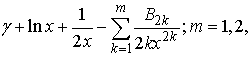 are alternatively larger and smaller than the generalized Euler’s harmonic numbers
 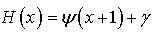 with sharp bounds, where γ is the Euler's constant,
  are the Bernoulli numbers and ψ is the digamma function.
Keywords: Euler constant, ψ-function, harmonic numbers, inequalities, asymptotic expansion, sharp bounds
Turkish Journal of Analysis and Number Theory, 2014 2 (4),
pp 147-151.
DOI: 10.12691/tjant-2-4-8
Received July 03, 2014; Revised September 01, 2014; Accepted September 08, 2014
Copyright © 2013 Science and Education Publishing. All Rights Reserved.Cite this article:
- Mahmoud, Mansour. "A New Proof of an Inequality for the Logarithm of the Gamma Function and Its Sharpness." Turkish Journal of Analysis and Number Theory 2.4 (2014): 147-151.
- Mahmoud, M. (2014). A New Proof of an Inequality for the Logarithm of the Gamma Function and Its Sharpness. Turkish Journal of Analysis and Number Theory, 2(4), 147-151.
- Mahmoud, Mansour. "A New Proof of an Inequality for the Logarithm of the Gamma Function and Its Sharpness." Turkish Journal of Analysis and Number Theory 2, no. 4 (2014): 147-151.
| Import into BibTeX | Import into EndNote | Import into RefMan | Import into RefWorks |
1. Introduction
Euler, in his "Institutiones calculi differentialis" [10], introduced the concept of inexplicable functions. These functions were appeared originally as functions in the positive integers of one symbol or more. He presented the following examples of the inexplicable functions:
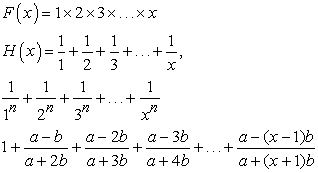 |
where there is no necessity for x to be an integer. The first function  generalizes the factorial function and the second one
  generalizes the harmonic numbers
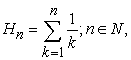 | (1) |
which are partial sums of the harmonic series. The function  can be defined by the definite integral
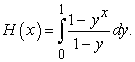 | (2) |
We will call the function  , Euler's generalized Harmonic numbers. The recurrence relation of
  is given by
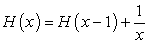 | (3) |
and its reflection relation is
 |
The multiplication formula is given by
 |
The function  is related to the Euler's constant γ by the relation
 |
and its relation with the digamma function  (the logarithmic derivative of the gamma function) is
 | (4) |
There are many other generalizations of the harmonic numbers all of them depend only on the positive integers see [3,7,8,11,12,13,17,30,31]. Also, there are many estimations of the harmonic numbers  see [4,5,6,9,18,22,25,26,27,28,32,33].
A function f is said to be completely monotonic on an interval J if
 | (5) |
If the inequality (5) is strict  and all
  then f is said to be strictly completely monotonic on the interval J.
In [1], Alzer proved that the functions
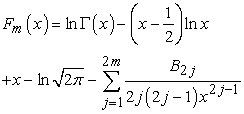 |
and
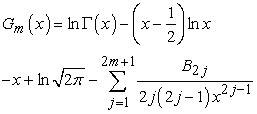 |
For  are completely monotonic on (0,∞). This means that the functions
  and
and  are also are completely monotonic on (0,∞) see [15]. These complete monotonicity have been repeated in [16] and [23]. These results can also be found in the survey [29]. From the complete monotonicity of
  and
and  , we get the following double inequality
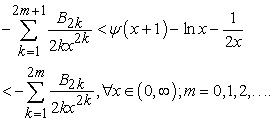 | (6) |
In this paper, we will present a new proof of the double inequality (6), using Artin's technique [2] and we will use a method due to Mortici [24] to prove that the bounds in (6) are the best possible. Also, we will provide new proof of the complete monotonicity of the two Functions  and
and  .
.
2. Main Results
Theorem 1.
For x>0, 
 | (7) |
with sharp bounds.
Proof
Consider the function
 | (8) |
Then using the recurrence relation (3), we get
 |
If we define the following function
 |
then
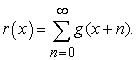 |
We can express the function  by the integral representation
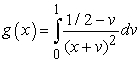 |
and hence
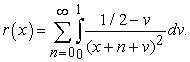 |
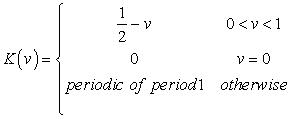
By considering the known discontinuous function
 | (9) |
we get
 |
The oscillating of the function and
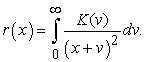
and 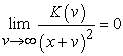 provided us by the existence of the integration
 | (10) |
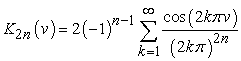
In [2], Artin introduced the functions
 | (11) |
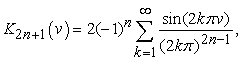 | (12) |
Where  is the Fourier series [20, 21] of the function
  . He showed that the series
  is absolutely and uniformly convergent for all v with n=2,3,… and the series is uniformly convergent in every closed interval has no integer for n=1. Also,
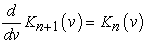 | (13) |
for all v when n=2,3,… and for nonintegral v when n=1.
Now by repeated the integrations by parts of (10), we obtain
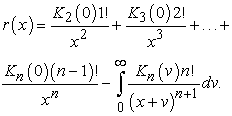 | (14) |
But
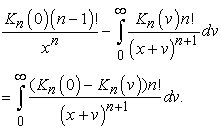 | (15) |
If n is even, the 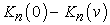 has the same sign as
  for all v and thus the integral (15) has this sign. Also,
 | (16) |
Then the signs of  alternate between minus and plus. Then the function
  lies between any two successive partial sums
 | (17) |
In other words, for every n, there exists a number  satisfies
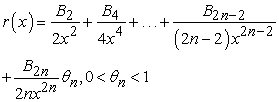 | (18) |
and hence
 | (19) |
Now, we will prove the sharpness of the bounds in (19). By the definition of the asymptotic expansion [14], the expansion of a function  of the form
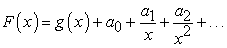 |
satisfies for every fixed k, that
 |
Then
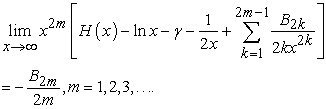 | (20) |
If we have other constants  have the property that for all
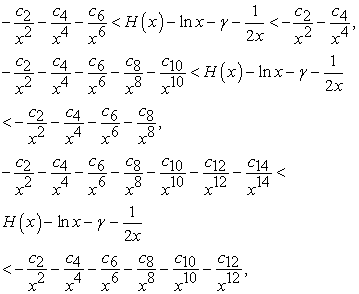 |
etc. These inequalities give us that
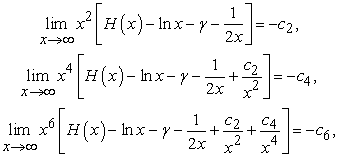 | (21) |
the relations (20) and (21), gives us that
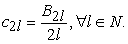 | (22) |
Then the choice of the constants  in the inequality (7) is the best one. To complete our results, we need to prove that the constant 1/2 in the the function
 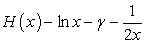 can not be improved by any method whatsoever. Consider the function
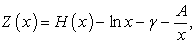 |
then
 |
Now, let
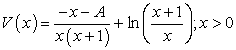 |
then
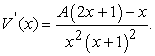 |
The The function  will be increasing if
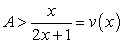 |
and the function  is increasing function with
 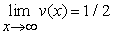 . So, the best choice of A is 1/2. Also, the function
  is increasing with limit tends to zero as x→∞, then
 |
Hence
 |
As n→∞, we get
 |
with sharp bound. Now, consider the function
 |
then
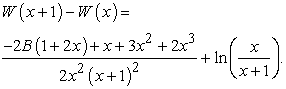 |
Let
 |
then
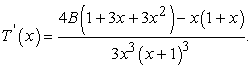 |
The function  will be increasing if
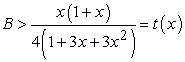 |
and the function  is increasing function with
  . So, the best choice of B is 1/12. Also, the function
  is increasing with limit tends to zero as
  , then
 |
Hence
 |
As  , we get
 |
Hence
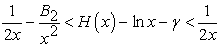 |
with sharp bounds.
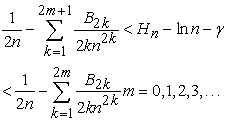
As a special case we get the following result [19]
Corollary 2.1.
For any natural number  ,
,
 | (23) |
with sharp bounds.
Now, we will present a new proof for the complete monotonicity of the functions  and
and  .
.
Lemma 2.2
For m=0,1,2,…, the functions
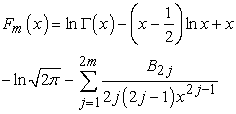 |
and
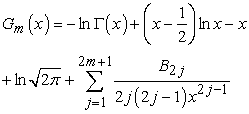 |
are completely monotonic on (0,∞).
Proof
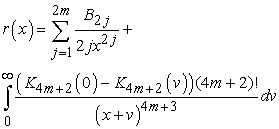
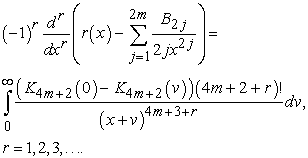
Using the relations (15), (17) and (16) at n=4m+2, we get
 |
and hence
 | (24) |
But for m=0,1,2,3,…, the  has the same sign as
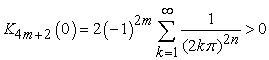
  for all v and thus the integral (24) has this sign. Using the relation (11), we obtain
 |
and hence
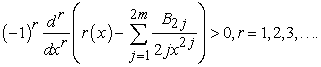 |
But
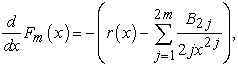 |
then
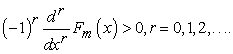 |
Similarly, we can prove the complete monotonicity for  by replacing n by 4m+4.
Remark 1.
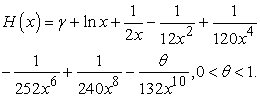
Series (17) is divergent so we can not take the limit as n tends to ∞ but the relation (18) provided us by approximations of the function  or any finite order. For example, if n=5 we obtain the following approximation:
 |
Remark 2.
The formula (10) implies the the function  is completely monotonic on (0,∞), that is
 |
Acknowledgement
The author is very grateful to Prof. Feng Qi at Tianjin Polytechnic University in China for valuable comments and useful suggestions, which greatly helped improve the presentation and the quality of the paper.
References
| [1] | Alzer, H., “On some inequalities for the gamma and psi functions,” Mathematics of Computation, 66, no. 217, 373-389, 1997. | ||
 In article In article | CrossRef | ||
| [2] | Artin, E., The Gamma function, translated by M. Butler, Holt, Rinehart and Winston, New York, 1964. | ||
| In article | |||
| [3] | Benjamin, A. T., Gaebler, D. and Gaebler, R., “A combinatorial approach to hyperharmonic numbers”, Integers, 3: A15, 2003. | ||
| In article | |||
| [4] | Chen, C.-P. and Qi, F., “The best bounds of the n-th harmonic number”, Glob. J. Appl. Math. Math. Sci. 1, no. 1, 41-49, 2008. | ||
| In article | |||
| [5] | Chen, C.-P., “Inequalities for Euler-Mascheroni constant,” Appl. Math. Lett. 23, 161-164, 2010. | ||
| In article | CrossRef | ||
| [6] | Guo, B.-N. and Qi, F., “Sharp bounds for harmonic numbers”, Applied Mathematics and Computation, Vol. 218, 3, 991-995, 2011. | ||
| In article | CrossRef | ||
| [7] | Chu, W., “Harmonic number identities and Hermite-Padé approximations to the logarithm function, J. Approx. Theory, 137, 42-56, 2005. | ||
| In article | CrossRef | ||
| [8] | Coffey, M. W. and Lubbers, N., “On generalized harmonic number Sums”, Applied Mathematics and Computation, Vol. 217, Issue 2, 689-698, 2010. | ||
| In article | CrossRef | ||
| [9] | DeTemple, D. W., “A quicker convergence to Euler's Constant”, The Amer. Math. Monthly 100, 468-470, 1993. | ||
| In article | CrossRef | ||
| [10] | Euler, L., “Institutiones calculi differentialis”, St. Petersburg, 1755. | ||
| In article | |||
| [11] | Gertsch, A., “Generalized harmonic numbers”, C. R. Acad. Sci. Paris, Sér. I Math. 324, no. 1, 7-10, 1997. | ||
| In article | CrossRef | ||
| [12] | Gessel, I. M., “On Miki’s identity for Bernoulli numbers”, J. Number Theory, 110, 75-82, 2005. | ||
| In article | CrossRef | ||
| [13] | Ken, K., “On 3-adic valuations of generalized harmonic numbers”, Integers, Vol. 12, Issue 2, 311-319, 2012. | ||
| In article | |||
| [14] | Knopp, K., Theory and application of infinite series, Dover, New York, 1990. | ||
| In article | |||
| [15] | Koumandos, S., “Remarks on some completely monotonic functions”, J. Math. Anal. Appl. 324, 1458-1461, 2006. | ||
| In article | CrossRef | ||
| [16] | Koumandos, S. and Pedersen, H. L., “Completely monotonic functions of positive order and asymptotic expansions of the logarithm of Barnes double gamma function and Euler's gamma function”, J. Math. Anal. Appl. 355, no. 1, 33-40, 2009. | ||
| In article | CrossRef | ||
| [17] | Kronenburg, M. J., “Some generalized harmonic number identities”, arXiv: 1103.5430v2, 2012. | ||
| In article | |||
| [18] | Mansour, M., “On quicker convergence towards Euler's constant”, J. Comput. Anal. Appl. 17, No. 4, 632-638, 2014. | ||
| In article | |||
| [19] | Mahmoud, M., “On the bounds of Euler's constant γ, Life Sci J, 11 (9): 617-621, 2014. | ||
| In article | |||
| [20] | Mishra, V. N. and Mishra, L. N., “Trigonometric Approximation of Signals (Functions) in Lp-Norm”, Int. Journal of Contemp. Math. Sciences, Vol. 7, no. 19, 909-918, 2012. | ||
| In article | |||
| [21] | Mishra, V. N., Khatri, K. and Mishra, L. N., “Using Linear Operators to Approximate Signals of Lip(α,p), (p≥1)-Class, Filomat 27: 2, 353-363, 2013. | ||
| In article | CrossRef | ||
| [22] | Mortici, C., “Fast convergences towards Euler-Mascheroni constant”, Computational and Appl. Math., Vol. 29, N. 3, 479-491, 2010. | ||
| In article | CrossRef | ||
| [23] | Mortici, C., “Very accurate estimates of the polygamma functions”, Asympt. Anal. 68, no. 3, 125-134, 2010. | ||
| In article | |||
| [24] | Mortici, C., “A new representation formula for the factorial function”, Thai Journal of Mathematics, Vol. 8, no. 2, 249-254, 2010. | ||
| In article | |||
| [25] | Qi, F., Cui, R.-Q., Chen, C.-P. and Guo, B.-N., “Some completely monotonic functions involving polygamma functions and an application”, Journal of Mathematical Analysis and Applications 310, no. 1, 303-308, 2005. | ||
| In article | CrossRef | ||
| [26] | Qi, F. and Luo, Q.-M., “Bounds for the ratio of two gamma functions--From Wendel's and related inequalities to logarithmically completely monotonic functions”, Banach Journal of Mathematical Analysis 6, no. 2, 132-158, 2012. | ||
| In article | CrossRef | ||
| [27] | Qi, F. and Luo, Q.-M., “Bounds for the ratio of two gamma functions: from Wendel's asymptotic relation to Elezović-Giordano-Pečarić's theorem, Journal of Inequalities and Applications 2013, 2013: 542, 20 pages. | ||
| In article | |||
| [28] | Guo, B.-N. and Qi, F., “Sharp inequalities for the psi function and harmonic numbers”, Analysis--International mathematical journal of analysis and its applications 34, 2014, in press. | ||
| In article | |||
| [29] | Qi, F., “Bounds for the ratio of two gamma functions”, J. Inequal. Appl., Vol. 2010, Article ID 493058, 84 pages. | ||
| In article | |||
| [30] | Cheon, Gi-S., and El-Mikkawy, M. A., “Generalized harmonic numbers with Riordan arrays”, J. Number Theory, 128, 413-425, 2008. | ||
| In article | CrossRef | ||
| [31] | Santmyer, J. M., “A Stirling like sequence of rational numbers”, Discrete Math. 171, 229-239, 1997. | ||
| In article | CrossRef | ||
| [32] | Tóth, L., Problem E3432, Amer. Math. Monthly, 98 (3), 264, 1991. | ||
| In article | |||
| [33] | Young, R. M., “Euler’s constant”, Math. Gazette 75, Vol 472, 187-190, 1991. | ||
| In article | |||

 CiteULike
 Mendeley
 StumbleUpon
 Delicious
 Facebook
 Twitter
 LinkedIn
 Print
Print