The aim of this study is to investigate chemical composition of Salvia Officinalis L. essential oil relating three factors: geographic position, year and harvesting season and the relationship of these factors with each other. Thirteen representative samples were taken for this study, on five locations, in north and south Albania. They were collected in two consecutive years, 2017-2018, and two harvesting periods, June and September. Essential oil extraction was done with Clevenger-type apparatus and each of them was analyzed using GC-FID and GC MS/MS. Yield percentage for different geographic positions but the same year, and harvesting period, June 2017, varies from 2.32% to 3%. During the flowering stage (June), yield percentage is higher (2.3 to 3.0 %) than during the beginning of the fruiting phase (September), (2 to 2.2%). South Albania sage belonged to the camphor ecotype, with a higher percentage during June (41.3% to 43.6%) and lower in September (31.1% to 36.3%). North sage belonged to α-thujone ecotype, with a higher percentage in June (28.4% to 37.3%) and lower in September. The year factor in this study shows a lower effect in essential oil composition and yield percentage. Data obtained from this study are indicative and may be helpful for future commercial cultivation of the Salvia officinalis L. plant. The results of this study, provides indicative information on the selection of the best variety of Salvia officinalis L. to use, in a particular site and harvesting season.
Salvia officinalis L. (sage, garden sage, or common sage) is a perennial, evergreen subshrub, with woody stems, greyish leaves, and blue to purplish flowers. It is native to the Mediterranean region and, currently cultivated in various countries 1, 2. Sage is largely used as a savory food flavoring either as dried leaves or essential oil 3. Salvia officinalis L. is a medicinal plant, as such is the source of a number of compounds, known as secondary metabolites. It has been found that these components have no direct implication on growth and plant development and often are synthesized from primary metabolites. Also, often they may show high toxicity and may have a marked biological effect on other organisms. Stage development of medicinal plants organs such as leaf, flower, and fruit can be determinant for the volatiles compounds composition, present in the essential oils of these organs 4, 5. In order to fully know the best time of harvesting period, in terms of oil composition and/or yield percentage, it is important to know the factors that influence both oil composition and/or yield percentage, and for each particular case, their specific requirements. According to 6 in some plants essential oil composition changes with the period of the year, and thus the right period of harvest may be of major importance from an agronomic and economic point of view. Environmental conditions such as temperature, day length, and light, influence, essential oil production, and quantitative composition of it 7, 8, 9. Relating to that, 10 states that, during months of lowest temperature and fewest hours of sunlight, there is an obvious decrease in volatiles production. As a summary of the many conclusions drawn about the factors affecting medicinal and aromatic plants essential oil composition variation, 11 states that this appears to be the rule rather than the exception. He suggested that this variation is influenced by three major factors: (i) individual genetic variability; (ii) variation among different plant parts and their different stages of development and, (iii) modifications due to the environment. The aim of this study, is to investigate variations of yields and chemical composition of sage essential oil relating to three factors: geographic position, year, and harvesting season. This to expand the knowledge and, to use it practically from an economic point of view, for future commercial cultivation of Salvia officinalis L. Still, the data obtained remain indicative and are part of a further study relating to Albanian sage, considering the economic values that this plant has.
Plant material. Thirteen representative samples were taken for this study. Sampling was concentrated on five locations, from north to the south Albania. Samples were taken in two consecutive years, 2017 and 2018, and in two of the main harvesting periods, June and September.
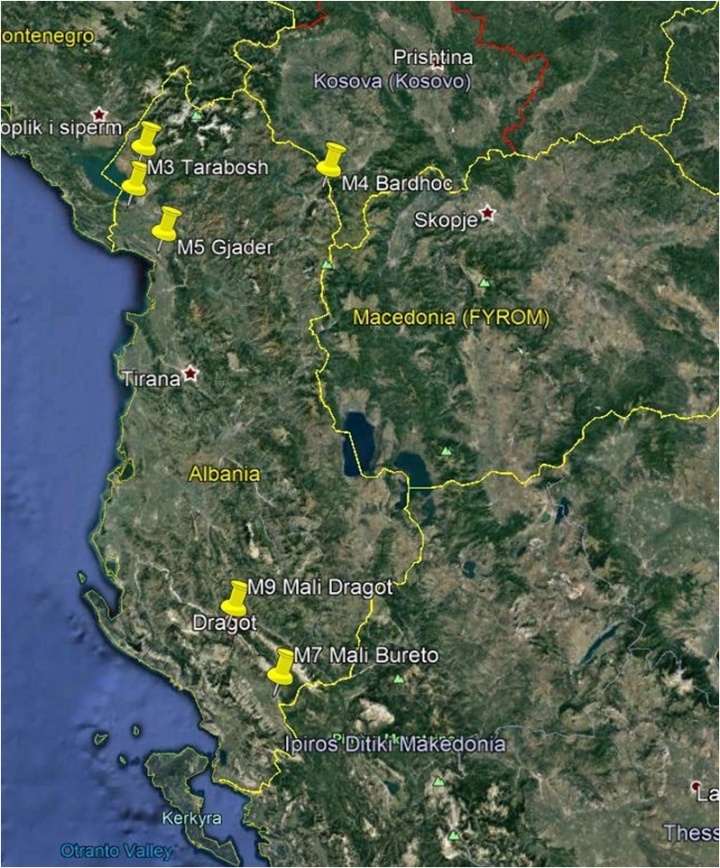
Samples were classified in two categories and the study is related to these two. The first category of plants, was collected in different locations, in north, respectively Koplik/M2, Gjader/M5, Tarabosh/M3 and south Libohove (Mali bureto)/M7, in two consecutive years, and the same harvesting season, June 2017 and June 2018. The second category of plants, was collected in different locations, in north, Bardhoc/M4 and, south Libohove (Mali bureto)/M7 and, Dragot/M9, in the same year but in two consecutive harvesting periods (June and September). The variety of plants chosen was wild and, it was collected in altitudes from 500 to 800 m above sea level. Part of the plant chosen to be analyzed were aerial parts (leaves). At each location, samples are collected randomly, from a large number of plants, representing the population of the sampling stations. Samples were collected by hand, taking into account “Good collection practice of medical and aromatic plants in nature” and were placed in airy places, in shade to get fully dried at room temperature. Sampling site is presented in Figure 1.

Oil extraction and profiling. Dry leaves were cleaned from impurities and all other solid matters or other plants. Samples were comminuted before hydro distillation extraction. The quantity of sample used is 50 g immersed in 500 ml water, using a distillation flask heater and a Clevenger-type apparatus for 3 hours, at boiling point temperature. Plant/liquid ratio used for this study was 1:10 (g:ml). The obtained essential oils were dried with anhydrous sodium sulphate and stored at 4-5°C for further analysis. All samples were used for oil profiling with GC-FID/GC-MS/MS analysis and all of them, were chosen to compare essential oil composition differences. Samples were analyzed at Noval Laboratory shpk, a laboratory in Maminas, Durres, Albania. Analysis of the essential oil was carried out in SHIMADZU NEXIS GC-2030 (Shimadzu Europa GmbH, Analytical and Measuring Instruments) chromatograph with a data handling software Lab solution, equipped with a Split/Split less injector SPL 2030, On-Column injection unit OCI 2030, and Flame ionization detectors (FID-2030). Agilent 7000D triple quadrupole GC/MS (Agilent). Essential oils fraction was carried out with an Agilent GC/MSD system with a mass spectrometer detector 7000D MS, 7890B GC, and Mass Hunter acquisition, data handling, and reporting software. Highly inert capillary column Rxi-5ms column Rxi-5ms, (30m x 0.25mm, film thickness 0.50 μm), ID, 0.25 mm, was used. 10 µl of essential oil, was accurately weighed in a vial and 1000 µl of Hexane. Temperature program of the column: 60°C for 1 min, 4°C / 1 min till 180°C and 20°C / 1 min till 250 °C, total 40 min. A carrier gas, Helium, column flow 1 ml/min constant speed, total flow 14 ml/min split ratio 100:1. Injection volume 1 µL (10 µL syringe). The identification of chemical components was made by a comparison of their relative retention time and mass spectra with those of compounds published in literature and databases. The identified components were listed according to their retention time. Percentage composition of components was calculated according to their chromatographic peak area.
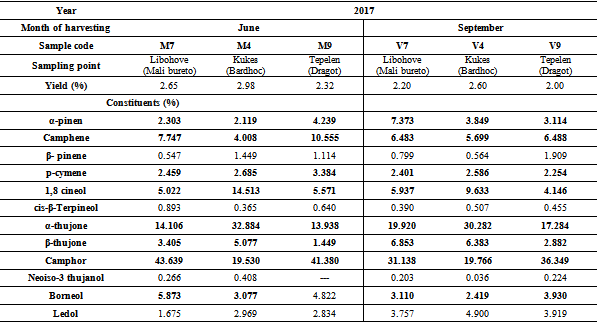
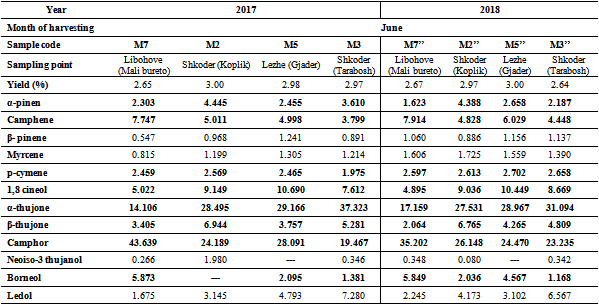
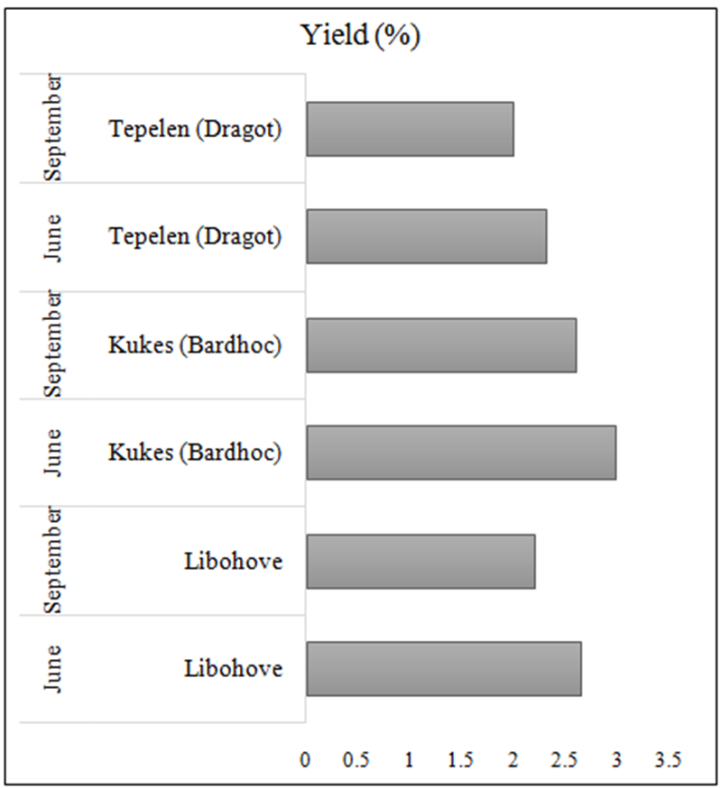
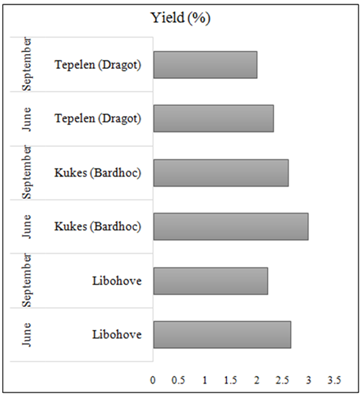
Yield percentage of Essential Oils. Extracted leaves, yielded a mobile colourless to yellow essential oil (color differs for samples of different geographic position) and characteristic, camphoraceous, with a spicy note odour 12. Evaluation of the essential oil yield was done relating to the same three factors mentioned above: geographic position, year, and harvesting seasons, results are shown in, Table 1 and Table 2. Obtained results show that sage plant, in all sampling points, was rich in essential oil. Sage dried leaves, collected in different geographical positions, resulted to have significant differences in oil yield percentage. The most common yield percentage of S. Officinalis essential oil is up to 3% 13. In this study, yield percentage obtained referring to geographical position, the same year, and same harvesting period, June 2017, varies from 3% / M2 (Koplik) to 2.32 % / M9 (Dragot). Essential oil yield (w/w %) based on dry weight of sage, was in the following order: 3% / M2 (Koplik) > 2.98% / M4 (Gjader) & 2.98% / M5 (Bardhoc) > 2.97% / M3 (Gjader) > 2.65% / M7 (Mali Bureto) > 2.32 % / M9 (Dragot). Essential oil yield shows interesting differences for plants cropped in different harvesting periods, the same year, and the same location, Table 1. Flowering stage of S. Officinalis L. is during May till July, depending on the climatic subarea where the plant biotope is found 14. According to 15, the amount of EO for sage, is at its highest level at the floral budding stage when the oil is intensively biosynthesized, and decreased gradually at the fruiting phase. Our data for the essential oil content, results to be higher at the flowering stage (June), from 2.3% to 3%, then decreases from 2% to 2.2%, in course of the beginning of fruiting phase (September). As we see it is important to establish and carefully select the harvesting time, to ensure maximum yield of essential oil and, for sage flowering stage could be favored. As reported by 11, oil content has been shown to be heritable in other species and it might be possible to develop S. Officinalis L. cultivars with high oil contents.
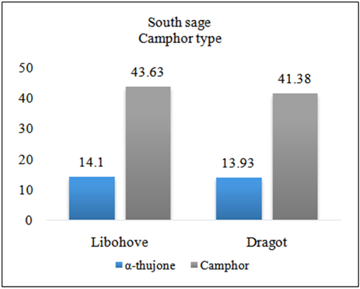
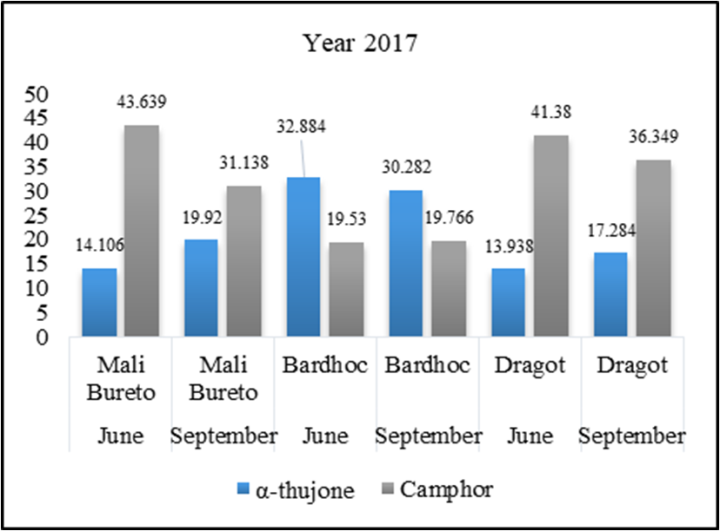
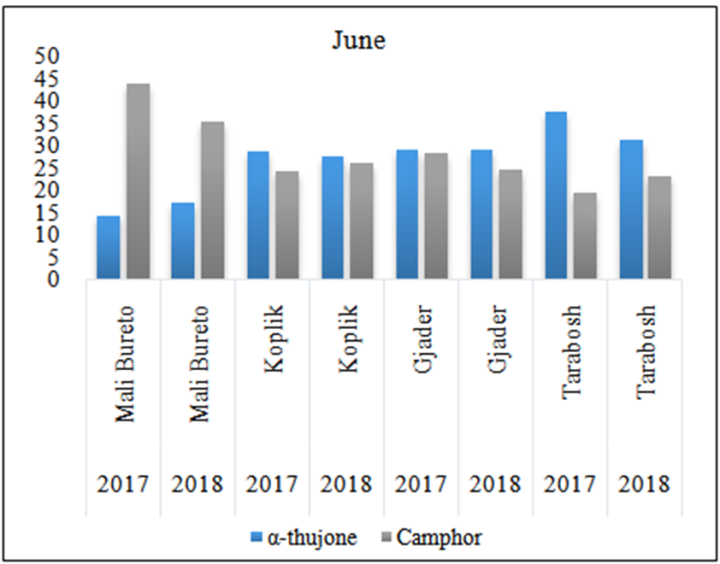
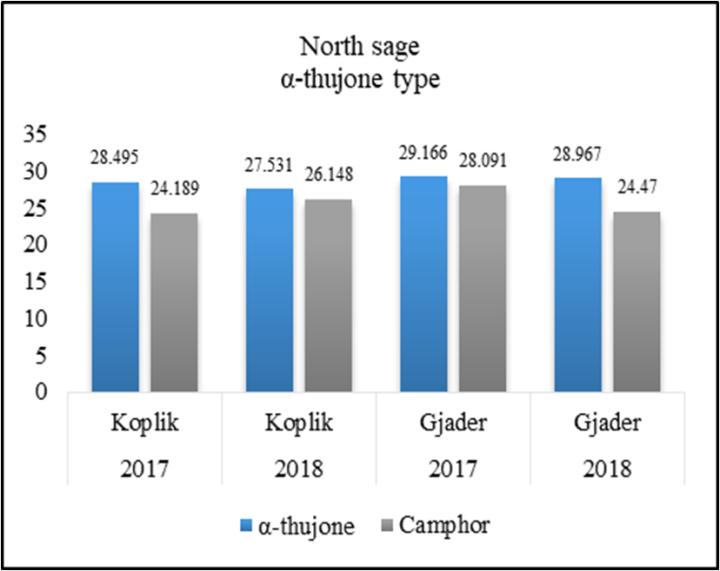
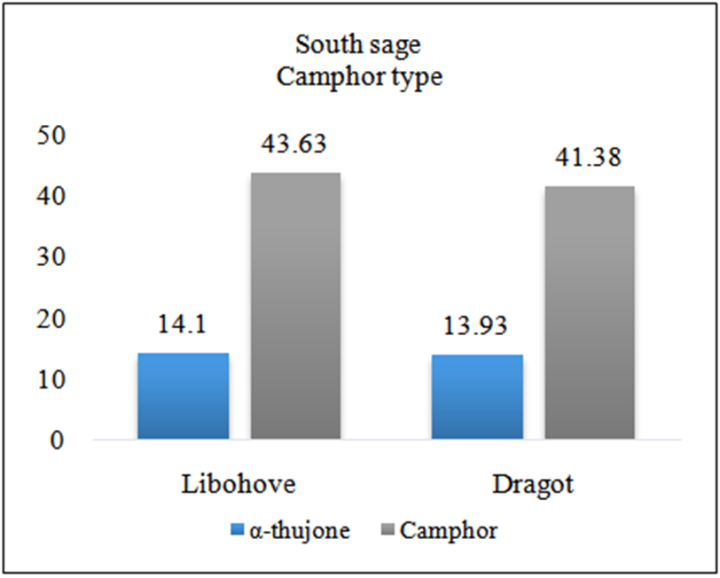
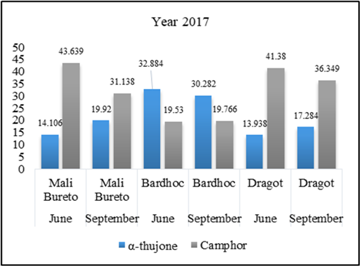
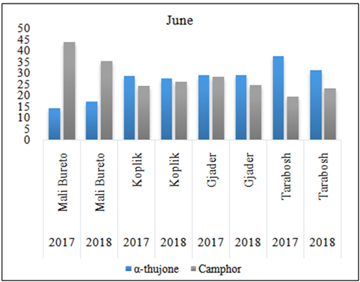
Composition of Essential Oils. Chemical composition of Salvia Officinalis L. essential oil is showed in Table 1 and Table 2. Thirty compounds were identified in essential oils, from which we extracted those with the highest percentage and at the same time typical of sage essential oil. The eight main constituents, in all samples were: camphor (19.4% - 43.6%), α-thujone (13.9% - 37.3%), camphene (4.0% - 10.5%), 1.8-cineole (4.8% - 14.5%), β-pinene (0.5% - 13.5%), β-thujone (1.4% - 6.9%), Borneol (1.16% - 5. %) and p-cymene (1.97% - 3.38%). Samples harvested in south Albania M7 / Mali Bureto and M9 / Dragot belongs to camphor chemo type. They contain reduced levels of α-thujone and higher levels of camphor. In these samples camphor concentration varies from 41.3% to 43.6% during June. For the same period, α-thujone has a lower level 13.9% to 14.1%, thus maintaining the inverse relationship they have between them. North Albanian sage M2 / Koplik, M4 / Gjader, M5 / Bardhoc, M3 / Gjader, belongs to the α-thujone chemo type. Results show that for the same period (June), samples have higher percentage of α-thujone, from 28.4% to 37.3%, the opposite is for camphor, and it ranges from 19.4% to 28.09%. Samples cropped in south Albania, during September show a slight deviation, camphor level decrease from 31.1% to 36.3%, and α-thujone increases from 17.2% to 19.9%. The same deviation is noticed for samples cropped in North M5 / Bardhoc, but in reverse, camphor level increase from 19.53% to 19.76% and α-thujone decrease from 32.88% to 30.2%. Other major components are camphene and 1, 8-cineole, which showed different dynamics and different trends of changes in concentration during the seasons. Almost all differences can be classified into three basic types of change (decreasing, increasing, and fluctuating type) 16. An interesting case is the one of β-thujone, north sage has higher concentration of it, than south, comparing for the same harvesting period (June) and same year 2017. Concentration of β-thujone varies from 5.07% to 6.94%, in north and 1.44% to 3.40%, in south. For the same geographic position but in a different harvesting period (September), concentration of β-thujone decreases in north sage and increases in south sage. Maintaining the same line of change as α-thujone. Samples collected in the same geographic position but in two consecutive years, 2017 and 2018 show slight differences in essential oil yield percentage and composition. The ratio between α-thujone and camphor is preserved for all points, also for other components, referring to south and north Albania. It is interesting the relationship between these components in samples of the same region like M2/Koplik, north and going down on north-west M5/Gjader. The difference between α-thujone and camphor, decreases. This relationship is preserved in both years. According to 16, the asynchronous variations in the concentration of individual constituents appears to be the rule rather than the exception. This means that a component from plants from different geographical areas and different habitats, may have very different trends of variation during the season. In different years, conditions to which the plant is exposed vary, leading to a pattern of seasonal variation in plant metabolites that is, generally repeated every year.
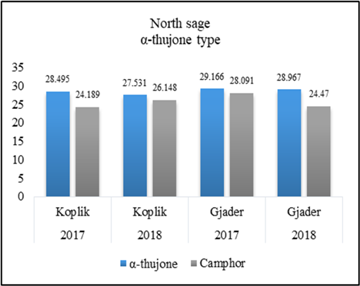
Albanian sage is rich in essential oil and show significant variations in yield percentage for samples collected in different geographic positions, same year, and same harvesting season. In our study, sampling stations of north Albania show higher yield percentage than south. Essential oils yield content for plants collected in the same year and same geographic position, is higher at the flowering stage but then decreases in course of beginning of fruiting stage. In this study all samples analysed despite different origins or harvesting season, were all rich in α-thujone, camphor, ledol, 1, 8 cineol, β-thujone, camphene, and β-pinene. Samples from south Albania belongs to the camphor chemo type and those from north to the α-thujone chemo type. Chemical composition of essential oils from the same geographic position, were effected by harvesting period, south Albania sage shows higher level of camphor during June and lower during September, were α-thujone instead increases. The same pattern was noticed for north sage, showing higher level of α-thujone during June and lower in September, camphor instead increases. Both chemo types for different harvesting periods, preserve their typical pattern of chemical composition but they show differences in compounds content. Samples collected in the same geographic position but in two consecutive years, show slight differences in essential oil yield percentage and composition. On basis of all analyses, it could be concluded that yield and essential oil composition varies in different geographic position for different harvesting seasons. The results of this study, provides indicative information on the selection of the best variety of S. Officinalis to use, in a particular site and harvesting season. Also, can be used for cultivation purpose.
| [1] | Raal, A., Orav, A. and Arak, E., “Composition of the essential oil of Salvia officinalis L. from various European countries”, Natural Product Research, 21 (5), pp. 406–411, June 2007. | ||
| In article | View Article PubMed | ||
| [2] | M. H. Mirjalili, P. Salehi,A. Sonboli, and M. M. Vala, “Essential oil variation of Salvia officinalis aerial parts during its phenological cycle”, Chemistry of Natural Compounds, 42(1), pp. 19-23, 2006. | ||
| In article | View Article | ||
| [3] | Perry, N.B., Anderson, R. E., Brennan, J. N., Douglas, H. M., Heaney, J. A., McGimpsey, A. J., and Smallfield, M. B., “Essential oils from Dalmatian sage (Salvia officinalis L.): variations among individuals, plant parts, seasons, and sites”, Journal of Agricultural and Food Chemistry, 47(5), pp. 2048-2054, April, 1999. | ||
| In article | View Article PubMed | ||
| [4] | Figueiredo, AC., Barroso, JG., Pedro, LG., “In Essential Oils: Basic and Applied Research”, Proceedings of the 27th International Symposium on Essential Oils, Franz Ch, Máthé Á, Buchbauer G (eds). Allured: Carol Stream, IL, pp. 95-107, 1997. | ||
| In article | |||
| [5] | Badalamenti, F., “The Essential Oils of the Mediterranean Region, Green C (ed.)”, Proceedings of the IFEAT International Conference 2004. International Federation of Essential Oil and Aroma Trades (FEAT), London, UK, pp. 77-97, 2004. | ||
| In article | |||
| [6] | Figueiredo, A.C, Barroso, J.G., Pedro, L.G. J., Scheffer, J. C. “Factors affecting volatile and essential oil production in plants”, Flavour and Fragrance Journal February, 23, pp. 213-226, May 2008. | ||
| In article | View Article | ||
| [7] | Kintzios, S.E., “Medicinal and aromatic plants—industrial profiles”, Sage, The Genus Salvia, 14, Harwood Academic Publishers, The Netherlands, 2000. | ||
| In article | |||
| [8] | A.L. Giannouli, S.E. Kintzios III, “Essential Oils of Salvia ssp., examples of intraspecific and seasonal variation”, vol. 14, Harwood Academic Publishers, The Netherlands, 2000. | ||
| In article | |||
| [9] | Shafiee-Hajiabad, M., Novak, J., Honermeier, B., “Content and composition of essential oil of four Origanum vulgare L. accessions under reduced and normal light intensity conditions”, Journal of Applied Botany and Food Quality 89, 126-134. June 2016. | ||
| In article | |||
| [10] | Tingey, DT., Manning, M., Grothaus, LC et al., “Influence of Light and Temperature on Monoterpene Emission Rates from Slash Pine”, Plant Physiol. 65: 797-801, 1980. | ||
| In article | View Article PubMed | ||
| [11] | Franz, Genetics, “Volatile Oil Crops: Their Biology, Biochemistry and Production”, On: Hay RKM & Waterman PG, pp. 63-96, 1993. | ||
| In article | |||
| [12] | IS0 9909:1997, Oil of Dalmatian sage (Salvia officinalis L.). | ||
| In article | |||
| [13] | European Medicines Agency, “Assessment Report On Salvia Officinalis L., Folium And Salvia Officinalis L., Aetheroleum”, 2009. | ||
| In article | |||
| [14] | GIZ, Albania’s natural heritage of medicinal and aromatic plants (Monograph description of 40 medicinal and aromatic plant species and their importance for the livelihoods of mountain communities in Albania), Tirana December 2013. | ||
| In article | |||
| [15] | Baranauskiene, R., Dambrauskiene, E., Venskutonis. P.R., Viskelis, P., “Influence Of Harvesting Time On The Yield And Chemical Composition Of Sage (Salvia Officinalis L.)”, FOODBALT, 1-6, Lithuania, 2011. | ||
| In article | |||
| [16] | Branislava S. Lakušić, Mihailo S. Ristić , Violeta N. Slavkovska, Danilo Lj. Stojanović and Dmitar V. Lakušić, “Variations in essential oil yields and compositions of Salvia officinalis (Lamiaceae) at different developmental stages”, March 2013. | ||
| In article | |||
Published with license by Science and Education Publishing, Copyright © 2021 Evelina Hasa, Sonila Duka, Ervis Lika and Enida Nushi
 This work is licensed under a Creative Commons Attribution 4.0 International License. To view a copy of this license, visit
http://creativecommons.org/licenses/by/4.0/
This work is licensed under a Creative Commons Attribution 4.0 International License. To view a copy of this license, visit
http://creativecommons.org/licenses/by/4.0/
| [1] | Raal, A., Orav, A. and Arak, E., “Composition of the essential oil of Salvia officinalis L. from various European countries”, Natural Product Research, 21 (5), pp. 406–411, June 2007. | ||
| In article | View Article PubMed | ||
| [2] | M. H. Mirjalili, P. Salehi,A. Sonboli, and M. M. Vala, “Essential oil variation of Salvia officinalis aerial parts during its phenological cycle”, Chemistry of Natural Compounds, 42(1), pp. 19-23, 2006. | ||
| In article | View Article | ||
| [3] | Perry, N.B., Anderson, R. E., Brennan, J. N., Douglas, H. M., Heaney, J. A., McGimpsey, A. J., and Smallfield, M. B., “Essential oils from Dalmatian sage (Salvia officinalis L.): variations among individuals, plant parts, seasons, and sites”, Journal of Agricultural and Food Chemistry, 47(5), pp. 2048-2054, April, 1999. | ||
| In article | View Article PubMed | ||
| [4] | Figueiredo, AC., Barroso, JG., Pedro, LG., “In Essential Oils: Basic and Applied Research”, Proceedings of the 27th International Symposium on Essential Oils, Franz Ch, Máthé Á, Buchbauer G (eds). Allured: Carol Stream, IL, pp. 95-107, 1997. | ||
| In article | |||
| [5] | Badalamenti, F., “The Essential Oils of the Mediterranean Region, Green C (ed.)”, Proceedings of the IFEAT International Conference 2004. International Federation of Essential Oil and Aroma Trades (FEAT), London, UK, pp. 77-97, 2004. | ||
| In article | |||
| [6] | Figueiredo, A.C, Barroso, J.G., Pedro, L.G. J., Scheffer, J. C. “Factors affecting volatile and essential oil production in plants”, Flavour and Fragrance Journal February, 23, pp. 213-226, May 2008. | ||
| In article | View Article | ||
| [7] | Kintzios, S.E., “Medicinal and aromatic plants—industrial profiles”, Sage, The Genus Salvia, 14, Harwood Academic Publishers, The Netherlands, 2000. | ||
| In article | |||
| [8] | A.L. Giannouli, S.E. Kintzios III, “Essential Oils of Salvia ssp., examples of intraspecific and seasonal variation”, vol. 14, Harwood Academic Publishers, The Netherlands, 2000. | ||
| In article | |||
| [9] | Shafiee-Hajiabad, M., Novak, J., Honermeier, B., “Content and composition of essential oil of four Origanum vulgare L. accessions under reduced and normal light intensity conditions”, Journal of Applied Botany and Food Quality 89, 126-134. June 2016. | ||
| In article | |||
| [10] | Tingey, DT., Manning, M., Grothaus, LC et al., “Influence of Light and Temperature on Monoterpene Emission Rates from Slash Pine”, Plant Physiol. 65: 797-801, 1980. | ||
| In article | View Article PubMed | ||
| [11] | Franz, Genetics, “Volatile Oil Crops: Their Biology, Biochemistry and Production”, On: Hay RKM & Waterman PG, pp. 63-96, 1993. | ||
| In article | |||
| [12] | IS0 9909:1997, Oil of Dalmatian sage (Salvia officinalis L.). | ||
| In article | |||
| [13] | European Medicines Agency, “Assessment Report On Salvia Officinalis L., Folium And Salvia Officinalis L., Aetheroleum”, 2009. | ||
| In article | |||
| [14] | GIZ, Albania’s natural heritage of medicinal and aromatic plants (Monograph description of 40 medicinal and aromatic plant species and their importance for the livelihoods of mountain communities in Albania), Tirana December 2013. | ||
| In article | |||
| [15] | Baranauskiene, R., Dambrauskiene, E., Venskutonis. P.R., Viskelis, P., “Influence Of Harvesting Time On The Yield And Chemical Composition Of Sage (Salvia Officinalis L.)”, FOODBALT, 1-6, Lithuania, 2011. | ||
| In article | |||
| [16] | Branislava S. Lakušić, Mihailo S. Ristić , Violeta N. Slavkovska, Danilo Lj. Stojanović and Dmitar V. Lakušić, “Variations in essential oil yields and compositions of Salvia officinalis (Lamiaceae) at different developmental stages”, March 2013. | ||
| In article | |||