The species we have chosen is Terminalia aviccinniodes from the combretacae family is a medium-sized tree that can reach about 30 m in height and is widespread in tropical Africa, known locally in the Central African pharmacopoeia. It is a species widely used in traditional medicine for its therapeutic properties. Objectives: As part of the development of medicinal plants in the Central African Republic, the interest of this study is focused on the traditional uses, the phytochemical study and the antioxidant activity of Terminalia aviccinniodes. Results: The results of the various extracts obtained showed that the methanol extract has the best yield with a percentage of 9.02%. Qualitative analyzes revealed the presence of flavonoides, tannins, les saponins, sterols and triterpenes. The results showed that the root extracts of Terminalia aviccinniodes contain more polyphenols than the other families (tannins, anthocyanins and flavonoids). The quantified total polyphenols of the different extracts varied between 9.35±8.77 and 41.00± 31.66 mg of gallic acid equivalent (mg EqAG/g). The methanol extract has the best rate of polyphenols 41.00± 31.66 mg of gallic acid equivalent (mg EqAG/g), than the other extracts. It is followed by the ethyl acetate extract with a level of 28.60 ± 2.10 mg of gallic acid equivalent (mg EqAG/g). The quantified tannins have a rate that varies between 2.21±11.54 and 9.17±2.97mg Catechin Equivalent/g. The best correlation coefficient obtained is R2=0.899 between antioxidant activity and flavonoids. Conclusion: The phytochemical study revealed the presence of certain molecules such as polyphenols and alkaloids, which can give Terminalia aviccinniodes its therapeutic properties.
The medicinal plants used for the treatment of various pathologies possess chemical substances assimilated to secondary metabolites (alkaloids, phenolic compounds and terpenoids) whose biological properties have been demonstrated at length in the literature. Indeed, more than 25% of existing drugs belong to the secondary metabolisms of plants 1.
Polyphenolic compounds are among the molecules sought for their physiological and pharmacological activities 2. These are natural compounds widely distributed in the plant kingdom. Their role as natural antioxidants is attracting more and more interest in the prevention and treatment of cancer, inflammatory and cardiovascular diseases. Polyoxygenated steroles and triterpenes have selective cytotoxicity and antitumor properties 3.
In view of the beneficial effects assigned to polyphenols and their derivatives, to alkaloids and other natural compounds, our research is oriented towards the class of chemical molecules endowed with biological activities. Terminalia aviccinniodes of the Combrétaceae family, with the vernacular name Dafo (in Banda), Bebera (in Mandjas) and Begbakoa (in Gbanou), was selected from among the medicinal plants used in the Central African pharmacopoeia.
This plant is recognized in the Central African Republic for its use in the treatment of certain diseases. Generally, it is used for its virtues against diarrhea, viral hepatitis, cancer, headaches, tooth decay, yellow fever, asthma and cough. Pharmacological studies have shown that the barks of Terminalia aviccinniodes are used in traditional medicine in Nigeria in the treatment of painful menstruation (dysmenorrhea), menorrhagia, trypanosomiasis, diarrhea, tuberculosis, cough, wounds especially for a better healing of skin infections, gastrointestinal disorders, ulcers, dental caries 4, 5.
The aim of this work is to carry out the phytochemical study of Terminalia aviccinniodes and to evaluate its antioxidant activity.
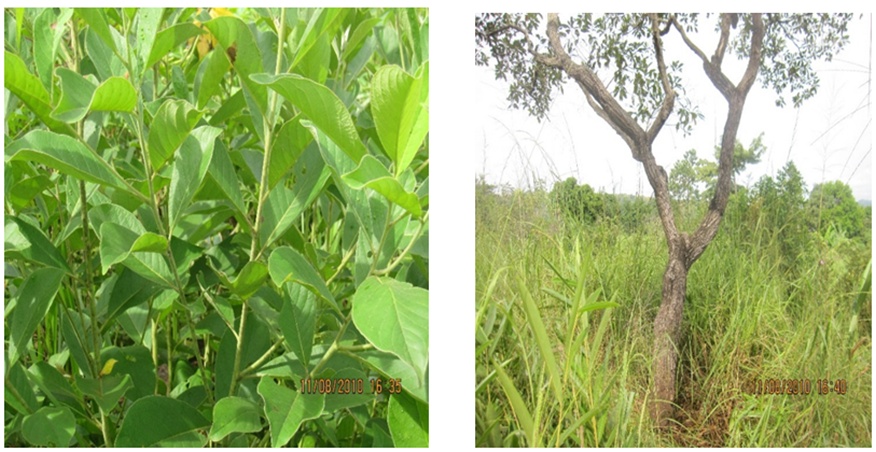
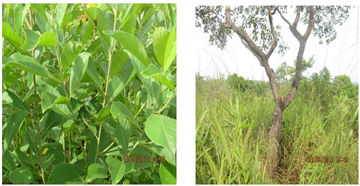
Origin of the plant: The study was carried out on the roots of Terminalia aviccinniodes collected in July 2021, in the Yassara region, which is a subdivision of the Begoua region 15 kilometers from Bangui towards the village of Voudambala in the Central African Republic. The plant (Figure 1) was identified at the Center for Studies and Research in Pharmacopoeia and Traditional African Medicine (CERPHAMETA) by Doctor Denis BEINA. The harvested parts were dried in the open air at the LAARSN Laboratory for two weeks and reduced to powder.
2.2. Phytochemical StudyThe maceration method was used. One hundred grams (100g) of Terminalia aviccinniodes bark powder was successively extracted with four solvents of increasing polarity (petroleum ether, dichloromethane, acetone and methanol). A quantity of 100g of powder was put in 400mL of petroleum ether with stirring for 4 hours at room temperature. After filtration, the extract is evaporated using a rotavapor at 35°C and the residues are taken up with the following solvent.
To search for the major families of secondary metabolites, we used standard methods based on color reactions in tubes. Anthocyanins by the ammonia reaction, alkaloids by Mayer's tests, tannins by the FeCl3 test, foam tests were used for saponosides. As for triterpenes and steroids, the Liebermann-Burchard test was used 6.
A modification made to the method used by Worowounga et al 7 made it possible to measure the polyphenols. A volume of 20 µL of extract was added to 100 µL of Folin's reagent solution (0.2 N). The mixture was stirred for 30 seconds followed by incubation for 5 minutes in the dark. After incubation, a volume of 80 µL of Na2CO3 was added. The mixture is again stirred for 30 seconds with 15 minutes of incubation at room temperature. The absorbance was read at 620 nm. The reference used was gallic acid.
The vanillin solution was prepared at 1% in H2SO4 (7 M). A volume of 150 µL of this solution was added to 50 µL of extract. After incubation for 15 minutes at 25°C, the absorbancewas measured at 500 nm 7. The results are expressed in mg catechin equivalent/g dry matter (DM) and the catechin was the reference used. Different concentrations between 0 and 1000 µg/mL prepared from a stock solution of catechin, made it possible to plot the calibration curve.
For rapid and accurate measurement of total anthocyanins even in the presence of degraded polymerized pigments and other interfering compounds, the differential pH spectrophotometric method is recommended 8. It is based on the determination of the absorbance of extractive solutions diluted with buffer solutions of pH = 1 and pH = 4.5. Anthocyanins are reversibly transformed under the influence of pH. The structural change associated with the modification of the chromophores determines the different color of the solutions of the anthocyanins according to the pH. The colored form (oxonium) predominates at pH=1 and the colorless form (hemiacetal) at pH=4.5. Two solutions of different pH were prepared. Solution at pH=1 contains KCl (0.2 M) and HCl (0.2 M). That at pH=4.5 is a mixture of CH3COOH (0.2 M), CH3COONa (0.2 M) and H2O. A volume of 100 µL of extract was added to 100 µL of the pH=1 solution in four wells, the next four wells contain 100 µL of extract and 100 µL of the pH=4.5 solution. The absorbance of the extract was measured at two wavelengths, 450 and 620 nm after incubation for 15 minutes at 25°C 8. The results are expressed in mg cyanidin-3-glucoside equivalent/g plant material.
The quantification of flavonoids was carried out by a method based on the formation of a very stable complex between aluminum chloride and the oxygen atoms present on carbons 4 and 5 of the flavonoids 9. The protocol used is based on that described by Worowounga et al 7. The solution of AlCl3 (0.02 g/mL) in methanol was prepared. A volume of 100 µL of this solution is added to 100 µL of extract (3 mg/mL). For the control blank, 100 µL of methanol is added to 100 µL of solvent used to dissolve the extract. The measurement is made after 15 minutes of incubation at room temperature; the absorbance of the extract is measured at 415 nm. An aqueous solution of quercetin was prepared. Daughter solutions prepared from the stock solution at different concentrations between 0 and 1000 µg/mL will allow the calibration curve to be plotted.
2.3. Antioxidant ActivityA solution of DPPH (0.35 M) prepared in methanol (MeOH) was diluted 10 times. From the Terminalia aviccinniodes extract solution (3mg/mL), a range of 16/20 dilutions; 1/2 and 1/5 was prepared. A volume of 180 µL of DPPH is added to 20 µL of the diluted solution of Terminalia avicenioides extract. The mixture is stirred for 30 seconds, followed by incubation for 25 min. Absorbance is measured at 450 nm 7. Ascorbic acid is used as a reference (0.25 mg/mL). The percentage inhibition of DPPH by the plant extracts was obtained, using the following formula::
 |
Ab: Absorbance white
Ae: extract absorbance
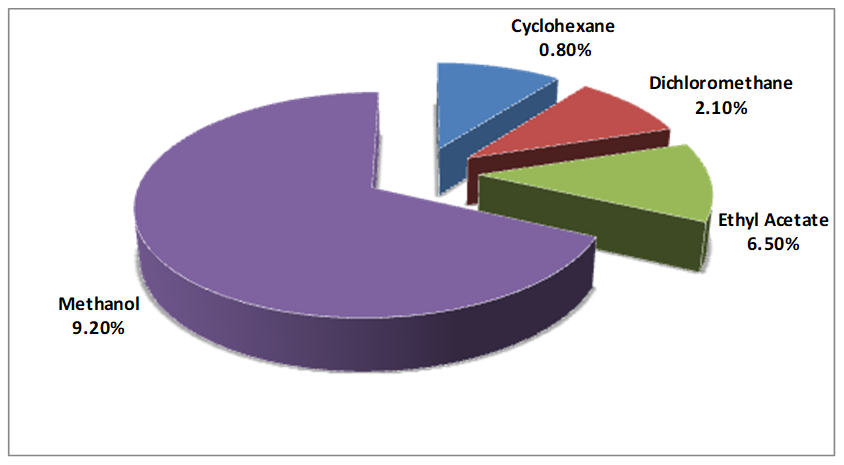
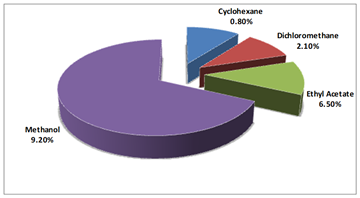
The extraction yield of the Terminalia aviccinniodes root powders obtained varies between 0.80 and 9.20% (Figure 2). The methanol extract has the best yield of 9.20%. The work of Musa et al on the methanol extract of Terminalia aviccinniodes bark gave a yield of 17.8% 10. This yield is double what we found for the methanol extract from the same plant.
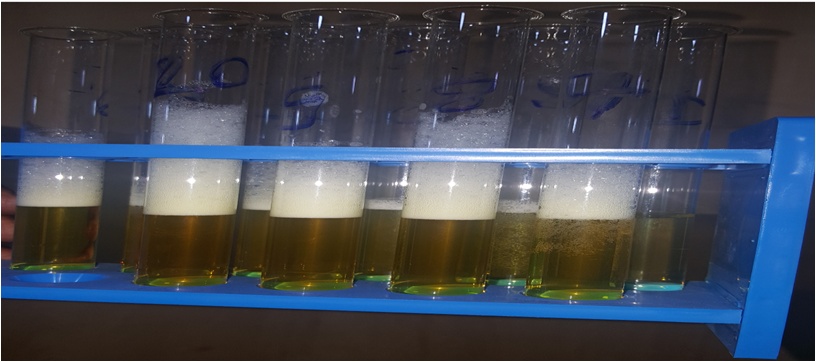
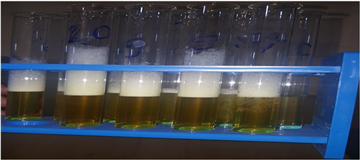
The tube, which has a color which is accentuated by acidification and which turns blue-violet in a basic medium, for the presence of anthocyanins, was obtained. The height of the foams (Figure 3) indicating the presence of saponins was observed. The saponification index of this extract was 627.08. The results of qualitative analysis of the roots of Terminalia aviccinniodes indicated the presence of flavonoids, tannins, saponosides, sterols and triterpenes. We noted however, the absence of alkaloids, anthocyanins (Table 1). The work of the qualitative analyzes of the extract of Terminalia aviccinniodes carried out by Jules Yoda et al 11, by Louis-Claire Ndel Famen et al 12, revealed the presence of alkaloids, anthocyanins, tannins, saponosides, sterols and triterpenes.
The results in Table 2 showed that the root extracts of Terminalia avicinioides contain more polyphenols than the other families (tannins, anthocyanins and flavonoids). By family of compounds, the quantified total polyphenols of the different extracts varied between 9.35 ± 8.77 and 41.00 ± 31.66 mg of gallic acid equivalent (mg EqAG/g). The methanol extract has the best rate of polyphenols 41.00± 31.66 mg of gallic acid equivalent (mg EqAG/g), than the other extracts. It is followed by the ethyl acetate extract with a level of 28.60 ± 2.10 mg of gallic acid equivalent (mg EqAG/g). Yoda et al 11 found a polyphenol level of 223.16 ± 3.93 mg GAE/g in the alcoholic extract of the same plant. This rate is much higher than that obtained from the methanol extract (Table 2).
The quantified tannins have a rate that varies between 2.21±11.54 and 9.17±2.97mg catechin equivalent/g. the cyclohexane and ethyl acetate extracts have a similar rate. However, the flavonoid and anthocyanin contents are very low compared to the polyphenols of the different extracts (Table 2).
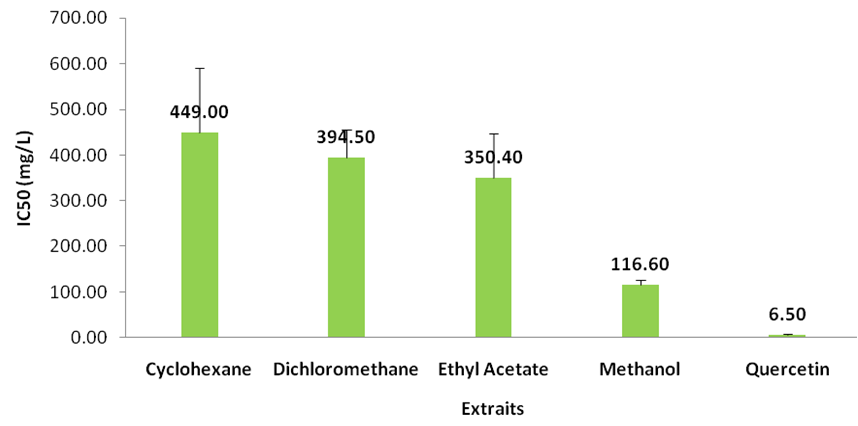
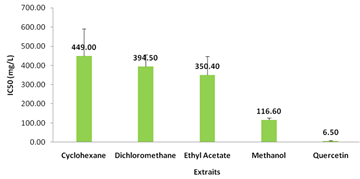
The results of the antioxidant activitiy of the extracts are represented in Figure 4. We note from these results that the percentages of inhibition of DPPH by the extracts of the Terminalia avicinioides roots varied from 116.60 to 394, 50mg/L. The methanol extract inhibited DPPH with the IC50 =116.60±8.9 mg/L, this methanol extract inhibited DPPH better compared to the other three extracts of the same plant. However, all the plant extracts moderately inhibited DPPH compared to the quercetin used as a reference which gave the IC50= 6.50 ±0.40mg/L. The antioxidant activity of the hydro-alcoholic decoction extract of the stem bark of Terminalia aviccinniodes 11 gave the IC50= 11.09 ± 0.22 µg/mL). Therefore, they obtained better inhibition than our result.
The best correlation coefficient obtained is R2=0.899 between antioxidant activity and flavonoids. The correlation coefficients between the inhibition of DPPH and polyphenols, then between antioxidant activity and tannins are respectively R2=0.770 and R2=0774.
The results of qualitative analyzes revealed the presence of flavonoids, tannins, saponosides, sterols and triterpenes. Quantitative analyzes of the different extracts from the roots of Terminalia avicinioides gave a high rate of polyphenols such as tannins, flavonoids and anthocyanins. The results of the antioxidant activity of the extracts of the roots of this plant nevertheless remain significantly lower than that of the quercetin that we used as a reference. Therefore, the root extracts of this plant moderately inhibited DPPH. We obtained a good correlation between antioxidant activity and the three families of quantified compounds (polyphenols, tannins and flavonoids). In perspective we plan to realize the antibacterial activities of the extracts of Terminalia avicinioides.
The authors would like to thank Dr. Denis Beina, botanist at the Department of Life Sciences and at the Center for Studies in Pharmacopoeia and Traditional Medicine (CERPHAMETRA) at the University of Bangui, for the identification of the plant.
| [1] | Yeshi K, Cravn D, Edita Ritmejeryte E, and Wangchuk P., “Plant Secondary Metabolites Produced in Response to Abiotic Stresses Has Potential Application in Pharmaceutical Product Development”. Molecules, 27, 313, 2022. | ||
| In article | View Article PubMed | ||
| [2] | Juanying, O., Ingfu, W., Jie, Z., Shiyi, O, “Positive and negative effects of polyphenol incorporation in bakedfoods”. Food chemistry. 284, 90-99, 2019. | ||
| In article | View Article PubMed | ||
| [3] | Bang Luu, B., Ourisson, G, “Stérols et triterpènes polyoxygénés: une famille de produits à larges spectres d'activités biologiques”. Médecine/sciences, 5, 403-407, 1989. | ||
| In article | View Article | ||
| [4] | Mann. A, K. Ibrahim, A. O. Oyewale, J. O. Amupitan, M. O. Fatope, J. I. Okogun. (2012). “Isolation and Elucidation of Three Triterpenoids and Its Antimycobacterial Activty of Terminalia aviccinniodes”. Am. J. Org. Chem. 2, 14-20. | ||
| In article | View Article | ||
| [5] | Mann. A, O.S. Ajiboso, Ajeigbe, S., Gbate, M., Isaiah, S, “Evaluation of the wound healing activity of ethanol extract of Terminalia aviccinniodes root bark on two wound models in rats”. Int. J. Med. Aromat. Plants, 95-100, 2011. | ||
| In article | |||
| [6] | Worowounga, X., Namkona, A.F., Semboli Olivia, Issa-Madongo Mathurin, Koueni-Ouakounda Kevin Hermann, Bienvenu Armand Éric Foto, and Jean-Laurent Syssa-Magalé, “Quantification of total phenolics, flavonoids, tannins, anthocyannins and antioxidant activities of Cola urceolata K. Schum”. International Journal of Innovation and Applied Studies, Vol. 36 (3), 670-677, 2022. | ||
| In article | View Article PubMed | ||
| [7] | Worowounga, X., Rahmani, R., Namkona, A.F., Cazaux, S., Syssa-magalé, J.L., Matondo, H., And Bouajila, J, “Metabolites Profiling of Manilkara mabokeensis Aubr´ev Bark and Investigation of Biological Activities”. International Journal of Analytical Chemistry, 14, 2022. | ||
| In article | View Article PubMed | ||
| [8] | M. M. Giusti, M.M., and Wrolstad, R.E, “Anthocyanins: characterization and measurement with UV-visible spectroscopy” Current protocols in food analytical chemistry, New York: John Wiley & Sons: Unit, 2001. | ||
| In article | View Article | ||
| [9] | Lagnika, L, “Etude phytochimique et activité biologique de substances naturelles isolées de plantes béninoises”. Thèse de doctorat, Université Louis Pasteur, Strasbourg, 24, 20005. | ||
| In article | |||
| [10] | Musa, F.M., Ameh, J.B., Ado, S.A. and Olonitola, O.S., 2016. “Evaluation of phytochemical and antibacterial properties of Terminalia aviccinniodes crude extract against selected bacteria from diarrhoeic patients”. Bayero Journal of Pure and Applied Sciences, 9(1): 129–137. | ||
| In article | View Article | ||
| [11] | Jules Yoda, Seydou Sourabié, Angèle Zoungrana., 2020. “Antioxidant Activity of Five Medicinal Plants Extrats Used for Management of Bacterial Diseases in Burkina Faso” . Advances in Analytical Chemistry.; 10(2): 20-25. | ||
| In article | |||
| [12] | Louis-Claire Ndel Famen, Benjamin TangueTalom, Richard SimoTagne, Gabriel Tchuente Kamsu, Norbert Kodjio, Stephen Tamekou Lacmata and Donatien Gatsin., 2020. “In vitro Antioxidant Activities and Effect of Hydroethanolic and Aqueous Extracts of Terminalia aviccinniodes (Combretaceae) on Salmonella”. Microbiology Research Journal International, 30(1): 1-14. | ||
| In article | View Article | ||
Published with license by Science and Education Publishing, Copyright © 2022 Mathurin Issa-Madongo, Xavier Worowounga, Paul Ngaïssona, Armel Frédéric Namkona, Eugene Gbayonnon, Olivia Semboli, Fatia Moustapha and Jean-Laurent Syssa-Magalé
 This work is licensed under a Creative Commons Attribution 4.0 International License. To view a copy of this license, visit
http://creativecommons.org/licenses/by/4.0/
This work is licensed under a Creative Commons Attribution 4.0 International License. To view a copy of this license, visit
http://creativecommons.org/licenses/by/4.0/
| [1] | Yeshi K, Cravn D, Edita Ritmejeryte E, and Wangchuk P., “Plant Secondary Metabolites Produced in Response to Abiotic Stresses Has Potential Application in Pharmaceutical Product Development”. Molecules, 27, 313, 2022. | ||
| In article | View Article PubMed | ||
| [2] | Juanying, O., Ingfu, W., Jie, Z., Shiyi, O, “Positive and negative effects of polyphenol incorporation in bakedfoods”. Food chemistry. 284, 90-99, 2019. | ||
| In article | View Article PubMed | ||
| [3] | Bang Luu, B., Ourisson, G, “Stérols et triterpènes polyoxygénés: une famille de produits à larges spectres d'activités biologiques”. Médecine/sciences, 5, 403-407, 1989. | ||
| In article | View Article | ||
| [4] | Mann. A, K. Ibrahim, A. O. Oyewale, J. O. Amupitan, M. O. Fatope, J. I. Okogun. (2012). “Isolation and Elucidation of Three Triterpenoids and Its Antimycobacterial Activty of Terminalia aviccinniodes”. Am. J. Org. Chem. 2, 14-20. | ||
| In article | View Article | ||
| [5] | Mann. A, O.S. Ajiboso, Ajeigbe, S., Gbate, M., Isaiah, S, “Evaluation of the wound healing activity of ethanol extract of Terminalia aviccinniodes root bark on two wound models in rats”. Int. J. Med. Aromat. Plants, 95-100, 2011. | ||
| In article | |||
| [6] | Worowounga, X., Namkona, A.F., Semboli Olivia, Issa-Madongo Mathurin, Koueni-Ouakounda Kevin Hermann, Bienvenu Armand Éric Foto, and Jean-Laurent Syssa-Magalé, “Quantification of total phenolics, flavonoids, tannins, anthocyannins and antioxidant activities of Cola urceolata K. Schum”. International Journal of Innovation and Applied Studies, Vol. 36 (3), 670-677, 2022. | ||
| In article | View Article PubMed | ||
| [7] | Worowounga, X., Rahmani, R., Namkona, A.F., Cazaux, S., Syssa-magalé, J.L., Matondo, H., And Bouajila, J, “Metabolites Profiling of Manilkara mabokeensis Aubr´ev Bark and Investigation of Biological Activities”. International Journal of Analytical Chemistry, 14, 2022. | ||
| In article | View Article PubMed | ||
| [8] | M. M. Giusti, M.M., and Wrolstad, R.E, “Anthocyanins: characterization and measurement with UV-visible spectroscopy” Current protocols in food analytical chemistry, New York: John Wiley & Sons: Unit, 2001. | ||
| In article | View Article | ||
| [9] | Lagnika, L, “Etude phytochimique et activité biologique de substances naturelles isolées de plantes béninoises”. Thèse de doctorat, Université Louis Pasteur, Strasbourg, 24, 20005. | ||
| In article | |||
| [10] | Musa, F.M., Ameh, J.B., Ado, S.A. and Olonitola, O.S., 2016. “Evaluation of phytochemical and antibacterial properties of Terminalia aviccinniodes crude extract against selected bacteria from diarrhoeic patients”. Bayero Journal of Pure and Applied Sciences, 9(1): 129–137. | ||
| In article | View Article | ||
| [11] | Jules Yoda, Seydou Sourabié, Angèle Zoungrana., 2020. “Antioxidant Activity of Five Medicinal Plants Extrats Used for Management of Bacterial Diseases in Burkina Faso” . Advances in Analytical Chemistry.; 10(2): 20-25. | ||
| In article | |||
| [12] | Louis-Claire Ndel Famen, Benjamin TangueTalom, Richard SimoTagne, Gabriel Tchuente Kamsu, Norbert Kodjio, Stephen Tamekou Lacmata and Donatien Gatsin., 2020. “In vitro Antioxidant Activities and Effect of Hydroethanolic and Aqueous Extracts of Terminalia aviccinniodes (Combretaceae) on Salmonella”. Microbiology Research Journal International, 30(1): 1-14. | ||
| In article | View Article | ||