 OPEN ACCESS
  PEER-REVIEWED
Sheep in Wolf’s Clothing – Enigma Unravelled
Treville Pereira1, , Subraj Shetty1, Svylvy Pereira2
1Department of Oral & Maxillofacial Pathology and Microbiology Dr D. Y. Patil Dental College & Hospital, Sector 7, Nerul, Navi Mumbai, Maharashtra, India
2Private Practise 1101, Maruti Mount View, Sector 8-B, C.B.D., Belapur, Navi Mumbai, Maharashtra, India
Abstract
Ulcers are common in the oral cavity. A wide spectrum of disorders can give rise to oral ulcers which may range from a local minor trauma to a significant local disease such as a malignancy or any other systemic illness. Early detection and prevention can have a potential impact on the overall incidence, morbidity, and mortality from oral cancers. However the clinical features may sometimes be ambiguous. This article presents two cases of chronic ulcers on the tongue mimicking malignancy on initial presentation.
At a glance: Figures
Keywords: Chronic tongue ulcers, non healing ulcer, Squamous cell carcinoma Traumatic ulcer
Oral Surgery, Oral Medicine, Oral Radiology, 2015 3 (1),
pp 6-8.
DOI: 10.12691/oral-3-1-2
Received November 03, 2014; Revised January 10, 2015; Accepted January 13, 2015
Copyright © 2015 Science and Education Publishing. All Rights Reserved.Cite this article:
- Pereira, Treville, Subraj Shetty, and Svylvy Pereira. "Sheep in Wolf’s Clothing – Enigma Unravelled." Oral Surgery, Oral Medicine, Oral Radiology 3.1 (2015): 6-8.
- Pereira, T. , Shetty, S. , & Pereira, S. (2015). Sheep in Wolf’s Clothing – Enigma Unravelled. Oral Surgery, Oral Medicine, Oral Radiology, 3(1), 6-8.
- Pereira, Treville, Subraj Shetty, and Svylvy Pereira. "Sheep in Wolf’s Clothing – Enigma Unravelled." Oral Surgery, Oral Medicine, Oral Radiology 3, no. 1 (2015): 6-8.
| Import into BibTeX | Import into EndNote | Import into RefMan | Import into RefWorks |
1. Introduction
Ulcerations on the tongue are commonly encountered in dental practice. Solitary ulcers of the tongue are more commonly caused as a result of sharp edges of a broken tooth or ill fitting dentures. Other less commonly known causes include traumatic ulcerative granuloma with stromal eosinophilia, atypical histiocytic granuloma, infections like tuberculosis, late stage of syphilis or fungal infections like histoplasmosis. [1] Occasionally, the ulcer may be of malignant etiology. [2] A lingual carcinoma may undergo metastasis early. Hence, it is extremely important as a dentist to diagnose lingual cancer at an early stage. [2] An ulcer which has a suspicious appearance and which does not heal within two weeks needs to be biopsied to rule out malignancy [3].
2. Report of Two Cases
2.1. Case 1

) PowerPoint Slide
PowerPoint Slide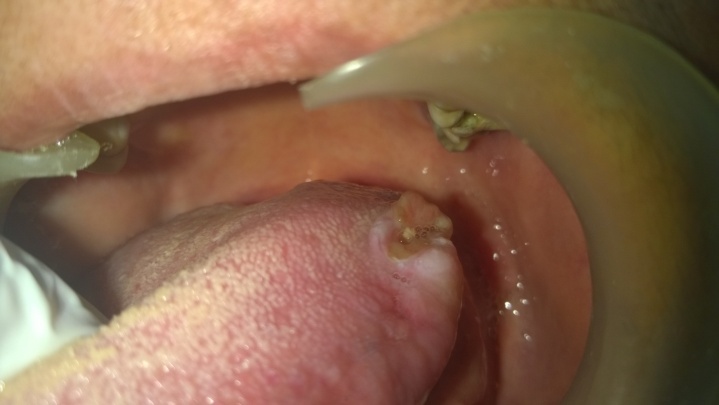 Larger image(png format)


A 65-year-old female reported to our dental clinic at Airoli, Navi Mumbai, India with complain of an ulcer on the left lateral border of tongue for the past 5 months. The ulcer had been growing in size since then. The patient did not complain of any pain or burning sensation and did not complain of any discomfort during mastication. She had received some medication from a general practitioner, but was not relieved. Her medical history was non-contributory.

. (case 1)) PowerPoint Slide
PowerPoint Slide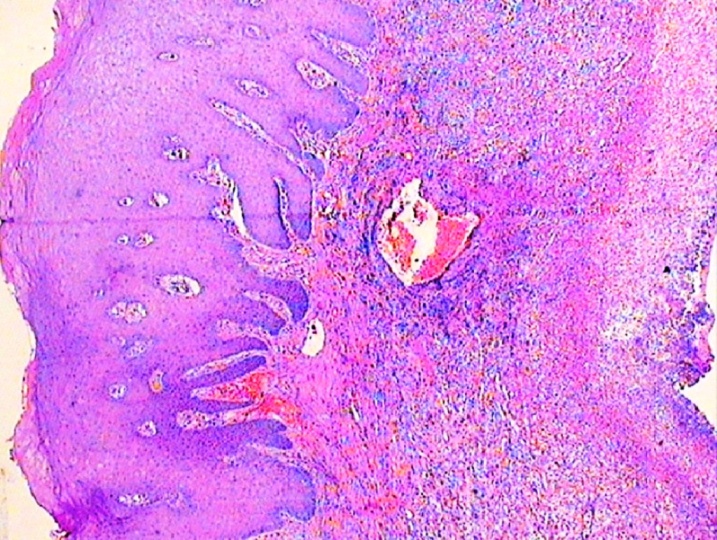 Larger image(png format)
On intraoral examination, an ill defined ulcerative lesion, 1.5 × 1 cm in size was present on the posterior left lateral border of the tongue (Figure 1). Patient gave a history of using mishri (form of tobacco used for cleaning teeth by women in rural India) twice a day for 30 years. The molar teeth in the maxillary left quadrant were carious and had sharp margins. It was non tender on palpation. The clinical appearance raised the suspicion of a malignant ulcer and a biopsy was advised. Hematological investigations were within normal limits. At the time of biopsy, the carious teeth i.e. maxillary left molar teeth with ragged margins seemingly associated with the lesion were also extracted. Histopathological examination showed the presence of parakeratinized stratified squamous epithelium showing proliferation at places. Underlying connective tissue stroma showed chronic inflammatory infiltrate and blood vessels. There was no evidence of malignancy. A diagnosis of fibro-epithelial hyperplasia was arrived (Figure 2). The patient was recalled after one week for suture removal. Healing was uneventful (Figure 3).

) PowerPoint Slide
PowerPoint Slide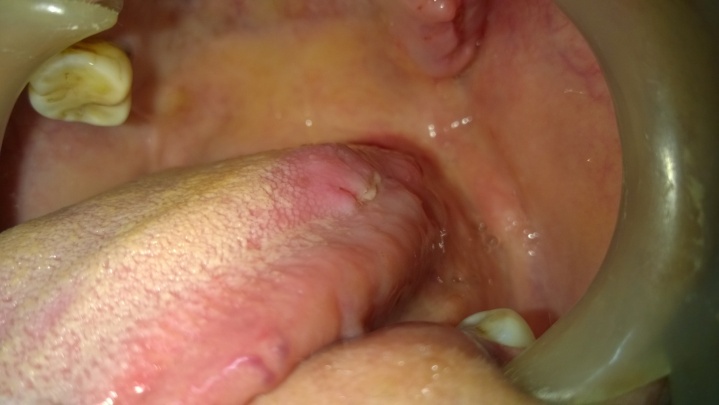 Larger image(png format)
) PowerPoint Slide
PowerPoint Slide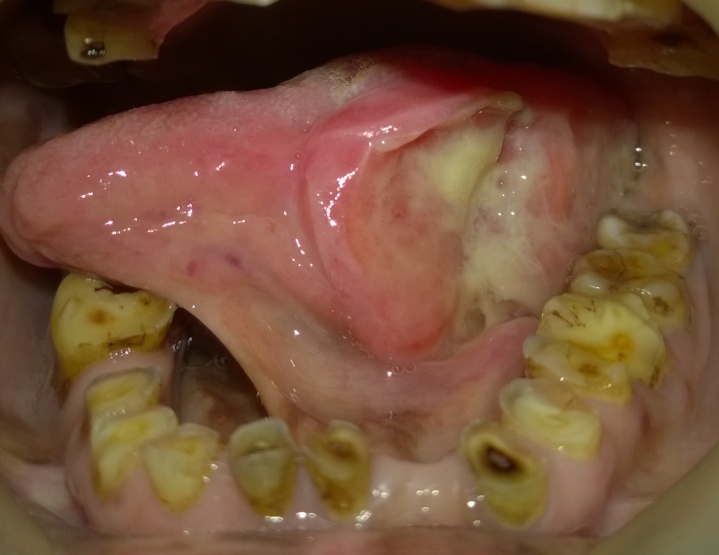 Larger image(png format)
A 58-year-old female patient reported to our dental clinic with a complaint of an ulcer on the left lateral border of the tongue for the past two months. The patient had a history of bruxism. On intraoral examination an ulcer of 3×3 cm in size was observed on the left lateral border of the tongue (Figure 4). The ulcer had everted margins and the base was covered with slough. Mandibular left posterior teeth were attrited with sharp margins. Patient had a history of applying mishri and chewing tobacco for the last 25 years. There was generalised attrition of teeth. In view of the present condition a biopsy was advised. At the time of biopsy the sharp margins of the mandibular posterior teeth were rounded off. Histopathological examination showed the presence of parakeratinized stratified squamous epithelium showing ulceration at places. Underlying connective tissue stroma showed chronic inflammatory infiltrate and blood vessels. There was no evidence of malignancy. A diagnosis of traumatic ulcer was arrived (Figure 5). The patient was recalled after one week for suture removal. However the patient was lost to follow-up.

. (case 2)) PowerPoint Slide
PowerPoint Slide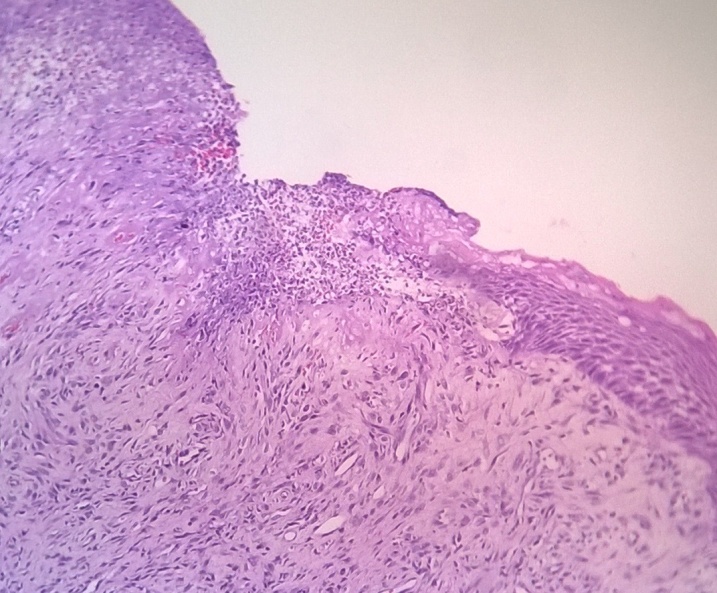 Larger image(png format)
3. Discussion
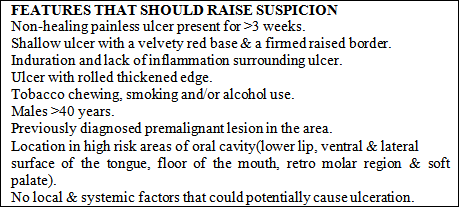
Dentist and medical practitioners often encounter a wide spectrum of oral mucosal lesions. These include mild mucosal alterations needing simple therapeutic remedies to life threatening lesions such as carcinomas. Traumatic ulcers can be recognized if the clinician can establish the cause of physical injury. Sometimes, the nature of trauma is obscure; and hence the diagnosis may be difficult to establish. Traumatic lesions especially those that occur on the tongue, may persist for weeks; and may be included in the differential diagnosis of persistent ulcers (Table 1).

 PowerPoint Slide
 Larger image(png format)
 View current table in a new window
Patient with traumatic ulcers usually complain of pain or tenderness in the area of the lesion. Traumatic causes of oral ulcerations may be physical or chemical. Physical damage to the oral mucosa may be caused by sharp surface of the cusps, ragged edges of carious teeth, faulty dentures and restorations. Physical injury is likely to cause a localized deep ulcer and often the clinical picture may be misleading. [4, 5] In the present cases, the patient did not complain of pain in the area of the lesion. This could be due to the long standing nature of the lesion. The offending teeth also had sharp ragged edges.
Traumatic ulcers are soft on palpation with rolled margins, surrounded by a whitish mucosa. [6, 7] In the present cases, the lesions were firm with indurated margins which could be due to continuous trauma and chronicity of the ulcer. Presence of risk factors like mishri application and age were also in favor of the lesion being malignant. However, the dramatic response to extraction of the offending teeth in case 1 and rounding off the sharp edges in case 2 along with histopathology findings ruled out any malignant etiology.
Delay in diagnosis and treatment of oral cancer can be attributed to three things. First public awareness of oral cancer is low compared to any other form of cancer. Hence patient ignores early signs and symptoms. Second, health professionals like dentist and specialists who routinely diagnose and treat more common complaints in oral cavity may overlook the risk of a possible malignancy. Furthermore, health professionals who are not familiar with the diagnosis of oral malignancy must realize the need for referral. Thirdly, oral squamous cell carcinoma presents in various clinical forms and early lesions are asymptomatic [8].
Thus keeping in mind the morbidity associated with oral carcinomas, even the most innocuous looking lesions should be looked upon with suspicion. The final decision for further management will depend on complete history along with a thorough clinical examination as this can have a major impact on the patients well being.
Improved diagnosis of patients with tongue ulcers can only be achieved by careful examination of a seemingly innocuous lesion. Early detection of a malignant or pre malignant lesion can be achieved by prompt performance of a biopsy and referral for treatment. Though the presentation of the lesion may be misleading at times, the further line of management should be weighed upon the judicious knowledge of one’s thorough clinical diagnosis.
References
| [1] | Gopalkrishnan R, Miloro M, Allen CM. Indurated ulceration of tongue. Oral Surg Oral Med Oral Pathol. 1996; 82 (3): 119-21. | ||
 In article In article | CrossRef | ||
| [2] | Turner PS. Transformation of an unspecific chronic ulcer of the tongue into squamous cell carcinoma. Quintessence International. 1993; 7: 703-5. | ||
| In article | |||
| [3] | Van Heerden WFP, Boy SC. Diagnosis and management of common non-viral oral ulcerations. SA Fam Pract. 2007; 49 (8): 20-26. | ||
| In article | |||
| [4] | Michael AOL and Richard CKJ. Traumatic Ulceration. A Color Handbook of Oral Medicine. London: Manson publishing; 2004: 22-23. | ||
| In article | |||
| [5] | Hegde RJ. Sublingual Traumatic Ulceration due to neonatal teeth (Riga-Fede disease). J Ind Soc Pedod Prev Dent. 2005; 23: 51-52. | ||
| In article | CrossRef | ||
| [6] | Schneider LC, Schneider AE. Diagnosis of Oral Ulcers. Mt Sinai J Med. 1998; 65: 383-7. | ||
| In article | |||
| [7] | Wood NK, Goaz PW. Oral Cancer Differential Diagnosis of oral and maxillofacial lesions. 5th ed. St. Louis, Mosby; 1997: 587-95. | ||
| In article | |||
| [8] | Jensen A, Nolet PS, Diwan MA. Oral squamous cell carcinoma: a typical presentation mimicking temperomandibular joint disorder. J Can Chiropr Assoc. 2004; 48 (4): 266-72. | ||
| In article | |||

 CiteULike
 Mendeley
 StumbleUpon
 Delicious
 Facebook
 Twitter
 LinkedIn
 Print
Print