An assessment on wetland type, floristic characteristics and ecosystem services of Asarama - Adoni in Rivers State, Niger Delta was carried out based on seasonal variation. Systematic stratified Wetland Ecosystem Dynamic Plots (WEDP) and Participatory Research (Focused Group Discussion and Key Informant Interview) techniques were adopted. Result revealed five wetland habitat types viz: mangrove, mudflat, Nypa, estuary and fresh water forest habitats. The most prevalent wetland ecosystem was the Nypa habitat. Across the wetland habitat types were five major species under three families viz; Rhizophora racemosa, Rhizophora mangle, and Rhizophora harrizonii (Rhizophoraceae), Aviccennia germinans (Avicenniaceae) and Laguncularia racemosa (Combretaceae). Paspalum vaginatum and Conocarpus erectus was the dominant among associated species on the shoreline. Species compositions of sampled stations were recorded in both seasons with the highest (760) at station 3 and least (100) individual at station 5. Highest dominance (1.00) at station 5, Simpson dominance (0.83), Shannon-Wienner diversity richness (2.00) as well as Margalef richness (1.36) and equitability richness (0.85) at station 3 were recorded with variation among stations in both season. Three floristic ecotype: fringe, riverine and scrub mangrove forests in the mangrove wetland were recorded amidst the ravaging invasive Nypa palm encroachment. Land use ecology and ecosystem services revealed value chains of ecosystem provisioning, ecological regulation, socio-cultural and habitat supporting among the inhabitant of Asarama people. It therefore becomes imperative for conservation prioritization of the area in order to stabilize the ecosystem dynamics and protect the wetland from the influence of biotic and abiotic drivers of change.
Wetlands are areas inundated or saturated by surface or ground water at a frequency and duration under normal circumstances sufficient to support, a prevalence of vegetation typically adapted for life in saturated soil conditions. Wetlands generally include swamps, marshes, fen, bogs, estuaries, peat-land and similar areas, whether natural or artificial, permanent or temporary, with water that is static or flowing, fresh, brackish or salt, including areas of marine water, the depth of which at low tide does not exceed 6 m” 1, 2, 3. Wetlands as areas or regions wholly or partly covered by water and where trees such as Nypa palm and Mangrove plants co-habit 4. In addition, the Ramsar convention suggests that wetlands may incorporate “riparian and coastal zones adjacent to the wetlands and island bodies of marine water, deeper than 6 m at low tide lying within the wetland” 3. Wetlands are associated with the following general diagnostic environmental characteristics viz: The prevalence of vegetation consisting of macrophytic hydrophytes that are typically adapted to areas having hydrologic soil conditions, due to their morphological, physiological, and / or reproductive adaptation(s), with the ability to grow, effectively compete, reproduce, and / or persist in anaerobic soil conditions. Hydric soil with reducing conditions is also common in such area. The area is inundated either permanently or periodically at mean water depths 6.6 ft, or the soil is saturated to the surface at some time during the growing season of the prevalent vegetation 5, 6.
Studies on the species diversity changes and floristic composition of forest vegetation habitats have received appreciable attention 7, 8. Forest vegetation represents an important natural resource with diverse scientific, technological, cultural and ecological values at the local, state, national and international levels of societal needs. The Mangroves is one among such vegetation with an ever green, tall and / or shrubby species belonging to several unrelated families which share similar habitat preferences, physiognomy, physiological and structural adaptations. Nigeria is recorded to have the third largest mangrove in the world, and the largest in Africa covering approximately 105,000 hectares 9.
The mangrove forest occurs in varying degree of development and concentration all along the Nigerian coastal areas. But attains maximum development in the Niger Delta brackish water areas with its largest proportion of species composition mostly exploited in the world. The forest is characterized by the dominance of a small number of species belonging to two major genera – Rhizophora and Aviccenia.
Asarama wetlands (particularly the estuary) are one of the most important navigable waterways in the far reaches within Andoni land and it connects several communities therein. Besides, it is exposed to both the natural factors and human exploitation activities daily 10. Tropical deltas and estuaries are subject to variable rates and types of geomorphological change thus, creating a network of habitats which are colonized by mangroves. Asarama estuary is typically a shallow inter-tidal ecosystem rich in nutrient resulting in high productivity in the littoral and offshore zones with diverse ecosystem services. The widespread institutional interest and studies in mangrove swamp forest ecosystems and the surge in mangrove literature involving distribution, species structure and composition, exploitation and conservation, clearly indicate that these ecosystems have increasingly received enormous attention 11, 12, 13, 14. This essentially implies that the economic roles of mangroves in tropical coastal environments, their efficiency in coastal protection, their biological and cultural diversity and their links with coastal fisheries are currently better recognized and understood.
However, there are abiotic and biotic drivers of change and variable with adverse environmental conditions associated with mangal wetland habitat. Despite these conditions, these ecosystems are highly productive with an average primary productivity often higher than that of neighbouring terrestrial forest ecosystems. This calls the need to appropriately recognize wetland functions, increase and promote public acceptance of these functions, to ensure that they are conserved and utilized in a sustainable manner. Wetlands are considered to be the most biologically diverse of all ecosystems whose formation has been dominated by water, as well as its processes and characteristics. Wetlands are the Earth’s most productive ecosystems as a result have been described both as “the kidneys of the landscape”, because of the functions they perform in the hydrological and chemical cycles, and as “biological supermarkets” because of the broad food webs and rich biodiversity they support 15.
Wetlands are celebrated worldwide for the many services they provide 16. In assessing the value of wetland services, three categories of values were established thus; ecological values 17, 18, socio-cultural values 18 and economic values 19, 20. Providing data and information about the values of wetlands is a major way to ensure their wise use and stem their conversion and development 21, 22. However, there is general information on wetlands in Africa, including those of Nigeria’s Niger Delta where various pressures bring about ecological changes at a drastic rate thereby threatening the wetlands’ ability to continually provide ecosystem services. There is a clear need to promote the sustainable use of the Niger Delta wetlands. This requires an understanding of the types of wetlands, floristic ecotype and ecosystem services provided, by the wetlands in Asarama - Andoni, in Rivers State.
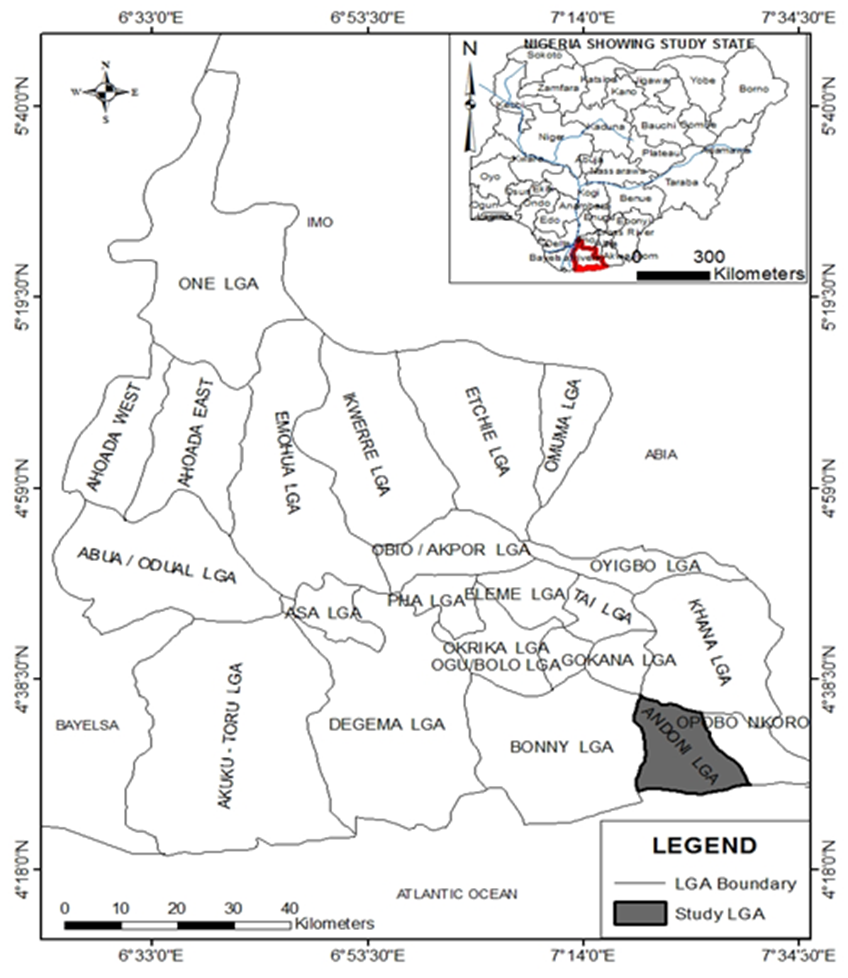
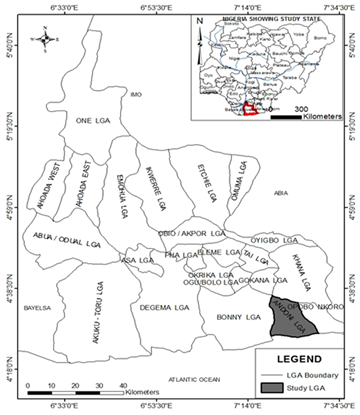
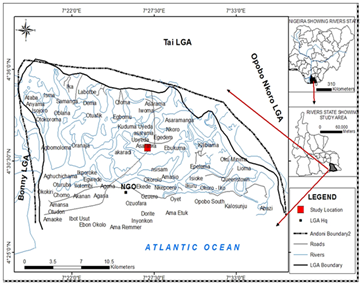
The study area Andoni is one of the 23 Local Government Areas in Rivers State, Nigeria. It is located in the southeastern axis of Rivers State, which is situated between Lat. 4° 18’0”N to 4°38’30”N and Long. 7°14’0’E to 7° 34’30”E (Figure 1) and land mass area coverage of over 233 km². It is bounded by Bonny, Khana and Opobo Nkoro Local Government Areas 23. Andoni area in Rivers State is one of the local council with greater population, housing approximately nine major towns with Ngo Town as headquarter. It is a host to autonomous communities that inhabit four major Islands of the ecological zone 23. The area has an equatorial climate characterized by maximum temperature, relative humidity, abundant rainfall pattern by its proximity to the Atlantic Ocean. The area is known as the largest fishing community in Rivers State. The major towns among the autonomous communities which are traversed by both land and sea transportation network include: Agwut- Obolo, Ataba, Ekede, Ikuru Town, Ngo Town, Samanga, Unyeada, Unyen Gala and Asarama – the study location 24.
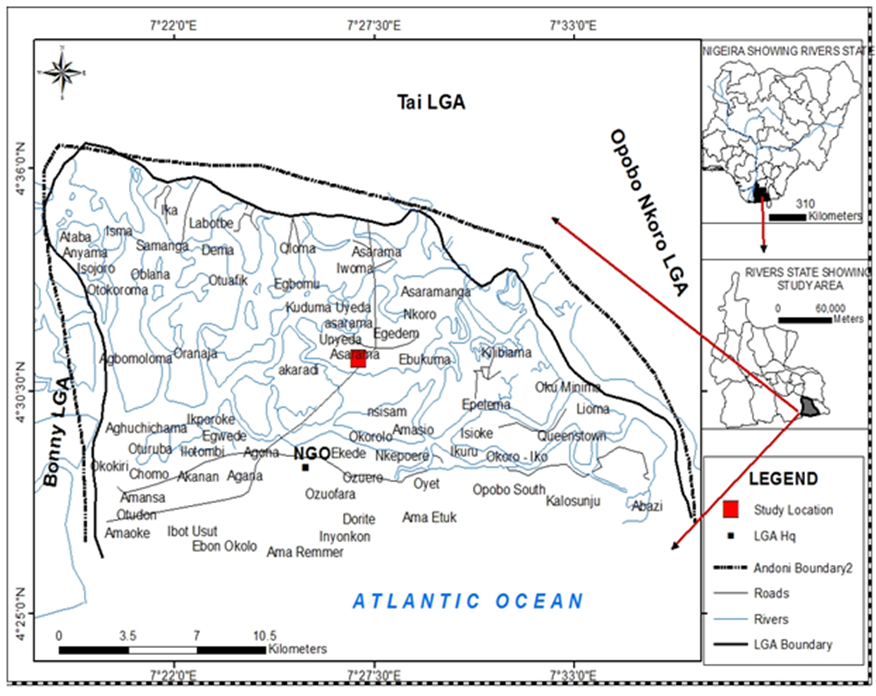
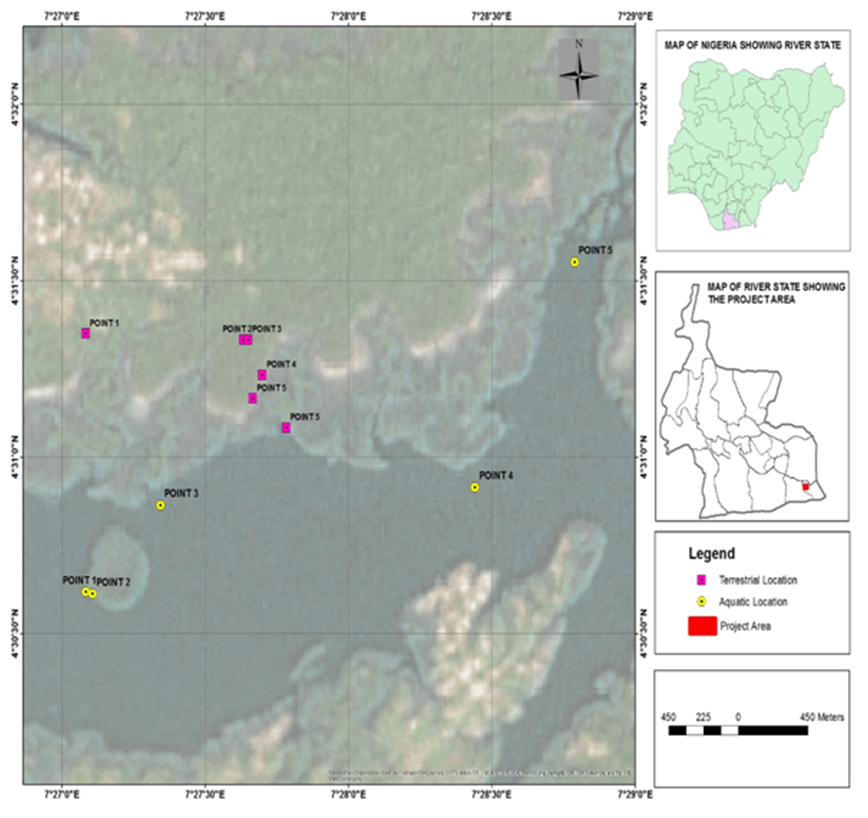
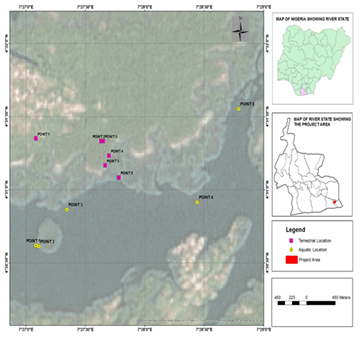
The Asarama study location is a riverine estuary at Andoni, with its geographical situate between Lat. 4o30’30”N to 4o36’0”N and Long. 7o22’0”E to 7o27’30”E of Rivers State, with an elevation of 9 meters above sea level at the southern part of Nigeria, (Figure 2). It is bounded to the north by Bori Ogonis, to the east by Opobo, to the south by Ebuguma and Ngo town and Bonny and Kalabari Kingdoms to the west. It is one of the largest and the most populated towns in Andoni Local Government Area of the State and few miles away from the Atlantic Ocean 25. It is a semi-diurnal tidal estuary system known for two common communities (Ataijong and Amaubong sampling sites – Figure 3) separated by a major road linking the Ogoni hinterland and a bridge across to other communities near shore. The ecosystem is characterised by rich flora communities of mangal vegetation and associated halophytes belonging to such family as: Rhizophoraceae, Avicenniaceae, Combretaceae, Fabaceae, Adiantaceae, and Myrtaceae. These are nourished by the Asarama-Inyorog-Nkro, Asarama-Egnengem and Asarama-Ebukuma Rivers and several creeks that provide the communities with aquatic resources and sources of sustainable livelihood. Edaphically the sampling site is characterized by substratum mixture of silty-clay and sandy-mud flat which are mostly exposed at an ebbing tide particularly at the upper reaches.
Based on heterogeneity and irregular physiognomy of the Asarama study sites, the Braun-Blanquet releve 26 method for rapid assessment was adapted. This involved a reconnaissance boat survey of the study sites where a systematic sampling along directed transects was applied to conduct the flora enumeration of the sites in both down stream and upstream mangrove forest of coastal zone in the study location. Field inventories were conducted in order to document the phytosociology of the mangrove vegetation of the ecosystem which could be used to determine the ecological status of mangrove vegetation forest in the Niger Delta.
Five study sites involving the down stream (Station 1- ASO mangrove, Stations 2, and 3) and upstream (Stations 4 and 5) were sampled. A total of five transect direction of 50 x 50m wide were laid out in each site as to accommodate subjectively the observable environmental altitude. A systematic randomly stratified Wetland Ecosystem Dynamics Plots (WEDP) of five sampling (10 m x 50 m) sub-units was laid within the 50 x 50 m dimension along the transect directions in respective site. The sub-unit markings were based on the vegetation structure of the area. A hand-held Garmin geographic positioning system (GPS - Garmin Dakota 10 model) was used to record the location coordinates of each sample station (Table 1) for the distribution status of the mangal species in the area under observation. All the important representative plant species sampled were identified in the field as far as possible and were properly authenticated using reference books such as Burkill, 27, 28, 29, 30 and Floras such as Hutchinson and Dalziel, 31, 32, 33, 34, 35 and Keay, 36.
The degree of land use ecology and human resource interaction of the study location and study site (coastal mangal forest) was assessed based on Participatory Research Approach (PRA) through empirical observation. Disturbances observed were verified using the Focused Group Discussion (FGD) and the Key Informant Interview (KII).
The quantitative analysis of the distribution was based on standard phytosociological indices to determine frequency of distribution, abundance, and density of the representative species of the study site 37, 38, 39. Flora results were subjected to some basic measurement of central tendency with the aid of PAST software (version 1.97) 40.
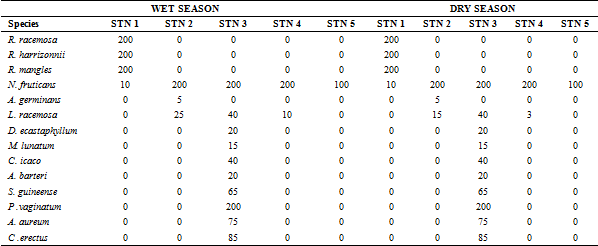
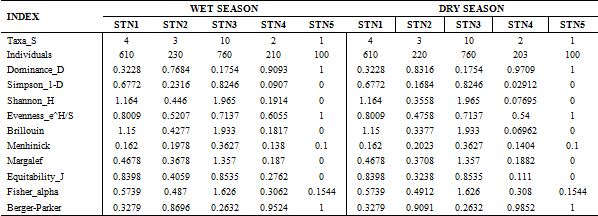
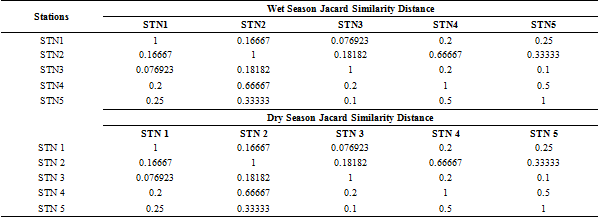
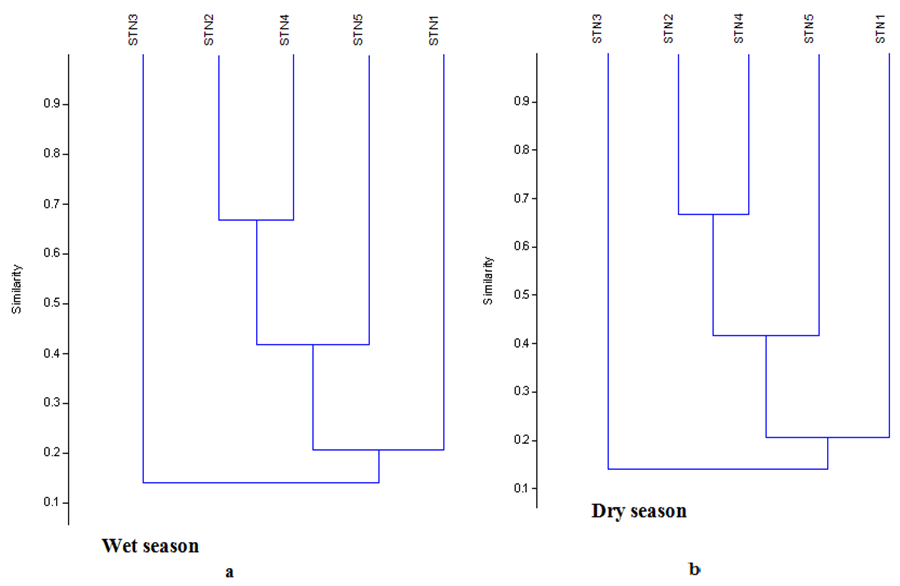
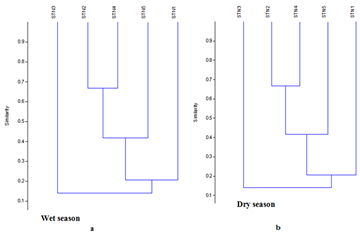
The Asarama study area is a coastal brackish water ecosystem intertidal in nature, with edaphic mixture of silt-clay, clay-loam and mud flat substratum observable at low ebbing tide and peaty soil commonly called “chikoko” soils across Islands. The ecosystem by empirical observatory assessment recorded five wetland habitat types; viz: the Mangrove, mudflats, Nypa, Estuary and Freshwater forest. These intertidal wetlands are nourished by three (3) inter-tidal rivers namely: Asarama Inyorong-Nkro River, Asarama-Egnengem River and Asarama-Ebukuma River which flows in opposite direction to meet at the embankment created by the major road linking Asarama and Ogoni hinterland, before they all empty into the Atlantic Ocean. This wetland phytosociology is characterized by three major species under three families: the Rhizophoraceae involving Rhizophora species (Rhizophora racemosa, R. mangle and R. harrizonii -red mangroves). Avicenniaceae (Avicennia germinans var. Africana - white mangrove) and Combretaceae (Laguncularia racemosa -Black mangrove). Among the associated species on the shoreline was Conocarpus erectus in station 3 (Table 1). In Asarama Conocarpus erectus is an important mangrove associate that is transitional between the true mangroves and non-mangrove species thus, exist at the ecotone between the mangal vegetation and rainforest vegetation. At first glance, these species may appear very similar, but closer inspection reveals differences in morphology, physiology, and reproductive biology. These species can be distinguished using characteristics such as growth form, bark, and structure of leaves, twigs, aerial roots, flowers, and fruits / propagules. Other associated species of the Asarama mangal marine ecosystem particularly at the estuary include Macharum lunatum and Dalbergia ecastaphyllum under the Fabaceae, Acrostichum aureum (Adiantaceae), Combretum hispidium (Combretaceae) and Syzygium guineense (Myrtaceae) Paspalum vaginatum (Poaceae), Chrysobalanus icaco and Acioa barteri (Chrysobalanaceae) in both wet and dry season (Table 1). The PAST analysis has recorded trend in quantitative species composition among sampled stations (Table 1) between both seasons. Though there was variation in individual species composition in stations 2 and 4 in both wet and dry season, station 3 in both season had the highest composition (760) of individual species and least composition (100) of individual species in station 5 respectively. The highest level of dominance (1.00) at station 5 was recorded in both season despite the variation in station 2, while station 3 had the highest Simpson dominance of 0.83 also with variation at stations 2 and 4 respectively, as well as highest Shannon – Wiener diversity richness of 2.00 despite variation at stations 2 and 4 in both seasons respectively. The highest Margalef species richness (1.36) was at station 3 in both seasons respectively as well as equitability index (0.85) at station 3 with variation at stations 2 and 4 in both seasons (Table 2). The similarity among sampled stations is represented in Figure 4a and b as exemplified in Table 3 in both seasons. Stations 2 and 4 had a Jacard similarity index of 0.70 while, Stations 5 and 4 had 0.50 in both seasons.
The Asarama mangrove ecosystem in light of ecological niche adaptation is characterized by three major mangrove forest ecotypes namely; the fringe mangrove forest, riverine mangrove forest, and scrub mangrove forest. Each of these mangrove ecotypes is characterized by different patterns of forest structure, productivity and biogeochemistry under the influence of combination of factors such as hydrological regime (due to tidal variation, fresh water discharge, wave action, and rainfall), soil characteristic, biological interactions and other disturbances. There is also a massive invasion and encroachment of Nypa palm (Nypa fruiticans) which has ravaged the various habitat of the ecosystem. Information from key community informant indicates that the hydrology / hydrodynamics of the river systems in the study area is based on 6 hours interval of 2 cycles of tidal regime in every 12 hours, with the diurnal low ebbing tide at 6am – 12pm and high tide at 12pm-6pm in the day. Nocturnal tidal regimes of low tide at 6 pm – 12 pm and high tide at 12 pm – 6 am.
Mangroves are unique and halophytic plant species that form the critical interface between terrestrial, estuarine and near shore marine ecosystem. They are habitat specialist associated with tropical and subtropical coastal environment and adapted to intertidal conditions. Approximately all the true mangrove species (four Species) and its associates that have been recorded from Nigeria, occurs in Asarama - Andoni mangal estuary in Rivers State parts of the Niger Delta study area. However, there was variation in phytogeographical distribution in the five study stations in the dry and wet seasons. Although, a particular species Nypa fruticans occur in the entire study station, but differ markedly in the wet and dry season in stations 1 and 5 which recorded the least and lower sampled plot richness respectively.
Many factors including geographical latitude, wave action, rainfall, freshwater runoff, erosion/sedimentation rates, acidity, salinity, nutrient inputs and soil quality are known to influence the occurrence and growth of mangroves 41. Also biotic and abiotic environmental factors determine the growth and distribution of plants in nature 42. This could be reaffirmed by the obvious flora diversity changes reflecting some suspected degree of dynamics in the physicochemical variation 43, though not considered in this present study between the wet and dry season. This corroborates studies on correlation of salinity and standing biomass of mangroves and productivity 44 and local pattern of tidal inundation that influences soil characteristics and species zonation of mangroves 45. Similar case study has recorded some natural drivers of change in mangal ecosystem of Niger Delta 46, 47, 48. Also few associate species that were found growing in station 3 were absent in stations 1, 2, 4, and 5 indicating the presence of pockets of fresh and brackish water at the landward side of the station 3 close to the ecotone. Nypa fruticans were found growing in all the stations in varying density. It is an invasive species that has posed severe threat to the mangrove ecosystem. Its invasion in the mangrove wetland habitat was observed to be connected to anthropogenic activities. It is a strong competitor with no immediate utility value to the local inhabitant according to the local informant. This corroborates similar report by Perera et al. 42; Olowokudejo and Oyebanji, 49; John et al. 50 who have recorded the effect of Nypa palm on the floristic diversity of mangrove species in littoral vegetation of wetland ecosystem.
The loss of individual mangrove species is of great concern especially as pristine mangrove areas are poor in species richness compared with other tropical plant ecosystem. Besides the influence of abiotic complex on the species population, there was reduction in the population density of Laguncularia racemosa in the dry season at stations 2 and 4 due to anthropogenic harvesting for fuel wood and aquacultural practices. It was estimated that 26% of mangrove forests worldwide were degraded due to over-exploitation for fuel wood and timber production 51. Similarly, clearing of mangrove for shrimp culture and other aquaculture accounting for 38% and 14% global mangrove loss have been reported 52. Several other studies have recorded diverse anthropogenic influence to be causative factors of wetland and mangrove vegetation loss 53, 54, 55, 56, 57, 58, 59.
Reports of the intertidal distribution of mangrove and associate species have been presented in several studies 60, 61. The submission was the potential for interactions among the various biotic and abiotic factors in determining the distribution and abundance of intertidal vascular plant species 62. Mosaic stand of Avicennia germinans were recorded in station 2 with patchy distribution and low population density at mean sea level of 6 m. This patchy distribution may not reflect the heterogeneity of sediments but simply a function of variable fecundity, abiotic variables and patchy dispersal. Dispersal of propagules, water logging, soil moisture, sediment type and salinity were noted among the limiting factors of intertidal and land ward distribution of Avicennia and such factors can also influence zonation of mangrove forests 60, 61, 63, 64.
Given the accelerating rate of loss, it has earlier been stated that mangrove forests may at least functionally disappear in as little as 100 years 65. The understanding of wetland habitat type, phytosociology and floristic ecotype is important in several biodiversity studies. Such assessment of vegetation is often carried out in order to establish the degree of imminent ecological demand and recovery of such envisaged ecological demand as could be the case in the Asarama Andoni parts of the Niger Delta mangrove coastal marine ecosystem. Current exploration rates may continue unless mangrove forests are protected as valuable resource.
3.2. Land Use Ecology and Ecosystem ServicesBased on observation and information from Focused Group Discussion (FGD) and the Key Informant Interview (KII), the area has remained the largest fishing settlement in Rivers State characterized by pockets of satellite structures by fish farmers. The Asarama community is characterized by major human activities in the locality involving land and water transportations using cars, motor-bikes and boats, fishing with fish nets, gears and fish traps. Fishing, farming and trading, and the picking of periwinkle, crab and lobster is the major livelihoods of members of communities in Andoni area, Rivers State. Artisanal fishing such as aquaculture and / or mariculture of Oysters (Castrostrea sp) and Periwinkles (Tympanotonus fuscatus var. Radular) is predominantly the main traditional occupation of the people and is majorly carried out by the men and women folks. At low ebbing tides particularly between 0830 hr and 1000 hr some of the locals were often engaged in unsystematic periwinkles picking or harvesting without been regulated. Artesianal illegal local refinery of petroleum products was observed far upstream off the estuary at the north-western bank. Land farming and agricultural activities in these communities are on a subsistence level and crops such as Musa paradisiaca (plantain) and Musa sapientum (banana), Manihot esculenta (cassava), Elaeis guineensis (palm oil) and vegetables such as Telfairea occidentalis (fluted pumpkin) Talinium triangulare (water leave) and Vernonia amygdalina (bitter leave) are the major crops besides root and tuber crops such as Colocasia esculenta, Xanthosoma maffafa (Cocoyam) and Dioscorea alata (water yam). Other major activities in the area entail fish and coconut smoking. However, there are micro scale businesses of open and lock up shops among various homes in the community.
This wetland habitat at the time of wet season survey was observed to be associated with hydrocarbon soot and oil slicks at the water surfaces emanating from the local artesian refineries in the area. However, this was not observed to be present during the dry season sampling. This could corroborates the rising cases of local and international demand for crude oil which is abundant in the Niger Delta and consequent environmental change through a high demand for wetland area for oil exploration and exploitation 66. In addition, existing institutional and legal frameworks have given priority to oil exploration over protection of the wetland 67. Wetland ecosystems provide many services that are important for human well-being 68, 69. The MEA 18 classified such goods and services as provisioning, regulating, cultural and supporting services. Although, all wetlands have the potential to contribute diverse services, different wetlands are noted for one or more major service.
The Niger Delta wetlands including those observed and recorded in Asarama - Andoni marine ecosystem are generally acclaimed for incredible well-endowed wide range of functional values and services in the ecosystem. The Asarama wetlands and mangrove of the area are known for ecosystem services such as habitat support for a wide range of wildlife fauna mostly birds, bee hives, crabs, molluscs and other aquatic life support, and human well-being. Wetland is quite instrumental and plays a critical role in supporting the livelihoods of millions of people in littoral and coastal regions 70. Similarly, research has revealed mangroves as important breeding and nursery sites for many commercially important shrimp, crab, fish and birds. While some of these species are permanent residents (such as oysters, dog whelk, etc), some are temporary residents –associated with mangroves during at least one stage in their life history. Juvenile fish and shrimp have been found to move substantial distances into mangrove forest habitat at high tide, where they gain protection from predation by larger fish, which remain in or near mangrove water ways 71.
Also the Asarama wetlands in the present study has recorded provisioning services including Artisanal fishing such as aquaculture and /or mariculture in Oyesters and periwinkle, crab and lobster picking and practices and logging of the mangrove for domestic fuel. The vast biological riches of wetlands such as air and water purification; provision of food, medicines, energy and raw materials have been documented 72, 73. The trees of mangrove ecosystem contribute directly to the livelihood of most local communities by providing products such as wood fuel, thatch materials, timber logs and as well breeding ground for sea food nutrients 4. Other service of the wetlands is the vital support and provision of rapid transport routes in an otherwise difficult terrain, with many urban and rural settlements accessible only through the wetland 74.
The regulatory services of mangrove wetland in shoreline embankment and protection were observed in parts of Asarama study location. Wetlands are celebrated worldwide for the many services they provide. They help regulate climate, store surface water, control pollution and flooding, replenish aquifers, promote nutrient cycling, protect shorelines, maintain natural communities of plants and animals, regenerate soils and pollinate crops, serve as critical nursery areas, and provide opportunities for education and recreation and spiritual renewal 16, 70, 72, 73, contribute to carbon sequestration 75. Other reports have shown how mangroves counteract tropical storms and their capacity to stabilize shoreline substrate thereby protecting it from erosion 76.
The cultural value of some mangrove area such as the sacred ASO Mangrove Island is noted for traditional and cultural practices among the people of Asarama, Andoni. Mangrove ecosystem offer opportunities for recreation and spiritual renewal 72, 73. Very little is written of the spiritual values and sacred sites in the Niger Delta wetlands. This is likely due to the secrecy that surrounds these services in most African society 77. However, it is known that the wetland has many essential spiritual and sacred sites 78, 79.
The study had revealed the major types of wetland habitats in Asarama Andoni and the various flora characteristics of the wetlands. Nypa fruticans was prevalent across the various habitats which were characterized by five major species under three families. The ecological niche adaptation of the mangrove species has revealed three major ecotypes involving; fringe mangrove forest, riverine mangrove forest and scrub mangrove forest within the mangrove wetland habitat. Also the study shows that the species across the wetland habitat were under the influence of diverse abiotic and biotic drivers of change including Nypa palm encroachment, dynamics of the ebbing and rising tidal influence and human intrusions such as mangal logging for domestic fuel energy, conversion of wetland to other land use ecological processes and unsystematic aquaculture and maricultural practices. All these constitute threat to the well-being of the ecosystems. Despite these ecological vagaries, the ecosystem is still resilience in its potential toward the services of mankind with its diverse forms of value chain addition in terms of its provisioning, regulating, socio-cultural and habitat supporting services. Therefore species conservation in the ecosystem is highly imperative in order to maintain the ecosystem dynamics and the benefit that can be derived from these natural resources in perpetuity.
We are grateful to the following persons of Asarama community: Obediah Owoh (community liaison officer and local curator), Godswill Amos (boat coxswain), Ikechuckwu Odoemenam (diver) and Hakeem Okunola (taxi driver) for their various assistance during the project. We (particularly ARD and MAU) are very thankful to Duke University and Oak Foundation of the United States for the award of Duke University Marine Lab mini grant for marine conservation project.
The authors have no competing interests.
| [1] | Federal Register. 40 CFR Part 230: Section 404(b) (1) Guidelines for Specification of Disposal Sites for Dredged or Fill Material," U.S. Government Printing Office, Washington, DC, 45(249), 85,352-85,353. 1980. | ||
| In article | |||
| [2] | Federal Register. Title 33: Navigation and Navigable Waters; Chapter 2. Regulatory Programs of the Corps of Engineers," U.S. Government Printing Office, Washington, DC, 47(138), 31,810. 1982. | ||
| In article | |||
| [3] | Ramsar Convention Secretariat (RCS) Wise use of wetlands: a conceptual framework for the wise use of wetlands Ramsar handbooks for the wise use of wetlands. 3rd edn. Ramsar Convention Secretariat Gland, Switzerland. 2007. | ||
| In article | |||
| [4] | Nwilo, P. Nigerian coastal landforms, a lecture for Coastal zone management study, Department of Surveying and Geo-informatics, University of Lagos. 2007. | ||
| In article | |||
| [5] | Environmental Laboratory. Corps of Engineers Wetlands Delineation Manual," Technical Report Y-87-1, U.S. Army Engineer Waterways Experiment Station, Vicksburg, MS. 1987. | ||
| In article | |||
| [6] | Mitsch WJ, and Gosselink JG. Wetlands. 4th ed. Hoboken (NJ): Wiley. 2007. | ||
| In article | |||
| [7] | Duke, N.C. Mangrove floristics and biogeography. In: Robertson, A. and Alongi, D.M. (Eds.) Coastal and Estuarine, series 42. American Geophysical Union, Washington, DC. PP.63 – 100, 1992. | ||
| In article | View Article | ||
| [8] | Field, C.D. Journey amongst mangroves. International Society for Mangrove Ecosystem (Ed) Okinawa, Japan. 144pp. 1995. | ||
| In article | |||
| [9] | Anon, Defining an Environmental Strategy for the Niger Delta, Vol.11. Industry and Energy Operations Division, West Central Africa Department, 1995. | ||
| In article | |||
| [10] | Ansa, E. J., and Francis, A. Sediment characteristics of the Andoni Flats, Niger delta, Nigeria. – Journal of Applied Science and Environmental Management 11(3): 21-25, 2007. | ||
| In article | View Article | ||
| [11] | Walter, B.B. People and mangrove in the Philippines: fifty years of Coastal Environmental Change. Conservation, 30(3): 293-303. 2003. | ||
| In article | View Article | ||
| [12] | Donald J. M. and Elizabeth C. A. World Bank, ISME, cenTER Aarhus Draft Code of Conduct for the Sustainable Management of Mangrove Ecosystems. International Society for Mangrove Ecosystems, Okinawa, Japan, 2004. | ||
| In article | |||
| [13] | Vieira, D.L.M. and Seariot, A. Principles of natural regeneration of tropical dry forest for restoration. Restor Ecol. 14(1): 11-20, 2006. | ||
| In article | View Article | ||
| [14] | Udoh, J. P. Sustainable nondestructive mangrove-friendly aquaculture in Nigeria II: models, best practices and policy frame work. AACL BIOFLUX 9(1):151-173. 2016. | ||
| In article | |||
| [15] | Enwere C. L. impacts of wetland degradation in Niger delta Nigeria and its significance in flood control. International Journal Of Environment, 4(3): 177- 184, 2015. | ||
| In article | View Article | ||
| [16] | NRAC State of the State’s Wetlands; “10 Years of Challenges and Progress”. Natural Resources Agency of California, 2010. | ||
| In article | |||
| [17] | Farber SC, Costanza R, Wilson MA. Economic and ecological concepts for valuing ecosystem services. Ecol Econ. 41: 375-392. 2002. | ||
| In article | View Article | ||
| [18] | MEA. Ecosystems and human well-being: a framework for assessment. Washington (DC): Island Press. Millennium Ecosystem Assessment, 2003. | ||
| In article | |||
| [19] | Turner, K., Paavola, J. Cooper, P. Farber S., Jessamy, V. and Georgiou, S. Valuing Nature:Lessons Learned and Future Research Directions. Ecological Economics, 46: 493-510. 2003. | ||
| In article | View Article | ||
| [20] | Straton A. A Complex Systems Approach to the Value of Ecological Resources. Ecological Economics. 56: 402-411. 2006. | ||
| In article | View Article | ||
| [21] | Balmford A, Bruner A, Cooper P, Costanza R, Farber S, Green RE, Jenkins M, Jefferiss P, Jessamy V, Madden J. Economic reasons for conserving wild nature. Science. 297: 950-953, 2002. | ||
| In article | View Article PubMed | ||
| [22] | Mmopelwa G. Economic and financial analysis of harvesting and utilization of river reed in the Okavango Delta, Botswana. J Environ Manage. 79:329-335. 2006. | ||
| In article | View Article PubMed | ||
| [23] | https://en.wikipedia.org/wiki/Andoni- (Accessed August, 6th 2019). | ||
| In article | |||
| [24] | Alagoa, E.J. A Short story of the Niger Delta. Ibadan: Longmans.1972. | ||
| In article | |||
| [25] | http://wikiedit.org/Nigeria/Asarama/2399628/ - 2019. [Accessed August, 6th 2019] | ||
| In article | |||
| [26] | Braun-Blanquet, J. Pflanzensoziologie, Grundzüge der Vegetationskunde. (3. Auflage). Springer Verlag, Wien, 865 pages. 1964. | ||
| In article | View Article | ||
| [27] | Burkill, H.M. Useful Plant of West Tropical Africa, Vol. 1 (2ed.). Royal Botanic Garden, Kew, London, 1985. | ||
| In article | |||
| [28] | Burkill, H.M. Useful Plant of West Tropical Africa, Vol. 2 (2ed.). Royal Botanic Garden, Kew, London, 1994. | ||
| In article | |||
| [29] | Burkill, H.M. Useful Plant of West Tropical Africa, Vol. 3 (2ed.). Royal Botanic Garden, Kew, London, 1995. | ||
| In article | |||
| [30] | Burkill, H.M. Useful Plant of West Tropical Africa, Vol. 4 (2ed.). Royal Botanic Garden, Kew, London, 1997. | ||
| In article | |||
| [31] | Hutchinson, J.; Dalziel, J.M. Flora of West Tropical Africa, Vol. 1. (Part 1.) Crown Agents for oversea government and administrations, Millbank London. 1954. | ||
| In article | |||
| [32] | Hutchinson, J.; Dalziel, J.M. Flora of West Tropical Africa, Vol. 1. (Part 2.) Crown Agents for oversea government and administrations, Millbank London. 1958. | ||
| In article | |||
| [33] | Hutchinson, J.; Dalziel, J.M. Flora of West Tropical Africa, Vol. 2. Crown Agents for oversea government and administrations, Millbank London. 1963. | ||
| In article | |||
| [34] | Hutchinson, J.; Dalziel, J.M. Flora of West Tropical Africa, Vol. 3. (Part 1) Crown Agents for oversea government and administrations, Millbank London. 1968. | ||
| In article | |||
| [35] | Hutchinson, J.; Dalziel, J.M. Flora of West Tropical Africa, Vol.3. (Part 2.) Crown Agents for oversea government and administrations, Millbank London. 1972. | ||
| In article | |||
| [36] | Keay, R.W.J. Trees of Nigeria. Clarendon Press. 1989. | ||
| In article | |||
| [37] | Supriya LD and Yadava PS. Floristic diversity assessment and vegetation analysis of tropical semievergreen forest of Manipur, north east India. Tropical Ecology, 47(1):89-98. 2006. | ||
| In article | |||
| [38] | Shukla, R.P. Patterns of plant species diversity across Terai landscape in north-eastern Uttar Pradesh, India. Tropical Ecology, 50(1):111-123. 2009. | ||
| In article | |||
| [39] | Chikkahuchaiah S, Rayasamudra KS and Badenahally CN. Diversity and composition of riparian vegetation across forest and agrosystem landscapes of river Cauvery, Southern India. Tropical Ecology. 57(2):343-354, 2016. | ||
| In article | |||
| [40] | Hammer, O., Harper, D. A. T., and Ryan, D. A. T. PAST: Palaeontological Statistics Software Package for Education and data analysis. – Palaeontologia Electronica 4: 1-9, 2001. http://clade.ansp.org/entomology/mongolia/maishome.html. | ||
| In article | |||
| [41] | Cintron,G. and Novelli,Y.S. Methods for studying mangrove structure, In: Snedaker,S.C.and Snedaker,J.G.(eds.) The mangrove ecosystem: research methods. United Nations Educational, Scientific and Cultural Organization, Paris, 91-113, 1984. | ||
| In article | |||
| [42] | Perera, K. A. R. S, Amarasinghe, M. D. and Somaratna, S. Vegetation Structure and Species Distribution of Mangroves along a Soil Salinity Gradient in a Micro Tidal Estuary on the North-western Coast of Sri Lanka. American Journal of Marine Science, 1(1): 7-15. 2013. | ||
| In article | |||
| [43] | Ana REE, Sridhar MKC, and Emerole GO. A comparative assessment of soil pollution by polycyclic aromatic hydrocarbons in two Niger Delta communities. Nigeria Afr J Pure Appl Chem. 3:31-41, 2009. | ||
| In article | |||
| [44] | Ukpong, I.E. The performance and distribution of species along soil salinity gradient of mangrove swamps in southeastern Nigeria, Vegetation, 95: 63-70, 1991. | ||
| In article | View Article | ||
| [45] | Saha, S. and Choudhury, Vegetation analysis of restored and natural mangrove forests in Sagar Island, Sundarabarns, east coast of India, Indian journal of Marine sciences, 24: 133-136. 1995. | ||
| In article | |||
| [46] | Walther, G.R, Post E, Convey P, Menzel A, Parmesan C, Beebee TJC, Fromentin J-M, Hoegh-Guldberg O, and Bairlein F. Ecological responses to recent climate change. Nature. 416: 389-395. 2002. | ||
| In article | View Article PubMed | ||
| [47] | Alley RB, Marotzke J, Nordhaus WD, Overpeck JT, Peteet DM, Pielke RA, Pierrehumbert RT, Rhines PB, Stocker TF, and Talley LD, Abrupt climate change. Science.299:2005-2010, 2003. | ||
| In article | View Article PubMed | ||
| [48] | Odjugo PA. Regional evidence of climate change in Nigeria. J Geogr Reg Plan. 3:142-150. 2010. | ||
| In article | |||
| [49] | Olowokudejo, J.D. and Oyebanji, O.O. Floral diversity of the littoral vegetation of Southeastern Nigeria. International Journal of Biodiversity and Conservation, 8(2):320-333. 2016. | ||
| In article | View Article | ||
| [50] | John O., Michael U. and Nnaemeka O. The use of GIS techniques in delineating Mangrove sites of Conservation interest in Asarama area, Eastern part of the Niger Delta. Proceedings of NTBA/NSCB Joint Biodiversity Conference; Unilorin 2016 (350-358) 2016. | ||
| In article | |||
| [51] | Valiela I., Bowen, J.L., and York, J.K. Mangrove forests: one of the world’s threatened major tropical environments. BioScience, 51: 807-815. 2001. | ||
| In article | View Article | ||
| [52] | Ellison, A.M. Managing mangroves with benthic biodiversity in mind: moving beyond roving banditry. Journal of Sea Research 59: 2-15, 2008. | ||
| In article | View Article | ||
| [53] | Ong, J.E. Plants of the Merbok mangrove, Kedah, Malaysia and the urgent need for their conservation. Folia Malaysiana 4: 1-18. 2003. | ||
| In article | |||
| [54] | FAO Status and trends in mangrove area extent worldwide. In: Wilkie ML, Fortuna S, eds; Forest Resources Assessment Working Paper No. 63. Rome: Forest Resources Division, FAO. Available: http://www.fao. org/docrep/007/j1533e/j1533e00.HTM. Accessed 2009 August 1. 2003. | ||
| In article | |||
| [55] | FAO The World’s Mangroves 1980-2005, FAO Forestry Paper 153. Rome: Forest Resources Division, FAO. 77 p. 2007. | ||
| In article | |||
| [56] | Nenibarini Z Impacts of Extractive Industries on the Biodiversity of the Niger Delta. National Workshop on Coastal and Marine Biodiversity Management. NNPC, Nigerian National Petroleum Cooperation, Monthly Petroleum Information. September, Lagos, Nigeria, 1984:53, 2004. | ||
| In article | |||
| [57] | Miththapala, S. Mangroves. Coastal Ecosystems Series Volume 2. Colombo Sri Lanka: Ecosystems and Livelihoods Group Asia IUCN. 28 p. 2008. | ||
| In article | |||
| [58] | Chidumeje N. P.O., Lalit K. and Subhashni T. The Niger Delta wetland ecosystem: What threatens it and why should we protect it? African Journal of Environmental Science and Technology, 9 (5):451-463, 2015. | ||
| In article | View Article | ||
| [59] | Ajibola, M. O.; Oni, S. A. and Awodiran, O. O. Assessing Wetland Services in the Niger Delta, Nigeria. International Journal of Humanities and Social Science, 5(1): 268-277, 2015. | ||
| In article | |||
| [60] | Clarke L. D. and Harmon N. J. The mangrove swamp and salt marsh communities of the Sydney district. III. Plant growth in relation to salinity and water logging, Jour. Ecol. 58: 351-369, 1970. | ||
| In article | View Article | ||
| [61] | Clarke L. D. and Hannon N. J. The mangrove swamp and salt marsh communities of the Sydney district. IV. The significance of species interaction, Jour. Ecol. 59:535-353, 1971. | ||
| In article | View Article | ||
| [62] | Clarke, P. J. and Myerscough, P. J. The intertidal distribution of the grey mangrove (Avicennia marina) in southeastern Australia: The effects of physical conditions, interspecific competition, and predation on propagule establishment and survival. Australian Journal of Ecology 18: 307-315, 1993. | ||
| In article | View Article | ||
| [63] | Rabinowitz, D. Early growth of mangrove seedlings in Panama, and an hypothesis concerning the relationship of dispersal and zonation. Jour. Biogeogr. 5: 113-133. 1978. | ||
| In article | View Article | ||
| [64] | Jimenez, J. A. and Sauter, K. Structure and dynamics of mangrove forests along a flooding gradient. Estuaries 14:49-56. 1991. | ||
| In article | View Article | ||
| [65] | Duke, N.C., Meynecke, J.O., Dittmann, S., Ellison, A.M., and Anger. K.) A world without mangroves. Science 317: 41, 2007. | ||
| In article | View Article PubMed | ||
| [66] | Olalekan A. and Gordon M. The Niger Delta wetlands: threats to ecosystem services, their importance to dependent communities and possible management measures, International Journal of Biodiversity Science, Ecosystem Services & Management, 7: 1, 50-68, 2011. | ||
| In article | View Article | ||
| [67] | Ebeku K.S.A. Biodiversity conservation in Nigeria: an appraisal of the legal regime in relation to the Niger Delta area of the country. J Environ Law. 16: 361-375, 2004. | ||
| In article | View Article | ||
| [68] | de Groot RS, Wilson MA, Boumans RMJ. A typology for the classification, description and valuation of ecosystem functions, goods and services. Ecol Econ. 41: 393-408, 2002. | ||
| In article | View Article | ||
| [69] | MEA. Ecosystem and human well-being: synthesis. Washington (DC): Island Press. Millennium Ecosystem Assessment, 2005. | ||
| In article | |||
| [70] | Chidi, O.H. and Ominigbo, O.E., Climate change and coastal wetlands: Nigeria in Perspective. International Journal of Environmental Issues, 7(2): 216-223. Mitsch WJ, Gosselink JG (2007). Wetlands. 4th ed. Hoboken (NJ): Wiley, 2010. | ||
| In article | |||
| [71] | Zabbey N, Erondu ES, and Hart AI. Nigeria and the prospect of shrimp farming: critical issues. Livestock Res Rural Dev. 22. 2010. | ||
| In article | |||
| [72] | Mitsch WJ, and Gosselink JG. The value of wetlands: importance of scale and landscape setting. Ecol Econ. 35:25-33. 2000. | ||
| In article | View Article | ||
| [73] | Brander L, Florax R, and Vermaat J. The empirics of wetland valuation: a comprehensive summary and a meta-analysis of the literature. Environ Resour Econ. 33:223-250, 2006. | ||
| In article | View Article | ||
| [74] | Wolf, C.P, Emerhi E.A, and Okosi PH. Community impact assessment of lower Niger River dredging. In: Comparing Rivers: the Mississippi and the Niger – the Fifth Randall L Gibson Tulane University – US Army Corps of Engineers Conference on the Mississippi River French Quarter of New Orleans (LA). New Orleans (LA): Tulane University. 2002. | ||
| In article | |||
| [75] | Uluocha N, and Okeke I. Implications of wetlands degradation for water resources management: lessons from Nigeria.GeoJournal. 61:151-154. 2004. | ||
| In article | View Article | ||
| [76] | Mazda, Y., Wolanski, E. and Ridd, P.V. The role of physical processes in mangrove environments. Manual for the preservation and utilization of mangrove ecosystems. 2006. | ||
| In article | |||
| [77] | Speranza I, Kiteme B, Ogalleh S, and Joseph G. Assessment of indigenous knowledge to improve resilience to environmental and climate change case studies from Kenya and Nigeria.AFR Scoping Study. Bonn (Germany): German Development Institute (DIE). 2008. | ||
| In article | |||
| [78] | Anderson MG, and Peek PM. Ways of the rivers: arts and environment of the Niger Delta. 1st ed. Los Angeles (CA): University of California Los Angeles, Fowler. 2002. | ||
| In article | |||
| [79] | Bisina J. Environmental degradation in the Niger Delta. Port Harcourt (Nigeria): Niger Delta Environmental Roundtable Hotel Presidential Port Harcourt. 2006. | ||
| In article | |||
Published with license by Science and Education Publishing, Copyright © 2020 Nsirim L. Edwin-Wosu, Abdul-Rahman Dirisu and Michael A. Uwagbae
 This work is licensed under a Creative Commons Attribution 4.0 International License. To view a copy of this license, visit
http://creativecommons.org/licenses/by/4.0/
This work is licensed under a Creative Commons Attribution 4.0 International License. To view a copy of this license, visit
http://creativecommons.org/licenses/by/4.0/
| [1] | Federal Register. 40 CFR Part 230: Section 404(b) (1) Guidelines for Specification of Disposal Sites for Dredged or Fill Material," U.S. Government Printing Office, Washington, DC, 45(249), 85,352-85,353. 1980. | ||
| In article | |||
| [2] | Federal Register. Title 33: Navigation and Navigable Waters; Chapter 2. Regulatory Programs of the Corps of Engineers," U.S. Government Printing Office, Washington, DC, 47(138), 31,810. 1982. | ||
| In article | |||
| [3] | Ramsar Convention Secretariat (RCS) Wise use of wetlands: a conceptual framework for the wise use of wetlands Ramsar handbooks for the wise use of wetlands. 3rd edn. Ramsar Convention Secretariat Gland, Switzerland. 2007. | ||
| In article | |||
| [4] | Nwilo, P. Nigerian coastal landforms, a lecture for Coastal zone management study, Department of Surveying and Geo-informatics, University of Lagos. 2007. | ||
| In article | |||
| [5] | Environmental Laboratory. Corps of Engineers Wetlands Delineation Manual," Technical Report Y-87-1, U.S. Army Engineer Waterways Experiment Station, Vicksburg, MS. 1987. | ||
| In article | |||
| [6] | Mitsch WJ, and Gosselink JG. Wetlands. 4th ed. Hoboken (NJ): Wiley. 2007. | ||
| In article | |||
| [7] | Duke, N.C. Mangrove floristics and biogeography. In: Robertson, A. and Alongi, D.M. (Eds.) Coastal and Estuarine, series 42. American Geophysical Union, Washington, DC. PP.63 – 100, 1992. | ||
| In article | View Article | ||
| [8] | Field, C.D. Journey amongst mangroves. International Society for Mangrove Ecosystem (Ed) Okinawa, Japan. 144pp. 1995. | ||
| In article | |||
| [9] | Anon, Defining an Environmental Strategy for the Niger Delta, Vol.11. Industry and Energy Operations Division, West Central Africa Department, 1995. | ||
| In article | |||
| [10] | Ansa, E. J., and Francis, A. Sediment characteristics of the Andoni Flats, Niger delta, Nigeria. – Journal of Applied Science and Environmental Management 11(3): 21-25, 2007. | ||
| In article | View Article | ||
| [11] | Walter, B.B. People and mangrove in the Philippines: fifty years of Coastal Environmental Change. Conservation, 30(3): 293-303. 2003. | ||
| In article | View Article | ||
| [12] | Donald J. M. and Elizabeth C. A. World Bank, ISME, cenTER Aarhus Draft Code of Conduct for the Sustainable Management of Mangrove Ecosystems. International Society for Mangrove Ecosystems, Okinawa, Japan, 2004. | ||
| In article | |||
| [13] | Vieira, D.L.M. and Seariot, A. Principles of natural regeneration of tropical dry forest for restoration. Restor Ecol. 14(1): 11-20, 2006. | ||
| In article | View Article | ||
| [14] | Udoh, J. P. Sustainable nondestructive mangrove-friendly aquaculture in Nigeria II: models, best practices and policy frame work. AACL BIOFLUX 9(1):151-173. 2016. | ||
| In article | |||
| [15] | Enwere C. L. impacts of wetland degradation in Niger delta Nigeria and its significance in flood control. International Journal Of Environment, 4(3): 177- 184, 2015. | ||
| In article | View Article | ||
| [16] | NRAC State of the State’s Wetlands; “10 Years of Challenges and Progress”. Natural Resources Agency of California, 2010. | ||
| In article | |||
| [17] | Farber SC, Costanza R, Wilson MA. Economic and ecological concepts for valuing ecosystem services. Ecol Econ. 41: 375-392. 2002. | ||
| In article | View Article | ||
| [18] | MEA. Ecosystems and human well-being: a framework for assessment. Washington (DC): Island Press. Millennium Ecosystem Assessment, 2003. | ||
| In article | |||
| [19] | Turner, K., Paavola, J. Cooper, P. Farber S., Jessamy, V. and Georgiou, S. Valuing Nature:Lessons Learned and Future Research Directions. Ecological Economics, 46: 493-510. 2003. | ||
| In article | View Article | ||
| [20] | Straton A. A Complex Systems Approach to the Value of Ecological Resources. Ecological Economics. 56: 402-411. 2006. | ||
| In article | View Article | ||
| [21] | Balmford A, Bruner A, Cooper P, Costanza R, Farber S, Green RE, Jenkins M, Jefferiss P, Jessamy V, Madden J. Economic reasons for conserving wild nature. Science. 297: 950-953, 2002. | ||
| In article | View Article PubMed | ||
| [22] | Mmopelwa G. Economic and financial analysis of harvesting and utilization of river reed in the Okavango Delta, Botswana. J Environ Manage. 79:329-335. 2006. | ||
| In article | View Article PubMed | ||
| [23] | https://en.wikipedia.org/wiki/Andoni- (Accessed August, 6th 2019). | ||
| In article | |||
| [24] | Alagoa, E.J. A Short story of the Niger Delta. Ibadan: Longmans.1972. | ||
| In article | |||
| [25] | http://wikiedit.org/Nigeria/Asarama/2399628/ - 2019. [Accessed August, 6th 2019] | ||
| In article | |||
| [26] | Braun-Blanquet, J. Pflanzensoziologie, Grundzüge der Vegetationskunde. (3. Auflage). Springer Verlag, Wien, 865 pages. 1964. | ||
| In article | View Article | ||
| [27] | Burkill, H.M. Useful Plant of West Tropical Africa, Vol. 1 (2ed.). Royal Botanic Garden, Kew, London, 1985. | ||
| In article | |||
| [28] | Burkill, H.M. Useful Plant of West Tropical Africa, Vol. 2 (2ed.). Royal Botanic Garden, Kew, London, 1994. | ||
| In article | |||
| [29] | Burkill, H.M. Useful Plant of West Tropical Africa, Vol. 3 (2ed.). Royal Botanic Garden, Kew, London, 1995. | ||
| In article | |||
| [30] | Burkill, H.M. Useful Plant of West Tropical Africa, Vol. 4 (2ed.). Royal Botanic Garden, Kew, London, 1997. | ||
| In article | |||
| [31] | Hutchinson, J.; Dalziel, J.M. Flora of West Tropical Africa, Vol. 1. (Part 1.) Crown Agents for oversea government and administrations, Millbank London. 1954. | ||
| In article | |||
| [32] | Hutchinson, J.; Dalziel, J.M. Flora of West Tropical Africa, Vol. 1. (Part 2.) Crown Agents for oversea government and administrations, Millbank London. 1958. | ||
| In article | |||
| [33] | Hutchinson, J.; Dalziel, J.M. Flora of West Tropical Africa, Vol. 2. Crown Agents for oversea government and administrations, Millbank London. 1963. | ||
| In article | |||
| [34] | Hutchinson, J.; Dalziel, J.M. Flora of West Tropical Africa, Vol. 3. (Part 1) Crown Agents for oversea government and administrations, Millbank London. 1968. | ||
| In article | |||
| [35] | Hutchinson, J.; Dalziel, J.M. Flora of West Tropical Africa, Vol.3. (Part 2.) Crown Agents for oversea government and administrations, Millbank London. 1972. | ||
| In article | |||
| [36] | Keay, R.W.J. Trees of Nigeria. Clarendon Press. 1989. | ||
| In article | |||
| [37] | Supriya LD and Yadava PS. Floristic diversity assessment and vegetation analysis of tropical semievergreen forest of Manipur, north east India. Tropical Ecology, 47(1):89-98. 2006. | ||
| In article | |||
| [38] | Shukla, R.P. Patterns of plant species diversity across Terai landscape in north-eastern Uttar Pradesh, India. Tropical Ecology, 50(1):111-123. 2009. | ||
| In article | |||
| [39] | Chikkahuchaiah S, Rayasamudra KS and Badenahally CN. Diversity and composition of riparian vegetation across forest and agrosystem landscapes of river Cauvery, Southern India. Tropical Ecology. 57(2):343-354, 2016. | ||
| In article | |||
| [40] | Hammer, O., Harper, D. A. T., and Ryan, D. A. T. PAST: Palaeontological Statistics Software Package for Education and data analysis. – Palaeontologia Electronica 4: 1-9, 2001. http://clade.ansp.org/entomology/mongolia/maishome.html. | ||
| In article | |||
| [41] | Cintron,G. and Novelli,Y.S. Methods for studying mangrove structure, In: Snedaker,S.C.and Snedaker,J.G.(eds.) The mangrove ecosystem: research methods. United Nations Educational, Scientific and Cultural Organization, Paris, 91-113, 1984. | ||
| In article | |||
| [42] | Perera, K. A. R. S, Amarasinghe, M. D. and Somaratna, S. Vegetation Structure and Species Distribution of Mangroves along a Soil Salinity Gradient in a Micro Tidal Estuary on the North-western Coast of Sri Lanka. American Journal of Marine Science, 1(1): 7-15. 2013. | ||
| In article | |||
| [43] | Ana REE, Sridhar MKC, and Emerole GO. A comparative assessment of soil pollution by polycyclic aromatic hydrocarbons in two Niger Delta communities. Nigeria Afr J Pure Appl Chem. 3:31-41, 2009. | ||
| In article | |||
| [44] | Ukpong, I.E. The performance and distribution of species along soil salinity gradient of mangrove swamps in southeastern Nigeria, Vegetation, 95: 63-70, 1991. | ||
| In article | View Article | ||
| [45] | Saha, S. and Choudhury, Vegetation analysis of restored and natural mangrove forests in Sagar Island, Sundarabarns, east coast of India, Indian journal of Marine sciences, 24: 133-136. 1995. | ||
| In article | |||
| [46] | Walther, G.R, Post E, Convey P, Menzel A, Parmesan C, Beebee TJC, Fromentin J-M, Hoegh-Guldberg O, and Bairlein F. Ecological responses to recent climate change. Nature. 416: 389-395. 2002. | ||
| In article | View Article PubMed | ||
| [47] | Alley RB, Marotzke J, Nordhaus WD, Overpeck JT, Peteet DM, Pielke RA, Pierrehumbert RT, Rhines PB, Stocker TF, and Talley LD, Abrupt climate change. Science.299:2005-2010, 2003. | ||
| In article | View Article PubMed | ||
| [48] | Odjugo PA. Regional evidence of climate change in Nigeria. J Geogr Reg Plan. 3:142-150. 2010. | ||
| In article | |||
| [49] | Olowokudejo, J.D. and Oyebanji, O.O. Floral diversity of the littoral vegetation of Southeastern Nigeria. International Journal of Biodiversity and Conservation, 8(2):320-333. 2016. | ||
| In article | View Article | ||
| [50] | John O., Michael U. and Nnaemeka O. The use of GIS techniques in delineating Mangrove sites of Conservation interest in Asarama area, Eastern part of the Niger Delta. Proceedings of NTBA/NSCB Joint Biodiversity Conference; Unilorin 2016 (350-358) 2016. | ||
| In article | |||
| [51] | Valiela I., Bowen, J.L., and York, J.K. Mangrove forests: one of the world’s threatened major tropical environments. BioScience, 51: 807-815. 2001. | ||
| In article | View Article | ||
| [52] | Ellison, A.M. Managing mangroves with benthic biodiversity in mind: moving beyond roving banditry. Journal of Sea Research 59: 2-15, 2008. | ||
| In article | View Article | ||
| [53] | Ong, J.E. Plants of the Merbok mangrove, Kedah, Malaysia and the urgent need for their conservation. Folia Malaysiana 4: 1-18. 2003. | ||
| In article | |||
| [54] | FAO Status and trends in mangrove area extent worldwide. In: Wilkie ML, Fortuna S, eds; Forest Resources Assessment Working Paper No. 63. Rome: Forest Resources Division, FAO. Available: http://www.fao. org/docrep/007/j1533e/j1533e00.HTM. Accessed 2009 August 1. 2003. | ||
| In article | |||
| [55] | FAO The World’s Mangroves 1980-2005, FAO Forestry Paper 153. Rome: Forest Resources Division, FAO. 77 p. 2007. | ||
| In article | |||
| [56] | Nenibarini Z Impacts of Extractive Industries on the Biodiversity of the Niger Delta. National Workshop on Coastal and Marine Biodiversity Management. NNPC, Nigerian National Petroleum Cooperation, Monthly Petroleum Information. September, Lagos, Nigeria, 1984:53, 2004. | ||
| In article | |||
| [57] | Miththapala, S. Mangroves. Coastal Ecosystems Series Volume 2. Colombo Sri Lanka: Ecosystems and Livelihoods Group Asia IUCN. 28 p. 2008. | ||
| In article | |||
| [58] | Chidumeje N. P.O., Lalit K. and Subhashni T. The Niger Delta wetland ecosystem: What threatens it and why should we protect it? African Journal of Environmental Science and Technology, 9 (5):451-463, 2015. | ||
| In article | View Article | ||
| [59] | Ajibola, M. O.; Oni, S. A. and Awodiran, O. O. Assessing Wetland Services in the Niger Delta, Nigeria. International Journal of Humanities and Social Science, 5(1): 268-277, 2015. | ||
| In article | |||
| [60] | Clarke L. D. and Harmon N. J. The mangrove swamp and salt marsh communities of the Sydney district. III. Plant growth in relation to salinity and water logging, Jour. Ecol. 58: 351-369, 1970. | ||
| In article | View Article | ||
| [61] | Clarke L. D. and Hannon N. J. The mangrove swamp and salt marsh communities of the Sydney district. IV. The significance of species interaction, Jour. Ecol. 59:535-353, 1971. | ||
| In article | View Article | ||
| [62] | Clarke, P. J. and Myerscough, P. J. The intertidal distribution of the grey mangrove (Avicennia marina) in southeastern Australia: The effects of physical conditions, interspecific competition, and predation on propagule establishment and survival. Australian Journal of Ecology 18: 307-315, 1993. | ||
| In article | View Article | ||
| [63] | Rabinowitz, D. Early growth of mangrove seedlings in Panama, and an hypothesis concerning the relationship of dispersal and zonation. Jour. Biogeogr. 5: 113-133. 1978. | ||
| In article | View Article | ||
| [64] | Jimenez, J. A. and Sauter, K. Structure and dynamics of mangrove forests along a flooding gradient. Estuaries 14:49-56. 1991. | ||
| In article | View Article | ||
| [65] | Duke, N.C., Meynecke, J.O., Dittmann, S., Ellison, A.M., and Anger. K.) A world without mangroves. Science 317: 41, 2007. | ||
| In article | View Article PubMed | ||
| [66] | Olalekan A. and Gordon M. The Niger Delta wetlands: threats to ecosystem services, their importance to dependent communities and possible management measures, International Journal of Biodiversity Science, Ecosystem Services & Management, 7: 1, 50-68, 2011. | ||
| In article | View Article | ||
| [67] | Ebeku K.S.A. Biodiversity conservation in Nigeria: an appraisal of the legal regime in relation to the Niger Delta area of the country. J Environ Law. 16: 361-375, 2004. | ||
| In article | View Article | ||
| [68] | de Groot RS, Wilson MA, Boumans RMJ. A typology for the classification, description and valuation of ecosystem functions, goods and services. Ecol Econ. 41: 393-408, 2002. | ||
| In article | View Article | ||
| [69] | MEA. Ecosystem and human well-being: synthesis. Washington (DC): Island Press. Millennium Ecosystem Assessment, 2005. | ||
| In article | |||
| [70] | Chidi, O.H. and Ominigbo, O.E., Climate change and coastal wetlands: Nigeria in Perspective. International Journal of Environmental Issues, 7(2): 216-223. Mitsch WJ, Gosselink JG (2007). Wetlands. 4th ed. Hoboken (NJ): Wiley, 2010. | ||
| In article | |||
| [71] | Zabbey N, Erondu ES, and Hart AI. Nigeria and the prospect of shrimp farming: critical issues. Livestock Res Rural Dev. 22. 2010. | ||
| In article | |||
| [72] | Mitsch WJ, and Gosselink JG. The value of wetlands: importance of scale and landscape setting. Ecol Econ. 35:25-33. 2000. | ||
| In article | View Article | ||
| [73] | Brander L, Florax R, and Vermaat J. The empirics of wetland valuation: a comprehensive summary and a meta-analysis of the literature. Environ Resour Econ. 33:223-250, 2006. | ||
| In article | View Article | ||
| [74] | Wolf, C.P, Emerhi E.A, and Okosi PH. Community impact assessment of lower Niger River dredging. In: Comparing Rivers: the Mississippi and the Niger – the Fifth Randall L Gibson Tulane University – US Army Corps of Engineers Conference on the Mississippi River French Quarter of New Orleans (LA). New Orleans (LA): Tulane University. 2002. | ||
| In article | |||
| [75] | Uluocha N, and Okeke I. Implications of wetlands degradation for water resources management: lessons from Nigeria.GeoJournal. 61:151-154. 2004. | ||
| In article | View Article | ||
| [76] | Mazda, Y., Wolanski, E. and Ridd, P.V. The role of physical processes in mangrove environments. Manual for the preservation and utilization of mangrove ecosystems. 2006. | ||
| In article | |||
| [77] | Speranza I, Kiteme B, Ogalleh S, and Joseph G. Assessment of indigenous knowledge to improve resilience to environmental and climate change case studies from Kenya and Nigeria.AFR Scoping Study. Bonn (Germany): German Development Institute (DIE). 2008. | ||
| In article | |||
| [78] | Anderson MG, and Peek PM. Ways of the rivers: arts and environment of the Niger Delta. 1st ed. Los Angeles (CA): University of California Los Angeles, Fowler. 2002. | ||
| In article | |||
| [79] | Bisina J. Environmental degradation in the Niger Delta. Port Harcourt (Nigeria): Niger Delta Environmental Roundtable Hotel Presidential Port Harcourt. 2006. | ||
| In article | |||