Minimally invasive techniques have revolutionized the field of cardiac surgery, offering less invasive alternatives to traditional open-heart procedures. This study investigates the impact of these advanced methods on patient outcomes and postoperative recovery. Specifically, the research explores the benefits of minimally invasive procedures, such as robot-assisted surgery and keyhole techniques, in enhancing surgical outcomes for cardiac patients.By utilizing minimally invasive approaches, surgeons can mitigate postoperative complications, reduce hospital stays, and expedite patient recovery times. These techniques are designed to minimize the need for large incisions and lessen the trauma associated with conventional surgeries, ultimately enhancing patient safety and overall surgical experiences.Drawing on recent research and clinical evidence, this study highlights the benefits of incorporating minimally invasive strategies into cardiac surgery practices. These innovative techniques have shown promise in lowering infection risks, reducing blood loss, minimizing scarring, and optimizing long-term patient outcomes. By incorporating these advancements into standard procedures, healthcare professionals can enhance the quality of care provided to cardiac surgery patients.Overall, this research emphasizes the significant role of minimally invasive methods in cardiac surgery, offering a pathway towards safer, more efficient, and patient-centered surgical interventions. Embracing these advancements can lead to improved outcomes and better quality of life for individuals undergoing cardiac procedures, highlighting the potential of these techniques to elevate the standard of care in the field of cardiac surgery.
Despite its benefits, MICS remains underutilized in many regions, including parts of the Middle East, due to limited resources, technical complexity, and the steep learning curve for surgical teams. In Jordan, this technique is still in its early adoption phase, and few centers have fully integrated MICS into routine cardiac surgical practice.
The adoption of minimally invasive techniques in cardiac surgery offers numerous advantages, including:
Reduced Trauma to the Body: Smaller incisions minimize tissue damage and blood loss during procedures.
Faster Recovery Times: Patients generally experience quicker healing and shorter hospital stays compared to traditional surgery.
Lower Risk of Complications: The precision of minimally invasive methods decreases the likelihood of infections and other post-operative issues.
Improved Cosmetic Outcomes: Smaller scars align with patients' preferences for less visible surgical marks.
Enhanced Quality of Life: With reduced pain and faster mobility, patients often report a better post-surgery experience.
Minimally invasive techniques have proven to be effective for a variety of cardiac conditions, including valve repair and replacement, coronary artery bypass, and atrial fibrillation management. The refinement of these procedures continues to expand their applicability.
Minimally invasive cardiac surgery (MICS) has emerged as a less traumatic alternative to traditional median sternotomy, offering reduced surgical trauma, faster recovery, and shorter hospital stays. 2
•To describe patient demographics and clinical profiles undergoing MICS
•To assess the duration of ICU and hospital stays
•To identify the frequency and type of postoperative complications
•To gather surgeon insights and patient-reported satisfaction levels related to the surgical experience
Ethical Considerations
No experimental interventions were performed as part of this study.
All data was de-identified to protect patient privacy. No personal names or medical record numbers were included.
Study Design
This study is a retrospective case series aimed at exploring the outcomes of minimally invasive cardiac surgery (MICS). We looked back at patient records from a single cardiac center in Jordan where this technique has been newly introduced. Rather than comparing two groups, our goal is to describe what happened to patients who had these types of procedures, including their recovery, hospital stay, pain levels, and satisfaction.
Study Population
The study included 12 adult patients who underwent successful minimally invasive cardiac surgery between March 15, 2023, and April 1, 2025, at Al Hussain AlSalt, AlJadeed Hospital, Jordan. All patients had procedures such as valve replacements or coronary artery bypass surgery done through smaller incisions rather than traditional open-heart surgery.
Inclusion Criteria:
• Adults (age ≥ 18)
• Underwent minimally invasive cardiac surgery
• Surgery completed successfully without conversion to open-heart technique
• Available complete records for analysis
Exclusion Criteria:
• Patients with incomplete data
• Cases converted to full sternotomy
• Pediatric patients
Data Collection Process
We created a custom data entry form using Google Sheets. The local cardiac surgery team entered the information directly based on hospital records.
The data collected included:
• Patient demographics (age, gender, BMI)
• Medical background (comorbidities, heart function, diagnosis)
• Surgical details (type of surgery, approach, duration)
• Postoperative outcomes (complications, ICU and hospital stay, pain score, satisfaction score, mortality)
• Free-text surgeon comments to provide qualitative insights
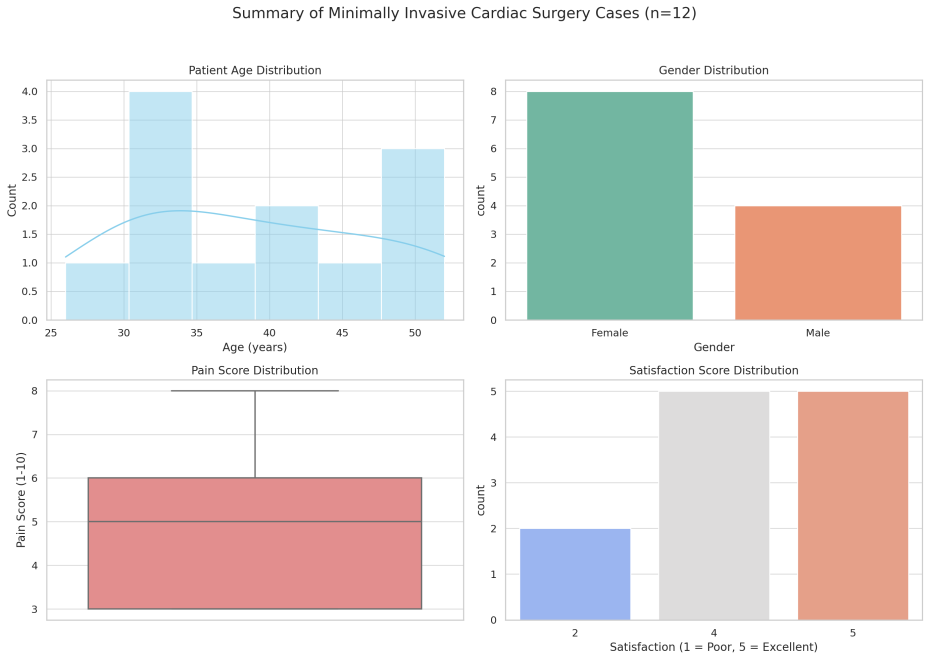
The table below is a visual summary grouped by the patients’ demographics, clinical outcomes, and surgical successes.
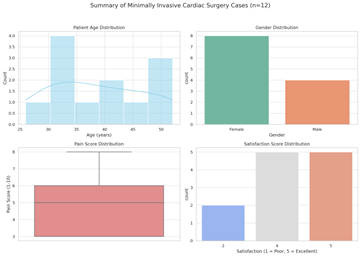

Age Distribution: Most patients are between 60–80 years, with a few younger cases.
Gender Distribution: Slightly more femalepatients than males in this case series.
Pain Score: Pain scores are generally moderate, with a few outliers (higher discomfort).
This gives insight into post-op recovery and analgesia adequacy.
Satisfaction Score: Most patients reported high satisfaction (4–5/5), a positive outcome indicator for the minimally invasive approach.
Clinical Outcomes and Procedural Insights of Minimally Invasive Cardiac Surgery
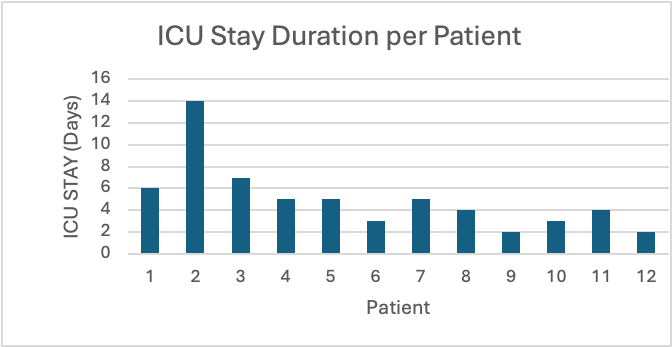
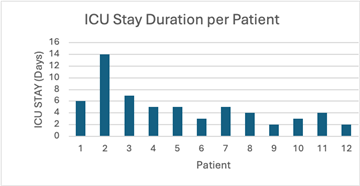
The hospital stay ranged from 5 to 19 days, with most patients discharged within 5 to 8 days, suggesting that minimally invasive techniques may contribute to shorter hospitalization.
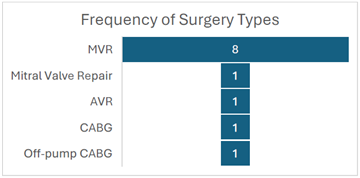
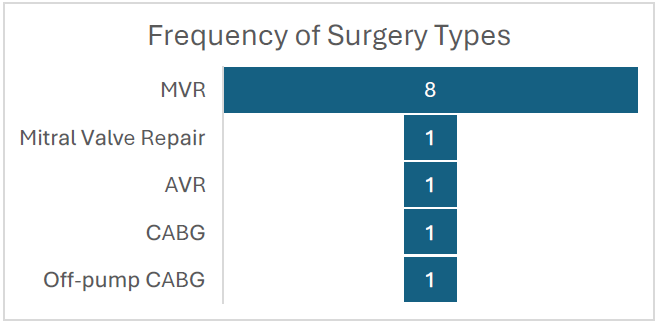
The findings of this observational study highlight the potential benefits and clinical safety of minimally invasive cardiac surgery (MICS) in a real-world cohort of adult patients undergoing procedures such as mitral valve replacement (MVR), aortic valve replacement (AVR), and coronary artery bypass grafting (CABG). Among the 12 patients included, the majority experienced relatively short ICU and hospital stays, with 10 patients (83.3%) discharged within 8 days postoperatively. These outcomes align with the growing body of literature suggesting that MICS can significantly reduce surgical trauma, blood loss, postoperative pain, and recovery time compared to conventional median sternotomy. 5
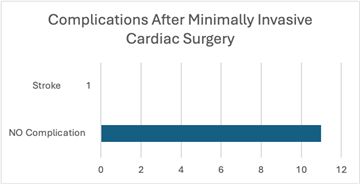
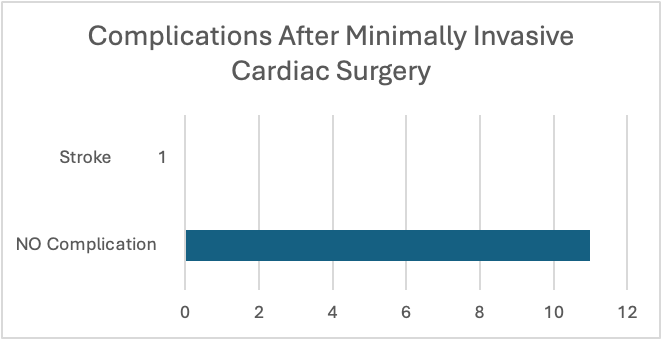
The low complication rate is also noteworthy- 91.7% of patients had no postoperative complications, and only one experienced a stroke. This supports the established safety profile of MICS when performed by experienced teams and with proper patient selection 6, 7. The adoption of techniques such as the Miami method, which emphasizes direct visualization, limited incisions, and specialized instruments, has made complex mitral valve repairs and replacements more accessible while maintaining surgical precision. 8
From a clinical perspective, the reduced ICU and hospital stays observed in our cohort not only benefit patient outcomes but also contribute to healthcare cost-efficiency and improved bed availability. Prior research by Chikwe et al. demonstrated similar trends, reporting that patients who underwent minimally invasive mitral valve surgery had shorter hospitalization and faster return to functional status.
Despite these promising results, limitations of this study include its small sample size, single-center data, and retrospective nature. Future multicenter studies with larger cohorts and standardized outcome tracking are essential to validate the generalizability of these findings. Nonetheless, this study adds valuable local data to the global discourse on minimally invasive cardiac surgery and supports its continued integration into cardiac surgical practice, especially in centers developing this expertise.
Future studies with larger patient cohorts and longer follow-up are recommended to further validate these outcomes and explore the long-term benefits of MICS in diverse clinical settings.
The research team extends its deepest appreciation to Al Hussain AlSalt, AlJadeed Hospital, Jordan, for their generous support and collaboration in conducting this study. We are particularly grateful to the cardiac surgery team, whose clinical expertise and dedication to innovation in minimally invasive techniques provided the foundation for this research.
We also wish to thank the hospital’s medical administration and medical records department for granting access to the necessary clinical data and for facilitating the smooth retrieval of information. Their assistance was crucial in ensuring the accuracy and integrity of the data collection process.
This study reflects a shared commitment to advancing the quality of cardiac care and contributing meaningful insights to the evolving field of minimally invasive cardiac surgery.
| [1] | Bonaros, N., Schachner, T., Wiedemann, D., et al. (2020). Minimally invasive cardiac surgery: from evolution to revolution. Innovations: Technology and Techniques in Cardiothoracic and Vascular Surgery, 15(1), 10-18. | ||
| In article | |||
| [2] | Modi, P., Hassan, A., Chitwood, W.R. (2008). Minimally invasive mitral valve surgery: a systematic review and meta-analysis. European Journal of Cardio-Thoracic Surgery, 34(5), 943–952. | ||
| In article | View Article PubMed | ||
| [3] | Lamelas J. Minimally invasive valve surgery: the Miami method. Ann Cardiothorac Surg. 2016; 5(6): 610–614. | ||
| In article | |||
| [4] | Lamelas J. Minimally invasive valve surgery: the Miami method. Ann Cardiothorac Surg. 2016; 5(6): 610–614. | ||
| In article | |||
| [5] | Modi, P., Hassan, A., & Chitwood, W. R. (2008). Minimally invasive mitral valve surgery: A systematic review and meta-analysis. European Journal of Cardio-Thoracic Surgery, 34(5), 943–952. | ||
| In article | View Article PubMed | ||
| [6] | Lamelas, J. (2016). Minimally invasive valve surgery: The Miami method. Annals of Cardiothoracic Surgery, 5(6), 610–614. | ||
| In article | |||
| [7] | Glauber, M., Miceli, A., Gilmanov, D., & Ferrarini, M. (2017). Minimally invasive mitral valve surgery via right minithoracotomy. Multimed Man Cardiothorac Surg, 2017. | ||
| In article | |||
| [8] | Chikwe, J., Adams, D. H., & Egorova, N. (2011). Minimally invasive versus sternotomy approach for mitral valve surgery: A population-based study of outcomes. The Journal of Thoracic and Cardiovascular Surgery, 142(4), 837–843. | ||
| In article | |||
Published with license by Science and Education Publishing, Copyright © 2025 Manhal Rebhi Al Ramahi
 This work is licensed under a Creative Commons Attribution 4.0 International License. To view a copy of this license, visit
http://creativecommons.org/licenses/by/4.0/
This work is licensed under a Creative Commons Attribution 4.0 International License. To view a copy of this license, visit
http://creativecommons.org/licenses/by/4.0/
| [1] | Bonaros, N., Schachner, T., Wiedemann, D., et al. (2020). Minimally invasive cardiac surgery: from evolution to revolution. Innovations: Technology and Techniques in Cardiothoracic and Vascular Surgery, 15(1), 10-18. | ||
| In article | |||
| [2] | Modi, P., Hassan, A., Chitwood, W.R. (2008). Minimally invasive mitral valve surgery: a systematic review and meta-analysis. European Journal of Cardio-Thoracic Surgery, 34(5), 943–952. | ||
| In article | View Article PubMed | ||
| [3] | Lamelas J. Minimally invasive valve surgery: the Miami method. Ann Cardiothorac Surg. 2016; 5(6): 610–614. | ||
| In article | |||
| [4] | Lamelas J. Minimally invasive valve surgery: the Miami method. Ann Cardiothorac Surg. 2016; 5(6): 610–614. | ||
| In article | |||
| [5] | Modi, P., Hassan, A., & Chitwood, W. R. (2008). Minimally invasive mitral valve surgery: A systematic review and meta-analysis. European Journal of Cardio-Thoracic Surgery, 34(5), 943–952. | ||
| In article | View Article PubMed | ||
| [6] | Lamelas, J. (2016). Minimally invasive valve surgery: The Miami method. Annals of Cardiothoracic Surgery, 5(6), 610–614. | ||
| In article | |||
| [7] | Glauber, M., Miceli, A., Gilmanov, D., & Ferrarini, M. (2017). Minimally invasive mitral valve surgery via right minithoracotomy. Multimed Man Cardiothorac Surg, 2017. | ||
| In article | |||
| [8] | Chikwe, J., Adams, D. H., & Egorova, N. (2011). Minimally invasive versus sternotomy approach for mitral valve surgery: A population-based study of outcomes. The Journal of Thoracic and Cardiovascular Surgery, 142(4), 837–843. | ||
| In article | |||