The shoulder is vulnerable to injury and dislocation in a variety of sports. A new physical performance test (PPT) is presented: The Sitting Apprehension Throw Test (SATT), which assesses power of the shoulder in the 90/90 position and readiness to return to sport. This pilot study determines the intra and inter-rater reliability of the SATT in a healthy adult population.18 male military volunteers were assessed by experienced physiotherapists. A test-retest design was used with 14-day intervals between sessions. The participant was seated with their arm resting on a plinth in the 90/90 position. A 2kg weighted ball was coated in chalk and thrown. Distance thrown was measured and repeated three times for each arm. Mean distance was calculated. 18 males, mean age 22 (± 4) had mean SATT score 206cm (SD 35), SEM 17cms and MDC90 40cms. There was high interobserver and intraobserver reliability with strong correlation between right and left arms (r=0.7)The SATT is reliable and can be used to evaluate shoulder power and inform assessment of readiness to return to sport after injury. It is simple, quick and easy to perform.
The shoulder is vulnerable to injury and dislocation in a variety of sports and is a commonly injured site for military personnel 1, 2, 3, 4, 5. Workplace demands such as overhead working, heavy lifting and working in an awkward posture also increase risk of shoulder disorders 6, 7. Management of shoulder injuries includes rest, rehabilitation and surgery, and may result in a significant loss of playing time and time out of work 1, 2, 4, 5. The complex mobility of the shoulder joint presents challenges to the clinician in assessing when it is appropriate to return to training, sport participation and physically demanding work after rehabilitation 8, 9, 10. There is a clear need for objective tests to inform the clinician on the readiness of an individual to return to full activities 11.
Physical performance tests (PPT) can be used to evaluate the performance capacity of an individual’s upper extremity and guide rehabilitation after injury 10, 11, 12, 13. To the authors’ knowledge, there is no reliable clinical test than can assess shoulder function and power, with the shoulder in a position of combined abduction and external rotation, the ‘at risk’ position for anterior shoulder dislocation. Measurement of power in this position is important as it mirrors the soft tissue mechanics of the deltoid and rotator cuff during overhead activities and sports 14. The throwing motion requires a high level of muscle activation, generates an extraordinary demand upon the shoulder joint, and utilises both the static and dynamic stabilises of the shoulder 5, 15.
The authors present a new PPT: The Sitting Apprehension Throw Test (SATT). This tests the ability of an individual, in a seated position, to throw a weighted ball with the shoulder in a starting position of 90° of abduction and 90° of external rotation (90/90 position). It measures the explosive power of the shoulder, required in many sports and activities. This simple yet informative test can be conducted in a clinical setting, using minimal equipment found in any rehabilitation department. The primary objective of this pilot study was to determine the intra and inter-rater reliability of the SATT, in a healthy adult military population. We hypothesised that the SATT would be a reliable test with good intra and inter-rater reliability.
The study was approved by the local ministry of defence research committee. Male military volunteers were sought from a local base affiliated with the hospital. This population was selected due to the high incidence of shoulder pathology in this population and the high physical demands required as part of their training. Participants were excluded if they had a diagnosis of shoulder pathology which included shoulder instability, joint hypermobility, labral tear, rotator cuff tear or fracture of the shoulder. Other exclusion criteria included history of shoulder pain in the preceding 6 months, current treatment of or previous surgery on the shoulder, neck or spine. 18 male volunteers took part in this study. A power analysis was conducted based on detecting an intraclass correlation coefficient (ICC) of 0.85, tested against a null hypothesis of 0.60, with a significance level (α) of 0.05 and desired statistical power of 0.80. A minimum of 18 participants was deemed sufficient to achieve the target power for both intra-rater and inter-rater reliability assessments 16, 17.
All participants watched an instructional video and were given a presentation with an information leaflet on how to perform the test. Following this, all volunteers provided written informed consent for participation in the study and were blinded to the results.
A test-retest design of the SATT was conducted with an interval of fourteen days between each test session. Inter and intra-rater reliability were investigated during and between the sessions. Both examiners were physiotherapists with more than 11 years of clinical experience.
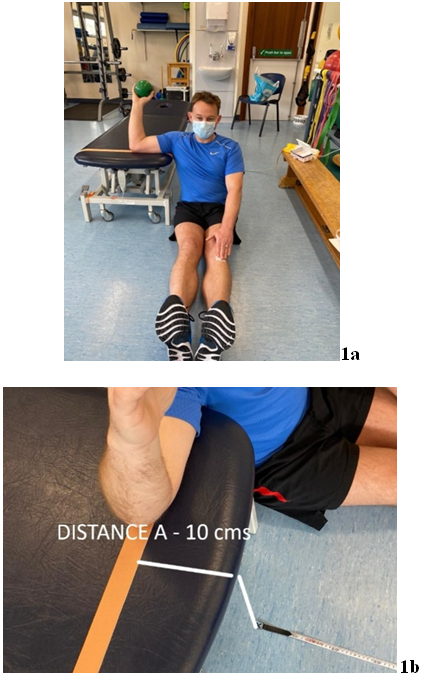
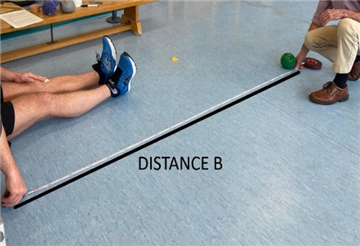
2.2. Equipment & Set-UpA 2kg weighted ball (Thera-band soft weight, Theraband, Akron, Ohio, USA) was used. This weight was chosen as a standard weight commonly available in rehabilitation units. Climbers chalk (magnesium carbonate) was used to coat the weight and measurements taken from the mark this made on the floor once thrown. An adjustable height plinth was used to stabilise the participant’s arm. To ensure this was standardised between participants and throws, tape was used to mark 10cm from the end of the centre of the plinth which acted as the point of positioning for the arm on the plinth. A reference point on the floor directly below the centre of the front edge of the plinth was made to enable accurate measurement of throw length (Figure 1b &Figure 1c).

The SATT was performed with the participant positioned sat adjacent to the plinth with knees in extension to facilitate neutral positioning of the spine. All participants in this study were able to achieve this sitting position but if not, a comfortable sitting position with knees bent and the spine maintained in neutral position would be acceptable. The shoulder of the upper limb being tested was placed in 90° abduction and 90° of external rotation (Figure 1a). The plinth height was adjusted to enable the participant to place their upper arm to rest on the centre of the tape marker positioned across the width of the plinth (Figure 1b). By fixing the arm on the plinth, it created standardisation between participants of the starting position of the throw. To prevent trunk rotation, participants were asked to place their opposite palm on the corresponding anterior thigh and to maintain this position throughout. This test position limited compensatory trunk involvement during shoulder power production, which could otherwise artificially increase power produced.
2.4. Warm-upPrior to the test, each participant undertook a dynamic warmup protocol informed by previous work 18. In the test position, the participant undertook 30 seconds of shoulder internal/external rotation slowly through range (in the 90/90 position) using the 2kg weighted ball. Immediately following this, a familiarisation trial was undertaken where participants performed three throws at between 50 % and 75% of their maximum effort. Warm-
up exercises conducted at increasing but less than full capacity has been shown to improve performance when assessing throwing power 19. 2 minutes rest was then observed before proceeding with the test. This time period was chosen as it has been shown to avoid a significant decrease in throwing power output 20.
2.5. Performing the TestWith the prepared 2kg weighted ball in the throwing hand, the participant was asked to externally rotate the shoulder as far as possible and to hold this position for a 5 second count to decrease the stress reflex and as standardisation between participants. The participant was then instructed to throw the weighted ball with maximal effort, forwards as far as possible, whilst maintaining the test position. Three throws were undertaken with 2-minute rest between each throw to mitigate against fatigue 13. The mean distance of the three throws was calculated and used as the score for the SATT. Each participant performed the SATT test once with each examiner per session.
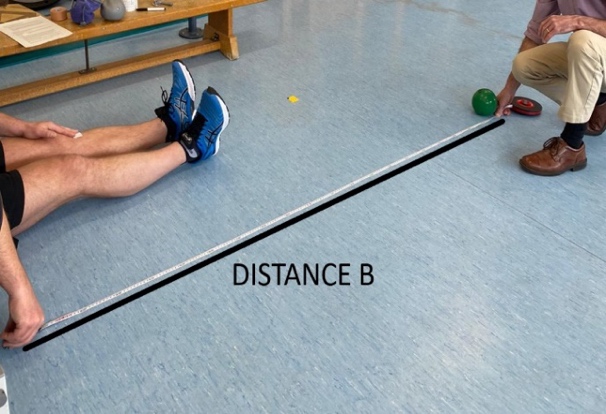
The measurement of throw length was taken between the reference point on the floor measured to the closest point of the chalk print made during the landing of the weighted ball (distance B). 10 centimetres is added to this value to account for the distance marked by the tape on the plinth (distance A, Figure 1b). Any throws that deviated from the established protocol were disregarded, and the attempt was repeated.
2.6. Statistical AnalysisResults were presented as continuous variables, mean and standard deviation (SD). Inter and intra observer reliability were assessed using intraclass correlation coefficients (ICC2k) and categorised as follows: perfect reliability (0.90-0.99), very high reliability (0.70-0.89), high reliability (0.50-0.69), moderate reliability (0.26-0.49), or low reliability (0.00-0.25) 21. Standard error of measurement (SEM) and the minimal detectable change (MDC) were also calculated. Correlation analyses were conducted using Pearson correlation coefficient (r) and categorised as either weak (<0.5), moderate (0.5-0.7), or strong (>0.7) 22. All statistical analyses were performed using Stata 15 (Stata Statistical Software: Release 15. College Station, TX: StataCorp LLC) and R (R Core Team (2021). R: A language and environment for statistical computing. R Foundation for Statistical Computing, Vienna, Austria).
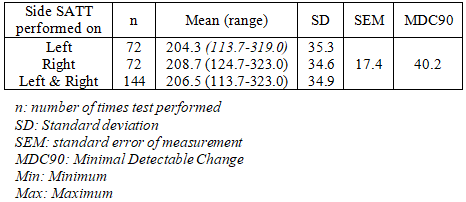
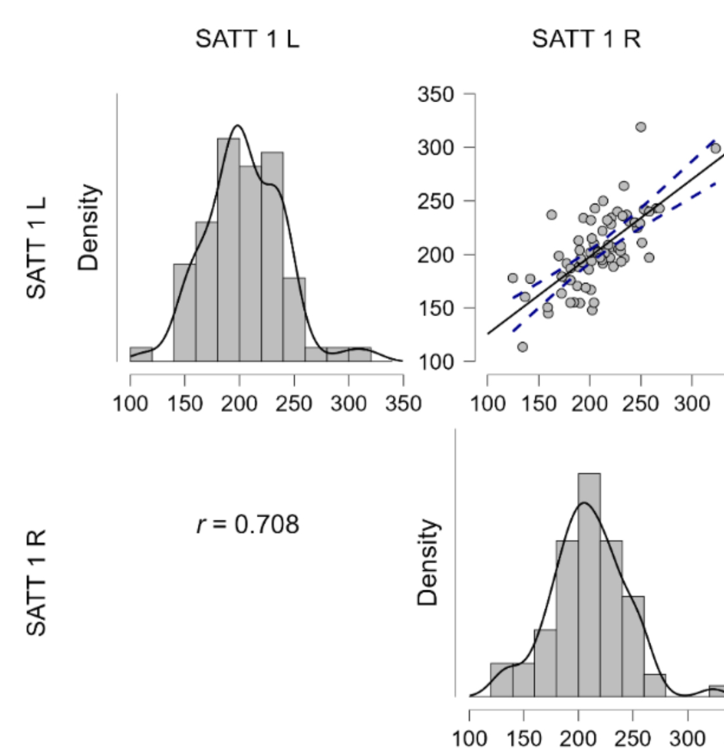
Eighteen male volunteers participated in the study with a mean age of 22 (± 4.0 years), mean height of 180.5cm (± 5.8), and mean weight of 82.8kg (± 5.5). The mean SATT score was 206cm (SD 34.8), SEM was 17.4cms and MDC90 was 40.2cms (Table 1). The SATT was found to have very high interobserver reliability, with mean ICC2K 0.83 (SD 0.07) and high intraobserver reliability ICC2k 0.68 (SD 0.08). There was strong correlation between right and left arms (r = 0.71), see Figure 2.

The current study’s purpose was to determine the intra and inter-rater reliability of a novel technique, the SATT, to assess shoulder power in a healthy adult population. The results indicate high intra- and inter-rater reliability. The SATT is therefore a reliable measure of shoulder power between sessions and clinicians. To the authors’ knowledge, no prior studies have been conducted specifically assessing power of the shoulder in the 90/90 position. Therefore, direct comparisons with related reports in the literature are difficult.
The ASH Test has been shown to be a reliable tool in measuring upper limb force production and assessing readiness to return to high-intensity activity 23. This test involves the participant placing their arm in the ‘I’, ‘Y’ and ‘T’ positions to assess force applied through a handheld dynamometer (HHD). However, these test positions have limited applicability for overhead activities.
The 90/90 position of the shoulder is the position in the late cocking phase of throwing in many overhead activities and sports. It is also the position of maximal vulnerability to anterior shoulder dislocation. This position places significant demand on the rotator cuff and superior labrum, and results in tensile loading of the anteroinferior capsule 24, 25. The forceful internal rotation required in throwing requires effective muscle activation of the shoulder gridle 14. Rotator cuff coordination and control prevents excessive movement of the humeral head and reduces stress on the anterior shoulder stabilisers 26. This complex interplay highlights the importance of testing the shoulder in the 90/90 position, when assessing readiness to return to overhead sport and activities.
Several studies have investigated the production of shoulder force in this 90/90 position 27, 28, 29, 30, 31. The gold standard method to assess force is using an isokinetic dynamometer. Whilst this test is reliable, it is expensive, cumbersome, time consuming and requires technical expertise 31. A smaller more cost-effective HHD can be used as an alternative, but results can be subject to variability due to patient set-up, tester strength, placement of device and patient compliance 31, 32, 33. However, when standardisation factors are implemented, contemporary literature suggests that HHD is a reliable tool 9, 27, 31, 33. These elements of standardisation have been incorporated into the SATT and have likely contributed to its reliability. However, in contrast to using an HHD, the SATT does not require specialist equipment and is therefore cheaper, easier to perform and interpret.
Positioning of participants in previous studies is variable. Many have placed the participant supine 27, 34 (which is artificial and does not replicate the natural throwing position) or standing 29 (which does not control for the contribution of the trunk to the kinetic chain). The lower limbs and trunk are known to significantly contribute to generation of power in throwing 35. For this reason, the SATT adopted a seated position with the arm fixed on a plinth. This allowed for standardisation between tests and controlled the contribution of the trunk and legs to the kinetic chain of throwing.
Whilst muscle strength is a key component of athletic performance, both strength and power are required to conduct high performance overhead activities 36, 37. Power is the product of force and velocity, the rate at which work is performed 38. Assessment of power is crucial to fully assess performance and readiness to return to activities. However, measurement of shoulder power is challenging. It involves expensive, complex equipment and time-consuming analysis 38, 39. The development of the SATT aimed to address this by designing a test that assed power but was easy to conduct, using equipment readily available in the typical rehabilitation setting. Increased shoulder power has been shown to result in increased ball-throwing distance and this simple principle was used as the assessment of power in the SATT 38, 40, 41, 42.
4.1. Interpreting the SATTStudies have shown that there is up to 10% higher performance in the dominant arm in throwing activities compared to the non-dominant arm 13, 24, 25. However, our study found minimal variation between the dominant and non-dominant arms (0.32%) when performing the SATT. This suggests that the SATT could be employed to assess the power in both the injured and uninjured arm. Repeatable results in the injured arm equivalent to the uninjured side could indicate that the individual is safe to return to sporting activities. Results could also be recorded and plotted during the rehabilitation process to inform the clinician and patient on progress which would be both reassuring and motivating. Whilst a single test should not be used in isolation to evaluate the readiness of an individual to return to sport, the SATT can offer valuable information to contribute to this decision-making process 43.
4.2. LimitationsThis pilot study is inherently limited by the small sample size with narrow patient demographics but is adequately powered. Promising results were achieved in this healthy young adult male population, but caution should be taken when interpreting the results and attempting to generalise them. Our study population contained no female participants, did not include adults above the age of 26 years, nor any participants with shoulder pathology. Participants with differing demographics to our study population may have had different results. However, the SATT has demonstrated promising initial results, and this study should be used to inform the design of future larger-scale studies.
4.3. Future DirectionsLarger randomised studies, with broader population demographics, should be conducted to further assess the reliability of the SATT. Validity of the SATT should be investigated by comparing it with similar tests of shoulder strength in the 90/90 position, for example with isokinetic dynamometry. Following this, the SATT could be more widely adopted in the field of rehabilitation to inform readiness to return to sport and activities after injury. The SATT could also be used to track power throughout a season of sport and correlate with injury occurrence and performance.
The SATT is a reliable PPT that can be safely used to evaluate shoulder power and inform assessment of readiness to return to sport after rehabilitation. It is simple, cheap, quick and easy to perform, using equipment already available in clinic. The scores are easy to interpret and have limited measurement error.
Nil
The authors have no competing interests.
| [1] | Abrams GD, Renstrom PA, Safran MR. Epidemiology of musculoskeletal injury in the tennis player. British journal of sports medicine. 2012; 46(7): 492-8. | ||
| In article | View Article PubMed | ||
| [2] | Horsley IG, Fowler EM, Rolf CG. Shoulder injuries in professional rugby: a retrospective analysis. Journal of Orthopaedic surgery and research. 2013; 8: 1-6. | ||
| In article | View Article PubMed | ||
| [3] | Johnson CD, Nijst BK, Eagle SR, Kessels MW, Lovalekar MT, Krajewski KT, et al. Evaluation of shoulder strength and kinematics as risk factors for shoulder injury in United States special forces personnel. Orthopaedic journal of sports medicine. 2019;7(3):2325967119831272. | ||
| In article | View Article PubMed | ||
| [4] | Wanivenhaus F, Fox AJ, Chaudhury S, Rodeo SA. Epidemiology of injuries and prevention strategies in competitive swimmers. Sports health. 2012; 4(3): 246-51. | ||
| In article | View Article PubMed | ||
| [5] | Wilk KE, Obma P, Simpson CD, Cain EL, Dugas J, Andrews JR. Shoulder injuries in the overhead athlete. Journal of orthopaedic & sports physical therapy. 2009; 39(2): 38-54. | ||
| In article | View Article PubMed | ||
| [6] | Linaker CH, Walker-Bone K. Shoulder disorders and occupation. Best practice & research Clinical rheumatology. 2015; 29(3): 405-23. | ||
| In article | View Article PubMed | ||
| [7] | Poploski KM, Picha KJ, Winters JD, Royer SD, Heebner NR, Lambert B, et al. Patterns and associations of shoulder motion, strength, and function in MARSOC personnel without history of shoulder injury. Military medicine. 2018; 183(11-12): e685-e92. | ||
| In article | View Article PubMed | ||
| [8] | Ciccotti MC, Syed U, Hoffman R, Abboud JA, Ciccotti MG, Freedman KB. Return to play criteria following surgical stabilization for traumatic anterior shoulder instability: a systematic review. Arthroscopy: The Journal of Arthroscopic & Related Surgery. 2018; 34(3): 903-13. | ||
| In article | View Article PubMed | ||
| [9] | Cools AM, Maenhout AG, Vanderstukken F, Declève P, Johansson FR, Borms D. The challenge of the sporting shoulder: From injury prevention through sport-specific rehabilitation toward return to play. Annals of physical and rehabilitation medicine. 2021; 64(4): 101384. | ||
| In article | View Article PubMed | ||
| [10] | Wilk KE, Bagwell MS, Davies GJ, Arrigo CA. Return to sport participation criteria following shoulder injury: a clinical commentary. International journal of sports physical therapy. 2020; 15(4): 624. | ||
| In article | View Article PubMed | ||
| [11] | Goldbeck TG, Davies GJ. Test-retest reliability of the closed kinetic chain upper extremity stability test: a clinical field test. Journal of Sport Rehabilitation. 2000; 9(1): 35-45. | ||
| In article | View Article | ||
| [12] | Decleve P, Attar T, Benameur T, Gaspar V, Van Cant J, Cools AM. The “upper limb rotation test”: reliability and validity study of a new upper extremity physical performance test. Physical therapy in sport. 2020; 42: 118-23. | ||
| In article | View Article PubMed | ||
| [13] | Westrick RB, Miller JM, Carow SD, Gerber JP. Exploration of the y-balance test for assessment of upper quarter closed kinetic chain performance. International journal of sports physical therapy. 2012; 7(2): 139. | ||
| In article | |||
| [14] | Alizadehkhaiyat O, Hawkes DH, Kemp GJ, Frostick SP. Electromyographic analysis of shoulder girdle muscles during common internal rotation exercises. International journal of sports physical therapy. 2015; 10(5): 645. | ||
| In article | View Article PubMed | ||
| [15] | Reinold MM, Curtis AS. Microinstability of the shoulder in the overhead athlete. International journal of sports physical therapy. 2013;8(5):601. | ||
| In article | |||
| [16] | Monti CB, Ambrogi F, Sardanelli F. Sample size calculation for data reliability and diagnostic performance: a go-to review. European Radiology Experimental. 2024; 8(1): 79. | ||
| In article | View Article PubMed | ||
| [17] | Walter S, Eliasziw M, Donner A. Sample size and optimal designs for reliability studies. Statistics in medicine. 1998; 17(1): 101-10. | ||
| In article | View Article | ||
| [18] | Mascarin NC, Vancini RL, Lira CA, Andrade MS. Stretch-induced reductions in throwing performance are attenuated by warm-up before exercise. The Journal of Strength & Conditioning Research. 2015; 29(5): 1393-8. | ||
| In article | View Article PubMed | ||
| [19] | Dolan M, Sevene TG, Berninig J, Harris C, Climstein M, Adams KJ, et al. Post-activation potentiation and the shot put throw. Int J Sports Sci. 2017; 7(4): 170-6. | ||
| In article | |||
| [20] | Davó JLH, Solana RS, Marín JMS, Fernández JF, Ramón MM. Rest interval required for power training with power load in the bench press throw exercise. The Journal of Strength & Conditioning Research. 2016; 30(5): 1265-74. | ||
| In article | View Article PubMed | ||
| [21] | Portney LG, Watkins MP. Foundations of clinical research: applications to practice: Pearson/Prentice Hall Upper Saddle River, NJ; 2009. | ||
| In article | |||
| [22] | Chan Y. Biostatistics 104: correlational analysis. Singapore Med J. 2003; 44(12): 614-9. | ||
| In article | |||
| [23] | Ashworth B, Hogben P, Singh N, Tulloch L, Cohen DD. The Athletic Shoulder (ASH) test: reliability of a novel upper body isometric strength test in elite rugby players. BMJ Open Sport & Exercise Medicine. 2018; 4(1): e000365. | ||
| In article | View Article PubMed | ||
| [24] | Burkhart SS, Morgan CD, Kibler WB. The disabled throwing shoulder: spectrum of pathology Part I: pathoanatomy and biomechanics. Arthroscopy: The Journal of Arthroscopic & Related Surgery. 2003; 19(4): 404-20. | ||
| In article | View Article PubMed | ||
| [25] | Lin DJ, Wong TT, Kazam JK. Shoulder injuries in the overhead-throwing athlete: epidemiology, mechanisms of injury, and imaging findings. Radiology. 2018; 286(2): 370-87. | ||
| In article | View Article PubMed | ||
| [26] | Hess SA, Richardson C, Darnell R, Friis P, Lisle D, Myers P. Timing of rotator cuff activation during shoulder external rotation in throwers with and without symptoms of pain. Journal of Orthopaedic & Sports Physical Therapy. 2005; 35(12): 812-20. | ||
| In article | View Article PubMed | ||
| [27] | Chen B, Liu L, Chen LB, Cao X, Han P, Wang C, et al. Concurrent validity and reliability of a handheld dynamometer in measuring isometric shoulder rotational strength. Journal of Sport Rehabilitation. 2021; 30(6): 965-8. | ||
| In article | View Article PubMed | ||
| [28] | Fieseler G, Molitor T, Irlenbusch L, Delank K-S, Laudner KG, Hermassi S, et al. Intrarater reliability of goniometry and hand-held dynamometry for shoulder and elbow examinations in female team handball athletes and asymptomatic volunteers. Archives of orthopaedic and trauma surgery. 2015; 135: 1719-26. | ||
| In article | View Article PubMed | ||
| [29] | Holt K, Raper D, Boettcher C, Waddington G, Drew M. Hand-held dynamometry strength measures for internal and external rotation demonstrate superior reliability, lower minimal detectable change and higher correlation to isokinetic dynamometry than externally-fixed dynamometry of the shoulder. Physical Therapy in Sport. 2016; 21: 75-81. | ||
| In article | View Article PubMed | ||
| [30] | Kolber MJ, Beekhuizen K, Cheng M-SS, Fiebert IM. The reliability of hand-held dynamometry in measuring isometric strength of the shoulder internal and external rotator musculature using a stabilization device. Physiotherapy Theory and practice. 2007; 23(2): 119-24. | ||
| In article | View Article PubMed | ||
| [31] | Loepfe JG, Nagelli CV, Larson DR, Tagliero AJ, Cherny CE, Johnson AJ. Reliability and Validity of Measuring Shoulder Internal and External Rotation Strength in Volleyball Specific Positions. International Journal of Sports Physical Therapy. 2025; 20(4): 532. | ||
| In article | View Article PubMed | ||
| [32] | Chamorro C, Arancibia M, Trigo B, Arias-Poblete L, Jerez-Mayorga D. Absolute reliability and concurrent validity of hand-held dynamometry in shoulder rotator strength assessment: systematic review and meta-analysis. International Journal of Environmental Research and Public Health. 2021; 18(17): 9293. | ||
| In article | View Article PubMed | ||
| [33] | Roy J-S, MacDermid JC, Orton B, Tran T, Faber KJ, Drosdowech D, et al. The concurrent validity of a hand-held versus a stationary dynamometer in testing isometric shoulder strength. Journal of Hand Therapy. 2009; 22(4): 320-7. | ||
| In article | View Article PubMed | ||
| [34] | Croteau F, Robbins SM, Pearsall D. Hand-held shoulder strength measures correlate with isokinetic dynamometry in elite water polo players. Journal of Sport Rehabilitation. 2021; 30(8): 1233-6. | ||
| In article | View Article PubMed | ||
| [35] | Ellenbecker TS, Aoki R. Step by step guide to understanding the kinetic chain concept in the overhead athlete. Current reviews in musculoskeletal medicine. 2020; 13: 155-63. | ||
| In article | View Article PubMed | ||
| [36] | Lorenz D, Morrison S. Current concepts in periodization of strength and conditioning for the sports physical therapist. International journal of sports physical therapy. 2015; 10(6): 734. | ||
| In article | |||
| [37] | Suchomel TJ, Nimphius S, Stone MH. The importance of muscular strength in athletic performance. Sports medicine. 2016; 46: 1419-49. | ||
| In article | View Article PubMed | ||
| [38] | Harris C, Wattles AP, DeBeliso M, Sevene-Adams PG, Berning JM, Adams KJ. The seated medicine ball throw as a test of upper body power in older adults. The Journal of Strength & Conditioning Research. 2011; 25(8): 2344-8. | ||
| In article | View Article PubMed | ||
| [39] | Beckham G, Lish S, Disney C, Keebler L, DeBeliso M, Adams KJ. The reliability of the seated medicine ball throw as assessed with accelerometer instrumentation. Journal of Physical Activity Research. 2019; 4(2). | ||
| In article | View Article | ||
| [40] | Leite MAFdJ, Sasaki JE, Lourenço CLM, Zanetti HR, Cruz LG, Mota GRd, et al. Medicine ball throw test predicts arm power in rugby sevens players. Revista Brasileira de Cineantropometria & Desempenho Humano. 2016; 18(2): 166-76. | ||
| In article | |||
| [41] | Marques MC, Van Den Tillaar R, Vescovi JD, González-Badillo JJ. Relationship between throwing velocity, muscle power, and bar velocity during bench press in elite handball players. International journal of sports physiology and performance. 2007; 2(4): 414-22. | ||
| In article | View Article PubMed | ||
| [42] | November RV-C. The relationship between shoulder complex strength and throwing velocity in club cricketers. 2016. | ||
| In article | |||
| [43] | Olds M, Coulter C, Marant D, Uhl T. Reliability of a shoulder arm return to sport test battery. Physical therapy in sport. 2019; 39: 16-22. | ||
| In article | View Article PubMed | ||
Published with license by Science and Education Publishing, Copyright © 2025 A Rich, S J Donoghue, C Spencer, A L Cox, R Hemingway, J P Evans and P Guyver
 This work is licensed under a Creative Commons Attribution 4.0 International License. To view a copy of this license, visit
http://creativecommons.org/licenses/by/4.0/
This work is licensed under a Creative Commons Attribution 4.0 International License. To view a copy of this license, visit
http://creativecommons.org/licenses/by/4.0/
| [1] | Abrams GD, Renstrom PA, Safran MR. Epidemiology of musculoskeletal injury in the tennis player. British journal of sports medicine. 2012; 46(7): 492-8. | ||
| In article | View Article PubMed | ||
| [2] | Horsley IG, Fowler EM, Rolf CG. Shoulder injuries in professional rugby: a retrospective analysis. Journal of Orthopaedic surgery and research. 2013; 8: 1-6. | ||
| In article | View Article PubMed | ||
| [3] | Johnson CD, Nijst BK, Eagle SR, Kessels MW, Lovalekar MT, Krajewski KT, et al. Evaluation of shoulder strength and kinematics as risk factors for shoulder injury in United States special forces personnel. Orthopaedic journal of sports medicine. 2019;7(3):2325967119831272. | ||
| In article | View Article PubMed | ||
| [4] | Wanivenhaus F, Fox AJ, Chaudhury S, Rodeo SA. Epidemiology of injuries and prevention strategies in competitive swimmers. Sports health. 2012; 4(3): 246-51. | ||
| In article | View Article PubMed | ||
| [5] | Wilk KE, Obma P, Simpson CD, Cain EL, Dugas J, Andrews JR. Shoulder injuries in the overhead athlete. Journal of orthopaedic & sports physical therapy. 2009; 39(2): 38-54. | ||
| In article | View Article PubMed | ||
| [6] | Linaker CH, Walker-Bone K. Shoulder disorders and occupation. Best practice & research Clinical rheumatology. 2015; 29(3): 405-23. | ||
| In article | View Article PubMed | ||
| [7] | Poploski KM, Picha KJ, Winters JD, Royer SD, Heebner NR, Lambert B, et al. Patterns and associations of shoulder motion, strength, and function in MARSOC personnel without history of shoulder injury. Military medicine. 2018; 183(11-12): e685-e92. | ||
| In article | View Article PubMed | ||
| [8] | Ciccotti MC, Syed U, Hoffman R, Abboud JA, Ciccotti MG, Freedman KB. Return to play criteria following surgical stabilization for traumatic anterior shoulder instability: a systematic review. Arthroscopy: The Journal of Arthroscopic & Related Surgery. 2018; 34(3): 903-13. | ||
| In article | View Article PubMed | ||
| [9] | Cools AM, Maenhout AG, Vanderstukken F, Declève P, Johansson FR, Borms D. The challenge of the sporting shoulder: From injury prevention through sport-specific rehabilitation toward return to play. Annals of physical and rehabilitation medicine. 2021; 64(4): 101384. | ||
| In article | View Article PubMed | ||
| [10] | Wilk KE, Bagwell MS, Davies GJ, Arrigo CA. Return to sport participation criteria following shoulder injury: a clinical commentary. International journal of sports physical therapy. 2020; 15(4): 624. | ||
| In article | View Article PubMed | ||
| [11] | Goldbeck TG, Davies GJ. Test-retest reliability of the closed kinetic chain upper extremity stability test: a clinical field test. Journal of Sport Rehabilitation. 2000; 9(1): 35-45. | ||
| In article | View Article | ||
| [12] | Decleve P, Attar T, Benameur T, Gaspar V, Van Cant J, Cools AM. The “upper limb rotation test”: reliability and validity study of a new upper extremity physical performance test. Physical therapy in sport. 2020; 42: 118-23. | ||
| In article | View Article PubMed | ||
| [13] | Westrick RB, Miller JM, Carow SD, Gerber JP. Exploration of the y-balance test for assessment of upper quarter closed kinetic chain performance. International journal of sports physical therapy. 2012; 7(2): 139. | ||
| In article | |||
| [14] | Alizadehkhaiyat O, Hawkes DH, Kemp GJ, Frostick SP. Electromyographic analysis of shoulder girdle muscles during common internal rotation exercises. International journal of sports physical therapy. 2015; 10(5): 645. | ||
| In article | View Article PubMed | ||
| [15] | Reinold MM, Curtis AS. Microinstability of the shoulder in the overhead athlete. International journal of sports physical therapy. 2013;8(5):601. | ||
| In article | |||
| [16] | Monti CB, Ambrogi F, Sardanelli F. Sample size calculation for data reliability and diagnostic performance: a go-to review. European Radiology Experimental. 2024; 8(1): 79. | ||
| In article | View Article PubMed | ||
| [17] | Walter S, Eliasziw M, Donner A. Sample size and optimal designs for reliability studies. Statistics in medicine. 1998; 17(1): 101-10. | ||
| In article | View Article | ||
| [18] | Mascarin NC, Vancini RL, Lira CA, Andrade MS. Stretch-induced reductions in throwing performance are attenuated by warm-up before exercise. The Journal of Strength & Conditioning Research. 2015; 29(5): 1393-8. | ||
| In article | View Article PubMed | ||
| [19] | Dolan M, Sevene TG, Berninig J, Harris C, Climstein M, Adams KJ, et al. Post-activation potentiation and the shot put throw. Int J Sports Sci. 2017; 7(4): 170-6. | ||
| In article | |||
| [20] | Davó JLH, Solana RS, Marín JMS, Fernández JF, Ramón MM. Rest interval required for power training with power load in the bench press throw exercise. The Journal of Strength & Conditioning Research. 2016; 30(5): 1265-74. | ||
| In article | View Article PubMed | ||
| [21] | Portney LG, Watkins MP. Foundations of clinical research: applications to practice: Pearson/Prentice Hall Upper Saddle River, NJ; 2009. | ||
| In article | |||
| [22] | Chan Y. Biostatistics 104: correlational analysis. Singapore Med J. 2003; 44(12): 614-9. | ||
| In article | |||
| [23] | Ashworth B, Hogben P, Singh N, Tulloch L, Cohen DD. The Athletic Shoulder (ASH) test: reliability of a novel upper body isometric strength test in elite rugby players. BMJ Open Sport & Exercise Medicine. 2018; 4(1): e000365. | ||
| In article | View Article PubMed | ||
| [24] | Burkhart SS, Morgan CD, Kibler WB. The disabled throwing shoulder: spectrum of pathology Part I: pathoanatomy and biomechanics. Arthroscopy: The Journal of Arthroscopic & Related Surgery. 2003; 19(4): 404-20. | ||
| In article | View Article PubMed | ||
| [25] | Lin DJ, Wong TT, Kazam JK. Shoulder injuries in the overhead-throwing athlete: epidemiology, mechanisms of injury, and imaging findings. Radiology. 2018; 286(2): 370-87. | ||
| In article | View Article PubMed | ||
| [26] | Hess SA, Richardson C, Darnell R, Friis P, Lisle D, Myers P. Timing of rotator cuff activation during shoulder external rotation in throwers with and without symptoms of pain. Journal of Orthopaedic & Sports Physical Therapy. 2005; 35(12): 812-20. | ||
| In article | View Article PubMed | ||
| [27] | Chen B, Liu L, Chen LB, Cao X, Han P, Wang C, et al. Concurrent validity and reliability of a handheld dynamometer in measuring isometric shoulder rotational strength. Journal of Sport Rehabilitation. 2021; 30(6): 965-8. | ||
| In article | View Article PubMed | ||
| [28] | Fieseler G, Molitor T, Irlenbusch L, Delank K-S, Laudner KG, Hermassi S, et al. Intrarater reliability of goniometry and hand-held dynamometry for shoulder and elbow examinations in female team handball athletes and asymptomatic volunteers. Archives of orthopaedic and trauma surgery. 2015; 135: 1719-26. | ||
| In article | View Article PubMed | ||
| [29] | Holt K, Raper D, Boettcher C, Waddington G, Drew M. Hand-held dynamometry strength measures for internal and external rotation demonstrate superior reliability, lower minimal detectable change and higher correlation to isokinetic dynamometry than externally-fixed dynamometry of the shoulder. Physical Therapy in Sport. 2016; 21: 75-81. | ||
| In article | View Article PubMed | ||
| [30] | Kolber MJ, Beekhuizen K, Cheng M-SS, Fiebert IM. The reliability of hand-held dynamometry in measuring isometric strength of the shoulder internal and external rotator musculature using a stabilization device. Physiotherapy Theory and practice. 2007; 23(2): 119-24. | ||
| In article | View Article PubMed | ||
| [31] | Loepfe JG, Nagelli CV, Larson DR, Tagliero AJ, Cherny CE, Johnson AJ. Reliability and Validity of Measuring Shoulder Internal and External Rotation Strength in Volleyball Specific Positions. International Journal of Sports Physical Therapy. 2025; 20(4): 532. | ||
| In article | View Article PubMed | ||
| [32] | Chamorro C, Arancibia M, Trigo B, Arias-Poblete L, Jerez-Mayorga D. Absolute reliability and concurrent validity of hand-held dynamometry in shoulder rotator strength assessment: systematic review and meta-analysis. International Journal of Environmental Research and Public Health. 2021; 18(17): 9293. | ||
| In article | View Article PubMed | ||
| [33] | Roy J-S, MacDermid JC, Orton B, Tran T, Faber KJ, Drosdowech D, et al. The concurrent validity of a hand-held versus a stationary dynamometer in testing isometric shoulder strength. Journal of Hand Therapy. 2009; 22(4): 320-7. | ||
| In article | View Article PubMed | ||
| [34] | Croteau F, Robbins SM, Pearsall D. Hand-held shoulder strength measures correlate with isokinetic dynamometry in elite water polo players. Journal of Sport Rehabilitation. 2021; 30(8): 1233-6. | ||
| In article | View Article PubMed | ||
| [35] | Ellenbecker TS, Aoki R. Step by step guide to understanding the kinetic chain concept in the overhead athlete. Current reviews in musculoskeletal medicine. 2020; 13: 155-63. | ||
| In article | View Article PubMed | ||
| [36] | Lorenz D, Morrison S. Current concepts in periodization of strength and conditioning for the sports physical therapist. International journal of sports physical therapy. 2015; 10(6): 734. | ||
| In article | |||
| [37] | Suchomel TJ, Nimphius S, Stone MH. The importance of muscular strength in athletic performance. Sports medicine. 2016; 46: 1419-49. | ||
| In article | View Article PubMed | ||
| [38] | Harris C, Wattles AP, DeBeliso M, Sevene-Adams PG, Berning JM, Adams KJ. The seated medicine ball throw as a test of upper body power in older adults. The Journal of Strength & Conditioning Research. 2011; 25(8): 2344-8. | ||
| In article | View Article PubMed | ||
| [39] | Beckham G, Lish S, Disney C, Keebler L, DeBeliso M, Adams KJ. The reliability of the seated medicine ball throw as assessed with accelerometer instrumentation. Journal of Physical Activity Research. 2019; 4(2). | ||
| In article | View Article | ||
| [40] | Leite MAFdJ, Sasaki JE, Lourenço CLM, Zanetti HR, Cruz LG, Mota GRd, et al. Medicine ball throw test predicts arm power in rugby sevens players. Revista Brasileira de Cineantropometria & Desempenho Humano. 2016; 18(2): 166-76. | ||
| In article | |||
| [41] | Marques MC, Van Den Tillaar R, Vescovi JD, González-Badillo JJ. Relationship between throwing velocity, muscle power, and bar velocity during bench press in elite handball players. International journal of sports physiology and performance. 2007; 2(4): 414-22. | ||
| In article | View Article PubMed | ||
| [42] | November RV-C. The relationship between shoulder complex strength and throwing velocity in club cricketers. 2016. | ||
| In article | |||
| [43] | Olds M, Coulter C, Marant D, Uhl T. Reliability of a shoulder arm return to sport test battery. Physical therapy in sport. 2019; 39: 16-22. | ||
| In article | View Article PubMed | ||