General extenders (GEs) perform different functions in discourse and have been studied diversely, based on scholars’ foci. Viewed as universal vague informal spoken discourse markers in some studies, this study argues that the elements are deliberate vague discourse-pragmatic elements, in newspaper editorials of nine countries with different language situations of the English Language. Focusing on an aspect of the English GEs, the adjunctive GEs, and using the corpus-based and corpus-driven approaches of the corpus linguistics methodologies, the study purposively sampled five-month online newspaper editorials from the nine sampled countries to compare native and non-native speakers’ use of the English GEs. The corpus was subjected to AntConc® Concordance Tool to identify and examine, the occurrence of the linguistic items in the newspaper editorials as well as their similarities, variations and their functions in the editorials. The study provided statistical evidence in probing into the functions the discourse elements perform in the discourse of English users as well as determine the proficiency of non-native users of the elements and the impact of language contact on language use.
This study focuses attention on the English GEs with emphasis on the adjunctive GEs. The data for this study are from nine online newspapers from: China Daily (CD), Toronto Sun (TS), The Guardian, UK, (UTG), Pakistan Today (PT), The Japan Times (TJP), The Gleaner, Jamaica (TGJ), The Guardian, Nigeria (NTG), the New York Times (NYT) and The Korean Times (TKT).
Vagueness is a natural and an important attribute of the human language as well as an interaction element used both as an unintentional and deliberate communication strategy 1, 2. It is a paradox of the human language and communication as despite man’s attempts to communicate explicitly, our ability to communicate vaguely forms part of our pragmatic strategy and our metapragmatic and pragmatic awareness 2, 3, 4, 5, 6) Among the ealier criticisms/misconceptions of vagueness are that it is caused by lack of familiarity with the more complex forms of expression; a marker of inarticulateness, viewed as uncertainty, generality, ambiguity, ambivalence, and fuzziness among others 7, 8) but these have since being disploved as vagueness is the polysemous interpretation of an expression 9) as being vague entails sharing interests and knowledge 3). Vagueness in language could be through vague additives, choice of words and vague quantifiers, vagueness by implicature, vague lexis, vague reference etc. and for vagueness to be achieved in discourse, interlocutors draw on their communal understanding of the boundaries of the shared schematic knowledge 7, 10). Though earlier studies take vagueness as a major component of spoken interaction 8, 11), it is imperative to emphasise that it is not restricted to informal interactions among familiars alone as the formal (both spoken and written) modes of human communication are replete with vagueness 12). At the same time, studies in: medicine 13), mathematics classroom 14), courtroom 15), academic inaugural lectures 16) etc. have shown that most, if not all human endeavours contain vagueness in language.
The English language uses different vague linguistic elements in discourse. The elements are labelled differently as: utterance final tags 17, post noun hedges 18, extension particles 19, discourse extenders 20, vague language identifiers 4, extender tag 21 general extenders 11 etc. There are different terms used for them as there are various studies devoted to them since the elements are now seen as integral elements of the linguistic system 22). This study adopts 11 terminology, general extenders not for any particular reason as different terms exist. It focuses on the use of the English GEs among the native and non-natives users of English who are either members of the defunct colonial empire of Britain or those who have come to see the importance of English in world affairs and thus use it as a lingua franca. 23 describes these non-native users as outer and expanding circles. The sample of language on focus is from the newspaper editorials. The language use in newspaper editorials is taken very seriously by the newspapers houses as their editorials portray them to the world. Every newspaper worthy of the name would use no other language form than the norm providing (inner circle) variety.
The study investigated nine purposively sampled newspaper editorials from nine countries with different language situations; as inner, outer and expanding circles users of English with the objectives to:
i. identify adjunctive GEs used in the newspaper editorials
ii. illustrate that the identified adjunctive GEs are deliberate vague discourse elements
iii. determine the frequency of use of the identified adjunctive GEs in the newspaper editorials
iv. explain the pragmatic functions of the identified adjunctive GEs in the newspaper editorials.
v. show if the adjunctive GEs usage are determined by social factors.
vi. determine if native and non-native users of English use the adjunctive GEs with the same frequency
vii.show if the adjunctive GEs used by the non-natives are users’ own linguistic creations/innovations or not
viii. to ascertain of the human communication through the use of the English AGEs is explicit always among users of English in Nigeria by gender
ix. to find out if the English AGEs in the sampled newspaper editorials make the editorials inexplicit among first undergraduates in terms of their types of school
To achieve these objectives, the following research questions would be addressed:
i. what are the adjunctive GEs identified in the newspaper editorials?
ii. are the adjunctive GEs deliberate vague discouse elements?
iii. what is the frequency of usage of the adjunctive GEs in the newspaper editorials, on country by country basis?
iv. do the adjunctive GEs perform pragmatic specific functions in discourse?
v. are the usage of the adjunctive GEs “conditioned by social factors” as ascribed by earlier scholars?
vi. are there differences in the rate of use of the English adjunctive GEs among native and non-native users of English ?
vii. are there differences in the English adjunctive GEs used by the native and non-native speakers?
viii. Is the human communication through the use of the English AGEs explicit always among users of English in Nigeria by gender?
ix. Does the English AGEs in the sampled newspaper editorials make the editorials inexplicit among first undergraduates in terms of their types of school?
In addition to the objectives and research questions, two hypotheses are drawn from the last two research questions:
Ho. 1: The human communication through the use of the English adjunctive GEs is not explicit all the time among the users of English in Nigeria on the basis of gender.
Ho. 2: The English adjunctive GEs in the sampled newspaper editorials do not make the editorials inexplicit among first year undergraduate students in the federal, state and private universities in Nigeria.
Since the English language became a world language used by native and non-native speakers, arguments of whether the language is used appropriately or is conditioned by the linguistic creativity of users have risen. This study shall be of use to scholars in the field of variation studies as it compares use of the linguistic elements the three circles, of the English language, among native and non-native speakers. This study shall among other things help focus light on the speech fellowship debate and shall at the same time determine how native and non-native users of English use the English adjunctive GEs, in (newspaper editorial) discourse.
The linguistic items on focus are part of the “formulaic sequences” 24 that encompasses a number of other categories introduced in early vague language literature (p. 2611) they are termed general extenders because they are nonspecific, and extend otherwise grammatically complete utterances 11 to evoke multitude of possible elements in the set being thought/talked about belongs or with which it shares features 19, 25, 26. GEs have been part of the English language as evidence dates from the Old and Middle English where they are termed "mystery features" 21, 27 and served as style markers as well as orality feature 27. Unlike other pragmatic operators that GEs belong to, they are purposeful not optional or droppable elements in discourse 24.
There are two types GEs, on the basis of the conjunctions they take: those beginning with and, followed by a noun phrase are called adjunctive GEs and those beginning with or, followed by a noun phrase are called disjunctive GEs 11. Our attention in this study is limited to the adjunctive GEs. Examples of the elements in our nine-country include:
1. They pledge destruction of western and all infidel lives as an end in itself (UTG, 26 May, 2017) .
2. … after all, of both internal and foreign policies relating to security, terrorism, Afghanistan, and all that it entails (PT September 10, 2017).
3. ... this deceitful campaign ran aground by the narrowest of margins in the Senate thanks to the three Republicans and all 48 Democrats and independents (NYT, July 28, 2017).
4. Nearly eight out of 10 Jamaicans believe the country to be corrupt and a high level of suspicion, heading towards, or at nearly that level, pervades most national institutions - the legislature, the police, the civil service, etc (TGJ, January 5, 2017).
5. … the relevant federal agencies will have to face the laborious and uncertain process of writing new rules and whatever court challenges those rules bring (NYT, May 8, 2017).
6. … PPP refusing to play along at all, and Jamaat e Islami and the like also disagreeing… (PT, August 25, 2017)
Though there are exceptions to this form as and so on/and so forth deviate from the conjunction + noun phrase, they have no noun phrases 10.
7. The attributes of the other breeds for quality, early maturity, and so on, are still there ... (TGJ, May 25, 2017)
8. … they can make sense of written texts and can write the names of people and things in their environment (NTG, 23 February, 2017)
GEs are syntactically conjoined to utterances and thus are part of sentence structure as they typically occur in clause-final position 11;
1. the United States offers a number of important minerals like gold, coal, clay, copper, and so on (UTG, 28 April 2017).
2. … or reasons that had nothing to do with sound transportation planning and everything to do with nostalgia (TS, February 18, 2017).
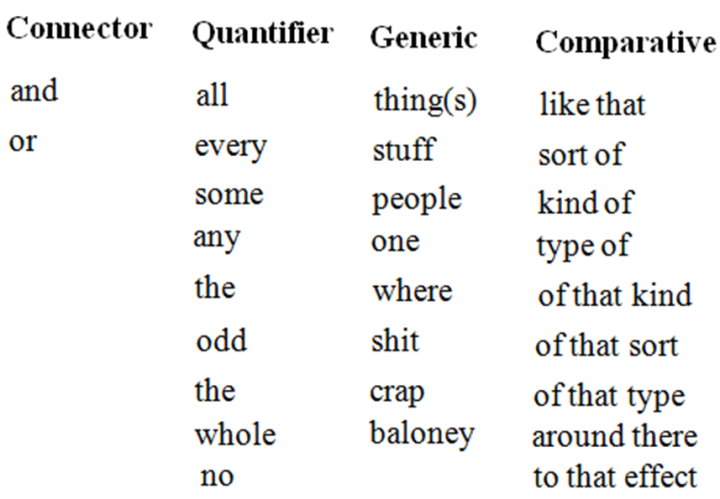
yet there are exceptions here too as and of thing(s) is not necessarily clause final but clause-internally 10, 25, 26 in our corpus, and all.. is found in clause initial position: and and stuff, may be in the process of becoming more flexible with regard to position 11. This makes 28 say GEs are “‘slippery’ since they can be realised in many different ways”. 25 hold that prototypical GEs follow a basic template where a connector is required, a quantifier and/or a generic is necessary, and the comparative is optional. They go on to add:
The first element in the GE construction is a conjunction, either and or or, typically followed by a quantifier such as all, every, and/or some. Occasionally no connector appears ... The third element is a generic noun, such as thing or stuff. Last, an optional comparative appears either at the end of the construction, as in and stuff like that, or in the middle, as in and that kind of stuff. (p. 336-7).
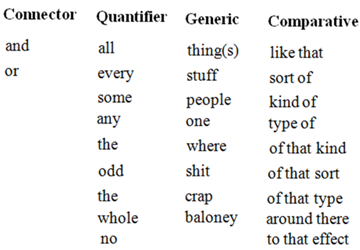
But the greatest opportunity for Mr Trump and others like him to achieve (TGJ, May 2, 2017)
Due to this flexibility, we need to stress that different quantifiers could be used with the connectors, and/or: many, few, several, something/some, anything/any and nothing/no, everyone, everybody, everything, each etc.
Examples of the Ges flexibility with the connectors and the quantifiers they take in the corpus are:
11. The South China Sea disputes, which involve China and some ASEAN members … (CD, 2017-11-14)
12. … Protectionism is always unfair for some producers and many consumers … (TS, April 19, 2017)
13. … credibility is that it rose with little mainstream radio support and few ad campaigns (UTG, 2 January, 2017).
14. ... ISIS, Al-Qaeda, Afghan Taliban and several other terrorist networks... (PT, November 6, 2017)
15. … be able to use these bases to challenge U.S. presence in the region, and any forces deployed to the islands …(JT, May 28, 2018)
16. … and instead act on the reality that no country alone can address the many challenges facing mankind, and no country can afford to act solely on self-interest (CD, 2017-10-26).
17. … crime against humanity asking only for an apology from Japan before she dies and nothing more (KT, 2018-01-09).
18. … in the 1970s for reasons that had nothing to do with sound transportation planning and everything to do with nostalgia (TS, February 18, 2017).
19. Once again, the majority has prevailed and everybody except for the lawmaker should be happy (KT, 2017-11-24).
20. … Convention Concerning the Protection of the World Cultural and Natural Heritage in 1985, and each country is allowed to nominate only two sites each year. (CD, 2017-07-11)
21. It is something that requires consensus from politicians and all stakeholders for the economic... (TG, February 25, 2017)
Brinton says the function the elements perform include:
a) to mark various kinds of boundaries (to initiate or end a discourse or to effect a shift in topic), and
b) to assist in turn-taking in oral discourse or "chunking" (marking of episode or paragraph) in written discourse;and on the interpersonal level:
c) subjectively, to express speaker attitude, and
d) interactively, to achieve intimacy between speaker and addressee (for example, by appealing to the addressee or expressing shared or common knowledge) (p. 6).
From the perspective of 11, the English GEs like other vague language elements perform different functions in discourse: they do not serve a predominantly referential function, but rather have a much more interpersonally defined role (p. 11). To her, the adjuctive GEs imply that there is more left unsaid than the information given thus calling the interlocutors to apply their shared knowledge. The disjunctive Ges, on the other hand, imply the existence of alternatives to the proposition given 29. Other commentators attribute them to function as: to avoid unnecessary repetitions, confrontations, imposition by the speaker on the interlocutor(s), to express uncertainty, invitation to a shared social space, creating in-group membership etc. while other scholars attribute to the multifunctionality of the GEs 30, 31. This study shall dwell solely on the adjunctive GEs.
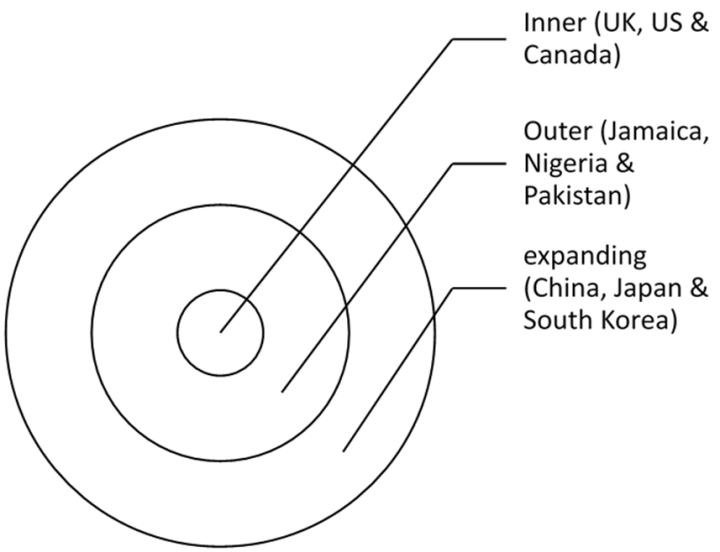
Since this study is about the use of the English language in different parts of the world, it is important to mention how these users come about the language. This brings us to the three concentric circles (inner, outer and expanding) of English speakers as proposed by 23.
Users of English are either native or non-native speakers. The native speakers are those on the British Isles and those who moved in droves from the British Isles with the language as their mother tongue to North America and Caribbeans, South Africa, Australia and New Zealand 23. The non-natives are those who came in contact with the language through the expansionism of the British interests to the continents of Africa and Asia and those who English came to as language of wider influence. We thus have a situation where English exists as a native language in the United Kingdom, and in countries such as in the United States, and Canada who are our sampled countries for the native speakers. The three native speakers’ countries have different language situation: UK being the original land where the English language domiciled before it moved to other countries, and it is still spoken there. The status of the English language in the US is different from other native English speaking countries as the US citizens emphasize their country being "perceived as a country with its ‘own’ variety of English". Canada on the other hand is averse "towards prescribed linguistic standards" 32. These three countries shall be out inner circle members.
Next is the situation where English exists as a second language (L2) in countries where the UK was the colonial master. The countries in this region are multicultural and mutilingual with English used as language of intranational and as international communication. For our study, these include Jamaica, Nigeria and Pakistan. According to 23, English in these countries has linguistic, political and sociocultural histories. Politically, the countries have gone through extended period of colonialzation by English native speakers as a result of this, the English language now exists side-by-side of other languages and the non-nativer users of English in these regions are bi/multilinguials which has thus resulted in the local languages and cultures robbing off on English thereby creating a unique distinction or obvious varieties. English in these countries is used for official communication and has ventured into their social, educational, administrative, and literary domains and carries a lot of prestige 23. The three countries in this class shall be our outer circle members.
The third situation is where English is a foreign language and used for international communication. For our study these countries are: China, Japan and South Korea. Like the outer circle members, this group are non-native speakers of English but unlike the outer circle members they have no political ties with the UK. According to Kachru, the status of English “in the language policies of such countries changes from time to time”. The changes involve from ESL to EFL or vice versa (1985, p. 14). In the 23 model this is represented thus:
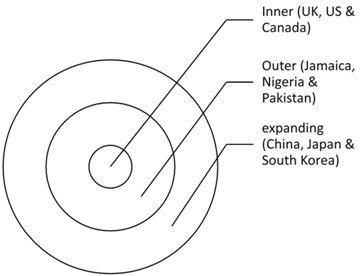
23 says the diffusion of the language through these situations brings with it unprecidented “cultural pluralism, and a linguistic heterogeneity and diversity” and with it other problems of “codification, standardization, nativization, teaching, and description and, of course, a multitude of attitudes …” (p. 14). These problems shall be viewed in terms of usage of the English language by the three circles of users.
The study investigated a five-month online newspaper editorial acquired from nine purposively sampled countries (Canada, UK, US, Jamaica, Nigeria, Pakistan, China, Japan, and South Korea) with different language situations, of the English language. The nine countries are paired into three groups made up of three countries per group; one group for native speakers and the other two groups for non-native speakers where the English language has different language situations. Using 23 categories, the native and non-native speakers are the three circles of users of English: the inner, represented by Canada, the UK and the US; the outer, represented by Jamaica (though this has a peculiar language situation, according to 23, Nigeria and Pakistan; and the expanding circle represented by China, Japan and South Korea. Each country is represented by a randomly selected online newspaper: Canada is represented by the Toronto Sun, the UK by The Guardian, and the US by the New York Times. The Gleaner represented Jamaica, The Guardian for Nigeria and Pakistan Today for Pakistan. China Daily was selected for China, The Japan Times for Japan and The Korea Times for South Korea. To prove the deliberate usage of the linguistic elements in the three language situations, the study opted for the formal (written) communication genre of the newspaper editorials. Since the editorials are all online versions, they are easily accessible and are all machine-readable which makes them ideal for the corpus linguistics methodologies. At the same time, a 20-item questionnaire was administered to 300 students (100 apiece) of three purposively sampled universities from the three different types of university, the Federal (represented by the University of Uyo, Akwa Ibom State), State (represented by the University of Africa, Toru-Orua, Bayelsa State) and Private (represented by Elizade University, Ilara-Mokin, Ondo State), in Nigeria. The study is both corpus-based as the linguistic elements studied are pre-selected from previous studies and corpus-driven as instances of novel usage not previously studied are discovered from the corpus 33, 34. There is also representativeness in the use of the editorials as each of them represent an opinion and are all interactive 35. The nine countries newspaper editorials were all downloaded on the internet from their respective websites (list websites) in the html format and converted to the plain text format after they have been edited to remove some extraneous materials and subjected to the AntConc 36, a freeware corpus analysis toolkit for concordancing and text analysis was employed in searching for the linguistic elements in the corpus.
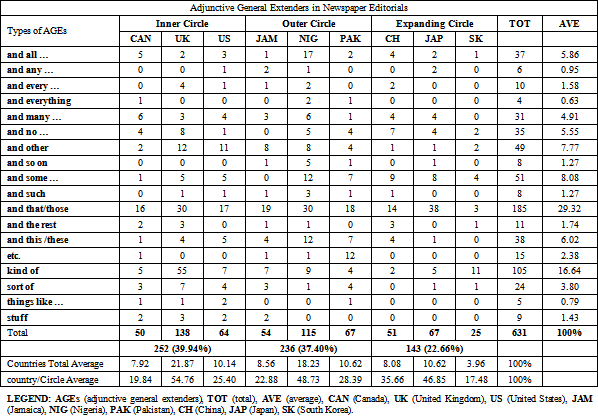
Though there are many adjunctive GEs in the corpus, only those with four or more tokens were identified. 18 of such elements are the focus of this study. They are: and all (that), and any …, and every …, and everything, and many …, and no …, and so on, and some …, and such, and that, and the rest, and this, etc., stuff, kind of, sort of, and things like …
The inner circle members used the elements 252 instances in all which gives them 39.94% out of the 631 instances that the elements were used by members of the three circles. The three members, used 14 of the 18 AGEs. Canada used the items 50 times (7.92%) out of the 631 times every country in the corpus used them and 19.84% out of the 252 times the items were used. The UK had 21.87% by using the item 138 times out of the 252 times the items were used in the corpus which yielded 54.76% out the 252 tokens that the items were used by members of the circles. This makes her the highest user of the elements among the nine countries in the three groups of the corpus. The US had 10.14% of the 631 items with 64 uses which amounted to 25.40% of the 252 tokens of the group. The UK had the highest usage in the circle and Canada the least users of the AGEs.
The outer circle members had 236 uses in all with 37.40% of the 631 tokens that the items where used. Jamaica used the elements 54 times out of the 236 tokens with 8.56% that the elements recorded for the group. It is the least user of the elements with 22.88% of the 236 times that the items were used. Nigeria had 48.73% of the 236 times that the group used the items with 115 tokens out of the 631 tokens that the elements recorded for the corpus which gave it 18.23% of the total usage of the items. The 18.23% made Nigeria the second highest user, after Britain, of the elements among the three groups. Nigeria is also the only country that used 16 out of the 18 AGEs found in the nine countries corpus. Pakistan used the elements 67 times out of the 236 times the group used the items which gave her 10.62% usage of the total usage of the items and 28.39% of the 236 tokens recorded for the group.
For the expanding group, South Korea used the elements 25 times that gave her 3.96% usage of the 631 tokens recorded by the three groups. South Korea is also the least user of all the nine countries the study covered. The country also recorded the least amount of AGEs used with only eight of the 18 items the study covered as it recorded 17.48% of the 143 tokens the group recorded. Japan had 67 tokens with 10.62% general usage and 46.85% of the group’s usage. China had 51 tokens of the 631 hits of the study which gave it 8.08% of the total usage and 35.66% of the 143 instances of the expanding group’s usage.
The research questions raised earlier in the study are discussed here:
i. what are the adjunctive GEs identified in the newspaper editorials?
AGEs abound in the nine-country corpus, but the one this study focused on are those with four or more hits. There are 18 of such AGEs. They are: and all (that), and any …, and every …, and everything, and many …, and no …, and so on, and some …, and such, and that, and the rest, and this, etc., stuff, kind of, sort of, and things like …
ii. are the adjunctive GEs deliberate vague discourse elements?
It can be argued that the linguistic elements covered in the study are deliberate vague discourse elements. In every of the situation where the elements are used, careful examination of the element show that they are deliberately used instead of the randomly putting words together.
22. For some people, in some parts of the world, Islamophobia basically equals blasphemy – covering any and all criticism of Islam (TS, March 24, 2017).
Here, rather than the paper listing the criticism of Islam which would be from different perspective: Christianity, atheisms, westernisation, liberalism, gender and the rest, the paper has limited itself to using a term that readers can draw inferences from. It will be a waste space if the criticisms against Islam were to be listed. It would bore readers and chances are that the criticism that would be mentioned would not be all-embracing as the writer(s) of editorials would have general and not specialist knowledge on the topics covered in the editorials. Rather than waste space, bore readers and be accused of not having adequate knowledge on the topic of discourse, the paper resulted to using the adjunctive general extender to present a positive image of itself to her audience.
This is noticed in the following example from the corpus:
23. Death by crucifixion was the greatest symbol of the rejection of Jesus and everything he stood for by the religious and political authorities of the day.(NTG, 16 April 2017)
Jesus stood for relief, hope, selflessness, love, peace, faithfulness, promise of a better, more organised and caring kingdom greater than Rome, and everlasting life to mention a few. To the Romans, the crucifixion of Jesus was a statement to the whole Judea and other regions of the empire, other preachers and religious sect in the kingdom, particularly in Judea that the Romans would deal swiftly with anyone foments trouble for the smooth running of the government. Rather than use about 20 words to describe the things Jesus stood for, the paper has used two words and everything to cover what Jesus stood for. In doing this, it has saved time and space as well spared the audience with boring details and has relied on the shared background knowledge of history, religion, sociology and other spheres of knowledge to minimise the amount of words and space spent on the idea of what transpired in the crucifixion of Jesus and the exigencies of the ruling power.
This is also noticed in the following example, from the corpus:
24. The program is a blueprint for national economic development and dominance in the critical industries of the post-industrial economy: cloud computing, artificial intelligence, robotics, 5G communications and the like (TJP, Jun 18, 2018).
The paper could go on listing “critical industries of the post-industrial economy” but stopped after the fourth item and expects the audience to fill the gap from their sphere of knowledge world. In the view of 25 though done with the spoken interaction in mind, they can be applied to written interaction: these elements:
Ÿ create rapport with listener (audience),
Ÿ invite listener (audience) to complete the general set by means of shared knowledge,
Ÿ condenses discourse if, through shared knowledge, the listener (audience) can reconstruct the set
iii. what is the frequency of usage of the adjunctive GEs in the newspaper editorials, on country by country basis?
As mentioned earlier, the nine countries used the AGEs 631instances in the following order:
Canada 50, the UK 138, US 64, Jamaica 54, Nigeria 115, Pakistan 67, China 51, Japan 67, South 25. The UK used the elements the most while South Korea used them the least. In terms of the group, the inner used the elements 252 (39.94%) times, the outer 236 (37.40%) and the expanding 143 (22.66%) times.
iv. do the adjunctive GEs perform pragmatic specific functions in discourse? (check 17, 25)As in previous studies, the AGEs in the study could be attributed with specific pragmatic function of discourse. According to 11, the AGEs indicate that there is “more” to be said on the part of the speaker but has be left unsaid “because the speaker assumes that the speaker and hearer share an intersubjective understanding which will enable the hearer to make sense of the speaker's message without further elaboration …”
25. Despite that ambiguity, Canada and the rest of the G7 meet this week to discuss options moving forward. Clearly, were all on the same page when it comes to fighting ISIS (TS, April 10, 2017).
The paper could have gone ahead to list the other members of the G7 (US, Japan, Germany, UK, France, Japan and Italy) but stops at the mention of one of the seven, Canada and left the other six members out (unsaid) through the assumption of the interlocutors’ “share an intersubjective understanding” with the use of the linguistic element and the rest.
In the same vein, the AGEs as exemplified by and everything could be used to intensify, to emphasize or highlight a previous part of an assertion or question 11:
26. Unfortunately, the Trump administration’s senseless approach to the Afghan war, and everything associated of course, has prompted equally irrational reactions in Afghanistan and Pakistan (PT, September 3, 2017).
Part of the things associated with “the Afghan war” include killing, maiming, destruction of lives and properties, displacement, trauma, general insecurity and chaos. The paper didn’t list all these point in talking of the senselessness that the approach Trump administration has brought to the Afghan war so has used the AGE, to intensify “a previous part of an assertion” – the senselessness. The papers use the AGEs to say without stating it that the audience that alternatives may exist, which the audience knows exist and above all the audience knows what the papers mean 11.
v. are the usage of the adjunctive GEs “conditioned by social factors” as ascribed by earlier scholars 37?
Unlike previous studies 19, 37 that were spoken discourse based, ours is written discourse based; that means we could not attribute the use of the elements to a factor that have conditioned the use of any of the items by the different groups that the study covered. The only factor that would have conditioned the use of the elements would be the need to be brief in their use of words but not any social factor as in the previous studies.
vi. are there differences in the rate of use of the English adjunctive GEs among native and non-native users of English ?
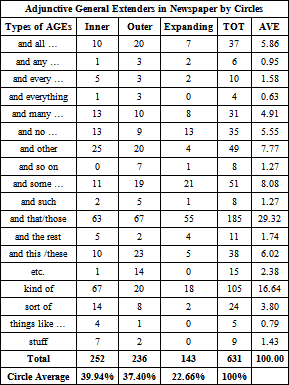
As shown in Table 4, there are differences in the rate of usage of the elements by the three groups. On the overall usage, the inner group used the elements more than the other two members. On individual basis, the usage of the elements is divided. For example, the items: and all … and that/those, & and this /these were used most by the Outer group while and many …, and other, kind of, sort of & stuff were most used by the inner group. and no … had the same frequency of usage by the expanding and inner groups. and some … was most used by the expanding group.
vii. are there differences in the English adjunctive GEs used by the native and non-native speakers?
The difference in usage between the native and non-native speakers is not too significant as both parties used the elements liberally. Both groups have 127 difference instances between them. If the three groups are to be viewed individually, the three members of the inner groups could be said to use the items more than the other six members of outer and expanding circles. If however the outer and expanding groups are viewed jointly as non-native members, they have (236 and 143 respectively) 379 tokens.
viii. are there novel forms of the adjunctive GEs not formally paid attention to, in discourse?
There are no novel forms of the adjunctive GEs not formally paid attention to, in discourse, in the corpus of the nine countries studied
Previous studies, 38 for example, found that, although native and non-native English speakers used a similar range of expressions, native speakers use more vague expressions than non-native speakers. In our study, like that of 37, we also found out that the native and the non-native speakers use similar AGEs but that the native speakers use the elements more than the native speakers. The three countries in the inner circle used the elements 252 (39.94%) instances out of the 631 times that the elements were used, in the corpus. This is followed by the outer circle while the expanding circle used the items the least. None of the three groups used the whole 18 items the study focused on. The three members of the inner group used 14 out of the 18 studied. Two out of the outer (Nigeria and Pakistan) used 16 out of the 18 while Jamaica use 15 of the elements. The expanding group members used the items moderately as both China and Japan used 11 out of the 11 items studied will South Korea only eight of the items which is the least by any country. It is also of importance to stress that Japan, a member of the expanding circle used a particular AGE, and that, more than the native speakers and those who English is an official language. Japan used the item 38 times which is 20.54% of the 185 instances that the element was used. On the overall, Japan, used the AGEs more than both Canada and the US who are native speakers’ country as well as Jamaica and Pakistan who the English language is an official language for but was five instance lesser than the UK.
It is also of note to state that the use of stuff without a connector is apparent in the three members of the inner circle and a member (Jamaica) of the outer circle but none at all by members of the expanding circle. This is seen in examples such as:
1. The early word is that it’s pretty mundane stuff (NYT, May 10, 2017).
2. Who needs satire when Liberal cabinet ministers … say stuff like this? (TS, February 05, 2017)
This confirms 28 claim that the “connective can be deleted (Ø things like that)”. In the five instances where stuff was used, the connective and was not included.
Also commenting on previous studies, 39 reported the GE form and that is very common in British dialects 30, 40 but not in North American dialects. We would report that from our study, this claim does not match ours as the element is prevalent in all the users – whether native or non-native speakers English. and that/those is the most used of the elements (185) by the three group: inner (63; 34.05%), outer (67; 36.22%), expanding (55; 29.73%) with a 29.32% average in the whole usage of the 18 linguistic elements.
According to “Also 30 quoting the Oxford English Dictionary states that and that is a substandard speech element and an indicator of social class. The element is prevalent in our study that is focused a formal written discourse. Our study therefore does not support the idea of and that being “a substandard speech element and an indicator of social class” as there is no class in indicator(s) among the users of the three circles that this study focused on. At the same time, since the corpus is mainly written newspaper editorials, the idea of the elements being speech elements is also ruled out.
Hypothesis One: The human communication through the use of the English adjunctive GEs is not explicit all the time among the users of English in Nigeria on the basis of gender
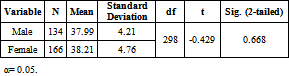
Table 3 shows that the number of respondents are made up of 134 males and 166 females with mean and standard deviation of 37.99 (4.21) and 38.21 (4.76) for male and female students respectively. The degree of freedom is 298, the t-value is -0.429 and the p-value is 0.668. Testing the hypothesis at 0.05 (alpha value) significant level, the p-value (0.668) is greater than the alpha value. This means that there is no difference and the null hypothesis is retained. Conclusively, the human communication through the use of the English adjunctive GEs is not explicit all the time among the users of English in Nigeria on the basis of gender.
Hypothesis Two: The English adjunctive GEs in the sampled newspaper editorials do not make the editorials inexplicit among first year undergraduate students in the Federal, State and Private universities in Nigeria.
Table 4 shows the Analysis of Variance (ANOVA) of the difference in the responses of students in terms of their universities. The table shows F-value of 0.418 and p-value = 0.659. Testing the hypothesis at the 0.05 significant level, the p-value (0.659) is greater than the alpha value (0.05). This shows that there is no significant difference and the null hypothesis is retained. Conclusively, the English adjunctive GEs in the sampled newspaper editorials do not make the editorials inexplicit among first year undergraduate students in the Federal, State and Private universities in Nigeria.
Borrowing from the opinion of 23, we could say, despite “...the Englishization of other world languages”, the English language has not deviated from the language it started as in terms of meaning, from the perspective of the GEs as the native and non-native speakers in the three circles use the AGEs in the newspaper editorials. That the forms used in the inner, outer and expanding circles are the same, we could say the “decontrol” that 23 mentioned does not apply to the adjunctive GEs as the “universally acceptable standards are not absent”.
Another implication is that some elements, for example, and that that were classified as informal and substandard speech tagged as an indicator of social class has moved away from the tag and used by all the three circles, as a matter of fact used more by the inner circle than the other two. This means the line between formal and informal usage of elements in discourse is gradually if not totally thinned out 12, 16.
The study concludes that humans deliberately make their communication vague, through the use of these and other linguistic elements. Viewed from the perspective of the English language, we see how both native speakers (represented by Canada, the UK and US; as well as Jamaica, Nigeria and Pakistan; and China, Japan and South Korea) the non-native speakers used the vague discourse liberally. With 631 between then them, both native and non-natives are both comfortable with the use of the elements and non-native speakers could be adjudged to be proficient in the usage of the elements.
The language situation in the nine countries studied could not be adjudged as a determining factor in the usage of the elements as countries in the outer and expanding circles have more usage of the elements than countries in the inner circles.
On whether the use of the elements is conditioned by the linguistic creativity of the users cannot also be ascertained as virtually all the users, native and non-native speakers alike use the elements profusely does the idea of linguistic creativity could not be sustained as the elements are used appropriately by all the users.
With the pattern of use and the function they perform in the corpus of the study, we would conclude that the English AGEs are deliberate vague discourse-pragmatic elements in discourse in the nine countries newspaper editorials.
We would also conclude that there are no variations in the pattern of usage of the elements by the nine sampled countries.
The authors have no competing interests.
TOT (total), AVE (average), CAN (Canada), UK (United Kingdom), US (United States), JAM (Jamaica), NIG (Nigeria), PAK (Pakistan), CH (China), JAP (Japan), SK (South Korea).
China Daily (CD), Toronto Sun (TS), The Guardian, UK, (UTG), Pakistan Today (PT), The Japan Times (TJP), The Gleaner, Jamaica (TGJ), The Guardian, Nigeria (NTG), the New York Times (NYT) and The Korean Times (TKT).
| [1] | Wenzhong, Z. and Jingyi, “A pragmatic study on the functions of vague language in commercial advertising”. English Language Teaching, 6 (6). 103-112. 2013. | ||
| In article | View Article | ||
| [2] | Cutting, J, “Introduction”. In J. Cutting (Ed.), Vague language explored, Palgrave Macmillan, Hampshire/New York, 2007, 3-17. | ||
| In article | View Article | ||
| [3] | Channell, J, Vague language, Oxford University Press, Oxford, 1994. | ||
| In article | |||
| [4] | Jucker, A. H., Smith, S. W., and Ludge, T, “Interactive aspects of vagueness in conversation”, Journal of Pragmatics, 35. 1737-1769. June 2003. | ||
| In article | View Article | ||
| [5] | Shi, Y, “Exploring the communicative functions of pragmatic vagueness as a discursive strategy”, Open Journal of Modern Linguistics, 5. 225-231. 2015. | ||
| In article | View Article | ||
| [6] | Wishnoff, J. R, “Hedging your bets: L2 learners’ acquisition of pragmatic devices in academic writing and computer-mediated discourse”, Second Language Studies, 19 (1). 119-148. 2000. | ||
| In article | |||
| [7] | Cheng, W. and O’Keeffe, A, “Vagueness”. In C. Aijmer, K. & Rühlemann (Ed.), Corpus pragmatics: A handbook, Cambridge University Press, Cambridge, 2015, 360-378. | ||
| In article | View Article PubMed | ||
| [8] | Thornbury, S. and Slade, D, Conversation: From description to pedagogy. Cambridge University Press, Cambridge, 2006. | ||
| In article | View Article | ||
| [9] | Zhang, Q, “Fuzziness - vagueness - generality – ambiguity”, Journal of Pragmatics, 29. 13-31. 1998. | ||
| In article | View Article | ||
| [10] | O’Keeffe, A, “Like the wise virgins and all that Jazz’: Using a corpus to examine vague categorisation and shared knowledge”. In U. C. & T. A. Upton (Ed.), Applied corpus linguistics: A multidimensional perspective, Rodopi, Amsterdam/New York, 2004, 120. | ||
| In article | View Article | ||
| [11] | Overstreet, M, Whales, candlelight, and stuff like that: General extenders in English discourse, Oxford University Press, New York/Oxford, 1999. | ||
| In article | |||
| [12] | Ewata, T. O, Analysis of English general extenders in Nigerian newspaper editorials. Adekunle Ajasin Universty, Akungba-Akoko, Ondo State, Nigeria, 2014. | ||
| In article | |||
| [13] | Prince, E., Frader, J. and Bosk, C, “On hedging in physician-physician discourse”. In R. D. Pietro (Ed.), Linguistics and the professions, Ablex, Norwood, NJ, 1982, 83-97. | ||
| In article | |||
| [14] | Rowland, T, “Well maybe not exactly, but it’s around fifty basically?: Vague language in Mathematics classroom”. In J. Cutting (Ed.), Vague language explored, Palgrave Macmillan, Hampshire/New York, 2007, 79-96. | ||
| In article | View Article | ||
| [15] | Cotterill, J, “I think he was kind of shouting or something: Uses and abuses of vagueness in the British ourtroom”. In J. Cutting (Ed.), Vague language explored, Palgrave Macmillan, Hampshire/New York, 2007, 97-114. | ||
| In article | View Article | ||
| [16] | Ewata, T. O, “Linguistic hedging: Conflict management tool in academic discourse”. Modern Research Studies, 4 (4). 536-554. 2017. | ||
| In article | |||
| [17] | Aijmer, K, “What happens at the end of our utterances? The use of utterance final tags introduced by ‘and’and ‘or’”, in 8th Scandinavian Conference of Linguistics, 1985, 366-389. | ||
| In article | |||
| [18] | Meyerhoff, M. “A sort of something”. Hedging Strategies on Nouns. Working Papers on Language, Gender and Sexism, 2 (1). 59-73. 1992. | ||
| In article | |||
| [19] | Dubois, S, “Extension particles, etc”. Language Variation and Change, 4 (2). 163-203. 1992. | ||
| In article | View Article | ||
| [20] | Norrby, C. and Winter, J, “Affiliation in adolescents’ use of discourse extenders”, in Proceedings of the 2001 conference of the Australian Linguistic Society, 2002. | ||
| In article | |||
| [21] | Carroll, R, “Historical English phraseology and the extender tag”. Journal of the Spanish Society for Mediaeval English Language and Literature, 15, 7-37. 2008. | ||
| In article | |||
| [22] | Pichler, H, The structure of discourse-pragmatic variation, John Benjamins, 2013. | ||
| In article | View Article | ||
| [23] | Kachru, B. B, “Standards, codification and sociolinguistic realism: The English language in the outer circle”. In H. G. Quirk, R. & Widdowson (Ed.), English in the world: Teaching and learning the language and literatures, Cambridge University Press, Cambridge, 1985, 11-30. | ||
| In article | |||
| [24] | Fernandez, J. and Yuldashev, A, “Variation in the use of general extenders and stuff in instant messaging interactions”. Journal of Pragmatics, 43 (2610-2626). 2011. | ||
| In article | View Article | ||
| [25] | Tagliamonte, S. A. and Denis, D, “The Stuff of Change: General Extenders in Toronto, Canada”. Journal of English Linguistics, 38(4). 335-368. 2010. | ||
| In article | View Article | ||
| [26] | Wagner, S. E., Hesson, A. and Little, H. M, “The use of referential general extenders across registers”. In Discourse-pragmatic variation and change in English: New methods and insights, Cambridge University Press, Cambridge, 2016, 211-231. | ||
| In article | View Article | ||
| [27] | Brinton, L. J, Pragmatic markers in English: Grammaticalization and discourse functions, Mouton de Gruyter, Berlin/ New York, 1996. | ||
| In article | |||
| [28] | Aijmer, K, “General extenders in learner language. In S. Groom, N., Charles, M. & John (Ed.), Corpora, grammar and discourse. In honour of Susan Hunston, John Benjamins, Amsterdam, 2015, 211-233. | ||
| In article | View Article | ||
| [29] | Overstreet, M, “And stuff und so: Investigating pragmatic expressions in English and German”. Journal of Pragmatics, 37, 1845-1864. 2005. | ||
| In article | View Article | ||
| [30] | Aijmer, K, English discourse particles, (Vol. 10). 2002. | ||
| In article | View Article | ||
| [31] | Cheshire, J, “Discourse variation, grammaticalization, and stuff like that”. Journal of Sociolinguistics, 11(2). 155-193. 2007. | ||
| In article | View Article | ||
| [32] | Chambers, J. K, “Three kinds of standard in Canadian English”. In W. L. C. (Ed.), In search of the standard in Canadian English, Strathy Language Unit, Queen’s University, Kingston, Ont, 1986. 1-15. | ||
| In article | |||
| [33] | Tognini-Bonelli, E, Corpus linguistics at work, J. Benjamins, Philadelphia, Amsterdam, 2001, Vol. 6. | ||
| In article | View Article | ||
| [34] | Biber, D, “A corpus-driven approach to formulaic language in English”. International Journal of corpus linguistics, 14 (3). 275-311. 2009. | ||
| In article | View Article | ||
| [35] | Elyazale, N, “Characteristics of newspaper editorials: ‘Chouftchouf’ in ‘Almassae’ Moroccan newspaper as a case study”, New Media and Mass Communication, 32, 21-43. 2014. | ||
| In article | |||
| [36] | Anthony, L. A, Computer software. Waseda University, Tokyo, Japan, 2011. | ||
| In article | |||
| [37] | Stubbe, M. and Holmes, J, “You know, eh and other" exasperating expressions": An analysis of social and stylistic variation in the use of pragmatic devices in a sample of New Zealand English”. Language & Communication. Vol. 15 (1). 63-88. 1995. | ||
| In article | View Article | ||
| [38] | Drave, K, “Vaguely speaking: A corpus approach to vague language in intercultural conversations”. Language and Computers, 36 (1). 25-40. 2001. | ||
| In article | View Article | ||
| [39] | Wagner, S. E., Hesson, A. and Little, H. M. (2016). The use of referential general extenders across registers. In Discourse-pragmatic variation and change in English: New methods and insights, Cambridge University Press, Cambridge, 2016, 211-231. | ||
| In article | View Article | ||
| [40] | Pichler, H, and Levey, S, “In search of grammaticalization in synchronic dialect data: general extenders in northeast England”. English Language & Linguistics, 15 (3). 441-471. 2011. | ||
| In article | View Article | ||
Published with license by Science and Education Publishing, Copyright © 2019 Thompson O. Ewata and Chinelo Blessing Oribhabor
 This work is licensed under a Creative Commons Attribution 4.0 International License. To view a copy of this license, visit
http://creativecommons.org/licenses/by/4.0/
This work is licensed under a Creative Commons Attribution 4.0 International License. To view a copy of this license, visit
http://creativecommons.org/licenses/by/4.0/
| [1] | Wenzhong, Z. and Jingyi, “A pragmatic study on the functions of vague language in commercial advertising”. English Language Teaching, 6 (6). 103-112. 2013. | ||
| In article | View Article | ||
| [2] | Cutting, J, “Introduction”. In J. Cutting (Ed.), Vague language explored, Palgrave Macmillan, Hampshire/New York, 2007, 3-17. | ||
| In article | View Article | ||
| [3] | Channell, J, Vague language, Oxford University Press, Oxford, 1994. | ||
| In article | |||
| [4] | Jucker, A. H., Smith, S. W., and Ludge, T, “Interactive aspects of vagueness in conversation”, Journal of Pragmatics, 35. 1737-1769. June 2003. | ||
| In article | View Article | ||
| [5] | Shi, Y, “Exploring the communicative functions of pragmatic vagueness as a discursive strategy”, Open Journal of Modern Linguistics, 5. 225-231. 2015. | ||
| In article | View Article | ||
| [6] | Wishnoff, J. R, “Hedging your bets: L2 learners’ acquisition of pragmatic devices in academic writing and computer-mediated discourse”, Second Language Studies, 19 (1). 119-148. 2000. | ||
| In article | |||
| [7] | Cheng, W. and O’Keeffe, A, “Vagueness”. In C. Aijmer, K. & Rühlemann (Ed.), Corpus pragmatics: A handbook, Cambridge University Press, Cambridge, 2015, 360-378. | ||
| In article | View Article PubMed | ||
| [8] | Thornbury, S. and Slade, D, Conversation: From description to pedagogy. Cambridge University Press, Cambridge, 2006. | ||
| In article | View Article | ||
| [9] | Zhang, Q, “Fuzziness - vagueness - generality – ambiguity”, Journal of Pragmatics, 29. 13-31. 1998. | ||
| In article | View Article | ||
| [10] | O’Keeffe, A, “Like the wise virgins and all that Jazz’: Using a corpus to examine vague categorisation and shared knowledge”. In U. C. & T. A. Upton (Ed.), Applied corpus linguistics: A multidimensional perspective, Rodopi, Amsterdam/New York, 2004, 120. | ||
| In article | View Article | ||
| [11] | Overstreet, M, Whales, candlelight, and stuff like that: General extenders in English discourse, Oxford University Press, New York/Oxford, 1999. | ||
| In article | |||
| [12] | Ewata, T. O, Analysis of English general extenders in Nigerian newspaper editorials. Adekunle Ajasin Universty, Akungba-Akoko, Ondo State, Nigeria, 2014. | ||
| In article | |||
| [13] | Prince, E., Frader, J. and Bosk, C, “On hedging in physician-physician discourse”. In R. D. Pietro (Ed.), Linguistics and the professions, Ablex, Norwood, NJ, 1982, 83-97. | ||
| In article | |||
| [14] | Rowland, T, “Well maybe not exactly, but it’s around fifty basically?: Vague language in Mathematics classroom”. In J. Cutting (Ed.), Vague language explored, Palgrave Macmillan, Hampshire/New York, 2007, 79-96. | ||
| In article | View Article | ||
| [15] | Cotterill, J, “I think he was kind of shouting or something: Uses and abuses of vagueness in the British ourtroom”. In J. Cutting (Ed.), Vague language explored, Palgrave Macmillan, Hampshire/New York, 2007, 97-114. | ||
| In article | View Article | ||
| [16] | Ewata, T. O, “Linguistic hedging: Conflict management tool in academic discourse”. Modern Research Studies, 4 (4). 536-554. 2017. | ||
| In article | |||
| [17] | Aijmer, K, “What happens at the end of our utterances? The use of utterance final tags introduced by ‘and’and ‘or’”, in 8th Scandinavian Conference of Linguistics, 1985, 366-389. | ||
| In article | |||
| [18] | Meyerhoff, M. “A sort of something”. Hedging Strategies on Nouns. Working Papers on Language, Gender and Sexism, 2 (1). 59-73. 1992. | ||
| In article | |||
| [19] | Dubois, S, “Extension particles, etc”. Language Variation and Change, 4 (2). 163-203. 1992. | ||
| In article | View Article | ||
| [20] | Norrby, C. and Winter, J, “Affiliation in adolescents’ use of discourse extenders”, in Proceedings of the 2001 conference of the Australian Linguistic Society, 2002. | ||
| In article | |||
| [21] | Carroll, R, “Historical English phraseology and the extender tag”. Journal of the Spanish Society for Mediaeval English Language and Literature, 15, 7-37. 2008. | ||
| In article | |||
| [22] | Pichler, H, The structure of discourse-pragmatic variation, John Benjamins, 2013. | ||
| In article | View Article | ||
| [23] | Kachru, B. B, “Standards, codification and sociolinguistic realism: The English language in the outer circle”. In H. G. Quirk, R. & Widdowson (Ed.), English in the world: Teaching and learning the language and literatures, Cambridge University Press, Cambridge, 1985, 11-30. | ||
| In article | |||
| [24] | Fernandez, J. and Yuldashev, A, “Variation in the use of general extenders and stuff in instant messaging interactions”. Journal of Pragmatics, 43 (2610-2626). 2011. | ||
| In article | View Article | ||
| [25] | Tagliamonte, S. A. and Denis, D, “The Stuff of Change: General Extenders in Toronto, Canada”. Journal of English Linguistics, 38(4). 335-368. 2010. | ||
| In article | View Article | ||
| [26] | Wagner, S. E., Hesson, A. and Little, H. M, “The use of referential general extenders across registers”. In Discourse-pragmatic variation and change in English: New methods and insights, Cambridge University Press, Cambridge, 2016, 211-231. | ||
| In article | View Article | ||
| [27] | Brinton, L. J, Pragmatic markers in English: Grammaticalization and discourse functions, Mouton de Gruyter, Berlin/ New York, 1996. | ||
| In article | |||
| [28] | Aijmer, K, “General extenders in learner language. In S. Groom, N., Charles, M. & John (Ed.), Corpora, grammar and discourse. In honour of Susan Hunston, John Benjamins, Amsterdam, 2015, 211-233. | ||
| In article | View Article | ||
| [29] | Overstreet, M, “And stuff und so: Investigating pragmatic expressions in English and German”. Journal of Pragmatics, 37, 1845-1864. 2005. | ||
| In article | View Article | ||
| [30] | Aijmer, K, English discourse particles, (Vol. 10). 2002. | ||
| In article | View Article | ||
| [31] | Cheshire, J, “Discourse variation, grammaticalization, and stuff like that”. Journal of Sociolinguistics, 11(2). 155-193. 2007. | ||
| In article | View Article | ||
| [32] | Chambers, J. K, “Three kinds of standard in Canadian English”. In W. L. C. (Ed.), In search of the standard in Canadian English, Strathy Language Unit, Queen’s University, Kingston, Ont, 1986. 1-15. | ||
| In article | |||
| [33] | Tognini-Bonelli, E, Corpus linguistics at work, J. Benjamins, Philadelphia, Amsterdam, 2001, Vol. 6. | ||
| In article | View Article | ||
| [34] | Biber, D, “A corpus-driven approach to formulaic language in English”. International Journal of corpus linguistics, 14 (3). 275-311. 2009. | ||
| In article | View Article | ||
| [35] | Elyazale, N, “Characteristics of newspaper editorials: ‘Chouftchouf’ in ‘Almassae’ Moroccan newspaper as a case study”, New Media and Mass Communication, 32, 21-43. 2014. | ||
| In article | |||
| [36] | Anthony, L. A, Computer software. Waseda University, Tokyo, Japan, 2011. | ||
| In article | |||
| [37] | Stubbe, M. and Holmes, J, “You know, eh and other" exasperating expressions": An analysis of social and stylistic variation in the use of pragmatic devices in a sample of New Zealand English”. Language & Communication. Vol. 15 (1). 63-88. 1995. | ||
| In article | View Article | ||
| [38] | Drave, K, “Vaguely speaking: A corpus approach to vague language in intercultural conversations”. Language and Computers, 36 (1). 25-40. 2001. | ||
| In article | View Article | ||
| [39] | Wagner, S. E., Hesson, A. and Little, H. M. (2016). The use of referential general extenders across registers. In Discourse-pragmatic variation and change in English: New methods and insights, Cambridge University Press, Cambridge, 2016, 211-231. | ||
| In article | View Article | ||
| [40] | Pichler, H, and Levey, S, “In search of grammaticalization in synchronic dialect data: general extenders in northeast England”. English Language & Linguistics, 15 (3). 441-471. 2011. | ||
| In article | View Article | ||


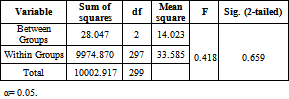





 showing the difference in the responses of first year students in terms of the types of university)