Preparing pre-service teachers for industry readiness requires not only technical competence but also the capacity to take ownership of their own learning. Despite extensive research on self-regulated learning (SRL) among pre-service teachers, there remains limited evidence on how SRL translates into multi-domain industry readiness—particularly in the Philippine Bachelor of Technology and Livelihood Education (BTLED) program where graduates are expected to serve as teachers, TVET trainers, TESDA assessors, entrepreneurs, and community leaders. This study addresses this gap by examining the relationship between SRL and industry readiness among BTLED Home Economics majors in a state university. Using survey data from 65 respondents, validated scales were administered to measure SRL (planning, monitoring, reflection) and industry readiness across five domains. Reliability indices were excellent (Cronbach’s α = .95–.97). Results revealed high ratings for both SRL and industry readiness. More importantly, correlation analysis demonstrated a strong and positive relationship between SRL and industry readiness (ρ = .650, p < .001). These findings underscore SRL as an enabling mechanism that bridges academic preparation and applied competence across diverse industry roles. Implications point to embedding explicit SRL strategies in technical teacher education curricula to strengthen graduates’ employability and professional adaptability.
Preparing pre-service teachers for industry readiness is a major goal of technical and vocational education in the Philippines. Graduates of the Bachelor of Technology and Livelihood Education (BTLED) program are expected not only to teach in secondary schools but also to serve as trainers, assessors, entrepreneurs, and community leaders. To perform these roles effectively, students must develop competencies that extend beyond content knowledge. One critical personal resource that supports this transition is self-regulated learning (SRL).
SRL refers to the ability of learners to set goals, plan strategies, monitor progress, and reflect on outcomes in order to improve performance. According to Zimmerman, self-regulated learners are active participants who take responsibility for their own education rather than relying solely on external guidance. In higher education, SRL has been consistently linked to motivation, adaptability, and achievement. At the same time, industry readiness has emerged as an essential framework for evaluating how prepared students are to assume diverse professional roles. In BTLED education, readiness encompasses five domains: teaching TLE–Home Economics, functioning as a TVET trainer, qualifying as a TESDA assessor, facilitating entrepreneurship, and engaging with workplaces and communities.
While prior studies confirm that SRL supports academic success, motivation, and adaptability, most evidence focuses on digital readiness, pedagogical competencies, or self-regulation in general higher education contexts. Three gaps remain unaddressed. First, there is limited research that directly connects SRL to industry readiness across the multiple mandated roles of BTLED graduates in the Philippines. Second, existing studies often examine readiness in fragmented terms—such as technological competence or teaching preparedness—without linking these to a comprehensive, role-specific readiness framework. Third, few studies provide BTLED-specific correlational evidence using validated, domain-based measures of industry readiness, leaving teacher education programs without clear guidance on how SRL development contributes to employability outcomes.
This study addresses these gaps by providing empirical evidence on the relationship between SRL and industry readiness among BTLED Home Economics majors in a Philippine state university. Using validated instruments with excellent reliability, it shows that higher SRL is strongly associated with higher levels of readiness across teaching, training, assessment, entrepreneurship, and community engagement domains. In doing so, it positions SRL as a vital mechanism that translates academic preparation into applied competence for multifaceted industry roles.
The study pursues three objectives:
• To describe the level of self-regulated learning among BTLED Home Economics pre-service teachers.
• To describe their level of industry readiness across five domains.
• To examine the association between SRL and industry readiness.
Based on prior theory and evidence, the study hypothesizes that self-regulated learning is positively associated with industry readiness among BTLED Home Economics pre-service teachers.By framing SRL as a lever for multi-domain industry readiness, the study offers important insights for curriculum designers and teacher educators. Integrating explicit SRL strategies into coursework and practice can enhance graduates’ preparedness to take on diverse professional roles, ensuring that BTLED programs remain responsive to both educational and industry demands.
Self-Regulated Learning (SRL)
Self-regulated learning (SRL) is increasingly recognized as a cornerstone of preservice teacher preparation. It enables learners to plan, monitor, and evaluate their progress, strengthening both autonomy and academic achievement. Zimmerman describes SRL as an active process where learners regulate cognition, motivation, and behavior to achieve academic goals 1. Pintrich further emphasized SRL’s role in sustaining motivation and engagement 2.
Studies confirm that SRL strategies—such as goal-setting, reflection, and metacognition—support academic success across disciplines 3, 4. For preservice teachers, SRL enhances not only content mastery but also professional readiness, since they must later foster similar skills in their students 5. Empirical evidence highlights the importance of interventions that build SRL strategies 6, the influence of self-efficacy and motivation 7, and the value of blended and flipped classrooms in cultivating independent learning habits 8, 9. Together, these studies position SRL as an essential resource for preparing teacher education graduates to manage complex learning environments.
Industry Readiness of Preservice Teachers
Industry readiness refers to the extent to which preservice teachers are prepared to assume diverse professional roles. For BTLED graduates, this encompasses teaching, training, TESDA assessment, entrepreneurship, and community engagement. Research on Technical and Vocational Education and Training (TVET) highlights persistent challenges, including inadequate preparation in mathematics and English 10, and the need for alignment with global competency standards 11.
Pedagogical strategies strongly influence readiness. Integrating instructional technology, STEAM approaches, and community-based experiences has been shown to improve both competence and adaptability 12, 13. Innovative methods such as inquiry-based and flipped classrooms elevate preservice teachers’ adaptability and professional skills 14. These findings stress that readiness is not only technical but also socio-emotional, requiring resilience, collaboration, and cultural awareness 15.
Linking SRL and Industry Readiness
While SRL has been linked to academic performance and teaching efficacy, limited evidence directly examines how it predicts industry readiness across the mandated roles of BTLED graduates. Bembenutty 22 found that preservice teachers with stronger self-regulatory skills develop work habits that align with professional demands 22. Fuchs et al. reported that online SRL correlates with digital readiness, influencing learning engagement 17. Other studies confirm that SRL strengthens resilience and adaptability in diverse teaching contexts 18.
Panadero reviewed evidence showing SRL as a predictor of both academic success and professional performance 19. In the BTLED context, where graduates are expected to be teachers, trainers, assessors, and entrepreneurs, this linkage remains underexplored. The present study addresses this empirical gap by providing correlational evidence on the relationship between SRL and multi-domain industry readiness in Philippine technical teacher education.
This study aimed to describe the relationship between self-regulated learning (SRL) and industry readiness among pre-service teachers. A descriptive–correlational design was employed using existing survey data, with validated instruments administered to a cohort of BTLED Home Economics majors. The methodology outlines the research design, participants, instruments, data collection, and analytic approach.
3.1. Research DesignThis study employed a descriptive–correlational design to examine the relationship between self-regulated learning (SRL) and industry readiness. The design was appropriate because the objective was not to manipulate variables but to describe and analyze the association between constructs using existing data.
The respondents were 65 pre-service teachers enrolled in the Bachelor of Technology and Livelihood Education (BTLED) Home Economics program at a state university in Northern Mindanao, Philippines, during Academic Year 2024–2025. They were purposely selected as the population represented a graduating cohort preparing for transition to teaching, training, and industry-related roles. Participation was voluntary, and informed consent was secured.
Two validated instruments were used:
• Self-Regulated Learning Scale: This tool measures students’ capacity to plan, monitor, and reflect on their learning processes. Items were rated on a 4-point Likert scale ranging from Strongly Disagree (1) to Strongly Agree (4). Internal consistency was high, with Cronbach’s alpha exceeding .95.
• Industry Readiness Scale: This instrument assessed preparedness across five domains: (1) teaching TLE–Home Economics, (2) TVET trainer readiness, (3) TESDA assessor readiness, (4) entrepreneurship and livelihood facilitation,and (5) workplace and community engagement. The 20-item scale likewise used a 4-point Likert response format and demonstrated excellent reliability (Cronbach’s α = .967).
Both instruments underwent expert validation, with scale content validity indices (S-CVI/Ave) ranging from .95 to 1.0.
Data were drawn from a previously conducted survey. Respondents accomplished the instruments during regular class schedules under the supervision of faculty researchers. The purpose of the study was explained, and confidentiality of responses was assured.
Descriptive statistics (mean, standard deviation) were used to summarize SRL and industry readiness scores. The relationship between the two constructs was examined using Spearman’s rho correlation, since preliminary tests confirmed non-normal data distribution. Results were interpreted using the conventional thresholds for correlation coefficients (small = .10, moderate = .30, strong = .50 and above).
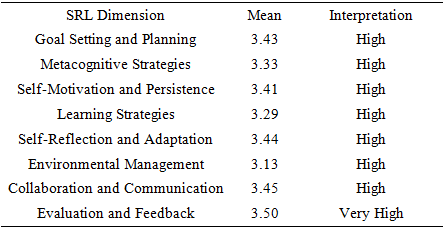
The results in Table 1 shows that BTLED Home Economics students demonstrated an overall high level of self-regulated learning (SRL) across all eight dimensions. Among the categories, the highest mean scores were found in Evaluation and Feedback (M = 3.50, Very High), followed by Collaboration and Communication (M = 3.45) and Self-Reflection and Adaptation (M = 3.44). These results suggest that students are particularly strong in seeking feedback, working with peers, and reflecting on their own learning, which are essential practices for continuous improvement.
Meanwhile, the lowest-rated dimension was Environmental Management (M = 3.13, High), indicating that while students manage their learning environments reasonably well, there is still room to strengthen skills related to organizing study spaces, managing distractions, and optimizing online tools. This finding is important because a well-structured learning environment supports other SRL dimensions such as planning, persistence, and reflection.
The consistently high scores across all categories align with Zimmerman’s 1 model of SRL, which describes learners as proactive agents who regulate their cognition, motivation, and behavior to achieve academic goals. In the context of teacher education, these results highlight that BTLED students already demonstrate strong self-regulatory skills, particularly in reflection and collaboration, which are critical for professional growth and readiness. However, the relative weakness in environmental management suggests the need for curricular interventions that equip students with practical strategies for structuring both physical and digital learning environments.
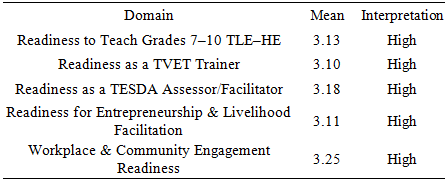
The results in Table 2 indicate that BTLED Home Economics students demonstrated an overall high level of industry readiness across all five domains. The highest mean score was in Workplace and Community Engagement Readiness (M = 3.25), which reflects students’ strong preparation for real-world contexts such as industry immersion, professional collaboration, and lifelong learning. This suggests that learners feel confident in engaging with external stakeholders and maintaining professional conduct in workplace settings.
The lowest scores were observed in Readiness as a TVET Trainer (M = 3.10) and Readiness for Entrepreneurship and Livelihood Facilitation (M = 3.11). While still interpreted as “High,” these findings indicate that students may require more targeted support in applying TESDA-based training competencies and developing entrepreneurial ventures. These areas are crucial, as BTLED graduates are expected not only to teach but also to train others and initiate livelihood programs aligned with community needs.
Overall, the consistent “High” ratings across domains reflect the program’s effectiveness in preparing students for diverse professional roles. However, the slight variation in domain means highlights opportunities for curriculum enhancement—particularly in strengthening technical training and entrepreneurial skills alongside academic preparation. This is consistent with the mandate of teacher education to produce graduates who are industry-responsive, adaptable, and capable of contributing to both educational and economic development.
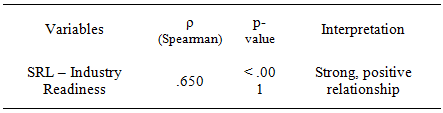
Correlation analysis using Spearman’s rho showed a strong, positive relationship between SRL and industry readiness (ρ = .650, p < .001). This suggests that students with higher self-regulation skills also reported higher levels of preparedness for their prospective industry roles.
The findings confirm that self-regulated learning is strongly associated with industry readiness among pre-service BTLED Home Economics teachers. This aligns with Zimmerman’s 1 description of SRL as an active process of goal-setting, self-monitoring, and reflection, which empowers learners to take ownership of their education. Students who regulate their learning more effectively are also those who report higher levels of preparedness for professional roles.
Pintrich 2 highlighted that SRL contributes significantly to motivation and sustained engagement, which supports the present results showing that self-regulated learners feel more confident and competent in industry-related tasks. Similarly, Panadero (2017) emphasized that SRL predicts both academic achievement and professional performance, reinforcing its role as a foundation for employability.
The strong correlation observed here suggests that SRL is not only an academic strategy but also a bridge to professional readiness. In the BTLED context, learners who actively plan, monitor, and adjust their study habits are also those who feel equipped to function as teachers, trainers, assessors, entrepreneurs, and community leaders.
From a curricular perspective, these findings resonate with Bandura’s 30 Social Cognitive Theory, which underscores the role of self-efficacy and self-regulation in shaping human agency. Teacher education programs should therefore integrate explicit SRL development strategies—such as reflective journals, independent projects, and formative feedback—to enhance both academic performance and industry preparedness.
Overall, the results demonstrate that cultivating SRL is essential not only for academic success but also for ensuring that graduates can thrive in the multifaceted demands of education and industry.
This study described the relationship between self-regulated learning (SRL) and industry readiness among pre-service Bachelor of Technology and Livelihood Education (BTLED) Home Economics students in a Philippine state university. Results revealed that both SRL and industry readiness were rated high, and correlation analysis confirmed a strong positive relationship (ρ = .650, p < .001) between the two constructs.
These findings suggest that pre-service teachers who are more capable of regulating their own learning—through planning, monitoring, and reflection—also perceive themselves as better prepared to assume diverse professional roles, including teaching, technical training, TESDA assessment, entrepreneurship, and community engagement. SRL thus functions as an enabling mechanism that strengthens graduates’ capacity to transition from academic preparation into the complex demands of industry and professional practice.
Based on the findings, the following recommendations are offered:
1. Curriculum integration of SRL strategies. Teacher education programs should explicitly embed SRL practices, such as reflective journals, self-assessment tasks, and independent projects, to reinforce students’ capacity for self-directed learning.
2. Faculty support and mentoring. Instructors should model and encourage self-regulatory behaviors, providing feedback that fosters student autonomy and confidence in handling both academic and technical competencies.
3. Strengthening industry-oriented readiness domains. While overall readiness was high, relatively lower scores in TESDA assessor and TVET trainer readiness suggest the need for greater emphasis on competency-based assessment and technical training in the curriculum.
4. Capacity-building workshops. Supplementary training sessions on SRL and industry readiness could be offered to pre-service teachers, ensuring they are well-prepared to meet multifaceted professional expectations.
Future research. Similar studies with larger samples and across different teacher education programs are encouraged to validate these findings and further explore how SRL contributes to employability and long-term professional success.
| [1] | Zimmerman, B.J. (2000). Attaining self-regulation: A social cognitive perspective. Handbook of Self-Regulation. Academic Press. | ||
| In article | View Article | ||
| [2] | Pintrich, P., Smith, D., Garcia, T., &McKeachie, W. (1991). Manual for the Motivated Strategies for Learning Questionnaire (MSLQ). University of Michigan. | ||
| In article | |||
| [3] | Ganda, D. & Boruchovitch, E. (2018). Promoting self-regulated learning of Brazilian preservice student teachers: results of an intervention program. Frontiers in Education, 3. | ||
| In article | View Article | ||
| [4] | Oates, S. (2019). The importance of autonomous, self-regulated learning in primary initial teacher training. Frontiers in Education, 4. | ||
| In article | View Article | ||
| [5] | Karlen, Y., Hertel, S., & Hirt, C. (2020). Teachers’ professional competences in self-regulated learning: a holistic approach. Frontiers in Education, 5. | ||
| In article | View Article | ||
| [6] | Haerazi, H. (2023). Mall integrated with metacognitive skills to promote preservice English teachers’ intercultural communicative competence. Journal on English as a Foreign Language, 13(2), 581–609. | ||
| In article | View Article | ||
| [7] | Chen, C. & Hung, C. (2022). Plan and then act: moderated effects of professional identity and action control. Healthcare, 10(10), 1938. | ||
| In article | View Article PubMed | ||
| [8] | Susiyawati, E., Erman, E., Astriani, D., & Rahayu, D. (2024). Blended learning in science classrooms: impact on preservice teachers’ process skills. KnE Social Sciences. | ||
| In article | View Article | ||
| [9] | FİLİZ, O. & Kurt, A. (2022). The effect of preservice teachers’ experiences in a flipped course on digital competencies and innovativeness. Journal of Educational Technology and Online Learning, 5(3), 655–675. | ||
| In article | View Article | ||
| [10] | Hyppönen, L., Hirsto, L., & Sointu, E. (2019). Perspectives on university students’ SRL, time management, and achievement in flipped classrooms. International Journal of Learning, Teaching and Educational Research, 18(13), 87–106. | ||
| In article | View Article | ||
| [11] | Liu, J., Xiang, P., McBride, R., & Chen, H. (2019). SRL strategies and achievement goals among preservice PE teachers. European Physical Education Review, 26(2), 375–391. | ||
| In article | View Article | ||
| [12] | Horn, D., Grötzbach, D., & Drechsel, B. (2020). Fostering preservice teachers’ psychological literacy through SRL counseling. Psychology Learning & Teaching, 20(2), 279–293. | ||
| In article | View Article | ||
| [13] | Sulistiani, I., Setyosari, P., Sa’dijah, C., &Praherdhiono, H. (2023). Technology acceptance in e-learning among preservice teachers. Indonesian Journal of Electrical Engineering and Computer Science, 31(3), 1821–1828. | ||
| In article | View Article | ||
| [14] | Broadbent, J. & Poon, W. (2015). SRL strategies and academic achievement in online higher education. Internet and Higher Education, 27, 1–13. | ||
| In article | View Article | ||
| [15] | Kebede, A. & Asgedom, A. (2024). Challenges of training TVET teachers in Ethiopia. BJE, 24(1), 105–123. | ||
| In article | View Article | ||
| [16] | Almerez, Q., Adolfo, G., Bucod, J., Egos, M., &Tangpos, A. (2019). TVET pedagogy in globalization: strategies and practices. Asian Journal of Education and Social Studies. | ||
| In article | |||
| [17] | Gökdaş, İ. & Torun, F. (2017). Instructional technology courses and competency development. Educational Sciences: Theory & Practice. | ||
| In article | |||
| [18] | ElSayary, A., Zein, R., & Antonio, L. (2022). Using interactive technology to develop preservice teachers’ STEAM competencies. Eurasia Journal of Mathematics, Science and Technology Education, 18(2), em2079. | ||
| In article | View Article | ||
| [19] | Speicher, S. (2021). Experiential education with preservice teachers. Journal of Global Education and Research, 5(2), 111–120. | ||
| In article | View Article | ||
| [20] | Horzum, T. &İzci, K. (2018). Preservice teachers’ competence for inclusive education. Journal of Education and E-Learning Research, 5(2), 131–143. | ||
| In article | View Article | ||
| [21] | Çuhadar, C. (2018). Readiness of preservice teachers to integrate technology. Contemporary Educational Technology, 9(1). | ||
| In article | |||
| [22] | Bembenutty, H. (2016). Motivation and SRL among preservice and in-service teachers. Scholarship of Teaching and Learning in Psychology, 2(4), 231–244. | ||
| In article | View Article | ||
| [23] | Fuchs, K., Pösse, L., Bedenlier, S., Gläser‐Zikuda, M., Kammerl, R., Kopp, B., … & Händel, M. (2022). Preservice teachers’ online SRL and digital readiness. Education Sciences, 12(4), 272. | ||
| In article | View Article | ||
| [24] | Berger, F., Schreiner, C., Hagleitner, W., Jesacher-Rößler, L., Roßnagl, S., &Kraler, C. (2021). Coping with SRL in distance learning during COVID-19. Frontiers in Psychology, 12, 701255. https://doi.org/10.3389/fpsyg.2021.701255. | ||
| In article | |||
| [25] | Panadero, E. (2017). A review of SRL: six models and four directions for research. Frontiers in Psychology, 8, 422. | ||
| In article | View Article PubMed | ||
| [26] | Griful-Freixenet, J., Struyven, K., &Vantieghem, W. (2020). Universal design for learning among preservice teachers. Journal of Teacher Education, 72(3), 381–395. | ||
| In article | View Article | ||
| [27] | Aydoğmuş, M. & Ibrahim, M. (2022). Preservice teachers’ TPACK competencies and SRL skills. Journal of Computer and Education Research, 10(20), 531–546. | ||
| In article | View Article | ||
| [28] | Chen, Y. & Jang, S. (2018). Exploring SRL and TPACK of Taiwanese teachers. Journal of Educational Computing Research, 57(4), 978–1002. | ||
| In article | View Article | ||
| [29] | Sointu, E., Valtonen, T., Hallberg, S., Kankaanpää, J., Väisänen, S., Heikkinen, L., … &Hirsto, L. (2022). Flipped learning and learning analytics for preservice teachers. Seminar.Net, 18(1). | ||
| In article | View Article | ||
| [30] | Bandura, A. (1997). Self-efficacy: The exercise of control. Freeman, New York. | ||
| In article | |||
Published with license by Science and Education Publishing, Copyright © 2025 Glenfford M. Esparcia and Maria Teresa M. Fajardo
 This work is licensed under a Creative Commons Attribution 4.0 International License. To view a copy of this license, visit
http://creativecommons.org/licenses/by/4.0/
This work is licensed under a Creative Commons Attribution 4.0 International License. To view a copy of this license, visit
http://creativecommons.org/licenses/by/4.0/
| [1] | Zimmerman, B.J. (2000). Attaining self-regulation: A social cognitive perspective. Handbook of Self-Regulation. Academic Press. | ||
| In article | View Article | ||
| [2] | Pintrich, P., Smith, D., Garcia, T., &McKeachie, W. (1991). Manual for the Motivated Strategies for Learning Questionnaire (MSLQ). University of Michigan. | ||
| In article | |||
| [3] | Ganda, D. & Boruchovitch, E. (2018). Promoting self-regulated learning of Brazilian preservice student teachers: results of an intervention program. Frontiers in Education, 3. | ||
| In article | View Article | ||
| [4] | Oates, S. (2019). The importance of autonomous, self-regulated learning in primary initial teacher training. Frontiers in Education, 4. | ||
| In article | View Article | ||
| [5] | Karlen, Y., Hertel, S., & Hirt, C. (2020). Teachers’ professional competences in self-regulated learning: a holistic approach. Frontiers in Education, 5. | ||
| In article | View Article | ||
| [6] | Haerazi, H. (2023). Mall integrated with metacognitive skills to promote preservice English teachers’ intercultural communicative competence. Journal on English as a Foreign Language, 13(2), 581–609. | ||
| In article | View Article | ||
| [7] | Chen, C. & Hung, C. (2022). Plan and then act: moderated effects of professional identity and action control. Healthcare, 10(10), 1938. | ||
| In article | View Article PubMed | ||
| [8] | Susiyawati, E., Erman, E., Astriani, D., & Rahayu, D. (2024). Blended learning in science classrooms: impact on preservice teachers’ process skills. KnE Social Sciences. | ||
| In article | View Article | ||
| [9] | FİLİZ, O. & Kurt, A. (2022). The effect of preservice teachers’ experiences in a flipped course on digital competencies and innovativeness. Journal of Educational Technology and Online Learning, 5(3), 655–675. | ||
| In article | View Article | ||
| [10] | Hyppönen, L., Hirsto, L., & Sointu, E. (2019). Perspectives on university students’ SRL, time management, and achievement in flipped classrooms. International Journal of Learning, Teaching and Educational Research, 18(13), 87–106. | ||
| In article | View Article | ||
| [11] | Liu, J., Xiang, P., McBride, R., & Chen, H. (2019). SRL strategies and achievement goals among preservice PE teachers. European Physical Education Review, 26(2), 375–391. | ||
| In article | View Article | ||
| [12] | Horn, D., Grötzbach, D., & Drechsel, B. (2020). Fostering preservice teachers’ psychological literacy through SRL counseling. Psychology Learning & Teaching, 20(2), 279–293. | ||
| In article | View Article | ||
| [13] | Sulistiani, I., Setyosari, P., Sa’dijah, C., &Praherdhiono, H. (2023). Technology acceptance in e-learning among preservice teachers. Indonesian Journal of Electrical Engineering and Computer Science, 31(3), 1821–1828. | ||
| In article | View Article | ||
| [14] | Broadbent, J. & Poon, W. (2015). SRL strategies and academic achievement in online higher education. Internet and Higher Education, 27, 1–13. | ||
| In article | View Article | ||
| [15] | Kebede, A. & Asgedom, A. (2024). Challenges of training TVET teachers in Ethiopia. BJE, 24(1), 105–123. | ||
| In article | View Article | ||
| [16] | Almerez, Q., Adolfo, G., Bucod, J., Egos, M., &Tangpos, A. (2019). TVET pedagogy in globalization: strategies and practices. Asian Journal of Education and Social Studies. | ||
| In article | |||
| [17] | Gökdaş, İ. & Torun, F. (2017). Instructional technology courses and competency development. Educational Sciences: Theory & Practice. | ||
| In article | |||
| [18] | ElSayary, A., Zein, R., & Antonio, L. (2022). Using interactive technology to develop preservice teachers’ STEAM competencies. Eurasia Journal of Mathematics, Science and Technology Education, 18(2), em2079. | ||
| In article | View Article | ||
| [19] | Speicher, S. (2021). Experiential education with preservice teachers. Journal of Global Education and Research, 5(2), 111–120. | ||
| In article | View Article | ||
| [20] | Horzum, T. &İzci, K. (2018). Preservice teachers’ competence for inclusive education. Journal of Education and E-Learning Research, 5(2), 131–143. | ||
| In article | View Article | ||
| [21] | Çuhadar, C. (2018). Readiness of preservice teachers to integrate technology. Contemporary Educational Technology, 9(1). | ||
| In article | |||
| [22] | Bembenutty, H. (2016). Motivation and SRL among preservice and in-service teachers. Scholarship of Teaching and Learning in Psychology, 2(4), 231–244. | ||
| In article | View Article | ||
| [23] | Fuchs, K., Pösse, L., Bedenlier, S., Gläser‐Zikuda, M., Kammerl, R., Kopp, B., … & Händel, M. (2022). Preservice teachers’ online SRL and digital readiness. Education Sciences, 12(4), 272. | ||
| In article | View Article | ||
| [24] | Berger, F., Schreiner, C., Hagleitner, W., Jesacher-Rößler, L., Roßnagl, S., &Kraler, C. (2021). Coping with SRL in distance learning during COVID-19. Frontiers in Psychology, 12, 701255. https://doi.org/10.3389/fpsyg.2021.701255. | ||
| In article | |||
| [25] | Panadero, E. (2017). A review of SRL: six models and four directions for research. Frontiers in Psychology, 8, 422. | ||
| In article | View Article PubMed | ||
| [26] | Griful-Freixenet, J., Struyven, K., &Vantieghem, W. (2020). Universal design for learning among preservice teachers. Journal of Teacher Education, 72(3), 381–395. | ||
| In article | View Article | ||
| [27] | Aydoğmuş, M. & Ibrahim, M. (2022). Preservice teachers’ TPACK competencies and SRL skills. Journal of Computer and Education Research, 10(20), 531–546. | ||
| In article | View Article | ||
| [28] | Chen, Y. & Jang, S. (2018). Exploring SRL and TPACK of Taiwanese teachers. Journal of Educational Computing Research, 57(4), 978–1002. | ||
| In article | View Article | ||
| [29] | Sointu, E., Valtonen, T., Hallberg, S., Kankaanpää, J., Väisänen, S., Heikkinen, L., … &Hirsto, L. (2022). Flipped learning and learning analytics for preservice teachers. Seminar.Net, 18(1). | ||
| In article | View Article | ||
| [30] | Bandura, A. (1997). Self-efficacy: The exercise of control. Freeman, New York. | ||
| In article | |||