Cassava (Manihot esculenta Crantz) is very perishable and bulky. One way of prolonging its shelf-life is by drying. The study was conducted to investigate the effects of drying on proximate, starch, sugar compositions and functional properties of cassava flour. Three drying methods (open sun, solar and oven) were used to produce the dry cassava chips out of which the cassava flours were obtained. Determinations of moisture, ash, starch, crude fibre, protein, crude fat, sugar, carbohydrate contents and functional properties of the cassava flour were carried out using standard methods. The results showed that all parameters examined were affected by the drying methods except starch and crude fibre which showed no significant differences for the three drying methods. The moisture contents of the flours were 5.95%, 9.49% and 11.18% for oven, solar and open sun drying respectively. Ash contents were 2.13%, 3.25% and 3.58% for open sun, solar and oven drying respectively whereas the protein contents were 0.73%, 1.00% and 1.15% for open sun, solar and oven drying respectively. The crude fibre contents were 1.83% (open sun), 2.01% (solar) and 2.71(oven drying) while crude fat contents were 0.64% (open sun), 0.51% (solar) and 0.49% (oven drying). Carbohydrates contents were 83.48%, 83.72% and 86.10% for open sun, solar and oven respectively. The starch contents were 83.62% (open sun), 82, 39% (solar) and 84. 04% (oven) and the sugar contents were 11.14%, 22.48% and 16.107% for open sun, solar and oven respectively. The swelling capacity, foam capacity, foam stability, water absorption capacity, oil absorption capacity, bulk density and solubility of the cassava flours from the various drying methods ranged between 9.233 – 12.513, 9.207 – 14.363, 48.037 – 60.193, 122.103 – 151.257, 100.247 – 174.777, 0.578 – 0.715 and 10.883 – 15.533 respectively. On the whole, the results indicate that oven–dried samples had best nutritional value, functional properties and keeping abilities followed by solar and then open sun.
In Ghana, cassava (Manihot esculenta Crantz) is one of the most important crops in terms of production, energy intake, and contribution to Gross Domestic Product. It is considered a food security crop with a great potential for industrial applications 1. Furthermore, cassava is the source of raw materials for a number of industrial products such as starch, flour and ethanol. The production of cassava is relatively easy as it is tolerant to the biotic and edaphic encumbrances that hamper the production of other crops. Cassava’s roots are used only to store energy, unlike the roots of sweet potato and yam that are reproductive organs. Despite their agronomic advantages, root crops are far more perishable than the other staple food crops. Once out of the ground, some root crops have a shelf life of only few days. Roots as living organs of plants continue to metabolize and respire after harvest. Cassava has a shelf life that is generally accepted to be of the order of 24 to 48 hours after harvest 2. Cassava utilization patterns vary considerably in different parts of the world. In Ghana, the majority of cassava produced (90%) is used for human food 3. Cassava is very versatile and its derivatives and starch are applicable in many types of products such as foods, confectionery, sweeteners, glues, plywood, textiles, paper, biodegradable products, monosodium glutamate, and drugs. Cassava chips and pellets are used in animal feed and alcohol production. Animal feed and starch production are only minor uses of the crop in Ghana. Cassava, in its processed form, is a reliable and convenient source of food for tens of millions of rural and urban dwellers in Ghana 3.
Drying is the oldest method of preserving food. It may be defined as defined a mass transfer process consisting of the removal of moisture from solid, semi-solid or a liquid 4. It is also a method of food preservation that works by removing water from the food, which inhibits deterioration 5. Food can be dried in several ways for example by the sun if the air is hot and dry enough, in an oven if the climate is humid and in solar system if the climate is hot to about 30-40ºC 5. Sun (open air) drying uses heat from the sun and natural movement of the air and expose the food material to environmental factors such as dust, bacterial growth and excessive respiration. Oven drying involves the use of equipment (dryer). Solar drying involves the use of the sun’s energy for dying but excluding an open air 6.
Cassava is very perishable and bulky. One way of prolonging the shelf-life of cassava is by drying. However, the drying method adopted can have some positive and negative effects on the proximate, starch, sugar compositions and functional properties of cassava flour. The effects may be due to some biochemical changes that may occur during the drying process. Also, technological application of flour from dried cassava will depend on some of these proximate compositions and the functional properties. However, limited information is available on the effects of the various drying methods used in drying cassava hence there is the need to carryout in-depth study on flour from different dying methods to furnish intending users with information, encourage production and make possible technical assistance to processing and marketing as raw materials for intending factories, customers and health inspectors. The aim of the study was to determine the effects of drying methods on proximate, starch, sugar compositions and functional properties of cassava flour.
Freshly harvested cassava roots (Capevas bankye) which were above 10 months old were purchased from the School of Agriculture Teaching and Research farm of the University of Cape Coast, Ghana and transported to School of Agriculture Research Laboratory.
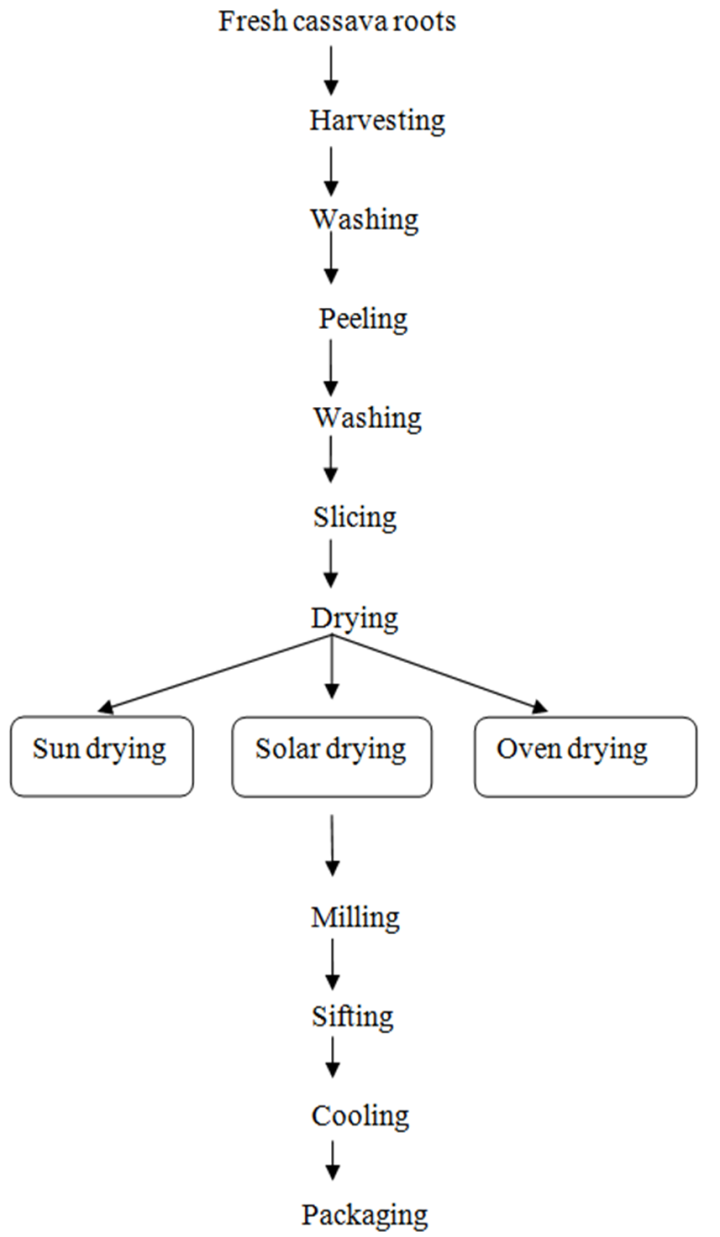
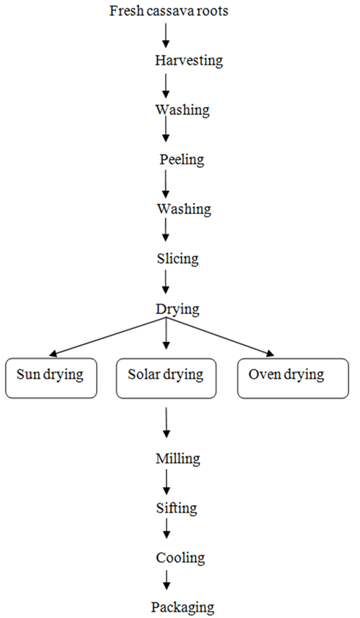
2.2. Sample PreparationFresh roots of cassava were washed to remove soil and other dirt accumulated using ordinary tap water, peeled manually using knife, washed again using distilled water sliced into chips of using a slicer.
2.3. Sample TreatmentThe sliced cassava was divided into three parts and subjected to three drying treatments. One part of weight 830.29 g was subjected to open sun drying at maximum temperature of 35-37°C for 21days. The second part of weight 830.45 g was oven dried at 40°C for 2 days and the third portion of weight 830.23 g was dried in the solar dryer at maximum temperature of 35-37°C for 14 days. All the dried samples were milled into flour using a hammer mill after attaining constant moisture content and sieved through a 0.25 mm mesh. The samples were kept in an air-tight polyethylene bags and stored in a refrigerator at 2°C until use. The flow chart of the entire processes is given in Figure 1.
The moisture content was determined by the oven drying method. Five grams of the cassava flour sample was oven (Gallenkamp Sanyo/Weiss, Leicestershire, UK) dried at 103◦C for 24 hours until the stable weight was obtained following Association of Official Analytical Chemists (AOAC) method 7. The ash content was determined by weighing ten grams of the sample into a previously weighed crucible and placed into a muffle furnace at 500◦C for 4 hours 8. The percentage fat content of the sample was determined by the conventional soxhlet extraction method with hexane as the solvent, according to AOAC method 7. The percentage crude protein of the sample was determined by the Kjeldahl apparatus using AOAC method 7. The fibre content of the flours was determined by weighing the acid and alkaline treated defatted sample in accordance with AOAC method 7. The carbohydrate content was obtained by the difference as described by Ojo et al. 8, 9. The starch and sugar contents of the flours were determined by the spectrophotometry methods described by AOAC 7 using a spectrophotometer (Shimadzu UV-1240).
2.5. Functional Properties DeterminationThe swelling powers of the flours from the various drying methods were determined according to the method described by Appiah et al. 10 and Leach et al. ]11]. One gram of the sample was mixed with 10 mL distilled water in a centrifuge tube. This was heated at 85◦C for 30 minutes with continuous shaking of the tube. The suspension was then centrifuged for 15 minutes at 1000 rpm and the supernatant was decanted. The weight of the paste was recorded and the swelling capacity of the sample was computed. The solubility property was determined in the same way as swelling capacity except that, in addition, the supernatant was evaporated and the residue was re-weighed.
The method of Jitngarmkusol et al. 12 was used for the determination of the foaming capacity and foam stability of flours with some slight modifications. Two grams of each flour sample was mixed with 100 mL of distilled water and the suspension was whipped with a kitchen blender. The whipped suspension was transferred into a 250 mL graduated cylinder. Volumes of the whole mixture were recorded before and after whipping. The foaming capacity (FC) and foam stability (FS) were calculated using the following equations:
 |
 |
Where V1 is the volume of initial mixture, V2 is the volume of the mixture after whipping and V3 is the volume of the foam after 5 hours.
Water absorption capacity was determined according to the method described by Appiah et al. 10 and Beuchat 13. One gram of the sample was added to 10 mL water in a pre-weighed 25 mL centrifuge tube and allowed to stand at room temperature (29°C) for 1 hour. The suspension was centrifuged at 500 rpm for 30 minutes. The volume of water on the sediment was measured and the water absorbed was expressed as percentage water absorption based on the original weight of sample.
The modified method of Medcalf and Giles 14 was used to determine oil absorption capacity of the flour samples. About 2 g of each flour sample was weighed into 50 mL pre-weighed centrifuge tubes and stirred into 40 mL oil for 1 hour on a shaker (Edmund Buhler SM 30). The mixtures were placed in a centrifuge (Spectra Scientific Merlin) and centrifuged at 2200 rpm for 15 minutes. The oil released on centrifugation was drained and the wet flour weighed to determine by difference, the weight of oil. The percentage oil absorption capacity (%OAC) was calculated using the following equation:
 |
Bulk densities of the powders were determined according to method of 10, 15 with few modifications. A measuring cylinder was weighed and the sample was filled to 20 mL mark by constant tapping until there was no further change in volume. The contents were then weighed and the difference in weight determined, and the bulk densities were computed.
2.6. Statistical AnalysisThe results are presented as the mean and standard deviation of three replicates. The General Linear Model (GLM) procedure of Minitab version 16 statistical software was used for the Analysis of Variance (ANOVA) and significant differences were reported at 95% confidence level using Tukey’s Post-hoc test.
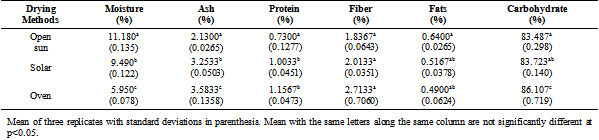
The proximate compositions of the cassava flour from the various drying methods are shown on Table 1. Moisture content of food gives an indication of the shelf-life and nutritive values. Moisture content of the cassava flours ranged between 5.95% to 11.18% which was low relative to value of 10.78% to 12.72% reported by Maziya-Dixon et al. 16. The oven drying method gave the lowest value while that of open sun drying yielded a higher value. The low value of the oven drying may be attributed to the fact that the temperature used was constant and was not affected by any environmental factors whereas with the open sun drying, although the temperature was constant there were variations since the energy from the sun cannot be controlled. Moisture is an important parameter in the storage of cassava flour; very high levels greater than 12% allow for microbial growth and thus low levels are favourable and give relatively longer shelf life. All the samples had good moisture contents and hence have the potential for better shelf life. There were significant differences (p<0.05) in the moisture contents of the flours from the drying methods.
The ash content of a food sample gives an expression of the mineral composition of the sample. The ash contents of the cassava flours ranged between 2.13% and 3.58%. Significant differences (p<0.05) existed in the ash contents of the flours from the various drying methods. Oven dried had the highest ash content and this may be attributed to the temperature used for drying. The higher the drying temperature, the lower the moisture content and this has a direct effect on the concentration of the food components. Values obtained were comparable to the range of 1.7% to 2.5% for cocoa yam reported by Amandikwa 6.
The crude protein contents of the flours ranged between 0.73% and 1.16% for open sun drying and oven respectively. Crude protein content was higher for solar and oven drying methods than in the sun and control. There were significant differences (p<0.05) in the protein contents of flours from the different drying methods. The high crude protein contents observed in solar and oven drying methods may be due to the time and temperatures used for drying. Both time and tempereature enhance the reaction rates, which also strongly depend on water activity of the products. Many biochemical reactions can be induced by temperature increase in foods such as Mallard reactions, vitamin degradation, fat oxidation, denaturation of thermally unstable proteins, enzyme reactions and so on. A relatively high temperature was used for the oven drying method at a relatively shorter time thus at 40˚C for 2 days whilst the solar drying method was carried out for 14 days because of the energy reserved for drying even at night, this facilitated the drying process but in the case of the open sun drying method, it was done between 35-37˚C for a longer time (21 days) which intend denatured most of the protein. The values were relatively low as compared to values between 0.70% and 1.83% reported by Mensah 17.
Crude fibre measures the cellulose, hemicelluloses and lignin contents of a food. The crude fibre contents of the flours ranged from the minimum value of 1.84% for open sun drying and the maximum value of 2.07% for oven drying. There were no significant differences (p > 0.05) in the crude fibre contents of the cassava flours for the drying methods. Usually fibre content does not exceed 1.5% in fresh root and 4% in root flour 18.
The fat content of the cassava flour samples ranged from 0.49% to 0.64% with open sun drying having the highest and oven dry having the lowest. There were significant differences (p<0.05) in the fat content of the cassava flour for the three drying methods. The lower fat contents observed in open sun and solar samples could be associated with the oxidation of fat during drying. The low fat content will enhance the storage life of the flour due to the lowered chance of rancid flavour development. However, the values were higher than those of 0.1% to 0.4% reported by Charles et al. 19 and 0.65% reported by Padonou et al. 20
Carbohydrate contents of the flours ranged from 83.49% to 86.11% with open sun having the lowest value and oven drying with the highest. There were significant (p<0.05) differences in the carbohydrate contents for the drying methods. The results showed that oven dried flour samples contain more carbohydrates than flour samples produced using the other drying methods. The carbohydrate contents indicate that the oven dried flour is an excellent source of energy. The high carbohydrate values obtained in this study suggest that cassava could be utilized as a reliable food and energy security crop as proposed by FAO 21.
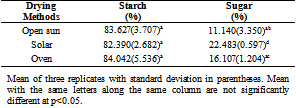
3.2. Starch and Sugar Compositions of Cassava FloursThe starch and sugar compositions of the cassava flours from open sun, solar and oven drying methods are shown on Table 2. Starch contents of cassava flours ranged from 82.39% to 84.04% with solar having the lowest and oven drying having the highest, although the differences were not significant (p> p0.05). The higher values obtained indicates that cassava is predominantly a starch food as compared to protein and crude fat with smaller values. Also, due to its high content of starch, it can be used in the industries in the manufacturing of noodles, cassava based adhesives like cereal starch, tapioca and can be used as raw materials for sweeteners.
Sugar contents of the samples varied between 11.14% to 22.48% with open sun having the minimum and solar having the maximum. There were significant differences in the sugar contents of the cassava flours for the various drying methods (p<0.05). As a result of the sugar content which is relatively low, the use of cassava can be employed in the industry in the production of ethanol and also in the pharmaceuticals for coating medicines.
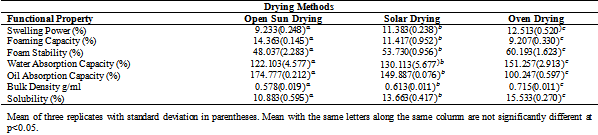
The results of the functional properties of cassava flours from sun drying, solar drying and oven drying methods are shown in Table 3. The swelling powers of the flours ranged between 9.233-12.513%. Oven dried samples had the highest swelling power and open sun dried samples had the lowest swelling power. There were significant differences (p<0.05) in the swelling powers of the cassava flour from the various drying methods. The higher swelling power for oven dried flours may be due to the strength and character of the micellar network within the starch granules being a major factor contributing to the swelling behaviour of starch. Thus, a highly associated starch with extensively strongly-bonded micellar network structure is readily resistant to swelling. This indicates that the increase in temperature for oven drying results in a decrease in strength and character of the micellar network. This is similar to observations of Aprianita 22 for yam, taro and sweet potato tubers in relation to temperature. Thus, the relative increase in swelling power as temperature of drying increased suggests that starch structural damage is directly proportional to increase in drying temperature. Moorthy 23 also reported that the swelling power of cassava starch varied from 42-71%. The differences in the swelling powers among the samples may be due to the variation of amylose content. The higher the amylose content, the lower the swelling power. The swelling power of starch depends on the ability of amylose to solubilize in water hence allowing water to be absorbed by starch granules. Therefore an increase in swelling power is a function of increased solubility of amylose 24. Abera and Rakshit 25 reported that the swelling ability of starch is inhibited by its lipid content. No appreciable influence was expected from lipid, since cassava starch has low lipid content of approximately 1% 26. According to Abera and Rakshit 25, cassava starches with amylose contents exceeding 20% are likely to have low swelling powers. The values obtained for the swelling power indicates that an increase in temperature weakened the starch granules by allowing interaction between the amylose (water soluble fraction) molecules located in the bulk amorphous regions and the branched segment of amylopectin (water insoluble fraction) in the crystalline regions. The swelling power of flour samples are often related to their protein and starch contents. Higher protein content in flour may cause the starch granules to be embedded within a stiff protein matrix which subsequently limits the access of the starch to water and restricts the swelling. Flours lower in protein and higher in total starch content have higher swelling ability. In addition to protein content, a higher concentration of phosphorus may increase hydration and swelling power by weakening the extent of bonding with the crystalline domain 22.
The solubility of cassava flours ranged from 10.883-15.533% for the various drying methods. Sun dried samples had the lowest solubility and oven dried had the highest solubility. There were significant differences (p<0.05) in the solubility of the cassava flours from the various drying methods. The results for solubility were higher than the reported range of 7.57% and 10.46% for cassava by (Baafi and Safo-Kantanka 27. This could be attributed to the variety of cassava used for the work. Decrease solubility could be attributed to the amylose content, since the solubilized amylose molecules leach from the swelled starch granules of flour 28. Solubility of flour is an indicator of quality, therefore the high values observed in the oven dried samples of the flour suggest that they could be very digestible and therefore could possibly be suitable for infant food formulations. According to Chin-Lin Hsu 29, solubility index reflects the extent of starch degradation. The results indicate that sun dried samples showed the least starch degradation while oven dried samples showed more profound effects on starch degradation.
Open sun dried samples showed a higher foaming capacity with the highest value of 14.363%, followed by solar drying with a value of 11.417% and the least value of 9.207% from oven dried samples. Sun dried samples had a low foaming stability with a value of 48.037% and oven dried samples had the highest foaming stability of 60.193%. There were significant differences (p<0.05) in the foaming capacities and foaming stabilities of the cassava flours from the various drying methods. The foaming capacity of all starches can be rated as low since they do not contain considerable high amounts of protein, a good foaming agent and this accounted for lower values produced from solar, oven and sun dried samples. The foaming capacity of a protein refers to the amount of interfacial area that can be created by the protein and foam stability refers to the ability of protein to stabilize against gravitational and mechanical stresses 30. Foam formation and foam stability are a function of the type of protein, pH, processing methods, viscosity and surface tension. Foaming capacity is influenced by the surface activity of proteins. The capacity of proteins to form stable foams with gas by forming impervious protein films is an important property in cakes, soufflés, whipped toppings, fudges, ice creams and marshmallows. High protein content of a flour increases the foaming capacity of the flour. Denaturation of proteins increases their solubility and consequently foaming capacity due to the unfolding of the protein structure which allows more protein surface to be exposed and interact with the external environment 31. The differences in the foaming capacity of the flours may be attributed to the different composition and nature of the protein fractions. It may also be explained on the basis of globular proteins which make denaturing of the surface difficult. Foams are used to improve texture, consistency and appearance of foods.
The water absorption capacities of flours from the different drying methods were within the range of 122.103 - 151.257%. Solar dried flour had the lowest water absorption capacity and oven dried flour had the highest water absorption capacity. There were significant differences (p<0.05) in the water absorption capacity of the cassava flours from the various drying methods. The water absorption capacity of a starch is an indication of the amount of water held by the starch extract and this describes the ability of the starch to associate with water and under conditions of limitation of water and dough and pastes. The increase in water absorption capacity for cassava samples obtained from oven drying may be due to the presence of esterified phosphate groups resulting in mutual electrical repulsion which weakens the association between starch molecules thus increasing water absorption capacity. Also, the observed variation in water absorption capacities for oven-dried samples may be due to changes induced by the different drying methods. Probably the conformational characteristics and degree of interaction with water was modified by oven drying resulting in oven dried flour having the highest water absorption capacity 10. Carbohydrates and proteins have significant influence on the water absorption capacity of food due to the presence of hydrophilic components like polar or charged side chains. When the protein content, number of charged amino acid residues and hydrophilic groups are high, hydrogen bonding with water molecules increases as well as electrostatic repulsion between protein polymers, which facilitates binding and entrapment of water 31. Starches contribute to high water absorption capacity when the associative forces between starch granules are weak, allowing more starch surfaces to be available for binding water 32. Flours with the ability to absorb water and swell for improved consistency in food have beneficial applications in dough, processed meats and custards 31. According to Onimawo and Egbekun 33, heat processing increases water absorption capacity. The result of this study suggests that oven dried flour would be useful in foods such as bakery products which require hydration to improve handling features.
Results obtained showed that sun dried samples had the highest oil absorption capacity with a value of 174.777% and it was followed by solar dried samples with a value of 149.887%. Oven dried samples recorded the lowest oil absorption capacity with a value of 100.247%. There were significant differences (p<0.05) in the oil absorption capacities of the cassava flour from the various drying methods. The oil absorption index is influenced by the lipophilic nature on the granular surface and interior which were influenced for functional properties of starches 34. The major factor affecting oil absorption index is protein content, which is composed of both hydrophilic and hydrophobic parts. Non-polar amino acid side chains can form hydrophobic interactions with hydrocarbon chains of lipid 35 and has implication in functional properties of flours. Oil absorption index is important since oil acts as flavour retainer and increases the mouth feel of foods, improvement of palatability and extension of shelf life particularly in bakery or meat products where fat absorptions are desired 36. The relatively high oil absorption capacity of sun dried flour suggests that it could be useful in food formulation where oil holding capacity is needed such as sausage and bakery products. This shows that sun dried flour would be useful in this respect more than oven dried flour since it had significantly higher oil absorption capacity.
The bulk densities of the flours ranged from 0.578 - 0.715g/ml. Oven dried samples showed the highest bulk densities, followed by solar dried samples and sun dried samples. There were significant differences (p<0.05) in the bulk densities of the cassava flours from the various drying methods. According to Adejuyitan et al. 37, bulk density is a measure of the heaviness of flour produced. Shittu et al. 38 also reported bulk density as an important parameter that determines the suitability of flours for ease of packaging and transportation of particulate foods. Different values of bulk densities have been reported for cassava products. Abu et al. 39 reported a range of 0.401 - 0.402 g/ml for gari. Ukpabi and Ndimele 40 also reported a range of 0.568 - 0.908 g/ml for gari in Eastern States of Nigeria. The bulk density of cassava fufu flour was reported to range from 0.63 g/ml to 0.77 g/ml 41. The results in this work fall within these ranges. Elkhalifa et al. 42 noted that fermentation results in a reduction in bulk density. This probably explains the lower bulk densities observed in the flours produced from sun and solar drying technologies. Nelson-Quartey et al. 43 concluded in their work that flours with lower bulk density were desirable for infant food preparation. The flours produced using sun and solar drying methods had relatively lower bulk densities making them more suitable for infant formulations. The results obtained indicate that the cassava flours will increase the bulkiness of food when used in food formulation. According to Appiah et al. 10 bulk density is a function of particle size, particle size being inversely proportional to bulk density. Particle size differences may be the cause of variations in bulk density of the flours. The particle size also influences the package design and could be used in determining the type of package material required. Higher bulk density is desirable since it offers greater packaging advantage as greater quantity of flour can be packed within a constant volume. The bulk density of the flours could be used to determine their handling requirement because it is the function of mass and volume. Since sun dried sample was the least dense it would occupy greater space and therefore would require more packaging material per unit weight and so could have high packaging cost however, sun dried sample would be easier to transport as it was lighter. The low bulk density of sun dried flour would be an advantage in the use of the flour for preparation of complementary foods.
It has been shown from the study that the drying methods have various unequal characteristics that can be utilized in the food, pharmaceutical and textile industries. Acceptable cassava flours can be produced through different drying methods depending on the utilization. The results of the study carried out on cassava flour indicated that the drying methods affect the proximate, starch, sugar compositions and functional properties. In terms of the best method of drying cassava with best nutritional value keeping abilities, samples oven-dried at 40°C gave the best results.
| [1] | Amoa-Awua, W. K., Owusu, M. and Feglo, P. Utilization of unfermented cassava flour for the production of an indigenous African fermented food, agbelima. World Journal of Microbiology and Biotechnology. 21, 1201-1207, 2005. | ||
| In article | View Article | ||
| [2] | Andrew, W. Cassava utilization, storage, and small scale processing. Natural Resource Institute, Chatham Maritime. UK. 14, 2002, 270-290. | ||
| In article | |||
| [3] | IITA, Post Harvest Technology”. Annual report. 2010, 62-80. | ||
| In article | |||
| [4] | Maxwell, E. O. and Zantoph, U. B. Drying effect on food products. 4th edition, CBS publishers, New Delhi, 2002. | ||
| In article | |||
| [5] | Zantoph, B.C. and Schuster, U.N. Effects of colour drying on food products. Int .J. Food. Tech, 27, 323-329, 2004. | ||
| In article | |||
| [6] | Amandikwa C. Proximate and Functional properties of open air, solar and oven dried cocoyam flour. Int’l Journal of Agric. and Rural Dev. 15(20), 988-994, 2012. | ||
| In article | |||
| [7] | Association of Analytical chemists. Official methods of analysis, 15th Edition, Washington D. C, U.S.A., 2005. | ||
| In article | |||
| [8] | Akoto, O., Borquaye, L.S., Howard, A.S. and Konwuruk, N. Nutritional and Mineral Composition of the Fruits of Solanum torvum from Ghana. Int. J. Mol. Sci. 4, 222-226, 2015. | ||
| In article | |||
| [9] | Ojo, M., Ariahu, C. and Chinma, E. Proximate, Functional and Pasting Properties of Cassava Starch and Mushroom (Pleurotus pulmonarius) Flour Blends. Am. J. Food Sci. Technol. 5, 11-18, 2017. | ||
| In article | |||
| [10] | Appiah, F., Asibuo, J. and Kumah, P. Physicochemical and functional properties of bean flours of three cowpea (Vigna unguiculata L.Walp) varieties in Ghana. Afr. J. Food Sci. 5, 100-104, 2011. | ||
| In article | View Article | ||
| [11] | Leach, H.; McCowen, L.; Schoch, T. Swelling power and solubility of granular starches. Cereal Chem. 36, 534-544, 1959. | ||
| In article | |||
| [12] | Jitngarmkusol, S., Hongsuwankul, J. and Tananuwong, K. Chemical compositions, functional properties and microstructure of defatted macadamia flours, Food Chemistry, 110, 23-30, 2008. | ||
| In article | View Article PubMed | ||
| [13] | Beuchat, L.R. Functional and electrophoretic characteristics of succinylated peanut flour protein. J. Agric. Food Chem. 25, 258-261, 1977. | ||
| In article | View Article | ||
| [14] | Medcalf, D. G. and Gilles, K. A. Wheat starches. I. Comparison of physicochemical properties. Cereal Chemistry, 42, 558-568, 1965. | ||
| In article | |||
| [15] | Okaka, J.C. and Potter, N.N. Physico-chemical and functional properties of cowpea powders processed to reduce beany flavor. J. Food Sci. 44, 1235-1240, 1979. | ||
| In article | View Article | ||
| [16] | Maziya –Dixon, B., Adebowale, A.A., Onabanjo, O.O. and Dixon, A.G.O. African crop science conference proceedings, 7, 635-641, 2005. | ||
| In article | |||
| [17] | Mensah, A.A. Comparative evaluation of physicochemical and functional properties of cassava flour from different fertilizer protocols. MSc. Thesis, 2013, 39. | ||
| In article | |||
| [18] | Gil, J.L. and Buitrago, A.J.A. 2002. La yuca en la alimentacion animal. In: Ospina B, Ceballos H,editors. La yuca en el tercer milenio: sistemas modernos de producci´on, procesamiento, utilizaci ´on comercializaci ´on. Cali, Colombia: Centro Internacional de Agricultura Tropical. Pp 527-69. Available from: http://www.clayuca.org/PDF/libro_yuca/capitulo28.pdf. Accessed April 17, 2016. | ||
| In article | |||
| [19] | Charles, A.L., Sriroth, K. and Huang, T.C. Proximate composition, mineral contents, hydrogen cyanide and phytic acid of 5 cassava genotypes. Food Chemistry 92, 615-20, 2005. | ||
| In article | View Article | ||
| [20] | Padonou, W., Mestres, C. and Nago, M.C. The quality of boiled cassava roots: instrumental characterization and relationship with physicochemical properties and sensorial properties. Food Chemistry 89, 261-270, 2005. | ||
| In article | View Article | ||
| [21] | Food and Agriculture Organization of United Nations. Cassava a guide to sustainable production intensification, Rome, 2008, 87-96. | ||
| In article | |||
| [22] | Aprianita, A Purwandari, U, Watson, . and Vasiljevic, T. Physico-chemical properties of flours and starches from selected commercial tubers available in Australia. International Food Research Journal, 16, 507-520, 2009. | ||
| In article | |||
| [23] | Moorthy, S.N. Physicochemical and functional properties of tropical tuber starches. A review. Starch 54, 559-592, 2002. | ||
| In article | View Article | ||
| [24] | Nuwamanya, E, Baguma, Y, Wembabazi, E. and Rubaihayo, P. A comparative study of the physicochemical properties of starches from root, tuber and cereal crops. African Journal of Biotechnology, 10 (56), 12018-12030, 2011. | ||
| In article | |||
| [25] | Abera, S. and Rakshit, S.K. Comparison of Physicochemical and Functional Properties of Cassava Starch Extracted from Fresh Root and Dry Chips. Starch, 55, 287-296, 2003. | ||
| In article | View Article | ||
| [26] | Breuninger, W. F., Piyachomkwan, K. and Sriroth, K. Tapioca/cassava starch: Production and use. In Starch, 3rd ed.; Elsevier: Amsterdam, The Netherlands, pp. 541–568, 2009. | ||
| In article | View Article | ||
| [27] | Baafi, E. and Safo-Kantanka, O. Agronomic evaluation of some local elite and released cassava varieties in the forest and traditional ecozones of Ghana. Asian Journal of Agriculture Research, 2(1), 32-36, 2008. | ||
| In article | View Article | ||
| [28] | Dengate, H.W. Swelling, Pasting and Gelling of Wheat Starch” In: Pomeranz, Y(Ed). Advances in Cereal Science and Technology. America Association of Cereal Chemist (AACC) St. Paul, MN, 1984, 49-71. | ||
| In article | |||
| [29] | Chin-Lin, H., Wenlung, C., Yih-Ming, W. and Chin-Yin, T. Chemical compositions, physical properties, and antioxidant activities of yam flours as affected by different drying methods.J. Food Chemistry, 83, 85-92, 2003. | ||
| In article | View Article | ||
| [30] | Fennama, R. O. Food Chemistry. Basel, Hong Kong: Marcel Dekker Inc. New York, 1996, 36-39. | ||
| In article | |||
| [31] | Kinsella, J. E. Functional properties of food proteins: A Review, Critical Reviews in Food Science and Nutrition, 7, 219-280, 1976. | ||
| In article | View Article | ||
| [32] | Rickard, J. E., & Coursey, D. G. Cassava storage, part 1: storage of fresh cassava roots. Tropical Science, 23, 1-32, 1981. | ||
| In article | |||
| [33] | Onimawo, A.I. and Egbekun, K. M. Comprehensive Food Science and Nutrition. Revised edn. Grace Foundation Publications, Jos, 1998. | ||
| In article | |||
| [34] | Babu, A.S. and Parimalavalli, R. Functional and chemical properties of starch isolated from tubers. International Journal of Agriculture and Food Science, 2, 77-80, 2012. | ||
| In article | |||
| [35] | Eltayeb, A. R., Ali. A. O. and Abou-Arab, A. S. Chemical composition and functional properties of flour and protein isolate extracted from Bambara groundnut (Vigna subterranean). African J. Food Sci., 5(2), 82-90, 2011. | ||
| In article | |||
| [36] | Aremu, M. O., Olaofe, O. and Akintayo, E. T. Functional properties of some Nigerian varieties of legume sedd flours and flour concentration effect on foaming and gelatin properties. Journal of Food Technology, 5(2), 109-115, 2007. | ||
| In article | |||
| [37] | Adejuyitan, J. A., Otunola, E. T., Akande, E. A., Bolarinwa, I. F. and Oladokun, F. M. Some physicochemical properties of flour obtained from fermentation of tigernut (Cyperus esculentus) sourced from a market in Ogbomoso, Nigeria. African Journal of Food Science, 3(2), 51-55, 2009. | ||
| In article | |||
| [38] | Shittu, T.A., Sanni, L.O., Awonorin, S. O., Maziya-Dixon, B. and Dixon, A. Use of multivariate techniques in studying flour making characteristics of some Cassava Mosaic Disease resistant cassava clones. African Crop Science Conference Proceedings, 7, 621-630, 2005. | ||
| In article | |||
| [39] | Abu, J. O.; Badifu, G. I. O and Akpapunam, M.A. Effect of crude palm oil inclusion onsome physico-chemical properties of gari- a fermented cassava food product. Nigerian Food Journal 24(1), 73-79, 2006. | ||
| In article | View Article | ||
| [40] | Ukpabi, U. J. and Ndimele, C. Evaluation of gari production in Imo State Nigeria. Nig. Food Journal., 8, 105-110, 1990. | ||
| In article | |||
| [41] | Etudaiye, H. A.,Nwabueze T. U. and Sanni L. O. Quality of fufu processed from cassava mosaic diseases (CMD) resistant varieties. Africa Journal of Food Science. 3(3), 061- 067, 2009. | ||
| In article | |||
| [42] | Elkhalifa, A. O., Schiffler, B. and Bernhardt, R. Effect of fermentation on the functional properties of sorghum flour. J. Food Chem., 92, 1-5, 2005. | ||
| In article | View Article | ||
| [43] | Nelson-Quartey, F. C., Amagloh, F. K., Oduro,I. and Ellis, W. O. Formulation of an infant food based on breadfruit (Artocarpus altilis) and breadnut (Artocarpus camansi). ActaHorticulturae. (ISHS) 757, 212-224, 2007. | ||
| In article | View Article | ||
Published with license by Science and Education Publishing, Copyright © 2019 Robert Agbemafle
 This work is licensed under a Creative Commons Attribution 4.0 International License. To view a copy of this license, visit
http://creativecommons.org/licenses/by/4.0/
This work is licensed under a Creative Commons Attribution 4.0 International License. To view a copy of this license, visit
http://creativecommons.org/licenses/by/4.0/
| [1] | Amoa-Awua, W. K., Owusu, M. and Feglo, P. Utilization of unfermented cassava flour for the production of an indigenous African fermented food, agbelima. World Journal of Microbiology and Biotechnology. 21, 1201-1207, 2005. | ||
| In article | View Article | ||
| [2] | Andrew, W. Cassava utilization, storage, and small scale processing. Natural Resource Institute, Chatham Maritime. UK. 14, 2002, 270-290. | ||
| In article | |||
| [3] | IITA, Post Harvest Technology”. Annual report. 2010, 62-80. | ||
| In article | |||
| [4] | Maxwell, E. O. and Zantoph, U. B. Drying effect on food products. 4th edition, CBS publishers, New Delhi, 2002. | ||
| In article | |||
| [5] | Zantoph, B.C. and Schuster, U.N. Effects of colour drying on food products. Int .J. Food. Tech, 27, 323-329, 2004. | ||
| In article | |||
| [6] | Amandikwa C. Proximate and Functional properties of open air, solar and oven dried cocoyam flour. Int’l Journal of Agric. and Rural Dev. 15(20), 988-994, 2012. | ||
| In article | |||
| [7] | Association of Analytical chemists. Official methods of analysis, 15th Edition, Washington D. C, U.S.A., 2005. | ||
| In article | |||
| [8] | Akoto, O., Borquaye, L.S., Howard, A.S. and Konwuruk, N. Nutritional and Mineral Composition of the Fruits of Solanum torvum from Ghana. Int. J. Mol. Sci. 4, 222-226, 2015. | ||
| In article | |||
| [9] | Ojo, M., Ariahu, C. and Chinma, E. Proximate, Functional and Pasting Properties of Cassava Starch and Mushroom (Pleurotus pulmonarius) Flour Blends. Am. J. Food Sci. Technol. 5, 11-18, 2017. | ||
| In article | |||
| [10] | Appiah, F., Asibuo, J. and Kumah, P. Physicochemical and functional properties of bean flours of three cowpea (Vigna unguiculata L.Walp) varieties in Ghana. Afr. J. Food Sci. 5, 100-104, 2011. | ||
| In article | View Article | ||
| [11] | Leach, H.; McCowen, L.; Schoch, T. Swelling power and solubility of granular starches. Cereal Chem. 36, 534-544, 1959. | ||
| In article | |||
| [12] | Jitngarmkusol, S., Hongsuwankul, J. and Tananuwong, K. Chemical compositions, functional properties and microstructure of defatted macadamia flours, Food Chemistry, 110, 23-30, 2008. | ||
| In article | View Article PubMed | ||
| [13] | Beuchat, L.R. Functional and electrophoretic characteristics of succinylated peanut flour protein. J. Agric. Food Chem. 25, 258-261, 1977. | ||
| In article | View Article | ||
| [14] | Medcalf, D. G. and Gilles, K. A. Wheat starches. I. Comparison of physicochemical properties. Cereal Chemistry, 42, 558-568, 1965. | ||
| In article | |||
| [15] | Okaka, J.C. and Potter, N.N. Physico-chemical and functional properties of cowpea powders processed to reduce beany flavor. J. Food Sci. 44, 1235-1240, 1979. | ||
| In article | View Article | ||
| [16] | Maziya –Dixon, B., Adebowale, A.A., Onabanjo, O.O. and Dixon, A.G.O. African crop science conference proceedings, 7, 635-641, 2005. | ||
| In article | |||
| [17] | Mensah, A.A. Comparative evaluation of physicochemical and functional properties of cassava flour from different fertilizer protocols. MSc. Thesis, 2013, 39. | ||
| In article | |||
| [18] | Gil, J.L. and Buitrago, A.J.A. 2002. La yuca en la alimentacion animal. In: Ospina B, Ceballos H,editors. La yuca en el tercer milenio: sistemas modernos de producci´on, procesamiento, utilizaci ´on comercializaci ´on. Cali, Colombia: Centro Internacional de Agricultura Tropical. Pp 527-69. Available from: http://www.clayuca.org/PDF/libro_yuca/capitulo28.pdf. Accessed April 17, 2016. | ||
| In article | |||
| [19] | Charles, A.L., Sriroth, K. and Huang, T.C. Proximate composition, mineral contents, hydrogen cyanide and phytic acid of 5 cassava genotypes. Food Chemistry 92, 615-20, 2005. | ||
| In article | View Article | ||
| [20] | Padonou, W., Mestres, C. and Nago, M.C. The quality of boiled cassava roots: instrumental characterization and relationship with physicochemical properties and sensorial properties. Food Chemistry 89, 261-270, 2005. | ||
| In article | View Article | ||
| [21] | Food and Agriculture Organization of United Nations. Cassava a guide to sustainable production intensification, Rome, 2008, 87-96. | ||
| In article | |||
| [22] | Aprianita, A Purwandari, U, Watson, . and Vasiljevic, T. Physico-chemical properties of flours and starches from selected commercial tubers available in Australia. International Food Research Journal, 16, 507-520, 2009. | ||
| In article | |||
| [23] | Moorthy, S.N. Physicochemical and functional properties of tropical tuber starches. A review. Starch 54, 559-592, 2002. | ||
| In article | View Article | ||
| [24] | Nuwamanya, E, Baguma, Y, Wembabazi, E. and Rubaihayo, P. A comparative study of the physicochemical properties of starches from root, tuber and cereal crops. African Journal of Biotechnology, 10 (56), 12018-12030, 2011. | ||
| In article | |||
| [25] | Abera, S. and Rakshit, S.K. Comparison of Physicochemical and Functional Properties of Cassava Starch Extracted from Fresh Root and Dry Chips. Starch, 55, 287-296, 2003. | ||
| In article | View Article | ||
| [26] | Breuninger, W. F., Piyachomkwan, K. and Sriroth, K. Tapioca/cassava starch: Production and use. In Starch, 3rd ed.; Elsevier: Amsterdam, The Netherlands, pp. 541–568, 2009. | ||
| In article | View Article | ||
| [27] | Baafi, E. and Safo-Kantanka, O. Agronomic evaluation of some local elite and released cassava varieties in the forest and traditional ecozones of Ghana. Asian Journal of Agriculture Research, 2(1), 32-36, 2008. | ||
| In article | View Article | ||
| [28] | Dengate, H.W. Swelling, Pasting and Gelling of Wheat Starch” In: Pomeranz, Y(Ed). Advances in Cereal Science and Technology. America Association of Cereal Chemist (AACC) St. Paul, MN, 1984, 49-71. | ||
| In article | |||
| [29] | Chin-Lin, H., Wenlung, C., Yih-Ming, W. and Chin-Yin, T. Chemical compositions, physical properties, and antioxidant activities of yam flours as affected by different drying methods.J. Food Chemistry, 83, 85-92, 2003. | ||
| In article | View Article | ||
| [30] | Fennama, R. O. Food Chemistry. Basel, Hong Kong: Marcel Dekker Inc. New York, 1996, 36-39. | ||
| In article | |||
| [31] | Kinsella, J. E. Functional properties of food proteins: A Review, Critical Reviews in Food Science and Nutrition, 7, 219-280, 1976. | ||
| In article | View Article | ||
| [32] | Rickard, J. E., & Coursey, D. G. Cassava storage, part 1: storage of fresh cassava roots. Tropical Science, 23, 1-32, 1981. | ||
| In article | |||
| [33] | Onimawo, A.I. and Egbekun, K. M. Comprehensive Food Science and Nutrition. Revised edn. Grace Foundation Publications, Jos, 1998. | ||
| In article | |||
| [34] | Babu, A.S. and Parimalavalli, R. Functional and chemical properties of starch isolated from tubers. International Journal of Agriculture and Food Science, 2, 77-80, 2012. | ||
| In article | |||
| [35] | Eltayeb, A. R., Ali. A. O. and Abou-Arab, A. S. Chemical composition and functional properties of flour and protein isolate extracted from Bambara groundnut (Vigna subterranean). African J. Food Sci., 5(2), 82-90, 2011. | ||
| In article | |||
| [36] | Aremu, M. O., Olaofe, O. and Akintayo, E. T. Functional properties of some Nigerian varieties of legume sedd flours and flour concentration effect on foaming and gelatin properties. Journal of Food Technology, 5(2), 109-115, 2007. | ||
| In article | |||
| [37] | Adejuyitan, J. A., Otunola, E. T., Akande, E. A., Bolarinwa, I. F. and Oladokun, F. M. Some physicochemical properties of flour obtained from fermentation of tigernut (Cyperus esculentus) sourced from a market in Ogbomoso, Nigeria. African Journal of Food Science, 3(2), 51-55, 2009. | ||
| In article | |||
| [38] | Shittu, T.A., Sanni, L.O., Awonorin, S. O., Maziya-Dixon, B. and Dixon, A. Use of multivariate techniques in studying flour making characteristics of some Cassava Mosaic Disease resistant cassava clones. African Crop Science Conference Proceedings, 7, 621-630, 2005. | ||
| In article | |||
| [39] | Abu, J. O.; Badifu, G. I. O and Akpapunam, M.A. Effect of crude palm oil inclusion onsome physico-chemical properties of gari- a fermented cassava food product. Nigerian Food Journal 24(1), 73-79, 2006. | ||
| In article | View Article | ||
| [40] | Ukpabi, U. J. and Ndimele, C. Evaluation of gari production in Imo State Nigeria. Nig. Food Journal., 8, 105-110, 1990. | ||
| In article | |||
| [41] | Etudaiye, H. A.,Nwabueze T. U. and Sanni L. O. Quality of fufu processed from cassava mosaic diseases (CMD) resistant varieties. Africa Journal of Food Science. 3(3), 061- 067, 2009. | ||
| In article | |||
| [42] | Elkhalifa, A. O., Schiffler, B. and Bernhardt, R. Effect of fermentation on the functional properties of sorghum flour. J. Food Chem., 92, 1-5, 2005. | ||
| In article | View Article | ||
| [43] | Nelson-Quartey, F. C., Amagloh, F. K., Oduro,I. and Ellis, W. O. Formulation of an infant food based on breadfruit (Artocarpus altilis) and breadnut (Artocarpus camansi). ActaHorticulturae. (ISHS) 757, 212-224, 2007. | ||
| In article | View Article | ||