Food safety and food loss are major challenges to agrifood sector development in Cambodia, Laos, Myanmar and Vietnam (CLMV) - the less developed economies of Mekong region. Evaluating policies and interventions could create strengthened direction and actions. Food safety and food loss reduction are embedded in overarching national policies aligning with global, regional and subregional policies. CLMV have new or amended food safety laws but have no legislation on food loss/waste reduction. Food safety laws of Cambodia and Laos stipulated both food safety and food quality (food loss reduction) while Vietnam has ministerial proclamation addressing both. Implementation of food safety laws involved 3-8 ministries led by the commerce ministry in Cambodia and health ministry in Laos, Myanmar and Vietnam. Multi-ministry implementation is challenging due to variable food safety capacities, duplication of regulatory activities, poor enforcement and surveillance, and poor coordination. A specialized agency may be created for unified implementation of food safety law. On the other hand, food loss reduction law is crucial to quicken and perpetuate actions complementing the overall strategy to feed the growing population. Several countries have enacted laws on food loss/waste reduction. CLMV have not taken the nexus strategy to addressing the interconnected challenges of food safety and food loss. Although knowledge on food safety and food loss reduction has increased, policies and practice are not harmonized for an optimal approach to producing more safe food. Value chain actors have to be capacitated to pursue the twin objectives of ensuring food safety and reducing food loss.
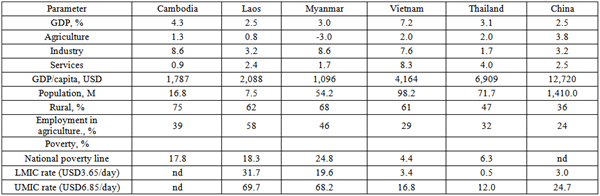
Cambodia, Laos, Myanmar and Vietnam (CLMV) are less developed economies of the six-country Greater Mekong Subregion (GMS) that also includes Thailand and China. Economic growth in CLMV was strong and robust before the pandemic (1995-2019), with annual gross domestic product (GDP) averaging 6.8-9.2% leading to increased incomes per capita and overall progress. 1, 2, 3, 4 During the pandemic (2020-2021), GDP plummeted but recovered quickly in 2022 (Table 1). Despite the significant success, economic differences persisted, with CLMV having much lower GDP per capita than Thailand and China. CLMV should sustain high economic growth to narrow the economic disparity between GMS countries. This has to be achieved in the face of political, technological, health and climate challenges, such as the Ukraine conflict and 2021 military takeover of government in Myanmar, the mainstreaming of Agriculture 4.0 digital technologies that could displaced workers, health uncertainty based on COVID-19 experience, and climate variabilities that could lead to socioeconomic difficulties.
The agrifood sector has made large contribution to poverty reduction in CLMV. Despite lower share in GDP than industry and services (Table 1), the agrifood sector remains a strong socioeconomic foundation as large segment of the population relied on it for food and livelihood. Further, the agrifood sector has an important role in shaping the growing relationship between CLMV, Thailand and China, particularly in the cross-border trade of agrifood products. With both the population and the poor of CLMV being predominantly rural, agrifood sector development is crucial to inclusive growth and social stability. The sustainability of the agrifood sector is intertwined with climate and environmental impacts. Climate change manifested as extreme weather and increased frequency of severe flooding and droughts as well as environmental degradation due to excessive agrochemical use, deforestation, and hydropower construction are serious threats which could lead to crop failures, agrifood system breakdowns, and increased marginalization of disadvantaged sectors, i.e. the smallholders, women, youth and indigenous people. Taking these factors into account is vital to building sustainable, resilient, and vibrant agrifood sector.
Food safety and food loss are key challenges of the agrifood sector in CLMV. Food safety is a complex problem, and there is still a long way to go in effectively addressing it but building awareness, capacities and enabling environment is a basic necessity. Food safety hazards have continued to grow and have become more complex. New organisms are adapting and becoming more deadly, causing crippling illness in the food chain. Commercial adulteration, evolving consumer attitudes and increasing pressure from a 24-hour social media are compounding the challenges faced by food producers and suppliers. The key challenge is that not all food safety management is created equal; supply chains are being managed to varying levels of food safety capability, often lacking the infrastructure and validation system necessary to keep pace with volume of trade. Lack of harmonization of food safety management also hinders the development and application of cohesive and standardized food safety standards and governance. All of this translates into tangible economic costs, which cannot be afforded by most business models, health systems or economies.
Food loss is an additional burden on today’s overstretched food supply and is indicative of poorly functioning and inefficient food systems. Not all food produced for human consumption is eaten. Around one third of the food produced in the world every year – about 1.3 billion tons – is lost or wasted, which otherwise could feed 2 billion people. 5 The lost food is equivalent to about one-fourth of the land, water and fertilizers used in production and produces greenhouse gas (GHG) emissions equivalent to 3.3 billion tons of CO2 per year, the third largest after the GHG emissions of China and USA. And much bigger challenges lie ahead. The world’s population is forecast to increase by 2 billion people and to exceed 9 billion by 2050. To meet the projected demand, global agricultural production will have to increase and food supply systems will have to be optimized in an unprecedented way. The world has to produce as much food in the next 30-40 years as it did the last 8,000 years, and if done without expanding into the environment, production must be doubled on the same piece of land, a very difficult task. Reducing food loss and assuring food safety are critical ways to feed the future.
Food safety and food loss reduction are core components of food security and are integral of sustainable and inclusive agrifood systems. Securing food safety advances health, livelihoods, trade, economic growth, and overall prosperity. Unsafe food has serious socioeconomic consequences, including lost productivity, lost income, lost markets, and lost food. Lost food has two dimensions – food loss (decrease in quantity and quality of food along supply chains) and food waste (consumable food discarded by retailers and consumers). Food loss due to food safety problem is sporadic but dramatic, phenomenal and devastating. Reducing food loss is a means towards achieving improved food security and nutrition, reduced GHG emissions, and lowered pressure on water and land resources; these contribute to increased productivity, economic growth and social progress.
Unsafe food and food loss are heavy burden of economies worldwide. In CLMV, food loss was estimated at 0.66-1.73% of GDP 6; GDP of CLMV in 2021 was about USD1,515 billion 7; thus, food loss has drained the CLMV economy over USD 12 billion in 2021 alone, which is much higher than the 2021 national budget of Cambodia and Laos. Food loss also worsens food insecurity. In fruits and vegetables, for example, total production in CLMV in 2021 was about 43.7 million tons but 17-40% or 28.5% on average are lost after harvest. 8 This loss is equivalent to about 12.5 million metric tons of fruits and vegetables which could have provided 205 grams/person/day for the 166.7 million people of CLMV or more than 50% of the World Health Organization’s recommended minimum fruit and vegetable intake (400 g/person/day) in order to reduce the risk of death and morbidity due to cancer, heart attack, diabetes, obesity, micronutrient deficiency (hidden hunger) and other chronic diseases. Global crises, such as the COVID-19 pandemic and climate change, exacerbate food loss due to massive disruptions and breakdowns of food systems. On the other hand, unsafe food costs about US$ 110 billion in lost productivity and medical expenses each year in low- and middle-income economies that include CLMV. 9 Other costs are difficult to quantify, including losses of sales at farmgate to retail; foregone markets and trade; repercussions of consumer avoidance of perishable yet nutrient-rich foods; and the economic and environmental burden of food loss.
Food safety-food loss nexus relates to interconnections between food safety and food loss reduction which may be opportunities (i.e. reducing food loss enhances food safety or vice versa) or challenges (i.e. reducing food loss compromises food safety or vice versa). Deliberate planning and action can convert challenges into opportunities and may lead to reprioritizing actions. In general, good food safety management reduces food loss; safe postharvest management prevents food safety problems. This direct association between food safety and food loss reduction exists in the entire food chain from production to consumption. However, significant research gaps remain. Most broadly, evaluations of policy and intervention effectiveness are needed to enable prioritizing and improving approaches for both food safety advancement and food loss reduction. Improved understanding and monitoring of causes of food loss and food safety problems would advance the implementation of interventions, increase accountability, and enable proper measurement of impacts of policies and programs.
Policies are key drivers of all actions. Creating right policies for food safety and food loss reduction is a prerequisite for rolling out actions towards realizing the agrifood sector’s potential to boost economic growth, reduce poverty and inequality, provide food security and nutrition, and deliver environmental services. The objectives of this work were to assess the food safety and food loss reduction policies and their implementation in CLMV; identify synergy and/or disconnect of food safety and food loss reduction policies; and recommend actions to strengthen the policies and their implementation.
A desk-research was conducted consisting of literature survey and study, and assembly and analysis of key facts and figures. Publicly available literatures on food loss reduction and food safety laws, policies or related instruments and their implementation in CLMV were accessed from online resources through google and other search engines and from soft file collections some of which were provided by CLMV country partners. Key overarching policies were also studied. Policies and laws are interrelated, though laws are formal system of rules and regulation while policies are informal as they are statements or documents of what is intended to be done and to achieve in the future; some policies lead to new laws. In this documentary study, policies are meant to include laws or legislations, decrees, sub-decrees, rules, regulations, proclamations, decisions, agreements, circulars, strategies, roadmaps, and other policy related documents. They are collectively referred to as enabling policy environment, also termed as policy agenda, policy landscape, or legal basis. Food loss and food waste are defined earlier. If not specified, food loss includes food waste. Food loss is also referred to in literatures as postharvest loss or loss of food quality. Any mention of food quality improvement is analogous to food loss reduction. Policies that consider both food safety and food quality/food loss reduction are taken to imply that one cannot be detached from the other, hence interconnected. Focus is on fruits and vegetables (horticultural crops) which are high-value nutrient-dense crops as they are the richest natural plant sources of vitamins, minerals, dietary fiber and phytochemicals, and they generate much more income and jobs than staple cereals.
The gathered information was reviewed and sifted, and relevant data were collated and assembled to comprise the substance of this report. The assembled information was analyzed to reveal strengths and deficiencies as well as interconnection or disconnect between food safety and food loss reduction policies and programs; and the impact of food safety system on food loss and vice versa. Finally, stakeholders’ consultation was conducted to validate the food safety and food loss reduction policies and clarify the operationalization of the policies.
The succeeding analysis section starts with transnational policies (global and regional) which usually trigger or strengthen country policies. Comparative cross-country analysis is presented before concluding with recommendations for future action.
International trends, policies and obligations shape national policies. The United Nations (UN) 2030 Agenda for Sustainable Development launched in 2015 reflects the growing understanding by Member States that a development model that is sustainable for this and future generations offers the best path forward for reducing poverty and improving lives of people everywhere. 10 It is critical that the international community meet the Sustainable Development Goals (SDGs). Food safety and food loss reduction are enshrined in SDG 2 and SDG 12, while the present initiative and strategic actions on food safety and food loss are also prescribed in SDG 17 11:
SDG 2 (End hunger, achieve food security and improved nutrition, and promote sustainable agriculture), Target 2.1 - By 2030, end hunger and ensure access by all people, in particular the poor and people in vulnerable situations, including infants, to safe, nutritious and sufficient food all year round. This target also relates to SDG 3 (Ensure healthy lives and promote well-being for all at all ages).
SDG 12 (Ensure sustainable consumption and production patterns), Target 12.3 - By 2030, halve per capita global food waste at the retail and consumer levels and reduce food losses along production and supply chains, including postharvest losses. Reducing food loss could potentially contribute to other SDGs, including SDG 1 (no poverty), SDG 2, SDG 13 (climate action), among others.
SDG 17 (Strengthen the means of implementation and revitalize the global partnership for sustainable development), particularly the following targets:
Target 17.9 - Enhance international support for implementing effective and targeted capacity-building in developing countries to support national plans.
Target 17.14 - Enhance policy coherence for sustainable development
Target 17.16 - Enhance the global partnership for sustainable development, complemented by multi-stakeholder partnerships that mobilize and share knowledge, expertise, technology and financial resources, to support the achievement of the SDGs in all countries, in particular developing countries
Pursuing the above SDGs, UN agencies prioritize food safety and food loss reduction in their strategic frameworks. The Food and Agriculture Organization (FAO) Strategic Framework 2022–2031 on Better Nutrition specified ‘Safe food for everyone’ and ‘Reducing food loss and waste’ as program priority areas. 12 FAO together with the World Food Programme (WFP), International Fund for Agricultural Development (IFAD) and UN Environment Programme (UNEP) pursues the Zero Hunger Challenge (SDG 2) with a 5th element on zero food loss/waste. 13
CLMV are members of the Association of Southeast Asian Nations (ASEAN). The ASEAN Economic Community (AEC) prioritizes food and agriculture as integration factors and its Strategic Plan for the Agriculture, Fisheries and Forest Sector (2016-2025) with food safety and food loss implications includes assisting small producers and SMEs (small and medium enterprises) to improve productivity, technology and product quality in order to meet global market standards and increase competitiveness; increasing demand for food traceability due to consumers concerns regarding food origin and safety; and maintaining the safety and quality of food products. 14
GMS cooperation initiatives usually place higher priority to CLMV being less developed economies. These initiatives include the GMS Economic Cooperation Program (GMS Program), Lancang-Mekong Cooperation (LMC), and Mekong Institute programs. The GMS Program Strategic Framework 2030 (GMS2030) aims to develop a more integrated, prosperous, sustainable, and inclusive subregion. 15 Food safety and food loss reduction are embedded in Pillar 3 (Competitiveness) for the agriculture sector. LMC singled out agriculture as a priority area, with strengthened cooperation on food security to build more sustainable agrifood system by reducing food loss, improving supply chain resilience, promoting cold chain logistics, facilitating policy exchanges and information sharing, enhancing public-private partnership and fostering production networks. 16 Mekong Institute, an intergovernmental organization of the six GMS countries, deepens regional cooperation and integration through capacity building, dialogue and advocacy to accelerate sustainable socioeconomic development and poverty alleviation. 17 Food safety and food loss reduction are part of its strategic initiatives on agriculture: Sustainable Food Systems; Value Chain Development; Postharvest Management; Climate-smart Agriculture; and Food Safety and Market Access.
3.2. National PoliciesOverarching policies. Cambodia’s Vision 2030 to become an upper middle-income country (similar to the current status of Thailand and China) by 2030 and Vision 2050 to become a high-income country (developed country) by 2050 are ultimate goals enshrined in the Royal Government of Cambodia (RGC) Rectangular Strategy-Phase 4 (2019-2023). 18 The Strategy highlights the need to diversify the economy and establish more economic pillars by increasing value addition in agriculture and promoting agro-industrial development. The National Strategic Development Plan (NSDP) is RGC’s second most important policy instrument and is the roadmap for the implementation of the RGC’s Political Platform and the Rectangular Strategy. NSDP 2019-2023 prioritizes the promotion of agriculture sector and rural development by strengthening the role of the agriculture sector in generating jobs, ensuring food security, reducing poverty, and developing the rural areas. 19 Priorities with implication on food safety and food loss reduction include improving productivity, quality, and diversification through increased investments in R&D for high value crops, livestock and aquaculture; model farm development; upgraded processing industry; farming diversification aimed at substituting imports and establishing clean and hygienic wholesale vegetable markets; and better application of Sanitary and Phytosanitary system. To implement the RGC’s priority policies on agriculture, the Ministry of Agriculture, Forestry and Fisheries (MAFF) operationalizes the Agriculture Master Plan 2030 with a vision of a modern agriculture sector that is competitive, inclusive, resilient and sustainable to contribute to food security and nutrition for prosperity and wellbeing of Cambodian people. 20 MAFF Crop Master Plan 2030 envisions Cambodia as a reliable source of high quality, safe, and competitive crops in the global economy while ensuring sufficient volumes of safe food to meet food and nutrition security of its own citizens in a sustainable and climate resilient way. 21 Priority value chains are rice, maize, cassava, mungbean, mango, cashew, pepper and vegetables.
Food safety policies. A new Law on Food Safety was enacted as Royal Kram No. NS/RKM/0622/006 on June 8, 2022. 22 It sets out the framework and mechanisms for managing and ensuring safety, quality, hygiene and legitimacy of food in all stages of the food chain. The law deals on managing both food safety and food quality (food loss reduction) at all stages of the food chain, suggesting one cannot be detached from the other, hence both are linked. The law further stipulates that all pre-packaged foods must have labelling that meets Minimum Food Requirements, Food Requirements, and other laws and regulations on labelling. Khmer food labelling with traceable information is the most impactful immediate change of this law, which was not standard practice in the market. The requirement for nutritional values and calories on food labelling is also a substantial change, which will contribute greatly to consumer protection and fairer playing field for businesses.
Implementation of food safety law is led by MOC. At least four other ministries will most likely be involved – MAFF, Ministry of Health (MOH), Ministry of Economy and Finance (MEF) and Ministry of Industry, Science, Technology and Innovation (MISTI), based on the 2010 Prakas (official proclamation or ministerial decision) on the Implementation Arrangements of Food Safety Based on Farm-to-table Approach. An Inter‐Ministerial Committee coordinates the activities of the ministries.
Other food safety-related policies precede the new food safety law and the fate of some hangs in the balance even because of overlapping provisions:
Law on the Management of Quality and Safety of Products and Services (2000) - covers inspection procedures to ensure quality and safety of products, goods, and services as well as guidelines on production and commercialization, consumers' rights and economic operators' obligations, labeling, commercial fraud repression, etc. – This may be sustained if it covers only non-foods.
Law on Standards of Cambodia (2007) - seeks to improve the quality of products and services to (a) raise production efficiency, (b) ensure fair and simplified trade, (c) rationalize product use, and (d) enhance consumer protection and public welfare – This supports the food safety law relative to standards.
Law on Management of Pesticides and Fertilizers (2012) - aims to enhance public awareness on the implementation of standard requirements of pesticides and fertilizers – This supports the food safety law.
Sub-decree on Hygiene of Food for Human Consumption (2013) – aims to. establish hygiene standards for food produced for human consumptions; some provisions may overlap with the food safety law.
Food safety management systems are specific to certain stage in the agrifood chain. MAFF has issued Prakas 99 of 2010 on Good Agricultural Practice (GAP) promoting Cambodia GAP (CamGAP) standards for fruit and vegetable production. CamGAP adapted the ASEAN GAP standards and has four modules: Food Safety, Produce Quality, Environmental Management, and Workers Health, Safety and Welfare. 23 MAFF Prakas 163 (2020) on organic agriculture (OA) aims to ensure organic products are of good quality and safe for human consumption. 24 Third party certification is required which is costly. As a low-cost smallholder-friendly quality assurance system for organic produce, the Participatory Guarantee Systems (PGS) has been adopted. 25 In addition, Cambodia has a law on Geographical Indications (GI) (NS/RKM/0114/006) to protect consumers and the intellectual property rights of producers and operators, in addition to preserving and strengthening the traditional knowhow and national identity, and to reduce poverty. 26 GI identifies products as originating from a particular location and produced using particular materials and methods, which convey a special quality, reputation or other characteristic, and includes food safety assurance among elements of production and supply. Cambodia GI products include Kampot pepper, Kampong Speu palm sugar and Koh Trung pomelo. MAFF’s General Directorate of Agriculture implements and manages GAP, OA and PGS while MOC manages GI.
Food loss reduction policies. Cambodia has no separate policy dedicated to food loss reduction. Food loss reduction is embedded in overarching policies, food safety law, and food safety management systems. In 2021, the Food Systems Summit in Cambodia came up with the Roadmap for Food Systems for Sustainable Development 2030 with a vision that by 2030, all Cambodians will have access to healthy diets and safe food, with an initial focus on women and children, to break the intergenerational cycle of malnutrition and address the nutrition transition. 27 Implied in this vision are assuring food safety (access to safe food) and reducing food loss (strengthen local production and distribution) as specified in 3 of the 4 priority thrusts: (1) Healthy diets for all; (2) Resilient livelihoods and resilient food systems; and (3) Governance for a more inclusive food system.
The game changing actions for Cambodia lie in innovation and value adding for agricultural production, agro-ecological transformations, and food safety and quality improvement. A number of national and sectoral strategies come to an end in 2023, offering an opportunity to align these frameworks in the next iteration with a broader food systems approach.
Overarching policies. The Government of Laos (GOL) unfurled in 2016 its Vision 2030 and Ten-year National Socio-Economic Development Strategy 2016-2025 (NSEDP). 28 Vision 2030 is for Laos to become an upper middle-income country by 2030, with innovative, green and sustainable economic growth, availability of industrial pillars, and strong basic infrastructure system to support industrialization and modernization. NSEDP aims for Laos to graduate from Least Developed Country (LDC) status by 2020 and to transition after LDC graduation up to 2025. The current 9th Five-year NSEDP 2021-2025 integrates food safety and food loss reduction in some priority activities for Outcome 1 outputs: Output 1 - promoting GAP and organic farming for domestic consumption and tourism attraction, and establishing higher food safety standards; and Output 4 - improving business management practices, access to markets and sources of funding, scientific and technological knowhow and innovative local knowledge, and packaging and labelling to improve product quality and competitiveness, and encouraging large companies and MSMEs to strengthen the communities’ capacity to improve the quality of people’s production to be able to integrate into the value chain. 29
Based on GOL’s Vision 2030 and NSEDP, the Ministry of Agriculture and Forestry (MAF) formulated the Agriculture Development Strategy to 2025 and Vision to the Year 2030. 30 The vision is ensuring food security, producing comparative and competitive potential agricultural commodities, developing clean, safe and sustainable agriculture, and shifting gradually to the modernization of a resilient and productive agriculture economy, linking with rural development and contributing to the national economic basis. Food safety is explicit in the vision, and both food safety and food loss reduction are figured out in two technical measures: (1) clean agriculture production and food safety and (2) food security and nutrition.
Food safety policies. Food safety is integrated in the above overarching policies. Also, a separate food safety law (Law on Food 2013) replaces the 2004 Law on Food and cancels three regulations of the Ministry of Public Health (MOPH) - National Food Safety Policy 2009, Basic Principles in the Application of Sanitary and Technical Measures for the Food Safety Management 2009, and Food Inspection Regulations 2012. 31 Consisting 87 articles in 9 parts, the Food Law defines principles, regulations and measures on management, monitoring and inspection of food and food business to ensure quality, effectiveness, safety and nutrition; protect consumers’ health; promote food business; and contribute to protection and development of the nation. The Food Law’s Article 4 on Food Policy declares that the State promotes domestic and foreign individuals, legal entities and organizations to invest in food businesses, whether traditional or international, in the areas of manufacturing, processing, serving, storage, distribution and transport of food to meet domestic consumption and for export. The State should provide information to citizens on the consumption of safe, quality and nutritious food; and provide facilities, personnel, vehicles and financial support for food management activities as appropriate. This Article is clear that the law covers both food safety and food loss reduction (quality food) of nutritious foods such as fruits and vegetables.
Some provisions of the Law on Hygiene, Disease Prevention and Health Promotion 2011 32 may overlap with some provisions of the Food Law 2013. Hygiene of Food and Consumer Goods (Article 15) stipulates maintaining cleanliness and safety of foods from microbes, parasites and toxic chemical substances with harmful effects to health and physical growth in human life. Hygiene of Production (Article 21) stipulates ensuring the conditions and standards in the production of consumer goods to be free from germs and toxic chemical residues. However, since MOPH leads the implementation of this law and the Food Law 2013, it can program and harmonize the activities to avoid or minimize duplication.
The Food and Drug Management Committee implements the food law and consists of MOPH (Chair), MAF, Ministry of Industry and Commerce (MOIC), Ministry of Science and Technology (MOST), Ministry of Finance (MOF), Ministry of Planning and Investment (MOPI), Ministry of Information, Culture and Tourism (MICT), Ministry of Public Security (MOPS), representatives of relevant Committees of National Assembly, Chiefs of Cabinets or Director Generals of Departments. Another committee takes charge of food safety management and is centrally carried out with MOPH as the responsible agency.
On the production side, food safety management systems include GAP, OA, PGS and GI. LaoGAP standards aligned with the ASEAN GAP similar to that of CamGAP, with the food safety and produce quality modules respectively addressing food safety and food loss reduction for fruit and vegetable production. 33 Traceability, record keeping, labelling and certification are parts of the standards. OA standards are based on IFOAM Basic Standards governing management, harvesting and processing stages. 34 Articles 20-24 relate to postharvest handling and storage to maintain quality and safety and reduce losses of organic products. PGS standards are also based on IFOAM standards. 35 Further, Laos is a member of Geneva Act of Lisbon Agreement on Appellations of Origin and Geographical Indications since 2020 and has GI regulation since 2016, protected under the Law on Intellectual Property and MOIC Ministerial Decision. 36 GI products include tea (Phongsaly and Champasak Provinces), rice (Houaphan and Xieng Khouang Provinces), and coffee (Champasak). GAP, OA and PGS are implemented by MAF while GI by MOIC. HACCP certification is provided by third party, such as Certvalue which provides services from implementation and registration to audit, following ISO 22000 scheme and requirements of Codex Alimentarius Commission. 37
Food loss reduction policies. Laos has no separate policy for food loss reduction similar to Cambodia. Food loss reduction is embedded in the overarching policies. Food safety policies (Food Law, GAP, OA, PGS, GI) have food quality provisions that correspond to food loss reduction. Food loss reduction (SDG 12.3) is part of sustainable food systems and recent evaluation in meeting SDG 12.3 revealed that Laos is in good alignment between indicator, responsible entity, and targets. 38 As part of developing sustainable food systems, the 2021 Food Systems Summit in Laos came up with four thematic priorities integrating food safety and food loss reduction: (1) Ensuring safe and nutritious food for all, (2) Boosting nature-positive food production, (3) Advancing equitable livelihoods and value distribution, and (4) Building resilience to vulnerabilities, shocks and stresses. 39
Overarching policies. The Government of Myanmar (GOM) has two overarching policies; the National Comprehensive Development Plan 2010-2011 to 2030-2031 (NCDP) 40 and Myanmar Sustainable Development Plan 2018-2030 (MSDP) 41, both came into effect before the military takeover in 2021. NCDP vision is for Myanmar to become a prosperous country integrated into the global community, supported by strategic thrusts in economic development, environmental protection, and the strengthening of governance and public institutions. MSDP, launched in 2016, encapsulates the overall framework that guides Myanmar’s economic and social development. Its vision is to achieve inclusive and continuous development. It aims to establish an economic framework that supports national reconciliation, based on the just balancing of sustainable natural resource mobilization and allocation across the States and Regions. In both policies, agriculture figured out prominently as people depend on it for food, income and survival.
Myanmar Agriculture Development Strategy and Investment Plan 2018-2023 has a vision of an inclusive, competitive, food and nutrition secure and sustainable agricultural system contributing to the socioeconomic wellbeing of farmers and rural people and further development of the national economy. 42 The strategy has three objectives corresponding to the three pillars. The pillar on Productivity (Increased productivity and farmers’ income) promotes GAP and other safe production systems, such as OA, while the pillar on Competitiveness (Enhanced market linkages and competitiveness) specifies enhanced food quality and safety as an outcome.
Food safety policies. The National Food Safety Policy was officially introduced in April 2022. 43 This was based on the 1997 National Food Law 44 which was amended 16 years later when the 2013 Law Amending the National Food Law was promulgated. 45 The most significant amendment was the composition of Myanmar Food and Drug Board of Authority (MFDBA) as the implementing body led by the Ministry of Health and Sports (MOHS) together with Ministry of Agriculture, Livestock, and Irrigation (MOALI), Ministry of Commerce (MOC), Ministry of Planning, Finance and Industry (MOPFI) and Ministry of Education (MOE). MFDBA functions include laying down policy relating to production, storage, distribution, sale of food; determining Good Manufacturing Practice (GMP) with respect to quality assurance of food; laying down policies for inspection, control and laboratory analysis of food; and coordinating with relevant Ministries with respect to import and export of food for the safety of consumers. The Department of Food and Drug Administration (DFDA) is the enforcement unit of MOHS conducting regulatory, inspection and advisory services. DFDA also implements GMP and HACCP.
Policies on GAP 46 and OA 47 of fruits and vegetables were similar to that of Cambodia and Laos. They are implemented by MOALI through its Department of Agriculture. OA can be certified by third party (e.g. Myanmar Organic Agriculture Association). MOALI also implements PGS, with vegetables, fruits and coffee as main products. 48 GI is protected under the Trademark Law managed by Ministry of Science and Technology (MOST). 49 Some GI products include honey melon, mango, watermelon and tea.
Food loss reduction policies. Food loss reduction has no separate law or policy, similar to that in Cambodia and Laos. It is embedded in the agriculture development strategy. Both food safety and food loss reduction are outcomes of the following priority programs of the Myanmar sustainable food systems roadmap: (1) Ensure access to safe and nutritious food for all – through upscaling cold chain technology; increasing access to nutritious food (upscaling nutrition improvement and awareness programs, increasing availability of nutritious food, strengthening agrifood industries); and making food safer by strict enforcement of food safety protocols, strengthening legal and regulatory frameworks, capacity and institutional development; (2) Shift to sustainable and healthy consumption pattern – through food loss and waste reduction; creating favorable food environment by developing food system framework and promoting nutrition education; and raising awareness of sustainable food systems; and (3) Build resilience to vulnerabilities, shocks and stresses – through ensuring continued functionality of sustainable food systems in areas that are prone to conflict, climate change, environmental decay, natural disasters, and health and economic shocks; and supporting existing all-inclusive coordination and partnerships within existing architecture to facilitate joint advocacy, decision-making, policy and programming. 50
Overarching policies. The Government of Vietnam (GOV) pushes Vision 2035 declaring the country’s aspiration to modernity, industrialization, and a higher quality of life and to become a modern, industrialized economy. 51 This is embedded in the Socio-Economic Development Strategy 2021–2030, operationalized by 5-year Socio-Economic Development Plans; both are benchmarks of sectoral strategies and plans. The agriculture sector is Vietnam’s advantage and sustainable foundation, and modernizing and commercializing agriculture is critical to industrialize more deeply. The Sustainable Agriculture and Rural Development Strategy 2021-2030 Vision to 2050 pursues the objective of building commodity-based agricultural sector while developing specific agriculture plans based on local advantages, with high productivity, quality, efficiency, sustainability; increasing competitiveness to make Vietnam a leading country in the region and in the world. 52 The Agriculture Development Plan 2021−2025 forges the following objectives: (1) continue the agricultural restructuring and transformation toward sustainable agricultural development and increase in quality, added value, and agricultural competitiveness; (2) protect the environment and ecology; (3) improve the income for people in rural areas; (4) ensure food security and national defense; and (5) promote the development of modern agriculture, clean agriculture and OA linked to agricultural processing industry, adapting to climate change and sustainably connecting with global agricultural value chains. 53 Food safety and food loss reduction are priorities with supporting laws and decrees.
Food safety policies. Law on Food Safety 2010 54 and Decree 5/2018 Regulating the Implementation of a Number of Articles of the Law on Food Safety 2018 55 are the current policies. The food safety law has 11 chapters and 72 articles; and has implied the inclusion of food quality (food loss reduction) in Article 4 (State policies on food safety) No. 3 - encourage food producers and traders to renew technologies and expand their production: to produce high-quality and safe food. Other than this, the law has no provisions about food quality. Decree 5/2018 implements provisions of the food safety law, including procedures for product declaration and self-declaration; assurance of genetically engineered food; inspection of imported and exported food; food labelling; food advertisement; and traceability, among others. To conform to international commitments under SPS Agreements for WTO-member countries, Prime Minister Decision 147/2008 sets out the National Action Plan on Acceleration of the Implementation of Commitments under the Agreement on the Application of Sanitary and Phytosanitary Measures in Performing the WTO Member Obligations. 56 Several food safety management systems have been mainstreamed, including GAP (VietGAP), OA, PGS organic, GMP, HACCP and GI.
The food safety laws are implemented by three ministries with functions delineated by product assignment: (1) Ministry of Health (MOH) - bottled waters, mineral water, functional foods, food additives, flavors, and food processing aids; (2) Ministry of Agriculture and Rural Development (MARD) - cereal, meat, poultry, seafood, fruits and vegetables, eggs, raw milk, honey, GE food, spice, sugar, tea, coffee, cocoa, pepper, cashew, and other agricultural products (production to primary processing and marketing); and (3) Ministry of Industry and Trade (MOIT) - flour, starch, dairy products, vegetable oils, confectionary, beer, alcohol and alcoholic drinks, soft drink (secondary processing). The Ministry of Science and Technology (MOST) has supporting role of setting food safety standards. However, this function could be given to the three implementing ministries for standard setting for their assigned commodities. MOST and universities can provide research and technical backstopping but this has to be coordinated with the research units of the three implementing agencies (e.g. MARD’s Fruit and Vegetable Research Institute).
MARD implements VietGAP 57 and OA 58. VietGAP follows the ASEAN GAP similar to the other three countries. VietGAP undergoes constant upgrading to meet international standards. The same holds for the OA standards which were revised by MOST in 2018. As the cost of OA certification is prohibitive, PGS organic is being promoted; several products are PGS certified, including vegetables, fruits, rice, arrowroot, coconut and peanut oil. 59 GI products are protected under the Intellectual Property Law administered by MOST. 60 GI products include Bac Giang/Luc Ngan Thieu litchi, Dong Thap mango, Son La longan, and Binh Thuan dragon fruit. In the absence of national standards, international, regional and foreign standards are adopted based on the MARD Circular 7/2015. 61
Food loss reduction policies. Unlike food safety, food loss reduction has no dedicated law. Nevertheless, Vietnam is the first ASEAN country to commit and implement the National Action Plan for Zero Hunger by 2025, which included the national target of zero food loss and waste. 62 On March 28, 2023, Prime Minister Decision 300/QD-TTG promulgated the National Action Plan to Transform Food Systems Towards Transparency, Responsibility and Sustainability in Vietnam by 2030, with targets on food loss reduction (postharvest losses of key agricultural products decrease by 0.5-1.0%/year) and food safety (increase in planting area with codes such as VietGAP and OA; organic fertilizer is over 30% of fertilizer supply in the market; organic fertilizer use in agricultural production increases by more than 2 times that in 2020; value added products under GMP or equivalent is over 30%; acute poisoning is below 5 people/100,000 population; more than 50% of enterprises in agroforestry-fishery value chains are connected to the National Products and Goods Traceability Portal). 63
3.3. Comparative AnalysisCLMV’s overarching policies are well rationalized, with visions translated into strategies and plans of measured actions as detailed previously and summarized in Table 2. All policies integrated explicitly or implicitly both food safety and food loss reduction to create safe and sufficient food sustainably. CLMV countries have also advanced in food safety policy making as all existing national food safety laws (or food law or national food safety policy) are updated versions of old ones. Laos, with the oldest food safety law (2013), may need to study and update the food law or promulgate a new law on food safety (replacing the food law) consolidating current and emerging food safety developments and harmonizing with the CMV laws and global trends.
CLMV did not differ much in the other food safety parameters, except in implementation. Cambodia has different lead implementing ministry (commerce) than Laos, Myanmar and Vietnam (health). Because of the multi-disciplinary, multi-sector, multi-commodity nature of food safety, many ministries are involved. Multi-ministry implementation is challenging due to variable food safety capacities, duplication of regulatory activities, poor enforcement and surveillance, and poor coordination. Mechanisms to unite these different ministries are in place in the form of interministerial committee (Cambodia and Vietnam) which may be less rigid than an empowered management board (Laos and Myanmar). Vietnam is very clear in delineating the functions of the 3 involved ministries based on commodity assignment. Dividing food safety responsibilities among different ministries is good but food safety efforts may sometimes be disjointed due to lack of clarity and overlap in responsibilities of each. ministry. Additionally, while one ministry may be responsible for a certain stage of production, this responsibility may be further subdivided into different departments within the same ministry. Thus, some food safety efforts may be uncoordinated in certain cases and duplicative in others as different ministries have different protocols and standards for testing similar products.
GI implementation differed, with MOC or MOIC as lead agency in Cambodia and Laos and MOST in Myanmar and Vietnam. GI is protected by different laws, a specific law on GI in Cambodia, IPR law in Laos and Vietnam, and Trademark law in Myanmar. GI is being promoted in CLMV as it can add value to products and help producers to become more competitive. This responds to increasing consumers’ demand for information regarding place of origin, production method and characteristics of products.
Food loss reduction is addressed as part of national action plans of CLMV governments. No country has a legislation for food loss reduction. Food loss/waste reduction law is probably the most decisive measure to sustain food supply for the growing population which has to be nourished with dwindling arable lands, expanding degraded lands, and global threats of economic, political, health and climatic disorders. Also, the right to food is a basic human right and reducing food loss is an imperative morality. 64 It is morally wrong to waste food while 828 million people are hungry and 2.3 billion people are food-insecure. 65 Further, lost food means wasted opportunities to earn more, to feed more people, to save resources used in production, and to reduce emissions and slow earth’s warming.
Vietnam is the only CLMV country which has a ministerial proclamation that includes food loss reduction as a target for action as well as a national action plan for the zero-hunger challenge that includes zero food loss and waste (Table 2). This could be used as a springboard for enacting a law on food loss reduction which can serve as a model for the other three countries.
Assuring food safety and reducing food loss in CLMV take the value chain approach. No country has taken the nexus approach which could reinforce the value chain approach to achieve two targets – assuring food safety and reducing food loss. Both food safety and food quality are addressed in the food safety law of Cambodia and Laos and in the codes of practice (GAP, OA, PGS and GI) in CLMV. The main target is food safety while food quality protection is designed to reduce loss in quality and quantity of safety-assured food. The apparent disconnect between food safety and food loss reduction need better coordination of policies. Monitoring of food safety hazard and food loss in agrifood chains should be synchronized.
The sustainable food systems roadmap of CLMV governments puts equal emphasis on food safety and food loss reduction but they are addressed separately rather than collectively. Thus, synergistic or antagonistic relationship between food safety and food loss reduction cannot be drawn. It appears that the relationship is cumulative or the total of the benefits from food safety intervention plus the benefits from food quality maintenance that reduces food loss. In many cases, efficient food safety system reduces food loss while efficient technologies to reduce food loss reduces food safety problems. For example, the sanitizing food safety protocol to reduce microbiological hazard, could also reduce microbiological spoilage of produce. The cold chain technology for produce quality maintenance can benefit both food safety and food loss reduction.
Overall, CLMV policymakers and implementers have increased knowledge and focus on food safety and food loss reduction but policies and practice need to be harmonized for an optimal approach to producing more safe food. Down the produce value chain, value chain actors may lack the capacity and resources to engage in activities that ensure food safety and reduce food loss.
Food safety is a legislated national agenda in CLMV but its implementation involved several ministries which creates problems related to variable, inconsistent and uncoordinated actions. To achieve a unified approach to food safety, a national food safety agency could be created, possibly merging the food safety units or functions of the ministries and other agencies involved. A dedicated single agency with nationwide responsibility operates in other countries.
Food loss reduction is embedded in policies which may or may not be strictly followed unlike laws. Enacting a legislation on food loss reduction can elevate its necessity and urgency and could accelerate and perpetuate the elimination of food loss as a crucial step to feed the future. Laws on food loss/waste reduction in other countries (e.g. China, Japan, South Korea, Peru, Colombia, Moldova, France, Italy and USA) can be used as reference. Key policy messages for such legislation include the following: (1) food loss must be drastically reduced, if not totally prevented. Investing in prevention result in more safe and nutritious food for human consumption than investing only in increasing food production; (2) food loss represents economic losses for all actors along agrifood chains, including end consumers; (3) food loss represents a highly inefficient use of resources (e.g. labor, water, energy and land) as well as avoidable climate and social impacts; and (4) tackling food loss is a defined target within the internationally agreed SDGs and a key component of the Zero Hunger Challenge. The drivers for change are evidence-based policies that facilitate the identification of targeted incentives, regulatory frameworks and investment actions. Processes that engage jointly the public sector, private sector and civil society will facilitate target setting, raise awareness, focus efforts, mobilize resources and guarantee actions. The food loss reduction law could be implemented by the agriculture ministry with strong linkage with the food safety agency to operationalize the save food-safe food nexus strategy to food system development. Interventions and investment actions should be harmonized in order to deliver the twin objectives of ensuring food safety and reducing food loss.
The authors gratefully acknowledge the funding from the New Zealand Aid Programme for the project on Promoting Safe Food for Everyone (PROSAFE).
The authors declare no conflict of interest.
| [1] | ADB (Asian Development Bank), Key indicators for Asia and the Pacific 2023 (54th edition), Manila, 2023, Available: www.adb.org/ sites/default/files/publication/900716/ki2023.pdf. | ||
| In article | |||
| [2] | World Bank, Macro Poverty Outlook: Country-by-country Analysis and Projections for the Developing World (East Asia and the Pacific), 2022, Available: https:// thedocs.worldbank.org/ en/doc/77351105a334213c64122e44c2efe523-0500072021/ related/mpo-am22-eap.pdf. | ||
| In article | |||
| [3] | World Bank, Open Data for Cambodia, Laos, Myanmar, Thailand, Vietnam, China, 2024, Available: https:// data.worldbank.org/? locations=KH-LA-MM-TH-VN-CN. | ||
| In article | |||
| [4] | World Bank, Open Data - Employment in agriculture (% of total employment) (modeled ILO estimate), 2024, Available: . | ||
| In article | |||
| [5] | FAO (Food and Agriculture Organization of the United Nations), The State of Food and Agriculture 2019. Moving forward on food loss and waste reduction, Rome, 2019, Available: www.fao.org/news/story/en/item/196402/icode/. | ||
| In article | |||
| [6] | Jaroensathapornkul, J., “Value of food loss in ASEAN countries and its relationship with economic growth”, International Journal of Agricultural Technology, 17(1). 115-128. 2021. | ||
| In article | |||
| [7] | World Bank, Open Data on GDP, PPP (current international $) - Myanmar, Cambodia, Lao PDR, Viet Nam, 2024, Available: https://data.worldbank.org/indicator/NY.GDP.MKTP.PP.CD?locations=MM-KH-LA-VN. | ||
| In article | |||
| [8] | FAO, FAOSTAT data on selected countries and crops in 2021, Available: www.fao.org/faostat/en/#data/QCL. | ||
| In article | |||
| [9] | World Bank, The safe food imperative: Accelerating progress in low- and middle-Income countries, 2019, Available: . | ||
| In article | |||
| [10] | United Nations, Support Sustainable Development and Climate Action, n.d., Available: www.un.org/en/our-work/support-sustainable-development-and-climate-action. | ||
| In article | |||
| [11] | United Nations, The 17 Goals, n.d., Available: https:// sdgs.un.org/goals. | ||
| In article | |||
| [12] | FAO, Strategic Priorities for Food Safety within the FAO Strategic Framework 2022–2031, Rome, 2023, Available: www.fao.org/3/cc4040en/cc4040en.pdf. | ||
| In article | |||
| [13] | United Nations, Goal 2: Zero Hunger, n.d., Available: www.un.org/en/zerohunger. | ||
| In article | |||
| [14] | ASEAN (Association of Southeast Asian Nations), ASEAN Economic Community 2015: Progress and Key Achievements, ASEAN Secretariat, Jakarta, 2015, Available: www.asean.org/ storage/images/2015/November/aec-page/AEC-2015-Progress-and-Key-Achievements.pdf. | ||
| In article | |||
| [15] | ADB, The Greater Mekong Subregion Economic Cooperation Program Strategic Framework 2030, Manila, 2021, Available: gms-economic-cooperation-strategic-framework-2030.pdf. | ||
| In article | |||
| [16] | LMC (Lancang-Mekong Cooperation), Five-Year Plan of Action on LMC (2023-2027), LMC Secretariat, Beijing, 2023, Available: /www.lmcchina.org/eng/2024-03/11/content_42720837.html. | ||
| In article | |||
| [17] | Mekong Institute, Strategic Plan 2021-2025, Khon Kaen, 2021, Available: https:// mekonginstitute.org/wp-content/ uploads/ 2023/04/MI_Strategic_Plan_2021-2025.pdf. | ||
| In article | |||
| [18] | RGC (Royal Government of Cambodia), Rectangular Strategy for Growth, Employment, Equity and Efficiency: Building the Foundation Toward Realizing the Cambodia Vision 2050 Phase IV of the Royal Government of Cambodia of the Sixth Legislature of the National Assembly 2018-2023, Phnom Penh, 2018, Available: http:// cnv.org.kh/ wp-content/ uploads/2012/10/ Rectangular-Strategy-Phase-IV-of-the-Royal-Government-of-Cambodia-of-the-Sixth-Legislature-of-the-National-Assembly-2018-2023.pdf. | ||
| In article | |||
| [19] | RGC, National Strategic Development Plan 2019-2023, Phnom Penh, 2019, Available: https://cambodiancorner.com/wp-content/uploads/2021/02/nsdp-2019-2023_en.pdf. | ||
| In article | |||
| [20] | MAFF (Ministry of Agriculture, Forestry and Fisheries), Agricultural Master Plan 2030: Strategic Framework for Agricultural Sector Development toward 2030, MAFF Department of Planning and Statistics, Phnom Penh, 2017, Available: https://web.maff.gov.kh/documents/gQMqjQBOBX?lang=en. | ||
| In article | |||
| [21] | MAFF, Development of master plan for crop production in Cambodia by 2030-Final report. Phnom Penh, 2016, Available: www.ecolex.org/es/details/legislation/master-plan-for-crop-production-in-cambodia-to-2030-lex-faoc173300/. | ||
| In article | |||
| [22] | RGC, Law on Food Safety, Phnom Penh, 2022, Available: www.jetro.go.jp/view_interface.php?blockId=33978606. | ||
| In article | |||
| [23] | MAFF, GAP Implementation in Cambodia and National Roadmap for Cambodian Good Agricultural Practices (CamGAP 2017-2021), MAFF General Directorate of Agriculture, Phnom Penh, Available: www.adelaide.edu.au/ global-food/ ua/media/ 190/Roadmap_CamGap_and _CamOrganic.pdf. | ||
| In article | |||
| [24] | Food Navigator Asia, “Competitive edge: New organic legislation and logo in Cambodia aims to reform local market”, Cambodia Daily, May 21, 2020, Available: https:// english. cambodiadaily.com/ business/competitive-edge-new-organic-legislation-and-logo-in-cambodia-aims-to-reform-local-market-164343/. | ||
| In article | |||
| [25] | IFOAM (International Federation of Organic Agriculture Movements) Organics International, Participatory Guarantee System Worldwide-Cambodia, Available: pgs_groups/map?utf8=%E2%9C%93&filter=&status_filter=& country_filter=Cambodia. | ||
| In article | |||
| [26] | RGC, Cambodia Law on Geographical Indications (NS/RKM/0114/006), Phnom Penh, 2014, Available: www.fao.org/faolex/results/details/en/c/LEX-FAOC175709/. | ||
| In article | |||
| [27] | CARD/TWG-FSN (Council for Agricultural and Rural Development/Technical Working Group for Food Security and Nutrition), Cambodia’s Roadmap for Food Systems for Sustainable Development 2030, Phnom Penh, 2021, Available: . | ||
| In article | |||
| [28] | GOL (Government of Laos), Vision 2030 and 10-Year Socioeconomic Development Strategy 2016-2025, Vientiane, 2016, Available: https:// rtm.org.la/ wp-content/ uploads/ 2017/08/ Vision2030-and-10-Year-SocioEconomic-Dev-Strategy-2016_2025-LAO.pdf. | ||
| In article | |||
| [29] | GOL, 9th Five-year National Socioeconomic Development Strategy 2021-2025, Vientiane, 2021, Available: https:// effectivecooperation.org/ content/ lao-national-socio-economic-development-plan-2021-2025. | ||
| In article | |||
| [30] | MAF (Ministry of Agriculture and Forestry), Agriculture Development Strategy to 2025 and Vision to the year 2030, Vientiane, 2015, Available: www.maf.gov.la/wp-content/uploads/ 2016/01/MDS-2025-and-Vision-to-2030-Eng.pdf. | ||
| In article | |||
| [31] | GOL, Law on Food, Vientiane, 2013, Available: https:// micor.agriculture.gov.au/Dairy/Documents/Pdfs/Lao_draft_food_law.pdf. | ||
| In article | |||
| [32] | GOL, Law on Hygiene, Disease Prevention and Health Promotion (Amended), Vientiane, 2011, Available: www.vertic.org/wp-content/uploads/2022/04/LA_Law_Hygiene-disease-prevention_ Amended-2011_EN.pdf. | ||
| In article | |||
| [33] | MAF, Agreement No. 0115/MAF of the Minister on Good Agriculture Practices for Food Safety Standard, Vientiane, 2011, Available: https:// leap.unep.org/ en/countries/la/national-legislation/agreement-no-0115maf-minister-good-agriculture-practices-food. | ||
| In article | |||
| [34] | MAF, Decision of the Minister of Agriculture and Forestry on Organic Agriculture Standards, Vientiane, 2005, Available: https://faolex.fao.org/docs/pdf/lao141126.pdf. | ||
| In article | |||
| [35] | IFOAM Organics International, Participatory Guarantee System Worldwide-Laos, Available: map?utf8=%E2%9C%93&filter=&status_filter= & country_ filter=Laos. | ||
| In article | |||
| [36] | WIPO (World Intellectual Property Organization), Laos Products expected to Benefit from GI Registration, 2023, Available: www.wipo.int/en/web/ip-advantage/w/stories/thailand-leads-the-way-to-gi-registration-in-asean-countries. | ||
| In article | |||
| [37] | Certvalue. HACCP Certification in Laos, Vientiane, 2022, Available: www.certvalue.com/haccp-certification-in-laos/. | ||
| In article | |||
| [38] | AEF (Asia-Europe Foundation), Sustainable Consumption and Production in the Lao PDR after the Voluntary National Review: Policy Options for Effective Implementation and Monitoring, 2019, Available: https://asef.org/publications/sustainable-consumption-and-production-in-lao-pdr-after-the-voluntary-national-review/. | ||
| In article | |||
| [39] | UN Lao PDR, Synthesis Report: Pathways to Sustainable Food Systems. Food Systems Summit 2021: Member State Dialogues in Lao PDR, Vientiane, 2021, Available: sites/ default/files/2021-07/Synthesis%20Report_FSS_22072021.pdf. | ||
| In article | |||
| [40] | GOM (Government of the Republic of the Union of Myanmar), National Comprehensive Development Plan 2010-2011 to 2030-2031, Nay Pyi Taw, 2014, Available: https:// myanmarbookshop.com/PDF/Contents/NationalComprehensivePlan2030.pdf. | ||
| In article | |||
| [41] | GOM, Myanmar Sustainable Development Plan (2018 – 2030), Nay Pyi Taw, 2018, Available: themimu.info/files/documents/Core_Doc_Myanmar_ Sustainable_Development_Plan_2018_-_2030_Aug2018.pdf. | ||
| In article | |||
| [42] | MOALI (Ministry of Agriculture, Livestock and Irrigation), Myanmar Agriculture Development Strategy and Investment Plan (2018-2019 to 2022-2023), Nay Pyi Taw, 2018, Available: https://faolex.fao.org/docs/pdf/mya180003.pdf. | ||
| In article | |||
| [43] | Myanmar ITV, National Food Safety Policy: Ensuring the Safety of Consumer Health, Nay Pyi Taw, 2022, Available: www.myanmaritv.com/news/national-food-safety-policy-ensuring-safety-consumer-health. | ||
| In article | |||
| [44] | GOM, National Food Law, Yangon, 1997, Available: www.fao.org/faolex/results/details/en/c/LEX-FAOC063441/. | ||
| In article | |||
| [45] | GOM, Law Amending the National Food Law, Nay Pyi Taw, 2013, Available: https:// wipolex-res.wipo.int/ edocs/lexdocs/ laws/en/mm/mm044en.html. | ||
| In article | |||
| [46] | MOALI, Implementation and Development of GAP in Myanmar, Nay Pyi Taw, 2017, Available: 2020/9/5f664fb036ab85.02549479.pdf. | ||
| In article | |||
| [47] | Thu, K.M., Organic agriculture and agroecology in Myanmar: opportunities, constraints and strategies for TOA partners, 2017, Available: https://towardsorganicasiath. files.wordpress.com/ 2017/08/myanmar-country-assessment-2017.pdf. | ||
| In article | |||
| [48] | IFOAM Organics International, Participatory Guarantee System Worldwide-Myanmar, Available: groups/map?utf8=%E2%9C%93&filter=&status_ filter= &country _filter=Myanmar. | ||
| In article | |||
| [49] | MOST (Ministry of Science and Technology), Current Situation in Myanmar concerning Geographical Indications, Nay Pyi Taw, 2014, Available: https://unctad.org/system/files/non-official-document/aldc2014-12-11_Myanmar.pdf. | ||
| In article | |||
| [50] | MOALI, National Pathway to Sustainable Food System of Myanmar by 2030, Nay Pyi Taw, 2021, Available: https://summitdialogues.org/wp-content/uploads/2021/09/Draft-Document-National-Pathway-to-Sustainable-Food-System-of-Myanmar-by-2030.pdf. | ||
| In article | |||
| [51] | Mahajan, S., Vietnam 2035: Toward Prosperity, Creativity, Equity and Democracy, Hanoi, 2016, Available: https://vietnamlawmagazine.vn/vietnam-2035-toward-prosperity-creativity-equity-and-democracy-5279.html. | ||
| In article | |||
| [52] | GOV (Government of Vietnam), Prime Minister Decision Approving the Sustainable Agriculture and Rural Development Strategies for the period 2021-2030 with a Vision Toward 2050, Hanoi, 2022, Available: https://lawnet.vn/en/vb/Decision-150-QD-TTg-2022-sustainable-agriculture-and-rural-development-strategies-7B2B6.html. | ||
| In article | |||
| [53] | ADB, Agriculture, Natural Resources and Rural Development Sector Assessment, Strategy and Road Map - Viet Nam 2021–2025, Manila, 2022, Available: default/files/institutional-document/763181/viet-nam-2021-2025-agriculture-sector-assessment-strategy-road-map.pdf. | ||
| In article | |||
| [54] | GOV, Law on Food Safety, Hanoi, 2010, Available: www.fao.org/faolex/results/details/en/c/LEX-FAOC099786. | ||
| In article | |||
| [55] | GOV, Decree No. 15/2018/ND-CP dated 2 February 2018 Providing Detailed Regulations Regarding Some Provisions of Food Safety. Law, Hanoi, 2018, Available: https://apps.fas.usda.gov/newgainapi/api/report/downloadreportbyfilename?filename= GVN% 20Reformed% 20Decree% 20Guiding% 20the%20Law%20on%20Food%20Safety_Hanoi_Vietnam_4-4-2018.pdf. | ||
| In article | |||
| [56] | GOV, Prime Minister Decision No. 147/2008/QD-TTg of November 17, 2008 Approving the National Action Plan on Acceleration of the Implementation of Commitments under the Agreement on the Application of Sanitary and Phytosanitary Measures in Performing the WTO Member Obligations, Hanoi, 2008, Available: https://faolex.fao.org/docs/pdf/vie86703.pdf. | ||
| In article | |||
| [57] | GOV, Good Agricultural Practices – VietGAP standards, Hanoi, 2008, Available: https://quacert.gov.vn/en/good-agriculture-practice.nd185/vietgap-standard.i88.html. | ||
| In article | |||
| [58] | GOV, Decree 109/2018 / ND-CP on organic agriculture, Hanoi, 2018, Available: http://vitad-agri.vn/en/nghi-dinh-109-2018-nd-cp-ve-nong-nghiep-huu-co.html. | ||
| In article | |||
| [59] | IFOAM Organics International, Participatory Guarantee System Worldwide-Vietnam, https:// pgs.ifoam.bio/ pgs_groups/ map?utf8= % E2%9C% 93&filter= &status_ filter= country_filter=Vietnam. | ||
| In article | |||
| [60] | Phuong, L, Government promotes geographical indications of Vietnamese export products, Hanoi, 2022, Available: https://vovworld.vn/en-US/current-affairs/government-promotes-geographical-indications-of-vietnamese-export-products-1062814.vov. | ||
| In article | |||
| [61] | MARD (Ministry of Agriculture and Rural Development), Circular No. 07/2015/TT-BNNPTNT Hanoi, February 14, 2015 Guiding the adoption of international standards, regional standards and foreign standards in activities managed by the Ministry of Agriculture and Rural Development, Hanoi, 2015, Available: https://faolex.fao.org/docs/pdf/vie168511.pdf. | ||
| In article | |||
| [62] | Pham, S., Vietnam strives to reduce food loss and waste., 2021, Available: https://vietnamagriculture.nongnghiep.vn/vietnam-strives-to-reduce-food-loss-and-waste-d302433.html#: ~:text= Vietnam% 20was%20the%20first%20country,carbon%20 agriculture%20and%20sustainable%20growth. | ||
| In article | |||
| [63] | GOV, Prime Minister Decision No. 150/QD-TTg Approving the Sustainable Agriculture and Rural Development Strategies for the Period 2021-2030 with a Vision Toward 2050, Hanoi, 2022, Available: https://faolex.fao.org/docs/pdf/vie217154.pdf. | ||
| In article | |||
| [64] | UNHR (United Nations Human Rights), The Right to Adequate Food. Factsheet No. 34, 2010, Documents/Publications/FactSheet34en.pdf. | ||
| In article | |||
| [65] | Concern, World hunger facts: What you need to know in 2023, Available: https:// concernusa.org/ news/ world-hunger-facts/#:~:text=At%20the%20end%20of% 202021,29 %25% 20of%20the%20global%20population. | ||
| In article | |||
Published with license by Science and Education Publishing, Copyright © 2024 Maria Theresa Medialdia, Maria Cecilia Salamat and Antonio Acedo Jr
 This work is licensed under a Creative Commons Attribution 4.0 International License. To view a copy of this license, visit
https://creativecommons.org/licenses/by/4.0/
This work is licensed under a Creative Commons Attribution 4.0 International License. To view a copy of this license, visit
https://creativecommons.org/licenses/by/4.0/
| [1] | ADB (Asian Development Bank), Key indicators for Asia and the Pacific 2023 (54th edition), Manila, 2023, Available: www.adb.org/ sites/default/files/publication/900716/ki2023.pdf. | ||
| In article | |||
| [2] | World Bank, Macro Poverty Outlook: Country-by-country Analysis and Projections for the Developing World (East Asia and the Pacific), 2022, Available: https:// thedocs.worldbank.org/ en/doc/77351105a334213c64122e44c2efe523-0500072021/ related/mpo-am22-eap.pdf. | ||
| In article | |||
| [3] | World Bank, Open Data for Cambodia, Laos, Myanmar, Thailand, Vietnam, China, 2024, Available: https:// data.worldbank.org/? locations=KH-LA-MM-TH-VN-CN. | ||
| In article | |||
| [4] | World Bank, Open Data - Employment in agriculture (% of total employment) (modeled ILO estimate), 2024, Available: . | ||
| In article | |||
| [5] | FAO (Food and Agriculture Organization of the United Nations), The State of Food and Agriculture 2019. Moving forward on food loss and waste reduction, Rome, 2019, Available: www.fao.org/news/story/en/item/196402/icode/. | ||
| In article | |||
| [6] | Jaroensathapornkul, J., “Value of food loss in ASEAN countries and its relationship with economic growth”, International Journal of Agricultural Technology, 17(1). 115-128. 2021. | ||
| In article | |||
| [7] | World Bank, Open Data on GDP, PPP (current international $) - Myanmar, Cambodia, Lao PDR, Viet Nam, 2024, Available: https://data.worldbank.org/indicator/NY.GDP.MKTP.PP.CD?locations=MM-KH-LA-VN. | ||
| In article | |||
| [8] | FAO, FAOSTAT data on selected countries and crops in 2021, Available: www.fao.org/faostat/en/#data/QCL. | ||
| In article | |||
| [9] | World Bank, The safe food imperative: Accelerating progress in low- and middle-Income countries, 2019, Available: . | ||
| In article | |||
| [10] | United Nations, Support Sustainable Development and Climate Action, n.d., Available: www.un.org/en/our-work/support-sustainable-development-and-climate-action. | ||
| In article | |||
| [11] | United Nations, The 17 Goals, n.d., Available: https:// sdgs.un.org/goals. | ||
| In article | |||
| [12] | FAO, Strategic Priorities for Food Safety within the FAO Strategic Framework 2022–2031, Rome, 2023, Available: www.fao.org/3/cc4040en/cc4040en.pdf. | ||
| In article | |||
| [13] | United Nations, Goal 2: Zero Hunger, n.d., Available: www.un.org/en/zerohunger. | ||
| In article | |||
| [14] | ASEAN (Association of Southeast Asian Nations), ASEAN Economic Community 2015: Progress and Key Achievements, ASEAN Secretariat, Jakarta, 2015, Available: www.asean.org/ storage/images/2015/November/aec-page/AEC-2015-Progress-and-Key-Achievements.pdf. | ||
| In article | |||
| [15] | ADB, The Greater Mekong Subregion Economic Cooperation Program Strategic Framework 2030, Manila, 2021, Available: gms-economic-cooperation-strategic-framework-2030.pdf. | ||
| In article | |||
| [16] | LMC (Lancang-Mekong Cooperation), Five-Year Plan of Action on LMC (2023-2027), LMC Secretariat, Beijing, 2023, Available: /www.lmcchina.org/eng/2024-03/11/content_42720837.html. | ||
| In article | |||
| [17] | Mekong Institute, Strategic Plan 2021-2025, Khon Kaen, 2021, Available: https:// mekonginstitute.org/wp-content/ uploads/ 2023/04/MI_Strategic_Plan_2021-2025.pdf. | ||
| In article | |||
| [18] | RGC (Royal Government of Cambodia), Rectangular Strategy for Growth, Employment, Equity and Efficiency: Building the Foundation Toward Realizing the Cambodia Vision 2050 Phase IV of the Royal Government of Cambodia of the Sixth Legislature of the National Assembly 2018-2023, Phnom Penh, 2018, Available: http:// cnv.org.kh/ wp-content/ uploads/2012/10/ Rectangular-Strategy-Phase-IV-of-the-Royal-Government-of-Cambodia-of-the-Sixth-Legislature-of-the-National-Assembly-2018-2023.pdf. | ||
| In article | |||
| [19] | RGC, National Strategic Development Plan 2019-2023, Phnom Penh, 2019, Available: https://cambodiancorner.com/wp-content/uploads/2021/02/nsdp-2019-2023_en.pdf. | ||
| In article | |||
| [20] | MAFF (Ministry of Agriculture, Forestry and Fisheries), Agricultural Master Plan 2030: Strategic Framework for Agricultural Sector Development toward 2030, MAFF Department of Planning and Statistics, Phnom Penh, 2017, Available: https://web.maff.gov.kh/documents/gQMqjQBOBX?lang=en. | ||
| In article | |||
| [21] | MAFF, Development of master plan for crop production in Cambodia by 2030-Final report. Phnom Penh, 2016, Available: www.ecolex.org/es/details/legislation/master-plan-for-crop-production-in-cambodia-to-2030-lex-faoc173300/. | ||
| In article | |||
| [22] | RGC, Law on Food Safety, Phnom Penh, 2022, Available: www.jetro.go.jp/view_interface.php?blockId=33978606. | ||
| In article | |||
| [23] | MAFF, GAP Implementation in Cambodia and National Roadmap for Cambodian Good Agricultural Practices (CamGAP 2017-2021), MAFF General Directorate of Agriculture, Phnom Penh, Available: www.adelaide.edu.au/ global-food/ ua/media/ 190/Roadmap_CamGap_and _CamOrganic.pdf. | ||
| In article | |||
| [24] | Food Navigator Asia, “Competitive edge: New organic legislation and logo in Cambodia aims to reform local market”, Cambodia Daily, May 21, 2020, Available: https:// english. cambodiadaily.com/ business/competitive-edge-new-organic-legislation-and-logo-in-cambodia-aims-to-reform-local-market-164343/. | ||
| In article | |||
| [25] | IFOAM (International Federation of Organic Agriculture Movements) Organics International, Participatory Guarantee System Worldwide-Cambodia, Available: pgs_groups/map?utf8=%E2%9C%93&filter=&status_filter=& country_filter=Cambodia. | ||
| In article | |||
| [26] | RGC, Cambodia Law on Geographical Indications (NS/RKM/0114/006), Phnom Penh, 2014, Available: www.fao.org/faolex/results/details/en/c/LEX-FAOC175709/. | ||
| In article | |||
| [27] | CARD/TWG-FSN (Council for Agricultural and Rural Development/Technical Working Group for Food Security and Nutrition), Cambodia’s Roadmap for Food Systems for Sustainable Development 2030, Phnom Penh, 2021, Available: . | ||
| In article | |||
| [28] | GOL (Government of Laos), Vision 2030 and 10-Year Socioeconomic Development Strategy 2016-2025, Vientiane, 2016, Available: https:// rtm.org.la/ wp-content/ uploads/ 2017/08/ Vision2030-and-10-Year-SocioEconomic-Dev-Strategy-2016_2025-LAO.pdf. | ||
| In article | |||
| [29] | GOL, 9th Five-year National Socioeconomic Development Strategy 2021-2025, Vientiane, 2021, Available: https:// effectivecooperation.org/ content/ lao-national-socio-economic-development-plan-2021-2025. | ||
| In article | |||
| [30] | MAF (Ministry of Agriculture and Forestry), Agriculture Development Strategy to 2025 and Vision to the year 2030, Vientiane, 2015, Available: www.maf.gov.la/wp-content/uploads/ 2016/01/MDS-2025-and-Vision-to-2030-Eng.pdf. | ||
| In article | |||
| [31] | GOL, Law on Food, Vientiane, 2013, Available: https:// micor.agriculture.gov.au/Dairy/Documents/Pdfs/Lao_draft_food_law.pdf. | ||
| In article | |||
| [32] | GOL, Law on Hygiene, Disease Prevention and Health Promotion (Amended), Vientiane, 2011, Available: www.vertic.org/wp-content/uploads/2022/04/LA_Law_Hygiene-disease-prevention_ Amended-2011_EN.pdf. | ||
| In article | |||
| [33] | MAF, Agreement No. 0115/MAF of the Minister on Good Agriculture Practices for Food Safety Standard, Vientiane, 2011, Available: https:// leap.unep.org/ en/countries/la/national-legislation/agreement-no-0115maf-minister-good-agriculture-practices-food. | ||
| In article | |||
| [34] | MAF, Decision of the Minister of Agriculture and Forestry on Organic Agriculture Standards, Vientiane, 2005, Available: https://faolex.fao.org/docs/pdf/lao141126.pdf. | ||
| In article | |||
| [35] | IFOAM Organics International, Participatory Guarantee System Worldwide-Laos, Available: map?utf8=%E2%9C%93&filter=&status_filter= & country_ filter=Laos. | ||
| In article | |||
| [36] | WIPO (World Intellectual Property Organization), Laos Products expected to Benefit from GI Registration, 2023, Available: www.wipo.int/en/web/ip-advantage/w/stories/thailand-leads-the-way-to-gi-registration-in-asean-countries. | ||
| In article | |||
| [37] | Certvalue. HACCP Certification in Laos, Vientiane, 2022, Available: www.certvalue.com/haccp-certification-in-laos/. | ||
| In article | |||
| [38] | AEF (Asia-Europe Foundation), Sustainable Consumption and Production in the Lao PDR after the Voluntary National Review: Policy Options for Effective Implementation and Monitoring, 2019, Available: https://asef.org/publications/sustainable-consumption-and-production-in-lao-pdr-after-the-voluntary-national-review/. | ||
| In article | |||
| [39] | UN Lao PDR, Synthesis Report: Pathways to Sustainable Food Systems. Food Systems Summit 2021: Member State Dialogues in Lao PDR, Vientiane, 2021, Available: sites/ default/files/2021-07/Synthesis%20Report_FSS_22072021.pdf. | ||
| In article | |||
| [40] | GOM (Government of the Republic of the Union of Myanmar), National Comprehensive Development Plan 2010-2011 to 2030-2031, Nay Pyi Taw, 2014, Available: https:// myanmarbookshop.com/PDF/Contents/NationalComprehensivePlan2030.pdf. | ||
| In article | |||
| [41] | GOM, Myanmar Sustainable Development Plan (2018 – 2030), Nay Pyi Taw, 2018, Available: themimu.info/files/documents/Core_Doc_Myanmar_ Sustainable_Development_Plan_2018_-_2030_Aug2018.pdf. | ||
| In article | |||
| [42] | MOALI (Ministry of Agriculture, Livestock and Irrigation), Myanmar Agriculture Development Strategy and Investment Plan (2018-2019 to 2022-2023), Nay Pyi Taw, 2018, Available: https://faolex.fao.org/docs/pdf/mya180003.pdf. | ||
| In article | |||
| [43] | Myanmar ITV, National Food Safety Policy: Ensuring the Safety of Consumer Health, Nay Pyi Taw, 2022, Available: www.myanmaritv.com/news/national-food-safety-policy-ensuring-safety-consumer-health. | ||
| In article | |||
| [44] | GOM, National Food Law, Yangon, 1997, Available: www.fao.org/faolex/results/details/en/c/LEX-FAOC063441/. | ||
| In article | |||
| [45] | GOM, Law Amending the National Food Law, Nay Pyi Taw, 2013, Available: https:// wipolex-res.wipo.int/ edocs/lexdocs/ laws/en/mm/mm044en.html. | ||
| In article | |||
| [46] | MOALI, Implementation and Development of GAP in Myanmar, Nay Pyi Taw, 2017, Available: 2020/9/5f664fb036ab85.02549479.pdf. | ||
| In article | |||
| [47] | Thu, K.M., Organic agriculture and agroecology in Myanmar: opportunities, constraints and strategies for TOA partners, 2017, Available: https://towardsorganicasiath. files.wordpress.com/ 2017/08/myanmar-country-assessment-2017.pdf. | ||
| In article | |||
| [48] | IFOAM Organics International, Participatory Guarantee System Worldwide-Myanmar, Available: groups/map?utf8=%E2%9C%93&filter=&status_ filter= &country _filter=Myanmar. | ||
| In article | |||
| [49] | MOST (Ministry of Science and Technology), Current Situation in Myanmar concerning Geographical Indications, Nay Pyi Taw, 2014, Available: https://unctad.org/system/files/non-official-document/aldc2014-12-11_Myanmar.pdf. | ||
| In article | |||
| [50] | MOALI, National Pathway to Sustainable Food System of Myanmar by 2030, Nay Pyi Taw, 2021, Available: https://summitdialogues.org/wp-content/uploads/2021/09/Draft-Document-National-Pathway-to-Sustainable-Food-System-of-Myanmar-by-2030.pdf. | ||
| In article | |||
| [51] | Mahajan, S., Vietnam 2035: Toward Prosperity, Creativity, Equity and Democracy, Hanoi, 2016, Available: https://vietnamlawmagazine.vn/vietnam-2035-toward-prosperity-creativity-equity-and-democracy-5279.html. | ||
| In article | |||
| [52] | GOV (Government of Vietnam), Prime Minister Decision Approving the Sustainable Agriculture and Rural Development Strategies for the period 2021-2030 with a Vision Toward 2050, Hanoi, 2022, Available: https://lawnet.vn/en/vb/Decision-150-QD-TTg-2022-sustainable-agriculture-and-rural-development-strategies-7B2B6.html. | ||
| In article | |||
| [53] | ADB, Agriculture, Natural Resources and Rural Development Sector Assessment, Strategy and Road Map - Viet Nam 2021–2025, Manila, 2022, Available: default/files/institutional-document/763181/viet-nam-2021-2025-agriculture-sector-assessment-strategy-road-map.pdf. | ||
| In article | |||
| [54] | GOV, Law on Food Safety, Hanoi, 2010, Available: www.fao.org/faolex/results/details/en/c/LEX-FAOC099786. | ||
| In article | |||
| [55] | GOV, Decree No. 15/2018/ND-CP dated 2 February 2018 Providing Detailed Regulations Regarding Some Provisions of Food Safety. Law, Hanoi, 2018, Available: https://apps.fas.usda.gov/newgainapi/api/report/downloadreportbyfilename?filename= GVN% 20Reformed% 20Decree% 20Guiding% 20the%20Law%20on%20Food%20Safety_Hanoi_Vietnam_4-4-2018.pdf. | ||
| In article | |||
| [56] | GOV, Prime Minister Decision No. 147/2008/QD-TTg of November 17, 2008 Approving the National Action Plan on Acceleration of the Implementation of Commitments under the Agreement on the Application of Sanitary and Phytosanitary Measures in Performing the WTO Member Obligations, Hanoi, 2008, Available: https://faolex.fao.org/docs/pdf/vie86703.pdf. | ||
| In article | |||
| [57] | GOV, Good Agricultural Practices – VietGAP standards, Hanoi, 2008, Available: https://quacert.gov.vn/en/good-agriculture-practice.nd185/vietgap-standard.i88.html. | ||
| In article | |||
| [58] | GOV, Decree 109/2018 / ND-CP on organic agriculture, Hanoi, 2018, Available: http://vitad-agri.vn/en/nghi-dinh-109-2018-nd-cp-ve-nong-nghiep-huu-co.html. | ||
| In article | |||
| [59] | IFOAM Organics International, Participatory Guarantee System Worldwide-Vietnam, https:// pgs.ifoam.bio/ pgs_groups/ map?utf8= % E2%9C% 93&filter= &status_ filter= country_filter=Vietnam. | ||
| In article | |||
| [60] | Phuong, L, Government promotes geographical indications of Vietnamese export products, Hanoi, 2022, Available: https://vovworld.vn/en-US/current-affairs/government-promotes-geographical-indications-of-vietnamese-export-products-1062814.vov. | ||
| In article | |||
| [61] | MARD (Ministry of Agriculture and Rural Development), Circular No. 07/2015/TT-BNNPTNT Hanoi, February 14, 2015 Guiding the adoption of international standards, regional standards and foreign standards in activities managed by the Ministry of Agriculture and Rural Development, Hanoi, 2015, Available: https://faolex.fao.org/docs/pdf/vie168511.pdf. | ||
| In article | |||
| [62] | Pham, S., Vietnam strives to reduce food loss and waste., 2021, Available: https://vietnamagriculture.nongnghiep.vn/vietnam-strives-to-reduce-food-loss-and-waste-d302433.html#: ~:text= Vietnam% 20was%20the%20first%20country,carbon%20 agriculture%20and%20sustainable%20growth. | ||
| In article | |||
| [63] | GOV, Prime Minister Decision No. 150/QD-TTg Approving the Sustainable Agriculture and Rural Development Strategies for the Period 2021-2030 with a Vision Toward 2050, Hanoi, 2022, Available: https://faolex.fao.org/docs/pdf/vie217154.pdf. | ||
| In article | |||
| [64] | UNHR (United Nations Human Rights), The Right to Adequate Food. Factsheet No. 34, 2010, Documents/Publications/FactSheet34en.pdf. | ||
| In article | |||
| [65] | Concern, World hunger facts: What you need to know in 2023, Available: https:// concernusa.org/ news/ world-hunger-facts/#:~:text=At%20the%20end%20of% 202021,29 %25% 20of%20the%20global%20population. | ||
| In article | |||