The social representations on healthy eating of the students of a public educational institution in Cartagena de Indias were analyzed. Methods: A mixed investigation was carried out, starting with the collection and analysis of qualitative information, for which twelve interviews and one focus group were applied, and a participant observation was carried out. From this inquiry, the economic access to healthy foods emerged as a relevant factor for healthy eating, which led to the development of a comparison between the food price behavior identified as healthy and unhealthy. The study was performed during 2018. Results: Concerning social representations, it was identified that healthy eating is expensive and difficult for the population to access, which was subsequently demonstrated by analyzing food prices. Other factors, such as taste, ease of preparation, healthy foods availability at school, were also identified as relevant to maintain healthy eating practices. Conclusion: The research identified factors such as access to food, pleasure, the low availability of healthy food at school, customs, and the loss of symbolic value of typical preparations, among others, related to food decision-making in the population. In this sense, it is necessary to highlight that the strategies for improving schoolchildren's nutritional status must include intersectoral actions, actively linking the community, the family, the school, the media, and students.
According to the World Health Organization 1, maintaining healthy eating behaviors reduces the risk of malnutrition and chronic non-communicable diseases. In turn, the school stage is considered essential for acquiring desirable behaviors in feeding and nutrition. The influences exerted during these ages are critical for learning behaviors and to acquire and maintain a suitable state of health 2. In this respect, in schoolchildren from Cartagena de Indias, in descriptive investigations performed in 2012, 2014, and 2015, high daily consumption of soft drinks (74.7%) and highly processed packaged foods (40.9%) have been identified. Also in the mentioned researches carried out the intake of these foods was higher than fruits (23.2%) and vegetables (25.3%) on overweight and obese schoolchildren 3, 4. The figures mentioned above show a worrying panorama, and therefore it is crucial to determine the aspects that can favor or hinder the consumption of a healthy diet in this population. Additionally, among the reported factors that influence the schoolchildren eating habits in Cartagena are socioeconomic such as access to food, the sociodemographic characteristics of the population, such as family size and parents' educational level, among others 4, 5.
In this sense, since food is a process around which cultural valuations are built, and psychosocial interactions occur, subjective meanings are generated, influencing food practices. Understanding the social context, which explains the people's eating behavior, is essential to identify why there are differences between nutritional recommendations derived from scientific evidence and individuals' daily eating behavior. From this perspective, social representations are an essential element through which it is possible to identify the ideologies and symbologies related to food practices 6.
The theory of social representations raised by Moscovici allows knowing common sense as a form of the reality social construction 7. Likewise, social representations are conceptualized as a particular knowledge, and its function is to generate behaviors and communication between individuals 8. A characterization provided by Araya 9 allows us to understand the relationship that exists between the eating behaviors of the population with social representations. According to that, the social representations constitute cognitive systems whereby the presence of stereotypes, opinions, beliefs, values, and norms can be recognized, which have an orientation towards action. In this way, from the study of social representations, it is possible to explain why certain practices may seem contrary to those of the community that develops them. Still, these are the result of their own and crucial social construct. Likewise, according to Araya 9, the representations are deeply rooted, but it is possible to modify them by influencing social practices. Additionally, it is important to mention that social representations also function as predictors of behavior 10.
In turn, the concept of healthy eating constructed by human beings is subject to interpretations influenced by social interaction. According to Pereira 11, the healthy eating model promoted throughout history has led to the construction of paradigms about healthy behaviors. Among those, the food can be view as a way to achieve beauty or a perfect body, becoming an element of consumption promoted by the media, industry, and society. On the other hand, this body ideal is conditioned by access to certain foods classified as healthy. If the population does not have access to such food due to the characteristics of their context, the social gaps increase between who may access widespread foods as healthy and those who are relegated to eating to survive.
Likewise, considering that the representations on healthy eating arise from the constant social interaction between human beings, it is essential to highlight that individuals, from birth, have a predisposition towards socialization, and their apprehension of reality occurs when interrelating with others, subjectively linking different situations. From this perspective, the school population is no stranger to these social dynamics, which allow them to develop constructs and thus establish their representations 12. Knowing the social representations about healthy eating of schoolchildren and the factors that influence it, can help to understand the construction of strategies that favor their nutritional and health status, taking into account the context in which eating practices occur. The aforementioned is also relevant because it has been identified that chronic diseases appear at younger ages, tending to be present throughout life. Overweight and obesity, in particular, are difficult to reverse, and when they to appear in childhood they are more likely to continue into adolescence and adulthood. Therefore, health promotion from an early age is necessary, being food a relevant factor for this purpose 13, 14.
However, though people build their representations of healthy eating, these may or may not be in line with official guidelines. In this sense, following Colombian regulations on a healthy diet, food-based dietary guidelines have been developed which recommends, among other aspects, to consume fresh and varied foods as directed by the healthy dish, in which more than 50% corresponds to fruits, vegetables, cereals, root vegetables and to reduce the consumption of sugars and sweets, sugary drinks and fast foods. For elaborating the food guides, a list of food exchanges was made, grouped according to whether they have a similar amount of energy or a similar composition of some particular nutrient. Also, the food guides provide specific guidelines for food consumption by age groups and sex, based on the prioritization of food and nutritional problems evidenced at the national level 15.
However, it is essential to identify why, despite having guidelines on healthy eating, the school population's dietary practices from Cartagena differ from these. Some research carried out on social representations of healthy eating in other places has identified a presence in the discourse of the relationship between its consumption and having a good health, pointing to fruits and vegetables as foods that are part of this diet. However, factors such as the price of food, social norms, and the symbolic valuation have also been identified as important factors to explain this difference 4, 5, 16. It is so; the research was raised based on the following questions: what does it mean for schoolchildren from an educational institution in Cartagena de Indias, Colombia, their parents, and teachers to have a healthy diet? What factors favor or hinder its implementation?
Therefore, to know the social representations about healthy eating of schoolchildren, a mixed study was developed in the settlement 2 of Cartagena; because this is one of the areas in which there are the highest child malnutrition cases. Beginning with a qualitative phase, in this, the analysis of the information carried out followed the ethnographic methodology 17.
This study was conducted in two phases. In the first phase, a qualitative study was performed. In the second phase, the qualitative information was complemented by an exploratory quantitative analysis of the food price to identify the food's cost considered healthy by the population versus the cost of food considered unhealthy. The second phase was developed because the population expressed that one of the factors for not having a healthy diet was the price of healthy foods.
Procedures for the collection and analysis of qualitative information
Ethnographic research was conducted, for its development, ten semi-structured interviews carried out, with primary and secondary students, one focus group with twelve parents representing each school group, two semi-structured interviews directed at coordinating teachers of the educational institution. Participant observation of the schoolchildren's eating practices was also carried out during a week in the school break. In the qualitative phase, the participants were chosen for convenience, in the following way: students who were representatives of the course and who could provide information through the speech was prioritized. The school's director chose parents because they were representatives of the other parents. Two institution's coordinators were selected: the coordinator of the morning session and the coordinator of the afternoon session as representatives of the teachers, 11th-grade students were excluded due to the institution's request for having limited time availability, given their academic responsibilities, and students in grades before 6th because they were less able to provide information in the semi-structured interview. The unit of analysis was made up of social representations of healthy eating. An open coding process carried out to classify the data, using Atlas.ti version 8 software and triangulation between data to contrast the testimonies.
Study exploratory of food prices
After the qualitative information analysis, an exploratory study of food prices was carried out from secondary information sources. For this phase, it was hypothesized that fruits and vegetables, indicated as healthy foods, were more expensive than the foods mentioned by the population as less healthy. Among them, the food groups identified were roots, tubers, sugars, and sweets. The hypothesis raised arose from the results of the qualitative phase. For the price estimation, the consumer prices were obtained, reported in the historical records of the wholesale centrals by the National Statistics Department (DANE) during the year 2018 18. In these historical records, the food prices that make up the basic Colombian family basket are reported and traded in the country's main wholesale centers. For this study, the price was taken into account, for 1,000 grams and 1,000 milliliters, published by the Cartagena de Indias wholesale central, Bazurto. For each food group identified, every food reported in the database was selected every food reported in the database, except for the group fruits and vegetables. Regarding fruits and vegetables, five vegetables and five most consumed fruits were chosen, according to the national profile of consumption of fruits and vegetables identified by the department of Bolívar, to which Cartagena belongs 19. Subsequently, each food's weight was adjusted by the percentage of the edible part, taking into account the correction factors established in the composition table of Colombian foods 20.
Subsequently, the weight in grams per standardized exchange portion, recommended for each of the foods, in net weight, was identified, according to the food guidelines for the Colombian population 15. Next, the monthly price per standardized exchange portion for each food established and the food group's monthly price was averaged, which would be equivalent to the group's average price for an exchange. It was taking into account all the prices reported for de DANE monthly for each food belonging to each group. Later, the number of exchanges recommended by the food guidelines for the Colombian population for each selected food group was estimated, averaging the suggested exchanges for all ages and sex, and the average monthly price determined by the total number of exchanges recommended by each food group (see Table 1). The portion in grams of food exchange that was not found in the dietary guidelines was estimated according to the list of food exchanges of the University of Antioquia 21 which was used as a reference for the Colombian food guidelines. The prices of fruits and vegetables not reported in the Bazurto wholesale plant were estimated by averaging the prices identified in the other wholesale plants in the Colombian Caribbean region, in which Cartagena is located.
We worked with monthly Colombian pesos from the same annual period. Finally, a one-way analysis of variance (ANOVA) was performed to determine the statistical differences in the monthly prices of exchanges recommended by food groups and a posthoc Bonferroni test to find the statistical price differences between food groups, using the StataMP version 13 software. For all statistical analyzes, a value of P <0.05 was considered statistically significant. Regarding ethical considerations, the research was of minimal risk, and the parents of the students interviewed signed the informed consent for their participation and the participating teachers and parents. Schoolchildren signed informed nods. Before starting the investigation, we shared the proposal with the school's director, who agreed to participate, using a signed act.
This research was approved by the review board of the Universidad del Sinú within the macroproject number NUT-PD / 2016-04, by act F09 / 2016-I, and the requirements of the Declaration of Helsinki for human research were met.
Results from the analysis of qualitative information
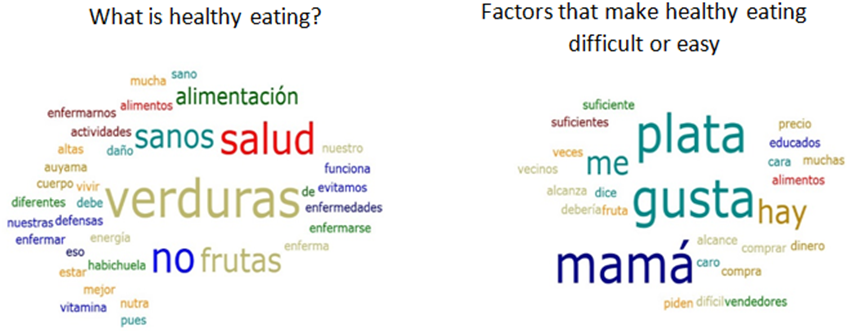
The participants pointed out different aspects of a healthy diet; they highlighted the consumption of fruits and vegetables as part of it. Additionally, they reported that a healthy diet is one that does not generate diseases. Image 1 shows the words mentioned the most by the students to communicate healthy eating (The words are presented transcribed in the interviews' original language). Among these were: health, healthy, healthy, not getting sick, living, defenses, we avoid diseases, nourish, to be well, and to eat food, fruits, and vegetables.

In the interview, the students expressed phrases like: "to eat fruits, to eat vegetables" (sixth-grade student), "it is a diet that does not make you sick and does not harm" (seventh-grade student). The importance they assigned to a healthy diet was related to the non-appearance of chronic non-communicable diseases, mentioning, for example: "high cholesterol, high sugar (tenth-grade student)." Thus, a healthy diet is necessary to have health and like a sign of the absence of disease. Phrases such as "to avoid illness, to have high defenses" (ninth-grade student) were identified. Regarding the question, what foods are not healthy? Participants pointed to foods such as fast foods, including hot dogs, hamburgers, pizzas, as unhealthy. They also included in this classification fried preparations typical of the region and preparations with foods high in carbohydrates. Within these, the soup appears unhealthy because it contains foods such as cassava and potatoes. Some expressions in this regard were as follows:
"Empanadas, Egg Arepa, Cheese fingers" (ninth-grade student). "Eating street food, like hot dogs and pizzas" (sixth-grade student). "Another problem is soup because they do not let us have soup because it has much food" (sixth-grade student). When inquiring about what she was referring to, she denoted: "Well, the soup has a lot of cassava, plantain, potato, yam."
About the limiting or facilitating factors of healthy eating perceived at home, school, or neighborhood, both students, teachers, and parents mentioned the Taste for unhealthy food and the economic factor as a difficulty for the population to have a healthy diet. Money, Taste, buy, enough, are repeated words in the interview (See Image 1). Schoolchildren, for example, expressed that parents have financial difficulties in acquiring healthy foods. In the interviews, expressions such as "It is difficult because there is not enough money" (seventh-grade student) were found, "my mother says that I cannot eat fruit because it is costly and also because if there is a price the vendors request another "(sixth-grade student). "The problem that prevents my neighbors is because there is no money and it prevents us from eating healthy because it is expensive" (eighth-grade student). "Sometimes, there is not much money to buy, so you choose what you can get" (mother).
Additionally, vendors, mothers, and neighbors appeared in the interviews as relevant actors who participate in the construction of representations about healthy eating for schoolchildren. Participants pointed out factors that can facilitate a healthy diet like nutrition education, evidenced in phrases such as: "In the neighborhood, people are not well educated to feed themselves" (tenth-grade student)." Lack of knowledge in families about serious diseases caused by poor nutrition" (father of the family). According to the interviews carried out with the teachers about the feeding practices of schoolchildren, they expressed that the beneficiary students of the school feeding program have strengthened habits at home, which makes it challenging to consume new and different foods at school. They mentioned that salads, liver, and tuna were identified among the school canteen’s rejected meals. However, rice and eggs are the most consumed foods, and they related this to the foods usually consumed in households. In some students' interviews, this statement could be confirmed: "well, the rice, the yucca, the egg," a sixth-grade student when answering about the food offered by the mother at home. The teachers emphasized that economic factors affect the consumption of food in households, but also the customs and highlighted the purchase of soup in neighborhoods as a consistent practice to illustrate this situation, as the following expression shows: "for their little income, for example, with 6,000 pesos it is not enough for eight people to eat lunch, but I am going to buy soup, and with4,000 it is enough for everyone, and I have 2,000 left" (teaching coordinator).
As relevant aspects of the participant observation, the school store offers sugary drinks, sweet cookies, candies in variety, bottled water, and highly processed packaged foods such as potato chips. During the break between classes, the children consumed sugary drinks, sweet foods, and foods like hot dogs, empanadas, packaged foods, and mango with salt, the latter purchased from street vendors outside the school.

Exploratory price study
The exploratory price study identified that, on average, the highest prices, according to the recommended portion of food exchange, corresponded to foods from the fruits and vegetable group. The second group of groceries with the highest average price per exchange was sugars and sweets. The food group with the lowest price corresponded to cereals, roots, tubers (See Table 1).
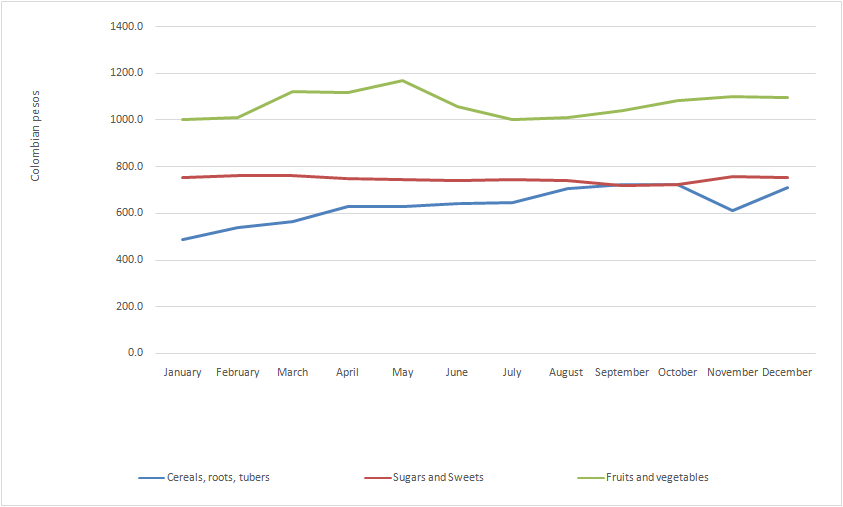
According to the estimated price trend for 2018, on average, by the food group and the number of exchanges, the fruit and vegetable group was the highest price, with slight fluctuations throughout the year, but no one month it was below the other food groups. The food group with the lowest average price during the year was cereals, roots, and tubers, with fluctuations during the year; therefore, the average cost is higher than sugars and sweets in some months. The price of sugars and sweets remained stable throughout the year (see Figure 1).
Subsequently, an estimate of the monthly average cost was made for each food group, adjusted according to the recommendation of daily consumption of each group for the entire population; the results are summarized for the year in Table 2.
When estimating the average prices according to the number of exchanges recommended by each group, fruits, vegetables, and vegetables continue with the highest price in 2018.
From the analysis of variance, it is inferred that there are statistically significant differences in the variances (F <to 0.05) of the price averages, by food group according to the recommendation of exchanges for each group (see Table 3).
The post hoc test results show that the average price of foods such as fruits and vegetables with the highest consumption is higher than that of the other food groups, taking into account the average number of exchanges recommended for each group by the Colombian population food guidelines. Therefore, it was verified the hypothesis identified in the population's discourse.
The food process is not only the act of eating to satisfy individuals' biological needs; in this sense, it is vital to highlight the importance of social representations within psychological factors. In this regard, a relevant feature that the present investigation demonstrated is that having a healthy diet is of hard economic access. Pereira 11 has pointed out a relationship between food and biopolitics, with the concept of healthy eating being a construction between society, the media, and the food industry, which can generate social segregation. Two scenarios are then evident: that of healthy foods represented by fruits and vegetables, but difficult economic access and those unhealthy foods, represented by sugars and sweets, among others, that generate pleasure and are available in the school environment, with prices that can be more accessible than those of fruits and vegetables, which has caused a social representation of healthy eating like inaccessible and difficult to meet. Theodore et al 16 also reported a strong presence in the discourse of the relationship fruits and vegetables with the representation of healthy eating in schoolchildren. Additionally, they identified that food's symbolic classification system could produce a difference between discourse and practice and, too, that around the hierarchy of food mediates as a central function, the eating pleasure.
According to Prada, Gamboa, and Jaime 22, in other research about social representations, it was identified that families buy lower-priced food to make their budget more efficient and, therefore, prefer to buy foods as roots, tubers in compared to meats and fruits. The above coincides with the results of the exploration of basic basket prices reported in this study. The cost of fruits and vegetables in 2018, for portions of recommended exchanges, was generally higher than that of cereals, roots, tubers, and sugars, and sweets.
In turn, Vega, Mora, and Espitia 5 identified in schoolchildren from Cartagena de Indias that 68% of the respondents indicated concerns about the purchase of food and limited income. Furthermore, 52% expressed that the food purchased at home did not last long enough, and no money to buy more. González and Diaz 4 determined in Cartagena schoolchildren that the family characteristic: having an income equal to or less than the current legal minimum wage was associated with a nutritional deficit. The above denotes a worrying panorama about the population's food and nutritional security, which requires structural measures to transform the situation. In this respect, according to the latest "The State of Food Security and Nutrition in the World” report, the cost of a healthy diet is above the international poverty line 23. Additionally, this cost is higher than the average household expenditure of most countries in the global south; in other words, a healthy diet is unaffordable for the poor.
On the other hand, in this study, although sugars and sweets have a lower average price than fruits, vegetables, and vegetables, their acquisition has a significant monetary value that competes with the purchase of healthy foods. Also, the consumption of sweets is not recommended by the dietary guidelines, so it is necessary to identify healthy alternatives that can be purchased with the budget allocated. Further, it was determined that the neighborhood, the school, and the family are vital scenarios to achieve a better positioning of healthy alternatives that improve the students' nutrition. According to the Pan American Health Organization (PAHO) 24, the environments where people transit daily are essential to promote health. The strategies destined for this task require the participation of multiple sectors and community actors to work together. In turn, in the present investigation, the mother and the neighbors' role, the store's involvement, the school restaurant, and the function of food outlets in the neighborhood to construct social representations were relevant.
It is appropriate to note that some fruits and vegetables reported as having the highest consumption in Bolívar are not produced in the region, affecting the high price. In this regard, the evidence shows that the de-localization and de-seasonalization of the diets contribute to increased sugar consumption and refined carbohydrates. Getting people to buy food produced at harvest times and locally could contribute to optimizing the family budget and improving healthy food intake 6, 19.
Another aspect identified is the participants' consideration of soup as unhealthy food and the roots and tubers group. However, soups are part of the gastronomy of the Caribbean region, according to Ordoñez 25, its ingredients include vegetables, roots, tubers, bananas, legumes, and different types of meat. The dietary guidelines recommend all these foods for the Colombian population 15. That is, soups and roots and tubers can be part of a healthy diet, considering the recommendations for portions, ingredients, and preparation techniques. Additionally, soups have been highlighted in the food guides as practical preparations that are part of the most vulnerable populations' survival strategies. The group of cereals, roots, and tubers is the most critical energy source in the Colombian diet. Its symbolic devaluation can represent a risk for the food security of the population.
The analyzed context shows that schoolchildren understand the implications that an unhealthy diet has on health. However, their food decisions are influenced by other factors, such as pleasure, social status, group membership, ease of preparation and consumption of food, the availability, the access to these, and knowledge about healthy eating, which influence the symbolic assessment of the food. In this sense, together with the structural actions on access to food, it is convenient to generate new narratives and discourses on health, disease, nutritional value, and price, to achieve greater social acceptance and daily inclusion of healthy foods. In this sense, according to Higgs 26, the construction of social norms around food affects the choice and intake of food, altering even the hedonic sensory evaluation that is made of them. Faced with these approaches, food and nutrition education plays an essential role in redefining social representations of healthy eating for the population, which is critical to include from school and in coordination with the community, family, the media, and the food industry.
Additionally, it is essential to mention that there were difficulties in the present investigation, such as the lack of information in databases on specific food brands and the price of a greater variety of them that could improve the approximation towards the average price of food groups. It is also suggested in future research to carry out consumption surveys to identify the foods most frequently consumed.
The research identified factors such as access to food, pleasure, the low availability of healthy food at school, customs, and the loss of symbolic value of typical preparations, among others, related to food decision-making in the population. In this sense, it is necessary to highlight that the strategies for improving schoolchildren's nutritional status must include intersectoral actions, actively linking the community, the family, the school, the media, and students. It is also necessary to promote reflective and critical processes, considering the psychological and social aspects that influence the differences between food norms and practices.
The study was carried out with the support of CONACYT grant number 734107.
We thank the teachers, students, administrators, and parents who participated in the research.
All researchers state that they have no conflicts of interest with the research.
| [1] | World Health Organization. Healthy diet. Oficial website 2020. https://www.who.int/news-room/fact-sheets/detail/healthy-diet | ||
| In article | |||
| [2] | Macías A, Gordillo L, and Camacho, E. “Hábitos alimentarios de niños en edad escolar y el papel de la educación para la salud”. Revista Chilena de Nutrición. 39 (3). 40 - 43. 2012. | ||
| In article | View Article | ||
| [3] | Romero M, Mallarino M, Cruz J, Vásquez D. Sobrepeso y obesidad, hábitos alimenticios, actividad física y actividades de ocio, en escolares de una localidad de la ciudad de Cartagena. Informe final de pregrado. Universidad de Cartagena. 2014. | ||
| In article | |||
| [4] | González Y, Díaz, C. “Características familiares relacionadas con el estado nutricional en escolares de la ciudad de Cartagena”. Revista de Salud Pública. 17(6). 836-847. 2015. | ||
| In article | View Article PubMed | ||
| [5] | Vega L.Y, Mora A, and Pérez P. “Case-Study: Nutritional Status and Contextual Factors in the Food Security of Teenager Students in Cartagena (Colombia)”. Advance Journal of Food Science and Technology. 16: 47-54. 2018. | ||
| In article | View Article | ||
| [6] | Aguirre P. “Alimentación humana: El estudio científico de lo obvio”. Salud Colectiva. 12 (4). 463-472. 2016. | ||
| In article | View Article PubMed | ||
| [7] | Cárdenas, J, Ovalles, G. “Teoría de las representaciones sociales. Una aproximación al estado del arte de América Latina”. Psicogente. 21(40). 495-544. 2018. | ||
| In article | View Article | ||
| [8] | Moscovici, S. “On social representations”. In J.P. Forgas (Ed.) Social Cognition perspectives on everyday knowledge. London: Academic Press, 181-209. 1981. | ||
| In article | |||
| [9] | Araya S. “Las representaciones sociales: ejes teóricos para su discusión”. Cuaderno de ciencias sociales. 127. 1- 84. 2002. | ||
| In article | |||
| [10] | Monaco G, Bonetto E. “Social representations and culture in food studies”. Food Research International. 115. 474-479. 2019. | ||
| In article | View Article PubMed | ||
| [11] | Pereira P. “Construcción del modelo de alimentación saludable y su implicancia en la configuración de la subjetividad de la infancia y la familia”. Demetra: alimentação, nutrição & saúde. 13 (2). 341-361. 2018. | ||
| In article | View Article | ||
| [12] | Yáñez, H. “La construcción social de la realidad”. Ars Boni et Aequi. 6(2). 289-304. 2010. | ||
| In article | |||
| [13] | Albañil M.R, Rogero M.E, Sánchez S, Olivas A, Rabanal A, Sanz M.T. “Riesgo de mantener obesidad desde la infancia hasta la adolescencia”. Revista Pediátrica de Atención Primaria. 13. 199-211. 2011. | ||
| In article | View Article | ||
| [14] | World Health Assembly, 71. (2018). WHO Results Report: Programme Budget 2016-2017. World Health Organization. | ||
| In article | |||
| [15] | Instituto Colombiano de Bienestar Familiar. Guías alimentarias basadas en alimentos para la población colombiana mayor de 2 años. Documento técnico. https://www.minsalud.gov.co/sites/rid/Lists/BibliotecaDigital/RID E/VS/PP/SNA/guias-alimentarias-basadas-en-alimentos.pdf. 2016. | ||
| In article | |||
| [16] | Théodore F, Bovenchio A, Blanco A, Carreto Y. “Representaciones sociales relacionadas con la alimentación escolar: el caso de las escuelas públicas de la Ciudad de México”. Salud colectiva. 2. 215-229. 2011. | ||
| In article | View Article | ||
| [17] | Moreno - Ruiz D, Picon M, Marrugo - Arnedo C, Marrugo V, Alvis N. “Determinantes socioeconómicos del estado nutricional en menores de cinco años atendidos en el Hospital Infantil Napoleón Franco Pareja”. Revista de la Universidad Industrial de Santander Salud. 49(2). 352-363. 2017. | ||
| In article | View Article | ||
| [18] | Departamento Nacional de Estadística. “Sistema de información de precios SIPSA (dataset)”. Accessed july 15, 2019. https://www.dane.gov.co/index.php/servicios-al- ciudadano/servicios-informacion/sipsa. | ||
| In article | |||
| [19] | Ministerio de Salud y Protección Social. “Perfil nacional de consumo de frutas y verduras”. 2013. | ||
| In article | |||
| [20] | Instituto Colombiano de Bienestar Familiar. “Tabla de composición de alimentos colombianos”. Segunda edición. Colombia. 2015. | ||
| In article | |||
| [21] | Manjarres L. “Lista de intercambios de alimentos”. Medellín: Universidad de Antioquia. N.D | ||
| In article | |||
| [22] | Prada G, Gamboa M, and Jaime M. 2006. “Representaciones sociales sobre alimentación saludable en población vulnerable”. Revista de la Universidad Industrial de Santander Salud. 38(3). 181-188. 2018. | ||
| In article | |||
| [23] | FAO, IFAD, UNICEF, WFP and WHO. 2020. The State of Food Security and Nutrition in the World 2020. Transforming food systems for affordable healthy diets. Rome, FAO. | ||
| In article | |||
| [24] | Pan American Health Organization. ¿Cómo construir una escuela promotora de salud? Buenos Aires. 2018. | ||
| In article | |||
| [25] | Ordoñez, C. N.D. Gran Libro de la Cocina Colombiana. Biblioteca Básica de Cocinas Tradicionales de Colombia. Bogotá. | ||
| In article | |||
| [26] | Higgs, S. “Social norms and their influence on eating behaviors”. Appettite. 86. 38-44. 2014. | ||
| In article | View Article PubMed | ||
Published with license by Science and Education Publishing, Copyright © 2020 Ana Paola Mora Vergara, Antonio López-Espinoza, Alma G Martínez Moreno, Samantha Josefina Bernal-Gómez and Tania Yadira Martínez Rodríguez
 This work is licensed under a Creative Commons Attribution 4.0 International License. To view a copy of this license, visit
http://creativecommons.org/licenses/by/4.0/
This work is licensed under a Creative Commons Attribution 4.0 International License. To view a copy of this license, visit
http://creativecommons.org/licenses/by/4.0/
| [1] | World Health Organization. Healthy diet. Oficial website 2020. https://www.who.int/news-room/fact-sheets/detail/healthy-diet | ||
| In article | |||
| [2] | Macías A, Gordillo L, and Camacho, E. “Hábitos alimentarios de niños en edad escolar y el papel de la educación para la salud”. Revista Chilena de Nutrición. 39 (3). 40 - 43. 2012. | ||
| In article | View Article | ||
| [3] | Romero M, Mallarino M, Cruz J, Vásquez D. Sobrepeso y obesidad, hábitos alimenticios, actividad física y actividades de ocio, en escolares de una localidad de la ciudad de Cartagena. Informe final de pregrado. Universidad de Cartagena. 2014. | ||
| In article | |||
| [4] | González Y, Díaz, C. “Características familiares relacionadas con el estado nutricional en escolares de la ciudad de Cartagena”. Revista de Salud Pública. 17(6). 836-847. 2015. | ||
| In article | View Article PubMed | ||
| [5] | Vega L.Y, Mora A, and Pérez P. “Case-Study: Nutritional Status and Contextual Factors in the Food Security of Teenager Students in Cartagena (Colombia)”. Advance Journal of Food Science and Technology. 16: 47-54. 2018. | ||
| In article | View Article | ||
| [6] | Aguirre P. “Alimentación humana: El estudio científico de lo obvio”. Salud Colectiva. 12 (4). 463-472. 2016. | ||
| In article | View Article PubMed | ||
| [7] | Cárdenas, J, Ovalles, G. “Teoría de las representaciones sociales. Una aproximación al estado del arte de América Latina”. Psicogente. 21(40). 495-544. 2018. | ||
| In article | View Article | ||
| [8] | Moscovici, S. “On social representations”. In J.P. Forgas (Ed.) Social Cognition perspectives on everyday knowledge. London: Academic Press, 181-209. 1981. | ||
| In article | |||
| [9] | Araya S. “Las representaciones sociales: ejes teóricos para su discusión”. Cuaderno de ciencias sociales. 127. 1- 84. 2002. | ||
| In article | |||
| [10] | Monaco G, Bonetto E. “Social representations and culture in food studies”. Food Research International. 115. 474-479. 2019. | ||
| In article | View Article PubMed | ||
| [11] | Pereira P. “Construcción del modelo de alimentación saludable y su implicancia en la configuración de la subjetividad de la infancia y la familia”. Demetra: alimentação, nutrição & saúde. 13 (2). 341-361. 2018. | ||
| In article | View Article | ||
| [12] | Yáñez, H. “La construcción social de la realidad”. Ars Boni et Aequi. 6(2). 289-304. 2010. | ||
| In article | |||
| [13] | Albañil M.R, Rogero M.E, Sánchez S, Olivas A, Rabanal A, Sanz M.T. “Riesgo de mantener obesidad desde la infancia hasta la adolescencia”. Revista Pediátrica de Atención Primaria. 13. 199-211. 2011. | ||
| In article | View Article | ||
| [14] | World Health Assembly, 71. (2018). WHO Results Report: Programme Budget 2016-2017. World Health Organization. | ||
| In article | |||
| [15] | Instituto Colombiano de Bienestar Familiar. Guías alimentarias basadas en alimentos para la población colombiana mayor de 2 años. Documento técnico. https://www.minsalud.gov.co/sites/rid/Lists/BibliotecaDigital/RID E/VS/PP/SNA/guias-alimentarias-basadas-en-alimentos.pdf. 2016. | ||
| In article | |||
| [16] | Théodore F, Bovenchio A, Blanco A, Carreto Y. “Representaciones sociales relacionadas con la alimentación escolar: el caso de las escuelas públicas de la Ciudad de México”. Salud colectiva. 2. 215-229. 2011. | ||
| In article | View Article | ||
| [17] | Moreno - Ruiz D, Picon M, Marrugo - Arnedo C, Marrugo V, Alvis N. “Determinantes socioeconómicos del estado nutricional en menores de cinco años atendidos en el Hospital Infantil Napoleón Franco Pareja”. Revista de la Universidad Industrial de Santander Salud. 49(2). 352-363. 2017. | ||
| In article | View Article | ||
| [18] | Departamento Nacional de Estadística. “Sistema de información de precios SIPSA (dataset)”. Accessed july 15, 2019. https://www.dane.gov.co/index.php/servicios-al- ciudadano/servicios-informacion/sipsa. | ||
| In article | |||
| [19] | Ministerio de Salud y Protección Social. “Perfil nacional de consumo de frutas y verduras”. 2013. | ||
| In article | |||
| [20] | Instituto Colombiano de Bienestar Familiar. “Tabla de composición de alimentos colombianos”. Segunda edición. Colombia. 2015. | ||
| In article | |||
| [21] | Manjarres L. “Lista de intercambios de alimentos”. Medellín: Universidad de Antioquia. N.D | ||
| In article | |||
| [22] | Prada G, Gamboa M, and Jaime M. 2006. “Representaciones sociales sobre alimentación saludable en población vulnerable”. Revista de la Universidad Industrial de Santander Salud. 38(3). 181-188. 2018. | ||
| In article | |||
| [23] | FAO, IFAD, UNICEF, WFP and WHO. 2020. The State of Food Security and Nutrition in the World 2020. Transforming food systems for affordable healthy diets. Rome, FAO. | ||
| In article | |||
| [24] | Pan American Health Organization. ¿Cómo construir una escuela promotora de salud? Buenos Aires. 2018. | ||
| In article | |||
| [25] | Ordoñez, C. N.D. Gran Libro de la Cocina Colombiana. Biblioteca Básica de Cocinas Tradicionales de Colombia. Bogotá. | ||
| In article | |||
| [26] | Higgs, S. “Social norms and their influence on eating behaviors”. Appettite. 86. 38-44. 2014. | ||
| In article | View Article PubMed | ||