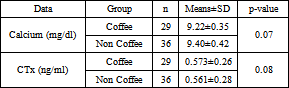
The adverse effect of coffee on bone metabolism is an unresolved controversy until now. Coffee was speculated as an enhancer of calcium loss and also a trigger for bone resorption. The purpose of this study was to analyze the effect of coffee consumption on bone resorption in female. Biomarker of bone resorption is a serum C-terminal Telopeptide Type I collagen (CTx). This study was a cross-sectional study. The subjects used in this study were female, aged 18-25 years, non-smokers, not taking calcium supplements, non-alcoholic drinker, non-coffee drinker and those that consume 1-2 cups of coffee a day, and healthy. A total of 65 volunteer participants were included in this study. CTx levels were measured by Electrochemical Luminescence Immunoassay (ECLIA). Calcium was examined using the Ortho Cresol Phthalein Complexone (CPC). We found that there was no significant difference in CTx levels between the non-coffee and coffee groups (0.561±0.28 vs 0.573±0.26; p=0.08). There were no significant differences in calcium between the non-coffee and coffee groups (9.40±0.42 vs 9.22±0.33; p=0.07). In conclusion, daily coffee consumption does not increase serum CTx levels nor does it reduces serum calcium levels. In this study therefore, coffee did not trigger an increase in bone resorption and calcium loss. Consumption of 1-2 cups of coffee (150-200 ml) or 2 times daily could maintain normal calcium levels in the body without adverse effects on the bone.
Coffee has many beneficial effects on health, but coffee is also thought to cause adverse effects on health. There is a lot of controversy about the adverse effects of coffee consumption on human health, one of which is that coffee consumption is thought to increase the risk of osteoporosis in women. 1, 2 Research on the adverse effects of coffee on the risk of osteoporosis has been widely studied, but the effect of coffee on bone metabolism is still controversial and needs to be extensively studied. This study analyzed the effect of coffee consumption on a bone resorption marker by measuring the levels of C-Terminal Telopeptides Type I Collagen (CTx) and calcium. Research in Taiwan found that coffee consumption prevents osteopenia/osteoporosis in premenopause women. 3 Other studies suggested that excessive coffee consumption as high as more than 3 cups volume of coffee consumption per day is reported to affect bone metabolism and reduce bone density. 4
Pharmacological effects of coffee are generally caused by the caffeine in coffee. About 65-70% of the caffeine consumed by adults is sourced from coffee. 5 About 150-300 mg of caffeine consumption will increase calcium excretion in urine after 2-3 hours of coffee caffeine consumption in adolescents and adult men and women. 5 coffee caffeine consumption of more than 400 mg per day also interferes with the process of bone remodeling in healthy premenopausal women (ages 35-45 years). 2, 6 Coffee caffeine is reported to increase urine calcium excretion until 24 hours after ingestion of caffeine coffee. 5, 6, 9 Long-term coffee consumption potentially increase calcium absorption and result imbalance of calcium in the body. 6, 9 Therefore, long-term coffee consumption is thought to result into a decrease in calcium levels so that the potential for hypocalcemia, increases bone resorption which triggers a decrease in bone density and causes osteoporosis. 1, 10, 11, 12
This research was conducted on young female population (age range 18-25 years) because of the current trend of consuming coffee by young people in Aceh, Indonesia. The results of this research are expected to assist in providing possible guidelines for coffee drinkers so as to keep and maintain a physiological dose of coffee consumption for pharmacological benefits for bone health.
65 young women (18-25 years old), drinking 1-2 cups or about 150-200 ml of coffee per day, not coffee drinkers, not smoking, not drinking alcohol, not exercising regularly, not taking calcium supplements were used for this study. A total of 80 nursing college students were briefed on the research objectives and research parameters that will be determined in this study. They were asked to become willing volunteer subjects in this study.
Volunteer subjects were given written informed consent. Out of a total of 80 students, only about 56 people were willing as volunteer subjects. The subjects were examined by anthropometry (body weight, height, and body mass index or BMI), blood pressure, and blood sampling. Body weight is measured using a weight scale. Height was measured using a measuring scale height. Measurement Body Mass Index (BMI) was performed using a BMI calculation formula. Blood samples were taken for examination and CTx levels of calcium.
This study was a cross-sectional study. This research was conducted in the Physiology Laboratory, Faculty of Medicine, Universitas Syiah Kuala, Banda Aceh, Aceh Province, Indonesia. The implementation of this research was approved by the ethics committee for medical/health research, the Faculty of Medicine, Universitas Syiah Kuala. The ethical approval letter number was 02/EA/FK-RSUDZA/2018.
2.2. Blood Bone Resorption Marker and Calcium AnalysisBlood samples were collected in the morning between 7:00 a.m. to 8:00 am. The subject was fasted for 10 hours (starting at 09.00 pm to 07.00 am) before blood sampling. The blood sample is taken from the venous blood. The amount of venous blood taken is as much as 10 ml. Examination of serum calcium levels was carried out using the Ortho Cresol Phthalein Complexone (CPC) method. Normal blood calcium level is 8.6-10.3 mg/dl. Examination of CTx levels was performed using methods Electrochemical Luminescence Immunoassay (ECLIA). The CTx reference value is 0.016-0.584 ng/mL.
2.3. Statistical AnalysisData were analyzed using a computer program using the Statistical Package for the Social Sciences application (SPSS version 19). The statistical analysis is a different test (independent sample t-test). Independent sample t-test was conducted to determine differences in blood pressure, calcium and CTx levels between groups of coffee drinkers and no coffee consumption.
The characteristics of the research subjects are shown in Table 1. The results showed that there were no significant differences in age, weight, height, and BMI between coffee drinkers and non-coffee drinkers (p>0.05).
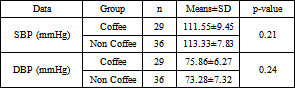
Table 2 shows that there were no significant differences in blood pressure between coffee and non-coffee drinkers (p>0.05). Coffee does not increase systolic blood pressure (SBP) and diastolic blood pressure (DBP) in a young female.
Table 3 shows that there were no differences in calcium levels between the drinkers and non-coffee drinkers (p>0.05). Regular coffee consumption (1-2 cups) every day does not reduce blood calcium levels in young women. Calcium levels in the coffee drinker group are at normal limits, therefore regular coffee consumption does not trigger hypocalcemia. We also found that there were no significant differences in CTx levels between coffee drinkers and non-coffee drinkers (p>0.05). Drinking coffee at physiological doses (1-2 cups) a day does not increase bone resorption in young women.
We found that coffee consumption of 1-2 cups (volume 200 ml for a cup and weight of the powdered coffee reconstituted to coffee drink is 1 tablespoon or 8-10 grams of coffee powder that provided 1-2 cups) daily did not increase bone resorption in young women. The moderate dose of coffee consumption is beneficial to bone health in post-menopause women. 13 Coffee consumption is not related to Bone Mineral Density (BMD), therefore coffee consumption is not associated with osteoporosis. 14 Coffee consumption is not associated with BMD and osteoporosis in men and women over 50 years of age. 14 Coffee consumption minimizes the risk of osteopenia/osteoporosis in postmenopause Taiwanese women. 3 Consumption of high-dose coffee (more than 4 cups per day) increases the risk of osteoporosis. 4, 15, 16 Consumption of high-dose coffee decreases Bone Mineral Density (BMD) and does not increase the risk of fracture in women. 16 Other studies also revealed that coffee consumption might increase risk of fracture in women, but still needs further verification. 17 Coffee consumption affects material and structure of bone, reduce trabecular and cortical bone density, brittle bones and bones fracture. 10
The results of our study found that daily coffee consumption did not reduce serum calcium levels. Research in rats has shown that coffee caffeine has an adverse effect on calcium metabolisms such as increased urine and plasma calcium levels, low bone volume and decreased bone density. 18 Caffeine changes the extracellular matrix needed for mineral deposition and thus affects calcium deposition in bone. 18 Caffeine is the main component in coffee which has various pharmacological effects and responses to the human body. 19 The effect of caffeine is to stimulate the central nervous system, relax muscle, affect cardiac muscle and increase diuresis. 19
Caffeine consumption as much as 175 mg/day was positively correlated with an increase in urinary calcium excretion over 24 hours. 5 The consumption of caffeine causes an increase of calcium excretion of urine and reduced calcium absorption in the intestine, therefore the coffee has a negative effect on calcium balance. 5 We found that coffee consumption of 1-2 cups per day (20 grams of coffee powder and 200 ml of the coffee drink) does not cause an adverse effect on calcium balance in young women. Caffeine inhibits calcium absorption. 6, moderate doses of caffeine (25 mg/kg) increases calcium loss through urine but does not affect BMD in rats. 21
Moderate consumption of coffee is beneficial for bone protection in postmenopausal women. 2 Coffee caffeine has a negative effect if consumed in amounts greater than 300 mg/day or equivalent to more than 4 cups of coffee per day. 6 Consumption of coffee caffeine has a weak negative effect against BMD in postmenopause forearm women. 22 Coffee does not have a negative effect on bone status and calcium economy if the daily calcium intake is sufficient. 23 Caffeine intake does not affect Bone mineral content (BMC) and bone mineral density (BMD) in mice. 21 Giving caffeine increases osteoclastogenesis thereby reducing BMD in mice. 24, 25 Caffeine damages osteoblast cells inhibit osteoblast proliferation and also causes osteoblast apoptosis. 11, 12, 19, 25 In vitro studies found that Low-dose caffeine increases osteoclast formation triggered by increased RANKL regulated by cyclooxygenase-2 (COX-2) and Prostaglandin-E2 (PGE2). 25 Coffee m inhibit bone mineralization process. 18
We found that coffee consumption did not increase C-telopeptide (CTx) levels in young women. Ctx is a marker of bone resorption as a monitoring and intervention standard for osteoporosis. 3, 26 Research in young men in Korea shows that coffee consumption does not affect the level of type 1 collagen C-terminal telopeptide (1-CTP). 14 Coffee consumption of no more than 300 mg/day does not have a negative effect on the body. 6 Organic coffee has the potential to have beneficial effects on health. 27 Daily coffee consumption is not associated with decreased BMD and increased risk of osteoporosis 14.
3.3. Limitation of StudySmall sample size was used for this study. Also BMD examination was not performed and the coffee drinkers analyzed were coffee drinkers of physiological doses (1-2 cups/ weight of coffee) a day. Further research is needed that analyzes coffee consumption of more than 2 cups (more than 400 ml or 20 grams of coffee powder) per day and uses older age groups. Possible results of this study will be different if you use a coffee drinker subject above 30 years of age and also a coffee dose of more than 2 cups per day.
This study concluded that regular coffee consumption did not reduce serum calcium levels and the physiological dose of coffee consumption can maintain calcium within normal limits in the body. Regular coffee consumption does not increase serum CTx levels, therefore coffee does not increase bone resorption in a young female. Consumption of coffee in physiological doses is safe for young women and does not trigger increased bone resorption, therefore it will not increase the risk of early osteoporosis. It is recommended that coffee is consumed regularly but not more than 2 cups/day.
Thank you to all volunteers for their participation in this research. Thanks also to the Universitas Syiah Kuala and Ministry of Research, Technology and Higher Education of the Republic of Indonesia for their sponsorship and support of this research.
| [1] | P. Yang, X. Zhang, K. Zhang, and Z. Tang, “Associations between frequency of coffee consumption and osteoporosis in Chinese postmenopausal women,” Int J Clin Exp Med, vol. 8, no. 9, pp. 15958-15966, 2015. | ||
| In article | PubMed PubMed | ||
| [2] | T. Wolde, “Effects of caffeine on health and nutrition,” Food Sci Qual Manag, vol. 30, no. January, pp. 59-65, 2014. | ||
| In article | |||
| [3] | H. Chang, C. Hsieh, Y. Lin, D. M. Tantoh, and Y. Kung, “Coffee Consumption Might Reduce the Risk of Osteopenia/Osteoporosis in Premenopausal Taiwanese Women,” J Food Nutr Res, vol. 5, no. 10, pp. 789-793, 2017. | ||
| In article | View Article | ||
| [4] | H. Hallström, L. Byberg, A. Glynn, E. W. Lemming, and A. Wolk, “Long-term Coffee Consumption in Relation to Fracture Risk and Bone Mineral Density in Women,” Am J Epidemiol, vol. 178, no. 6, pp. 898-909, 2013. | ||
| In article | View Article PubMed | ||
| [5] | P. Nawrot, S. Jordan, J. Eastwood, and J. Rotstein, “Effects of caffeine on human health,” Food Addit Contam, vol. 20, pp. 1-30, 2003. | ||
| In article | View Article PubMed | ||
| [6] | E. Choi, K. Choi, S. M. Park, and D. Shin, “The Benefit of Bone Health by Drinking Coffee among Korean Postmenopausal Women: A Cross-Sectional Analysis of the Fourth & Fifth Korea National Health and Nutrition Examination Surveys,” PLoS One, vol. 11, no. 1, pp. 1-14, 2016. | ||
| In article | View Article PubMed PubMed | ||
| [7] | D. Ryul, J. Lee, M. Rota, J. Lee, H. Sik, S. Min, and D. Shin, “Coffee consumption and risk of fractures: A systematic review and dose–response meta-analysis,” Bone, vol. 63, pp. 20-28, 2014. | ||
| In article | View Article PubMed | ||
| [8] | L. K. Massey and S. J. Whiting, “Supplement Caffeine, urinary Calcium, Calcium Metabolism and Bone,” J Nutr, vol. 123, pp. 1611-1614, 1993. | ||
| In article | View Article PubMed | ||
| [9] | L. K. Massey, “Is caffeine a risk factor for bone loss in the elderly?,” Am J Clin Nutr, vol. 74, pp. 569-570, 2001. | ||
| In article | View Article PubMed | ||
| [10] | M. P. Santos, J. C. M. Pagani, T. D. Silva, J. A. D. Garcia, M. O. C. Romão, G. J. M. Fernandes, and E. A. and Soares, “Effects of coffee (Coffea arabica) consumption on the femoral morphology and biomechanics in rats,” J Morphol Sci, vol. 31, no. 1, pp. 42-47, 2014. | ||
| In article | View Article | ||
| [11] | R. M. Macedo, L. G. Brentegani, and S. A. De Lacerda, “Effects of Caffeine on Bones of Osteoporotic Rats,” J Caffeine Res, vol. 2, no. 3, pp. 140-145, 2012. | ||
| In article | View Article | ||
| [12] | R. M. Macedo, L. G. Brentegani, and S. A. De Lacerda, “Effects of Coffee Intake and Intraperitoneal Caffeine on Bone Repair Process-A Histologic and Histometric Study,” Braz Dent J, vol. 26, no. 2, pp. 175-180, 2015. | ||
| In article | View Article PubMed | ||
| [13] | M. Choi Mi-Kyeong; Kim, “The Association between Coffee Consumption and Bone Status in Young Adult Males according to Calcium Intake Level,” Clin Nutr Res, vol. 5, no. 3, pp. 180-189, 2016. | ||
| In article | View Article PubMed PubMed | ||
| [14] | M. F. Alshanbari, E. M. Alsofyani, D. M. Almalki, and K. Alswat Abdullah, “Caffeine Effect on Bone Mineral Density: A Cross-sectional Study,” J Clin Diagnostic Res, vol. 12, no. 2, pp. 10-13, 2018. | ||
| In article | View Article | ||
| [15] | S. Y. Kim, “Coffee Consumption and Risk of Osteoporosis,” Korean J Fam Med, vol. 35, no. 1, p. 4082, 2014. | ||
| In article | View Article PubMed PubMed | ||
| [16] | H. Hallström, “Coffee Consumption in Relation to Osteoporosis and Fractures Observational Studies in Men and Women.” Acta Universitatis Upsaliensis., Uppsala, Sweden, pp. 1-102, 2013. | ||
| In article | |||
| [17] | H. Liu, K. Yao, W. Zhang, J. Zhou, T. Wu, and C. He, “Coffee consumption and risk of fractures: a meta-analysis,” Arch Med Sci, vol. 8, no. 5, pp. 776-783, 2012. | ||
| In article | View Article PubMed PubMed | ||
| [18] | S. A. Lacerda, R. I. Matuoka, R. M. Macedo, S. O. Petenusci, A. A. Campos, and L. G. Brentegani, “Bone Quality Associated with Daily Intake of Coffee: A Biochemical, Radiographic and Histometric Study,” Braz Dent J, vol. 21, no. 3, pp. 199-204, 2010. | ||
| In article | View Article PubMed | ||
| [19] | Y. Tsuang, J. Sun, L. Chen, S. Chung-, K. Sun, and S. Chen, “Direct effects of caffeine on osteoblastic cells metabolism: the possible causal effect of caffeine on the formation of osteoporosis,” J Orthop Surg Res, vol. 1, no. 7, pp. 1-10, 2006. | ||
| In article | |||
| [20] | V. Pavone, G. Testa, F. Alberghina, L. Lucenti, and G. Sessa, “The Importance of a Correct Diet in Preventing Osteoporosis,” J Osteoporos Phys Act, vol. 3, no. 3, pp. 1-4, 2015. | ||
| In article | |||
| [21] | M. Choi, “Moderate Intake of Caffeine Has No Effect on Bone Health in Growing Male Rats,” Curr Top Nutraceutical Res, vol. 9, no. 3, pp. 77-82, 2011. | ||
| In article | |||
| [22] | K. Holvik and H. E. Meyer, “The association between caffeine intake and forearm bone mineral density in postmenopausal women: The Oslo Health Study,” Nor Epidemiol 2003, vol. 13, no. 1, pp. 177-183, 2003. | ||
| In article | |||
| [23] | R. P. Heaney, “Effects of caffeine on bone and the calcium economy,” Food Chem Toxicol, vol. 40, pp. 1263-1270, 2002. | ||
| In article | View Article | ||
| [24] | Y. P. Yen, R. S. Yang, C. L. Chen, J. Tsai, and S. H. Liu, “Low-Dose Caffeine Enhances Osteoclast Differentiation from Bone Marrow Hematopoietic Stem Cells and Reduces Bone Mineral Density in Growing Rats,” in Annual Meeting of the Orthopaedic Research Society, 2008, no. 518, p. 518. | ||
| In article | PubMed | ||
| [25] | S. H. Liu, C. Chen, R. Sen Yang, Y. P. Yen, Y. T. Yang, and C. Tsai, “Caffeine Enhances Osteoclast Differentiation from Bone Marrow Hematopoietic Cells and Reduces Bone Mineral Density in Growing Rats,” J Orthop Res, no. June, pp. 954-960, 2011. | ||
| In article | View Article PubMed | ||
| [26] | T. Sözen, L. Özışık, and N. Ç. Başaran, “An overview and management of osteoporosis,” Eur J Rheumatol 2017, vol. 4, pp. 46-56, 2017. | ||
| In article | |||
| [27] | J. P. L. Silva, E. B. Ferreira, L. F. Barbisan, M. R. P. L. Brigagao, F. B. A. Paula, G. O. I. Moraes, C. S. Magalhães, and L. Azevedo, “Organically produced coffee exerts protective effects against the micronuclei induction by mutagens in mouse gut and bone marrow,” Food Res Int, vol. 61, pp. 272-278, 2014. | ||
| In article | View Article | ||
Published with license by Science and Education Publishing, Copyright © 2019 Yusni Yusni and Safrizal Rahman
 This work is licensed under a Creative Commons Attribution 4.0 International License. To view a copy of this license, visit
http://creativecommons.org/licenses/by/4.0/
This work is licensed under a Creative Commons Attribution 4.0 International License. To view a copy of this license, visit
http://creativecommons.org/licenses/by/4.0/
| [1] | P. Yang, X. Zhang, K. Zhang, and Z. Tang, “Associations between frequency of coffee consumption and osteoporosis in Chinese postmenopausal women,” Int J Clin Exp Med, vol. 8, no. 9, pp. 15958-15966, 2015. | ||
| In article | PubMed PubMed | ||
| [2] | T. Wolde, “Effects of caffeine on health and nutrition,” Food Sci Qual Manag, vol. 30, no. January, pp. 59-65, 2014. | ||
| In article | |||
| [3] | H. Chang, C. Hsieh, Y. Lin, D. M. Tantoh, and Y. Kung, “Coffee Consumption Might Reduce the Risk of Osteopenia/Osteoporosis in Premenopausal Taiwanese Women,” J Food Nutr Res, vol. 5, no. 10, pp. 789-793, 2017. | ||
| In article | View Article | ||
| [4] | H. Hallström, L. Byberg, A. Glynn, E. W. Lemming, and A. Wolk, “Long-term Coffee Consumption in Relation to Fracture Risk and Bone Mineral Density in Women,” Am J Epidemiol, vol. 178, no. 6, pp. 898-909, 2013. | ||
| In article | View Article PubMed | ||
| [5] | P. Nawrot, S. Jordan, J. Eastwood, and J. Rotstein, “Effects of caffeine on human health,” Food Addit Contam, vol. 20, pp. 1-30, 2003. | ||
| In article | View Article PubMed | ||
| [6] | E. Choi, K. Choi, S. M. Park, and D. Shin, “The Benefit of Bone Health by Drinking Coffee among Korean Postmenopausal Women: A Cross-Sectional Analysis of the Fourth & Fifth Korea National Health and Nutrition Examination Surveys,” PLoS One, vol. 11, no. 1, pp. 1-14, 2016. | ||
| In article | View Article PubMed PubMed | ||
| [7] | D. Ryul, J. Lee, M. Rota, J. Lee, H. Sik, S. Min, and D. Shin, “Coffee consumption and risk of fractures: A systematic review and dose–response meta-analysis,” Bone, vol. 63, pp. 20-28, 2014. | ||
| In article | View Article PubMed | ||
| [8] | L. K. Massey and S. J. Whiting, “Supplement Caffeine, urinary Calcium, Calcium Metabolism and Bone,” J Nutr, vol. 123, pp. 1611-1614, 1993. | ||
| In article | View Article PubMed | ||
| [9] | L. K. Massey, “Is caffeine a risk factor for bone loss in the elderly?,” Am J Clin Nutr, vol. 74, pp. 569-570, 2001. | ||
| In article | View Article PubMed | ||
| [10] | M. P. Santos, J. C. M. Pagani, T. D. Silva, J. A. D. Garcia, M. O. C. Romão, G. J. M. Fernandes, and E. A. and Soares, “Effects of coffee (Coffea arabica) consumption on the femoral morphology and biomechanics in rats,” J Morphol Sci, vol. 31, no. 1, pp. 42-47, 2014. | ||
| In article | View Article | ||
| [11] | R. M. Macedo, L. G. Brentegani, and S. A. De Lacerda, “Effects of Caffeine on Bones of Osteoporotic Rats,” J Caffeine Res, vol. 2, no. 3, pp. 140-145, 2012. | ||
| In article | View Article | ||
| [12] | R. M. Macedo, L. G. Brentegani, and S. A. De Lacerda, “Effects of Coffee Intake and Intraperitoneal Caffeine on Bone Repair Process-A Histologic and Histometric Study,” Braz Dent J, vol. 26, no. 2, pp. 175-180, 2015. | ||
| In article | View Article PubMed | ||
| [13] | M. Choi Mi-Kyeong; Kim, “The Association between Coffee Consumption and Bone Status in Young Adult Males according to Calcium Intake Level,” Clin Nutr Res, vol. 5, no. 3, pp. 180-189, 2016. | ||
| In article | View Article PubMed PubMed | ||
| [14] | M. F. Alshanbari, E. M. Alsofyani, D. M. Almalki, and K. Alswat Abdullah, “Caffeine Effect on Bone Mineral Density: A Cross-sectional Study,” J Clin Diagnostic Res, vol. 12, no. 2, pp. 10-13, 2018. | ||
| In article | View Article | ||
| [15] | S. Y. Kim, “Coffee Consumption and Risk of Osteoporosis,” Korean J Fam Med, vol. 35, no. 1, p. 4082, 2014. | ||
| In article | View Article PubMed PubMed | ||
| [16] | H. Hallström, “Coffee Consumption in Relation to Osteoporosis and Fractures Observational Studies in Men and Women.” Acta Universitatis Upsaliensis., Uppsala, Sweden, pp. 1-102, 2013. | ||
| In article | |||
| [17] | H. Liu, K. Yao, W. Zhang, J. Zhou, T. Wu, and C. He, “Coffee consumption and risk of fractures: a meta-analysis,” Arch Med Sci, vol. 8, no. 5, pp. 776-783, 2012. | ||
| In article | View Article PubMed PubMed | ||
| [18] | S. A. Lacerda, R. I. Matuoka, R. M. Macedo, S. O. Petenusci, A. A. Campos, and L. G. Brentegani, “Bone Quality Associated with Daily Intake of Coffee: A Biochemical, Radiographic and Histometric Study,” Braz Dent J, vol. 21, no. 3, pp. 199-204, 2010. | ||
| In article | View Article PubMed | ||
| [19] | Y. Tsuang, J. Sun, L. Chen, S. Chung-, K. Sun, and S. Chen, “Direct effects of caffeine on osteoblastic cells metabolism: the possible causal effect of caffeine on the formation of osteoporosis,” J Orthop Surg Res, vol. 1, no. 7, pp. 1-10, 2006. | ||
| In article | |||
| [20] | V. Pavone, G. Testa, F. Alberghina, L. Lucenti, and G. Sessa, “The Importance of a Correct Diet in Preventing Osteoporosis,” J Osteoporos Phys Act, vol. 3, no. 3, pp. 1-4, 2015. | ||
| In article | |||
| [21] | M. Choi, “Moderate Intake of Caffeine Has No Effect on Bone Health in Growing Male Rats,” Curr Top Nutraceutical Res, vol. 9, no. 3, pp. 77-82, 2011. | ||
| In article | |||
| [22] | K. Holvik and H. E. Meyer, “The association between caffeine intake and forearm bone mineral density in postmenopausal women: The Oslo Health Study,” Nor Epidemiol 2003, vol. 13, no. 1, pp. 177-183, 2003. | ||
| In article | |||
| [23] | R. P. Heaney, “Effects of caffeine on bone and the calcium economy,” Food Chem Toxicol, vol. 40, pp. 1263-1270, 2002. | ||
| In article | View Article | ||
| [24] | Y. P. Yen, R. S. Yang, C. L. Chen, J. Tsai, and S. H. Liu, “Low-Dose Caffeine Enhances Osteoclast Differentiation from Bone Marrow Hematopoietic Stem Cells and Reduces Bone Mineral Density in Growing Rats,” in Annual Meeting of the Orthopaedic Research Society, 2008, no. 518, p. 518. | ||
| In article | PubMed | ||
| [25] | S. H. Liu, C. Chen, R. Sen Yang, Y. P. Yen, Y. T. Yang, and C. Tsai, “Caffeine Enhances Osteoclast Differentiation from Bone Marrow Hematopoietic Cells and Reduces Bone Mineral Density in Growing Rats,” J Orthop Res, no. June, pp. 954-960, 2011. | ||
| In article | View Article PubMed | ||
| [26] | T. Sözen, L. Özışık, and N. Ç. Başaran, “An overview and management of osteoporosis,” Eur J Rheumatol 2017, vol. 4, pp. 46-56, 2017. | ||
| In article | |||
| [27] | J. P. L. Silva, E. B. Ferreira, L. F. Barbisan, M. R. P. L. Brigagao, F. B. A. Paula, G. O. I. Moraes, C. S. Magalhães, and L. Azevedo, “Organically produced coffee exerts protective effects against the micronuclei induction by mutagens in mouse gut and bone marrow,” Food Res Int, vol. 61, pp. 272-278, 2014. | ||
| In article | View Article | ||