Onion (Allium cepa L.) is a common crop produced in numerous regions over the world and is one of the most consumed vegetables. In Côte d’Ivoire, the onion sector is dominated by large-scale annual imports to meet the consumers’ demand. The current work aims to fill data relating to the trade and consumption of onions in large urban areas such as Korhogo, northern Côte d’Ivoire. Investigations at field were achieved from onion traders and consumers regarding their social profile and the main factors involved in the acquisition, marketing and uses of onions. The survey revealed the involvement of more women (80%) in the onion trade than men (20%). Onions sold in the market are imported according to 60% traders. The marketed onions are mainly yellow and purple varieties according to respective 51.90% and 38.05% traders. However, purple onion is the most preferred according to 70.01% consumers. In addition, onions are largely used in fresh form (86.67% consumers) and more consumed in sauces (37.92% respondents) and grilled foods (32.09% respondents). The investigation in onion trade and consumption fills significant data to be considered in the development of sustainable onion sector in Côte d’Ivoire.
Onion (Allium cepa L.) is a vegetable mainly cultivated for its bulbs used in the human diet. Originating from Central Asia and the Middle East, the onion crop belongs to the Alliaceae plant family and represents the most cultivated species of the genus Allium 1. It was initially consumed in ancient Egypt, where it symbolized eternity. But onions are now grown all over the world and are significantly valued in various daily meals for a balanced diet.
Onion is one of the most currently consumed vegetables in the world, ranking as the fourth vegetable used beyond tomatoes, cabbage and watermelon 2. Known as the commonly used onion plant product, the onion raw bulb serves as a flavour and aroma ingredient for various food recipes all over the world. The onion bulbs are generally used in sauces and soups and for seasoning many dishes. It is also eaten in raw vegetables.
Onion crop is of important interest in global agriculture and is produced in numerous lands dealing with hot climates such as African countries 3. The onion industry accounts for a significant involvement in the economy of Western African countries. By the ECOWAS region, agriculture contributes at 35% of the Gross Domestic Product (GDP), employing 60% of the working population 4.
Onions are largely cultivated in numerous West African countries such as Niger, Nigeria, Senegal and Burkina Faso, whereas it’s still little exploited in Côte d’Ivoire. From this country, the annual production is setting below 9,000 tons of fresh onion and shallot bulbs 5, against a strong national demand over 115,000 tons since 2014 6.
Consequently, large volumes of onions imports are casted to fit the national need, so that Côte d’Ivoire is the top onion importing country in Western Africa. Thus, 95% local onion consumption is provided from the external supply, as reported by Konan et al. 7. The requirement resulted in a commitment of about 75 million dollars between 2015 and 2016 for the onion imports 8.
To mitigate this dependence which generates huge state expenses, the national projects promoting the local production could support and improve the onion sector in various agroclimatic regions. However, the raw information about the post- harvest preservation, trading and consumption concerns should be soundly investigated standing as useful data for the onion production, since this crop is known with different varieties displaying various physicochemical and agromorphological traits 9, 10, 11. The current document reports the main data deriving from due investigation about the onion marketing and consumption in Korhogo, a large urban area in Côte d’Ivoire.
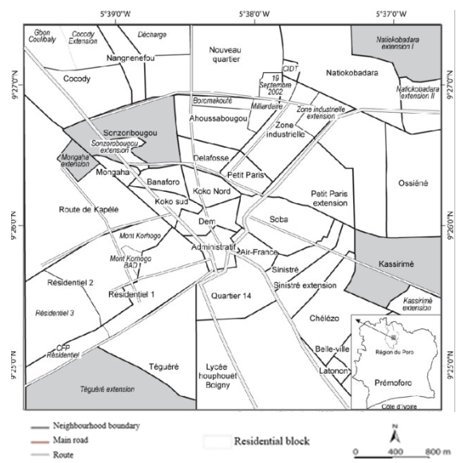
The survey was carried out in the communal city of Korhogo, located in north of Côte d’Ivoire, 633 km from Abidjan, between 5°15 and 6°20 West longitude and 8°30 and 10°25 North latitude. Korhogo is the leading city of Poro region, with an estimated population of about 243,048 residents 12. Onion traders were investigated from three communal markets located in three city’s districts, namely Sinistré market, Haoussabougou market, and the general communal market, according to their most frequentation and supply with vegetables. Also, 100 consumers in the 10 mains city’s residential districts (Haoussabougou, Sonzoribougou, Koko, Soba, Sinistré, Téguéré, Nouveau quartier, Tiékélézo, Kassirimé and Petit Paris) were visited during investigations at field (Figure 1).
2.2. Investigations implementationThe study was completed for three months, from October to December 2020. The investigations were carried out through direct individual interviews with traders and consumers using pre-designed questionnaires. For the marketing survey, a sample of 45 traders was interviewed in the three markets. Onion traders were selected among traders displaying onions stalls in the market, with preference to onions wholesalers. In addition, the consumption survey was carried out with 100 consumers from both household and restaurant locations in the 10 city’s districts according to their population size and presence of restaurants. From each district, the households were randomly chosen separated with a minimum 100 m distance.
During the marketing investigations, the main traders’ profile, as well as the supply, sales, and preservation indicators were focused. From the consumers, the social profile and the onion uses and consumptions traits were targeted.
2.3. Data analysisThe collected data were treated using STATISTICA Version 7.1 software (StatSoft; Tibco Software, Paris, France). The rates resulting from the main responses routes were calculated. Then, a Chi-square (X2) test was performed to compare the percentages by investigated trait at 5% significance.
Statistical analysis revealed clear statistical differences between the main responses dealing with numerous indicators focused.
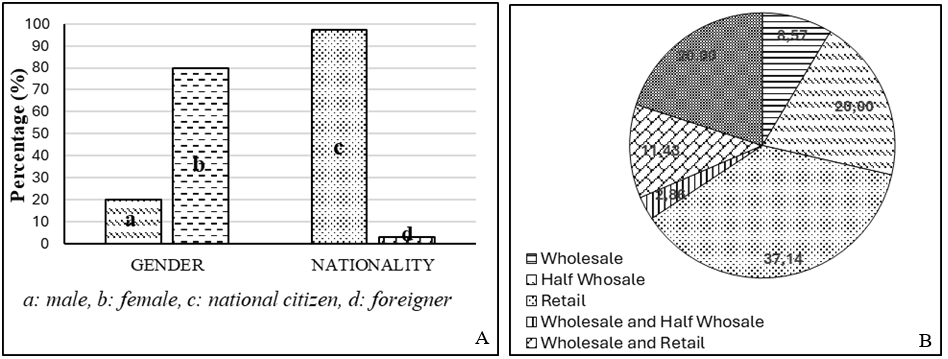
3.1. Onion’s Trading InformationFigure 2 displays the data of the gender, nationality and education level of the traders involved in the onion distribution chain in Korhogo. According to the results, 80% onions traders are women, against only 20% male stakeholders. Among these traders, 97.14% are national citizens (Ivoirians) and only 2.86% responded as foreign citizens. The onions bulbs are distributed applying retailing from 37.14% traders. On the other hand, 40% traders are involved in semi-wholesale, and 20% traders responded for only semi-wholesale, while 20% associate this method with retail sales. The rate of traders involved in onion full wholesale is 22.85%.
Table 1 presents the onion supply indicators rated by traders. For 60% traders, the onions sold are imported, while only 11.43% were supplied by local production. In addition, 75.24% merchants pay invoices for orders after sale.
The most popular onion varieties for sale are yellow and purple onions according to respective 51.90% and 38.05% traders interviewed. Also, 60% traders investigated emphasize a permanent abundance of onions while 34.29% prefer a fluctuating abundance by months. In addition, 65.71% traders attest the existence of local onion producers, who are relatively numerous according to 40% respondents. The local producers grow purple onions as rated by 47.14% traders, against 12.86% responding for the red onions.
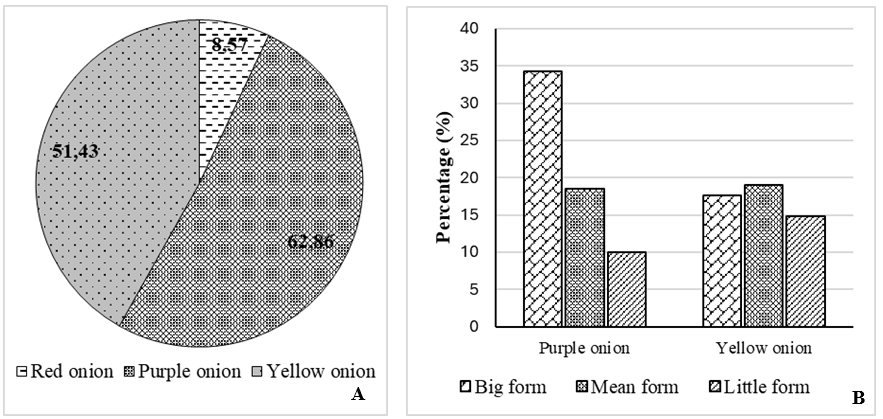
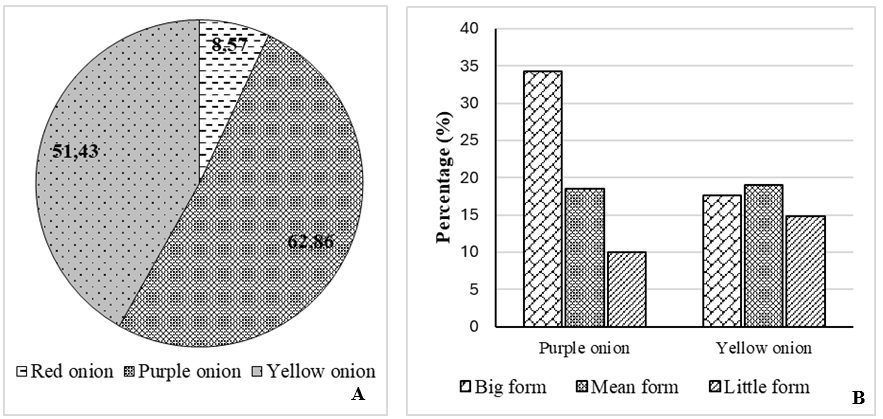
Table 2 shows some key onion’s sale indicators in Korhogo. For 42.86% traders, the combination ‘‘colour and shape of bulbs” is the most important criterion in the sale of onions. Also, 25.71% traders rate the triple criteria ‘‘firmness, colour and shape’’ as significant basis for purchasing onions by customers. For most traders (55.71%), purple onions are the most requested by customers, followed by yellow onions (20%). Regarding the onion’s shape, the largest bulbs are more agreed by customers, according to 41.90% traders. However, the purple onions and yellow onions record higher volumes of sales in Korhogo according to respective 62.86% and 51.43% of the traders investigated (Figure 3A). For the purple onions, large sizes bulbs are more sold, while for yellow onions, medium shapes are preferred (Figure 3B).
The main conservation traits rated by onion traders are provided in Table 3. For 60% traders, the onions are stored in warehouses, while 34.29% store them on site at the market. Also, most traders (67%) estimate the shelf life of onions as lower than one month against 31.43% estimating between one- and five-months’ preservation. Overall traders attest any onion’s treatment with preservatives during storage.
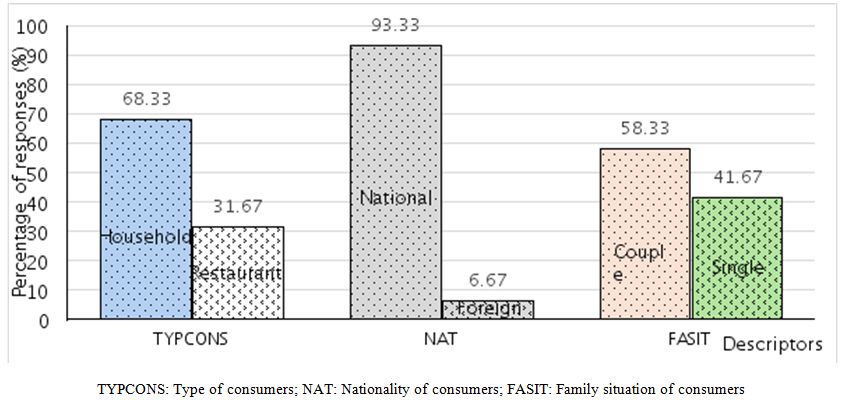
3.2. Onion Consumption InformationThe data about the type, nationality and family situation of onion consumers from Korhogo are displayed in Figure 4. The consumers focused were from households (68.33%) and restaurants (31.67%). These consumers are mainly Ivoirians (93.33%), against 6.67% foreigners. In addition, most of them (58.33%) ensured to be in couple, against 41.67% of single life.
The onions’ uses mentioned by consumers are recorded in Table 4. According to the data, most consumers (86.67%) use still fresh onion bulbs and fewer as dry powder. Besides, 63.33% responded for only home onions’ consumption against 31.67% for both household consumption and out-of-home catering. In addition, the overall consumers investigated (100%) are provided with onions from communal markets. Thus, 78.33% of consumers are concerned by either the bulb shape, or both the shape and colour, as main criteria for the onion’s purchase. However, a significant rate of consumers (15%) does not consider any specific criteria for the onion’s purchase. Daily and weekly purchases are the most common plans of onion’s supply by consumers, with respective ratings of 46.67% and 30%. For each purchase, the weight of onion collected by consumer hardly exceeds 3 kg (78.23%). However, restaurant owners usually gather from 3 kg to 5 kg (6.67%) or over 10 kg (11.67%) per onion purchase.
Table 5 displays information about the onion consumption indicators recorded from the investigation. Onions are consumed in both raw and cooked forms by 71.67% consumers, while 11.67% consumers use dry onion powder. From the raw form, the use of onions as crude vegetables with seasoning is most reported by consumers (65%). On the other hand, the consumption of cooked onions is mainly by grills and sauces recipes (81.67%). However, 23.76% consumers have preference for crude onion with seasoning, while 37.92% are favoured for cooked onion dishes and 32.09% for grilled recipes. These consumption preferences are mostly correlated with the onion variety. Thus, the purple varieties are the most appreciated by consumers (70.01%) and to a lower extent the yellow onions (33.35%). Among the preferred varieties, higher size bulbs are the premium onions for consumers (Figure 5). Regarding organoleptic traits, consumers are sensitive to the taste (46.11%) and the onion aroma (29.44%). Also, 95% of the investigated population rated a daily intake of onion, generally consisting of in more than 5 bulbs (45%) or between 1 and 3 bulbs (39.17%) per consumption.


The investigation revealed the main involvement of women in the onion trade in the city of Korhogo. Generally, local foodstuff commerce is known as one of the main livelihoods of African women which are for key role in the economy 14. The onion trade in Korhogo is characterized by the presence of many retailers. Such a plan could be linked to the fewer resources necessary to engage in this trade. Indeed, wholesale trade requires a large investment capital compared to the retail trade which is more accessible to people with limited resources. The investigation reveals that the onions sold in the communal markets are most imported. Since the local domestic production does not fit the consumption demand, Côte d'Ivoire usually imports onions from the sub-regional countries such as Niger, Burkina Faso, and from Netherlands, as reported by RONGEAD 6. According to the same author, the distinction between the sub-regional imported onions and those imported from Europe is mainly related to bulb colour. In fact, the sub-regional onions are purplish or red, but the most onion imports from Netherlands are yellow, so that the purple and yellow onions are the most met on the markets. Purple onion has been identified as the type of onion grown by local producers. Indeed, the variety spelt Violet de Galmi was the most popularized onion variety in Côte d'Ivoire 15 and considered as a local variety. This variety has a good adaptation ability for the agroclimatic conditions of the production areas. However, both purple and yellow onions varieties are not simultaneously available in sufficient seed amounts by the same period during the year for farmers.
Most traders store onions in warehouses and market stores, usually without treatment and any control about the temperature and relative moisture. However, these environmental factors impede the shelf life of onions. Thus, recommendations of 27°C for room temperature and relative moisture of 83% are suggested by Abdullah et al. 16 to improve the onion's preservation delay.
Logically, the onion consumers investigated are mainly Ivorians (93.33%), since the local communal population are of major national citizens. These results corroborate similar assessments achieved in Abidjan by Lagou et al. 17 resulting in a percentage of 78% of Ivorian citizens among orange consumers in urban areas. Most of the people interviewed live as couples in households. Such social position is friendly with the promoting of domestic consumption of cooked meals with onions added into various food recipes. Onions are mostly used in the form of fresh bulbs in crude vegetables or in cooked dishes. This observation supports the work of Silué 18 who reports the populations’ preference for the consumption of ready cooked meals and crude foods. Onion is therefore one of the most vegetables used in foods to fit the balanced diets. This mode of consumption corresponds to the traditional uses applied by the local populations. In fact, for decades, onion had been consumed in fresh form, crude or cooked, but fewer in powder form that would be also probably scantly known by consumers. As a result, the demand for fresh onion is, like other vegetables and fruits, under the constraint of regular supply on local markets. Fresh onions display higher moisture rates and are easily perishable under certain conditions. Rather, the processing of onion into dry powder provides a product with significant biochemical and organoleptic qualities 19, 20. This technological method could thus promote the preservation of onions and reduce the cases of loss of shortages observed on the urban supply markets.
Most onion purchases plan from consumers are daily. This practice could result from the need for fresh and healthy onions and other vegetables for domestic consumption 21. The study also revealed that every household should not get sufficient resources for bulk purchases of large volumes of food products. Purchases below 3 kg of onion bulbs are regularly done by household consumers, whereas higher quantities over 10 kg are acquired by restaurants since the out-of-home catering is a strengthened consumption habit in large cities 22. The purple and yellow onions are the most popular with consumers, especially the larger size ones. This observation is consistent with the challenges in the popularization of shallots as local types of onions traditionally produced from rural areas in Côte d'Ivoire. The fleshy bulb of onions therefore appears as preferential criterion for consumers. This approach is also observed in the consumption choices and valorization of other fruits such as mango. For this fruit, the Kent variety, which has a larger size, is of the most popular 23.
Furthermore, onions are consumed in raw form added with other vegetables and seasonings. Also, onions are used in the preparation of sauces and in grilled food as sides of dishes. Regarding onions’ varieties, purple bulbs are preferred for consumption. The purple onions provided from the West African sub-region fit many expected consumption traits as spiciness and dispersion in sauces compared to the onions imported from Europe. A similar approach has been concluded from previous investigation 24. According to these searches, most housewives declare preferences for the quality of purple onions cultivated in Niger, Burkina Faso and Côte d’Ivoire, rather than yellow onion from Holland or shallot from Côte d’Ivoire, thanks to the spiciness taste and the thickness ability of sauces. A larger ratio of consumers is favorable to such a tangy aspect of the onion. Strategies for popularizing local onion production should consider preferred criteria requested by consumers, most important of which are the aroma and taste.
The current investigation at field aimed to reveal the main traits related to the trading and consumption of onions in urban areas, with a specific focus on Korhogo, the third largest city in Côte d'Ivoire. From the data, the onion’s trade in urban area is mainly a gender activity dominated by local women, while the goods are most acquired through imports. The purple and yellow onion varieties are most dominant for sale in the markets, where the crops are usually stored without any treatment and preservatives. Generally, onions are consumed in raw vegetables, grilled meals and sauces. However, purple onions are the most preferred by consumers thanks to their pungent taste and thickening power in sauces. Also, large size onions are preferred. The main information derived from this investigation at field could be used in varietal selection and due policies to support the local industry of onion and to strengthen food resilience.
The authors thank the Korea Africa Food & Agriculture Cooperation Initiative (KAFACI) as Project funder of this investigation.
The authors declare that there are no competing interests with this manuscript.
| [1] | Bindu, B., Podikunju, B. ‘‘Performance evaluation of onion (Allium cepa L. Var. cepa) varieties for their suitability in kollam district’’, International Journal of Research in Agricultural Sciences, 1(1). 18-20. 2015. | ||
| In article | View Article | ||
| [2] | Silué, S., Fondio, L., Coulibaly, M.Y., Magein, H. ‘‘Sélection des variétés d’oignon (Allium cepa L) adaptées au Nord de la Côte d’Ivoire’’, Tropicultura, 21(3). 129-134. 2003. | ||
| In article | |||
| [3] | Bennacer, M., Bouderbala, A. Etude du désherbage (chimique et manuel) en pépinière sur la culture d’oignon A. cepa (deux hybrides F1 et une variété population). Mémoire de Master. Université Abdelhamid Ibn Badis-Mostaganem, Algérie. 2016, 66p. | ||
| In article | |||
| [4] | Blein, R., Soulé, B.G., Dupaigre, B.F., Yérima, B. Les potentialités agricoles de l'Afrique de l'Ouest (CEDEAO). Fondation pour l’agriculture et la ruralité dans le monde (FARM). Presles, France, 2008, 116p. | ||
| In article | |||
| [5] | FAOSTAT. Organisation des nations unies pour l’alimentation et l’agriculture. 2025, . Consulté le 28/08/2025. | ||
| In article | |||
| [6] | RONGEAD. Diagnostic de la filière oignon en Côte d’Ivoire. Projet « Redynamiser les productions, l’accès au marché et le conseil agricole pour les filières vivrières et commerciales du Nord de la Côte d’Ivoire ». Rapport d’étude, 2015, 35p. | ||
| In article | |||
| [7] | Konan, S., Affery, A., Bomisso, E.L., Bire, A., Zouzou, M. ‘‘Evaluation of the Agronomic Performance of Onion Varieties in the Rainy and Dry Season in Northern Ivory Coast’’, Ind. J. Pure App. Biosci., 8(2). 8-15. 2020. | ||
| In article | View Article | ||
| [8] | Dagnogo, F., Coulibaly, S.S., Konaté, D., Fofana, L. ‘‘Low Productivity of Onion in Côte d’Ivoire: Causes and Recommendations’’, SSRG International Journal of Agriculture & Environmental Science, 5(5). 49-56. 2018. | ||
| In article | View Article | ||
| [9] | Konan, N.Y., Diarrassouba, N., Koffi, E.-B.Z., Yao, S.D.M., Soro, K., Cissé, M., Biego, G.H.M. ‘‘Assessment of Nutritional Properties from Six Varieties of Onion (Allium cepa L., Alliaceae) Produced in Northern Côte d’Ivoire’’, Journal of Experimental Agriculture International, 43(11). 168-179. 2021. | ||
| In article | View Article | ||
| [10] | Koffi, E.-B.Z., Diarrassouba, N., Konan, N.Y., Yao, S.D.M., Sahi, G.A., Sié, R.S. ‘‘Agromorphological Variability of Five Onion (Allium cepa L.) Varieties in Korhogo, Northern Côte d'Ivoire’’, World Journal of Agricultural Research, 10(1). 7-14. 2022. . | ||
| In article | |||
| [11] | Koffi, E.-B.Z., Daramcoum, M.P.W.A., Konan, N.Y., Kouyaté, I., Yao, S.D.M., Sié, R.S., Diarrassouba, N. ‘‘Agromorphological Evaluation of Eight Onion Varieties (Allium cepa) in Northern Côte d'Ivoire’’, International Journal of Agriculture & Biology, 34: 340408. 2025. | ||
| In article | View Article | ||
| [12] | Institut National des Statistiques. Recensement Général de la Population et de l’Habitat 2014 Répertoire des localités : Région du Poro. Abidjan. 2015, 52p. | ||
| In article | |||
| [13] | Amalaman, D.M., Kouabenan, B.S., Kone, S., Ouattara, S. ‘‘Conflict management process with witchcraft antecedents at the legal and community level in Korhogo in Côte d’Ivoire’’, Revue Africaine d’Anthropologie, Nyansa-Pô, 33. 51- 74. 2021. | ||
| In article | |||
| [14] | Brenton, P., Gamberoni, E., Sear, C. Women and trade in Africa: Realizing the potential. World Bank, Washington, DC. 2013, 190 p. | ||
| In article | View Article | ||
| [15] | Kuipers, J.J. Expérimentation oignon, campagne 1980-1981. Station expérimentale de Sinématiali. Projet PNUD/FAO/IVC/009 “Développement des cultures maraîchères. Expérimentation et formation. Secrétariat d’état à l’agriculture. Côte d’Ivoire, Ferkessédougou, SODEFEL, 1982, 37 p. | ||
| In article | |||
| [16] | Abdullah-Al, M., Hamidul, M.I., Asmaul, H., Ismot, Z. ‘‘Revolutionizing onion preservation: A novel aerated storage approach’’, Archives of Agriculture and Environmental Science, 9(2). 329-335. 2024. | ||
| In article | View Article | ||
| [17] | Lagou, V.C., Assa, R.R., Soro, S., Koffi, K.A., Ayoua, A.R.W., Chatigre, K.O. ‘‘Inventory on the valorization of the residues deriving from the oranges (Citrus sinensis L.) consumption in Côte d’Ivoire’’, World J. Pharm. Life Sci., 4(3). 12- 17. 2018. | ||
| In article | |||
| [18] | Silué. Etude des voies de consommation des produits vivriers dans la province du Yatenga. Mémoire d’ingénieur en vulgarisation agricole, Université Polytechnique de Bobo-Dioulasso, Burkina Faso, 2017, 46 p. | ||
| In article | |||
| [19] | Muhaba, S., Yetenayet, B.T., Ali, M., Tessema, A. ‘‘Effect of variety and drying temperature on physicochemical quality, functional property, and sensory acceptability of dried onion powder’’, Food Science and Nutrition, 6. 1641–1649. 2018. | ||
| In article | View Article PubMed | ||
| [20] | Bamba, B.S.B., Komenan, A.C.A., Kouassi, K.K.P., Soro, D. ‘‘Effects of onion bulb processing conditions on drying characteristics, physicochemical and functional properties profile of onion (Allium cepa L.) powder’’. Journal of Food Science, 1(1). 1- 10. 2020. | ||
| In article | View Article PubMed | ||
| [21] | Ibrahima, D. Le consommateur urbain africain et les SADA. Programme «Approvisionnement et distribution alimentaires des villes». Communication présentée au séminaire sous- régional FAO-ISRA « Approvisionnement et distribution alimentaires des villes de l’Afrique francophone ». Dakar, Sénégal, 14 au 17 avril, 1997. 20 p. | ||
| In article | |||
| [22] | Kengap, E.J., Djou, P., Tchamda, C., Martin, P., Bricas, N. L’évolution de la consommation alimentaire au Cameroun de 2001 à 2007. In L’Afrique à la conquête de son marché alimentaire intérieur. Enseignements de dix ans d’enquêtes auprès des ménages d’Afrique de l’Ouest, du Cameroun et du Tchad. 2007. Site internet: https:// agritrop.cirad.fr/ 588978/ 1/ID588978.pdf. | ||
| In article | |||
| [23] | CNUCED. Variétés, Norme de qualité, Classification. In Mangue. Un profil de produit de base par INFOCOMM. Conférence des Nations Unies sur le Commerce et le Développement. New York et Genève, 2016. 6- 7. | ||
| In article | |||
| [24] | David, O., Moustier, P. ‘‘La formation de la qualité dans la filière oignon en Afrique de l'Ouest’’, Fruit, 51(5). 347-358. 1996. | ||
| In article | |||
Published with license by Science and Education Publishing, Copyright © 2025 KONAN N’Guessan Ysidor, KOFFI Eric- Blanchard Zadjéhi, SORO Koulotioloma, CISSE Mohamed, YAO Saraka Didier Martial, BIEGO Godi Henri Marius and DIARRASSOUBA Nafan
 This work is licensed under a Creative Commons Attribution 4.0 International License. To view a copy of this license, visit
http://creativecommons.org/licenses/by/4.0/
This work is licensed under a Creative Commons Attribution 4.0 International License. To view a copy of this license, visit
http://creativecommons.org/licenses/by/4.0/
| [1] | Bindu, B., Podikunju, B. ‘‘Performance evaluation of onion (Allium cepa L. Var. cepa) varieties for their suitability in kollam district’’, International Journal of Research in Agricultural Sciences, 1(1). 18-20. 2015. | ||
| In article | View Article | ||
| [2] | Silué, S., Fondio, L., Coulibaly, M.Y., Magein, H. ‘‘Sélection des variétés d’oignon (Allium cepa L) adaptées au Nord de la Côte d’Ivoire’’, Tropicultura, 21(3). 129-134. 2003. | ||
| In article | |||
| [3] | Bennacer, M., Bouderbala, A. Etude du désherbage (chimique et manuel) en pépinière sur la culture d’oignon A. cepa (deux hybrides F1 et une variété population). Mémoire de Master. Université Abdelhamid Ibn Badis-Mostaganem, Algérie. 2016, 66p. | ||
| In article | |||
| [4] | Blein, R., Soulé, B.G., Dupaigre, B.F., Yérima, B. Les potentialités agricoles de l'Afrique de l'Ouest (CEDEAO). Fondation pour l’agriculture et la ruralité dans le monde (FARM). Presles, France, 2008, 116p. | ||
| In article | |||
| [5] | FAOSTAT. Organisation des nations unies pour l’alimentation et l’agriculture. 2025, . Consulté le 28/08/2025. | ||
| In article | |||
| [6] | RONGEAD. Diagnostic de la filière oignon en Côte d’Ivoire. Projet « Redynamiser les productions, l’accès au marché et le conseil agricole pour les filières vivrières et commerciales du Nord de la Côte d’Ivoire ». Rapport d’étude, 2015, 35p. | ||
| In article | |||
| [7] | Konan, S., Affery, A., Bomisso, E.L., Bire, A., Zouzou, M. ‘‘Evaluation of the Agronomic Performance of Onion Varieties in the Rainy and Dry Season in Northern Ivory Coast’’, Ind. J. Pure App. Biosci., 8(2). 8-15. 2020. | ||
| In article | View Article | ||
| [8] | Dagnogo, F., Coulibaly, S.S., Konaté, D., Fofana, L. ‘‘Low Productivity of Onion in Côte d’Ivoire: Causes and Recommendations’’, SSRG International Journal of Agriculture & Environmental Science, 5(5). 49-56. 2018. | ||
| In article | View Article | ||
| [9] | Konan, N.Y., Diarrassouba, N., Koffi, E.-B.Z., Yao, S.D.M., Soro, K., Cissé, M., Biego, G.H.M. ‘‘Assessment of Nutritional Properties from Six Varieties of Onion (Allium cepa L., Alliaceae) Produced in Northern Côte d’Ivoire’’, Journal of Experimental Agriculture International, 43(11). 168-179. 2021. | ||
| In article | View Article | ||
| [10] | Koffi, E.-B.Z., Diarrassouba, N., Konan, N.Y., Yao, S.D.M., Sahi, G.A., Sié, R.S. ‘‘Agromorphological Variability of Five Onion (Allium cepa L.) Varieties in Korhogo, Northern Côte d'Ivoire’’, World Journal of Agricultural Research, 10(1). 7-14. 2022. . | ||
| In article | |||
| [11] | Koffi, E.-B.Z., Daramcoum, M.P.W.A., Konan, N.Y., Kouyaté, I., Yao, S.D.M., Sié, R.S., Diarrassouba, N. ‘‘Agromorphological Evaluation of Eight Onion Varieties (Allium cepa) in Northern Côte d'Ivoire’’, International Journal of Agriculture & Biology, 34: 340408. 2025. | ||
| In article | View Article | ||
| [12] | Institut National des Statistiques. Recensement Général de la Population et de l’Habitat 2014 Répertoire des localités : Région du Poro. Abidjan. 2015, 52p. | ||
| In article | |||
| [13] | Amalaman, D.M., Kouabenan, B.S., Kone, S., Ouattara, S. ‘‘Conflict management process with witchcraft antecedents at the legal and community level in Korhogo in Côte d’Ivoire’’, Revue Africaine d’Anthropologie, Nyansa-Pô, 33. 51- 74. 2021. | ||
| In article | |||
| [14] | Brenton, P., Gamberoni, E., Sear, C. Women and trade in Africa: Realizing the potential. World Bank, Washington, DC. 2013, 190 p. | ||
| In article | View Article | ||
| [15] | Kuipers, J.J. Expérimentation oignon, campagne 1980-1981. Station expérimentale de Sinématiali. Projet PNUD/FAO/IVC/009 “Développement des cultures maraîchères. Expérimentation et formation. Secrétariat d’état à l’agriculture. Côte d’Ivoire, Ferkessédougou, SODEFEL, 1982, 37 p. | ||
| In article | |||
| [16] | Abdullah-Al, M., Hamidul, M.I., Asmaul, H., Ismot, Z. ‘‘Revolutionizing onion preservation: A novel aerated storage approach’’, Archives of Agriculture and Environmental Science, 9(2). 329-335. 2024. | ||
| In article | View Article | ||
| [17] | Lagou, V.C., Assa, R.R., Soro, S., Koffi, K.A., Ayoua, A.R.W., Chatigre, K.O. ‘‘Inventory on the valorization of the residues deriving from the oranges (Citrus sinensis L.) consumption in Côte d’Ivoire’’, World J. Pharm. Life Sci., 4(3). 12- 17. 2018. | ||
| In article | |||
| [18] | Silué. Etude des voies de consommation des produits vivriers dans la province du Yatenga. Mémoire d’ingénieur en vulgarisation agricole, Université Polytechnique de Bobo-Dioulasso, Burkina Faso, 2017, 46 p. | ||
| In article | |||
| [19] | Muhaba, S., Yetenayet, B.T., Ali, M., Tessema, A. ‘‘Effect of variety and drying temperature on physicochemical quality, functional property, and sensory acceptability of dried onion powder’’, Food Science and Nutrition, 6. 1641–1649. 2018. | ||
| In article | View Article PubMed | ||
| [20] | Bamba, B.S.B., Komenan, A.C.A., Kouassi, K.K.P., Soro, D. ‘‘Effects of onion bulb processing conditions on drying characteristics, physicochemical and functional properties profile of onion (Allium cepa L.) powder’’. Journal of Food Science, 1(1). 1- 10. 2020. | ||
| In article | View Article PubMed | ||
| [21] | Ibrahima, D. Le consommateur urbain africain et les SADA. Programme «Approvisionnement et distribution alimentaires des villes». Communication présentée au séminaire sous- régional FAO-ISRA « Approvisionnement et distribution alimentaires des villes de l’Afrique francophone ». Dakar, Sénégal, 14 au 17 avril, 1997. 20 p. | ||
| In article | |||
| [22] | Kengap, E.J., Djou, P., Tchamda, C., Martin, P., Bricas, N. L’évolution de la consommation alimentaire au Cameroun de 2001 à 2007. In L’Afrique à la conquête de son marché alimentaire intérieur. Enseignements de dix ans d’enquêtes auprès des ménages d’Afrique de l’Ouest, du Cameroun et du Tchad. 2007. Site internet: https:// agritrop.cirad.fr/ 588978/ 1/ID588978.pdf. | ||
| In article | |||
| [23] | CNUCED. Variétés, Norme de qualité, Classification. In Mangue. Un profil de produit de base par INFOCOMM. Conférence des Nations Unies sur le Commerce et le Développement. New York et Genève, 2016. 6- 7. | ||
| In article | |||
| [24] | David, O., Moustier, P. ‘‘La formation de la qualité dans la filière oignon en Afrique de l'Ouest’’, Fruit, 51(5). 347-358. 1996. | ||
| In article | |||