The social facilitation of public dining is important for healthy development. Unfortunately, this practice was, for many, temporarily interrupted by COVID-19. In this crossover study, we posit that two conditions—silent eating versus conversing while eating with cafeteria situation affects consumption and taste. In all, 11 students at a university in Japan served 10 g of popcorn each during a 90-s interval under these two conditions. The main outcome measures were consumption, the scores for which were significantly higher when eating with conversation. The results indicated that ambience and friendship affected eating rates are important for food consumption. This paper’s result suggested the importance of eating with others. We need to conduct additional experiments in the future. However, this paper is necessary for future developments.
The environment influences the nature of food’s palatability. Various factors influence this perception, including sight, sound, smell, and color 1, 2, 3, 4, 5. However, food tasting is complex because it requires both psychological and physiological considerations.
For example, Suzuki et al. found that food color modulates and motivates food intake 3. Postprandial satiety, thermal sensations, and peripheral temperature also affect intake. Moreover, Genschow et al. suggested that red-colored food acts as a subtle cue to limit incidental ingestion and taste 6. Indeed, research has shown that food that has a progressively darker shade of red was perceived to be less appetizing, and food with warm hues is perceived as tastier than that with cold ones 2. In the dining environment, hearing, sound, and music can also affect palatability, as evidenced by the effect of hearing on the senses of taste such as wine tasting 4, 5. Thus, color, and music affect food taste and have a psychological effect. Therefore, color, music type, cultural background, race, and mechanism require detailed consideration.
The factor of visualization is closely related to this area of study. Several studies have highlighted the relationship between visuals and images people see while eating 1, 7, 8, 9. Nakata confirmed how eating rates result in palatable changes when participants ate in front of a mirror or a wall-reflecting monitor 7. This result suggests that the mirroring condition is better than the monitoring condition. One reason for this may be rooted in the relationship with modeling. Cruwys et al. suggested that social modeling can dictate specific food behaviors in familiar situations 8. Thus, we selected a setting where social modeling is likely to occur, as how, and with whom we eat is also important.
The Japanese government's fourth Shikoku promotion basic plan suggested that people should eat together 10. However, COVID-19 meant that in Japan, people refrained from eating while talking in public, including school lunches from 2020 to 2022 11, 12. Although some studies recommended eating together, one study suggested that decreased frequency in commensality was associated with low health-related quality of life 13. However, few studies, if any, have examined silent eating, or conversing with friends while eating. This study theorizes that eating with a group while talking versus silent eating affects consumption and tastiness. The main outcome is proposed that eating with a group while talking is important because how eating is done affects palatability and rate of consumption.
Study 1
This crossover study consisted of 11 students (male = 4, female = 7) between the ages of 20 and 21 years. The participants had good health and self-reported no food allergies, history of eating disorders, or special dietary restrictions. In this experiment, the participants experienced two conditions. We confirmed and determined the sample size using G power. Although we aimed for a minimum of 12-15 participants, due to some absences, our final sample size ended up being 11 participants.
The study protocol was reviewed and approved by Tokyo University Ethical Review Board for Medical and Health Research involving Human Subjects (TU-2022-009). The experiment was carefully explained to all participants, who provided their informed consent to participate in the study.
Study 2
A group similar to Study 1 was used, but with only female participants (n=7). Using a crossover design, two rounds of experiments (silent and talk) were conducted with 3 or 4 participants respectively.
2.2. Sampling ProcedureStudy 1
The participants were randomly divided into two groups, the group that received the intervention from the silent eating first, consisting of Group 1 (Silent Eating Group, n = 6); and Group 2 (Talking and Eating Group, n = 5). The experiment took place in the school cafeteria at one university in Japan. Due to the continuing COVID-19 pandemic, the researchers installed a transparent screen between the participants.
White bowls of salty buttered soy sauce popcorn (Japan Frito-Lay, Ltd., 10 g per bowl, butter soy source taste, 50 kcal per 10 g), were placed on a desk. An alarm bell signaled the beginning of each tasting period. Four tests were conducted, beginning with Group 1. Each participant took the tests twice.
All participants served 10 g of popcorn that was placed before them for 90 s. We calculated the consumption rate by checking the amount remaining from the initial amount. Participants were not informed they were eating the same popcorn. However, each was required to self-complete a short evaluation questionnaire.
Study 2
We conducted the same experiment as Study 1. The experiments from Study 1 and Study 2 were analyzed together (n=18).
2.3. Data Collection and MeasurementsEach questionnaire contained one question about the tastiness of the popcorn and was scored based on a 6-point Likert scale (from “not at all” to “extremely” tasty). The questions reflected participants’ evaluations of the popcorn; an example question was “How tasty is this food?” The higher the score, the more positive participants’ perception of tastiness 1, 7, 8.
After completing all of the eating tests, six questions were asked about two popcorn preferences, and four questions about their eating habits; “Do you like popcorn?”, “How often do you eat popcorn?” “How often do you eat alone?” “Is your meal time short or long compared to that of your friends?” “Do you eat quickly?” and “Do you watch a screen while eating?” Questions about their eating speed were answered based on a 5-point likert scale. The higher the score, the faster participants’ eating speed.
We also calculated the consumption ratio of each bowl of popcorn by subtracting the ratio of the quantity of the remaining popcorn from the initial quantity.
2.4. Statistical AnalysisData analysis was conducted with the Statistical Package for the Social Sciences version 25 (Chicago, IL, USA). Data were presented as the mean ± standard deviations unless otherwise stated.


We conducted a paried t-test for popcorn consumption rate and a Wilcoxon signed-rank test for popcorn taste. In addition, we used Spearman’s rank correlation coefficient to measure consumption and speed; p < 0.05 was considered statistically significant.
“Do you like popcorn?”, 91% answered that they liked popcorn.The frequency of popcorn consumption was categorized as “almost never” or “less than once a month”. “How often do you eat alone?” The participants answered that they do not eat alone so often., “Is your meal time short or long compared to that of your friends?”,63% answered that they spend more “Do you eat quickly?”, and “Do you watch a screen while eating?”, all participants answered that they watched videos while eating.
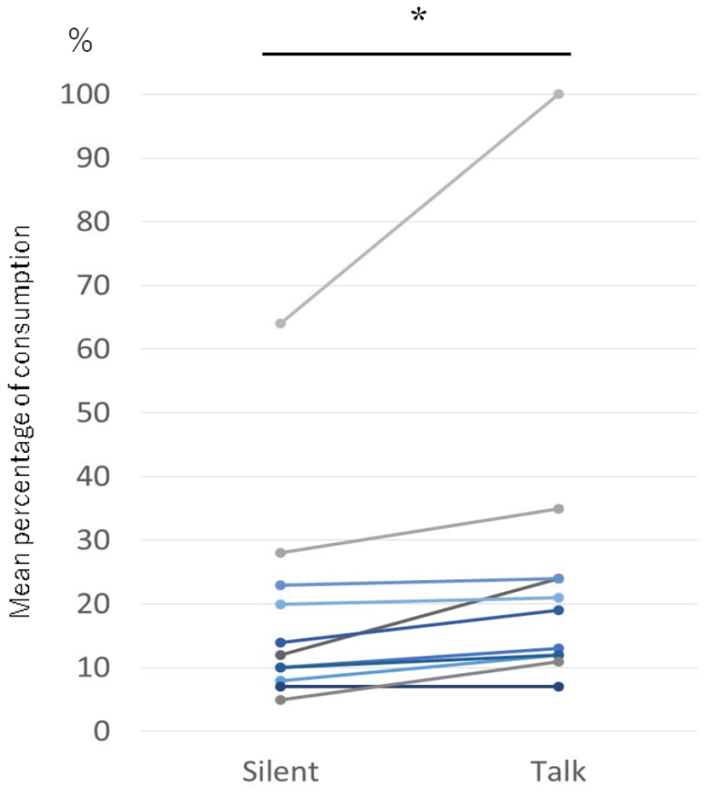
3.2. Differences in Eating Rate and Tastiness Under Two Tasting Conditions as Study 1Participants’ ratings of the popcorn and consumption ratio in each condition were analyzed using a paired t-test with the factors of the presence of silent vs speaking condition (Figure 1). The participants’ rating was significantly higher in the talking condition (M=25.3, SD=26.0) than the silent condition (M=18.3, SD=16.8, p < 0.05).
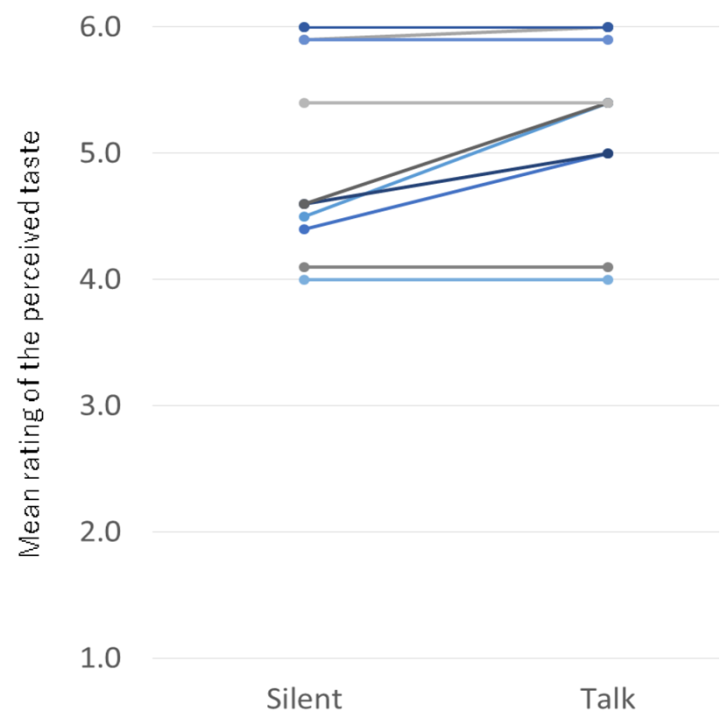
Participants’ deliciousness of the popcorn in each condition was analyzed using Wilcoxon signed-rank sum test with the factors of the presence of silent vs talk condition (Figure 2). The participants’ scoring was significantly higher in the talking condition (M=5.29, SD=0.72,) than the silent condition (M=5.04, SD=0.81, p=N.S).
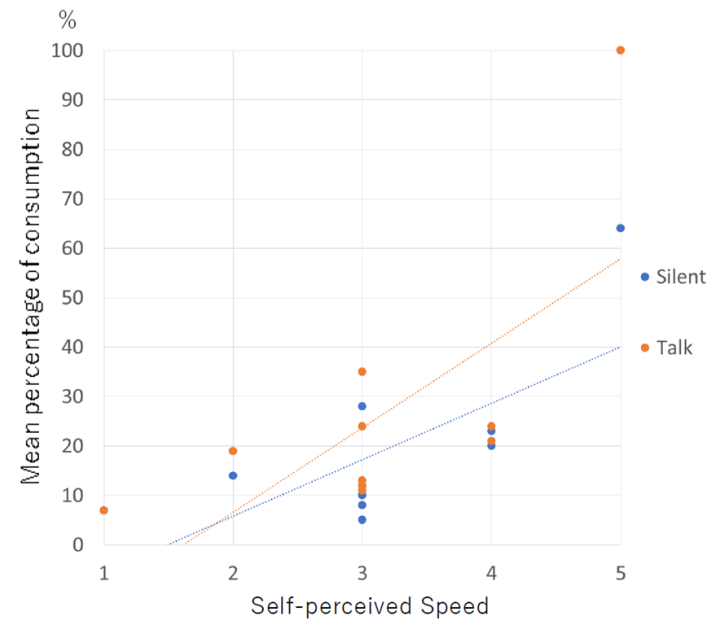
3.3. Correlation Between the Ratios of Consumption of Popcorn and Eating Speed as Study 1We confirmed the correlation between the habitual eating speed and the eating rate during the experiment. Self-perceived speed was moderately correlated with speed during experiment (r=0.56, p < 0.01, data not shown) and consumption of popcorn (r=0.62 p < 0.01 data not shown) in both two conditions.
In the condition of silent eating, a significant correlation was observed between self-perceived speed and experimental condition seppd, as well as consumption ratio, speed during experiment r=0.62, p < 0.05, data not shown, consumption of popcorn r=0.62, p < 0.05, Figure 3.
The same correlation was observed even in situations were conversation was possible, speed r=0.64, data not shown, p < 0.05, consumption r=0.64, p < 0.05, Figure 3). There were no significant correlation with self-perceived speed and tasty in both two conditions.
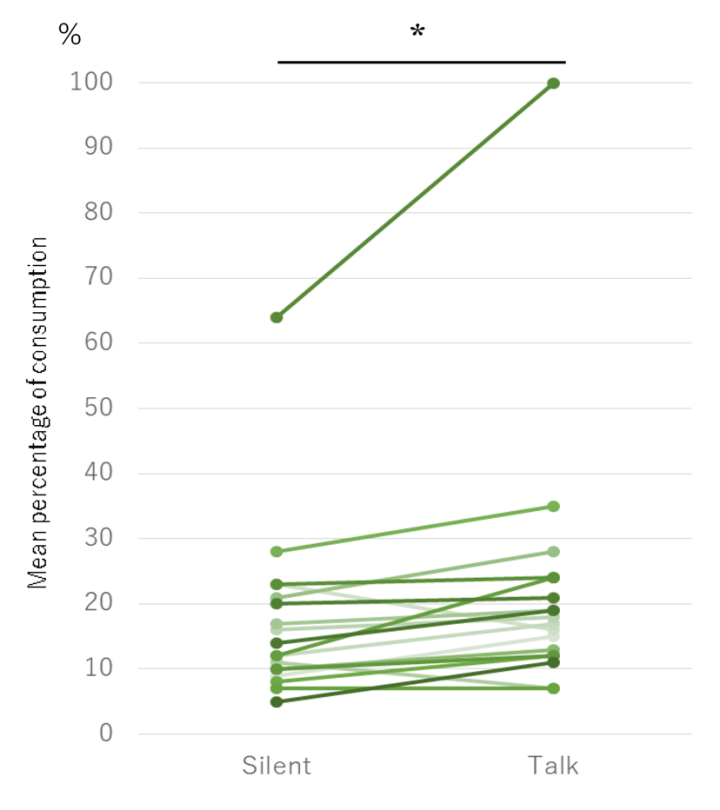
3.4. Differences in Eating Rate and Tastiness Under Two Tasting Conditions as Study 1 and Study 2Participants’ ratings of the popcorn and consumption ratio in each condition were analyzed using a paired t-test with the factors of the presence of silent vs speaking condition (Figure 4). The participants’ rating was significantly higher in the talking condition (M=22.1, SD=20.7) than the silent condition (M=17.2, SD=13.3, p < 0.05).

Participants’ deliciousness of the popcorn in each condition was analyzed using Wilcoxon signed-rank sum test with the factors of the presence of silent vs talk condition (Figure 5). The participants’ scoring was significantly higher in the talking condition (M=5.28, SD=0.73) than the silent condition (M=4.96, SD=0.81, p < 0.05).

To the best of our knowledge, the effectiveness of eating silently versus eating while talking with cafeteria situation has not been fully investigated. Our results suggested that the group eating while talking with cafeteria situation ate more than the group that ate silently. Both conditions had only 90 s to eat. Despite this, consumption increased for the talking group, even though time was not subtracted from the period they spent talking (Figure 1 and Figure 3). No significant difference was also observed in tastiness (Figure 2). When analyzing Study 1 and Study 2 together, it was found that in the situation where participants ate while talking, both the eating rate and the perceived tastiness were higher (Figure 4 and Figure 5).
Studies have examined how eating rates change palatability when still or mirror images are shown 7, although this finding contradicts that earlier work. Indeed, Cruwys et al.’s study suggested social modeling occurs in a familiar situation 8. In our study, the participants knew each other, so consumption increased in the conversing group.
A high frequency of solo eating is associated with depression and anorexia 1, 13. Eating and living alone are perceived to be associated with a higher prevalence of unhealthy eating behaviors in men such as adiposity 6. Many negative effects are attributed to living alone. Although it is dissimilar, it seems better to eat one meal with friends than to eat in silence or alone. This study is important as the results show the importance of commensality 14. A Korean study highlighted the association between the frequency of eating together and health-related quality of life 13. Similarly, a Japanese study highlighted the relationship between self-rated health and morning routines, like home meals 15. Commensality is a relationship annexed to health, quality of life, dietary intake, and weight status 14, 15, 16. The influence of mothers on children must also be considered. For instance, mothers who felt that family commensality was unimportant are more likely to have overweight adolescents than those who perceived otherwise 17. The home food environment concerning children’s dietary quality and weight status is pivotal 18, 19, 20, 21. Research revealed that happiness while eating is connected more with dinner than breakfast and lunch 22.
While this study does not provide conclusive evidence, it is generally believed that speaking activates the prefrontal cortex, so it is possible that its activity has increased 23.
People’s work situation and the number of eating companions may be related to their happiness. Additionally, group size, and gender ratio have also affected feeding 24, 25, 26. In this study, the group size was small with only two males in each group. However, other results may vary depending on group size and gender 24, 25, 26. We also believe that further examination is necessary regarding the number of male and female participants.
Eating speed was a factor in consumption (Figure 3). We confirmed that there is an effect of social modeling (some had increased eating and faster eating speed), and there were no significant differences between the two groups and gender. Therefore, this research shows the importance of eating while talking with friends.
The experiment occurred in a familiar setting with a group of friends, so it may have been less stressful than in a laboratory setting. The study suggested that there was no social modeling of out-group members’ eating but the same group (in-group) had a modeling effect 27. Participants were friends, and their familiar habit of eating together was more than for the silent group, which may explain the positive modeling effect.
Previous studies used 90-s meals with popcorn 7, 27, but it may be necessary to extend the time and consider other foods. However, to implement this scenario in real life, it may be necessary to test for a longer duration with a larger group and experiment with other foods. Further, it should be ascertained whether similar results can be obtained for children, adults, and older people. Our results suggested that eating with others may increase the consumption rate compared to eating alone. This paper’s result suggested the importance of eating with others.
Post-COVID-19, friends will be able to resume eating and celebrating. Maternal influence must also be considered regarding children 17, as this is reflected in how offspring consume school lunches; teachers’ involvement will be pivotal 28, 29. In the future, we will examine how the situation is affected using remote video confederates. It can be expected to conduct investigations on various situations and foods. However, this result could serve as one of the pieces of evidence for recommending talking while eating in school cafeterias or company cafeterias.
We thank all the participants of this study.
This study was supported by Toyo University grant for “Inoue enryou research grant”.
Declare conflicts of interest or state “The authors declare no conflict of interest.” Authors must identify and declare any personal circumstances or interest that may be perceived as inappropriately influencing the representation or interpretation of reported research results.
| [1] | Kawai, N., Guo Z, and Nakata R. “Watching a remote-video confederate eating facilitates perceived taste and consumption of food.” Physiology & Behavior, 238: 113469. 2021. | ||
| In article | View Article PubMed | ||
| [2] | Osera, T., Iijima, K., and Kurihara, N. “Effect of the colour red on an apple’s deliciousness, taste and texture.” Journal of Food and Nutrition Research, 10 (3): 216-220. 2022. | ||
| In article | View Article | ||
| [3] | Suzuki, M., Kimura, R., Kido, Y., et al. “Color of hot soup modulates postprandial satiety, thermal sensation, and body temperature in young women.” Appetite, 114: 209-216. 2017. | ||
| In article | View Article PubMed | ||
| [4] | Wang, Q.J., Spence, C. “Assessing the effect of musical congruency on wine tasting in a leve performance setting.” i-Perception, 6(3): 1-13. 2015. | ||
| In article | View Article PubMed | ||
| [5] | Hus, L., Chen, Y. “Music and wine tasting: an experimental neuromarketing study.” British Food Jounal, 122(8):2725-2737. 2020. | ||
| In article | View Article | ||
| [6] | Genschow, O, Reutner, L, and Wanke, M. “The color red reduces snack food and soft drink intake.” Appetite, 58: 699-702. 2012. | ||
| In article | View Article PubMed | ||
| [7] | Nakata, R., and Kawai, N. The “social” facilitation of eating without the presence of others: Self-reflection on eating makes food taste better and people eat more. Physiology & Behavior, 179: 23-29. 2017. | ||
| In article | View Article PubMed | ||
| [8] | Hermans, R, C.J, Salvy, SJ, Larsen, JK., Engels, C.M.E. “Examining the effects of remote-video confederates on young women’s food intake.” Eating Behaviors, 13, 246-251. 2012. | ||
| In article | View Article PubMed | ||
| [9] | Rosenthal, R. and Raynor, H. “The effect of television watching and portion size on intake during a meal.” Appetite, 117: 191-196. 2017. | ||
| In article | View Article PubMed | ||
| [10] | Ministry of Agriculture, Forestry and Fisheries. Foruth shokuiku promotion basic plan. https://www.maff.go.jp/j/syokuiku/plan/4_plan/(download 2023.1.31). | ||
| In article | |||
| [11] | Ministry of Health, Labour and Welfare. To prevent the spread of infection. https://www.mhlw.go.jp/stf/seisakunitsuite/bunya/kansentaisaku.html (download 2023.1.31). | ||
| In article | |||
| [12] | Ministry of Education, Culture, Sports, Science and Technology. Changes to the basic policy for countermeasures against COVID-19. https://www.mext.go.jp/content/20221129-mxt_kouhou01-000004520_4.pdf(download 2023.1.31). | ||
| In article | |||
| [13] | Choi, M.J., Park, Y.G., Kim, Y.H., et al. “Eating together and health-related quality of life among Korean adults.” Journal of Nutrition Education and Behavior, 52 (8): 758-765. 2020. | ||
| In article | View Article PubMed | ||
| [14] | Hanna, K.L., Collins, PF. “Relationship between living alone and food nutrient intake.” Nutrition Reviews, 73 (9): 594-611. 2015. | ||
| In article | View Article PubMed | ||
| [15] | Osera, T., Awai, M., Kobayashi, M., et al. “Relationship between self-rated health and lifestyle and food habits in Japanese high school students.” Behavioral Sciences (Basel), 7: 71. 2017. | ||
| In article | View Article PubMed | ||
| [16] | Larson, N., MacLehose R, Fulkerson JA, et al. “Eating breakfast and dinner together as a family: Associations with sociodemographic characteristics and implications for diet quality and weight status.” Journal of Academy of Nutrition and Diet, 113: 1601-1609. 2013. | ||
| In article | View Article PubMed | ||
| [17] | Mamun, A.A., Lawlor, D.A., O’Callaghan, M.J., et al. “Positive maternal attitude to the family eating together decreases the risk of adolescent overweight.” Obesity Research, 13 (8): 1422-1430. 2005. | ||
| In article | View Article PubMed | ||
| [18] | Couch, S.C., Glanz, K., Zhou, C., Sallis, JF, Saelens, BE. Home food environment in relation to children’s diet quality and weight status. Journal of Academy of Nutrition and Dietetics, 114; 1569-1579. 2014. | ||
| In article | View Article PubMed | ||
| [19] | Suggs, L.S., Bella, S.D., Rangelov, N., Marques-Vidal, P. “Is it better at home with my family? The effects of people and place on children’s eating behaviour.” Appetite, 121: 111-118. 2018. | ||
| In article | View Article PubMed | ||
| [20] | Utter, J., Denny, S. “Supporting families to cook at home and eat together: Findings from a feasibility study.” Journal of Nutrition Education and Behavior, 48(10): 716-722. 2016. | ||
| In article | View Article PubMed | ||
| [21] | Park-Cardoso, J., Silva, APSD. “Preference to eat alone: Autistic adults’ desire for freedom of choice for a peaceful space.” Autism Adulthood, 3(3): 257-265. 2021. | ||
| In article | View Article PubMed | ||
| [22] | Wahl, D.R., Villinger, K., Konig, L.M., Ziesemer, K., Schupp, HT., Renner, B. “Healthy food choices are happy food choices: Evidence from a real life sample using smartphone based assessments.” Scientific Reports, 7: 17069. 2017. | ||
| In article | View Article PubMed | ||
| [23] | Frith, C., Dolan, R. “The role of the prefrontal cortex in higher cognitive functions.” Cognitive Brain Research, 5: 175-181. 1996. | ||
| In article | View Article PubMed | ||
| [24] | Berry, SL, Beatty, WW, Klesces, RC. “Sensory and Social Influences on Ice Cream Consumption by Males and Females in a Laboratory Setting.” Appetite, 6: 41-45. 1985. | ||
| In article | View Article PubMed | ||
| [25] | Young, M.E., Mizzau, M., Mai, N.T., Sirisegaram, A., Wilson, M. “Food for thought. What you eat depends on your sex and eating companions.” Appetite, 53: 268-271. 2009. | ||
| In article | View Article PubMed | ||
| [26] | Pliner, P. “Eating, social motives, and self-presentation in women and men.” Journal of Experimental Social Psychology, 26: 240-254. 1990. | ||
| In article | View Article | ||
| [27] | Cruwys, T., Platow, M.J., Angullia, S.A., et al. “Modeling of food intake is moderated by salient psychological group membership.” Appetite, 58: 754-757. 2012. | ||
| In article | View Article PubMed | ||
| [28] | Olarte, D.A., Koch, P.A., Wolf, R.L., et al. “Teachers’ resources to support school lunch: Professional development is warranted.” Nutrients, 14: 4596. 2022. | ||
| In article | View Article PubMed | ||
| [29] | Zandian M, Loakimidis, L., Bergstrom, J., Brodin, U., Bergh, C., Leon, M., Shield, J., Sodersten, P. “Children eat their school lunch too quickly: an exploratory study of the effect on food intake.” BMC Public Health, 12, 351. 2012. | ||
| In article | View Article PubMed | ||
Published with license by Science and Education Publishing, Copyright © 2023 Tomoko Osera, Yoshiki Katayama, Yuki Mitsui, Yukiko Segawa, Saki Maruyama and Nobutaka Kurihara
 This work is licensed under a Creative Commons Attribution 4.0 International License. To view a copy of this license, visit
http://creativecommons.org/licenses/by/4.0/
This work is licensed under a Creative Commons Attribution 4.0 International License. To view a copy of this license, visit
http://creativecommons.org/licenses/by/4.0/
| [1] | Kawai, N., Guo Z, and Nakata R. “Watching a remote-video confederate eating facilitates perceived taste and consumption of food.” Physiology & Behavior, 238: 113469. 2021. | ||
| In article | View Article PubMed | ||
| [2] | Osera, T., Iijima, K., and Kurihara, N. “Effect of the colour red on an apple’s deliciousness, taste and texture.” Journal of Food and Nutrition Research, 10 (3): 216-220. 2022. | ||
| In article | View Article | ||
| [3] | Suzuki, M., Kimura, R., Kido, Y., et al. “Color of hot soup modulates postprandial satiety, thermal sensation, and body temperature in young women.” Appetite, 114: 209-216. 2017. | ||
| In article | View Article PubMed | ||
| [4] | Wang, Q.J., Spence, C. “Assessing the effect of musical congruency on wine tasting in a leve performance setting.” i-Perception, 6(3): 1-13. 2015. | ||
| In article | View Article PubMed | ||
| [5] | Hus, L., Chen, Y. “Music and wine tasting: an experimental neuromarketing study.” British Food Jounal, 122(8):2725-2737. 2020. | ||
| In article | View Article | ||
| [6] | Genschow, O, Reutner, L, and Wanke, M. “The color red reduces snack food and soft drink intake.” Appetite, 58: 699-702. 2012. | ||
| In article | View Article PubMed | ||
| [7] | Nakata, R., and Kawai, N. The “social” facilitation of eating without the presence of others: Self-reflection on eating makes food taste better and people eat more. Physiology & Behavior, 179: 23-29. 2017. | ||
| In article | View Article PubMed | ||
| [8] | Hermans, R, C.J, Salvy, SJ, Larsen, JK., Engels, C.M.E. “Examining the effects of remote-video confederates on young women’s food intake.” Eating Behaviors, 13, 246-251. 2012. | ||
| In article | View Article PubMed | ||
| [9] | Rosenthal, R. and Raynor, H. “The effect of television watching and portion size on intake during a meal.” Appetite, 117: 191-196. 2017. | ||
| In article | View Article PubMed | ||
| [10] | Ministry of Agriculture, Forestry and Fisheries. Foruth shokuiku promotion basic plan. https://www.maff.go.jp/j/syokuiku/plan/4_plan/(download 2023.1.31). | ||
| In article | |||
| [11] | Ministry of Health, Labour and Welfare. To prevent the spread of infection. https://www.mhlw.go.jp/stf/seisakunitsuite/bunya/kansentaisaku.html (download 2023.1.31). | ||
| In article | |||
| [12] | Ministry of Education, Culture, Sports, Science and Technology. Changes to the basic policy for countermeasures against COVID-19. https://www.mext.go.jp/content/20221129-mxt_kouhou01-000004520_4.pdf(download 2023.1.31). | ||
| In article | |||
| [13] | Choi, M.J., Park, Y.G., Kim, Y.H., et al. “Eating together and health-related quality of life among Korean adults.” Journal of Nutrition Education and Behavior, 52 (8): 758-765. 2020. | ||
| In article | View Article PubMed | ||
| [14] | Hanna, K.L., Collins, PF. “Relationship between living alone and food nutrient intake.” Nutrition Reviews, 73 (9): 594-611. 2015. | ||
| In article | View Article PubMed | ||
| [15] | Osera, T., Awai, M., Kobayashi, M., et al. “Relationship between self-rated health and lifestyle and food habits in Japanese high school students.” Behavioral Sciences (Basel), 7: 71. 2017. | ||
| In article | View Article PubMed | ||
| [16] | Larson, N., MacLehose R, Fulkerson JA, et al. “Eating breakfast and dinner together as a family: Associations with sociodemographic characteristics and implications for diet quality and weight status.” Journal of Academy of Nutrition and Diet, 113: 1601-1609. 2013. | ||
| In article | View Article PubMed | ||
| [17] | Mamun, A.A., Lawlor, D.A., O’Callaghan, M.J., et al. “Positive maternal attitude to the family eating together decreases the risk of adolescent overweight.” Obesity Research, 13 (8): 1422-1430. 2005. | ||
| In article | View Article PubMed | ||
| [18] | Couch, S.C., Glanz, K., Zhou, C., Sallis, JF, Saelens, BE. Home food environment in relation to children’s diet quality and weight status. Journal of Academy of Nutrition and Dietetics, 114; 1569-1579. 2014. | ||
| In article | View Article PubMed | ||
| [19] | Suggs, L.S., Bella, S.D., Rangelov, N., Marques-Vidal, P. “Is it better at home with my family? The effects of people and place on children’s eating behaviour.” Appetite, 121: 111-118. 2018. | ||
| In article | View Article PubMed | ||
| [20] | Utter, J., Denny, S. “Supporting families to cook at home and eat together: Findings from a feasibility study.” Journal of Nutrition Education and Behavior, 48(10): 716-722. 2016. | ||
| In article | View Article PubMed | ||
| [21] | Park-Cardoso, J., Silva, APSD. “Preference to eat alone: Autistic adults’ desire for freedom of choice for a peaceful space.” Autism Adulthood, 3(3): 257-265. 2021. | ||
| In article | View Article PubMed | ||
| [22] | Wahl, D.R., Villinger, K., Konig, L.M., Ziesemer, K., Schupp, HT., Renner, B. “Healthy food choices are happy food choices: Evidence from a real life sample using smartphone based assessments.” Scientific Reports, 7: 17069. 2017. | ||
| In article | View Article PubMed | ||
| [23] | Frith, C., Dolan, R. “The role of the prefrontal cortex in higher cognitive functions.” Cognitive Brain Research, 5: 175-181. 1996. | ||
| In article | View Article PubMed | ||
| [24] | Berry, SL, Beatty, WW, Klesces, RC. “Sensory and Social Influences on Ice Cream Consumption by Males and Females in a Laboratory Setting.” Appetite, 6: 41-45. 1985. | ||
| In article | View Article PubMed | ||
| [25] | Young, M.E., Mizzau, M., Mai, N.T., Sirisegaram, A., Wilson, M. “Food for thought. What you eat depends on your sex and eating companions.” Appetite, 53: 268-271. 2009. | ||
| In article | View Article PubMed | ||
| [26] | Pliner, P. “Eating, social motives, and self-presentation in women and men.” Journal of Experimental Social Psychology, 26: 240-254. 1990. | ||
| In article | View Article | ||
| [27] | Cruwys, T., Platow, M.J., Angullia, S.A., et al. “Modeling of food intake is moderated by salient psychological group membership.” Appetite, 58: 754-757. 2012. | ||
| In article | View Article PubMed | ||
| [28] | Olarte, D.A., Koch, P.A., Wolf, R.L., et al. “Teachers’ resources to support school lunch: Professional development is warranted.” Nutrients, 14: 4596. 2022. | ||
| In article | View Article PubMed | ||
| [29] | Zandian M, Loakimidis, L., Bergstrom, J., Brodin, U., Bergh, C., Leon, M., Shield, J., Sodersten, P. “Children eat their school lunch too quickly: an exploratory study of the effect on food intake.” BMC Public Health, 12, 351. 2012. | ||
| In article | View Article PubMed | ||