The metabolites of Lycii cortex from L. chinense (CM), L. barbarum (BL), and the related species L. barbarum var. auranticarpum (BA) and L. ruthenicum Murr. (RM) were analysed to determine their quality differences in the metabonomic method. Ultra-performance liquid chromatography coupled with time-of-flight mass spectrometry was used to compare the metabolites in Lycii cortex of different origins. Partial least-squares discriminant analysis and cluster heat map analysis were used to identify the difference in metabolites, and KEGG pathway enrichment analysis was performed. The correlation between different metabolites and antioxidant activity (DPPH, ABTS, and FRAP) was analysed by the grey correlation degree method. The results showed that the Lycii cortex of different sources can be obviously distinguished, and the metabolite contents of BA, CM, and BL samples were similar, obtained 242 variables and 15 Differential metabolites (VIP > 1). Kukoamines were the most abundant and had higher contents in CM, BL, and BA samples, while the content was lower in RM samples. It was determined that the differential metabolites of the four varieties of Lycii cortex mainly came from tryptophan metabolism, sphingolipid metabolism, isoquinoline alkaloid biosynthesis, and phenylalanine metabolism with KEGG database. There was a significant correlation between the metabolites of Lycii cortex and antioxidant activity. The correlation coefficient between 103 metabolites and the antioxidant activity was > 0.90, and that between kukoamines was 0.98. Metabonomic is a reliable system biology approach for understanding the quality difference of Lycii cortex, and searching for new drug sources.
Lycii cortex is the dried root barks of the Solanaceae plants Lycium chinense Mill. or Lycium barbarum L. It is used as a traditional Chinese medicine (TCM) according to the Chinese Pharmacopoeia (2020 edition). Lycii cortex is harvested at the beginning of spring or after autumn, washed, peeled, and dried. It has the function of cooling blood, clearing lungs, and reducing fever 1. Genus Lycium consists of 7 species and 3 varieties and is mainly produced in Northern China. It was reported that roots of 9 Lycium species are used as medicine. In addition to the root bark of L. chinense and L. barbarum, other varieties have also been used and are common in the ethnic minority traditional medicine, such as L. barbarum var. auranticarpum K.F. Ching and L. ruthenicum Murr. 2.
Modern pharmacological studies have shown that Lycii cortex has certain pharmacological effects, such as hypoglycemic 3, 4, anti-hypertension 5, antipyretic analgesic effects 6, 7, and antibacterial effects 8. The unique and abundant chemical constituents in Lycii cortex are cyclopeptides and kukoamines, which have a wide range of physiological activities and potential therapeutic effects. Among them, kukoamine A (KA) has an antihypertensive activity 9, 10, and kukoamine B (KB) has a significant hypoglycemic activity 11, 12, 13.
In recent years, metabonomics analysis based on liquid chromatography tandem time-of-flight mass spectrometry has been applied to study complex systems of food and TCM, such as Magnolia officinalis cortex 14, Eucommiae cortex 15, and Polygalae radix 16. However, no comparative study is found on the chemical constituents and quality of Lycii cortex from different sources. In this study, the root barks of L. chinense (CM), L. barbarum (BL), and the related species L. barbarum var. auranticarpum (BA) and L. ruthenicum Murr. (RM) were studied. UHPLC-Triple TOF-MS was used to conduct a comparative study of their metabolites and analyze the variation in Lycii cortex from different origins. In addition, the antioxidant activity of the ethanol extract was validated, and in Grey relation analysis research was performed in the different cultivars Lycii cortex. The results could provide a scientific basis for evaluating the quality differences of Lycii cortex and finding new drug sources.
Lycii cortex was collected from Julu seedling base in Hebei, China (Table 1). The species of the samples were identified by Dr. Yuping Yan of Hebei University of Chinese Medicine, Shijiazhuang, Hebei province, China. Voucher specimens for the herbs were stored in the Traditional Chinese Medicine Processing Technology Innovation Centre of Hebei Province, Shijiazhuang, Hebei province, China.
Acetonitrile, formic acid, and methanol (HPLC grade) were purchased from Fisher Chemical (Leicestershire, UK), and isopropanol (HPLC grade) was obtained from Merck (Darmstadt, Germany). Total antioxidant capacity test kits (ABTS, FRAP) were purchased from Nanjing Jiancheng Biological Technology Co., Ltd. (Nanjing, China). DPPH (LOT: 6KCYN-LT) was purchased from TCI (Shanghai, China). All other chemicals were analytical grade.
2.3. Sample PreparationThe Lycii cortex samples collected were pulverized, and 50 mg of herbal powder was accurately weighed into a 2-mL centrifuge tube. Next, 400 µL of 80% methanol-aqueous solution was added, and the mixture was ultrasonicated at low temperature for 30 min. After centrifugation (13,000 rpm, 15 min, room temperature), 20 μL of supernatant for each sample was mixed as a quality control sample.
2.4. LC-MS/MS MethodWe used an ExionLC AD System UHPLC, Triple TOF 5600 + (AB SCIEX). Chromatographic separation was performed on a Waters ACQUITY UPLC HSS T3 (100 mm × 2.1 mm, 1.8 μm). A mobile system with 95% water + 5% acetonitrile containing 0.1% formic acid (v/v) (phase A) and 47.5% acetonitrile + 47.5% isopropanol + 5% water containing 0.1% formic acid (v/v) (phase B) was applied for the separation. The running program was set as follows: 0-0.5 min, 100% A, 0.5-2.5 min, 100%-75% A, 2.5-9 min, 75%-0% A, 9-13.0 min, 0% A, 13.0-13.1 min, 0%-100% A, 13.1-16 min, 100% A. The flow rate was 0.4 mL·min-1, the column temperature was 40°C, and the injection volume was 10 μL.
The electro-spray source (ESI) of the MS was operated in positive ion mode, following the operational conditions: scan type (m/z), 50-1000; ion spray voltage 5 kV; curtain gas, 30 psi; interface heater, “on”; ion source gas 1, 50 psi; ion source gas 2, 50 psi; source temperature, 550°C; declustering potential, 80 V; collision energy, 40±20 eV; and cycle time, 510 ms.
2.5. Data ProcessingThe original data import software was Progenesis QI (Waters Corporation, Milford, Massachusetts, USA). The metabolomics data matrix was derived, and then the software was used to identify the characteristic peak database. The MS and MS/MS mass spectrum information was matched with the metabolic database. The MS mass error was set as <10 ppm, and the metabolites were identified according to the matching score of the secondary mass spectrum. We imported the data matrix into SIMCA-P (Umetrics, Sweden) and used Metabo Analyst 5.0 (http://www.metaboanalyst.ca/MetaboAnalyst/home.xhtml) for metabolomics analysis 17.
2.6. Antioxidant Activity of Lycii CortexThe herbal powder (1.5 g) was accurately weighed into a 50-mL Erlenmeyer flask. We added 15 mL of an aqueous solution of 50% methanol and 0.5% acetic acid, and the mixture was ultrasonicated at room temperature for 30 min. After centrifugation (13,000 rpm, 10 min, room temperature), the supernatant was diluted to the appropriate concentration and stored at -80°C in a refrigerator 18. The Trolox (VE analogue) equivalent (mmol/g) was used similarly to the VE antioxidant capacity to represent the total antioxidant capacity of the Lycii cortex.
We established a DPPH reaction system (Table 2). After dark reaction at room temperature for 30 min, the absorbance was measured at 520 nm. A0 is the control group, and Aj is the experimental group.
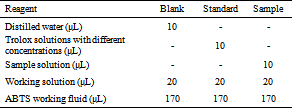
We established a reaction system according to the instructions of the ABTS total antioxidant capacity kit (Table 3). After fully shaking and mixing, a natural reaction occurred at room temperature for 6 min. The OD value of each hole was read by a microplate reader at a wavelength of 405 nm.
We established a reaction system according to the instructions of the FRAP total antioxidant capacity kit (Table 4). After fully shaking and mixing, we incubated samples at 37°C for 3-5 min. The OD value of each hole was read by a microplate reader (producer, city, state, country) at a wavelength of 593 nm.
The specific steps were as follows: dimensionless processing of raw data, absolute difference calculation between comparison sequence and reference sequence, maximum and minimum value calculation, correlation coefficient calculation, and correlation degree calculation.
2.8. Statistical AnalysisThree parallel experiments were performed as replications. Data was expressed as the mean ± standard deviation (SD). One-way ANOVA followed by Tukey’ test for multiple comparisons was employed to compare the means between groups. The level of significance was set at P <0.05.
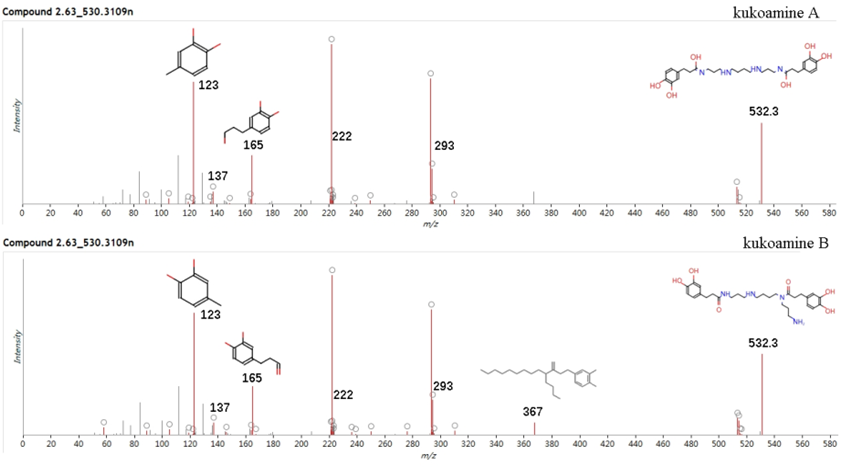
According to the conditions of liquid chromatography mass spectrometry, the sample solution was qualitatively analysed, and the total ion flow diagram of mass spectrometry under positive ion detection mode was obtained. The two phenolic amide compounds KA and KB had the most significant activity, and their mass spectra were extracted based on the fragment ion information of multi-stage mass spectrometry and related literature (Figure 1). In the positive ion mode, the KB molecule’s ion peak m/z was at 532.3 [M+2H]+. The fragment ions at m/z 165 and neutral group m/z 367 were generated by breaking the peptide bond. Further cleavage of neutral groups into fragment ions at m/z 293, 222, 123, and m/z 165 lost a molecule of CO and gained fragment ions at m/z 137 and m/z 137. Debris ions were also obtained at m/z 123 by losing one molecule of CH2. KA and KB shared the same molecular ion peaks and similar ion fragments at m/z 293, 222, 165, 137, and 123.

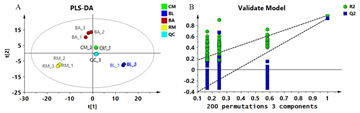

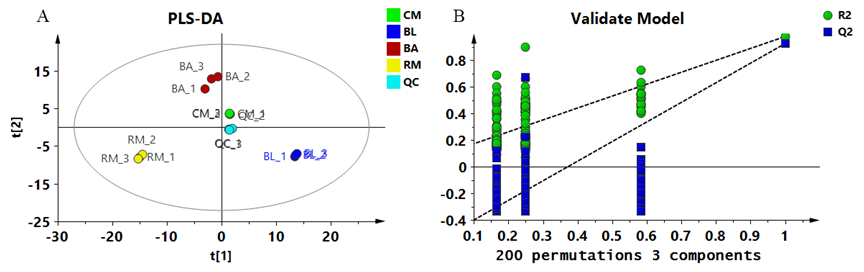
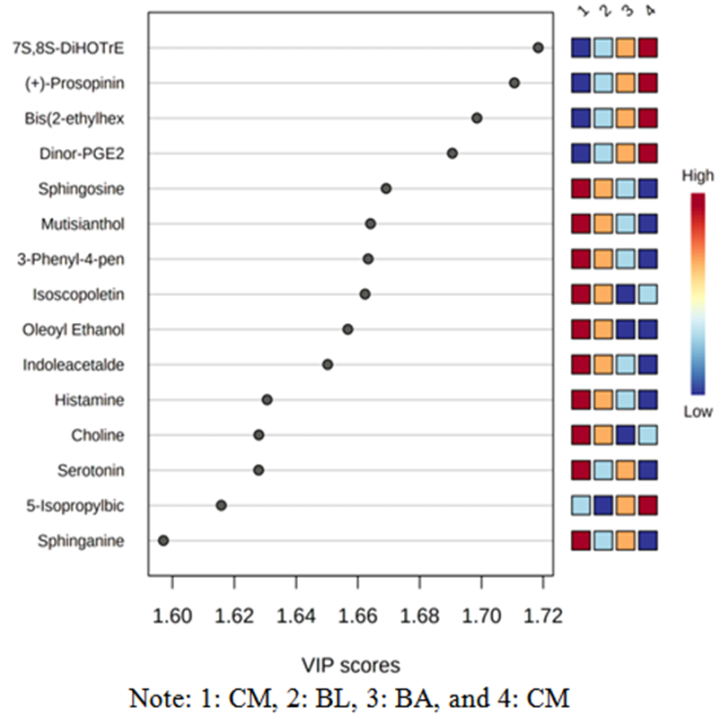
A total of 242 variables were obtained by Progenesis QI analysis. In order to compare the differences of Lycii cortex metabolites from different sources, the data matrix was further analysed by multivariate statistical analysis. The QC samples were used to monitor the stability of the system during the whole experiment. The difference of QC samples was small and showed a close aggregation state, indicating the stability of the method and the reliability of the data (Figure 2A). The CM and BL were clearly distinguished from BA and RM by the t 1 axis (PC1 : 34.3%) as revealed by PLS-DA analysis. The CM and BL were located on the positive axis, and BA and RM on the negative axis. The fitting degree of the model was verified by a replacement test. The PLS-DA validation model (n = 200) showed that the intercept between Q2 and the Y axis was less than 0 (Figure 2B), which could be used to detect the differences of components between the subsequent groups. According to the results of one-way analysis of variance (ANOVA) and the VIP value obtained by the PLS-DA model, 110 metabolites with P < 0.05 and VIP > 1 were selected in the positive ion detection mode. Differential metabolites with the top 15 VIP values are listed (Figure 3).
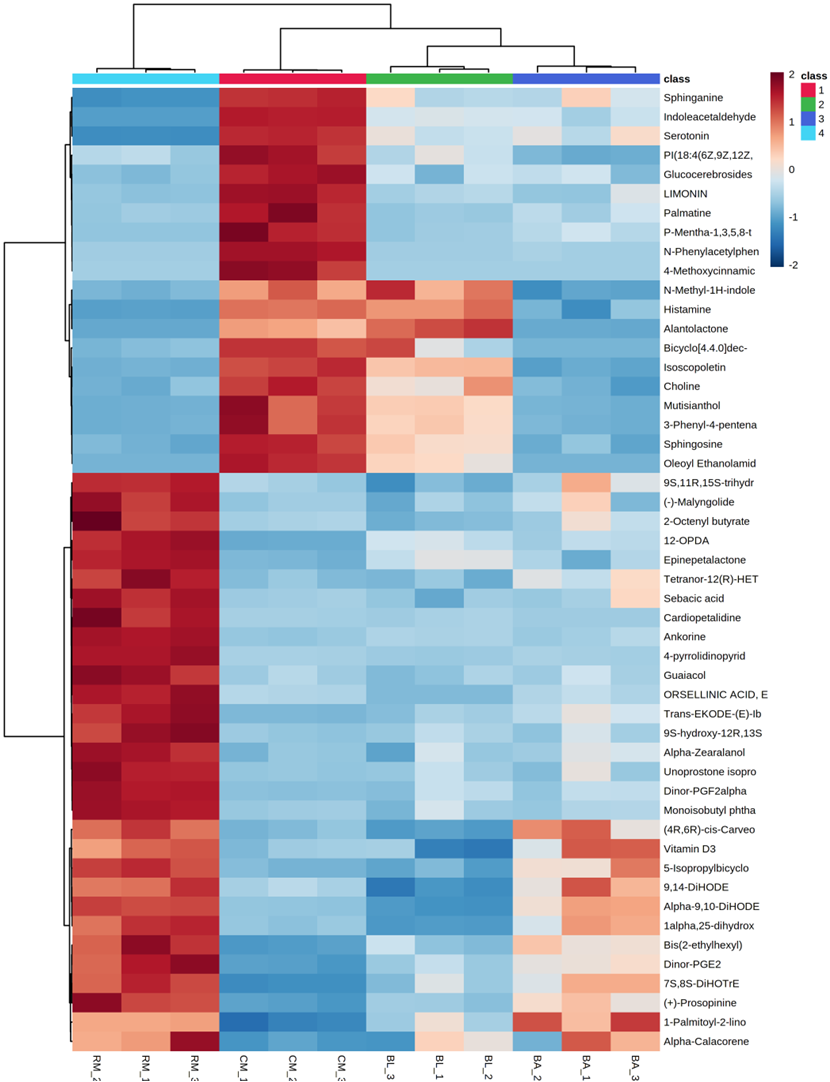
3.3. Contents of Differential MetabolitesMetabo Analyst 5.0 was used to make a cluster thermal map in order to further clarify the content analysis of differential metabolites in Lycii cortex from different origins. There were clear areas with high or low expression in different samples (Figure 4). The contents of histamine, choline, mutisianthol, isoscopolin, sphingosine, and others were higher in the CM and BL samples than in the BA and RM ones. In contrast, (+)-Prosopinine, 5-isopropylbicyclo[3.1.0]hexan-2-one, bis (2-ethylhexyl) phthalate, alpha-9,10-DiHODE, and others were lower in the CM and BL samples than in the BA and RM ones. Kukoamines, 2-hydroxycinnamic acid, benzoic acid, 2-linoleoyl glycerol, and others were higher in the CM, BL, and BA samples than in the RM samples. Ankorine, guaiacol, cardiopetalidine, sebacic acid, benzamide, and others were lower in the CM, BL, and BA samples than in the RM samples.
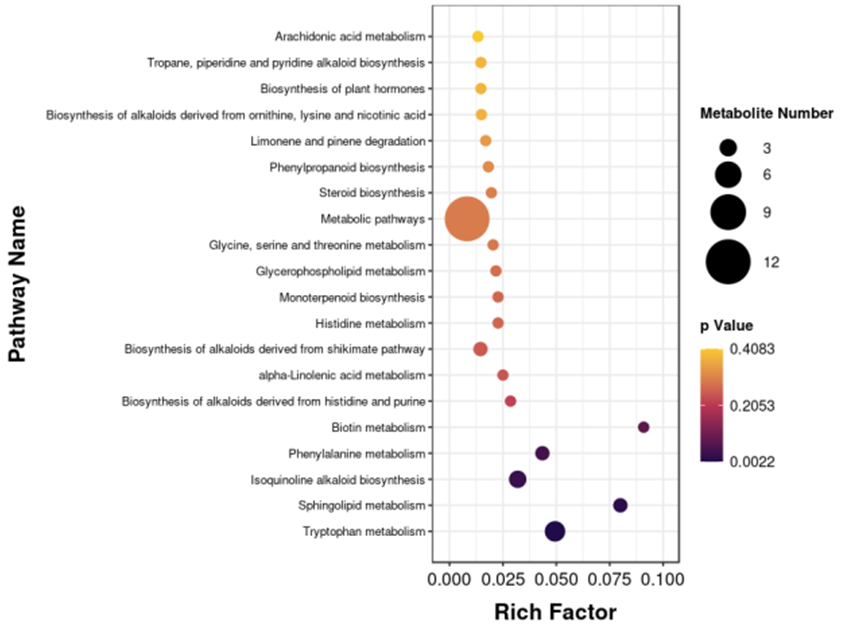
3.4. Enrichment Analysis of Metabolic PathwaysThe metabolic pathways of differential metabolites were enriched by KEGG, MBRole, and other websites. The enriched differential metabolites pathways are shown in Table 5 and Figure 5. Tryptophan metabolism, sphingolipid metabolism, isoquinoline alkaloid biosynthesis, and phenylalanine metabolism were significantly enriched differential metabolites pathways (P < 0.05).
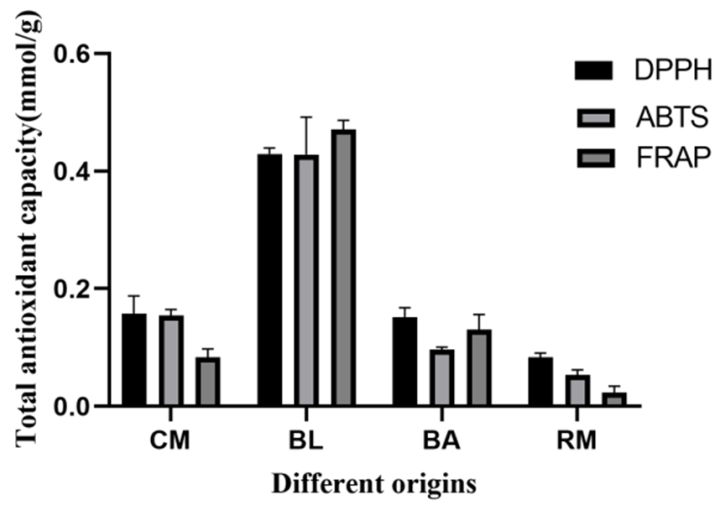
3.5. Antioxidant Capacity of Lycii CortexUnder the same extraction conditions, the Trolox equivalents of DPPH free-radical scavenging by Lycii cortex from CM, BL, BA, and RM were 0.151, 0.439, 0.155, and 0.080 mmol/g, respectively. The Trolox equivalents of ABTS free-radical scavenging were 0.165, 0.392, 0.091, and 0.047 mmol/g, respectively. The Trolox equivalents of total reduction capacity determined by the FRAP method were 0.075, 0.488, 0.104, and 0.011 mmol/g, respectively. The total antioxidant capacity of the BL sample was higher than any other samples, while the CM and BA samples were similar, and RM sample had the lowest capacity (Figure 6).


The peak area of differential metabolites in Lycii cortex samples was used as a comparison sequence, and the results of total antioxidant activity were used as a reference sequence for the grey correlation analysis. There was a significant correlation between the differential metabolites and the antioxidant activity (r > 0.70), indicating that the antioxidant activity of the Lycii cortex was the result of the combined action of chemical constituents. The correlation coefficient between 103 metabolites and the antioxidant activity was > 0.90, and that between kukoamines was 0.98.
Lycii cortex, as a medicinal and edible herbal medicine, had been widely used in clinical practice in China and other Asian countries 19, 20. At present, most of Lycii cortex were derived from L. chinense and L. barbarum in clinical practice. However, the market was many other varieties of Lycii cortex (such as L. barbarum var. auranticarpum and L. ruthenicum), and there was a lack of scientific basis for development and utilization, which seriously hindered the healthy development of Lycii cortex 21. The differences in alkaloids, amides, organic acids, flavonoids and other medicinal components and contents among Lycii cortex varieties reflect the genetic differences of Lycii cortex varieties to a certain extent 22, 23. The results of this experiment show that there are significant differences in the content of alkaloids and organic acids.
Although the research on the quality of Chinese medicinal materials by metabolomics technology started late, it had developed rapidly and has been widely used 24. This study used on UHPLC-Triple TOF-MS metabolomics technology combined with multivariate statistical analysis technology to compare the different metabolites of Lycii cortex from different sources. The Lycii cortex samples were distributed in different regions on the PLS-DA score plot, indicating that their metabolites were significantly different. The CM and BL samples were distinguished from BA and RM samples by the first principal component. The BA, CM, and BL samples were relatively close, indicating that their metabolite contents were similar.
The main components of Lycii cortexs were polyphenols and alkaloid compounds, including KA, KB, and caffeoyl butanediamine, and so on 25, 26. In the results, the clustering heat map showed that CM, BL, and BA were clustered into a large group, and RM samples were clustered into a single group. Kukoamines were the most abundant, and their content was higher in the CM, BL, and BA samples, while it was lower in the RM samples.
Through the KEGG database search, it was determined that the differential metabolites of the four varieties of Lycii cortex mainly came from tryptophan metabolism, sphingolipid metabolism, isoquinoline alkaloid biosynthesis, and phenylalanine metabolism. The biosynthesis of isoquinoline alkaloids starteds from the condensation of two tyrosine derivatives, followed by a series of reactions to form (S)-1-(3-hydroxy-4-methoxybenzyl)-6-methoxy-2-methyl-1,2,3,4-tetrahydroisoquinolin-7-ol, which is mainly derived from phenylalanine, tryptophan, lysine, and ornithine 27. The synthesis of indole alkaloids is mainly through the shikimic acid pathway to produce tryptophan, an important intermediate product, and then through secondary metabolism 28. Phenylalanine generates intermediate products such as trans-cinnamic acid, coumarinic acid, ferulic acid, and erucic acid. These intermediate products can be further converted into secondary metabolites such as lignin, flavonoids, isoflavones, alkaloids, and benzoate glycosides. They play a variety of important roles in plant growth and development, such as anti-ultraviolet damage, resistance to pathogens, etc. They can also be further transformed into active ingredients 29, 30. As the experiment shows, the content of alkaloids in Lycii cortex had a greater effect on antioxidants. The total antioxidant capacity of BL sample was always higher than that of other samples, while the CM and BA samples were similar, and that of the RM sample was the lowest. Combined with the grey correlation analysis, the results showed that there was a high correlation between different metabolites and antioxidant activity. This indicates that the antioxidant activity of Lycii cortex was the result of the interaction of chemical constituents.
In this study, a non-targeted metabolomic analysis method was established for the chemical composition analysis of different varieties of Lycii cortex. Significantly different metabolites were screened and preliminarily identified by statistical analysis, which laid a solid foundation for the follow-up research of Lycii cortex. The reason for the correlation between the differences of active ingredients and the de-efficacy among different varieties needs to be further studied.
We thank Shanghai Majorbio Bio-Pharm Technology Co. Ltd for data collection. This study was financed in part by the subject of scientific research plan of Hebei province universities (grant QN2018151), and the Natural Science Foundation of Hebei Province of China (grant 19276414D) and Technology Innovation Ability Cultivation Project (grant 2021H011608).
The authors declare that they have no conflicts of interest.
| [1] | Chinese Pharmacopeia CommitteePharmacopoeia of the People's Republic of China (Vol.1). Beijing: China Medical Science and Technology Press, pp. 128, 2020. | ||
| In article | |||
| [2] | Lu, Y. Y., Guo, S., Zhang, F. Qian, D. -W., Yan, H., Wang, H. -Q., YU, J. -Q., & Duan, J. -A., Systematic utilization and industrialization development of medicinal plant resources of Lycium genus, Modern Chinese Medicine, 21(1), 29-36, 2019. | ||
| In article | |||
| [3] | Yuan, Y., Research progress of Lycii cortex chemical composition, measuring content and pharmacological effect, Clinical Journal of Traditional Chinese Medicine, 30(11), 2131-2134, 2018. | ||
| In article | |||
| [4] | Li, L., Liu, Y., Zhang, F., & Du, Y., Mechanism of Cortex Lycii extracts underlying cognitive function improvement in hyperglycemic AD mice. Chinese Journal of Geriatric Heart Brain and Vessel Diseases 23(2), 196-199, 2021. | ||
| In article | |||
| [5] | Liu, W. -W., Song, Q., Zu, Y. -X. Jiang, X. -W., Yang, Y., Gao, H., & Zhao, Q. -C., Neuroprotective effects of kukoamine A against rotenone-induced neurotoxicity in PC12 cells, Chinese Traditional and Herbal Drugs, 51(24), 6302-6309, 2020. | ||
| In article | |||
| [6] | Kadiliya, M., Ailigen, A., & Zhang, J., Kukoamine A regulating VEGF signal pathway in rats with otitis media with effusion, Practical Pharmacy and Clinical Remedies, 23(12), 1069-1073, 2020. | ||
| In article | |||
| [7] | Li, Y. -P., Zeng, S. -H., Li, F., Xie, H. -H., Chahel, A. -A., Yang, T. -S., & Wang, Y., Variation of Kukoamine A (KuA) and B (KuB) contents and related meteorological factors for Cortex Lycii radicis of different areas, Biochemical Systematics and Ecology, 88(2), 103985, 2020. | ||
| In article | View Article | ||
| [8] | Song, M. -Y., Jung, H. -W., Kang S. -Y., Kim, K. -H., & Park, Y. -K., Anti-Inflammatory Effect of Lycii radicis in LPS-Stimulated RAW 264.7 Macrophages, The American Journal of Chinese Medicine, 42(4), 891-904, 2014. | ||
| In article | View Article PubMed | ||
| [9] | Jiang, G., Takase, M., Aihara, Y. & Shigemori, H., Inhibitory activities of kukoamines A and B from Lycii Cortex on amyloid aggregation related to Alzheimer's disease and type 2 diabetes, Journal of natural medicines, 74(1), 247-251, 2020. | ||
| In article | View Article PubMed | ||
| [10] | Zhang J. -X., Guan S. -H., Sun J. -H. Liu, T., Chen, P., Feng, R. -H., Chen, X., Wu, W. -Y., & Yang, M., Characterization and profiling of phenolic amides from Cortex Lycii by ultra-high performance liquid chromatography coupled with LTQ-Orbitrap mass spectrometry, Analytical and bioanalytical Chemistry, 407(2), 581-595, 2015. | ||
| In article | View Article PubMed | ||
| [11] | Li, Y. -Y., Stewart, D. -A., Ye, X. -M. Yin, L. -H., Pathmasiri, W. -W, McRitchie, S. -L., & Fennell, T. -R., A metabolomics approach to investigate kukoamine B-A potent natural product with anti-diabetic properties, Frontiers in pharmacology, 9(22), 1575, 2018. | ||
| In article | View Article PubMed | ||
| [12] | Park, E., Kim, J., Kim, M. -C. Yeo, S., Kim, J., Park, S., Jo, M., Choi, C. -W., Jin, H. -S., Lee, S. -W., Li, W. -Y., Lee, J. -W., Park, J. -H., Huh, D., & Jeong, S. -Y., Anti-osteoporotic effects of kukoamine B isolated from Lycii Radicis Cortex extract on osteoblast and osteoclast cells and ovariectomized osteoporosis model mice, International Journal of Molecular Sciences, 20(11), 2784, 2019. | ||
| In article | View Article PubMed | ||
| [13] | Wang, Q., Li, H., Sun, Z.; Dong, L. -H, Gao, L., Liu, C. -L., & Wang, X.-J., Kukoamine A inhibits human glioblastoma cell growth and migration through apoptosis induction and epithelial-mesenchymal transition attenuation, Scientific Reports, 6(8), 36543, 2016. | ||
| In article | View Article PubMed | ||
| [14] | Zhao, H., Yan, Y., Chai, C., Zou, L. -S., Liu, X. -H., Wang, S. -N., & Hua, Y. -J., Dynamic changes of eight bioactive constituents in magnoliae officinalis cortex based on UFLC-QTRAP-MS/MS combined with grey relational analysis, Current Pharmaceutical Analysis, 15(5), 497-504, 2019. | ||
| In article | View Article | ||
| [15] | Xue, Y., Li, X. -W., Li, Z. -Y., Zeng, Z. -P., Zhang, F. -S.,Li, A. -P., Qin, X. -M., & Peng, B., UPLC/Q-TOF MS and NMR plant metabolomics approach in studying the effect of growth year on the quality of Polygala tenuifolia, Acta Pharmaceutica Sinica, 50(3), 340-347, 2015. | ||
| In article | |||
| [16] | Yan, Y., Zhao, H., Zou, L. -S. Liu, X. -H., Chai, C., Wang, S. -N., & Hua, Y. -J., Difference of chemical constituents in different medicinal parts of Eucommia ulmoides by LC-Triple TOF MS/MS, Journal of Chinese Mass Spectrometry Society, 39(1), 101-111, 2018. | ||
| In article | |||
| [17] | Deng, J., Lin, X. -L., Liu, R. -Y. Lin, L. -M., Liao, D. -F., Wu, P., & Xia, B. -H., Comparative study of Zanthoxylum echinocarpum and Z. nitidum based on phenotype-metabolomics, Natural Product Research and Development, 32(7), 1219-1227, 2020. | ||
| In article | |||
| [18] | Li, Y. -Y., Di, R., Hsu, W. -L., Huang, Y. -Q, & Cheung, H. -Y., Quality control of Lycium chinense and Lycium barbarum cortex (Digupi) by HPLC using kukoamines as markers, Chinese Medicine, 12(1), 1-8, 2017. | ||
| In article | View Article PubMed | ||
| [19] | Wei, X. -Y., Yin, L. -Q., Zhong, C., Zhang, M. -H., & Niu, Y. -Z., Advances in the DPPH radical scavenging assay for antioxidant activity evaluation, Food Science, 35(9), 317-322, 2014. | ||
| In article | |||
| [20] | Chen, X. -H., Su, L., Jiang, L. -J., Zhang W., Jiang, Y. -Y., & Liu, B., Identification of compounds in Lycii Cortex by UPLC-LTQ-Orbitrap-MS, China Journal of Chinese Materia Medica, 44(20): 4486-4494, 2019. | ||
| In article | |||
| [21] | Lin, X. -M., Yue, L. -D., Zhang, Z. -L., Hang, J. -S., Yan, M. -Z., & Chen, Y. -T., Using GC-MS to compare difference of specific odor components of Angelicae Sinensis Radix by different yellow wine processing methods, Chinese Traditional and Herbal Drugs, 51(17), 4464-4472, 2020. | ||
| In article | |||
| [22] | Zhang, H. -Q., Liu, P., Qian, D. -W., Liu, L., Zhu, S. -Q., Li, H. -W., & Duan, J. -A.,Study on modern drying processing method for Trichosanthis pericarpium based on multi-bioactive constituents, Chinese Traditional and Herbal Drugs, 51(4), 950-964, 2020. | ||
| In article | |||
| [23] | Xu, N., Sun, R., Zhu, X. -M. Huang, X.,Li, M. -C., & Shi, H. -Y., Identification of quality markers (Q-marker) of Banxia Baizhu Tianma Decoction based on component difference analysis and multivariate statistical method, Chinese Traditional and Herbal Drugs, 50(19), 4595-4602, 2019. | ||
| In article | |||
| [24] | Li, H., Bao, Y. -R., Wang, S., Li, T. -J., & Meng, X. -S., Fingerprint analysis of Radix Rubiae based on multivariate statistical analysis, Lishizhen Medicine and Materia Medica Research, 30, 1385-1388, 2019. | ||
| In article | |||
| [25] | Lu, J. -B., Wang, Y. -Y., Zhang, S., Li, J. -P.,Xu, X. -J., Peng, Y., Chen, C. -K., Guo, J. -M., & Duan, J. -A., Huang-Kui-Si-Wu Formula decreases uremic toxin production by modulatingintestinal microbial metabolic pathways, Acta Pharmaceutica Sinica, 55(6), 1229-1236, 2020. | ||
| In article | |||
| [26] | Wang, H. -J., Ma, Z. -J., Dong, J. -M., Wu, H., Yu, X. -H., & Duan, X. -Y., Analysis of toxicity reduction on Tripterygium wilfordii combined with Radix glycyrrhizae by using metabolomics of rat urine, World Chinese Medicine, 15(8), 1102-1107, 2020. | ||
| In article | |||
| [27] | Cheng, Q., Zeng, J. -G., & Le, J., Process of cell biology of isoquinoline alkaloid biosynthesis, transport and storage, Chinese Bulletin of Botany, 49(6), 720-728, 2014. | ||
| In article | View Article | ||
| [28] | Chen, Y., Zhang, Q. -L., Huang, Y. -X. Tan, H. -X., Diao, Y., & Zhang, L., A research progress on the biosynthetic pathways of indole alkaloids, Modernization of Traditional Chinese Medicine and Materia Medica-World Science and Technology, 18(11), 1914-1920, 2016. | ||
| In article | |||
| [29] | Cui, J. -D., Li, Y., Mou, D. –H., Research progress of phenylalanine ammonia-lyase in plants, Shipin Gongye Keji, 29(7), 306-308, 2009. | ||
| In article | |||
| [30] | Wang, B., Liang, W. -L., Lin, Q. -X., Kang Z. -Y., Wang, Q. -F., & Gou, C. -D., Quality evaluation of cortex moutan from different producing areas by grey correlation degree method, Chinese Journal of Ethnomedicine and Ethnopharmacy, 30(2), 47-54, 2021. | ||
| In article | |||
Published with license by Science and Education Publishing, Copyright © 2022 Donglai Ma, Xinrui Li, Meng Wu, Yuxin Jia, Yongxing Song, Ning Liu and Si Li
 This work is licensed under a Creative Commons Attribution 4.0 International License. To view a copy of this license, visit
http://creativecommons.org/licenses/by/4.0/
This work is licensed under a Creative Commons Attribution 4.0 International License. To view a copy of this license, visit
http://creativecommons.org/licenses/by/4.0/
| [1] | Chinese Pharmacopeia CommitteePharmacopoeia of the People's Republic of China (Vol.1). Beijing: China Medical Science and Technology Press, pp. 128, 2020. | ||
| In article | |||
| [2] | Lu, Y. Y., Guo, S., Zhang, F. Qian, D. -W., Yan, H., Wang, H. -Q., YU, J. -Q., & Duan, J. -A., Systematic utilization and industrialization development of medicinal plant resources of Lycium genus, Modern Chinese Medicine, 21(1), 29-36, 2019. | ||
| In article | |||
| [3] | Yuan, Y., Research progress of Lycii cortex chemical composition, measuring content and pharmacological effect, Clinical Journal of Traditional Chinese Medicine, 30(11), 2131-2134, 2018. | ||
| In article | |||
| [4] | Li, L., Liu, Y., Zhang, F., & Du, Y., Mechanism of Cortex Lycii extracts underlying cognitive function improvement in hyperglycemic AD mice. Chinese Journal of Geriatric Heart Brain and Vessel Diseases 23(2), 196-199, 2021. | ||
| In article | |||
| [5] | Liu, W. -W., Song, Q., Zu, Y. -X. Jiang, X. -W., Yang, Y., Gao, H., & Zhao, Q. -C., Neuroprotective effects of kukoamine A against rotenone-induced neurotoxicity in PC12 cells, Chinese Traditional and Herbal Drugs, 51(24), 6302-6309, 2020. | ||
| In article | |||
| [6] | Kadiliya, M., Ailigen, A., & Zhang, J., Kukoamine A regulating VEGF signal pathway in rats with otitis media with effusion, Practical Pharmacy and Clinical Remedies, 23(12), 1069-1073, 2020. | ||
| In article | |||
| [7] | Li, Y. -P., Zeng, S. -H., Li, F., Xie, H. -H., Chahel, A. -A., Yang, T. -S., & Wang, Y., Variation of Kukoamine A (KuA) and B (KuB) contents and related meteorological factors for Cortex Lycii radicis of different areas, Biochemical Systematics and Ecology, 88(2), 103985, 2020. | ||
| In article | View Article | ||
| [8] | Song, M. -Y., Jung, H. -W., Kang S. -Y., Kim, K. -H., & Park, Y. -K., Anti-Inflammatory Effect of Lycii radicis in LPS-Stimulated RAW 264.7 Macrophages, The American Journal of Chinese Medicine, 42(4), 891-904, 2014. | ||
| In article | View Article PubMed | ||
| [9] | Jiang, G., Takase, M., Aihara, Y. & Shigemori, H., Inhibitory activities of kukoamines A and B from Lycii Cortex on amyloid aggregation related to Alzheimer's disease and type 2 diabetes, Journal of natural medicines, 74(1), 247-251, 2020. | ||
| In article | View Article PubMed | ||
| [10] | Zhang J. -X., Guan S. -H., Sun J. -H. Liu, T., Chen, P., Feng, R. -H., Chen, X., Wu, W. -Y., & Yang, M., Characterization and profiling of phenolic amides from Cortex Lycii by ultra-high performance liquid chromatography coupled with LTQ-Orbitrap mass spectrometry, Analytical and bioanalytical Chemistry, 407(2), 581-595, 2015. | ||
| In article | View Article PubMed | ||
| [11] | Li, Y. -Y., Stewart, D. -A., Ye, X. -M. Yin, L. -H., Pathmasiri, W. -W, McRitchie, S. -L., & Fennell, T. -R., A metabolomics approach to investigate kukoamine B-A potent natural product with anti-diabetic properties, Frontiers in pharmacology, 9(22), 1575, 2018. | ||
| In article | View Article PubMed | ||
| [12] | Park, E., Kim, J., Kim, M. -C. Yeo, S., Kim, J., Park, S., Jo, M., Choi, C. -W., Jin, H. -S., Lee, S. -W., Li, W. -Y., Lee, J. -W., Park, J. -H., Huh, D., & Jeong, S. -Y., Anti-osteoporotic effects of kukoamine B isolated from Lycii Radicis Cortex extract on osteoblast and osteoclast cells and ovariectomized osteoporosis model mice, International Journal of Molecular Sciences, 20(11), 2784, 2019. | ||
| In article | View Article PubMed | ||
| [13] | Wang, Q., Li, H., Sun, Z.; Dong, L. -H, Gao, L., Liu, C. -L., & Wang, X.-J., Kukoamine A inhibits human glioblastoma cell growth and migration through apoptosis induction and epithelial-mesenchymal transition attenuation, Scientific Reports, 6(8), 36543, 2016. | ||
| In article | View Article PubMed | ||
| [14] | Zhao, H., Yan, Y., Chai, C., Zou, L. -S., Liu, X. -H., Wang, S. -N., & Hua, Y. -J., Dynamic changes of eight bioactive constituents in magnoliae officinalis cortex based on UFLC-QTRAP-MS/MS combined with grey relational analysis, Current Pharmaceutical Analysis, 15(5), 497-504, 2019. | ||
| In article | View Article | ||
| [15] | Xue, Y., Li, X. -W., Li, Z. -Y., Zeng, Z. -P., Zhang, F. -S.,Li, A. -P., Qin, X. -M., & Peng, B., UPLC/Q-TOF MS and NMR plant metabolomics approach in studying the effect of growth year on the quality of Polygala tenuifolia, Acta Pharmaceutica Sinica, 50(3), 340-347, 2015. | ||
| In article | |||
| [16] | Yan, Y., Zhao, H., Zou, L. -S. Liu, X. -H., Chai, C., Wang, S. -N., & Hua, Y. -J., Difference of chemical constituents in different medicinal parts of Eucommia ulmoides by LC-Triple TOF MS/MS, Journal of Chinese Mass Spectrometry Society, 39(1), 101-111, 2018. | ||
| In article | |||
| [17] | Deng, J., Lin, X. -L., Liu, R. -Y. Lin, L. -M., Liao, D. -F., Wu, P., & Xia, B. -H., Comparative study of Zanthoxylum echinocarpum and Z. nitidum based on phenotype-metabolomics, Natural Product Research and Development, 32(7), 1219-1227, 2020. | ||
| In article | |||
| [18] | Li, Y. -Y., Di, R., Hsu, W. -L., Huang, Y. -Q, & Cheung, H. -Y., Quality control of Lycium chinense and Lycium barbarum cortex (Digupi) by HPLC using kukoamines as markers, Chinese Medicine, 12(1), 1-8, 2017. | ||
| In article | View Article PubMed | ||
| [19] | Wei, X. -Y., Yin, L. -Q., Zhong, C., Zhang, M. -H., & Niu, Y. -Z., Advances in the DPPH radical scavenging assay for antioxidant activity evaluation, Food Science, 35(9), 317-322, 2014. | ||
| In article | |||
| [20] | Chen, X. -H., Su, L., Jiang, L. -J., Zhang W., Jiang, Y. -Y., & Liu, B., Identification of compounds in Lycii Cortex by UPLC-LTQ-Orbitrap-MS, China Journal of Chinese Materia Medica, 44(20): 4486-4494, 2019. | ||
| In article | |||
| [21] | Lin, X. -M., Yue, L. -D., Zhang, Z. -L., Hang, J. -S., Yan, M. -Z., & Chen, Y. -T., Using GC-MS to compare difference of specific odor components of Angelicae Sinensis Radix by different yellow wine processing methods, Chinese Traditional and Herbal Drugs, 51(17), 4464-4472, 2020. | ||
| In article | |||
| [22] | Zhang, H. -Q., Liu, P., Qian, D. -W., Liu, L., Zhu, S. -Q., Li, H. -W., & Duan, J. -A.,Study on modern drying processing method for Trichosanthis pericarpium based on multi-bioactive constituents, Chinese Traditional and Herbal Drugs, 51(4), 950-964, 2020. | ||
| In article | |||
| [23] | Xu, N., Sun, R., Zhu, X. -M. Huang, X.,Li, M. -C., & Shi, H. -Y., Identification of quality markers (Q-marker) of Banxia Baizhu Tianma Decoction based on component difference analysis and multivariate statistical method, Chinese Traditional and Herbal Drugs, 50(19), 4595-4602, 2019. | ||
| In article | |||
| [24] | Li, H., Bao, Y. -R., Wang, S., Li, T. -J., & Meng, X. -S., Fingerprint analysis of Radix Rubiae based on multivariate statistical analysis, Lishizhen Medicine and Materia Medica Research, 30, 1385-1388, 2019. | ||
| In article | |||
| [25] | Lu, J. -B., Wang, Y. -Y., Zhang, S., Li, J. -P.,Xu, X. -J., Peng, Y., Chen, C. -K., Guo, J. -M., & Duan, J. -A., Huang-Kui-Si-Wu Formula decreases uremic toxin production by modulatingintestinal microbial metabolic pathways, Acta Pharmaceutica Sinica, 55(6), 1229-1236, 2020. | ||
| In article | |||
| [26] | Wang, H. -J., Ma, Z. -J., Dong, J. -M., Wu, H., Yu, X. -H., & Duan, X. -Y., Analysis of toxicity reduction on Tripterygium wilfordii combined with Radix glycyrrhizae by using metabolomics of rat urine, World Chinese Medicine, 15(8), 1102-1107, 2020. | ||
| In article | |||
| [27] | Cheng, Q., Zeng, J. -G., & Le, J., Process of cell biology of isoquinoline alkaloid biosynthesis, transport and storage, Chinese Bulletin of Botany, 49(6), 720-728, 2014. | ||
| In article | View Article | ||
| [28] | Chen, Y., Zhang, Q. -L., Huang, Y. -X. Tan, H. -X., Diao, Y., & Zhang, L., A research progress on the biosynthetic pathways of indole alkaloids, Modernization of Traditional Chinese Medicine and Materia Medica-World Science and Technology, 18(11), 1914-1920, 2016. | ||
| In article | |||
| [29] | Cui, J. -D., Li, Y., Mou, D. –H., Research progress of phenylalanine ammonia-lyase in plants, Shipin Gongye Keji, 29(7), 306-308, 2009. | ||
| In article | |||
| [30] | Wang, B., Liang, W. -L., Lin, Q. -X., Kang Z. -Y., Wang, Q. -F., & Gou, C. -D., Quality evaluation of cortex moutan from different producing areas by grey correlation degree method, Chinese Journal of Ethnomedicine and Ethnopharmacy, 30(2), 47-54, 2021. | ||
| In article | |||