In order to clarify the suitable planting density under wide-space sowing, conduct field experiments in Hongtong County Winter wheat demonstration base of Shanxi province from 2018 to 2020. The wheat variety Shannong-20’ was used as the experimental material, and five planting densities of 1.5 million plants·ha-1 (D1), 2.25 million plants·ha-1 (D2), 3.0 million plants·ha-1 (D3), 3.75 million plants·ha-1 (D4) and 4.5 million plants·ha-1 (D5). The study aim to evaluate the influence of wheat density on population size, dry substance accumulation and remobilization, grain yield, protein, and starch. The results indicated that in the density range of 1.50-4.5 million plants·ha-1, the population tiller number, population dry substance weight during sowing, wintering, anthesis, maturity stages, harvest index, dry substance production post anthesis, the rate of dry substance remobilization to grain, proportion to total dry matter of kernel weight in mature period, panicle number, grain yield, water utilization efficiency (WUE) throughout the growth period were highest in D4. The substance weight, dry matter transport before anthesis, remobilization rate, the rate of contribution about the vegetative organs post anthesis to grain in the overwintering-jointing were highest under D5. Compared with other treatments, the spike number, yield and WUE increased by 3.35%-33.42%, 2.40%-14.98% and 0.78%-10.87% in D4, respectively. The increase of planting density is profit for soluble sugar and sucrose content. Under different planting densities, there were significant or extremely significant correlations between yield and spike number, tiller number at over-wintering stage and jointing stage, dry matter accumulation before wintering stage and at different growth stages after jointing stage. The accumulation of dry matter in leaves and grains at maturity. Further path analysis showed that the most important factor affecting yield was tiller number, followed by dry matter accumulation. The 375×104 plants·ha-1 was the optimal planting density for constructing reasonable population structure of wheat, improving dry substance accumulation and transport, yield formation and the WUE.
Food crops such as wheat play an important role in human nutrition. Recently, more than 20% of the total sown area was wheat in China, the past few decades, a substantial increase in production, wheat production growth to protect national food security and meet the needs of people 's lives have an important positive impact 1. However, as a result of population growth and ecological degradation, the demand for wheat continues to expand, and there are serious constraints and challenges facing wheat production 2. Accordingly, a decrease in cultivated land area must be compensated for by increasing yields per unit area to ensure food security.
The yield of wheat not only based on water's rational use, fertilizer, medicine, other management measures, but also closely related to the sowing method and planting density. The sowing method used in traditional wheat planting is conventional drilling, which is easy to cause problems such as narrow single-row sowing, small plant spacing, and poor ventilation and light transmission conditions in the field, in which grains cannot form. Wide-width drilling is a wheat precision sowing methods developed by Shandong Agricultural University. It is a new type of wheat sowing methods that uses a wide-width drilling machine with a seedling width of 8-10 cm, the row spacing of 22-25 cm. It is a new type of wheat sowing methods that completes sub soiling, rotary tillage, fertilization, and sowing at one time. Compared to the traditional dense drilling, it can effectively promote the uniform sowing of seeds, the nutritional area of single plant (single grain), and optimize the spatial structure within the population, thus promoting the cultivation of strong seedlings in the early stage and the utilization of light energy in the middle and at the end stages 3. Studies have shown that compared with conventional drilling, wide sowing increased yield by 22.5% and 15.4% by increasing the number of spike per unit area 4, 5.
Planting density is the basis for the establishment of field population structure, and it is also the dominant factor affecting population number and yield composition. By adjusting the sowing methods of winter wheat, the number of population during its growth period can be regulated, which can affect its dry matter accumulation and grain yield formation. The results of previous studies have been shown the total tiller number of wheat increases with the reduction of sowing rate in a certain range of sowing rate and can obtain better population quality and achieve the purpose of increasing production. However, too high sowing rate will cause the increase of ineffective tiller number, poor light transmission, low photosynthetic efficiency and waste of nutrients and water, reduce the formation of effective panicles, resulting in reduced production 6.
In crops, dry matter is the final product of photosynthesis. It is important to note that dry matter accumulation at different growth stages plays an important role in yield formation during the wheat growth period 7, 8. Planting density has been shown to affect dry matter accumulation at different growth stages, in each stage, dry matter accumulation increased with increasing planting density 9. Assimilate remobilization and distribution can be controlled by planting density. Increasing planting density can significantly increase the population dry matter accumulation of wheat, but too high planting density is not conducive to dry matter accumulation after anthesis. After anthesis, a suitable planting density can increase the contribution of dry matter from vegetative organs to grains, a full filling of grains is possible with this material high yields are achieved 10. The increasing yield should pay attention to the accumulation of dry matter before anthesis,so as to improve the transport of dry matter to grains before anthesis 11. In the study of winter wheat population quality under the influence of sowing methods and nitrogen fertilizer. That appropriate reduction of sowing rate could promote the full development of individual plants before anthesis of winter wheat, which greatly improved the buildup ability of wheat vegetative organs dry matter 12. However, some studies suggested that the dry substance accumulation of wheat at maturity increased with the elevation of planting density, and after anthesis. The translocation of dry matter stored in aboveground vegetative organs priority anthesis to grains and its contribution to grains access with the increase of planting density also had significant effects on the translocation and distribution of dry matter under different organs 13, 14.
By adjusting population structure of wheat, sowing density can change the number of ears, kernel number per ear, thousand seed weight, and has a regulatory effect on production 15. Previous studies about the influence of planting density on grain yield components were different. Low sowing methods may greatly reduce the effective number of ears but increase the kernel numbers per spike ultimate achieve stable yield. Although the high sowing rate treatment enhance the number of ear the amount of grains per panicle and the thousand seed weight of wheat Moreover excessive density will lead to the large population of winter wheat, the weak and weak stems of the plants and the possibility of lodging in late-growth, finally reduce grain yield 16, 17, 18. That there was little difference in kernel yield of wheat among different treatments within a certain sowing rate range 19. Therefore, the appropriate seeding density under wide-space sowing, and drill sowing mode can improve the dry substance accumulation in mid-late fertility, coordinate the three elements of yield, thereby increasing grain yield. However, rarely studies on the realization of high yield and related mechanism of wide drilling in Shanxi Province. Therefore in the current study, the impact of different sowing density on population dynamics, dry matter accumulation and associated traits, grain yield of winter wheat were studied under the condition of wide strip sowing, so as to clarify the suitable sowing rate of wide strip sowing winter wheat and its effect on yield formation, and provide reference for high yield cultivation techniques of winter wheat.
Field experiment was series performed in Masan Village (36°31'N, 111°65'E), Hong tong City, Shanxi Province from 2018-2020. The area is situate in the western region of the Huang-Huai-Hai River Basin. The local altitude is 460 m, the annual frost-free period is 210 days, the annual mean temperature is12.1°C, and the annual average precipitation is 441.5mm.The planting mode of cultivated land in this experiment adopts the rotation of winter wheat-summer maize in one year. The soil was loam. The basic fertility of topsoil (0-20) was measured on September 20 and September 25 respectively in the two test years, as shown in Table 1.
In this experiment, the main test variety Shannong-20’. The experimental design adopted a single-factor completely randomized design method. Five planting densities of 1.50 million plants·ha-1 (D1), 2.25 million plants·ha-1 (D2), 3.00 million plants·ha-1 (D3), 3.75 million plants·ha-1 (D4), 4.50 million plants·ha-1 (D5) were set up respectively. The plot size was 90 m2 (3 m×30 m), and each treatment was repeated three times. Wheat sowing time in mid-October, harvested early June 2nd year, and the fodder of the previous summer maize crop was returned every year. Every treatment included the use of nitrogen (urea), phosphate (P2O5), potassium (K2O) fertilizer homological 126, 150, 90 kg·ha-1, respectively as the base fertilizer. The sowing method was wide strip sowing. The overall precipitation was 73.3 mm during the growth period in 2018-2019. The irrigation was performed once at the wintering period, elongation stage, postulation period, 60 mm each time. Topdressing with irrigation at elongation stage was 84 kg·ha-1,and the precipitation was 155.6 mm during 2019-2020, which cropping on June 18, 2019, June 20, 2020, respectively.
Samples were taken at the winter period (WS), elongation stage (JS), booting stage (BS), anthesis (AS) and maturity (MS) of winter wheat in each experimental plot. After measuring the area of the sample plot, the tiller of winter wheat in the sample plot was observed and recorded, and the mean value was calculated and the population dynamics was calculated.
Field sampling investigation and analysis were carried out in each growth period of winter wheat. After the determination of individual morphological indexes of plants was completed, the samples of different treatments were separated into vegetative organs and reproductive organs. In addition to the mature grains, the rest specimen were deactivated at 105°C for 30 min, dried at 80°C to stabilizing weight, and the dry matter accumulation of winter wheat population in each treatment was weighed and recorded 20.
The number of panicles, kernel number per ear, and thousand grain weight were investigated in 0.667 m2 of each experimental plot at mature. Each plot was cropping in 20 m2 and threshed after drying. The yield was converted according to 13% water content, and the water use efficiency (grain yield/water consumption during growth period) was calculated.
2.3. Calculation of Dry Matter Remobilization IndexThe variables related to dry matter accumulation (DMA) and remobilization (DMR) within the wheat plant during postulation period 21, 22 were determined by following Eqs:
 |
 |
 |
 |
 |
Excel 2010 was used to analyze all the experimental data Analyze of variance (ANOVA) was proceed using DPS7.05 software. SD method was used for multiple comparison (α=0.05).
The test results show increase planting density can enhance grain soluble sugar content, sucrose content and starch content in D1to D4 (Table 2). The planting density of D4 increased the soluble sugar content by 8.6%, and the sucrose content by 3.8% compared with other planting density. Compared with farmers' planting density significantly reduces soluble sugar content by 5.9%-14.3%, and sucrose by 9.4%-12.7%; D3, and D4 reduction significantly reduces soluble sugar content by 20.6%-26.0%, and sucrose by 20.9%-23.7% compared to farmers' planting density. The increase of planting density is useful to enhance the content of soluble sugar, sucrose in grains, and the reduction of planting density will affect the accumulation and transformation of sugar.
Compared to D5, there are higher volume on grain gliadin, grain protein content, grain protein yield of D4 (Table 3). It is non-significant on globulin content in grains of D1. The grain gliadin content of D1, and D4 was significantly higher than others. The glutenin content is maximum in D4, and was significant difference with other treatment. The ANOVA showed that there are appreciable impact between planting density and grain various protein components content, glutento ratio, and grain protein characteristics. D4 treatment significantly highest in grain gliadin, glutenin, protein content, and yield.
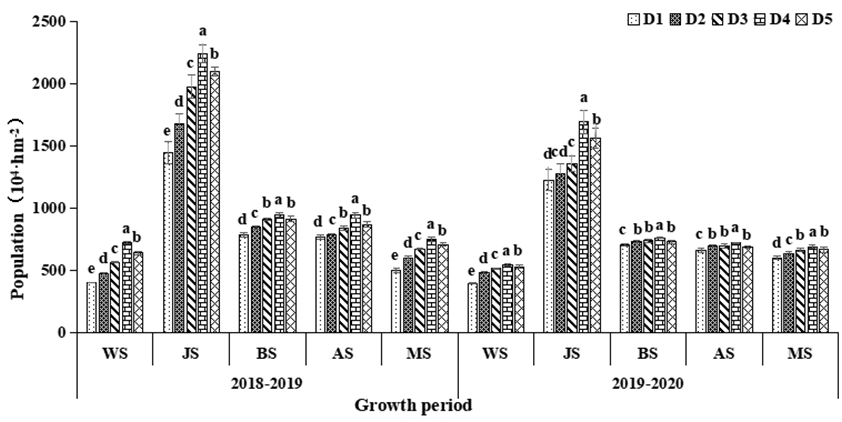
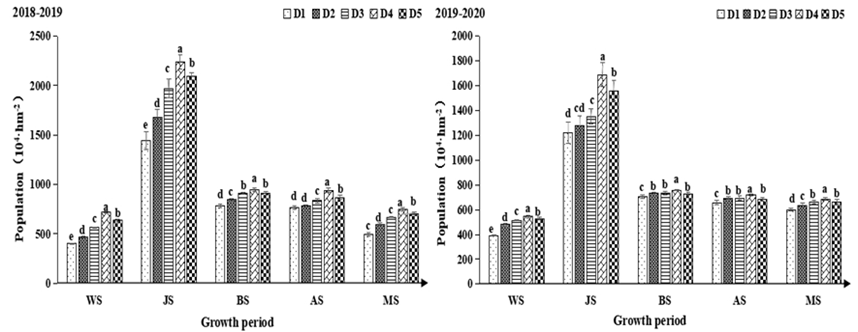
The two years field population survey showed that the amount of populations under different planting densities increased first and then decreased during the period of duration, and achieve the highest value at elongation stage in D4 treatment (Figure 1). Compared with other treatments, the population tiller number of D4 treatment increased by 3.03%-44.23, 6.52%-35.48%, 3.50%-16.84%, 3.62%-18.51% and 3.47%-33.42% at WS, JS, BS, AS and MS, respectively. The elongation stage is a critical period for the growth of wheat population. By regulating the population number of winter wheat at the elongation stage through planting density and optimizing the spatial structure, it has obvious influence on grain filling and yield in the later stage of wheat growth.

The results of the two years showed that the dry substance accumulation was mainly concentrated after the flowering stage, accounting for more than 60% of the dry substance accumulation during the growth period (Figure 2). Increase planting density, dry substance accumulation and its proportion in the total dry matter quality in SS-WS and AS-MS increase first, then decrease, and was the highest under D4 treatment. The dry substance accumulation in SS-WS increased by 602.23 kg·ha-1 compared to other treatments, accounting for 3.24%-14.83%. The AS-MS increased by 2086.40 kg·ha-1 compared with other treatments, accounting for 1.51%-10.73%. The dry substance accumulation in WS-JS enhanced with the increase of planting density, and it was the highest under D5 treatment, which was 1099.48 kg·ha-1 higher than other treatments, accounting for 5.53%-10.99%. The dry substance accumulation in JS-AS increased with the increase of sowing rate in 2018-2019. The D5 treatment increased by 1830.52 kg·ha-1 compared to other treatments, accounting for 4.54%-7.14%. The dry substance accumulation in 2019-2020 was significantly the highest under D4 treatment. In conclusion, the dry matter accumulation and the ratio of total dry matter accumulation in different planting densities were the highest in AS-MS stage, followed by JS-AS stage, and D4 treatment was the best for dry matter accumulation in wheat growth period, which laid a foundation for improving wheat yield.

The results of two years showed that the harvest index, dry substance production post anthesis, contribution rate of substance synthesis to grain were basically the same under different planting density treatments (Table 4). The harvest index and dry matter production after anthesis first rise then fall with the increase of planting density, and highest under D4 treatment, which were 51.11%, 48.38% and 7189.97 kg·ha-1,6309.38 kg·ha-1 respectively. The dry substance remobilization and remobilization rate before anthesis were the highest under D5, significantly, and the rate of contribution about vegetative organs before anthesis to grain was 19.72%-31.31%. The rate of contribution on dry substance of vegetative organs to grain post anthesis was 68.69%-80.28%, the highest under D4 treatment (Table 4). The post-anthesis dry substance production is an important source of grain dry matter, D4 treatment is conducive to post-anthesis dry substance accumulation to achieve yield raise.
The order about distribution ratio of dry substance in each organ of winter wheat at maturity was grain > stem + leaf sheath > cob + glume > leaf under various planting density treatments (Table 5). The distribution amount and proportion of grain were 5233.98-8957.30 kg·ha-1 and 45.68%-51.11%, respectively. The grain dry matter quality and proportion were the highest of D4, and the difference of grain dry matter quality among treatments was significant. The distribution proportion of grain dry matter was 0.22%-10.63% higher than that of other treatments. It can be seen that the appropriate increase of planting density under wide strip sowing of winter wheat can effectively improve the material accumulation of grain at maturity, and the effect on grain weight gain is more significant on D4, finally conducive to increasing yield.
The results of two years showed that in the range of D1-D4, increase planting density can elevate the number of ears, grain yield water use efficiency of winter wheat. The above indicators are lower than D4 on D5.The grain number of ear and thousand seeds weight highest under D1 (Table 6). Compared with other treatments, the number of ears grain yield water use efficiency of D4 increased by 3.35%-33.42%, 2.40%-14.98% and 0.78%-10.87%, respectively. Compared with other treatments, D1 increased the grain number of ear and thousand seeds weight by 2.23%, 10.94% and 0.81%-8.71%, respectively. Changing the planting density and regulating number of ears under wide drilling can effectively increase wheat grain yield, improve WUE. D4 treatment is the optimal treatment for high yield and high WUE in this experiment.
According to the correlation analysis, yield is positively correlated with ear number, while grain number per ear, 1000-grain weight, and water usage are negatively correlated, and water use efficiency is significantly positively correlated with 1000-grain weight (Table 7). A significant correlation was observed between yield, spike number with the number of ear at wintering and maturity, correlations that are significant and positive between yield, spike number with dry matter quality of leaves, glume + spike axis and grains at maturity. The correlation was significantly positive between grain number per spike and tiller number at elongation stage and anthesis. A significant negative correlation was observed between 1000-grain weight and tiller number at elongation stage, booting stage and anthesis, and a significant positive correlation exists between 1000-grain weight and stem + sheath dry matter quality at maturity. There was a significant positive correlation between 1000-grain weight and water use efficiency, stem + sheath dry matter quality at maturity. A significant positive correlation between yield, spike number with dry matter quality at sowing-wintering stage, elongation-anthesis, anthesis-maturity dry matter production post anthesis. There was a significant negative correlation between grain numbers per spike to dry substance accumulation at wintering-elongation stage, a significant positive correlation between grain numbers per spike with dry matter accumulation at anthesis-maturity stage. There was a significant positive correlation between 1000-grain weight with water use efficiency, dry matter accumulation at overwintering-elongation stage (Table 8, Table 9). The main factor affecting yield in the yield composition under different sowing rates is the number of spikes, and the number of tillers before the jointing stage has the greatest impact on the number of spikes. It shows that changing the sowing rate can regulate the number of groups, improve the plant growth environment, promote the accumulation and operation of dry matter in the late growth stage, increase the grain production after flowering, and improve the grain dry matter quality in the mature stage, so as to achieve the effect of increasing yield.
According to the path analysis, the order of direct effect on yield was wintering stag's tillers> jointing stag's tillers>the grain's dry matter weight at maturity>he grain's dry matter weight at jointing-anthesis stage>the dry matter weight of cob + glume at mature stage>the dry matter weight of sowing-wintering stage>the dry matter weight of flowering-mature stage>the dry matter weight of leaves at mature stage. It shows that population tiller number is the main factor affecting yield (Table 10). It can be seen from the indirect path coefficient that the number of stems and tillers in wintering stage and the dry matter weight of leaves and cob+glume in maturity had indirect negative effect on yield. In this study, the yield was effectively improved by adjusting sowing density, increasing the number of stem tillers at jointing stage, and increasing dry matter accumulation at different growth stages.
The key to improving winter wheat yield is reasonable population structure and effective population quality management. By adjusting the planting density of winter wheat to regulate the number of populations during its growth period, it can affect its dry substance accumulation, and grain yield formation 23. According to studies, the total tiller number of wheat in main period of birth increases with the heighten of planting density 24, 25. Under wide-space sowing, and drill sowing, suitable planting density can effectively increase the total stem number of the population 24. According to the results of this experiment, the number of tillers in the range of 1.50-4.50 million plants per ha-1 increased initially, but then decreased with increasing planting density, the maximum was at 3.75million plants·ha-1,in general, the results were consistent with previous research. The planting density of 3.75million plants per hectare was found to increase the total number of tillers in the wheat population, which ultimately resulted in greater production.
4.2. Effect of Planting Density on Dry Substance Accumulation and TranslocationThe course of the growth process of wheat, during different growth stages, dry substance accumulation plays an important role in yield formation. Studies have shown that wheat dry matter accumulation can be promoted by appropriate planting density, it is conducive to wheat dry matter accumulation in early growth, but inhibits it in middle and late growth periods 26, 27, 28. According to related studies, grain yield is significantly correlated with dry substance accumulation at seedling-jointing and at anthesis. But significantly negatively correlated in jointing-anthesis stage Dry substance accumulation increased before elongation stage and anthesis-maturity stage, reduced in elongation-anthesis stage can enhance grain yield 29. Current test presentation increase planting density, the dry substance accumulation in in the sowing-wintering and anthesis-maturity stages maximum under 3.75 million plants·ha-1. When planting density in this experiment was 1.50 million plants per hectare, the dry substance accumulation was the lowest at each growth stage, indicating the planting density was within the acceptable range. 375million plants·ha-1 was the best planting density to increase dry substance accumulation and yield in late growth stage.
The increase of dry matter accumulation is the material guarantee of yield formation, and the dry matter remobilization capacity and efficiency are equally important for the formation of high yield. Previous studies have shown that 60% of dry matter in wheat grains comes from the accumulation of photosynthetic products in functional leaves after anthesis. Therefore, expanding dry substance accumulation after anthesis is the basis for high yield 30. Related studies have also shown that the use of wide-space sowing, and drill sowing increasing the planting density, significantly increased the accumulation of dry matter after anthesis and its contribution to grain, but not conducive to the remobilization of dry matter in pre- anthesis 31.
With increasing planting density, dry matter translocation and translocation rate increased significantly before anthesis. With an increase in planting density, the dry matter production after anthesis and its contribution rate to grain first increased, then declined. Under the treatment of 3.75million plants·ha-1. The dry substance accumulation of various vegetative organs at maturity was the highest in stem, followed by rachis+glume and the lowest in leaf. Likewise, the dry matter quality and distribution ratio of leaf and grain were highest on 3.75million plants·ha-1.It indicated that changing the planting density play an important role to regulate the remobilization and distribution of assimilates. The planting density of 3.75million plants·ha-1 mating wide-space sowing, and drill sowing to the accumulation of dry matter quality was beneficial, and increased the Production of carbohydrates after anthesis.
4.3. Effects of Planting Density on Yield and Yield Components of Winter WheatThe yield of wheat is determined by 1000-grain weight, grain number per era and spike number on region area. In order to obtain high yield, the relationship between the three must be coordinated. Planting density has obvious effect on wheat yield 32, 33, 34. Recent research demonstrates that too small planting density will lead to insufficient ears of wheat, reduce grain yield too magnum planting density will lead to more ineffective tillers, reducing population dry matter accumulation 35. The increasing the amount of seeding within a certain range in the wide-space sowing, winter wheat yield is achieved by increase in the number of spike. The amount of planting is too large, the amount of spike area increased is difficult to compensate for the loss of grain number and grain weight decreased, wheat production depression 36, 37. The results of present trial the number of spike, grain yield and WUE increased were maximum on 3.75 million plants·ha-1 treatment under wide-space sowing. The highest yield increased by 15% compared to the increase of planting density, the number of grains per spike, 1000-grain weight decreased. In the range of 1.50-3.75 million plants·ha-1, winter wheat increased yield by increasing the number of spikes, and more than 3.75 million plants·ha-1, the grain yield decreased. Wide-space sowing, and drill sowing suitable density matching can obtain higher panicle number, thus laying the foundation for further increasing the number of populations.
The results of correlation analysis under the experimental conditions showed that there were significant or extremely significant correlations between yield and spike number with wintering stages tillers, elongation stage and mature, dry substance accumulation before wintering and after elongation stage, leaf, spike+glume and grain dry matter quality at mature, respectively. There was a significant negative correlation between spike number with 1000-grain weight, WUE, and a significant positive correlation between 1000-grain weights with WUE. Path analysis showed that the most important factor affecting yield was tiller number at wintering stage and elongation stage, followed by dry substance accumulation and distribution. Therefore, regulating the number of tillers before jointing stage is the key to increase yield, and increasing the accumulation of dry matter can lay a foundation for enhancing yield under wide strip sowing.
In the south of Shanxi province, winter wheat was planted by wide drilling, the spike number was closely related to yield in winter period, elongation stage and maturity. The dry substance accumulation before winter period and post elongation stage was closely related to the number of spikes and yield, especially the dry substance accumulation after anthesis. When the planting density was 3.75million plants·ha-1, the number of tillers and the dry substance accumulation of the aboveground population in the early growth stage were increased, the reasonable population structure was constructed, the dry matter remobilization before anthesis the dry substance accumulation post anthesis and its contribution rate to grain were increased, the spike number was significantly increased, ultimate increase the grain yield.
The authors are thankful to China Agriculture Research System (No. CARS-03-01-24), State Key Laboratory of Sustainable Dryland Agriculture, Shanxi Agricultural University (No.202003-1), The Key Laboratory of Shanxi Province (No.201705D111007), The "1331" Engineering Key Innovation Cultivation Team of Shanxi Province (No. SXYBKY201733). For financial support of this study.
| [1] | Chen Y, Zhang Z, Tao F, et al. Spatio-temporal patterns of winter wheat yield potential and yield gap during the past three decades in North China. Field Crops Research, 2017 206: 11-20. | ||
| In article | View Article | ||
| [2] | Li X, Li NJ, You LZ, et al. Patterns of cereal yield growth across China from 1980 to 2010 and their implications for food production and food security. PLOS ONE, 2016, 11(7): e0159061. | ||
| In article | View Article PubMed | ||
| [3] | Shi YH, Chu JP, Yin LJ. et al. Wide-range sowing improving yield and nitrogen use efficiency of wheat sown at different dates[J]. Transactions of the Chinese Society of Agricultural Engineering, 2018, 34(17): 127-133. | ||
| In article | |||
| [4] | Lv P, Lv GD, Ju ZC et al. Effect of row spacing on wheat yiled and dry matter accumulation and transport under wide planting. Journal of triticeae crops, 2021, 41(2): 232-237. | ||
| In article | |||
| [5] | Chu JP, Zhu WM, Yin LJ et al .Effects of wide-range planting on the yield and nitrogen use efficiency of winter wheat cultivar Tainong 18. Chinese Journal of Applied Ecology, Aug. 2018, 29(8): 251-2524. | ||
| In article | |||
| [6] | Zhang F, Zhang ZW, Liang XQ et al .Effects of density on the population dynamics and dry matter accumulation and distribution of winter wheat when uniformly sowed. Shandong Agricultural Sciences, 2022, 54(09): 36-41. | ||
| In article | |||
| [7] | Li ZX, Zhao SJ, Meng QW, et al. Advances in study on physiologicalbse of wheat population with high Grain-leaf area ratio. Journal of triticeae crops. 2022, 22(4): 79-83. | ||
| In article | |||
| [8] | Zhang M, Wang YY, Cai RG et al. Ragulating effect of delayed sowing date on yield for mation and grain quality of winter wheat. Journal of triticeae crops. 2013, 33(2): 325-330. | ||
| In article | |||
| [9] | Zhang FQ, Wang XY, Yu ZW et al. Characteristics of accumulation and distribution of nitrogen and dry matter in wheat at yield level of ten thousand kilograms per hectare. Acta agronomica sinica, 2009, 35(6): 1086-1096 | ||
| In article | View Article | ||
| [10] | Zhou X, Cai SX, Huang CX et al. Eddects of sowing rate on dry matter accumulation and distribution, grain yield of winter wheat and soil water consumption under strip mulch straw. Journal of GanSu agricultural university. 2016, 51(3): 31-36. | ||
| In article | |||
| [11] | Álvaro F,Isidro J,Villegas D,et al. Breeding effects on grain filling,biomass partitioning and remobilization in mediterranean durum wheat. Agronomy Journal, 2008, 100(2): 361-37. | ||
| In article | View Article | ||
| [12] | Liu WD, Chen XY, Yin J et al. Effect of sowing date and planting density on population trait and grain yield of winter wheat Cultivar Yumai49-198.Journal of triticeae crops. 2009, 29(3): 464-469. | ||
| In article | |||
| [13] | Ma SY, Wang YY, Liu YN, et al. Effect of sowing date, planting density, and nitrogen application on dry matter accumulation, transfer, distribution, and yield of wheat. Chinese Journal of Eco-Agriculture, Mar. 2020, 28(3): 375-385. | ||
| In article | |||
| [14] | Wang DM, Yu ZW, Zhang YL, et al. Effects of irrigation on dry matter production and water use of different wheat cultivars. Journal of triticeae crops.2010, 30(2): 366-371. | ||
| In article | |||
| [15] | Zhao YP, Zhang BJ, Zhang ZM, et al. Effects of planting density on yield and yield components of winter wheat. Acta Agriculturae Boreali-occidentalis Sinica. 2009, 18(6): 107-111. | ||
| In article | |||
| [16] | Ma SC, Wang TC, Guan XK, et al. Effect of sowing time and seeding rate on yield components and water use efficiency of winter wheat by regulating the growth redundancy and physiological traits of root and shoot. Field Crops Res, 2018, 221: 166-174. | ||
| In article | View Article | ||
| [17] | Fang Q, Wang HG, Ma BW et al. Effect of planting density and nitrogen application rate on population quality and for mation of super high yield winter wheat. Journal of triticeae crops. 2015, 35(3): 364-371. | ||
| In article | |||
| [18] | Zhang X, Zhu WM, Dong SX, et al. Interactive effects of irrigation regime and planting densityon grain yield and water use efficiency in winter wheat. Chinese Journal of Applied Ecology, Jan. 2021, 32(1): 163-174. | ||
| In article | |||
| [19] | Meng QS. Influence of seed treatment planting date and on tiller earing and yield of winter wheat. Journal of Hebei agricultural science. 2006, 10(1): 60-62. | ||
| In article | |||
| [20] | Zheng CY, Yu ZW, Ma XH. et al. Water consumption characteristic and dry matter accumulation and distribution in high-yielding wheat. Acta agronomica sinica. 2008, 34(8): 1450-1458. | ||
| In article | View Article | ||
| [21] | Tang XW, Luo LP, Yu ZW et al. Differences in population dynamics and dry matter accumulation characteristics of wheat varieties with different yield potential. Shandong Agricultural Sciences. 2020, 52(3): 29-33. | ||
| In article | |||
| [22] | Hai JB, You HX, Zhang BJ. Effects of different sowing rates on the growth and development,yield and quality of winter wheat variety xiaoyan 503 for noodles. Journal of triticeae crops. 2002, 22(3): 92-94. | ||
| In article | |||
| [23] | Zhen HZ, Liang HF, Liang ZG. Effects of sowing date and sowing density on individual growth dynamics and yield of dryland wheat in southern Shanxi. Shaanxi. Journal of agricultural sciences. 2011, 57(02): 3-6. | ||
| In article | |||
| [24] | Kong LY, Zhao JY, Yu ZW, et al. Effect of planting density on population structure and light use efficiency of wheat under wide width sowing conditions. Journal of triticeae crops.2020, 40(7): 850-856. | ||
| In article | |||
| [25] | Zhang M, Wang YY, Cai RG et al. Regulating effect of delayed sowing date on yield formation and grain quality of winter wheat. Journal of triticeae crops.2013,33(2):325-330. | ||
| In article | |||
| [26] | Zhang XQ, Du SZ, Cao CF.et al. Effect of planting density on population quality, chlorophyll fluorescence parameters and yield of wheat. Agricultural Rresearch in the Arid Areas. 2014, 32(05): 93-99. | ||
| In article | |||
| [27] | Zhang J, Wang BZ, Feng X et al. Effect of nitrogen fertilizer managementi on the dry matter quantity, yield and nutilization winter wheat. Journal of triticeae crops.2014, 34(4): 516-520. | ||
| In article | |||
| [28] | Tian ZW, Wang FR, Dai TB et al. During the wheat genetic improvement and their relationship to grain yield. Scientia Agricultura Sinica.2012, 45(4): 801-808 | ||
| In article | |||
| [29] | Liu L, Gan Y, Bueckert, et al. Rooting systems of oilseed and pulse crops I: Temporal growth patterns across the plant developmental periods. Field Crops Research. 2011, 122(3): 256-263. | ||
| In article | View Article | ||
| [30] | Zheng CY, Yu ZW, Ma XH et al. Water consumption characteristic and dry matter accumulation and distribution in high-yielding wheat. Acta agronmica sinica. 2008, 34(8): 1450-1458 | ||
| In article | View Article | ||
| [31] | Zhang XT, Huang YF, Ma XJ et al. Effects of seeding rate and nitrogen level on dry matter accumulation,translocation and grain yield in two genotypes of winter wheat (Triticum aestivum).Plant Physiology Journal. 2017, 53(6): 1067-1076. | ||
| In article | |||
| [32] | Wang XW, Ren AX, Sun M et al. Effect of sowing rate on population structure and dry matter accumulation, distribution of winter wheat sowing in wide strip. Journal of triticeae crops. 2021, 41(10): 1272-1280. | ||
| In article | |||
| [33] | Chen M, Liang XQ, Li L et al. Effect of planting density on dry matter accumulation, translocation and grain yield of uniformly sown winter wheat. Journal of triticeae crops. 2021, 41(2): 238-244. | ||
| In article | |||
| [34] | Lv GD, Yin FW, Sun YY et al. Effects of different seeding rates on yield, dry matter accumulation and distribution of linmai 4. Crops. 2020 (3): 142-148. | ||
| In article | |||
| [35] | Shao QQ, Yan SH, Zhang GY et al. Effect of planting density on yield and quality of later-sown winter wheat along Huaihe River. Chinese Journal of Eco-Agriculture, Sep.2018, 26(9): 1366-1377. | ||
| In article | |||
| [36] | Zheng FN, Chu JP, Zhang X et al. Interactive effects of sowing pattern and planting density on grain yield and nitrogen use efficiency in large spike wheat cultivar. Acta agronomica sinica 2020, 46(3): 423-431. | ||
| In article | View Article | ||
| [37] | Liu Y, Tang Q, Wang LF et al. Effect of sowing date and planting density on yield and quality of wheat Variety Xiangmai D31. Journal of triticeae crops. 2017, 37(3): 376-381. | ||
| In article | |||
Published with license by Science and Education Publishing, Copyright © 2022 Yang Lei, Hafeez Noor, Min Sun, Aixia Ren, Pengcheng Ding and Zhiqiang Gao
 This work is licensed under a Creative Commons Attribution 4.0 International License. To view a copy of this license, visit
http://creativecommons.org/licenses/by/4.0/
This work is licensed under a Creative Commons Attribution 4.0 International License. To view a copy of this license, visit
http://creativecommons.org/licenses/by/4.0/
| [1] | Chen Y, Zhang Z, Tao F, et al. Spatio-temporal patterns of winter wheat yield potential and yield gap during the past three decades in North China. Field Crops Research, 2017 206: 11-20. | ||
| In article | View Article | ||
| [2] | Li X, Li NJ, You LZ, et al. Patterns of cereal yield growth across China from 1980 to 2010 and their implications for food production and food security. PLOS ONE, 2016, 11(7): e0159061. | ||
| In article | View Article PubMed | ||
| [3] | Shi YH, Chu JP, Yin LJ. et al. Wide-range sowing improving yield and nitrogen use efficiency of wheat sown at different dates[J]. Transactions of the Chinese Society of Agricultural Engineering, 2018, 34(17): 127-133. | ||
| In article | |||
| [4] | Lv P, Lv GD, Ju ZC et al. Effect of row spacing on wheat yiled and dry matter accumulation and transport under wide planting. Journal of triticeae crops, 2021, 41(2): 232-237. | ||
| In article | |||
| [5] | Chu JP, Zhu WM, Yin LJ et al .Effects of wide-range planting on the yield and nitrogen use efficiency of winter wheat cultivar Tainong 18. Chinese Journal of Applied Ecology, Aug. 2018, 29(8): 251-2524. | ||
| In article | |||
| [6] | Zhang F, Zhang ZW, Liang XQ et al .Effects of density on the population dynamics and dry matter accumulation and distribution of winter wheat when uniformly sowed. Shandong Agricultural Sciences, 2022, 54(09): 36-41. | ||
| In article | |||
| [7] | Li ZX, Zhao SJ, Meng QW, et al. Advances in study on physiologicalbse of wheat population with high Grain-leaf area ratio. Journal of triticeae crops. 2022, 22(4): 79-83. | ||
| In article | |||
| [8] | Zhang M, Wang YY, Cai RG et al. Ragulating effect of delayed sowing date on yield for mation and grain quality of winter wheat. Journal of triticeae crops. 2013, 33(2): 325-330. | ||
| In article | |||
| [9] | Zhang FQ, Wang XY, Yu ZW et al. Characteristics of accumulation and distribution of nitrogen and dry matter in wheat at yield level of ten thousand kilograms per hectare. Acta agronomica sinica, 2009, 35(6): 1086-1096 | ||
| In article | View Article | ||
| [10] | Zhou X, Cai SX, Huang CX et al. Eddects of sowing rate on dry matter accumulation and distribution, grain yield of winter wheat and soil water consumption under strip mulch straw. Journal of GanSu agricultural university. 2016, 51(3): 31-36. | ||
| In article | |||
| [11] | Álvaro F,Isidro J,Villegas D,et al. Breeding effects on grain filling,biomass partitioning and remobilization in mediterranean durum wheat. Agronomy Journal, 2008, 100(2): 361-37. | ||
| In article | View Article | ||
| [12] | Liu WD, Chen XY, Yin J et al. Effect of sowing date and planting density on population trait and grain yield of winter wheat Cultivar Yumai49-198.Journal of triticeae crops. 2009, 29(3): 464-469. | ||
| In article | |||
| [13] | Ma SY, Wang YY, Liu YN, et al. Effect of sowing date, planting density, and nitrogen application on dry matter accumulation, transfer, distribution, and yield of wheat. Chinese Journal of Eco-Agriculture, Mar. 2020, 28(3): 375-385. | ||
| In article | |||
| [14] | Wang DM, Yu ZW, Zhang YL, et al. Effects of irrigation on dry matter production and water use of different wheat cultivars. Journal of triticeae crops.2010, 30(2): 366-371. | ||
| In article | |||
| [15] | Zhao YP, Zhang BJ, Zhang ZM, et al. Effects of planting density on yield and yield components of winter wheat. Acta Agriculturae Boreali-occidentalis Sinica. 2009, 18(6): 107-111. | ||
| In article | |||
| [16] | Ma SC, Wang TC, Guan XK, et al. Effect of sowing time and seeding rate on yield components and water use efficiency of winter wheat by regulating the growth redundancy and physiological traits of root and shoot. Field Crops Res, 2018, 221: 166-174. | ||
| In article | View Article | ||
| [17] | Fang Q, Wang HG, Ma BW et al. Effect of planting density and nitrogen application rate on population quality and for mation of super high yield winter wheat. Journal of triticeae crops. 2015, 35(3): 364-371. | ||
| In article | |||
| [18] | Zhang X, Zhu WM, Dong SX, et al. Interactive effects of irrigation regime and planting densityon grain yield and water use efficiency in winter wheat. Chinese Journal of Applied Ecology, Jan. 2021, 32(1): 163-174. | ||
| In article | |||
| [19] | Meng QS. Influence of seed treatment planting date and on tiller earing and yield of winter wheat. Journal of Hebei agricultural science. 2006, 10(1): 60-62. | ||
| In article | |||
| [20] | Zheng CY, Yu ZW, Ma XH. et al. Water consumption characteristic and dry matter accumulation and distribution in high-yielding wheat. Acta agronomica sinica. 2008, 34(8): 1450-1458. | ||
| In article | View Article | ||
| [21] | Tang XW, Luo LP, Yu ZW et al. Differences in population dynamics and dry matter accumulation characteristics of wheat varieties with different yield potential. Shandong Agricultural Sciences. 2020, 52(3): 29-33. | ||
| In article | |||
| [22] | Hai JB, You HX, Zhang BJ. Effects of different sowing rates on the growth and development,yield and quality of winter wheat variety xiaoyan 503 for noodles. Journal of triticeae crops. 2002, 22(3): 92-94. | ||
| In article | |||
| [23] | Zhen HZ, Liang HF, Liang ZG. Effects of sowing date and sowing density on individual growth dynamics and yield of dryland wheat in southern Shanxi. Shaanxi. Journal of agricultural sciences. 2011, 57(02): 3-6. | ||
| In article | |||
| [24] | Kong LY, Zhao JY, Yu ZW, et al. Effect of planting density on population structure and light use efficiency of wheat under wide width sowing conditions. Journal of triticeae crops.2020, 40(7): 850-856. | ||
| In article | |||
| [25] | Zhang M, Wang YY, Cai RG et al. Regulating effect of delayed sowing date on yield formation and grain quality of winter wheat. Journal of triticeae crops.2013,33(2):325-330. | ||
| In article | |||
| [26] | Zhang XQ, Du SZ, Cao CF.et al. Effect of planting density on population quality, chlorophyll fluorescence parameters and yield of wheat. Agricultural Rresearch in the Arid Areas. 2014, 32(05): 93-99. | ||
| In article | |||
| [27] | Zhang J, Wang BZ, Feng X et al. Effect of nitrogen fertilizer managementi on the dry matter quantity, yield and nutilization winter wheat. Journal of triticeae crops.2014, 34(4): 516-520. | ||
| In article | |||
| [28] | Tian ZW, Wang FR, Dai TB et al. During the wheat genetic improvement and their relationship to grain yield. Scientia Agricultura Sinica.2012, 45(4): 801-808 | ||
| In article | |||
| [29] | Liu L, Gan Y, Bueckert, et al. Rooting systems of oilseed and pulse crops I: Temporal growth patterns across the plant developmental periods. Field Crops Research. 2011, 122(3): 256-263. | ||
| In article | View Article | ||
| [30] | Zheng CY, Yu ZW, Ma XH et al. Water consumption characteristic and dry matter accumulation and distribution in high-yielding wheat. Acta agronmica sinica. 2008, 34(8): 1450-1458 | ||
| In article | View Article | ||
| [31] | Zhang XT, Huang YF, Ma XJ et al. Effects of seeding rate and nitrogen level on dry matter accumulation,translocation and grain yield in two genotypes of winter wheat (Triticum aestivum).Plant Physiology Journal. 2017, 53(6): 1067-1076. | ||
| In article | |||
| [32] | Wang XW, Ren AX, Sun M et al. Effect of sowing rate on population structure and dry matter accumulation, distribution of winter wheat sowing in wide strip. Journal of triticeae crops. 2021, 41(10): 1272-1280. | ||
| In article | |||
| [33] | Chen M, Liang XQ, Li L et al. Effect of planting density on dry matter accumulation, translocation and grain yield of uniformly sown winter wheat. Journal of triticeae crops. 2021, 41(2): 238-244. | ||
| In article | |||
| [34] | Lv GD, Yin FW, Sun YY et al. Effects of different seeding rates on yield, dry matter accumulation and distribution of linmai 4. Crops. 2020 (3): 142-148. | ||
| In article | |||
| [35] | Shao QQ, Yan SH, Zhang GY et al. Effect of planting density on yield and quality of later-sown winter wheat along Huaihe River. Chinese Journal of Eco-Agriculture, Sep.2018, 26(9): 1366-1377. | ||
| In article | |||
| [36] | Zheng FN, Chu JP, Zhang X et al. Interactive effects of sowing pattern and planting density on grain yield and nitrogen use efficiency in large spike wheat cultivar. Acta agronomica sinica 2020, 46(3): 423-431. | ||
| In article | View Article | ||
| [37] | Liu Y, Tang Q, Wang LF et al. Effect of sowing date and planting density on yield and quality of wheat Variety Xiangmai D31. Journal of triticeae crops. 2017, 37(3): 376-381. | ||
| In article | |||