The low priority for lead exposure control in Nigeria makes lead toxicity highly prevalent and an issue of public health importance. This situation is demonstrated by the established low awareness, weak regulation and recent events of large scale acute lead poisoning resulting in the deaths of many children in Nigeria. It is on this background that this review evaluates the various perspectives of lead exposure, toxicity and control in Nigeria through literature search of indexes and databases with the following keywords: Lead levels; exposure; toxicity; poisoning; Nigeria. The review provides historical perspectives of lead exposure trends in Nigeria; aggregates evidence for situational assessment and summarizes existing knowledge to guide further action and research. The review is structured in line with the framework for lead exposure by Fewtrell et al covering the distal and proximal sources of exposure and the health effects. The review established that in spite of the reduction of leaded gasoline in Nigeria, lead exposure and toxicity from other sources is perturbing with high blood lead and lead in other sources like paint, water, air and food. In addition lead producing activities like mining and other industrial and artisanal process which occur occupationally and environmentally remain poorly regulated. The challenges for successful lead prevention and control in Nigeria include low awareness, poor surveillance and weak occupational regulation. Additional factors are the absence of screening for risk groups and implementation of rehabilitation and preventive programs. The current levels of lead exposure in Nigeria remain unacceptable, yet little attention is paid to the consequences which have a huge burden on health and the economy. It is imperative that lead exposure prevention and control be made a national public health emergency and prioritized for national action to reduce the burden of lead exposure in Nigeria.
The harmful consequence of lead (Pb) exposure has been known since 370BC 1, 2; with recognition of the clinical effects as early as the 2nd century BC, by Nikander a Greek physician who reported colic’s, paralysis, visual disturbances and encephalopathy as symptoms of exposure to lead carbonate (Cerussa) 3.
In spite of the known hazards of lead exposure, world Pb consumption from human activity increased from 1965 to 1990, reaching 5.6 million tonnes per year 2. Examination of this trend showed that while the consumption of lead in developed countries between 1980 and 1990 rose only marginally, the consumption in developing countries, like Nigeria, rose from 315,000 tonnes to 844,000 tonnes per annum over the same period 2.
The global Pb contamination attributable to increased circulation of Pb in soil, water and air remains a significant threat to the environment and health, even at low level exposure and 4, 5, blood lead level (BLL) concentrations in the range of 5 - 10ug/dl 5, 6, 7.
The toxic health effects of lead are multisystem and include neurologic system effects with intellectual impairment especially in children, haematological effects such as anaemia, impaired reproductive function in both males and females, symptoms of gastrointestinal abnormality, elevated blood pressure and lead induced kidney disease amongst others 5, 6, 7.
In recognition of the dangers of Pb exposure; lead toxicity became recognised as an issue of global public health importance 2, 3, 5. The public health importance of Pb exposure is exemplified in the contribution of Pb exposure and toxicity to the global burden of disease as Pb toxicity accounted for 0.9% of the estimated global disease burden in the year 2003 5. This assessment was based solely on Pb effects related to mental retardation, blood pressure increase and cardiovascular risk 5.
The contribution of Pb exposure to global health burden has most recently been reemphasized in the 2016 global burden of disease assessment which indicates that 23% of all estimated global deaths are linked to environmental issues 8, with exposure to chemicals and occupational particulates as a key contributor especially in Low and Middle income countries (LMICs). Occupational and environmental Pb exposure remains a key risk factor for elevated blood pressure and cerebrovascular disease as Pb exposure was estimated to account for 4.6% of global stroke burden in 2010 8.
The Institute for Health Metrics and Evaluation (IHME) estimated that in 2016 Pb exposure accounted for 540,000 deaths and 13.9 million years of healthy life lost disability-adjusted life years (DALYs) worldwide due to long-term effects on health. IHME also estimated that in 2016, Pb exposure accounted for 63.8% of the global burden of idiopathic developmental intellectual disability, 3% of the global burden of ischaemic heart disease and 3.1% of the global burden of stroke 8.
In specific relation to Pb exposure regulation and control, it is reported that only 36% of World Health Organisation (WHO) member countries have confirmed legally binding controls on the production, import, sale and use of lead paints as at the last quarter of 2018 9. The majority of these countries which are in Sub Saharan Africa include Nigeria.
The lack of regulation and control on the use of Pb paints in Nigeria is a reflection of the low priority for lead exposure prevention and control in the country. In addition the recent events of large scale acute Pb poising resulting in the deaths of many children 10 highlight the perturbing levels of lead exposure with low awareness and regulation in Nigeria 11.
It is on this background that this review attempts to assess the various perspectives of lead exposure, toxicity and control in Nigeria based on existing literature search of indexes and databases with the following keywords: Lead levels; exposure; toxicity; poisoning; Nigeria.
It is expected that this review will provide a historical perspective of lead toxicity and exposure trends in Nigeria; aggregate the evidence for assessment of the situation and summarize existing knowledge to guide further action and research. The review will be structured in line with the framework for lead exposure by Fewtrell et al 5, 12, 13 (See Figure 1 and Figure 2).
Framework for Lead Exposure and Toxicity:
Lead which is one of most abundant elements and heavy metals exists in the earth crust and arises naturally in the environment through a variety of mechanisms including volcanic emissions and geochemical weathering. However most sources of Pb pollution originate from human activity to extract and exploit the metal 6. The widespread use of lead results in distal sources of lead exposure which are lead in water distribution systems, paint and pigment, lead in gasoline, mining, industrial and cottage industry activities, cans, ceramics and traditional remedies, cosmetics and pigments. All these distal sources result in environmental, occupational and maternal exposure to lead, through proximal sources of lead in air and dust, water and food, thus providing routes for uptake which are inhalation, ingestion, dermal and trans-placental intake with consequent accumulation in the body resulting in adverse health effects 5, 12, 13.
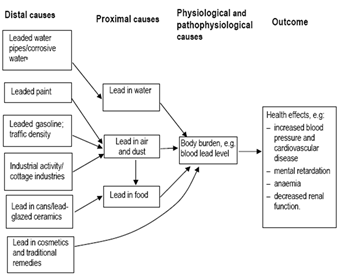
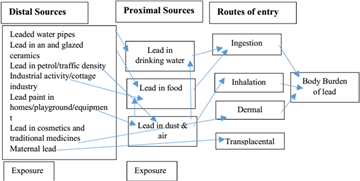
The burden and risk of exposure in an environment or country can be assessed by the evaluation of these distal sources of Pb exposure, as many interventions to reduce Pb exposure are targeted at these distal sources 2, 5, 13.
2.1. Lead in Paint and PigmentsLead in paint and pigments has long been known as a major source of Pb exposure, with documented risks of Pb toxicity from flaking house paint and paint in toys, especially in developing countries 13, 14. The contribution of Pb in paint to lead toxicity in Nigeria is illustrated in a report by Wright et al, from a study in Jos Nigeria, which demonstrated that flaking house paint was significantly associated and predictive of elevated BLL, with 70% of children in that study reported to have BLL >10 mg/dl. 15 The wide scale use of Pb based paint and exposure risk from flaking paint in Nigeria is further highlighted in a study across 4 cities in southern Nigeria by Nduka et al 16, who established that lead levels from paint flakes in 164 buildings was significantly higher than the United States Environmental Protection Agency (USEPA) permissible level of 5 mg/kg, with mean levels ranging from 39.39 mg/kg to 74.35 mg/kg. Sindiku and Osibanjo, 17 demonstrated the risk of Pb exposure from toys in Nigeria, from the outcome of their study which showed high levels of lead, cadmium, chromium and nickel in 51 random samples of toys imported into the country, with lead concentrations being the highest ranging from 28.50 to 12600 mg/kg. In spite of the above established risk of Pb in paint in Nigeria and the global efforts at Pb in paint elimination, various studies have still documented levels of Pb in paints far above the recommended limits in Nigeria. Adebamowo et al 18 in a study of paints manufactured in Nigeria stated that the mean and median Pb levels were 14,500 parts per million (ppm) and 15,800 ppm respectively far above the recommended 90ppm, with 96% of the paints having higher than recommended levels of lead 18. Another study of 174 Nigerian paint samples from Ibadan and Lagos, South West Nigeria of manufacturers registered with the Standards Organization of Nigeria (SON) reported the range of Pb in paint samples of 170-3231 μg/g, with all samples concentration above the permissible limits of 90 ppm by the US Consumer Product Safety Commission (USCPSC) and 100 ppm limit of the European Union (EU) for Pb in paint 19.
A comparative time analysis of the state of Pb in paint in Nigeria, executed as part of the Pb paint elimination project in Africa, compared two time periods 2009 and 2017 20. The 2017 assessment showed that 40 (74%) out of 54 analysed solvent-based paints for home use were lead paints, containing lead concentrations above the regulatory limit of 90 ppm/dry weight of paint. In addition 29 paints (54%) contained dangerously high lead concentrations above 10,000 ppm, with a concentration of 160,000 ppm found in a yellow finecoat paint sold for home use. The study also reported that information on the lead content and hazards of the paints was poor and no precautionary warnings on the effects of lead dust to children and pregnant women were provided. There were also no significant changes between the 2009 and 2017 situation as shown in Table 1, which indicates that over the 8 year period there had been no progress on the reduction of lead in paint in Nigeria 20.
The reports of all the above cited studies are justified and confirmed by the WHO global health observatory report on Pb exposure regulation and control, which reports that Nigeria is among the 64% of WHO member countries without confirmed legally binding controls on the production, import, sale and use of Pb paints as at the last quarter of 2018 9. It is therefore evident that Pb in paint remains a major source of Pb exposure in Nigeria.
2.2. Gasoline and Traffic densityLead in Gasoline: Lead in gasoline is known to be a major source of airborne Pb and body Pb accumulation. 2, 5, 21 In recognition of this risk the reduction of Pb in gasoline has been a major strategy in Pb exposure reduction; with evidence showing that reduction of lead in gasoline results in significant reduction of BLLs as demonstrated in the United States of America (USA) population with ≥90% decrease in children from 1976 to 1995 21.
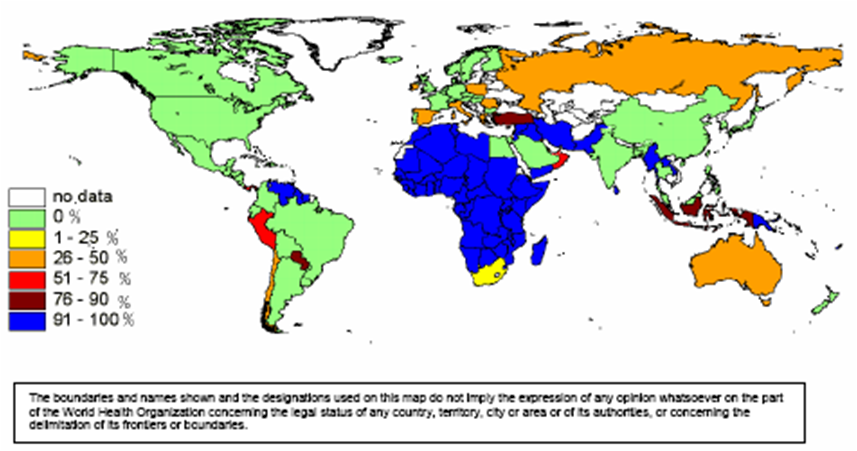
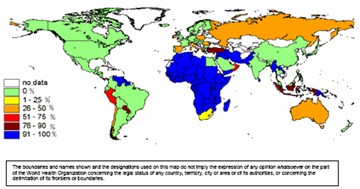
While it was known that reduction of Pb in gasoline limits Pb exposure, leaded gasoline still remained in significant use especially in developing countries as reported between 2001 to 2002 5. The gasoline lead concentration in most African countries, Nigeria inclusive was high with values ranging from 0.5 - 0.8g lead/L; with the percentage of total leaded gasoline sales in Nigeria ranging from 91 - 100%, compared to 1 - 25% in South Africa, and 0% in the USA and North America as at 2001 (See Figure 3) 5.
In response to this risk a regional conference on phasing out leaded gasoline in Sub-Saharan Africa organized by the World Bank in the framework of the Clean Air Initiative in sub-Saharan Africa was held in Dakar in 2001, with a resolution to eliminate use of leaded gasoline by 2005 22. This resulted in a National conference in Nigeria that outlined a National action plan to reduce the concentration of Pb in gasoline from 0.65 to 0.74 g/L to 0.15 g/L by the end of 2002 and a total phase-out of leaded gasoline by year 2004. 22, 23. In spite of the target and resolutions set for the elimination of leaded gasoline in Nigeria by 2005, there was no evidence to indicate that this targets had been achieved as studies on Pb exposure risk still indicated significant Pb exposure levels in the country 23, 24.
A study in 2014 25, conducted in 6 states of south western Nigeria, analyzed lead levels in gasoline and diesel and used the data to extrapolate the, atmospheric loadings of lead from gasoline and diesel consumption in Southwestern Nigeria. The levels of lead in gasoline and diesel from all the samples across the six states ranged from 0.49 -1.90mg/L for gasoline and 2.30 -10.97 mg/L for diesel respectively.
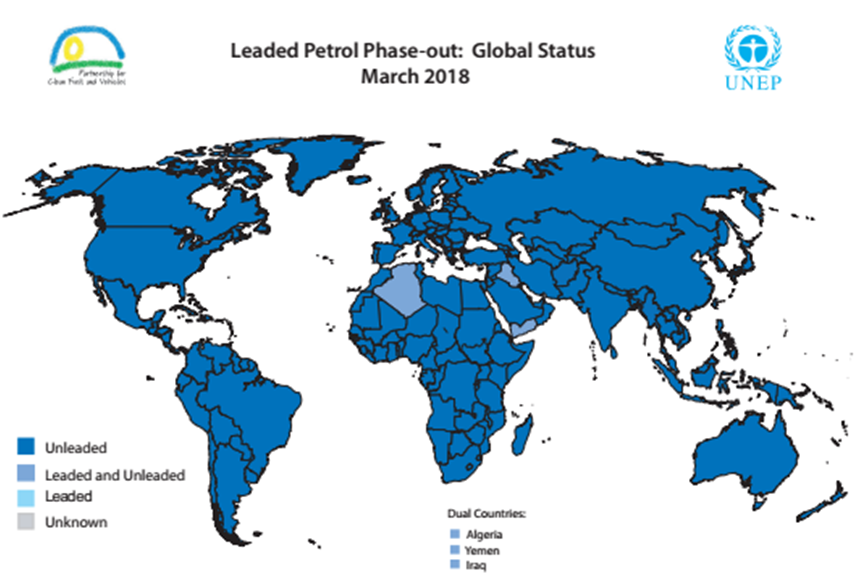
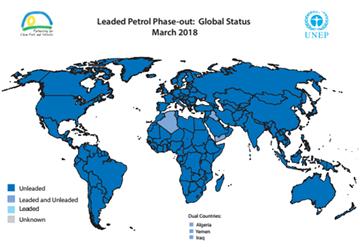
The range of lead in the gasoline samples were below the limits of 3.37 mg/L approximately (5 ppm) set by the Department of Petroleum Resources (DPR) Nigeria, indicating a total level of compliance for reduction of lead in gasoline, though there was no limit for lead in diesel. The percentage contributions of Pb emission from fuel consumption from this study which ranged from the highest Pb emission of 3.47 tons/year in 2009 to the lowest Pb emission of 1.28 tons/year in 2011 were all lower than the estimated annual total atmospheric lead emissions of 2,790 tons/year in Nigeria reported in 1994 25. In contrast a report from Port Harcourt, Nigeria in 2014 26 revealed that mean value of lead in gasoline was 0.82 mg/L, far above the WHO standards. In spite of the divergent reports on the status of lead in gasoline, the evidence on the reduction of Pb in gasoline in Nigeria to acceptable levels is corroborated by the United nations environmental program (UNEP) global Status report on the phase out of lead in gasoline as at March 2018 27, which indicates that Nigeria is among the countries that have complied with the use of unleaded gasoline, (see Figure 4) as compared to the data from 2001 (see Figure 3). Despite the fact that the current status on the phase out of leaded gasoline in Nigeria is encouraging, the atmospheric and body lead level over the next decade will tell if this attainment has resulted in significant reduction in the risk of Pb exposure in Nigeria.
Traffic density: Emissions from automobile exhausts are believed to account for more than 80% of the air pollution in some urban centers in Nigeria 2, 3, 27, 28. Heavy metals like Pb have been shown to be important constituents of the emissions 2, 3, 27, 28 especially with the prevalent use of leaded gasoline before 2005 in Nigeria 22, 23. It is therefore expected that high traffic density (TD) will be a risk factor for Pb exposure in a country like Nigeria. The contribution of Pb emissions in areas of TD can be assessed by direct evaluation of automobile emissions and lead in air in relation to TD and indirectly from lead levels in routes of exposure and BLL in areas of TD.
Orisakwe and Nduka 29 in the report of a study on environmental distribution of lead in south eastern Nigeria, stated that Agbo estimated that close to 15,000 kg of lead was emitted into the environment daily through combustion from gasoline as at 1997 in Nigeria. The study also found that the dust particle concentrations of Pb ranged from of 0.13-0.49 mg/kg and 0.15-0.47 mg/kg for both 2007 and 2008 respectively for all the 7 cities in the study, with values above the USEPA limit of 0.15 μg/m3.
Ogunshola et al in 2 studies 30, 31, established that lead concentrations in air particulate matter in Lagos and Ife, were proportionate to the traffic densities (TD) with Total suspended particulate (TSP) matter concentrations in Lagos of 100 and 2000 μg/m3 and traffic density of 1000-10000 vehicles per hour (vph), higher than the TSP and TD values of 120 and 720 μg/m3 and 450-1500 vph respectively at Ile-Ife; In addition the levels of the Pb concentration in the TSP exceeded the threshold limit value (TLV) prescribed by the Nigerian Federal Environmental Protection Agency (FEPA) for over 50% of the sampling times. 30 In a comparable way Kamson et al, through an analysis of roadside dust from roads with high, medium, and low vehicular traffic congestion in the city of Lagos revealed that between 2.35 and 7.25 mg Pb/g of dust is present in samples from roads with high traffic congestion 32.
These finding indicate that Pb in air and dust related to TD is a significant contributor to lead exposure as further validated by a study 33 among Nigerian traffic wardens which demonstrated that wardens in Lagos with higher TD had higher mean BLLs of 18.10 ± 6.40 μg/dl, compared to a mean of 10.20 ± 2.70 μg/dl in Ife with lower TD.
The risk of Pb exposure from lead in dust and air is not limited to occupationally exposed persons as established in studies on environmental exposure in Nigeria. Nriagu et al 34 revealed that among children in Kaduna, Nigeria with a mean BLL of 10.60ug/dl compared to expected levels of<5ug/dl; residence near a tarred road and ownership of a car was more strongly associated with higher BLL.
Correspondingly other studies in Benin 35 and Abeokuta 36, also established association between high TD with blood and environmental lead levels respectively. The study by Ademoroti and Oviawe in Benin 35 showed that BLL was related to traffic volume and duration of exposure with residents in areas of high traffic and longer duration of exposure having higher BLL (22.10 - 43.20 ug/dl) compared to those with low levels (8.60 -18.00ug/dl) and very low levels (2.0-4.4 ug/dl) respectively. Bada and Oyegbami in Abeokuta 36 also reported the following TDs (vph) and environmental lead concentration (mg/kg) of 2500 vph and 216.83mg/kg, 1,400vph and 193.3 mg/kg, 500vph and 173.73mg/kg and 300 vph and 156.08mg/Kg in four different towns.
The contribution of environmental Pb exposure from TD to the proximal sources of Pb exposure such as food, is illustrated by a study in Port Harcourt, South Nigeria which assessed the impact of automobile exhaust fumes and TD to Pb concentration in a common food component like bread 26. The result showed that bread Pb concentration in five 5 locations ranged from 0.147ug/g to 0.464ug/g, while the atmospheric lead concentrations ranged from 0.001 - 3.50ug/g. In addition, the study established a direct relationship between the volume of vehicular counts and Pb concentrations in bread.
The summary of these studies indicate that automobile emissions related to traffic density contribute significantly to the airborne and environmental lead levels in Nigeria and can contaminate food which is a proximal path of lead ingestion.
2.3. Mining other industrial and activitiesLead distribution and exposure is related to various large and small scale industrial activities. These activities include mining, welding, battery repairs and recycling, metal smelting, local pigment and cosmetic industry amongst others. The contribution of these activities have recently been brought to the fore with significant acute lead toxicity identified across Africa exemplified by the incidents in Ageneys, South Africa, Kabwe, Zambia, Thiaroye sur Mer, Senegal and Zamfara, Nigeria 13.
A study of the environmental impact of lead and zinc mining in the Arufu area of the Benue River trough in Nigeria 37 revealed a range of lead concentrations of 3.36- 59660 ppm, with significant Index of geoaccumulation (Igeo), contamination factor (CF) and degree of contamination (Cdeg) indicating moderate to high Pb contamination with values of 20ppm far above the permitted limits 0.01ppm in water, establishing significant risk to human health from new and old mining sites in the area. Elom 38 in an analysis of four mining sites in Ebonyi state found that the Pb concentration at the four sites was 7177 mg/kg, 5051mg/kg, 3198 mg/kg and 7881 mg/kg, with a range of 1093 mg/kg to 18753 mg/kg which were all far above the range soil guideline values (SGV) for Pb in areas of residential and industrial use of 200-500mg/kg and 300-600mg/kg in Nigeria and Canada respectively.
The report of fatal childhood lead exposure in Zamfara State Nigeria is a situation that has been widely studied and typifies the risk of lead exposure and toxicity associated with mining activities especially in artisanal and unregulated ways within communities. A report on the spatial distribution of lead in Anka, Zamfara state indicated that the mean lead concentration was higher in mining compared to non-mining villages 36,450.67mg/kg Vs. 467.33mg/kg respectively with values higher than the permissible limits of 400mg/kg 39. Further associations on the risk of lead from mining on the proximal sources of exposure and effect on human health and body lead burden are also reported in other studies from Zamfara.
Abdu and Yusuf characterized the risk to human health with lead exposure from farms in Azare, Anka LGA, Zamfara state, through assessment of lead in soils at various depths and distance, lead in water and lead in plants 40. The average concentrations of Pb were 515 mg/kg and 365 mg/kg in farmlands and profile pits respectively, while the concentration in plant materials was 1220mg/kg. The average chronic daily intake (CDI) for carcinogenic and non-Carcinogenic risk was 1.3 x 10⁵mg/kg and 1.7 x 10⁸mg/kg respectively with an average of 9.7 x 10⁷mg/kg for children. These values and concentrations are far above the acceptable limits of normal with attendant consequence for human health. The average concentrations of Pb in soil was 1266mg/kg in contrast to the limit of 300mg/kg EU/UK, 150mg/kg in USA and 70mg/kg in Canada, The Pb in plants primarily sorghum and cowpea leaves were 3500-fold higher than the recommended thresholds of 50 mg/kg in edible crops by the Food and Agricultural Organisation (FAO) and WHO. The lead concentration from eight sources of water ranged from 4.32 to 10.08 mg/l, above 0.01ppm WHO values for drinking water. The high transfer factor from soil to plants resulting in phytotoxicity of lead indicates the risk to human health in the area, related to mining activities.
Kauffman et al 41, established that lead poisoning was more prevalent among children living in compounds associated with ore mining and processing activities as the following proportion of children ≤5 years in ore processing compared to non-ore processing compounds 81.8% Vs. 68.9 %, 38.2% Vs. 22.3 and 20.0% vs. 1.8%, had BLLs ≥5ug/dl, ≥10ug/dl and ≥20ug/dl respectively. In addition the study showed significant correlations between Pb in soil, and dust and the number of ore processing activities and BLL.
The association between artisanal mining which even occurs in households and compounds is reiterated in two other reports from Zamfara state, Nigeria. Ajumobi et al 42 in a follow up cross sectional survey, in Bagega, report the association of severe lead exposure resulting in convulsion related death with being in a household breaking ore rocks within the compound. The study reported that 99.5% of children had BLLs > 10ug/dl, with a range of 8-332µg/dl.
In comparable manner Lo et al 43, also reported that the odds of childhood lead poisoning and lead soil contamination was 3.5 times higher in ore-processing villages with majority of children having BLL ≥ 45µg/dL which requires chelation therapy.
Studies in other group of industrial and small scale artisanal workers also show higher risk of lead exposure in such populations. Babalola et al 44 in as study among auto mechanics in Abeokuta, South west Nigeria, reported significantly higher mean BLL and Hair lead (HPb) in mechanics compared to controls with BLL and HPb of 48.50 ± 9.08 ug/dl compared to 33.65± 10.09 ug/dl and 17.75±5.16ug/dl compared to 14.30±5.90ug/dl respectively. Another study by Babalola and Babajide 45 in an industrial community also showed that granite workers, ceramic workers and cement workers had higher blood lead 43±0.12ug/dl, 44.10±0.12ug/, 43.0±0.10ug/dl compared to controls 22.0±0.07ug/dl or 31.0±0.10ug/dl. A more interesting finding in this study was the fact the resident and neighbors of the granite factory had higher lead levels than the granite workers and controls with BLL of 46.0±0.19ug/dl.
Ademuyiwa et al, studied workers from 9 occupational groups with lead exposure risk and reported higher mean BLL in subjects ranging from 27.00±1.05ug/dl to 48.90±10.54ug/dl compared to 15.78±2.84ug/dl in controls 46.
A study from Lagos 47, compared lead exposure between organized automobile mechanics and artisanal and small scale mechanics. The study results showed BLLs significantly associated with toxicity for both groups as 40.3% of organized mechanics had high BLL with a median BLL of 66.0 μg/dL compared to 34.3% of road sided mechanics who had a median BLL of 43.5 μg/dL.
Two other studies from Nnewi, South East Nigeria 48, 49, also establish the risk of lead toxicity among mechanics and petrol station attendants in comparison with controls. Dioka et al 48 in a comparative study of auto mechanic’s in a mechanic village noted that mechanics had higher BLL of 59.6 ± 15.9 compared to 35 ± 7 µg/dL in controls; while Ibeh et al 49 showed that auto mechanics had higher BLL of 36.11 ± 14.52ug/dl, compared to Petrol station attendants and controls with BLL of 15.11 ± 6.50ug/dl, 13.61 ± 3.4ug/dl respectively an indication of higher risk of Pb exposure in artisanal workers.
It is therefore obvious that populations engaged in occupations such as mining, artisanal and small scale industries as well as population’s in such environments are still at risk of lead exposure and toxicity in Nigeria.
2.4. Cosmetics and Traditional RemediesLead based pigments have been used as cosmetics and herbal remedies across many cultures for centuries; yet the contribution of these sources to lead toxicity remains significant with certification of lead compounds in both traditional and contemporary cosmetic products and medicines 50, 51. The import of this risk is validated in a 2011 report of lead toxicity, in an infant born in the United States to Nigerian parents with elevated BLL of 13 µg/dl and 2+ erythrocyte microcytosis following application of an imported eyelid pigment painting called Tiro by family members 52. Tiro which is a common lead based pigment applied around the eyelids and other areas for beatification purposes in Nigeria was found to consist of 82.6% of lead sulphite (galena) 52. The above report illustrates the extent to which cultural influences promote lead exposure from cosmetic use in addition to the low awareness of the risk of lead exposure from its use 52. The risk of lead exposure from unregulated lead cosmetics has also been previously reported by Wright et al 15, Nriagu et al 34 and Blankson et al 53 who established an association between use of lead ore eye cosmetics and higher BLLs in Nigerian children.
The risk of lead exposure via contemporary cosmetics has also been examined in Nigeria. Nnorom et al 54 evaluated cosmetics products purchased from Umuahia south east Nigeria. The mean, geometric mean and range of lead in eyeliner, eye pencil and lipstick were 31±61ug/g, 120.5ug/g, (66.4 - 213ug/g), 129.2±40.4ug/g, 123.2ug/g, (66.0-187.1ug/g) and 105.6±67.5ug/g, 87.3ug/g, (28.7-252.4 ug/g) respectively.
Iwegbue et al. 55 also reported the following mean lead in lipstick, lip gloss and facial mascara eye shadow of 14.9±2.6ug/g, 11.9ug/g, 325.6±102 respectively with a range of 12-240 μg/g.
Another study by Orisakwe et al 56 in Port Harcourt, South South, Nigeria reported the range of lead concentration in body creams and lotions to be 1.2 to 9.2ug/g, while the range in powders was 1.3 to 12.9 ug/g. In addition lead was detected in 50% and 70% of body creams /lotions and powders respectively. Though the systemic exposure dosage (SED) of lead in facial cosmetics reported by Iwegbue et al is said to be below their respective provisional tolerable daily intake (PTDI) or recommended daily intake (RDI) values, the long term dermal absorption of Pb in cosmetics products will certainly have deleterious effects. The current state of data indicates that Pb based cosmetics remain a significant route of lead exposure in Nigeria.
2.5. Cans and CeramicsLeaching of Pb from ceramics and cans is a source of Pb exposure, especially in countries with poor regulation on the levels of lead in ceramics and cans. The awareness of lead-soldered cans as a source of Pb in food had led to a decline in the use of lead-soldered cans in the food processing industry especially in developed countries 4, 6. The potential for leaching of lead is heightened especially in acidic food and drinks to values above the FDA limit of 0.5ug/ml, in line with the maximum allowable dose level (MADL) of 0.5 μg/day of lead, with efforts to lower the levels to 0.2ug/day 57. It has also been established that the amount of leached lead is also dependent on the lead content of the cup, mug, can or ceramic ware 57. Various studies have sought to evaluate the contribution of lead from cans and ceramics to lead exposure in Nigeria. Ogidi, et al, established the leachability of heavy metals inclusive of Pb from commonly used aluminum and cast iron household cookware in Nigeria. The study results showed that lead was leached in both cooked and uncooked food with the highest mean concentration of lead measured as 31mg/Kg 58.
Another study by Aderemi et al 59, which investigated the leaching of Pb from ceramic food ware products in Nigeria, reported the range of ceramic Pb concentration of 26.45-2071.46 mg/L with corresponding leached Pb concentration of 0.11-0.97mg/L. The study also observed that the metals were found in both the ceramic glaze and clay used in the ceramics products. Though not all metals were leached significantly, the amount of Pb in glaze and clay used for the products reflects the unregulated nature of the process and the attendant long term health risk associated with their use.
Idris et al 60 in Kaduna, Northern, Nigeria analyzed the leachability of heavy metals in ceramic domestic cookware, sold in Kaduna, with all the products manufactured in China. The concentration of lead in the following ceramic products of pot, soup bowls, plate, cup, mug and spoon were 32.37mg/kg, 140.91mg/kg, 67.42mg/kg, 134.02mg/kg, 13.71mg/kg and 119.19mg/kg respectively all below the 500ug/g limit for lead in such materials. In spite of the seemingly acceptable lead levels in ceramic products, analysis of leached lead in acetic acid at room temperature was 13.37mg/kg - 66.80mg/kg while the percentage of leached lead in various acidic, alkaline, hot distilled water and tea were 12 - 97%, 32-93%, 16-86% and 9-88% respectively indicating a risk of significant absorption over time from these products. In contrast to the findings of this study Omolaoye et al 61, studied metal level in traditional pottery imported from china in the 3 Northern Nigerian cities of Zaria, Kano and Kaduna. The concentration range of lead was 218.83-866.67 μg/g, far above the mean range of 13.71mg/kg - 140.91 mg/kg reported by Idris et al stated above but lower than the upper limit of lead range concentration of 2071.46 mg/L reported by Aderemi et al. In addition about 60% of the ceramic ware in the study showed Pb concentration higher than 500μg-1 recommended by USFDA (1988).
In further comparison to the results from Nigeria studies, a comparative analysis by Ahmad et al in Qatar 62, evaluated the leaching of heavy metals from ceramics imported into Qatar from China, India and Spain. The analysis showed that the concentration of leached Pb in Chinese products of 17.991ug/l and 37.034ug/l was higher than the values in Indian products of 10.449ug/l and 15.317ug/l, while Pb was not detected in the Spanish products. These results indicate that the risk of Pb in ceramic ware is a function of the degree of regulation in a particular country.
Though more studies are available on lead in ceramics, the evaluation of lead exposure risk from canned drinks was done by Iwegbue et al 63 who reported the range concentrations of lead of 0.06-1.93 ppm in 5 types of imported canned drinks sold in Nigeria. The study also established that the concentration of Pb exceeded the statutory safe limit of 0.01ppm in (>80%) 5 of 6 types of juices, with values of 0.58±0.12ppm, 0.85±0.64ppm, 1.12±0.17ppm, 1.26±1.25ppm, 1.93±1.35ppm respectively.
The summary of the above cited studies indicate that Nigerian made ceramic ware have higher Pb content, compared to imported ceramics and the risk of Pb exposure remains high due to the percentage leachability of lead. Therefore the long term use of such materials, especially in favourable acidic and higher temperature settings will lead to significant Pb exposure. These findings establish the existing poor regulation of a key distal source of Pb exposure in Nigeria.
2.6. Lead in SoilSoil lead levels serves as a source for Pb in dust and air and is transferable to crops and other materials which may be ingested, especially in vulnerable groups like children 2, 3, 4, 5. Soil Pb levels are determined by the nature of Pb producing activity, the depth and physicochemical properties of the soil and remediation measures in place. Previous data from 1990 3, 5 showed that while the mean soil Pb content in the United states, Canada and Scandinavia was in the range of 10 - 500ug/L the mean soil Pb content in most African countries was >1000ug/L. In realization of this risk various studies have evaluated soil lead levels in Nigeria across various settings.
Considering the vulnerability of children to lead exposure Ekwumemgbo and Omoniyi 64 conducted a nationwide assessment of lead concentration in primary school soil-dust in all the six zones of Nigeria. The mean range concentration of soil Pb in the dry season was 45.98 ± 34.60 mg/kg in South East (SE) to 131.60 ± 70.98 mg/kg in the North East (NE), while the range in the rainy season was 44.58 ± 28.90 mg/kg in the (SE) to 130.78 ± 70.80 mg/kg in NE. The concentration of lead in the samples analysed were above the estimated natural lead concentration range of 5.00 mg/kg to 25.00 mg/kg. The study found that the mean lead concentration from the NE and North West (NW) were above the permissible limits while levels in North central (NC), South South (SS), SE and South West (SW) were below the maximum tolerable (permissible) limit of 100mg/kg according to WHO).
Adeyi et al 65 assessed the levels of Pb and cadmium in topsoil of residential areas in Lagos and Ibadan potentially resulting from painting. Lead concentration in residential areas in Lagos and Ibadan ranged from 1.56-419 mg/kg, with mean range values of 23.4±1.2 mg/kg to 77.7±79 mg/kg and 5.74±5.4 to 90.5±118mg/kg in Ibadan and Lagos respectively compared to 2.34±1.1 mg/kg in control sites. In addition the contamination factor (CF) for Pb in Lagos ranged from 2.5 to 38.7 indicative of low to considerable contamination and 10-33.2 in Ibadan indicative of considerable contamination. The values indicate significant risk for lead exposure in residential areas especially in vulnerable groups such as children.
Adeniyi et al 66 in 2008 to 2009 evaluated the level of total petroleum hydrocarbons (TPH) and trace heavy metals (lead, copper, and cadmium) in soil samples from 3 sites in Lagos, Nigeria. The mean Pb levels were 4.24 ± 3.10, 3.72 ± 0.60, and 3.70 ± 1.32 μg/g, respectively compared to the control site of 0.25 ± 0.13ug/g and the soil guideline value (SGV) of 200 or 300mg/kg for soil in residential places.
The concentration of soil lead around two major mechanic clusters in Benue state was studied by Pam et al 67. The mean range concentration of Pb in the two clusters was 283-665mg/kg, compared to 12.7 mg/kg and 65.12 mg/kg for the control clusters; with the maximum range value above the SGV for lead. The reasons adduced for the elevated Pb levels include waste oil, presence of automobile emissions, and expired motor batteries indiscriminately dumped by battery chargers and auto mechanics in the surrounding areas. A similar assessment in Nekede and Orji, Imo state of South Eastern, Nigeria was done by Okoro et al 68, who analysed topsoil heavy metals levels in the vicinity of automobile mechanics at 3 different depths of 0-20, 20-40 and 40-60cm. The concentration of lead ranged from 693.33 to 2917.30mg/kg compared to 0.05 - 0.24mg/kg in controls sites. The Pb values which were above the SGV also decreased with increasing soil depth.
Additional studies which explore the contribution of traffic density and artisanal occupational processes especially associated with the automobile mechanic industry, metal smelting and other industrial activity still show a consistent trend of significant Pb exposure risk from soil lead levels.
The analysis of lead in roadside surface soils and dust in areas of traffic congestion was done across seven urban cities in Southern, Nigeria by Nduka and Orisakwe 69, between 2007 and 2008. The maximum range of mean concentration of Pb in soil samples were 14.50 to 28.20mg/kg in Enugu, 15.96 - 18.82 mg/kg in Awka, 44.09 - 4238.29 mg/Kg in Nnewi, 21.28 - 22.56 mg/kg in Aba, 80.36 - 120.00 mg/kg in Onitsha, 13.08 - 89.75 mg/kg in Port Harcourt and 8.75mg/kg in Warri. The Pb in dust concentrations ranged from 0.13-0.49 mg/kg and 0.15-0.47 mg/kg for 2007 and 2008, respectively. The values were far above the concentrations reported for all control sites with alarming concentration in Nnewi with a value of 4238.29 mg/kg in 2008.
In comparable way, Ameh et al 70 studied the concentrations of heavy metals in soil from the vicinity of automobile mechanic villages located in Zaria, Northern Nigeria. Pb in top soil was evaluated at 18 sites and compared with a control site being an organic rural farmland. The range of Pb concentration was 0 - 5800 mg/kg compared to undetectable levels in the control farmlands. The reported levels were above the USEPA limit of 300 mg/kg monthly average concentration and percentage composition of 0.0300. In addition >88.89% samples had Pb concentration above the USEPA limit.
Oyeleke et al 71, studied levels of heavy metals including Pb around the vicinity of an abandoned battery factory in Ibadan western Nigeria, in respect to distance from the factory. The results generally show a decrease of Pb concentrations with increase in distance away from the company in all the four different directions (Northwest, Northeast, Southwest and Southeast). The mean and range concentrations of Pb, was 59.13±48.9 (5.00 -182.00mg/kg), values above the normal crustal average for soils.
The contribution of recycled metals waste to soil lead pollution was evaluated by Olatunji et al 72 in South west Nigeria. The range of lead in the soil was 21.0-2399.0 mg/kg with values over the SGV for Pb, while the concentration of Pb in PM which was 4.6-160.0ug/g, was also above the limits, showing that recycled metals contribute significantly to Pb driven soil pollution in Nigeria.
The metal concentration in soil at industrial areas of Kaduna and Kano states in, North Western, Nigerian was evaluated by Inuwa et al 73, who found that the dry weight concentration range of lead in soils was 151ug/g to 540 ug/g, which is above the SGV for Pb as prescribed by Nigerian Federal Environmental Protection Agency (FEPA) and WHO.
The above studies show that occupational and other lead producing activities determine soil and dust lead levels as seen in the high soil lead values in Nnewi an industrialized town and higher lead values associated with auto mechanic industry, metal smelting and battery processing. The risk in residential areas also exist from flaking paint and other artisanal activities which occur within residential settings. There is a risk of significant contamination and transfer of lead across the food chain and other proximal routes of lead exposure from elevated soil lead levels.
In Nigeria, the contribution of ore processing and mining activities to lead toxicity and soil Pb particularly remains significant as shown in the well-known large scale Pb poisoning in Zamfara state Northern Nigeria. Lo et al 43 conducted a village level assessment covering 70 villages across 3 local government areas in Zamfara state, and reported the range of concentration of Pb in soil/dust from ND to 87,293 ppm. High levels of Pb in soil were associated with ore processing and mining activities as 50% and 37% of the ore-processing villages had ≥ 1 soil/dust sample with a lead level > 400 ppm and > 1,200 ppm respectively compared to 0% in the non-ore processing villages.
Other studies of mining areas in the Benue trough North central Nigeria reported soil lead range concentration of 3.357- 59660 ppm 37 while a study in mining areas of Ebonyi state , South East 38 reported a range of 1093 mg/kg to 18753 mg/kg, and corroborate the contribution of mining soil Pb levels. The findings across the north, central and southern parts of Nigeria, provide insights into the risk of Pb exposure from mining activities in the country. It is therefore evident that Pb in soil levels in Nigeria, are significantly higher than expected SGV and remain a risk for human lead toxicity.
The proximal sources of Pb exposure include Pb in air, water, and food 5, 12, 13. These proximal sources are the pathways through which Pb is amassed in the body either via inhalation, ingestion and dermal absorption. Maternal lead which ls also distal source of Pb 13 is dependent on exposure to these proximal sources and results in trans-placental uptake of Pb.
3.1. Lead in Air and DustThe concentration of Pb in air depends on a number of factors, including proximity to roads and point sources 2, 3, 4. If an average concentration in air of 0.2 µg/m3 is assumed, the intake of Pb from air can be calculated to range from 0.5 µg/day for an infant to 4 µg/day for an adult as the inhalational route is a major route for Pb uptake in adults 2, 3, 4, 6, 74.
In many urban areas in Africa, average atmospheric lead concentration ranged from 0.5 - 30ug/m in 1985 2, 3, 4, 6, 74. These values were significantly higher than the average atmospheric lead concentration in Canada in 1973 which was 0.74ug/m. While the figures in Canada declined to 0.10ug/m3 in 1985 2, 3, 4, 6, 74, the values in many urban areas in Africa remained above the pre-1973 levels in Canada. The decrease in the levels seen in Canada and other countries has largely been attributed to the reduction of lead in gasoline 2, 3, 4, 6, 74.
It should also be noted that the ambient Pb levels in Africa as at 1990 are comparable to those in the urban and rural areas of the United States in the 1970s when childhood lead toxicity was known to have been pandemic 2, 3, 4, 6, 74.
The Pb concentrations from dust fall rates in some areas of Lagos were estimated to exceed 5pg/m3; while the city-wide average was estimated to be 0.5pg/m3. 30 The Pb concentrations in urban dusts have also found to be as high as 7000ug/g in Lagos, Nigeria 30, 31, 32, 33.
Analyses of roadside dust collected from roads with high, medium, and low vehicular traffic congestion in the city of Lagos have shown that between 2.35 and 7.25 mg Pb/g of dust is present in samples from roads with high traffic congestion; while an analysis of elemental concentrations of air particulates showed that the TSP matter concentrations were between 100 and 2000 μg/m3 in Lagos and between 120 and 720 μg/m3 at Ile-Ife; while traffic densities were 1000-10000 vehicles per hour and 450-1500 vehicles per hour respectively. 30, 31, 32, 33 These results indicate that Pb concentration exceeded the threshold limit value (TLV) prescribed by FEPA for over 50% of the sampling times, with evidence of vehicular exhaust emissions as the source 30, 31, 32, 33.
A more recent study in the Lagos, south west region of Nigeria by Obioh et al 75, evaluated lead levels in relation to traffic density (TD). TD in Lagos ranged from 298 to 4100 vehicles/hour while the range in Ile-Ife was 10 vehicles/h to 1500 vehicles/h. The pattern of total particulate matter (TPM) and Pb concentrations in TPM mirrored the degree of TD as the maximum SPM concentrations in Lagos were 238 pg/m3 for PM25, 599 pg/m3 for PM10 and 1413 pg/m3 compared to Ile-Ife 261 pg/m3 for PM25, 531 pg/m3 for PM10 and 1185 pg/m3. Correspondingly the concentrations of Pb in Lagos ranged between 1.84 and 9.58 μg/m-3 compared to Ile-Ife with a range of 0 to 8.09 μg/m3. In both study locations of Ile-Ife and Lagos, the PM10 concentrations were averagely 2 to 4 times higher than the 150 pg/m3 for the United States National Ambient Air Quality Standards (NAAQS). The Pb concentrations especially in Lagos were also 3 to 6 times higher than the 1.5 pg/m3 of NAAQS and WHO, indicating substantial levels of Pb in air with risk for toxicity. In addition a time trend analysis through comparison of the studies by Ogunshola et al and Ajayi et al 30, 31, 32, 33 reported in 1983 and 1995 respectively and the 2005 report by Obioh et al shows that the risk for lead exposure through Pb in air in Nigeria has not improved and remains a source of concern.
Studies in the south of Nigeria, also show a similar trend for risk of lead exposure in air and dust as Uzoekwe and Ajayi et al 76, in yenagoa Bayelsa state, evaluated the levels of Pb in SPM during an air pollution assessment study revealing air Pb concentration of 5.3pg/m3. A study by Uno et al, 77 which evaluated the concentration of heavy metals in airborne SPM in the Niger delta between 2005 - 2006, across four major cities of Calabar, Eket, Aba and Port Harcourt reported high Pb mean and range values of 11.25±5.86 (4.9 -22.4) ug/m3, 11.83±2.28 (8.2-16.2) ug/m3, 15.77±4.01 (9.83-20.6)ug/m3 and 14.19±2.99 (9.42-17.25) ug/m3 respectively.
Okuo et al 78, in Benin South south Nigeria, analysed SPM and heavy metal concentration around artisanal workshops. The range of SPM concentrations for the three workshops was 583 - 20,166μg/m3. The highest concentrations of these elements were observed in Motor Spray Painting (MSP): 8528±389μg/m3 and Welding and Panel-beating (WDP) workshops: 11086.8±10644 μg/m3. The mean Pb levels in the 3 groups of artisanal workshops was 1.210±0.837ug/m3, 2.419±0.870ug/m3 and 0.771±0.514ug/m3 for Battery Maintenance and Charging (BMC), MSP and WDP workers with all values above the recommended levels.
From the North of Nigeria, Philip et al 79, investigated the levels of heavy metals in street dust in Adamawa state and found the Pb concentration to be 1.24 μg/m3 in Bachure to 2.89 μg/m3 in Shinko, with values increasing based on TD. The concentration of Pb was still above the limits previously cited 75 and for the EPA as stated in the study. Still within the North East of Nigeria, Ogbugbuaja et al 80 evaluated the lead levels in SPM in Maiduguri, Bornu state and Yola in Adamawa state. The mean and range of SPM were 28.3 (1.3-144) μg/m3 and 13.6 (1.1-52) μg/m3 for Maiduguri and yola areas respectively. While the reported SPM levels were below the annual average limit of 150μg/m3, the Pb concentration in SPM was indicative of substantial risk with values of 83.1 to 111 ppm and 68.6 to 95.0 ppm in Maiduguri and Yola respectively.
The values of Pb reported in air, TSP and SPM in the reviewed studies are indicative of high risk for lead exposure especially with potential for inhalation and transfer to crops and food at the road side amongst other risk and proximal portals.
3.2. Lead in WaterLead in water is another important source of global environmental lead exposure 81. The historical recognition of Pb toxicity from leached Pb in water sources from Pb containing pipes and plumbing systems prompted a global response to reduce the presence of Pb in water delivery systems and promote water quality guidelines 82, 83. The impact of Pb exposure and toxicity through water is exemplified by the estimated daily Pb intake of 3.8 µg/day and 10 µg/day for an infant and adult respectively if a lead concentration of 5 µg/liter in drinking-water is assumed 81.
The efforts at reduction of Pb in water have been implemented for at least 40 years in developing countries 82, 83, 84 with remarkable reduction in Pb in water and corresponding BLL. In contrast many developing countries like Nigeria, still have challenges with access to portable water and many citizens rely on other untreated sources of surface and ground water for drinking and other purposes 85, 86. It is reported that the water and sanitation situation in Nigeria is inadequate and the access to piped water on premises in urban areas has dropped from 32% in to 7% in 2015 85, 86. It is also reported that approximately 8% to 10% of the population rely on surface water, 67% rely on other improved sources like borehole and commercially packaged water while 21% access water from unimproved sources. A 2015 survey of Port Harcourt an urban city in south south Nigeria indicated that only 1% of residents had access to publicly piped water while the rest resorted to borehole, commercial water and surface water for drinking water use. It is therefore likely that contamination of water with heavy metals will remain a challenge in the country.
The levels of lead in ground water from wells and boreholes has been assessed by various studies in Nigeria.
Ogbu et al in 2005 87, reported high levels of lead in well water in Enugu state, South Eastern Nigeria, with values of 4.44± 0.6umol/L(20.72ug/dl), which was 1785.5% increase above the then WHO tolerable limits of 0.24umol/L (0.05mg/dl) and far above the Nigerian Standard for Drinking Water Quality (NSDWQ) maximum of 0.01mg/L 88 and revised WHO guideline 0.01 mg/L (ppm). 81 Other studies in south East Nigeria by Nkemdirim et al 89 in a spatial analysis of groundwater supply in selected urban centres of Abia State, reviewing 13 borehole water samples reported Pb concentrations ranging from 0.02-0.08mg/L.
Aremu et al 90 in Warri south Nigeria reported ground water Pb range of 0.06 to 0.044mg/L far above the WHO threshold limit of 0.01mg/L, while Sopoukwu 91 who conducted a ground water quality study of Ebubu, Eleme, Rivers state reported lead concentration of 0.117 ± 0.056 mg/L. In similar manner Apkoveta et al 92, in an appraisal of borehole water across two urban cities of Edo and Delta states in the south south Nigeria, reported the mean and range of Pb concentration across the three sites as 0.014 (0-013-0.015) mg/L, 0.013 (0.012-0.014) mg/L, 0.015 (0.014-0.016) mg/L which were marginally above the limit of 0.01mg/L. Another study in Warri environs by Ogeleka and Uruejoma 93 found Pb in water concentration within the recommended limits with a mean of <0.001 ± 0.0 mg/L.
Assessment of the situation in south west Nigeria, still indicate a risk of exposure from Pb in water sources. An evaluation of Pb levels in public portable water supply was done by Omokhodion 94 in Ibadan, South Western Nigeria in 1994. The estimated the mean tap water Pb level of 5g/dl was within the WHO tolerable limits at the time, however with the revised limit of 0.01, this value is far above the recommended NSDWQ and WHO limit and can result in toxicity 85, 88.
A study in Igbora, Oyo state by Adekunle et al in 2007 95, assessed water quality in twelve hand dug wells. The Pb concentration exceeded the WHO recommended thresholds for portable water with the following Pb mean (standard error) mg/L values of 0.20(0.09), 0.32(0.09), 0.14(0.01), 0.16(0.09) in the dry season and mean (SE) of 0.45 (0.04) 0.56 (0.05) 0.63 (0.01) 0.39 (0.02) in the wet season.
Odukoya 96 in study of 50 samples of hand dug wells and boreholes in Ijebu Igbo and environs in Southwest Nigeria reported range and mean Pb to be 0.1 - 20.5mg/L and 4.15±5.30mg/L. In 12% of samples Pb levels were higher than recommended standard and the pollution index varied from 0.09 to 1.66 with 8 % of the water samples showing pollution index above 1.
The surface water Pb in Ibadan, South West Nigeria was assessed by Adeyemo, et al 97 in 2003 - 2004. The Pb levels in surface waters ranged between 0.5-2.35mg/l with mean of 0.76mg/L and 1.15-2.20mg/L with a mean of 1.34mg/L during the dry and rainy seasons, respectively. The Pb levels in fish ponds were even higher, at 1.09-2.9mg/L with a mean of 1.88mg/L. The results indicates severe lead contamination of aquatic systems in Ibadan City, with its associated public health risk to humans.
Lead contamination of soil and ground contribute to lead in ground water sources. Lead contamination of water in areas with risk activity such as mining remains a significant source of Pb based water pollution. Evidence for this is adduced from two studies in mining communities in both North and South, Nigeria. Hassan et al 98, in a study from Bagega and its environs in Zamfara State a community associated with massive acute lead exposure, did a survey of water samples from boreholes, domestic wells and surface water from the Bagega Dam pond in 2013. The levels of Pb in well water samples analysed in the study area varied from a minimum of 0.065±0.019 ppm to a maximum of 0.121±0.014 ppm in Topeki and Dareta villages respectively. Similarly, the variation of lead Pb concentration in Borehole water samples ranged from a minimum of 0.039±0.027 ppm to a maximum of 0.165±0.034 ppm in Topeki and Dareta village samples respectively. In addition the Pb level of the surface water sample from Bagega dam was found to be 0.735±0.081 ppm and all the values obtained for all the water samples were higher than the WHO limit of 0.01ppm.
Aloke, et al 99 in a 2019 report compared Pb levels in surface water streams and ground water borehole at Enyingba a mining community of Ebonyi state south east Nigeria. The mean Pb values were 0.574±0.345mg/dl, 0.272±0.157mg/dl for Stream 1 and Stream 2 and 0.077±0.133mg/dl,0.043±0.075mg/dl for Borehole 1 and Borehole 2 respectively. The reported values where all above the WHO Limit of 0.010ppm (mg/dl) and a metal index (MI) above 1 for all sources, indicating a high risk of Pb exposure from these water sources.
Comparative studies of lead levels in various sources of drinking water which include tap water, borehole, well ground water and commercially prepared plastic bottle and sachet water reveal elevated lead levels in these sources with some sources showing safer lead content than others.
Anake et al 100, compared drinking and ground water in Ota, Ogun state and found that the levels of Pb were below detection limit in all the bottled, well and borehole water samples with exception of an hospital borehole which had concentration of 0.03 mg/kg above the WHO and SON levels of 0.01ppm. In like method Chinedu et al 101, in Canaan Land, Ogun State, reported the following values of lead 0.024mg/L , 0.086mg/L, 0.011mg/L and 0.054mg/L in portable distilled, public tap, processed bottled and sachet water respectively, values all above the WHO and NSDW limit of 0.01mg/l. In addition Pb level in rain water of 0.183mg/L and rivers water of 0.179mg/L were also excessive.
Two other studies by Maduka et al 102 from south east Nigeria and Musa et al 103 from North West Nigeria of evaluate Pb levels in comparative water sources. Maduka et al 102 analyzed Pb levels in alternative sources such as boreholes, streams, sachet, harvested rain and well water as these are the major sources of water in the absence of public treated tap water. The mean levels of Pb in the water samples in all the senatorial zones of the state were higher than the WHO limit of 0.01 mg/L. The mean level of Pb in harvested rain, sachet (pure water) and stream waters were 0.34 ± 0.23mg/l, 0.37 ± 0.08mg/L, and 0.23 ± 0.06 mg/L respectively.
In like manner Musa et al 103 in Zaria, Kaduna state found that the (mean) and maximum lead concentrations were (0.25±0.08mg/l) 1.0±0.4mg/L, (0.158±0.11mg/l). 03±0.95mg/L and (0.195±0.09mg/l) 0.56±0.34mg/L for shallow wells, boreholes and packaged water respectively; with the following percentages 30%, 53.8%, and 37.5% of samples for shallow well, borehole and packaged water having concentrations above the limits for lead. The analysed studies on Pb in drinking water sources in Nigeria, shows serious risk of lead ingestion from contaminated water as Pb levels are found to be high in all water sources especially in a sachet water popularly called pure water which is widely consumed in the country and said to be certified fit by the regulatory food and drug control agency. This findings call for more awareness on Pb in water risk and the need to include mandatory heavy metal assessment in the parameter’s for water safety and quality in addition to improving access to safe and quality water in the country.
3.3. Lead in FoodThe ingestion of Pb through food and water are key routes of Pb intake from proximal sources 5, 12. The amount of Pb in cooked food is increased when the water used for cooking or the cooking utensils contain Pb, or the food especially if acidic has been stored in lead-ceramic pottery ware or lead-soldered cans 57, 58, 59. Food can also be contaminated with Pb through transfer from soil, air and dust and absorption of the heavy metals by other life forms in the food chain 3, 4, 5, 6, 104.
A previous review by Onakpa et al 104 in 2018 shows that vegetables and other food crops consumed in Nigeria are contaminated by heavy metals with the consequent carcinogenic and non-carcinogenic health risk. Therefore evaluation and reduction of lead in food is a critical route to lead exposure control in any country.
Adekunle et al 105, assessed the lead contamination of 5 species of green leafy vegetables sold in outdoor markets in 3 cities of south west Nigeria. The range of lead concentrations in all the 585 vegetable samples of 6.35-20.85 mg/kg exceeded the recommended value of 0.3mg/kg for green leafy vegetables. In addition the estimated daily intakes (EDI) of Pb based on the concentration ranged from 1.11× 10⁻² to 2.02×10⁻² mg/kg/BW far higher than the FAO/WHO safety threshold of 3.0×10⁻³ to 4.0×10⁻³ mg/kg/BW for Pb. The concentrations were significant to the extent that washing the vegetables with water reduced Pb concentrations and EDIs by only 11.36 to 43.52 % but did not bring the values below the recommended limit. Since Green vegetables are a commonly consumed in Nigeria, the amount of lead taken in through this food source can thus be considered as very significant.
The sales of food of various types in road side settings is a common feature across Nigeria. Therefore the evaluation of risk for food contamination from road side dust, vehicular emission and other sources of Pb in the environment is important. Onipede and Rahman 106 in a study analysed concentration of Pb and cadmium in roasted corn (Zea mays), roasted plantain (Musa paradisiaca) and barbecue from roadside close to industrial and automobile emission in some selected parts of Lagos, Abeokuta and Ota, in South-West Nigeria. They found that the concentration of lead in all food types was higher than the FAO permissible limit of 0.3 mg/kg in 92% of the samples analysed. Awofolu 107 evaluated the concentration of trace metals including Pb in a total of 144 samples of grass, soil and earthworm, (Lybrodrilus violaceous) in Lagos, Nigeria. The levels of Pb varied from 0.01-0.14mg/kg, 0.02-0.23 mg/kg, and from trace-0.07mg/kg in plant, soil and earthworm respectively. The concentrations reported in this study are an indication of metal transfer from soil to plant and animal forms in the food chain, demonstrating the risk of lead ingestion from food.
The continuity and transfer of lead contamination from distal sources through the food chain is further exemplified by the study from Abdu and Yusuf 40 in Zamfara State, which set out to assess the health risk based on the level of lead contamination in farmlands, crop plants and water sources. The average concentrations of Pb in soil was 985 mg/kg, with average farmland concentrations of 515mg/kg. These values were above the recommended thresholds of 300 mg/kg in EU and UK, 150 mg/kg in USA and 70 mg/kg in Canada. The study also showed that the lead concentration in major staple crops sorghum and cowpea of 1220mg/kg was over 3500-fold higher than the FAO and WHO limits of 50mg/Kg in edible crops. The reasons for the extremely high levels of Pb in the plant materials include uptake from soil and lead dust from gold ore processing prevalent in the area. Based on the above assessment the average chronic daily intake (CDI) of Pb for carcinogenic risk in mg/kg/day was 1.3 x 10⁵, while non carcinogenic CDI averaged 1.7 x 10⁸ mg/kg/day for adults and 9.7 x 10⁷ mg/kg/day for children. The findings show high risk to health and illustrate the risk of lead exposure through food in the Nigerian environment.
Trima et al 108 in Zamfara state also evaluated the contribution of contaminated food to total lead exposure among children. The reported average post-harvest and processed cereal grain Pb levels were 0.32mg/kg and 0.85 mg/kg dry weight, respectively, while the age-specific food lead intake ranged from 7 to 78μg/day. The contamination of food by pulverized ores accounted for 11-34% of BLLs in children during the epidemic and beyond. Other previously established nutritional factors 2, 4, 13 such as dusty environment, fasting between meals, and nutritional deficiencies were also documented as significant risk factors for lead bioaccumulation.
The risk of transfer of Pb from soil to food, irrespective of the nature of industrial activity remains significant in many other areas of Nigeria. Ndimele et al 109 assessed Pb levels in various species of mushrooms. The mean concentrations of Pb were 12.40±2.12 mg/kg in V. Speciosa, 20.40±3.43 mg/kg in C. molybdites, 40.00±3.56 mg/kg in C. cibarius and 76.00±9.78 mg/kg in P. florida, while the bioaccumulation factors of the mushroom species ranged from 2.84 - 14.60, showing a high risk of transfer of Pb from soil to mushrooms and risk of lead exposure from mushroom consumption.
Oil exploration and hydrocarbon extraction and processing which largely occurs in Nigeria’s Niger delta region is associated with environmental pollution inclusive of heavy metals. The contribution of oil exploration to Pb exposure through food is assessed in three studies by Hart et al 110, Alum et al 111 and Nkwocha et al 112. Lead concentration in the following staple and commonly consumed crops and vegetables; cassava (Manihot esculenta), cocoyam (Colocasia esculenta), okra (Hibiscus esculentus), pumpkin leaves (Telfairia occidentalis) and waterleaf (Talinum traingulare) harvested in 5 sites at oil prospecting locations in Onelga and Phalga areas of Rivers state were measured and compared to a control site. The mean lead concentrations were 1.1μg/g to 2ug/g at the control site compared to 2.4ug/g in pumpkin leaves (Telfairia occidentalis) to 9.1 μg/g in okro, showing higher levels in oil exploration areas 110.
Alum et al 111, compared Pb levels in 3 oil exploration communities (Eleme, Ogoni, and Okrika), all in Rivers State, south south Nigeria and non-oil exploration areas (Ugwusimon and Nkwuba) in Ebonyi State south east Nigeria. The findings show significantly higher concentration of Pb (mg/kg) (0.99±0.0, 0.83±0.0) in cassava and plantain, respectively, from oil-exploration areas than non-oil exploration areas (0.1±0.00, 0.1±0.0)mg/kg. These soils therefore constitute a major health risk to the local population in oil producing communities who feed on these crops. A comparable outcome was also reported by Nkwocha et al 112 who found the following Pb levels in cocoyam, cassava and plantain of 1.20-1.92mg/kg, 0.94-2.41mg/kg and Plantain 1.73-2.00mg/kg from the Etelebuo Oil flow station in Bayelsa state south Nigeria were higher than values from a control site.
Even as lead from soil and other sources is transferred to plants, lead levels in animals and other livestock which make up a key component of the food chain, remains a key route for Pb ingestion.
Snails are a common source of farmed protein; therefore Aboho et al 113 assessed Pb levels in the two common species of snails Achatina achatina (African snail) and Pila ovata (water snail) in Makurdi Metropolis, Nigeria. The Pb levels of 0.43mg/kg and 0.79mg/Kg for the viscera and shell for achatina achatina and 0.92mg/kg for both viscera and shell of pila ovata indicate a risk of lead exposure from continuous consumption and bioaccumulation as the levels were above 0.3ppm limit.
The recognition of fish and other water animals as a source of heavy metal exposure gained prominence during mercury poisoning incidence in minamata japan 63 years ago 114. Since then fish and water animals are renowned as key routes of heavy metal exposure.
Farombi et al 115, assessed the heavy metals levels in various parts (kidney, Liver, Gills and Heart) of the African cat fish (Clarias gariepinus) from the Ogun River and compared them to fish obtained from a fish farm control site. The Pb levels in the heart, gills, kidney and liver of controls Vs. Ogun river samples were not detectable (ND) Vs. 1.69±0.96mg/kg, 0.02±0.01 Vs. 2.40±0.55mg/kg, 0.03±0.01 Vs. 3.35±0.38mg/kg, 0.06±0.02 Vs. 3.40±0.72 mg/kg, with percentage of 11900%, 11066% and 5566% difference for concentration in Ogun rivers compared to controls. The levels in the Ogun river samples were all above the limit of 0.3ppm for lead in food by FAO, WHO and UNEP.
Another study of fish by Murtala et al 116 analysed the Pb levels in various organs and tissues of 3 species of commonly consumed fish H. forskahlii, bebe occidentalis and C. gariepinus in the downstream area of Ogun River. The concentration of Pb in H. forskahlii varied from 0.02ppm in the vertebrae to 0.25ppm in the gills; in Bebe occidentalis from 0.01ppm in the muscle and vertebrae to 0.04ppm in the operculum and in C. gariepinus from 0.01 ppm in the gills and heart to 0.10ppm in the operculum. The Pb concentration in muscle was 0.05±0.03 in H Forskhalii, 0.01±0.00 in Bebe Occidentalis and 0.03±0.00 in C gariepinus. The findings indicate Pb levels above the limits in various part of the fishes.
Studies from other water bodies across the country still indicate risk of Pb pollution and transfer along the food chain. Findings of a study from the Lagos lagoon by Doherty et al 117 in 2010 showed a mean Pb concentration in Cat fish (Clarias gariepinus, Chrysichthys nigrodigitatus) of 0.395±0.0636ppm was higher than the value from a control site of 0.145±0.0636ppm. The same trend was observed in Tilapia fish species with Pb in lagoon fish concentration of 0.55±0.707ppm compared to 0.205±0.0071 ppm in controls.
A study of fishes in Ogba river Benin South South Nigeria by Obasohan et al, in 2006 118 and 2007 119 reported Pb concentration range of 0.10 - 0.83ppm in Malapeterurus electricus and Chrysicthys nigrodigitatus fishes 118 and 2.64 - 7.33ppm, in the freshwater mudfish (Parachanna obscura) 119. An assessment of lead levels in fish from Ikpoba, River, Benin by Oronsaye et al 120 in 2010 also showed elevated levels above 0.3pmm with values of 3.53±1.08 ug/g (3.53ppm) in Mormyrops deliciosus and 2.67±1.045ug/g (2.67ppm) in Mormyrus macrophthalmus. Edem et al 121, in an evaluation of (tilapia) Oreochromis niloticus from the popular Henshaw Town fish Market, Calabar reported Pb concentration range of 0.053ppm to 0.153ppm.
In Afikpo South East, Nigeria, Aniago et al 122 reported Pb concentration mean range of 0.024 ± 0.041 ppm to 0.036 ± 0.056 ppm in Clarias gariepinus, Channa obscura, and Tilapia zilli, while Nwani et al 123 reported Pb concentrations of 0.10±0.01ppm, 0.21±0.01ppm, 0.31±0.01 ppm, 0.50 ±0.02ppm, in gills and muscles of six fish species (Chrysichthys nigrodigitatus, Clarias anguillaris, Tillapia zillii, Mormyrus rume rume, Mormyrus macrophthalmus and Mormyrus tapirus).
The values obtained for lead in the study by Aniago et al 122 approximates with that of Daka et al 124 in 2008 who obtained a range 0.01-0.06ppm in fish species from Azuabie Creek in the Bonny Estuary, while lower values were documented by Akpannyung et al 125, in a study of 2 fishing sites of ibaka and ifiayong in Akwa Ibom state where the range of mean Pb concentration in Ibaka and Ifiayong were 0.017±0.0034 - 0.0311±0.005 ppm and 0.0020±0.0005 - 0.0058±0.066ppm respectively in Chrysichthys nigrodigitatus specie.
The variance in the results of studies cited indicate that Pb levels in fish are determined by the level of Pb pollution of that marine source as some studies showed fish Pb levels below 0.3ppm and others far above the 0.3ppm limits. However the risk of lead exposure in food from fish and other marine life also indicates the need for more awareness of this risk. In addition the remediation and control of marine body pollution should be prioritized in order to prevent and avoid transfer of lead and other toxicants into the food chain.
The risk of Pb intake from bird livestock a common source of protein has also been evaluated in Nigeria. Tyokumbor et al 126 in 2015, studied Pb concentration in the organs and tissue of domestic chicken (Gallus gallus domesticus) in Ibadan. The concentration in the chickens which were purchased from common retailer markets (Bodija, Ojoo and Sango) within Ibadan City showed maximum mean Pb concentrations of 2.94 ± 0.04ppm in liver, 3.98 ± 0.50ppm in intestine, 3.66 ± 0.60ppm in kidney, 3.59 ± 0.060 ppm in feather, and 3.40 ± 0.40ppm in muscle. The values in muscle had a raw range of 0.25-3.08 ppm in all ten muscle samples, values above the permissible limit of 0.1 ppm set by FAO and WHO. The findings of this level of lead in chicken muscle from popular markets is worrisome as it reflects Pb contaminated feed source for the chickens and risk of public intake of Pb through chicken consumption. The risk of Pb exposure and toxicity along the food chain is also typified in the one health concept study on the impact of Pb toxicity from mining activities in Zamfara state by Edward et al 127 where it was observed that months prior to the death of children, majority of water ducks in the area had died from lead poisoning as evaluation of ducks indicated that most ducks had BLL above 5ug/dl. This goes to show the transfer of Pb through proximal and distal sources of exposure and the risk posed to both animal and human health.
Herbal and alternative medicines which are commonly sold and used in Nigeria are another source of Pb ingestion. Sarper et al 128 in a survey of ayuverdic medicines sold in Boston found that 13 (18.6%) the medicines had Pb with a median and range concentration of 40 µg/g and 5-37000ug/g respectively indicating that users of such medicines are at risk for Pb toxicity as the levels are far above regulatory standards. In a country like Nigeria with poor regulation and free access to such medications it can be imagined that the risk would be higher. This assertion is validated by a case report 129 and a study 130 which demonstrates that the awareness about toxic effects of metals especially through ingestion of herbal and other sources of alternative medicines is low and lacking in Developing countries. Nnorom and Osinbajo 130 evaluated the lead and cadmium content of some common Nigerian medicinal preparations and found that Pb levels > 10 pg/g was detected in about 37% of the samples whereas 21% of the samples contains Pb levels >100 pg/g with a range of ND-213.6 pg/g. Higher Pb levels with a range of 8.06-213.6 pg/g were also observed in preparations used in the treatment of eye infections as cleansers and in cosmetics.
The risk of lead intake has also been established in some locally made beverages such as Gin with Pb concentrations of 3.00 - 6.75mg/dl above the WHO and SON reference of 0.01mg/dl. The probable source of heavy metals being the water, storage cans and barrels 131. The results of the study further validate the need for stringent monitoring and regulation of these products and the overall improved control of drug access in Nigeria in addition to heavy metal assessment for herbal drug and alcohol licensing screening.
The evidence of high Pb levels in distal and proximal sources of exposure in Nigeria makes it likely that body Pb levels indicative of toxicity and the adverse health effects of lead exposure in overt and subclinical forms will be found in the Nigerian population. Resultantly the prevalence of BLLs indicative of toxicity has been shown to be high in the Nigerian population. Seventy percent of Nigerian children were shown 5 to have BLLs above 10ug/dl while the mean BLL in Nigerian children and adults in urban areas was put at 11ug/dl and 11.6ug/dl, respectively in a 2003 WHO report 5. The WHO had also shown that 18.6% of children in Nigeria had BLL of 5 - 10ug/dl, while 10% had BLL of 10 - 20ug/dl and 13.9% had BLL > 20ug/dl. Correspondingly, the result in adult showed that 18.5%, 10% and 14.3% had BLLs in the range of 5-10ugldl, 10 - 20ug/dl and >20ug/dl respectively 3, 5.
Another study of children in Jos, in North Central Nigeria, showed that 34% of participants in that study had BLL >10ug/dl, indicating a significant risk for lead toxicity among Nigerian children. 15 In Kaduna, North Central Nigeria, Nriagu et al in 1997, 34 established that the mean BLL in children was 10.6ug/dl, with 2% of children having BLLs >30ug/dl. It has also been submitted that 15-30% of the children in some urban areas of Nigeria had BLL > 25 ug/dl 32. Omokhodion in Ibadan, South Western Nigeria, estimated that the mean BLLs in males and females were 11.4ug/dl and 12.4ug/dl respectively, with 62% of the study population having BLLs > 10 ug/dl 94.
Beyond the risk of Pb exposure from environmental sources, various studies have established grave risk of lead exposure in occupational exposed subjects compared to controls and even documented worrying levels of Pb in the controls indicating high environmental exposure to Pb.
Anetor and Adeniyi 28, in a two phase study covering Oyo in south west and Sokoto in northern Nigeria reported in 1999, with 1017 occupationally exposed persons documented that 95.3% of the population had BLL >40 ug/dl while 70% had BLL >55 ug/dl, indicative of excessive exposure. In addition 40% of Pb workers had BLL ≥60 ug/dl requiring the removal of affected individuals from further exposure. In the control group only 18% had BLL <10ug/dl. The import of this study in two states of north and south Nigeria reflects the high prevalence of elevated BLL in the range for toxicity.
Saliu et al 47 in Lagos Nigeria, compared the level of Pb exposure between organized automobile mechanics and more artisanal and small scale mechanics. The results showed that BLLs in the subjects were in the level that is significantly associated with toxicity as (40.3%) of organized mechanics with median BLL of 66.0 μg/dL had high BLL compared to (34.3%) of small scale mechanics with median BLL of 43.5 μg/dL. Clinical features of Pb exposure such as abnormal discolouration of the mucosa of the mouth was also significantly associated with high BLLs in the organised group.
Babalola et al in 2005 44, also evaluated the levels of Pb exposure among auto mechanics in Abeokuta South West Nigeria, They reported that BLL and hair lead were significantly higher in auto mechanics compared to control with values of 48.5±9.08ug/dl vs. 33.65±10.09 ug/dl and 17.75 ±5.16ug/dl Vs. 14.30 ± 5.90ug/dl respectively. The mean lead levels in both groups were above level 3 risk of exposure and significant for adverse health effects.
Another study by Babalola and Babajide, 45 reported in 2009 in an industrial community with a granite, ceramic and cement industry in Ogun state, reported a significantly higher mean BLL of 43.0 μg/dL in the granite industry workers compared to 31.0 μg/dL in controls. It was also found that neighbours of the granite industry had higher BLL levels than that of workers demonstrating high environmental exposure to the community from these sources.
Akinhanmi et al 132, also reported higher BLLs in 3 groups of workers in Abeokuta compared to controls. Artisans in a mechanic village, motor park and polyurethane factory had BLLs of 18.31 ±10.19ug/dl, 27.68 ±11.30ug/dl, 21.33 ± 12.57ug/dl respectively compared to BLL of 18.80 ±11.41ug/dl for all controls and 15.88±10.34 ug/dl, 15.76 ±12.05ug/dl in two control groups GTC and FUNAAB respectively. It is instructive to note that the BLL values for all groups was >10ug/dl which is significant for toxicity.
Studies done in various parts of south and northern Nigeria have also shown that Pb exposure using BLL and other biomarkers is associated with a myriad of multiple systems adverse effects.
In furtherance of this assertion, the association between Pb exposure especially in occupational exposed groups and changes in liver and renal function, uric acid and cardiovascular risk markers have been reported in Nigeria. Dioka et al 48 from a study in Nnewi showed that petrol workers with occupational exposure had significantly higher BLL of 59.6 ± 15.9 μg/dL compared to 35 ± 7 μg/dL in controls. The level of uric acid was also higher in petrol workers with a value of 357 ± 123μ mol/L compared to 228 ± 105μ mol/L in controls. The same trend was observed with phosphate levels of 1.5 ± 0.5mmol/L in exposed workers compared with 1.2 ± 0.41m mol/L in controls. The analysis of liver enzymes showed that alanine aminotransferase (ALT) of 11.4 ± 4.0 iu/L and aspartate aminotransferase (AST) of 15.8 ± 4.4 iu/L in occupationally exposed artisans were higher when compared with the AST of 6.8 ± 2.7 iu/L and ALT of 9.6 ± 3.5i u/L in unexposed controls. The results indicate that occupational exposure to Pb in petrol workers may compromise liver and renal function.
The above observation is also reflected in studies by Alasia et al 133, 134 and Anetor et al 135, which also showed that elevated BLL in occupationally exposed persons were associated with risk of renal impairment and increase uric acid levels. Alasia et al in a study from Port Harcourt documented significantly higher mean BLL of 50.37±24.58 ug/dl in a study of occupationally exposed cohorts, compared to 41.40±26.85 ug/dl in controls; while Anetor et al 135 reported a BLL of 56.30 ±0.95ug/dl in exposed workers compared to 30.47 ±1.4ug/dl in controls. Alasia et al 133, 134 also found that mean values of serum urea, creatinine and uric acid and were significantly higher in exposed workers compared to controls 3.06±0.81 mmol/L Vs. 2.7±0.84 mmol/L, 87.2±14.30 umol/L Vs. 80.68±14.70 umol/L and 271.93±71.18 umol/L Vs. 231.1±62.70 umol/L respectively; while Creatinine clearance was significantly lower in exposed workers compared to controls 98.86±21.26 ml/min/1.72m2 vs.108.18±25.16 ml/min/1.72m2. BLL also correlated positively with blood urea and negatively with serum phosphate in correspondence with the study findings by Dioka et al 48 in Nnewi.
Anetor et al 135 established that total urinary protein, urinary albumin and serum uric acid levels were significantly raised in lead workers than controls with significant correlations between BLL and urinary albumin and uric acid. Other significant findings reported in the study were higher serum potassium and lower serum calcium in exposed subjects.
The reports from these studies 133, 134, 135, show substantial levels of environmental and occupational Pb exposure in addition to higher risk of kidney function impairment and elevated uric acid with its associated cardiovascular risk among lead exposed populations in Nigeria.
Ademuyiwa et al 46 in Abeokuta south west Nigeria documented a significant correlation between BLL, total cholesterol and LDL cholesterol. The LDL/HDL cholesterol ratio was also higher in the artisans who had a higher mean range of BLL of 27±1.05 to 48.90±19.11ug/dl compared to 15.78±2.84ug/dl in controls. Though blood pressure was not significantly different the higher cholesterol levels also shows higher cardiovascular risk among Pb exposed subjects.
Adekunle et al 136 also evaluated the association between Pb exposure and other cardiovascular risk markers including BMI, Lipids and Blood Pressure among 528 smoking and non-smoking subjects in Abeokuta Nigeria. The BLL in smokers was 42 ± 12 µg/dl compared to 34 ± 11 µg/dl) in non-smokers. BLL was related to the systolic blood pressure of non-smokers and diastolic blood pressure for smokers. BLL was also associated significantly with serum cholesterol for non-smokers. The studies by Ademuyiwa et al 46 and Adekunle 136 shows that higher BLL are connected with cardiovascular risk factors such as cholesterol, blood pressure elevation and smoking among Nigerians.
The contribution of smoking to lead exposure and BLL is also reported by Babalola et al 137 in Akure Ondo state, South West Nigeria who conducted a study excluding persons occupationally exposed to Pb. The mean BLL in male smokers was 43.26±4.28ug/dl while the corresponding mean BLL in non-smokers was 32.44±3.02ug/dl, yet again emphasizing the contribution of smoking to Pb exposure.
The heamatologic and blood effects of Pb are well known, with anaemia, basophilic stippling and oxidative abnormalities as part of the impairments. Onukwor et al 138 in 2004, evaluated the haematological effects of Pb exposure among petrol attendants and auto-mechanics in a study designed to assess the impact of ascorbic acid on lead exposure. The study showed that reduced glutathione (GSH) and hemoglobin were observed in the occupationally exposed subjects compared to controls.
Ibeh et al 49 also evaluated the heamatologic effects of lead toxicity among petrol station attendants (PSAs) and automechanics (AMs) compared to controls in Nnewi south east Nigeria. BLL and white blood cell count (WBC) were significantly higher in AMs compared with PSAs and controls, while haemoglobin concentration (Hb), haematocrit, mean cell haemoglobin concentration (MCHC), mean cell volume (MCV), mean cell haemoglobin (MCH) and platelet count were significantly higher in controls, compared to PSAs and AMs. The MCV and MCH were negatively correlated with BLL in PSAs while the Hb, haematocrit, MCV, MCH, and MCHC were negatively correlated with BLL in AMs. The studies 49, 138 exemplify the adverse hematologic effects of Pb exposure among Nigerians.
The mental health impact of PB has been well established with intellectual impairment in children amongst other features. Stanley and Wakwe 139 analysed the role of toxic trace metals in mentally ill patients in Jos, Nigeria and found that BLL was increased in depressives and schizophrenics with mean BLL of 2.27ug/dl and 2.1ug/dl respectively compared to controls who had mean BLLs of 1.6ug/dl. The BLL in the subjects significantly reduced after three weeks of antipsychotic and antidepressant therapy to 1.86ug/dl for patients with depression and 1.65ug/dl in schizophrenics establishing an association with lead and mental health issues even though BLLs were below 5ug/dl.
4.1. Maternal and Trans-placental LeadThe revised framework for Pb exposure pathway 5, 12, 13 recognizes maternal Pb as a distal source of exposure and trans-placental transfer as route of Pb uptake. The importance of this distal source is the fact the lead exposure in neonates and infants comes with serious effects that affect formative development of children with irreversible lifetime consequences; in addition to the adverse pregnancy outcomes of miscarriage, stillbirth, premature birth and low birth weight in women exposed to high levels of lead 5, 12.
Adekunle et al 140 in 2010 did an assessment of Pb exposure among females in Lagos state, Nigeria. The study evaluated 214 pregnant, non-smoking females, without occupational exposure to Pb compared with 113 matched non-pregnant controls with age range of 17-49 years, representative of the reproductive age group. The study found that mean BLL and urine lead level (ULL) respectively for pregnant women of 59.5 ± 2.1 ug/dl and 29.4 ± 1.1ug/dl were significantly higher than 27.7 ± 1.1ug/dl and 9.2 ± 0.6ug/dl for non-pregnant women. BLL found in women in the first, second, and third trimesters were 57.2 ± 2.3ug/dl, 61.6 ± 2.2ug/dl, and 63.1 ± 1.8ug/dl, respectively. The reason for higher BLL in pregnancy in the study is uncertain; however the results indicate higher Pb levels in pregnancy with the risk of consequent transfer to neonates.
Two studies in south east Nigeria had also evaluated Pb exposure in women of reproductive age. Njoku and Orisakwe 141 did a comparative study of Pb exposure in pregnant women in rural and urban areas of Imo state, Nigeria. The mean BLL of subjects in rural and suburban settlements of 135±160ug/dl and 128±135mg/dl respectively were higher than those in urban settlements with BLL of 77±100mg/dl. The total mean BLL for all subjects was 99±123μg/dl, while the range of BLL was 0.5-448μg/dl with 78.9% of women having BLL > 10μg/dl. The Pb levels in the study were alarming and far above that reported in other studies raising concerns of severe environmental Pb exposure in the rural and suburban areas, in addition the wide variation in standard deviation values also suggest severe acute lead poisoning among some subjects. It is also possible that pregnancy may result in overestimation of lead values.
Ugwuaja et al 142, in Abakaliki south east Nigeria, evaluated BLL in 349 non occupationally exposed pregnant women with mean age of 27.0 ± 4.8 years and gestational age of 21.8 ± 3.1 weeks at recruitment. The results showed that 309 (88.5 %) of the women had a mean BLL of 40.0 ± 16.5 μg/dl, which is above the prevention and control action limit of 10ug/dl by the US CDC.
Otebhi 143 in Benin South South Nigeria assessed the heavy metal levels in pregnant women with and without complications and compared them with non-pregnant women. The results showed that pregnant women with history of pregnancy complications had significantly higher BLL of 25.81μg/dl compared to 23.70μg/dl and 11.23ug/dl for pregnant women without history of pregnancy complications and non-pregnant women respectively.
The trans-placental transfer of maternal lead was assessed by Ladele et al 144 in Lagos, who measured maternal and umbilical BLL. The median maternal and umbilical BLL was 64.3μg/dl and 39.2μg/dl respectively with 75.6% and 66.8% of maternal and umbilical BLL above 5ug/dl respectively. The study also showed a strong positive correlation between the maternal and umbilical cord BLL. The use of calcium supplements during pregnancy was significantly associated with a lower maternal BLL while recent painting and renovation of residential accommodation were associated with a higher BLL. A similar assessment of maternal and umbilical cord BLL was also done by Obi et al 145 in Eastern, Nigeria. BLL >10 μg/l was established in 10.9% of maternal and 3.4% of umbilical cord blood samples with a mean BLL value of 6.19 ± 2.77μg/dl and 4.75 ± 2.59μg/dl in maternal and umbilical cord blood respectively. In similarity with the study by Ladele et al 144, maternal and umbilical cord BLL were significantly correlated though there was no significant correlation between maternal and cord BLL with children's anthropometric parameters, with the exception of cord BLL and crown rump length which had a positive correlation. These studies show the importance of maternal and trans-placental transmission of Pb as key route of lead exposure with grim consequences for long term adverse health outcomes linked to Pb exposure.
A systematic review 146 of BLL among women of reproductive age in Sub Saharan Africa (SSA) reported a mean BLL range from 0.83 to 99 μg/dl, with an overall weighted mean BLL of 24.73 μg/dl. The review also identified Pb mining, informal lead-acid battery recycling, leaded gasoline and piped water as key sources of exposure. In addition elevated BLLs were associated with incidence of preeclampsia, hypertension, and malaria.
The key lessons from these studies 140, 141, 142, 143 144, 145, 146are that BLLs in women of reproductive age are significantly elevated and presents a risk to neonates and infants through trans-placental lead exposure with consequential adverse health outcomes which include pregnancy complications. The studies also indicate that there is a poor awareness of this risk as there are no programs to improve the awareness of maternal and trans-placental lead exposure. There is also an absence of bio-monitoring and screening programs for lead as part of routine maternal and reproductive services in the country in addition to lack of treatment for mothers with severely elevated BLL.
4.2. Adverse Effects of lead exposure in ChildrenChildren are more susceptible to Pb exposure and toxicity as childhood activities, such as nail-biting, thumb-sucking, and eating with fingers contaminated with lead are the ways lead is introduced into the body 147. In addition other factors like nutritional status and weight of children put them at higher risk of lead exposure and toxicity compared to adults 5, 6, 147. Children are particularly vulnerable to the toxic effects of lead and can suffer profound and permanent adverse health effects, particularly affecting the development of the brain and nervous system. Acute severe exposure may result in coma, convulsions and even death while mental retardation, reduced intelligence quotient (IQ), poor educational attainment and behavioural disorders such as reduced attention span and increased antisocial behaviour occur with sub-acute and chronic exposure 147.
In spite of the risk of lead exposure to children in Africa, studies on lead effects in children are sparse as shown in a systematic review by Ngueta and Ndjaboue 148 that found only 16 studies from SSA out of 11148 published papers with only 9 papers meeting the relevant inclusion criteria. The results of the review revealed a weighted mean BLL of 13.1 ug/dl from 9 studies and 16.2 ug/dl from 4 studies. Six of the included studies reported that the prevalence of BLL ≥10 ug/dl; ranged from 7.0% to 70.9% with a study reporting a 50% prevalence of BLL ≥5 ug/dl. A 1997 study in Nigeria had also reported a 30% prevalence of BLL ≥ 10ug/dl in children in Kaduna, with mean BLL of 10.6ug/dl 34. The review shows that in spite of the recognition of lead exposure as a cause of intellectual impairment in children and the high prevalence of lead exposure in Nigeria, studies evaluating the contribution of Pb to intellectual impairment among Nigerian children are limited.
Nriagu et al 149 in a study across 3 major cities of Port Harcourt, Nnewi and Ibadan investigated the prevalence of elevated BLLs in children, its association with malaria and the environmental and social risk factors for elevated BLL. The study which involved 653 children aged 2-9 years with average age of 3.7 years reported a mean BLL of 8.9±4.8 μg/dL and range of 1-52 μg/dL. The mean BLLs in three cities of Ibadan, Nnewi and Port Harcourt were 9.9±5.2 μg/dL, 8.3±3.5 μg/dL) and 4.7±2.2 μg/dL respectively. The prevalence of BLLs ≥ 10 μg/dL was 25% and there was no significant correlation between BLL and malaria.
Esimai and Awotoye 150 investigated air and urine Pb in primary schools and pupils aged 6 - 12 years in south western Nigeria in order to assess the effect of ascorbic acid on Pb levels. The findings showed that mean air lead levels in the school environment in the urban communities on the first, third and fifth day of the study were 8.69 ± 0.070 µg/m³, 9.27 ± 0.09 µg/m³ and 9.27 ± 0.09 µg/m³ respectively and significantly higher than air lead of 3.73 ± 0.030 µg/m³ in rural communities and far above the 0.5ug/m3 WHO limit. The urine lead excretion in the pupils increased with ascorbic acid administration and values changed from 5.51 ± 1.07ug/m3 and 5.27 ± 0.98 µg/m³ on day 1 to 11.22 ± 1.48 µg/m³ and 11.52±1.41ug/m3 on day 3 in urban and rural communities respectively, with values above the Agency for Toxic Substances and Disease Registry (ASTDR) limit of 0.677ul/l for the age of pupils 150.
Studies of the massive lead poisoning in Zamfara state Northwest Nigeria have also shown adverse health outcomes in children. Greig et al 151, revealed an association and increased odds of neurologic abnormalities (seizures and encephalopathy) with BLL ≥45ug/dl especially in children of 1-2 years of age. Severe neurologic features were also linked to BLL ≥80ug/dl and malaria. Similar associations from Zamfara state have also been documented by Kauffman et al 41 and Ajimobi et al 42.
In spite of the paucity of studies on the effects of lead exposure in children in Nigeria, available research outcomes show a significant risk of lead exposure and consequent adverse health effects in Nigerian children. There is need for large scale assessment of lead exposure in children and implementation of country wide control programs to reverse the trend.
The evidence of significant Pb exposure and the corresponding toxic effects to health in Nigeria across varying groups, including adults and children even at the foetal stage is overwhelming. This situation requires concerted effort to tackle the impact of lead exposure which is associated with high morbidity and mortality and health cost 152, 153.
The call for action to reduce Pb exposure and toxicity in Nigeria is supported by the established injurious health, social and educational effects estimated to account for annual losses approaching US$134.7 billion to the African continental economy from Pb exposure and its relationship with reduction in IQ 153. The need for urgent national action for Pb exposure prevention and reduction is further strengthened by a cost benefit analysis by Ogunseitan et al in 2007 152 who projected that Pb exposure accounted for 25% of disease burden in Nigerian children with cost implications on health and educational sectors of $0.38 -1.15 billion per year for every 1 mg/dL increase in BLL, an amount which is over 60% of the 2018 annual budget for education in Nigeria 154. The analysis also shows that the implementation of lead reduction programs will cost $0.076 - 0.23 billion year and if a target to lower National BLL to 1mg/dl is attained by 2020 the country would have saved between $2.3 to 8.0 billion which equates 32% of the 2018 National budget 154.
Nigeria thus requires a National action plan to prevent and reduce of Pb exposure through a strategically articulated National policy which incorporates multi-sector targets with defined timelines and target points for BLL and Pb levels in distal and proximal sources of the lead exposure pathway framework 5, 12with extra emphasis on maternal and childhood lead exposure prevention.
The rationale for an approach which targets various points in the distal and proximal pathway of the lead exposure framework 5, 12 is based on the fact that in spite of Nigeria attaining the targets for leaded gasoline reduction from 2006 22 which is further stated in the WHO data of 2018 27 the current BLL and Pb concentration in distal and proximal sources shows that the impact of leaded gasoline reduction has not become visible and other sources of lead exposure still remain unchecked.
The recognition that phasing out leaded gasoline alone will not result in reduction of lead exposure in developed countries has previously being stated by Finckleman in 1996 155 and other reviews 156. This also is implies that the contribution of other sources of lead exposure which remains significant need to be addressed in order to attain the benefits derived from leaded gasoline phase out.
Therefore other significant challenges such as Pb in paint and pigment for which Nigeria is yet to develop a plan for reduction 9, 20, 156 and a reduction of the high Pb concentration in drinking water 86, 88, 156require priority attention. Consideration should also be given to artisanal industrial activities and traditional practices which even occur in the home environment and remain significant threats to lead exposure.
The challenges for successful lead prevention, regulation and control in Nigeria, include low awareness, 11 poor surveillance, weak occupational regulation and protection which promotes para-occupational exposure. Other factors include poor environmental assessment and screening for risk groups and implementation of rehabilitation and preventive programs 28, 156, 157.
In addressing these challenges the legislative framework for lead exposure control needs to be updated with review of existing legislation and promulgation of new legislation to strengthen regulation of environmental and occupational Pb exposure in line with current global targets and permissible limits for Pb.
In addition regular screening for Pb biomarkers should be incorporated into other routine population surveys like the Nigerian demographic and health survey (NDHS) and non-communicable disease (NCD) surveys in order to achieve a national baseline data, assess the health burden of Pb in the country and measure the reduction and impact of Pb prevention and reduction programs. The surveys which should be similar to National health and nutrition examination surveys (NHANES) in the USA will also be useful to establish significant associations with health impacts of lead exposure such as cardiovascular risk, reproductive health, child health and intellectual impact, renal disease amongst others and monitor the burden, cost and health benefits of lead reduction policy and programs.
Dietary prevention measures and other therapies which are cheaper and readily available other than chelation can be implemented to reduce the burden and damage from lead exposure as shown by studies which have postulated a role for antioxidants such as vitamin C and vitamin E as well as the correction of iron and calcium deficiency 156, 158 as dietary approaches for Pb toxicity prevention. These programs which can be implemented in vulnerable groups such as children and women of reproductive age will be useful in a country like Nigeria where access to chelation therapy is limited and the benefits of chelation therapy in low dose exposure is limited 156, 157.
It is also important that priority is accorded to lead exposure in children and biomonitoring for pregnant women and children should be introduced as part of routine maternal and child health services.
In conclusion, the current levels of Pb exposure in Nigeria remain unacceptable, yet little attention is paid to the consequences which have a huge burden on health and the economy. It is therefore imperative that Pb exposure regulation prevention and control be made a national public health emergency and prioritized for national action to reduce the burden of lead exposure in Nigeria.
| [1] | Henberg S. Lead Poisoning in a historical perspective, Am J Industrial Medicine, 38(3). 244-54.Sept, 2000. | ||
| In article | View Article | ||
| [2] | Tong S, Von Schirnding YE, Prapamontol T. Environmental lead exposure: A public health problem of global dimensions: Theme papers. Bulletin of the WHO. 78(9).1068 - 1077.2000. | ||
| In article | |||
| [3] | Landrigan PJ. Current issues in the epidemiology and toxicology of occupational exposure to lead. Environmental Health Perspective, 89, 61 - 66, Nov, 1990. | ||
| In article | View Article PubMed PubMed | ||
| [4] | World Health Organization (WHO)/International Program on Chemical Safety (INCHEM). Inorganic lead; Environmental Health Criteria, No. 165; 1995. [Online]. Available http://www.inchem.org/documents/ehc/ehc/ehc165.htm/[Accessed July 7th 2019] | ||
| In article | |||
| [5] | Fewtrell L, Kautmann R, Pruss-Ustun A. Lead: Assessing the Environmental burden of disease at national and local levels. WHO 2003. WHO Environmental burden of disease series No 2). Available: https://www.who.int/quantifying_ehimpacts/publications/en/leade bd2.pdf [Accessed June 14th 2019] | ||
| In article | |||
| [6] | WHO: International Programme on Chemical Safety (IPCS)/INCHEM. Lead-environmental aspects. Geneva, World Health Organization. Environmental Health Criteria, No. 85). 1985. [Online]. Available: http://www.inchem.org/documents/ehc/ehc/ehc85.htm.[Accessed [June 14th 2019] | ||
| In article | |||
| [7] | Ekong EB, Jaar BG, Weaver VM. Lead-related nephrotoxicity: A review of the epidemiologic evidence. Kidney Int. 70, 2074-2084,Dec,2006 | ||
| In article | View Article PubMed | ||
| [8] | Prüss-Ustün A, Wolf J, Corvalán C, Bos R, Neira M. Preventing disease through healthy environments: A global assessment of the burden of disease from environmental risks. WHO; 1-176.2016. ISBN 978 92 4 156519 6 (NLM classification: WA 30.5) | ||
| In article | |||
| [9] | World Health Organization (WHO). Global Health Observatory (GHO) data: Regulations and controls on lead paint; WHO member states with legally binding control on lead paint as at 30th September 2018.[Online] Available: https://www.who.int/gho/phe/chemical_safety/lead_paint_regulati ons/en/[Accessed June 20th 2019] | ||
| In article | |||
| [10] | Joint UNEP/OCHA Environment Unit. Lead Pollution and Poisoning Crisis Environmental Emergency Response Mission Zamfara State, Nigeria September/October 2010. [Online]. Available: https://www.unocha.org/sites/unocha/files/Lead%20Pollution%20 and%20Poisoning%20Crisis%20Environmental%20Emergency% 20Response%20Mission%20Zamfara%20State%20Nigeria%2020 10.pdf.[Accessed February 28th 2019] | ||
| In article | |||
| [11] | Adebamowo EO, Agbede OA, Sridhar MKC, Adebamowo CA. An examination of knowledge, attitudes and practices related to lead exposure in South Western Nigeria. BMC Public Health 6, 82, Mar, 2006. | ||
| In article | View Article PubMed PubMed | ||
| [12] | Fewtrell L. Pruss-Ustun A, Landrigan P, Ayuso-Mateos J-L. Estimating the global burden of disease: mild mental retardation and cardiovascular diseases from environmental lead exposure. Environmental Research. 94:120-133.2004. | ||
| In article | View Article | ||
| [13] | WHO Regional office for Africa. Lead Exposure in African Children Contemporary Causes and concerns: [Online]. Available: //apps.who.int/iris/bitstream/handle/10665/200168/978086970787 6.pdf;jsessionid=854A491B824C500B0E70F5492EC11BB6?sequ ence=1’[Accessed July 5th 2019] | ||
| In article | |||
| [14] | Njatia SY, Magutab MM. Lead-based paints and children's PVC toys are potential sources of domestic lead poisoning: A review. Environmental Pollution. 249, 1091-1105, Mar, 2019. | ||
| In article | View Article PubMed | ||
| [15] | Wright NJ, Thacher TD, Pfitzner MA, Fischer PR, Pettifor JM. Causes of lead toxicity in a Nigerian city. Arch Dis Child. 90: 262-266.2005. | ||
| In article | View Article PubMed PubMed | ||
| [16] | Nduka JK, Orisakwe OE, Maduawguna CA. Lead levels in paint flakes from buildings in Nigeria: a preliminary study. Toxicol Ind Health. 24(8), 539-42, Sept, 2008. | ||
| In article | View Article PubMed | ||
| [17] | Sindiku OK, Osibanjo O. Some priority heavy metals in children toy’s imported to Nigeria. Journal of Toxicology and Environmental Health Sciences. 3(4), 109-15, April, 2011. | ||
| In article | |||
| [18] | Adebamowo EO, Clark SC, Roda S, Agbede OA, Sridhar MK, Adebamowo CAA. Lead content of dried films of domestic paints currently sold in Nigeria. Science Total Environment. 388(1-3), 116-20, Dec, 2007. | ||
| In article | View Article PubMed | ||
| [19] | Ajoke F, Apanpa-Qasim I, Adeyi AA, Mudliar SN, Raghunathan K, Thawale P. Examination of Lead and Cadmium in Water-based Paints Marketed in Nigeria. Journal of Health and Pollution .6(12), 43-49, Dec, 2016. | ||
| In article | View Article PubMed PubMed | ||
| [20] | Adogame L, Fabunmi V, Osa-Egharevba F. Sustainable Research and Action for Environmental Development (SRADev Nigeria). Lead in Solvent-Based Paints for Home Use in Nigeria. 1-39. July 2017. [Online] Available: https://ipen.org/sites/default/files/documents/ipen-nigeria-lead- report-v1_1-en.pdf [Accessed July 19th 2019] | ||
| In article | |||
| [21] | Landrigan PJ. The worldwide problem of lead in petrol. Bulletin of the World Health Organization .80(10), 768, Nov, 2002. | ||
| In article | |||
| [22] | The World Bank. Clean Air Initiative in Sub Saharan African Cities: National Conference on the Phase out of leaded gasoline in Nigeria. Working paper No 6. 1:1-70.2001. [Online]. Available: https://www.esmap.org/sites/default/files/esmapfiles/Rpt_Gasoline _in_NigeriaAbujaWP6.pdf [Accessed July 20th 2019] | ||
| In article | |||
| [23] | Galadima A, Okoronkwo MU, Mustapha DG, Leke L. Petrol in Nigeria: a fuel or a killer? “Is shift to hydroisomerisation not overdue?” Elixir Pollution 43, 6893-97, Feb, 2012. | ||
| In article | |||
| [24] | Orisakwe OE. Environmental pollution and blood lead levels in Nigeria: Who is un-exposed? Int J Occup Environ Health. 15(3), 315-17, Jul, 2009. | ||
| In article | View Article PubMed | ||
| [25] | Jimoda LA, Olatunji SO, Adeniran JA, Fakinle BS, Sonibare JA. Atmospheric Loadings of Lead from Refined Petroleum Products Consumption in Southwestern Nigeria. Petrol Sci Technol. 32(24),2921-29,Nov,2014 | ||
| In article | View Article | ||
| [26] | Weli VE, Iwowari FA. The Impact of Automobile Exhaust Fumes on Concentration Levels of Lead on Bread in Port Harcourt City, Nigeria. Int J Environ Pollut Res. 2(3), 57-72, Sept, 2014. | ||
| In article | |||
| [27] | United Nations Environment Programme (UNEP). Lead Petrol Phase out - Global Status July2018. [Online]. Available: https://wedocs.unep.org/bitstream/handle/20.500.11822/25422/Ma pWorldLead_March2018.pdf?sequence=1&isAllowed=y[Accesse d July 25th 2019] | ||
| In article | |||
| [28] | Adeniyi FA, Anetor JI. Lead-poisoning in two distant states of Nigeria: an indication of the real size of the problem. Afr J Med Med Sci. 2, (1-2), 107-12, Mar, 1999. | ||
| In article | |||
| [29] | Nduka OJ, Orisakwe OE. Assessment of Environmental Distribution of Lead in Some Municipalities of South-Eastern Nigeria. Int J Environ Res Public Health. 7(6), 2501-13, Jun, 2010. | ||
| In article | View Article PubMed PubMed | ||
| [30] | Ogunsola, O. J., A. F. Oluwole, I.B. Obioh, O. I. Asubiojo, F. A. Akeredolu, A. O. Akanle, N. M. Spyrou, 1993. Analysis of suspended Air Particulates along some Motorways in Nigeria by PIXE and EDXRF. Nuclear instruments and Methods in Physics Research. B79 (1-4), 404-07, Jun, 1993. | ||
| In article | View Article | ||
| [31] | Ogunsola OJ, Oluwole AF, Asubiojo OI, Olaniyi HB, Akeredolu FA, Akanle OA, et al. Traffic Pollution: Preliminary Elemental Characterization of Roadside Dust in Lagos, Nigeria. Sci Total Environ. 146-147,175-184,1994. | ||
| In article | View Article | ||
| [32] | Ajayi A, Kamson OF. Determination of lead in roadside dust in Lagos City by atomic absorption spectrophotometry. Environment International. 9(5), 397-400, 1983. | ||
| In article | View Article | ||
| [33] | Ogunsola OJ, Oluwole AF, Asubiojo OI, Durosimi MA, Fatusin AO, Ruck W. Environmental Impact of Vehicular Traffic in Nigeria-Health Aspects. Sci Total Environ. 146-147,111-16, Jun, 1994. | ||
| In article | View Article | ||
| [34] | Nriagu J, Oleru NT, Cudjoe C, Chine A. Lead poisoning of children in Africa, III. Kaduna, Nigeria. Sci Total Environ. 197 (1-3), 13-19, Apr, 1997. | ||
| In article | View Article | ||
| [35] | Ademoroti CMA, Oviawe AP. Blood Lead Levels of People Living in Traffic Areas in Benin City, Nigeria. Journal of Applied Sciences. 6 (9), 2014-19, Sept, 2006. | ||
| In article | View Article | ||
| [36] | Bada BS, Oyegbami TO. Heavy Metals Concentrations in Roadside Dust of Different Traffic Density. J Environ Earth Sci. 2(8), 54-59, Aug, 2012. | ||
| In article | |||
| [37] | Ekeleme IA, Olorunyomi AE, Uzoegbu MU. Environmental Impact from Lead-Zinc Mining and Lead-Arsenic Toxicity Effects in Arufu Area, Nigeria. IOSR Journal of Environmental Science, Toxicology and Food Technology. 6(2), 72-89, Sept, 2013. | ||
| In article | View Article | ||
| [38] | Elom NI. Lead (Pb) Mining In Ebonyi State, Nigeria: Implications For Environmental And Human Health Risk. International Journal of Environment and Pollution Research. 6(1), 24-32, Apr, 2018. | ||
| In article | |||
| [39] | Buba FN. Analysis of the Spatial Distribution of Lead Concentration in the Soil of Anka, Zamfara State, Nigeria. Journal of Environment Pollution and Human Health. 4(1), 16-23, Apr, 2016. | ||
| In article | |||
| [40] | Abdu N, Yusuf AA. Human health risk characterization of lead pollution in contaminated farmlands of Abare village, Zamfara, State, Nigeria. African Journal of Environmental Science and Technology. 7(9), 911-916, Sept, 2013. | ||
| In article | |||
| [41] | Kaufman JA, Brown MJ, Umar-Tsafe NT, Adbullahi MB, Getso KI, Kaita IM, et al. Prevalence and Risk Factors of Elevated Blood Lead in Children in Gold Ore Processing Communities, Zamfara, Nigeria. J Health Pollution. 11, 2-8, Sept, 2016. | ||
| In article | View Article PubMed PubMed | ||
| [42] | Ajumobi OO, Tsofo A, Yango M, Aworh KM, Anagbogu IN, Mohammed A, et al. High concentration of blood lead levels among young children in Bagega community, Zamfara - Nigeria and the potential risk factor. Pan Afr Med J. 18(Supp 1), 14, Apr, 2014. | ||
| In article | View Article | ||
| [43] | Lo Y-C, Dooyema CA, Neri A, Durant J, Jefferies T, Medina-Marino A, et al. Childhood Lead Poisoning Associated with Gold Ore Processing: a Village-Level Investigation—Zamfara State, Nigeria. Environ Health Perspect. 120(10), 1450-55, Oct, 2012. | ||
| In article | View Article PubMed PubMed | ||
| [44] | Babalola OO, Ojo LO, Aderemi MO. Lead levels in some biological samples of automechanics in Abeokuta Nigeria. Indian Journal of Biochemistry and Biophysics. 42,401-403, Dec, 2005. | ||
| In article | |||
| [45] | Babalola OO, Babajide SO. Selected heavy metals and electrolyte levels in blood of workers and residents of industrial communities. African Journal of Biochemistry Research. 3(3), 037-040, Mar, 2009. | ||
| In article | |||
| [46] | Ademuyiwa O, Ugbaja RN, Idumebor F, Adebawo O. Plasma lipid profiles and risk of cardiovascular disease in occupational lead exposure in Abeokuta, Nigeria. Lipids in Health and Disease. 4, 19, Sept, 2005. | ||
| In article | View Article PubMed PubMed | ||
| [47] | Saliu A, Adebayo O, Kofoworola O,Babatunde O, Ismail A. Comparative Assessment of Blood Lead Levels of Automobile Technicians in Organised and Roadside Garages in Lagos, Nigeria. Journal of Environmental and Public Health, Article ID 976563, 9, Jan, 2015. | ||
| In article | View Article PubMed PubMed | ||
| [48] | Dioka CE, Orisakwe OE, Adeniyi FAA, Meludu SC. Liver and Renal Function Tests in Artisans Occupationally Exposed to Lead in Mechanic Village in Nnewi, Nigeria. Int J Environ Res Public Health. 1, 21-25, Feb, 2004. | ||
| In article | View Article PubMed | ||
| [49] | Ibeh N, Aneke J, Okocha C, Okeke C, Nwachukwuma J. The influence of occupational lead exposure on haematological indices among petrol station attendants and automobile mechanics in Nnewi, South-East Nigeria. J Environ Occup Sci. 5(1), 1-6, Apr, 2016. | ||
| In article | View Article | ||
| [50] | Healy MA, Aslam M. Traditional medicine and lead-containing preparations in Nigeria. Public Health. 98(1), 26-32, Jan, 1984. | ||
| In article | View Article | ||
| [51] | Nourmoradi H,Foroghi M, Farhadkhani M, VahidDastjerdi M. Assessment of Lead and Cadmium Levels in Frequently Used Cosmetic Products in Iran. Journal of Environmental and Public Health. Article ID 962727, 5 pages, Aug, 2013. . | ||
| In article | View Article PubMed PubMed | ||
| [52] | Nasidi A. Infant Lead Poisoning Associated with Use of Tiro, an Eye Cosmetic from Nigeria — Boston, Massachusetts, 2011. MMWR. 61(30), 574-576, Aug.2012. | ||
| In article | |||
| [53] | JO, Blankson ML, Ocran K. Childhood lead poisoning in Africa: a growing public health problem. Science of the Total Environment. 181(2), 93-100, Mar, 1996. | ||
| In article | View Article | ||
| [54] | Nnorom IC, Igwe, JC, Oji-Nnorom CG. Trace metal contents of facial (make-up) cosmetics commonly used in Nigeria. African Journal of Biotechnology. 4(10), 1133-38, Oct, 2005. | ||
| In article | |||
| [55] | Iwegbue CMA, Bassey FI, Obi G, Tesi GO, Martincigh BS. Concentrations and exposure risks of some metals in facial cosmetics in Nigeria. Toxicol Rep. 3: 464-72.2016. | ||
| In article | View Article PubMed PubMed | ||
| [56] | [56]Orisakwe OE, Otaraku JO. Metal Concentrations in Cosmetics Commonly Used in Nigeria. The Scientific World Journal. Article ID 959637, 7 pages, Nov, 2013. | ||
| In article | View Article PubMed PubMed | ||
| [57] | Anderson GL, Garnick L, Fung MS, Gaffney SH. A pilot study to assess lead exposure from routine consumption of coffee and tea from ceramic mugs: comparison to California Safe Harbor Levels. International Journal of Food Contamination. 4, 4, Feb, 2017. | ||
| In article | View Article | ||
| [58] | Ogidi MA, Sridhar MKC, Coker AO.A Follow-Up Study Health Risk Assessment of Heavy Metal Leachability from Household Cookware’s. J Food Sci Toxicol. 1(1):3, Nov, 2017. | ||
| In article | |||
| [59] | Aderemi TA, Adenuga AA, Oyekunle JAO, Ogunfowokan AO. High level leaching of heavy metals from colorful ceramic foodwares: a potential risk to humans. Environ Sci Pollut Res. 24, 17116-126, Jul, 2017. | ||
| In article | View Article PubMed | ||
| [60] | Idris MK, Oyewale AO, LawalAO. Assessment of Leaching of some Heavy Metals from Domestic Ceramic Wares. Nigerian Journal of Chemical Research. 20,29-38,2015. | ||
| In article | |||
| [61] | Omolaoye JA, Uzairu A, Gimba CE. Heavy metal assessment of some ceramic products imported into Nigeria from China. Archives of Applied Science Research. 2 (5), 120-25, 2010. | ||
| In article | |||
| [62] | Ahmad MI, Ghouri ZK, Abdelfatah S, Easa A, Al-Meer S. Leaching of Some Essential and Non-Essential Heavy Metals from Modern Glazed Ceramic Crockeries Imported into Qatar from China, India and Spain. J Anal Bioanal Tech. 9, 396, Jan, 2018. | ||
| In article | |||
| [63] | Iwegbue CMA, Nwozo SO, Ossai EK, Nwajei GE. Heavy Metal Composition of Some Imported Canned Fruit Drinks in Nigeria. American Journal of Food Technology. 3,220-23,2008. | ||
| In article | View Article | ||
| [64] | Ekwumemgbo PA, Omoniyi KI. Lead Concentration in Primary School Soil-Dust in Nigeria, Africa. E3S Web of Conferences. e3sconf26003,Apr,2013.[Online] Available: https://www.e3s-conferences.org/articles/e3sconf/pdf/2013/01/e3sconf_ichm13_26 003.pdf.[Accessed July 19th 2019] | ||
| In article | |||
| [65] | Adeyi AA, Babalola BA. Lead and Cadmium Levels in Residential Soils of Lagos and Ibadan, Nigeria. Journal of Health and Pollution. 7(13), 42-55, Mar, 2017. | ||
| In article | View Article PubMed PubMed | ||
| [66] | Adeniyi AA, Owoade AJ. Total petroleum hydrocarbons and trace heavy metals in roadside soils along the Lagos-Badagry expressway, Nigeria. Environ Monit Assess. 167(1-4), 625-630, Aug, 2010. | ||
| In article | View Article PubMed | ||
| [67] | Pam AA, Ato RS, Offem JO. Evaluation of heavy metals in soils around auto mechanic workshop clusters in Gboko and Makurdi, Central Nigeria. Journal of Environmental Chemistry and Ecotoxicology 5(11), 298-306, Dec, 2013. | ||
| In article | |||
| [68] | Okoro AC, Chukwuma GO, Chukwuma EC, Nwachukwu PC, Ezeh KA. Investigating the Effects of Selected Heavy Metals on Topsoil at the Vicinities of Two Automobile Mechanic Villages, Owerri Municipal, Nigeria. The International Journal of Engineering and Science. 2(11), 19-26, Dec, 2013. | ||
| In article | |||
| [69] | Nduka JK, Orisakwe OE. Assessment of Environmental Distribution of Lead in Some Municipalities of South-Eastern Nigeria. Int J Environ Res Public Health. 7, 2501-13, Jun, 2017. | ||
| In article | View Article PubMed PubMed | ||
| [70] | Ameh AO, Mohammed-Dabo IA, Ibrahim S, Ameh JB, Odengle JO. Heavy Metal Contamination of Soil in Mechanic Workshops. Int J Biol Chem Sci. 5(5), 2103-13, 2011. | ||
| In article | View Article | ||
| [71] | Oyeleke PO, Abiodun OA, Salako RA, Odeyemi OE, Abejide TB. Assessment of some heavy metals in the surrounding soils of an automobile battery factory in Ibadan, Nigeria. African Journal of Environmental Science and Technology. 10(1), 1-8, 2016. | ||
| In article | View Article | ||
| [72] | Olatunji AS, Kolawole TO, Oloruntola M, Günter C. Evaluation of Pollution of Soils and Particulate Matter Around Metal Recycling Factories in Southwestern Nigeria. J Health Pollution. 17, 20-30, Mar, 2018. | ||
| In article | View Article PubMed PubMed | ||
| [73] | Inuwa M, Abdulrahman FW, Birnin-Yauri UA, Ibrahim SA. Analytical Assessment of Some Trace Metals in Soils around the Major Industrial Areas of North-western Nigeria. Trends in Applied Sciences Research. 2,515-521, 2007. | ||
| In article | View Article | ||
| [74] | WHO. Lead: Air quality guidelines, 2nd ed. Chapter 6.7. WHO Regional Office for Europe, Copenhagen, Denmark. 1-17. 2001. [Online]. Available: http://www.euro.who.int/__data/assets/pdf_file/0005/74732/E7192 2.pdf [Accessed July 27th 2019]. | ||
| In article | |||
| [75] | Obioh IB, Olise FS, Owoade OK, Olaniyi HB. Chemical Characterisation of Suspended Particulates along Air Corridors of Motorways in Two Nigerian Cities. Journal of Applied Sciences. 5,347-350,2005. | ||
| In article | View Article | ||
| [76] | Uzoekwe SA, Ajayi ED. Trace Metals Concentration Assessment in Urban Particulate Matter in Yenagoa and its Environs. J Appl Sci Environ Manage. 22(1), 134-140, 2018. | ||
| In article | View Article | ||
| [77] | Uno UA, Ekpo BO, Etuk VE, Etuk HS, Ibok UJ. Comparative Study of Levels of Trace Metals in Airborne Particulates in Some Cities of the Niger Delta Region of Nigeria. Environment and Pollution. 2(1):110-121. 2013. | ||
| In article | View Article | ||
| [78] | Okuo JM, Okolo PO. Levels of As, Pb, Cd and Fe in suspended particulate matter (SPM) in Ambient air of Artisan workshops in Benin City, Nigeria, Bayero. Journal of Pure and Applied Sciences. 4(2), 97-99, 2011. | ||
| In article | View Article | ||
| [79] | Philip M, Louis H, Magu TO, Fidelis TT, Maitera ON, Opara I. Evaluation of the Levels of Some Heavy Metal Contents of Street Dust in Some Parts of Yola Metropolis, Adamawa State, Nigeria. J Environ Anal Toxicol. 7, 453, Apr, 2017. | ||
| In article | |||
| [80] | Ogugbuaja VO, Barsisa LZ. Atmospheric Pollution in North-East Nigeria: Measurement and Analysis of Suspended Particulate Matter. Bull Chem Soc Ethiopia. 15(2), 109-117, Jul, 2001. | ||
| In article | |||
| [81] | World Health Organization (WHO) (2011). Lead in Drinking-water: WHO Guidelines for Drinking-water Quality Recommendations; 5th edition, WHO Press, 20 Avenue Appia 1211 Geneva 27, Switzerland. 45-76, 2011. [Online]. Available: https://apps.who.int/iris/bitstream/handle/10665/44584/978924154 8151_eng.pdf?sequence=1 [Accessed June 10th 2019] | ||
| In article | |||
| [82] | Sherlock JC, Ashby D, Delves HT, Forbes GI, Moore MR, Patterson WJ, et al. Reduction in Exposure to Lead from Drinking Water and its Effect on Blood Lead Concentrations. Human Toxicology. 3,383-392, Sep, 1984. | ||
| In article | View Article PubMed | ||
| [83] | Drill S, Konz J, Mahar J, Morse M. The environmental lead problem: an assessment of lead in drinking water from a multi-media perspective. Washington, DC, US Environmental Protection Agency, 1979 (Report EPA-570/9-79-003). [Online]. Available: http://nepis.epa.gov/Exe/ZyPDF.cgi?Dockey=2000J826.PDF [Accessed June 11th 2019] | ||
| In article | |||
| [84] | Triantafyllidou S, Edwards M. Lead (Pb) in Tap Water and in Blood: Implications for Lead Exposure in the United States. Crit Rev Environ Sci Technol 42(13), 1297-1352, May, 2012. | ||
| In article | View Article | ||
| [85] | WHO/UNICEF 2017. Progress on drinking water, sanitation and hygiene: 2017 update and SDG baselines. Geneva: World Health Organization (WHO) and the United Nations Children’s Fund (UNICEF), 2017. Licence: CC BY-NC-SA 3.0 [Online]. Available: https://washdata.org/report/jmp-2017-report-final [Accessed June 11th 2019]. | ||
| In article | |||
| [86] | World Bank. A Wake up Call: Nigeria Water Supply, Sanitation, and Hygiene Poverty Diagnostic. WASH Poverty Diagnostic. World Bank, Washington, DC 2017. [Online]. Available: http://documents.worldbank.org/curated/en/566381502379018228 /pdf/118241-WP-PUBLIC-WASH-series.pdf [Accessed June 15th 2019]. | ||
| In article | |||
| [87] | Ogbu SI, Onyekwere TO. Lead content of well water in Enugu, South East Nigeria. Journal of college of medicine. 9(2), 119 - 120, 2005. | ||
| In article | |||
| [88] | Standard Organization of Nigeria (SON). Nigerian Standard for Drinking Water Quality (NSDWQ): Nigerian Industrial Standard NIS-554-2015.2015. Technical Committee for Standard for Drinking Water Quality.1-28NSDWQ, (2007). Nigerian standards for drinking water quality. Addendum to 2005 Edition. ICS 13,060,20,2007. | ||
| In article | |||
| [89] | Nkemdirim VU, Alozie GC, Felix I. Spatial Analysis of the Quality of Groundwater Supply: Evidence from Abia State. American Journal of Water Resources. 4(4), 83-90, 2016. | ||
| In article | |||
| [90] | Aremu DA, Olawuyi JF, Meshitsuka S, Sridhar MK, Oluwande PA. Heavy metal analysis of groundwater from Warri, Nigeria. International Journal of Environmental Health Research. 12, 261-267, Jul, 2002. | ||
| In article | View Article PubMed | ||
| [91] | Sokpuwu IA. Groundwater Quality Assessment in Ebubu Community, Eleme, River State, Nigeria. J Environ Anal Chem. 4, 4, Dec, 2017. | ||
| In article | View Article | ||
| [92] | Akpoveta V, Okoh BE, Osakwe SA. Quality Assessment of Borehole Water used in the Vicinities of Benin, Edo State and Agbor, Delta State of Nigeria. Current Research in Chemistry. 3(1), 62-69, 2011. | ||
| In article | View Article | ||
| [93] | Ogeleka FD, Uruejoma FR. Your Potable Water; How Safe? A Characterization of Groundwater Quality in Some Selected Areas in Delta State. Chemistry Research Journal. 3(2), 78-86, 2018. | ||
| In article | |||
| [94] | Omokhodion FO. Blood lead and tap water levels in Ibadan, Nigeria. Sci Total Environ. 151(3), 187-190, Jul, 1994. | ||
| In article | View Article | ||
| [95] | Adekunle IM, Adetunji MT, Gbadebo AM, Banjoko OB. Assessment of Groundwater Quality in a Typical Rural Settlement in Southwest Nigeria. International Journal of Environmental Research and Public Health. 4(4), 307-318, Dec, 2007. | ||
| In article | View Article PubMed PubMed | ||
| [96] | Odukoya AM. Geochemical and quality assessment of groundwater in some Nigerian basement complex. International journal of Environmental Science and Technology. 12, 3643-56, Nov, 2015. | ||
| In article | View Article | ||
| [97] | Adeyemo OK. Lead levels in rivers, sediments and fish ponds in the Ibadan metropolitan area, south-west Nigeria. African Journal of Aquatic Science. 32(2), 153-7, Jan, 2007. | ||
| In article | View Article | ||
| [98] | Hassan MM, Nuhu AA, Sallau MS, Majiya HM, Mohammed AK. Zamfara lead poisoning saga: Comparison of lead contamination level of water samples and lead poisoning in Bagega Artisanal gold mining district, Nigeria. Journal of Chemical and Pharmaceutical Research. 73,7-12,2015. | ||
| In article | |||
| [99] | Aloke C, Uzuegbu IE, Ogbu PN, Ugwuja EI, Orinya FO, Obasi IO. Comparative assessment of heavy metals in drinking water sources from Enyigba Community in Abakaliki, Local Government Area, Ebonyi State, Nigeria. African Journal of Environmental Science and Technology. 13(4), 149-154, Apr, 2019. | ||
| In article | View Article | ||
| [100] | Anake WU, Benson NU, Akinsiku AA, Ehi-Eromosele CO, Adeniyi IO. Assessment of trace metals in drinking water and groundwater sources in Ota, Nigeria. International Journal of Scientific and Research Publications. 4(5), 4pages, May, 2014. | ||
| In article | |||
| [101] | Chinedu SN, Nwinyi OC, Oluwadamisi AY, Eze VN. Assessment of water quality in Canaan Land, Ota, Southwest Nigeria. Agriculture and Biology Journal of North America. 2(4), 577-583, 2011. | ||
| In article | View Article | ||
| [102] | Maduka IC, Anakwuo AI, Ogueche NP. Lead in potable water sources in Anambra State, South East, Nigeria. Afr J Med Health Sci. 17, 26-30, Jul, 2018. | ||
| In article | View Article | ||
| [103] | Musa A, Yakasai IA, Ya’u I. The Concentrations of Lead in Shallow Well, Borehole and Package Water Samples in Zaria, Nigeria. Int J Pure Applied Sciences. 2(2), 22-27, 2008. | ||
| In article | |||
| [104] | Onakpa MM, Njan AA, Kalu OC. A Review of Heavy Metal Contamination of Food Crops in Nigeria. Annals of Global Health. 84(3), 488-494, Aug, 2018. | ||
| In article | View Article PubMed PubMed | ||
| [105] | Adekunle IM, Olorundare O, Nwange C. Assessments of lead levels and daily intakes from green leafy vegetables of southwest Nigeria. Nutrition and Food Science. 39(4), 413 - 422, Jul, 2009. | ||
| In article | View Article | ||
| [106] | Onipede OJ, Rahman NT. Metals in Some Ready-to-Eat Foods on Some Highways of Lagos and Ota South-West Nigeria. J Environ Anal Chem. 4, 4, Dec, 2017. | ||
| In article | |||
| [107] | Awofolu OR. A Survey of Trace Metals in Vegetation, Soil and Lower Animal along Some Selected Major Roads in Metropolitan City of Lagos. Environmental Monitoring and Assessment. 105 (1-3), 431-447, Jun, 2005. | ||
| In article | View Article PubMed | ||
| [108] | Tirima S, Bartrem C, von Lindern I, von Braun M , Lind D, Anka SM, Abdullahi A. Food contamination as a pathway for lead exposure in children during the 2010-2013 lead poisoning epidemic in Zamfara,Nigeria. J Environ Sci (China). 67,260-272, May, 2018. | ||
| In article | View Article PubMed | ||
| [109] | Ndimele CC, Ndimele PE, Chukwuka KS. Accumulation of Heavy Metals by Wild Mushrooms in Ibadan, Nigeria. J Health Pollution. 16, 26-30, Dec, 2017. | ||
| In article | View Article PubMed PubMed | ||
| [110] | Hart AD, Oboh CA, Barimalaa IS, Sokari TG. Concentrations of trace metals (lead, iron, copper and zinc) in crops harvested in some oil prospecting locations in Rivers state, Nigeria. African J of Food Agric Nut and Dev. 5(2), 1-21, 2005. | ||
| In article | |||
| [111] | Alum EU, Essien EB, Abbey BW. Heavy metals content of food crops grown in oil exploration areas of Rivers State. Int J of Sci and Nat. 5(3), 486-493, 2014. | ||
| In article | |||
| [112] | Nkwocha EE, Pat-Mbano EC, Tony-Njoku NF. Assessment of heavy metal concentration in food crops grown around Etelebou oil flow station in Bayelsa State, Nigeria. International Journal of Science and Nature. 2(3), 665-670, 2011. | ||
| In article | |||
| [113] | Aboho SY, Anhwange BA, Ber GA. Screening of Achatinaachatina and Pila ovata for Trace Metals in Makurdi Metropolis. Pakistan Journal of Nutrition. 8,1170-71,2009. | ||
| In article | View Article | ||
| [114] | Harada M. Minamata Disease: Methylmercury Poisoning in Japan Caused by Environmental Pollution. Critical Reviews in Toxicology. 25(1), 1-24, Sep, 1995. | ||
| In article | View Article PubMed | ||
| [115] | Farombi EO, Adelowo OA, Ajimoko YR. Biomarkers of Oxidative Stress and Heavy Metal Levels as Indicators of Environmental Pollution in African Cat Fish (Clarias gariepinus) from Nigeria Ogun River.Int J Environ Res Public Health. 4(2), 158-165, Jun, 2007. | ||
| In article | View Article PubMed PubMed | ||
| [116] | Murtala BA, Abdul WO, Akinyemi AA. Bioaccumulation of Heavy Metals In Fish (Hydrocynus Forskahlii, Hyperopisus Bebe Occidentalis And Clarias Gariepinus) Organs In Downstream Ogun Coastal Water, Nigeria.Transnational Journal of Science and Technology. 2(5), 119-133, Nov, 2012. | ||
| In article | |||
| [117] | Doherty VF, Ogunkuade OO, Kanife UC. Biomarkers of Oxidative Stress and Heavy Metal Levels as Indicators of Environmental Pollution in Some Selected Fishes in Lagos, Nigeria. American-Eurasian J Agric & Environ Sci. 7(3), 359-365, 2010. | ||
| In article | |||
| [118] | Obasohan EE. Heavy Metals Concentrations in the offal, gill, muscle and liver of a freshwater mudfish (Parachana obscura) from Ogba River, Benin City, Nigeria. Afr Journ Biotech. 6(22), 2620-2627, Nov, 2007. | ||
| In article | View Article | ||
| [119] | Obasohan EE, Oronsaye JAO, Obano EE. (2006): Heavy Metal Concentrations in Malapterurus electricus and Chrysichthys nigrodigitatus from Ogba River in Benin City, Nigeria. Afr Journ Biotech 5(10), 1974-982, Nov, 2006. | ||
| In article | |||
| [120] | Oronsaye JAO, Wangboye OM, Oguzie FA. Trace Metals in Some Benthic Fishes of the Ikpoba River Dam, Benin City, Nigeria. Afr Journ Biotech. 9(51), 8860-64, 2019. | ||
| In article | |||
| [121] | Edem CA, Osabor V, Iniama G, Etiuma R, Eke J. Distribution of Heavy Metals in Bones, Gills, Livers and Muscles of (Tilapia) Oreochromis niloticus from Henshaw Town Beach Market in Calabar Nigeria. Pak J Nutr. 8(8), 1209-1211, Aug, 2009. | ||
| In article | View Article | ||
| [122] | Aniago EN, Okonkwo TM, Nweze CB, Mbaeyi-Nwaoha IE. Incidence of Heavy Metals (Pb, Cu, Zn) in Fish Species in Afikpo North Local Government Area of Ebonyi State. American Journal of Food Science and Technology. 7(4), 133-36, Jun, 2019. | ||
| In article | View Article | ||
| [123] | Nwani CD, Nwachi DA, Ogokwu OI, Ude EF, Odoh GE. Heavy metals in fish species from lotic freshwater ecosystem at Afikpo, Nigeria. J Environ Biol. 31(5), 595-601, Sep, 2010. | ||
| In article | |||
| [124] | Daka ER, Ekeh CA, Moslen M. Cadmium and lead level in some fish species from Azuabie creek in the Bonny Estuary, Nigeria. African J Biotech. 7, 63-64, Jan, 2008. | ||
| In article | |||
| [125] | Akpanyung EO, Ekanemesang UM, Akpakpan EI, Anadoze NO. Levels of Heavy metals in Fish obtained from two fishing sites in Akwa Ibom State Nigeria. African Journal of Environmental science and technology. 8(70), 416-421, Jul, 2014. | ||
| In article | View Article | ||
| [126] | Tyokumbur ET. Appraisal of Lead in the Organs and Tissues of Domestic Chicken (Gallus Gallus Domesticus) In Ibadan. International Journal of Pure and Applied Zoology. 4(2), 225-234, Jun, 2016. | ||
| In article | |||
| [127] | Edwards JR, Fossum TW, Nichols KJ, Noah DL, Tarpley RJ, Prozialeck WC. One Health: Children, Waterfowl, and Lead Exposure in Northwestern Nigeria.J Am Osteopath Assoc. 117(6), 370-376, Jun, 2017. | ||
| In article | View Article PubMed | ||
| [128] | Saper RB, Kales SN, Paquin J; Burns MJ, Eisenberg DM, Davis RB, Phillips RS. Heavy Metal Content of Ayurvedic Herbal Medicine Products. JAMA. 292(23), 2868-73, Dec, 2004. | ||
| In article | View Article PubMed | ||
| [129] | Raja AR, Vishal Babu GN, Menezes G, Venkatesh T.Lead toxicity as a result of herbal medication.Indian Journal of Clinical Biochemistry. 23(2), 200-03, Apr, 2008. | ||
| In article | View Article PubMed PubMed | ||
| [130] | Nnorom IC, OsibanjoO, Eleke C. Evaluation of Human Exposure to Lead and Cadmium from Some Local Nigerian Medicinal Preparations. Journal of Applied Sciences. 6(14), 2907-11, 2006. | ||
| In article | View Article | ||
| [131] | Izah SC, Inyang IR, AngayeTCN, Okowa IP. A Review of Heavy Metal Concentration and Potential Health Implications of Beverages Consumed in Nigeria. Toxics. 5:1, Dec, 2017. | ||
| In article | View Article PubMed PubMed | ||
| [132] | Akinhanmi TF, Ademuyiwa O, Odukoya OO, Babayemi DO, Ogunlesi AO, Adamson I, AkinhanmiAO. Amelioration of Lead Toxicity in an Occupationally Exposed Population with Ascorbic Acid. J Chem Soc Nigeria. 41(1), 69-75, 2016. | ||
| In article | |||
| [133] | Alasia DD, Emem-Chioma PC, Wokoma FS. Occupational and Environmental Lead Exposure in Port Harcourt, Nigeria: Analysis of its association with renal function indices. Nigerian Journal of Medicine. 19(4), 407-14, Nov, 2010. | ||
| In article | View Article PubMed | ||
| [134] | Alasia DD, Emem-Chioma PC, Wokoma FS. Association of Lead Exposure, Serum Uric Acid and Parameters of Renal Function in Nigerian Lead-Exposed Workers. IJOEM. 1(4), 182-190, Oct, 2010. | ||
| In article | |||
| [135] | Anetor JI. Serum uric acid and standardized urinary protein: reliable bio indicators of lead nephropathy in Nigerian lead workers. African Journal of Biomedical Research. 5,19-24,2002. | ||
| In article | |||
| [136] | Adekunle IM, Osuagwu JN, Babalola OO, Arolowo TA, Odukoya OO. Relationships between blood lead, blood pressure, serum cholesterol and body mass index of non-occupationally exposed male residents of Abeokuta, Nigeria. Int J Biol Chem Sci. 3(2), 277-286, 2009. | ||
| In article | View Article | ||
| [137] | Babalola OO, Adekunle IM, Okonji RE, Ejim-Eze EE, Terebo O. Selected heavy metals in blood of male Nigerian smokers. Pak J Biol Sci. 10, 3730-3733, 2007. | ||
| In article | View Article PubMed | ||
| [138] | Onunkwor B, Dosumu O, Odukoya OO, Arowolo T, Ademuyiwa O. Biomarkers of lead exposure in petrol station attendants and auto-mechanics in Abeokuta, Nigeria: effect of 2-week ascorbic acid supplementation. Environ Toxicol Pharmacol. 17(3), 169-76, Jul, 2004. | ||
| In article | View Article PubMed | ||
| [139] | Stanley PC, Wakwe VC. Toxic trace metals in mentally ill patients. Nig Post Grad Med J. 9(4), 199-203, Oct, 2002. | ||
| In article | |||
| [140] | Adekunle IM, Ogundele JA, Oguntoke O, Akinloye OA. Assessment of blood and urine lead levels of some pregnant women residing in Lagos, Nigeria. Environmental monitoring and Assessment. 170, (1-4), 467-7, Nov, 2010. | ||
| In article | View Article PubMed | ||
| [141] | Njoku OC, Orisakwe OE. Higher blood lead levels in rural than urban pregnant women in Eastern Nigeria. Occupational and Environmental Medicine. 69,850-851, Oct, 2012. | ||
| In article | View Article PubMed | ||
| [142] | Ugwuja EI, Ibiam UA, Ejikeme BN, Obuna JA, Agbafor KN. Blood Lead Levels in pregnant Nigerian women in Abakaliki, South-Eastern, Nigeria. Environ Monit Assess. 185(5), 3795-801, May, 2013. | ||
| In article | View Article PubMed | ||
| [143] | Otebhi, GE, Osadolor HB. Select toxic metals status of pregnant women with history of pregnancy complications in Benin City, South-South Nigeria. Appl Sci Environ Management. 20(1), 5-10, 2016. | ||
| In article | View Article | ||
| [144] | Ladele JI, Fajolu IB, Ezeaka VC. Determination of lead levels in maternal and umbilical cord blood at birth at the Lagos University Teaching Hospital, Lagos. PLoS One. 14(2), e0211535, Feb, 2019. | ||
| In article | View Article PubMed PubMed | ||
| [145] | Obi E, Orisakwe OE, Okafor C, Igwebe A, Ebenebe J, Afonne OJ, et al. Towards prenatal biomonitoring in eastern Nigeria: assessing lead levels and anthropometric parameters of new-borns. J UOEH. 1, 36(3), 159-70, Sep, 2014. | ||
| In article | View Article PubMed | ||
| [146] | Bede-Ojimadu O, Amadi CN, Orisakwe OE. Blood Lead Levels in Women of Child-Bearing Age in Sub-Saharan Africa: A Systematic Review. Front Public Health. 6,367, Dec, 2018. | ||
| In article | View Article PubMed PubMed | ||
| [147] | WHO. Childhood Lead Poisoning. 2010. [Online]. Available: https://www.who.int/ceh/publications/leadguidance.pdf [Accessed June 20th 2019] | ||
| In article | |||
| [148] | Ngueta G, Ndjaboue R. Blood lead concentrations in sub-Saharan African children below 6 years: systematic review. Tropical Med Int Health. 18(10), 1283-91, Aug, 2013. | ||
| In article | View Article PubMed | ||
| [149] | Nriagu J, Afeiche M, Linder A, Arowolo T, Ana G, Sridhar MK, et al. Lead poisoning associated with malaria in children of urban areas of Nigeria. International Journal of Hygiene and Environmental Health. 211, (5-6), 591-605, Oct, 2008. | ||
| In article | View Article PubMed | ||
| [150] | Esimai OA, Awotoye OO. Estimation of lead in urine of school children in southwestern Nigeria and effect of ascorbic intervention. African Journal of Environmental Science and Technology. 3(11), 370-375, Nov, 2009. | ||
| In article | |||
| [151] | Greig J, Thurtle N, Cooney L, Ariti C, Ahmed AO, Ashagre T, et al. Association of blood lead level with neurological features in 972 children affected by an acute severe lead poisoning outbreak in Zamfara State, Northern Nigeria. PLoS One. 9, e93716, Apr, 2014. | ||
| In article | View Article PubMed PubMed | ||
| [152] | Ogunseitan OA, Smith TR. The cost of environmental lead (Pb) poisoning in Nigeria. African Journal of Environmental Science and Technology. 1(2), 027-036, Sep, 2007. | ||
| In article | |||
| [153] | Ajayi OM, Ajayi OM, Odusanya AE.A Review Paper on Lead Exposure and Poisoning in Nigerian Children: the way forward. Elixir Pollution. 70, 23808-23811, 2014. | ||
| In article | |||
| [154] | BudgIT. Federal Government of Nigeria 2018 Budget: Analysis and recommendations. [Online]. Available: https://yourbudgit.com/wp-content/uploads/2019/02/FEDERAL-GOVERNMENT-2018-BUDGET-Final.pdf [Accessed July 25th 2019]. | ||
| In article | |||
| [155] | Finkcleman J. Phasing out Leaded Gasoline Will Not End Lead Poisoning in Developing countries. Environmental Health Perspectives. 104(1), 1-2, Jan, 1996. | ||
| In article | View Article PubMed PubMed | ||
| [156] | Chinenye OE, Okechukwu AO. Environmental Pollution Effect in Children, In view Of Achieving the Millennium Development Goals: Lead Poisoning in Developing Countries- Nigeria in Focus. IOSR Journal of Environmental Science Toxicology and Food Technology. 9(2), 4-10, Feb, 2015. | ||
| In article | |||
| [157] | Meyer PA, Brown MJ, Falk H. Global approach to reducing lead exposure and poisoning. Mutat Res. 659(1-2),166-75,Aug,2008 | ||
| In article | View Article PubMed | ||
| [158] | Kordas K. The “Lead Diet”Can Dietary Approaches Prevent or Treat Lead Exposure? Journal of Peadiatrics. 185,224-231, e1, June, 2017. | ||
| In article | View Article PubMed | ||
Published with license by Science and Education Publishing, Copyright © 2019 Datonye Dennis Alasia
 This work is licensed under a Creative Commons Attribution 4.0 International License. To view a copy of this license, visit
http://creativecommons.org/licenses/by/4.0/
This work is licensed under a Creative Commons Attribution 4.0 International License. To view a copy of this license, visit
http://creativecommons.org/licenses/by/4.0/
| [1] | Henberg S. Lead Poisoning in a historical perspective, Am J Industrial Medicine, 38(3). 244-54.Sept, 2000. | ||
| In article | View Article | ||
| [2] | Tong S, Von Schirnding YE, Prapamontol T. Environmental lead exposure: A public health problem of global dimensions: Theme papers. Bulletin of the WHO. 78(9).1068 - 1077.2000. | ||
| In article | |||
| [3] | Landrigan PJ. Current issues in the epidemiology and toxicology of occupational exposure to lead. Environmental Health Perspective, 89, 61 - 66, Nov, 1990. | ||
| In article | View Article PubMed PubMed | ||
| [4] | World Health Organization (WHO)/International Program on Chemical Safety (INCHEM). Inorganic lead; Environmental Health Criteria, No. 165; 1995. [Online]. Available http://www.inchem.org/documents/ehc/ehc/ehc165.htm/[Accessed July 7th 2019] | ||
| In article | |||
| [5] | Fewtrell L, Kautmann R, Pruss-Ustun A. Lead: Assessing the Environmental burden of disease at national and local levels. WHO 2003. WHO Environmental burden of disease series No 2). Available: https://www.who.int/quantifying_ehimpacts/publications/en/leade bd2.pdf [Accessed June 14th 2019] | ||
| In article | |||
| [6] | WHO: International Programme on Chemical Safety (IPCS)/INCHEM. Lead-environmental aspects. Geneva, World Health Organization. Environmental Health Criteria, No. 85). 1985. [Online]. Available: http://www.inchem.org/documents/ehc/ehc/ehc85.htm.[Accessed [June 14th 2019] | ||
| In article | |||
| [7] | Ekong EB, Jaar BG, Weaver VM. Lead-related nephrotoxicity: A review of the epidemiologic evidence. Kidney Int. 70, 2074-2084,Dec,2006 | ||
| In article | View Article PubMed | ||
| [8] | Prüss-Ustün A, Wolf J, Corvalán C, Bos R, Neira M. Preventing disease through healthy environments: A global assessment of the burden of disease from environmental risks. WHO; 1-176.2016. ISBN 978 92 4 156519 6 (NLM classification: WA 30.5) | ||
| In article | |||
| [9] | World Health Organization (WHO). Global Health Observatory (GHO) data: Regulations and controls on lead paint; WHO member states with legally binding control on lead paint as at 30th September 2018.[Online] Available: https://www.who.int/gho/phe/chemical_safety/lead_paint_regulati ons/en/[Accessed June 20th 2019] | ||
| In article | |||
| [10] | Joint UNEP/OCHA Environment Unit. Lead Pollution and Poisoning Crisis Environmental Emergency Response Mission Zamfara State, Nigeria September/October 2010. [Online]. Available: https://www.unocha.org/sites/unocha/files/Lead%20Pollution%20 and%20Poisoning%20Crisis%20Environmental%20Emergency% 20Response%20Mission%20Zamfara%20State%20Nigeria%2020 10.pdf.[Accessed February 28th 2019] | ||
| In article | |||
| [11] | Adebamowo EO, Agbede OA, Sridhar MKC, Adebamowo CA. An examination of knowledge, attitudes and practices related to lead exposure in South Western Nigeria. BMC Public Health 6, 82, Mar, 2006. | ||
| In article | View Article PubMed PubMed | ||
| [12] | Fewtrell L. Pruss-Ustun A, Landrigan P, Ayuso-Mateos J-L. Estimating the global burden of disease: mild mental retardation and cardiovascular diseases from environmental lead exposure. Environmental Research. 94:120-133.2004. | ||
| In article | View Article | ||
| [13] | WHO Regional office for Africa. Lead Exposure in African Children Contemporary Causes and concerns: [Online]. Available: //apps.who.int/iris/bitstream/handle/10665/200168/978086970787 6.pdf;jsessionid=854A491B824C500B0E70F5492EC11BB6?sequ ence=1’[Accessed July 5th 2019] | ||
| In article | |||
| [14] | Njatia SY, Magutab MM. Lead-based paints and children's PVC toys are potential sources of domestic lead poisoning: A review. Environmental Pollution. 249, 1091-1105, Mar, 2019. | ||
| In article | View Article PubMed | ||
| [15] | Wright NJ, Thacher TD, Pfitzner MA, Fischer PR, Pettifor JM. Causes of lead toxicity in a Nigerian city. Arch Dis Child. 90: 262-266.2005. | ||
| In article | View Article PubMed PubMed | ||
| [16] | Nduka JK, Orisakwe OE, Maduawguna CA. Lead levels in paint flakes from buildings in Nigeria: a preliminary study. Toxicol Ind Health. 24(8), 539-42, Sept, 2008. | ||
| In article | View Article PubMed | ||
| [17] | Sindiku OK, Osibanjo O. Some priority heavy metals in children toy’s imported to Nigeria. Journal of Toxicology and Environmental Health Sciences. 3(4), 109-15, April, 2011. | ||
| In article | |||
| [18] | Adebamowo EO, Clark SC, Roda S, Agbede OA, Sridhar MK, Adebamowo CAA. Lead content of dried films of domestic paints currently sold in Nigeria. Science Total Environment. 388(1-3), 116-20, Dec, 2007. | ||
| In article | View Article PubMed | ||
| [19] | Ajoke F, Apanpa-Qasim I, Adeyi AA, Mudliar SN, Raghunathan K, Thawale P. Examination of Lead and Cadmium in Water-based Paints Marketed in Nigeria. Journal of Health and Pollution .6(12), 43-49, Dec, 2016. | ||
| In article | View Article PubMed PubMed | ||
| [20] | Adogame L, Fabunmi V, Osa-Egharevba F. Sustainable Research and Action for Environmental Development (SRADev Nigeria). Lead in Solvent-Based Paints for Home Use in Nigeria. 1-39. July 2017. [Online] Available: https://ipen.org/sites/default/files/documents/ipen-nigeria-lead- report-v1_1-en.pdf [Accessed July 19th 2019] | ||
| In article | |||
| [21] | Landrigan PJ. The worldwide problem of lead in petrol. Bulletin of the World Health Organization .80(10), 768, Nov, 2002. | ||
| In article | |||
| [22] | The World Bank. Clean Air Initiative in Sub Saharan African Cities: National Conference on the Phase out of leaded gasoline in Nigeria. Working paper No 6. 1:1-70.2001. [Online]. Available: https://www.esmap.org/sites/default/files/esmapfiles/Rpt_Gasoline _in_NigeriaAbujaWP6.pdf [Accessed July 20th 2019] | ||
| In article | |||
| [23] | Galadima A, Okoronkwo MU, Mustapha DG, Leke L. Petrol in Nigeria: a fuel or a killer? “Is shift to hydroisomerisation not overdue?” Elixir Pollution 43, 6893-97, Feb, 2012. | ||
| In article | |||
| [24] | Orisakwe OE. Environmental pollution and blood lead levels in Nigeria: Who is un-exposed? Int J Occup Environ Health. 15(3), 315-17, Jul, 2009. | ||
| In article | View Article PubMed | ||
| [25] | Jimoda LA, Olatunji SO, Adeniran JA, Fakinle BS, Sonibare JA. Atmospheric Loadings of Lead from Refined Petroleum Products Consumption in Southwestern Nigeria. Petrol Sci Technol. 32(24),2921-29,Nov,2014 | ||
| In article | View Article | ||
| [26] | Weli VE, Iwowari FA. The Impact of Automobile Exhaust Fumes on Concentration Levels of Lead on Bread in Port Harcourt City, Nigeria. Int J Environ Pollut Res. 2(3), 57-72, Sept, 2014. | ||
| In article | |||
| [27] | United Nations Environment Programme (UNEP). Lead Petrol Phase out - Global Status July2018. [Online]. Available: https://wedocs.unep.org/bitstream/handle/20.500.11822/25422/Ma pWorldLead_March2018.pdf?sequence=1&isAllowed=y[Accesse d July 25th 2019] | ||
| In article | |||
| [28] | Adeniyi FA, Anetor JI. Lead-poisoning in two distant states of Nigeria: an indication of the real size of the problem. Afr J Med Med Sci. 2, (1-2), 107-12, Mar, 1999. | ||
| In article | |||
| [29] | Nduka OJ, Orisakwe OE. Assessment of Environmental Distribution of Lead in Some Municipalities of South-Eastern Nigeria. Int J Environ Res Public Health. 7(6), 2501-13, Jun, 2010. | ||
| In article | View Article PubMed PubMed | ||
| [30] | Ogunsola, O. J., A. F. Oluwole, I.B. Obioh, O. I. Asubiojo, F. A. Akeredolu, A. O. Akanle, N. M. Spyrou, 1993. Analysis of suspended Air Particulates along some Motorways in Nigeria by PIXE and EDXRF. Nuclear instruments and Methods in Physics Research. B79 (1-4), 404-07, Jun, 1993. | ||
| In article | View Article | ||
| [31] | Ogunsola OJ, Oluwole AF, Asubiojo OI, Olaniyi HB, Akeredolu FA, Akanle OA, et al. Traffic Pollution: Preliminary Elemental Characterization of Roadside Dust in Lagos, Nigeria. Sci Total Environ. 146-147,175-184,1994. | ||
| In article | View Article | ||
| [32] | Ajayi A, Kamson OF. Determination of lead in roadside dust in Lagos City by atomic absorption spectrophotometry. Environment International. 9(5), 397-400, 1983. | ||
| In article | View Article | ||
| [33] | Ogunsola OJ, Oluwole AF, Asubiojo OI, Durosimi MA, Fatusin AO, Ruck W. Environmental Impact of Vehicular Traffic in Nigeria-Health Aspects. Sci Total Environ. 146-147,111-16, Jun, 1994. | ||
| In article | View Article | ||
| [34] | Nriagu J, Oleru NT, Cudjoe C, Chine A. Lead poisoning of children in Africa, III. Kaduna, Nigeria. Sci Total Environ. 197 (1-3), 13-19, Apr, 1997. | ||
| In article | View Article | ||
| [35] | Ademoroti CMA, Oviawe AP. Blood Lead Levels of People Living in Traffic Areas in Benin City, Nigeria. Journal of Applied Sciences. 6 (9), 2014-19, Sept, 2006. | ||
| In article | View Article | ||
| [36] | Bada BS, Oyegbami TO. Heavy Metals Concentrations in Roadside Dust of Different Traffic Density. J Environ Earth Sci. 2(8), 54-59, Aug, 2012. | ||
| In article | |||
| [37] | Ekeleme IA, Olorunyomi AE, Uzoegbu MU. Environmental Impact from Lead-Zinc Mining and Lead-Arsenic Toxicity Effects in Arufu Area, Nigeria. IOSR Journal of Environmental Science, Toxicology and Food Technology. 6(2), 72-89, Sept, 2013. | ||
| In article | View Article | ||
| [38] | Elom NI. Lead (Pb) Mining In Ebonyi State, Nigeria: Implications For Environmental And Human Health Risk. International Journal of Environment and Pollution Research. 6(1), 24-32, Apr, 2018. | ||
| In article | |||
| [39] | Buba FN. Analysis of the Spatial Distribution of Lead Concentration in the Soil of Anka, Zamfara State, Nigeria. Journal of Environment Pollution and Human Health. 4(1), 16-23, Apr, 2016. | ||
| In article | |||
| [40] | Abdu N, Yusuf AA. Human health risk characterization of lead pollution in contaminated farmlands of Abare village, Zamfara, State, Nigeria. African Journal of Environmental Science and Technology. 7(9), 911-916, Sept, 2013. | ||
| In article | |||
| [41] | Kaufman JA, Brown MJ, Umar-Tsafe NT, Adbullahi MB, Getso KI, Kaita IM, et al. Prevalence and Risk Factors of Elevated Blood Lead in Children in Gold Ore Processing Communities, Zamfara, Nigeria. J Health Pollution. 11, 2-8, Sept, 2016. | ||
| In article | View Article PubMed PubMed | ||
| [42] | Ajumobi OO, Tsofo A, Yango M, Aworh KM, Anagbogu IN, Mohammed A, et al. High concentration of blood lead levels among young children in Bagega community, Zamfara - Nigeria and the potential risk factor. Pan Afr Med J. 18(Supp 1), 14, Apr, 2014. | ||
| In article | View Article | ||
| [43] | Lo Y-C, Dooyema CA, Neri A, Durant J, Jefferies T, Medina-Marino A, et al. Childhood Lead Poisoning Associated with Gold Ore Processing: a Village-Level Investigation—Zamfara State, Nigeria. Environ Health Perspect. 120(10), 1450-55, Oct, 2012. | ||
| In article | View Article PubMed PubMed | ||
| [44] | Babalola OO, Ojo LO, Aderemi MO. Lead levels in some biological samples of automechanics in Abeokuta Nigeria. Indian Journal of Biochemistry and Biophysics. 42,401-403, Dec, 2005. | ||
| In article | |||
| [45] | Babalola OO, Babajide SO. Selected heavy metals and electrolyte levels in blood of workers and residents of industrial communities. African Journal of Biochemistry Research. 3(3), 037-040, Mar, 2009. | ||
| In article | |||
| [46] | Ademuyiwa O, Ugbaja RN, Idumebor F, Adebawo O. Plasma lipid profiles and risk of cardiovascular disease in occupational lead exposure in Abeokuta, Nigeria. Lipids in Health and Disease. 4, 19, Sept, 2005. | ||
| In article | View Article PubMed PubMed | ||
| [47] | Saliu A, Adebayo O, Kofoworola O,Babatunde O, Ismail A. Comparative Assessment of Blood Lead Levels of Automobile Technicians in Organised and Roadside Garages in Lagos, Nigeria. Journal of Environmental and Public Health, Article ID 976563, 9, Jan, 2015. | ||
| In article | View Article PubMed PubMed | ||
| [48] | Dioka CE, Orisakwe OE, Adeniyi FAA, Meludu SC. Liver and Renal Function Tests in Artisans Occupationally Exposed to Lead in Mechanic Village in Nnewi, Nigeria. Int J Environ Res Public Health. 1, 21-25, Feb, 2004. | ||
| In article | View Article PubMed | ||
| [49] | Ibeh N, Aneke J, Okocha C, Okeke C, Nwachukwuma J. The influence of occupational lead exposure on haematological indices among petrol station attendants and automobile mechanics in Nnewi, South-East Nigeria. J Environ Occup Sci. 5(1), 1-6, Apr, 2016. | ||
| In article | View Article | ||
| [50] | Healy MA, Aslam M. Traditional medicine and lead-containing preparations in Nigeria. Public Health. 98(1), 26-32, Jan, 1984. | ||
| In article | View Article | ||
| [51] | Nourmoradi H,Foroghi M, Farhadkhani M, VahidDastjerdi M. Assessment of Lead and Cadmium Levels in Frequently Used Cosmetic Products in Iran. Journal of Environmental and Public Health. Article ID 962727, 5 pages, Aug, 2013. . | ||
| In article | View Article PubMed PubMed | ||
| [52] | Nasidi A. Infant Lead Poisoning Associated with Use of Tiro, an Eye Cosmetic from Nigeria — Boston, Massachusetts, 2011. MMWR. 61(30), 574-576, Aug.2012. | ||
| In article | |||
| [53] | JO, Blankson ML, Ocran K. Childhood lead poisoning in Africa: a growing public health problem. Science of the Total Environment. 181(2), 93-100, Mar, 1996. | ||
| In article | View Article | ||
| [54] | Nnorom IC, Igwe, JC, Oji-Nnorom CG. Trace metal contents of facial (make-up) cosmetics commonly used in Nigeria. African Journal of Biotechnology. 4(10), 1133-38, Oct, 2005. | ||
| In article | |||
| [55] | Iwegbue CMA, Bassey FI, Obi G, Tesi GO, Martincigh BS. Concentrations and exposure risks of some metals in facial cosmetics in Nigeria. Toxicol Rep. 3: 464-72.2016. | ||
| In article | View Article PubMed PubMed | ||
| [56] | [56]Orisakwe OE, Otaraku JO. Metal Concentrations in Cosmetics Commonly Used in Nigeria. The Scientific World Journal. Article ID 959637, 7 pages, Nov, 2013. | ||
| In article | View Article PubMed PubMed | ||
| [57] | Anderson GL, Garnick L, Fung MS, Gaffney SH. A pilot study to assess lead exposure from routine consumption of coffee and tea from ceramic mugs: comparison to California Safe Harbor Levels. International Journal of Food Contamination. 4, 4, Feb, 2017. | ||
| In article | View Article | ||
| [58] | Ogidi MA, Sridhar MKC, Coker AO.A Follow-Up Study Health Risk Assessment of Heavy Metal Leachability from Household Cookware’s. J Food Sci Toxicol. 1(1):3, Nov, 2017. | ||
| In article | |||
| [59] | Aderemi TA, Adenuga AA, Oyekunle JAO, Ogunfowokan AO. High level leaching of heavy metals from colorful ceramic foodwares: a potential risk to humans. Environ Sci Pollut Res. 24, 17116-126, Jul, 2017. | ||
| In article | View Article PubMed | ||
| [60] | Idris MK, Oyewale AO, LawalAO. Assessment of Leaching of some Heavy Metals from Domestic Ceramic Wares. Nigerian Journal of Chemical Research. 20,29-38,2015. | ||
| In article | |||
| [61] | Omolaoye JA, Uzairu A, Gimba CE. Heavy metal assessment of some ceramic products imported into Nigeria from China. Archives of Applied Science Research. 2 (5), 120-25, 2010. | ||
| In article | |||
| [62] | Ahmad MI, Ghouri ZK, Abdelfatah S, Easa A, Al-Meer S. Leaching of Some Essential and Non-Essential Heavy Metals from Modern Glazed Ceramic Crockeries Imported into Qatar from China, India and Spain. J Anal Bioanal Tech. 9, 396, Jan, 2018. | ||
| In article | |||
| [63] | Iwegbue CMA, Nwozo SO, Ossai EK, Nwajei GE. Heavy Metal Composition of Some Imported Canned Fruit Drinks in Nigeria. American Journal of Food Technology. 3,220-23,2008. | ||
| In article | View Article | ||
| [64] | Ekwumemgbo PA, Omoniyi KI. Lead Concentration in Primary School Soil-Dust in Nigeria, Africa. E3S Web of Conferences. e3sconf26003,Apr,2013.[Online] Available: https://www.e3s-conferences.org/articles/e3sconf/pdf/2013/01/e3sconf_ichm13_26 003.pdf.[Accessed July 19th 2019] | ||
| In article | |||
| [65] | Adeyi AA, Babalola BA. Lead and Cadmium Levels in Residential Soils of Lagos and Ibadan, Nigeria. Journal of Health and Pollution. 7(13), 42-55, Mar, 2017. | ||
| In article | View Article PubMed PubMed | ||
| [66] | Adeniyi AA, Owoade AJ. Total petroleum hydrocarbons and trace heavy metals in roadside soils along the Lagos-Badagry expressway, Nigeria. Environ Monit Assess. 167(1-4), 625-630, Aug, 2010. | ||
| In article | View Article PubMed | ||
| [67] | Pam AA, Ato RS, Offem JO. Evaluation of heavy metals in soils around auto mechanic workshop clusters in Gboko and Makurdi, Central Nigeria. Journal of Environmental Chemistry and Ecotoxicology 5(11), 298-306, Dec, 2013. | ||
| In article | |||
| [68] | Okoro AC, Chukwuma GO, Chukwuma EC, Nwachukwu PC, Ezeh KA. Investigating the Effects of Selected Heavy Metals on Topsoil at the Vicinities of Two Automobile Mechanic Villages, Owerri Municipal, Nigeria. The International Journal of Engineering and Science. 2(11), 19-26, Dec, 2013. | ||
| In article | |||
| [69] | Nduka JK, Orisakwe OE. Assessment of Environmental Distribution of Lead in Some Municipalities of South-Eastern Nigeria. Int J Environ Res Public Health. 7, 2501-13, Jun, 2017. | ||
| In article | View Article PubMed PubMed | ||
| [70] | Ameh AO, Mohammed-Dabo IA, Ibrahim S, Ameh JB, Odengle JO. Heavy Metal Contamination of Soil in Mechanic Workshops. Int J Biol Chem Sci. 5(5), 2103-13, 2011. | ||
| In article | View Article | ||
| [71] | Oyeleke PO, Abiodun OA, Salako RA, Odeyemi OE, Abejide TB. Assessment of some heavy metals in the surrounding soils of an automobile battery factory in Ibadan, Nigeria. African Journal of Environmental Science and Technology. 10(1), 1-8, 2016. | ||
| In article | View Article | ||
| [72] | Olatunji AS, Kolawole TO, Oloruntola M, Günter C. Evaluation of Pollution of Soils and Particulate Matter Around Metal Recycling Factories in Southwestern Nigeria. J Health Pollution. 17, 20-30, Mar, 2018. | ||
| In article | View Article PubMed PubMed | ||
| [73] | Inuwa M, Abdulrahman FW, Birnin-Yauri UA, Ibrahim SA. Analytical Assessment of Some Trace Metals in Soils around the Major Industrial Areas of North-western Nigeria. Trends in Applied Sciences Research. 2,515-521, 2007. | ||
| In article | View Article | ||
| [74] | WHO. Lead: Air quality guidelines, 2nd ed. Chapter 6.7. WHO Regional Office for Europe, Copenhagen, Denmark. 1-17. 2001. [Online]. Available: http://www.euro.who.int/__data/assets/pdf_file/0005/74732/E7192 2.pdf [Accessed July 27th 2019]. | ||
| In article | |||
| [75] | Obioh IB, Olise FS, Owoade OK, Olaniyi HB. Chemical Characterisation of Suspended Particulates along Air Corridors of Motorways in Two Nigerian Cities. Journal of Applied Sciences. 5,347-350,2005. | ||
| In article | View Article | ||
| [76] | Uzoekwe SA, Ajayi ED. Trace Metals Concentration Assessment in Urban Particulate Matter in Yenagoa and its Environs. J Appl Sci Environ Manage. 22(1), 134-140, 2018. | ||
| In article | View Article | ||
| [77] | Uno UA, Ekpo BO, Etuk VE, Etuk HS, Ibok UJ. Comparative Study of Levels of Trace Metals in Airborne Particulates in Some Cities of the Niger Delta Region of Nigeria. Environment and Pollution. 2(1):110-121. 2013. | ||
| In article | View Article | ||
| [78] | Okuo JM, Okolo PO. Levels of As, Pb, Cd and Fe in suspended particulate matter (SPM) in Ambient air of Artisan workshops in Benin City, Nigeria, Bayero. Journal of Pure and Applied Sciences. 4(2), 97-99, 2011. | ||
| In article | View Article | ||
| [79] | Philip M, Louis H, Magu TO, Fidelis TT, Maitera ON, Opara I. Evaluation of the Levels of Some Heavy Metal Contents of Street Dust in Some Parts of Yola Metropolis, Adamawa State, Nigeria. J Environ Anal Toxicol. 7, 453, Apr, 2017. | ||
| In article | |||
| [80] | Ogugbuaja VO, Barsisa LZ. Atmospheric Pollution in North-East Nigeria: Measurement and Analysis of Suspended Particulate Matter. Bull Chem Soc Ethiopia. 15(2), 109-117, Jul, 2001. | ||
| In article | |||
| [81] | World Health Organization (WHO) (2011). Lead in Drinking-water: WHO Guidelines for Drinking-water Quality Recommendations; 5th edition, WHO Press, 20 Avenue Appia 1211 Geneva 27, Switzerland. 45-76, 2011. [Online]. Available: https://apps.who.int/iris/bitstream/handle/10665/44584/978924154 8151_eng.pdf?sequence=1 [Accessed June 10th 2019] | ||
| In article | |||
| [82] | Sherlock JC, Ashby D, Delves HT, Forbes GI, Moore MR, Patterson WJ, et al. Reduction in Exposure to Lead from Drinking Water and its Effect on Blood Lead Concentrations. Human Toxicology. 3,383-392, Sep, 1984. | ||
| In article | View Article PubMed | ||
| [83] | Drill S, Konz J, Mahar J, Morse M. The environmental lead problem: an assessment of lead in drinking water from a multi-media perspective. Washington, DC, US Environmental Protection Agency, 1979 (Report EPA-570/9-79-003). [Online]. Available: http://nepis.epa.gov/Exe/ZyPDF.cgi?Dockey=2000J826.PDF [Accessed June 11th 2019] | ||
| In article | |||
| [84] | Triantafyllidou S, Edwards M. Lead (Pb) in Tap Water and in Blood: Implications for Lead Exposure in the United States. Crit Rev Environ Sci Technol 42(13), 1297-1352, May, 2012. | ||
| In article | View Article | ||
| [85] | WHO/UNICEF 2017. Progress on drinking water, sanitation and hygiene: 2017 update and SDG baselines. Geneva: World Health Organization (WHO) and the United Nations Children’s Fund (UNICEF), 2017. Licence: CC BY-NC-SA 3.0 [Online]. Available: https://washdata.org/report/jmp-2017-report-final [Accessed June 11th 2019]. | ||
| In article | |||
| [86] | World Bank. A Wake up Call: Nigeria Water Supply, Sanitation, and Hygiene Poverty Diagnostic. WASH Poverty Diagnostic. World Bank, Washington, DC 2017. [Online]. Available: http://documents.worldbank.org/curated/en/566381502379018228 /pdf/118241-WP-PUBLIC-WASH-series.pdf [Accessed June 15th 2019]. | ||
| In article | |||
| [87] | Ogbu SI, Onyekwere TO. Lead content of well water in Enugu, South East Nigeria. Journal of college of medicine. 9(2), 119 - 120, 2005. | ||
| In article | |||
| [88] | Standard Organization of Nigeria (SON). Nigerian Standard for Drinking Water Quality (NSDWQ): Nigerian Industrial Standard NIS-554-2015.2015. Technical Committee for Standard for Drinking Water Quality.1-28NSDWQ, (2007). Nigerian standards for drinking water quality. Addendum to 2005 Edition. ICS 13,060,20,2007. | ||
| In article | |||
| [89] | Nkemdirim VU, Alozie GC, Felix I. Spatial Analysis of the Quality of Groundwater Supply: Evidence from Abia State. American Journal of Water Resources. 4(4), 83-90, 2016. | ||
| In article | |||
| [90] | Aremu DA, Olawuyi JF, Meshitsuka S, Sridhar MK, Oluwande PA. Heavy metal analysis of groundwater from Warri, Nigeria. International Journal of Environmental Health Research. 12, 261-267, Jul, 2002. | ||
| In article | View Article PubMed | ||
| [91] | Sokpuwu IA. Groundwater Quality Assessment in Ebubu Community, Eleme, River State, Nigeria. J Environ Anal Chem. 4, 4, Dec, 2017. | ||
| In article | View Article | ||
| [92] | Akpoveta V, Okoh BE, Osakwe SA. Quality Assessment of Borehole Water used in the Vicinities of Benin, Edo State and Agbor, Delta State of Nigeria. Current Research in Chemistry. 3(1), 62-69, 2011. | ||
| In article | View Article | ||
| [93] | Ogeleka FD, Uruejoma FR. Your Potable Water; How Safe? A Characterization of Groundwater Quality in Some Selected Areas in Delta State. Chemistry Research Journal. 3(2), 78-86, 2018. | ||
| In article | |||
| [94] | Omokhodion FO. Blood lead and tap water levels in Ibadan, Nigeria. Sci Total Environ. 151(3), 187-190, Jul, 1994. | ||
| In article | View Article | ||
| [95] | Adekunle IM, Adetunji MT, Gbadebo AM, Banjoko OB. Assessment of Groundwater Quality in a Typical Rural Settlement in Southwest Nigeria. International Journal of Environmental Research and Public Health. 4(4), 307-318, Dec, 2007. | ||
| In article | View Article PubMed PubMed | ||
| [96] | Odukoya AM. Geochemical and quality assessment of groundwater in some Nigerian basement complex. International journal of Environmental Science and Technology. 12, 3643-56, Nov, 2015. | ||
| In article | View Article | ||
| [97] | Adeyemo OK. Lead levels in rivers, sediments and fish ponds in the Ibadan metropolitan area, south-west Nigeria. African Journal of Aquatic Science. 32(2), 153-7, Jan, 2007. | ||
| In article | View Article | ||
| [98] | Hassan MM, Nuhu AA, Sallau MS, Majiya HM, Mohammed AK. Zamfara lead poisoning saga: Comparison of lead contamination level of water samples and lead poisoning in Bagega Artisanal gold mining district, Nigeria. Journal of Chemical and Pharmaceutical Research. 73,7-12,2015. | ||
| In article | |||
| [99] | Aloke C, Uzuegbu IE, Ogbu PN, Ugwuja EI, Orinya FO, Obasi IO. Comparative assessment of heavy metals in drinking water sources from Enyigba Community in Abakaliki, Local Government Area, Ebonyi State, Nigeria. African Journal of Environmental Science and Technology. 13(4), 149-154, Apr, 2019. | ||
| In article | View Article | ||
| [100] | Anake WU, Benson NU, Akinsiku AA, Ehi-Eromosele CO, Adeniyi IO. Assessment of trace metals in drinking water and groundwater sources in Ota, Nigeria. International Journal of Scientific and Research Publications. 4(5), 4pages, May, 2014. | ||
| In article | |||
| [101] | Chinedu SN, Nwinyi OC, Oluwadamisi AY, Eze VN. Assessment of water quality in Canaan Land, Ota, Southwest Nigeria. Agriculture and Biology Journal of North America. 2(4), 577-583, 2011. | ||
| In article | View Article | ||
| [102] | Maduka IC, Anakwuo AI, Ogueche NP. Lead in potable water sources in Anambra State, South East, Nigeria. Afr J Med Health Sci. 17, 26-30, Jul, 2018. | ||
| In article | View Article | ||
| [103] | Musa A, Yakasai IA, Ya’u I. The Concentrations of Lead in Shallow Well, Borehole and Package Water Samples in Zaria, Nigeria. Int J Pure Applied Sciences. 2(2), 22-27, 2008. | ||
| In article | |||
| [104] | Onakpa MM, Njan AA, Kalu OC. A Review of Heavy Metal Contamination of Food Crops in Nigeria. Annals of Global Health. 84(3), 488-494, Aug, 2018. | ||
| In article | View Article PubMed PubMed | ||
| [105] | Adekunle IM, Olorundare O, Nwange C. Assessments of lead levels and daily intakes from green leafy vegetables of southwest Nigeria. Nutrition and Food Science. 39(4), 413 - 422, Jul, 2009. | ||
| In article | View Article | ||
| [106] | Onipede OJ, Rahman NT. Metals in Some Ready-to-Eat Foods on Some Highways of Lagos and Ota South-West Nigeria. J Environ Anal Chem. 4, 4, Dec, 2017. | ||
| In article | |||
| [107] | Awofolu OR. A Survey of Trace Metals in Vegetation, Soil and Lower Animal along Some Selected Major Roads in Metropolitan City of Lagos. Environmental Monitoring and Assessment. 105 (1-3), 431-447, Jun, 2005. | ||
| In article | View Article PubMed | ||
| [108] | Tirima S, Bartrem C, von Lindern I, von Braun M , Lind D, Anka SM, Abdullahi A. Food contamination as a pathway for lead exposure in children during the 2010-2013 lead poisoning epidemic in Zamfara,Nigeria. J Environ Sci (China). 67,260-272, May, 2018. | ||
| In article | View Article PubMed | ||
| [109] | Ndimele CC, Ndimele PE, Chukwuka KS. Accumulation of Heavy Metals by Wild Mushrooms in Ibadan, Nigeria. J Health Pollution. 16, 26-30, Dec, 2017. | ||
| In article | View Article PubMed PubMed | ||
| [110] | Hart AD, Oboh CA, Barimalaa IS, Sokari TG. Concentrations of trace metals (lead, iron, copper and zinc) in crops harvested in some oil prospecting locations in Rivers state, Nigeria. African J of Food Agric Nut and Dev. 5(2), 1-21, 2005. | ||
| In article | |||
| [111] | Alum EU, Essien EB, Abbey BW. Heavy metals content of food crops grown in oil exploration areas of Rivers State. Int J of Sci and Nat. 5(3), 486-493, 2014. | ||
| In article | |||
| [112] | Nkwocha EE, Pat-Mbano EC, Tony-Njoku NF. Assessment of heavy metal concentration in food crops grown around Etelebou oil flow station in Bayelsa State, Nigeria. International Journal of Science and Nature. 2(3), 665-670, 2011. | ||
| In article | |||
| [113] | Aboho SY, Anhwange BA, Ber GA. Screening of Achatinaachatina and Pila ovata for Trace Metals in Makurdi Metropolis. Pakistan Journal of Nutrition. 8,1170-71,2009. | ||
| In article | View Article | ||
| [114] | Harada M. Minamata Disease: Methylmercury Poisoning in Japan Caused by Environmental Pollution. Critical Reviews in Toxicology. 25(1), 1-24, Sep, 1995. | ||
| In article | View Article PubMed | ||
| [115] | Farombi EO, Adelowo OA, Ajimoko YR. Biomarkers of Oxidative Stress and Heavy Metal Levels as Indicators of Environmental Pollution in African Cat Fish (Clarias gariepinus) from Nigeria Ogun River.Int J Environ Res Public Health. 4(2), 158-165, Jun, 2007. | ||
| In article | View Article PubMed PubMed | ||
| [116] | Murtala BA, Abdul WO, Akinyemi AA. Bioaccumulation of Heavy Metals In Fish (Hydrocynus Forskahlii, Hyperopisus Bebe Occidentalis And Clarias Gariepinus) Organs In Downstream Ogun Coastal Water, Nigeria.Transnational Journal of Science and Technology. 2(5), 119-133, Nov, 2012. | ||
| In article | |||
| [117] | Doherty VF, Ogunkuade OO, Kanife UC. Biomarkers of Oxidative Stress and Heavy Metal Levels as Indicators of Environmental Pollution in Some Selected Fishes in Lagos, Nigeria. American-Eurasian J Agric & Environ Sci. 7(3), 359-365, 2010. | ||
| In article | |||
| [118] | Obasohan EE. Heavy Metals Concentrations in the offal, gill, muscle and liver of a freshwater mudfish (Parachana obscura) from Ogba River, Benin City, Nigeria. Afr Journ Biotech. 6(22), 2620-2627, Nov, 2007. | ||
| In article | View Article | ||
| [119] | Obasohan EE, Oronsaye JAO, Obano EE. (2006): Heavy Metal Concentrations in Malapterurus electricus and Chrysichthys nigrodigitatus from Ogba River in Benin City, Nigeria. Afr Journ Biotech 5(10), 1974-982, Nov, 2006. | ||
| In article | |||
| [120] | Oronsaye JAO, Wangboye OM, Oguzie FA. Trace Metals in Some Benthic Fishes of the Ikpoba River Dam, Benin City, Nigeria. Afr Journ Biotech. 9(51), 8860-64, 2019. | ||
| In article | |||
| [121] | Edem CA, Osabor V, Iniama G, Etiuma R, Eke J. Distribution of Heavy Metals in Bones, Gills, Livers and Muscles of (Tilapia) Oreochromis niloticus from Henshaw Town Beach Market in Calabar Nigeria. Pak J Nutr. 8(8), 1209-1211, Aug, 2009. | ||
| In article | View Article | ||
| [122] | Aniago EN, Okonkwo TM, Nweze CB, Mbaeyi-Nwaoha IE. Incidence of Heavy Metals (Pb, Cu, Zn) in Fish Species in Afikpo North Local Government Area of Ebonyi State. American Journal of Food Science and Technology. 7(4), 133-36, Jun, 2019. | ||
| In article | View Article | ||
| [123] | Nwani CD, Nwachi DA, Ogokwu OI, Ude EF, Odoh GE. Heavy metals in fish species from lotic freshwater ecosystem at Afikpo, Nigeria. J Environ Biol. 31(5), 595-601, Sep, 2010. | ||
| In article | |||
| [124] | Daka ER, Ekeh CA, Moslen M. Cadmium and lead level in some fish species from Azuabie creek in the Bonny Estuary, Nigeria. African J Biotech. 7, 63-64, Jan, 2008. | ||
| In article | |||
| [125] | Akpanyung EO, Ekanemesang UM, Akpakpan EI, Anadoze NO. Levels of Heavy metals in Fish obtained from two fishing sites in Akwa Ibom State Nigeria. African Journal of Environmental science and technology. 8(70), 416-421, Jul, 2014. | ||
| In article | View Article | ||
| [126] | Tyokumbur ET. Appraisal of Lead in the Organs and Tissues of Domestic Chicken (Gallus Gallus Domesticus) In Ibadan. International Journal of Pure and Applied Zoology. 4(2), 225-234, Jun, 2016. | ||
| In article | |||
| [127] | Edwards JR, Fossum TW, Nichols KJ, Noah DL, Tarpley RJ, Prozialeck WC. One Health: Children, Waterfowl, and Lead Exposure in Northwestern Nigeria.J Am Osteopath Assoc. 117(6), 370-376, Jun, 2017. | ||
| In article | View Article PubMed | ||
| [128] | Saper RB, Kales SN, Paquin J; Burns MJ, Eisenberg DM, Davis RB, Phillips RS. Heavy Metal Content of Ayurvedic Herbal Medicine Products. JAMA. 292(23), 2868-73, Dec, 2004. | ||
| In article | View Article PubMed | ||
| [129] | Raja AR, Vishal Babu GN, Menezes G, Venkatesh T.Lead toxicity as a result of herbal medication.Indian Journal of Clinical Biochemistry. 23(2), 200-03, Apr, 2008. | ||
| In article | View Article PubMed PubMed | ||
| [130] | Nnorom IC, OsibanjoO, Eleke C. Evaluation of Human Exposure to Lead and Cadmium from Some Local Nigerian Medicinal Preparations. Journal of Applied Sciences. 6(14), 2907-11, 2006. | ||
| In article | View Article | ||
| [131] | Izah SC, Inyang IR, AngayeTCN, Okowa IP. A Review of Heavy Metal Concentration and Potential Health Implications of Beverages Consumed in Nigeria. Toxics. 5:1, Dec, 2017. | ||
| In article | View Article PubMed PubMed | ||
| [132] | Akinhanmi TF, Ademuyiwa O, Odukoya OO, Babayemi DO, Ogunlesi AO, Adamson I, AkinhanmiAO. Amelioration of Lead Toxicity in an Occupationally Exposed Population with Ascorbic Acid. J Chem Soc Nigeria. 41(1), 69-75, 2016. | ||
| In article | |||
| [133] | Alasia DD, Emem-Chioma PC, Wokoma FS. Occupational and Environmental Lead Exposure in Port Harcourt, Nigeria: Analysis of its association with renal function indices. Nigerian Journal of Medicine. 19(4), 407-14, Nov, 2010. | ||
| In article | View Article PubMed | ||
| [134] | Alasia DD, Emem-Chioma PC, Wokoma FS. Association of Lead Exposure, Serum Uric Acid and Parameters of Renal Function in Nigerian Lead-Exposed Workers. IJOEM. 1(4), 182-190, Oct, 2010. | ||
| In article | |||
| [135] | Anetor JI. Serum uric acid and standardized urinary protein: reliable bio indicators of lead nephropathy in Nigerian lead workers. African Journal of Biomedical Research. 5,19-24,2002. | ||
| In article | |||
| [136] | Adekunle IM, Osuagwu JN, Babalola OO, Arolowo TA, Odukoya OO. Relationships between blood lead, blood pressure, serum cholesterol and body mass index of non-occupationally exposed male residents of Abeokuta, Nigeria. Int J Biol Chem Sci. 3(2), 277-286, 2009. | ||
| In article | View Article | ||
| [137] | Babalola OO, Adekunle IM, Okonji RE, Ejim-Eze EE, Terebo O. Selected heavy metals in blood of male Nigerian smokers. Pak J Biol Sci. 10, 3730-3733, 2007. | ||
| In article | View Article PubMed | ||
| [138] | Onunkwor B, Dosumu O, Odukoya OO, Arowolo T, Ademuyiwa O. Biomarkers of lead exposure in petrol station attendants and auto-mechanics in Abeokuta, Nigeria: effect of 2-week ascorbic acid supplementation. Environ Toxicol Pharmacol. 17(3), 169-76, Jul, 2004. | ||
| In article | View Article PubMed | ||
| [139] | Stanley PC, Wakwe VC. Toxic trace metals in mentally ill patients. Nig Post Grad Med J. 9(4), 199-203, Oct, 2002. | ||
| In article | |||
| [140] | Adekunle IM, Ogundele JA, Oguntoke O, Akinloye OA. Assessment of blood and urine lead levels of some pregnant women residing in Lagos, Nigeria. Environmental monitoring and Assessment. 170, (1-4), 467-7, Nov, 2010. | ||
| In article | View Article PubMed | ||
| [141] | Njoku OC, Orisakwe OE. Higher blood lead levels in rural than urban pregnant women in Eastern Nigeria. Occupational and Environmental Medicine. 69,850-851, Oct, 2012. | ||
| In article | View Article PubMed | ||
| [142] | Ugwuja EI, Ibiam UA, Ejikeme BN, Obuna JA, Agbafor KN. Blood Lead Levels in pregnant Nigerian women in Abakaliki, South-Eastern, Nigeria. Environ Monit Assess. 185(5), 3795-801, May, 2013. | ||
| In article | View Article PubMed | ||
| [143] | Otebhi, GE, Osadolor HB. Select toxic metals status of pregnant women with history of pregnancy complications in Benin City, South-South Nigeria. Appl Sci Environ Management. 20(1), 5-10, 2016. | ||
| In article | View Article | ||
| [144] | Ladele JI, Fajolu IB, Ezeaka VC. Determination of lead levels in maternal and umbilical cord blood at birth at the Lagos University Teaching Hospital, Lagos. PLoS One. 14(2), e0211535, Feb, 2019. | ||
| In article | View Article PubMed PubMed | ||
| [145] | Obi E, Orisakwe OE, Okafor C, Igwebe A, Ebenebe J, Afonne OJ, et al. Towards prenatal biomonitoring in eastern Nigeria: assessing lead levels and anthropometric parameters of new-borns. J UOEH. 1, 36(3), 159-70, Sep, 2014. | ||
| In article | View Article PubMed | ||
| [146] | Bede-Ojimadu O, Amadi CN, Orisakwe OE. Blood Lead Levels in Women of Child-Bearing Age in Sub-Saharan Africa: A Systematic Review. Front Public Health. 6,367, Dec, 2018. | ||
| In article | View Article PubMed PubMed | ||
| [147] | WHO. Childhood Lead Poisoning. 2010. [Online]. Available: https://www.who.int/ceh/publications/leadguidance.pdf [Accessed June 20th 2019] | ||
| In article | |||
| [148] | Ngueta G, Ndjaboue R. Blood lead concentrations in sub-Saharan African children below 6 years: systematic review. Tropical Med Int Health. 18(10), 1283-91, Aug, 2013. | ||
| In article | View Article PubMed | ||
| [149] | Nriagu J, Afeiche M, Linder A, Arowolo T, Ana G, Sridhar MK, et al. Lead poisoning associated with malaria in children of urban areas of Nigeria. International Journal of Hygiene and Environmental Health. 211, (5-6), 591-605, Oct, 2008. | ||
| In article | View Article PubMed | ||
| [150] | Esimai OA, Awotoye OO. Estimation of lead in urine of school children in southwestern Nigeria and effect of ascorbic intervention. African Journal of Environmental Science and Technology. 3(11), 370-375, Nov, 2009. | ||
| In article | |||
| [151] | Greig J, Thurtle N, Cooney L, Ariti C, Ahmed AO, Ashagre T, et al. Association of blood lead level with neurological features in 972 children affected by an acute severe lead poisoning outbreak in Zamfara State, Northern Nigeria. PLoS One. 9, e93716, Apr, 2014. | ||
| In article | View Article PubMed PubMed | ||
| [152] | Ogunseitan OA, Smith TR. The cost of environmental lead (Pb) poisoning in Nigeria. African Journal of Environmental Science and Technology. 1(2), 027-036, Sep, 2007. | ||
| In article | |||
| [153] | Ajayi OM, Ajayi OM, Odusanya AE.A Review Paper on Lead Exposure and Poisoning in Nigerian Children: the way forward. Elixir Pollution. 70, 23808-23811, 2014. | ||
| In article | |||
| [154] | BudgIT. Federal Government of Nigeria 2018 Budget: Analysis and recommendations. [Online]. Available: https://yourbudgit.com/wp-content/uploads/2019/02/FEDERAL-GOVERNMENT-2018-BUDGET-Final.pdf [Accessed July 25th 2019]. | ||
| In article | |||
| [155] | Finkcleman J. Phasing out Leaded Gasoline Will Not End Lead Poisoning in Developing countries. Environmental Health Perspectives. 104(1), 1-2, Jan, 1996. | ||
| In article | View Article PubMed PubMed | ||
| [156] | Chinenye OE, Okechukwu AO. Environmental Pollution Effect in Children, In view Of Achieving the Millennium Development Goals: Lead Poisoning in Developing Countries- Nigeria in Focus. IOSR Journal of Environmental Science Toxicology and Food Technology. 9(2), 4-10, Feb, 2015. | ||
| In article | |||
| [157] | Meyer PA, Brown MJ, Falk H. Global approach to reducing lead exposure and poisoning. Mutat Res. 659(1-2),166-75,Aug,2008 | ||
| In article | View Article PubMed | ||
| [158] | Kordas K. The “Lead Diet”Can Dietary Approaches Prevent or Treat Lead Exposure? Journal of Peadiatrics. 185,224-231, e1, June, 2017. | ||
| In article | View Article PubMed | ||


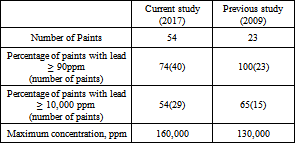


 [5])
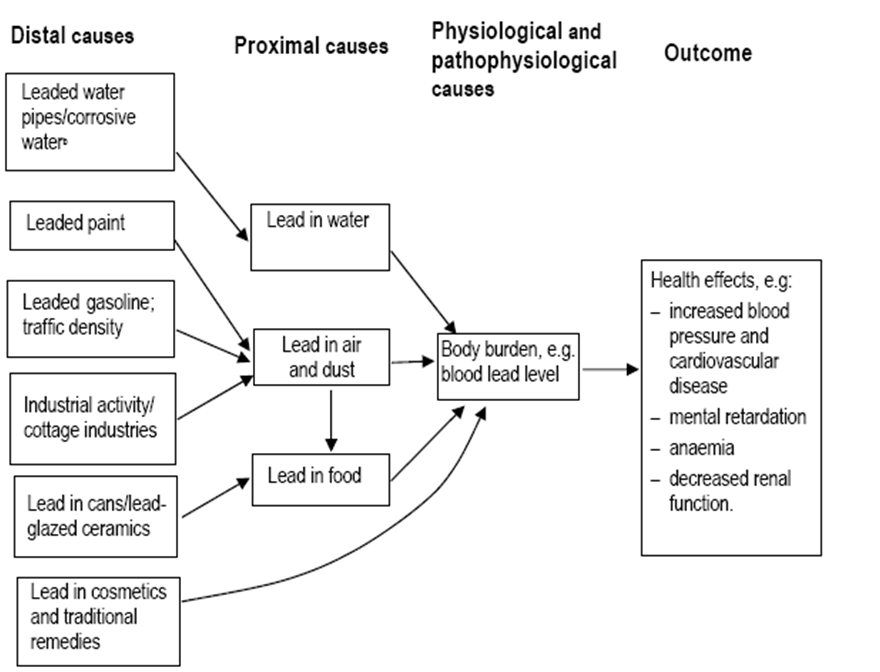

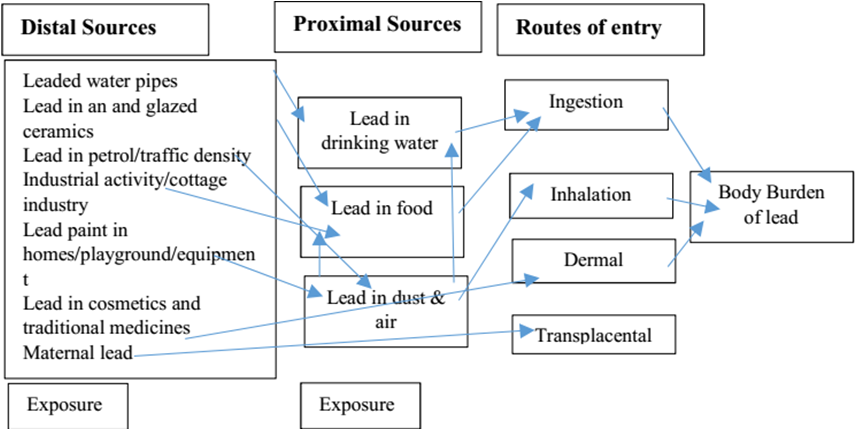
/IPEN study [20])
 5)