Polychlorinated biphenyls (PCBs) are synthetic organic compounds in which 2-10 chlorine atoms are attached to the biphenyl. They were industrially produced as complex mixtures by the direct chlorination of biphenyls using anhydrous chlorine. Theoretically 209 individual PCB compounds are possible, but only about 130 congeners have been identified in commercial PCB mixtures. Although their properties vary across a class, all PCBs are insoluble in water and persistent in both the environment and within biological systems. They are highly lipophilic and therefore tend to bioaccumulate and biomagnify in tissues of living organisms. Because of their chemical and physical stability and electrical insulating properties, they have had a variety of uses in industry included widely as coolants and lubricants in transformers, capacitors, and other electrical equipments. PCBs production was banned in many courtiers, 40 years ago; however, they are still present in the environment and their entry into the environment still occurs. Human exposure to PCBs contaminants can occur by ingestion, dermal contact, and inhalation. Some of the PCBs that enter the body are metabolized and excreted within a few days; whereas others stay in human body for months and even years. Thus, they are considered potent toxicants capable of producing a wide spectrum of adverse health effects in humans such as skin diseases, enzyme induction, liver toxicity, vitamin A deficiency, endocrine effects, immune system effects, brain dopamine levels deficiency, and genotoxicity.
Persistent organic pollutants (POPs) are organic chemicals that persist in the environment, undergo bioaccumulation in organisms, and affect human health and the environment. They include number of substances such as pesticides (e.g., dichlorodiphenyltrichloroethane, DDT), industrial chemicals (e.g., polychlorinated biphenyls, PCBs), and unintentional by-products during industrial processes (e.g., dioxins and furans) 1.
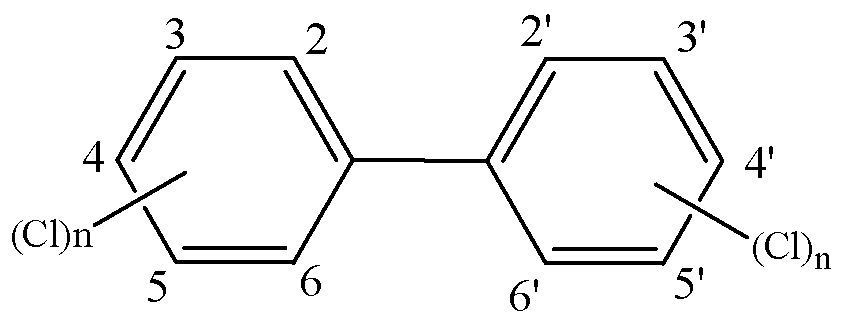
A phenyl is a univalent radical with chemical formula of C6H5 and the symbol Ph. Biphenyls are comprised of two benzene rings contain only hydrogen and carbon atoms. In chlorinated biphenyls, some chlorine atoms replace the hydrogens 2. Polychlorinated biphenyls (PCBs) are synthetic organic compounds with 2-10 chlorine atoms are attached to the biphenyl. The general chemical structure of PCBs is shown below in Figure 1 3 and chemical formula is C12H(10-n)Cln, where n is the number of chlorine atoms. Depending on different number of chlorine atoms and positions, theoretically 209 individual PCB compounds (congeners) are possible 4.

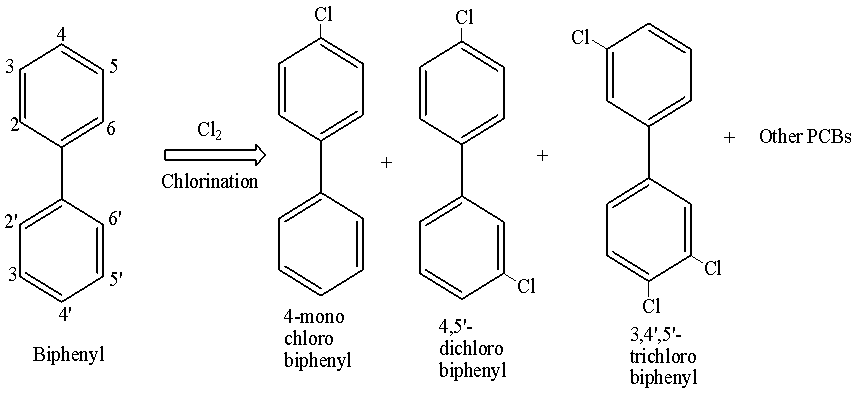
PCBs were originally synthesized in 1881 by the German chemists (Schmidt and Schulz); however, commercially they were produced in 1929 in the USA. Industrially, PCBs were made as mixtures of multiple congeners and manufactured by the direct chlorination of biphenyls using anhydrous chlorine, as indicated in Figure 2 5. Although theoretically 209 individual PCB compounds are possible, only about 130 congeners have been identified in commercial PCB mixtures at concentrations ≥0.05% 6. Commercial mixtures of multiple congeners sold in different countries under different trade names including Aroclor in the USA, Clophens in Germany, Phenoclors in France, Fenclors in Italy, Kanechlors in Japan, Sovol in Russia, Chlorofen in Poland, Fenochlors in Spain, and Delor in Czechoslovakia 7.
1.3. Physical and Chemical PropertiesDepending on the degree and position of chlorination, PCB congeners have different chemical and physical properties 9. Generally, pure single PCB congeners are slightly yellowish, colorless, and crystalline under normal conditions 4. However, manufacturers adjust mixtures of number of congeners to impart specific bulk properties to compounds. The congeners having the least chlorine atoms are oily liquids 10. While degree of chlorination increases, viscosity of PCBs also increases (i.e., light yellow oily liquids and then waxy solids) 11. Even at low temperatures, PCBs do not crystallize but turn into solid resins 4. They have high boiling points 10 and no known taste or odor 11. All PCBs are almost insoluble in water, and their solubility decreases with increasing chlorine content 12, 13, and they have a moderate to low volatility 12. Congeners with lower chlorine content are more volatile than those with higher 13. Many of them are very persistent in both the environment and within biological systems 14. Since all congeners of PCBs are lipophilic, they undergo bioaccumulation in living organisms 9. PCBs are very resistant to decomposition into corrosive compounds 10. Thus, they resist acids, alkalis, and oxidants 4. They have high thermal conductivity but low electrical transmission ability 13. Due to their high flash points (170-380°C), PCBs are practically fire resistant (non-flammable). However, at high temperatures they undergo combustion and may produce more hazardous than original materials including hydrogen chloride, polychlorinated dibenzodioxins (PCDDs), and polychlorinated dibenzofurans (PCDFs) 3.
1.4. UsePCBs can be used in both closed and open systems 15. Due to their low electrical conductivity with high thermal conductivity and thermal resistance, PCBs have been used as cooling liquids in electrical equipment such as transformers, capacitors 4, and high-capacity electric transmission cables 10. PCBs have also been used as hydraulic oils, in heat-exchange systems, and in vacuum pumps 4. Besides, because of their chemical stability, they were valuable for many industrial uses such as additives to paints, surface coatings, and varnishes; and as surface coatings for carbonless copy paper, plasticizer in plastics, and electrical cable insulation 14, and fire retardants 16.
1.5. Occurrence and Environmental ExposureThe production of PCBs was severely restricted or banned in many countries due to their possible human health and environmental impacts; for instance, Sweden in 1972, the USA in 1977, Norway in 1980, Finland in 1985, and Denmark in 1986 17. However, at least half of the PCBs produced, before the countries banned the production, are still in use, especially in older electrical equipments such as transformers and capacitors, or in storage 18. The transformers and capacitors might be found in old industrial equipments (e.g., welding material), medical machines, and household appliances such as refrigerators and televisions 19.
Before the production was banned, PCBs were entered the environment (soil, water, air) during the manufacture and use 3, 20, from accidental leaks and spills during the transport of the chemicals, or from leaks or fires in products containing PCBs. Today, PCBs can still be released into the environment from a variety of sources 3, including leaks from electrical transformers and capacitors that contain PCB oils, illegal or improper dumping (disposal) of PCB wastes such as old transformer and capacitor fluids 20, and by the open burning or incomplete incineration of waste and poorly maintained hazardous waste sites that contain PCBs 3. Improper disposal has been a major source of PCBs environmental contamination 21.

Once PCBs are released into the environment, they take several decades to decompose. Since they are hydrophobic and thus do not dissolve in water but instead adsorb to sediment 22. The partitioning of PCBs to sediments plays a role in the tendency of these compounds to become concentrated in aquatic organisms 19. For instance, PCBs are taken up into the bodies of small organisms living in or around sediment and bottom-feeding fish ingest in water 3. The resistance of these compounds to biodegradation causes concentrates the PCBs in their tissue 19. This is the process termed bioaccumulation 23. As a result of the bioconcentration, PCBs levels in aquatic organisms can be up to 1 million times higher than their concentration in the aquatic environment 19.
Small aquatic organisms are also taken up by other animals that eat these aquatic animals as food 3. PCBs accumulate in the fatty tissue of organisms low in a food chain are “magnified” when consumed by the animals in the higher level of the chain. This process is termed biomagnification 23. PCBs especially accumulate in fish and marine mammals such as seals and whales 3. Often the final consumers and concentrators of PCBs are humans 22. The biomagnification also occurs in several species of fish-consuming birds 17.
PCBs can enter human bodies in three ways: ingestion if there is contamination of food or drink, absorption through the skin, and inhalation of PCB vapors 3.
Food ingestion is the major route of PCB exposure, in general 4. The major dietary source of PCBs is fish in particular oily fish, such as salmon, herring, sardines, fresh tuna, anchovies, and swordfish, from contaminated water bodies. Plants absorb small amounts of PCBs from contaminated soil; so grazing animals’ meat and dairy products also play a greater role for exposure to higher chlorinated PCBs 3. Dust contaminated with lower chlorinated congeners may be found on the outer surfaces of fruits and vegetables 24. In addition, children can be exposed to PCBs in two ways: prenatally and breast milk. Mothers’ body can store PCBs, and during pregnancy they can be released cross the placenta and enter fetal tissues. Human breast milk can also accumulate a large amount of PCBs due to its high fat content, and then transfer PCBs to children through breastfeeding 3.
Due their highly lipophilic nature, PCBs can be absorbed through the skin contact with contaminated equipment, water, or soil 19. People living near waste sites, processing or storage facilities and work with or around PCBs are highly exposed to PCBs through skin contact 3. PCBs also enter human bodies during repair or maintenance of items containing PCBs and during fires, accidents, spills, or disposal 25. Swimming in contaminated water and accidentally swallowing the water during swimming are another ways that adults and children can be exposed to PCBs 3.
Overheated equipments that contain PCBs release significant quantities of these compounds 19. At room temperature, especially in a summer, low-chlorinated PCBs can be volatilized and found far even away from their original points of release 3. Thus, PCBs also enter bodies of people who living near waste sites or processing or storage facilities, and work with or around PCBs by inhaling PCB vapors.
2.2. Distribution of PCBs in Human BodyThe distribution of PCBs in human body is dependent on the chlorine content and position of chlorination of the individual congeners. Low-chlorinated PCBs are rapidly distributed to the tissues, whereas high-chlorinated are very slowly. Overall, PCBs are initially distributed into highly perfused tissues such as liver muscle, kidney, and brain; and then redistributed to other tissues with high lipid and fat content 4. PCBs, especially the highly chlorinated, tend to accumulate in lipid-rich tissues such as liver, adipose tissue, brain, skin 17, and breast milk 3.
2.3. Metabolism and ExcretionThe metabolism of PCB congeners first occurs in the liver by microsomal cytochromes P-450 enzymes to produce phenolic compounds, which can be further oxidised to dihydroxy metabolites. In addition, the sulphur-containing metabolites (e.g. methyl sulphones) and partially dechlorinated metabolites have been identified 3. The rate of PCBs metabolism depends on the number of chlorine atoms in the molecule 19. In general, PCB congeners with fewer number of chlorine atoms are quickly metabolized whereas those congeners with higher chlorine content (4–10 chlorines) exhibit resistance to metabolism 4. Consequently, highly chlorinated congeners tend to remain in the body longer than do less-chlorinated congeners 19. The position of the chlorine atoms on the biphenyls is also affect the rate of metabolism 3. The hydroxylated metabolites are major products that produced during hydroxylation which occurs primarily at unsubstituted para or meta positions 13, 26. PCBs with non-chlorinated meta/para-positions and chlorinated neighbouring ortho/meta-positions undergo faster metabolism. Besides, the pattern and levels of CYP isoenzymes and other enzymes in the target tissue also affect the metabolism 4.
The excretion of PCBs depends on the metabolism to more polar compounds 27. Overall, higher chlorinated PCBs (e.g., penta- and hexachlorobiphenyls) are excreted in faeces whereas those lower chlorinated in urine. The women who contaminated with PCBs also eliminates from their bodies during breastfeeding 4. However, due to their high lipophilicity or reversible binding to fats and lipids in human body, most PCB metabolites are retained for a long time in the body parts such as lung, liver, and kidney tissue 3.
2.4. Toxicological EffectsIn acute exposure to PCBs may cause an acne-like rash called chloracne 24 which arises as a result of inflammatory responses to irritants in the sebaceous glands. The chloracne toxicity can result from both dermal contact and ingestion of PCBs. The disease typically develops within weeks or months after exposure; however, its absence does not rule out exposure. The lesions are often resistant to treatment and can last for years to decades 19.
Receptors are small masses, often made of protein, which exist within the cells in human bodies that bind to molecules, forming a unit like a key in a lock. The Ah or aryl hydrocarbon receptor is one of probably thousands of the receptors. The function of the Ah receptor is to bind to many naturally occurring contaminants (e.g. organochlorine compounds) and break down them by the 'family' of enzymes known as cytochrome P-450. The Ah receptor thus plays an important part in detoxifying dioxins like PCBs. When PCBs are bound firmly to the Ah receptor, the receptor-dioxin complex moves to the DNA and stimulate the P-450 enzymes. The resulting enzymatic activity includes attempts to break down the DNA-attached dioxin. If the dioxin is not successfully broken down, the receptor strongly bound to the DNA and the P-450 enzymes production continue which results enzyme induction 28.
When PCBs present in the liver, they induce to varying a variety of degrees of liver phase I and phase II xenobiotic metabolizing enzymes. The enzyme induction may be viewed as an adaptive, protective mechanism; however, increased detoxication may result in enhanced toxicity, due to an increased formation of reactive metabolites 27. Enzyme induction (especially for dioxin- like PCBs) leads to proliferation of the endoplasmic reticulum in the liver, resulting in increase in liver size and alteration in liver function 4.
Vitamin A deficiency is another toxic symptom of PCB-exposure 27. The liver, which is the site of approximately 90% of the vitamin A in the body, has a major role in vitamin A metabolism 3. Surplus vitamin A accumulates in the liver from where it is released into the bloodstream in carefully regulated doses. Before it can be stored in the liver, this substance has to be converted into an ester, which is done with the help of an esterifying enzyme. However, the action of this enzyme inhibited and hence the storage of vitamin A and in this way even a very moderate intake of such compounds can result in falling levels of the vitamin in the liver 27.
PCBs cause alteration of several hormonal systems including thyroid and sex steroids. The effects of the endocrine disrupt depend probably on changes induced in the production or metabolism of endogenous hormones and the direct interaction with the hormonal receptors 4. Thyroid hormone deficiency is partially or predominantly mediated by alterations in hormonal binding to the thyroid hormone receptor. Due their essentiality for normal behavioral, intellectual, and neurologic development; deficiency of thyroid hormones cause deficits in learning, memory, and attentional processes 19.
PCBs can also affect the developing immune system. The immunotoxicity is dependent upon the expression of the Ah-receptor and on the ability of the PCB congener to bind to the receptor 27. A decrease in production of antibodies, an increase susceptibility to disease, and decreases in monocyte and granulocyte counts are some of PBCs effects on the immune system 19.
PCBs can also affect the levels and function of different transmitter substances in the central nervous system and cause decreasing dopamine concentrations in the brain 27. The dopamine is a neurotransmitter released by the brain to send signals to other nerve cells. The effect on dopamine levels in the brain has been postulated to involve decreased dopamine synthesis via direct or indirect PCB inhibition of tyrosine hydroxylase or L-aromatic amino acid decarboxylase and/or decreased uptake of dopamine into vesicles 3.
Dioxin-like PCBs cause indirectly genotoxic effects by increasing the formation of reactive oxygen species (ROS). The indirect genotoxicity may be via an Ah receptor dependent induction of the CYP1 family (e.g. CYP1A1), which leads to an induction of oxidative stress (i.e. increased ROS formation and oxidative DNA damage). Besides, lower chlorinated PCBs are metabolically converted to electrophilic species which bind to DNA and can cause genotoxicity 4.
PCBs were industrially manufactured as mixtures of multiple congeners. Although their production was banned 40 years ago in many courtiers, due to their possible effects on human health and the environment, PCBs are still present in the environment and their entry into the environment still occurs through improper disposal practices or leaks in electrical equipment such as transformers and capacitors manufactured before the production was banned. In general, PCBs are insoluble in water and persistent in both the environment and within biological systems. Human exposure to PCBs contaminants can occur by ingestion, dermal contact, and inhalation. Some of the PCBs that enter the body are metabolized and excreted within a few days; whereas others stay in human body for months and even years. Due their highly lipophilic nature, PCBs tend to bioaccumulate and biomagnify in tissues of living organisms such as human beings. Thus, they are considered potent toxicants capable of producing a wide spectrum of adverse health effects in humans such as skin diseases, enzyme induction, liver toxicity, vitamin A deficiency, endocrine effects, immune system effects, brain dopamine levels deficiency, and genotoxicity.
The authors declare that they have no competing interests.
| [1] | El Morabet R. (2018). Effects of outdoor air pollution on human health. Reference Module in Earth Systems and Environmental Sciences. Elsevier. | ||
| In article | View Article | ||
| [2] | EPA. (2013). America's Children and the Environment, 3rd ed., U.S. Environmental Protection Agency, Washington, D.C., pp 151-157. | ||
| In article | |||
| [3] | Agency for Toxic Substances and Disease Registry (ATSDR). (2000). Toxicological profile for Polychlorinated Biphenyls (PCBs). Atlanta, GA: U.S. Department of Health and Human Services, Public Health Service. | ||
| In article | |||
| [4] | Lindell B. (2012 ). 46(1) Polychlorinated biphenyls (PCBs). Document for Health Risks from Chemicals, Stockholm, Sweden. Available at: https://gupea.ub.gu.se/bitstream/2077/28926/1/gupea_2077_28926_1.pdf. | ||
| In article | |||
| [5] | Robinson G.K., Lenn M.J. (1994). The Bioremediation of Polychlorinated Biphenyls (PCBs): Problems and Perspectives. Biotechnol Genet Eng Rev, 12:139-188. | ||
| In article | View Article PubMed | ||
| [6] | Giesy J.P., Kannan K. (1998). Dioxin-Like and Non-Dioxin-Like Toxic Effects of Polychlorinated Biphenyls (PCBs): Implications for Risk Assessment. Crit Rev Toxicol, 28(6):511-569. | ||
| In article | View Article PubMed | ||
| [7] | Stemm D.N. (2005). "Interactions between Selenium and Polychlorinated Biphenyls (PCBs)". University of Kentucky Doctoral Dissertations. 472, USA. Available at: https://uknowledge.uky.edu/gradschool_diss/472. | ||
| In article | |||
| [8] | Aerobic Biodegradation of Polychlorinated Biphenyls. http://www.scribd.com/doc/61735291/Aerobic-Bio-Degradation-of-Polychlorinated-Biphenyls. [Accessed June 26, 2012]. | ||
| In article | |||
| [9] | EPA. (2011). Fact Sheet about the Polychlorinated Biphenyl (PCB) Total Maximum Daily Load (TMDL) Handbook, United States Environmental Protection Agency, USA. Available at: https://www.epa.gov/sites/production/files/2015-10/documents/pcb-tmdl-handbook-fact-sheet.pdf. | ||
| In article | |||
| [10] | Polychlorinated Biphenyls in Vessels. http://www.rand.org/content/dam/rand/pubs/monograph_reports/MR1377/MR1377.appc.pdf. [Accessed Dec. 5, 2017]. | ||
| In article | |||
| [11] | Polychlorinated Biphenyls (PCBs). (2005). Vol. 5, No. 1. http://www.craworld.com/en/newsevents/resources/ITGTechnologiesforPCBs_Feb05.pdf. [Accessed Dec. 10, 2012]. | ||
| In article | |||
| [12] | Generic Remedies for Soils Contaminated With Polychlorinated Biphenyls (PCBs). http://www.deq.state.or.us/lq/pubs/docs/cu/GenericRemediesSoilsContPCBs.pdf. [Accessed June 26, 2012]. | ||
| In article | |||
| [13] | Chapter 5.10. Polychlorinated biphenyls. http://www.euro.who.int/data/assets/pdf_file/0016/123064/AQG2ndEd_5_10PCBs.PDF. [Accessed Dec. 10, 2017]. | ||
| In article | |||
| [14] | Fischbein A., Rizzo J.N., Solomon S.J., Wolff M.S. (1985). Oculodermatological findings in workers with occupational to polychlorinated biphenyls (PCBs). Br J Ind Med, 42:426-430. | ||
| In article | View Article PubMed PubMed | ||
| [15] | United Nations Environment Programme (UNEP). (1998). Chemicals in co-operation with the Secretariat of the Basel Convention (SBC) Inventory of World-wide PCB Destruction Capacity, First Issue. http://www.chem.unep.ch/pops/pdf/pcbrpt.pdf. [Accessed Dec. 10, 2012]. | ||
| In article | |||
| [16] | Wilkie C.A., Morgan A.B. (2009). Fire Retardancy of Polymeric Materials, 2nd ed., CRC Press, pp 92. | ||
| In article | View Article | ||
| [17] | Faroon O.M., Keith L.S. (2003). Polychlorinated biphenyls: Human health aspects. Concise Int Chem Assess Doc 55, Atlanta, Georgia, USA. | ||
| In article | |||
| [18] | Rios L.M., Moore C., Jone P.R. (2007). Persistent organic pollutants carried by synthetic polymers in the ocean environment. Marine Pollution Bulletin, 54:1230-1237. | ||
| In article | View Article PubMed | ||
| [19] | Agency for Toxic Substances and Disease Registry (ATSDR). (1990). Polychlorinated Biphenyls (PCBs) Toxicity. Case Studies in Environmental Medicine, USA. Available at: https://www.atsdr.cdc.gov/csem/pcb/docs/pcb.pdf. | ||
| In article | |||
| [20] | O’Garro L. (2011). King County Alder Tower Polychlorinated Biphenyls (PCBs) Caulking Contamination: Letter Health Consultation, Washington State Department of Health, USA. Available at: https://www.doh.wa.gov/Portals/1/Documents/Pubs/334-274.pdf. | ||
| In article | |||
| [21] | Park H.Y., Hertz-Picciotto I., Sovcikova E., Kocan A., Drobna B., Trnovec T. (2010). Neurodevelopmental toxicity of prenatal polychlorinated biphenyls (PCBs) by chemical structure and activity: a birth cohort study. Environ Health, 9:51. | ||
| In article | View Article PubMed PubMed | ||
| [22] | Mahler B.J., Van Metre P.C., Miranda R.M. (2002). Occurrence of Polychlorinated Biphenyls (PCBs) on suspended sediment in the Donna Canal, Hidalgo County, Texas, 1999-2001. U. S. Geological Survey (USGS) Fact Sheet 016-02, USA. Available at: http://purl.access.gpo.gov/GPO/LPS100271. | ||
| In article | View Article PubMed | ||
| [23] | Blowes D.W., Ptacek C.J., Jambor J.L. Weisener C.G. (2003). 9.05 - The Geochemistry of Acid Mine Drainage, editor(s): Holland H.D., Turekian K.K., Treatise on Geochemistry, Pergamon, pp 149-204. | ||
| In article | View Article | ||
| [24] | Illinois Department of Public Health. (2009). Polychlorinated Biphenyls (PCBs). Environmental Heath Fact Sheet, USA. Available at: http://www.idph.state.il.us/envhealth/factsheets/polychlorinatedbiphenyls.htm. | ||
| In article | |||
| [25] | Polychlorinated Biphenyls (PCBs). Fact Sheet, USA. http://www-nehc.med.navy.mil/downloads/ep/Factsheets/pcbs.pdf. [Accessed Dec. 2, 2012]. | ||
| In article | |||
| [26] | Fiedler H. (2009). 12. Polychlorinated Biphenyls (PCBs): Uses and Environmental Releases. http://www.enrx.net/case-studies/download/pcbs-unep-pops.pdf. [Accessed June 26, 2012]. | ||
| In article | |||
| [27] | Ahlborg U.G, Hanberg A. Kenne K. (1992). Risk Assessment of Polychlorinated Biphenyls (PCBs). Document for Risk Assessment, Institute of Environmental Medicine, Stockholm, Sweden. Available at: https://books.google.com.et/books?id=ST1Hw92u2KUC. | ||
| In article | |||
| [28] | Health Effects of Dioxins. http://www.gascape.org/index%20/Health%20effects%20of%20Dioxins.html. [Accessed June 26, 2012]. | ||
| In article | |||
Published with license by Science and Education Publishing, Copyright © 2019 Mesfin Medihin Ododo and Bezabih Kelta Wabalo
 This work is licensed under a Creative Commons Attribution 4.0 International License. To view a copy of this license, visit
http://creativecommons.org/licenses/by/4.0/
This work is licensed under a Creative Commons Attribution 4.0 International License. To view a copy of this license, visit
http://creativecommons.org/licenses/by/4.0/
| [1] | El Morabet R. (2018). Effects of outdoor air pollution on human health. Reference Module in Earth Systems and Environmental Sciences. Elsevier. | ||
| In article | View Article | ||
| [2] | EPA. (2013). America's Children and the Environment, 3rd ed., U.S. Environmental Protection Agency, Washington, D.C., pp 151-157. | ||
| In article | |||
| [3] | Agency for Toxic Substances and Disease Registry (ATSDR). (2000). Toxicological profile for Polychlorinated Biphenyls (PCBs). Atlanta, GA: U.S. Department of Health and Human Services, Public Health Service. | ||
| In article | |||
| [4] | Lindell B. (2012 ). 46(1) Polychlorinated biphenyls (PCBs). Document for Health Risks from Chemicals, Stockholm, Sweden. Available at: https://gupea.ub.gu.se/bitstream/2077/28926/1/gupea_2077_28926_1.pdf. | ||
| In article | |||
| [5] | Robinson G.K., Lenn M.J. (1994). The Bioremediation of Polychlorinated Biphenyls (PCBs): Problems and Perspectives. Biotechnol Genet Eng Rev, 12:139-188. | ||
| In article | View Article PubMed | ||
| [6] | Giesy J.P., Kannan K. (1998). Dioxin-Like and Non-Dioxin-Like Toxic Effects of Polychlorinated Biphenyls (PCBs): Implications for Risk Assessment. Crit Rev Toxicol, 28(6):511-569. | ||
| In article | View Article PubMed | ||
| [7] | Stemm D.N. (2005). "Interactions between Selenium and Polychlorinated Biphenyls (PCBs)". University of Kentucky Doctoral Dissertations. 472, USA. Available at: https://uknowledge.uky.edu/gradschool_diss/472. | ||
| In article | |||
| [8] | Aerobic Biodegradation of Polychlorinated Biphenyls. http://www.scribd.com/doc/61735291/Aerobic-Bio-Degradation-of-Polychlorinated-Biphenyls. [Accessed June 26, 2012]. | ||
| In article | |||
| [9] | EPA. (2011). Fact Sheet about the Polychlorinated Biphenyl (PCB) Total Maximum Daily Load (TMDL) Handbook, United States Environmental Protection Agency, USA. Available at: https://www.epa.gov/sites/production/files/2015-10/documents/pcb-tmdl-handbook-fact-sheet.pdf. | ||
| In article | |||
| [10] | Polychlorinated Biphenyls in Vessels. http://www.rand.org/content/dam/rand/pubs/monograph_reports/MR1377/MR1377.appc.pdf. [Accessed Dec. 5, 2017]. | ||
| In article | |||
| [11] | Polychlorinated Biphenyls (PCBs). (2005). Vol. 5, No. 1. http://www.craworld.com/en/newsevents/resources/ITGTechnologiesforPCBs_Feb05.pdf. [Accessed Dec. 10, 2012]. | ||
| In article | |||
| [12] | Generic Remedies for Soils Contaminated With Polychlorinated Biphenyls (PCBs). http://www.deq.state.or.us/lq/pubs/docs/cu/GenericRemediesSoilsContPCBs.pdf. [Accessed June 26, 2012]. | ||
| In article | |||
| [13] | Chapter 5.10. Polychlorinated biphenyls. http://www.euro.who.int/data/assets/pdf_file/0016/123064/AQG2ndEd_5_10PCBs.PDF. [Accessed Dec. 10, 2017]. | ||
| In article | |||
| [14] | Fischbein A., Rizzo J.N., Solomon S.J., Wolff M.S. (1985). Oculodermatological findings in workers with occupational to polychlorinated biphenyls (PCBs). Br J Ind Med, 42:426-430. | ||
| In article | View Article PubMed PubMed | ||
| [15] | United Nations Environment Programme (UNEP). (1998). Chemicals in co-operation with the Secretariat of the Basel Convention (SBC) Inventory of World-wide PCB Destruction Capacity, First Issue. http://www.chem.unep.ch/pops/pdf/pcbrpt.pdf. [Accessed Dec. 10, 2012]. | ||
| In article | |||
| [16] | Wilkie C.A., Morgan A.B. (2009). Fire Retardancy of Polymeric Materials, 2nd ed., CRC Press, pp 92. | ||
| In article | View Article | ||
| [17] | Faroon O.M., Keith L.S. (2003). Polychlorinated biphenyls: Human health aspects. Concise Int Chem Assess Doc 55, Atlanta, Georgia, USA. | ||
| In article | |||
| [18] | Rios L.M., Moore C., Jone P.R. (2007). Persistent organic pollutants carried by synthetic polymers in the ocean environment. Marine Pollution Bulletin, 54:1230-1237. | ||
| In article | View Article PubMed | ||
| [19] | Agency for Toxic Substances and Disease Registry (ATSDR). (1990). Polychlorinated Biphenyls (PCBs) Toxicity. Case Studies in Environmental Medicine, USA. Available at: https://www.atsdr.cdc.gov/csem/pcb/docs/pcb.pdf. | ||
| In article | |||
| [20] | O’Garro L. (2011). King County Alder Tower Polychlorinated Biphenyls (PCBs) Caulking Contamination: Letter Health Consultation, Washington State Department of Health, USA. Available at: https://www.doh.wa.gov/Portals/1/Documents/Pubs/334-274.pdf. | ||
| In article | |||
| [21] | Park H.Y., Hertz-Picciotto I., Sovcikova E., Kocan A., Drobna B., Trnovec T. (2010). Neurodevelopmental toxicity of prenatal polychlorinated biphenyls (PCBs) by chemical structure and activity: a birth cohort study. Environ Health, 9:51. | ||
| In article | View Article PubMed PubMed | ||
| [22] | Mahler B.J., Van Metre P.C., Miranda R.M. (2002). Occurrence of Polychlorinated Biphenyls (PCBs) on suspended sediment in the Donna Canal, Hidalgo County, Texas, 1999-2001. U. S. Geological Survey (USGS) Fact Sheet 016-02, USA. Available at: http://purl.access.gpo.gov/GPO/LPS100271. | ||
| In article | View Article PubMed | ||
| [23] | Blowes D.W., Ptacek C.J., Jambor J.L. Weisener C.G. (2003). 9.05 - The Geochemistry of Acid Mine Drainage, editor(s): Holland H.D., Turekian K.K., Treatise on Geochemistry, Pergamon, pp 149-204. | ||
| In article | View Article | ||
| [24] | Illinois Department of Public Health. (2009). Polychlorinated Biphenyls (PCBs). Environmental Heath Fact Sheet, USA. Available at: http://www.idph.state.il.us/envhealth/factsheets/polychlorinatedbiphenyls.htm. | ||
| In article | |||
| [25] | Polychlorinated Biphenyls (PCBs). Fact Sheet, USA. http://www-nehc.med.navy.mil/downloads/ep/Factsheets/pcbs.pdf. [Accessed Dec. 2, 2012]. | ||
| In article | |||
| [26] | Fiedler H. (2009). 12. Polychlorinated Biphenyls (PCBs): Uses and Environmental Releases. http://www.enrx.net/case-studies/download/pcbs-unep-pops.pdf. [Accessed June 26, 2012]. | ||
| In article | |||
| [27] | Ahlborg U.G, Hanberg A. Kenne K. (1992). Risk Assessment of Polychlorinated Biphenyls (PCBs). Document for Risk Assessment, Institute of Environmental Medicine, Stockholm, Sweden. Available at: https://books.google.com.et/books?id=ST1Hw92u2KUC. | ||
| In article | |||
| [28] | Health Effects of Dioxins. http://www.gascape.org/index%20/Health%20effects%20of%20Dioxins.html. [Accessed June 26, 2012]. | ||
| In article | |||