The accumulation of microplastics (MPs) in agricultural soils poses a growing risk to terrestrial ecosystems, yet polymer-specific phytotoxic mechanisms remain only partially resolved. This study assessed the effects of 2% and 5% concentrations of low-density polyethylene (LDPE), polyvinyl chloride (PVC), and polypropylene (PP) MPs on Zea mays and Sorghum bicolor. Microplastic exposure induced reductions in plant growth parameters and photosynthetic pigments, accompanied by enhanced oxidative stress, depending on the concentrations. Soil enzymatic activities including dehydrogenase, acid and alkaline phosphatase were also significantly modulated, indicating alterations in biochemical processes and nutrient cycling in soil. Among the three types of MPs studied, the marked phytotoxic responses were witnessed in PVC, followed by LDPE, whereas PP exhibited comparatively lower toxicity. Consistently the highest MP concentrations (5%) led to more pronounced detrimental effects on both the plants. These findings shed light on polymer-specific and concentration-dependent impacts of MP on plants and emphasize the critical need for deeper understanding and more comprehensive regulatory mechanisms that could be beneficial in improving plant tolerance and various remedial measures to reduce the effects of the MPs on the agroecosystems.
The extensive production and utilization of plastics, along with ineffective recycling practices and inappropriate disposal, have increased plastic pollution worldwide 1. Among various synthetic polymers, polyethylene (PE), polypropylene (PP), and polyvinyl chloride (PVC) have been largely utilized, approximately comprising 21, 24, and 19% of worldwide plastic production, respectively 2. Though these polymers are resistant to biodegradation, they can fragment into minor particles via physical, chemical, and biological processes, leading to the development of microplastics (MPs) measuring less than 5 mm in diameter 3. Due to their ubiquitous distribution and potential ecological risks in terrestrial ecosystems, particularly in agricultural and wetland soils, MPs have recently attracted global attention 4. In general, the agricultural soils, have become chief reservoirs of MPs as a consequence of intensive use of plastic-based materials including plastic mulch films, compost, irrigation water, sewage sludge, soil conditioners, atmospheric deposition etc. Nevertheless, inadequate recycling and inappropriate disposal of degraded and non-degraded plastic films have emerged as noteworthy contributors to MP pollution in farmland soils 5. The occurrence of MPs in soil, exert harmful effects on soil structure, physico-chemical properties, and microbial community composition 6. In particular, they alter soil physical characteristics including aggregation, aeration, and porosity, thereby altering water and nutrient movement. These changes may eventually affect soil water retention and drainage, ultimately harming normal root growth and plant development 7.
MPs adhering to root surfaces may obstruct root pores, restricting the uptake of water and nutrients which suppress root growth, inhibit overall plant development, and induce oxidative stress 8. Photosynthetic processes are also harmfully affected under MPs stress. MPs can obstruct cell walls and aquaporin channels in plant roots which reduce water uptake resulting in closure of stomata and decreased Rubisco activity as a consequence of oxidative stress. Moreover, MP-induced stress impairs RuBP carboxylation, reduces light-use efficiency, and disrupts dark respiration, and thus plant photosynthetic performance 9. The persistence of MPs in agricultural soils increase major issues regarding their potential impact on soil ecological systems and crop performance, particularly given the wide variability in their size, shape, concentration, and polymer composition 10. Regardless of these variations, MPs are broadly accepted as detrimental to plant growth and physiological functions. Recently, 11 found that exposure to polystyrene MPs (PS-MPs) at a concentration of 200 mg L⁻¹ reduced chlorophyll a (chl a), chlorophyll b (chl b), and total chlorophyll (total chl) contents in Triticum aestivum by 14.8, 19.9, and 17.2%, respectively, highlighting that MP accumulation in plant tissues can elevate reactive oxygen species (ROS) buildup and ultimately hinder plant development. In addition, MPs alter soil enzyme activities, which are crucial for nutrient cycling and plant growth 12. For instance, 13 demonstrated that the addition of MPs like PE into soil led to decrease of 14.6–31.0% in catalase, 15.4–54.8% in phenol oxidase, 39.5–61.0% in manganese peroxidase, 16.9–40.8% in urease, 16.5–57.6% in laccase, and 30.6–42.7% in β-glucosidase activities, thereby reducing plant development. The MPs regulate the activities of these soil enzymes through a range of mechanisms. First, MPs disrupt soil aggregate structure, leading to the release of previously protected organic matter that can stimulate microbial activity. Second, MPs can act as rare microbial niches due to their high sorptive potential, which enables them to accumulate microbes. Third, MPs may alter soil physicochemical conditions, modulating the functional performance of exoenzymes in the soil 14. Despite a lot of studies that have documented that MPs impair plant growth, photosynthesis, antioxidant responses, and soil enzyme activities, there is still a limited understanding of how MPs of distinct types and concentrations interact with distinct plant systems.
Therefore, the purpose of the study was to assess the effects of three types of MPs viz., low-density polyethylene (LDPE), Polyvinyl chloride (PVC), and Polypropylene (PP) at concentrations of 2% and 5% on (1) morphometric traits and photosynthetic pigment levels, (2) biochemical parameters, (3) antioxidant responses, and (4) soil enzyme activities of Zea mays and Sorghum bicolor.
A controlled pot experiment was conducted under laboratory conditions to evaluate the effects of MPs namely, LDPE, PVC, and PP, applied at concentrations of 0, 2 and 5% on plant growth, physiological response and soil enzyme activities. Soil was collected from Bharathiar University field laboratory and sterilized by autoclaving at 121 °C for 30 minutes over five consecutive days. Seeds of Z. mays and S. bicolor were disinfected by immersing in 70 % ethanol for 1 minute, treated with 5% sodium hypochlorite for 5 minutes, and subsequently washed thoroughly with deionized water. The surface-sterilized seedlings were transplanted into plastic pots containing 750 g of MP amended and non-amended soil in triplicates, with four plants per pot. The pots were incubated under a 16/8 h light/dark photoperiod and after 45 days plants were carefully uprooted, and morphometric parameters such as root length (RL), shoot length (SL), fresh weight (FW), and dry weight (DW) were measured.
2.2. Estimation of Leaf Photosynthetic Pigments and Biochemical ParametersChlorophyll and carotenoids were estimated according to the procedure of 15. In brief, a 0.3 g of fresh leaf sample was homogenized in 6 mL of 80% ice-cold acetone and centrifuged at 12,000 rpm for 20 minutes and absorbance was recorded at 440, 645, and 663 nm using a spectrophotometer. Leaf relative water content (RWC) was assessed in accordance with 16 and calculated using the below formula:
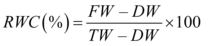 |
where FW =fresh weight, TW =turgid weight, and DW =dry weight.
Protein content was estimated according to the method of 17. Fresh leaf tissue (0.1 g) was homogenized in Tris-HCl buffer, centrifuged and 1 mL of the supernatant was mixed with a 50:1 mixture of Solution 1 (2% Na₂CO₃, 1% NaK(C₄H₄O₆), 0.4% NaOH) and Solution 2 (0.5% CuSO₄·5H₂O), incubated in the dark for 15 minutes and Folin–Ciocalteu reagent was added, incubated and absorbance was documented at 660 nm, and quantified employing bovine serum albumin (BSA) as a standard.
Proline accumulation was quantified in accordance with the procedure of 18. Leaf tissue weighing 0.1 g was blended thoroughly in 1 mL of sulfosalicylic acid (3%) and centrifuged followed by 2 mL of ninhydrin and 2 mL of glacial acetic acid addition, incubated in a boiling water bath at 90 °C for 60 minutes and 5 mL of toluene was added, incubated in dark for 15 minutes and quantified spectrophotometrically at 520 nm.
Lipid peroxidation was determined following the methodology detailed by 19. Fresh leaf tissues weighing 0.1 g was blended in trichloroacetic acid (0.1%) and centrifuged at 10,000 rpm for 10 minutes. An aliquot of 1 mL supernatant was mixed with 1.5 mL of thiobarbituric acid (0.5% w/v in 20% w/v trichloroacetic acid) and subjected to incubation in a boiling water bath and after cooling, centrifuged, and absorbance was recorded at wavelengths of 532 and 600 nm.
2.3. Estimation of Leaf Antioxidant Enzyme ActivitiesSuperoxide dismutase (SOD) activity was determined following the method of 20. A 0.1 g portion of fresh leaf tissue underwent homogenization in phosphate buffer (pH 7.8), centrifuged and 1 mL of the resulting supernatant was combined with 0.2 mL of 200 mM methionine, 1.125 mM nitro blue tetrazolium (NBT), 1.5 mM EDTA, 50 mM buffer and 0.2 mL of 75 μM riboflavin. The reaction mixture underwent exposure to fluorescent light for 10 minutes, and absorbance was recorded at 560 nm.
Peroxidase (POD) activity was measured following 21. Fresh leaf tissue (0.1 g) was homogenized in 1 mL of phosphoric acid and the reaction mixture consisted of 2.9 mL of 0.05 mol L⁻¹ phosphoric acid buffer, 1.0 mL of 2% H₂O₂, and 1.0 mL of 0.05 mol L⁻¹ guaiacol. Absorbance at 470 nm was recorded at one-minute intervals for four minutes.
Catalase (CAT) activity was measured following the procedure of 22. Leaf tissue (0.1 g) was ground in 1 mL of 50 mM sodium phosphate buffer (pH 7.8) and subsequently centrifuged for 10 minutes. The reaction mixture contained 0.89 mL of phosphate buffer and 10 μL of 3% H₂O₂. Absorbance decrease was measured at 240 nm for 3 minutes.
2.4. Estimation of Soil Enzyme ActivitiesSoil dehydrogenase activity was examined following 23 with minor modifications. Soil samples weighing 0.5 g were incubated with 500 μL of 1% triphenyl tetrazolium chloride (TTC) for 24 hours. After incubation, 500 μL of methanol was added, and the mixture underwent centrifugation for 10 minutes after which absorbance was analysed at 485 nm, and expressed as μmol TPF g⁻¹ h⁻¹.
Acid and alkaline phosphatase activities were determined as described by 24. Soil samples weighing 0.5 g were treated with 25 μL of toluene, 400 μL of universal buffer (pH 6.4 and 11, and 100 μL of p-nitrophenyl phosphate). The mixture was incubated at 37 °C for 1 hour, and added with 100 μL of 0.5 M CaCl₂ and 400 μL of 0.5 M NaOH. Measurement of absorbance was performed at 400 nm, and the activity was quantified as μg p-nitrophenol (pNP) g⁻¹ h⁻¹.
2.5. Statistical AnalysisAll experiments were performed in triplicate (n = 3), and results were expressed as mean ± standard deviation. Statistical analysis was carried out using analysis of variance (ANOVA) in SPSS software (version 25.0). Differences among treatment means were evaluated using Tukey’s honestly significant difference (HSD) post hoc test at a significance level of p < 0.05.
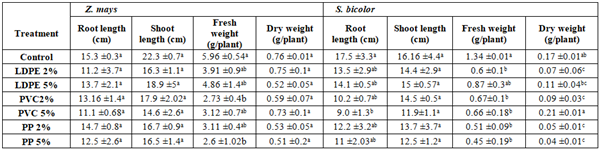
Plant morphometric and physiological parameters serve as indicators of overall plant health. In the present study, RL, SL, FW, and DW were evaluated and they showed a significant reduction in both Z. mays and S. bicolor under MP treatments compared to the control (Table 1). In Z. mays, the greatest decline in RL and SL was observed under the PVC 5% treatment, with reductions of 27 and 34%, respectively. In contrast, FW and DW exhibited maximum reductions of 56 and 33%, respectively, under the PP 5% treatment. A similar trend was noticed in S. bicolor, where RL and SL decreased by 48 and 25%, respectively, under PVC 5%, while FW and DW showed pronounced reductions of 66 and 77%, respectively, under PP 5% treatment relative to the control. These results were consistent with the observations of 25 highlighting that increasing MPs concentrations intensify their inhibitory effects on plant growth. The observed decline in growth parameters may be attributed to the MP induced physical stress (eg, impeding pore function and changing soil structure), root lignification, root cell apoptosis, and oxidative stress, chlorophyll degradation etc 26, 27.
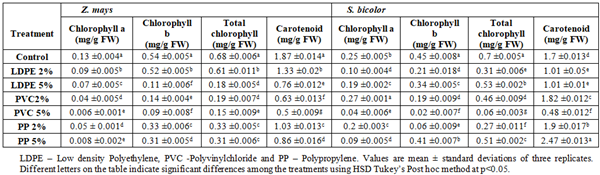
In our study, the photosynthetic pigment content was also markedly affected by MPs exposure (Table 2). In Z. mays, the PVC 5% treatment resulted in reductions of chl a, chll b, total chl, and carotenoid contents by 95, 82, 77, and 157%, respectively. Similarly, in S. bicolor, the same treatment resulted decreases of 84, 95, 91, and 71%, respectively, comparing the control. In general, the build-up of MPs within plant tissues is known to impair photosynthetic performance by reducing chlorophyll content, disrupting leaf gas exchange, and diminishing Rubisco activity 28. Consistent with the present results, 29 and 11 found substantial reductions in photosynthetic pigments, indicating disruption of photosynthetic machinery under microplastic stress. Similarly, 30 noticed a 28.2% decrease in carotenoid content in cherry radish following PVC exposure, whereas pigment levels remained relatively unchanged under PA- and PP-MP treatments. Moreover, MPs have been shown to disrupt the molecular integrity of thylakoid membranes and reduce the efficiency of the electron transport chain (ETC) by inhibiting electron transfer within chloroplasts, thereby suppressing photosynthesis 31. Overall, these findings strongly suggest that microplastic exposure leads to a decline in intact photosynthetic pigment levels and thus reduce overall plant growth 32.
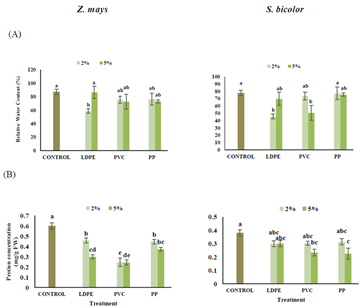
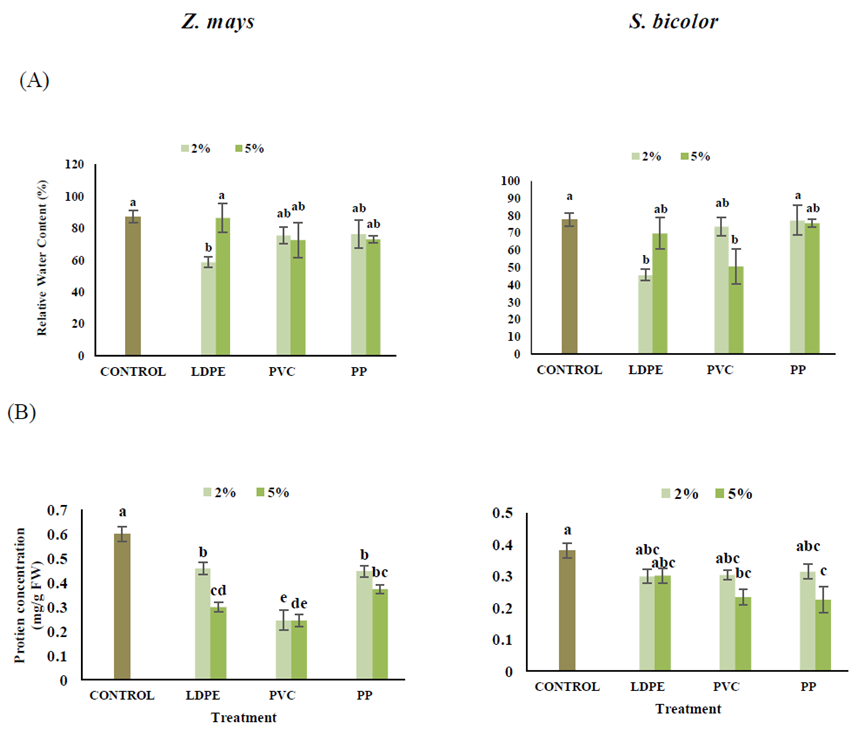
Leaf relative water content (RWC) serves as an important indicator of plant water status, representing the equilibrium between water absorbed by leaf tissues and water lost through transpiration 33. It is widely regarded as a reliable parameter for assessing plant stress responses. In the present study, RWC decreased significantly in both Z. mays and S. bicolor under microplastic treatments (Figure 1A). The maximum reduction in RWC was observed under the LDPE 2% treatment, with decreases of 32% in Z. mays and 40% in S. bicolor. This was followed by the PVC 5% treatment, which resulted in RWC reductions of 16 and 34% in Z. mays and S. bicolor, respectively, compared to the control. These results are consistent with 34, where a 3.6–11% reduction in RWC was observed in sweet potato plants exposed to PVC MPs. Certain plant species are particularly sensitive to stress and exhibit a reduced ability to maintain cellular water balance, thereby impairing osmotic adjustment under adverse conditions.
Protein content also declined markedly in response to microplastic exposure (Figure 1B). In Z. mays, the highest reduction in protein content (65%) was recorded under the 2% PVC treatment, whereas in S. bicolor, a maximum decrease of 39% was observed under the 5% PVC treatment relative to the control, indicating a greater reduction in protein levels at higher microplastic concentrations. In contrast, the lowest reductions were recorded under LDPE 2% in Z. mays (23%) and PP 2% in S. bicolor (18.3%), further supporting the concentration-dependent effects of MPs. These results are in line with 35, where a significant decrease in soluble protein content in Utricularia vulgaris was noticed, which was attributed to enhanced protein degradation or increased activity of catabolic enzymes under microplastic-induced stress.
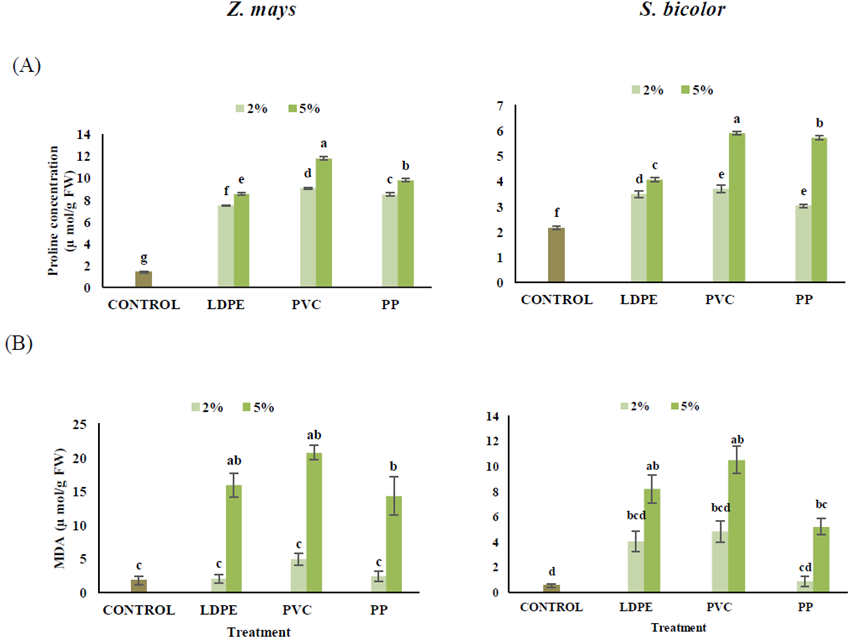
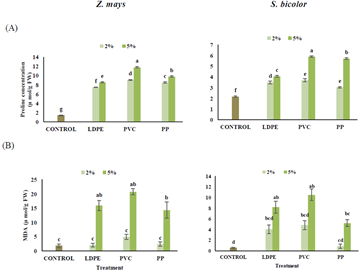
Proline content exhibited a pronounced increase in both plant species, with maximum elevations of 748 and 173% observed in Z. mays and S. bicolor respectively, under the 5% PVC treatment (Figure 2A). Similarly, 34 documented increases in proline content ranging from 42 to 102% in sweet potato plants exposed to PVC MPs. The enhanced accumulation of proline is commonly associated with reductions in RWC, as dehydration and osmotic stress stimulate proline biosynthesis to protect cellular structures and maintain osmotic balance 36. This trend aligns with the present findings, where significant reductions in RWC were observed in both Z. mays and S. bicolor under PVC exposure. In support, 37 demonstrated that Lepidium sativum plants treated with PVC MPs exhibited the highest proline accumulation, highlighting its protective role.
Malondialdehyde (MDA), a widely used biomarker of lipid peroxidation and oxidative stress, displayed similar trends in both Z. mays and S. bicolor (Figure 2B). Higher microplastic concentrations (5%) resulted in a substantial increase in MDA content, whereas lower concentrations (2%) induced comparatively smaller but still significant increases relative to the control. In Z. mays, the lowest increase in MDA was observed under LDPE 2% (15.25%), while in S. bicolor, PP 2% resulted in the least increase (62%). Consistent with these findings, 38 reported increases in MDA levels of 50, 27, and 54% in lettuce and 74%, 63%, and 57% in wheat under low, medium, and high microplastic concentrations, respectively. Furthermore, 39 confirmed that polystyrene (PS) and polylactic acid (PLA) MPs at a concentration of 10.0 mg L⁻¹ increased MDA levels by 38.47 and 53.42%, respectively, in Acorus calamus L. These observations suggest that the accumulation of PS and PLA-MPs in plant tissues enhances reactive oxygen species (ROS) production, disrupts cellular redox homeostasis, and ultimately affecting plant growth.
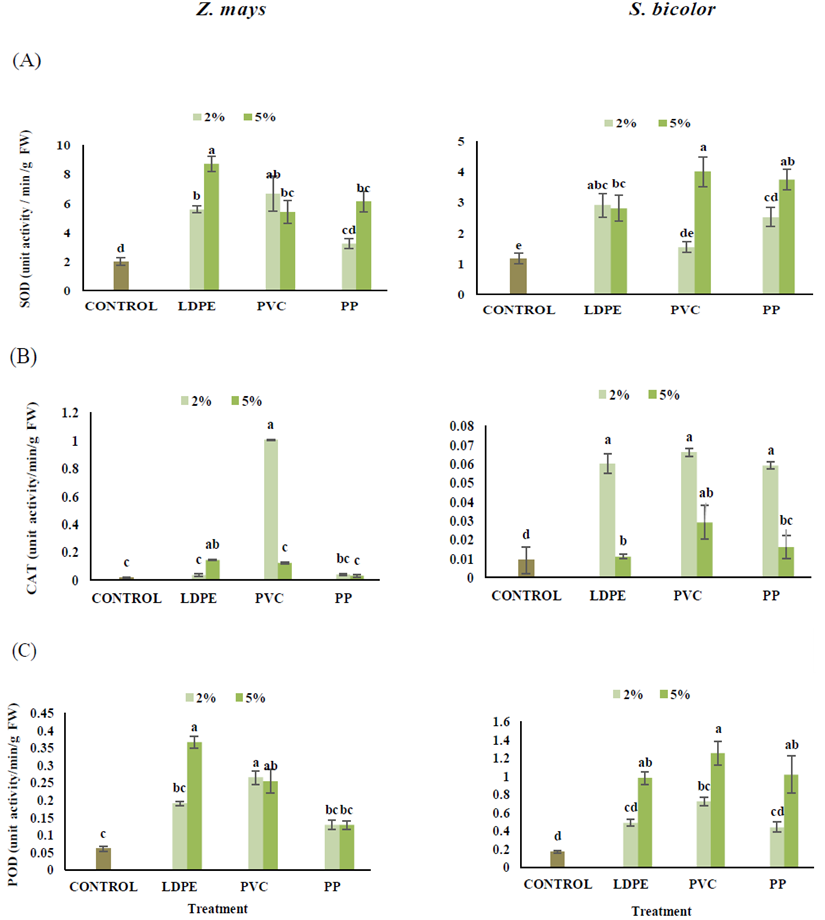
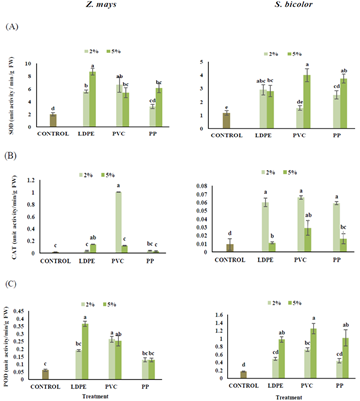
Plants possess an intrinsic defense system to mitigate microplastic-induced oxidative stress through the synthesis of enzymatic antioxidants such as SOD, CAT, and POD. SOD catalyzes the dismutation of superoxide radicals (O₂⁻) into molecular oxygen and hydrogen peroxide (H₂O₂). CAT breaks down H₂O₂ into water and oxygen, whereas POD facilitates the elimination of H₂O₂ and other organic peroxides. These enzymes play a vital role in scavenging ROS and safeguarding plant cells from oxidative damage 40. Under stress conditions, this redox balance is often disrupted, leading to increased accumulation of ROS like O₂⁻ and H₂O₂. Elevated levels of these ROS activate stress signaling pathways and defense mechanisms, thereby enhancing plant tolerance to adverse environmental conditions. Since O₂⁻ and H₂O₂ are key indicators of oxidative stress intensity, their concentrations reflect the degree of ROS-mediated damage within plant tissues 41. Previous studies have consistently reported enhanced antioxidant enzyme activities in response to increasing microplastic concentrations. 42, and 43 noticed a significant development in SOD, CAT, and POD activities following exposure to various types of MPs. In agreement with these reports, the present study revealed a pronounced elevation in SOD, POD, and CAT activities across all microplastic treatments in both Z. mays and S. bicolor. The highest enzyme activities were recorded in plants exposed to 5% concentrations of LDPE, PVC, and PP MPs (Figure 3A, Figure 3B and Figure 3C). The observed enhancement of antioxidant enzyme activities indicates that microplastic accumulation within plant tissues markedly elevates ROS production, thereby disrupting cellular redox homeostasis.
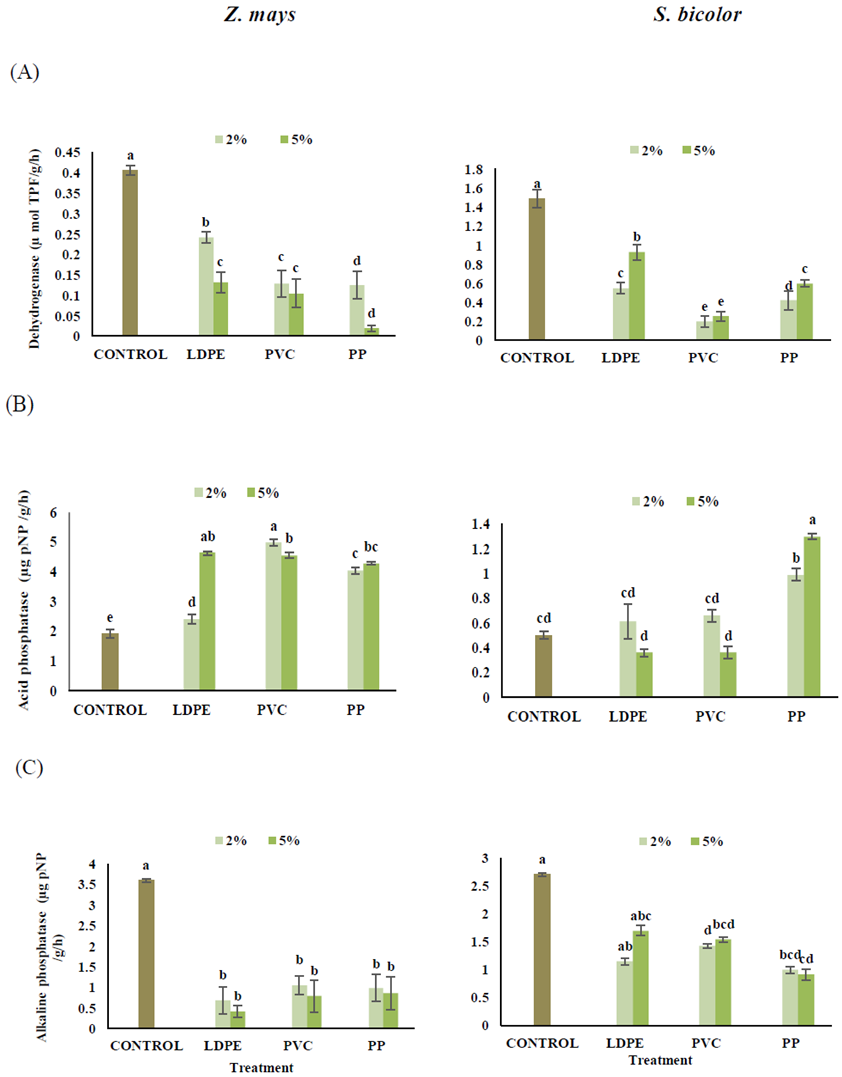
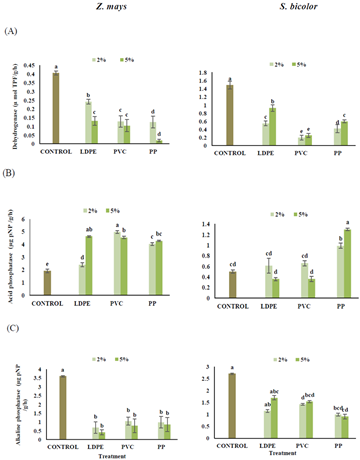
Soil enzymes function as biological catalysts and play a vital role in nutrient cycling and soil fertility by regulating the decomposition of organic matter and supporting plant growth 12. Within this group of enzymes, dehydrogenase is considered as a reliable marker of overall soil microbial activity as it is an intracellular enzyme found in living microbial cells and is highly sensitive to environmental stressors 44. In the present study, soil dehydrogenase activity was greatly influenced by microplastic exposure. The maximum reduction in dehydrogenase activity was observed under the PVC 5% treatment in Z. mays (74%) and under the PVC 2% treatment in S. bicolor (82%) relative to the control (Figure 4A). These findings align with 45, who found that the addition of 0.5% polystyrene MPs (PS-MPs) and polytetrafluoroethylene (PTFE) of size 0.1–1 µm reduced dehydrogenase activity by 20.6 and 18.7%, respectively. MPs can influence soil enzyme activity through various mechanisms, including binding to functional groups such as sulfhydryl, carboxyl, and imidazole moieties, or by displacing metal ions essential for enzyme stability and catalytic function. Such interactions may result in complex and often inhibitory effects on enzyme performance under stress conditions 46.
Acid phosphatase activity exhibited a contrasting response, showing a significant increase under microplastic treatments. The highest acid phosphatase activity was recorded under PVC 2% in Z. mays (160 %) and PP 5% in S. bicolor (160%) (Figure 4B). These observations are in line with the study of 47, where a 36% increase in acid phosphatase activity was recorded subsequent to the addition of high-density polyethylene (HDPE) MPs compared to the control. In contrast, alkaline phosphatase activity declined under MPs exposure, with the maximum reduction observed under PP 2% in Z. mays (72.5%) and LDPE 5% in S. bicolor (37%) (Figure 4C). Similarly, 48 reported a 20.8% decrease in alkaline phosphatase activity in soils contaminated with polyethylene, attributing this decline to disruptions in the soil phosphorus cycle induced by MPs. Overall, these findings demonstrate that MPs can significantly disrupt soil enzyme activities that are critical for maintaining soil health and nutrient availability. Alterations in these enzyme activities under MPs stress may have long-term implications on soil functionality and plant productivity 8.
The present study illustrates that MPs significantly disrupt plant growth, physiological processes, antioxidant defense mechanisms, and soil enzymatic activities, depending on polymer type with effects intensifying at higher concentrations. Exposure to LDPE, PVC, and PP MPs led to substantial reductions in growth parameters and photosynthetic pigments in Z. mays and S. bicolor, indicating impaired photosynthetic efficiency and biomass accumulation. MP stress induced oxidative damage, as evidenced by elevated lipid peroxidation and proline contents concurrent with a decline in RWC and protein levels. To counteract elevated ROS, plants initiated their antioxidant defense system, leading to an increase in SOD, POD, and CAT activities. Additionally, shifts in soil enzyme activities demonstrated disturbances in microbial activity and nutrient cycling. Overall, the findings emphasize that microplastic contamination poses a major threat to plant systems especially at higher concentrations and PVC exhibited the highest toxic impact on both plants, followed by LDPE, while PP showed comparatively lower phytotoxic effects, indicating the necessity of implementing effective management strategies to safeguard the agricultural ecosystems. Further studies are under progress employing transcriptomic approaches to assess the molecular mechanisms through which MPs exert impacts on plant growth and physiological response.
| [1] | Lin, H., Cui, G., Jin, Q., Liu, J., and Dong, Y., “Effects of MPs on the uptake and accumulation of heavy metals in plants: A review”, Journal of Environmental Chemical Engineering, 12(1), 111812. 2024. | ||
| In article | View Article | ||
| [2] | Lu, G., Wang, Z., Wang, J., and Zhang, X., “Transboundary Impacts of MPs within Planetary Boundaries: Regulation and Responses of Soil-Plant Systems under Climate Change”, Environmental Research, 122080. 2025. | ||
| In article | View Article PubMed | ||
| [3] | Lalrinfela, P., Vanlalsangi, R., Lalrinzuali, K., and Babu, P. J., “MPs: Their effects on the environment, human health, and plant ecosystems”, Environmental Pollution and Management. 2024. | ||
| In article | View Article | ||
| [4] | Yao, X., Lin, Z., Chen, W., Pan, Z., Hou, L., Li, J., Li, D., Liu, W., and Hu, K., “Toxic effects of MPs (MPs) on aquatic plants and phytoremediation potential in freshwater environments”, Journal of Water Process Engineering, 68, 106485. 2024. | ||
| In article | View Article | ||
| [5] | Gan, Q., Cui, J., and Jin, B., “Environmental MPs: Classification, sources, fates, and effects on plants”, Chemosphere, 313, 137559. 2023. | ||
| In article | View Article PubMed | ||
| [6] | Cui, L., Liang, R., Zhang, C., Zhang, R., Wang, H., and Wang, X. X., “Coupling polyethylene MPs with other pollutants: Exploring their combined effects on plant health and technologies for mitigating toxicity”, Science of The Total Environment, 955, 176657. 2024. | ||
| In article | View Article PubMed | ||
| [7] | Shi, X., Shi, R., Fu, X., Zhao, Y., Ge, Y., Liu, J., Chen, C., and Liu, W., “Impact of MPs on plant physiology: A meta-analysis of dose, particle size, and crop type interactions in agricultural ecosystems”, Science of the Total Environment, 955, 177245. 2024. | ||
| In article | View Article PubMed | ||
| [8] | Hasan, M. M., Tarannum, M. N., Bari, G. A. R., Swapon, A. R., Kabir, M. S., Ahmmed, S., and Prodhan, M. D. U., “Impact of MPs on terrestrial ecosystems: a plant-centric perspective”, Environmental Pollution and Management, 1, 223-234. 2024. | ||
| In article | View Article | ||
| [9] | Ren, F., Huang, J., and Yang, Y., “Unveiling the impact of MPs and nanoplastics on vascular plants: A cellular metabolomic and transcriptomic review”, Ecotoxicology and Environmental Safety, 279, 116490. 2024. | ||
| In article | View Article PubMed | ||
| [10] | Tayyab, M., Kazmi, S. S. U. H., Pastorino, P., Saqib, H. S. A., Yaseen, Z. M., Hanif, M. S., and Islam, W., “MPs in agroecosystems: Soil-plant dynamics and effective remediation approaches”, Chemosphere, 362, 142641. 2024. | ||
| In article | View Article PubMed | ||
| [11] | Li, R., Tu, C., Li, L., Wang, X., Yang, J., Feng, Y., Zhu, X., Fan, Q., and Luo, Y., “Visual tracking of label-free MPs in wheat seedlings and their effects on crop growth and physiology”, Journal of hazardous materials, 456, 131675. 2023. | ||
| In article | View Article PubMed | ||
| [12] | Yu, Y., Chen, Y., Wang, Y., Xue, S., Liu, M., Tang, D. W., Yang, X., and Geissen, V., “Response of soybean and maize roots and soil enzyme activities to biodegradable MPs contaminated soil”, Ecotoxicology and Environmental Safety, 262, 115129. 2023. | ||
| In article | View Article PubMed | ||
| [13] | Yu, H., Fan, P., Hou, J., Dang, Q., Cui, D., Xi, B., and Tan, W., “Inhibitory effect of MPs on soil extracellular enzymatic activities by changing soil properties and direct adsorption: An investigation at the aggregate-fraction level”, Environmental Pollution, 267, 115544. 2020. | ||
| In article | View Article PubMed | ||
| [14] | Liu, X., Li, Y., Yu, Y., and Yao, H., “Effect of nonbiodegradable MPs on soil respiration and enzyme activity: A meta-analysis” Applied Soil Ecology, 184, 104770. 2023. | ||
| In article | View Article | ||
| [15] | Smith, J. H., and Benitez, A., “Chlorophylls: analysis in plant materials”, Modern Methods of Plant Analysis: Volume 4, 142-196. 1955. | ||
| In article | View Article PubMed | ||
| [16] | Ali, B., Hafeez, A., Ahmad, S., Javed, M. A., Sumaira, Afridi, M. S., Dawoud, T.M., Almaary, K.S., Muresan, C.C., Marc, R. A., Alkhalifah, D.H.M., and Selim, S., “Bacillus thuringiensis PM25 ameliorates oxidative damage of salinity stress in maize via regulating growth, leaf pigments, antioxidant defense system, and stress responsive gene expression”, Frontiers in plant science, 13, 921668. 2022. | ||
| In article | View Article PubMed | ||
| [17] | Lowry, O. H., Rosebrough, N. J., Farr, A. L., and Randall, R. J., “Protein measurement with the Folin phenol reagent”, Journal of Biological Chemistry, 193(1), 265-275. 1951. | ||
| In article | View Article PubMed | ||
| [18] | Bates, L. S., Waldren, R. P. A., and Teare, I. D., “Rapid determination of free proline for water-stress studies”, Plant and soil, 39(1), 205-207. 1973. | ||
| In article | View Article | ||
| [19] | Heath, R. L., and Packer, L., “Photoperoxidation in isolated chloroplasts: I. Kinetics and stoichiometry of fatty acid peroxidation”, Archives of biochemistry and biophysics, 125(1), 189-198. 1968. | ||
| In article | View Article PubMed | ||
| [20] | Kono, Y., “Generation of superoxide radical during autoxidation of hydroxylamine and an assay for superoxide dismutase”, Archives of biochemistry and biophysics, 186(1), 189-195. 1978. | ||
| In article | View Article PubMed | ||
| [21] | Wu, L., Jiang, Q., Zhang, Y., Du, M., Ma, L., and Ma, Y., “Peroxidase activity in tomato leaf cells under salt stress based on micro-hyperspectral imaging technique”, Horticulturae, 8(9), 813. 2022. | ||
| In article | View Article | ||
| [22] | Lata, C., Jha, S., Dixit, V., Sreenivasulu, N., and Prasad, M., “Differential antioxidative responses to dehydration-induced oxidative stress in core set of foxtail millet cultivars [Setaria italica (L.)]”, Protoplasma, 248(4), 817-828. 2011. | ||
| In article | View Article PubMed | ||
| [23] | Meena, A., and Rao, K. S., “Assessment of soil microbial and enzyme activity in the rhizosphere zone under different land use/cover of a semiarid region, India”, Ecological Processes, 10(1), 16. 2021. | ||
| In article | View Article | ||
| [24] | Tabatabai, M. A., and Bremner, J. M., “Use of p-nitrophenyl phosphate for assay of soil phosphatase activity”, Soil biology and biochemistry, 1(4), 301-307. 1969. | ||
| In article | View Article | ||
| [25] | Wu, X., Liu, Y., Yin, S., Xiao, K., Xiong, Q., Bian, S., Liang, S., Hou, H., Hu, J., and Yang, J., “Metabolomics revealing the response of rice (Oryza sativa L.) exposed to polystyrene MPs”, Environmental Pollution, 266, 115159. 2020. | ||
| In article | View Article PubMed | ||
| [26] | Basumatary, T., Dey, R., Nava, A. R., Irnidayanti, Y., Narayan, M., and Sarma, H., “Micro, nano, and biodegradable plastics: hidden threats to plant health and soil function”, Reviews of Environmental Contamination and Toxicology, 264(1), 2. 2026. | ||
| In article | View Article | ||
| [27] | Xu, Z., Zhang, Y., Lin, L., Wang, L., Sun, W., Liu, C., Yu, G., Yu, J., Lv, Y., Chen, J., Fu, L., and Wang, Y., “Toxic effects of MPs in plants depend more by their surface functional groups than just accumulation contents”, Science of the Total Environment, 833, 155097, 2022. | ||
| In article | View Article PubMed | ||
| [28] | Teng, L., Zhu, Y., Li, H., Song, X., and Shi, L., “The phytotoxicity of MPs to the photosynthetic performance and transcriptome profiling of Nicotiana tabacum seedlings”, Ecotoxicology and environmental safety, 231, 113155. 2022. | ||
| In article | View Article PubMed | ||
| [29] | Martín, C., Pirredda, M., Fajardo, C., Costa, G., Sánchez-Fortún, S., Nande, M., Mengs, G., and Martín, M., “Transcriptomic and physiological effects of polyethylene MPs on Zea mays seedlings and their role as a vector for organic pollutants”, Chemosphere, 322, 138167. 2023. | ||
| In article | View Article PubMed | ||
| [30] | Cui, M., Yu, S., Yu, Y., Chen, X., and Li, J., “Responses of cherry radish to different types of MPs in the presence of oxytetracycline”, Plant physiology and biochemistry, 191, 1-9. 2022. | ||
| In article | View Article PubMed | ||
| [31] | Jia, L., Liu, L., Zhang, Y., Fu, W., Liu, X., Wang, Q., Tanveer, M., and Huang, L., “Microplastic stress in plants: effects on plant growth and their remediations”, Frontiers in plant science, 14, 1226484. 2023. | ||
| In article | View Article PubMed | ||
| [32] | Pehlivan, N., Terzi, Y., Gündoğdu, S., Öztürk, R. Ç., and Gedik, K., “Navigating microplastic-induced stress in plants: adaptations from physiology to gene regulation”, Plant Molecular Biology, 116(1), 5. 2026. | ||
| In article | View Article PubMed | ||
| [33] | Soltys-Kalina, D., Plich, J., Strzelczyk-Żyta, D., Śliwka, J., and Marczewski, W., “The effect of drought stress on the leaf relative water content and tuber yield of a half-sib family of ‘Katahdin’-derived potato cultivars”, Breeding science, 66(2), 328-331. 2016. | ||
| In article | View Article PubMed | ||
| [34] | Khan, M. A., Kumar, S., Wang, Q., Wang, M., Fahad, S., Nizamani, M. M., Chang, K., Khan, S., Huang, Q., and Zhu, G., “Influence of polyvinyl chloride microplastic on chromium uptake and toxicity in sweet potato”, Ecotoxicology and Environmental Safety, 251, 114526. 2023. | ||
| In article | View Article PubMed | ||
| [35] | Yu, H., Zhang, X., Hu, J., Peng, J., and Qu, J., “Ecotoxicity of polystyrene MPs to submerged carnivorous Utricularia vulgaris plants in freshwater ecosystems”, Environmental pollution, 265, 114830. 2020. | ||
| In article | View Article PubMed | ||
| [36] | Masheva, V., Spasova-Apostolva, V., Aziz, S., and Tomlekova, N., “Variations in proline accumulation and relative water content under water stress characterize bean mutant lines (P. vulgaris L.)”, Bulgarian Journal of Agricultural Science, 28(3). 2022. | ||
| In article | |||
| [37] | Pignattelli, S., Broccoli, A., Renzi, M., “Physiological responses of garden cress (L. sativum) to different types of MPs”, Science of the Total Environment, 727, p.138609. 2020. | ||
| In article | View Article PubMed | ||
| [38] | Zantis, L. J., Rombach, A., Adamczyk, S., Velmala, S. M., Adamczyk, B., Vijver, M. G., Peijnenburg, W., and Bosker, T., “Species-dependent responses of crop plants to polystyrene MPs”, Environmental Pollution, 335, 122243. 2023. | ||
| In article | View Article PubMed | ||
| [39] | Zhang, X., Lu, L., Jin, Y., Yang, J., Feng, C., Xu, K., and Wei, D., “Effect of different biodegradability of MPs on an emergent aquatic plant in constructed wetlands: Responses of tolerance and metabolic function”, Journal of Environmental Chemical Engineering, 118635. 2025. | ||
| In article | View Article | ||
| [40] | Rajput, V. D., Harish, Singh, R. K., Verma, K. K., Sharma, L., Quiroz-Figueroa, F. R., Meena, M., Gour, V.S., Minkina, T., Sushkova, S., and Mandzhieva, S., “Recent developments in enzymatic antioxidant defence mechanism in plants with special reference to abiotic stress”, Biology, 10(4), 267. 2021. | ||
| In article | View Article PubMed | ||
| [41] | Zhang, Q., Zhao, M., Meng, F., Xiao, Y., Dai, W., and Luan, Y., “Effect of polystyrene MPs on rice seed germination and antioxidant enzyme activity”, Toxics, 9(8), 179. 2021. | ||
| In article | View Article PubMed | ||
| [42] | Ma, J., Aqeel, M., Khalid, N., Nazir, A., Alzuaibr, F. M., Al-Mushhin, A. A., Hakami, O., Iqbal, M.F., Chen, F., Alamri, S., Hashem, M., and Noman, A., “Effects of MPs on growth and metabolism of rice (Oryza sativa L.)”, Chemosphere, 307, 135749. 2022. | ||
| In article | View Article PubMed | ||
| [43] | Esterhuizen, M., and Kim, Y. J., “Effects of polypropylene, polyvinyl chloride, polyethylene terephthalate, polyurethane, high-density polyethylene, and polystyrene microplastic on Nelumbo nucifera (Lotus) in water and sediment”, Environmental Science and Pollution Research, 29(12), 17580-17590. 2022. | ||
| In article | View Article PubMed | ||
| [44] | Navnage, N. P., Patle, P. N., and Ramteke, P. R., “Dehydrogenase activity (DHA): Measure of total microbial activity and as indicator of soil quality” International Journal of Chemical Studies, 6(1), 456-458. 2018. | ||
| In article | |||
| [45] | Dong, Y., Gao, M., Qiu, W., and Song, Z., “Effect of MPs and arsenic on nutrients and microorganisms in rice rhizosphere soil”, Ecotoxicology and Environmental Safety, 211, 111899. 2021. | ||
| In article | View Article PubMed | ||
| [46] | Shah, T., Ali, A., Haider, G., Asad, M., and Munsif, F., “MPs alter soil enzyme activities and microbial community structure without negatively affecting plant growth in an agroecosystem”, Chemosphere, 322, 138188. 2023. | ||
| In article | View Article PubMed | ||
| [47] | Pinto-Poblete, A., Retamal-Salgado, J., Zapata, N., Sierra-Almeida, A., and Schoebitz, M. “Impact of polyethylene MPs and copper nanoparticles: Responses of soil microbiological properties and strawberry growth”, Applied Soil Ecology, 184, 104773. 2023. | ||
| In article | View Article | ||
| [48] | Fan, P., Tan, W., and Yu, H. “Effects of different concentrations and types of MPs on bacteria and fungi in alkaline soil”, Ecotoxicology and Environmental Safety, 229, 113045. 2022. | ||
| In article | View Article PubMed | ||
Published with license by Science and Education Publishing, Copyright © 2026 Mani Rajkumar, Krishnan Sharmila, Sundaramoorthy Soundarya and Viswanathan Subhadra Varshini
 This work is licensed under a Creative Commons Attribution 4.0 International License. To view a copy of this license, visit
http://creativecommons.org/licenses/by/4.0/
This work is licensed under a Creative Commons Attribution 4.0 International License. To view a copy of this license, visit
http://creativecommons.org/licenses/by/4.0/
| [1] | Lin, H., Cui, G., Jin, Q., Liu, J., and Dong, Y., “Effects of MPs on the uptake and accumulation of heavy metals in plants: A review”, Journal of Environmental Chemical Engineering, 12(1), 111812. 2024. | ||
| In article | View Article | ||
| [2] | Lu, G., Wang, Z., Wang, J., and Zhang, X., “Transboundary Impacts of MPs within Planetary Boundaries: Regulation and Responses of Soil-Plant Systems under Climate Change”, Environmental Research, 122080. 2025. | ||
| In article | View Article PubMed | ||
| [3] | Lalrinfela, P., Vanlalsangi, R., Lalrinzuali, K., and Babu, P. J., “MPs: Their effects on the environment, human health, and plant ecosystems”, Environmental Pollution and Management. 2024. | ||
| In article | View Article | ||
| [4] | Yao, X., Lin, Z., Chen, W., Pan, Z., Hou, L., Li, J., Li, D., Liu, W., and Hu, K., “Toxic effects of MPs (MPs) on aquatic plants and phytoremediation potential in freshwater environments”, Journal of Water Process Engineering, 68, 106485. 2024. | ||
| In article | View Article | ||
| [5] | Gan, Q., Cui, J., and Jin, B., “Environmental MPs: Classification, sources, fates, and effects on plants”, Chemosphere, 313, 137559. 2023. | ||
| In article | View Article PubMed | ||
| [6] | Cui, L., Liang, R., Zhang, C., Zhang, R., Wang, H., and Wang, X. X., “Coupling polyethylene MPs with other pollutants: Exploring their combined effects on plant health and technologies for mitigating toxicity”, Science of The Total Environment, 955, 176657. 2024. | ||
| In article | View Article PubMed | ||
| [7] | Shi, X., Shi, R., Fu, X., Zhao, Y., Ge, Y., Liu, J., Chen, C., and Liu, W., “Impact of MPs on plant physiology: A meta-analysis of dose, particle size, and crop type interactions in agricultural ecosystems”, Science of the Total Environment, 955, 177245. 2024. | ||
| In article | View Article PubMed | ||
| [8] | Hasan, M. M., Tarannum, M. N., Bari, G. A. R., Swapon, A. R., Kabir, M. S., Ahmmed, S., and Prodhan, M. D. U., “Impact of MPs on terrestrial ecosystems: a plant-centric perspective”, Environmental Pollution and Management, 1, 223-234. 2024. | ||
| In article | View Article | ||
| [9] | Ren, F., Huang, J., and Yang, Y., “Unveiling the impact of MPs and nanoplastics on vascular plants: A cellular metabolomic and transcriptomic review”, Ecotoxicology and Environmental Safety, 279, 116490. 2024. | ||
| In article | View Article PubMed | ||
| [10] | Tayyab, M., Kazmi, S. S. U. H., Pastorino, P., Saqib, H. S. A., Yaseen, Z. M., Hanif, M. S., and Islam, W., “MPs in agroecosystems: Soil-plant dynamics and effective remediation approaches”, Chemosphere, 362, 142641. 2024. | ||
| In article | View Article PubMed | ||
| [11] | Li, R., Tu, C., Li, L., Wang, X., Yang, J., Feng, Y., Zhu, X., Fan, Q., and Luo, Y., “Visual tracking of label-free MPs in wheat seedlings and their effects on crop growth and physiology”, Journal of hazardous materials, 456, 131675. 2023. | ||
| In article | View Article PubMed | ||
| [12] | Yu, Y., Chen, Y., Wang, Y., Xue, S., Liu, M., Tang, D. W., Yang, X., and Geissen, V., “Response of soybean and maize roots and soil enzyme activities to biodegradable MPs contaminated soil”, Ecotoxicology and Environmental Safety, 262, 115129. 2023. | ||
| In article | View Article PubMed | ||
| [13] | Yu, H., Fan, P., Hou, J., Dang, Q., Cui, D., Xi, B., and Tan, W., “Inhibitory effect of MPs on soil extracellular enzymatic activities by changing soil properties and direct adsorption: An investigation at the aggregate-fraction level”, Environmental Pollution, 267, 115544. 2020. | ||
| In article | View Article PubMed | ||
| [14] | Liu, X., Li, Y., Yu, Y., and Yao, H., “Effect of nonbiodegradable MPs on soil respiration and enzyme activity: A meta-analysis” Applied Soil Ecology, 184, 104770. 2023. | ||
| In article | View Article | ||
| [15] | Smith, J. H., and Benitez, A., “Chlorophylls: analysis in plant materials”, Modern Methods of Plant Analysis: Volume 4, 142-196. 1955. | ||
| In article | View Article PubMed | ||
| [16] | Ali, B., Hafeez, A., Ahmad, S., Javed, M. A., Sumaira, Afridi, M. S., Dawoud, T.M., Almaary, K.S., Muresan, C.C., Marc, R. A., Alkhalifah, D.H.M., and Selim, S., “Bacillus thuringiensis PM25 ameliorates oxidative damage of salinity stress in maize via regulating growth, leaf pigments, antioxidant defense system, and stress responsive gene expression”, Frontiers in plant science, 13, 921668. 2022. | ||
| In article | View Article PubMed | ||
| [17] | Lowry, O. H., Rosebrough, N. J., Farr, A. L., and Randall, R. J., “Protein measurement with the Folin phenol reagent”, Journal of Biological Chemistry, 193(1), 265-275. 1951. | ||
| In article | View Article PubMed | ||
| [18] | Bates, L. S., Waldren, R. P. A., and Teare, I. D., “Rapid determination of free proline for water-stress studies”, Plant and soil, 39(1), 205-207. 1973. | ||
| In article | View Article | ||
| [19] | Heath, R. L., and Packer, L., “Photoperoxidation in isolated chloroplasts: I. Kinetics and stoichiometry of fatty acid peroxidation”, Archives of biochemistry and biophysics, 125(1), 189-198. 1968. | ||
| In article | View Article PubMed | ||
| [20] | Kono, Y., “Generation of superoxide radical during autoxidation of hydroxylamine and an assay for superoxide dismutase”, Archives of biochemistry and biophysics, 186(1), 189-195. 1978. | ||
| In article | View Article PubMed | ||
| [21] | Wu, L., Jiang, Q., Zhang, Y., Du, M., Ma, L., and Ma, Y., “Peroxidase activity in tomato leaf cells under salt stress based on micro-hyperspectral imaging technique”, Horticulturae, 8(9), 813. 2022. | ||
| In article | View Article | ||
| [22] | Lata, C., Jha, S., Dixit, V., Sreenivasulu, N., and Prasad, M., “Differential antioxidative responses to dehydration-induced oxidative stress in core set of foxtail millet cultivars [Setaria italica (L.)]”, Protoplasma, 248(4), 817-828. 2011. | ||
| In article | View Article PubMed | ||
| [23] | Meena, A., and Rao, K. S., “Assessment of soil microbial and enzyme activity in the rhizosphere zone under different land use/cover of a semiarid region, India”, Ecological Processes, 10(1), 16. 2021. | ||
| In article | View Article | ||
| [24] | Tabatabai, M. A., and Bremner, J. M., “Use of p-nitrophenyl phosphate for assay of soil phosphatase activity”, Soil biology and biochemistry, 1(4), 301-307. 1969. | ||
| In article | View Article | ||
| [25] | Wu, X., Liu, Y., Yin, S., Xiao, K., Xiong, Q., Bian, S., Liang, S., Hou, H., Hu, J., and Yang, J., “Metabolomics revealing the response of rice (Oryza sativa L.) exposed to polystyrene MPs”, Environmental Pollution, 266, 115159. 2020. | ||
| In article | View Article PubMed | ||
| [26] | Basumatary, T., Dey, R., Nava, A. R., Irnidayanti, Y., Narayan, M., and Sarma, H., “Micro, nano, and biodegradable plastics: hidden threats to plant health and soil function”, Reviews of Environmental Contamination and Toxicology, 264(1), 2. 2026. | ||
| In article | View Article | ||
| [27] | Xu, Z., Zhang, Y., Lin, L., Wang, L., Sun, W., Liu, C., Yu, G., Yu, J., Lv, Y., Chen, J., Fu, L., and Wang, Y., “Toxic effects of MPs in plants depend more by their surface functional groups than just accumulation contents”, Science of the Total Environment, 833, 155097, 2022. | ||
| In article | View Article PubMed | ||
| [28] | Teng, L., Zhu, Y., Li, H., Song, X., and Shi, L., “The phytotoxicity of MPs to the photosynthetic performance and transcriptome profiling of Nicotiana tabacum seedlings”, Ecotoxicology and environmental safety, 231, 113155. 2022. | ||
| In article | View Article PubMed | ||
| [29] | Martín, C., Pirredda, M., Fajardo, C., Costa, G., Sánchez-Fortún, S., Nande, M., Mengs, G., and Martín, M., “Transcriptomic and physiological effects of polyethylene MPs on Zea mays seedlings and their role as a vector for organic pollutants”, Chemosphere, 322, 138167. 2023. | ||
| In article | View Article PubMed | ||
| [30] | Cui, M., Yu, S., Yu, Y., Chen, X., and Li, J., “Responses of cherry radish to different types of MPs in the presence of oxytetracycline”, Plant physiology and biochemistry, 191, 1-9. 2022. | ||
| In article | View Article PubMed | ||
| [31] | Jia, L., Liu, L., Zhang, Y., Fu, W., Liu, X., Wang, Q., Tanveer, M., and Huang, L., “Microplastic stress in plants: effects on plant growth and their remediations”, Frontiers in plant science, 14, 1226484. 2023. | ||
| In article | View Article PubMed | ||
| [32] | Pehlivan, N., Terzi, Y., Gündoğdu, S., Öztürk, R. Ç., and Gedik, K., “Navigating microplastic-induced stress in plants: adaptations from physiology to gene regulation”, Plant Molecular Biology, 116(1), 5. 2026. | ||
| In article | View Article PubMed | ||
| [33] | Soltys-Kalina, D., Plich, J., Strzelczyk-Żyta, D., Śliwka, J., and Marczewski, W., “The effect of drought stress on the leaf relative water content and tuber yield of a half-sib family of ‘Katahdin’-derived potato cultivars”, Breeding science, 66(2), 328-331. 2016. | ||
| In article | View Article PubMed | ||
| [34] | Khan, M. A., Kumar, S., Wang, Q., Wang, M., Fahad, S., Nizamani, M. M., Chang, K., Khan, S., Huang, Q., and Zhu, G., “Influence of polyvinyl chloride microplastic on chromium uptake and toxicity in sweet potato”, Ecotoxicology and Environmental Safety, 251, 114526. 2023. | ||
| In article | View Article PubMed | ||
| [35] | Yu, H., Zhang, X., Hu, J., Peng, J., and Qu, J., “Ecotoxicity of polystyrene MPs to submerged carnivorous Utricularia vulgaris plants in freshwater ecosystems”, Environmental pollution, 265, 114830. 2020. | ||
| In article | View Article PubMed | ||
| [36] | Masheva, V., Spasova-Apostolva, V., Aziz, S., and Tomlekova, N., “Variations in proline accumulation and relative water content under water stress characterize bean mutant lines (P. vulgaris L.)”, Bulgarian Journal of Agricultural Science, 28(3). 2022. | ||
| In article | |||
| [37] | Pignattelli, S., Broccoli, A., Renzi, M., “Physiological responses of garden cress (L. sativum) to different types of MPs”, Science of the Total Environment, 727, p.138609. 2020. | ||
| In article | View Article PubMed | ||
| [38] | Zantis, L. J., Rombach, A., Adamczyk, S., Velmala, S. M., Adamczyk, B., Vijver, M. G., Peijnenburg, W., and Bosker, T., “Species-dependent responses of crop plants to polystyrene MPs”, Environmental Pollution, 335, 122243. 2023. | ||
| In article | View Article PubMed | ||
| [39] | Zhang, X., Lu, L., Jin, Y., Yang, J., Feng, C., Xu, K., and Wei, D., “Effect of different biodegradability of MPs on an emergent aquatic plant in constructed wetlands: Responses of tolerance and metabolic function”, Journal of Environmental Chemical Engineering, 118635. 2025. | ||
| In article | View Article | ||
| [40] | Rajput, V. D., Harish, Singh, R. K., Verma, K. K., Sharma, L., Quiroz-Figueroa, F. R., Meena, M., Gour, V.S., Minkina, T., Sushkova, S., and Mandzhieva, S., “Recent developments in enzymatic antioxidant defence mechanism in plants with special reference to abiotic stress”, Biology, 10(4), 267. 2021. | ||
| In article | View Article PubMed | ||
| [41] | Zhang, Q., Zhao, M., Meng, F., Xiao, Y., Dai, W., and Luan, Y., “Effect of polystyrene MPs on rice seed germination and antioxidant enzyme activity”, Toxics, 9(8), 179. 2021. | ||
| In article | View Article PubMed | ||
| [42] | Ma, J., Aqeel, M., Khalid, N., Nazir, A., Alzuaibr, F. M., Al-Mushhin, A. A., Hakami, O., Iqbal, M.F., Chen, F., Alamri, S., Hashem, M., and Noman, A., “Effects of MPs on growth and metabolism of rice (Oryza sativa L.)”, Chemosphere, 307, 135749. 2022. | ||
| In article | View Article PubMed | ||
| [43] | Esterhuizen, M., and Kim, Y. J., “Effects of polypropylene, polyvinyl chloride, polyethylene terephthalate, polyurethane, high-density polyethylene, and polystyrene microplastic on Nelumbo nucifera (Lotus) in water and sediment”, Environmental Science and Pollution Research, 29(12), 17580-17590. 2022. | ||
| In article | View Article PubMed | ||
| [44] | Navnage, N. P., Patle, P. N., and Ramteke, P. R., “Dehydrogenase activity (DHA): Measure of total microbial activity and as indicator of soil quality” International Journal of Chemical Studies, 6(1), 456-458. 2018. | ||
| In article | |||
| [45] | Dong, Y., Gao, M., Qiu, W., and Song, Z., “Effect of MPs and arsenic on nutrients and microorganisms in rice rhizosphere soil”, Ecotoxicology and Environmental Safety, 211, 111899. 2021. | ||
| In article | View Article PubMed | ||
| [46] | Shah, T., Ali, A., Haider, G., Asad, M., and Munsif, F., “MPs alter soil enzyme activities and microbial community structure without negatively affecting plant growth in an agroecosystem”, Chemosphere, 322, 138188. 2023. | ||
| In article | View Article PubMed | ||
| [47] | Pinto-Poblete, A., Retamal-Salgado, J., Zapata, N., Sierra-Almeida, A., and Schoebitz, M. “Impact of polyethylene MPs and copper nanoparticles: Responses of soil microbiological properties and strawberry growth”, Applied Soil Ecology, 184, 104773. 2023. | ||
| In article | View Article | ||
| [48] | Fan, P., Tan, W., and Yu, H. “Effects of different concentrations and types of MPs on bacteria and fungi in alkaline soil”, Ecotoxicology and Environmental Safety, 229, 113045. 2022. | ||
| In article | View Article PubMed | ||