Research management has become an increasingly important institutional capability in higher education, driven by intensified competition for research funding, expanding interdisciplinary collaboration, growing regulatory requirements, and stronger expectations for societal impact. However, it remains theoretically fragmented and is frequently treated as a collection of administrative services rather than as an integrated governance function. This study develops the HE-RISE Model (Higher Education - Research, Innovation, Society, and Ecosystem), as a framework for organizing future-ready research-management capability. The model synthesizes six complementary bodies of scholarship, namely the helix tradition, modes of knowledge production, open innovation, responsible research and innovation, participatory approaches including living labs and citizen science, and mission-oriented innovation. These perspectives are reorganized into four interdependent functional dimensions, Research, Innovation, Society, and Ecosystem, supported by Digital Enablement as a cross-cutting institutional capability. The preliminary framework was evaluated through a two-round modified Delphi study that examined indicator relevance, clarity, measurability, and overall expert acceptability. Fifteen experts completed Round 1, and 13 participated in Round 2, yielding a retention rate of 86.7%. In Round 1, all 29 indicators met the predefined relevance threshold. The overall scale level content validity indices were 0.929 for relevance, 0.841 for clarity, and 0.770 for measurability. Following the combined analysis of quantitative ratings and qualitative comments, 11 indicators were materially revised and reassessed in Round 2 for relevance and clarity. Across these indicators, mean relevance increased from 0.861 to 0.958, while mean clarity increased from 0.739 to 0.881. All final framework-level statements met the predefined consensus criteria. Nevertheless, the panel identified continuing implementation challenges relating to dimensional overlap, context-sensitive interpretation, and the specification of observable evidence for institutional capability. The refined framework was subsequently applied illustratively to two contrasting food-technology research settings, Middle East Technical University, a research-intensive university, and SITES, a private research-and-innovation intermediary. They do not provide comparative performance assessments or evidence of causal effectiveness. Further research involving cognitive testing, pilot implementation, independent multi-institutional samples, and confirmatory measurement analysis is required to establish reliability, construct validity, contextual adaptability, and relationships with institutional research outcomes.
Over the past two decades, research management has evolved from a predominantly administrative support activity into a strategic institutional function within research-intensive universities 1. This evolution reflects the increasing organizational complexity of research, intensified competition for external funding, the expansion of interdisciplinary and cross-sectoral collaboration, and growing expectations that publicly funded research should generate scientific, economic, environmental, and societal value 2, 3, 4. Research management professionals now operate across academic, administrative, strategic, and external engagement boundaries, occupying what Poli et al. 1 describe as the “third space” of higher education. In response, universities have established increasingly specialized structures and support mechanisms for proposal development, partnership management, regulatory compliance, research-data stewardship, knowledge exchange, and impact assessment 4, 5.
Within the European research policy environment, this institutional shift has been reinforced by funding and assessment frameworks that emphasize mission orientation, open science, research integrity, stakeholder engagement, and responsible innovation. Mission-oriented research and innovation policies require research-performing organizations to coordinate multiple disciplines, actors, capabilities, and policy instruments around complex societal challenges rather than isolated technological or disciplinary objectives 6. In the United Kingdom, the Research Excellence Framework similarly recognizes the strategic importance of the research environment by evaluating its vitality and sustainability alongside research outputs and impact 7.
Research information systems, interoperable repositories, persistent identifiers, data-management platforms, open-science infrastructures, and analytical tools increasingly support activities across the research lifecycle, including funding intelligence, proposal development, compliance, reporting, performance monitoring, and institutional decision-making 8, 9. Its institutional value depends on the alignment of technology with organizational strategy, governance arrangements, professional competencies, operational processes, and research culture 10. The FAIR principles have further established data stewardship as a core institutional responsibility by requiring research data to be findable, accessible, interoperable, and reusable 9. Open science extends this logic beyond data and open-access publication by promoting transparency, collaboration, reproducibility, and reuse throughout the research lifecycle 11.
A further influence is the increasing emphasis on participation in research and innovation governance. Approaches such as citizen science, co-creation, living labs, public and patient involvement, and structured stakeholder engagement are increasingly incorporated into research priority setting, project design, implementation, and impact evaluation rather than being confined to communication or dissemination activities 12, 13, 14. This participatory orientation is closely related to responsible research and innovation, which emphasizes anticipation, reflexivity, inclusion, and responsiveness in the governance of science and technology 15. Scholarship has also identified important areas of convergence between responsible research and innovation and open science, particularly their shared commitments to transparency, inclusion, collaboration, and institutional learning 16, 17.
Despite its growing strategic importance, research management remains theoretically and organizationally fragmented. Innovation-system and knowledge-exchange scholarship recognizes the expanding roles of universities but provides limited guidance on how these roles should be translated into coordinated internal functions, governance arrangements, and capability-development processes. Similarly, the Triple, Quadruple, and Quintuple Helix models explain relationships among universities, industry, government, civil society, and the natural environment, but do not specify how an individual institution should organize and govern the research-support functions required to participate effectively in these systems 18, 19. Consequently, responsibilities for research support, knowledge exchange, innovation, and external engagement often remain distributed across academic departments, research offices, technology-transfer units, innovation centers, and external-relations structures 20.
A related gap concerns the assessment of institutional research capability. Publication counts, citation indicators, and research income provide important information about research outputs and resources, but they do not fully represent the integrity, openness, inclusiveness, sustainability, or societal contribution of the environment in which research is conducted. Therefore, recommend that quantitative indicators should support, rather than replace, expert judgement and context-sensitive evaluation 21. Responsibility, stakeholder participation, ecosystem development, sustainability, and digital capability may appear separately within funding and assessment frameworks, but they are not consistently organized as components of an integrated institutional research-management capability 22, 23.
This study addresses the identified gap by developing and provisionally evaluating the HE-RISE Model. The model conceptualizes future-ready research management through four interdependent functional dimensions, Research, Innovation, Society, and Ecosystem, supported by Digital Enablement as a cross-cutting institutional capability. Digital Enablement is positioned as an evidential and operational foundation that supports information integration, open-science practices, funding intelligence, collaboration, data governance, performance monitoring, and institutional decision-making across the four dimensions. It therefore examines the conceptual foundations and core components of the framework, evaluates the relevance, clarity, and measurability of its proposed indicators, develops a staged pathway for institutional implementation, and explores its interpretive applicability across two contrasting organizational settings.
Accordingly, the study addresses four research questions: RQ1: What conceptual and operational components should be included in an integrated framework for future-ready research management?, RQ2: To what extent do experts judge the proposed HE-RISE indicators to be relevant, clear, and measurable?, RQ3: How can the HE-RISE dimensions be translated into a staged and context-sensitive implementation pathway?, and RQ4: How can the framework be used to organize and interpret evidence across contrasting research-performing and research-support organizations?
First, it synthesizes complementary perspectives from the helix tradition, modes of knowledge production, open innovation, responsible research and innovation, participatory research, and mission-oriented innovation into a function-based framework for institutional research management. Second, it translates this conceptual synthesis into 29 operational indicators and a staged pathway for capability diagnosis, strategic prioritization, organizational alignment, funding-supported capability development, and continuous monitoring. Third, it provides provisional evidence of content validity and expert acceptability through a two-round modified Delphi study, while identifying continuing challenges relating to indicator measurability, dimensional overlap, evidential requirements, and contextual adaptation. Fourth, it demonstrates the framework’s interpretive utility through illustrative applications to Middle East Technical University and SITES within the field of food technology. Building on these contributions, the study also specifies a subsequent multi-institutional research design through which reliability, construct validity, and relationships between HE-RISE capabilities and institutional outcomes may be examined.
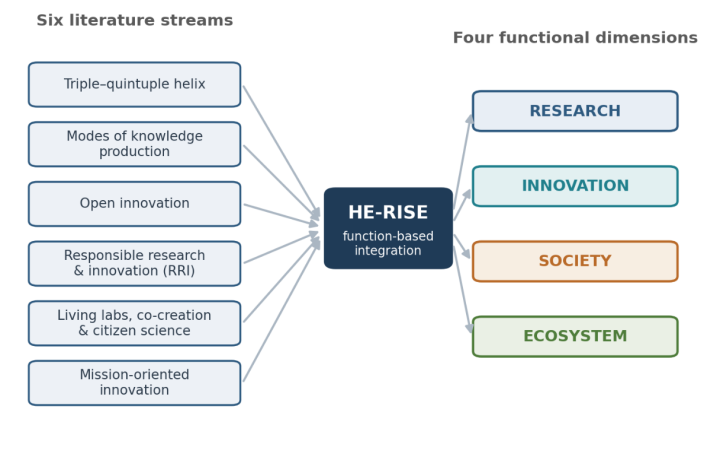
The HE-RISE Model is situated within the broader literature on research management as an institutional function and synthesizes six complementary theoretical streams: innovation systems and the helix tradition, modes of knowledge production, open innovation, responsible research and innovation, participatory approaches including living labs and citizen science, and mission-oriented innovation.
2.1. Research Management as an Institutional FunctionResearch evaluation, technology transfer, research integrity, public engagement, open science, and knowledge exchange have emerged as recognizable areas of scholarship and professional practice, but they are rarely connected within a unified explanation of the purposes, structures, and capabilities of institutional research management. Universities have consequently developed specialized structures to support interdisciplinary research, institutional partnerships, proposal development, and competition for external funding 4, 5.
In the United Kingdom, the Research Excellence Framework evaluates the vitality and sustainability of the research environment alongside research outputs and impact. Sustainability in this context concerns the capacity of an institution or discipline to maintain its future health, diversity, wellbeing, and wider contribution 7. Broader reforms in research assessment also emphasize research culture, integrity, openness, diversity of contribution, and societal value alongside conventional indicators of output and income 21, 22. These policy developments imply that institutional research-management systems must support not only productivity, but also responsibility, resilience, openness, and long-term capability. Nevertheless, these expectations have not been consistently translated into an integrated framework specifying the functions through which they should be governed and evidenced.
2.2. Innovation Systems and the Helix TraditionThe helix family of models provides an influential systems perspective for understanding collaboration in knowledge production and innovation. The Triple Helix focuses on interactions among universities, industry, and government, including the increasing overlap among their institutional roles 24. The Quadruple Helix extends this configuration by incorporating civil society, culture, media, and public participation, while the Quintuple Helix further incorporates the natural environment and sustainable development into the innovation system 18, 25, 26.
The helix models are valuable because they represent innovation as a systemic and relational process in which knowledge is produced and applied across institutional boundaries. Related research on universities’ third missions demonstrates that engagement with industrial, governmental, and societal actors has become increasingly diverse, but also organizationally difficult to coordinate 20. They provide less guidance on the internal and boundary-spanning capabilities through which an individual university supports research, governs partnerships, manages data, promotes responsible practice, evaluates impact, and coordinates its external relationships. HE-RISE builds on the systems logic of the helix tradition while shifting the principal unit of analysis from actor configuration to institutional research-management functions.
2.3. Modes of Knowledge ProductionA second theoretical stream concerns changes in the organization and production of knowledge. Gibbons et al. 27 distinguished Mode 1, characterized primarily by disciplinary organization, academic governance, and knowledge production within established scientific communities, from Mode 2, which is more application-oriented, transdisciplinary, socially distributed, and situated within contexts of use. The subsequent concept of Mode 3 emphasizes the coexistence and interaction of multiple knowledge and innovation modes within pluralistic systems. More recent interpretations connect Mode 3 with future-oriented universities that combine disciplinary excellence with transdisciplinary collaboration, digital transformation, societal engagement, and participation in wider innovation systems 28.
These forms of knowledge production frequently involve heterogeneous participants, permeable institutional boundaries, context-sensitive objectives, and complex requirements for accountability and knowledge integration 29. They also depend on sustained interaction among disciplinary expertise, non-academic knowledge, collaborative learning, and context-specific problem solving, rather than on the simple aggregation of separate disciplinary contributions 30. It describes how knowledge production is changing but provides limited operational guidance on how research-performing organizations should design, coordinate, resource, and evaluate the institutional capabilities needed to support these forms of research 31. HE-RISE responds to this limitation by translating changing modes of knowledge production into identifiable research-support and governance functions.
2.4. Open innovationBogers et al. 32 conceptualize open innovation as a distributed innovation model involving purposively managed inflows and outflows of knowledge across organizational boundaries to support value creation and capture. Subsequent scholarship distinguishes inbound, outbound, and coupled forms of open innovation, demonstrating that organizational boundaries are permeable, but that knowledge flows still require deliberate selection, coordination, and governance 33. In universities, this perspective extends beyond a linear model of technology transfer to include collaborative and contract research, academic consulting, personnel mobility, licensing, spin-out formation, shared infrastructure, and co-development with external users and partners 34, 35. Research offices, technology-transfer units, and innovation intermediaries therefore perform important coordinating functions by connecting academic, commercial, policy, and public-value objectives 36.
Recent evidence similarly indicates that successful university-industry open innovation depends on supportive organizational structures, stakeholder attitudes, infrastructure, incentives, project-management arrangements, and relational and educational practices 37. HE-RISE therefore uses open innovation as the primary theoretical anchor for the Innovation dimension, while integrating it with the Society and Ecosystem dimensions to address these wider institutional responsibilities.
2.5. Responsible research and innovationStilgoe et al. 15 conceptualized responsible innovation through four interrelated processes, anticipation, reflexivity, inclusion, and responsiveness. Owen et al. 38 situated this development within a broader movement from conducting science in society towards conducting science for and with society. Similarly, von Schomberg 39 described responsible research and innovation as a transparent and interactive process through which innovators and societal actors become mutually responsive to one another. Recent scholarship argues that RRI should not be treated as a compliance checklist or reduced to isolated engagement activities. Its institutionalization requires governance arrangements and organizational conditions that support reflexivity, transparency, inclusion, responsiveness, and continuous learning 17. RRI also shares important commitments with open science, particularly in relation to accessibility, transparency, participation, and the broader democratization of knowledge production 16. However, RRI does not by itself constitute a complete institutional research-management framework, because it provides limited guidance on how responsibility should be integrated with proposal development, organizational structures, digital infrastructure, partnership governance, performance monitoring, and strategic decision-making. HE-RISE addresses this limitation by embedding responsible practice within a broader configuration of research-management functions.
2.6. Living Labs, Co-creation, and Citizen ScienceLiving labs are commonly understood as physical or virtual environments in which public, private, and societal actors jointly define problems, develop ideas, prototype solutions, and evaluate them in real-world contexts 40, 41. Their value lies in enabling iterative interaction among stakeholders during problem definition, experimentation, learning, and implementation. However, the participation of multiple stakeholder groups does not automatically produce meaningful co-creation. Effective co-creation depends on appropriate governance, facilitation capacity, trust, role clarity, sustained participation, and procedures for addressing differences in power, expertise, and incentives. Living labs therefore require institutional functions for stakeholder identification, engagement design, ethical oversight, documentation, data governance, and evaluation.
Irwin 12 framed citizen science in terms of a changing relationship between scientific expertise and the public, while Bonney et al. 42 highlighted its potential to contribute both to scientific knowledge and to public scientific literacy. The field has developed more systematic terminology, participation models, data-quality procedures, methodological guidance, and ethical standards 13, 14. Meaningful participation requires institutional procedures for recruitment, informed consent, inclusion, data quality, recognition, safeguarding, feedback, and sustained engagement. These requirements are particularly important in food-technology research, where consumers may simultaneously act as stakeholders, research participants, co-designers, data contributors, and intended users of resulting products or processes.
2.7. Digital Enablement in Research ManagementCurrent research information systems, including systems based on the Common European Research Information Format, can integrate information on projects, research outputs, funding, facilities, organizations, and personnel within an institution-wide information environment 8. Research-data management has also been shaped by the FAIR principles, which require data to be findable, accessible, interoperable, and reusable 9. Together, these developments position data stewardship, interoperability, and information governance as important components of funding compliance, research integrity, reproducibility, institutional accountability, and evidence-informed management.
Open-science platforms, persistent identifiers, interoperable repositories, electronic research-administration systems, and portfolio-analytics tools can support activities including funding-opportunity identification, proposal preparation, partner discovery, compliance management, reporting, portfolio monitoring, and impact assessment. It requires digital platforms to be aligned with organizational structures, professional competencies, governance arrangements, operational workflows, and institutional culture 10. Emerging applications of artificial intelligence (AI) and advanced analytics may further support literature discovery, funding intelligence, partner identification, portfolio analysis, and research evaluation. Their institutional use nevertheless requires safeguards relating to transparency, explainability, bias, privacy, research security, human oversight, and the responsible interpretation of automated indicators.
2.8. Mission-Oriented Innovation and SustainabilityMazzucato 43 described mission-oriented research and innovation policy as an approach for mobilizing diverse actors, resources, technologies, and policy instruments around ambitious goals addressing complex societal challenges. It requires governance mechanisms for coordinating multiple actors, managing portfolios of complementary projects, combining policy and funding instruments, supporting experimentation, and adapting priorities in response to emerging evidence and learning 44, 45. Mission-oriented approaches have also been linked to the Sustainable Development Goals and to forms of systemic transformation that extend beyond incremental technological improvement 46.
This process requires coordinated governance, inclusive priority setting, portfolio-level management, organizational learning, and systemic impact assessment rather than reliance on isolated projects 44, 45, 47. Within HE-RISE, sustainability has two related but distinct meanings. The first is substantive, referring to environmental and social transformation as an objective of research and innovation. The second is institutional, referring to the long-term vitality, resilience, diversity, integrity, and adaptability of the research environment itself. Mission-oriented innovation therefore provides strategic direction, but offers limited guidance on the internal organizational structures, professional functions, and evidential processes through which research-performing organizations can operationalize and sustain that direction.
2.9. Theoretical Synthesis and Research GapThe reviewed theoretical streams which have influenced the HE_RISE model are illustrated in Figure 1. These streams provide complementary insights but remain insufficiently integrated at the level of institutional research management, thus the development of the HE-RISE model as an alternative approach. Responsible research and innovation provide normative and procedural principles for anticipation, inclusion, and responsiveness, while living labs and citizen science provide participatory settings and practices that are frequently project-specific and context-dependent. Mission-oriented innovation supplies strategic direction, and digital enablement provides the information infrastructure through which these functions can be connected, evidenced, and monitored. Taken together, however, these streams do not yet provide an integrated function-based framework through which a research-performing organization can assess and develop its capabilities across knowledge production, innovation, societal responsibility, ecosystem coordination, sustainability, and digital governance.
HE-RISE addresses this integration gap by reorganizing the six theoretical streams into four interdependent functional dimensions, Research, Innovation, Society, and Ecosystem, supported by Digital Enablement as a cross-cutting capability. The framework complements the Quintuple Helix by shifting the principal unit of analysis from the configuration of innovation-system actors to the governance of internal and boundary-spanning research-management functions. Diagnostically, it provides a structured basis for examining existing institutional capabilities, evidence, gaps, and areas of overlap. Developmentally, it supports strategic prioritization, organizational alignment, capability-building interventions, funding-instrument selection, and the monitoring of institutional progress.

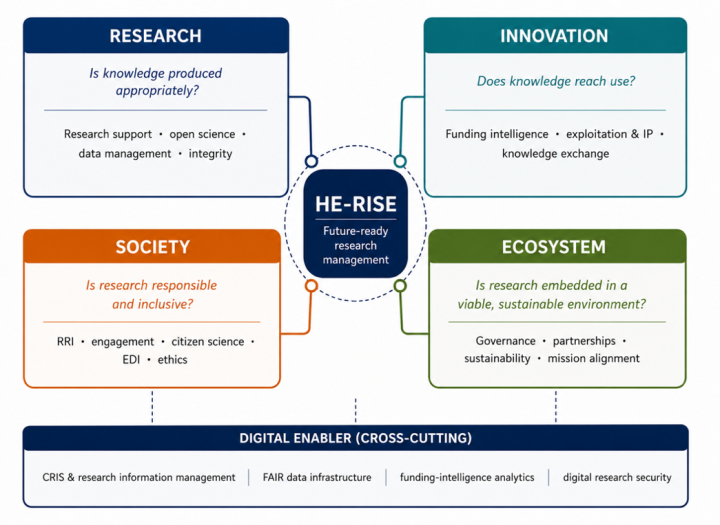
The acronym HE-RISE refers to Higher Education: Research, Innovation, Society, and Ecosystem. The prefix “HE” identifies higher education as the model’s primary institutional context, while RISE represents its four functional dimensions. Drawing on the theoretical synthesis presented in Section 2, the framework, illustrated in Figure 2, organizes research management into four interdependent dimensions, each defined by a governing institutional question.
• Research: Does the institution support rigorous, open, well-resourced, and strategically aligned knowledge production across disciplinary, interdisciplinary, and application-oriented contexts?
• Innovation: Does the institution enable knowledge to be exchanged, co-developed, translated, and applied through appropriate partnership, intellectual-property, knowledge-transfer, and valorization mechanisms?
• Society: Is research governed ethically, responsibly, inclusively, and responsively, with meaningful stakeholder and public participation?
• Ecosystem: Are internal structures, external relationships, shared resources, and strategic priorities coordinated to sustain institutional research capability over time?
The four dimensions constitute the substantive governance structure of HE-RISE. They are supported by Digital Enablement as a cross-cutting operational and evidential capability rather than as a fifth substantive dimension. Digital Enablement includes research information systems, open-science and data-management infrastructure, interoperable repositories, workflow platforms, analytical and decision-support tools, and digital research-security arrangements. Reliable data, interoperable systems, appropriate governance, and human oversight are therefore necessary for consistent institutional diagnosis and continuous improvement.

HE-RISE translates its conceptual dimensions into institutional responsibilities and assessable indicators derived from documentary evidence, organizational structures, institutional data, and staff experience. Indicators are allocated according to their principal governance function, while significant secondary relationships are recognized because research-management activities often extend across several domains. The research dimension examines the conditions required for rigorous, open, strategically directed, and adequately support knowledge production, including priority setting, funding support, researcher development, infrastructure, portfolio management, and research quality. Its conceptual basis draws on Mode 2 and Mode 3 perspectives, which emphasize interdisciplinarity, application-oriented knowledge production, and interaction among diverse knowledge systems 27, 25. The innovation dimension addresses the transfer, co-development, commercialization, and application of research-based knowledge, technologies, and expertise. It includes intellectual-property management, technology transfer, collaboration with external users, venture support, and both commercial and non-commercial forms of value creation, consistent with open-innovation theory 33, 48.
The society dimension focuses on ethical, inclusive, participatory, and publicly accountable research governance through research integrity, equity, public engagement, societal responsiveness, impact assessment, and responsible research and innovation. It is informed by citizen-science and RRI scholarship, which emphasize anticipation, reflexivity, transparency, inclusion, and responsiveness 12, 15. The ecosystem dimension evaluates the organizational and relational mechanisms that sustain research capability, including internal coordination, interdisciplinary collaboration, external partnerships, international networks, shared resources, and long-term institutional relationships. Its foundations lie in Quintuple Helix and mission-oriented innovation approaches, which locate universities within broader governmental, economic, societal, and environmental systems 26, 43. Digital enablement operates across all four dimensions through integrated information systems, data governance, interoperability, analytics, lifecycle digitization, and responsible artificial intelligence. Table 1 presents 29 interconnected indicators, comprising six indicators for each substantive dimension and five for Digital Enablement, collectively forming a structured institutional assessment architecture.
The indicator structure presented in Table 1 provides the basis for using HE-RISE as an institutional diagnostic framework. Rather than representing research-management capability through a single aggregate score, the framework examines whether individual functions are formally established, adequately resourced, coordinated across organizational units, supported by appropriate digital systems, and demonstrated through credible evidence. This multidimensional approach enables institutions to identify uneven capability development, functional gaps, cross-dimensional dependencies, and areas in which formal structures are not matched by consistent implementation. HE-RISE is therefore not intended to operate as a rigid or universally linear maturity model. An institution may demonstrate advanced capability in some functions while remaining less developed in others. For example, it may possess well-developed research-data infrastructure but limited capacity for stakeholder participation, or strong knowledge-transfer arrangements but weak mission alignment and societal-impact assessment. The diagnostic purpose is to produce a context-sensitive institutional capability profile that supports organizational learning and prioritization, rather than to generate a universal ranking of institutions.
Each indicator is assessed across five developmental levels: Absent, where no formal function or evidence exists; Ad hoc, where practice is inconsistent and individually dependent; Defined, where responsibilities and procedures are formally established; Governed, where implementation is routinely monitored and reviewed; and Optimized, where the function is integrated, evidence-based, digitally enabled where appropriate, and continuously improved. Ratings should rely on triangulated evidence, including policies, governance records, workflows, resource allocations, system data, performance indicators, user feedback, and stakeholder input. HE-RISE may be applied at institutional, faculty, center, programme, or project level, provided that the unit of analysis, evidence period, respondents, and rating criteria are defined in advance. Provisional ratings should be used where evidence is incomplete or contradictory, preferably through multi-assessor review. Although indicator and dimension profiles may be aggregated descriptively, average scores should not conceal critical deficiencies in governance, ethics, security, or research integrity.
3.4. A Staged Implementation PathwayHE-RISE supports institutional adoption through a staged pathway that converts its dimensions and indicators into an iterative capability-development process adaptable to mandate, scale, discipline, governance, and existing capability. Stage 1, Institutional Diagnosis, establishes a baseline across the 29 indicators by defining the assessment unit, identifying stakeholders, collecting documentary, digital, quantitative, and experiential evidence, and assigning ratings. Outputs include an evidence register, capability gaps, dependencies, uncertainties, and risks. Stage 2, Strategic Prioritization, interpreting findings against institutional mission, research strategy, legal and ethical obligations, stakeholder needs, resources, and the policy and funding environment. Priorities should reflect strategic importance, risk, feasibility, influence, and consequences of non-intervention.
Stage 3, Organizational Alignment, translates priority needs into governance arrangements by assigning owners, decision rights, coordination mechanisms, competencies, workflows, resources, evidence requirements, and review schedules. Stage 4, Capability Development and Funding Alignment, converts priorities into internal interventions and externally funded activities. Funding may support training, mobility, networking, infrastructure access, partnerships, governance reform, and transformation. Programmes such as MSCA, COST, ERA Talents, Twinning, and initiatives may be used when objectives and eligibility align with diagnosed needs. External funding should complement, not replace, institutional responsibility, resources, and long-term ownership.
Stage 5, Digital Integration, Monitoring, and Continuous Improvement, embeds HE-RISE evidence and review in institutional systems, governance, and performance cycles. Institutions should define indicator ownership, data sources, update frequencies, permissions, quality controls, reporting, and interpretation procedures. Monitoring should enable reassessment, learning, and reprioritization rather than becoming a compliance exercise. Completion of Stage 5 begins a new diagnostic cycle to assess whether interventions improved capability, created unintended effects, or exposed dependencies and risks. Quantitative indicators should be interpreted alongside documentary and stakeholder evidence, professional judgement, and context. Digital monitoring should support deliberation and learning, not reduce capabilities to decontextualized metrics or automated rankings. Table 2 illustrates this funding-alignment logic using examples from the METU food-technology project portfolio that are examined in Section 6.1. (Food-Grade Aerogels for Sustainable Food Systems (FAroGels), Fixing Alternative Proteins: Overcoming Key Challenges for Practical Integration into Food Systems (Fix-APro), Alternative Proteins Research and Innovation Skills Enhancement (APRISE), European Network for Valorizing Food Processing Waste into Sustainable Fibers (ENFiber, COST Action CA24111), 49 and Reforms and Empowerment for Agri-food Competitiveness and Open Excellence (REACtOE). The project examples demonstrate how different European funding instruments may support distinct but overlapping HE-RISE capabilities. Their inclusion does not imply that participation in, or success under, a particular funding instrument constitutes evidence of capability maturity or project effectiveness.
This study employed a sequential, multi-method framework-development design comprising three components. First, a preliminary version of HE-RISE was developed through an integrative, concept-driven synthesis of literature concerning institutional research management, knowledge production, open innovation, responsible research and innovation, participatory research, mission-oriented innovation, research governance, and digital infrastructure. Second, the relevance, clarity, measurability, and professional acceptability of the preliminary framework were evaluated through a two-round modified Delphi study. Third, the refined framework was applied illustratively to two contrasting organizational settings to examine its interpretive utility and identify issues requiring contextual adaptation. A separate future study is proposed to examine the framework’s reliability, construct validity, and relationships with institutional outcomes using an independent, multi-institutional sample.
The modified Delphi process then examined whether experts regarded these components as relevant, understandable, and potentially measurable, while qualitative comments informed revisions to terminology, indicator boundaries, dimensional placement, and evidential requirements. The refined framework was subsequently used as an analytical template for organizing documentary and institutional evidence from METU and SITES. Similarities were examined to determine whether the framework could organize evidence across different organizational forms, while differences were interpreted in relation to mandate, scale, governance structure, institutional maturity, and position within the wider research and innovation ecosystem. The illustrative applications were not designed to estimate organizational performance, test causal effectiveness, or establish generalizability.
4.2. Development of the Preliminary HE-RISE FrameworkThe preliminary HE-RISE framework was developed through an integrative, concept-driven literature synthesis. The analytical process comprised three stages. First, the authors extracted recurring institutional functions, governance requirements, enabling conditions, implementation challenges, and intended outcomes from the reviewed literature. Second, conceptually related functions were compared and grouped according to their primary governance purpose. Third, the resulting groups were organized into four substantive dimensions, Research, Innovation, Society, and Ecosystem, while functions concerned principally with information integration, digital workflows, data governance, analytics, and monitoring were grouped under Digital Enablement as a cross-cutting capability.
Literature was identified through searches of Scopus, Web of Science, and Google Scholar, supplemented by targeted searches of relevant policy, funding, and professional sources. The database searches covered publications from 2010 to 2026; seminal pre-2010 sources were retained where they provided foundational concepts required for the theoretical synthesis. Search terms combined concepts relating to research management, research administration, research governance, open innovation, responsible research and innovation, citizen science, living labs, mission-oriented innovation, open science, research information systems, and institutional research capability. Sources were included where they provided a theoretical concept, institutional function, governance requirement, implementation mechanism, or evaluative criterion relevant to institutional research-management capability. The synthesis was integrative and concept-driven rather than a systematic review and should therefore not be interpreted as an exhaustive enumeration of literature.
The synthesis produced a preliminary set of 29 indicators, comprising six indicators for each substantive dimension and five indicators for Digital Enablement. Indicator placement was based on primary governance purpose rather than conceptual exclusivity. Where an indicator was relevant to more than one dimension, it was assigned to the component that most clearly represented its principal institutional function, while its secondary relationships were retained in the conceptual mapping. This allocation rule was intended to improve interpretability and reduce duplication without assuming that the dimensions or indicators were operationally independent.
4.3. Modified Delphi EvaluationExperts were recruited using predefined eligibility criteria to ensure relevant academic, policy, and professional expertise. Participants were required to have at least five years of experience in institutional research management, higher-education governance, research policy, innovation and knowledge exchange, responsible research and societal engagement, European research funding, organizational development, or digital research systems. Potential participants were identified based on their demonstrated professional or academic expertise in these domains and were invited directly to participate in the Delphi exercise. The purposive recruitment strategy was intended to obtain complementary perspectives across the framework's four dimensions and its cross-cutting Digital Enablement capability rather than to generate a statistically representative sample. Fifteen experts completed Round 1 in June 2026, and 13 completed Round 2 in July 2026, yielding an 86.7% retention rate. For ethical considerations, no formal ethics approval was sought for this expert-consensus exercise. The Delphi exercise involved professional experts who provided judgements on the content, structure, clarity, and potential measurability of the proposed HE-RISE framework. Participation in both Delphi rounds was voluntary. Individual responses were treated confidentially during analysis and are reported only in anonymized or aggregated form. No personally identifiable information or individual-level responses are reported in this manuscript
In Round 1, experts independently rated all 29 preliminary indicators for relevance, clarity, and potential measurability on four-point scales; ratings of 3 or 4 were treated as favorable. They also evaluated framework-level statements on five-point agreement scales covering structural coherence, dimensional overlap, indicator placement, Digital Enablement, contextual applicability, implementation, and alignment with European funding instruments. Open-text responses captured concerns about terminology, scope, duplication, evidence, applicability, and adaptation. Qualitative feedback was analyzed by grouping similar comments into common themes. These themes, along with quantitative assessments, were used to refine and define the indicators, required evidence, and implementation guidelines.
Dimensional placement was assessed according to each function’s principal institutional objective, likely organizational owner, and required evidence. Experts could recommend retention, relocation, cross-referencing, consolidation, or removal. Item-level content validity (I-CVI) was calculated as the proportion of experts rating an indicator 3 or 4 for relevance, clarity, or measurability, while S-CVI/Ave represented the mean I-CVI across all 29 indicators. I-CVI values of at least 0.78 were acceptable; values of 0.70-0.77 were borderline and interpreted with qualitative comments; values below 0.70 prompted substantial revision or reconsideration. Indicators with adequate relevance but weaker clarity or measurability were operationally revised. Placement concerns were resolved using the primary-purpose criteria, duplication led to consolidation, and difficult-to-measure indicators were retained only when observable practices and evidence sources could be specified.
A modified kappa statistic was calculated as a chance-corrected sensitivity analysis for each item-level content-validity estimate. The probability of chance agreement was calculated as  , where
 represents the number of responding experts and
 represents the number assigning a rating of 3 or 4. Modified kappa was then calculated as
 . Values from 0.40 to 0.59 were interpreted as fair, values from 0.60 to 0.74 as good, and values above 0.74 as excellent agreement [50]. For the five-point framework-level statements, consensus defined as a priori as the simultaneous achievement of three conditions: at least 80% of valid responses at ratings 4 or 5, a median of at least 4, and an interquartile range not exceeding 1. In Round 2, the 11 revised indicators were re-rated for relevance and clarity only. Measurability, assessed in Round 1, was not re-rated following revision. Therefore, round 2 provides evidence of improved relevance and clarity but does not establish improved measurability of the revised indicators. Between-round comparisons were treated as descriptive rather than inferential because the second-round panel was smaller, the reassessed indicators were purposively selected, and revisions sometimes changed wording or dimensional placement.
The Delphi-refined HE-RISE framework was applied to two illustrative organizational settings: Middle East Technical University (METU) and Sustainable Innovation Technologies Ltd (SITES). METU was selected to illustrate the framework in food technologies, including food safety, sustainable food systems, and the agri-food transition. Its European project portfolio, administered through the Project Management Office, exceeds €17 million across coordinator and partner roles. The Department of Food Engineering includes projects corresponding to the funding categories in Table 2, allowing HE-RISE dimensions to be illustrated through identifiable projects and programmed. METU also hosts a European-funded institutional transformation programmed focused on strengthening research-management capability.
SITES was selected as a contrasting boundary case. It is a private research and innovation intermediary led by the first author, with activities in research support, partnership development, innovation intermediation, and knowledge exchange. Its inclusion illustrates how HE-RISE may organize evidence in a non-academic research and innovation setting. The two settings are illustrative applications and are not used as independent evidence of framework validation, institutional performance, or general transferability.
4.5. Data Sources and Analytical LimitationsThe study drew on four principal evidence sources. The first was the integrative literature synthesis used to develop the preliminary framework. The second comprised publicly accessible documents, including institutional information, European project records, project websites, and COST Action documentation. The third consisted of aggregate institutional records supplied through METU’s research-coordination and project-management functions, including information on project portfolios, funding values, training and mobility activities, internal support, and selected performance-review processes. The fourth source was the quantitative and qualitative evidence generated through the modified Delphi study. Insider practitioner knowledge contributed to contextual interpretation but was not treated as an independent source capable of verifying organizational performance.
They were not sufficient to determine the consistency or quality of implementation, user experience, institutional outcomes, comparative performance, or causal effectiveness. Public project documentation may emphasize intended activities rather than realized outcomes, while aggregating internal data may be affected by differences in institutional recording practices. The organizational applications should therefore be understood as structured illustrations of framework use rather than independent evaluations of capability maturity.
4.6. Proposed Future Validation StudyA future multi-institutional study is proposed to examine the measurement properties and external relationships of the HE-RISE framework. The study would collect indicator-level evidence from research managers, academic leaders, professional-services staff, and other relevant institutional stakeholders across a diverse sample of higher-education institutions. Before structural relationships are tested, the dimensional structure of HE-RISE should be evaluated through cognitive testing, pilot administration, inter-rater reliability assessment, and exploratory and confirmatory measurement analyses. The specification of each dimension as reflective, formative, or composite should be determined theoretically and empirically according to the relationship between its indicators and the underlying institutional capability. Institutional outcomes should be measured independently from the HE-RISE capability indicators and defined across research quality, innovation and knowledge exchange, societal contribution, resource development, and research-environment sustainability.
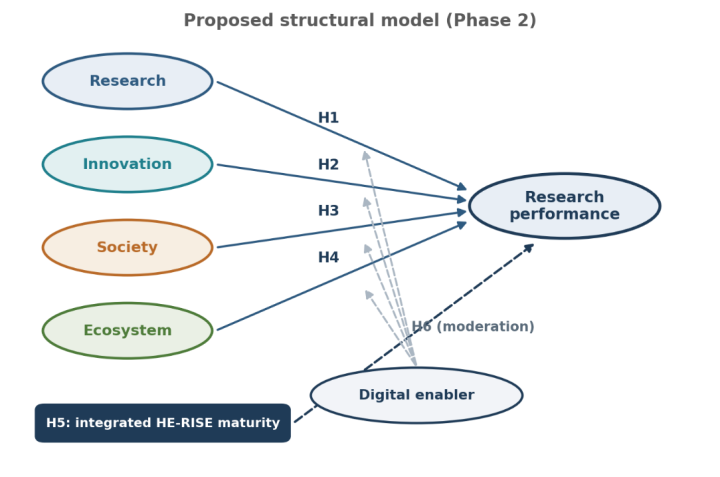
Based on these proposed relationships, six hypotheses are formulated for future empirical testing, as summarized in Table 3.
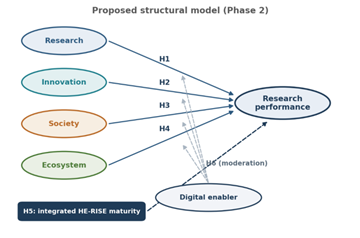
Because HE-RISE concerns institutional rather than individual capability, the future study should be distinguished clearly between respondent-level perceptions and institution-level constructs. Multiple informed respondents should be recruited from each participating institution, and agreement among respondents should be examined before individual ratings are aggregated. The five developmental levels constitute ordered capability categories rather than conventional agreement items. Their ordinal nature should be reflected in statistical analysis. Estimation methods appropriate for ordered categorical data should therefore be used unless empirical evidence supports treating the ratings as approximately continuous. The provisional measurement and structural relationships among the HE-RISE dimensions, Digital Enablement, and institutional outcomes are illustrated in Figure 3.
4.7. Positionality and Researcher InvolvementThe first and second authors occupy insider positions in relation to organizational cases, and these roles are declared openly. The first author is the Chief Executive of SITES and a doctoral candidate at the University of Chester. The second author coordinates the METU food-technology projects examined in Section 6 and serves as the university’s Research Coordinator and head of its Project Management Office. These positions provide valuable contextual knowledge while requiring appropriate reflexive safeguards. To support transparency and consistency, project-level claims were checked against publicly available sources, including CORDIS records, project websites, and COST Action documents, where available. Internal institutional data were reported in aggregate and identified as internal sources. Each author also reviewed the interpretation of the other author’s organizational case. The cases are presented as illustrative applications rather than assessments of implementation quality, organizational success, or independent framework validation.
Fifteen experts completed Round 1 of the modified Delphi study, and 13 of these experts completed Round 2, corresponding to a retention rate of 86.7%. In Round 1, all 29 preliminary HE-RISE indicators were assessed for relevance, clarity, and potential measurability. The overall S-CVI/Ave values were 0.929 for relevance, 0.841 for clarity, and 0.770 for potential measurability. All 29 indicators met the predefined item-level relevance threshold. Twenty-one indicators met the corresponding clarity threshold, while 18 met the potential-measurability threshold. Following joint consideration of the quantitative ratings and qualitative comments, 11 indicators underwent material revision and were reassessed in Round 2 for relevance and clarity.
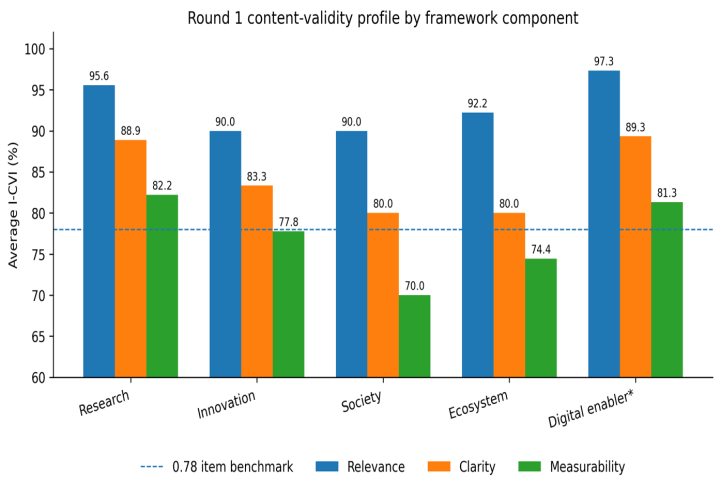
Table 4 summarizes the Round 1 S-CVI/Ave values by HE-RISE component. Research recorded mean item-level indices of 0.956 for relevance, 0.889 for clarity, and 0.822 for potential measurability. The corresponding values were 0.900, 0.833, and 0.778 for Innovation; 0.900, 0.800, and 0.700 for Society; and 0.922, 0.800, and 0.744 for Ecosystem. Digital Enablement recorded values of 0.973 for relevance, 0.893 for clarity, and 0.813 for potential measurability. It therefore had the highest average relevance and clarity ratings among the five HE-RISE components, although these descriptive differences were not tested inferentially.
The largest difference between relevance and potential measurability was observed for Society, with a component-level gap of 0.200, followed by Ecosystem at 0.178. Rather, the results suggest that institutional capabilities involving participation, inclusion, societal responsiveness, relationship sustainability, and research-environment vitality were more difficult to express through standardized and consistently observable evidence. This finding is consistent with expert recognition of its importance, but its treatment as a cross-cutting capability should be justified primarily through the framework-level consensus results, qualitative comments, and theoretical rationale rather than through component averages alone.
The lower potential-measurability ratings for Society and Ecosystem are theoretically plausible because many of their indicators represent relational, context-dependent, and temporally extended institutional processes. Responsible research, public participation, societal contribution, partnership continuity, and institutional resilience cannot generally be evaluated through a single numerical indicator. Responsible research and innovation, for example, involves anticipation, reflexivity, inclusion, and responsiveness, which require evidence of institutional practice rather than the existence of formal policies alone 15. Quantitative metrics should therefore be interpreted alongside documentary evidence, contextual information, and informed professional judgement 21. As a chance-corrected sensitivity analysis, round 1 (see Figure 4) modified kappa values ranged from 0.797 to 1.000 for relevance, from 0.633 to 0.933 for clarity, and from 0.528 to 0.866 for potential measurability. These ranges were consistent with the I-CVI results, showing the strongest agreement for relevance and greater variation in expert judgements concerning measurability.

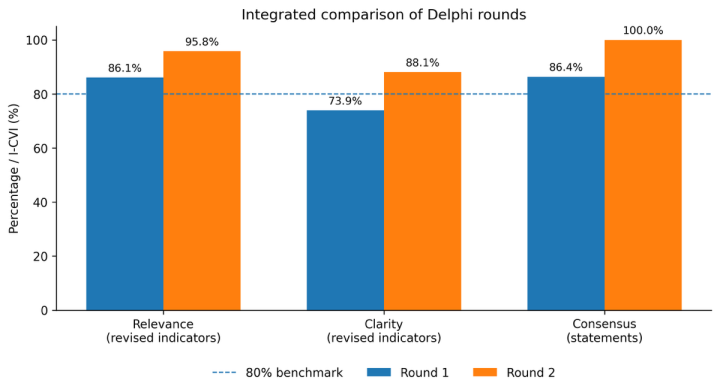
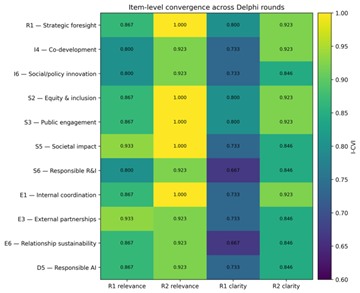
Eleven indicators underwent material revision following Round 1. Across these 11 indicators, the average relevance I-CVI increased descriptively from 0.861 in Round 1 to 0.958 in Round 2, an absolute difference of 0.097. The average clarity I-CVI increased from 0.739 to 0.881, an absolute difference of 0.142. These changes should be interpreted as descriptive evidence of convergence because the indicator wording had been revised and the number of respondents decreased from 15 to 13 between rounds. The 11 revised indicators were reassessed quantitatively for relevance and clarity only. At Figure 5 and Table 5 a comparison is shown of the round 1 and round 2 results Although Round 2 included a framework-level statement concerning whether the final indicators were measurable in subsequent empirical studies, potential measurability was not re-rated at the individual-indicator level. Therefore, no item-level conclusion regarding improved measurability can be drawn for the revised indicators.

Relevance I-CVI increased to 10 of the 11 reassessed indicators. External Partnerships was the only indicator to record a lower value, decreasing slightly from 0.933 to 0.923, while remaining above the predefined acceptance threshold. Clarity I-CVI increased for all 11 indicators. The number of revised indicators meeting the clarity criterion increased from three in Round 1 to all 11 in Round 2. For the 11 revised indicators, modified kappa values for relevance ranged from 0.797 to 0.933 in Round 1 and from 0.923 to 1.000 in Round 2. The corresponding clarity values ranged from 0.633 to 0.797 in Round 1 and from 0.845 to 0.923 in Round 2. Under the predefined interpretation criteria, all Round 2 relevance and clarity values fell within the excellent-agreement category. These results were consistent with the I-CVI findings, although they should be interpreted as chance-adjusted content-agreement estimates rather than evidence of inter-rater reliability in the future institutional application of HE-RISE.
The Round 2 clarity results therefore indicate that experts viewed the revised wording as more understandable and conceptually precise. They do not, however, establish that the indicators can yet be applied consistently in institutional assessments. Such a conclusion requires pilot implementation, indicator-specific evidence anchors, and inter-rater reliability testing. The results nevertheless demonstrate the value of interpreting quantitative content-validity ratings alongside qualitative comments, since an indicator may be considered highly relevant while still requiring substantial operational clarification.
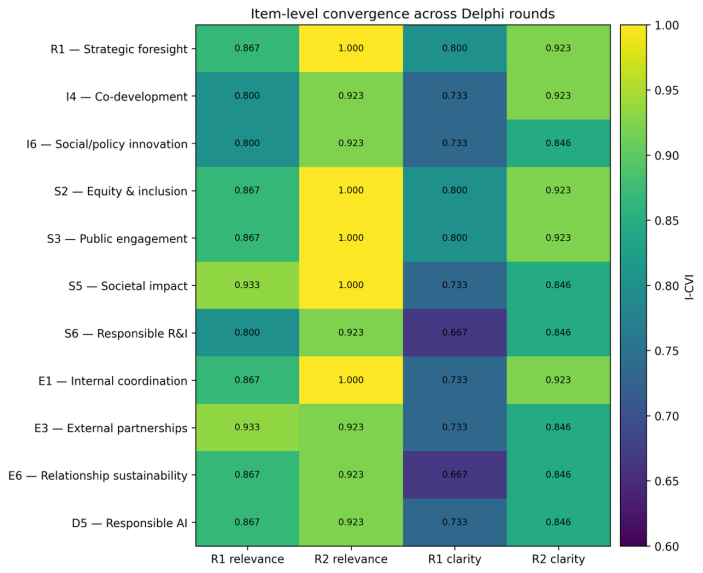
At the item level, all 11 revised indicators met the predefined relevance and clarity thresholds in Round 2. Relevance I-CVI values ranged from 0.923 to 1.000, while clarity I-CVI values ranged from 0.846 to 0.923. These findings indicate that the Round 2 panel regarded the revised indicators as relevant and sufficiently clear for retention within the framework. They do not, however, demonstrate that the indicators can yet be scored consistently during institutional implementation. The largest descriptive increases in clarity were observed for Co-development with Users and Partners and Internal Coordination, each of which increased by 0.190. Responsible Research and Innovation and Sustainability of Relationships and Capabilities each increased by 0.179. These patterns indicate that the strongest changes occurred among indicators whose functions extended across organizational units or institutional boundaries. The results are consistent with experts viewing the revised definitions as more precise, although the differences should not be interpreted as inferential effect estimates.
The item-level relevance and clarity I-CVI values for the 11 reassessed indicators are shown in Figure 6.
The larger clarity changes among boundary-spanning indicators are conceptually relevant because these functions commonly involve several organizational units and external actors. Their institutional ownership and evidential boundaries may therefore be less immediately apparent than those of more narrowly defined functions. The Round 1 comments consequently led to clearer specifications of each indicator’s primary governance purpose, likely organizational ownership, unit of analysis, expected practices, and potential evidence sources. External Partnerships was the only reassessed indicator to record a lower relevance I-CVI in Round 2, decreasing from 0.933 to 0.923. The difference was small, both values exceeded the predefined threshold, and the two rounds had different respondent denominators. The change should therefore not be interpreted as evidence of a meaningful decline in perceived relevance. At the same time, the indicator’s clarity rating increased, indicating that the revised wording was viewed as more understandable while its substantive acceptability was maintained. The item-level findings are consistent with allocating each indicator according to its primary governance purpose while recognizing significant secondary relationships. The four dimensions provide an analytical structure for organizing institutional functions, but they should not be interpreted as independent organizational or statistical silos. During implementation, assessors should record the principal placement of each function, its relevant secondary dimensions, the units responsible for its delivery, and the mechanisms used to coordinate activity across organizational boundaries.
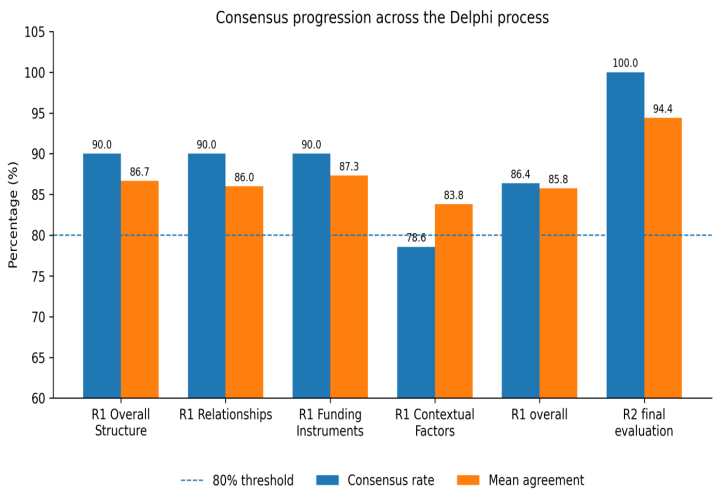
In Round 1, 38 of the 44 framework-level statements met the combined consensus criterion, producing an overall statement-level consensus rate of 86.4%. Nine of the ten statements in each of the Overall Structure, Relationships, and Funding Instruments sections reached consensus. Eleven of the 14 Contextual Factors statements reached consensus, corresponding to 78.6% and representing the lowest section-level rate. The six statements that did not meet the combined criterion concerned the distinctiveness of the four dimensions, the relative importance of integration and dimension-specific strength, the possibility of organizing funding instruments into a universal progressive pathway, and the general relevance of institutional age, disciplinary profile, and geographic or regional position as contextual factors.
Experts did not uniformly accept that boundaries among Research, Innovation, Society, and Ecosystem would remain distinct in institutional practice, or that research-management development could be represented through a common sequence applicable to all organizations. The Round 1 results therefore supported the overall architecture while indicating that dimensional overlap, contextual interpretation, and implementation sequencing required further clarification. In Round 2, all 11 final framework-evaluation statements met the combined consensus criterion. The mean proportion of ratings at 4 or 5 across the 11 statements was 94.4%. The lowest agreement level, 84.6%, was recorded for statements concerning the acceptability of the dimensional boundaries and the adaptability of the framework across institutional contexts. These values exceeded the predefined 80% threshold but remained lower than those of the other final statements. Dimensional overlap and contextual adaptation should therefore remain explicit components of implementation guidance and future validation.

The framework-level findings across the two rounds should be interpreted as evidence of iterative convergence rather than as a direct paired comparison. The 11 Round 2 statements evaluated the revised framework as a whole and were not identical to the 44 statements used in Round 1. Consequently, the increase from 86.4% of Round 1 statements meeting consensus to all Round 2 statements meeting consensus should not be interpreted as a direct percentage-point improvement in the same items. Instead, round 2 indicates that the final panel accepted the revised framework under the predefined consensus rule. Institutional research-management capability may be shaped by national regulation, funding conditions, disciplinary composition, organizational mandate, resource availability, governance maturity, and relationships with external actors. HE-RISE should provide a common analytical architecture and consistent indicator definitions, while allowing evidence expectations, priorities, and developmental interpretations to be adapted transparently to the relevant institutional context.
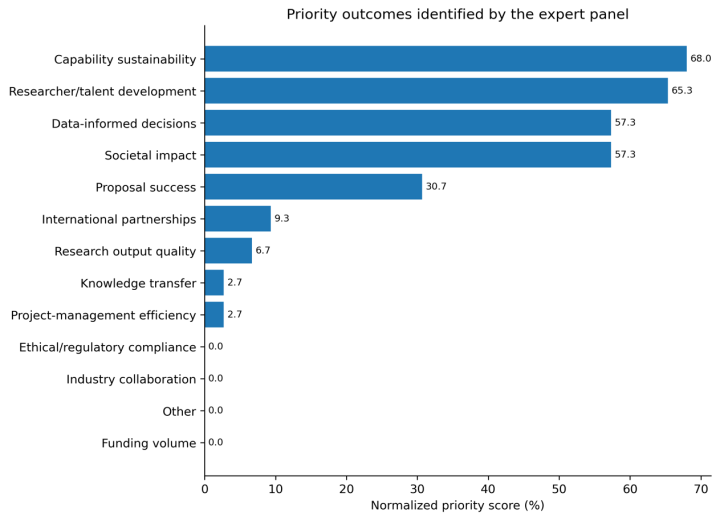
5.5. Prioritization and Funding-Instrument MappingIn the partial Top-5 ranking exercise, Capability Sustainability received the highest normalized priority score, at 68.0%, followed by Researcher and Talent Development, at 65.3%. Societal Impact and Data-Informed Decision-Making each recorded a normalized score of 57.3% as shown in Figure 8. Because participants ranked only their five highest priorities, the results represent a partial preference structure rather than a complete ranking of all proposed outcomes.

The ranking pattern is consistent with interpreting HE-RISE as an institutional-capability framework rather than solely as a model of funding performance. The findings suggest that funding performance may be interpreted not only in terms of income obtained, but also in terms of the capabilities that funded activity helps to develop or sustain. Relevant capabilities may include researcher and professional development, digital infrastructure, governance arrangements, international networks, stakeholder relationships, and organizational learning. The Delphi results do not, however, demonstrate that funding instruments actually produce these outcomes.
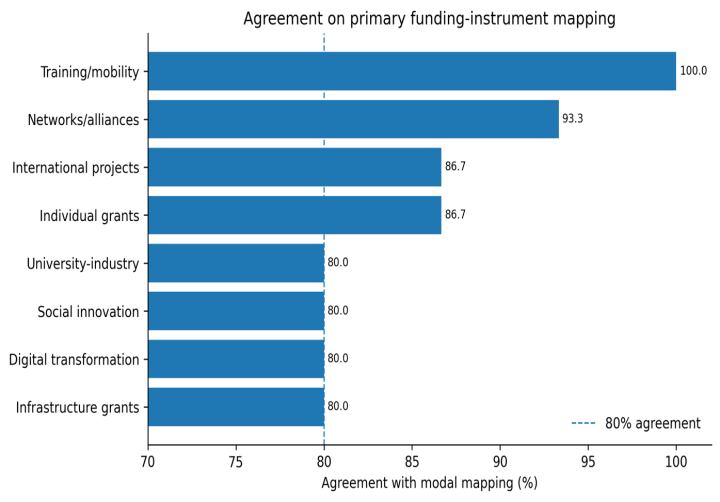
As shown in Figure 9, Agreement with the modal primary mapping of the selected European funding instrument categories ranged from 80.0% to 100.0%. Training and mobility instruments were assigned primarily to the Research dimension by all Round 1 respondents, while networks and alliances were assigned primarily to Ecosystem by 93.3%. Agreement for the remaining categories ranged from 80.0% to 86.7%. These results indicate a shared view of the principal capability-development role of each category, but do not imply that the instruments contribute exclusively to one HE-RISE dimension.

Experts also identified secondary relationships for several funding categories. For example, a training or mobility instrument may contribute primarily to Research capability while also supporting Innovation through intersectoral exchange and Ecosystem capability through international relationships. Funding instruments should therefore be treated as potentially multidimensional capability-development mechanisms rather than assigned through rigid one-to-one correspondence. The appropriate selection and sequencing of instruments should depend on the institution’s diagnosed capability gaps, strategic priorities, eligibility conditions, resource commitments, policy environment, and ability to sustain resulting functions after funding ends.
5.6. Qualitative FindingsAnalysis of the open-text responses identified five interrelated themes that helped explain the quantitative ratings and informed the refinement of HE-RISE: integrated institutional value, boundary ambiguity, operational evidence, context-sensitive application, and interpretive limits. Experts valued the integration of research management, innovation, societal responsibility, ecosystem relationships, and digital capability within a single framework. This finding reinforces the model’s principal contribution: research management is treated as an integrated institutional capability rather than a collection of disconnected administrative services. Boundary ambiguity. The most persistent overlaps concerned co-development, external partnerships, social and policy innovation, societal impact, and responsible research and innovation. Experts emphasized the need for explicit decision rules identifying the primary purpose, organizational responsibility, and unit of analysis associated with each indicator. These concerns are consistent with the item-level results, in which several boundary-spanning indicators showed the largest improvements in clarity after revision.
Suggested evidence included documented theories of change, governance procedures, stakeholder-engagement records, research-information-system data, monitoring indicators, oversight mechanisms, and evidence that capabilities remained after project funding ended. This theme helps explain why measurability was weaker than relevance in Round 1: the panel generally accepted the importance of the capabilities but required clearer guidance concerning how their institutional presence and maturity should be demonstrated. Context-sensitive application. Experts noted that institutional mission, disciplinary profile, national regulation, funding conditions, resource availability, organizational age, and administrative maturity could affect indicator interpretation and the expected level of capability.
The Delphi process therefore produced not only a refined set of HE-RISE indicators but also a set of interpretive principles for their application, including the use of primary-purpose allocation, recognition of secondary dimensional relationships, specification of observable evidence, and explicit adaptation to organizational context. The next section applies these principles illustratively to METU and SITES. The applications are not an additional Delphi stage, a comparative performance assessment, or a test of causal effectiveness. Rather, they examine whether the final framework can organize and interpret evidence across two contrasting organizational settings and show how the boundary and contextual issues identified by the expert panel may arise in practice.
Following the Delphi-based refinement reported in Section 5, the final HE-RISE framework was applied as an analytical template to two contrasting organizational settings operating within the food-technology research and innovation ecosystem: Middle East Technical University (METU), a research-intensive higher education institution, and Sustainable Innovation Technologies Ltd (SITES), a private research and innovation intermediary. Food technology was selected as the shared application domain because it combines interdisciplinary knowledge production, industrial collaboration, consumer and stakeholder involvement, regulatory and ethical requirements, sustainability objectives, digital data practices, and international research partnerships.
6.1. Middle East Technical UniversityMETU provides an illustrative setting for examining how HE-RISE may organize evidence within a research-intensive university. Its food-technology activities combine scientific research, doctoral and researcher development, international collaboration, externally funded projects, professional research support, and institution-level governance.
FAroGels, implemented through the Marie Skłodowska-Curie Doctoral Networks programme, exemplifies the integration of scientific investigation with structured doctoral training, international supervision, researcher mobility, open-science obligations, and research-data management. The project also requires institutional capacity for opportunity identification, proposal development, consortium coordination, researcher recruitment, ethical and administrative compliance, and the retention of knowledge and skills after the funding period. These features correspond primarily to the Research dimension of HE-RISE, particularly strategic research development, talent development, research infrastructure, project management, and research quality.
Fix-APro, undertaken through the MSCA Staff Exchanges programme, uses international and intersectoral mobility to connect academic and non-academic organizations working in the alternative-protein field. APRISE, supported through ERA Talents, similarly contributes to the circulation and development of research, technical, and research-management personnel. Considered together, these initiatives demonstrate how innovation capability may be strengthened through mobility, co-development, partner engagement, exploitation planning, and professional learning rather than through commercialization alone. This interpretation reflects the broader open-innovation view that knowledge can be created, exchanged, and applied through multiple organizational pathways 33, 35.
The ENFiber COST Action, for example, supports international networking, early-career participation, knowledge exchange, and interaction with relevant stakeholder communities. Such participation is relevant to HE-RISE only when it is accompanied by appropriate ethical oversight, inclusive recruitment, transparent communication, feedback procedures, and evidence that stakeholder contributions influence project decisions. This interpretation is consistent with responsible research and innovation, which treats anticipation, reflexivity, inclusion, and responsiveness as integral features of research governance 15.
At the institutional level, the REACtOE initiative illustrates how individual projects may be connected to broader organizational development. From the perspective of HE-RISE, these activities contribute to the Ecosystem dimension by linking academic departments, central research-support services, project-management structures, institutional leadership, and external partners. Research capability is therefore understood not only as the presence of successful projects but also as the existence of relationships, coordination mechanisms, shared resources, and governance arrangements that enable such projects to be developed and sustained.
A doctoral-network project may primarily strengthen Research while simultaneously expanding international partnerships and improving digital research practices. A staff-exchange initiative may be associated principally with Innovation but may also contribute to researcher development, societal application, and ecosystem connectivity. The assignment of an activity to one dimension is therefore based on its primary institutional purpose rather than on an assumption that it contributes exclusively to that dimension.
Relevant institutional functions include electronic project administration, research-information systems, internal funding workflows, performance reporting, portfolio monitoring, and data governance. Their contribution depends not simply on the presence of digital tools but on the quality, interoperability, accessibility, and governance of the underlying information. This interpretation accords with the FAIR principles and with research showing that digital transformation depends on the alignment of technology with organizational processes, governance, and institutional culture 9, 10.
Research projects provide opportunities to develop knowledge, talent, partnerships, engagement practices, and digital systems, but their institutional value depends on whether these capabilities become embedded beyond the lifetime of individual grants.
6.2. SITES as a Research and Innovation IntermediaryIts activities include funding-opportunity analysis, proposal development, consortium formation, partner identification, innovation planning, project coordination, and support for communication, dissemination, stakeholder engagement, and impact development. Its inclusion enables examination of whether the functional logic of HE-RISE can be applied to an organization operating at the boundaries among universities, industry, public bodies, funding organizations, and societal actors.
The relevance of the HE-RISE dimensions differs in this context because SITES does not perform all the functions expected of a university. Within the Research dimension, its contribution is primarily indirect and includes supporting the conceptual framing of proposals, methodological coherence, work-package development, funding alignment, and coordination among research partners. It does not independently provide the full research environment associated with higher education, such as doctoral education, laboratory infrastructure, academic career structures, or institution-wide research governance. For a research-and-innovation intermediary, research capability relates principally to the quality and consistency of research-development support rather than to direct scientific production.
Relevant functions include innovation-opportunity identification, funding intelligence, consortium development, partner brokerage, exploitation planning, and support for collaboration between academic and non-academic organizations. Intermediaries may also reduce coordination barriers among organizations with different objectives, professional languages, regulatory responsibilities, and institutional cultures 36, 34, 51. From an open-innovation perspective, the value of such organizations lies not merely in connecting partners but also in supporting the structured exchange and application of knowledge across organizational boundaries.
Within the society dimension, SITES contributes by incorporating responsible research and innovation, stakeholder engagement, inclusion, ethics, communication, dissemination, and societal-impact considerations into proposal and project design. Relevant evidence may include documented stakeholder analyses, inclusive engagement procedures, ethical safeguards, feedback mechanisms, communication strategies, and records demonstrating how societal considerations affected project design, implementation, or expected outcomes. This interpretation is consistent with responsible research and innovation, which emphasizes anticipation, reflexivity, inclusion, and responsiveness as integral components of research governance 15.
SITES also aligns strongly with the ecosystem dimension because its principal role involves connecting universities, firms, public authorities, funding bodies, and societal organizations. Its functions include consortium formation, partner coordination, mission alignment, relationship development, and the identification of complementary capabilities across participating organizations. Unlike METU, where ecosystem capability includes both internal institutional coordination and external relationships, the SITES case demonstrates an externally oriented form of ecosystem capability centered on brokerage, network development, and cross-organizational coordination.
Digital Enablement supports these activities through opportunity-monitoring systems, collaborative proposal-development platforms, partner databases, project-documentation tools, digital communication, and coordination systems. Their institutional contribution depends on data quality, interoperability, security, accessibility, governance, and integration with organizational processes. In the SITES case, digital enablement is therefore primarily externally oriented, supporting information exchange and coordination among organizations, whereas a university such as METU requires digital integration across both internal and external research-management systems.
The framework identifies relevant functions across all four dimensions, although their organizational expression and expected maturity differ from those of a research-intensive university. The case also confirms that HE-RISE should be applied with explicit attention to organizational mission, unit of analysis, and institutional responsibility.
6.3. Cross-Case Comparison and Integrated InterpretationMETU represents a research-performing university responsible for direct knowledge production, doctoral education, research infrastructure, institutional governance, and the long-term development of internal capability. SITES, by contrast, operates primarily as a research-and-innovation intermediary whose principal functions involve funding intelligence, consortium formation, partner brokerage, proposal development, stakeholder coordination, and the translation of research opportunities across organizational boundaries. The comparison is therefore based on contrasting organizational roles rather than on an assumption that the two cases are equivalent in scale, mandate, or performance.
Within the research dimension, METU exhibits direct institutional responsibility for scientific production, researcher development, infrastructure, project and portfolio management, open science, and research integrity. SITES contributes more indirectly by supporting proposal framing, methodological coherence, work-package development, and coordination among research partners. In a university, it includes the structures through which research is produced and sustained; in an intermediary organization, it is more closely associated with the quality of research-development support.
METU combines academic research, researcher mobility, intersectoral collaboration, and project-based knowledge transfer. SITES performs a more explicit boundary-spanning role by identifying opportunities, assembling consortia, connecting academic and non-academic partners, and supporting exploitation and impact planning. These differences are consistent with open-innovation scholarship, which recognizes that innovation may be supported through multiple organizational pathways and that intermediary organizations can facilitate the transfer, combination, and application of knowledge across institutional boundaries.
At METU, societal capability is embedded within research ethics, consumer and stakeholder participation, inclusive networking, public communication, and the societal relevance of food-technology research. In both settings, however, the presence of engagement activities alone is insufficient evidence of mature capability. Stronger evidence would show how stakeholder contributions influenced research priorities, methodological choices, implementation processes, or intended outcomes. This interpretation reflects the responsible research and innovation literature, which treats anticipation, reflexivity, inclusion, and responsiveness as substantive governance processes rather than formal project requirements. METU must coordinate both internal and external relationships, including those among academic departments, central research-support units, institutional leadership, international partners, and shared infrastructures. SITES is more externally oriented, acting as a connector among universities, firms, public authorities, funding organizations, and societal actors. Innovation-intermediary research similarly emphasizes that such organizations can reduce information asymmetries, connect complementary actors, and facilitate collaborative knowledge production and innovation.
METU requires systems capable of integrating internal and external information concerning researchers, projects, funding, outputs, partnerships, infrastructure, and institutional performance. In both cases, digital maturity depends not simply on the availability of tools but on interoperability, data quality, governance, security, professional capability, and integration with organizational decision-making. This is consistent with the FAIR principles and with research showing that digital transformation requires the alignment of technology with strategy, processes, governance, and institutional culture. The comparative application of the HE-RISE components across METU and SITES is summarized in Table 6.
First, the framework’s dimensions are interdependent rather than organizationally isolated. Assigning an activity to one component therefore identifies its primary governance purpose but does not imply exclusivity. Second, the interpretation of capability must be adapted to organizational mandate. HE-RISE provides a common analytical structure, but the evidence expected from a university should not be identical to that expected from an intermediary. For example, researcher development at METU may involve doctoral programmes, supervision systems, institutional career pathways, and research infrastructure, whereas SITES may contribute through project-based training, mobility support, proposal development, and professional learning. Third, the comparison distinguishes the presence of activities from their institutionalization. Participation in European-funded projects, stakeholder events, digital platforms, or international networks does not by itself demonstrate mature capability. Stronger evidence would include formally assigned responsibilities, documented procedures, integrated information systems, performance monitoring, organizational learning, and continuation of the capability after project funding has ended. METU illustrates how the framework can organize evidence within a research-intensive university, while SITES demonstrates its interpretive relevance to a boundary-spanning intermediary.
The findings indicate that HE-RISE provides a coherent and professionally acceptable framework for organizing institutional research-management capability. The Delphi findings demonstrate strong expert agreement on the relevance of the HE-RISE capability domains. The comparatively lower clarity and measurability scores highlighted the need to define complex institutional capabilities in more observable and context-sensitive terms. The 11 revised indicators retained high relevance and showed clear improvement in clarity following revisions to their terminology, scope, dimensional placement, units of analysis, and evidence requirements.
The findings also show that measurability varies according to the nature of the capability being assessed. Relational capabilities, including societal responsiveness, inclusion, responsible research, and partnership sustainability, require broader evidence showing how institutional practices influence decisions and outcomes. HE-RISE therefore emphasizes the use of triangulated evidence, combining policies, organizational responsibilities, resource allocation, digital records, stakeholder experience, and professional judgement. The Delphi results consequently establish a strong foundation for pilot application and subsequent multi-institutional validation.
HE-RISE connects these perspectives by shifting attention from the configuration of external actors to the institutional functions required to engage effectively with them. Research, Innovation, Society, and Ecosystem are therefore presented as interdependent governance domains through which institutions can coordinate knowledge production, knowledge exchange, societal responsibility, partnerships, and long-term capability development. A further contribution is the integration of normative and operational dimensions of research management. Future-ready research management is therefore understood as supporting research that is productive, open, responsible, inclusive, strategically aligned, and institutionally sustainable.
Digital Enablement provides the cross-cutting infrastructure connecting the four dimensions. Their contribution depends on appropriate data governance, interoperability, accessibility, security, professional competence, and human oversight. By combining 29 operational indicators, five developmental levels, evidence requirements, and a staged implementation pathway, HE-RISE translates theoretical concepts into a practical diagnostic and developmental architecture. It therefore provides a coherent basis for examining and strengthening institutional research-management capability. The applications to METU and SITES show that HE-RISE can be used across different organizational settings. METU illustrates the framework within a research-intensive university responsible for research production, doctoral training, infrastructure, governance, and long-term capability development. The cases also show that the same HE-RISE dimension may take different forms depending on the organization’s mandate. In both cases, funded projects can strengthen institutional capability when their activities are embedded in organizational responsibilities, procedures, resources, and monitoring systems. HE-RISE gives institutions a structured way to identify strengths, capability gaps, and priorities for development. Institutions can define the scope of assessment, collect evidence for each indicator, assign developmental ratings, and use the resulting profile to support strategic planning. Regular reassessment can then be used to monitor progress, refine priorities, and support continuous improvement.
This study developed HE-RISE as a framework for future-ready research management in higher education. It addresses fragmented research-support functions by organizing capability into four dimensions Research, Innovation, Society, and Ecosystem with Digital Enablement operating across them. The framework treats research management as a governance function linking knowledge production, innovation, societal responsibility, partnerships, sustainability, and digital infrastructure. It integrates six perspectives: the helix tradition, modes of knowledge production, open innovation, responsible research and innovation, participatory research, and mission-oriented innovation. Its contribution is translating these perspectives into assessable functions. Rather than concentrating only on relationships among innovation-system actors, HE-RISE examines the internal and boundary-spanning capabilities institutions need to manage research, support collaboration, engage stakeholders, and participate in research and innovation ecosystems.
The final framework contains 29 operational indicators: six for each functional dimension and five for Digital Enablement. These are supported by five developmental levels and a staged implementation pathway, enabling institutions to assess capabilities, identify gaps, set priorities, assign responsibilities, select interventions, and monitor progress. A two-round modified Delphi study provided provisional evidence of content validity and professional acceptability. Fifteen experts completed Round 1 and 13 completed Round 2, an 86.7% retention rate. In Round 1, all indicators met the relevance criterion, with S-CVI/Ave values of 0.929 for relevance, 0.841 for clarity, and 0.770 for potential measurability. Twenty-one met the clarity threshold and 18 the potential-measurability threshold. After review, 11 indicators were revised; their mean relevance rose from 0.861 to 0.958 and mean clarity from 0.739 to 0.881. All revised indicators met the thresholds, and all framework-level statements achieved consensus. The key challenge was not relevance but operational definition and evidential observability, especially in the Society and Ecosystem dimensions. Accordingly, HE-RISE should be applied using clear definitions, units of analysis, documentary evidence, stakeholder perspectives, and professional judgement.
Digital Enablement supports information integration, digital workflows, research-data governance, funding intelligence, analytics, monitoring, and institutional learning, but tools alone do not demonstrate mature capability. Value depends on interoperability, data quality, accessibility, security, governance, professional competence, and integration with decision-making. Applications to METU and SITES show that HE-RISE can accommodate different organizational mandates while maintaining a structure. METU represents a research-intensive university, whereas SITES represents a research-and-innovation intermediary focused on funding intelligence, proposal development, consortium formation, brokerage, innovation planning, and stakeholder coordination. The framework also distinguishes participation in funded activities from sustained capability, which requires assigned responsibilities, embedded procedures, continuing resources, integrated systems, monitoring, and organizational learning. HE-RISE therefore supports capability assessment, strategic prioritization, coordination, funding alignment, and continuous improvement. However, the study establishes provisional content validity rather than full measurement validation. Further research should include cognitive testing, pilot implementation, assessor calibration, multi-institutional studies, confirmatory measurement analysis, and longitudinal evaluation.
| [1] | Poli, S., Kerridge, S., Ajai-Ajagbe, P., & Zornes, D. (2023). Research management as labyrinthine-How and why people become and remain research managers and administrators around the world. | ||
| In article | View Article | ||
| [2] | Sá, C. M. (2008). ‘Interdisciplinary strategies’ in U.S. research universities. Higher Education, 55(5), 537-552. | ||
| In article | View Article | ||
| [3] | Kirkland, J. (2010). The management of university research. Elsevier eBooks, 316-321. | ||
| In article | View Article | ||
| [4] | Kienast, S. (2023). How do universities’ organizational characteristics, management strategies, and culture influence academic research collaboration? A literature review and research agenda. Tertiary Education and Management, 29(2), 139-160. | ||
| In article | View Article | ||
| [5] | Barringer, S. N., Leahey, E., & Salazar, K. (2020). What catalyzes research universities to commit to interdisciplinary research? Research in Higher Education, 61(6), 679-705. | ||
| In article | View Article | ||
| [6] | Henderson, D., Morgan, K., & Delbridge, R. (2024). Putting missions in their place: Micro-missions and the role of universities in delivering challenge-led innovation. Regional Studies, 58(1), 208-219. | ||
| In article | View Article | ||
| [7] | Research England. (2023). Research Excellence Framework 2029: Initial decisions and issues for further consultation. Research England and UK funding bodies. | ||
| In article | |||
| [8] | Jörg, B. (2010). CERIF: the Common European Research Information Format Model. Data Science Journal, 9, CRIS24-CRIS31. | ||
| In article | View Article | ||
| [9] | Wilkinson, M. D., Dumontier, M., Aalbersberg, I. J., Appleton, G., Axton, M., Baak, A., Blomberg, N., Boiten, J., Da Silva Santos, L. B., Bourne, P. E., Bouwman, J., Brookes, A. J., Clark, T., Crosas, M., Dillo, I., Dumon, O., Edmunds, S., Evelo, C. T., Finkers, R., Mons, B. (2016). The FAIR Guiding Principles for scientific data management and stewardship. Scientific Data, 3(1), 160018. | ||
| In article | View Article PubMed | ||
| [10] | Benavides, L., Arias, J. T., Serna, M. A., Bedoya, J. B., & Burgos, D. (2020). Digital transformation in higher education institutions: A systematic literature review. Sensors, 20(11), 3291. | ||
| In article | View Article PubMed | ||
| [11] | Vicente-Saez, R., & Martinez-Fuentes, C. (2018). Open Science now: A systematic literature review for an integrated definition. Journal of Business Research, 88, 428-436. | ||
| In article | View Article | ||
| [12] | Irwin, A. (1995). Citizen Science: A Study of People, Expertise and Sustainable Development. Routledge. | ||
| In article | |||
| [13] | Eitzel, M. V., Cappadonna, J. L., Santos-Lang, C., Duerr, R. E., Virapongse, A., West, S. E., et al. (2017). Citizen science terminology matters: Exploring key terms. Citizen Science: Theory and Practice, 2(1), Article 1. | ||
| In article | View Article | ||
| [14] | Vohland, K., Land-Zandstra, A., Ceccaroni, L., Lemmens, R., Perelló, J., Ponti, M., Samson, R., & Wagenknecht, K. (Eds.). (2021). The science of citizen science. Springer. | ||
| In article | View Article | ||
| [15] | Stilgoe, J., Owen, R., & Macnaghten, P. (2013). Developing a framework for responsible innovation. Research Policy, 42(9), 1568-1580. | ||
| In article | View Article PubMed | ||
| [16] | Shelley-Egan, C., Gjefsen, M. D., & Nydal, R. (2020). Consolidating RRI and Open Science: Understanding the potential for transformative change. Life Sciences Society and Policy, 16(1), 7. | ||
| In article | View Article PubMed | ||
| [17] | Owen, R., von Schomberg, R., & Macnaghten, P. (2021). An unfinished journey? Reflections on a decade of responsible research and innovation. Journal of Responsible Innovation, 8(2), 217-233. | ||
| In article | View Article | ||
| [18] | Carayannis, E. G., & Campbell, D. F. J. (2010). Triple Helix, Quadruple Helix and Quintuple Helix and how do knowledge, innovation and the environment relate to each other? International Journal of Social Ecology and Sustainable Development, 1(1), 41-69. | ||
| In article | View Article | ||
| [19] | Rezk, M. R. A., Piccinetti, L., Santoro, D., Salem, N., Omoruyi, T. U., Uhunamure, S. E., Hassan, M. M., & El-Bary, A. A. (2026). Scaling living labs in Egypt through the Quintuple Helix: Future policy options from a fuzzy Delphi study. Insights Into Regional Development, 8(1), 139-162. | ||
| In article | View Article | ||
| [20] | Knudsen, M. P., Frederiksen, M. H., & Goduscheit, R. C. (2021). New forms of engagement in third mission activities: A multi-level university-centric approach. Innovation, 23(2), 209-240. | ||
| In article | View Article | ||
| [21] | Hicks, D., Wouters, P., Waltman, L., De Rijcke, S., & Rafols, I. (2015). Bibliometrics: The Leiden Manifesto for research metrics. Nature, 520(7548), 429-431. | ||
| In article | View Article PubMed | ||
| [22] | Godonoga, A., & Sporn, B. (2023). The conceptualisation of socially responsible universities in higher education research: A systematic literature review. Studies in Higher Education, 48(3), 445-459. | ||
| In article | View Article | ||
| [23] | Rushforth, A. (2025). Beyond impact factors? Lessons from the Dutch attempt to transform academic research assessment. Research Evaluation, 34. | ||
| In article | View Article | ||
| [24] | Etzkowitz, H., & Leydesdorff, L. (2000). The dynamics of innovation: From national systems and “Mode 2” to a Triple Helix of university-industry-government relations. Research Policy, 29(2), 109-123. | ||
| In article | View Article | ||
| [25] | Carayannis, E. G., & Campbell, D. F. J. (2009). “Mode 3” and “Quadruple Helix”: Toward a 21st century fractal innovation ecosystem. International Journal of Technology Management, 46(3/4), 201-234. | ||
| In article | View Article | ||
| [26] | Carayannis, E. G., Barth, T. D., & Campbell, D. F. J. (2012). The Quintuple Helix innovation model: Global warming as a challenge and driver for innovation. Journal of Innovation and Entrepreneurship, 1(2), 1-12. | ||
| In article | View Article | ||
| [27] | Gibbons, M., Limoges, C., Nowotny, H., Schwartzman, S., Scott, P., & Trow, M. (1994). The new production of knowledge: The dynamics of science and research in contemporary societies. Sage. | ||
| In article | |||
| [28] | Carayannis, E. G., & Morawska-Jancelewicz, J. (2022). The futures of Europe: Society 5.0 and Industry 5.0 as driving forces of future universities. Journal of the Knowledge Economy, 13(4), 3445-3471. | ||
| In article | View Article PubMed | ||
| [29] | Schneider, F., Patel, Z., Paulavets, K., Buser, T., Kado, J., & Burkhart, S. (2023). Fostering transdisciplinary research for sustainability in the Global South: Pathways to impact for funding programmes. Humanities and Social Sciences Communications, 10(1). | ||
| In article | View Article | ||
| [30] | Markauskaite, L., Schwarz, B., Damşa, C., & Muukkonen, H. (2024). Beyond disciplinary engagement: Researching the ecologies of interdisciplinary learning. Journal of the Learning Sciences, 33(2), 213-241. | ||
| In article | View Article | ||
| [31] | Newman, J. (2023). Incentivising interdisciplinary research collaboration: Evidence from Australia. Journal of Higher Education Policy and Management, 46(2), 146-165. | ||
| In article | View Article | ||
| [32] | Bogers, M. L. A. M., Chesbrough, H., Heaton, S., & Teece, D. J. (2023). Creating and capturing value from open innovation: Humans, firms, platforms, and ecosystems. California Management Review, 65(2), 5-21. | ||
| In article | View Article | ||
| [33] | Dahlander, L., & Gann, D. M. (2010). How open is innovation? Research Policy, 39(6), 699-709. | ||
| In article | View Article | ||
| [34] | Perkmann, M., & Walsh, K. (2007). University-industry relationships and open innovation: Towards a research agenda. International Journal of Management Reviews, 9(4), 259-280. | ||
| In article | View Article PubMed | ||
| [35] | Perkmann, M., Tartari, V., McKelvey, M., Autio, E., Broström, A., D’Este, P., Fini, R., Geuna, A., Grimaldi, R., Hughes, A., Krabel, S., Kitson, M., Llerena, P., Lissoni, F., Salter, A., & Sobrero, M. (2013). Academic engagement and commercialisation: A review of the literature on university-industry relations. Research Policy, 42(2), 423-442. | ||
| In article | View Article PubMed | ||
| [36] | Geuna, A., & Muscio, A. (2009). The governance of university knowledge transfer: A critical review of the literature. Minerva, 47(1), 93-114. | ||
| In article | View Article | ||
| [37] | Murga Pinillos, A. Y. (2024). University-industry open innovation: Main enablers and practices based on a scoping review. International Journal of Innovation Science, 17(6), 1301-1335. | ||
| In article | View Article | ||
| [38] | Owen, R., Macnaghten, P., & Stilgoe, J. (2012). Responsible research and innovation: From science in society to science for society, with society. Science and Public Policy, 39(6), 751-760. | ||
| In article | View Article PubMed | ||
| [39] | von Schomberg, R. (2013). A vision of responsible research and innovation. In R. Owen, J. Bessant, & M. Heintz (Eds.), Responsible innovation: Managing the responsible emergence of science and innovation in society (pp. 51-74). Wiley. | ||
| In article | View Article | ||
| [40] | Westerlund, M., & Leminen, S. (2011). Managing the challenges of becoming an open innovation company: Experiences from living labs. Technology Innovation Management Review, 1(1), 19-25. | ||
| In article | View Article | ||
| [41] | Leminen, S., Westerlund, M., & Nyström, A.-G. (2012). Living Labs as open-innovation networks. Technology Innovation Management Review, 2(9), 6-11. | ||
| In article | View Article | ||
| [42] | Bonney, R., Cooper, C. B., Dickinson, J., Kelling, S., Phillips, T., Rosenberg, K. V., & Shirk, J. (2009). Citizen science: A developing tool for expanding science knowledge and scientific literacy. BioScience, 59(11), 977-984. | ||
| In article | View Article | ||
| [43] | Mazzucato, M. (2018). Mission-oriented innovation policies: Challenges and opportunities. Industrial and Corporate Change, 27(5), 803-815. | ||
| In article | View Article PubMed | ||
| [44] | Janssen, M. J., Torrens, J., Wesseling, J. H., & Wanzenböck, I. (2021). The promises and premises of mission-oriented innovation policy—A reflection and ways forward. Science and Public Policy. | ||
| In article | View Article | ||
| [45] | Wittmann, F., Hufnagl, M., Lindner, R., Roth, F., & Edler, J. (2021). Governing varieties of mission-oriented innovation policies: A new typology. Science and Public Policy, 48(5), 727-738. | ||
| In article | View Article | ||
| [46] | Al-Jayyousi, O., Amin, H., Al-Saudi, H. A., Aljassas, A., & Tok, E. (2023). Mission-oriented innovation policy for sustainable development: A systematic literature review. Sustainability, 15(17), 13101. | ||
| In article | View Article | ||
| [47] | Pfeifer, L., & Helming, K. (2024). Effective mission-oriented research: A new framework for systemic research impact assessment. Research Evaluation, 33. | ||
| In article | View Article | ||
| [48] | Smirnov, D. S., & Willoughby, K. W. (2023). How can business schools create and appropriate value in university-based technological innovation?. International Journal of innovation and technology management, 20(08), 2350052. | ||
| In article | View Article | ||
| [49] | COST Association. (2025). CA24111: ENFiber. https://www.cost.eu/actions/CA24111 | ||
| In article | |||
| [50] | Polit, D. F., Beck, C. T., & Owen, S. V. (2007). Is the CVI an acceptable indicator of content validity? Appraisal and recommendations. Research in Nursing & Health, 30(4), 459-467. | ||
| In article | View Article PubMed | ||
| [51] | Alexander, A. T., & Martin, D. P. (2013). Intermediaries for open innovation: A competence-based comparison of knowledge transfer office practices. Technological Forecasting and Social Change, 80(1), 38-49. | ||
| In article | View Article | ||
Published with license by Science and Education Publishing, Copyright © 2026 Leonardo Piccinetti, Mecit Halil Oztop, Jeny Edward, Gustavo Perez, Trevor Uyi Omoruyi and Mohamed Ramadan A. Rezk
 This work is licensed under a Creative Commons Attribution 4.0 International License. To view a copy of this license, visit
http://creativecommons.org/licenses/by/4.0/
| [1] | Poli, S., Kerridge, S., Ajai-Ajagbe, P., & Zornes, D. (2023). Research management as labyrinthine-How and why people become and remain research managers and administrators around the world. | ||
| In article | View Article | ||
| [2] | Sá, C. M. (2008). ‘Interdisciplinary strategies’ in U.S. research universities. Higher Education, 55(5), 537-552. | ||
| In article | View Article | ||
| [3] | Kirkland, J. (2010). The management of university research. Elsevier eBooks, 316-321. | ||
| In article | View Article | ||
| [4] | Kienast, S. (2023). How do universities’ organizational characteristics, management strategies, and culture influence academic research collaboration? A literature review and research agenda. Tertiary Education and Management, 29(2), 139-160. | ||
| In article | View Article | ||
| [5] | Barringer, S. N., Leahey, E., & Salazar, K. (2020). What catalyzes research universities to commit to interdisciplinary research? Research in Higher Education, 61(6), 679-705. | ||
| In article | View Article | ||
| [6] | Henderson, D., Morgan, K., & Delbridge, R. (2024). Putting missions in their place: Micro-missions and the role of universities in delivering challenge-led innovation. Regional Studies, 58(1), 208-219. | ||
| In article | View Article | ||
| [7] | Research England. (2023). Research Excellence Framework 2029: Initial decisions and issues for further consultation. Research England and UK funding bodies. | ||
| In article | |||
| [8] | Jörg, B. (2010). CERIF: the Common European Research Information Format Model. Data Science Journal, 9, CRIS24-CRIS31. | ||
| In article | View Article | ||
| [9] | Wilkinson, M. D., Dumontier, M., Aalbersberg, I. J., Appleton, G., Axton, M., Baak, A., Blomberg, N., Boiten, J., Da Silva Santos, L. B., Bourne, P. E., Bouwman, J., Brookes, A. J., Clark, T., Crosas, M., Dillo, I., Dumon, O., Edmunds, S., Evelo, C. T., Finkers, R., Mons, B. (2016). The FAIR Guiding Principles for scientific data management and stewardship. Scientific Data, 3(1), 160018. | ||
| In article | View Article PubMed | ||
| [10] | Benavides, L., Arias, J. T., Serna, M. A., Bedoya, J. B., & Burgos, D. (2020). Digital transformation in higher education institutions: A systematic literature review. Sensors, 20(11), 3291. | ||
| In article | View Article PubMed | ||
| [11] | Vicente-Saez, R., & Martinez-Fuentes, C. (2018). Open Science now: A systematic literature review for an integrated definition. Journal of Business Research, 88, 428-436. | ||
| In article | View Article | ||
| [12] | Irwin, A. (1995). Citizen Science: A Study of People, Expertise and Sustainable Development. Routledge. | ||
| In article | |||
| [13] | Eitzel, M. V., Cappadonna, J. L., Santos-Lang, C., Duerr, R. E., Virapongse, A., West, S. E., et al. (2017). Citizen science terminology matters: Exploring key terms. Citizen Science: Theory and Practice, 2(1), Article 1. | ||
| In article | View Article | ||
| [14] | Vohland, K., Land-Zandstra, A., Ceccaroni, L., Lemmens, R., Perelló, J., Ponti, M., Samson, R., & Wagenknecht, K. (Eds.). (2021). The science of citizen science. Springer. | ||
| In article | View Article | ||
| [15] | Stilgoe, J., Owen, R., & Macnaghten, P. (2013). Developing a framework for responsible innovation. Research Policy, 42(9), 1568-1580. | ||
| In article | View Article PubMed | ||
| [16] | Shelley-Egan, C., Gjefsen, M. D., & Nydal, R. (2020). Consolidating RRI and Open Science: Understanding the potential for transformative change. Life Sciences Society and Policy, 16(1), 7. | ||
| In article | View Article PubMed | ||
| [17] | Owen, R., von Schomberg, R., & Macnaghten, P. (2021). An unfinished journey? Reflections on a decade of responsible research and innovation. Journal of Responsible Innovation, 8(2), 217-233. | ||
| In article | View Article | ||
| [18] | Carayannis, E. G., & Campbell, D. F. J. (2010). Triple Helix, Quadruple Helix and Quintuple Helix and how do knowledge, innovation and the environment relate to each other? International Journal of Social Ecology and Sustainable Development, 1(1), 41-69. | ||
| In article | View Article | ||
| [19] | Rezk, M. R. A., Piccinetti, L., Santoro, D., Salem, N., Omoruyi, T. U., Uhunamure, S. E., Hassan, M. M., & El-Bary, A. A. (2026). Scaling living labs in Egypt through the Quintuple Helix: Future policy options from a fuzzy Delphi study. Insights Into Regional Development, 8(1), 139-162. | ||
| In article | View Article | ||
| [20] | Knudsen, M. P., Frederiksen, M. H., & Goduscheit, R. C. (2021). New forms of engagement in third mission activities: A multi-level university-centric approach. Innovation, 23(2), 209-240. | ||
| In article | View Article | ||
| [21] | Hicks, D., Wouters, P., Waltman, L., De Rijcke, S., & Rafols, I. (2015). Bibliometrics: The Leiden Manifesto for research metrics. Nature, 520(7548), 429-431. | ||
| In article | View Article PubMed | ||
| [22] | Godonoga, A., & Sporn, B. (2023). The conceptualisation of socially responsible universities in higher education research: A systematic literature review. Studies in Higher Education, 48(3), 445-459. | ||
| In article | View Article | ||
| [23] | Rushforth, A. (2025). Beyond impact factors? Lessons from the Dutch attempt to transform academic research assessment. Research Evaluation, 34. | ||
| In article | View Article | ||
| [24] | Etzkowitz, H., & Leydesdorff, L. (2000). The dynamics of innovation: From national systems and “Mode 2” to a Triple Helix of university-industry-government relations. Research Policy, 29(2), 109-123. | ||
| In article | View Article | ||
| [25] | Carayannis, E. G., & Campbell, D. F. J. (2009). “Mode 3” and “Quadruple Helix”: Toward a 21st century fractal innovation ecosystem. International Journal of Technology Management, 46(3/4), 201-234. | ||
| In article | View Article | ||
| [26] | Carayannis, E. G., Barth, T. D., & Campbell, D. F. J. (2012). The Quintuple Helix innovation model: Global warming as a challenge and driver for innovation. Journal of Innovation and Entrepreneurship, 1(2), 1-12. | ||
| In article | View Article | ||
| [27] | Gibbons, M., Limoges, C., Nowotny, H., Schwartzman, S., Scott, P., & Trow, M. (1994). The new production of knowledge: The dynamics of science and research in contemporary societies. Sage. | ||
| In article | |||
| [28] | Carayannis, E. G., & Morawska-Jancelewicz, J. (2022). The futures of Europe: Society 5.0 and Industry 5.0 as driving forces of future universities. Journal of the Knowledge Economy, 13(4), 3445-3471. | ||
| In article | View Article PubMed | ||
| [29] | Schneider, F., Patel, Z., Paulavets, K., Buser, T., Kado, J., & Burkhart, S. (2023). Fostering transdisciplinary research for sustainability in the Global South: Pathways to impact for funding programmes. Humanities and Social Sciences Communications, 10(1). | ||
| In article | View Article | ||
| [30] | Markauskaite, L., Schwarz, B., Damşa, C., & Muukkonen, H. (2024). Beyond disciplinary engagement: Researching the ecologies of interdisciplinary learning. Journal of the Learning Sciences, 33(2), 213-241. | ||
| In article | View Article | ||
| [31] | Newman, J. (2023). Incentivising interdisciplinary research collaboration: Evidence from Australia. Journal of Higher Education Policy and Management, 46(2), 146-165. | ||
| In article | View Article | ||
| [32] | Bogers, M. L. A. M., Chesbrough, H., Heaton, S., & Teece, D. J. (2023). Creating and capturing value from open innovation: Humans, firms, platforms, and ecosystems. California Management Review, 65(2), 5-21. | ||
| In article | View Article | ||
| [33] | Dahlander, L., & Gann, D. M. (2010). How open is innovation? Research Policy, 39(6), 699-709. | ||
| In article | View Article | ||
| [34] | Perkmann, M., & Walsh, K. (2007). University-industry relationships and open innovation: Towards a research agenda. International Journal of Management Reviews, 9(4), 259-280. | ||
| In article | View Article PubMed | ||
| [35] | Perkmann, M., Tartari, V., McKelvey, M., Autio, E., Broström, A., D’Este, P., Fini, R., Geuna, A., Grimaldi, R., Hughes, A., Krabel, S., Kitson, M., Llerena, P., Lissoni, F., Salter, A., & Sobrero, M. (2013). Academic engagement and commercialisation: A review of the literature on university-industry relations. Research Policy, 42(2), 423-442. | ||
| In article | View Article PubMed | ||
| [36] | Geuna, A., & Muscio, A. (2009). The governance of university knowledge transfer: A critical review of the literature. Minerva, 47(1), 93-114. | ||
| In article | View Article | ||
| [37] | Murga Pinillos, A. Y. (2024). University-industry open innovation: Main enablers and practices based on a scoping review. International Journal of Innovation Science, 17(6), 1301-1335. | ||
| In article | View Article | ||
| [38] | Owen, R., Macnaghten, P., & Stilgoe, J. (2012). Responsible research and innovation: From science in society to science for society, with society. Science and Public Policy, 39(6), 751-760. | ||
| In article | View Article PubMed | ||
| [39] | von Schomberg, R. (2013). A vision of responsible research and innovation. In R. Owen, J. Bessant, & M. Heintz (Eds.), Responsible innovation: Managing the responsible emergence of science and innovation in society (pp. 51-74). Wiley. | ||
| In article | View Article | ||
| [40] | Westerlund, M., & Leminen, S. (2011). Managing the challenges of becoming an open innovation company: Experiences from living labs. Technology Innovation Management Review, 1(1), 19-25. | ||
| In article | View Article | ||
| [41] | Leminen, S., Westerlund, M., & Nyström, A.-G. (2012). Living Labs as open-innovation networks. Technology Innovation Management Review, 2(9), 6-11. | ||
| In article | View Article | ||
| [42] | Bonney, R., Cooper, C. B., Dickinson, J., Kelling, S., Phillips, T., Rosenberg, K. V., & Shirk, J. (2009). Citizen science: A developing tool for expanding science knowledge and scientific literacy. BioScience, 59(11), 977-984. | ||
| In article | View Article | ||
| [43] | Mazzucato, M. (2018). Mission-oriented innovation policies: Challenges and opportunities. Industrial and Corporate Change, 27(5), 803-815. | ||
| In article | View Article PubMed | ||
| [44] | Janssen, M. J., Torrens, J., Wesseling, J. H., & Wanzenböck, I. (2021). The promises and premises of mission-oriented innovation policy—A reflection and ways forward. Science and Public Policy. | ||
| In article | View Article | ||
| [45] | Wittmann, F., Hufnagl, M., Lindner, R., Roth, F., & Edler, J. (2021). Governing varieties of mission-oriented innovation policies: A new typology. Science and Public Policy, 48(5), 727-738. | ||
| In article | View Article | ||
| [46] | Al-Jayyousi, O., Amin, H., Al-Saudi, H. A., Aljassas, A., & Tok, E. (2023). Mission-oriented innovation policy for sustainable development: A systematic literature review. Sustainability, 15(17), 13101. | ||
| In article | View Article | ||
| [47] | Pfeifer, L., & Helming, K. (2024). Effective mission-oriented research: A new framework for systemic research impact assessment. Research Evaluation, 33. | ||
| In article | View Article | ||
| [48] | Smirnov, D. S., & Willoughby, K. W. (2023). How can business schools create and appropriate value in university-based technological innovation?. International Journal of innovation and technology management, 20(08), 2350052. | ||
| In article | View Article | ||
| [49] | COST Association. (2025). CA24111: ENFiber. https://www.cost.eu/actions/CA24111 | ||
| In article | |||
| [50] | Polit, D. F., Beck, C. T., & Owen, S. V. (2007). Is the CVI an acceptable indicator of content validity? Appraisal and recommendations. Research in Nursing & Health, 30(4), 459-467. | ||
| In article | View Article PubMed | ||
| [51] | Alexander, A. T., & Martin, D. P. (2013). Intermediaries for open innovation: A competence-based comparison of knowledge transfer office practices. Technological Forecasting and Social Change, 80(1), 38-49. | ||
| In article | View Article | ||