Contemporary research places significant emphasis on the vital role of collaborative leadership (CL) in addressing the recurring performance challenges faced by organizations. Despite ongoing discussions regarding the primary factors contributing to these challenges, leadership remains a central concern in scholarly discourse. This study aimed to explore the influence of CL on the performance of organizations. Employing an interpretivist research paradigm and qualitative research design, the research used a phenomenological approach to explore the perceptions and experiences of chief executive officers (CEOs) in insurance companies in Kenya. The study conducted semi-structured individual interviews with 11 CEOs between May and August 2023. Thematic analysis revealed three core CL themes and 16 associated sub-themes. The findings underscore the positive influence of CL on various aspects of performance. This research offers a comprehensive understanding of CL in organizations, contributing to knowledge and practice by proposing a model for enhancing CL in insurance companies.
Effective leadership, comprising essential components such as strategic direction-setting, individual capacity development, and the facilitation of organizational change, has been the focus of extensive research and scholarship [1-3] 1. Definitions of leadership have evolved and continue to do so, with various elements such as authority, command, dynamism, guidance, and influence persisting as commonalities in both traditional and contemporary understandings [4-7] 4. Globalization has ushered in a proliferation of fragmented value chains and a corresponding shift toward open outsourcing through global collaborative networks, rendering traditional vertical integration obsolete [8-10] 8. This transformation has disrupted established power dynamics, prompting the need for a new leadership style—one marked by greater engagement and collaboration—to manage value chain networks and achieve sustainability objectives effectively [11-13] 11.
In response to these evolving landscapes, collaborative leadership has emerged as a contemporary leadership approach 14, 15 This approach addresses the global economic and political shifts by establishing a shared purpose and a framework of engagement firmly rooted in an organization's core values and strategic direction. These underpinnings guide the relationships, structure, and operations of internal groups and teams and interactions with external stakeholders 16, 17. Collaborative leadership has garnered significant attention from scholars and practitioners over the past 15 years and is considered a fundamental facet of positive leadership in all its forms 15, 18, 19.
However, despite the burgeoning interest in collaborative leadership, significant disagreement persists among scholars regarding its precise conceptualization. Recent reviews have underscored the need for further theory development and even the re-conceptualization of this construct 12, 20, 21. This raises a critical gap in the literature—a lack of consensus and clarity in defining and understanding collaborative leadership. This study assumes paramount importance to bridge this gap and contribute to the growing body of knowledge in collaborative leadership theory. By delving into the perceptions and experiences of top echelons in the selected companies, this research is poised to provide much-needed clarity and a comprehensive understanding of the collaborative leadership concept and its influence on the performance of organizations. The main objective of this study was to explore the influence of collaborative leadership on performance. Collaborative leadership is the independent variable, and performance is the dependent variable. Insurance companies in Kenya have been adopted as the context of the study.
Problem Statement
Scholars and practitioners within the realm of collaborative leadership grapple with an ongoing predicament characterised by a notable absence of consensus in both the conceptualization and paradigms associated with the subject despite a burgeoning body of literature addressing the matter 12, 15, 22. This prevailing lack of accord has engendered divergent viewpoints, obstructing the formulation of a cohesive, multidisciplinary framework for comprehensively understanding and pragmatically applying collaborative leadership in organizations [23-26] 23. Consequently, this absence of clarity complicates comparative analyses in scholarly pursuits and impedes the advancement of this pivotal field [27-29] 27.
Substantial empirical inquiry within collaborative leadership has illuminated the potential advantages and efficacy of collaborative leadership. However, despite these inroads, empirical investigations into the influence of collaborative leadership on performance in less-explored organizational contexts remain noticeably limited. The scarcity of empirical research in non-traditional settings underscores a fundamental lacuna in our comprehension of the applicability and effectiveness of collaborative leadership across diverse organizational landscapes. 16, 18, 19, 30, 31. There is a need to diversify collaborative leadership research to ascertain whether the positives observed in specific contexts can be replicated and sustained in other contexts.
The study’s central research question is, “How does collaborative leadership influence the performance of an organization?” The insights garnered from this research are expected to be instrumental in guiding organizations toward harnessing the full potential of collaborative leadership, ultimately enabling them to achieve higher levels of individual and organizational performance in an era of environmental dynamism and change.
Significance of the Study
This research study holds substantial significance across multiple dimensions. First, it offers valuable insights to researchers, shedding light on the implications of collaborative leadership on the performance of organizations, particularly within the context of insurance companies. Second, the study is paramount to organizational leaders as it provides practical insights and a framework for effectively implementing collaborative leadership in organizations. It underscores the pivotal role played by the environment, employees, and leaders, including the top echelons, in fostering a collaborative leadership environment to drive sustainable performance in organizations. Moreover, this study is poised to catalyze policy developments in organizations, particularly within the insurance companies in Kenya, besides stimulating further discourse and research initiatives in academic circles.
Literature Review
Collaborative Leadership and Performance
In the quest for sustainable performance, organizations increasingly emphasize collaborative leadership as a pivotal strategy for effectively navigating the dynamic business environment 32, 33. This study sought to explore the intricate relationship between collaborative leadership paradigms and the performance of organizations. The study critically examined the distinct influence of three collaborative leadership key components: authentic relationships, leaders' behaviour, and top echelons' support 15, 17 34, 35.
The significance of authentic relationships within an organization cannot be overstated. These relationships, characterized by trust, respect, open-mindedness, and mutual understanding, play a profound role in shaping team engagement and, by extension, overall organizational performance 10, 36. Collaborative leadership hinges on continuous dialogue, deep reflection, and active listening, all exemplifying authenticity. The literature emphasizes the importance of building consensus across stakeholders by bringing one's authentic self into relationships with team members 37, 38. Moreover, high-quality relationships grounded in mutual trust facilitate productive interactions, driving organizational outcomes 39, 40.
Leaders' behaviour is critical in facilitating collaborative leadership and impacting organizational performance. Leaders who encourage open communication, inclusivity, and empowerment contribute to engaged employees who take ownership of their roles within the collaborative setting 14, 41. Essential behaviours, such as systematic thinking habits, relationship building, conflict management, and problem-solving, are instrumental in optimizing the performance of constituents and organizations 42, 43. This study reconceptualized collaborative leaders' behaviour in terms of inclusivity, empowerment, and open communication, thereby shedding new light on behaviours that drive performance in modern organizations.
Top echelons, comprising the highest-ranked employees in an organization, wield significant influence through their support in terms of governance, operational guidelines, and collaborative strategies 44, 45. Effective governance structures define the formal purpose of collaborative relationships and set the stage for alignment on shared objectives 28. In particular, suitable governance structures empower employees to participate in decision-making regarding the rules governing their behaviour and relationships, a pivotal aspect of collaborative leadership. Operational guidelines, or operational systems, are essential in supporting the practical application of collaborative leadership, ensuring the organization can adapt to environmental dynamism and maintain a competitive position 46. Furthermore, the collaborative strategy of organizations, which promotes teamwork and shared goal achievement, directly affects performance 47, 48.
The connection between collaborative leadership and the performance of organizations finds support in the Leader-Member Exchange (LMX) Theory. According to LMX theory, the relationship between a leader and a follower (member) is fundamentally a relational exchange process 49. The quality of this relationship is intricately influenced by leader and follower characteristics 50, 51. This theory elucidates the impact of collaborative leadership, particularly the dimensions of leaders' behaviour and top echelons support, on the performance of organizations.
Additionally, complementary theories, such as Social Constructivism Theory, provide valuable insights into how collaborative leadership influences performance. Social Constructivism Theory underscores the role of collaborative relationships in facilitating social exchange interactive transactions within organizations 40, 52, 53 These interactions, shaped by collaborative leadership, contribute to leader-member and member-member exchange relationships, which, in turn, have a significant bearing on an organization's performance. Hence, Social Constructivism Theory offers another lens through which to understand the impact of collaborative leadership on organizational outcomes 45, 54, 55.
The performance dimension in this study was grounded on stakeholder theory, initially introduced by Freeman 56 and further developed by Donaldson and Preston 57, Donaldson 58, and Hubbard 59. Stakeholder theory, grounded in management and business ethics research, offers a framework to evaluate an organization's performance against the expectations of a diverse range of stakeholders, including employees, internal business processes, customers, suppliers, creditors, the local community, and other social governance constituencies 59.
This theory has significantly influenced performance measurement methodologies, particularly the Balanced Scorecard 60 and the Sustainable Balanced Scorecard 59, which aim to balance the historically skewed focus on shareholders' financial interests 56, 59. These frameworks incorporate performance measures aligned with the interests of various stakeholders, encompassing financial, customer, internal processes, learning and development, and environmental and social factors 87, emphasizing the need for a collaborative approach by all stakeholders for optimal performance outcomes.
Examining the intricate dynamics of collaborative leadership, the authenticity of employee relationships, the behaviour of leaders, and the support of top echelons within organizations is essential to enhance their performance in today's highly competitive business landscape. Through the analysis in this study, we gain valuable insights into the multifaceted nature of collaborative leadership and its profound influence on the performance of insurance companies in Kenya.
The insurance companies serve as a vital financial safeguard, evaluating risks and offering legally binding policies across life, property, health insurance, and reinsurance sectors, adapting to technological advancements and evolving customer preferences 61, 62. However, the global insurance landscape faces sustainability challenges, with Africa's insurance market holding a mere 1% market share compared to the dominance of North America, Asia-Pacific, and Europe at 96% [62-64] 62.
Within this context, insurance companies in Kenya have shown substantial growth in offering a range of products, including life insurance, general insurance, micro insurance, and Takaful insurance 65. Nevertheless, challenges persist in the form of low insurance penetration, inadequate customer trust and experience, and financial instability, resulting in receiverships and insolvencies 66, 67. To effectively address these challenges and ensure sustainable performance in the insurance industry, implementing collaborative leadership in their leadership and management practices is imperative 68, 69.
Emerging Issues
In the contemporary global organizational landscape, it is increasingly imperative for organizations to adopt a collaborative leadership approach to ensure their survival 90. However, the literature on collaborative leadership lacks consensus regarding its defining variables and dimensions 12, 14, 17 42, 70, 71, 88. As a result, the implications of collaborative leadership on organizational performance remain to be definitively established. While existing literature has explored the relationships between collaborative leadership and the performance of organizations, there is a noticeable dearth of comprehensive studies encompassing these variables 3, 12. Most studies have primarily focused on the linear relationship between collaborative leadership and performance, resulting in a fragmented understanding of the influence of collaborative leadership on performance.
The emerging issue lies in the need for organizations to have clarity of the high degree of environmental dynamism to address intricate challenges and achieve their intended objectives effectively. In the contemporary application of collaborative leadership, the emphasis should be on comprehending how an organization's internal changes align with external environmental changes 26, 72. Collaborative leaders should be tasked with synchronising dynamic capabilities and strategic responses to enhance their organizations' performance 72, 73.
Organizations, akin to social entities, must navigate the complexities of both internal and external environments to achieve their collective goals 74. This open system perspective underscores the need for a continuous review of internal and external environments and responsiveness to their needs, recognising the necessity for continuous adaptation to enhance performance 75. The central focus is aligning organisations to adapt to environmental dynamism 76.
These arguments underscore the significance of advancing new knowledge in this emerging field. The existing literature review emphasizes the need to develop a new theoretical model for enhancing collaborative leadership in organizations. This is because collaborative leadership is multifaceted and represents a dynamic, collective effort involving teams, groups, their attributes, and the entire organizational environment, as opposed to being static or one-dimensional 10, 12, 14, 77. Furthermore, a holistic reconceptualization of collaborative leadership is likely to improve its understanding and effective implementation across a broader organizational context, offering a coherent blueprint for leadership and management practice 12, 78, 42.
Given the dynamism of the organizational environment, developing a new theoretical model for collaborative leadership that comprehensively explains its multifaceted and multidisciplinary nature, taking into account the collective interaction of various organizational elements, including the organizational environment, to achieve sustainable performance is paramount. This new model is poised to serve as a foundation for effective collaborative leadership practices in organizations, contributing to the advancement of scholarship and the practice of collaborative leadership in organizations. Thus, this study underscores the critical role that environmental dynamism may play in the relationship between collaborative leadership and organizational performance and is worth exploring.
The study used an interpretivist research paradigm. Specifically, the study followed a qualitative research design (a phenomenological approach). As per Creswell and Creswell 79, the qualitative research design allowed an in-depth understanding of the relevant variables by sharing the perceptions, assessments, and experiences of respondents from insurance companies in Kenya.
Instruments
The methodology employed for this qualitative investigation encompassed the acquisition of primary data through an in-depth, semi-structured interview guide. This interview guide was devised following an exhaustive review of pertinent literature and adherence to established guidelines as elucidated by Cairns-Lee, Lawley, and Tosey 32 and Aguinis and Solarino 80. It was thoughtfully tailored to encapsulate the requisite information essential for fulfilling the central research question. This holistic information was subsequently transmuted into interview questions characterized by a balance between generality and specificity, designed to facilitate a comprehensive exploration of participants' experiences while simultaneously eliciting maximal information from the interviewees. The articulation of the interview inquiries was intentionally broad and open-ended to encourage the provision of elaborate responses while striving to maintain impartial and non-leading phrasing. The interview questions designed were:
1). Collaborative leadership is an emerging concept in organisations.
a). In your view, what does collaborative leadership mean in practice for insurance companies in Kenya?
b). Do you feel the authenticity of employee relationships affects performance in your organisation? Tell me more.
c). Could you share how leaders' behaviours affect the performance of your organisation?
d). In your view, how can top management support improve organisational performance?
2) Understanding the changes in the environment is critical.
a). What do you think are some environmental changes affecting insurance companies in Kenya? Tell me more about the internal and external changes affecting your organisation's performance.
A well-organized approach was implemented during the interview sessions, wherein the questions were presented sequentially, one at a time. Furthermore, participants were actively encouraged to expound upon their responses through probing inquiries. Careful consideration was given to the lucidity of the questions, with an emphasis on avoiding the deployment of jargon or obscure terminology; any potentially ambiguous terms were either omitted or elucidated. Additionally, the interview guide was tailored with an awareness of social desirability and cultural sensitivities, as expounded upon by Creswell and Creswell 81.
The authors formulated questions designed to align with the research objective to ensure the cogency of participants' responses and facilitate a comprehensive data collection process. In anticipation of the interviews, follow-up questions and prompts were diligently prepared to ensure the retrieval of optimal responses from the participants. The construction of the interview questions was underpinned by an extensive review of existing literature and engaged discussions with recognized experts and peers. The paramount objective of the study was perpetually kept at the forefront during the formulation of these questions, and their efficacy was subsequently validated through a pilot study involving four expert respondents, encompassing two academicians and two senior executives within a financial institution.
For a rigorous appraisal and refinement of the interview guide, due consideration was given to the questions' adequacy in consonance with the recommendations articulated by Terrell 78. This refinement process was conducted in a manner consistent with established scholarly practices and was informed by the insights and suggestions of experts in the field 82. To establish a foundational context and secure participants' informed consent for their engagement in the interviews, a brief preamble was presented prior to the initiation of the substantive questions. This preamble elucidated the study's rationale and subsequently documented the interviewees' verbal confirmation of their consent to participate, aligning with the ethical considerations emphasized by Silverman 82.
Sample
A total of 11 in-depth interviews were conducted with the Chief Executive Officers (CEOs) of insurance companies operating in Kenya. The selection of this sample size was predicated on the well-established principle that, in qualitative research, the notion of data saturation becomes a pivotal criterion for determining sample adequacy. Data saturation is a point at which conducting additional interviews no longer contributes novel themes, perceptions, or insights to the research findings, as it is more prone to yield repetitions. This phenomenon, commonly referred to as the "saturation point," is typically observed to manifest between the range of 5 to 20 interviews 79, 81. Thus, the decision to engage in 11 interviews was grounded in the recognition that this sample size was deemed sufficient to attain data saturation, ensuring that the study obtained a rich and comprehensive exploration of the research phenomena under investigation.
Data Analysis
Two essential software tools were employed for the analysis and interpretation of the qualitative data in this study, namely NVivo and Microsoft Excel version 92. The adoption of these software applications facilitated a systematic and efficient approach to thematic analysis. The thematic analysis process was executed per the prescribed steps for thematic qualitative analysis delineated by Braun and Clarke 83.
Respondents Characteristics
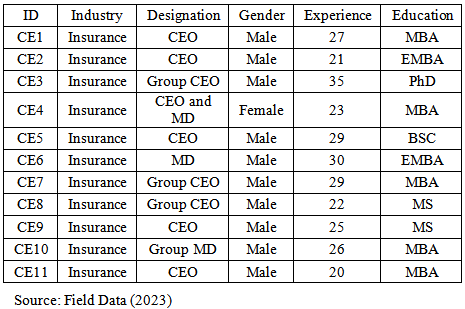
Respondents were CEOs of insurance companies in Kenya with sufficient experience, exposure to the strategic and dynamics of organizational leadership, and an active role in implementing policies and practices in their organizations. These aspects of strategic acumen, coupled with their industry leadership experience, were likely to make them a suitable choice for providing information on collaborative leadership and the performance of their organizations 80. The summary of the demographic characteristics of respondents is presented in Table 1.
Thematic Analysis
The study employed the thematic analysis process developed by Braun and Clarke 84, which consists of six distinct phases, structured in a logical, sequential order but recursive and iterative. These six phases were viewed as guiding principles rather than inflexible directives. This methodological framework provided a rigorous, structured approach to extracting meaningful component themes and patterns from the qualitative data. By adhering to these steps, the authors ensured a methodical and comprehensive examination of the data, ultimately contributing to the robustness and credibility of the study's findings 84. The authors employed a deductive approach to thematic analysis, as advised by Boyatzis 85 and Braun and Clarke 84, ensuring alignment with the central research question. In this 'researcher-driven' process, thematic codes were established according to the elucidated study’s conceptual plan. The subsequent sections describe the systematic steps of the Braun and Clarke 83 thematic data analysis methodology, facilitating a clear presentation of the qualitative results.
The initial familiarization with the data phase involved an acquaintance with the dataset. This commenced with an extensive review of the interview recordings, where each recording was listened to in its entirety before transcription. During this process, the researcher maintained focused attention, making succinct notations, pausing, and replaying audio as needed to capture critical elements accurately. The primary objective was to grasp salient sub-themes and areas covered in each interview prior to transcription. Transcriptions were conducted using the "Cockatoo" online tool and underwent multiple revisions, accompanied by the documentation of preliminary patterns and reflections on the data and analytical process.
The second generating initial codes phase transitioned the data coding process from NVivo software (version 14) to Microsoft Excel Spreadsheet (version 2016). This shift facilitated the systematic cataloguing of data elements in columns, enabling the researcher to maintain structural oversight. The process emphasized equal sensitivity to context in all interview transcripts, as it was predominantly deductive. All codes from the initial coding iteration in NVivo were transferred, and corresponding participant narratives were entered into the Excel spreadsheet. Subsequent coding iterations were recorded in both NVivo and Excel.
The third generating themes step involved the derivation of overarching and component themes. The primary theme, "Collaborative Leadership Influence on Performance," and the component theme ", collaborative leadership", were deduced through examination of theoretical literature and research questions, in alignment with Braun and Clarke 83, 84. The researcher consolidated codes into initial sub-themes, such as "Collaboration" and "Leaders' Behavior," supported by distinct and concurrent narratives. Similarly, the sub-theme "Relationships" was formulated by aggregating relevant coded data items.
In the fourth step, reviewing themes, sub-themes with unclear boundaries were reviewed to establish coherence and distinctiveness. The iterative nature of the analysis allowed for reconsidering earlier stages and incorporating fresh interpretations. The researcher's constructivist and interpretivist approaches were pivotal in constructing and reconstructing sub-themes, ensuring alignment with theoretical constructs and the research coding phase. The defining and naming themes phase involved revisiting themes, sub-themes, and codes, including revisions to definitions and names where necessary. Short narratives were created for each theme to enhance understanding of the research story and its connection to the research questions. This process was informed by theoretical assumptions and pertinent literature, facilitating a holistic grasp of the research narrative.
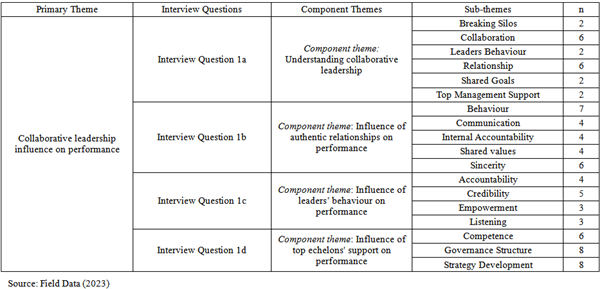
The sixth and final stage entailed the development of the research's final report, where the findings were presented and discussed in response to the research questions. Themes and codes were continually reviewed as the final data presentation was constructed. This stage represents the culmination of the research story's articulation in response to the research questions. Since the study aimed to explore respondents' opinions concerning the influence of collaborative leadership on the performance of insurance companies in Kenya, the final responses were classified into codes linked (n), sub-themes, component themes and the primary theme. These are presented in Table 2. The study was designed to answer one central research question, which constituted the primary theme, “Collaborative Leadership Influence on Performance”:
RQ: How does collaborative leadership influence the performance of insurance companies in Kenya?
Understanding Collaborative Leadership
In the first interview question, the respondents in this study were asked to elucidate their comprehension of collaborative leadership in the context of insurance companies in Kenya. A thematic representation table (Table 2) illustrates the key components and sub-themes of this understanding. The study delved into the concept of collaborative leadership in the insurance sector, and several vital sub-themes emerged from the respondents' perceptions. "Collaboration" was a central theme, with respondents highlighting its significance in connecting various departments like human resources, product development, and information communication technology. These shared departments were seen as a foundation for promoting collaboration and teamwork across the organization. Additionally, "relationship" emerged as a prominent sub-theme, underscoring the importance of building consensus, conflict management, and the development of robust relationships to reduce operational losses and ensure long-term sustainability.
Another crucial sub-theme was "shared goals," emphasizing the role of managers in taking ownership of shared responsibilities and working collectively to achieve common business objectives. This extended to collaboration within and outside the organization to address market risks and promote industry growth. Respondents also stressed the significance of leadership behaviour, top executive support, and breaking down departmental silos as integral elements of collaborative leadership. They recognized that such leadership could enhance organizational performance, customer satisfaction, and competitive positioning in the market.
Furthermore, the study underscored the role of top executives in fostering a collaborative culture and its potential benefits, including improved service delivery, enhanced shareholder value, and increased corporate social responsibility. The breakdown of departmental silos was identified as a vital step in addressing systemic organizational and industry issues that hinder growth and market penetration within the insurance sector. Overall, the respondents' vews emphasized the importance of fostering collaboration, cultivating robust relationships, working towards shared goals, exhibiting the right leadership behaviour, and securing top executive support to maximize the potential of collaborative leadership in the insurance industry.
Influence of Authentic Relationships on Performance
In the second interview question, respondents were asked to share their views on the influence of the authenticity of employee relationships on the performance of their organizations. The findings are represented in Table 2. One prominent sub-theme, "sincerity," was mentioned by six respondents a total of thirteen times, highlighting the close association between authenticity and sincerity. Respondents expressed concerns about the lack of sincerity among employees within their organizations and across the insurance industry. The authenticity concept was linked to trust and shared responsibility, with several respondents emphasizing its critical role in fostering organizational performance through trust and shared responsibility.
Another noteworthy sub-theme was "internal accountability," emphasized by most respondents. They highlighted its importance in cultivating authentic relationships among employees, especially in light of challenges related to sincerity. The leadership in insurance companies had initiated mechanisms to encourage internal dialogues and foster employee engagement, particularly during product development processes, promoting internal accountability. Furthermore, the sub-theme "shared values" was mentioned six times and was interwoven with other sub-themes, reflecting its multi-disciplinary nature. Shared values were identified as a crucial element that cut across communication, collaboration, behaviour, and trust among employees, facilitating an understanding of shared values and the need to address employee concerns to integrate these values effectively.
Influence of Leaders' Behaviour on Performance
The third interview question aimed to explore the influence of leaders' behaviours on the performance of insurance companies in Kenya. The findings are structured in Table 2, which reveals four key sub-themes. "Credibility" emerged as a significant sub-theme, discussed by five respondents. Credibility was linked to issues of fraud and corruption within insurance companies, with leaders' trustworthiness and integrity viewed as pivotal to the industry's reputation and sustainability. The study shed light on how leadership credibility is central to addressing internal fraud and corruption and ensuring the ethical functioning of insurance organizations.
"Accountability" was another prominent sub-theme mentioned by four respondents. The lack of leadership accountability was identified as a prevalent issue across insurance companies, with potential roots in recruitment practices, especially the inclusion of external agents who may not be solely employed by one company. Establishing effective accountability mechanisms to monitor team productivity and leadership effectiveness was proposed as a solution to address this challenge. Additionally, "empowerment" and "listening" emerged as important sub-themes, each discussed by three respondents. Empowerment was seen as a means to address historical issues by educating employees on ethics and integrity, while effective listening was regarded as essential for fostering the exemplary leadership mindset, building trust, and finding solutions to internal challenges. Open discussions facilitated by leaders were identified as valuable tools for building trust and improving employee connections within the organization.
Influence of Top Echelons Support on Performance
The fourth interview question aimed to examine the influence of top echelons support on the performance of insurance companies in Kenya. The findings are summarized in Table 2, which highlights three primary sub-themes. "Governance structure" emerged as a critical sub-theme, raised by eight respondents, who emphasized the importance of establishing effective governance models within insurance companies. These governance structures were seen as essential for fostering internal and external collaboration, enabling conversations at various organizational levels, including the board level, and connecting with external stakeholders to address performance-affecting issues, particularly related to customer experience.
"Strategy" was another central sub-theme, also discussed by eight respondents. They underlined strategic alignment's significance, particularly at the board level. Respondents stressed the need for robust customer education strategies, especially among top insurers, to combat the issue of low insurance penetration. Furthermore, they acknowledged that misalignment in strategic priorities between the board and top management, especially in terms of ethical considerations, could significantly impact overall organizational performance. This misalignment was identified as a challenge affecting several insurance companies in Kenya.
"Competence" in the top leadership was the final sub-theme mentioned by six respondents. They expressed concerns about leadership appointments based on personal connections rather than merit and called for the development of competent leaders who possess the necessary skills to handle risks, offer strategic support, and align the interests of the board and investors to improve overall performance. This emphasis on leadership competence and the understanding of insurance fundamentals was deemed essential for effectively communicating the value of the business to various stakeholders, thereby benefiting customers and staff and ensuring a return on investment for investors.
Emerging Component Themes.
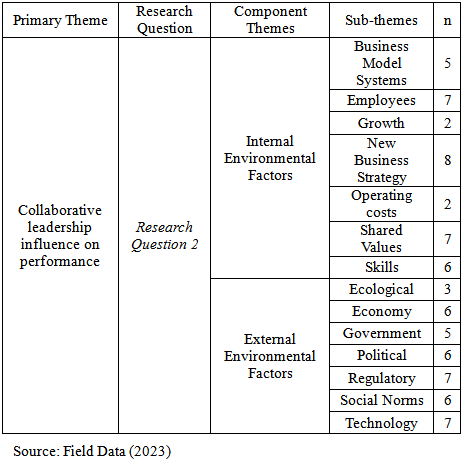
As part of the emerging issues, respondents were asked to highlight some of the environmental dynamism factors that influence collaborative leadership and performance. Table 3 below summarizes the emergent component sub-themes based on respondents' feedback. Environmental dynamism is defined as the rate of change in various environmental factors over time 89. Internal environmental dynamism involves changes within the insurance companies themselves. Respondents highlighted factors contributing to internal environmental changes, such as shifts in customer preferences, evolving organizational structures, changes in competitive dynamics, and adopting new technologies. These changes necessitate adaptability within the organization to stay competitive and enhance performance. External environmental dynamism pertains to changes occurring outside the insurance companies. Participants in the study identified external environmental factors such as evolving market conditions, changes in legal and regulatory landscapes, technological advancements, and competitive shifts. These external changes impact the insurance industry, requiring companies to effectively adjust their strategies and operations to navigate the evolving external environment.Top of Form.
The exploration of collaborative leadership within the insurance industry in Kenya elicited diverse perspectives from respondents, revealing a lack of consensus on its precise definition across multiple disciplines. Nevertheless, a clear consensus emerged regarding the substantial influence of collaborative leadership on performance. Key factors identified by respondents as vital for understanding and practising authentic relationships within insurance companies, which subsequently influence performance, include sincerity, shared values, effective communication, and desirable employee behaviours. The results align with prior research findings, such as Lau's 91 investigation on collaboration strategies that emphasized the critical role of employee talents, expertise, creativity, and skills in resolving complex organizational challenges, mirroring the behaviour sub-theme in this study.
The qualitative findings also underscored the influence of leaders' behaviour on insurance companies' performance, with leaders' credibility identified as the most pivotal behaviour. These findings are consistent with research by Markle-Reid et al. 38, which identified seven leadership behaviours crucial to performance, including understanding, relationship-building, communication clarity, alignment of shared values, capacity building and development, alignment of teams and tasks, and open sharing of information and knowledge. These attributes correlate with the sub-themes in this study, namely, listening (comprising understanding, relationship-building, and communication clarity), accountability (encompassing shared values and alignment of teams and tasks), and empowerment (encompassing capacity building, development, and open sharing of information and knowledge).
Furthermore, the examination revealed that governance structure, specifically as part of the top management support, is a pivotal factor influencing insurance companies' performance. This outcome is consistent with Mugo, Namusonge, and Sakwa's 92 research on organizational core competencies within insurance companies in Kenya, highlighting the significant impact of strategy, operational processes, and systems on organizational performance and positioning. These align with the present study's sub-themes of strategy and governance structures, which encompass operational processes and systems. Additionally, the study confirmed the positive influence of environmental dynamism on collaborative leadership and the performance of insurance companies in Kenya, encompassing changes in skills, shared values, operating costs, new business strategies, growth, employees, and business model systems. These insights can inform the strategic focus of insurance companies as they seek to address and enhance their performance 86. Table 4 summarises some of the vital performance sub-themes shared by respondents as critical and influenced by collaborative leadership.
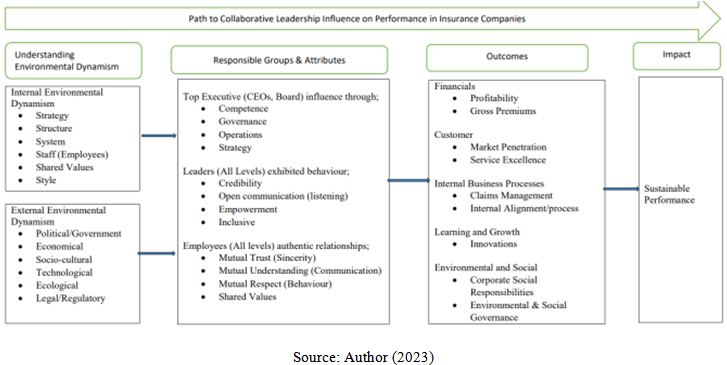
This study aimed to enrich the discourse surrounding collaborative leadership and its relationship with performance. It adopted an interpretivist paradigm, utilizing a qualitative research design to investigate the interplay between collaborative leadership and performance in insurance companies in Kenya. The research addressed a notable gap in the literature, particularly the scarcity of consensus on models addressing the effective implementation of collaborative leadership and its influence on the performance of organizations. Based on the findings of this study, the authors propose a novel collaborative leadership model, depicted in Figure 1, emphasizing the importance of understanding both internal and external environmental dynamism as emerging factors influencing the success of collaborative leadership influence on the performance of organizations. Moreover, the framework underlined the significance of organisational players' and leaders' key attributes and responsibilities in fostering a collaborative leadership culture within their organizations.
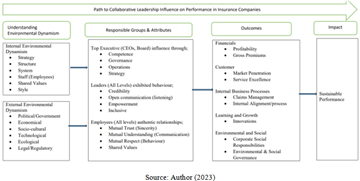
The study contributes to the theoretical understanding of collaborative leadership and provides practical insights for organizations, more specifically, insurance companies in Kenya. Introducing a structured framework that considers environmental dynamism and leadership attributes equips leaders with a strategic tool to enhance collaborative leadership, ultimately leading to improved performance outcomes. The framework addresses a critical need in the evolving organizational landscape, where effective leadership practices are pivotal for sustainable performance.
This study makes a significant practical contribution to leadership within insurance companies in Kenya by introducing a novel framework for enhancing collaborative leadership. This framework offers a structured and practical approach to navigating the intricate interplay between collaborative leadership, environmental dynamism, and organizational performance. By highlighting the importance of comprehending internal and external environmental dynamism, the framework equips insurance company leaders with a strategic tool to foster effective collaborative leadership, ultimately leading to sustainable and improved performance outcomes. This contribution can be borrowed cautiously across various organizational contexts where effective leadership practices are crucial.Top of Form
The first limitation is regarding the sampling technique, which was purposive sampling. This technique helped search for suitable respondents within the insurance companies in Kenya for the study while remaining within time and resource constraints. Insurance companies' cultures differed, which may have affected respondents' responses. Further, the data was collected from the top echelons of the insurance companies in Kenya. Although top echelons were selected as strategic experts to give their assessment, there is merit for future respondents to cut across lower levels of the hierarchy, which could enhance the richness of data. Time and resource constraints compelled the authors to restrict data collection from eleven insurance companies in Kenya.
The findings of this study strongly indicate a favourable positive influence of collaborative leadership on the performance of insurance companies in Kenya. Respondents' perceptions and insights consistently highlighted the significance of collaborative leadership in enhancing various aspects of performance and success within the insurance companies in Kenya. Collaborative leadership variables (authentic relationships, leaders' behaviour, top echelons' support) were associated with many positive outcomes, as evidenced by the respondents' comments and observations.
The study illuminated that collaborative leadership is perceived as a vital driver of improved performance within insurance companies. The emphasis on collaboration, relationship-building, shared goals, leadership behaviour, top echelons support, and the breaking down of silos all underscored the belief that collaborative leadership is a critical factor in achieving better results for these organizations. Respondents pointed out that when organizations actively foster collaborative leadership and facilitate an environment of authenticity among employees, effective leaders' behaviour and enhanced top echelons' support lead to mutual trust, respect and understanding, shared values, open communication, inclusiveness, empowerment and credibility in leaders, governance, operational, and strategic support from top echelons and improved competency. This, in turn, minimizes losses, enhances customer satisfaction, and positions organizations to anticipate and meet customer needs more effectively.
Moreover, the study highlighted that top executives play a pivotal role in promoting a culture of collaborative leadership, which has the potential to improve service delivery, shareholder value, and enhanced corporate social responsibility. The collective sentiment among respondents was that collaborative leadership serves as a catalyst for organizational growth and competitive advantage, allowing organizations to resolve systemic issues and compete effectively. In sum, the research findings suggest that collaborative leadership is a driving force behind the enhanced performance and success of organizations.
Acknowledging the limited geographical scope of this research, which primarily focused on Kenya, is essential. Therefore, future research should encompass a broader range of geographical settings to gain a more comprehensive understanding of collaborative leadership's conditions and outcomes and its impact on performance. Given the valuable insights acquired from the study's respondents, it is recommended that further investigations be conducted in diverse countries where insurance market penetration levels are notably higher than in Kenya. Cross-national studies across these regions can shed light on the practice and impact of collaborative leadership in varying contexts, offering potential strategies for enhancing the performance of insurance companies within these markets.
It is advisable to expand the scope to encompass other organizational contexts to enhance the depth and breadth of research endeavours. This expansion should encompass sectors like banking, telecommunications, microfinance, and the tobacco industry. Such an approach will provide a more comprehensive and holistic understanding of the applicability and impact of collaborative leadership across a diverse range of organizational domains, facilitating the identification of common principles and unique insights applicable to various industries.
The authors have no competing interests.
| [1] | Leithwood, K., Louis, K.S., Anderson, S., and Wahistrom, K. (2004). How leadership influences student learning. The Wallace Foundation. https://www.wallacefoundation.org/knowledge-center/documents/how-leadership-influences-student-learning.pdf. | ||
| In article | |||
| [2] | Leithwood, K., & Mascall, B. (2008). Collective Leadership Effects on Student Achievement. Educational Administration Quarterly, 44(4), 529-561. | ||
| In article | View Article | ||
| [3] | Drummond, S. B. (2019). Dynamic discernment. Pilgrim Press. ISBN-10: 0829820450, ISBN-13: 978-0829820454. https://www.abebooks.com/9780829820454/Dynamic-Discernment-Reason-Emotion-Power-0829820450/plp. | ||
| In article | |||
| [4] | Calvert, K. (2018). Collaborative Leadership: Cultivating an Environment for Success. Collaborative Librarianship: Vol. 10: Issue 2, Article 4. https://digitalcommons.du.edu/collaborativelibrarianship/vol10/iss2/4. | ||
| In article | |||
| [5] | Goleman, D., & Boyatzis, R. (2013). HBR's 10 need to-reads on collaboration. Harvard Business Review Press. ISBN: 9781422190128, ISBN10: 1422190129. https://store.hbr.org/product/hbr-s-10-must-reads-on-collaboration-with-featured-article-social-intelligence-and-the-biology-of-leadership-by-daniel-goleman-and-richard-boyatzis/11378. | ||
| In article | |||
| [6] | Harris, C. B., Barnier, A. J., & Sutton, J. (2012). Consensus collaboration enhances group and individual recall accuracy. The Quarterly Journal of Experimental Psychology, 65(1), 179-194. | ||
| In article | View Article PubMed | ||
| [7] | Yukl, G. (2012). Effective leadership behavior: what we know and what questions need more attention. Academy of Management Perspectives, 26(4): 66–85. | ||
| In article | View Article | ||
| [8] | Bird, A., Mendenhall, M., Stevens, M. J., & Oddou, G. (2010). Defining the content domain of intercultural competence for global leaders. Journal of Managerial Psychology, 25(8), 810–828. | ||
| In article | View Article | ||
| [9] | Blaess D. A., Hollywood K. G., Grant C. (2012). Preparing the professoriate to prepare globally competent leaders. Journal of Leadership Studies, 6(2), 88-94. | ||
| In article | View Article | ||
| [10] | Hoogsteen, T.J. (2020). Collective efficacy: toward a new narrative of its development and role in achievement. Palgrave Communications. | ||
| In article | View Article | ||
| [11] | Lowy, A., Hood, P. and Singer, E. (2005). The networked idealist advantage. Strategy and Leadership, Vol. 33, No. 3, 4 -10. | ||
| In article | View Article | ||
| [12] | Maalouf, G. Y. (2019). Effects of collaborative leadership on organizational performance. International Journal of Multidisciplinary Research and Development, Volume 6, Issue 1, Pages 138-144. | ||
| In article | View Article | ||
| [13] | Schmidt, H. (2006) Leadership styles and leadership change in human and community service organisations. Nonprofit Management and Leadership, Vol. 17, No. 2. | ||
| In article | View Article | ||
| [14] | Archer, D., & Cameron, A. (2013). Collaborative leadership: Building relationships, handling conflict and sharing control (2nd ed.). Routledge. ISBN: 9780415539494. https://www.routledge.com/Collaborative-Leadership-Building-Relationships-Handling-Conflict-and/Archer-Cameron/p/book/9780415539494. | ||
| In article | View Article | ||
| [15] | Ang’ana, G. A., & Kilika, J. M. (2022). Collaborative Leadership in an Organizational Context: A Research Agenda. Journal of Human Resource & Leadership, 6(1), 48–71. | ||
| In article | View Article | ||
| [16] | Akpedonu, T., Lumsdaine, B., and Sow, A. (2013). Keeping the peace: lessons learned from preventive action towards Kenya's 2013 elections. Geneva, The Graduate Institute of International and Development Studies, Geneva Peacebuilding Platform. Geneva peacebuilding platform paper; no. 10. https://repository.graduateinstitute.ch/record/288064?ln=en. | ||
| In article | |||
| [17] | Ang’ana, G., A., & Chiroma J., A. (2021). Collaborative leadership and its influence in building and sustaining successful cross-functional relationships in organizations in Kenya. IOSR Journal of Business and Management (IOSR-JBM), 23(08), 2021, pp. 18-26. | ||
| In article | |||
| [18] | Bolon, I., Mason, J., O'Keeffe, P., Haeberli, P., Adan, H. A., Karenzi, J. M., Osman, A. A., Thumbi, S. M., Chuchu, V., Nyamai, M., Babo Martins, S., Wipf, N. C., & Ruiz de Castañeda, R. (2020). One Health education in Kakuma refugee camp (Kenya): From a MOOC to projects on real world challenges. One health (Amsterdam, Netherlands), 10, 100158. | ||
| In article | View Article PubMed | ||
| [19] | Tondeur, J., van Braak, J., Ertmer, P.A. et al. (2017). Understanding the relationship between teachers’ pedagogical beliefs and technology use in education: a systematic review of qualitative evidence. Education Tech Research Dev 65, 555–575 (2017). | ||
| In article | View Article | ||
| [20] | Brock, M. E., Cannella-Malone, H. I., Seaman, R. L., Andzik, N. R., Schaefer, J. M., Page, E. J., Barczak, M. A., & Dueker, S. A. (2017). Findings Across Practitioner Training Studies in Special Education: A Comprehensive Review and Meta-Analysis. Exceptional Children, 84(1), 7-26. | ||
| In article | View Article | ||
| [21] | Meister, J. C. and Willyerd, K. (2020). The 2020 Workplace: How innovative Companies Attract, Develop, and Keep Tomorrow's Employees Today. HarperCollins. ISBN 0061992356, 9780061992353. https://www.amazon.com/2020-Workplace-Innovative-Companies-Tomorrows/dp/0061763276. | ||
| In article | |||
| [22] | Amborg, J., Bauer, S., Boschert, F., et al. (2016). Collaborative leadership: Engaging collective intelligence to achieve results across organizational boundaries, white paper. Oxford Leadership. https://www.oxfordleadership.com/wp-content/uploads/2017/07/OL-White-Paper-Collaborative-rship.pdf. | ||
| In article | |||
| [23] | Bryson, J. M., Crosby, B. C., & Stone, M. M. (2015). Designing and implementing cross-sector collaborations: Needed and challenging. Public Administration Review, 75(5), 647- 663. | ||
| In article | View Article | ||
| [24] | De Silva, M., Howells, J., & Meyer, M. (2018). Innovation Intermediaries and Collaboration: Knowledge-Based Practices and Internal Value Creation. Research Policy, 47, 70-87. | ||
| In article | View Article | ||
| [25] | Drago-Severson, E., & Blum-DeStefano, J. (2019). Growing leaders in schools and out: Building internal capacity for the mid-21st-century. Development and Learning in Organizations: An International Journal, 34(2), 49-52. | ||
| In article | View Article | ||
| [26] | Hargreaves, E. & Elhawary, D. (2020). Exploring collaborative interaction and self-direction in teacher learning teams: Case studies from a middle-income country analyzed using Vygotskian theory. Compare: A Journal of Comparative and International Education, 50(1), 71-89. | ||
| In article | View Article | ||
| [27] | Bakken, L. (2018). Evaluation practice for collaborative growth. Oxford University Press, Incorporated. ISBN-13: 978-0190885373, ISBN-10: 0190885378. https://global.oup.com/academic/product/evaluation-practice-for-collaborative-growth-9780190885373. | ||
| In article | |||
| [28] | Berardo, R., Fischer, M., & Hamilton, M. (2020). Collaborative governance and the challenges of network-based research. American Review of Public Administration, 50(8), 898- 913. | ||
| In article | View Article | ||
| [29] | Boyer, E. J., Kolpakov, A., & Schmitz, H. P. (2019). Do executives approach leadership differently when they are involved in collaborative partnerships? A perspective from international nongovernmental organizations (INGOs). Public Performance & Management Review, 42(1), 213-240. | ||
| In article | View Article | ||
| [30] | Munene, C. M. (2013). Generation Y employees perception of the role of leadership in retention: A survey of commercial banks in Kenya. Research Project submitted to Strathmore University. https://su-plus.strathmore.edu/items/15f9432c-b8eb-4e4e-a724-2f4a999e198b. | ||
| In article | |||
| [31] | Seims, L. R. K., Alegre, J. C., Murei, L., Bragar, J., Thatte, N., Kibunga, P., & Cheburet, S. (2012). Strengthening management and leadership practices to increase health-service delivery in Kenya: an evidence-based approach. Human resources for health, 10(25), 1-7. | ||
| In article | View Article PubMed | ||
| [32] | Cairns-Lee, H., Lawley, J., & Tosey, P. (2022). Enhancing Researcher Reflexivity About the Influence of Leading Questions in Interviews. The Journal of Applied Behavioral Science, 58(1), 164-188. | ||
| In article | View Article | ||
| [33] | Lee, Y., and Yeunjae L. (2017). Exploring the impacts of relationship on employees’ communicative behaviors during issue periods based on employee position. Corporate Communications: An International Journal 22:4, 542-555. https://www.semanticscholar.org/paper/Exploring-the-impacts-of-relationship-on-employees%E2%80%99-Lee/d10edfb8f6e37a68feebc35c95a2f1a8899cfd38. | ||
| In article | View Article | ||
| [34] | Jiang, H. and Men, R.L. (2015). Creating an engaged workforce: the impact of authentic leadership, transparent organizational communication, and work-life enrichment. Communication Research, Vol. 44 No. 2, pp. 225-243. | ||
| In article | View Article | ||
| [35] | Leroy, H., Anseel, F., Gardner, W.L. and Sels, L. (2015). Authentic leadership, authentic followership, basic need satisfaction, and work role performance. Journal of Management, Vol. 41 No. 6, pp. 1677-1697. | ||
| In article | View Article | ||
| [36] | Hurley, T., J. (2011). Collaborative leadership: Engaging collective intelligence to achieve results across organizational boundaries. Oxford Leadership. https://www.oxfordleadership.com/collaborative-leadership-white-paper/. | ||
| In article | |||
| [37] | Getha-Taylor, H. & Morse, R. S. (2013). Collaborative leadership development for local government officials: Exploring competencies and program impact. Public Administration Quarterly. 37 (1): 71–102. https://www.jstor.org/stable/24371989. | ||
| In article | |||
| [38] | Markle-Reid, M., Dykeman, C., Ploeg, J., Kelly S. C., Andrews, A., Bonomo, S., Orr-Shaw, S., & Salker, N. (2017). Collaborative leadership and the implementation of community-based fall prevention initiatives: a multiple case study of public health practice within community groups. BMC Health Services Research. 17 (1): 141. https://pubmed.ncbi.nlm.nih.gov/28209143/. | ||
| In article | View Article PubMed | ||
| [39] | Akhabue, A. O. (2015). Understanding the relationship between leader-member exchange (LMX) and organizational commitment. The Business and Management Review, 6(5), 213-220. https://cberuk.com/cdn/conference_proceedings/v6%20n5%20bmr%2010.pdf. | ||
| In article | |||
| [40] | Robbins, S. P., & Judge, T. A. (2015). Organizational behaviour. (15thed.). Upper Saddle River, New Jersey: Pearson Publishing Inc. ISBN-13: 978-0-13-283487-2; ISBN-10: 0-13-283487-1. http://www.mim.ac.mw/books/Organizational%20Behavior%20(15e).pdf. | ||
| In article | |||
| [41] | Goddard, R., Goddard, Y., Sook Kim, E., & Miller, R. (2015). A Theoretical and Empirical Analysis of the Roles of Instructional Leadership, Teacher Collaboration, and Collective Efficacy Beliefs in Support of Student Learning. American Journal of Education. | ||
| In article | View Article | ||
| [42] | Vaggers, J., & Anderson, E.S. (2021): An essential model for leaders to enable integrated working to flourish: a qualitative study examining leaders of Children’s Centers. Journal of Inter professional Care. | ||
| In article | View Article PubMed | ||
| [43] | Wilson, S. (2013). Collaborative leadership: it's good to talk. British Journal of Healthcare Management. 19 (7): 335–337. | ||
| In article | View Article | ||
| [44] | Emerson, K., Nabatchi, T., and Balogh, S. (2012). An Integrative Framework for Collaborative Governance. Journal of Public Administration Research and Theory. 22 (1): 1–29. | ||
| In article | View Article | ||
| [45] | Kinder, T., Stenvall, J., Six, F., & Memon, A. (2021). Relational leadership in collaborative governance ecosystems. Public Management Review, 23:11, 1612-1639. | ||
| In article | View Article | ||
| [46] | Fiberesima, D.D., and Abdul Rani, N.S. (2013). Strategy Management and Business Success. Proceedings of the 2012 International Conference on Industrial Engineering and Operations Management, Istanbul, Turkey, 6, 26-33. https://www.researchgate.net/publication/280147527_Strategy_Management_and_Business_Success. | ||
| In article | |||
| [47] | Kalei, A. (2018). The Influence of Collaborating Strategy in Improving Employees’ Performance in Insurance Companies in Homa Bay County, Kenya. East African Scholars Journal of Economics, Business and Management, Volume-1, Issue-3; 47-56. | ||
| In article | |||
| [48] | Kamau R. C., and Kwanya, T. (2019). The Impact of Knowledge Management on the Competitiveness of Insurance Firms in Kenya. In book: Emerging Trends in Information and Knowledge Management Publisher. Moi University Press. https://www.semanticscholar.org/paper/The-Impact-of-Knowledge-Management-on-The-of-Firms-Kamau-Kwanya/5ff7f8d70a53a7725f12102c444212ad5422a7a5. | ||
| In article | |||
| [49] | Graen, G. B., & Scandura, T. A. (1987). Toward a Psychology of Dyadic Organizing. Research in Organizational Behavior, 9, 175-208. https://terriscandura.com/redesign/wp-content/uploads/2017/08/Toward-a-Psychology-of-Dyadic-Organizing-Graen-Scandura87.pdf. | ||
| In article | |||
| [50] | Derindag, O.F., Demirtas, O., and Bayram, A. (2021). The Leader-Member Exchange (LMX) influence at organizations. The Moderating Role of Person-Organization (PO) Fit. Review of Business Ethics, 41(2); 32-48. https://www.proquest.com/scholarly-journals/leader-member-exchange-lmx-influence-at/docview/2546154776/se-2. | ||
| In article | |||
| [51] | Dulebohn, J.H., Bommer, W.H., Liden, R.C., Brouer, R. and Ferris, G.R. (2012) A Meta-Analysis of the Antecedents and Consequences of Leader-Member Exchange: Integrating the Past with an Eye toward the Future. Journal of Management, 38, 1715-1759. | ||
| In article | View Article | ||
| [52] | Akpan, V. I., Igwe, U. A., Mpamah, I. B. I., and Okoro, C. O. (2020). Social Constructivism: Implications on Teaching and Learning. British Journal of Education. Vol.8, Issue 8, pp.49-56. https://www.eajournals.org/wp-content/uploads/Social-Constructivism.pdf. | ||
| In article | |||
| [53] | Ivey, G.W., & Kline, T. J. B. (2010). Transformational and active transactional leadership in the Canadian military. Leadership and Organizational Development Journal, 31(3), 246-262. | ||
| In article | View Article | ||
| [54] | Schreiber, L. M., & Valle, B. E. (2013). Social constructivist teaching strategies in the small group classroom. Small Group Research, 44(4), 395–411. | ||
| In article | View Article | ||
| [55] | Vygotsky, L (1962). Thought and Language. Cambridge: M.I.T.Press, Massachusetts Institute of Technology. https://mitpress.mit.edu/9780262720014/thought-and-language/. | ||
| In article | View Article | ||
| [56] | Freeman, E.R. (1984). Strategic Management: A Stakeholder Approach. Cambridge University Press. ISBN: 978-0521151740. https://www.amazon.com/Strategic-Management-A-Stakeholder-Approach/dp/0521151740/ref=pd_bxgy_b_img. | ||
| In article | |||
| [57] | Donaldson, T., & Preston, L. E. (1995). The Stakeholder Theory of the Corporation: Concepts, Evidence, and Implications. The Academy of Management Review, 20(1), 65–91. | ||
| In article | View Article | ||
| [58] | Donaldson, T. (2002). The Stakeholder Revolution and the Clarkson Principles. Business Ethics Quarterly, 12(2), 107–111. http://www.jstor.org/stable/3857806. | ||
| In article | View Article | ||
| [59] | Hubbard G. (2009). Measuring organizational performance: Beyond the triple bottom line. Business Strategy and Environment, 19, 177-191. | ||
| In article | View Article | ||
| [60] | Kaplan, R. S., & Norton, D. P. (1996). The balanced scorecard: Translating strategy into action. Boston: HBS Press. https://www.hbs.edu/faculty/Pages/item.aspx?num=8831. | ||
| In article | |||
| [61] | Benami E*, Jin Z-N*, Carter M, Ghosh A, Hijmans RJ, Hobbs A, Kenduiywo B, Lobell DB. (2020). Uniting Advances in Remote Sensing, Crop Modeling, & Economics for Understanding and Managing Weather Risk in Agriculture. Nature Review Earth & Environment. https://10.1038/s43017-020-00122-y. | ||
| In article | View Article | ||
| [62] | OECD. (2021). Global Insurance Market Trends 2020. https://www.oecd.org/daf/fin/insurance/Global-Insurance-Market-Trends-2020.pdf. | ||
| In article | |||
| [63] | Apergis, N. and Poufinas, T. (2020). The role of insurance growth in economic growth: Fresh evidence from a panel of OECD countries. The North American Journal of Economics and Finance, 53, (C). | ||
| In article | View Article | ||
| [64] | Bagus, U., Jurd de Girancourt, F., Mahmood, R., and Manji, Q. (December 2020). The African insurance market is set for take-off: Five strategic considerations to help guide insurance companies on their journey to success in Africa. https://www.mckinsey.com/featured-insights/middle-east-and-africa/africas-insurance-market-is-set-for-takeoff#. | ||
| In article | |||
| [65] | Kiragu, R. W. (2016). Influence of Innovation on performance of Insurance companies in Kenya. Doctoral dissertation, Strathmore University. https://su-plus.strathmore.edu/bitstreams/fb85a6af-75b8-44ca-a414-7a6088311359/download. | ||
| In article | |||
| [66] | Azinga, E.N., Kamaara, M., Nzulwa, J., & Ombui, K. (2019). Influence of leadership styles on employees’ turnover in the insurance industry in Kenya. International Journal of Human Resources and Procurement. Vol. 8 (2) pp 1-22.http://www.ijsse.org/images/ijhrp_v8_i2_1_22.pdf. | ||
| In article | |||
| [67] | Nyaga, P. K., & Muema, M. W. (2017). An analysis of the effect of pricing strategies on profitability of Insurance firms in Kenya. International Journal of Finance and Accounting, 2(3), 44-65. https://www.iprjb.org/journals/index.php/IJFA/article/download/320/434/1541. | ||
| In article | View Article | ||
| [68] | Langat, G. K., Linge, T. K., & Sikalieh, D. (2019). Influence of Inspirational Motivation on Employee Job Performance in the Insurance Industry in Kenya. International Journal of Research in Business and Social Science (2147- 4478), 8(6), 01–07. | ||
| In article | View Article | ||
| [69] | Otwori, A. M., & Muturi, W.M. (2019). Influence of strategic leadership on performance of insurance companies in Kenya. International Journal of Economics, Commerce and Management United Kingdom, Vol. VII, Issue 12. http://ijecm.co.uk/wpcontent/uploads/2019/12/71212.pdf. | ||
| In article | |||
| [70] | Endres, T., Kranzdorf, L., Schneider, V. et al. (2020). It matters how to recall – task differences in retrieval practice. Instr Sci 48, 699–728. | ||
| In article | View Article | ||
| [71] | Martin, T. (2021). The effects of collaborative leadership practices on employee satisfaction levels. Theses and Dissertations. 1208. https://digitalcommons.pepperdine.edu/etd/1208. | ||
| In article | |||
| [72] | Teece, D. J. (2007). Explicating Dynamic Capabilities: The Nature and Micro foundations of (Sustainable) Enterprise Performance. Strategic Management Journal, 28(13), 1319–1350. | ||
| In article | View Article | ||
| [73] | Zahra, S.A., Gedajlovic, E., Neubaum, D.O. and Shulman, J.M. (2009). A typology of social entrepreneurs: Motives, search processes and ethical challenges. Journal of Business Venturing, 24(5), 519-532. | ||
| In article | View Article | ||
| [74] | Porter, C., Palmier-Claus, J., Branitsky, A., Mansell, W., Warwick, H., & Varese, F. (2020). Childhood adversity and borderline personality disorder: a meta-analysis. Acta psychiatrica Scandinavica, 141(1), 6–20. | ||
| In article | View Article PubMed | ||
| [75] | Bertalanffy, L.V. (1950). The theory of open systems in physics and biology. Science, 111, 23-29. http://vhpark.hyperbody.nl/images/a/aa/Bertalanffy-The_Theory_of_Open_Systems_in_Physics_and_Biology.pdf. | ||
| In article | View Article PubMed | ||
| [76] | Maru, B. W. (2015). Application of McKinsey 7s Model in strategy implementation at the Kenya Revenue Authority. Journal of Strategic Management, 3 (6), 67-89. https://docplayer.net/49156456-Application-of-the-mckinsey-7s-model-in-strategy-implementation-at-the-kenya-revenue-authority-by-beatrice-wanjiru-maru.html. | ||
| In article | |||
| [77] | Echavarria, M. (2015). Enabling Collaboration: Achieving Success through Strategic Alliances and Partnerships. LID Publishing Inc. ISBN 9780986079337. https://www.abebooks.com/9780986079337/Enabling-Collaboration-Framework-Successfully-Establishing-0986079332/plp. | ||
| In article | |||
| [78] | Terrell, S. R. (2016). Writing a proposal for your dissertation: Guidelines and examples. New York, NY: The Guilford Press. https://worldcat.org/en/title/922572297. | ||
| In article | |||
| [79] | Creswell, J. W., & Creswell, J. D. (2018). Research design: Qualitative, quantitative, and mixed methods approach. SAGE Publications. ISBN: 9781506386706. https://spada.uns.ac.id/pluginfile.php/510378/mod_resource/content/1/creswell.pdf. | ||
| In article | |||
| [80] | Aguinis H., and Solarino A. M. (2019). Transparency and replicability in qualitative research: The case of interviews with elite informants. Strategic Management Journal, 40(8), 1291-1315. | ||
| In article | View Article | ||
| [81] | Creswell, J. W., & Poth, C. N. (2018). Qualitative inquiry and research design: Choosing among five approaches. SAGE Publications. ISBN: 9781506330204. https://us.sagepub.com/en-us/nam/qualitative-inquiry-and-research-design/book246896. | ||
| In article | |||
| [82] | Silverman, D. (2015). Interpreting Qualitative Analysis. Sage, London. https://books.google.co.ke/books?id=BvmICwAAQBAJ&printsec=frontcover&source=gbs_ge_summary_r&cad=0. | ||
| In article | |||
| [83] | Braun, V., & Clarke, V. (2015). Thematic analysis. In H. Cooper, P. M. Camic, D. L. Long, A. T. Panter, D. Rindskopf, & K. J. Sher (Eds.), APA handbook of research methods in psychology, Vol. 2. Research designs: Quantitative, qualitative, neuropsychological, and biological (pp. 57–71). American Psychological Association. | ||
| In article | |||
| [84] | Braun, V., & Clarke, V. (2019). Reflecting on reflexive thematic analysis. Qualitative Research in Sport, Exercise and Health, 11:4, 589-597. | ||
| In article | View Article | ||
| [85] | Boyatzis, R. (1998). Transforming Qualitative Information: Thematic Analysis and Code Development. Thousand Oaks, CA: Sage Publications. https://psycnet.apa.org/record/1998-08155-000. | ||
| In article | |||
| [86] | Mutisya, P. M., K’Obonyo, P., Ogollah, K., & Njihia, J. M. (2020). Effect of environmental dynamism on organizational ambidexterity and performance of large manufacturing firms in Kenya. DBA Africa Management Review, 10 (4); 138-152. http://journals.uonbi.ac.ke/damr. | ||
| In article | View Article | ||
| [87] | Lin, Tom C. W. (2018). Incorporating Social Activism. Boston University Law Review 1535. https://ssrn.com/abstract=3294317. | ||
| In article | |||
| [88] | Wang, J., Zhang, R., Hao, J., & Chen, X. (2019). Motivation factors of knowledge collaboration in virtual communities of practice: A perspective from system dynamics. Journal of Knowledge Management, 23(3), 466-488. | ||
| In article | View Article | ||
| [89] | Martinez-Conesa, I., Soto-Acosta, P., & Palacios-Manzano, M. (2017). Corporate social responsibility and its effect on innovation and firm performance: An empirical research in SMEs. Journal of Cleaner Production, 142, 2374-2383. | ||
| In article | View Article | ||
| [90] | Aggarwal, S., & Srivastava, M. K. (2019). A grey-based DEMATEL model for building collaborative resilience in supply chain. International Journal of Quality & Reliability Management, 36(8). 1409-1437. | ||
| In article | View Article | ||
| [91] | Lau, G. (2020). 10 collaboration strategies to improve teamwork in your company. https://www.ringcentral.com/us/en/blog/collaboration-strategies/. | ||
| In article | |||
| [92] | Mugo, I. N., Namusonge, G. S., and Sakwa, M. M. (2016). Effect Of Organizational Core Competencies On Performance In The Insurance Industry In Kenya. The Strategic Journal of Business & Change Management, Vol. 3, Iss. 4 (88); pp 1634 – 1668. http://strategicjournals.com/index.php/journal/article/view/402/434. | ||
| In article | View Article | ||
Published with license by Science and Education Publishing, Copyright © 2023 Gilbert A. Ang’ana and Dr. Walter J. Ongeti
 This work is licensed under a Creative Commons Attribution 4.0 International License. To view a copy of this license, visit
http://creativecommons.org/licenses/by/4.0/
This work is licensed under a Creative Commons Attribution 4.0 International License. To view a copy of this license, visit
http://creativecommons.org/licenses/by/4.0/
| [1] | Leithwood, K., Louis, K.S., Anderson, S., and Wahistrom, K. (2004). How leadership influences student learning. The Wallace Foundation. https://www.wallacefoundation.org/knowledge-center/documents/how-leadership-influences-student-learning.pdf. | ||
| In article | |||
| [2] | Leithwood, K., & Mascall, B. (2008). Collective Leadership Effects on Student Achievement. Educational Administration Quarterly, 44(4), 529-561. | ||
| In article | View Article | ||
| [3] | Drummond, S. B. (2019). Dynamic discernment. Pilgrim Press. ISBN-10: 0829820450, ISBN-13: 978-0829820454. https://www.abebooks.com/9780829820454/Dynamic-Discernment-Reason-Emotion-Power-0829820450/plp. | ||
| In article | |||
| [4] | Calvert, K. (2018). Collaborative Leadership: Cultivating an Environment for Success. Collaborative Librarianship: Vol. 10: Issue 2, Article 4. https://digitalcommons.du.edu/collaborativelibrarianship/vol10/iss2/4. | ||
| In article | |||
| [5] | Goleman, D., & Boyatzis, R. (2013). HBR's 10 need to-reads on collaboration. Harvard Business Review Press. ISBN: 9781422190128, ISBN10: 1422190129. https://store.hbr.org/product/hbr-s-10-must-reads-on-collaboration-with-featured-article-social-intelligence-and-the-biology-of-leadership-by-daniel-goleman-and-richard-boyatzis/11378. | ||
| In article | |||
| [6] | Harris, C. B., Barnier, A. J., & Sutton, J. (2012). Consensus collaboration enhances group and individual recall accuracy. The Quarterly Journal of Experimental Psychology, 65(1), 179-194. | ||
| In article | View Article PubMed | ||
| [7] | Yukl, G. (2012). Effective leadership behavior: what we know and what questions need more attention. Academy of Management Perspectives, 26(4): 66–85. | ||
| In article | View Article | ||
| [8] | Bird, A., Mendenhall, M., Stevens, M. J., & Oddou, G. (2010). Defining the content domain of intercultural competence for global leaders. Journal of Managerial Psychology, 25(8), 810–828. | ||
| In article | View Article | ||
| [9] | Blaess D. A., Hollywood K. G., Grant C. (2012). Preparing the professoriate to prepare globally competent leaders. Journal of Leadership Studies, 6(2), 88-94. | ||
| In article | View Article | ||
| [10] | Hoogsteen, T.J. (2020). Collective efficacy: toward a new narrative of its development and role in achievement. Palgrave Communications. | ||
| In article | View Article | ||
| [11] | Lowy, A., Hood, P. and Singer, E. (2005). The networked idealist advantage. Strategy and Leadership, Vol. 33, No. 3, 4 -10. | ||
| In article | View Article | ||
| [12] | Maalouf, G. Y. (2019). Effects of collaborative leadership on organizational performance. International Journal of Multidisciplinary Research and Development, Volume 6, Issue 1, Pages 138-144. | ||
| In article | View Article | ||
| [13] | Schmidt, H. (2006) Leadership styles and leadership change in human and community service organisations. Nonprofit Management and Leadership, Vol. 17, No. 2. | ||
| In article | View Article | ||
| [14] | Archer, D., & Cameron, A. (2013). Collaborative leadership: Building relationships, handling conflict and sharing control (2nd ed.). Routledge. ISBN: 9780415539494. https://www.routledge.com/Collaborative-Leadership-Building-Relationships-Handling-Conflict-and/Archer-Cameron/p/book/9780415539494. | ||
| In article | View Article | ||
| [15] | Ang’ana, G. A., & Kilika, J. M. (2022). Collaborative Leadership in an Organizational Context: A Research Agenda. Journal of Human Resource & Leadership, 6(1), 48–71. | ||
| In article | View Article | ||
| [16] | Akpedonu, T., Lumsdaine, B., and Sow, A. (2013). Keeping the peace: lessons learned from preventive action towards Kenya's 2013 elections. Geneva, The Graduate Institute of International and Development Studies, Geneva Peacebuilding Platform. Geneva peacebuilding platform paper; no. 10. https://repository.graduateinstitute.ch/record/288064?ln=en. | ||
| In article | |||
| [17] | Ang’ana, G., A., & Chiroma J., A. (2021). Collaborative leadership and its influence in building and sustaining successful cross-functional relationships in organizations in Kenya. IOSR Journal of Business and Management (IOSR-JBM), 23(08), 2021, pp. 18-26. | ||
| In article | |||
| [18] | Bolon, I., Mason, J., O'Keeffe, P., Haeberli, P., Adan, H. A., Karenzi, J. M., Osman, A. A., Thumbi, S. M., Chuchu, V., Nyamai, M., Babo Martins, S., Wipf, N. C., & Ruiz de Castañeda, R. (2020). One Health education in Kakuma refugee camp (Kenya): From a MOOC to projects on real world challenges. One health (Amsterdam, Netherlands), 10, 100158. | ||
| In article | View Article PubMed | ||
| [19] | Tondeur, J., van Braak, J., Ertmer, P.A. et al. (2017). Understanding the relationship between teachers’ pedagogical beliefs and technology use in education: a systematic review of qualitative evidence. Education Tech Research Dev 65, 555–575 (2017). | ||
| In article | View Article | ||
| [20] | Brock, M. E., Cannella-Malone, H. I., Seaman, R. L., Andzik, N. R., Schaefer, J. M., Page, E. J., Barczak, M. A., & Dueker, S. A. (2017). Findings Across Practitioner Training Studies in Special Education: A Comprehensive Review and Meta-Analysis. Exceptional Children, 84(1), 7-26. | ||
| In article | View Article | ||
| [21] | Meister, J. C. and Willyerd, K. (2020). The 2020 Workplace: How innovative Companies Attract, Develop, and Keep Tomorrow's Employees Today. HarperCollins. ISBN 0061992356, 9780061992353. https://www.amazon.com/2020-Workplace-Innovative-Companies-Tomorrows/dp/0061763276. | ||
| In article | |||
| [22] | Amborg, J., Bauer, S., Boschert, F., et al. (2016). Collaborative leadership: Engaging collective intelligence to achieve results across organizational boundaries, white paper. Oxford Leadership. https://www.oxfordleadership.com/wp-content/uploads/2017/07/OL-White-Paper-Collaborative-rship.pdf. | ||
| In article | |||
| [23] | Bryson, J. M., Crosby, B. C., & Stone, M. M. (2015). Designing and implementing cross-sector collaborations: Needed and challenging. Public Administration Review, 75(5), 647- 663. | ||
| In article | View Article | ||
| [24] | De Silva, M., Howells, J., & Meyer, M. (2018). Innovation Intermediaries and Collaboration: Knowledge-Based Practices and Internal Value Creation. Research Policy, 47, 70-87. | ||
| In article | View Article | ||
| [25] | Drago-Severson, E., & Blum-DeStefano, J. (2019). Growing leaders in schools and out: Building internal capacity for the mid-21st-century. Development and Learning in Organizations: An International Journal, 34(2), 49-52. | ||
| In article | View Article | ||
| [26] | Hargreaves, E. & Elhawary, D. (2020). Exploring collaborative interaction and self-direction in teacher learning teams: Case studies from a middle-income country analyzed using Vygotskian theory. Compare: A Journal of Comparative and International Education, 50(1), 71-89. | ||
| In article | View Article | ||
| [27] | Bakken, L. (2018). Evaluation practice for collaborative growth. Oxford University Press, Incorporated. ISBN-13: 978-0190885373, ISBN-10: 0190885378. https://global.oup.com/academic/product/evaluation-practice-for-collaborative-growth-9780190885373. | ||
| In article | |||
| [28] | Berardo, R., Fischer, M., & Hamilton, M. (2020). Collaborative governance and the challenges of network-based research. American Review of Public Administration, 50(8), 898- 913. | ||
| In article | View Article | ||
| [29] | Boyer, E. J., Kolpakov, A., & Schmitz, H. P. (2019). Do executives approach leadership differently when they are involved in collaborative partnerships? A perspective from international nongovernmental organizations (INGOs). Public Performance & Management Review, 42(1), 213-240. | ||
| In article | View Article | ||
| [30] | Munene, C. M. (2013). Generation Y employees perception of the role of leadership in retention: A survey of commercial banks in Kenya. Research Project submitted to Strathmore University. https://su-plus.strathmore.edu/items/15f9432c-b8eb-4e4e-a724-2f4a999e198b. | ||
| In article | |||
| [31] | Seims, L. R. K., Alegre, J. C., Murei, L., Bragar, J., Thatte, N., Kibunga, P., & Cheburet, S. (2012). Strengthening management and leadership practices to increase health-service delivery in Kenya: an evidence-based approach. Human resources for health, 10(25), 1-7. | ||
| In article | View Article PubMed | ||
| [32] | Cairns-Lee, H., Lawley, J., & Tosey, P. (2022). Enhancing Researcher Reflexivity About the Influence of Leading Questions in Interviews. The Journal of Applied Behavioral Science, 58(1), 164-188. | ||
| In article | View Article | ||
| [33] | Lee, Y., and Yeunjae L. (2017). Exploring the impacts of relationship on employees’ communicative behaviors during issue periods based on employee position. Corporate Communications: An International Journal 22:4, 542-555. https://www.semanticscholar.org/paper/Exploring-the-impacts-of-relationship-on-employees%E2%80%99-Lee/d10edfb8f6e37a68feebc35c95a2f1a8899cfd38. | ||
| In article | View Article | ||
| [34] | Jiang, H. and Men, R.L. (2015). Creating an engaged workforce: the impact of authentic leadership, transparent organizational communication, and work-life enrichment. Communication Research, Vol. 44 No. 2, pp. 225-243. | ||
| In article | View Article | ||
| [35] | Leroy, H., Anseel, F., Gardner, W.L. and Sels, L. (2015). Authentic leadership, authentic followership, basic need satisfaction, and work role performance. Journal of Management, Vol. 41 No. 6, pp. 1677-1697. | ||
| In article | View Article | ||
| [36] | Hurley, T., J. (2011). Collaborative leadership: Engaging collective intelligence to achieve results across organizational boundaries. Oxford Leadership. https://www.oxfordleadership.com/collaborative-leadership-white-paper/. | ||
| In article | |||
| [37] | Getha-Taylor, H. & Morse, R. S. (2013). Collaborative leadership development for local government officials: Exploring competencies and program impact. Public Administration Quarterly. 37 (1): 71–102. https://www.jstor.org/stable/24371989. | ||
| In article | |||
| [38] | Markle-Reid, M., Dykeman, C., Ploeg, J., Kelly S. C., Andrews, A., Bonomo, S., Orr-Shaw, S., & Salker, N. (2017). Collaborative leadership and the implementation of community-based fall prevention initiatives: a multiple case study of public health practice within community groups. BMC Health Services Research. 17 (1): 141. https://pubmed.ncbi.nlm.nih.gov/28209143/. | ||
| In article | View Article PubMed | ||
| [39] | Akhabue, A. O. (2015). Understanding the relationship between leader-member exchange (LMX) and organizational commitment. The Business and Management Review, 6(5), 213-220. https://cberuk.com/cdn/conference_proceedings/v6%20n5%20bmr%2010.pdf. | ||
| In article | |||
| [40] | Robbins, S. P., & Judge, T. A. (2015). Organizational behaviour. (15thed.). Upper Saddle River, New Jersey: Pearson Publishing Inc. ISBN-13: 978-0-13-283487-2; ISBN-10: 0-13-283487-1. http://www.mim.ac.mw/books/Organizational%20Behavior%20(15e).pdf. | ||
| In article | |||
| [41] | Goddard, R., Goddard, Y., Sook Kim, E., & Miller, R. (2015). A Theoretical and Empirical Analysis of the Roles of Instructional Leadership, Teacher Collaboration, and Collective Efficacy Beliefs in Support of Student Learning. American Journal of Education. | ||
| In article | View Article | ||
| [42] | Vaggers, J., & Anderson, E.S. (2021): An essential model for leaders to enable integrated working to flourish: a qualitative study examining leaders of Children’s Centers. Journal of Inter professional Care. | ||
| In article | View Article PubMed | ||
| [43] | Wilson, S. (2013). Collaborative leadership: it's good to talk. British Journal of Healthcare Management. 19 (7): 335–337. | ||
| In article | View Article | ||
| [44] | Emerson, K., Nabatchi, T., and Balogh, S. (2012). An Integrative Framework for Collaborative Governance. Journal of Public Administration Research and Theory. 22 (1): 1–29. | ||
| In article | View Article | ||
| [45] | Kinder, T., Stenvall, J., Six, F., & Memon, A. (2021). Relational leadership in collaborative governance ecosystems. Public Management Review, 23:11, 1612-1639. | ||
| In article | View Article | ||
| [46] | Fiberesima, D.D., and Abdul Rani, N.S. (2013). Strategy Management and Business Success. Proceedings of the 2012 International Conference on Industrial Engineering and Operations Management, Istanbul, Turkey, 6, 26-33. https://www.researchgate.net/publication/280147527_Strategy_Management_and_Business_Success. | ||
| In article | |||
| [47] | Kalei, A. (2018). The Influence of Collaborating Strategy in Improving Employees’ Performance in Insurance Companies in Homa Bay County, Kenya. East African Scholars Journal of Economics, Business and Management, Volume-1, Issue-3; 47-56. | ||
| In article | |||
| [48] | Kamau R. C., and Kwanya, T. (2019). The Impact of Knowledge Management on the Competitiveness of Insurance Firms in Kenya. In book: Emerging Trends in Information and Knowledge Management Publisher. Moi University Press. https://www.semanticscholar.org/paper/The-Impact-of-Knowledge-Management-on-The-of-Firms-Kamau-Kwanya/5ff7f8d70a53a7725f12102c444212ad5422a7a5. | ||
| In article | |||
| [49] | Graen, G. B., & Scandura, T. A. (1987). Toward a Psychology of Dyadic Organizing. Research in Organizational Behavior, 9, 175-208. https://terriscandura.com/redesign/wp-content/uploads/2017/08/Toward-a-Psychology-of-Dyadic-Organizing-Graen-Scandura87.pdf. | ||
| In article | |||
| [50] | Derindag, O.F., Demirtas, O., and Bayram, A. (2021). The Leader-Member Exchange (LMX) influence at organizations. The Moderating Role of Person-Organization (PO) Fit. Review of Business Ethics, 41(2); 32-48. https://www.proquest.com/scholarly-journals/leader-member-exchange-lmx-influence-at/docview/2546154776/se-2. | ||
| In article | |||
| [51] | Dulebohn, J.H., Bommer, W.H., Liden, R.C., Brouer, R. and Ferris, G.R. (2012) A Meta-Analysis of the Antecedents and Consequences of Leader-Member Exchange: Integrating the Past with an Eye toward the Future. Journal of Management, 38, 1715-1759. | ||
| In article | View Article | ||
| [52] | Akpan, V. I., Igwe, U. A., Mpamah, I. B. I., and Okoro, C. O. (2020). Social Constructivism: Implications on Teaching and Learning. British Journal of Education. Vol.8, Issue 8, pp.49-56. https://www.eajournals.org/wp-content/uploads/Social-Constructivism.pdf. | ||
| In article | |||
| [53] | Ivey, G.W., & Kline, T. J. B. (2010). Transformational and active transactional leadership in the Canadian military. Leadership and Organizational Development Journal, 31(3), 246-262. | ||
| In article | View Article | ||
| [54] | Schreiber, L. M., & Valle, B. E. (2013). Social constructivist teaching strategies in the small group classroom. Small Group Research, 44(4), 395–411. | ||
| In article | View Article | ||
| [55] | Vygotsky, L (1962). Thought and Language. Cambridge: M.I.T.Press, Massachusetts Institute of Technology. https://mitpress.mit.edu/9780262720014/thought-and-language/. | ||
| In article | View Article | ||
| [56] | Freeman, E.R. (1984). Strategic Management: A Stakeholder Approach. Cambridge University Press. ISBN: 978-0521151740. https://www.amazon.com/Strategic-Management-A-Stakeholder-Approach/dp/0521151740/ref=pd_bxgy_b_img. | ||
| In article | |||
| [57] | Donaldson, T., & Preston, L. E. (1995). The Stakeholder Theory of the Corporation: Concepts, Evidence, and Implications. The Academy of Management Review, 20(1), 65–91. | ||
| In article | View Article | ||
| [58] | Donaldson, T. (2002). The Stakeholder Revolution and the Clarkson Principles. Business Ethics Quarterly, 12(2), 107–111. http://www.jstor.org/stable/3857806. | ||
| In article | View Article | ||
| [59] | Hubbard G. (2009). Measuring organizational performance: Beyond the triple bottom line. Business Strategy and Environment, 19, 177-191. | ||
| In article | View Article | ||
| [60] | Kaplan, R. S., & Norton, D. P. (1996). The balanced scorecard: Translating strategy into action. Boston: HBS Press. https://www.hbs.edu/faculty/Pages/item.aspx?num=8831. | ||
| In article | |||
| [61] | Benami E*, Jin Z-N*, Carter M, Ghosh A, Hijmans RJ, Hobbs A, Kenduiywo B, Lobell DB. (2020). Uniting Advances in Remote Sensing, Crop Modeling, & Economics for Understanding and Managing Weather Risk in Agriculture. Nature Review Earth & Environment. https://10.1038/s43017-020-00122-y. | ||
| In article | View Article | ||
| [62] | OECD. (2021). Global Insurance Market Trends 2020. https://www.oecd.org/daf/fin/insurance/Global-Insurance-Market-Trends-2020.pdf. | ||
| In article | |||
| [63] | Apergis, N. and Poufinas, T. (2020). The role of insurance growth in economic growth: Fresh evidence from a panel of OECD countries. The North American Journal of Economics and Finance, 53, (C). | ||
| In article | View Article | ||
| [64] | Bagus, U., Jurd de Girancourt, F., Mahmood, R., and Manji, Q. (December 2020). The African insurance market is set for take-off: Five strategic considerations to help guide insurance companies on their journey to success in Africa. https://www.mckinsey.com/featured-insights/middle-east-and-africa/africas-insurance-market-is-set-for-takeoff#. | ||
| In article | |||
| [65] | Kiragu, R. W. (2016). Influence of Innovation on performance of Insurance companies in Kenya. Doctoral dissertation, Strathmore University. https://su-plus.strathmore.edu/bitstreams/fb85a6af-75b8-44ca-a414-7a6088311359/download. | ||
| In article | |||
| [66] | Azinga, E.N., Kamaara, M., Nzulwa, J., & Ombui, K. (2019). Influence of leadership styles on employees’ turnover in the insurance industry in Kenya. International Journal of Human Resources and Procurement. Vol. 8 (2) pp 1-22.http://www.ijsse.org/images/ijhrp_v8_i2_1_22.pdf. | ||
| In article | |||
| [67] | Nyaga, P. K., & Muema, M. W. (2017). An analysis of the effect of pricing strategies on profitability of Insurance firms in Kenya. International Journal of Finance and Accounting, 2(3), 44-65. https://www.iprjb.org/journals/index.php/IJFA/article/download/320/434/1541. | ||
| In article | View Article | ||
| [68] | Langat, G. K., Linge, T. K., & Sikalieh, D. (2019). Influence of Inspirational Motivation on Employee Job Performance in the Insurance Industry in Kenya. International Journal of Research in Business and Social Science (2147- 4478), 8(6), 01–07. | ||
| In article | View Article | ||
| [69] | Otwori, A. M., & Muturi, W.M. (2019). Influence of strategic leadership on performance of insurance companies in Kenya. International Journal of Economics, Commerce and Management United Kingdom, Vol. VII, Issue 12. http://ijecm.co.uk/wpcontent/uploads/2019/12/71212.pdf. | ||
| In article | |||
| [70] | Endres, T., Kranzdorf, L., Schneider, V. et al. (2020). It matters how to recall – task differences in retrieval practice. Instr Sci 48, 699–728. | ||
| In article | View Article | ||
| [71] | Martin, T. (2021). The effects of collaborative leadership practices on employee satisfaction levels. Theses and Dissertations. 1208. https://digitalcommons.pepperdine.edu/etd/1208. | ||
| In article | |||
| [72] | Teece, D. J. (2007). Explicating Dynamic Capabilities: The Nature and Micro foundations of (Sustainable) Enterprise Performance. Strategic Management Journal, 28(13), 1319–1350. | ||
| In article | View Article | ||
| [73] | Zahra, S.A., Gedajlovic, E., Neubaum, D.O. and Shulman, J.M. (2009). A typology of social entrepreneurs: Motives, search processes and ethical challenges. Journal of Business Venturing, 24(5), 519-532. | ||
| In article | View Article | ||
| [74] | Porter, C., Palmier-Claus, J., Branitsky, A., Mansell, W., Warwick, H., & Varese, F. (2020). Childhood adversity and borderline personality disorder: a meta-analysis. Acta psychiatrica Scandinavica, 141(1), 6–20. | ||
| In article | View Article PubMed | ||
| [75] | Bertalanffy, L.V. (1950). The theory of open systems in physics and biology. Science, 111, 23-29. http://vhpark.hyperbody.nl/images/a/aa/Bertalanffy-The_Theory_of_Open_Systems_in_Physics_and_Biology.pdf. | ||
| In article | View Article PubMed | ||
| [76] | Maru, B. W. (2015). Application of McKinsey 7s Model in strategy implementation at the Kenya Revenue Authority. Journal of Strategic Management, 3 (6), 67-89. https://docplayer.net/49156456-Application-of-the-mckinsey-7s-model-in-strategy-implementation-at-the-kenya-revenue-authority-by-beatrice-wanjiru-maru.html. | ||
| In article | |||
| [77] | Echavarria, M. (2015). Enabling Collaboration: Achieving Success through Strategic Alliances and Partnerships. LID Publishing Inc. ISBN 9780986079337. https://www.abebooks.com/9780986079337/Enabling-Collaboration-Framework-Successfully-Establishing-0986079332/plp. | ||
| In article | |||
| [78] | Terrell, S. R. (2016). Writing a proposal for your dissertation: Guidelines and examples. New York, NY: The Guilford Press. https://worldcat.org/en/title/922572297. | ||
| In article | |||
| [79] | Creswell, J. W., & Creswell, J. D. (2018). Research design: Qualitative, quantitative, and mixed methods approach. SAGE Publications. ISBN: 9781506386706. https://spada.uns.ac.id/pluginfile.php/510378/mod_resource/content/1/creswell.pdf. | ||
| In article | |||
| [80] | Aguinis H., and Solarino A. M. (2019). Transparency and replicability in qualitative research: The case of interviews with elite informants. Strategic Management Journal, 40(8), 1291-1315. | ||
| In article | View Article | ||
| [81] | Creswell, J. W., & Poth, C. N. (2018). Qualitative inquiry and research design: Choosing among five approaches. SAGE Publications. ISBN: 9781506330204. https://us.sagepub.com/en-us/nam/qualitative-inquiry-and-research-design/book246896. | ||
| In article | |||
| [82] | Silverman, D. (2015). Interpreting Qualitative Analysis. Sage, London. https://books.google.co.ke/books?id=BvmICwAAQBAJ&printsec=frontcover&source=gbs_ge_summary_r&cad=0. | ||
| In article | |||
| [83] | Braun, V., & Clarke, V. (2015). Thematic analysis. In H. Cooper, P. M. Camic, D. L. Long, A. T. Panter, D. Rindskopf, & K. J. Sher (Eds.), APA handbook of research methods in psychology, Vol. 2. Research designs: Quantitative, qualitative, neuropsychological, and biological (pp. 57–71). American Psychological Association. | ||
| In article | |||
| [84] | Braun, V., & Clarke, V. (2019). Reflecting on reflexive thematic analysis. Qualitative Research in Sport, Exercise and Health, 11:4, 589-597. | ||
| In article | View Article | ||
| [85] | Boyatzis, R. (1998). Transforming Qualitative Information: Thematic Analysis and Code Development. Thousand Oaks, CA: Sage Publications. https://psycnet.apa.org/record/1998-08155-000. | ||
| In article | |||
| [86] | Mutisya, P. M., K’Obonyo, P., Ogollah, K., & Njihia, J. M. (2020). Effect of environmental dynamism on organizational ambidexterity and performance of large manufacturing firms in Kenya. DBA Africa Management Review, 10 (4); 138-152. http://journals.uonbi.ac.ke/damr. | ||
| In article | View Article | ||
| [87] | Lin, Tom C. W. (2018). Incorporating Social Activism. Boston University Law Review 1535. https://ssrn.com/abstract=3294317. | ||
| In article | |||
| [88] | Wang, J., Zhang, R., Hao, J., & Chen, X. (2019). Motivation factors of knowledge collaboration in virtual communities of practice: A perspective from system dynamics. Journal of Knowledge Management, 23(3), 466-488. | ||
| In article | View Article | ||
| [89] | Martinez-Conesa, I., Soto-Acosta, P., & Palacios-Manzano, M. (2017). Corporate social responsibility and its effect on innovation and firm performance: An empirical research in SMEs. Journal of Cleaner Production, 142, 2374-2383. | ||
| In article | View Article | ||
| [90] | Aggarwal, S., & Srivastava, M. K. (2019). A grey-based DEMATEL model for building collaborative resilience in supply chain. International Journal of Quality & Reliability Management, 36(8). 1409-1437. | ||
| In article | View Article | ||
| [91] | Lau, G. (2020). 10 collaboration strategies to improve teamwork in your company. https://www.ringcentral.com/us/en/blog/collaboration-strategies/. | ||
| In article | |||
| [92] | Mugo, I. N., Namusonge, G. S., and Sakwa, M. M. (2016). Effect Of Organizational Core Competencies On Performance In The Insurance Industry In Kenya. The Strategic Journal of Business & Change Management, Vol. 3, Iss. 4 (88); pp 1634 – 1668. http://strategicjournals.com/index.php/journal/article/view/402/434. | ||
| In article | View Article | ||