Digital transformation helps organizations to implement technologies and best practices for agile business models that can respond quickly to the continuous change in market trends, customer expectations, and competitors' strategies. The digital business strategy is considered the blueprint that can lead to digital transformation if it is planned and implemented successfully. Therefore, this research aims to analyze the mediating effect of digital IT capabilities on the relationship between managerial capabilities as one of the main dimensions of a digital business strategy and the firm’s efficiency. The Egyptian Oil and Gas Sector case was considered specifically in this research through managers working in Joint Venture and Investment Law Companies. The research uses quantitative methodology; the sample size is 380 while the analyzed valid responses are 399 out of 418 received responses accumulated using a survey questionnaire that is distributed to managers. Structural equation modeling (SEM) is the adopted statistical analysis technique, where the measurement model assessment proved the reliability and validity of the measurement instrument, in addition to the goodness of the proposed model. SEM path analysis findings reveal that the full mediation effect of the digital IT capabilities between the digital business strategy and the firm’s efficiency has been proven through the mediation analysis as the major research finding. Therefore, the research concludes that digital IT capabilities are expected to mediate the impact of managerial capabilities on the firm’s efficiency in the case of the Egyptian Oil and Gas sector. Therefore, the research provided some theoretical and practical recommendations or implications that represent real applications of the conclusion and findings to real life.
There is little realization and identification of how Managerial Capabilities as one of the digital business strategy dimensions is affecting the firm efficiency and the role of digital IT Capabilities in the relationship between them.
In the contemporary and perpetually changing environment, firms have transformed their business models by integrating advanced digital technologies where firms’ capabilities contribute crucially. Organizations change their business strategies by incorporating digital technology where their skills make an important contribution to the contemporary and continually changing world. This paper is intended to examine the relationship between Managerial Capabilities (MC) and the efficiency of organizations in the Egyptian Oil and gas Sector through the intervening role of Digital Information Technology (IT) capabilities.
The research model with its empirical testing and analysis will try to achieve the objective of examining the mediation effect of the Digital IT capabilities (ITC) between the Managerial Capabilities (MC) and the Firm’s Efficiency (FE) in addition to examining the influence of managerial capabilities on the efficiency of firms in the Egyptian Oil and Gas Sector.
The contribution of this research to the body of knowledge includes emphasizing the mediating role of the digital IT capabilities between the managerial capabilities as one of the main dimensions of DBS and the firms’ efficiency in the Egyptian Oil and Gas Sector. The comprehensive conceptual model contributes by proofing reliability and validity in the Egyptian Oil and Gas Sector.
The research provides a clear roadmap to the digital transformation of organizations in the Egyptian Oil and Gas sector because digital business strategy leads to digital transformation.
This paper confirms the findings of the previously conducted literature on managerial capabilities as one of the DBS dimensions and firms’ efficiency or performance by testing the mediation of digital IT capabilities. However, to verify and validate this in a different environment, the empirical assessment is conducted in this study by accumulating the data from managers in the Joint Venture and Investment Law Companies of the Egyptian Oil and Gas Sector.
2.1. Managerial Capabilities (MC)Managers' ability to operate with digitalization is considered one of the issues that shape companies' strategies in the digital era 1. Based on a survey conducted in 2015 of U.S. managers, strategy, culture, and skill development are the issues of concern in digitalization in comparison with technology issues.
Thus, to move companies toward utilizing digitalization, there is a need for managers who support the development and implementation of digitalization to adopt the transition toward digitalization as an organizational culture 2. For example, knowledge is one of the levers that assists managers in understanding threats and opportunities better. Therefore, good knowledge of digital tools and a digital business strategy helps managers proactively identify risks and find solutions for those risks 3. Additionally, the development of digital skills must be mature in the digital environment.
Therefore, a management team with good knowledge of digital tools and a clear vision for digitalization is necessary for digital transformation 4, 5. Thus, managerial capability is crucial in the context of digitalization. In this context, managerial capability refers to managers' abilities to utilize digitalization in a business strategy, employees’ mindsets and skillsets, as well as the workplace 1.
The importance of managerial capabilities is that they are concerned with the role of managers in refreshing and transforming the firm's resource base so that it maintains and develops its competitive advantage and performance.
In the research paper of Nasiri et al., 20, the digital business strategy managerial and operational capabilities are the independent variables, and each is measured with three items. Managerial capability as a dimension of a digital business strategy includes items related to managers' knowledge of and skills in digital tools, managers' clear vision for utilizing digital technologies, and managers’ support for digitalization 3, 4, 5.
2.2. Digital IT Capabilities (ITC)IT capability is defined by Bassellier et al., (2000) as firms that can obtain, expand, link, and reform the IT-based resources of the company, improving the operational efficiency and business strategy of the firm. Fundamentally, it presents a unified picture of organizations’ resources in terms of human resources, infrastructure, IT-based resources, and intangible assets of the companies, including IT skills, synergy, consumer orientation, and related knowledge 6.
The research of Chae et al., (2014) and Lu and Ramamurthy (2011) described the benefits of enhancing IT capability in terms of precise efficiency, cost reduction, growth in sales, and more market value.
Digital IT capabilities have been found to influence the degree of digitalization in firms 7, 8, 9. DeLone et al., 11 define digital IT capabilities as the ability to use technological applications to create value for customers, suppliers, and the firm itself. Those technical applications include software and hardware. They form the basis for developing digital products/services. Therefore, it is assumed that digital IT capabilities support a digital strategy in increasing the degree of digitalization of organizations’ products/services 10.
Having digital IT capabilities allows firms to collect customer feedback through digital platforms for active integration of customers’ opinions within the progress of digitalizing products/services. As such, digital IT capabilities might be also supportive in enabling more rapid digital innovation that comes alive in digital products/services 11, 12. Furthermore, it is supposed that the effect of digital strategy on digital processes is strengthened by digital IT capabilities as organizations need suitable digital IT capabilities to automate their processes 9, 10, 11, 12, 13. Digital IT capabilities enable organizations to connect their IT with digital offerings, such as digital payment, logistics, and customer- or supplier-relationship management systems.
2.3. Firm’s Efficiency (FE)The dependent construct of the study is firm’s efficiency in which certain indicators are considered, for instance, sales growth, enhancement in work productivity, customer satisfaction, reduced customer churn, and so on. These indicators are also considered in previous literature with similar methodologies have been adopted in energy, economics, environment, and other academic fields.
As explained earlier, DBS is a significant strategy that businesses utilize to improve the viability and efficiency of firms 14 in terms of reducing costs, integrating digital technologies, and updating business models. The research works that have considered DBS as a firm-level strategy and managed to examine its impact on the efficiency of firms are limited whereas previous research works focused on IT alignment 15, 16. In this concern, the literature review has revealed that DBS’s integration helps the firms to excel exhibiting positive characteristics 17, 18.
Firm’s efficiency includes certain indicators, for instance, sales growth, enhancement in work productivity, customer satisfaction, reduced customer churn, and so on. Those indicators are also considered by the study of Rehman and Anwar, 21 whereas similar methodologies have been adopted in the fields of energy economics, environment, and other academic fields 19.
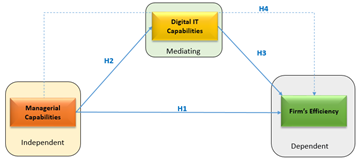
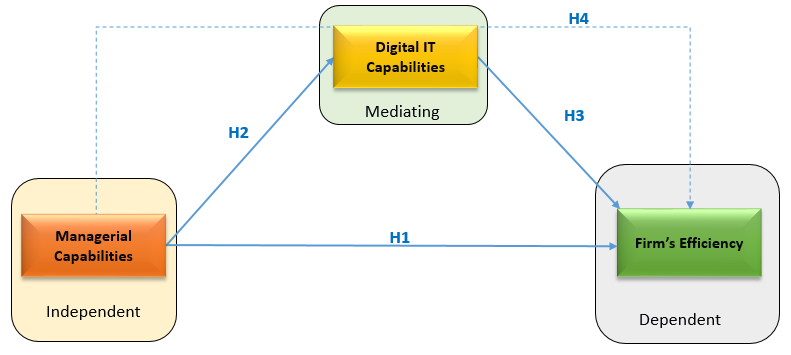
The conceptual model of the research is presented in Figure 1 The independent variable of the study is the Managerial Capabilities. The dependent variable is the firm’s efficiency in which certain indicators have been considered including sales growth, enhancement in work productivity, customer satisfaction, reduced customer churn, quality of products and services, reputation of the firm, task completion and reduction of the production cost.
Digital IT Capabilities is the mediating variable that has been used in this current research.
The interrelationships between the mediating variable and the other variables will be analyzed and studied also, like the effect of the Managerial Capabilities on Digital IT Capabilities and the effect of Digital IT capabilities on the Firm’s Efficiency.
The managerial capability is defined as managers' ability to utilize digitalization in a business strategy, employees’ mindsets and skillsets, as well as the workplace.
The mediating variable in the model, which is the term or the variable named Digital IT Capabilities is defined in this research as organizational competence, expertise, and talent in operating digital technology for developing new products or services through obtaining, expanding, linking, and reforming the IT-based resources of the company, improving the operational efficiency, and business strategy of firms. IT-based resources refer to a unified picture of organizations’ resources in terms of human resources, infrastructure, and intangible assets of firms including IT skills, synergy, consumer orientation, and related knowledge.
The dependent variable in the model, which is the Firm’s Efficiency, is defined in this research as the ability of the firm to enhance and improve multiple aspects or KPIs, those aspects are used as dimensions for measuring and evaluating the firm’s efficiency.
The relationships between variables in the conceptual model in Figure 1. lead to the construction of the hypothesis detailed in Table 1.
The research employs a quantitative research design where the data collection method is primary. The target population is managers working in the Egyptian Oil and Gas sector companies. Selecting the Oil and Gas sector and focusing on managers for the target population is because the Egyptian Ministry of Petroleum and Mineral Resources started the journey of digital transformation in 2016 by beginning with the development and modernization journey. Then, a program has been dedicated to digital transformation named Program 7 (P7).
This program has been developed a lot, as the first phase focused on the use of data and its flow between the sector entities through the ERP system, which increased the smooth flow of information that supports decision-making. It provides the required basis for a unified work network, and after the successes achieved in the first phase, a more comprehensive strategy was developed to take better advantage of digital transformation. The second phase included the implementation of more than 70 digital projects that represent success stories of digital transformation in partnership with the main partners of the petroleum sector, including international companies operating in the petroleum sector, experts, and specialists.
Ministry of Petroleum and Mineral Resources believes that digital transformation is not only about the use of new technologies to improve operations carried out by the oil and gas industry, but it is a much deeper necessity that requires the basic integration of digital technologies in all areas of business.
Another reason for the selection of the Oil and Gas sector is that Oil and Gas sector is one of the main factors driving economic and social development, according to the Information and Decision Support Center – IDSC, its contribution to the economy represents 13 percent of the gross domestic product (GDP).
The Egyptian oil and gas sector since the beginning of the 21st century has been categorized into four main holding companies with 137 companies.
The four holding companies are: Egyptian General Petroleum Corporation (EGPC), which has 91 companies sub-categorized into 11 General sector companies, 4 foreign sector companies (International companies having a local presence in Egypt), 42 Joint Ventures, and 34 Investment Companies (Law no. 8 for the year of 1997).
The second holding company is the Egyptian Natural Gas Company (EGAS), which includes 28 companies sub-categorized into 6 foreign sector companies, 8 Joint Ventures, and 14 Investment Companies.
The third holding company is South Valley Egyptian Petroleum Holding Company (GANOPE), which includes 10 companies sub-categorized into 4 Joint Ventures and 6 Investment Companies.
The fourth holding company is the Egyptian Petrochemicals Holding Company (ECHEM) that has 8 companies sub-categorized as 1 General sector company, 6 Joint Ventures, and 1 Investment Company.
The selected categories for Oil and Gas companies are Joint Ventures and Investment Companies for the following reasons:
• Joint ventures and Investment Law companies have sophisticated and developed shareholders who know of the importance of digital transformation, which will reflect on the culture of the organization and all employees.
• Excluding General Sector companies is due to a lack of sufficient maturity to apply the advanced phases of digital transformation because they are in the starting stages of digitalization.
• Excluding foreign sector companies is logical since they are just regional branches of their international companies and so they belong to other countries outside of the geographical boundaries of this thesis.
The selected categories of Oil and Gas Sector companies that represent the frame or the level for the unit of analysis in this current research are 115 companies 60 Joint Ventures and 55 Investment Companies.
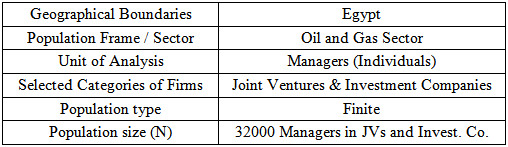
4.1. PopulationBased on the information from the Human Resources Management Program P3 (Ministry of Petroleum Modernization Project - Program No.3) the total headcount in Oil and Gas sector Joint Ventures and Investment Companies is 160000 employees. The total number of managers is 32000.
Table 2. Summarizes the target population definition previously explained and justified.
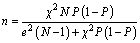
4.2. Sample SizeThis current research has been used the Krejcie & Morgan (1970) formula to determine the appropriate sample size. With a confidence level of 95% and a margin of error of 5%, the calculated sample size is 380 respondents:
 |
 |
where:
n = represents the required sample size,
N = Population Size,
e = acceptable sampling error (margin of error),
χ2 = chi-square of the degree of freedom and confidence level 95% which is 3.841,
p = proration of the population (if unknown, 0.50).
4.3. Sampling Technique and Response RateOne of the probability-sampling techniques is selected in this current research, where probability-sampling techniques have the advantage of making results more likely to reflect the entire population accurately while leading to more generalizability for results and outcomes.
Since the population is finite and well known (based on information from the Human Resources Management Program P3). Therefore, the simple random sampling technique is suitable for being used in this current research.
Response rate ranges between 65 % & 88 % in previous research 19 37 in the same context, therefore the current research takes the lower response rate of 65% to be more conservative, which leads to a total count of requested responses for analysis, which is 585 responses.
The measurement instrument of this current research is a comprehensive instrument consolidated from multiple research papers. The below table summarizes the adopted comprehensive instrument parts with the reference papers or research based on which the instrument was adopted, added to that reliability that is represented through Cronbach Alpha (α) value.
This section explains the results of the data collection stage that is concerned with the distrusted questionnaire, the number of received responses, and the number of clean responses that are ready for the statistical analysis stage.
Furthermore, sample descriptive statistics have been analyzed to justify important conclusions and compare results in the research discussion section.
Finally, the statistical analysis part explains in detail the structural equation modeling (SEM) analysis technique through its two major stages, which are measurement model assessment and structure model assessment.
5.1. Questionnaire Distribution and Responses CollectionThe questionnaire link is sent to the contact details of the 585 managers with names and contacts provided. The received responses are 418 responses out of 585 distributed requests with the survey link, taking into consideration that the data cleaning stage removes 19 responses to finally reach 399 clean responses ready for analysis.
This means that the actual response rate is about 71.5 %, which is slightly higher than the expected response rate which ranges between 65 % and 88 %.
5.2. Data Preparation for AnalysisData cleaning or data preparation sometimes called the data screening step is an important step before data analysis regardless of the analysis technique that is to be used.
The importance of the data preparation process is to discard inappropriate data that most probably cause inaccurate and wrong results. Data preparation includes processes like the elimination of missing and incomplete responses, discarding reluctant responses, and handling univariate and multivariate outliers. Incomplete responses are responses with some questions unanswered, but reluctant responses or sometimes-called unengaged responses are those having the same answer for all or almost all questions of the survey due to the limited time of the respondent.
Previous literature proves that including reluctant participants will lead to higher measurement errors or poor data quality 22, 23.
Unengaged responses with a standard deviation value of <0.30 are recommended to be discarded, as the respondents answered with the same scale for all questions; hence, these responses are not useful for data analysis 24.
In this current research, there are no incomplete responses; however, there are 19 reluctant responses that have been removed to make the number of clean responses 399 responses.
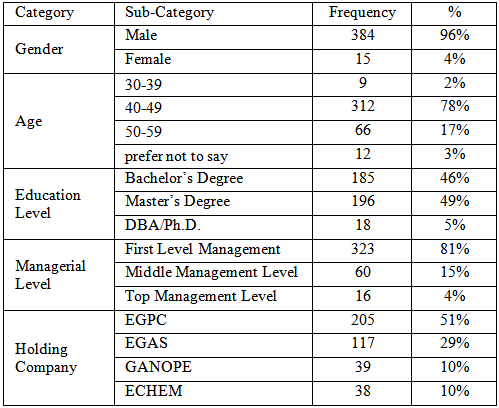
5.3. Sample Descriptive StatisticsThe analysis related to the demographic questions leads to the demographic profiling and descriptive statistics that are explained in Table 4.
Since the research model has a mediator, which means that mediation analysis is required, and hence structural equation modeling (SEM) is the most suitable statistical analysis technique for being used in this research.
SEM simplifies the testing of mediation hypotheses because it is designed, in part, to test these more complicated mediation models in a single analysis 25.
SEM has two techniques, which are Covariance Based SEM (SEM-CB) and Partial Least Squares SEM (SEM-PLS). Partial Least Squares (PLS) is particularly useful when the focus is on predicting latent constructs or when the sample size is relatively small. One advantage of PLS is its ability to handle non-normal data, making it a flexible and robust method for analyzing diverse datasets 26.
This current research employs SEM-PLS as the analytical framework to examine the relationships between managerial capabilities, digital IT capabilities, and firm efficiency in the context of Egyptian Oil and Gas JVs and Investment Law Companies.
The analysis tool or software package used in this research is SmartPLS. A comprehensive and user-friendly software package that offers advanced capabilities for conducting PLS-based structural equation modeling. It provides researchers with a range of features, including model specification, estimation, assessment of model fit, and interpretation of results 26.
The usage of SmartPLS 4, combined with the flexibility of PLS, allows for performing rigorous statistical analysis without the strict assumption of normality. This feature is particularly advantageous when dealing with data that may exhibit non-normal distributions or when sample sizes are limited. By leveraging the robustness and flexibility of PLS and SmartPLS 4, it is expected to gain insights into the mediation of the digital IT capabilities in the relationship between managerial capabilities and firm efficiency in the Egyptian Oil and Gas JVs & Investment Law Companies context.
The measurement model used in this current research is crucial for assessing the quality of the constructs under investigation. The evaluation of the measurement model involves several key steps, including examining the factor loadings, establishing construct reliability, and assessing construct validity.
• Factor Loadings
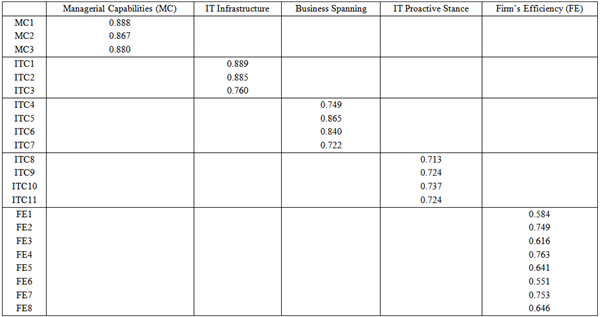
To assess the quality of the factor loadings in this current research, a recommended threshold of 0.50, as suggested by Hair et al., 26, is used. Any factor loading below this threshold indicates a weak relationship between the item and the factor, potentially recommending the removal of that particular item.
Fortunately, none of the items in this current research exhibited factor loadings below the recommended value of 0.50. This indicates that all items demonstrated a satisfactory level of correlation with their respective latent factors and contribute meaningfully to the measurement model. As a result, no items need to be removed from the analysis based on their factor loadings. The specific factor loadings for each item are presented in Table 5.
• Multicollinearity Indicator
To evaluate multicollinearity among the indicators, the Variance Inflation Factor (VIF) is employed, as suggested by Fornell and Bookstein (1982). Multicollinearity refers to the presence of high correlations between independent variables, which can lead to inflated standard errors and unstable coefficient estimates.
The research of Hair et al., 26 recommends that a VIF value below 5 is indicative of acceptable levels of multicollinearity. In this current research, Table 6 presents the VIF values for the indicators, and it is evident that all VIF values fall below the recommended threshold. This suggests that there is no significant multicollinearity issue among this current research indicators.
By ensuring that the VIF values remain below 5, it means the confidence that the independence of the indicators is preserved and that the coefficient estimates obtained from the analysis are reliable. Therefore, the absence of serious multicollinearity concerns among the indicators enhances the robustness of this current research results and strengthens the validity of its findings.
• Reliability
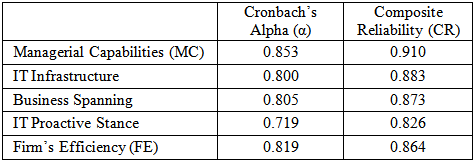
In this current research, two widely used methods for establishing reliability are employed: Cronbach's Alpha (α) and Composite Reliability (CR). Cronbach's Alpha measures the internal consistency of a scale, reflecting the extent to which items within a construct are correlated. Composite Reliability, on the other hand, assesses the reliability of the construct by considering the factor loadings of the indicators.
This current research results of the reliability analysis are presented in Table 7.
Both Cronbach's Alpha and Composite Reliability values surpass the recommended threshold of 0.70, as suggested by Hair et al., 26. This indicates that the measuring instrument used in this current research demonstrates adequate reliability, ensuring the stability and consistency of the measured constructs.
• Validity
There are two types of construct validity: convergent validity and discriminant validity.
Convergent validity, specifically, refers to the degree to which different measures of the same construct are highly correlated.
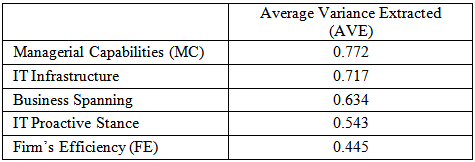
In this research, convergent validity is assessed using the Average Variance Extracted (AVE) statistic.
According to Fornell and Larcker 27, an AVE value equal to or greater than 0.50 indicates that the items converge to measure the underlying construct, thus establishing convergent validity 27.
Furthermore, Fornell and Larcker 27 prove that if AVE is between 0.4 and 0.5, but composite reliability is higher than 0.6, the convergent validity of the construct is still adequate.
Table 8 provides the AVE values for each construct, highlighting the convergence of the items in measuring their respective constructs.
The results of the convergent validity analysis, based on the AVE statistics, indicate that all constructs have AVE greater than 0.5, except for the Firm's Efficiency (FE), which has a slightly lower AVE value but is still above 0.4.
Discriminant validity is ensuring that measures of different concepts are distinct from each other. As stated by Bagozzi et al., (1991), when concepts are unique, valid measures of each concept should not exhibit high correlations with measures of other concepts.
In this current research, Fornell and Larcker criterion to examine the discriminant validity of the research constructs is applied. The results in Table 9 indicate that the square root of the AVE for each construct is greater than its correlation with other constructs, except for a slight correlation between the Firm's Efficiency (FE) and IT Proactive Stance.
However, it is important to note that this slight correlation does not pose a significant issue because as discussed in the Construct Validity section, convergent validity is established for all constructs, and the Composite Reliability (CR) values exceed the recommended threshold 25.
Therefore, based on the results of the Fornell and Larcker 27 criterion and considering the overall findings on construct validity, it can be concluded that discriminant validity is successfully established for constructs in this research.
The structural model analysis allows the evaluation of the relationships between the latent constructs and the testing of the hypotheses proposed in this current research. Examining the path coefficients and their statistical significance leads to meaningful findings that can be obtained about the relationships and the overall model fit.
By evaluating the statistical significance of the path coefficients, in addition to mediation analysis, support or rejection of the research hypotheses can be determined.
• Direct Relationship Analysis
Based on the assessment of the structural path coefficients and their statistical significance, the following results / findings can be drawn in the context of Egyptian Oil and Gas JVs and Investment Law Companies:
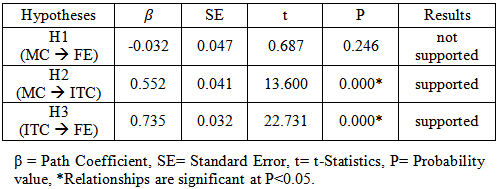
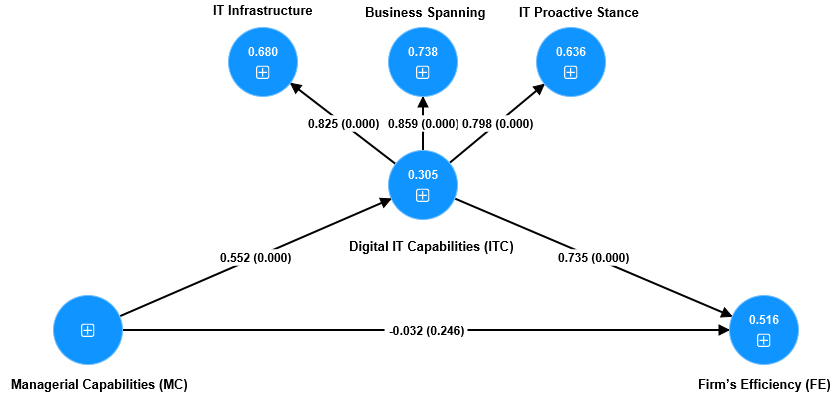
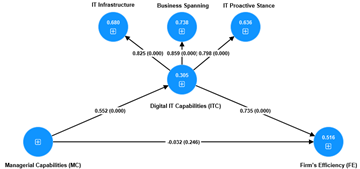
Hypothesis H1, which states that Managerial Capabilities (MC) are positively affecting the Firm's Efficiency (FE), is not supported (β = -0.032, t = 0.687, p = 0.246), which indicates that the direct impact of MC on FE is not statistically significant in the examined context.
Hypothesis H2, which states that the Managerial Capabilities (MC) are positively affecting the Digital IT Capabilities (ITC), is supported (β = 0.552, t = 13.60, p < 0.001), which suggests that MC plays a crucial role in fostering Digital IT Capabilities (ITC) in the analyzed context.
Hypothesis H3, which states that the Digital IT Capabilities (ITC) are positively affecting The Firm’s Efficiency (FE), is supported (β = 0.735, t = 22.731, p < 0.001), which indicates that ITC plays a crucial role in improving FE in the analyzed context. Organizations with strong ITC are likely to exhibit higher levels of efficiency.
The results of the structural model assessment, including the path coefficients and statistical significance, are presented in Table 10.
The structural model itself is presented in Figure 2.
• Mediation Analysis
The mediation analysis is conducted to examine the role of Digital IT Capabilities (ITC) in mediating the relationship between Managerial Capabilities (MC) and the Firm's Efficiency (FE) in the context of Egyptian Oil and Gas JVs and Investment Law Companies. The analysis aims to test hypothesis H4, which states that ITC positively mediates the relationship between MC and FE.
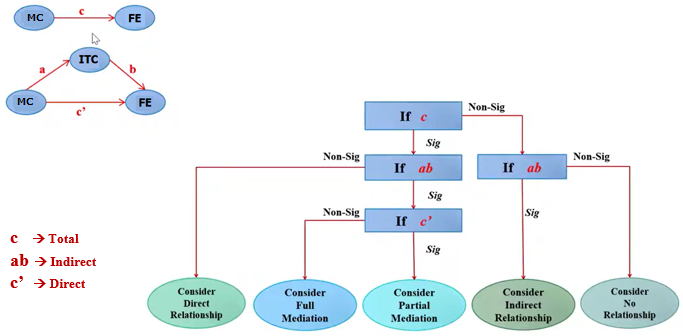
The results, as presented in Table 11 and Figure 3, reveal several important findings.
Firstly, the total effect of MC on FE is found to be significant (β = 0.374, t = 13.600, P < 0.001), which proves that MC has a direct influence on FE, even before considering the mediating effect of ITC.
Furthermore, there is a significant indirect effect of MC on FE through ITC (β = 0.406, t = 10.879, P < 0.001), This indicates whether the impact of MC on FE is either partially or fully mediated by the role of ITC.
However, when the mediator (ITC) is included in the analysis, the direct effect of MC on FE became insignificant (β = -0.032, t = 0.687, P = 0.246). This indicates that the relationship between MC and FE is fully mediated by ITC.
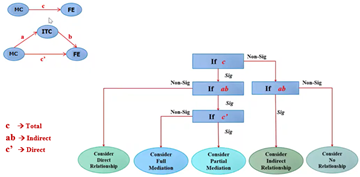
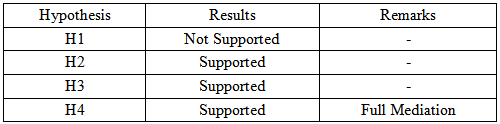
Therefore, hypothesis H4 is supported because The Digital IT Capabilities (ITC) positively and fully mediate the relationship between the Managerial Capabilities (MC) and the Firm’s Efficiency (FE). In other words, the positive impact of MC on FE is entirely channeled through its influence on digital ITC. This highlights the crucial role of digital ITC in translating the strategic initiatives of MC into improved firm efficiency.
5.5. Research FindingsFindings can be summarized through the below bullets:
- The direct impact of the Managerial Capabilities (MC) on the Firm’s Efficiency (FE) is not significant in the Egyptian Oil and Gas Sector JVs and Inv. Law Companies. The direct impact means that the impact is analyzed in the presence of the Digital IT Capabilities (ITC) not its absence.
- The impact of the Managerial Capabilities (MC) on the Digital IT Capabilities (ITC) is significant and positive in the Egyptian Oil and Gas Sector JVs and Inv. Law Companies.
- The impact of Digital IT Capabilities (ITC) on Firm Efficiency (FE) is positive and significant in the Egyptian Oil and Gas Sector JVs and Inv. Law Companies.
- The Digital IT Capabilities (ITC) are fully mediating positively the relationship between the Managerial Capabilities (MC) as a predictor and the Firm Efficiency (FE) as an outcome in the Egyptian Oil and Gas Sector JVs and Inv. Law Companies.
Table 12 lists the Hypotheses testing results.
The discussion section indicates to which extent the major findings of the current research and match the previous literature, in addition, it compares with justification the similarities and differences in results. While conclusion section develops the theoretical recommendations based on the interpreted findings of the research and assures that the research objectives are achieved in addition to that the research questions are answered.
6.1. DiscussionPrevious literature suggested that superior managerial capabilities foster successful strategic-level changes, such as digital transformations, and subsequently lead to enhanced business performance 29, 30.
Previous studies also suggest that digital transformation is a managerial issue rather than a technical or operational one. Digital Transformation requires not only acquiring and deploying technical resources but also tackling managerial issues, such as redesigning business processes, training and investing in organizational capabilities 31, 32, 33. Managers with the accompanying experience, knowledge, and skills may be more successful in identifying and capturing opportunities 34, 35, 36. Thus, capable managers are likely to be very quick to adjust to the changes caused by digital transformation.
Further, research by Wang et al., 19 aims to analyze the mediating effect of IT capability between digital business strategy and the firm efficiency of Chinese SMEs. The research is quantitative; therefore, the sample comprised 351 participants accumulated using a survey questionnaire. The findings of that research implicate that DBS individually does not affect the efficiency of firms, but through the mediation and inclusion of IT capabilities of the companies, the effect of DBS on firm efficiency is significant. This implies full mediation of IT capability which completely matches the findings of this current research.
Differences between Wang et al., 19 research and this current research are the geographical boundary in which the research is conducted. This current research model is tested in Egypt, while in Wang et al., 19 research the model was tested in China.
The second difference is the sector in which the model is tested, the current research model is tested in the Egyptian Oil and Gas sector, while in the other research, the model is tested on SMEs in different sectors like Manufacturing, Services & Trading.
The third difference is measuring the DBS where DBS is measured in Wang et al., 19 research through the use of specific technologies like using social media, artificial intelligence, data analytics, and cloud techniques. However, in the current research, the DBS is measured through Managerial Capabilities, and this extends the technological integration to other current and future technologies in addition to achieving the fusion between business and IT strategies, which is mandatory to establish an effective DBS.
Similarities between Wang et al., 19 research and this current research are the quantitative methodology, which is based on primary data, in addition to the analysis technique, which is SEM-PLS, and the analysis tool, which is SmartPLS.
The research of Eniola et al., 37 is intended to examine the relationship between Digital Business Strategy (DBS) and the efficiency of Small and Medium Enterprises (SMEs) in Nigeria through the intervening role of Information Technology (IT) capability 37. The survey is therefore quantitative, and the findings show that DBS not only affects the efficiency of the firm but that DBS has a significant impact on the firm's efficiency through its business intermediaries and IT capabilities. This means completely mediating IT capability. This implies full mediation of IT capability which completely matches the findings of this current research.
Differences between Eniola et al., 37 research and the current research are the geographical boundary on which the research is conducted. This current research model is tested in Egypt, while the other research model is tested in Nigeria. The second difference is the sector in which the model was tested, the current research model is tested in the Egyptian Oil and Gas sector, while in the other research, the model is tested on SMEs in the non-specified sector(s) in Nigeria.
Similarities between Eniola et al., 37 research and the current research are the quantitative methodology, which is based on primary data, and the analysis technique, which is SEM-PLS.
Another previous research of Chi et al., 15 suggests a framework, which describes the value creation and appropriation process of digital business strategy in digital settings. The research model of that research is tested by survey data and financial data from a sample of 138 manufacturing firms, which adopted the e-selling process. The results proved that the impact of digital business strategy on firm performance is fully mediated by e-collaboration capability, which is one kind of digital IT capability.
Differences between Chi et al., 15 research and this current research are the geographical boundary in which the research is conducted. This current research model is tested in Egypt, however the other research model is tested in China. The second difference is the sector in which the model is tested. This current research model is tested on the Egyptian Oil and Gas sector, while in the other research, the model is tested on 138 Manufacturing Companies in China.
Another major difference between that research and this current research is that the model is tested on one of the digital IT capabilities, which is e-collaboration with distributors and customers, however in this current research the Digital IT Capabilities, are generally tested with no determination of one specific type of those capabilities.
Similarities between that research and this current research are the quantitative methodology, which is based on primary data, and the analysis technique, which is SEM-PLS.
6.2. ConclusionThe conclusion of this research can be classified into theoretical recommendations and practical implications.
The theoretical conclusion can be derived based on the interpreted findings and can be generalized to the level of the whole Egyptian Oil and Gas Sector as follows:
- The importance of aligning business strategy with IT strategy and the role of managerial capabilities to get an effective digital business strategy that will trigger and initiate the digital transformation success.
- The Managerial Capabilities will not be able to affect the Firm’s Efficiency unless relying on the Digital IT Capabilities with its powerful resources that are represented through robust up-to-date Infrastructure and technology-aware qualified calibers who can use current and future technologies in achieving sustainable competitiveness.
The implications section explores the practical recommendations that represent the applications of the theoretical recommendations.
Chief-Digital Officer (CDO) Position to get an effective DBS
One of the most important applications to the current research findings is the position named Chief Digital Officer (CDO). That position is responsible for playing the role of the bridge between the executive C-level management responsible for the business strategy and the functional managerial level responsible for IT strategy. The CDO will make the required fusion and integration between the corporate-level business strategy that he participates in its planning and the functional-level IT strategy that is planned by the IT manager or CIO (Chief Information Officer), to create the effective Digital Business Strategy (DBS).
The position will be like the Chief-Financial Officer (CFO) reporting to the Chief-Executive Officer (CEO), and to be a board member like the CFO.
The CDO position is the best solution in many cases like when managers at the top management level do not have the solid technological background required to plan the digital business strategy and to draw the technological direction that leads to the transformation needed.
In addition, it is the best solution when the IT manager is just a functional manager and has no sufficient top-level managerial skills related to strategic planning and business model analysis and modifications.
One of the most important recommendations for the Egyptian Oil and gas sector is to develop this position in the organizational structure of all companies to play this crucial bridging role and follow up achieving Digital Transformation (DX) to companies.
Furthermore, it is important to develop this role on two other levels in the Ministry of Petroleum. The first level is the level of the four main holding companies, while the second level is the level of the ministry itself. The reason for that is that the program of Digital Transformation was started in 2016 and the actual progress is not reflecting the real efforts exerted, in addition, there is no clear roadmap with defined milestones that indicate the progress of Digital Transformation of the Sector as a whole.
Therefore, this position should exist on both levels of holding companies and the ministry level. Furthermore, it is recommended for the ministry to form a committee for all of the CDOs to report directly to the Egyptian Petroleum Minister, and then there will be a solid management structure, that will be able to manage and control the digital transformational efforts and direct them in the correct direction with no deviation or conflicts.
The current research has different limitations while execution, these limitations are outlined as follows:
- Using Self-Administered Questionnaire: The current research methodology is quantitative using primary data that represent opinions of managers working in Oil and Gas sector companies, which may be considered as a subjective point of view, not official information that comes out of the organizations.
- Using Cross-Sectional Study: The research is limited to only one sector in Egypt, which is the Oil and Gas Sector, which limits the generalizability.
It is recommended for future research to:
- Include secondary data coming from official reports if this is available in addition to the adoption of mixed methodology through adding a qualitative part depending on interviews with experts to guarantee the objectivity of information and data the official representation of the collected data
- Extend the scope of the research to other sectors like Telecommunications, Banking, Educational, Health, and Tourism to be able to generalize outcomes to the level of the country as a whole.
- It is recommended to consider other capabilities and dimensions besides the managerial capabilities in DBS.
Words cannot express my gratitude to my professor Prof. Dr. Tarek Abdeen for his invaluable patience and feedback; this endeavor would not have been possible without his generous support as the DBA supervisor. I am also deeply indebted to the working employees in the Modernization Program (P3) of the Egyptian Ministry of Petroleum for their great role in availing the important data that was needed for the population in this research. Additionally, I would like to express my deepest appreciation to Dr. Mahmoud Rady who generously provided knowledge and expertise in the statistical analysis part and SmartPLS 4 software package.
I would like to thank Dr. Kareem Essam for his valuable recommendation to Science and Education Publishing (SciEP) for publishing the article as a partial fulfillment of DBA requirements.
Lastly, I would be remiss in not mentioning my family, especially my spouse, and daughters. Their belief in me, patience, and continuous support have kept my spirits and motivation high during this process.
| [1] | Sawy, Omar & Amsinck, H. and Kræmmergaard, Pernille and Vinther, A.L.. (2016). How LEGO built the foundations and enterprise capabilities for digital leadership. 15. 141-166. | ||
| In article | |||
| [2] | Chuang, Shu-Hui and Lin, Hong-Nan. (2015). Co-creating e-service innovations: Theory, practice, and impact on firm performance. International Journal of Information Management. 35. 10.1016/j.ijinfomgt.2015.01.002. | ||
| In article | View Article | ||
| [3] | Xue, Ling. (2014). Governance-Knowledge Fit and Strategic Risk Taking in Supply Chain Digitization. Decision Support Systems. 62. 10.1016/j.dss.2014.03.003. | ||
| In article | View Article | ||
| [4] | Parida, V., Sj€odin, D.R., Lenka, S., Wincent, J., 2015. Developing global service innovation capabilities: how global manufacturers address the challenges of market heterogeneity. Res. Technol. Manag. 58 (5), 35e44. | ||
| In article | View Article | ||
| [5] | Sia, S.K., Soh, C., Weill, P., 2016. How DBS bank pursued a digital business strategy. MIS Q. Exec. 15 (2), 105e121. | ||
| In article | |||
| [6] | Bharadwaj, A. S. (2000). A Resource-Based Perspective on Information Technology Capability and Firm Performance: An Empirical Investigation. MIS Quarterly, 24(1), 169–196. | ||
| In article | View Article | ||
| [7] | Barnir, Anat and Gallaugher, John and Auger, Pat. (2003). Business process digitization, strategy, and the impact of firm age and size: The case of the magazine publishing industry. Journal of Business Venturing. 18. 789-814. 10.1016/S0883-9026(03)00030-2. | ||
| In article | View Article | ||
| [8] | Neus, A., Buder, F., and Galdino, F. (2017). Are you too successful to digitalize? How to fight innovation blindness. NIM Marketing Intelligence Review, 9(1), 30. | ||
| In article | View Article | ||
| [9] | Souza De Oliveira, P., and Sommer, L. (2017). Globalization and digitalization as challenges for a professional career in manufacturing industries—differences in awareness and knowledge of students from Brazil and Germany. Education Sciences, 7(2), 55. | ||
| In article | View Article | ||
| [10] | Denner, M. S., Püschel, L. C., and Röglinger, M. (2018). How to exploit the digitalization potential of business processes. Business and Information Systems Engineering, 60, 331-349. | ||
| In article | View Article | ||
| [11] | DeLone, W., Migliorati, D., and Vaia, G. (2018). Digital IT governance. CIOs and the digital transformation: A new leadership role, 205-230. | ||
| In article | View Article | ||
| [12] | von Briel, F., Davidsson, P., and Recker, J. (2018). Digital technologies as external enablers of new venture creation in the IT hardware sector. Entrepreneurship Theory and Practice, 42(1), 47-69. | ||
| In article | View Article | ||
| [13] | Berghaus, S., and Back, A. (2017). Disentangling the fuzzy front end of digital transformation: Activities and approaches. | ||
| In article | |||
| [14] | Setia, P., Setia, P., Venkatesh, V., and Joglekar, S. (2013). Leveraging digital technologies: How information quality leads to localized capabilities and customer service performance. MIS quarterly, 565-590. | ||
| In article | View Article | ||
| [15] | Chi, M., Zhao, J., and Li, Y. (2016). Digital business strategy and firm performance: the mediation effects of E-collaboration capability. | ||
| In article | |||
| [16] | Tallon, P. P., and Pinsonneault, A. (2011). Competing perspectives on the link between strategic information technology alignment and organizational agility: insights from a mediation model. MIS quarterly, 463-486. | ||
| In article | View Article | ||
| [17] | Bharadwaj, A., El Sawy, O. A., Pavlou, P. A., and Venkatraman, N. V. (2013). Digital business strategy: toward a next generation of insights. MIS quarterly, 471-482. | ||
| In article | View Article | ||
| [18] | Kohli, R., and Grover, V. (2008). Business value of IT: An essay on expanding research directions to keep up with the times. Journal of the association for information systems, 9(1), 1. | ||
| In article | View Article | ||
| [19] | Wang, C., Zhang, Q., and Zhang, W. (2020). Corporate social responsibility, Green supply chain management and firm performance: The moderating role of big-data analytics capability. Research in Transportation Business and Management, 37, 100557. | ||
| In article | View Article | ||
| [20] | Ukko, J., Nasiri, M., Saunila, M., and Rantala, T. (2019). Sustainability strategy as a moderator in the relationship between digital business strategy and financial performance. Journal of Cleaner Production, 236, 117626. | ||
| In article | View Article | ||
| [21] | Rehman, A. U., and Anwar, M. (2019). Mediating role of enterprise risk management practices between business strategy and SME performance. Small Enterprise Research, 26(2), 207-227. | ||
| In article | View Article | ||
| [22] | Biemer, P. P. (2001). Nonresponse bias and measurement bias in a comparison of face to face and telephone interviewing. Journal of Official Statistics, 17(2), 295. | ||
| In article | |||
| [23] | Hox, J., De Leeuw, E., Couper, M. P., Groves, R. M., De Heer, W., and Kuusela, V. (2002). The influence of interviewers’ attitude and behavior on household survey nonresponse: An international comparison. Survey nonresponse, 103-120. | ||
| In article | |||
| [24] | Lowry, P. B., and Gaskin, J. (2014). Partial least squares (PLS) structural equation modeling (SEM) for building and testing behavioral causal theory: When to choose it and how to use it. IEEE transactions on professional communication, 57(2), 123-146. | ||
| In article | View Article | ||
| [25] | MacKinnon, D. (2012). Introduction to statistical mediation analysis. Routledge. | ||
| In article | View Article | ||
| [26] | Hair, Jr, J. F., Sarstedt, M., Matthews, L. M., and Ringle, C. M. (2016). Identifying and treating unobserved heterogeneity with FIMIX-PLS: part I–method. European business review, 28(1), 63-76. | ||
| In article | View Article | ||
| [27] | Fornell, C., and Larcker, D. F. (1981). Structural equation models with unobservable variables and measurement error: Algebra and statistics. | ||
| In article | View Article | ||
| [28] | Redza, Ammar. (2020). Title of thesis The Impact Of Social Structure On Smallholders Participative Behavior In Certified Sustainable Palm Oil Scheme. 10.13140/RG.2.2.15590.86084. | ||
| In article | |||
| [29] | Helfat, C. E., and Martin, J. A. (2015). Dynamic managerial capabilities: Review and assessment of managerial impact on strategic change. Journal of management, 41(5), 1281-1312. | ||
| In article | View Article | ||
| [30] | Li, L., Su, F., Zhang, W., and Mao, J. Y. (2018). Digital transformation by SME entrepreneurs: A capability perspective. Information Systems Journal, 28(6), 1129-1157. | ||
| In article | View Article | ||
| [31] | Besson, P., and Rowe, F. (2012). Strategizing information systems-enabled organizational transformation: A transdisciplinary review and new directions. The journal of strategic information systems, 21(2), 103-124. | ||
| In article | View Article | ||
| [32] | Cha, K. J., Hwang, T., and Gregor, S. (2015). An integrative model of IT-enabled organizational transformation: A multiple case study. Management Decision, 53(8), 1755-1770. | ||
| In article | View Article | ||
| [33] | Doherty, N. F., and King, M. (2005). From technical to socio-technical change: tackling the human and organizational aspects of systems development projects. European Journal of Information Systems, 14, 1-5. | ||
| In article | View Article | ||
| [34] | Li, L., Su, F., Zhang, W., and Mao, J. Y. (2018). Digital transformation by SME entrepreneurs: A capability perspective. Information Systems Journal, 28(6), 1129-1157. | ||
| In article | View Article | ||
| [35] | Kickul, J., and Gundry, L. K. (2001). Breaking through boundaries for organizational innovation: new managerial roles and practices in e-commerce firms. Journal of Management, 27(3), 347-361. | ||
| In article | View Article | ||
| [36] | Nyberg, A. J., and Wright, P. M. (2015). 50 years of human capital research: Assessing what we know, exploring where we go. Academy of Management Perspectives, 29(3), 287-295. | ||
| In article | View Article | ||
| [37] | Eniola, A. A., Kenzhin, Z., and Kairliyeva, G. (2022). Entrepreneur Digital Business Strategy and Efficiency: Intervening Role of Firm’s IT Capabilities. Journal of Scientific & Industrial Research, 81(02), 137-147. | ||
| In article | View Article | ||
Published with license by Science and Education Publishing, Copyright © 2023 Khalid Fahmy Mahmoud Elghayesh and Tarek Hassan Ibrahim Abdeen
 This work is licensed under a Creative Commons Attribution 4.0 International License. To view a copy of this license, visit
http://creativecommons.org/licenses/by/4.0/
This work is licensed under a Creative Commons Attribution 4.0 International License. To view a copy of this license, visit
http://creativecommons.org/licenses/by/4.0/
| [1] | Sawy, Omar & Amsinck, H. and Kræmmergaard, Pernille and Vinther, A.L.. (2016). How LEGO built the foundations and enterprise capabilities for digital leadership. 15. 141-166. | ||
| In article | |||
| [2] | Chuang, Shu-Hui and Lin, Hong-Nan. (2015). Co-creating e-service innovations: Theory, practice, and impact on firm performance. International Journal of Information Management. 35. 10.1016/j.ijinfomgt.2015.01.002. | ||
| In article | View Article | ||
| [3] | Xue, Ling. (2014). Governance-Knowledge Fit and Strategic Risk Taking in Supply Chain Digitization. Decision Support Systems. 62. 10.1016/j.dss.2014.03.003. | ||
| In article | View Article | ||
| [4] | Parida, V., Sj€odin, D.R., Lenka, S., Wincent, J., 2015. Developing global service innovation capabilities: how global manufacturers address the challenges of market heterogeneity. Res. Technol. Manag. 58 (5), 35e44. | ||
| In article | View Article | ||
| [5] | Sia, S.K., Soh, C., Weill, P., 2016. How DBS bank pursued a digital business strategy. MIS Q. Exec. 15 (2), 105e121. | ||
| In article | |||
| [6] | Bharadwaj, A. S. (2000). A Resource-Based Perspective on Information Technology Capability and Firm Performance: An Empirical Investigation. MIS Quarterly, 24(1), 169–196. | ||
| In article | View Article | ||
| [7] | Barnir, Anat and Gallaugher, John and Auger, Pat. (2003). Business process digitization, strategy, and the impact of firm age and size: The case of the magazine publishing industry. Journal of Business Venturing. 18. 789-814. 10.1016/S0883-9026(03)00030-2. | ||
| In article | View Article | ||
| [8] | Neus, A., Buder, F., and Galdino, F. (2017). Are you too successful to digitalize? How to fight innovation blindness. NIM Marketing Intelligence Review, 9(1), 30. | ||
| In article | View Article | ||
| [9] | Souza De Oliveira, P., and Sommer, L. (2017). Globalization and digitalization as challenges for a professional career in manufacturing industries—differences in awareness and knowledge of students from Brazil and Germany. Education Sciences, 7(2), 55. | ||
| In article | View Article | ||
| [10] | Denner, M. S., Püschel, L. C., and Röglinger, M. (2018). How to exploit the digitalization potential of business processes. Business and Information Systems Engineering, 60, 331-349. | ||
| In article | View Article | ||
| [11] | DeLone, W., Migliorati, D., and Vaia, G. (2018). Digital IT governance. CIOs and the digital transformation: A new leadership role, 205-230. | ||
| In article | View Article | ||
| [12] | von Briel, F., Davidsson, P., and Recker, J. (2018). Digital technologies as external enablers of new venture creation in the IT hardware sector. Entrepreneurship Theory and Practice, 42(1), 47-69. | ||
| In article | View Article | ||
| [13] | Berghaus, S., and Back, A. (2017). Disentangling the fuzzy front end of digital transformation: Activities and approaches. | ||
| In article | |||
| [14] | Setia, P., Setia, P., Venkatesh, V., and Joglekar, S. (2013). Leveraging digital technologies: How information quality leads to localized capabilities and customer service performance. MIS quarterly, 565-590. | ||
| In article | View Article | ||
| [15] | Chi, M., Zhao, J., and Li, Y. (2016). Digital business strategy and firm performance: the mediation effects of E-collaboration capability. | ||
| In article | |||
| [16] | Tallon, P. P., and Pinsonneault, A. (2011). Competing perspectives on the link between strategic information technology alignment and organizational agility: insights from a mediation model. MIS quarterly, 463-486. | ||
| In article | View Article | ||
| [17] | Bharadwaj, A., El Sawy, O. A., Pavlou, P. A., and Venkatraman, N. V. (2013). Digital business strategy: toward a next generation of insights. MIS quarterly, 471-482. | ||
| In article | View Article | ||
| [18] | Kohli, R., and Grover, V. (2008). Business value of IT: An essay on expanding research directions to keep up with the times. Journal of the association for information systems, 9(1), 1. | ||
| In article | View Article | ||
| [19] | Wang, C., Zhang, Q., and Zhang, W. (2020). Corporate social responsibility, Green supply chain management and firm performance: The moderating role of big-data analytics capability. Research in Transportation Business and Management, 37, 100557. | ||
| In article | View Article | ||
| [20] | Ukko, J., Nasiri, M., Saunila, M., and Rantala, T. (2019). Sustainability strategy as a moderator in the relationship between digital business strategy and financial performance. Journal of Cleaner Production, 236, 117626. | ||
| In article | View Article | ||
| [21] | Rehman, A. U., and Anwar, M. (2019). Mediating role of enterprise risk management practices between business strategy and SME performance. Small Enterprise Research, 26(2), 207-227. | ||
| In article | View Article | ||
| [22] | Biemer, P. P. (2001). Nonresponse bias and measurement bias in a comparison of face to face and telephone interviewing. Journal of Official Statistics, 17(2), 295. | ||
| In article | |||
| [23] | Hox, J., De Leeuw, E., Couper, M. P., Groves, R. M., De Heer, W., and Kuusela, V. (2002). The influence of interviewers’ attitude and behavior on household survey nonresponse: An international comparison. Survey nonresponse, 103-120. | ||
| In article | |||
| [24] | Lowry, P. B., and Gaskin, J. (2014). Partial least squares (PLS) structural equation modeling (SEM) for building and testing behavioral causal theory: When to choose it and how to use it. IEEE transactions on professional communication, 57(2), 123-146. | ||
| In article | View Article | ||
| [25] | MacKinnon, D. (2012). Introduction to statistical mediation analysis. Routledge. | ||
| In article | View Article | ||
| [26] | Hair, Jr, J. F., Sarstedt, M., Matthews, L. M., and Ringle, C. M. (2016). Identifying and treating unobserved heterogeneity with FIMIX-PLS: part I–method. European business review, 28(1), 63-76. | ||
| In article | View Article | ||
| [27] | Fornell, C., and Larcker, D. F. (1981). Structural equation models with unobservable variables and measurement error: Algebra and statistics. | ||
| In article | View Article | ||
| [28] | Redza, Ammar. (2020). Title of thesis The Impact Of Social Structure On Smallholders Participative Behavior In Certified Sustainable Palm Oil Scheme. 10.13140/RG.2.2.15590.86084. | ||
| In article | |||
| [29] | Helfat, C. E., and Martin, J. A. (2015). Dynamic managerial capabilities: Review and assessment of managerial impact on strategic change. Journal of management, 41(5), 1281-1312. | ||
| In article | View Article | ||
| [30] | Li, L., Su, F., Zhang, W., and Mao, J. Y. (2018). Digital transformation by SME entrepreneurs: A capability perspective. Information Systems Journal, 28(6), 1129-1157. | ||
| In article | View Article | ||
| [31] | Besson, P., and Rowe, F. (2012). Strategizing information systems-enabled organizational transformation: A transdisciplinary review and new directions. The journal of strategic information systems, 21(2), 103-124. | ||
| In article | View Article | ||
| [32] | Cha, K. J., Hwang, T., and Gregor, S. (2015). An integrative model of IT-enabled organizational transformation: A multiple case study. Management Decision, 53(8), 1755-1770. | ||
| In article | View Article | ||
| [33] | Doherty, N. F., and King, M. (2005). From technical to socio-technical change: tackling the human and organizational aspects of systems development projects. European Journal of Information Systems, 14, 1-5. | ||
| In article | View Article | ||
| [34] | Li, L., Su, F., Zhang, W., and Mao, J. Y. (2018). Digital transformation by SME entrepreneurs: A capability perspective. Information Systems Journal, 28(6), 1129-1157. | ||
| In article | View Article | ||
| [35] | Kickul, J., and Gundry, L. K. (2001). Breaking through boundaries for organizational innovation: new managerial roles and practices in e-commerce firms. Journal of Management, 27(3), 347-361. | ||
| In article | View Article | ||
| [36] | Nyberg, A. J., and Wright, P. M. (2015). 50 years of human capital research: Assessing what we know, exploring where we go. Academy of Management Perspectives, 29(3), 287-295. | ||
| In article | View Article | ||
| [37] | Eniola, A. A., Kenzhin, Z., and Kairliyeva, G. (2022). Entrepreneur Digital Business Strategy and Efficiency: Intervening Role of Firm’s IT Capabilities. Journal of Scientific & Industrial Research, 81(02), 137-147. | ||
| In article | View Article | ||