Purpose: The research is focused on finding out the challenges facing the Egyptian’s manufacturing small and medium size enterprises during “Covid-19”, and the effect of the three main key players “Enterprise Management, Government and Financial Services providers” on supporting the manufacturing SMEs to absorb the stiffness of the crisis challenges. Aim and objectives: the research aims that based on the challenges study, the research will provide enlightenment through proposing solutions, not only to overcome the current crisis “Covid-19”, but also to learn how to be prepared in the future for such unpredictable events. Hypotheses: The researcher constructed three basic hypotheses in order to test and measure how far are the relations between the variables, based on, that the challenges are dependent variable and the independent variables (Enterprise Management, Government, FSPs). Design/methodology/approach: The study proposes a research model that was established based on comprehensive research and a fully constructive literature review that simulates the variables and the relationships among all these variables. The target population are mainly the Egyptian Small & Medium Size manufacturing enterprises. Main results: The results of the data analysis revealed that independent predictor variables were found significantly affecting the dependent variable. More over the research proposes solutions that have influence in the role of the key players to support the Egyptian’s manufacturing small and medium size enterprises to overcome the challenges of the pandemic and any future unprecedented crisis.
Several phenomena have affected the global economy and the majority was having a major impact on the domestic economy level where the phenomena occur with slight effect on the global. Now a days since late 2019 the Global is facing one of the phenomena that has the highest effect on the glob which is Corona Virus “Covid-19” pandemic, The Covid-19 pandemic considered the toughest and more globalized pandemic effect the earth compared to the world ware one and two and the global financing crisis in 2008 (OECD, 2020) 1. The virus started from China late 2019 and within a few months its spread to Asia, Europe, USA, Africa and by March 2020 as the virus spread worldwide, the World Health Organization (WHO) has announced that it has become an epidemic disease. The spreading of the coronavirus outbreak had already caused a sharp decline in economic growth in China, and subsequent outbreaks in other countries were eroding prospects for economic growth.
1.2. Problem StatementManufacturing Small and Medium Size enterprises play a significant role in the global economy, and in developing countries such as Egypt, they are crucial for help reduce the socio-economic challenges. However, during Covid-19 pandemic its disappointing that a quite number of those SMEs continue to fail within a very short time. They face numerous challenges which results into their unacceptable high failure rates. It is therefore important to identify and investigate these challenges and propose solutions.
1.3. Research ObjectivesThis paper aims to highlight the challenges facing the Egyptian’s Manufacturing Small & Medium size enterprise “SME’s” during the crisis time covid-19 pandemic globally, and supporting SME’s during the covid-19 pandemic to allow the enterprises to absorb the impact of the pandemic and sustain its growth. In order to achieve these objectives, the research passes are as follows:
First, Identify the challenges.
Second, illustrate the factors affecting this challenge,
Third, analyze the role of each key players.
Fourth, propose solutions for the Egyptian Manufacturing SMEs to over-come this crisis and maintain the sustainability of the business as well as the health of the Egyptian economy.
1.4. Research ImportanceManufacturing small and medium enterprises have always played a very important role in economic and social life of any country, considered to be essential for the harmonious development of the economy of any state, and may ensure the cohesion of the economic structure, good economic growth and, of course, creation of new jobs” (Abdel bary, Amr 2019) 2. Small and medium-sized enterprises (SMEs), accounting for, on average, 33% of GDP and 45% of the workforce in high-income countries, and over 60% of GDP and 70% of employment in developing economies 3. As for Egypt, SMEs represent 95% to 98% of the total industrial enterprises, distributed in 2.5 million enterprises and constrain 75% of the total work force where, 95% of these enterprises are in non- agricultural projects. Small and Medium firms represent 13%& 46% industrial enterprises respectively 3. Accordingly, SME’s considered the backbone for the existing and future high growth businesses with both domestic and foreign companies investing in the ‘Make in Egypt’.
1.5. Research QuestionsThe main drivers for the causes of success and failure of manufacturing SMEs are internal and external factors. Internal factors include management experience, functional skills, experience staff, training & development and attitudes towards customers. External factors include policies & regulations, availability of a logistics chain, cost of distribution, competition, costs of doing business, sources of finance. Therefore, the research built on finding and propose solutions to reply on the below questions:
Q1- What is the role of enterprise management in order to overcome the Covid-19 pandemic?
Q2- How is the government will be dealing with the pandemic in order to support manufacturing SME’s and in return support the economy to reduce the impact of Covid-19 on the country growth?
Q3- What is the role of the financial institution to support the manufacturing SMEs to reach financial support with more creative and innovative tools matching with the circumstances of covid-19 pandemic?
Small and Medium Enterprises (SMEs) play a major role in most economies, particularly in developing countries. SMEs account for the majority of businesses worldwide and are important contributors to job creation and global economic development. They represent about 90% of businesses and more than 50% of employment worldwide. Formal SMEs contribute up to 40% of national income (GDP) in emerging economies. These numbers are significantly higher when informal SMEs are included (World Bank, “Improving SMEs’ access to finance and finding innovative solutions to unlock sources of capital”). According to the estimates, 600 million jobs will be needed by 2030 to absorb the growing global workforce, which makes SME development a high priority for many governments around the world. In emerging markets, most formal jobs are generated by SMEs, which create 7 out of 10 jobs. Currently, one of the major circumstances that had a great effect not only on the sustainability of the SME’s but also its existence which is the Coronavirus “Covid-19” pandemic.
Covid-19 pandemic considered the toughest and more globalized pandemic effect the earth compared to the world ware one and two and the global financing crisis in 2008. In general, the world passed through several crises but the majority was having a domestic impact rather than global as several studies have reported. For example, the 1999 earthquake in Turkey severely impacted SMEs, with damages ranging from $1.1 to $4.5 billion. Similarly, the 2011 flooding in Thailand affected at least 557,637 businesses, resulting in 2.5 million job losses, with 90% of these businesses being SMEs (Mohsin Shafi, Junrong Liu, Wenju Ren 2020) 4. Also, many developed countries have also seen similar devastation to SMEs. For instance, during the 2001 Foot and Mouth Disease (FMD) outbreak in the United Kingdom, SMEs suffered massive losses, with non-farming losses estimated to be 5 billion pounds (for further details, see Bennett & Phillipson, 2004).
2.2. Characteristics of Covid-19 CrisisIn order to understand the characteristics of Covid-19, the researchers asked one important question, Is Covid-19 considered as Black Swan? truly is it a black Swan? According to Nasim Taleb “professor, statistician and former option trader”, there are some pillars need to be assessed to explain how an event can come to be named a Black Swan.
Ø Pillar One: Is the Covid-19 pandemic is outlier?
Ø Pillar Two: Does COVID-19 carry an extreme impact?
Ø Pillar Three: Is it, or will it be, normalized after the fact?
Pillar One: Is the COVID pandemic an outlier?
In recent years, hundreds of health experts have written books, white papers and op-eds warning of the possibility of the next pandemic, governments themselves often conduct exercises, including table-top simulations and other planning, in an attempt to determine how to get ahead of the next pandemic. Obviously, can’t say fairly that no one can said we did not saw the possibility of COVID-19 coming?
Pillar Two: Does COVID-19 carry an extreme impact?
Because of the need for social distance to prevent the spread of COVID-19, non-essential companies have been forced to close temporarily. While COVID-19 is not expected to have anywhere like the magnitude of the 1918 influenza pandemic (at least 50 million deaths), there is little doubt that the current epidemic has had — and will continue to have — a massive impact on individuals and national economies.
Pillar Three: Is it, or will it be, normalized after the fact?
The concept of "normalizing" a huge occurrence in hindsight by making it explainable or predictable completes the three criteria and makes it a black swan. This factor, on the other hand, appears to be completely random, posing various questions. No one could estimate whether the COVID-19 pandemic will be normalized, cause the global still in the middle of the current pandemic catastrophe.
According to the above characteristics, Covid-19 is not all that rare, as many historical sources have raised a numerous warning, and the mathematical odds of an occurrence are not all that remote. Consequently, as per the characteristics illustrated above, the main characteristics of Corona Virus become clearer, and ensure that the concept that Covid-19 considered as Black Swan is argued.
2.3. Characteristics of the Small and Medium Size EnterprisesFinding a universal standard for the definition of manufacturing SMEs poses a sharp and acute critic to institutionalist, economists, academics and industrialists. Although a dilemma, more negligible is coining enterprise or business, although all authors use them interchangeably. As the research find out, in 1971 Bolton Report (Dawes and Haydock in Frank, 1999) conclude a definition from economic point of view “a firm is regarded as small if it meets the following three criteria:
1) they had a relatively small share of their market place;
2) they were managed by owners or part owners in a personalized way, and not through the medium of a formalized management structure;
3) they were independent, in the sense of not forming part of a large enterprise”.
Abbreviation SME which is usually faced in the European Union and international organizations as the World Bank, United Nations and World Trade Organization (Holátová, & Monika Březinová, 2013) 5, suggests that companies that fall into categories according to criteria that are different from large companies to be labeled as enterprise (Small and Medium Enterprise). Manufacturing SMEs definition differentiated according to two criteria:
A- Quantitative Criteria, and
B- Qualitative criteria.
A- Quantitative Criteria:
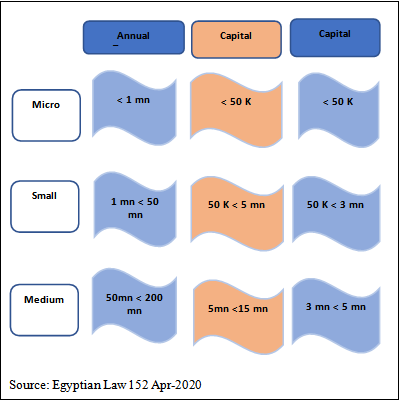
According to Egypt’s, as per law 152 on Apr-2020 unifying the definition of SMEs, with small enterprises being defined as those enterprises with business volumes starting from LE 1 million to LE 50 million, and medium enterprises were defined as businesses whose volume ranges between LE 50 million and LE 200 million.
B- Qualitative criteria:
Small firms may be difficult to define precisely on paper, but most are easy to recognize once they are seen in operation. Not only because of the greater likelihood of facing small and medium enterprises, due to greater share compared to large businesses, but also because of the simpler practices and structures, SMEs are relatively easily distinguishable from a superficial survey. Also, finds two bases to distinguish small and medium enterprises from large ones, “personal principle” and “unity of leadership and capital” as quoted in (Berisha, G. and Pula, J. 2015) 6.
According to the definitions of the SME’s, in addition to its strengths and weakness, research conclude some characteristics of SME’s, which is often discussed as follows:
I. Limited resources. A small and medium enterprise generally has limited resources.
II. Informal management style. For small and medium enterprises, the management is usually informal.
III. Flexibility. The enterprise has more flexibility to adapt to changes in the environment due to its size and informal structure.
IV. Dependence on individual decision makers. The firms are managed and operated by the owner.
2.4. The Global Effect of Covid-19 PandemicsMore than one year on, the coronavirus disease of 2019 (COVID-19) pandemic continues to dominate our lives. Despite the effective creation of vaccines, the epidemic is still far from over. Early estimates predicated that, should the virus become a global pandemic, most major economies will lose at least 2.9 percent of their gross domestic product (GDP) over 2020. This forecast was already restated to a GDP loss of 3.4 percent. To put this number in perspective, global GDP was estimated at around 84.54 trillion U.S. dollars in 2020 – meaning that a 4.5 percent drop in economic growth results in almost 2.96 trillion U.S. dollars of lost economic. (Statista Research Department Jan 2023) 7. Accordingly, some main indicators are impacted severely due to the pandemic, as report concerning the impact of Covid-19 pandemic on trade and development indicates that, the Economic Growth will decline to -3.9% in 2020, The FDI failed by 42%. Manufacturing and Small & Medium Size enterprises will have a significant drop of 11.2 per cent in the second quarter due to pandemic-related confinement measures (UNCTAD 2021) 8.
2.5. Role of Governments WorldwideIn order to understand how governments, handle the pandemic, Blavatnik School of Government at Oxford University, initiate The Oxford COVID-19 Government Response Tracker (OxCGRT), (OXFORD Business Group 2021) 3. The study indicates that the government shared the below mentioned activities and responsibilities:
1. Containment and Closure, through lockdown, Curfew and distancing procedures.
2. Economics, and that through, Income support Ordinal Sectoral, Debt/contract relief for households., Fiscal measures Numeric., Giving international support.
3. Health systems, and that through, Public information campaign, testing policy, Contact tracing, Emergency investment in healthcare, Investment in Covid-19 vaccines.
Also, several factors have been assessed to indicate the efficiency of the measure’s takin by government. The OECD 2020 report (Government support & Covid-19) indicates some main factors that have an effect on the efficiency of the measure’s takin. Those factors could be illustrated as follows:
1-Transparency. Clear communication is essential to ensure that the public understands the measures being taken and why they are necessary.
2-Targeted. The support becomes most beneficial when focus on the companies and sectors that experience the most disruption as a direct result of the pandemic.
3-Support of MSMEs. MSMEs considered the most vulnerable organization and which are generally least able to cope with large economic shocks.
4-Time Limited. In order not to lose the main objective from the economic support and not hindering its importance, the economics support should have a time limit.
2.6. Role of Enterprises ManagementThe role of management in a business is to monitor and act on uncertainty, and to ensure that components of the business are adjusted to meet the dynamics of change. Some specific tasks in managing the dynamics of the business according to are namely; monitor internal and external risks and uncertainties that endanger business, anticipate potential consequences and implement actions designed to modify business, so that company performance can be improved. The company's strategic goal after determining the focus of its business is to limit the business and find a path so that the company's competitive advantage can be maintained (Fitriasari, F., 2020) 9. Manufacturing SME’s need to take into consideration the importance of some factors in its searching for sustainability and survival such as:
1. Digitalization.
2. Cost optimization / Cash stress.
3. Ambitious entrepreneur.
4. Innovative practice.
2.7. The Role of the Financial Service Providers (FSP)Usually, at crisis time the main targets for manufacturing SMEs are how to find source of cash to finance the short- and medium-term objectives, and to minimize the cash flow needed for investment. Accordingly, the role of FSPs are maximized specially during the crisis of covid19. Due to this importance and the high expectations for the verity of services that expected to be provided by the financial institutions. The terminology Financial Service Providers (FSP) was broadly use. FSPs are organizations that provide financial services, particularly those related to financing, and include institutions that directly provide capital for companies, commercial banks, and providers who gather information and mitigate risk to facilitate financing activities, such as online industrial platforms and logistics service providers (Song, H., Yang, Y. and Tao, Z., 2020) 10.
Accordingly, FSPs need to be more innovative in their planning process to finance SMEs, as they must gradually focus on mitigating information asymmetry in order to expand lending business to SMEs Existing research has investigated how FSPs assist SMEs in addressing financing issues through innovative financing modes and emerging technology. FSPs, in particular, innovate financing modes by collaborating with other stakeholders, such as supply chain participants, to collect data that can be used to replace traditional lending. For example, supply chain finance is widely regarded as a novel financing strategy for SMEs by FSPs (Song, H., Yang, Y. and Tao, Z., 2020) 10.
2.8. Lessons Learned from Developed and Developing Countries Interaction with the PandemicIn order to enrich the research with a lot of experience, some countries targeted as a model for the countries practices to containment the spreading of the virus and their tools to support the economy during the Covid-19 pandemic. The selection distributed between developed and developing countries as follows:
Developed Countries, United Kingdom, China & Germany.
Developing Countries, Brazil, India & South Africa.
From the practices and the reading of the articles initiated by expertise on personal level or organization at the local and international level such as, UNCTAD, OECD, Mckinsey & CO., IMF, World Bank, British Business Bank, (Spillane and Hough), (Williams), (Zhu), (JhCRC), the research could summarize the lessons learned from the countries practice during Covid-19, and determined the advantage and disadvantage in those lessons as follows:
Lessons learned from developed & developing countries:
1-Transparency: is the major successful eliminate that have a great influence on the battle against Covid-19. Clear communication is essential to ensure that the public understands the measures being taken and why they are necessary.
2-The importance of public health measures & early intervention: the existence of capable health system in addition to early intervention in implementing strict measures is ultimate path to control the spread of the virus,
3-The importance of digitalization: The pandemic accelerated the trend towards digitalization, with more people than ever before working remotely and relying on online services.
4-Importance of fiscal stimulus and economic support: The pandemic had a severe impact on businesses and workers and required to implement significant fiscal stimulus packages to support their economies during the pandemic.
5-The importance of international trade: The pandemic highlighted the importance of international trade, particularly in the area of vaccine development, medical supplies and equipment.
6-Importance of data gathering and analysis: Accurate data is critical for understanding the spread of the virus and developing effective strategies to combat it.
The research designed based on Qualitative and Quantitative approach, using the Phenomenological research methodology. The research based on understanding the current situation, the thoughts and experience of concerned parties. In addition, it reveals the relation among concerned parties to interpret and reach general conclusions that may contribute, improve and allow to propose alternative to overcome the current situation.
3.2. Study Population and Sample Size CalculationThe research objective is to measure the challenges facing the Egyptian Manufacturing SMEs during crisis time Covid-19, According to Central Agent for Public Mobilization and Statistics (CAPMAS) report, the population of manufacturing small and medium size enterprises are as follows:
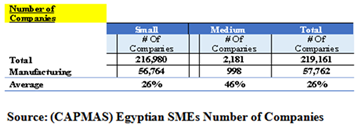 |
More over the range of the population according to new law number 152 on Apr-2020 are as in Table 1
According to (Uma Sakran and Roger Bougie, 2020) 11, The population that exceed roughly 10,000 units the target sample of the study is roughly going to be 384 respondents at confidence level 95%. And as per the above mention statistics for the manufacturing SMEs there are around 58 thousand enterprises. The research applies the below equation to calculate the sample size.
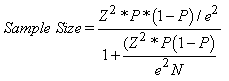 |
Where:
n = is the population size,
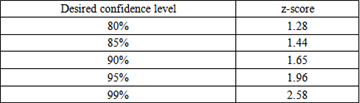
z = is the value for selected alpha level of.025 in each tail = 1.96. (The alpha level of.05 indicates the level of risk the researcher is willing to take that true margin of error may exceed the acceptable margin of error)
P = estimate of variance =.25. (Maximum possible proportion (.5) * 1- maximum possible proportion (.5) produces maximum possible sample size).
 |
e = acceptable margin of error for proportion being estimated =.05 (error researcher is willing to except).
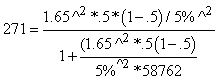
Accordingly, the sample size is 271 respondents at confidence level 90%.
 |
The research constructed three basic questions as follows;
Q1. How is the government will be dealing with the pandemic in order to support manufacturing SME’s and in return support the economy to reduce the impact of Covid-19 on the country growth?
Q2. What is the role of enterprise management for the manufacturing SMEs in order to overcome the Covid-19 pandemic?
Q3. What is the role of the financial institution to support the manufacturing SMEs to reach financial support with more creative and innovative tools matching with the circumstances of covid-19 pandemic?
According to the above questions three hypotheses are developed as follows:
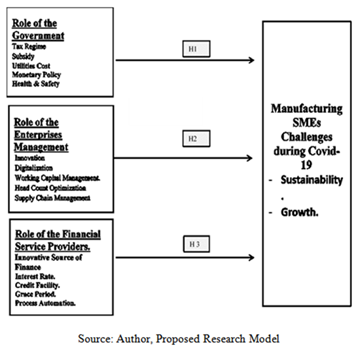
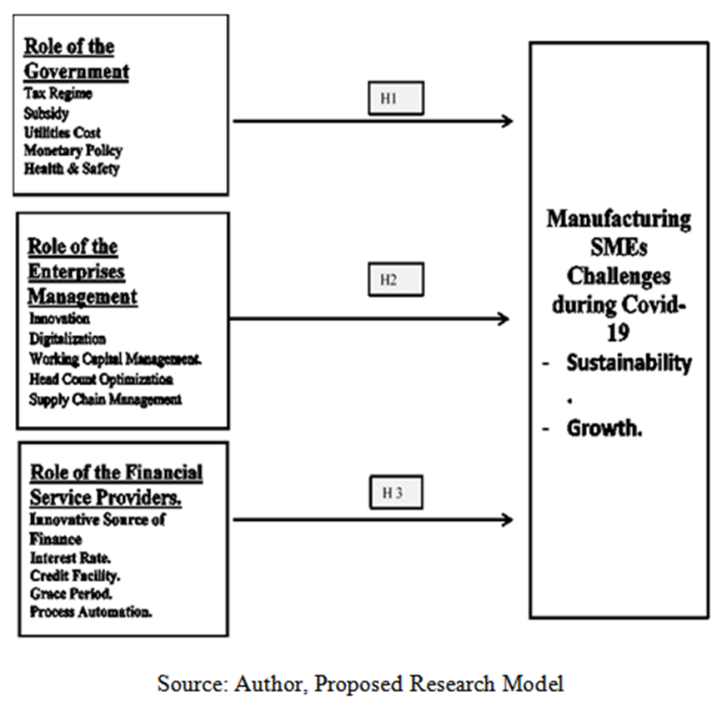
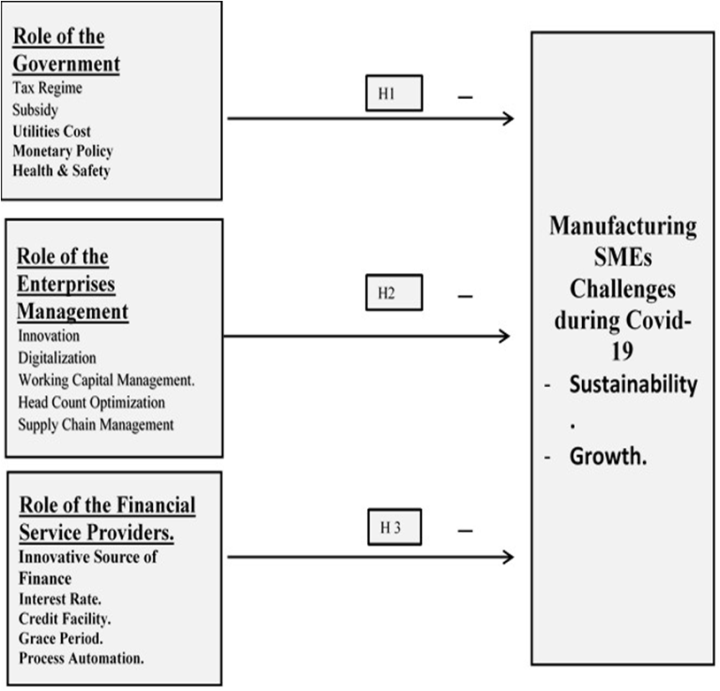
H1 The role of the government has an effect on the challenges facing manufacturing SMEs during Covid19.
H2 The Role of Enterprises Management has an effect on the challenges facing manufacturing SMEs during Covid-19.
H3 The Role of Financial Services Providers has an effect on the challenges facing manufacturing SMEs during Covid-19.
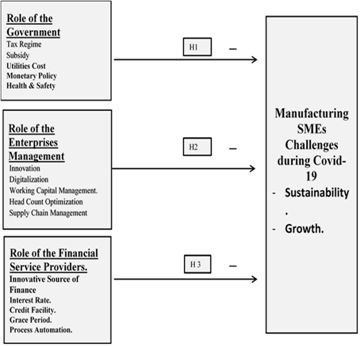
According to the hypotheses and the dimensions add to each key player, the proposed research model is as follows in Figure 1
The analysis of this research done using the statistical package for social sciences (SPSS V26) for both descriptive and inferential statistics, and (Smart PLS 3.2.7) for SEM-PLS modeling. The data analysis provides the respondents’ demographics, also includes screening and testing for missing data, finding outliers, testing data normality, and investigating common method bias. And based on the testing result the data is free from any omission, bias, nonnormality distribution and its sufficient to depend on it. Moreover, the application of PLS-SEM is presented in seven stages: specifying the structural model, specifying the measurement model, data collection and examination, path model estimation, assessing the measurement model, assessing the structural model, and interpretation of the results. Based on the above-mentioned test the result of the data analysis and the relation are presented through the (Path Coefficient) as follows:
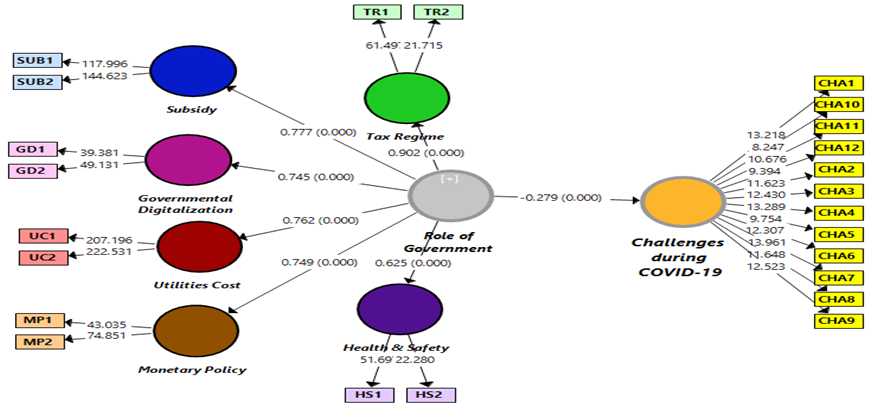
Path coefficients refer to the estimates of the relationships between the model’s constructs (Hair, Sarstedt, Hopkins, & Kuppelwieser, 2014). Those coefficients range from +1 to -1, where +1 means a strong positive relationship, 0 means a weak or non-existence relationship, and -1 means a strong negative relationship (Garson, 2016). When assessing PLS path, studies should report path coefficients beside the significance level, t-value, and p-value (Hair, Sarstedt, Ringle, & Mena, 2012). The hypothesis testing has been done to understand the signs, size, and statistical significance of the estimated path coefficients between the constructs. Higher path coefficients suggest stronger effects between the predictor and predicted variables. The significance of the supposed relationships has been established by measuring the significance of the p-values for each path with threshold p <0.05, p <0.01, p <0.001 be used to assess the significance of the path coefficient estimations (Henseler et al., 2009; Hair et al., 2017). Later, the inferences have been drawn for all hypotheses based on the significance of p-values at the above-mentioned conventional levels. The p-values and inference of hypotheses, as well as the confidence level for each estimate, are shown in Table 2.
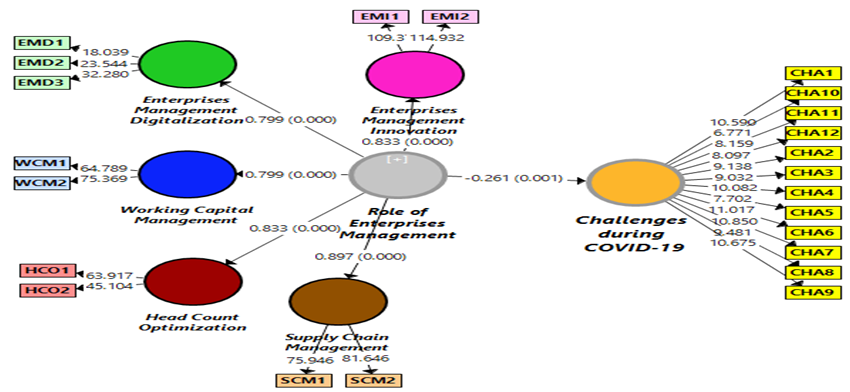
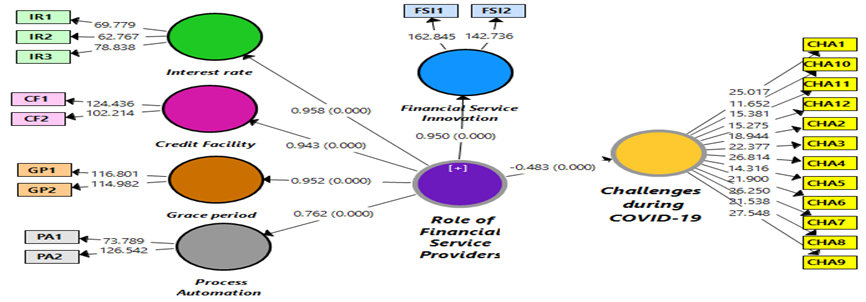
The results of hypothesis testing in Table 2 and Figure 2, Figure 3, and Figure 4 showed that Role of Government construct yielded a statistically significant negative effect on Challenges during COVID-19 since (β=-0.279, t=3.911, P<0.001, 95% CI for β= [-0.39, -0.133]) consequently, the first hypothesis is confirmed.
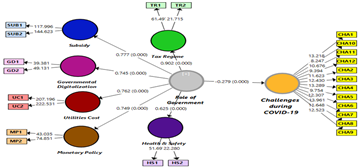
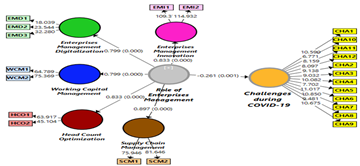
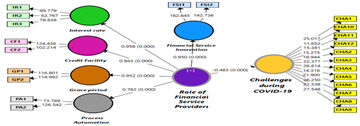
This result suggests as the role of government increases, the challenges facing Egyptian manufacturing SMEs during covid-19 decreases. Also, Role of Enterprises Management construct yielded a statistically significant negative effect on Challenges during COVID-19 since (β=-0.261, t=3.486, P<0.001, 95% CI for β= [-0.379, -0.117]) so, the second hypothesis is confirmed. This result suggests as the role of Enterprises Management increases, the challenges facing Egyptian manufacturing SMEs during covid-19 decreases. Furthermore, Role of Financial Service Providers construct yielded a statistically significant negative effect on Challenges during COVID-19 since (β=-0.483, t=9.158, P<0.001, 95% CI for β=[-0.573,-0.369]) , so, the third hypothesis is confirmed. This result suggests as the role of Financial Service Providers increases, the challenges facing Egyptian manufacturing SMEs during covid-19 decreases.
According to the above-mentioned result from the statistical data analysis, the hypotheses test result are as follows:
H1 The role of the government has a significant negative effect on the challenges facing manufacturing SMEs during Covid-19.
H2 The Role of Enterprises Management has a significant negative effect on the challenges facing manufacturing SMEs during Covid-19.
H3 The Role of Financial Services Providers has a significant negative effect on the challenges facing manufacturing SMEs during Covid-19.
Accordingly, the research proposed model after the statistical analysis is as follows as shown in Figure 5
For the sake to increase the quality of the research and have further enhancement on the practical part, interviews held with key persons at diversified types of organization specialized in a different type of industries. The interview is conducted based on semi structured interview, as it aims to collect detailed information from the interviewee by answering certain types of questions, at the same time, additional questions pop up during the interviews to provide.
Accordingly, from the interviews the research concludes out the below challenges:
A. Lack of data base for the manufacturing SMEs.
B. Lack of awareness for the new laws and regulations.
C. Lack of management capabilities to change the business model.
D. Regulations are not supporting the expansions.
E. Access to finance is not that easy.
F. Lack of understanding from the governmental units in applying the rules and regulations announced by government in addition to the corruption at the some of the governmental units.
G. Real concerned parties’ contribution at project proposal and preparation.
The main challenges faced by the manufacturing SMEs are coming from the weakness at its characteristics, which related to internal challenges and the threats coming from the surrounding environment from both economic and environmental sides, which related to external factors. The impact of those weakness and threats challenges exacerbates due to Covid-19 pandemic and the un-preceding measures takin by countries (El Naggar, F. and El Naggar, N. 2021) 12. The research summarized the weakness (Internal challenges) and threats (external challenges) due to Covid-19 pandemic as follows:
- The Weakness (Internal Challenges):
1) Financial
a. Provide suitable source of finance.
b. Decreased value of monthly sales domestic and export.
c. Delays and reduced collection of receivables.
d. The increase of the cost of raw material, equipment, production supplies and labor.
2) Supply Chain:
a. Failure to deliver contracted sales to partners.
b. Failure to received raw material and production supplies.
3) Market & Product:
a. Reduced purchasing power of consumers.
b. Investments for market and technological development.
c. Change in consumers’ demand and purchasing preferences.
4) Work environment
a. Reduction in the number of working days
b. High rates of work absenteeism.
c. Automated work environment.
- The Threats (External Challenges):
5) Policies & Regulations:
a. Policy uncertainty concerning CBE interest rate and money flow.
b. Policy uncertainty concerning tax rules and regulations.
c. Policy uncertainty for the regulation organizing the investment specially for the new entrance to the market.
6) Market & Economy:
a. Economic recession and political instability.
b. Difficulty accessing emergency support introduced by government departments, and lack of innovative source of finance.
c. Difficulties resulted from government bureaucracy process.
d. Restrictions on transportation and disruptions in distribution channels to market.
7) Environment
a. Uncertainty at the health care safety measures.
b. Uncertainty to control the crimes and disorder.
c. Uncertainty at the current infrastructure to support during crisis.
Over the last decade, small and medium-sized enterprises (SMEs) have been among the most popular types of business in Egypt. With government initiatives to support SMEs, Egypt's SME sector has only grown since then. The SMEs sector in Egypt is a key driver in the Egyptian economy and one of the fastest growing fields that boosts economic growth and contributes to the economy's sustainability (Amr A.bary, A. 2019) 2.
The government have to find and apply the best policies and rules to support the industrial sector and the SMEs and the study ensures the crucial importance of creating revival policies after the crisis. To conclude, they found that manufacturing SMEs’ resilience completely depends on the great efforts of the policymakers, SMEs operators and the government.
According to (Zaazou, Z.A. and Salman Abdou, D. 2022) 13, during economic crises and pandemics, Egypt should implement digital transformation in all sectors' practices: government, private sector, and across the entire society. This transformation is critical to combating the impact of the COVID-19 pandemic, but its success is heavily dependent on the country's technological and informational infrastructure. The short-term impact of the pandemic on the Egyptian economy was as follows:
Ø The IHS Markit Egypt Purchasing Managers' Index for non-oil private sector activity has dropped to 42.2 in March 2020 from 48.2 in December 2019, indicating worsening business conditions in the country in the first quarter of 2020.
Ø The government estimates a monthly loss of around 1 billion USD from tourism, which is a USD 12.5 billion/year industry that contributes 12% of GDP. Tourist cancellations had already reached 80% in mid-March compared to the same period in 2019, threatening an estimated 138,000 jobs. The negative effects of the tourism crisis are expected to affect at least 1.4 million people who work in the industry (latest available data is for 2014). Tourism employs 10% of the total workforce and is the third largest source of revenue after remittances and non-oil exports.
Ø Egypt is the world's fifth-largest recipient of remittances, with USD 26.8 billion in 2019 representing nearly 10% of GDP. While the value of remittances is expected to be around USD 6 billion in January-March, it is expected to fall by USD 2.3 billion in April-June 2020.
Ø The Egyptian Stock Exchange's main index (EGX30) has fallen 39% since its peak on 9 February, reaching EGP 10 154 on 16 April 2020.
The economic slowdown caused by the containment measures risks increasing the vulnerability of Egyptian women in the labour force. Women constitute 23.8% of the Egyptian labour force, with the majority working in the informal sector.
The Egyptian government interacted with the pandemic to support health, economy and specially the manufacturing SMEs could be summarized as follows (OECD Apr. 2020) 14:
Ø Healthcare and society safety, the government has closed all schools and universities, monuments, restaurants, churches, mosques, and their associated facilities, cancelled cultural events and touristic trips, and prohibited religious prayers in public gatherings as well as other large public gatherings. In addition to the above precautions, the government allocates 1 billion EGP (USD 63.5 million) in extra funding for its health services and applied various measures to increase the country’s capacity to absorb the sudden increase of critical patients that the outbreak might bring.
Ø Monetary policy, Egypt Central Bank takes several measures in order to support and sustain the economy such as:
a. cut interest rates to historic lows: this cut was done gradually on three phases over year 2020, till interest reached 8.25%, 9.25% and 8.75% respectively and the discount rate to 8.75%.
b. limits on cash withdrawals and deposits to avoid overcrowding, in particular during payroll and pension disbursement.
c. Lifting the fees on electronic transactions for six months.
d. Deferring all credit dues for customers whether corporate, SME’s and individuals including retail loan.
e. Availing the necessary credit limits to support the imports of strategic product, financing the working capital especially payment for salaries for company’s employees, in addition to support the sectors most effected by Covid-19.
f. Initiative for Non-performing: such as:
1. Companies, with bad and doubtful debts with credit scoring (9-10) and outstanding debt balance is less than 10 million EGP: Removal from nonperforming loans list, waiving for all current and exchanged legal cases and Releasing of all guarantees that held to secure the debt.
2. Individuals, with bad and doubtful debts with outstanding debt balance is less than 1 million EGP: waiving for all current and exchanged legal cases, Lifting the ban on dealing with those clients and releasing of all guarantees that held to secure the debt.
3. Industrial, agriculture and construction private sector, 100 billion EGP has been allocated through banks with 8 percent interest rate decreasing, in order to finance the purchase of raw materials, production suppliers, capital expenditure and payment of salaries.
Ø Tax measures: The Ministry of Finance lifted the administrative detention for taxpayers in return for payment of 10% of the tax due and to settle the outstanding tax due through the Dispute Resolution Committee.
a. Extending the deadline for individuals to file their annual tax returns to April 16 instead of March 31.
b. Capital Gains: the extension of the exemption from capital gains taxation on securities listed on the EGX for Egyptian residents until 1 January 2022.
c. Dividends: The withholding tax on dividends paid by EGX-listed companies will be reduced from 10% to 5%.
d. Property tax: three-month extension for payment of property taxes for companies in the industrial and tourism sectors. The property taxes will be paid in six monthly installments over the next six months.
e. The cost stamp duty on transactions in the EGX reduced from 0.15% to 0.125% and from 0.15% to 0.05% for non-residents and Egyptian residents, respectively. All spot transactions on EGX will be exempt from stamp duty.
Ø Company-specific measures:
a. allocation of 100 billion EGP (USD 6.4 billion equivalent to 2% of GDP) to fund a comprehensive plan to combat the coronavirus.
b. The price of natural gas and electricity has been reduced for industrial use.
c. The government also postponed repayment of loans for SMEs.
d. The National Bank of Egypt and Bank Miser announced a one-year deposit program with a 15%. interest rate.
e. In March and April 2020, the Export Subsidy Fund will pay out the entire EGP 1 billion in arrears, plus 10% in cash payments to exporters in June 2020.
f. The Financial Regulatory Authority (FRA) announced a series of measures to support microfinance activity.
g. The Egyptian Central Bank allocated USD 1.3 billion to support the country's stock exchange through a stock purchase programmed.
h. The EGX created electronic trading support systems that enabled remote access to a variety of platforms.
i. The Egypt for Information Dissemination Company (EGID), an EGX subsidiary, created an electronic voting system known as (E Magles) that allows board members of a publicly traded company to vote remotely.
By reaching the final stage of the research, and looking forward to achieve its main goals, which are, determining the challenges facing the Egyptian's Manufacturing SME’s during Covid-19 and propose solutions to overcome those challenges during Covid-19 pandemic. At the coming words, the research will illustrate for each key player, the challenges related and the proposed solution for each challenge.
5.1. GovernmentThis is a key ingredient in building trust which the government needs to show at turbulent times. Transparency has two directions, firstly; how good/ bad the country’s position during the pandemic crisis. Secondly; all pros and cons related to the transparency of the support provided needs to be clearly stated to the manufacturing SMEs.
Proposed Solutions:
a) Regular conferences and workshops must be scheduled on regular basis. This will build up trust with the government.
b) Competent and well experienced spoke persons should be holding these conferences. This will provide the needed credibility.
c) Announced support, must clearly identify the following:
i. Type of support: Financing, exemptions of charges/fees or tariffs, providing subsidization post bond for due amount, or as deemed provided.
ii. How to apply for the support program needed using a seamless process for an online application saving time and more efficient.
iii. Clear criteria for identifying eligible entities for each support program.
There is no clear database for up-to-date information concerning the manufacturing SMEs regarding its capital structure, size of operation, head count, nature of operation.etc. Which limits capabilities of the support providers such as, angel investors, FSP and any other future investors to have all the required information to plan for any future investment or provide the needed support for manufacturing SMEs.
Proposed Solution:
Establishing a nationwide online platform under the sponsorship of the Prime ministry office for uploading and registering all manufacturing SMEs along with quarterly uploading of their financial information – similar to the Egyptian Stock Exchange and Financial Regulatory Agency mandates for listed companies.
This dimension represents the cornerstone for the economic stability for the country. Hence having great influence over the survival and endurance of manufacturing SMEs during the pandemic and any critical times. The challenges related to this dimension are summarized as follows:
a. Governmental units, several governmental units share the same service provided to the M_SMEs, not only that, in fact every unit’s paperwork differs from one to the other causing a tremendous amount of confusion for SMEs in addition to waste time and resources.
b. Process, Bureaucratic structure was accepted in controlling operations at old ages due to the small numbers of activities and units. Nowadays this system is considered one of the prime obstacles faced by both M_SMEs and investors. Moreover, it opens the door to corruption practice.
c. Tax, the Egyptian tax regime is considered a Levies system. In other words; government becomes a preferred shareholder with a share of Manufacturing SMEs activities,
d. Regulations (New Laws, Monetary Policy & Subsidy), The government challenges concentrate on the regulations announced indicating the country’s capabilities to provide financial support and their understanding to the M_SMEs actual needs during the pandemic.
Proposed Solutions:
a) Unified Governmental Units, the government must establish a sole interface responsible for dealing with all M_SMEs legalization, and documentation. In addition to avoiding centralization and availing regional offices representing this association at each governorate to facilitate interactions with M_SMEs.
b) Process automation for programs submission after including rigid system controls to avoid malicious intrusions and abolishing paperwork.
c) Establishing an inclusive and robust database for M_SMEs with all its legal supporting documents, permits and any other special requirements legalizing its nature of operations on Egyptian soil.
d) The government during crisis times, must provide some tax incentives for the M_SMEs, in order to reduce the burden on the enterprise cashflow and financial position.
e) Regulation initiation, the main aim of regulations is to manage and support the enterprises’ operation, accordingly the below criteria must be considered at the regulation’s initiation especially at time of crisis:
I. New regulation must be discussed and reviewed by adhering committee representing the M_SMEs practitioners.
II. Regulation is not just an idea that must be implemented momentarily, rather than a rule and tool for policymakers and governmental bodies to ensure abidance of companies to its predetermined goals.
III. The government must ignore the old way for announcing new laws and regulation and start apply modernized Marketing Concept.
5.2. Enterprises ManagementOne of the challenges to the enterprise’s management at crisis times, is to sustain the business and avoid going out of business. Unfortunately, the majority fail to achieve that goal and usually bankruptcy sadly becomes reality.
Proposed Solution:
Having a clear view prior to start the business. This can be attained via endorsing CANVAS model. CANVAS Model is a strategic management template containing nine blocks, used for developing new business models and documenting existing ones. CANVAS model assists businesses to align their activities by illustrating potential trade-offs. Also, this model should be updated at least on a quarterly basis through using the SWOT analysis template (S: Strength, W: Weakness, O: Opportunities, T: Threats).
Trusting information between the lender & borrower, is one of the challenges that hinder the relationship between enterprise management and the FSP. Due to the obstacles in the FSP lending process and requirements, the enterprise management starts to undergo cosmetics over their financial figures, in order to have their financial results match the lender requirements.
Proposed Solution:
The enterprises must present to the FSPs their accurate operation data, their real financial figures. The enterprise management needs to change their concept for the FSPs and deal with them as their financial consultant, who will support the enterprises with their actual financial needs.
Working capital considered the blood pump for the organization. For any organization; working capital is on top of the enterprise management list, and its management represent a great challenge for the enterprise management. And those challenges exacerbated due to the covid-19 pandemic effect on the whole business cycle.
Proposed Solution:
a) Defining a S.M.A.R.T KPIs – Specific, Measurable, Attainable, Relevant, and Time-Bound. The enterprises management should define feasible short, medium and long-term plans in order to meet its KPIs. This can be achieved through periodic following up on the below performance indicators: Cash Conversion Cycle “CCC”, is a metric expressing how many days it takes a company to convert the cash it spends on inventory back into cash by selling its product. The shorter a company’s CCC, the less time it has money tied up in accounts receivable and inventory. The cash conversion cycle formula is as follows: CCC = DIO + DSO – DPO.
b) Close Monitoring over Supply Chain. A supply chain is an entire system of producing and delivering a product or service, from the very beginning stage of sourcing the raw materials to the final delivery of the product or service to end-users.
c) Cost optimization, must become one of the priorities for the enterprise’s management during crisis time. Cost are one of the major sources of creating stress on the cashflow, in addition to the enterprise profitability.
d) Cash Flow Forecast, setting an adequate cash flow forecast policy is an aim to be able to ensure securing short and medium-term liquidity cash flows, covering three months period.
e) New source of finance, during crisis times and due to the stressed cashflow, normally the enterprises searching for additional source of finance to be able to secure and sustain the operation.
During Covid-19 pandemic, one of the enterprises challenges is to maintain healthy and safety environment to their employees, in addition to maintain the operation and facilitate the employees work and the connection with their customers.
Proposed Solution:
a) ERP system: ERP refers to Enterprise Resource Planning system, is an automated platform, companies use to manage and integrate the essential parts of their businesses. Which will allow companies to facilitate their employees work and increase efficiency.
b) Website platform: This website will contain all info about the company, including hyperlinks to allow users from easily surface the Web, in addition to provide information about the company and its product, pricing, how to place orders and how to pay for your orders.
5.3. Financial Service ProvidersThe main obstacles, that the FSPs teams are not fully grasping the M_SME structure business model and/or its specific needs, and on the contrary, they are following a rigid rule book for granting facilities and financial stimulus.
Proposed Solution:
FSPs management and staff should attain an essential training and induction sessions tailored for each industry covering the whole M_SMEs seeking financial aids.
Finding the suitable financial aid facilities that will be suitable for M_SMEs is one of the challenges any FSP may encounter.
Proposed solution:
Comprehension to M_SMEs needs especially during Covid-19 pandemic is very important approach. The FSP need to avoid the traditional approaches in dealing with manufacturing SMEs and shift its mindset from being only a lender to become a stakeholder/ partner. Consequently, the narrow scope of lending facilities will be just one of many other alternatives.
This is considered an inherent challenge within any FSP control environment. As in order to grant any financial facility; the M_SMEs must comply to an exhausting list of requirements mandated by FSPs – sometimes requested by regulators as well.
Proposed Solution:
The above challenges address two main concerns:
a) Documentation: FSPs should review the list of documentation required according to a set of factors such as: the size and maturity of the M_SMEs, the nature of the financial facility requested, along with linking with the M_SMEs platform proposed in above solution.
b) Collateral: The FSPs must review their collateral strategy, as they should not apply standard collateral strategy with all customers. In addition, increase the number and awareness of the Credit Guarantee Associations, in order to distribute the financing risk over several institutions rather than being a burden on only one.
Covid-19 pandemic emphasized the importance of establishing digital environment along with challenges as well. Thanks to the precautionary measures implemented during pandemic ranging from distancing to lockdown emphasized the importance of digitalization, as it raises the question of How will business be able to operate under such mandatory restrictions?
Proposed Solution:
The FSPs management must cope with the pandemic and the crisis times management requirements. In order to maintain the business, the FSP must shift to virtual environment for operating their activities rather than traditional hardcopies and paperwork. By applying virtual and online approach this will facilitate the communication with its M_SMEs customers remotely allowing them to apply for financial facilities, make transfers and process all needed transactions without physical contact between customers and FSPs.
The Covid-19 pandemic has created unprecedented challenges for businesses worldwide, including small and medium-sized enterprises (SMEs) in the manufacturing sector. Those enterprises have been hit hard by the pandemic, due to the disruptions in supply chains, reduced demand for their products and services, shortage in collection and difficulties in accessing to finance and government support.
One of the most significant challenges faced by manufacturing SMEs during the pandemic has been the disruption to their supply chains. Many SMEs sourced their raw materials and components from overseas, and the closure of borders and restrictions on international travel have made it difficult to import goods. As a result, manufacturers have struggled to maintain their production schedules, leading to delays in delivery and lost revenue. Another challenge faced by manufacturing SMEs during the pandemic has been the reduced in demand for their products and services. With many businesses and consumers cutting back on spending, SMEs have seen a decline in orders and revenue, and they lack the possibility to innovate new sources to create additional demand on their products. This has put pressure on their cash flow and forced them to consider cost-cutting measures, such as reducing staff or scaling back production.
Access to finance and government support has also been a challenge for manufacturing SMEs during the pandemic. Many SMEs have struggled to secure loans and other forms of financing, as lenders have tightened their lending criteria in response to the economic uncertainty caused by the pandemic. Government support programs have been available, but the process of accessing them has been complex and time-consuming, leading some SMEs to miss out on vital financial support.
In conclusion, manufacturing SMEs have faced significant challenges during the Covid-19 pandemic, including disruptions to their supply chains, reduced demand for their products and services, and difficulties in accessing finance and government support. Accordingly, As the pandemic continues to evolve, it is essential that manufacturing SMEs receive the support they need to overcome those challenges and emerge stronger.
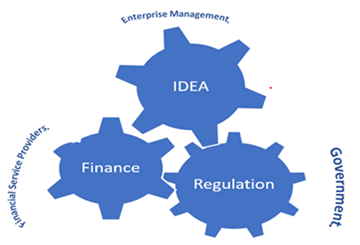
Moreover, the pandemic emphasizes that the concept of working in a separate island should not exist anymore, as the relations between challenges and key players are overlapping. At many cases it apparent that the three key players are sharing the same responsibility for the same challenge. YES, each one has its role to overcome the challenges, BUT it must be through the cooperation among them. It’s sort of relation between three pillars IDEA / Regulation / Finance and this relation has two ways as it depending on each other’s.
 |
The primary limitation faced by this study is the lack of information about the manufacturing small and medium size enterprises. Due to the insufficient digitalization system, it was very difficult to collect accurate and update information about M_SMEs. Moreover, the insecurity and scepticism to provide information about the business and the faced complications especially which related to government, was a great challenge for the study.
| [1] | OECD (2020) The impact of the coronavirus (COVID-19) crisis on development, https://read.oecd-ilibrary.org/view/?ref=134_13456. OECD. Available at: https://read.oecdilibrary.org/view/?ref=134_134569-xn1go1i113&title=The-impact-of-the-coronavirus-(COVID-19) -crisis-on-development-finance. | ||
| In article | |||
| [2] | Amr A.bary, A. (2019) SMEs sector: A key driver to the Egyptian economic development., Munich Personal RePEc Archive. Available at: https://mpra.ub.uni-muenchen.de/93034/. | ||
| In article | View Article | ||
| [3] | OXFORD Business Group (2021) “Roadmap Egypt Financial Services In collaboration with Recovery Covid-19,” Financial Regulatory Affair, May. | ||
| In article | |||
| [4] | Mohsin Shafi, Junrong Liu, Wenju Ren, Impact of COVID-19 pandemic on micro, small, and medium-sized Enterprises operating in Pakistan,Research in Globalization,Volume 2,2020, 100018, ISSN 2590-051X, (https://www.sciencedirect.com/science/article/pii/S2590051X20300071). | ||
| In article | View Article | ||
| [5] | Doc. Darja Holátová, PhD Ing. Monika Březinová, PhD, Basic Characteristics of Small and MediumSized Enterprises in Terms of Their Goals, International Journal of Business and Social Science Vol. 4 No. 15 [Special Issue – November 2013] https://ijbssnet.com/journals/Vol_4_No_15_Special_Issue_November_2013/13. | ||
| In article | |||
| [6] | Berisha, G. and Pula, J. (2015) Defining small and medium enterprises: A critical review: Semantic scholar, undefined. Academic Journal of Business, Administration, Law and Social Sciences. Available at: https://www.semanticscholar.org/paper/Defining-Small-and-Medium-Enterprises%3A-a-critical-. | ||
| In article | |||
| [7] | Statista Research Department (2023) Coronavirus: Impact on the global economy, Statista. Available at: http://www.statista.com/topics/6139/covid-19-impact-on-the-global-economy/. | ||
| In article | |||
| [8] | UNECE Regional Policy Dialogue: The role of competition policy in supporting msmes economic recovery in the post covid19 crisis (2021) UNCTAD. Available at: https://unctad.org/meeting/unctad-unece-regional-policy-dialogue-role-competition-policy-supporting-msmes-economic. | ||
| In article | |||
| [9] | Fitriasari, F., 2020. How do Small and Medium Enterprise (SME) survive the COVID-19 outbreak?. Jurnal Inovasi Ekonomi, 5(02). https://ejournal.umm.ac.id/index.php/JIKO/article/view/11838/7934. | ||
| In article | View Article | ||
| [10] | Song, H., Yang, Y. and Tao, Z. (2020) How different types of financial service providers support small- and medium- enterprises under the impact of covid-19 pandemic: From the perspective of expectancy theory - frontiers of Business Research in China, Springer Open. Springer Singapore. Available at: https://fbr.springeropen.com/articles/10.1186/s11782-020-00095-1. | ||
| In article | View Article | ||
| [11] | Bougie Roger and Uma Sekaran. 2020. Research Methods for Business: A Skill-Building Approach Eighth ed. Hoboken NJ: John Wiley & Sons. | ||
| In article | |||
| [12] | El Naggar, F. and El Naggar, N. (2021) The Egyptian SME’s Force Field Analysis 2020, Idsc,gov.eg. The Egyptian Cabinet_ Information and Decision Support Center. Available at: https://idsc.gov.eg/Upload/DocumentLibrary/Attachment_A/4834/8The%20Egyptian%20SME’s%20Force% 20Field%20Analysis%202020.pdf. | ||
| In article | |||
| [13] | Zaazou, Z.A. and Salman Abdou, D. (2022), "Egyptian small and medium sized enterprises’ battle against COVID-19 pandemic: March–July 2020", Journal of Humanities and Applied Social Sciences, Vol. 4 No. 2, pp. 94-112. | ||
| In article | View Article | ||
| [14] | OECD (2020) The COVID-19 crisis in Egypt - OECD, OECD. Available at: https://www.oecd.org/mena/competitiveness/The-Covid-19-Crisis-in-Egypt.pdf. | ||
| In article | |||
Published with license by Science and Education Publishing, Copyright © 2023 Amgad Moustafa Abdelaal, Hussein Seoudy and Mona Kadry
 This work is licensed under a Creative Commons Attribution 4.0 International License. To view a copy of this license, visit
http://creativecommons.org/licenses/by/4.0/
This work is licensed under a Creative Commons Attribution 4.0 International License. To view a copy of this license, visit
http://creativecommons.org/licenses/by/4.0/
| [1] | OECD (2020) The impact of the coronavirus (COVID-19) crisis on development, https://read.oecd-ilibrary.org/view/?ref=134_13456. OECD. Available at: https://read.oecdilibrary.org/view/?ref=134_134569-xn1go1i113&title=The-impact-of-the-coronavirus-(COVID-19) -crisis-on-development-finance. | ||
| In article | |||
| [2] | Amr A.bary, A. (2019) SMEs sector: A key driver to the Egyptian economic development., Munich Personal RePEc Archive. Available at: https://mpra.ub.uni-muenchen.de/93034/. | ||
| In article | View Article | ||
| [3] | OXFORD Business Group (2021) “Roadmap Egypt Financial Services In collaboration with Recovery Covid-19,” Financial Regulatory Affair, May. | ||
| In article | |||
| [4] | Mohsin Shafi, Junrong Liu, Wenju Ren, Impact of COVID-19 pandemic on micro, small, and medium-sized Enterprises operating in Pakistan,Research in Globalization,Volume 2,2020, 100018, ISSN 2590-051X, (https://www.sciencedirect.com/science/article/pii/S2590051X20300071). | ||
| In article | View Article | ||
| [5] | Doc. Darja Holátová, PhD Ing. Monika Březinová, PhD, Basic Characteristics of Small and MediumSized Enterprises in Terms of Their Goals, International Journal of Business and Social Science Vol. 4 No. 15 [Special Issue – November 2013] https://ijbssnet.com/journals/Vol_4_No_15_Special_Issue_November_2013/13. | ||
| In article | |||
| [6] | Berisha, G. and Pula, J. (2015) Defining small and medium enterprises: A critical review: Semantic scholar, undefined. Academic Journal of Business, Administration, Law and Social Sciences. Available at: https://www.semanticscholar.org/paper/Defining-Small-and-Medium-Enterprises%3A-a-critical-. | ||
| In article | |||
| [7] | Statista Research Department (2023) Coronavirus: Impact on the global economy, Statista. Available at: http://www.statista.com/topics/6139/covid-19-impact-on-the-global-economy/. | ||
| In article | |||
| [8] | UNECE Regional Policy Dialogue: The role of competition policy in supporting msmes economic recovery in the post covid19 crisis (2021) UNCTAD. Available at: https://unctad.org/meeting/unctad-unece-regional-policy-dialogue-role-competition-policy-supporting-msmes-economic. | ||
| In article | |||
| [9] | Fitriasari, F., 2020. How do Small and Medium Enterprise (SME) survive the COVID-19 outbreak?. Jurnal Inovasi Ekonomi, 5(02). https://ejournal.umm.ac.id/index.php/JIKO/article/view/11838/7934. | ||
| In article | View Article | ||
| [10] | Song, H., Yang, Y. and Tao, Z. (2020) How different types of financial service providers support small- and medium- enterprises under the impact of covid-19 pandemic: From the perspective of expectancy theory - frontiers of Business Research in China, Springer Open. Springer Singapore. Available at: https://fbr.springeropen.com/articles/10.1186/s11782-020-00095-1. | ||
| In article | View Article | ||
| [11] | Bougie Roger and Uma Sekaran. 2020. Research Methods for Business: A Skill-Building Approach Eighth ed. Hoboken NJ: John Wiley & Sons. | ||
| In article | |||
| [12] | El Naggar, F. and El Naggar, N. (2021) The Egyptian SME’s Force Field Analysis 2020, Idsc,gov.eg. The Egyptian Cabinet_ Information and Decision Support Center. Available at: https://idsc.gov.eg/Upload/DocumentLibrary/Attachment_A/4834/8The%20Egyptian%20SME’s%20Force% 20Field%20Analysis%202020.pdf. | ||
| In article | |||
| [13] | Zaazou, Z.A. and Salman Abdou, D. (2022), "Egyptian small and medium sized enterprises’ battle against COVID-19 pandemic: March–July 2020", Journal of Humanities and Applied Social Sciences, Vol. 4 No. 2, pp. 94-112. | ||
| In article | View Article | ||
| [14] | OECD (2020) The COVID-19 crisis in Egypt - OECD, OECD. Available at: https://www.oecd.org/mena/competitiveness/The-Covid-19-Crisis-in-Egypt.pdf. | ||
| In article | |||