This research studies factors affecting Intention towards Green Consumption through a comparative study of the impact of Company Controlled Variables (Advertising Message and Social Media Effect) and Market Controlled Variables (Government Regulations and Availability of Green Products), on Egyptians’ Intention towards Green Consumption. The study followed a mixed methodology of qualitative and quantitative approaches; ten in-depth interviews were conducted with subject matter experts. Then, a structured questionnaire was distributed on target respondents; 396 responses were collected and analyzed using SPSS version 23. The findings of the study showed that Company Controlled variables had positive significant relation with Intention towards Green Consumption. Market Controlled variables were found insignificant. The research closed the gap in literature through the comparative study conducted, which was not done before. It tested new relations, provided new insights and included new variables. The study is aspired to be of value for governments and marketers, explaining the variables most affecting Intention towards Green Consumption for better green initiatives’ design, promotion and easier market penetration.
Sustainable Development is becoming a persisting issue worldwide given the significant climate changes happening every day. Many countries are changing their laws and regulations to mitigate climate change effects and are adopting sustainable measures in all areas. Sustainable Development is generally defined as an attempt to take into account concerns about the environmental issues with socio-economic issues 1. In Egypt, Sustainable Development goals announced by the United Nations are well supported by the government and much progress has been achieved 2; as they are well placed in Egypt’s long-term strategy (Egypt’s Vision 2030). Egypt is one of many countries facing challenges in food, water and energy supplies affected by rising demand of the growing population, which according to State Information Service of Egypt reached 104.4 million in January 2023 3, and is expected to reach 122 million by 2030, added to the rapid urbanization and increased incomes 4. According to IFC report, climate-smart investments are expected to reach $23 trillion in emerging markets during the period 2016-2030. In Africa, the expected investment potential is almost $783 billion, with almost $123 billion dedicated to renewable energy projects, and $652 billion for buildings and transportation projects. While an estimate for North Africa and the Middle East-mainly Egypt, Morocco and Jordan-amounts for a potential of $265 billion, $97 billion (almost 30%) of which goes for renewable energy generation, and almost $169 billion for transportation, Green buildings, industry, waste management, electric transmission and distribution sectors. Egypt solely is expected to have climate investments of $174 billion till 2030 5.
To seize such opportunities, the paradigm of consumption and development must be shifted towards sustainable patterns, through encouraging Green consumption and targeting Green consumers through mega initiatives. The Egyptian government is working on developing and promoting a number of Green initiatives and policy regulations. A close analysis of the Egyptian market should be conducted, to get a better understanding of the factors affecting Green consumption and the intention towards it, which is what this study aspires to achieve. The study wishes to help government officials and market practitioners understand consumers to be able to design and promote Green projects and initiatives, and have better market penetration.
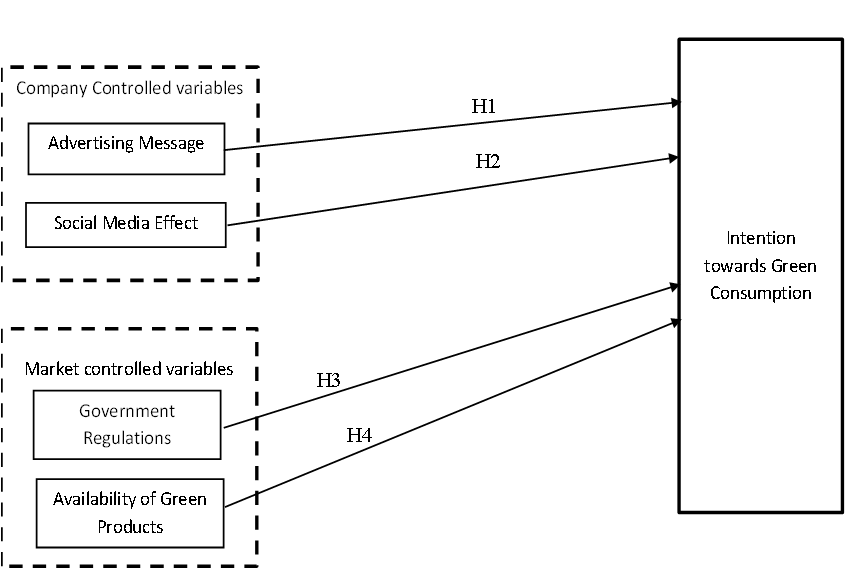
This section presents an overview of the theoretical background of the variables and their relations, on which the proposed hypotheses and theoretical model were developed. Green consumption is defined as “the tendency to express the value of environmental protection through one’s consumption behaviors” 6. In a study by 7, it was claimed that Green purchase intention explains Green purchase behavior, and that attitude towards Green products had a strong positive effect on both Green purchase intention and Green purchase. Based on a thorough review for the literature available on the topic, factors most influencing Intention towards Green Consumption were specified, of which is the Advertising Message presented to consumers. In their book, 8 mentioned that products are designed to meet consumers’ needs, and that advertising helps to show products’ availability and reduces search time. Juwaheer et al., 9 proposed a significant positive relationship between Green advertisements and purchase intentions for consumers. Moreover, Social Media is becoming an everyday routine. All age groups especially young people log in to several media platforms such as Facebook and Instagram, and follow up posts and new trends. Most companies, governments and well-known figures have social media accounts and post their news and experiences to them. In their study for cosmetics industry, Pop et al., 10 were able to confirm that social media impacts Purchase Intention through affecting Altruism and Egoistic motivation as well as affecting Attitude and Subjective norm, which then affect Purchase Intention. Governments influence the Green marketing approach through Green marketing-related legislations 11. In a study by 12, they proved that Government and NGO initiatives had a strong positive impact on Environmental Knowledge and Environmental Concern, which have a positive effect on perceived value, which has a positive effect on Green attitude, and thus strongly affects Green consumption intention. In their study, 13 proved that one of the two moderators that widely affect the intention- behavior gap is the Availability of Green products, as it refreshes the memories of consumers about their earlier Green consumptions and reminds them to act according to their intentions. Gleim et al., 14 also proved that unavailability of Green products is one of the top variables affecting consumption decisions. In his study, Akturan, 15 defined Green Purchase Intention as “The subjective probability that consumers will purchase Green products”. Fitriani et al., 16 confirmed that there is a positive relation between Green consumer behavior and Green purchase intention, and that Green consumer behavior is positively related to the Green marketing mix. Based on the literature review above, the following four hypotheses were developed and the following conceptual model is proposed for the research study:
The study followed a mixed methodology of qualitative and quantitative approaches. Ten in-depth interviews were done with subject matter experts (consumers, government officials and private sector representatives). Recommendations for a more robust model were taken into consideration. A structured questionnaire adopted from previous studies was drafted and pre-tested to measure its accuracy and understandability, resulting in minor amendments for clarity purposes, Arabic translation for the questions, an introduction, a background and definitions for key terms were also added. The questionnaire was measured on a 5-point Likert scale. A total of 396 complete responses were collected using snow ball technique online and via hard copies. The target respondents were males and females aged 18 and above residing in Egypt. Statistical analysis was done using SPSS Version 23. Constructs of the questionnaire and their sources are listed in the annex below.
For testing reliability, Cronbach Alpha test was used. All variables have reliability values more than the benchmark of 0.7 and the overall model had a reliability value of 0.770. This indicates that the measures used in this study were reliable to capture data in the conceptual framework. The validity was measured using the Calculated Correlation Coefficient. All variables surpassed the recommended value, except for Availability of Green Product (0.168) that had a value less than the recommended value. It will be considered for this research since it presented very good reliability, however, it should be investigated further in future research. The overall model had a validity value of 0.439. Table 1 below shows the reliability and validity values of the study variables:
Table 2 shows the demographic analysis of the study sample, which shows that the sample comprised more females, most respondents were in the age group 36-54 and well educated.
Table 3 shows the descriptive analysis of the sample, most of the respondents agreed on the importance of Company and Market controlled variables and their effect on Intention towards Green Consumption.
Table 4 above shows the Pearson’s correlation values of the study variables, Company Controlled Variables showed the highest values for Intention Towards Green Consumption, followed by the Market Controlled Variables. Table 5 below shows that the R square value for the model is 0.38, indicating that the linear regression explains 38% of the variance in the data.
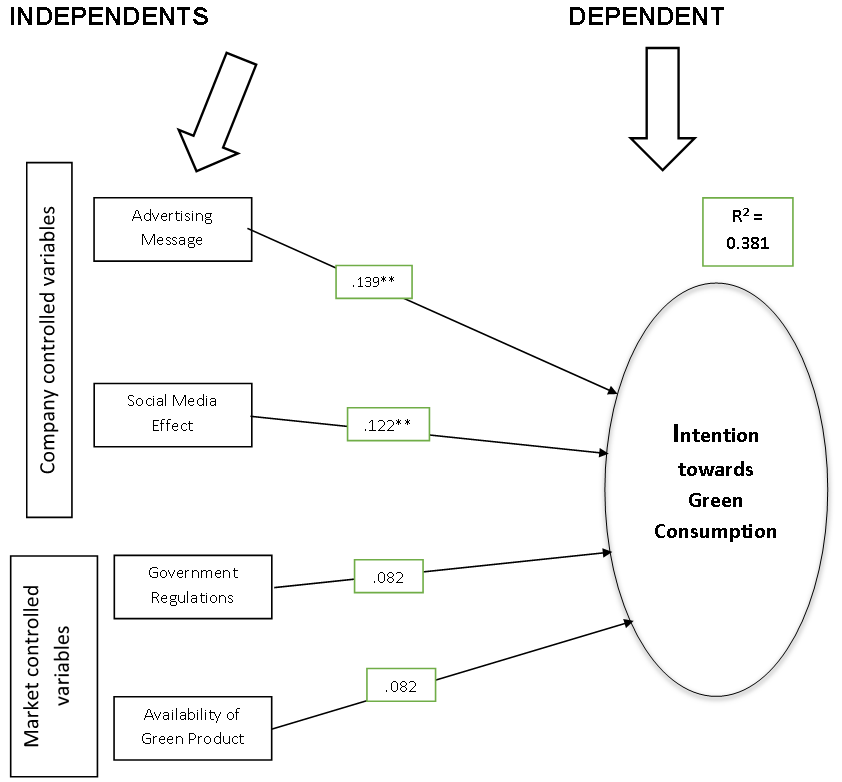
Regarding the model coefficients, Table 6 below shows the multiple linear regression estimates including the intercept and the significance levels, in addition to Pearson’s Correlation Coefficients between Intention towards Green Consumption and all other variables. All “r” values are significant. If we force all variables into the multiple linear regression, we find that the significant variables are Advertising Message and Social Media Effect.
Therefore, the Detailed Path Coefficient Analysis for Intention towards Green Consumption, using SPSS, where Path Coefficients are β (beta) weights from the Linear Regression Analysis is as follows:
As the effect of the independent variables on Intention towards Green Consumption was examined, results showed that Company Controlled Variables had the strongest relation and the highest Beta values. Advertising Message showed significant positive relation indicating its importance and effect on people’s intention, similarly Social Media Effect showed significant positive relation with Intention towards Green Consumption. This might be attributed to the demographic nature of the sample, as most of the sample are well-educated individuals, who use the social media heavily. Market Controlled Variables showed positive insignificant effect on Intention towards Green Consumption, as both individual variables; Government Regulations and Availability of Green Products were found insignificant. The insignificance might be due to the inconvenience of policies suggested by governments so far, as people do not feel their impact or do not relate to their lives. They usually feel that there will be an extra cost or financial burden associated, which makes them reluctant to use Green products. Regarding the insignificance of Availability of Green Products; it suggests that without consumers’ acknowledgement of the Green products’ benefits and a real interest in shifting their consumption towards them, availability will not make any difference, especially if their prices are not affordable. This further emphasizes that raising consumers’ awareness is indispensable.
Study outcomes showed that using a well-designed marketing mix of Company Controlled Variables will result in the greatest effect on Intention towards Green Consumption. Designing a well-structured advertising message, as brief as possible, to the point, and relates to the target audience, then disseminating it through different channels, especially online through social media, is believed to be very effective in reaching a wide base of consumers with minimal costs and no downtime. Celebrities can be well-positioned in advertising for green brands to leverage their equity and acceptance, as their influence was found very profound during in-depth interviews. Segmentation of social media users is very essential, as every age group has its own interests. For instance, senior citizens prefer Youtube and News channels, games applications, and cooking programs. Thus, advertisements should be disseminated through these platforms for senior citizens. Governments should enhance their role and regulate the market in a way that supports Green products, the demand will then gradually shift towards green products creating economies of scale and reducing prices. Since government regulations are mandatory by definition, governments should be careful with the associated cost. Stakeholder consultations should be conducted before the formulation of new policies or legislations. Governments as well have a competitive advantage in their procurement power, as their mass consumption can help shift the paradigm of consumption towards Green products. Worth mentioning that Egypt’s procurement law no. 182 FY 2018 supports sustainable consumption, which can be better used in the country’s plan in shifting towards Green Consumption. The government of Egypt has taken steps in shifting towards a greener economy through a number of sustainable projects especially in the transport sector. Incentive schemes were used to encourage consumers. The government should also interfere through tax and customs tools, carbon tax has been suggested for high GHG emitting industries to encourage the shift towards more sustainable energy resources. Customs on polluting products should be leveraged. Real estate tax can also be used as an encouraging incentive for households who use sustainable energy resources such as solar energy; they can get exempted from real estate tax to encourage them adopt clean sources of energy. To encourage people to get engaged in such initiatives, awareness must be raised, which shall be done through Advertising Messages and Social Media platforms, with proper segmentation techniques. Availability of Green Products should be given more attention when demand is created, to give people access to what they are encouraged to consume. If physical availability would be a problem, then a well-designed delivery service should be available for consumers, at least at the beginning. Raising awareness should be done since early stages of education. Also, extensive advertising plans should be done, conveying appropriate advertising messages, through proper channels, especially social media, for its massive effect on all ages.
The sample was collected from Cairo, Egypt; expanding the context to other cities will definitely enrich the topic. Also, collecting a true random sample will enhance the research.
Regarding in-depth interviews, time was a very limiting factor and scheduling interviews- with government officials in particular- was very challenging. Increasing In-depth Interviews would be of great benefit, including more sectors other than Government officials, consumers and private sectors representatives will enrich the topic, such as service or tourism sectors.
Finally, other variables should be studied such as the internal, social and emotional factors affecting Intention towards Green Consumption. Availability of Green Products should be investigated further.
| [1] | Sobol, A. (2007). Governance barriers to local sustainable development in Poland. Management of Environmental Quality: An International Journal Vol. 19 No. 2, pp. 194-203. | ||
| In article | View Article | ||
| [2] | United Nations (2023). The 17 goals. THE 17 GOALS | Sustainable Development (un.org). | ||
| In article | |||
| [3] | State Information Service, (2023) https://www.sis.gov.eg/Story/174798/Egypt's-population-hit-104.395-million-CAPMAS?lang=en-us#:~:text=Egypt's%20Population%20has%20reached%20on,Ministry%20of%20Health%20and%20Population. | ||
| In article | |||
| [4] | UNDP (2018). Sustainable Development Goals Report: Egypt 2030. Frederick S. Pardee Center for international futures, Josef Korbel School of International studies, University of Denver. | ||
| In article | |||
| [5] | IFC (2016). Climate Investment Opportunities in Emerging Markets. An IFC Analysis. | ||
| In article | |||
| [6] | Semprebon, E., Mantovani, D., Demczuk, R., Maior, C., S. & Vilasanti, V. (2018). Green consumption: a network analysis in marketing. Marketing Intelligence & Planning Vol. 37 No. 1, pp. 18-32. | ||
| In article | View Article | ||
| [7] | Duong, C., D. (2021). Big Five personality traits and green consumption: bridging the attitude-intention-behavior gap. Asia Pacific Journal of Marketing and Logistics, 1355-5855. | ||
| In article | View Article | ||
| [8] | Solomon, M., R., Bamossy, G., J., Askegaard, S. & Hogg, M., K. (2016). Consumer Behaviour, A European Perspective. Sixth edition, Pearson Education Limited, page 23. | ||
| In article | |||
| [9] | Juwaheer, T., D., Pudaruth, S. & Noyaux, M., M., E. (2012). Analysing the impact of green marketing strategies on consumer purchasing patterns in Mauritius. World Journal of Entrepreneurship, Management and Sustainable Development Vol. 8 No. 1, pp. 36-59. | ||
| In article | View Article | ||
| [10] | Pop, R., A., Săplăcan, Z. & Alt, M., A. (2020). Social Media Goes Green—The Impact of Social Media on Green Cosmetics Purchase Motivation and Intention. Information, 11, 447. | ||
| In article | View Article | ||
| [11] | Alomari, B., M., A. & Alomari, I., A., A. (2020). Green Marketing and its Impact on Consumer Purchasing Behavior and The Tourism Sector/An Analytical Study - The Jordanian Green Market. Journal of Economics, Business and Market Research (JEBMR), Vol. 1 (1) 8-24. | ||
| In article | |||
| [12] | Kumar, R., Saha, R., Sekar P.,C. & Dahiya, R. (2019). Examining the role of external factors in influencing green behavior among young Indian consumers. Young Consumers, VOL. 20 No. 4, pp. 380-398. | ||
| In article | View Article | ||
| [13] | Nguyen, H., V., Nguyen, C., H. & Hoang, T., T., B. (2018). Green consumption: Closing the intention – behavior gap. Sustainable Development, 27: 118-129. | ||
| In article | View Article | ||
| [14] | Gleim, M., R., Smith, J., S., Andrews, D., Cronin Jr., J., J. (2013). Against the Green: A Multi-method Examination of the Barriers to Green Consumption. Journal of Retailing, Volume 89, Issue 1, Pages 44-61. | ||
| In article | View Article | ||
| [15] | Akturan, U. (2018). How does greenwashing affect green branding equity and purchase intention? An empirical research. Marketing Intelligence & Planning Vol. 36 No. 7, pp. 809-824. | ||
| In article | View Article | ||
| [16] | Fitriani, L., K., Jumantini, E., Supriatna, O. & Jaelani (2021). The Effect of Green Marketing Mix On Green Consumer Behavior and Green Purchasing Decision. | ||
| In article | View Article | ||
| [17] | Chen, Y., S. & Chang, C., H. (2012). Enhance green purchase intentions, The roles of green perceived value, green perceived risk, and green trust. Management Decision Vol. 50 No. 3, pp. 502-520. | ||
| In article | View Article | ||
Published with license by Science and Education Publishing, Copyright © 2023 Dina Kordy
 This work is licensed under a Creative Commons Attribution 4.0 International License. To view a copy of this license, visit
http://creativecommons.org/licenses/by/4.0/
This work is licensed under a Creative Commons Attribution 4.0 International License. To view a copy of this license, visit
http://creativecommons.org/licenses/by/4.0/
| [1] | Sobol, A. (2007). Governance barriers to local sustainable development in Poland. Management of Environmental Quality: An International Journal Vol. 19 No. 2, pp. 194-203. | ||
| In article | View Article | ||
| [2] | United Nations (2023). The 17 goals. THE 17 GOALS | Sustainable Development (un.org). | ||
| In article | |||
| [3] | State Information Service, (2023) https://www.sis.gov.eg/Story/174798/Egypt's-population-hit-104.395-million-CAPMAS?lang=en-us#:~:text=Egypt's%20Population%20has%20reached%20on,Ministry%20of%20Health%20and%20Population. | ||
| In article | |||
| [4] | UNDP (2018). Sustainable Development Goals Report: Egypt 2030. Frederick S. Pardee Center for international futures, Josef Korbel School of International studies, University of Denver. | ||
| In article | |||
| [5] | IFC (2016). Climate Investment Opportunities in Emerging Markets. An IFC Analysis. | ||
| In article | |||
| [6] | Semprebon, E., Mantovani, D., Demczuk, R., Maior, C., S. & Vilasanti, V. (2018). Green consumption: a network analysis in marketing. Marketing Intelligence & Planning Vol. 37 No. 1, pp. 18-32. | ||
| In article | View Article | ||
| [7] | Duong, C., D. (2021). Big Five personality traits and green consumption: bridging the attitude-intention-behavior gap. Asia Pacific Journal of Marketing and Logistics, 1355-5855. | ||
| In article | View Article | ||
| [8] | Solomon, M., R., Bamossy, G., J., Askegaard, S. & Hogg, M., K. (2016). Consumer Behaviour, A European Perspective. Sixth edition, Pearson Education Limited, page 23. | ||
| In article | |||
| [9] | Juwaheer, T., D., Pudaruth, S. & Noyaux, M., M., E. (2012). Analysing the impact of green marketing strategies on consumer purchasing patterns in Mauritius. World Journal of Entrepreneurship, Management and Sustainable Development Vol. 8 No. 1, pp. 36-59. | ||
| In article | View Article | ||
| [10] | Pop, R., A., Săplăcan, Z. & Alt, M., A. (2020). Social Media Goes Green—The Impact of Social Media on Green Cosmetics Purchase Motivation and Intention. Information, 11, 447. | ||
| In article | View Article | ||
| [11] | Alomari, B., M., A. & Alomari, I., A., A. (2020). Green Marketing and its Impact on Consumer Purchasing Behavior and The Tourism Sector/An Analytical Study - The Jordanian Green Market. Journal of Economics, Business and Market Research (JEBMR), Vol. 1 (1) 8-24. | ||
| In article | |||
| [12] | Kumar, R., Saha, R., Sekar P.,C. & Dahiya, R. (2019). Examining the role of external factors in influencing green behavior among young Indian consumers. Young Consumers, VOL. 20 No. 4, pp. 380-398. | ||
| In article | View Article | ||
| [13] | Nguyen, H., V., Nguyen, C., H. & Hoang, T., T., B. (2018). Green consumption: Closing the intention – behavior gap. Sustainable Development, 27: 118-129. | ||
| In article | View Article | ||
| [14] | Gleim, M., R., Smith, J., S., Andrews, D., Cronin Jr., J., J. (2013). Against the Green: A Multi-method Examination of the Barriers to Green Consumption. Journal of Retailing, Volume 89, Issue 1, Pages 44-61. | ||
| In article | View Article | ||
| [15] | Akturan, U. (2018). How does greenwashing affect green branding equity and purchase intention? An empirical research. Marketing Intelligence & Planning Vol. 36 No. 7, pp. 809-824. | ||
| In article | View Article | ||
| [16] | Fitriani, L., K., Jumantini, E., Supriatna, O. & Jaelani (2021). The Effect of Green Marketing Mix On Green Consumer Behavior and Green Purchasing Decision. | ||
| In article | View Article | ||
| [17] | Chen, Y., S. & Chang, C., H. (2012). Enhance green purchase intentions, The roles of green perceived value, green perceived risk, and green trust. Management Decision Vol. 50 No. 3, pp. 502-520. | ||
| In article | View Article | ||