 OPEN ACCESS
  PEER-REVIEWED
Isolation and Screening of Dye Decolorizing Bacteria
M P Shah
Abstract
The present study reveals that the enriched aerobic cultures of indigenous microbes can be used successfully for decolorizing dye effluents. Physico-chemical analysis of dye effluent revealed high load of pollution. Textile dye effluent and contaminated soils were collected and analyzed for selection of suitable bacteria for dye degradation. The residual bacterial load was found to be in the range of 108 cfu.mL-1. Six bacterial species viz., two species of both Bacillus and Klebsiella,, and one species of Planococcus and Micrococcus were isolated. The best two species of dye degraders namely Planococcus and Bacillus were further optimized for the effect of carbon and nitrogen source, pH, temperature and percentage of inoculums. The optimized conditions for both isolates of Planococcus sp. and Bacillus sp. were used in bio-decolorization studies of textile effluent. More than 50% of decolorization was achieved within 4 days of incubation while 80% of decolorization after 6 days. The isolates of Planococcus sp. and Bacillus sp. exhibited maximum decolorization ability at pH between 5-8 and temperature 37C. Moreover, 10% (v/v) inoculums, glucose and peptone as carbon and nitrogen sources respectively were found to be the optimum conditions for decolorization. Both those isolates showed highest decolorization percentage of Coractive Blue 3R dye effectively during optimization.
At a glance: Figures
Keywords: Textile effluent, Bacillus, Klebsiella, Planococcus, Micrococcus, decolorization
Journal of Applied & Environmental Microbiology, 2014 2 (5),
pp 244-248.
DOI: 10.12691/jaem-2-5-7
Received June 06, 2014; Revised July 01, 2014; Accepted August 04, 2014
Copyright © 2013 Science and Education Publishing. All Rights Reserved.Cite this article:
- Shah, M P. "Isolation and Screening of Dye Decolorizing Bacteria." Journal of Applied & Environmental Microbiology 2.5 (2014): 244-248.
- Shah, M. P. (2014). Isolation and Screening of Dye Decolorizing Bacteria. Journal of Applied & Environmental Microbiology, 2(5), 244-248.
- Shah, M P. "Isolation and Screening of Dye Decolorizing Bacteria." Journal of Applied & Environmental Microbiology 2, no. 5 (2014): 244-248.
| Import into BibTeX | Import into EndNote | Import into RefMan | Import into RefWorks |
1. Introduction
Environmental pollution has been recognized as one of the major hazard of the modern world. Due to rapid industrialization, lot of chemicals including dyes synthesized chemically were used in day to day life (14). Dyes usually have a synthetic origin and complex aromatic molecular structures which make them more stable and more difficult to biodegrade [2]. Approximately 10,000 different dyes and pigments are used industrially and over 0.7 million tons of synthetic dyes are produced annually, worldwide. The three most common groups of dyes are azo, anthraquinone and phthalocyanine [5], most of which are toxic and carcinogenic. Disposal of these dyes into the environment causes serious damage, since they may significantly affect the photosynthetic activity of hydrophytes by reducing light penetration and also toxic to aquatic organisms due to their break down products [3, 9]. One of the most pressing environmental problems related to dye effluents is the improper disposal of waste water from dyeing industry [11]. Traditional methods for the cleanup of azo dyes in the textile waste water usually involve the removal of unwanted materials through sedimentation, filtration and subsequent chemical treatments such flocculation, neutralization and electro-dialysis before disposal. These processes may not guarantee the treatment of toxic dye in the effluent. Moreover, considering the volume of wastes released during the industrial production process these are often laborious and expensive [8]. Over the past decades, biological decolorization has been investigated as a method to transform, degrade or mineralize azo dyes [6]. The present study deals with isolation of textile dye degrading bacteria from a dye contaminated environment and its ability to degrade textile dyes into non-toxic product. The efficient organisms were then optimized under different cultural conditions to study optimal bioremediative capacity.
2. Materials and Methods
2.1. Collection Of Effluent SamplesEffluent samples were collected in clean collection bottles from different textile dyeing units in Ankleshwar GIDC of Ankleshwar, Gujarat, India. The samples were transferred immediately to the laboratory for further analysis.
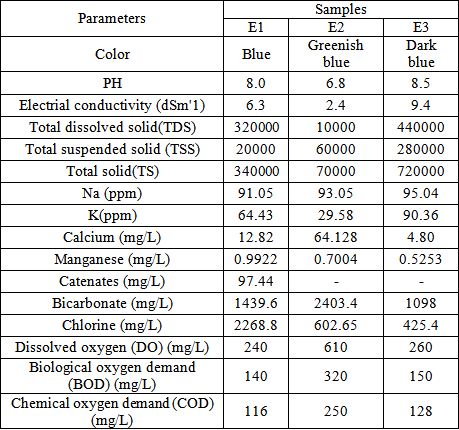
2.2. Physico-Chemical AnalysisThe samples were analyzed and characterized by various parameters such as pH, color, texture, total suspended solids, total dissolved solids, total solids, chemical oxygen demand (COD), biological oxygen demand (BOD), electrical conductivity (EC), bulk density, organic carbon, available nitrogen, phosphorous and potassium, calcium, magnesium, copper, zinc, manganese, iron, carbonates, bicarbonates, chlorine [4].
2.3. Enrichment and Isolation of Dye Degrading MicrobesCollected effluent sample was used as the parent source of inoculums in this study. For enrichment of total heterotrophic (TH) population of dye degrading isolates in the samples, 1 mL of the sample was aseptically added to 100 mL of enrichment medium, containing 1% (w/v) glucose as carbon source. The flasks were incubated in shaker condition at 150 rpm at 28C for 6 days. The isolation of dye degrading bacteria from contaminated samples was performed by modifying the method as described by Akhilesh et al. (2010). The enriched cultures were serially diluted up to 10-6 dilution and the diluted cultures were spread plated aseptically and incubated at 28-30C for 3 days. The experiment was carried out with triplicates. On incubation, population density was counted and different colony morphology were selected and maintained on nutrient agar slants at 4C.
2.4. Biochemical Identification of Dye Degrading IsolatesSelected isolates were grown on nutrient agar plates (Himedia, India). Based upon the growth characteristics, staining reactions and biochemical tests [13] the isolates were identified according to Bergey's Manual of Determinative bacteriology [10].
2.5. Screening of Effective Isolates for Dye DecolorizationAs per the method described by Nigam et al. [15], 10% (v/v) inocula for each isolate were inoculated in 100 mL of Zhou and Zimmermann (ZZ) medium containing 0.02 g of Coractive blue P 3R to evaluate decolorization percentage. Uninoculated dye medium served as control. All the flasks were incubated at 30C for 6 days under shaker condition at 150 rpm. The culture broth was centrifuged at 8000 rpm for 15 min. Clear supernatant was measured at 600 nm in UV-Vis spectrophotometer (SHIMADZU-1800, JAPAN). The percentage decolorization of dye was determined by using the formula:
 |
Where,
C = Absorbance of control flask,
T = Absorbance of the isolate containing flask.
2.6. Effect of Carbon and Nitrogen Sources On Dye DecolorizerEffect of various carbon sources viz., glucose, sucrose and mannitol at 1% (w/v) and nitrogen sources viz., yeast extract and peptone at 0.25% (w/v) on dye decolorization of coractive blue P3R dye in modified ZZ medium was studied for the best two dye degraders. Experiments were carried out with 10% (v/v) inocula of each selected isolate in ZZ medium and medium without culture was served as control. All the flasks were incubated at 30C under shaking condition for 6 days and it was analyzed for percent decolorization.
2.7. Effect of Temperature and Ph on Dye DecolorizerEffect of various temperature viz., 4C, 27C, 37C, 45C and pH viz., 5, 6, 7, 8, 9 on dye decolorization of coractive blue P3R dye in ZZ medium was also studied for the best two dye degraders. All the flasks were incubated at 30C under shaking condition for 6 days and it was analyzed for percent decolorization.
2.8. Effect Of Inoculum Concentration On Dye DecolorizerEffect of various inocula percentage (v/v) viz., 1, 2, 5 and 10% on dye decolorization of coractive blue P3R dye in ZZ medium was studied for the best two dye degraders. All the flasks were incubated at 30C under shaking condition for 6 days and it was analyzed for percent decolorization.
2.9. Study on Bio-Decolorization of Dye Effluent Using Dye Degrading IsolatesThree samples of untreated textile effluent were treated with best two optimized dye degrading isolates individually and as consortium. The time course of decolorization was carried out under optimum condition obtained from growth optimization studies.
3. Results and Discussion
The data on physico-chemical analysis of effluent samples is presented in Table 1. The effluent E1 and E3 shows alkaline pH (8.0 and 8.5) well within permissible limits. Buckley [7] reported that the pH of effluent affects aquatic life, plants and humans. Electrical conductivity (EC) of samples was found to be very high (6.3, 2.4 and 9.4 ds/m). Total suspended solid (TSS) in the effluents were very high (20000, 60000, 280000 mg.L-1) above the permissible limits laid down Central Pollution Control Board (CPCB), India. Total dissolved solid (TDS) and Total solid (TS) of the effluent was also very high above permissible limits. Tyagi and Mehra [19] reported that the high TDS are one of the major sources of sediments which reduce the light penetration and affect photosynthesis, thereby decreasing dissolved oxygen (DO) level and decreased purification by the microorganisms. There was a high load of BOD and COD viz., 140, 320, 150 mg/L and 116,250, 128 mg/L respectively. The chloride content was found to be very high in E1 sample (2268.8 mg/L), compared to E2 sample (602.65 mg.L-1 and E3 sample (425.4 mg.L-1. reported that the high chlorine contents are harmful in food chains of aquatic life.
3.1. Population Density of Total Heterotrophic Bacteria in Effluent SamplesIt was observed that the E3 sample had the highest population density (22 x 108 cfu.mL-1) followed by E2 (17.6 x 10⁸ cfu.mL-1). The sample E1 had the least population density (2.3 x 10⁸cfu/mL). Nigam et al. [15] reported the isolation of di-azo dye direct red 81 degrading novel bacterial consortium from dye contaminated effluent samples.
3.2. Identification of Dye DegradersSix isolates were isolated from effluent samples and it was coded as ETL1 [1], ETL1 [2], ETL3, ETL4 and ETL55. These species were identified tentatively up to genera level based on morphological and biochemical characters. Two species of both Bacillus, and Klebsiella viz., Klebsiella pneumonia and Klebsiella oxytoca, one species of Planococcus. and Micrococcus luteus were identified. Similar kind of observation was made by Saranraj et al. [18]. They have isolated five isolates from textile dye effluent samples and identified as Bacillus subtilis, Pseudomonas aeruginosa, Proteus mirabilis, Klebsiella pneumonia and Escherichia coli.
3.3. Screening for Most Effective Dye Degrading Isolates for Coractive Blue P 3RAll the six isolates were screened for dye degrading ability with respect to Coractive blue P3R (20 mg.100mL-1) in Zhou and Zimmermann medium. Visual screening revealed that all the isolates were able to decolorize the dye from moderate to intense. Two isolates Planococcus sp. ETL1 [1] and Bacillus sp (ETL3) were intense dye decolorizers. Percentage of decolorization was calculated with respect to control. It was observed that Planococccus sp. ETL1 [1] was able to decolorize up to 69.02% after 6 days of incubation followed by Bacillus sp. (S3) at 68.09%.
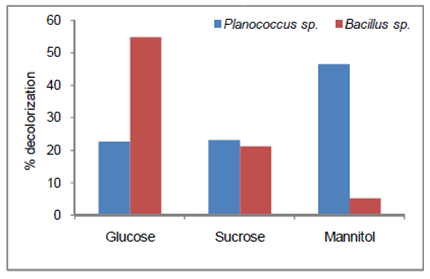
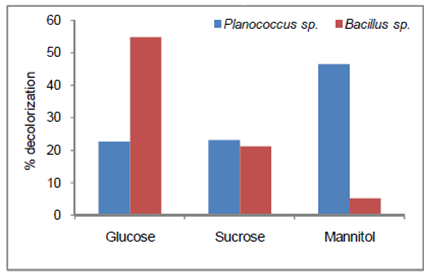
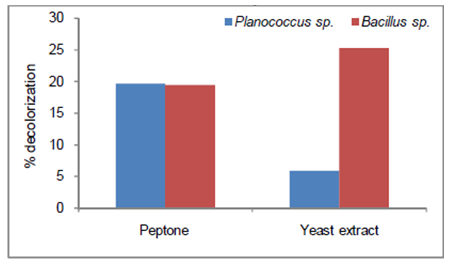
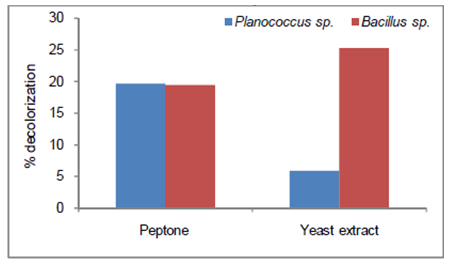
3.4. Effect of Carbon and Nitrogen Sources on Decolorization DyeIt was observed that after 6 d of incubation, decolorization percentage was higher (54.6%) in Bacillus sp. as compared with Planococcus sp. (46.53%) for glucose and vice versa for mannitol (Figure 1). In case of nitrogen source, Planococcus sp. showed highest decolorization percentage in the presence of peptone but in Bacillus sp. decolorization percentage was found to be high (25.23%) in yeast extract as compared to nitrogen source (Figure 2). Similar to this work, Wang et al. (2009) reported that a Citrobacter sp. decolorized 96.2% of reactive red 180 dye with 4 g.L-1 of glucose as carbon source.

 PowerPoint Slide
 Larger image(png format)


 PowerPoint Slide
 Larger image(png format)
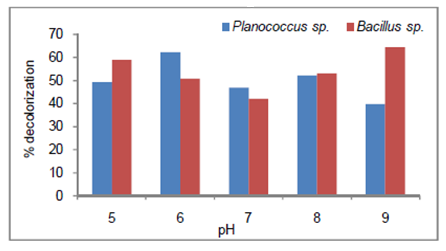
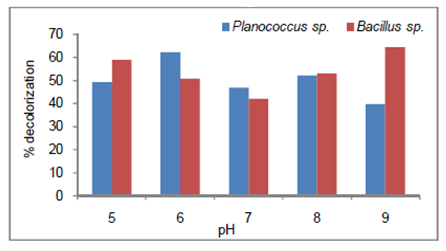
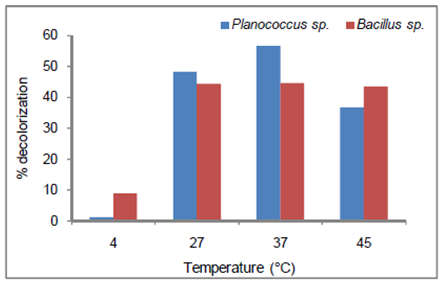
At 6th d of incubation, it was observed that the decolorization percentage was highest (64.34%) at alkaline pH for Bacillus sp. at pH 9 but in Planococcus sp. decolorization percentage was found to be high (62.19%) in acidic pH [6] as compared to other pH ranges (Figure 3). In case of optimum temperature, Planococcus sp. and Bacillus sp. in the presence of 37C showed maximum decolorization when compared to other temperatures (Figure 4).
 PowerPoint Slide
 Larger image(png format)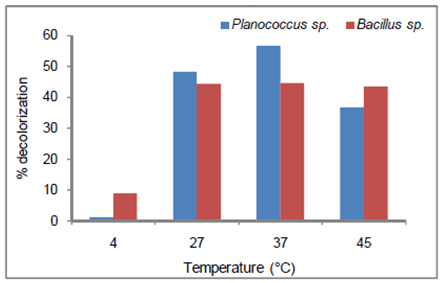
 PowerPoint Slide
 Larger image(png format)
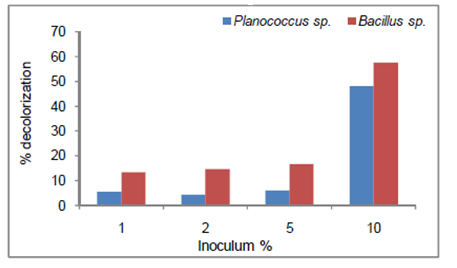
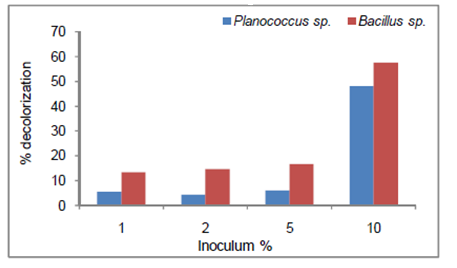
It was observed that decolorization percentage was highest at 10% inoculum concentration for Bacillus sp. (48.15%) and Planococcus sp. (57.68%) and low decolorization was obtained in other inoculums concentration (Figure 5). This study is corroborated with the findings of Kumar et al. (2009). They used the mixed culture for decolorization of reactive azo dye and reported 98% decolorization at 10% inoculums size.
 PowerPoint Slide
 Larger image(png format)
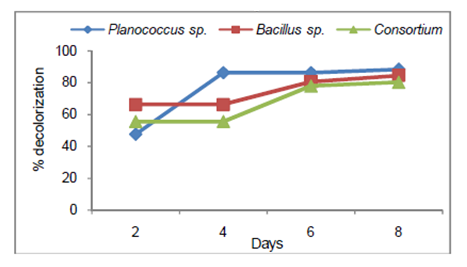
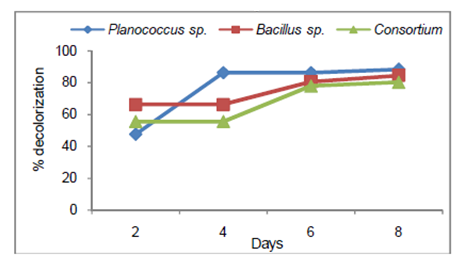
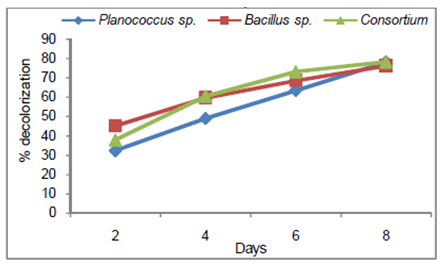
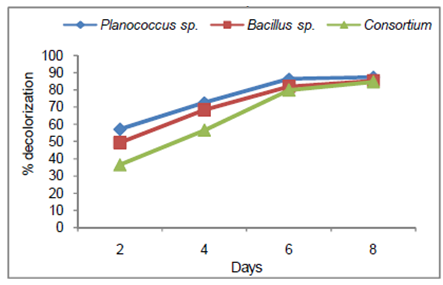
Three samples of untreated textile effluents were treated with best two optimized dye degrading isolates, Planococcus sp. and Bacillus sp. individually and as consortium. Planococcus sp. gave the highest decolorization percentage (88.31%) for E1 sample followed by Bacillus sp. (84.51%) and consortium of both the strains (80.21%) after 8 days (Figure 6). In E2 sample, Planococcus sp. decolorized the dye effluent up to 78.21% followed by Bacillus sp. and microbial consortium (76.3% and 8.3% respectively) after 8 days (Figure 7). Planococcus sp. gave maximum decolorization against E3 sample, whereas Bacillus sp. and microbial consortium gave 85.21 and 84.6% respectively after 8 d (Figure 8) found to be high in Planococcus sp. followed by Bacillus sp., which shows the adaptability of the strains to severe conditions of effluent and survival in highly contaminated sites. The ability of isolates to decolorize textile dye is attributed to their adaptability to xenobiotic compounds by their biological activity and chemical structure of dye. Similar studies were achieved by Ponraj et al. [16] & Prasad et al. [17] when they used Bacillus sp. and Pseudomonas sp. which showed 89% of decolorization of Orange 3R dye.
 PowerPoint Slide
 Larger image(png format)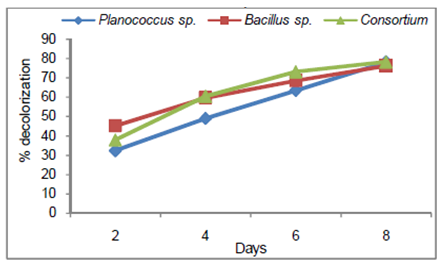
 PowerPoint Slide
 Larger image(png format)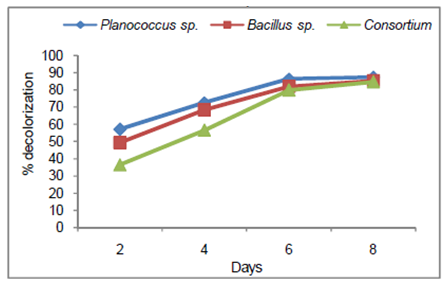
 PowerPoint Slide
 Larger image(png format)
4. Conclusion

 PowerPoint Slide
 Larger image(png format)
 View current table in a new window
On the basis of the results of the present study, suitable strategy can be developed for the treatment of waste water contaminated with the dye. Bacterial strains of this study, Planococcus sp. and Bacillus sp. can be used as a good microbial source for waste water treatment. The isolated and identified bacterial strains were found to be most effective and having enormous potential of textile dye degradation under versatile environmental conditions. Since these strains decolorize number of dyes, in future it can be used for textile waste water treatment.
References
| [1] | Akhilesh, D., Neeraj, M, Neha, S, Abhina, S. and Shivendra, V. 2010. Isolation of dye degrading microorganism. Elec. J. Environ. Agri. Food Chem. 9 (9): 1534-1539. | ||
 In article In article | |||
| [2] | Aksu, Z. 2005. Application of biosorption for the removal of organic pollutants: A review. Proc. Biochem. 40: 997-1026. | ||
| In article | CrossRef | ||
| [3] | Aksu, Z., Kilic, N, Ertugrul, V. and Donmez, G. 2007. Inhibitory effects of chromium (Vl) and Remazol black on chromium (Vl) and dye stuff removals by Trametes versicolor. Enz. Microbial Technol. 40: 1167-1174. | ||
| In article | CrossRef | ||
| [4] | APHA. 1992. Standard methods for examination of water and waste water. APHA, AWWA. Washington, DC., USA. | ||
| In article | |||
| [5] | Axelsson, J., Nilsson, U., Terrazas, E., Aliaga, T.A. and Welander, U. 2006. Decolorization of the textile dyes reactive red 2 and reactive blue for using Bjerekandera sp. strain Bol 13 in a continuous rotating biological contactor reactor. Enz. Microbial Technol. 39: 32-37. | ||
| In article | CrossRef | ||
| [6] | Banat, I.M., Nigam, P., Singh, D. and Marchant, R. 1996. Microbial decolorization of textile dye containing effluents: A review. Biores. Technol. 58: 217-227. | ||
| In article | CrossRef | ||
| [7] | Buckley, C.A. 1992. Membrane technology for the treatment of dye house effluents. Water Sci. Technol. 25 (10): 203-209. | ||
| In article | |||
| [8] | Gopi, V., Akhilesh, U. and Soundararajan, N. 2012. Bioremediation potential of individual and consortium non-adapted fungal strains on Azo dye containing textile effluent. Adv. Appl. Sci. Res. 3 (1): 303-311. | ||
| In article | |||
| [9] | Hao, O.J, Kim, H. and Chaing, P.C. 2000. Decolorization of wastewater critical reviews. Environ. Sci. Technol. 30: 449-505. | ||
| In article | CrossRef | ||
| [10] | Holt, J.G., Krig, N.R., Sneath, P.H.A., Staley, J.T. and Williams, S.T. 1994. Bergey's manual of determinative bacteriology (9th edn). Baltimore, Maryland: Williams and Wilkins. | ||
| In article | |||
| [11] | Jayarajan, M., Arunachalam, R. and Annadurai, G. 2011. Agricultural wastes of jackfruit peel nano-pourous adsorbent for removal of rhodamine dye. Asian J. Appl. Sci. 4: 263-270. | ||
| In article | CrossRef | ||
| [12] | Kumar, K., Dastidar, M.G. and Sreekrishnan, T.R. 2009. Effect of process parameters on aerobic decolorization of reactive azo dye using mixed culture. World Acad. Sci. Engg. Technol. 58: 962-965. | ||
| In article | |||
| [13] | Martin, D., Stanley, F., Eugene, R., Karl-Heinz, S. and Erok, S. 2006. The prokaryotes: A hand book on the biology of bacteria, 3rd edn. Vol-I-VII. | ||
| In article | |||
| [14] | Moorthi, P.S., Selvam, S., Sasikalaveni, A, Murugesan, K. and Kalaichelvan, P.T. 2007. Decolorization of textile dyes and their effluents using white rot fungi. African J. Biotech. 6 (4): 424-429. | ||
| In article | |||
| [15] | Nigam, P., Geoff, M., Banat, I.M. and Roger, M. 1996. Decolorization of effluent from the textile industry by a microbial consortium. Biotechnol. Lett. 18 (1): 117-120. | ||
| In article | CrossRef | ||
| [16] | Ponraj, M., Gokila, K. and Vassudeo Zambare. 2011. Bacterial decolorization of textile dye-orange 3R. Int. J. Adv. Biotechnol. Res. 2: 168-177. | ||
| In article | |||
| [17] | Prasad, A.A.S. and Rao, K.V.B. 2010. Physicochemical characterization of textile effluent and screening for dye decolorizing bacteria. Global J. Biotechnol. Biochem. 5 (2): 80-86. | ||
| In article | |||
| [18] | Saranraj, P., Sumathi, V., Reetha, D. and Stella, D. 2010. Decolorization and degradation of direct azo dyes and biodegradation of textile dye effluent by using bacteria isolated from textile dye effluent. J. Ecobiotechnol. 2 (7): 7-11. | ||
| In article | |||
| [19] | Tyagi, O.D. and Mehra, M. 1990. A textbook of environmental chemistry. Anmol Publications, New Delhi, India. | ||
| In article | |||
| [20] | Wang, H., Su, J.Q., Zheng, X.W., Tian, Y., Xiong, X.J. and Zheng, T.L. 2009. Bacterial decolorization and degradation of the reactive dye Reactive Red 180 by Citrobacter sp. CK3q. Int. Biodeterioration Biodegradation. 63: 395-399. | ||
| In article | CrossRef | ||

 CiteULike
 Mendeley
 StumbleUpon
 Delicious
 Facebook
 Twitter
 LinkedIn
 Print
Print