The study examined cooperative aids to members’ livelihood among fishing communities in Anambra North agricultural zone of Anambra State consisting of seven (7) LGAs. A notable problem that appears to be confronting fishery activities in the study area is that of developing appropriate and effective organization or institution like cooperatives to mobilize and induce members of the rural fishing community to a greater productive effort. Rural fishers who are characterized by low income, low resource utilization, small or outdated fishing gadgets and unprofessionalism, find it difficult to pool their resources together in order to raise their income and substantially improve their living conditions. The study examined socio-economic background of fisher-members of the farmers multipurpose cooperative societies; identified forms of aids fisher-members received from their cooperatives; determined the advancement in the livelihood status of fisher-members after joining farmers cooperatives; determined the reduction in the constraining factors to the fishing enterprises of members after joining cooperatives. Multi-stage sampling techniques were used to collect data from 300 respondents. Simple descriptive and inferential statistics were used in analyzing the data. OLS regression model was also used to test the hypotheses. Hypothesis one was significant at 5% level of probability while hypothesis two was rejected because the Z-cal was greater than the Z-tab. However, the study concluded that in evaluating the cooperative aids to members’ livelihood among fishing communities in the study area, there were improving fishing skills, preservation/roasting, net weaving techniques, net casting, and boat rehabilitation training. It was therefore, recommended that farmers should be encouraged to organize themselves into cooperative in order to improve their access to Government facilities among others.
Fish farming has a significant potential to make substantial contributions to national socio-economic development, revitalization and reduction of poverty in the short, medium and long term. FAO 1 argues that over 80 percent of the world's population depends on fish for protein, hence, the need for improved fish production, preservation and distribution. Manasi, Latha and Raju 2, opine that fish farming can support livelihoods of marginal families and contributes significantly to the household income and provide way out of poverty. The potential cannot be effectively harnessed without financial, physical human assets, and institutionalized framework, like cooperatives for a sustainable benefit of the present and future generations. A cooperative is an autonomous association of persons united voluntarily to meet their common economic, social and cultural needs and aspirations through a jointly-owned and democratically-controlled enterprise. Cooperatives in the fishery sector are ways of maximizing long-term community benefits to deal with the threats of fisheries mismanagement, livelihood insecurity and poverty – harsh realities for many of the world’s small-scale fishers, FAO 3. A well designed fishery cooperatives can offer substantial benefits to its members, its immediate community and the world in general, 4.
In the world, many people especially from rural fishing communities are very much dependent on fishery related activities for a living. In rural Zambia, fish production is an important occupation with about 25,000 artisanal fishers and 30,000 others that actively derive their livelihood directly from fish processing and trading, 5. The main areas of employment or source of livelihood associated with fishery comprises of boat building and repairs, net manufacturing, fish processing, fuel wood supply, power supply, transportation and marine workshops. Fishery employs more than 40% of world’s population and about 107 million people are into fish processing, distribution and marketing 6. Fishery plays an important role in supporting livelihoods and also forms a source of diet and income for over one billion people. Notably, inland fisheries are of particular importance to the rural poor, accounting for about 15% of global employment FAO, 7.
In Nigeria, fish availability is either by capture, artisanal fish farming or by import. Statistics has shown that Nigeria is one of the largest African producers of fish, with an output of about 817,516 metric tons in 2010 (616,981 metric tons from capture and 200,535 tons from aquaculture) 8. In 1980, the Federal Government of Nigeria decided to boost fish production through fishermen cooperatives as effective machinery for improving socio-economic welfare of small-scale farmers throughout the federation with provision of cooperative aids 9.
Cooperative aid is the support in form of credit, training, fishing gadgets, information and so on, given to fishers to boast their source of livelihood. When these are not provided or lacking, fishing activities suffer a great setback, and the members’ livelihood hampers. In Nigeria, particularly in Anambra North agricultural zone, many fishermen use fishing nets with small meshes that invariably catch many juvenile fishes and most times not sustainable. These fishermen inability to maintain sustainable fish farming could be linked to weak capital assets which include natural, financial, human and physical resources affecting their level of production and standard of living. It is against this background that the study examines cooperative aids to members’ livelihood among fishery communities in Anambra North agricultural zone, with specific interest in examining the socio-economic background of farmers’ multipurpose cooperative societies in fishery; identifying the forms of aids members of these farmers multi-purpose cooperatives received from their society; determining the level of impact of these aids on the living standard of these cooperatives members; and determining the level of reduction in the constraining factors to the fishing enterprises of the members after joining the farmers’ multipurpose cooperative societies in Anambra North agricultural zone.
1.2. Hypotheses : There is no significant difference in livelihood status (human, social, financial, natural & physical) of fisher-members before and after joining the farmers’ multipurpose cooperative societies in Anambra North Agricultural Zone.
 : There is no significant reduction in the constraints affecting the fishing enterprises of the members before and after joining the farmers’ multipurpose cooperative societies in Anambra North Agricultural Zone.
Aid is a sort of help or assistance in form of money, treatment, equipment or even food given to fishers by cooperative societies in support of their fishing activities or in sustenance of their livelihood. Encyclopedia Britannica (Accessed 2019) 13 sees aid as a help, assistance, or support given to someone in the achievement of something. Collins English dictionary (2017) defines aid as money, equipment or services that are provided for people, countries or organizations that need them but cannot provide them for themselves.
2.2. Livelihood of Fish FarmersA livelihood comprises the capabilities, assets (including both material and social resources) and activities required to provide a means of living 11. Normally, a livelihood is known by any set of economic activities through which a household meets its basic needs and earns some cash income. When carried out on a repetitive basis, this tends to become a “way of life” 12. A vast majority of people make a living through self or wage employment in the agricultural sector. In a broader sense, livelihood comprises of people, their capabilities and means of living including food, income and assets. The tangible assets are income, fishing boats, nets, and so on, while the intangible assets comprise of information, training etc. The livelihoods should be sustainable environmentally and socially. The livelihood of farmers in Nigeria largely depends on agriculture and allied agricultural activities and the agriculture depends on land, water, agri-inputs, credit, market, government policies and knowledge base 13.
2.3. Fishery CommunitiesFishing communities are the geographical areas that have rivers that fishing activities are carried out 2. They note that the communities are usually located throughout the basin and are either restricted to a few households spread out in a village or living in a locality together in groups, or ‘camps’ and range between 4 to 200 households.
2.4. Theoretical FrameworkThe theory of ‘Collective Action’ was adopted for this study which was propounded by Mancur Olson 14. Collective action refers to action taken together by a group of people whose is to enhance their status and achieve a common objective. It is enacted by a representative of the group. It is a term that has formulations and theories in many areas of the social sciences including psychology, sociology, anthropology, political science and economics. The theory of collective action advances common interest among group of individuals in a given place as contrary to traditional economic development models that often promote sense of competition within a region and group of people. The theory supports the fact that public goods bear common and collective benefits. Since there is common interest, the theory emphasizes on collective participation to foster the common interest of its members through their joint efforts.
An account of collective action according to which this rests on a special kind of interpersonal commitment what Gilbert calls a "joint commitment". A joint commitment in Gilbert's sense is not a matter of a set of personal commitments independently created by each of the participants, as when each makes a personal decision to do something. Rather, it is a single commitment to whose creation each participant makes contribution. Thus suppose that one person says "Shall we go for a walk?" and the other says "Yes, let's go". Gilbert proposes that as a result of this exchange the parties are jointly committed to go for a walk, and thereby obligated to one another to act as if they were parts of a single person taking a walk. Joint commitments can be created less explicitly and through processes that are more extended in time. One merit of a joint commitment account of collective action, in Gilbert's view, is that it explains the fact that those who are out on a walk together, for instance, understand that each of them is in a position to demand collective action of the other if he or she acts in ways that affect negatively the completion of their walk. She discusses the pertinence of joint commitment to collective actions in the sense of the theory of rational choice. Searle argues that what lies at the heart of a collective action is the presence in the mind of each participant of a "we-intention". Searle does not give an account of “we-intentions”, or as he also puts it, "collective intentionality", but insists that they are distinct from the "I-intentions" that animate the actions of persons acting alone.
Bratman proposes that, roughly, two people "share an intention" to paint a house together when each intends that the house is painted by virtue of the activity of each, and also intends that it is so painted by virtue of the intention of each that it is so painted. That these conditions obtain must also be "common knowledge" between the participants. Cooperative-Aids to its members livelihood among fishery cooperative communities in Agricultural zones of Anambra North Area in Anambra State is herein promised on the application of collective action (cooperative organization) towards: (i). Common interest behind collective production of fish among fishermen' so as to achieve common goals as against working alone and competing with each other to achieve individual goals; (ii). Achieving economics of scale, by participating collectively in the production of fish, through joint efforts in advancing their livelihoods; and (iii). Promoting common interest encourages collective action which facilitates the attainment of common goals which also leads to common benefits. That is, the fishermen through the cooperative platform (aid) benefit in their production of fish and improvement in member livelihood. This theory is relevant to the study in the sense that is link to the study objective which discussed the benefits of cooperative aids to members’ livelihood and compares the capital assets received by members in their farm enterprises, and impact in enhancing their livelihood.
Survey research design was employed for the study. The choice of this design is because it enables a researcher to gather data from the total sample obtained from the population of study and generalization of findings easier.
3.2. Area of StudyThe study was conducted in Anambra North Agricultural Zone of Anambra State, Nigeria. Anambra State is in South-East geopolitical zone of Nigeria and which was created in 1991. Its name is an anglicized version of the original “OmaMbala”, the native name of the Anambra River which is a tributary of the famous ‘River Niger’. Interestingly, the river is situated in Anambra North agricultural zone and an area for commercial fishing activities. The State slogan is “Light of the Nation”. Anambra North Agricultural zone comprised seven LGAs, which are Anambra East, Anambra West, Ayamelum, Ogbaru, Onitsha North, Onitsha South and Oyi. The area is predominantly. The people of Anambra North agricultural zone are traditionally farmersand mostly fishers due to the large concentration of rivers in the area.
3.3. Sample Size and Sampling ProcedureThe multi-stage sampling procedure was adopted in the study. First, the stratified random sampling was used in selecting LGAs and cooperatives. To do this, Anambra North agricultural zone was stratified into seven (7) LGAs of Anambra East, Anambra West, Ayamelum, Ogbaru, Onitsha North, Onitsha South and Oyi. Thereafter, the purposive random sampling was used to select four LGAs which comprised of Anambra East, Anambra west, Ayamelum and Ogbaru. The choice of the LGAs was not just because they are known for fishing activities, but it also made sampling easier as the agricultural zone appears too large to cover within the short period.
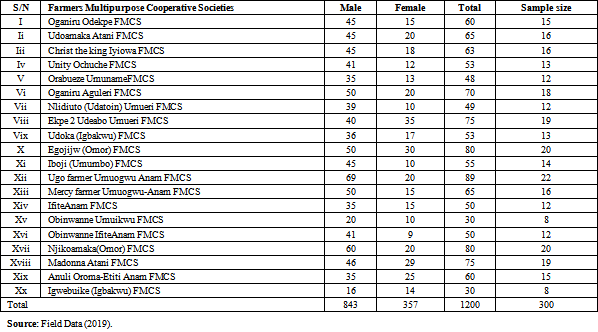
However, five (5) cooperatives were randomly selected from each of the four LGAs. This gave rise to a total of twenty cooperatives. The selected societies were as follows:
The sample size for this study is three hundred (300) members in Anambra North agricultural zone.
This was statistically generated from the population of study using Taro Yamane formula.
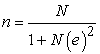 |
Where; n = Sample size
N = Population
e = error of sample (.05)2
1 = unity or constant.
Therefore;
 |
 |
The study generated data through primary and secondary sources. Primarily, data were gotten from a unified structured questionnaire. While the secondary data were generated through textbooks, journals, internet, published and unpublished research materials.
3.6. Validity and Reliability of Research InstrumentsThe measuring instrument used in this study was carefully designed in a systematic way that enabled sound opinion, factual and interpretative information pertinent to the purpose and objective of the study from the respondents. While the reliability of the instrument was established using test re-test method. Copies of the questionnaire for the study were administered to 20 (twenty) respondents in Anambra North Agricultural Zone of Anambra State. The same instrument was re-administered to the same respondents after two weeks. The coefficient of reliability for their responses was established using Pearson Correlation Coefficient. The Pearson Correlation Coefficient showed a reliability value of 0.811 which was considered high enough for the instrument to be reliable.
The generated data were analyzed using the Statistical Package for Social Sciences (SPSS). Specifically, the Bio-Data of the respondents were analyzed using table of descriptive statistics, frequencies and percentages. The research objectives were addressed through mean ratings that are based on a threshold of 5-point likert-scale. It is stated thus;
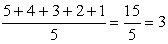 |
The following decision rules were applied;
1. Every form of aids with a mean rating of 3.0 and above were rated as ‘Available’ in Anambra North agricultural zone, while those below 3.0 were ‘Not Available’.
2. Any service with a mean rating of 3.0 and above was adjudged to have been ‘Received’ by fishery households; while those below were ‘Not Received’.
3. OLS multiple regression was used to achieve objective 3, thus:
 |
Where:
b0 = constant
b1- b5 = coefficient
X1 = human capital (dummy)
X2 = social capital (dummy)
X3 = financial capital (dummy)
X4 = natural capital (dummy)
X5 = physical capital (dummy)
4. Constraints with mean rating of 3.0 and above were rated as ‘Problems’, while those below that benchmark of 3.0 were not a ‘Problem’ to fishery.
Study hypotheses were tested at .05 level of significance using z-test. The study rejected the null hypotheses when z-cal> z-tab.
The formula is stated thus;
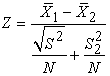 |
Where;
Z =computed z- test value for judging the significance of the mean difference
 = mean of sample 1
 = mean of sample 2.
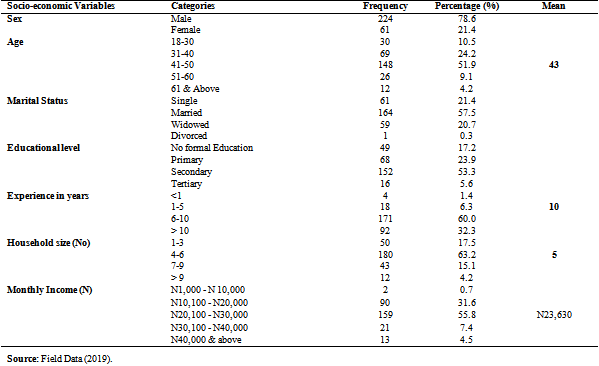
The socio-economic variables on Table 2 include sex, age, marital status, level of education, experience in years and household size. The table showed that majority (78.60%) of the respondents were male while the rest 24.40% were female. This implies that fishing in Anambra North Agricultural Zone is a male dominated activity in the area. This is supported with the findings of Wielgus et al., 4; when he explored the potential of ecological, social and economic benefits of adopting fishery cooperatives. The table also showed that majority (51.90%) of the respondents were within the age bracket of 41-50 years while the remaining 24.20%, 10.50%, 9.10% and 4.20% were within the age bracket of 31-40 years, 18-30 years, 51-60 years and 61 years & above respectively. The mean age of the fishing communities was found to be 43 years. According to FAO 15, 40-45 years is the active age in agriculture. At this age, adoption of innovative technology in agriculture is a welcome development. Here the farmers are still open to change. The Table 2 further showed that majority (57.50%) of the farmers were married while the remaining 21.40%, 20.70% and 0.30% of the farmers were single, widowed and divorced respectively. The Table 2 showed that majority (63.20%) of the fishing communities have an household size of 4-6 persons, while the remaining 17.50%, 15.10% and 4.20% have an household size of 1-3 persons, 7-9 persons and > 9 persons respectively. the mean household size is 5 persons. The table showed that majority (53.30%) of the fishing communities attended secondary school, while the rest 23.90% and 5.60% of the farmers attended primary school and tertiary education. did not have formal education respectively. 17.20% of the farmers did not have any formal education. Onugu and Onuoha 16 opined that lack of formal education will post a serious challenge to improving the livelihood status of the fishing communities, hence the majority of the farmers had secondary education, and there is a progressive appreciation to the livelihood status of the respondents. The table showed that majority (60.00%) of the fishing communities have fishing experience between the bracket of 6-10 years, while the rest 32.30%, 6.30% and 1.40% of the farmers have > 10 years, 1-5 years and < 1 year fishing experience respectively. the mean fishing experience in the area is 10 years. This is in support of Kuta, 2010; who postulate that, the more experience the farmers are the greater the chances to perform better in any chosen agricultural sector. The table showed that majority (55.80%) of the fishing communities have a monthly income of N20,100-N30,000, while the rest 31.60%, 7.40%, 4.50% and 0.70% have a monthly income of N10,100-N20,000, N30100-N40,000, N40,100 & above, and N1,000-N10,000 income respectively. the mean income of the fishing communities was N23,630. According to Yierlita and Perret, 17; income aids the accumulation of asset and also brings about improved livelihood status.
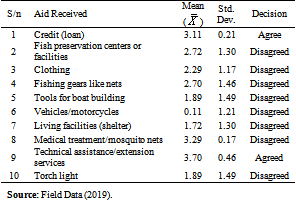
Table 3 based on the ten (10) items of aids received by fishing cooperative societies in Anambra North Agricultural Zone, 3 were mean threshold of 3.0, while 7 were below mean threshold of 3.0 implying that the major aids received by fishing cooperative societies in Anambra North Agricultural Zone were credits (loan), medical treatment/mosquito nets, and technical assistance/extension services. The aids received by the fishing cooperatives in the area still needs to be improved upon especially in the area of Fish preservation centers or facilities to help the preserve their catch.
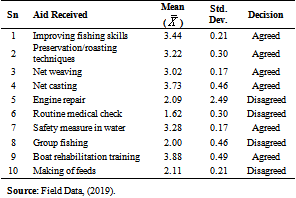
Table 4 based on the ten (10) items of training services received by fishing cooperative societies in Anambra North Agricultural Zone, 6 were mean threshold of 3.0, while 4 were below mean threshold of 3.0 implying that the major training services received by fishing cooperative societies in Anambra North Agricultural Zone were improving fishing skills, Preservation/roasting, net weaving techniques, net casting, and boat rehabilitation training. Training cooperatives members will help to improve farmers’ livelihood status.
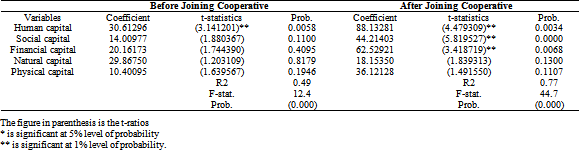
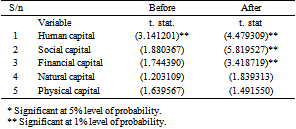
5.4. Advancement in the Livelihood Status (Human, Social, Financial, Natural and Physical) of Fisher-members after Joining the Farmers’ Multipurpose Cooperative Societies in Anambra North Agricultural ZoneThe Ordinary Least Square Regression model was used R2 before and after joining cooperatives were 0.49 and 0.77 respectively, these were in conformity with the a priori expectation. The coefficient of multiple determinant R2 (0.49) and (0.77) respectively indicates that 49.00% and 77.00% of the dependent variables (asset) were explained by the joint action of the explanatory variables before and after joining cooperatives; while the remaining 51.00% and 23.00 were due to error beyond the control of the fishing cooperatives. The coefficient of human capital (30.61296) and (88.13281) before and after joining cooperatives respectively were positive and statistically significant at 1% level of probability indicating that a unit change in the number of human capital will lead to 30.61 and 88.13 advancement in the livelihood status of the farmers. The coefficient of social capital (14.0097) before joining cooperative was positive and statistically not significant at either 5% or 1% level of probability while the coefficient of social capital (44.21403) was positive and statistically significant at 1% level of probability, this implies that social capital had direct impact in the livelihood status of the fishing cooperative only when they joined cooperatives. It therefore means that a unit change in the number of social capital after joining the cooperatives will bring about 44.21403 advancement in the livelihood status of the farmers. Onugu and Onuoha 16 opined that the advancement in the social capital that leads to improved livelihood status is brought about by functional cooperative organizations, encouragement on trust among fishers, common goal and community support, equal participation/involvement of women in decision making, and Cordial and harmonious relationship.
The coefficient of financial capital (20.16173) before joining cooperative was positive and statistically not significant at either 5% or 1% level of probability while the coefficient of financial capital (62.52921) was positive and statistically significant at 1% level of probability, this implies that financial capital had direct impact in the livelihood status of the fishing cooperatives only when they institutionalized their union. It therefore means that a unit change in the number of financial capital after joining the cooperatives will bring about 62.52921 advancement in the livelihood status of the farmers. Joining cooperative has an impact in the livelihood status of the farmers, according to Kuta, 11; this impact was as a result of services received in the form of; credit schemes, surplus income for savings, easy access to informal credit groups, interest free credit, and investment opportunities. The coefficient of natural capital (29.86750) and (18.15350) before and after joining cooperative was positive and statistically not significant at either 5% or 1% level of probability, this implies that natural capital is yet to have direct impact in the livelihood status of the fishing cooperatives in the study area despite the services received in form of open access to fisheries resources, use of large meshes that catch big fishes, active participation of fishers and other stakeholders, free flow of information and network of relationship among members. This result was not in accordance with the a priori expectation.
The coefficient of physical capital (10.40095) and (36.12128) before and after joining cooperative was positive and statistically not significant at either 5% or 1% level of probability, this implies that physical capital is yet to have direct impact in the livelihood status of the fishing cooperatives in the study area despite the services received in form of; Input supply (drugs, portable water, net, hook, boat, storage facilities etc.), Processing/packaging, Smoking ovens, Marketing services (collective sales, protective sales) and Infrastructural provision (roads, electricity etc.). This is not in agreement with DFID, 18. According to Yierlita and Perret 17 these services received in a cooperative in form of physical asset bring about advancement in the livelihood status among fishing cooperative in the area. This result was not in accordance with the a priori expectation.
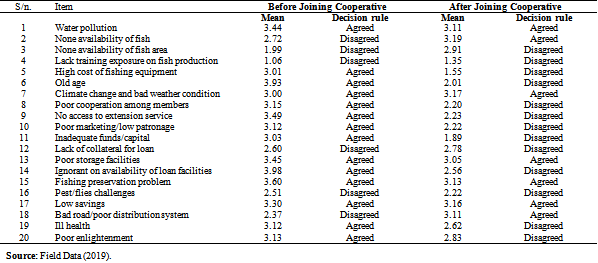
5.5. Reduction in the Constraining Factors to the Fishing Enterprises of the Members after Joining the Farmers’ Multipurpose Cooperative Societies in Anambra North Agricultural ZoneThe reduction in constraining factor before and after joining fishing cooperatives by farmers in Anambra North Agricultural Zone were analyzed from the information generated from the field work. The major constraining factors faced by farmers before joining fishing cooperative societies in Anambra North Agricultural Zone were water pollution, high cost of fishing equipment, old age, climate change and bad weather condition, poor cooperation among members, no access to extension service, poor marketing/low patronage, inadequate funds/capital, poor storage facilities, ignorant on availability of loan facilities, fishing preservation problem, low savings, ill health and poor enlightenment. But after joining the cooperatives, the following constraining factors were reduced; high cost of fishing equipment, old age, poor cooperation among members, no access to extension service, poor marketing/low patronage, inadequate funds/capital, lack of collateral for loan, ignorant on availability of loan facilities, ill health and poor enlightenment. FAO 15 opine that institutionalizing farming groups reduce most bottleneck faced by farmers.
 : There is no significant difference in livelihood status (human, social, financial, natural & Physical) of fisher-members before and after joining the farmers’ multipurpose cooperative societies in Anambra North agricultural zone.
Hypothesis one was tested from the multiple regression result used to achieve objective 3. The significance was tested from the t-ratios produced by the regression result. Table 7 showed that human capital was significant at 1% level of probability before and after joining the fishing cooperatives. This implies that there was no significant difference in human capital before and after joining the fishing cooperative in the area. Social capital was significant at 1% level of probability only after joining the fishing cooperative. This implies that significant difference exist between social capital before and after joining cooperatives. Financial capital was significant at 1% level of probability only after joining the fishing cooperative. This implies that significant difference exist between financial capital before and after joining cooperatives in the study area. Natural capital was neither significant at 5% nor 1% level of probability before and after joining the fishing cooperative. This implies that no significant difference exist between natural capital before and after joining cooperatives in the study area. Physical capital was neither significant at 5% nor 1% level of probability before and after joining the fishing cooperative. This implies that no significant difference exist between physical capital before and after joining cooperatives in the study area. This was not in accordance with a priori expectation.
 There is no significant reduction in the constraints affecting the fishing enterprises of the members before and after joining the farmers’ multipurpose cooperative societies in Anambra North agricultural zone.
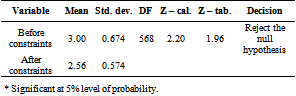
Table 8 showed that the mean (constraining factors) before joining fishing cooperative was 3.0 and 2.56 after joining Fishing cooperative respectively. The Z–calculated value was 2.20 at 5% level of probability. The z-cal. is greater than z-tab. (1.96), therefore reject the null hypothesis and accept the alternate. The implication of this is that there wassignificant reduction in the constraining factors after joining the multipurpose cooperative in Anambra North Agricultural Zone. This is in agreement with Loera and Zulawska 19, who embarked on a research that tried to identify the impact of fishing cooperatives in sustainable development of the Sinaloa region, Mexico. “The benefit of cooperative farming is to reduce risk effect encountered by individual farmer”.
Based on the above findings, it will be instructive to conclude that they were improving fishing skills, preservation/ roasting, net weaving techniques, net casting, and boat rehabilitation training among fishers in the study area and this significantly led to improvement on their standard of living. The researcher therefore, recommends that farmers should be encouraged to organize themselves into cooperative societies in order to improve their access to government aids. Physical capital of the cooperative should be improved upon through making sure that input supply (drugs, portable water, net, hook, boat, storage facilities etc.), processing/packaging, smoking ovens, marketing services (collective sales, protective sales) and infrastructural provision (roads, electricity etc.) are adequately provided for.
The researcher recommends that further studies be carried out to investigate what made physical capital not significant in Anambra North Agricultural Zone among fishing cooperatives.
The authors wish to acknowledge the entire lecturers in the Department of Cooperative Economics and Management, Nnamdi Azikiwe University, Awka. Anambra State. Nigeria.
| [1] | FAO (2009). A livelihoods analysis of coastal fisheries communities in Liberia. FAO Fisheries and Aquaculture Circular, No. 1043 FIDP/C1043 (En), pp. 1-20. | ||
| In article | |||
| [2] | Manasi, S., Latha, N. & K.V. Raju (2009). Fisheries and Livelihood in Tungabhadra Basin, India | ||
| In article | |||
| [3] | FAO (2012). Cooperatives in small-scale fisheries: Enabling successes through community empowerment. International Year of Cooperatives Issue Brief Series. | ||
| In article | |||
| [4] | Wielgus, F., Poon, S., Carballal-del-Río, E., Muñoz, D., Whittle, D. & Fujita, R. (2014). Fishery cooperatives in Cuba: Potential benefits, legal feasibility, and governance pre-conditions. Marine Policy, 45(1), 128-137. | ||
| In article | View Article | ||
| [5] | Akufuna Sonjiwe, Confred, G. Musuka & Lloyd Haambiya. (2015). The contribution of artisanal fisheries towards livelihoods and food security among communities of Chanyanya fishing camp in Kafue district. | ||
| In article | |||
| [6] | Mills, D.J., Westlund, L., de Graaf, G., Kura, Y., William, R., & Kelleher, K. (2011). P. 1-15. Under-reported and undervalued: Small-scale fisheries in the developing world. | ||
| In article | View Article | ||
| [7] | FAO (2000). Agriculture towards 2015/30.Technical Interim. Report. April, 2000. Rome. | ||
| In article | |||
| [8] | FAO (2016). The State of World Fisheries and Aquaculture 2016. Contributing to food security and nutrition for all. Rome. 200 pp. | ||
| In article | |||
| [9] | Olaoye, O. J. (2010). Dynamics of the Adoption Process of Improved Fisheries Technologies in Lagos and Ogun States Nigeria. A Ph.D thesis in the Department of Aquaculture and Fisheries Management, University of Agriculture Abeokuta, Ogun State, Nigeria. P 367 | ||
| In article | |||
| [10] | Collison, Robert Lewis (1966). Encyclopaedia Britannica: Technical Assistance. Published Date: May 21, 2013. https://www.britannica.com/topic/technical-assistance Accessed Date: February 13, 2019. | ||
| In article | |||
| [11] | Kuta, A. G. (2010) Fisheries and sustainable livelihoods of fishing communities in Nigeria. World Aquaculture. Publication of Native Fish Conservation and Recovery, Oregon Department of Fish and Wildlife, Salem, Oregon 97303 USA. Pp. 61-68. | ||
| In article | |||
| [12] | Harris, A. and Stefanson R. (2005). New generation cooperatives and cooperative theory. Journal of cooperatives. 11:15-28 | ||
| In article | |||
| [13] | Adegeye, A. N and Dittoh, J. S. (2005). Essentials of Agricultural Economics. Ibadan, Nigeria: Impact Publishers Nigeria Limited. | ||
| In article | |||
| [14] | Olson, Mancur (1965). The logic of collective action; public goods and the theory of groups. Cambridge, Mass: Harvard University Press. | ||
| In article | |||
| [15] | FAO. (2010). State of the World Fisheries and Aquaculture 2010 Fisheries and Aquaculture Department, Rome. ISBN 978-92-5-106675-1. | ||
| In article | |||
| [16] | Onugu, C.U and Onuoha, O. C. (2018). Public Support and Facilitation of Co-operative-Aid to Women Empowerment: The Role of WDC Programme in Anambra State, Nigeria. International Journal of Trend in Scientific Research and Development (IJTSRD). ISSN No: 2456- 6470, www.ijtsrd.com, Vol 2 . Issue 5. | ||
| In article | View Article | ||
| [17] | Yierlita & Perret, S.R. (2010). Livelihood features of small scale fishing communities: A case from Singkarak Lake, West Sumatra, Indonesia. International Journal of Environment and Rural Development, 1(2), 94-101. | ||
| In article | |||
| [18] | DFID. (2000). Strategies for achieving the international development targets: Poverty eradication and employment of women. Consultation document, Department for international development (DFID), UK. | ||
| In article | |||
| [19] | Loera & Zulawska (2013).Fisheries cooperative organization and sustainable development in the rural community. | ||
| In article | |||
Published with license by Science and Education Publishing, Copyright © 2019 Ezeh F. O., Onugu C. U., Nduka O. H, Ngoka I. E and Ekwere G. E
 This work is licensed under a Creative Commons Attribution 4.0 International License. To view a copy of this license, visit
http://creativecommons.org/licenses/by/4.0/
This work is licensed under a Creative Commons Attribution 4.0 International License. To view a copy of this license, visit
http://creativecommons.org/licenses/by/4.0/
| [1] | FAO (2009). A livelihoods analysis of coastal fisheries communities in Liberia. FAO Fisheries and Aquaculture Circular, No. 1043 FIDP/C1043 (En), pp. 1-20. | ||
| In article | |||
| [2] | Manasi, S., Latha, N. & K.V. Raju (2009). Fisheries and Livelihood in Tungabhadra Basin, India | ||
| In article | |||
| [3] | FAO (2012). Cooperatives in small-scale fisheries: Enabling successes through community empowerment. International Year of Cooperatives Issue Brief Series. | ||
| In article | |||
| [4] | Wielgus, F., Poon, S., Carballal-del-Río, E., Muñoz, D., Whittle, D. & Fujita, R. (2014). Fishery cooperatives in Cuba: Potential benefits, legal feasibility, and governance pre-conditions. Marine Policy, 45(1), 128-137. | ||
| In article | View Article | ||
| [5] | Akufuna Sonjiwe, Confred, G. Musuka & Lloyd Haambiya. (2015). The contribution of artisanal fisheries towards livelihoods and food security among communities of Chanyanya fishing camp in Kafue district. | ||
| In article | |||
| [6] | Mills, D.J., Westlund, L., de Graaf, G., Kura, Y., William, R., & Kelleher, K. (2011). P. 1-15. Under-reported and undervalued: Small-scale fisheries in the developing world. | ||
| In article | View Article | ||
| [7] | FAO (2000). Agriculture towards 2015/30.Technical Interim. Report. April, 2000. Rome. | ||
| In article | |||
| [8] | FAO (2016). The State of World Fisheries and Aquaculture 2016. Contributing to food security and nutrition for all. Rome. 200 pp. | ||
| In article | |||
| [9] | Olaoye, O. J. (2010). Dynamics of the Adoption Process of Improved Fisheries Technologies in Lagos and Ogun States Nigeria. A Ph.D thesis in the Department of Aquaculture and Fisheries Management, University of Agriculture Abeokuta, Ogun State, Nigeria. P 367 | ||
| In article | |||
| [10] | Collison, Robert Lewis (1966). Encyclopaedia Britannica: Technical Assistance. Published Date: May 21, 2013. https://www.britannica.com/topic/technical-assistance Accessed Date: February 13, 2019. | ||
| In article | |||
| [11] | Kuta, A. G. (2010) Fisheries and sustainable livelihoods of fishing communities in Nigeria. World Aquaculture. Publication of Native Fish Conservation and Recovery, Oregon Department of Fish and Wildlife, Salem, Oregon 97303 USA. Pp. 61-68. | ||
| In article | |||
| [12] | Harris, A. and Stefanson R. (2005). New generation cooperatives and cooperative theory. Journal of cooperatives. 11:15-28 | ||
| In article | |||
| [13] | Adegeye, A. N and Dittoh, J. S. (2005). Essentials of Agricultural Economics. Ibadan, Nigeria: Impact Publishers Nigeria Limited. | ||
| In article | |||
| [14] | Olson, Mancur (1965). The logic of collective action; public goods and the theory of groups. Cambridge, Mass: Harvard University Press. | ||
| In article | |||
| [15] | FAO. (2010). State of the World Fisheries and Aquaculture 2010 Fisheries and Aquaculture Department, Rome. ISBN 978-92-5-106675-1. | ||
| In article | |||
| [16] | Onugu, C.U and Onuoha, O. C. (2018). Public Support and Facilitation of Co-operative-Aid to Women Empowerment: The Role of WDC Programme in Anambra State, Nigeria. International Journal of Trend in Scientific Research and Development (IJTSRD). ISSN No: 2456- 6470, www.ijtsrd.com, Vol 2 . Issue 5. | ||
| In article | View Article | ||
| [17] | Yierlita & Perret, S.R. (2010). Livelihood features of small scale fishing communities: A case from Singkarak Lake, West Sumatra, Indonesia. International Journal of Environment and Rural Development, 1(2), 94-101. | ||
| In article | |||
| [18] | DFID. (2000). Strategies for achieving the international development targets: Poverty eradication and employment of women. Consultation document, Department for international development (DFID), UK. | ||
| In article | |||
| [19] | Loera & Zulawska (2013).Fisheries cooperative organization and sustainable development in the rural community. | ||
| In article | |||




)
)
)
 (N= 285))
)

