 OPEN ACCESS
 PEER-REVIEWED
Existence of Weak Solutions for Elliptic Nonlinear System in RN
Tahar Bouali1, , Rafik Guefaifia1
1Department of Mathematics, University Tebessa, Tebessa, Algeria
Abstract
We study the nonuniformly elliptic, nonlinear system 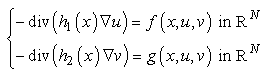 Under growth and regularity conditions on the nonlinearities f and g, we obtain weak solutions in a subspace of the Sobolev space
 by applying a variant of the Mountain Pass Theorem.
Keywords: nonuniformly elliptic, nonlinear systems, mountain pass theorem, weakly continuously differentiable functional
International Journal of Partial Differential Equations and Applications, 2014 2 (2),
pp 32-37.
DOI: 10.12691/ijpdea-2-2-3
Received May 06, 2014; Revised May 28, 2014; Accepted May 28, 2014
Copyright © 2013 Science and Education Publishing. All Rights Reserved.Cite this article:
- Bouali, Tahar, and Rafik Guefaifia. "Existence of Weak Solutions for Elliptic Nonlinear System in RN." International Journal of Partial Differential Equations and Applications 2.2 (2014): 32-37.
- Bouali, T. , & Guefaifia, R. (2014). Existence of Weak Solutions for Elliptic Nonlinear System in RN. International Journal of Partial Differential Equations and Applications, 2(2), 32-37.
- Bouali, Tahar, and Rafik Guefaifia. "Existence of Weak Solutions for Elliptic Nonlinear System in RN." International Journal of Partial Differential Equations and Applications 2, no. 2 (2014): 32-37.
| Import into BibTeX | Import into EndNote | Import into RefMan | Import into RefWorks |
1. Introduction
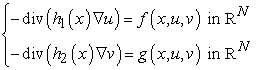
We study the nonuniformly elliptic, nonlinear system
 |
where 
System  , There, under appropriate growth and regularity conditions on the functions
 and
 , the weak solutions are exactly the critical points of a functional defined on a Hilbert space of functions
 in
 . In the scalar case, the problem
 |
with  and
 , has been studied by Mihailescu and Radulescu [12]. In this situation, the authors overcome the lack of compactness of the problem by using the the Caffarelli-Kohn-Nirenberg inequality
In this paper, we consider  which may be a nonuniformly elliptic system. We shall reduce
 to a uniformly elliptic system by using appropriate weighted Sobolev spaces. Then applying a variant of the Mountain pass theorem in [9], we prove the existence of weak solutions of system
 in a subspace of
 (
 ,
 ).
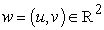
To prove our main results, we introduce the following some hypotheses:
 There exists a function

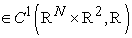 such that
 , for all
 ,

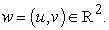
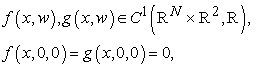 |
for all  there exists a positive constant
 such that
 |
for all  ,
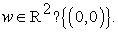
 There exists a constant

 such that
 |
for all  ,
Let  be the usual Sobolev space under the norm
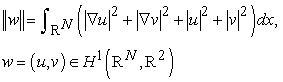 |
Consider the subspace
 |
Then  is a Hilbert space with the norm
 |
It is clear that
 |
and the embeddings  are continuous. moreover, the embedding
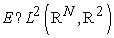 is compact
 see [8]). we now introduce the space
 |
endowed with the norm
 |
Since  for all
 we have
 with
 and
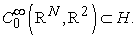
The set  is a Hilbert space with the inner product
 |
for all 
Proof. It suffices to check that any Cauchy sequences  in
 converges to

 . Indeed, let
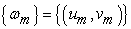 be a Cauchy sequence in
 Then
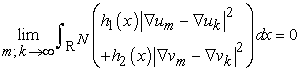 |
and  is bounded. Moreover, by Remark
 ,
 is also a Cauchy sequence in
 . Hence the sequence
 converges to


 ; i.e,
 |
It follows that  converges to
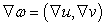 and
 converges to
 in
 Therefore
 converges to
 and
 converges to
 for almost everywhere
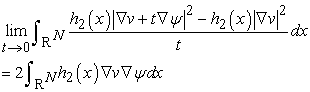 . Applying Fatou's lemma we get
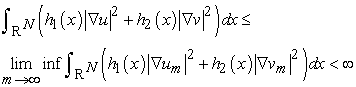 |
Hence 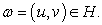 Applying again Fatou's lemma
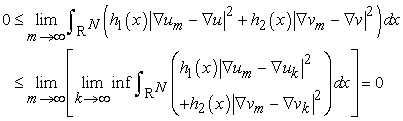 |
We conclude that  converges to
 in

We say that  is a weak solution of system
 if
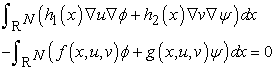 |
for all 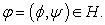
Our main result is stated as follows.
1.4. TheoremLet  and
 are satisfied, the system
 has at least one non-trivial weak solution in
 .
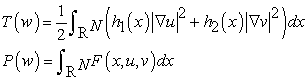
This theorem will be proved by using variational techniques based on a variant of the Mountain pass theorem in [9]. Let us define the functional  given by
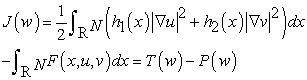 |
for 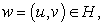
where
 |
2. Existence of weak solutions
In general, due to 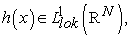 the functional
 may be not belong to
 (in this work, we do not completely care whether the functional
 belongs to
 or not).This means that we cannot apply directly the Mountain pass theorem by Ambrosetti-Rabinowitz (see [4]), we recall the following concept of weakly continuous differentiability. Our approach is based on a weak version of the Mountain pass theorem by Duc (see [9]).
Let  be a functional from a Banach space
 in to
 . We say that
 is weakly continuously differentiable on
 if and only if the following conditions are satisfied

 is continuous on
 .
 For any
 , there exists a linear map
 from
 into
 such that

 For any
 , the map
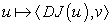 , vi is continuous on
 .
We denote by  the set of weakly continuously differentiable functionals on
 . It is clear that
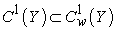 , where
 is the set of all continuously Frechet differentiable functionals on
 . The following proposition concerns the smoothness of the functional

Under the assumptions of Theorem 1.4, the functional 
 given by
 is weakly continuously differentiable on
 and
 |
for all 
Proof. By conditions  --
 and the embedding
 is continuous, it can be shown (cf. [[5], Theorem A.VI]) that the functional
 is well-defined and of class
 . Moreover, we have
 |
for all 
Next, we prove that  is continuous on
 . Let
 be a sequence converging to
 in
 , where
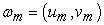 ,
 .,
 Then
 |
and  is bounded. Observe further that
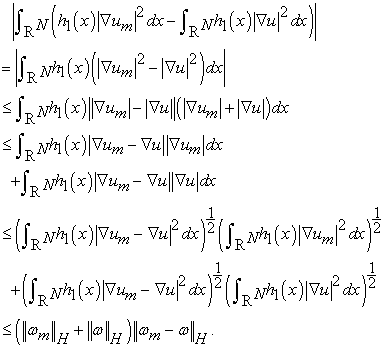 |
Similarly, we obtain
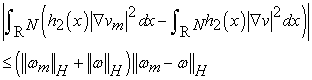 |
From the above inequalities, we obtain
 |
Thus  is continuous on
 . Next we prove that for all

 |
Indeed, for any,  any
 and
 we have
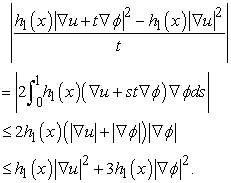 |
Since
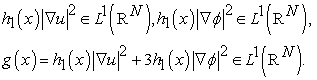 |
Applying Lebesgue's Dominated convergence theorem we get
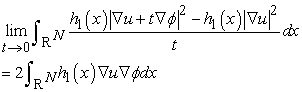 |
Similarly, we have
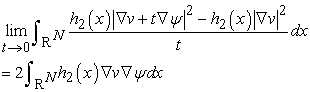 |
Combining  -
 , we deduce that
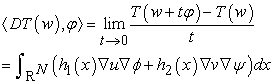 |
Thus  is weakly differentiable on
 .
Let 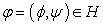 be fixed. We now prove that the map
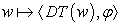 is continuous on
 . Let
 be a sequence converging to
 in
 . We have
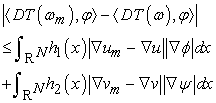 |
It follows by applying Cauchy's inequality that
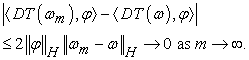 |
Thus the map 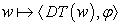 , i is continuous on
 and we conclude that functional
 is weakly continuously differentiable on
 . Finally,
 is weakly continuously differentiable on

From Proposition  we observe that the weak solutions of system
 correspond to the critical points of the functional
 given by
 Thus our idea is to apply a variant of the Mountain pass theorem in [9] for obtaining non-trivial critical points of
 and thus they are also the non-trivial weak solutions of system

The functional  given by
 satisfies the Palais-Smale condition.
Proof Let 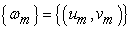 be a sequence in H such that
 |
First, we prove that  is bounded in
 . We assume by contradiction that
 is not bounded in
 . Then there exists a subsequence
 of
 such that
 as
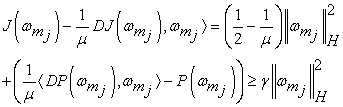
 . By assumption
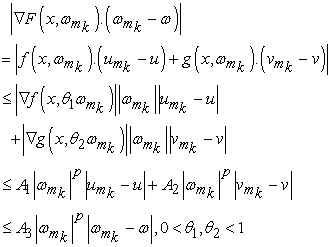
it follows that
 |
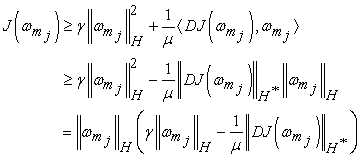 |
Letting  since
 we deduce that
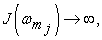 which is a contradiction. Hence
 is bounded in
 .
Since  is a Hilbert space and
 is bounded in
 , there exists a subsequence
 of
 weakly converging to
 in
 . Moreover, since the embedding
 is continuous,
 is weakly convergent to
 in
 . We shall prove that
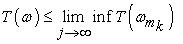 |
since  converges weakly to
 in
 ; i.e,
 |
for all 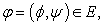 this implies that
 converges weakly to
 in

Applying [[16], Theorem 1.6], we obtain
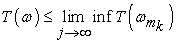 |
Thus  is proved. We now prove that
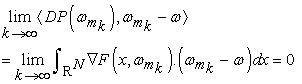 |
Indeed, by  , we have
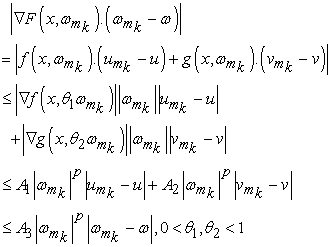 |
where 
 are positive constants.
Set  We have
 and
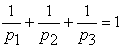
Therefore,
On the other hand, using the continuous embeddings 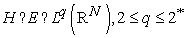 together with the interpolation inequality
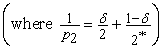 , it follows that
 |
Since the embedding  is compact we have
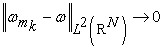 as
 Hence
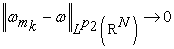 as
 and
 is proved.
On the other hand, by  and
 it follows
 |
Hence, by the convex property of the functional  we deduce that
 |
Relations  and
 imply
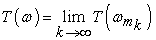 |
Finally, we prove that  converges strongly to
 in
 . Indeed, we assume by contradiction
 that is not strongly convergent to
 in
 . Then there exist a constant
 and a subsequence
 of
 such that
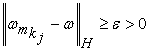 for any
 Hence
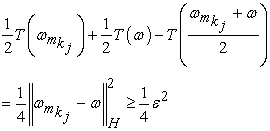 |
With the same arguments as in the proof of  , and remark that the sequence
 converges weakly to
 in
 , we have
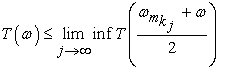 |
Hence letting  , from
 ) and
 we infer that
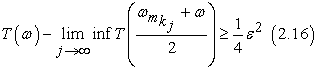 |
Relations  and
 imply
 which is a contradiction. Therefore, we conclude that
 converges strongly to
 in
 and
 satisfies the Palais -Smale condition on

To apply the Mountain pass theorem we shall prove the following proposition which shows that the functional  has the Mountain pass geometry.
 There exist
 and
 such that
 for all
 with

 There exists
 such that
 and

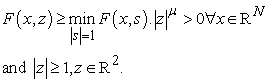
Proof.  From
 , it is easy to see that
 |
 |
where 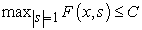 in view of
 . It follows from
 that
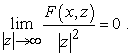 |
uniformly for 
By using the embeddings 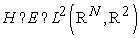 , with simple calculations we infer from
 that
 for
 small enough This implies
 .
 By
 , for each compact set
 there exists
 such that
 |
Let  having compact support, for
 large enough from
 we have
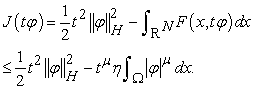 |
where  ,
 Then
 and
 imply

Proof of Theorem 1.4. It is clear that  . Furthermore, the acceptable set
 |
where  is given in Proposition
 is not empty (it is easy to see that the function
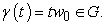 by Proposition. and Propositions
 -
 , all assumptions of the Mountain pass theorem introduced in [8] are satisfied. Therefore there exists
 such that
 |
and 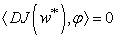 for all
 is a weak solution of system
 . The solution
 is a non-trivial solution by
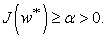 The proof is complete.
References
| [1] | A. Abakhti-Mchachti., J. Fleckinger-Pellé; Existence of positive solutions for non-cooperative semilinear elliptic systems defined on an unbounded domain, Pitman research Notes in Maths., 266 (1992), 92-106. | ||
 In article | |||
| [2] | ] R. A. Adams; Sobolev spaces, Academic Press, New York - San Francisco - London, 1975. | ||
| In article | |||
| [3] | A. Ambrosetti., K.C. Chang., I. Ekeland; Nonlinear functional analysis and Applications to differential equations, Proceedings of the second school ICTP, Trieste, Italy, 1997. | ||
| In article | |||
| [4] | A. Ambrosetti., P. H. Rabinowitz; Dual variational methods in critical points theory and applications, J. Funct. Anal. 4 (1973), 349-381. | ||
| In article | CrossRef | ||
| [5] | H. Berestycki., P. L. Lions; Nonlinear scalar field equations, I.Existence of a ground state, Arch. Rat. Mech. Anal., 82 (1984), 313-345. | ||
| In article | |||
| [6] | . Brezis; Analyse fonctionnelle theori et applications, Massion, 1992. | ||
| In article | |||
| [7] | A. Djellit., S. TAS, Existence of solutions for a class of elliptic systems in Rn involving the p- Laplacian, Electronic Journal of Differential Equations, Vol. 2003, No. 56, pp. 1-8. | ||
| In article | |||
| [8] | D. G. Costa; On a class of elliptic systems in Rn, Electronic Journal of Differential Equations 1994 (1194) No. 07, 1-14. | ||
| In article | |||
| [9] | D. M. Duc; Nolinear singular elliptic equations, J. London. Math. Soc. 40(2) (1989), 420-440. | ||
| In article | CrossRef | ||
| [10] | L. Gasnski., N. S. Parageorgiou; Nonsmooth critical point theory and nonlinear boundary value problems, Vol. 8, A CRC Press Company, London - New York, 2005. | ||
| In article | |||
| [11] | D. Gilbarg., N. C. Trudinger; Elliptic Partial Differential Equations of second order, Second Edition, Springer-Verlag, Berlin, 1983. | ||
| In article | CrossRef | ||
| [12] | M. Mihàilescu., V. Ràdulescu; Ground state solutions of nonlinear singular Schr¨odinger equations with lack compactness, Mathematical methods in the Applied Sciences, 26 (2003), 897-906. | ||
| In article | CrossRef | ||
| [13] | P. De Nàpoli., M. C. Mariani; Mountain pass solutions to equations of p-Laplacian type, Nonlinear Analysis, 54 (2003), 1205-1219. | ||
| In article | CrossRef | ||
| [14] | L. Nirenberg; Variational and topology methods in nonlinear problems, Bull. Amer. Math. Soc. 4 (1981), 267-302. | ||
| In article | CrossRef | ||
| [15] | P. H. Rabinowitz; Minimax methods and their applications to Partial Differential Equations,Nonlinear analysis, a collection of papers in honor of Erich Rothe, Academic Press, New York, 1978. | ||
| In article | |||
| [16] | M. Struwe; Variational Methods, Second Edition, Springer-Verlag, 2000. | ||
| In article | CrossRef | ||
| [17] | N. T. Vu., D. M. Duc; Nonuniformly elliptic equations of p-Laplacian type, Nonlinear Analysis 61 (2005), 1483-1495. | ||
| In article | CrossRef | ||
| [18] | E. Zeidler; Nonlinear Functional Analysis and its applications, Vol. III, Springer-Verlag, 1985. | ||
| In article | CrossRef | ||

 CiteULike
 Mendeley
 StumbleUpon
 Delicious
 Facebook
 Twitter
 LinkedIn
 Print