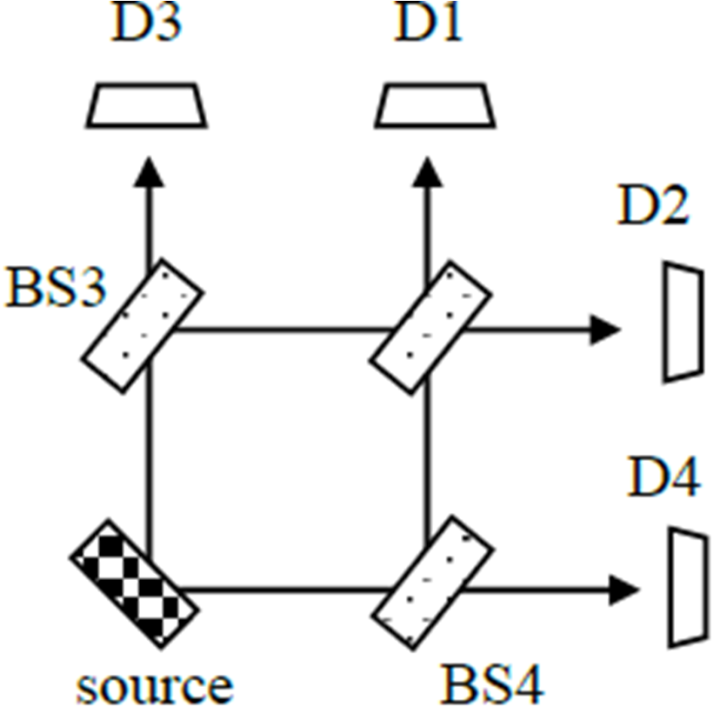
The interpretations of the delayed-choice experiments suggest that photons “retroactively decide” to travel as particles or as waves from the time of its emission. To test the interpretations thoroughly, we propose and perform novel extended-delayed-choice experiments. The experiments are designed for easier to set up, carry out and reach meaningful results without ambiguity. The experimental results show the following: (A) The present does not decide the past retroactively, i.e., the causality holds; (B) Bohr’s complementarity principle is challenged; (C) photons behave as particle before striking on a double-slit/cross-double-slit; (D) Particle nature is intrinsic.
In 1978 and 1984, Wheeler proposed a series of thought experiments, delayed-choice experiments, which was designed to resolve the fundamental issues in quantum physics 1. One version is to perform experiments with Mach-Zehnder-Interferometer (denoted as MZI) by removing/inserting an output device, beam splitter (BS). Another version is to utilize double-slit apparatus. Those experiments attempt to decide whether a photon "senses" the experimental apparatus in experiment it travels through and adjusts its previous behavior to fit for any final experimental configurations. Wheeler’s question is whether a time/position could be determined at which the photon made its "decision" to act as wave or as particle. Here a photon is described as a “person” who can “sense”, “make decision” and, even “retroactively decide” that challenges the causality.
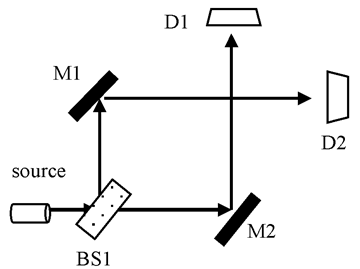
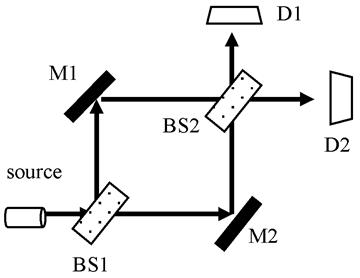
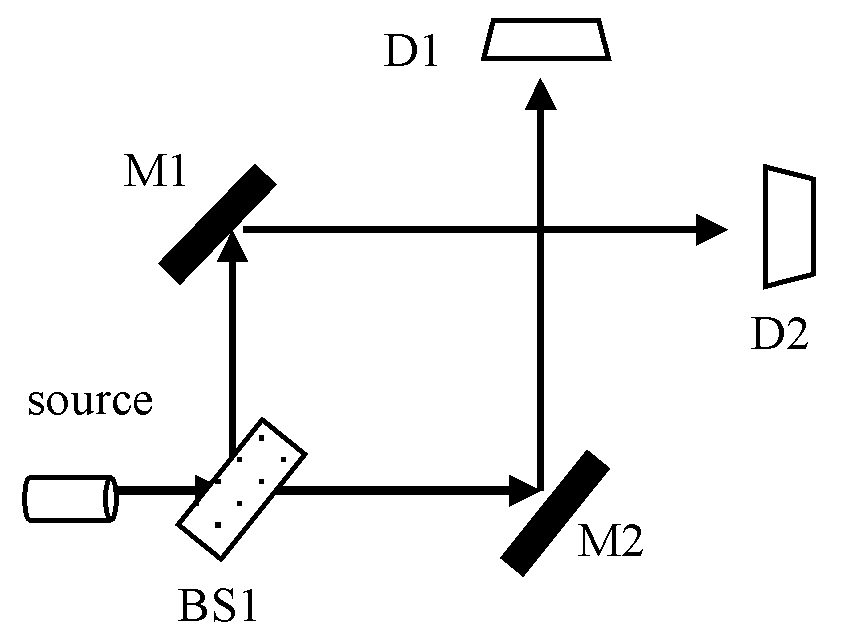
Let’s consider the MZI version in three configurations:
First configuration (Figure 1): without an output BS2 in place. Each photon behaves as particle detected by D1 and D2 respectively.
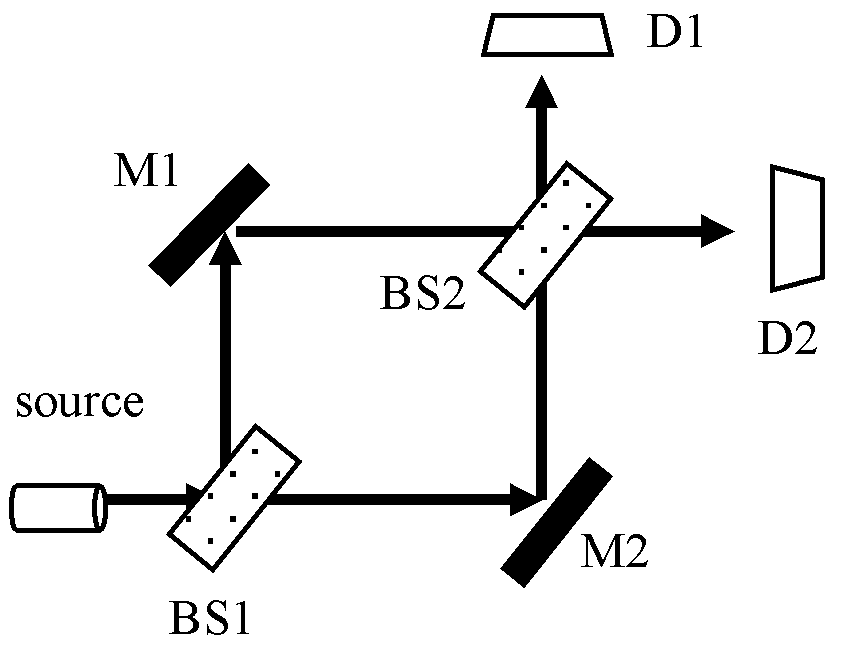
Second configuration (Figure 2): with BS2 in place. The beam of photons creates wave distribution on D2.
Third configuration: inserting BS2, while photon is flying and before arriving at the position of BS2.
The regular interpretations are:
(1) for first configuration: photon should behave the same, as particle, from the time of its emission to the time of its detection;
(2) for second configuration: before arriving at and after passing through BS2, photons should behave the same, as wave, from the time of its emission to the time of its detection;
(3) for third configuration: photons would behave as wave before arriving at the position of BS2 as BS2 were there; namely, photons would behave as wave from the time of its emission to the time of its detection, even there was no BS2 at the time of its emission, which challenges the causality; it is stated that photons made “retroactive decision”.
Moreover, there are similar interpretations of delayed-choice-double-slit experiments 2: (1) when there is no double-slit, photon behaves the same, as particle, from the time of its emission to the time of its detection; (2) when there is a double-slit, before arriving at and after passing through the double-slit, photons would behave the same, as wave, from the time of its emission to the time of its detection; the experimenters conclude that each photon "decides" to travel as a wave; (3) removing/inserting the board of double-slit, when a photon is flying, then the photon “decides" to travel as a particle/wave distribution, from the time of its emission to the time of its detection.
Although the experimental setups have been very difficult, the intensive efforts focus on both experiments and interpretations, for recent articles, see, for example, 3 4.
To test the above interpretations of MZI-delayed-choice experiments and double-slit experiments, we propose and carry out extended-MZI-delayed-choice experiments. The basic structure of the extended-MZI apparatuses is to combine normal MZI apparatus with double-slit and/or cross-double-slit apparatuses 5 6.
The purposes of experiments are to test: (1) whether photons behave differently when traveling along different paths; (2) whether photons behave differently when traveling along the same path; (3) what determines the behaviors of photons under the circumstances with or without output BS.
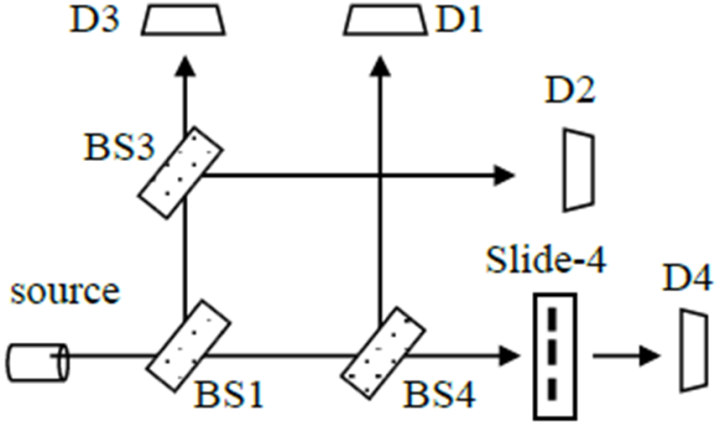
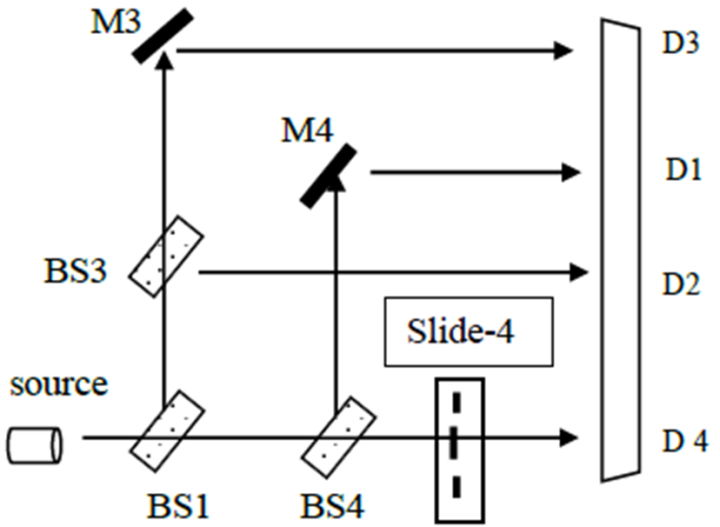
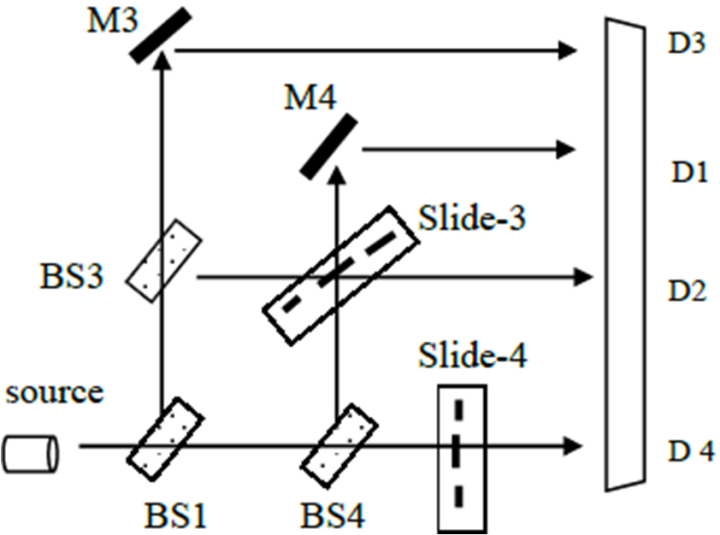
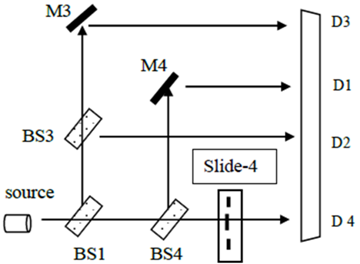
Experiment-1 (Figure 3): Replacing M1 and M2 of regular open-MZI (Figure 1) with BS3 and BS4 respectively. Photons passing through BS3 and BS4 travel towards D3 and slide-4/D4 respectively. Photons reflected by BS3 and BS4 travel to D2 and D1 respectively.
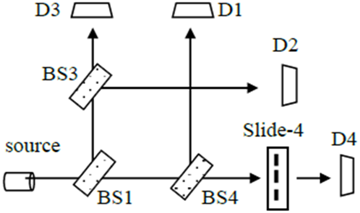
According to the standard interpretation of double-slit, photons behave as wave from the time of its emission to the time of its detection. On the other hand, according to the standard interpretation of delayed-choice experiments, D1 and D2 demand that photons behave as particle from the time of its emission to the time of its detection. This leads to a paradox.
The experiment-1 will test the paradox.
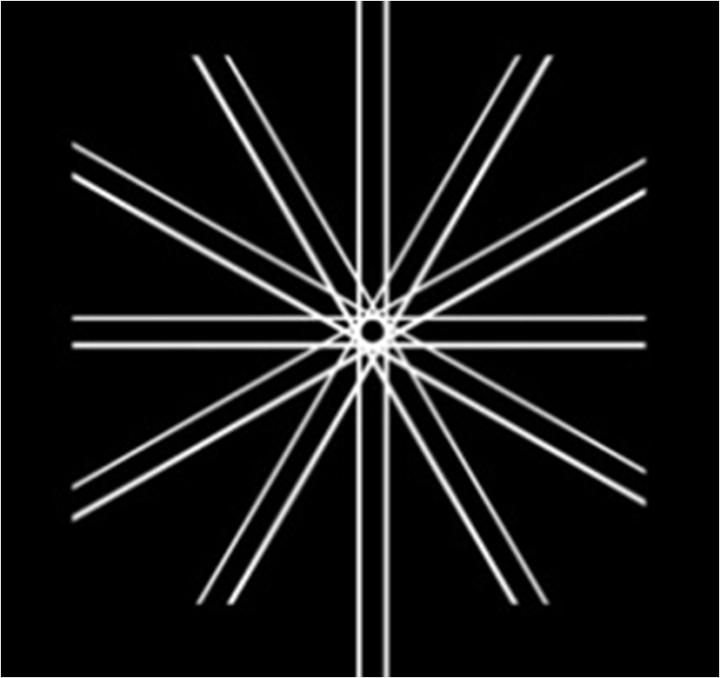
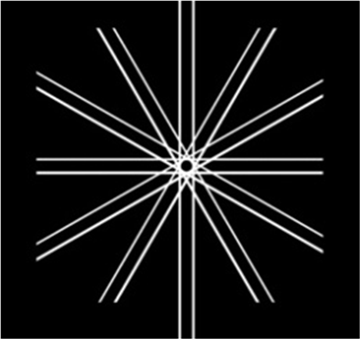
To show the observations of the experiment-1 clearly, we rearrange the setup in Figure 3 to its equivalent setup in Figure 4. Slide-4 is shown in Figure 5 6.
The result of the experiment-1 is interesting.
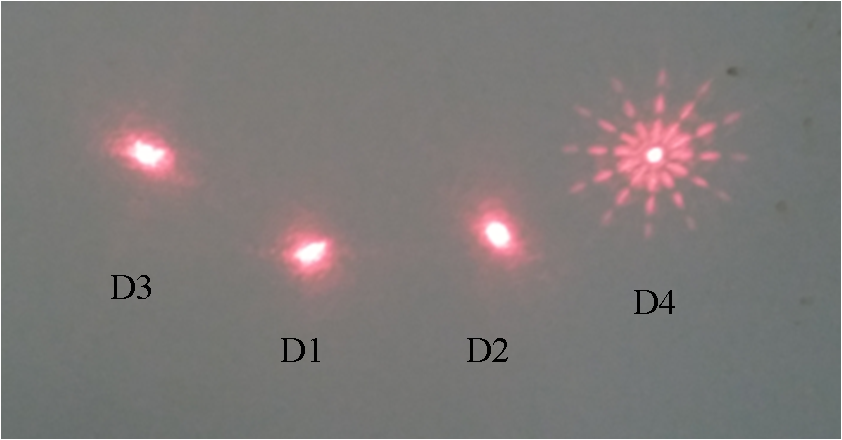
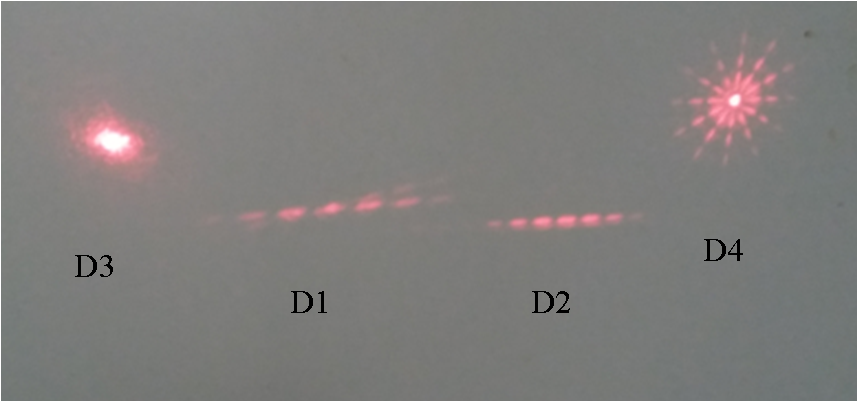
Observation (Figure 6):
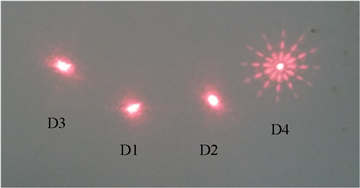
Turning on the laser. D1, D2 and D3 show the image of the laser source, i.e., the particle nature of photons, while D4 shows wave distribution of photons.
Conclusion:
A) Patterns shown on D1, D2 and D3 indicate that (A1) photons emitted by the source behave as particle; (A2) before passing through the slide-4, a cross-double-slit, photons behave as particle; and (A3) both either passing through a BS or reflected by a BS, photons’ nature do not change.
B) The particle nature and wave distribution coexist in the same experiment, which challenges Bohr’s complementarity principle.
We use the word “same experiment” in the sense that the experiment has only one light source.
Next, we carry out an experiment with output BS, more precisely speaking, in order to “see” the result of experiment by naked eyes, we replace output BS with a regular double-slit apparatus, slide-3.
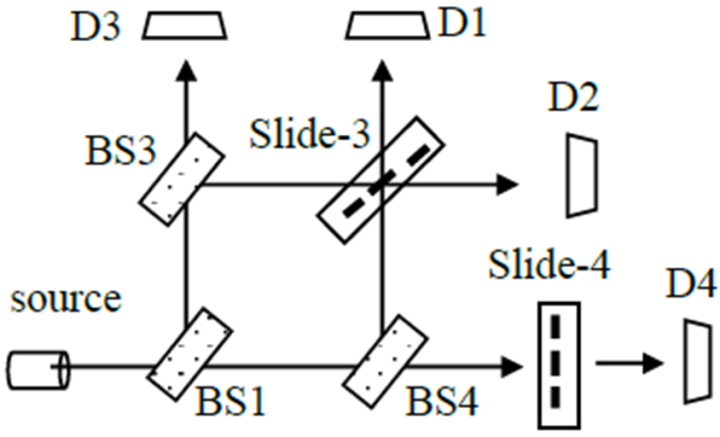
Experiment-2 (Figure 7):
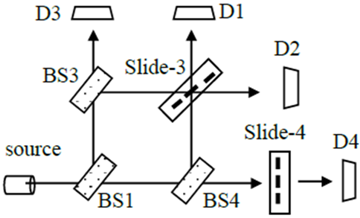
According to the regular interpretations of both delayed-choice experiments and double-slit experiments, during the experiment, D1 and D2 show wave distribution of photons and demand that photons behave as wave from the time of its emission to the time of its detection. D3 would detect particle nature of photons, thus would demand that photons behave as particle from the time of its emission to the time of its detection. It is a paradox.
To test this interpretation and see the experimental results by naked eyes, we perform experiment-2 with the following apparatus (Figure 8), which is equivalent to that in Figure 7.
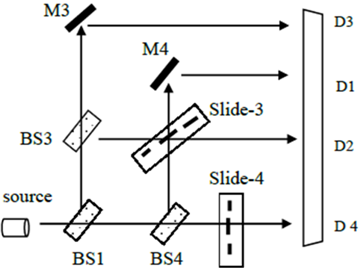
Observation (Figure 9):
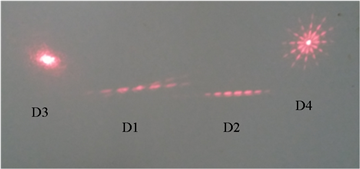
D1 and D2 show wave-like distributions created by slide-3 that is a regular double-slit, while D3 shows the very same particle pattern, and D4 shows the very same wave-like distribution.
Conclusion:
A) D3 and D4 still show the same patterns as there were no slide-3, i.e., with and without an output device, either a BS of a double-slit, D3 and D4 detect the same nature of photons, namely, photons do not retroactively decide their behavior. Thus, during delayed-choice experiments, an output device, either a BS or a double-slit, can be removed or inserted any time without affecting the photons’ behavior prior to arrive the output device.
B) both the particle behavior and wave distribution coexist, which challenge the complementarity principle.
First, one might question: whether an output BS, BS2, and a slide of double-slit/cross-double-slit are equivalent in a delayed-choice experiment? To answer, let’s analyze their effects in a delayed-choice experiment. Consider a regular MZI-delayed-choice experiment, as shown by Figure 2.
With BS2, D1 and D2 detect the wave-like distribution, while without BS2, D1 and D2 detect the particle nature of photons.
With a slide of double-slit, instead of BS2, D1 and D2 detect the wave-like distribution, while without the slide of double-slit, D1 and D2 detect the particle nature of photons.
Therefore, for the purpose of the delayed-choice experiments, an output BS, BS2, is equivalent to a slide of double-slit/cross-double-slit.
With and without an output device, either a BS of a double-slit, D3 detects the same particle nature of photons, while D4 detects the same wave distribution. Namely, photons do not retroactively decide their behavior. Thus, during delayed-choice experiments, an output device, either a BS or a double-slit, can be removed or inserted any time without affecting the conclusion of experiments.
The function of an output device is to affect the behavior of photons after passing through it, but before.
The causality holds. Namely the present does not determine the past retroactively.
The photons behave as particle before striking on a double-slit/cross-double-slit.
Bohr’s complementarity principle is challenged.
We suggest that the particle nature of photons always exists in experiments, thus is primary nature. The wave distribution exists only for special situations, thus is secondary.
Suggest: Those experiments are simple to carry out and budget is not very high. Interested person can DIY.
Here we propose several thought experiments: Extended-Delayed-Choice Thought Experiment with Entangled Photons (and/or Particle).
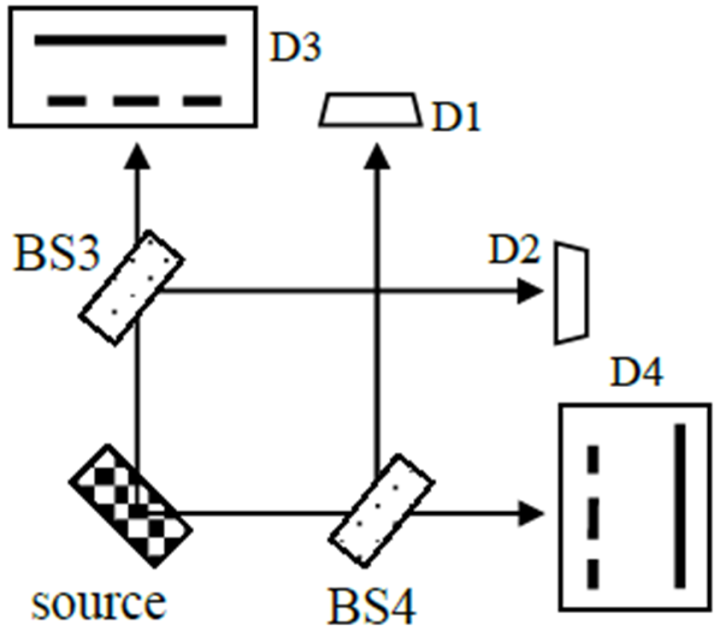
Thought experiment-A1 (Figure 10):
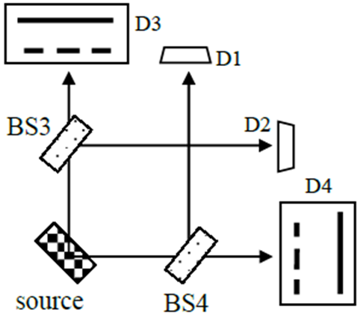
The apparatus is similar to that of experiment-1, except that source emits a pair of two entangled photons at a time. One of entangled photons, denoted as photon-1, travels to either double-slit D4 or detector D1, while another entangled photon, denoted as photon-2 goes to either D2 or double-slit D3.
We have six possible results:
1) Photon-1 and photon-2 behave as particle, when they arrive D1 and D2 respectively;
2) Photon-1 and photon-2 behave as particle, before they passing through D4 and D3, e.g., double-slit, respectively;
3) Photon-1 behaves as particle, when it arrives D1; while photon-2 behaves as wave, when it arrives D3; the question is whether entangled photon-1 and photon-2 should have the same nature?
4) Photon-1 behaves as wave, when it arrives D4; while photon-2 behaves as particle, when it arrives D2; the same question is whether entangled photon-1 and photon-2 should have the same nature?
5) Photon-1 behaves as wave, when it arrives D4, and behaves as particle, when it arrives D1; the question is whether entangled photon-1 should have the same nature, when travels along the common path: source-BS4?
6) Photon-2 behaves as wave, when it arrives D3, and behaves as particle, when it arrives D2; the question is whether entangled photon-2 should have the same nature, when travels along the common path source-BS3?
Thought experiment-A1 implies that Photons behave differently along different paths. Photons behave differently along the same path.
We propose Extended-EPR paradox: should the natures of entangle photons be the same or not?
If the natures of entangle photons should be the same, then the interpretation of thought experiment-A1 leads to a paradox.
If the natures of entangle photons can be different, then thought experiment-A1 discloses a novel property of entangled photons and test the original EPR paradox at a fundamental level.
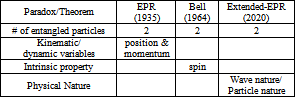
Table 1 compares EPR paradox, Bell theorem and Extended-EPR paradox, and show that EPR Paradox should be tested at different levels:
(1) EPR proposed thought experiments to test EPR paradox at the level of Kinematic/dynamic variables 7;
(2) Bell/GHZ experiments test EPR paradox at the level of intrinsic property 8 9 10; and
(3) thought experiment-A1 of Extended-EPR tests the EPR paradox at the level of physical nature, a fundamental level 11.
Thought experiment-A2 (Figure 11):
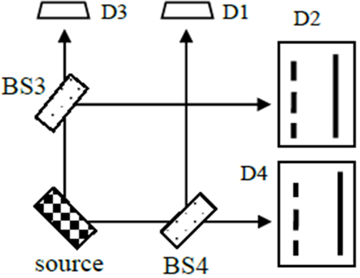
The thought experiment-A2 is similar to thought experiment-A1, except that D2 is double-slit, and D3 is a detector. The discussion should be modified accordingly.
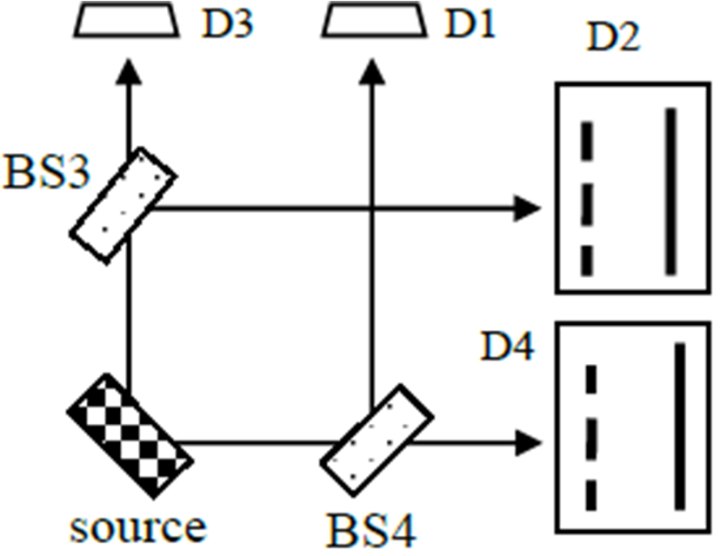
Thought experiment-A3 (Figure 12):
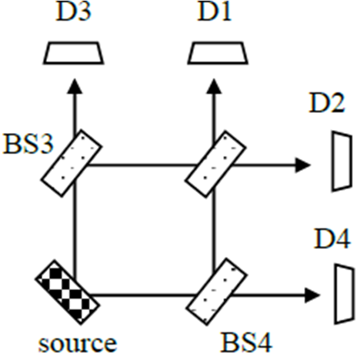
The apparatus consists of source emitting a pair of two entangled photons at a time. One of entangled photons, denoted as photon-1, travels to either detector D4 or D1 or D2, while another entangled photon, denoted as photon-2, goes to either D3 or D1 or D2.
Note there is phase shifter (not show in Figure 12) to change phase so that photon-1 and photon-2 would interfere at D2.
We would observe the following: Photon-1 and photon-2 behave as wave, when they arrive at D1 and D2 respectively. Namely, according to the regular interpretation of delayed-choice experiment, D2 and D1 demand that photon-1 and photon-2 behave as wave from the time of its emission to the time of its detection.
While photon-1 and photon-2 behave as particle, when they arrive at D4 and D3 respectively.
The thought experiment-A3 will test whether photon-1 and photon-2 behave as particle or as wave or as both?
The same question arises whether entangled photons should have the same physical nature?
The possible observation of this thought experiment would test EPR/Extended-EPR paradox at physical nature level.
| [1] | A. R. Marlow, Editor, Mathematical Foundations of Quantum Theory, Academic Press, 1978. P. 39. | ||
| In article | |||
| [2] | G. Greenstein and A. Zajonc, The Quantum Challenge, p. 37f. | ||
| In article | |||
| [3] | Dong, MX, et al. npj Quantum Inf 6, 72 (2020). | ||
| In article | |||
| [4] | Ellerman, D; Quantum Stud: Math Found 2, 183-199, 2015. | ||
| In article | View Article | ||
| [5] | Hui Peng, “Cross-Double-Slit Experiment and Extended-Mach-Zehnder Interferometer”, 2019. | ||
| In article | |||
| [6] | Hui Peng, “Observation of Cross-double-Slit Experiments”. International Journal of Physics. 2020, 8(2), 39-41. | ||
| In article | View Article | ||
| [7] | A. Einstein, B. Podolsky, and N. Rosen, “Can quantum-mechanical description of physical reality be considered complete?”, 1935, Phys. Rev, 47: 777-780. | ||
| In article | View Article | ||
| [8] | J. Bell, “On the Einstein-Podolsky-Rosen paradox”, 1964, Physics, 1: 195-200, reprinted in Bell 1987. | ||
| In article | View Article | ||
| [9] | J. Bell, Speakable and Unspeakable in Quantum Mechanics, 1987, New York: Cambridge University Press. | ||
| In article | |||
| [10] | D. M. Greenberger, M. A. Horne and A Zeilinger, “Going beyond Bell's Theorem”, 2007, :. | ||
| In article | |||
| [11] | Hui Peng, “Novel Quantum Experiments”, 2020. ISBN-13: 979-8635023006, ASIN: B086Y7DGJF. | ||
| In article | |||
Published with license by Science and Education Publishing, Copyright © 2021 Hui Peng
 This work is licensed under a Creative Commons Attribution 4.0 International License. To view a copy of this license, visit
http://creativecommons.org/licenses/by/4.0/
This work is licensed under a Creative Commons Attribution 4.0 International License. To view a copy of this license, visit
http://creativecommons.org/licenses/by/4.0/
| [1] | A. R. Marlow, Editor, Mathematical Foundations of Quantum Theory, Academic Press, 1978. P. 39. | ||
| In article | |||
| [2] | G. Greenstein and A. Zajonc, The Quantum Challenge, p. 37f. | ||
| In article | |||
| [3] | Dong, MX, et al. npj Quantum Inf 6, 72 (2020). | ||
| In article | |||
| [4] | Ellerman, D; Quantum Stud: Math Found 2, 183-199, 2015. | ||
| In article | View Article | ||
| [5] | Hui Peng, “Cross-Double-Slit Experiment and Extended-Mach-Zehnder Interferometer”, 2019. | ||
| In article | |||
| [6] | Hui Peng, “Observation of Cross-double-Slit Experiments”. International Journal of Physics. 2020, 8(2), 39-41. | ||
| In article | View Article | ||
| [7] | A. Einstein, B. Podolsky, and N. Rosen, “Can quantum-mechanical description of physical reality be considered complete?”, 1935, Phys. Rev, 47: 777-780. | ||
| In article | View Article | ||
| [8] | J. Bell, “On the Einstein-Podolsky-Rosen paradox”, 1964, Physics, 1: 195-200, reprinted in Bell 1987. | ||
| In article | View Article | ||
| [9] | J. Bell, Speakable and Unspeakable in Quantum Mechanics, 1987, New York: Cambridge University Press. | ||
| In article | |||
| [10] | D. M. Greenberger, M. A. Horne and A Zeilinger, “Going beyond Bell's Theorem”, 2007, :. | ||
| In article | |||
| [11] | Hui Peng, “Novel Quantum Experiments”, 2020. ISBN-13: 979-8635023006, ASIN: B086Y7DGJF. | ||
| In article | |||