Newton came upon the idea that there is a universal attractive force of gravity [1]. He discovered a fundamental law of gravitation that describes the gravitational attraction between any two bodies. In addition, In Einstein’s formulation, gravity is the manifestation of the curvature of spacetime [1]. However the relation between gravity and time is poorly recognized. Here I show that any object that rotates on its axis, it generates arms like spiral arms of spiral galaxy and these spiral arms are reflections of gravitational force and shaking in space. If you add velocity or time to Newton’s equation, we can unify gravity with time since velocity is related to time. So, there are three important factors that affect gravity and they are the mass of objects, the speed of rotation of object on its axis and the curvature of spacetime.
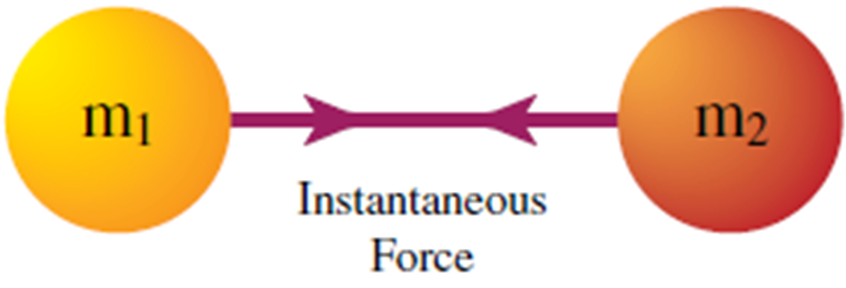
Every particle of matter in the universe attracts every other particle with a force that is directly proportional to the product of the masses of the particles and inversely proportional to the square of the distance between them. Newtonian forces can act instantaneously over arbitrarily large distances. Consider for example, Newton’s gravitational force FG between two masses m1 and m2, separated by a distance R; there is an instantaneous force, as shown in (Figure 1).

Newton’s laws of motion, combined with the force of gravitation given by the first equation yield Kepler’s three laws of planetary motion - and was one of the outstanding successes of Newtonian physics 1.
1.2. Special RelativityRelativity was born out of attempts to relate the descriptions of electrodynamic phenomena in different inertial frames. Einstein’s fundamental paper on special theory of relativity, published in 1905, is titled “Electrodynamics of Moving Bodies” 5. In the flat spacetime of special relativity, observers moving at different speeds will have different measures of time 6.
Einstein merely postulated that the idea of absolute space was not necessary for the new theory. As a result, any questions about absolute uniform motion and absolute rest were regarded as meaningless. Einstein did not answer the fundamental question of why there is no absolute space and therefore no absolute uniform motion and absolute rest, but at least he explicitly stated that special relativity did not need absolute space 7.
1.3. General RelativityEinstein proposed the general theory of relativity which is consistent with the special theory of relativity and provides an explanation of gravity radically different from Newton’s theory 1.
Until the advent of Einstein’s theory of gravity, space and time were considered to be an empty ‘stage’ given a priori, a precursor to material phenomena. In fact Newton thought of space as an absolute and unchanging structure with an inertial frame being in uniform motion relative to an absolute and immovable space. Newton also considered time to be identical for all observers, flowing at the same rate everywhere in the Universe. With the advent of Einstein all that changed 1.
Special relativity is a purely kinematical theory without directly involving mass or force. It only deals with uniform motion without the complication of acceleration. The dynamic theory that takes these factors into account is known as general relativity. Whereas special relativity reveals the four dimensional nature of space-time general relativity demands non-Euclidean geometry 4.

To explain time in different manner, the momentum of the earth or any object is related to time because of the more of the momentum of rotation of the earth around the sun, the less time we feel on the earth and time produced on the earth will shrink and vice versa. It is believed that the days and years calculation will be the same or will be less and the feeling of time on the earth will go faster. So, you cannot escape from time because every object that circulating about other object or have momentum in space, it generates time. From this explanation, it is concluded that time is inversely proportional to momentum 2.
 | (1) |
Where P is the momentum of an object.
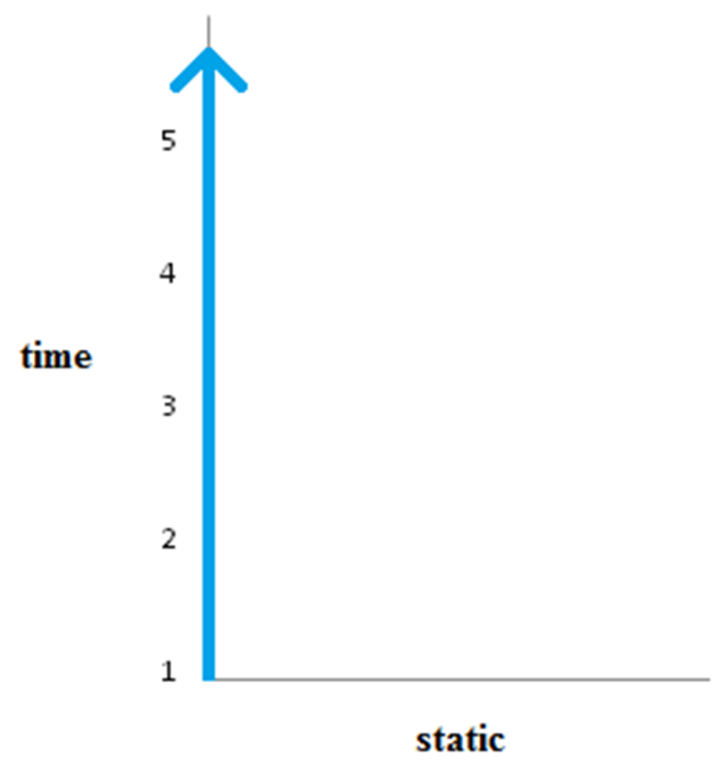
In addition, if it is suggested that time is inversely proportional to momentum 2, so time is direct proportional to static, so time is the static state. It is believed that there is no one is eternal other than God which proves his existence, so time is God and God is time. It is concluded that there is God who is eternal and has power to all times, and rotating about him everything in the universe.
It is believed the existence of God. God has power on everything including time, gravity and the entire universe. There is only "one" in the universe and that “one” must be God.
 | (2) |
In addition, we cannot precisely predict the position of the electron in the future because we cannot determine all the causes that affects the changing of the position of a particle in a certain time and if we could determine them, we cannot predict what will happen in a large percentage due to the complexity of the issue when the effectors or the causes are several 2.
There is a chance that the changing of a position of a particle will be nearer or farther and there will be a new position after that and that is why it is not accurate if there is a relation between two particles. Also, it is suggested you need to add the direction of one particle to another.
2.1. The Relation between Gravity and TimeThe newton equation of gravity cannot unify gravity with time. It has to be another theory of gravity to generalize the universe as a whole and in a relation with velocity and time and can explain general relativity.
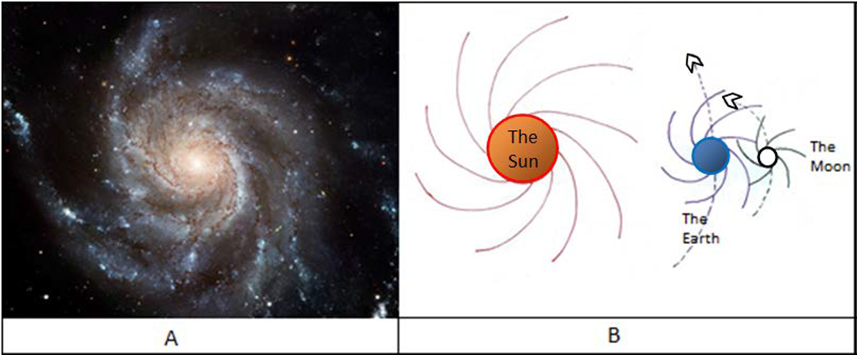
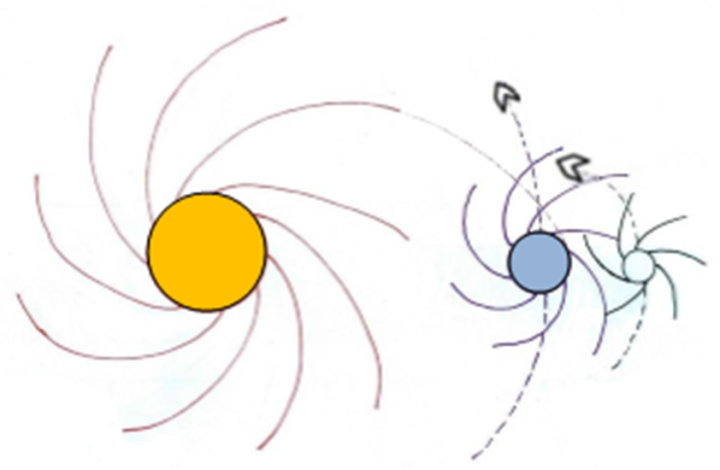
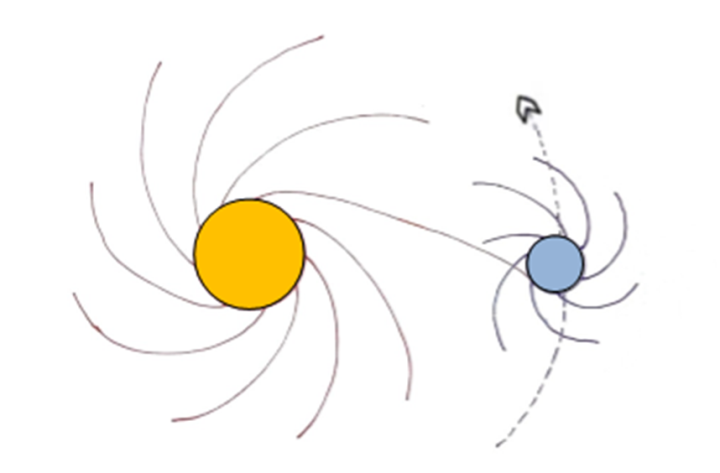
Rotation is a universal phenomena and many galaxies are rotating. Furthermore, our galaxy has a supermassive black hole at its center. Moreover, Spiral galaxies have copious amounts of gas and dust 1 (Figure 4A). The arrangement of gas and dust in a galaxy represents spiral arms. Any object that rotates on its axis, it generates arms like the spiral arms of a spiral galaxy. It is believed that these spiral arms are reflections of gravitational force. The rotation of the sun on its axis and rotation of the sun around the galactic core are really suggested to be affected by the supermassive black hole rotation in the center of the galaxy 2.
It is believed that spiral arms are also generated by the sun and planets. They represents gravitational force that is caused by any rotated object on its axis (Figure 4B). It is also have another function which is the rotation of the attracted object on its axis. These two functions cannot be obtained if the density of the object below certain value when compared to the other object. When the sun rotates on its axis, the latter two functions of spiral arms are considered. Spiral arms represent the stirring or shaking in space. When the stirring or shaking of an object (like the sun) is fast, the attracted objects which move about it cannot fall into the center and the objects will continue rotating about it (Figure 4) 2.
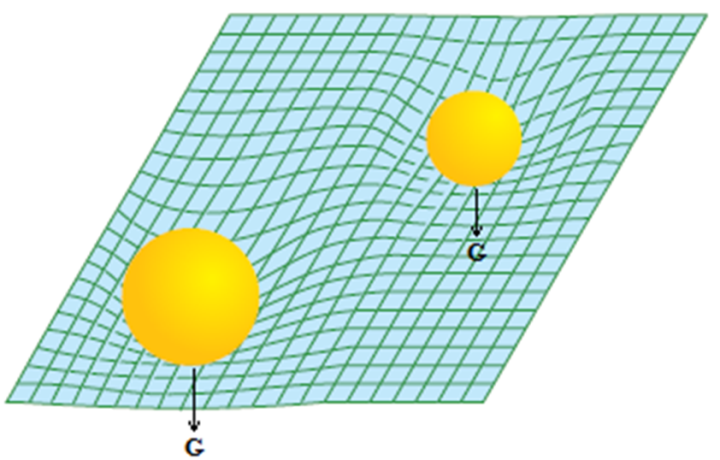
Assume there is liquid in a container, and the center of the liquid is representing the sun. When you shake the liquid in the container it produces a hole in the liquid and that represents space-time curvature (Figure 2) and also when you shake well and fast the peripheral liquid cannot fall into the center of the container so the equation need velocity addition. In addition, when you shake fast the liquid goes to the peripheral side of the container, so time increases and the calculations of days and years will be more and it is also suggested that the speed of the peripheral liquid will be less, so there is an inversely proportional relation between gravity and velocity.


The rate of flow of time is fastest in empty space, and slows down in the presence of matter-energy 1. So, gravity is proportional to time and gravity is inversely proportional to velocity.
Moreover, Einstein’s theory of gravity cannot explain how space and time come into existence 1, so we need velocity or time addition to the equation to relate gravity with velocity and time since velocity is related to time from equation (1).
 | (3) |
Where v1 is the speed of rotating of an object on its axis.
To unify gravity with time is that the more the gravity of the sun the less the distance between the sun and the earth so the calculations of the days of the year will be less, so time will decrease. Also, it is suggested that gravity creates time to any system.
 |
In addition, there are three factors that affect gravity; the mass of objects, the speed of rotation of the sun on its axis and the curvature of space-time. The last factor is a result of rotated objects on its axis.
It is suggested that the heart of human being is near to the left and not in the center of the body because when the earth is rotating on its axis it pumps the blood to right more than to the left, so it needed to be slightly to the left to increase pumping the blood to that side.
| [1] | Belal E Baaquie & Frederick H Willeboordse. Exploring the Invisible Universe from Black Holes to Superstrings (World Scientific Publishing Co., 2015). | ||
| In article | View Article | ||
| [2] | Osama Khalil. "Theoretical Atomic Model and the Theory of Everything". International Journal of Physics, Vol. 5, No. 3, 87-91. 2017. | ||
| In article | |||
| [3] | Osama Khalil. “Time Concept and the Center of the Universe”. International Journal of Physics, vol. 5, No. 5, 154-156. 2017. | ||
| In article | |||
| [4] | Jan C.A. Boeyens. Chemical Cosmology (Springer Science + Business Media, LLC, 2010). | ||
| In article | View Article PubMed | ||
| [5] | Pankaj Sharan. Spacetime, Geometry and Gravitation (Hindustan Book Agency, 2009). | ||
| In article | View Article | ||
| [6] | A. Einstein. “On Electrodynamics of Moving Bodies”. 1905. | ||
| In article | |||
| [7] | Vesselin Petkov. Relativity and the Nature of Spacetime, Second Edition. (Springer-Verlag Berlin Heidelberg, 2009). | ||
| In article | |||
Published with license by Science and Education Publishing, Copyright © 2019 O.K. AbouEassa
 This work is licensed under a Creative Commons Attribution 4.0 International License. To view a copy of this license, visit
http://creativecommons.org/licenses/by/4.0/
This work is licensed under a Creative Commons Attribution 4.0 International License. To view a copy of this license, visit
http://creativecommons.org/licenses/by/4.0/
| [1] | Belal E Baaquie & Frederick H Willeboordse. Exploring the Invisible Universe from Black Holes to Superstrings (World Scientific Publishing Co., 2015). | ||
| In article | View Article | ||
| [2] | Osama Khalil. "Theoretical Atomic Model and the Theory of Everything". International Journal of Physics, Vol. 5, No. 3, 87-91. 2017. | ||
| In article | |||
| [3] | Osama Khalil. “Time Concept and the Center of the Universe”. International Journal of Physics, vol. 5, No. 5, 154-156. 2017. | ||
| In article | |||
| [4] | Jan C.A. Boeyens. Chemical Cosmology (Springer Science + Business Media, LLC, 2010). | ||
| In article | View Article PubMed | ||
| [5] | Pankaj Sharan. Spacetime, Geometry and Gravitation (Hindustan Book Agency, 2009). | ||
| In article | View Article | ||
| [6] | A. Einstein. “On Electrodynamics of Moving Bodies”. 1905. | ||
| In article | |||
| [7] | Vesselin Petkov. Relativity and the Nature of Spacetime, Second Edition. (Springer-Verlag Berlin Heidelberg, 2009). | ||
| In article | |||