sciepub.com
 Quick Submission

Various Innovative Technologic Devices in Shipping Energy Saving and Diminish Fuel Consumption
Yaser Sharifi1, Hassan Ghassemi1, Hamid Zanganeh1,
1Department of Maritime Engineerin, Amirkabir University of Technology, Tehran, Iran
Abstract
Fluctuating fuel prices and stricter emissions regulations levied by IMO are the leading factors influencing the maritime shipping industry over the past few years and made shipping companies, charterers and ship owners find ways to reduce and optimize fuel consumption. So it is very crucial to reduce bunker consumption and it can be considered from two points of views: reducing consumption by optimizing the ship construction such as hull, propeller and rudder of the ships or by reducing the operational costs of the ships through controlling the speed, optimizing routes and so on. Present paper is evaluating these two approaches about the reduction of the fuel consumption.
Keywords: fuel consumption, energy saving, innovative techniques
Copyright © 2017 Science and Education Publishing. All Rights Reserved.Cite this article:
- Yaser Sharifi, Hassan Ghassemi, Hamid Zanganeh. Various Innovative Technologic Devices in Shipping Energy Saving and Diminish Fuel Consumption. International Journal of Physics. Vol. 5, No. 1, 2017, pp 21-29. http://pubs.sciepub.com/ijp/5/1/4
- Sharifi, Yaser, Hassan Ghassemi, and Hamid Zanganeh. "Various Innovative Technologic Devices in Shipping Energy Saving and Diminish Fuel Consumption." International Journal of Physics 5.1 (2017): 21-29.
- Sharifi, Y. , Ghassemi, H. , & Zanganeh, H. (2017). Various Innovative Technologic Devices in Shipping Energy Saving and Diminish Fuel Consumption. International Journal of Physics, 5(1), 21-29.
- Sharifi, Yaser, Hassan Ghassemi, and Hamid Zanganeh. "Various Innovative Technologic Devices in Shipping Energy Saving and Diminish Fuel Consumption." International Journal of Physics 5, no. 1 (2017): 21-29.
| Import into BibTeX | Import into EndNote | Import into RefMan | Import into RefWorks |
At a glance: Figures
1. Introduction
Maritime transport is the backbone of international trade and the global economy. Around 80 percent of global trade by volume and over 70 percent of global trade by value are carried by sea and are handled by ports worldwide. These shares are even higher in the case of most developing countries. The world seaborne trade was estimated at 9.84 billion tons in terms of total goods loaded in 2014 [1]. In recent years, increased competition and global shipping downturn have been putting downward pressure on the revenues of shipping companies; at the same time, increased security regulations and bunker prices and strict environmental targets continued to increase their operating costs. The bunker cost constitutes a large proportion of the operating costs of a shipping company. For example, Ronen [2] points out that when bunker fuel price is around 500USD per ton, the bunker cost constitutes about three quarters of the operating cost of a large containership.
On the other hand, as Psaraftis and Kontovas [3] said the amount of bunker consumed by ships also determines the amount of gas emission including CO2, CH4, SOX, NOX and various other pollutants such as particular matter, volatile organic compounds and black carbon. The above gases have negative effect on global climate and also have undesirable health effects. Therefore IMO is currently considering many measures to reduce them such as IMO MARPOL 73/78 Annex VI. In view of strict regulations on CO2 emission, tradable CO2 emission schemes have been developed and applied, and current average contract price is about 8 Euros of CO2 emitted [4]. To meet future regulations on emissions, shipping companies must either reduce bunker consumption or use cleaner but more expensive bunker fuel, or purchase emission quota from other companies. So it is very crucial for companies to reduce bunker consumption and it can be considered from two points of views: reducing consumption by optimizing the ship construction such as hull, propeller and rudder of the ships or by reducing the operational costs of the ships through controlling the speed, optimizing routes and so on. This paper aims to develop ship fuel efficiency analysis from these two points of views and thus we review the existing literature on bunker fuel efficiency with issues such as sailing speed and voyage optimization and also ships structure and hydrodynamic optimizations.
About the ship structure optimization and its effect on the fuel consumption, DSME energy saving devices [5], ABS ship energy efficiency measures advisory [6] and ABS seminar by Soren Hansen[7] provides guidance to owners and operators, on a wide range of options being promoted to improve vessel efficiency, reduce fuel consumption and lower emission through description of new technologies, their limitations and applicability or effectiveness.
Operational costs of ship mainly related to bunker costs and the sailing speed is one of the main determinants of the fuel consumption rate of a ship. The quantitative relationship between a ship’s fuel consumption rate and sailing speed is the basis for speed optimization and it has studied by Wang and Meng [8], Kontovas and Psaraftis [3]. Natteboom and Carriou [9] based on 2259 container ships studied the effect of speed on fuel consumption. A higher sailing speed generally means a shorter transit time and fewer ships required to maintain a fixed, e.g. weekly service frequency. Sailing speed optimization is therefore closely related to a wide class of issues in liner shipping network analysis, schedule design, service frequency determination, specifically studied by Catalani [10]. Ronen [3] propose cost models for analyzing the relationship between bunker prices, sailing speed, service frequency and number of ships on a shipping rout. Pyörre [11] discussed the challenges of speed on each leg of a voyage.
Despite the fruitful achievements regarding sailing speed optimization, studies on liner shipping network analysis seldom touch on the influence of the environment (wind, wave and currents) on ship’s fuel consumption. Wang and Meng [12] were aware of possible influence of bad weather in ship schedules, but do not provide a quantitative relationship between fuel efficiency and weather condition. In fact, most of existing studies on the effect of environment on ship’s fuel efficiency deal with environmental routing problem especially the weather routing problem. As Chen [13], Roh [14] and Safaei et al. [15] showed in their studies, rout selection is concerned with choosing a fair sailing track from the origin port to the destination port, by taking into account all severe factors effecting the fuel consumption such that desired objectives or combination of them are optimized. Generally an environmental routing system should balance the objectives of safety, fuel consumption, emissions and ship schedules. One of the main difficulties in doing so is the uncertainties of environmental information that make the problem complicated.
2. Optimizing Fuel Consumption through Optimizing of Ship Structure
The best measures for a ship to improve efficiency differ to a great extent depending upon ship type, cargoes, routes and other factors. The difficulty is in determining which ones are most appropriate for a particular vessel and service. Here we will review some perspectives of energy efficiency through optimizing ship structure.
Hull form optimization continues to be recognized as a growing field within the marine community as a means to improve energy efficiency of ships. Here we will review some benchmarks for assessing efficiency, describe the methods available to today’s naval architect for optimizing hull form and propeller, and outline some of the issues that owners should consider in the assessment of the hull form aiming to enhance vessel fuel efficiency.
2.1. Optimizing Ship Particulars2.1.1. Ship Size – Capacity
For containerships, increasing size from 4,500 TEU to 8,000 TEU reduces fuel consumption for propulsion by about 25 percent (measured in terms of fuel consumption per ton/nm of cargo transported). Increasing from 8,000 to 12,500 TEU reduces consumption by about 10 percent. The largest savings occur for higher speed ships and are most significant for smaller sized vessels. Increasing size from 4,500 TEU to 8,000 TEU reduces construction cost in terms by about 15 percent (measured in terms of USD per TEU). This shows transport efficiency in terms of fuel consumption per ton/mile of cargo moved for containerships as a function of capacity in TEUs. A service speed of 22.5 knots is assumed for all designs. The cargo payload is determined assuming stowage of 7 ton/TEU average weight containers within the constraints of slot capacity, available deadweight, container securing restrictions and visibility limits.
2.1.2. Service Speed
For containerships of 4,500 TEU and above, reducing speed by 1 knot reduces propulsion fuel consumption by 12 to 15 percent. For oil tankers, reducing speed by 1 knot reduces fuel consumption by 17 to 22 percent.
When selecting the service speed for liner services, customer expectations and the need for regularity of service should also be introduced into the study. For charter markets, the variability in charter rates should be accounted for, which tends to encourage a higher service speed so revenues can be maximized when rates are high. If the only focus of designing for slower speeds is low fuel consumption or low EEDI, the result may be low powered ships that may not operate safely in heavy seas or maneuver and stop safely. Such low powered ships may seem economically attractive at first, but the owner and designer should guard against such designs. Because of these concerns the issue of a minimum power requirement is being addressed by IMO.
Designing for the right speed, or right range of speeds, has other benefits as well. A hull form optimized for the slower speed usually means a fuller form and higher cargo deadweight. It is also possible to refine the hull form for multiple drafts and possibly multiple speeds if cargo quantities may vary or there are significant ballast legs. The main engine and propeller can be optimized around the slower speed for maximum benefit.
2.1.3. Principal Dimensions
Increasing the length/beam ratio or increasing length and reducing the block coefficient can provide reductions in propulsion fuel consumption up to 3 to 5 percent. As compared to increasing beam or depth, length is the more expensive dimension. For example, increasing L/B on an Aframax tanker from 5.5 to 5.75 while holding the ship speed and cargo volume constant increases construction cost by roughly 0.25 to 1 percent.
Increasing the length while reducing the beam and maintaining the draft, displacement and block coefficient (Cb) constant typically yields improvements in hull efficiency, provided additional ballast is not needed to maintain adequate stability. A higher length/beam ratio tends to reduce wave making resistance, while the reduced beam/draft ratio tends to reduce wetted surface and therefore the frictional resistance.
2.2. Minimizing Hull Resistance and Increasing Propulsion EfficiencyPropulsion fuel reductions of 5 to 8 percent are anticipated through further optimization of hull forms and propellers. Optimization of the hydrodynamic performance of a vessel’s hull form and propulsor in order to achieve the least required power and best propulsion efficiency involves several interrelated efforts:
• Optimization of the hull form given the principal particulars (lines development)
• Optimization of the propeller(s) for the flow from the hull and installed machinery
• Design and arrangement of the rudder in relation to the propeller and flow lines
• Study of optimal energy-saving devices.
2.2.1. Optimizing the Hull Form (Lines)
Viscous (frictional) resistance is the major component of overall resistance, accounting for between 70 and 93 percent of the total resistance in tankers and containerships. The percentage of total resistance attributed to viscous (frictional) resistance is greatest for slower, larger ships. Wave making resistance increases with ship speed and is a larger component of overall resistance for high-speed, fine-form ships than it is for slower, full form ships. When developing a full body hull form such as a tanker, emphasis is placed on reducing wetted surface as viscous resistance is such a major component of overall resistance. Another important consideration is to provide a smooth and gradual transition to the propeller, to avoid separation of flow at the stern and provide for a uniform wake field (i.e. constant axial velocities at each radius). This encourages the LCB to be as far forward as practical, although care must be taken to avoid a harsh shoulder forward. Mitigating wave propagation at the forward shoulder is more important than reducing wave making. Employing blunter bow shape is encouraged over finer bows. Blunt bows tend to accommodate a smoother transition. The blunter bow shape allows a shift in volume from the midship region into the forebody region, resulting in better overall resistance performance for full body ships.
2.2.2. Forebody Optimization
Forebody optimization includes consideration of the bulb design, waterline entrance, forward shoulder and transition to the turn of the bilge. Potential flow calculations are routinely applied in this optimization process.
The properly designed bulbous bow reduces wave making resistance by producing its own wave system that is out of phase with the bow wave from the hull, creating a canceling effect and overall reduction in wave making resistance.
2.2.3. Aftbody Optimization
Aftbody optimization includes efforts to mitigate stern waves, improve flow into the propeller and avoid eddy effects. A properly designed stern can reduce the aft shoulder crest wave as well as the deep wave trough and stern waves. Improving the nature of the stern flow can lead to improved propulsive efficiency. (Flow improving devices such as stern flaps may be beneficial).
Single screw sterns forward of the propeller may be V-shaped, U-shaped or bulb types. The tendency today is towards the bulb shape, as the improved wake reduces cavitation and vibration. Asymmetrical sterns are designed to improve propulsive efficiency through pre-rotation of the flow to the propeller and to some extent by reducing the thrust deduction. The pre-rotation of the flow into the propeller helps reduce the separation of flow in the stern aft of the propeller. To date, these enhancements have not been proven to be sufficiently effective to offset the extra cost and complexity involved in construction, with the exception of some twin skeg designs.
2.2.4. Twin-skeg Design
Twin-screw propulsion arrangements offer enhanced maneuverability and redundancy, and are also adopted when the power required for a single propeller is excessive. Propulsion power may exceed what can be handled reasonably by a single propeller if, for example, the vessel design is draft limited and the propeller diameter is correspondingly reduced. For a twin screw design there is the choice of open shafts with struts or twin skegs (or gondolas).
For full-hull form ships, the Swedish testing facility SSPA has found that the twin skegs provides a 2 to 3 percent efficiency improvement over well optimized single screw designs with corresponding characteristics. If the propeller diameter on a single screw design is suboptimal due to draft restrictions, unloading of the propellers in twin skeg arrangements can lead to efficiency improvements of 6 percent or more.
2.2.5. Maneuvering and Course-keeping Considerations
A high block coefficient, forward LCB, lower length to beam ratio and open stern are factors that can lead to reduced directional stability. Accordingly, performance should be assessed through computation means or by model tests, either through captive tests in a towing tank or by free running model testing in an open basin. Where the vessel’s operational requirements necessitate the use of a hull form with reduced directional stability, effective course-keeping can be provided by larger rudders, high performance rudders or skegs, which will induce a penalty in overall efficiency when compared to vessels not provided with such rudders or skegs. In such cases, viscous flow CFD assessment and model tests are recommended as the drag and added resistance resulting from the larger rudders, high performance rudders and skegs can vary substantially.
2.2.6. Added Resistance Due to Waves and Wind
There is a growing awareness among ship designers and ship owners of the importance of evaluating weather effects on performance throughout the design process. During the initial stage of design, consideration of wind and wave effects can influence ship proportions (increasing length/beam, reducing Cb, increasing freeboard, limiting bow flare). In particular, at higher sea states the added resistance in waves is a directly related to the ship’s beam and waterplane shape. A more accurate assessment of sea margin, accounting for the behavior of the specific vessel and intended trade route will help determine the engine margin and propeller design point.
2.3. Energy-saving DevicesMany different devices have been studied to either correct the energy performance of suboptimal ship designs, or to improve on already optimal or nearly-optimal standard designs by exploiting physical phenomena usually regarded as secondary in the normal design process, or not yet completely understood.
In this article we will have a look on a range of these devices, most of which historically concentrate on the improvement of propeller propulsion effectiveness. However, recent developments have led to a series of devices aimed at either reducing the hull frictional resistance or exploiting readily available natural resources, such as solar and wind energy. Some of these devices are mentioned here.
2.3.1. Propulsion Improving Devices (PIDs)
0 to 5 percent reduction in propulsion fuel consumption can be attained through these devices and they are best suited to correct known existing hydrodynamic problems. These devices include the following ones:
2.3.1.1. Wake Equalizing and Flow Separation Alleviating Devices: In general, wake equalization and flow separation alleviating devices are features to improve the flow around the hull that were developed to obviate propeller problems and added ship resistance caused by suboptimal aft hull forms. As such, they are less effective when the ship geometry has been designed correctly, with an eye at optimizing the flow to the propeller and avoiding the generation of detrimental hydrodynamic effects such as bilge vortices. The most common wake equalization and flow separation alleviating devices are Grothues spoilers, Schneekluth ducts and stern tunnels.
2.3.1.1.1. Grothues Spoilers: Grothues spoilers are small curved triangular plates welded at the side of the hull in front of the propeller and above the propeller axis. Their function is to deflect downward the flow of water so that it is redirected horizontally in towards the propeller. Grothues originally proposed them to minimize/prevent the formation of keel vortices in the U-shaped sterns of full block coefficient (Cb) ships (tankers and bulk carriers). However, tank testing provided some indication that they would also improve the efficiency of the propeller in view of the larger amount of water made available to the upper portion of the screw and lesser component of the incoming wake in the plane of the propeller disk (both wake equalization effects). In the best cases, spoilers might also provide a limited amount of additional thrust to the ship as a result of the redirection of vertical flow components in the horizontal direction.
2.3.1.1.2. Wake Equalizing (Schneekluth) Ducts: The purpose of wake equalizing ducts is similar to that of the Grothues spoilers, in the sense that both types of devices try to redirect flow to the upper portion of the propeller disk, thus homogenizing the wake and improving hull efficiency. However, unlike Grothues spoilers, Schneekluth ducts also accelerate the flow by means of the lift created by the aerofoil shape of the duct cross-section. The latter can be designed so that it is more forgiving to variations of the angle of attack than Grothues.
2.3.1.1.3. Stern Tunnels: Stern tunnels are horizontal hull appendages placed above and in front of the propeller disk that deflects water down towards the propeller. In most cases, these devices are retrofitted to reduce the wake peak effect of pronounced V-shaped sterns, thus reducing vibration.
2.3.2. Pre-swirl Devices
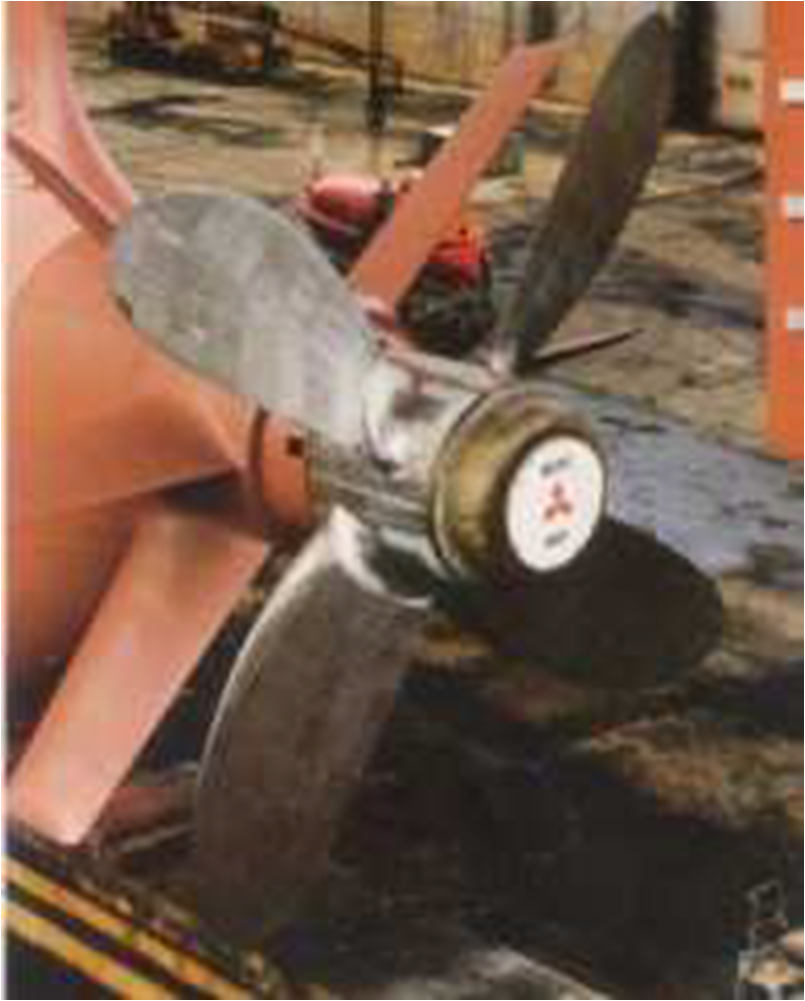
Pre-swirl devices are hydrodynamic appendages to the hull aiming to condition the wake flow so that a rotation opposite to that of the propeller is imposed on it, thus improving the angle of attack of the flow on the propeller blades over the entire disk. Also, the pre-swirl rotating flow counteracts the rotation flow induced by the propeller. As a result, the flow leaving the propeller disc can be made to contain minimum momentum in the circumferential direction, thus requiring less kinetic energy to produce thrust (Figure 1).

 Download as

Pre-swirl devices have been designed and installed both as retrofits to existing ships and as an integral feature of newbuildings. Normally, they can be made to work in nonoptimal flows (the ducted type in particular) but they work best in already optimal nominal wakes. In this sense, they can be considered as fully complementary to other optimization approaches with the exception of nonsymmetrical stern lines. These devices may result in 2 to 6 percent reduction in propulsion fuel consumption and include pre-swirl fins and stators, pre-swirl stators with accelerating ducts, rudder thrust fins, post-swirl stators and asymmetric rudders, rudder bulbs, propeller boss cap fin and divergent propeller caps.
2.3.3. High-efficiency Propellers
Under the umbrella of ‘high-efficiency propellers’ there are a vast number of often significantly different devices, accommodating different needs on different ship types with 3 to 10 percent reduction in propulsion fuel consumption.
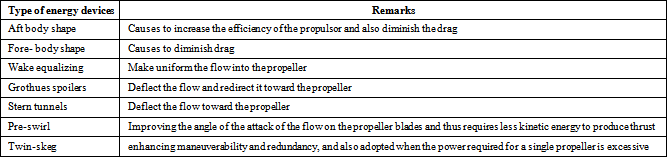
In general, larger diameter propellers with fewer blades operating at lower RPM are more efficient than smaller, faster counterparts, for a given required PE. However, this general principle is balanced by the need for reasonable propeller clearances, the nominal wake distribution behind a given hull form, and the need to match propeller and engine best performance. This type of optimization is done routinely at the design stage, when the principal propeller characteristics, and its detailed geometry is optimized to achieve best performance for the design speed and draft. Anyway, there are different types of propellers including controllable pitch propellers, ducted propellers, propellers with end-plates and Kappel propellers, contra-rotating and overlapping propellers, podded and azimuthing propulsion that can not be explained in this article. Some of those augmented devices on the ship employedto increase the thrust and efficiency are given in Table 1.




Viscous resistance accounts for the great majority of the resistance of a hull moving through water. This is particularly true for slower ships, where the wave making resistance is small both in percentage of the total, and in absolute terms. However, even for faster ships (where wave making resistance can account for some 30 percent of the total or more) reducing viscous resistance is still extremely attractive since this force increases with the square of the ship speed, thus becoming the source of an important portion of the total power consumption of a ship.
By far the largest component of viscous resistance is skin friction. This simply depends on the ship’s wetted surface, and the way it drags the water in touch with it and in its immediate surroundings, as the ship moves through it. To some extent, skin friction can be reduced by three methods: reducing the wetted surface (linear reduction), reducing speed (quadratic reduction) or improving the way the wetted surface interacts with the fluid it is in touch with. Reducing the speed and wetted surface are by far the easier and more effective ways to reduce skin friction. However, they both significantly affect ship operability. For this reason, a large amount of development has been dedicated through the years to improving hull-fluid interaction, either by changing the way fluid behaves (through its density, viscosity and boundary layer growth) or by improving the wetted area surface texture so that it would offer the best interaction with such fluid.
2.4.1. Air Lubrication
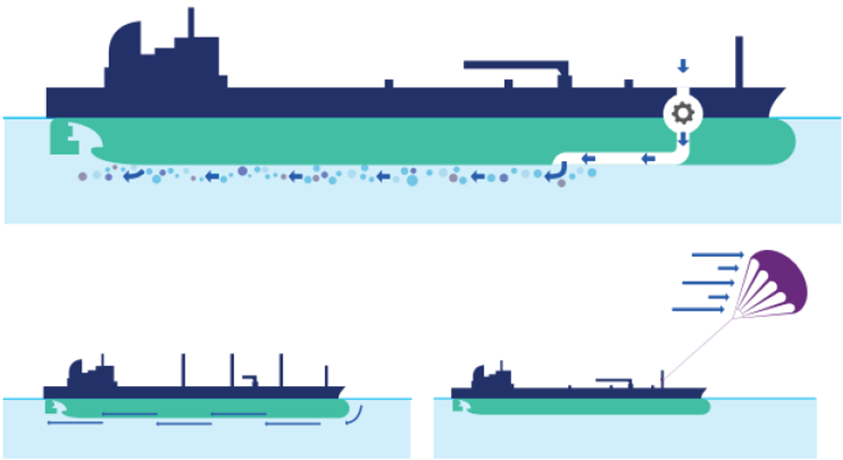
The general idea in air lubrication is to minimize the power needed to force air to stay in touch with those parts of the hull that would normally be in contact with water. There are two main types of air lubrication. In air cavity systems, a thin sheet of air is maintained over the flat portions of a ship’s bottom with the aid of pumps and hull appendages. In ideal conditions, this effectively amounts to a reduction in the wetted surface at the expense of the power needed to supply the pumps and the added resistance due to the hull modifications. An alternative method is that of effectively reducing the density and improving the viscous behavior of the water in contact with the hull by mixing it with air in the form of micro-bubbles.
There are some explanations that up to 10 percent reduction in propulsion fuel consumption can be attained through skin friction reduction.
2.4.2. Hull Surface Texturing
One method to reduce skin friction is to alter the way flow velocity grows through the boundary layer or the way the boundary layer grows along the hull. This depends in a complex way on ship speed and the geometrical characteristics (on all scales) of the hull. In general, a smooth hull surface is considered to be conducive of best performance and, to a large extent, this is the case when the alternative is a fouled hull as a consequence of marine growth. However, it has been demonstrated that some further benefits can be achieved by adopting particular types of surface texturing in place of a uniformly smooth hull. More specifically, the presence of riblets and semi-spherical micro cavities of certain sizes can distort the flow through the boundary layer and thus reduce skin friction.
This type of technology is still in its infancy and it is unclear how the correct shape and size of texture can be achieved and maintained on a ship’s hull. However, some paints are being developed that might be able to achieve this in the future. The saving through this technology is unknown but it is not likely more than 5 to 10 percent reduction in propulsion fuel consumption. Drag reduction types are presented in Table 2.





The utilization of renewable energy sources is currently benefiting from vast international attention in many industrial fields, including shipping. In our industry, attempts in this direction are naturally concentrating on wind power, since it is readily available at sea and has a history of successful use. However, photovoltaic (PV) solar panels are also being considered in specific fields such as the generation of auxiliary power.
2.5.1. Wind
Wind has been used to propel ships for the millennia, but the vast practical benefits of modern propulsion systems have meant the progressive decline and disappearance of sails from all merchant vessels. The feasibility of returning to sails needs to be integrated with the complexity of operation imposed by this type of propulsion.
However, the large fuel-saving benefits that wind power can provide estimated about 30 percent and should not be underestimated. Wind power seems to be reasonably easy to achieve in an effective way. Unfortunately, the technology commercially available at present is not advanced enough to achieve this aim. However, significant progress has been made during the last few years and it is reasonable to expect further improvements in the short term. In the following, the most promising technologies under development are discussed. Figure 2 shows two especial types of the energy generated using wind and air venting.
 Download as
2.5.1.1. Towing Kites: Towing kites are currently the only wind power technology commercially available to ships. The principle behind it is relatively simple, although the technology necessary to deploy, control and recover the kite is rather complex. In practice, extra power is provided to propel the ship by flying a kite tethered to the vessel’s bow. The kite speed through the air increases its efficiency compared to standard sails but the setup requires a computer to control the kite.
The real concern regarding towing kites is on the complexity of its operation and the risk associated with the system behavior in rough weather. As the largest gains provided by towing kites are when strong tail winds are present, it is paramount that the system can be operated safely, reliably and with no additional strain of the already limited crew resources available on board.
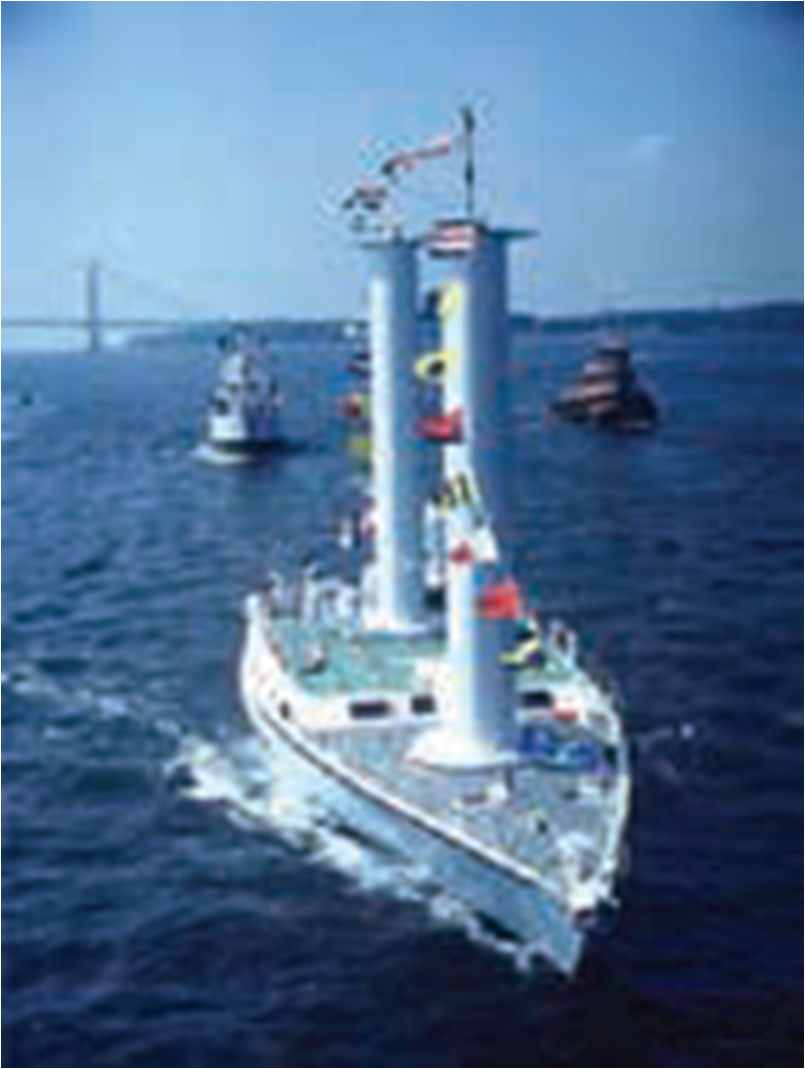
2.5.1.2. Rotor Sails, Flettner Rotors and Windmills: Flettner rotors are vertical, cylindrical sails spinning around their axis, as shown in Figure 3. A propulsive force is generated in the direction perpendicular to that of the wind hitting the rotor as a result of the Magnus effect. For this reason, rotor sails offer maximum efficiency near apparent beam wind conditions, a characteristic that could make them interesting as a complement to towing kites. However, rotors are normally powered by a diesel engine driven motor to achieve the necessary RPM. Also, unless they are made to telescopically collapse onto the deck to minimize aerodynamic drag when they are not in use, they might increase fuel consumption for a large range of wind directions. For these reasons, it is unclear if the overall efficiency of these systems can offer them a realistic chance of commercial success.
 Download as
An alternative to powering the rotors using engines is the use of vertical axis (savonius) wind turbines or VAWTs. They show some degree of autorotation as a result of the Magnus effect like Flettner rotors, but rotate simply as the result of wind hitting the blades. The other advantage of VAWTs is they can be made to power electrical generators, thus obviating to the limitation of standard Flettner rotors when the wind is from the stern. To this day, limited research is available on the onboard use of these devices, though, making it hard to assess their feasibility in practice.
2.5.1.3. Turbo sail: Turbo sails were first proposed by Jacques-Yves Cousteau, Bertrand Charrier and Lucien Malavard as a way to significantly improve the efficiency of standard sails, thus limiting the size needed to power a vessel and their heeling effect. The principle is to use a fan at the top of a hollow vertical cylinder to extract air from it. Inlets on the downwind side of the sail would then be opened to create a large depression and significantly increase lift.
Turbo sails were fitted on the Alcyone and operated in parallel with two standard diesel engines. An automatic system regulates the operation of the sails fan and the standard propulsion to optimize performance. Although this system is an interesting way to re-introduce wind propulsion in the modern shipping industry, very little public data is currently available on its actual performance.
2.5.2. Solar
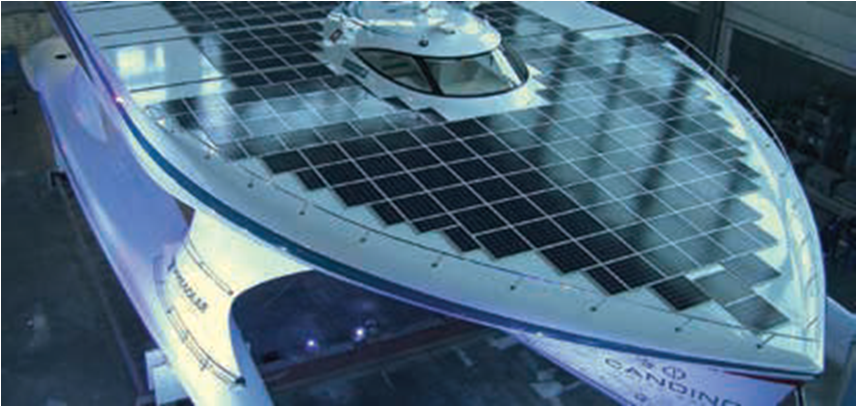
There have been attempts to use PV panels to power small craft, such as the 30-m long catamaran Planet Solar, designed to circumnavigate the world on a 500 m2 array. However, because of the low electrical output per unit surface, PV solar panels are better suited as an additional source of auxiliary power. In this role they have already been utilized on commercial vessels such as the NYK car carrier Auriga Leader, equipped with 328 solar panels at a cost of $1.68 million. The energy generated by the 40 kW solar array on this ship is used to power lighting and other applications in the crew’s living quarters (Figure 4). The obvious drawback of PV solar power is the high capital cost of these plants that have not yet benefited from large scale economies. It is to be hoped that as other land-based applications increase demand for this type of technology, the wider application in the shipping industry will be made viable. Table 3 presents three types of the marine renewable energy.
 Download as




2.5.3. Compatibility
The devices presented in the renewable energy section are not always compatible with each other and might only be feasible for specific ship types or designs. In this part, an attempt is made to give guidance on the general applicability of each device. In reading the following, the reader should bear in mind that the stated compatibilities should always be verified by means of appropriate model tests or CFD analysis, since the correct functioning of nearly all of the above measures is strongly dependent on having a good understanding of the way they will interact with a given specific design.
3. Optimizing Fuel Consumption through Voyage Optimization
In the process of optimizing, the fuel consumption in a voyage many variables such as safety and security of the voyage, whether condition, wave conditions, currents, wind, the ship structural design, type and size of the ship, and speed all play a role and have different values and weighting factors. Voyage optimization is a technology to predict the ship performance in various sea states and current conditions, and based on the performance of the ship to assist ship masters in route selection. The targets of increasing energy efficiency and reducing Green House Gas (GHG) emission in the shipping industry can be achieved by voyage optimization. However, the practical and accurate prediction of ship operational performance is the prerequisite to achieve targets. The prepared operational performance model for each ship enables the user to investigate the relation between fuel consumption and the various sea states that the ship may encounter in its voyage. The potential results of operational performance model are collected in the ship operational performance database. Based on the database and real time climatological information, the ships’ various courses can be evaluated according to a number of objectives including minimization of voyage time, maximization of safety, and minimization of fuel consumption using single or multi-objective methodologies. By utilizing a decision support tool, the ship’s crew may now select the optimum course according to their preference.
Here we review some important and effective factors in fuel consumption during a voyage.
3.1. Route SelectingIt is clear that the optimum route is not the shortest one. In this respect, it is a competitive advantage for a charterer or ship owner to select the best route in terms of reduced fuel consumption, high safety and security of a passage. In order to do so, sea and whether condition must be considered by solving the maneuvering equations of a ship in a defined time domain for each ship who wants to sail from point A to B. According to Safaei [15], a computer simulator showed a considerable decrease in fuel consumption of 3.7%. There are some challenges of route optimization and they will be discussed later on.
3.2. Speed OptimizingRising bunker costs and strict environmental targets are constraining voyage planning and driving technology solutions to address to these constraints by estimating journey times and speed requirements. By estimating optimal speed and route profiles based on empirical data and statistical models savings up to 10٪ can be achieved. Some companies have invested in software development that enables operators to compute, analyze and exploit real time data, adjusting performance dynamically based on the latest readings. These two factors are given in Table 4.




Speed optimization schemes face with tough challenges in daily vessel operations, due to strict itinerary demands and the limited accuracy of available whether and sea current forecasts. Since fuel-optimal routing is highly sensitive to constraints such as just-in-time arrival, one high-speed leg can wipe-out the accumulated fuel savings of an entire voyage. The optimization includes penalties for the undesired consequences of certain operating actions, such as excessive acceleration, as well as rewards for taking correct measures, such as maintaining a consistent speed, as appropriate. It is found that taking care to optimize speed can achieve possible 3±1% energy saving.
The most important challenges in route and speed optimization include the following ones:
-Quality of data: It includes data correctness (validity), consistency, resolution and completeness (sufficiency)
- Difficulty in estimating time of arrival accurately: This is often subject to change and dependent on prevailing environmental conditions. Wave and weather impact the speed the vessel is able to travel.
- Weather forecasting limitations: Since it is still largely based on probability rather than accuracy, the reliability of any forecast needs to be included in the evaluation of the optimization results.
- Sea current and weather forecasts: Successful speed optimization relies heavily on accurate forecasts. Generally speaking, forecasts made on a global scale and provided by international centers do not take into account all of the specific characteristics of the local areas. This is also true of global sea current models when predicting conditions in costal environments. It is also worth saying that abundant data exist listing statistical long-term parameters of winds and waves on shipping routes. Wave size characterization might be contained in a typical atlas in a specific sea area and for a given season.
-Off-design conditions for the vessel of propeller: Care should be taken to optimize propeller use to avoid excess fuel consumption. For example, excessive acceleration can be avoided by reducing RPM variation.
- Service speed optimization: It is difficult to optimize the service speed obtained by a vessel in real weather condition when sailing on a given shipping route or indeed to support routing decisions in heavy seas.
- Timely intervention: Operators often have differing opinions on vessel operations and optimum setting based on their own experiences. This means detecting small changes in sea conditions is difficult to compute. On larger vessels, the control settings of variable parameters are typically adjusted on an hourly basis rather than minutes. A key challenge is to assist the operator in keeping the adjustments that impact energy consumption to a minimum while taking account of changes in the condition of the vessel and its environment at appropriate intervals.
- User acceptance: For a system providing operational assistance it is crucial to gain acceptance from the operator. This involves attaining some degree of confidence in using the man-machine-interface that informs and drives operational decision making. It depends particularly on ease-of-use, usefulness, and on adequate support provided to onboard decision makers.
- Operation profile of the engine: These profiles are complex and are impacted by changing engine operational characteristics due to partial loading conditions or technical degradation of the engine.
Speed optimization helps us to solve numerically the speed distribution during the voyage in a way that minimizes the amount of fuel consumed. In addition to avoiding excessive speed, the fuel consumption of the vessel can be reduced by continually monitoring any changes in engine load and weather conditions and making the necessary engine load adjustments as changes are detected. It is why accurate information about the state of the vessel and its environmental surroundings are important in maintaining an efficient operation. Since engine load is expressed in terms of power, engine RPM and torque are the key variables use to monitor fuel consumption. Additional factors such as density and caloric value of the fuel may be used to obtain more accurate modeling.
4. Conclusions
Maritime shipping has seen significant challenges over the past few years. Most notably, the introduction of the Ship Energy Efficiency Measurement Plan(SEEMP), the Energy Efficiency Design Index (EEDI) and Emission Control Areas (ECAs). As regulations add to the economic demands of shipping, the importance of ship fuel efficiency and voyage optimization is further amplified. Therefore companies recognize this and are always seeking better ways to improve ship designing and vessel performance and operational efficiency through different ways. Here in this study we reviewed and extended a number of bunker consumption optimization methods including the following ones:
a. Optimizing fuel consumption through optimizing of ship structure by optimizing ship particulars, minimizing hull resistance, increasing propulsion efficiency, using energy-saving devices, skin friction reduction and using renewable sources of energy
b. Optimizing fuel consumption through voyage optimization by correct route selecting and optimizing ship speed.
References
| [1] | www.uctad.org | ||
 In article In article | |||
| [2] | Ronen, D., The effect of oil price on containership speed and fleet size .Journal of the Operational Research Society, Vol. 62(1), pp. 211-216, 2011. | ||
| In article | |||
| [3] | Kontovas, C., Psaraftis, H.N., Reduction of emissions along the maritime intermodal container chain :operational models and policies, Maritime Policy & Management, Vol. 38(4), pp. 451-469, 2011. | ||
| In article | |||
| [4] | ICE-ECX, (2012). | ||
| In article | |||
| [5] | Choi, Y, B., DSME Energy Saving Devices for Greece SNAME, 2008. | ||
| In article | |||
| [6] | ABS Ship energy efficiency measures advisory, status and guidance. | ||
| In article | |||
| [7] | Hansen, Soren, Vessel Performance Management, ABS SEMINAR, 2016. | ||
| In article | |||
| [8] | Wang, S., Meng, Q., Liu, Z., Bunker consumption optimization methods in shipping: A critical review and extensions, Transportation Research Part, Vol. E53, pp.49-62, 2013. | ||
| In article | |||
| [9] | Notteboom, T., Carriou, P., Fuel surcharge practices of container shipping lines: is it about cost recovery or revenue making? In: The 2009 International Association of Maritime Economists (IAME) Conference, Copenhagen, Denmark, 2009. | ||
| In article | |||
| [10] | Catalani, Mauro., Ship scheduling and routing optimization, An application to Western Mediterranean area, European Transport \ Trasporti Europei, Vol. 42, pp. 67-82, 2009. | ||
| In article | |||
| [11] | Pyörre, Jussi., Overcoming the challenges in vessel speed optimization, HANSA International Maritime Journal – 149. No. 9, Jahrgang, 2012. | ||
| In article | |||
| [12] | Wang, S., Meng, Q., Liner ship route schedule design with sea contingency time and port time uncertainty, Transportation Research Part B46(5), pp. 615-633, 2012. | ||
| In article | |||
| [13] | Chen, H., Voyage Optimization Supersedes weather routing, Jeppesen Commercial Marine Journal, 2013. | ||
| In article | |||
| [14] | Roh, M.I., Determination of an economical shipping rout considering the effects of sea state for lower fuel consumption, Int. J. Naval Archit. Ocean Eng. 5. 2. pp. 246-262, 2013. | ||
| In article | |||
| [15] | Safaei, A., Ghassemi, H., Ghiasi, M., Voyage optimization for a very large crude carrier oil tanker, a regional voyage case study, Scientific Journals of The Maritime University of Szczecin, 44(116) pp., 83-89, 2015. | ||
| In article | |||
 CiteULike
 Mendeley
 StumbleUpon
 Delicious
 Facebook
 Twitter
 LinkedIn